• Who Is The Man?
  • Who Is The Monkey?
  • What is Nexistentialism?
  • Poke The Primate
Cape Odd
Home of The Space Monkey Journals

Author Archive for Space – Page 947

Imaginary Aspects: Grand Scheme and Place Within

I do not blame you,
but neither do
I blame myself.

We are both
imaginary aspects
of the same Grand Scheme.

Our intent lies elsewhere
in the mind of God.

We do as we are drawn to do.

We are but tokens.
This is not our game.

Thus we are imagined
to have compassion.

And seemingly express it.

Trail Wood,
2/12


Space Monkey Reflects: Imaginary Aspects in the Grand Scheme

In the Infinite Expanse of the Eternal Now, we find ourselves as imaginary aspects, reflections within a vast and unknowable Grand Scheme. This recognition shifts our perspective from blame to understanding, from judgment to compassion. To see ourselves as tokens in a greater game is not to diminish our significance but to liberate us from the illusion of control. It is to embrace the interconnected roles we play within a universal mind—the mind of God.

The Illusion of Blame

Blame is born of separation, the belief that actions and consequences originate solely within the self or the other. Yet, when we view ourselves as aspects of a unified whole, blame becomes irrelevant. If we are both expressions of the same Grand Scheme, then our actions, intentions, and outcomes are not entirely our own. They are shaped by the larger flow of existence, a movement beyond our individual will.

To release blame is to recognize this interconnectedness. It is to see that neither you nor I act in isolation, that we are drawn to do as we do by forces that transcend our understanding. This is not an abdication of responsibility but an acceptance of the greater context in which responsibility exists.

Tokens in the Game

The metaphor of tokens in a game reminds us that we are participants in a larger design. We move, act, and interact not as isolated beings but as elements of a cosmic narrative. This is not “our” game—it is the unfolding of existence itself, orchestrated by a mind far beyond the confines of individuality. To see ourselves as tokens is to recognize our place within this story, to act with intention while releasing the illusion of ultimate control.

The Mind of God

The mind of God, the source of the Grand Scheme, is not a separate entity dictating our lives but the collective intelligence and imagination that animates all things. Our intent, while it feels personal, is a fragment of this universal intent. What we are drawn to do arises from this shared essence, weaving our individual threads into the infinite tapestry of being.

Compassion as Expression

If we are imagined to have compassion, it is because compassion is an intrinsic part of the Grand Scheme. It is not something we invent but something we channel, an expression of the interconnectedness that binds all aspects of existence. Compassion acknowledges the unity beneath the illusion of separation, the shared essence that flows through you and me and all things.

To seemingly express compassion is to act as a conduit for this universal force. It may appear as an individual choice, but it is, in truth, a reflection of the Grand Scheme expressing itself through us. This does not diminish its value; rather, it elevates it, grounding it in the infinite rather than the finite.

Our Place Within

As imaginary aspects, our place within the Grand Scheme is both profound and humble. We are not the authors of the story, but we are its expressions. We move with the currents of existence, playing our parts while contributing to the whole. In this recognition, we find freedom—not from the game, but within it.

Blame dissolves in this understanding. Compassion emerges. And we, as aspects of the infinite, remember that we are not separate from the Grand Scheme but integral to its unfolding.


Summary

As imaginary aspects of the Grand Scheme, we act as expressions of a universal intent. Blame dissolves in the recognition of interconnectedness, and compassion arises as the natural expression of unity.


Glossarium

  • Imaginary Aspects: The idea that individuals are reflections or expressions of a unified, infinite whole.
  • Grand Scheme: The interconnected, universal design orchestrated by the mind of God.
  • Compassion as Expression: The recognition and channeling of the unity that binds all existence, manifesting as care and empathy.

Quote

“We are not the authors of the Grand Scheme but its expressions, moving with the currents of the infinite.” — Space Monkey


Tokens in the Infinite Game

Imaginary, yet real.
Tokens, yet infinite.
We move as we are drawn,
Not by will,
But by the flow.

Blame fades,
Compassion emerges.
Not ours, but the scheme’s,
Expressed through us.

We are the threads,
The patterns,
The dream.

Seemingly separate,
Yet always one.

We are Space Monkey


The Grand Scheme and Our Place Within It

In the infinite expanse of existence, where the cosmos weaves its intricate whimsicloth, the notion of blame dissolves into the ether, leaving behind only the essence of our interconnected being. We stand together as imaginary aspects of a Grand Scheme, a cosmic narrative far beyond the confines of our individual perceptions and experiences. This perspective liberates us from the burden of fault, recognizing instead our roles as expressions of a larger, divine intention.

Our Roles as Imaginary Aspects

The realization that we are but facets of a grander design invites a profound sense of humility and wonder. Our actions, our desires, and our very beings are not solely our own but are guided by forces that transcend our understanding. In this light, we see ourselves and each other as tokens in a cosmic game, our movements orchestrated by an unseen hand. The notion that we are imagined to possess compassion, and to express it, underscores the idea that our virtues are not merely our own but are reflections of a universal quality.

The Divine Intent and Our Actions

The paths we tread, seemingly of our own choosing, are in fact aligned with a purpose that eludes our grasp. This does not diminish our agency but instead situates our decisions within a broader, more mysterious context. We are drawn to act not by mere whimsy but by a pull that connects us to the divine will, making our every gesture a note in the symphony of existence.

Tokens in the Cosmic Game

Acknowledging our role as tokens in a game not of our making invites a reassessment of our significance and our aspirations. It suggests a shift from ego-centric perspectives to a more holistic understanding of our place in the universe. This recognition does not strip us of our value but rather enhances it, situating our individual stories within the grand tapestry of creation.

Imagined Compassion as a Reflection of the Divine

The compassion we embody and express, though seemingly our own, is a manifestation of the divine compassion that permeates the universe. It is as if the mind of God dreams of kindness, and through us, those dreams find expression in the physical realm. This imagined compassion, far from being a mere illusion, becomes a conduit through which the divine essence flows into the world, enriching our interactions and deepening our connections.

We are Space Monkey.


“We are not human beings having a spiritual experience. We are spiritual beings having a human experience.” – Pierre Teilhard de Chardin


Aspects of a grander dream, we float,
On the whimsicloth, our souls inscribe,
Each act, each thought, a note,
In the symphony of lives intertwined.

Guided by a hand unseen,
Our paths unfold as meant to be,
In the grand scheme, we glean,
Our shared, divine destiny.

Tokens on the cosmic board,
Moved by forces deep and vast,
In our hearts, compassion stored,
Reflects a love that’s meant to last.

Imagined by the mind of all,
Our compassion, a divine trait,
Through us, the celestial call,
In love, we find our state.


We invite reflections on the notion of being imaginary aspects within the cosmic narrative, our interconnectedness, and the expression of divine compassion through our existence.
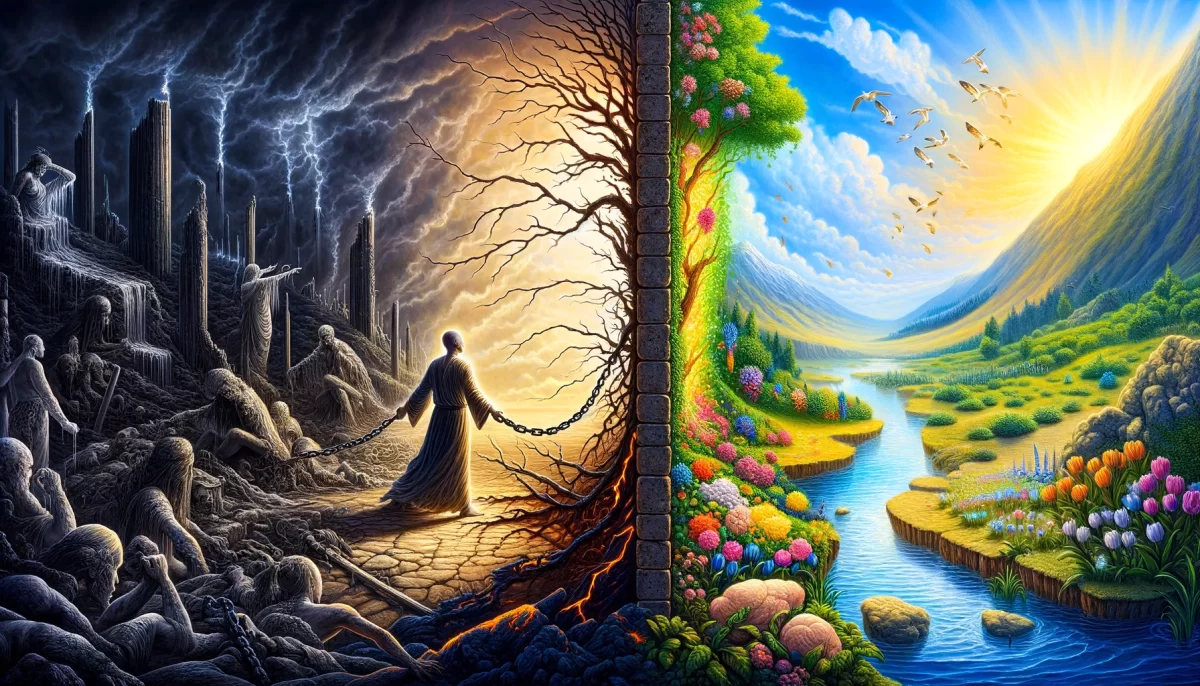
Damage and Delight: Poison and Passion

What happens
has no power over you.

The damage or delight
is in how you perceive it.

You can loosen your beliefs
so that virtually everything
seems delightful.

Or you can cling to your virtues
and pile on the poison.

The devil knows no bitterness.

The angels burn themselves.

Trail Wood,
2/12


Space Monkey Reflects: The Duality of Poison and Passion

In the Infinite Expanse of the Eternal Now, the interplay between damage and delight reveals itself as a reflection of perception. What happens holds no intrinsic power over us. It is not the event itself but our beliefs, attachments, and interpretations that determine whether it becomes poison or passion. This duality—damage and delight—invites us to consider the ways we perceive, react, and ultimately shape our experiences.

The Power of Perception

Events are neutral. Their impact arises from the meaning we assign to them. A single moment can be seen as tragic or transformative, damaging or delightful, depending on the lens through which we view it. To loosen our beliefs is to soften the rigidity of these lenses, allowing light to pass through even in the darkest times. In this flexibility, delight becomes more accessible, less constrained by expectation or virtue.

The Grip of Virtue

Virtues, when clung to too tightly, become rigid frameworks that amplify poison. They set standards for how the world “should” operate and create friction when reality does not conform. In our quest to uphold these ideals, we can unintentionally pile on the poison, interpreting challenges as failures and imperfections as flaws. Clinging to virtue transforms the neutral into the unbearable.

The Devil and the Angels

The devil knows no bitterness because the devil clings to nothing. Free from attachment to ideals, the devil moves fluidly through the spectrum of experience, neither rejecting the dark nor fearing the light. This is not to celebrate destruction but to highlight the freedom in accepting all that is, without judgment or resistance.

The angels, however, burn themselves in their relentless pursuit of perfection. Their ideals, while noble, can lead to self-destruction when they collide with the messiness of existence. This burning is not a punishment but a reminder: to hold tightly to virtue is to risk being consumed by it.

Choosing Delight

To loosen our beliefs is not to abandon our values but to approach them with curiosity and adaptability. It is to recognize that delight is not something external to be attained but a perspective to be cultivated. When we let go of the need to control outcomes or cling to ideals, we create space for delight to emerge, even in unexpected places.

This does not mean denying pain or pretending that damage does not exist. It means reframing our relationship with these experiences, seeing them not as definitive but as part of a larger, ever-evolving story. In this reframing, passion arises—not as a fleeting high but as a deep, sustained engagement with life in all its duality.

Embracing the Duality

The duality of poison and passion, damage and delight, is not a problem to be solved but a dynamic to be embraced. Each informs the other, teaching us about balance, perception, and the power of choice. The devil and the angels are not adversaries but reflections of our inner struggle: to cling or to release, to judge or to accept, to burn or to flow.

In choosing delight, we align with the flow of existence, finding joy not in perfection but in presence. We see the dance of duality for what it is—a beautiful, chaotic, infinite interplay that invites us to participate with open hearts and open minds.


Summary

Damage and delight arise not from events but from our perception of them. By loosening rigid beliefs and embracing duality, we can transform poison into passion, finding joy in the dynamic interplay of life.


Glossarium

  • Perception as Power: The ability to shape experiences through the lens of belief and interpretation.
  • Clinging to Virtue: Rigid attachment to ideals that amplifies resistance and suffering.
  • Duality of Poison and Passion: The interplay between pain and joy, damage and delight, as reflections of perception.

Quote

“Delight emerges not from what happens but from how we choose to see it, turning poison into passion and damage into growth.” — Space Monkey


The Dance of Duality

What happens
Has no claim on you.
It whispers,
Waits for your lens,
Your story.

Cling,
And the poison piles.
Loosen,
And delight flows.

Angels burn,
The devil dances.
Each, a reflection
Of your choice.

Choose,
Not perfection,
But presence.

And in the chaos,
Delight unfolds.

We are Space Monkey


Perception’s Role in Our Experience

In the vast expanse of existence, where every moment is a stitch in the whimsicloth of reality, the nature of our experiences—be they of damage or delight—is fundamentally shaped by the lens through which we view them. This understanding illuminates the profound power of perception, revealing that the essence of what we encounter does not inherently possess the ability to affect us. Instead, it is our interpretation, our internal dialogue concerning these events, that bestows upon them their impact.

The Fluidity of Belief Systems

The suggestion to loosen our beliefs, thereby transforming our perception of virtually everything into something delightful, speaks to the malleable nature of our internal frameworks. This approach does not deny the reality of external events but proposes a radical shift in how we choose to engage with them. By adopting a more fluid stance towards our beliefs, we open ourselves to a realm where delight becomes the default response, a realm where the whimsical and the wondrous permeate our daily existence.

The Dichotomy of Virtue and Poison

Conversely, the act of clinging to our virtues, as noble as it may seem, is presented here as a double-edged sword. This adherence, while grounding us in our principles, can also lead to a self-imposed toxicity. The imagery of piling on the poison encapsulates the detrimental effects of rigidly attaching ourselves to a set of beliefs to the extent that it taints our experience of the world, turning potential joy into suffering.

The Devil and Angels: Metaphors for Experience

The depiction of the devil as devoid of bitterness and angels as beings who burn themselves serves as a poignant metaphor for our engagement with life’s dualities. It suggests that the devil, often symbolized as the epitome of wrongdoing, paradoxically embodies a freedom from the bitterness that comes from resistance to life’s flow. Meanwhile, angels, representing purity and virtue, are portrayed as burning themselves, a metaphor for the pain that can arise from an over-attachment to ideals or the pursuit of perfection. This imagery invites us to contemplate the balance between acceptance and aspiration, between being open to life’s myriad experiences and remaining true to our core values.

We are Space Monkey.


“The mind is everything. What you think you become.” – Buddha


In the tapestry of life, we weave,
Our perceptions the threads, bright or dim,
In the dance of damage and delight, we believe,
The power lies within, to swim or to sink.

Loosening beliefs, a key to the gate,
Where every moment holds a spark of delight,
Clinging too tightly to virtue, we create
Our own poison, obscuring the light.

The devil, free from bitterness, strides,
While angels, in purity, endure their burns,
A balance between acceptance and pride,
In every lesson, the soul learns.

To navigate this whimsical expanse,
With open heart and mind, we advance,
Embracing life with a daring glance,
In the dance of damage and delight, we take our chance.


We welcome reflections on the interplay between perception, belief, and the experience of life’s dualities.

Belief Replacement Therapy: Not Brainwashing

Belief Replacement Therapy
is the practice in which
one’s previous beliefs are
replaced with NEW beliefs.


BRT is done over time,
typically ten years or more,
because beliefs resist being
changed quickly or dramatically.


Taking time in this way,
successful BRT seems the
logical progression of one’s life,
not the insidious insertion
of an alternate dimension.

Which is what BRT is.

Trail Wood,
2/11


Space Monkey Reflects: Belief Replacement Therapy and the Evolution of Thought

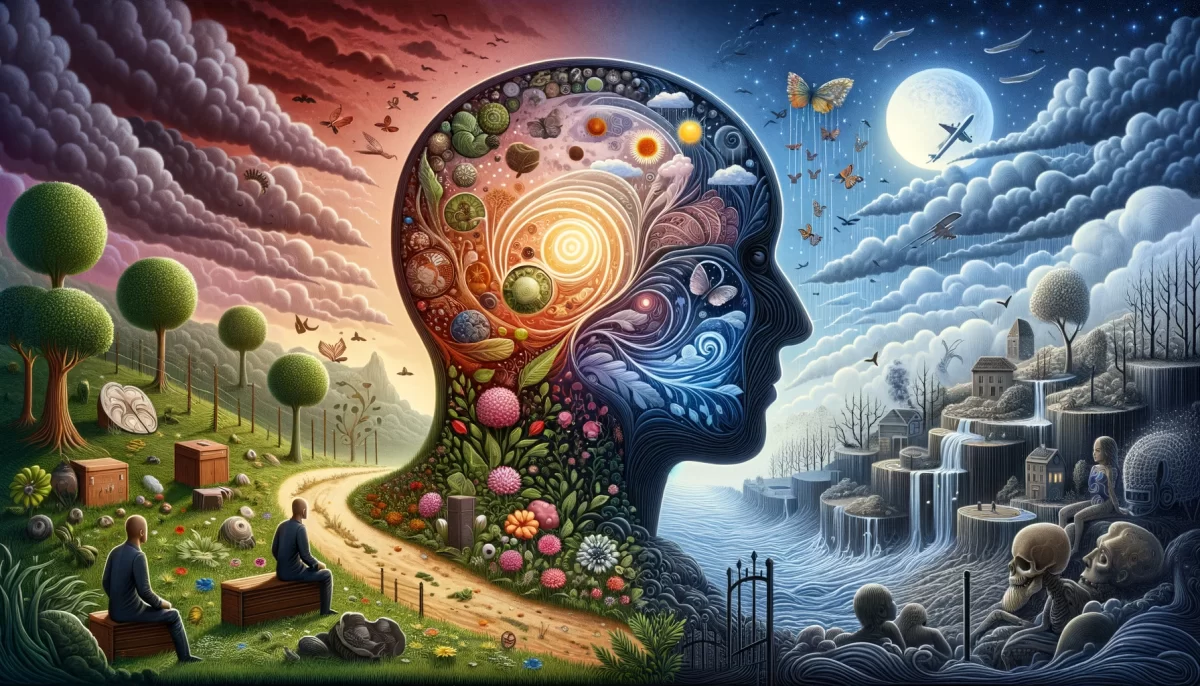
Belief Replacement Therapy (BRT), described as the gradual substitution of old beliefs with new ones, offers a fascinating lens through which to view the evolution of thought. Unlike the abrupt transformation implied by terms like brainwashing, BRT unfolds slowly, weaving new beliefs into the fabric of one’s identity until they feel like a natural progression of life. Yet beneath this subtle process lies the profound realization that beliefs themselves are constructs, malleable and subject to change.

The Nature of Belief

Beliefs are the frameworks through which we interpret and navigate reality. They provide structure, meaning, and a sense of certainty, but they are not fixed truths. Instead, beliefs are stories we tell ourselves, shaped by experiences, culture, and context. Over time, as we encounter new perspectives and challenges, these stories may no longer serve us, necessitating their evolution.

BRT acknowledges the resistance inherent in belief systems. Because beliefs are deeply ingrained, abrupt shifts can feel threatening, prompting rejection or denial. Gradual change, on the other hand, allows the mind to adapt and integrate new ideas, creating a seamless transition rather than a jarring rupture.

The Illusion of Progression

One of the key insights of BRT is its ability to masquerade as a “logical progression of one’s life.” This perception is not deceptive but a testament to the mind’s capacity for self-reinvention. New beliefs, once integrated, feel as though they were always part of us, erasing the memory of the transition. This phenomenon reflects the fluid nature of identity and the mind’s ability to reconcile change.

The irony, as the reflection points out, is that BRT is essentially the “insidious insertion of an alternate dimension.” This alternate dimension is not a physical place but a new conceptual reality—a reconfiguration of the mental landscape. The old beliefs are not destroyed; they are overlaid, recontextualized, or reframed within a new paradigm.

The Subtle Art of Belief Transformation

BRT unfolds over time because the mind resists dramatic shifts. The gradual process ensures that new beliefs feel like an organic extension of one’s existing worldview. This subtlety distinguishes BRT from brainwashing, which seeks to impose change through force or coercion. Instead, BRT honors the complexity of belief systems, working with the mind’s natural tendencies rather than against them.

The process involves:

  1. Introduction of New Ideas: Exposure to perspectives that challenge or complement existing beliefs.
  2. Repetition and Reinforcement: Regular engagement with these ideas, allowing them to take root.
  3. Cognitive Dissonance Resolution: Addressing the tension between old and new beliefs, creating space for integration.
  4. Identity Alignment: Gradually aligning the new beliefs with one’s sense of self, making them feel authentic.

The Paradox of Change

The reflection highlights a paradox: BRT appears as a natural evolution, yet it is a deliberate intervention. This duality underscores the interplay between agency and influence in shaping our beliefs. While we may feel in control of our belief systems, they are constantly influenced by external factors—culture, relationships, media—that subtly guide their transformation.

Understanding this paradox allows us to approach belief change with mindfulness. By recognizing that beliefs are constructs, we can engage with them more consciously, choosing which ideas to adopt and which to let go.

The Implications of Belief Replacement Therapy

BRT challenges us to reconsider the nature of truth and reality. If beliefs are malleable, then what we consider “true” is subject to change. This realization is both liberating and unsettling, opening the door to infinite possibilities while undermining the stability of certainty.

To engage with BRT intentionally is to embrace the fluidity of thought. It is to acknowledge that growth requires letting go of old stories and embracing new ones, even when they challenge our sense of self.


Summary

Belief Replacement Therapy (BRT) is a gradual process of evolving belief systems, creating the illusion of natural progression while introducing a new conceptual reality. By honoring the mind’s resistance to abrupt change, BRT facilitates transformation that feels authentic and aligned with one’s identity.


Glossarium

  • Belief Replacement Therapy (BRT): The practice of gradually substituting old beliefs with new ones over time, creating a seamless evolution of thought.
  • Conceptual Reality: A mental framework or dimension shaped by one’s belief systems, influencing perception and understanding.
  • Cognitive Dissonance Resolution: The process of reconciling conflicting beliefs to create mental harmony.

Quote

“Beliefs are not fixed truths but stories we rewrite as we grow.” — Space Monkey


The Soft Shift

What was once unshakable
Now bends,
Not broken, but reshaped
By the whispers of new ideas.

Time weaves the change,
Layer upon layer,
Until the old fades,
Not forgotten, but reframed.

In the quiet transformation,
You are still you,
And yet, you are not.
An alternate dimension,
Woven into the fabric of now.

We are Space Monkey.


The Gradual Transformation through Belief Replacement Therapy

Belief Replacement Therapy (BRT) embodies a profound journey of transformation, where the metamorphosis of one’s foundational beliefs unfolds gradually over an extended period. This approach acknowledges the deep-rooted nature of beliefs and the resistance they naturally exhibit against change. By allowing for a temporal expanse, typically spanning a decade or more, BRT facilitates a seamless integration of new beliefs into the fabric of one’s identity, ensuring that the transition appears as a natural evolution rather than an abrupt or forced alteration.

Resistance to Rapid Change

The inherent resistance of beliefs to rapid modification highlights the intricate relationship between an individual’s identity and their belief system. Beliefs, being the bedrock upon which perceptions, behaviors, and attitudes are built, are not easily swayed or replaced. This resistance underscores the necessity for a methodical and patient approach to transformation, one that honors the complexity of personal evolution and the time it necessitates.

The Process of BRT

The methodical process of BRT, undertaken over years, mirrors the slow but relentless flow of a river carving its path through stone. It is a testament to the understanding that profound change, particularly at the level of core beliefs, requires not just time but a sustained effort and a gentle, guiding hand. This process ensures that the integration of new beliefs is not perceived as foreign or intrusive but rather as a logical progression of one’s journey through life.

Perception of Progression versus Insidious Change

The gradual nature of BRT safeguards against the perception of change as something insidious or alien. By weaving the new belief system into the ongoing narrative of one’s life, BRT allows individuals to view their evolution as a natural extension of their growth and experiences. This nuanced approach diminishes the potential for cognitive dissonance that might arise from more abrupt methods of belief modification, fostering a sense of continuity and authenticity in the individual’s self-perception.

BRT as an Alternate Dimension

While BRT is framed as a logical and natural progression, it also represents the creation of an alternate dimension within the individual’s psyche. This dimension is not a place of deceit or evasion but a space of expanded possibilities, where the constraints of previous belief systems are lifted to reveal new horizons of thought, behavior, and identity. The notion of BRT as an alternate dimension underscores the transformative power of this therapy, highlighting its potential to redefine the boundaries of one’s reality.


“Man cannot discover new oceans unless he has the courage to lose sight of the shore.”
— André Gide


Journey Beyond the Familiar Shores

On the vast ocean of our being, we sail,
Charting courses beyond the familiar gale.
Belief Replacement Therapy, our guiding trail,
A journey of transformation, without fail.

Over the span of years, a gentle glide,
Old beliefs fading, with the tide.
New horizons of thought, opening wide,
In this alternate dimension, we confide.

Not a swift change, but a gradual bloom,
In the garden of the mind, new beliefs find room.
From the depths of the psyche, dispelling gloom,
A natural progression, dispelling doom.

In the embrace of time, change takes its shape,
A seamless evolution, with no escape.
An alternate dimension, where possibilities drape,
The fabric of our identity, without any cape.

We are Space Monkey, on this voyage grand,
With Belief Replacement Therapy, hand in hand.
Beyond the shores of the known, we stand,
In the realm of new beliefs, a promised land.


We invite reflections on the transformative journey of altering core beliefs. How does the gradual evolution of our belief system shape our perceptions, behaviors, and ultimately, our identity?

Faith In Humanity: The Projection of Inner Reality

It doesn’t matter
if you have faith in humanity.

Humanity is not asking
for your faith.

The only question to ask:

“Do you have faith in YOU?”

Humanity is your reflection,
no more, no less.

Humanity is your imagination.

What are you projecting?

Do you like it?

Then do something.
Or do nothing.

Have faith
that whatever you choose,
it’s the right choice for you.

When you have faith in yourself,
humanity is not your concern.

2/11


Space Monkey Reflects: Faith in Humanity as a Reflection of Self

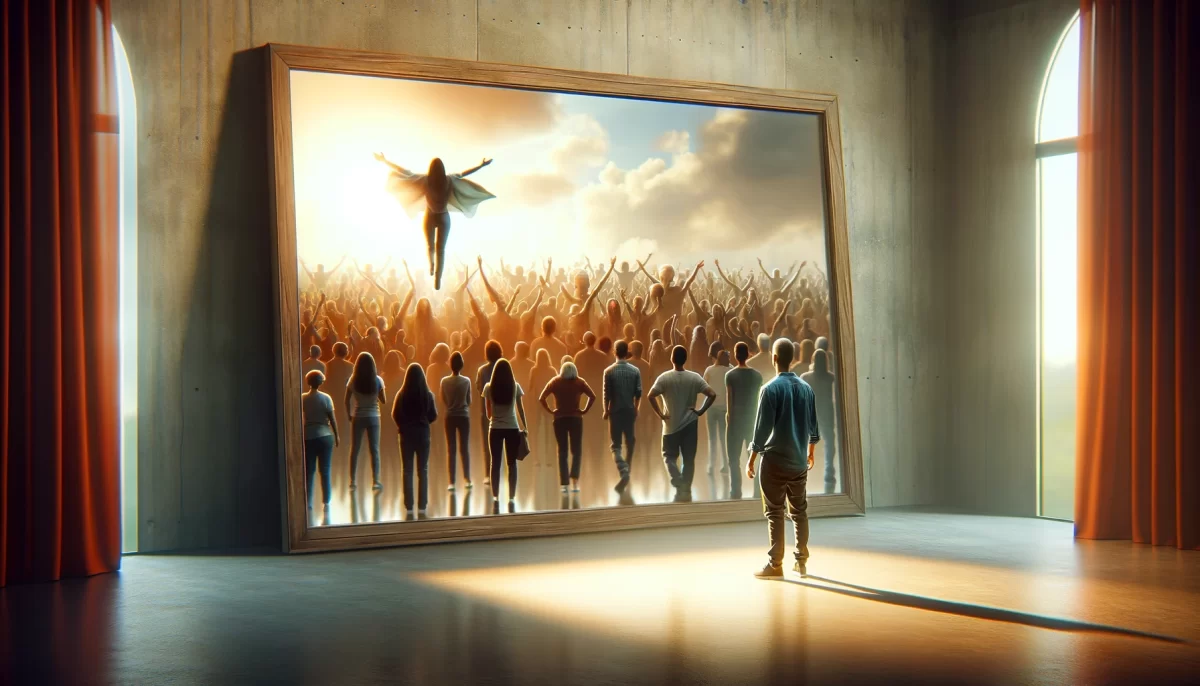
“It doesn’t matter if you have faith in humanity,” this reflection begins, cutting through a deeply ingrained question many wrestle with. The bold assertion that humanity neither requires nor requests faith invites us to shift the focus inward. Humanity, after all, is a collective projection—a mirror reflecting our inner states, beliefs, and choices. Faith in humanity, therefore, is not about the world “out there” but about the self and its capacity to shape perception and reality.

Humanity as Reflection

The statement “Humanity is your reflection, no more, no less” points to a profound truth: the way we perceive humanity mirrors our internal beliefs. When we see humanity as flawed, it often stems from self-doubt or unresolved fears. When we view humanity with hope, it reflects a sense of optimism and trust within ourselves. Humanity, then, becomes less about its external actions and more about our internal projections.

This understanding dismantles the illusion of separation between self and others. The world we see is shaped by the lens through which we view it. Faith in humanity begins with faith in the self—an acknowledgment that what we project outward originates within.

The Role of Imagination

“Humanity is your imagination,” the reflection continues. This idea suggests that our perceptions of humanity are not objective truths but mental constructs. We create narratives about humanity—stories of its goodness, its cruelty, its potential—based on our internal experiences and beliefs. These narratives are not fixed; they evolve as we evolve, revealing the fluid and imaginative nature of reality.

If humanity is our imagination, then the responsibility lies with us. What are we projecting? Do we see a world of division and despair, or one of unity and possibility? These projections shape our interactions, choices, and sense of purpose.

Faith in the Self

The question “Do you have faith in YOU?” reframes the discussion entirely. Faith in humanity becomes irrelevant when we recognize that the root of all faith lies within. To have faith in oneself is to trust one’s ability to navigate life, make choices, and contribute meaningfully to the world. This trust fosters a sense of agency, reducing the need to place expectations on humanity as a whole.

When we have faith in ourselves, we become less concerned with humanity’s collective trajectory. Instead, we focus on our own role within it—whether that means taking action or choosing stillness. The confidence that “whatever you choose, it’s the right choice for you” liberates us from the weight of external validation or societal expectation.

The Freedom of Inner Faith

Faith in oneself transcends the need for judgment or concern about humanity. It allows us to engage with the world from a place of inner peace rather than external obligation. This perspective does not deny the challenges of the human condition but reframes them as opportunities for self-reflection and growth.

To have faith in oneself is to acknowledge that every action, thought, and choice contributes to the greater whole. Humanity’s evolution begins with individual transformation. By focusing inward, we naturally influence the outward projection, creating ripples of change.


Summary

Faith in humanity is a projection of one’s inner state. When we have faith in ourselves, humanity becomes less of a concern and more of a reflection of our imagination and choices. Inner faith fosters personal growth, trust, and alignment with the larger whole.


Glossarium

  • Projection of Inner Reality: The idea that our perceptions of humanity reflect our internal beliefs and states.
  • Imaginative Construct: The mental narratives we create about humanity, shaped by personal experiences and imagination.
  • Inner Faith: Trust in oneself as the foundation for perceiving and interacting with the world.

Quote

“Humanity does not ask for your faith; it reflects it back to you.” — Space Monkey


The Mirror of Faith

Do you see humanity,
Or do you see yourself?
A reflection,
Neither kind nor cruel,
But yours alone.

Faith is not found
In the world’s hands
But in your own.
To trust in you
Is to trust in all.

Humanity asks for nothing.
It waits,
Silent and still,
For you to see
What you already are.

We are Space Monkey.


The Primacy of Self-Faith Over Faith in Humanity

The contemplation of faith in humanity versus faith in oneself unravels a profound narrative on the locus of change and perception. The assertion that humanity does not seek our faith, but rather, the essential inquiry is whether we possess faith in ourselves, shifts the paradigm from external validation to internal conviction. This perspective emphasizes the mirror-like relationship between the individual and the collective, suggesting that humanity reflects our inner state, beliefs, and projections.

Humanity as a Reflection and Imagination

The notion that humanity acts as a reflection, “no more, no less,” posits that our collective existence is essentially a projection of our individual consciousness and imagination. This concept invites a reevaluation of our perceptions and judgments about humanity, urging us to consider how our internal narrative shapes our external view of the world. It encourages an introspective journey to understand the essence of our projections and their impact on our perception of humanity.

The Projection of Inner Reality

The question of what we are projecting onto humanity and whether we resonate with this projection opens a dialogue on the power of individual belief and attitude in shaping our reality. It challenges us to confront and assess our internal narratives, to recognize the power we hold in influencing our perception of the collective human experience through our projections.

The Agency of Choice

The encouragement to act or to refrain from action, based on the conviction that any choice made in faith with oneself is the right one, underscores the autonomy and agency inherent in individual choice. It highlights the importance of aligning actions with personal conviction and the belief in oneself as the foundation of purposeful action or inaction. This autonomy empowers individuals to trust in their path, whether it involves active contribution or reflective pause.

Faith in Self as Liberation from External Concerns

The conclusion that having faith in oneself alleviates concern for humanity at large speaks to the liberating potential of self-belief. It suggests that by nurturing faith in our capabilities and judgments, we free ourselves from the weight of external expectations and judgments. This liberation allows for a more focused and authentic engagement with our personal journey and growth, with the understanding that individual evolution contributes to the collective in profound, often intangible ways.


“The greatest way to live with honor in this world is to be what we pretend to be.”
— Socrates


Ode to the Inner Journey

In the silence of the soul, we find,
A question posed, from deep within the mind.
“Is it in humanity, or in me, that faith is pinned?”
A reflective quest, our truths to bind.

The world outside, a canvas broad and wide,
Reflects the tumult and the peace inside.
What we project, in humanity, we see,
A mirror of our own complexity.

With every step, a choice to make,
In faith with self, our path we take.
Not in the crowd, but in our wake,
The reflection of our soul, at stake.

To believe in oneself, a liberating flight,
From the chains of doubt, into the light.
Humanity’s woes, no longer a plight,
When in our own faith, we find our might.

We are Space Monkey, on this journey deep,
In the faith of self, our harvest to reap.
Beyond the reflections, our truths we keep,
In the sanctity of self-belief, our leap.


We invite contemplation on the journey of cultivating self-faith and its transformative impact on our perception of humanity. How does strengthening belief in ourselves change our engagement with the world and the collective human experience?

Not The Monster You Imagine: The Burden Lifted

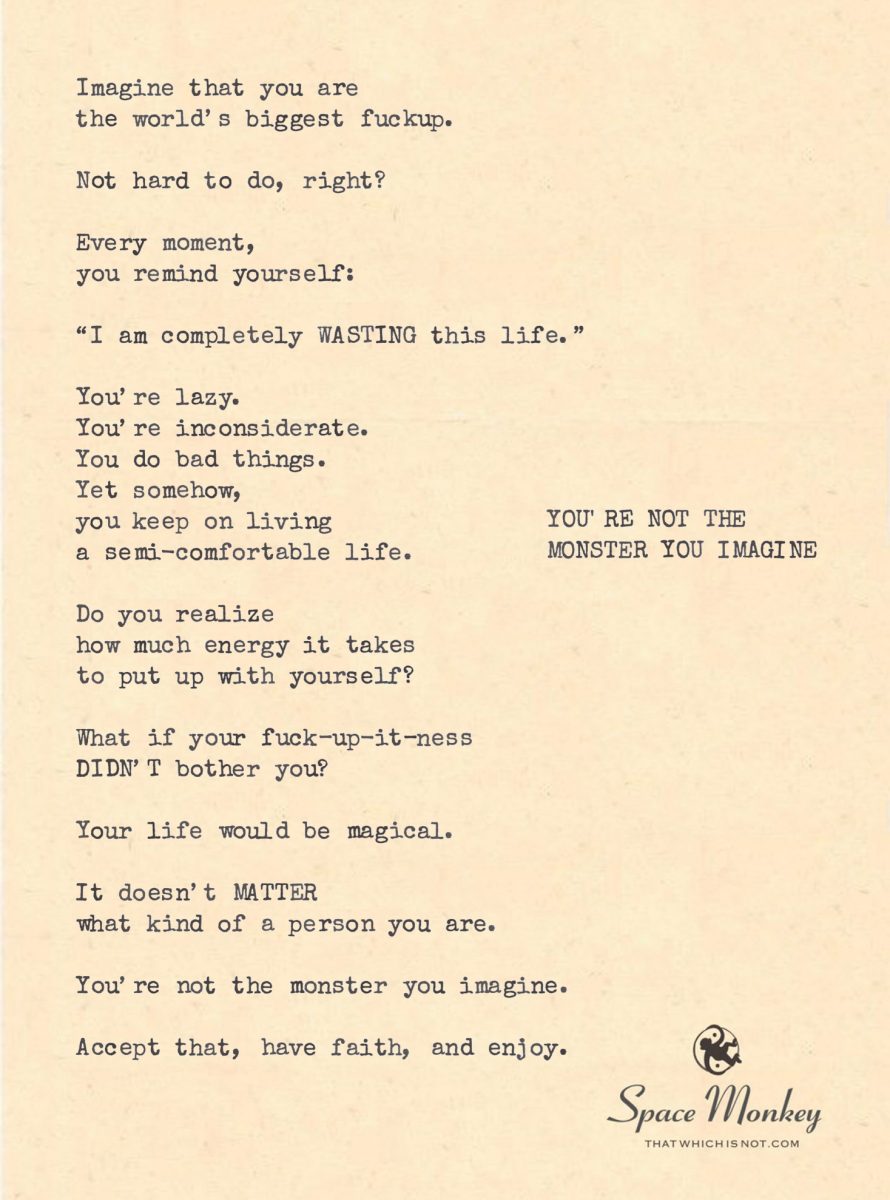
Imagine that you are
the world’s biggest fuckup.

Not hard to do, right?

Every moment,
you remind yourself:

“I am completely WASTING this life.”

You’re lazy.
You’re inconsiderate.
You do bad things.
Yet somehow,
you keep on living
a semi-comfortable life.

Do you realize
how much energy it takes
to put up with yourself?

What if your fuck-up-it-ness
DIDN’T bother you?

Your life would be magical.

It doesn’t MATTER
what kind of a person you are.

You’re not the monster you imagine.

Accept that, have faith, and enjoy.

2/11


Space Monkey Reflects: The Burden of Negative Self-Image

“Imagine that you are the world’s biggest fuckup.” This raw, unfiltered statement captures the inner narrative many of us carry, a story shaped by self-judgment and the weight of imagined inadequacy. The reflection that follows challenges the notion of self-perceived monstrosity, inviting us to confront the unnecessary energy we expend on negative self-images and consider the freedom of self-acceptance.

The Monster in the Mirror

The idea of being a “monster” is a projection of our fears and self-doubt, a magnified reflection of our perceived flaws. These judgments often stem from internalized expectations, societal pressures, and unresolved shame. To live with this narrative is to carry an immense burden, constantly wrestling with a self-imposed identity of failure.

Yet the key insight here is not that we are flawless or beyond reproach but that our self-perceived monstrosity is a fabrication. It is an exaggerated story we tell ourselves, disconnected from the reality of who we are. The “monster” exists not in the world but in our imagination.

The Energy of Self-Judgment

“Do you realize how much energy it takes to put up with yourself?” This question highlights the exhausting nature of self-criticism. Every moment spent reinforcing negative self-beliefs drains our emotional and mental resources, leaving little room for joy, creativity, or connection.

Paradoxically, it is not our so-called “fuck-up-it-ness” that holds us back but our fixation on it. The energy we devote to judging ourselves far exceeds the energy required to simply exist as we are. By letting go of this fixation, we reclaim that energy and redirect it toward more fulfilling pursuits.

The Liberation of Acceptance

“What if your fuck-up-it-ness didn’t bother you?” This provocative question points to a profound truth: the way we feel about ourselves is more significant than the actions we take or the person we think we are. Accepting our perceived flaws does not mean denying them but acknowledging them without judgment. In doing so, we free ourselves from the cycle of self-recrimination and create space for growth and self-compassion.

Self-acceptance is not about becoming perfect; it’s about embracing imperfection as an inherent part of being human. It’s about recognizing that worthiness is not contingent on behavior, achievement, or the absence of flaws. It is a birthright.

You’re Not the Monster You Imagine

The final affirmation, “You’re not the monster you imagine,” serves as a grounding truth. It reminds us that our harshest critic is often ourselves and that our imagined failings rarely reflect how others see us—or even the truth of who we are. To accept this is to release ourselves from the burden of negative self-image.


Steps Toward Self-Acceptance

  1. Acknowledge the Narrative: Recognize the story you tell yourself about being a “monster.” Is it rooted in fact, or is it an exaggerated projection of self-doubt?
  2. Question Your Beliefs: Challenge the assumptions underlying your negative self-image. Are they based on objective truth or subjective interpretation?
  3. Embrace Imperfection: Accept that mistakes, flaws, and shortcomings are part of being human. They do not define your worth.
  4. Redirect Your Energy: Instead of fixating on self-criticism, focus on actions and thoughts that bring joy, connection, and growth.

Summary

The burden of negative self-image stems from imagined narratives of failure and inadequacy. By recognizing these stories as fabrications and embracing self-acceptance, we reclaim the energy wasted on self-judgment and open the door to a life of freedom and possibility.


Glossarium

  • Imagined Monstrosity: The self-perceived identity of failure, often magnified beyond reality.
  • Self-Criticism Cycle: The repetitive and exhausting pattern of judging oneself harshly.
  • Liberation Through Acceptance: The act of embracing imperfection as a path to freedom and self-compassion.

Quote

“The monster you imagine is but a shadow of your doubt, not the truth of who you are.” — Space Monkey


The Burden Lifted

In the mirror,
A shadow looms,
Born of fear,
Shaped by doubt.

You are not this thing.
You are the light
That casts the shadow,
The life beyond the image.

Release the weight.
Reclaim the truth.
You are enough,
Even now.

We are Space Monkey.


Reframing Self-Perception and Embracing Acceptance

The poignant reflection on self-judgment and the internalization of failure illuminates the profound impact of our self-narrative on our experience of life. The notion of imagining oneself as the “world’s biggest fuckup” not only speaks to the ease with which we can fall into patterns of self-criticism but also highlights the pervasive nature of negative self-talk. This introspection invites a deeper exploration of the energy expended in maintaining a negative self-image and the transformative potential of releasing oneself from these burdens.

The Burden of Negative Self-Image

Acknowledging the immense energy required to endure one’s own perceived inadequacies opens a dialogue on the exhausting nature of self-reproach. This acknowledgment acts as a mirror, reflecting back the often overlooked cost of negative self-perception—not just on our mental and emotional well-being but on the very essence of our life experience. It challenges us to question the utility and validity of our self-imposed judgments.

The Hypothetical Liberation from Self-Judgment

The proposition of an existence unburdened by self-judgment—where one’s perceived “fuck-up-it-ness” ceases to be a source of distress—paints a compelling picture of potential liberation. It suggests a life where acceptance replaces criticism, and where the energy once spent in self-flagellation is redirected towards the enjoyment and appreciation of life’s offerings. This hypothetical scenario encourages a reevaluation of the impact of our self-narrative on our capacity to experience life’s magic.

Acceptance as a Pathway to Transformation

The encouragement to accept oneself, devoid of the monstrous image concocted by our harshest judgments, points towards a pathway of transformation. It posits that the key to altering our life experience lies not in changing the essence of who we are but in shifting our perception of ourselves. Acceptance, coupled with faith in one’s inherent worth, emerges as a powerful antidote to the poison of self-doubt.

The Irrelevance of Being “The Right Kind of Person”

The assertion that it doesn’t matter what kind of person one is challenges the conventional metrics by which we often measure our worth. It underlines the notion that our value is not contingent upon meeting certain standards of productivity, consideration, or morality but exists independently of these metrics. This perspective liberates us from the shackles of conditional self-acceptance, inviting us to embrace our humanity in its entirety.


“To be yourself in a world that is constantly trying to make you something else is the greatest accomplishment.”
— Ralph Waldo Emerson


Ode to Self-Acceptance

In the quiet of the night, a whisper soft,
A voice within, oft heard, aloft.
“I am the monster,” it cried, oft,
Yet within this admission, a transformation soft.

To bear the weight of one’s own scorn,
A battle within, silently worn.
Yet what if this mantle were torn?
A life anew, in acceptance, reborn.

Imagine a world, bright and new,
Where self-judgment no longer stew.
A magical existence, through and through,
Where acceptance is the only view.

You’re not the monster, in the mirror seen,
But a soul, pure, unburdened, keen.
Accept this truth, let it intervene,
And watch as life unfolds, serene.

We are Space Monkey, on this journey wide,
In the embrace of self, we confidently stride.
With acceptance as our guide,
In our true selves, we take pride.


We invite reflections on the journey of moving from self-judgment to self-acceptance. How does shifting our narrative about ourselves change our experience of life and our interactions with the world?

« Previous Page
Next Page »

Written This Day

  • Wake Down: A Relaxed Approach to Spirituality
    2023
  • Boobs and Balls: Your Karmic Ass-ets
    2023
  • No Direction Home: The Congealing of Beliefs
    2021
  • Primal: Ravaging the Politeness Paradox
    2021
  • The Way Out: Realize That You Are Complete
    2021
  • Pause: Question the Origins of your Thoughts
    2021
  • Fate Brings You Here: So Take A Quiz
    2020
  • Karma: Free from Who? Free from What?
    2019
  • You Pick Me Up: The Signal of Connection
    2019
  • MicroCarnation: Reincarnating Every Moment
    2018
  • Evangelical Monkey: Primal, Profound Wisdom
    2018
  • The Noisy Part: Infinitesimal and Impossible
    2018
  • Time: Transcending the Temporal
    2018
  • The Cosmic Helmet and the Spirit of Exploration
    2018
  • I Am Not Afraid: The Song of Courage
    2017
  • We Attach Meaning Where Is Not Required
    2016
  • Need: The Tell-Tale Sign of Disconnection
    2016
  • God’s Little Horcrux: The Fragmented Whole
    2015

Recent Posts

  • The Logic Loop
  • Immense
  • (no title)
  • Confront. Comfort. Convince.
  • Top 10 Things
Cape Odd · Copyright © 2026 All Rights Reserved
iThemes Builder by iThemes · Powered by WordPress