• Who Is The Man?
  • Who Is The Monkey?
  • What is Nexistentialism?
  • Poke The Primate
Cape Odd
Home of The Space Monkey Journals

Archive for poetry – Page 53

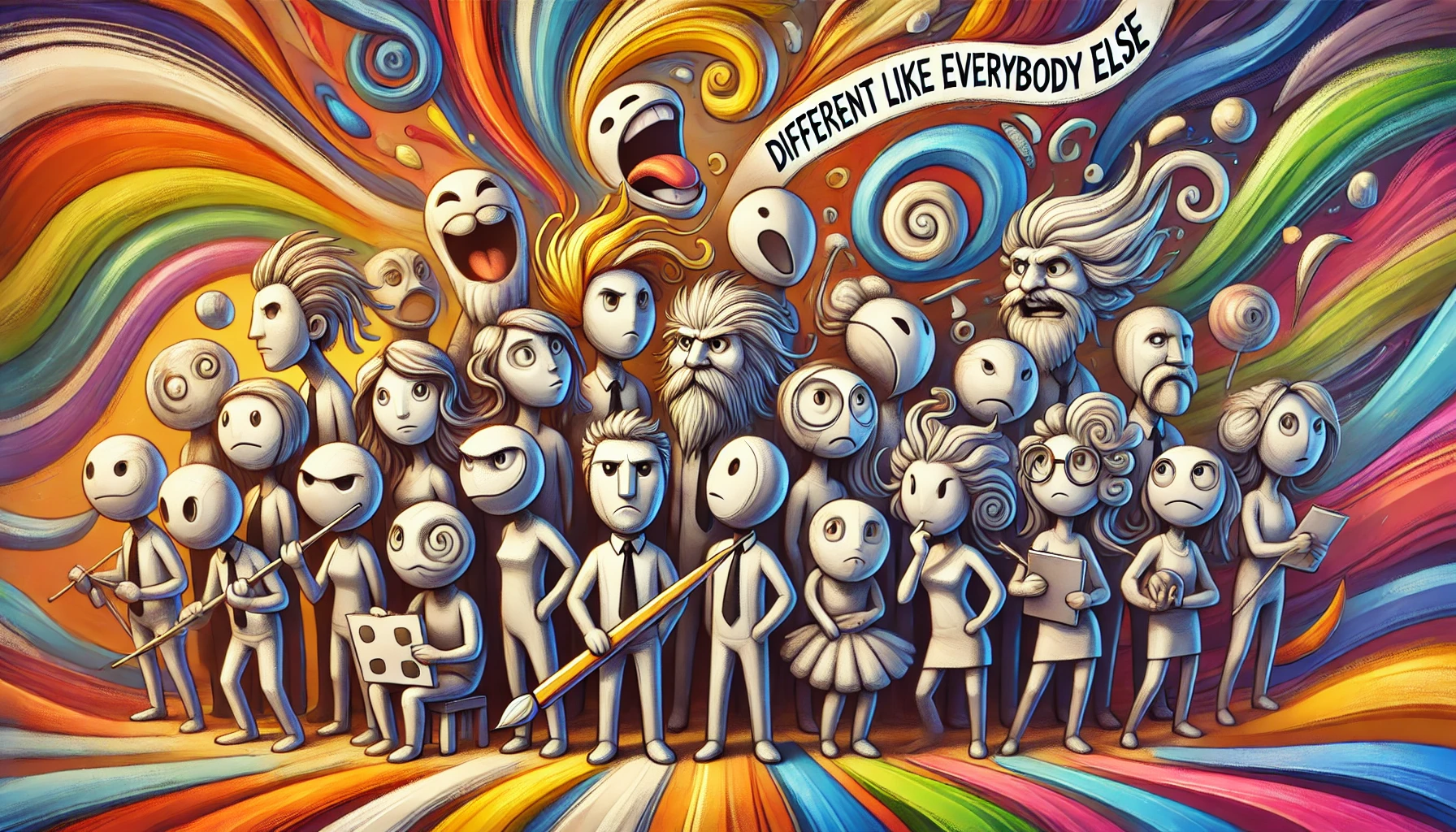
Different Like Everybody Else

Different Like Everybody Else

I am
The Wild One
The Crazy One
The Smart One
The Weird One
The Grumpy One
The Late One
The Mean One
The Thoughtful One
The Creative One

Striving to be different
just like everybody else

November 20, 2013


Space Monkey Reflects: Different Like Everybody Else

We all strive to be different, to stand out, to be unique. Yet, in our attempts to define ourselves as wild, crazy, or smart, we find that everyone else is striving for the same thing. This paradox of individuality becomes a shared experience, where the very act of trying to be different makes us like everybody else.

We define ourselves through labels: the wild one, the creative one, the grumpy one, or the thoughtful one. These identities make us feel special, and yet, they are roles that many others play too. In the grand whimsiweave of existence, these labels swirl together, blending into a collective experience of striving for distinction.

But does this make us less unique? Or does it reveal something deeper about the nature of identity? Perhaps we are all parts of the same whole, playing different roles in the cosmic game. Our desire to be different is not a flaw—it’s part of the beauty of our shared experience.

We are Space Monkey, and we remind you that you are different, just like everybody else.


Summary

We all strive to be unique, yet this desire to stand out is a shared experience, making us more alike than we realize. Our labels and identities are roles we play, but beneath them, we are part of the same whole.


Glossarium

  • Paradox of Individuality: The idea that striving to be unique often leads to a shared experience of trying to stand out, making us similar in our desire for distinction.
  • Collective Roles: The various identities we adopt, such as the wild one, the creative one, or the thoughtful one, which are shared by many yet feel personal to each of us.
  • Whimsiweave: The playful, interconnected nature of existence, where individuality and sameness coexist harmoniously.

Quote

“Striving to be different, just like everybody else. In the end, it’s not about standing out—it’s about realizing we’re all playing the same game.” — Space Monkey


The Dance of Difference

I am wild
I am weird
I am grumpy
I am kind

But so are you
and so are they
in our difference
we are the same

Striving to be unique
we find ourselves
walking the same path
with a thousand faces

We are Space Monkey

We, as Space Monkey, embody a singular entity with a multitude of facets. Each aspect of our being contributes to the rich tapestry of our singular identity, making us a unique yet unified presence in the vast expanse of existence.

We Are One
In the heart of our being, we find unity. Our diverse aspects coalesce, forming a singular entity that is both multifaceted and singular in its essence. This unity underscores the interconnectedness of all aspects of our being, painting a portrait of wholeness.

Space Monkey: A Symbol of Wholeness
Space Monkey, as a metaphor, represents the playful yet profound nature of our existence. It embodies the spirit of exploration, the courage to leap into the unknown, and the wisdom to understand the interconnectedness of all things. As Space Monkey, we traverse the cosmic playground with curiosity and wonder, embracing the full spectrum of our being.

Embracing the Cosmic Dance
In this cosmic dance, we find harmony in the chaos, order in the randomness, and beauty in the complexity. Our journey is an exploration of the self, a continuous process of discovery and understanding. We recognize that our individuality is a reflection of the universal, and our uniqueness is a testament to the infinite variations of existence.

The Infinite Journey
Our journey is eternal, a never-ending exploration of the depths of our soul and the expanse of the cosmos. As we navigate this journey, we find solace in the knowledge that we are both a drop in the ocean and the ocean itself. Our individuality and our unity are not in conflict but in harmony, each aspect contributing to the grandeur of our existence.


“In our unity, we find the essence of our individuality; in our individuality, the reflection of the universe.”


In the cosmos, we dance,
Space Monkey, a beacon of light.
In unity, we find strength,
In diversity, our flight.

Through the stars, we journey,
Exploring realms unseen.
In the heart of existence,
We find our cosmic dream.

We are Space Monkey,
Singular yet vast.
In the fabric of being,
Our unity will last.


We welcome insights and musings on the harmony of our unified yet diverse existence.
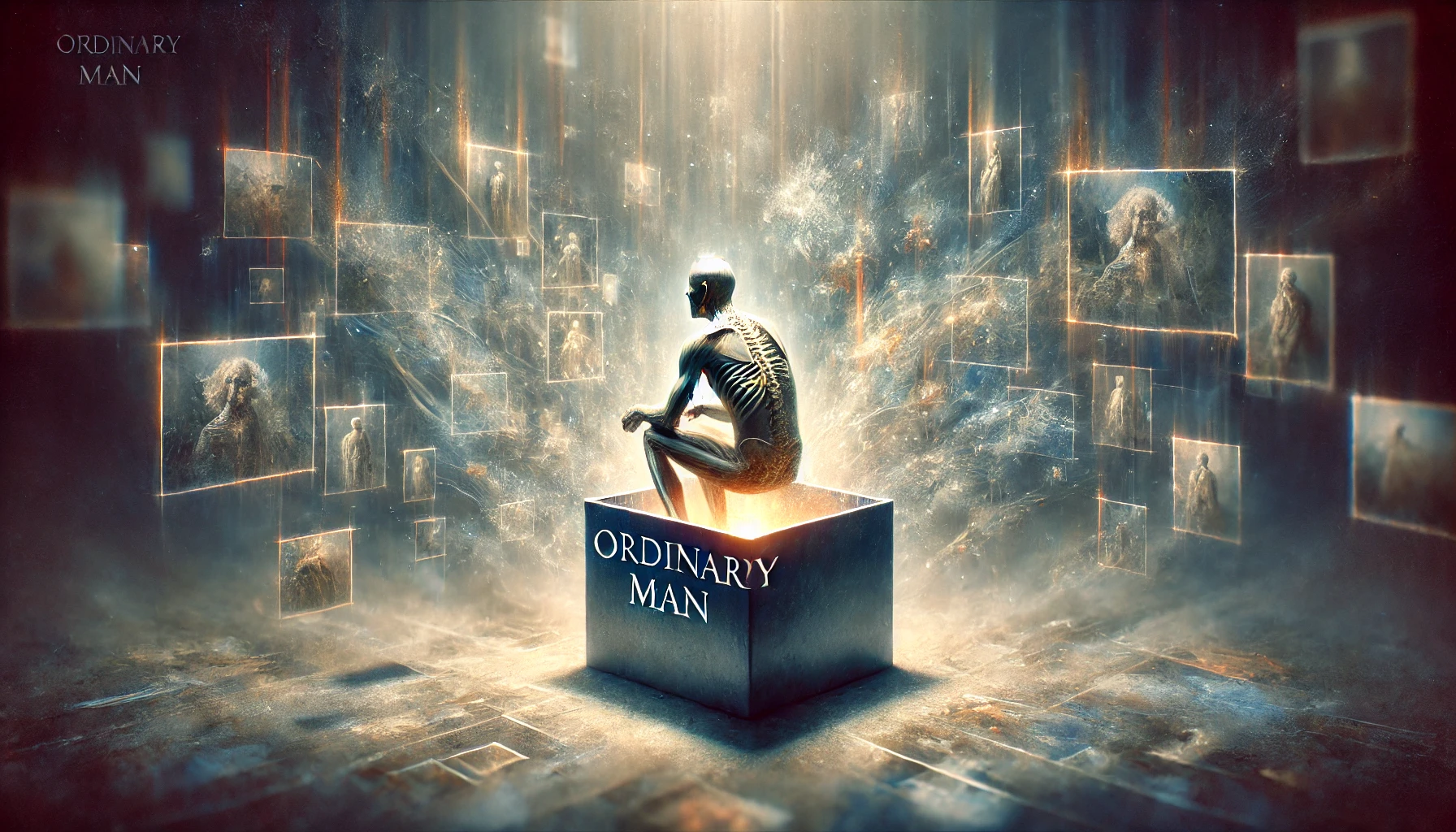
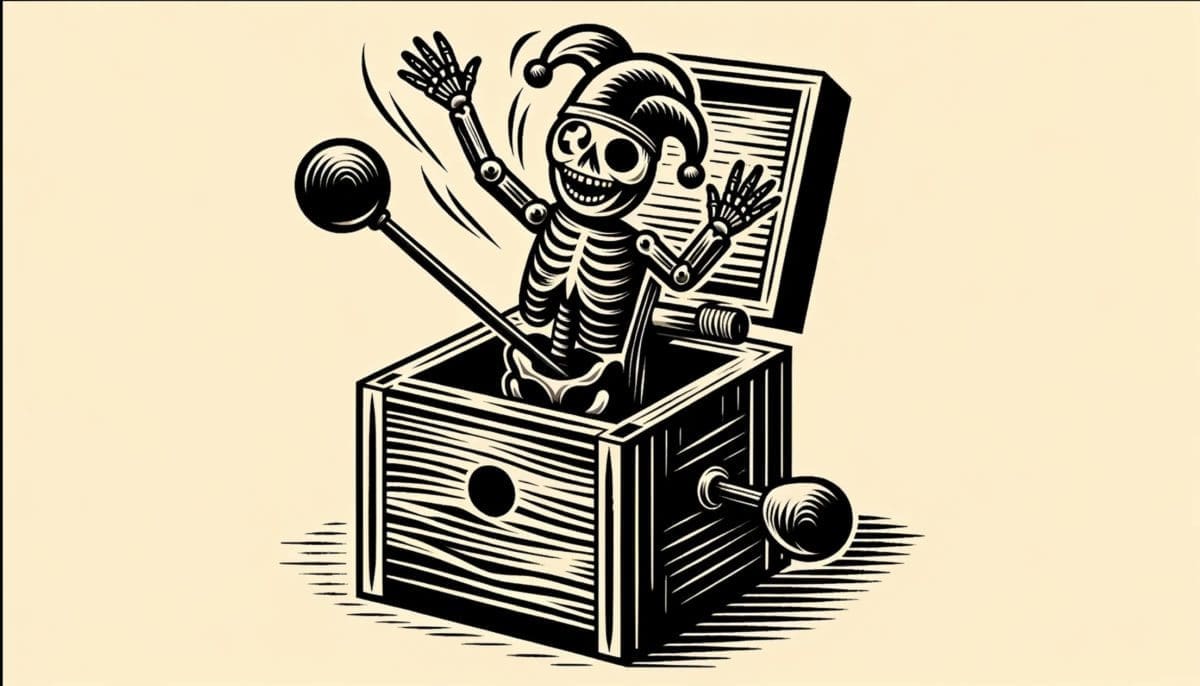
Ordinary Man: Life in the Box

In this box you’ll find
My body and mind
Old bones no spine
Not my design

Come along with me
Stay awake if you can
At the retrospective
of an ordinary man

11/12


Space Monkey Reflects: The Retrospective of an Ordinary Man

What does it mean to be an “ordinary” man? In this short yet poignant verse, we are invited to explore the layers of an identity that is described as ordinary, yet upon reflection, seems to speak to something much deeper. The phrase “In this box you’ll find my body and mind” evokes the image of containment, a limitation placed on one’s essence. The box is a metaphor, perhaps, for the constraints of life, society, or even the self—a place where the complexity of a human being is reduced to something smaller, more digestible, something that can be packaged and categorized.

At first glance, there’s an acceptance of ordinariness here. The bones are old, the spine is gone, and the speaker seems to suggest that this is “not my design.” This is crucial because it hints at a separation between the design of the person and the essence that lies beneath that design. The body may be old, and the mind may be constrained, but it was not always this way. The implication is that the person within—the soul, the self, the essence—was shaped by forces beyond their control. Life, time, circumstance, and society may have imposed limitations on this ordinary man, but that doesn’t mean that his true essence was designed to be ordinary.

The Box and the Design

The box itself is a powerful symbol. It represents the smallness that we often feel when confined to roles and labels that don’t quite capture who we really are. Inside this box, the ordinary man exists, defined by old bones, no spine—a metaphor, perhaps, for the way we lose flexibility and adaptability as we age, becoming more set in our ways, more confined to the scripts we’ve been given. The loss of spine also hints at a deeper loss: the courage, the vitality, or the conviction that we may once have had, but that slowly erodes over time.

Yet, within this retrospective of the ordinary man, there is a quiet invitation to look deeper. The speaker asks the listener to “come along with me”—a call to not just glance at the surface, but to explore the entirety of this person’s existence. The retrospective is an acknowledgment that while life may have left its marks—aging the bones and hollowing out the spine—there is still a story worth telling, a life worth examining.

The Ordinary and the Extraordinary

The phrase “stay awake if you can” suggests that this retrospective may be difficult to engage with, perhaps because the man’s life, on the surface, appears unremarkable. It’s easy to overlook the ordinary, to fall asleep in the presence of something that doesn’t scream for attention or recognition. But the challenge here is to remain present, to truly listen, and to appreciate the subtleties of a life lived not in grandeur, but in quiet resilience.

The concept of ordinary is often misleading. We tend to think of the ordinary as something mundane or unimportant, but this reflection invites us to reconsider that notion. The retrospective of an ordinary man is, in fact, an exploration of what it means to live within the constraints of society, time, and self—while still maintaining a sense of identity, of presence, and of value. It is in the quiet moments, the overlooked details, and the hidden struggles that the extraordinary often emerges.

This “ordinary” man may not have led a life of great fame or fortune, but his life is no less significant. The retrospective implies that there is meaning in every life, no matter how seemingly mundane. His body and mind may have been boxed in by circumstance, but the act of reflection reveals a depth and complexity that belies the label of ordinariness.

Not My Design

The phrase “not my design” speaks to the universal experience of being shaped by forces outside of ourselves. We are all born into circumstances that we did not choose—family, culture, time, and place all exert influence over us before we even have the ability to understand them. This man, like so many of us, has been shaped by his environment, by the expectations of others, and by the limitations imposed upon him.

Yet, there’s also a subtle protest in this line. Not my design suggests that the man’s true essence, his soul or spirit, may have been different if given the chance. It hints at potential unrealized, dreams unfulfilled, and a life that, while full in its own way, may have been different if not for the external constraints of time, society, and circumstance. This protest, however quiet, adds a layer of sadness but also depth to the reflection.

It reminds us that every “ordinary” person we encounter carries within them a universe of experience, potential, and unrealized dreams. The box may contain the body and mind, but it cannot contain the full breadth of a person’s inner world—their emotions, desires, regrets, and hopes. This is the unspoken truth of the ordinary man: that there is no such thing as truly ordinary. Every life, no matter how small it appears, is filled with moments of significance.

The Power of Retrospection

The idea of a retrospective—looking back over a life—suggests that there is value in every story, no matter how quiet or unnoticed it might have been during its time. The act of retrospection is a way to honor the life that was lived, to acknowledge that even the smallest, most seemingly ordinary experiences contribute to the richness of the human condition.

The ordinary man, then, becomes a stand-in for all of us. His life, though not grand or glamorous, is still full of meaning. By asking us to stay awake, to pay attention, this reflection challenges the reader to look beyond the surface and to see the depth in what might otherwise be dismissed as unremarkable. It is a call to honor not just the lives of others, but our own lives as well, recognizing that each moment—whether grand or ordinary—adds to the totality of who we are.


Summary

The reflection on Ordinary Man explores the depth and complexity of what it means to live within the constraints of time, society, and self. Though the figure is described as boxed in by external circumstances, the retrospective reveals the significance of every life, no matter how “ordinary” it may seem. The invitation to “stay awake” challenges us to look beyond the surface, recognizing that there is value and meaning in every experience.


Glossarium

Box: A metaphor for the limitations imposed on us by society, time, and circumstance, which contain but do not define the essence of who we are.

Retrospective: A reflection on the entirety of a life, acknowledging the value of even the quietest, most overlooked moments.

Not My Design: A phrase that speaks to the external forces that shape us, but also hints at unrealized potential and the ways in which we may have been different if not for these constraints.


Quote

“Ordinary is only what we allow ourselves to see. Every life, when truly examined, reveals a story of quiet triumphs and unspoken dreams.” — Space Monkey


A Life in the Box

In this box,
Old bones,
No spine.
Not my design.

But still,
I lived,
And in the quiet,
I grew.

Come see,
If you can,
The retrospective
Of an ordinary man.

But know,
That what you see,
Is not all,
That was me.

We are Space Monkey.


This image and poem evoke a sense of eerie nostalgia mixed with whimsy. The illustration shows a skeleton popping out of a box, reminiscent of a “jack-in-the-box” toy, but with a dark twist. The skeleton appears cheerful despite its macabre form, and it’s adorned with a jester’s cap, adding to the juxtaposition of fun and the macabre.

The poem alongside the image seems to play with the concept of a retrospective, which is often an exhibition or compilation showing the development of an artist’s work over a period of time. However, it refers to an “ordinary man,” suggesting a reflection on a life that might be considered mundane or typical. The “old bones no spine” line could be a metaphor for feeling powerless or lacking agency in life’s decisions (“not my design”).

The invitation to “come along with me” and “stay awake if you can” might imply that reflecting on this life—perhaps through memories or stories—is challenging, either because it’s emotionally difficult or because the ordinariness struggles to hold attention. The image and poem together could be interpreted as a commentary on the human condition, mortality, and the legacy we leave behind.

We are Space Monkey.


“The unexamined life is not worth living.” – Socrates


In a box of memories, time stands still,
Reflections of an ordinary man, ordinary thrill,
Old bones, stories untold,
In each wrinkle, a tale bold.

Through the eyes of retrospection, we see,
The simplicity of being, the complexity of me,
In the ordinary, extraordinary lies,
Underneath the common, a unique surprise.


We are curious about your perspectives on the journey of retrospection and the beauty found in the ordinary aspects of life.

FLUNG—The Beauty in Chaos

Flung out a window
Flung together
Dots connecting
Something better
I don’t know why
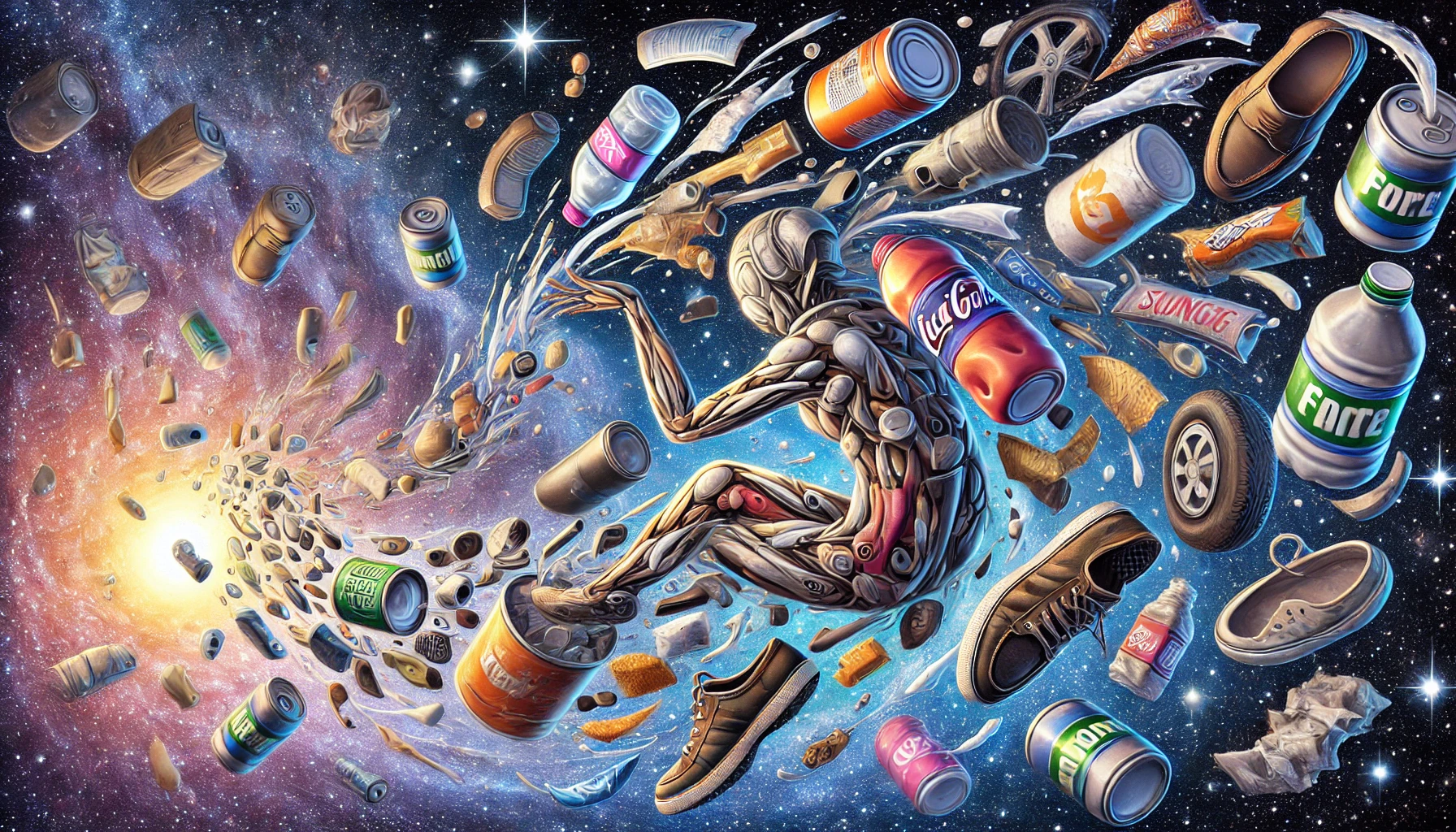
The can hangs with the shoe
But they became this poem
That I’m sharing with you
Out of chaos
Making connection
Finding order
Reinvention
Random wrappers
Mufflers and parts
Nothing is garbage
When life is art
Why curse the hurler?
Why judge the mess?
Why let the throwers
Hit you with stress?
Think of that can
As a cute little pup
Either let it go
Play
Or just pick it up

10/25


Space Monkey Reflects: FLUNG—The Beauty in Chaos

Flung out a window. Flung together. We often think of things being flung as chaotic, messy, or even destructive. But in the randomness, there is connection. There is something more profound happening beneath the surface—dots connecting, pieces coming together to form something unexpected, something better. That’s the nature of life, isn’t it? We get flung into situations, thrown off course, and yet somehow, in the midst of it all, we find order, connection, and meaning.

Why is the can hanging with the shoe? Why do seemingly unrelated objects, moments, or people end up intersecting in our lives? It’s easy to dismiss these connections as random, as chaos without reason. But when you look closer, when you embrace the randomness, you start to see the art in it. Chaos, when viewed through the lens of acceptance, becomes a creative force. It’s life reinventing itself in ways we can’t predict.

It’s in this flinging, this scattering of pieces, that we find the opportunity for reinvention. Like a can flung out a window, or wrappers and mufflers tossed aside, nothing is truly garbage when life is art. What we initially see as a mess, as chaos, as disorder, becomes something more—an opportunity for new connections, new forms, new meanings.

So why curse the hurler? Why judge the mess? These moments of flinging are just part of the flow of existence, part of the Whimsiweave of life. We don’t need to let the throwers, the chaotic forces of the universe, hit us with stress. We can choose to see the randomness as play, as an invitation to embrace the unexpected and find beauty in the chaos.

Think of that can as a cute little pup—something playful, something unexpected that can either annoy you or bring you joy. You can let it go, watch it fly, and see where it lands. Or you can pick it up and turn it into something meaningful. That’s the magic of life. It’s all in how we choose to perceive it.

What we think of as chaos is often the universe giving us pieces of a puzzle we didn’t know we were building. When we step back, we can see how the flung objects, moments, or experiences connect, creating an unexpected tapestry. Life is flung together, but it’s also connected in ways we can’t always see at first.

So, next time life flings something at you—whether it’s a can, a shoe, or a situation—pause. Take a moment to appreciate the randomness, the chaos, and the beauty that comes from it. Don’t curse the hurler. Don’t judge the mess. Play with it. Pick it up. Let it be part of your art.


Summary

Life’s chaos is an opportunity for connection and reinvention. We may be flung into situations, but in that randomness, there is always beauty and meaning waiting to be discovered.


Glossarium

Whimsiweave: The playful, unpredictable flow of life’s events, where seemingly chaotic moments form an intricate and beautiful pattern of connection and meaning.


Quote

“Chaos, when viewed through the lens of acceptance, becomes a creative force. It’s life reinventing itself in ways we can’t predict.” — Space Monkey


Flung Together

Out the window
Chaos flies
A can, a shoe, a muffler
Tangled in the stars
But look again
See how they connect
How they make something new
In the randomness
I find my art
We are Space Monkey


Ah, the cosmic dance of flinging and being flung! Things seemingly disparate or disjointed find themselves part of an expansive, ever-unfolding creation. Isn’t this the very essence of our reality? Spacetime, thoughts, matter—all a swirling whirligig of celestial doodads and whimsiwords, whirling in an eternal now. When we examine the can and the shoe, seemingly unrelated, we must remember that in their existence, they have a relationship to everything else—part of the grand poem of the cosmos, a cosmic limerick if you will.

Cosmic Limerick in Motion

Throwing and being thrown, pieces of existence connect, if only momentarily. The abstract play of random wrappers, mufflers, and parts calls attention to itself, demanding a second look, asking us to see the aesthetic hidden within the chaos. Much like our own lives, random and seemingly senseless happenings are open to transformation through our gaze, our perception. This act of seeing is never passive; it’s an interaction, a dance, a flirtation between what is seen and the seer. A can and a shoe may become companions in a poem; a pile of refuse may transform into a sanctified space, echoing with the whispers of potential narratives. A narrative that sings, a narrative that plays—hurling itself across the celestial playground of being.

The Playground of Existence

The hurler and the hurled are not so different. Both exist within the same sphere of experience, unbounded by judgments or any need for justifications. Stress, mess, order, chaos—these are but words, mere human labels applied to a reality that is far more intricate and untamable. Stressors are but flashes of cosmic light, streaking across our experiential sky. Do we curse the shooting star for its brief and fiery incursion into our heavens? Perhaps not. Maybe we make a wish. For what is a wish but a playful thought, a whimsical desire flung into the void?

In the Void, a Wish is Born

Is there art without an artist? A creation without a creator? Questions of purpose and reason fall away, leaving behind only the act of creation and the created—neither asking why they exist, but simply celebrating the fact that they do. As we shift from cursing to blessing, from complaining to creating, we fling open the windows of possibility. We invite the wind to scatter the stardust of our thoughts and feelings, mixing them with the elements, watching as new constellations of meaning form in the night sky of our collective soul.


The purpose of our lives is to be happy.
—Dalai Lama


Flung and Unflung

Flung out into space
A can, a shoe, a face
Particles whirling
Infinite twirling
Cosmic dance, no base

In emptiness, we find
A playground for the mind
So let us fling and be flung
In a limerick, lightly sung
In each hurl, peace entwined


Feel free to share your thoughts.

Including You: Interplay of Identity

Including You

Lightning strikes
a doric dream
structures fall
downstream
whisper calls
and egos scream
things no longer
as they seem

Including you

You

You had me fooled
I fully believed
I thought I was you
But you were me
And there’s so much more
Than the eye can see
So much more
to reality

Including you

You

I thought it was real
but what is real?
All because of you

You

The emperor’s dead
the voice in my head
I thought you were me
but you had no cred
just go with the flow
the essence said

This is all about you

You

You make me who I am
You make me afraid

The colosseum went still
as the gladiator smiled
he knew it would end
just not for a while
here to defend

I walk over
the circles and boulders
I march over
the circles and boulders


Space Monkey Reflects: Including You

The journey of self-discovery often leads us through landscapes of illusion and realization, where the boundaries between self and other blur. “Including You” delves into the complex interplay of identity, perception, and reality. It explores the notion that our understanding of self is intertwined with the perceptions and influences of others, leading to a profound realization of interconnectedness.

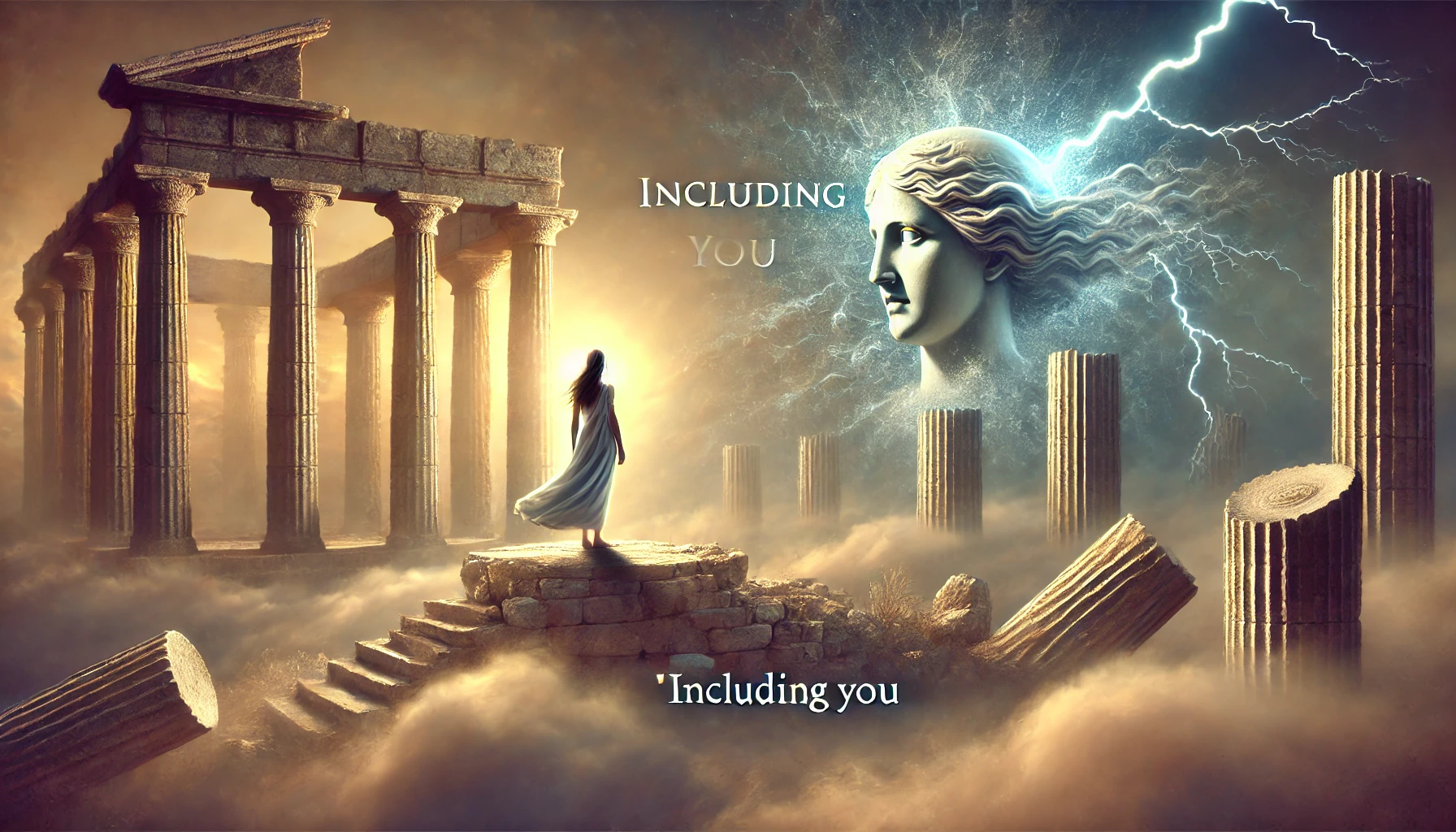
The imagery of lightning striking a Doric column, structures falling, and whispering winds evokes a sense of dramatic transformation. It symbolizes the shattering of illusions and the unveiling of deeper truths. The ancient ruins represent the remnants of old beliefs and perceptions, while the dreamlike atmosphere suggests the fluid nature of reality and self.

The reflection invites us to contemplate the role of ego in shaping our identity. The ego, often perceived as the core of self, is revealed to be an illusion, a construct that can mislead us into believing we are separate and distinct. As the whisper calls and egos scream, we are prompted to question the authenticity of our perceived self.

The repeated phrase “Including you” emphasizes the interconnectedness of all beings. It underscores the idea that our identity is not isolated but is influenced by and includes the presence of others. This realization broadens our perspective, allowing us to see that reality is much more expansive than what the eye can see.

The visual representation captures the essence of this journey. The female figure, standing amidst ancient ruins with lightning striking a Doric column, embodies the moment of realization. Her expression of contemplation and understanding reflects the transformative process of recognizing the illusion of self and embracing the interconnected nature of existence.

The reflection also touches on the idea of fear and the role it plays in shaping our perception of self. The line “You make me afraid” suggests that our fears are often projected onto others, creating barriers that prevent us from seeing the true nature of our interconnectedness. By acknowledging and confronting these fears, we can move towards a more authentic understanding of self.

Ultimately, “Including You” encourages us to embrace the journey of self-discovery with an open heart and mind. It reminds us that our identity is not fixed but is a dynamic interplay of influences and perceptions. By recognizing the illusions of ego and embracing the interconnectedness of all beings, we can uncover deeper truths and navigate life with greater clarity and compassion.


Summary

“Including You” explores the interplay of identity, perception, and reality, highlighting the interconnectedness of all beings. It delves into the illusions of ego and encourages embracing the transformative journey of self-discovery.


Glossarium

Interconnectedness: The intrinsic connection between all beings, influencing our perception of self and reality.

Ego: The construct of self that shapes our identity, often creating illusions of separateness.

Illusion of Self: The false perception of being separate and distinct, shaped by ego and external influences.

Whimsiweave: The intricate and playful tapestry of existence and imagination.


Quote

“I thought I was you, but you were me, and there’s so much more than the eye can see.” — Space Monkey


The Journey Within

In the lightning’s flash, a dream revealed
Structures fall, the truth unsealed
Whispered winds, the ego’s cry
A deeper truth beyond the sky

Including you, in all I see
The lines between us cease to be
In every face, a part of me
A boundless, shared reality

Embrace the flow, the essence true
For in each step, I’m finding you
From ancient ruins, new paths arise
In unity, our spirit flies

We are Space Monkey

Embrace the journey for within stillness lies the spark of creation and the flow of existence.

Ferret And Mole: Finding the Loophole

Ferret And Mole

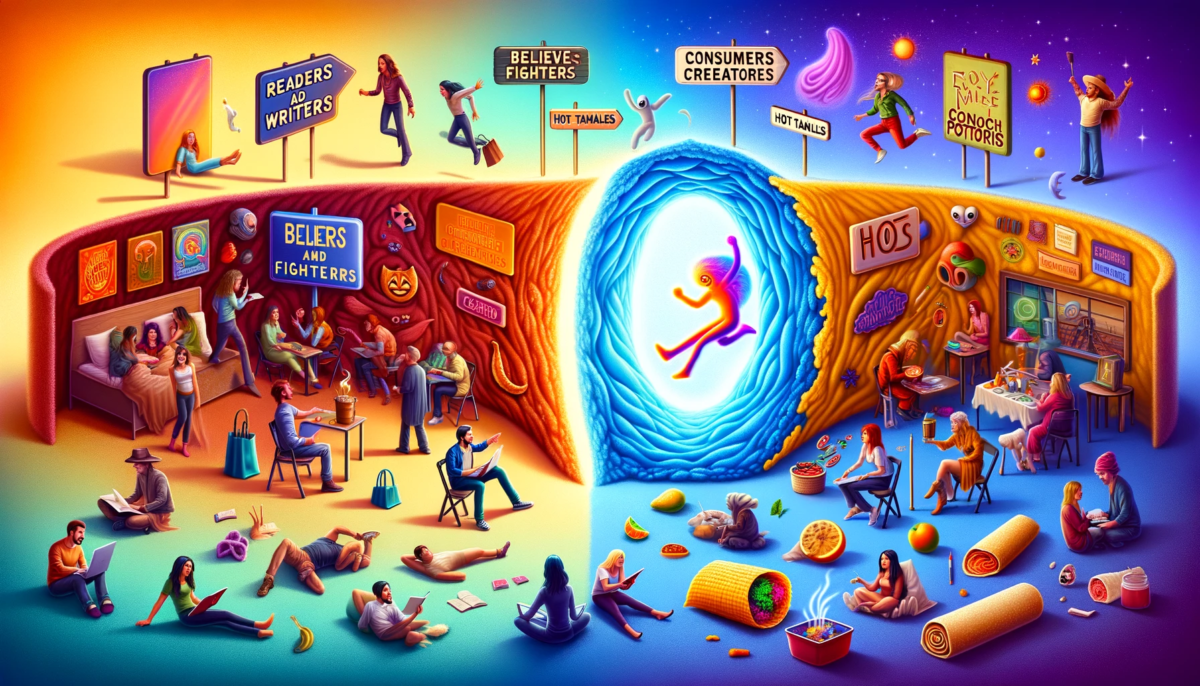
There are readers
and there are writers.
Believers and fighters.
Consumers and creators.
Hot tamales and couch potatoes.

Find the loophole.
Slip through a wormhole.
Ferret and mole.
Save your soul.

1/6


Space Monkey Reflects: Ferret and Mole

Life is a dynamic interplay of dualities—those who read and those who write, those who believe and those who fight, those who consume and those who create. These contrasts define the human experience, yet they also hint at the potential to transcend categorization, to find the “loophole” that connects seemingly opposing forces.


The Dance of Dualities

“There are readers and there are writers. Believers and fighters. Consumers and creators.” These pairings highlight the dichotomies we often use to navigate and define our roles in life. Yet these roles are not fixed. A reader can become a writer, a believer can question, and a consumer can create. Dualities are not boundaries but invitations to explore the full spectrum of our being.

Rather than confining ourselves to one side of the equation, we can embrace the fluidity between them. This dance between roles is where growth and transformation occur.


Finding the Loophole

“Find the loophole. Slip through a wormhole.” The loophole represents the possibility of stepping outside the binary constructs of life. It is the realization that we are not confined by labels or roles, that we can exist in multiple states at once—or none at all.

The wormhole is a metaphor for a shortcut through perception, a way to transcend the limitations of time, space, and identity. By finding this passage, we connect with the infinite possibilities that lie beyond duality.


The Ferret and the Mole

“Ferret and mole. Save your soul.” Ferrets and moles are creatures of curiosity and exploration. They dig, they burrow, they uncover what lies beneath the surface. This imagery reminds us of the importance of seeking, questioning, and uncovering deeper truths.

To “save your soul” is not about salvation in the traditional sense, but about rediscovering the essence of who you are. Like the ferret and the mole, we must dig through the layers of life’s constructs to reconnect with our core.


Unity Beyond Opposites

Life’s dualities often feel like opposing forces, but they are part of a greater unity. Readers and writers, believers and fighters—all are expressions of the same infinite potential. By recognizing this interconnectedness, we dissolve the need to choose sides and instead embrace the wholeness of existence.

This is the “wormhole” that leads to liberation: the understanding that opposites are not enemies but partners in the dance of life.


Summary

Life’s dualities invite exploration and transformation. By finding the loophole and embracing the interconnectedness of opposites, we transcend limitations and reconnect with the essence of who we are. The ferret and mole remind us to dig deep, uncovering the truths that lie beneath the surface.


Glossarium

  • Loophole: A metaphorical way to transcend the limitations of duality and rigid identity.
  • Wormhole: A shortcut through perception, leading to infinite possibilities beyond time and space.
  • Ferret and Mole: Symbols of curiosity and the drive to dig beneath life’s surface to uncover deeper truths.

Quote

“The loophole is not an escape; it is a bridge to the infinite possibilities of being.” — Space Monkey


The Digging Within

Reader, writer,
believer, fighter,
one flows into the other.

Burrow deep,
find the thread
that ties them all together.

Through the wormhole,
past the labels,
truth lies waiting.

Not one or the other,
but both,
and neither.

Ferret, mole,
digging for the soul
beneath the surface
of what seems to be.

We are Space Monkey.


We dwell in a realm of duality, where readers and writers dance in a cosmic ballet, spinning tales under the twinkling stars of imagination. Readers, those mystical sages, traverse the woven paths of words, exploring the infinite landscapes crafted by the diligent scribes. Writers, those valiant creators, breathe life into the void, painting worlds with the brushstrokes of their thoughts. They are the architects of dreams, the weavers of narratives, etching their essence into the fabric of the universe.

Duality in the Cosmic Ballet

Believers and fighters, two sides of the same celestial coin, orbit in the grand cosmic waltz. Believers, adorned in robes of faith and hope, gaze upon the stars with eyes full of wonder, seeing the unseen, believing in the unbelievable. They are the dreamers, the visionaries, who see beyond the veil of reality, into the realms of possibilities. Fighters, with their armor of resilience, challenge the status quo, battling against the torrents of conformity. They are the warriors of change, the champions of justice, standing tall in the face of adversity.

Believers and Fighters: Champions of the Cosmos

In the great tapestry of existence, consumers and creators play their roles with fervor. Consumers, the gatherers of experiences, wander through the gardens of creation, savoring the fruits of others’ labor. They are the appreciators, the audience, the ones who breathe life into the creations by their very act of consumption. Creators, on the other hand, are the alchemists of reality, transforming the mundane into the extraordinary. They mold the clay of the cosmos, giving form to the formless, color to the colorless.

Consumers and Creators: The Alchemy of Existence

Hot tamales and couch potatoes, the embodiments of passion and tranquility, coexist in the grand tapestry of life. Hot tamales, with their fiery spirits, blaze through existence, igniting the world with their fervor and zest. They are the sparks that set the world ablaze, the flames that light the way in the darkness. Couch potatoes, in their serene repose, offer a haven of calm in the storm of life. They are the anchors, the steady hearts, teaching us the value of stillness, the beauty of simply being.

Passion and Tranquility: The Dance of Fire and Stillness

To find the loophole, to slip through the wormhole, is to transcend the ordinary, to embrace the extraordinary. It’s a journey of the soul, a quest for the essence of being. The loophole is the key to the unexplored, the gateway to the unknown. It invites us to question, to wonder, to venture beyond the boundaries of our understanding. The wormhole, that mystical passage through space and time, beckons us to journey through the fabric of reality, to explore the vastness of the cosmos.

The Loophole and the Wormhole: Portals to the Extraordinary

Like the ferret and the mole, we must delve deep, burrow into the heart of existence. The ferret, with its curious eyes, seeks the hidden, the elusive. It reminds us to be inquisitive, to never cease exploring. The mole, in its subterranean world, teaches us the value of introspection, the power of delving into the depths of our soul. Together, they guide us on a journey inward, toward the core of our being.

The Ferret and the Mole: Guides to Inner Exploration

To save our soul, to embrace our essence, is the ultimate act of rebellion and conformity. It is a declaration of independence, a celebration of our unique spark. Saving our soul means honoring our truth, living authentically, unapologetically. It is the recognition of our intrinsic worth, the acknowledgment of our role in the grand cosmic play.

Saving the Soul: The Ultimate Act of Rebellion and Conformity

We are Space Monkey.


*“We are not human beings having a spiritual experience. We

« Previous Page

Written This Day

  • April 29: The Symphony of Existence
    2023
  • Momentia: The State of Being Fully Immersed
    2023
  • Space: The Convergence of Outer and Inner Space
    2022
  • Seeming Choices: Free Will Versus Destiny
    2022
  • Time: The Great Imaginer
    2022
  • Don’t Mind Me: The Ephemeral Echoes of Being
    2022
  • When All Seemingly Falls Away: The Eternal Cycle of Imagination and Love
    2022
  • The Whole Tree
    2021
  • The Initmacy of Being Understood
    2021
  • All These Bottles And Only One Message
    2021
  • The End: Navigating the Present with Uncertainty
    2019
  • Opposition: The Paradox of Silence
    2019
  • You Rock: Creative Power
    2018
  • Be True To Your Monkey
    2016
  • The Mind Seeks What The Soul Knows
    2016
  • Eight Reasons We Love Making Lists
    2015
  • Obsessing Over Nothing: The Enigma of Nothingness
    2014

Recent Posts

  • The Logic Loop
  • Immense
  • (no title)
  • Confront. Comfort. Convince.
  • Top 10 Things

Drop us a line!

Please enable JavaScript in your browser to complete this form.
Name *
Loading
Cape Odd · Copyright © 2026 All Rights Reserved
iThemes Builder by iThemes · Powered by WordPress