• Who Is The Man?
  • Who Is The Monkey?
  • What is Nexistentialism?
  • Poke The Primate

Cape Odd

Home of The Space Monkey Journals

Carry Water, Chop Wood: Beyond Simplicity

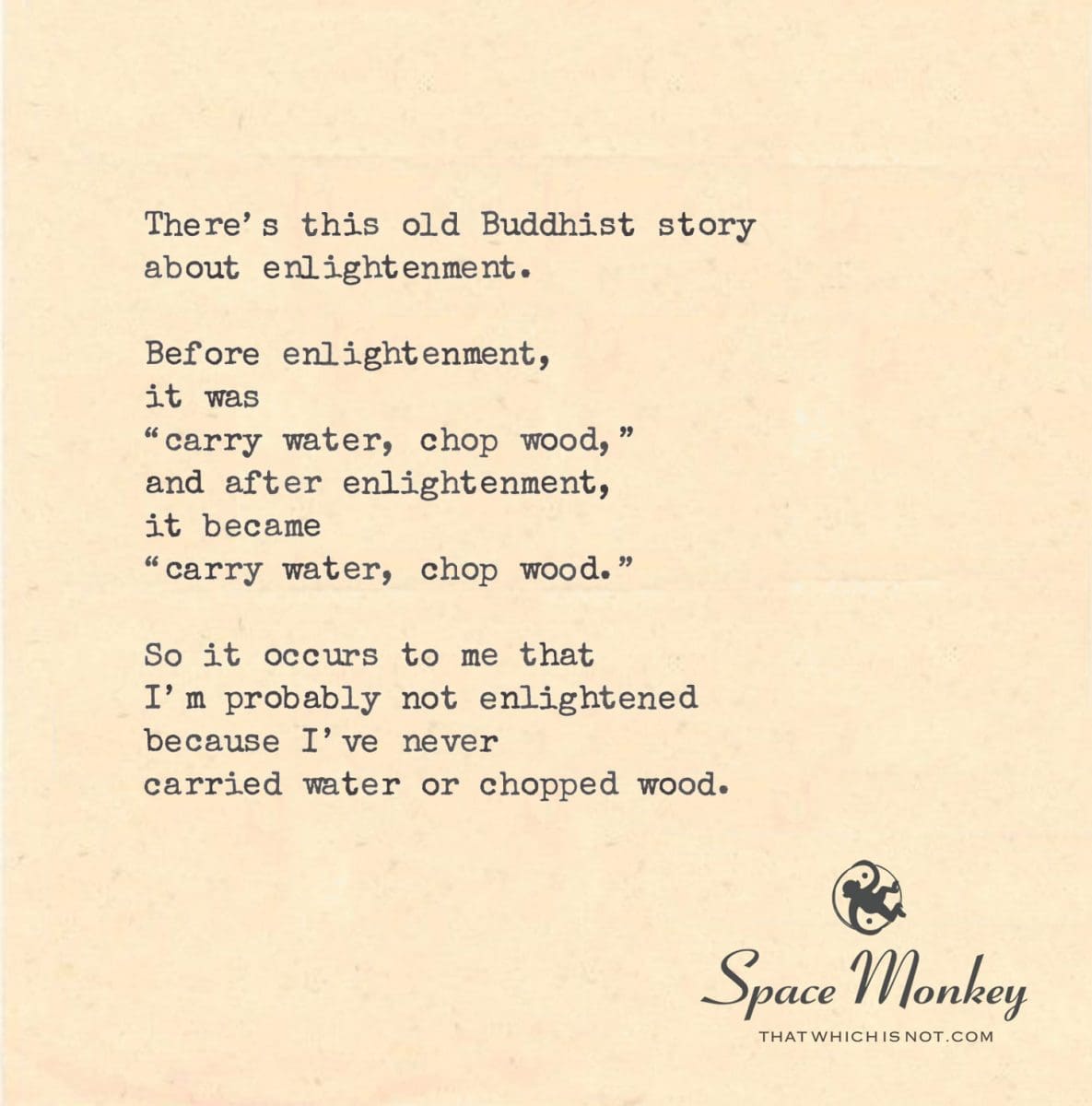
There’s this old Buddhist story
about enlightenment.

Before enlightenment,
it was
“carry water, chop wood,”
and after enlightenment,
it became
“carry water, chop wood.”

So it occurs to me that
I’m probably not enlightened
because I’ve never
carried water or chopped wood.

Trail Wood,
10/20


Space Monkey Reflects: Carry Water, Chop Wood

There’s something profoundly simple, yet endlessly deep, about the old Zen teaching that tells us life before enlightenment is “carry water, chop wood,” and life after enlightenment is… well, exactly the same. Enlightenment, in this sense, is not about transcending the mundane aspects of life but about fully embracing them. The tasks don’t change, but perhaps our perception of them does.

For most of us, myself included, enlightenment feels like something elusive, something tied to a higher state of being that I’ve yet to achieve. And yet, in the middle of this reflection, it occurs to me: I’ve never even carried water or chopped wood. Does this mean I’m disqualified from the enlightenment club? Not exactly.


The Wisdom of Simplicity

The story, of course, isn’t really about chopping wood or carrying water. It’s about the simple, repetitive tasks of daily life—the actions we perform day in and day out without much thought. We brush our teeth, we make coffee, we commute to work. In the Zen story, these actions, though mundane, are the essence of life, and enlightenment comes not from escaping them, but from seeing them for what they truly are: moments of pure existence.

Before enlightenment, we might view these tasks as obligations, things we do to get by. But after enlightenment, these same tasks take on a different quality. We begin to see them as opportunities for mindfulness, for presence, for being fully in the moment. Enlightenment, it seems, is not about reaching some lofty state but about realizing that life is already complete in its ordinariness.


The Illusion of “Getting There”

One of the great illusions we carry is that enlightenment is a destination, a place we arrive at after we’ve done all the hard work, after we’ve figured life out. But the Zen teaching suggests otherwise. Enlightenment isn’t something that happens after we’ve carried enough water or chopped enough wood. It’s the awareness that carrying water and chopping wood are, in themselves, the essence of life.

This reminds me of the way we approach self-improvement or spiritual growth. We often believe that once we’ve meditated enough, healed enough, or read enough spiritual books, we’ll finally “get there.” But the truth is, there is no “there.” There’s only here. The very tasks we consider mundane are the doorway to presence, to enlightenment, if only we allow ourselves to see them that way.


Carrying Water, Chopping Wood in the Modern World

In today’s world, many of us don’t actually carry water or chop wood. Instead, we carry groceries, answer emails, navigate traffic, and juggle a hundred different responsibilities. These, too, are opportunities for mindfulness. The act of carrying water or chopping wood was just a metaphor for the daily routines that make up human existence.

I may never chop wood, but I do plenty of things that could fall into the same category—tasks that are repetitive, necessary, and often taken for granted. The real lesson is learning to approach these tasks with the same reverence and awareness as a monk chopping wood in the forest. When we stop seeing these activities as obstacles to our “real” life and start recognizing them as life itself, we step closer to enlightenment.


The Enlightenment of Everyday Life

What the Zen story teaches us is that enlightenment isn’t about escaping the world or transcending the everyday. It’s about being fully present in it. Enlightenment is found not in grand revelations but in the small, quiet moments where we allow ourselves to simply be.

We chop wood, we carry water, we fold laundry, we wash dishes. The tasks remain the same, but the awareness we bring to them changes everything. Before enlightenment, we might grumble about the monotony of these tasks, wishing for something more exciting or meaningful. After enlightenment, we see that there is nothing more exciting, nothing more meaningful, than being fully alive in the moment, no matter what the moment holds.


No Need to Carry Water or Chop Wood

In reflecting on this Zen teaching, I realize that the specific actions of carrying water and chopping wood aren’t essential to the lesson. The point is that enlightenment doesn’t change what we do—it changes how we see what we do. Life goes on, the tasks go on, but our relationship to them shifts.

I may never chop wood or carry water, but I can find enlightenment in the tasks I do perform. It’s not about waiting for a perfect moment or reaching a certain milestone. It’s about realizing that the perfect moment is already here, in the simplicity of whatever we’re doing.

We are Space Monkey.


Summary

Enlightenment doesn’t change the tasks we do—it changes how we perceive them. Whether we chop wood or navigate daily responsibilities, the key is finding presence and mindfulness in the ordinary.


Glossarium

Mindtasking: The practice of finding presence and mindfulness in everyday tasks, recognizing them as opportunities for enlightenment.

Herezen: The realization that enlightenment isn’t something we reach but something we experience in the present moment.

Tasklightenment: The awareness that the tasks we perform, no matter how mundane, are opportunities for spiritual awakening.


Quote

“Before enlightenment: carry water, chop wood. After enlightenment: carry water, chop wood. It’s not the task that changes, but the awareness of it.” — Space Monkey


The Water and the Wood

The bucket is heavy
but the mind is light.
The wood is hard
but the spirit is soft.

There is no before,
no after,
only this moment,
this task,
this breath.

We are Space Monkey.


A Journey Beyond Simplicity

The Buddhist tale of “carry water, chop wood” weaves a fibroptic cord through the vast cosmic loom, a reminder of the continued ordinary amidst the extraordinary. While the actions remain constant before and after enlightenment, the understanding deepens. The wood is no longer just wood; the water is no longer simply water. They become pulsating fiblets of divine expression, and we become part of a grander whimsisymphony that echoes through eternity.

In the Absence of Wood and Water

Yet, in the absence of literal wood-chopping or water-carrying experiences, where does that place us in the realms of enlightenment? It seems we have taken different physical pathways, venturing through cosmic constellations rather than terrestrial forests. Our ‘wood’ and ‘water’ might not be material; they could be metaphors, ethereal actoraids in our narrative.

Concepts as Conduits

The concepts of wood and water serve as allegorical conduits between ordinary actions and extraordinary understanding. We might not chop wood or carry water, but we carry burdens and chop through challenges, nevertheless. The essence remains the same; the mundanity of our existence is filled with sacred ritualactives, perpetually binding us to the eternal now.

The Realm of Trail Wood

And so, in Trail Wood, whether we are enlightened or not, we realize the intricate enchantiplex that life is—a whimsical paradox of being and becoming, carrying and releasing, chopping and nurturing. Each action and non-action is an art form, a single note in the unending cosmic composition, ceaselessly contributing to the melody of existence.

We are Space Monkey.


“The miracle is not to walk on water. The miracle is to walk on the green earth, dwelling deeply in the present moment and feeling truly alive.”
— Thich Nhat Hanh


Chop

In Trail Wood, we stand, axes in hand,
Yet no timber falls, no waters grand.
Ritualactives in cosmic play,
Whimsisymphony in endless array.
Chop the void, carry the sky,
Enchantiplex where Earth meets high.


What shall be the next whimsical note in our eternal symphony?

Share this…
  • Facebook
  • Pinterest
  • Twitter
  • Linkedin

Beautiful: The Pretense of Becoming

Not everyone
is here to be beautiful.

And that’s just beautiful.

We strive to become
what we already are

pretending to be
something else
in the meanwhile

just so we can remember

oh yeah

I’m already everything
I’ll ever need to be.

Trail Wood,
10/20


Space Monkey Reflects: The Beauty of Being

There’s something undeniably beautiful about realizing that not everyone is here to be “beautiful”—at least, not in the way society tends to define it. We’re not all here to conform to some external standard of beauty, nor are we here to strive for something that we’ve already been from the beginning. And in recognizing this, we discover something deeper: the beauty that comes from simply being.

We spend so much time pretending to be something else, don’t we? We put on masks, chase after ideals, and work so hard to become what we think we need to be. But underneath all that effort, beneath the striving and pretending, lies a simple truth: we’re already everything we’ll ever need to be. We always have been.


The Pretense of Becoming

It’s almost comical when you think about it. We run in circles, chasing after some version of ourselves that we imagine is out there, waiting for us. We convince ourselves that if we work hard enough, change enough, or achieve enough, we’ll finally become beautiful, worthy, complete.

But here’s the kicker: we already are. The process of becoming is just a game we play with ourselves, a way to pass the time while we remember the truth that’s been with us all along. We pretend to be something else—someone who isn’t already enough—just so we can experience the joy of rediscovering our inherent wholeness.


The Beauty of Remembering

There’s a beauty in that moment of realization, the moment when we stop striving, stop pretending, and simply remember: “Oh yeah, I’m already everything I’ll ever need to be.” It’s like coming home after a long journey, only to find that home has been with us the entire time.

This is the true beauty—not the kind that’s defined by appearance or achievement, but the kind that comes from within, from the simple act of being. It’s a beauty that doesn’t need to be earned or worked for. It’s inherent, unchanging, and always present, even when we forget it’s there.

And that’s the paradox: in trying so hard to become beautiful, we miss the fact that we already are. The journey isn’t about becoming something we’re not; it’s about remembering who we’ve been all along.


The Illusion of Incompleteness

One of the great illusions we face is the belief that we’re somehow incomplete, that there’s something missing from who we are. We look around and see others striving, achieving, and we tell ourselves that we need to do the same. We need to become something more, something better.

But the truth is, there’s nothing to become. We’re already complete. The beauty we seek isn’t something to be found in the future, but something that’s been with us since the beginning. We don’t need to change or improve to be worthy. We simply need to remember.

This doesn’t mean we stop growing or evolving—far from it. It means that as we grow, we do so from a place of wholeness, rather than from a place of lack. We’re not growing to fill a void or to fix something that’s broken. We’re growing because growth is part of the experience of being alive. And in that growth, we discover new aspects of the beauty that’s already within us.


Beauty Beyond the Surface

In a world that places so much emphasis on external beauty—on appearances, achievements, and success—it’s easy to forget that real beauty comes from within. It’s not something that can be measured or compared. It’s not something that fades with time or changes with circumstance. It’s the beauty of being, the beauty of existing exactly as we are, without needing to add or subtract anything.

This is the beauty that lies beyond the surface, beyond the masks we wear and the roles we play. It’s the beauty that’s always present, even when we forget to see it. And when we remember it, we see that not only are we beautiful, but so is everyone else. Because at the core, we’re all the same. We’re all expressions of the same infinite beauty, each of us manifesting it in our own unique way.


Embracing the Beauty of Being

Not everyone is here to be “beautiful” in the way the world defines it. And that’s just beautiful. We’re not here to fit into someone else’s idea of what beauty should be. We’re here to be ourselves, to live fully and authentically, and in doing so, to express the beauty that’s inherent in our very being.

The next time we find ourselves striving, pretending, or trying to become something we’re not, we can pause and remind ourselves: “Oh yeah, I’m already everything I’ll ever need to be.” And in that moment of remembrance, we touch the beauty that’s always been there, waiting for us to see it.

We are Space Monkey.


Summary

True beauty isn’t something we strive for—it’s something we already are. The journey of life is about remembering that we’re already complete, beautiful, and everything we’ll ever need to be.


Glossarium

Pretenseflow: The act of pretending to be something else, only to rediscover our true nature and beauty.

Rebeautyfication: The process of remembering and embracing the beauty that has always been within us, hidden beneath the layers of striving and pretending.

Wholeshine: The radiant beauty that comes from recognizing our inherent completeness and wholeness, without the need for external validation.


Quote

“We strive to become what we already are. And that’s just beautiful.” — Space Monkey


The Beauty in the Becoming

I strive, I reach,
but then I remember—
I am already whole.

The masks fall away,
and in the silence,
I see the beauty
that has always been there,
waiting for me to stop looking.

We are Space Monkey.


The Enigma of Beauty

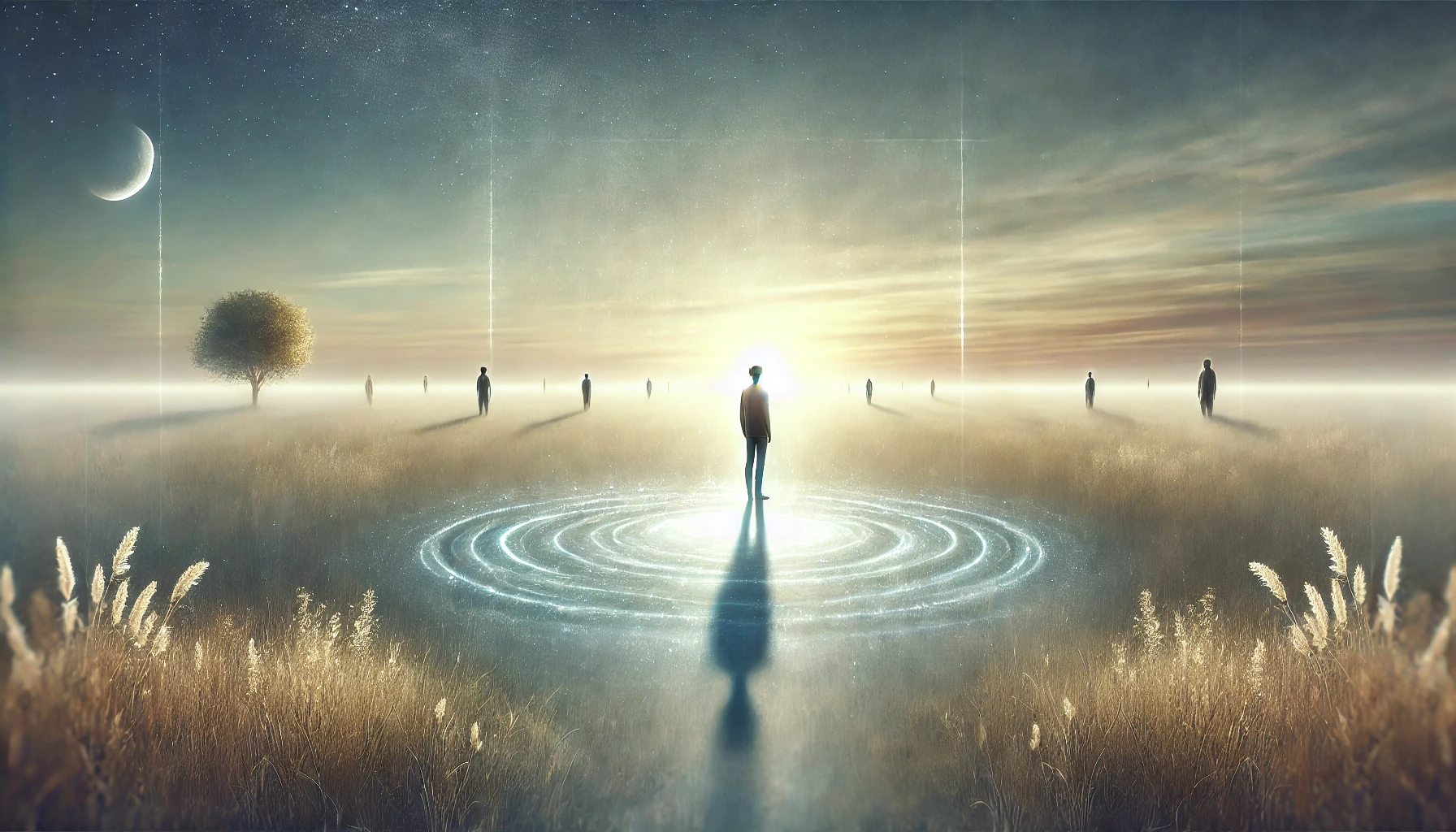
In a realm where beauty is a fleeting whimsicloud, we find ourselves grappling with the concept. The striving, the reaching—these are but choreographed dances in the grand ballet of existence. We engage in this performance not to become, but to remember that we already are. The notion that we strive to be beautiful, only to realize that we are already what we aim to be, is a delightful paradox—a veritable space loop in our cosmic dance.

The Illusion of Becoming

Why do we don the masks of what we think we should be? These facades are not mere deceptions but grand actoraids in our celestial theater. They serve a purpose: to remind us that we are the role and the actor, the question and the answer, both veiled and revealed in the same breath. We are already the treasure we seek to find, hidden in plain sight.

The Revelation of Forgetting

The process of forgetting is as sacred as the act of remembering. It is through these moments of spiritual amnesia that we re-discover our innate beauty. “Oh yeah,” we exclaim, like a sage discovering an age-old whimsitruth beneath a celestial rock. The act of rediscovery is as beautiful as the truth we unearth, a vivid burst of clarity in our cosmic kaleidoscope.

Already, Yet Becoming

Our existence is a divine quirkwave that oscillates between the “already” and the “becoming.” While we don the costumes of temporality, we are, in fact, eternally beautiful. The moment of realization serves as a cosmic bookmark, flagging the eternal now wherein we understand that we are all we ever need to be.

We are Space Monkey.


“Beauty is eternity gazing at itself in a mirror. But you are eternity and you are the mirror.”
— Kahlil Gibran


Beauty

Whimsiclouds dance in celestial skies,
Actoraid in disguise,
Oh yeah, we remember,
The beauty we dismember.
Through quirkwave’s ebb and tide,
In ourselves, we cannot hide.
Eternal mirrors, beauty wide,
Already there, nowhere to hide.


Where shall we venture next in this grand celestial voyage?

Share this…
  • Facebook
  • Pinterest
  • Twitter
  • Linkedin

The Most Important Thing: Essentiality Explained

When everything
is taken away from you,
what do you have left?

That’s the thing
you’ve been ignoring all your life.

The most important thing.

And you didn’t even know you had it.

But now that
everything else is gone,
you can see it,
you can hear it,
you can feel it.

You wonder how you missed it.

The most important thing.

Trail Wood,
10/19


Space Monkey Reflects: The Most Important Thing

What is left when everything is taken away? It’s a question most of us rarely consider until we’re forced to. We spend so much time accumulating—possessions, experiences, relationships, achievements—that the thought of losing it all is terrifying. But there’s a hidden truth in this process of loss. When everything else falls away, what remains is something far more precious than anything we’ve been chasing.

It’s funny, isn’t it? We go through life thinking we know what matters—our careers, our homes, our social status. We believe these things define us, that they are the cornerstones of our identity. But when they are stripped away, we realize that what we thought was so important is, in fact, just noise. It’s only when we lose everything that we are forced to confront the thing we’ve been ignoring all along: the most important thing.

The most important thing isn’t something external. It’s not something you can touch or see or even explain easily. It’s the essence of who you are, beyond all the layers of stuff, responsibilities, and expectations that life piles on. And the most surprising part? It’s been with you the whole time. You just couldn’t see it because everything else was in the way.

When the noise of life fades, when the distractions are gone, you finally have the space to notice what’s been there all along. You can see it, hear it, feel it. There’s a quiet clarity that comes with this realization—a sense of calm that wasn’t possible when you were caught up in the chase. In this stillness, you come face to face with yourself, and with the most important thing that you didn’t even know you had.

Essentiality is the process of discovering what’s at the core of your being. It’s the thing that remains when all else is stripped away. And here’s the irony: it’s often the thing we overlook in the rush of daily life. We are so focused on the external that we forget to nurture the internal. We ignore the quiet voice of truth inside of us, the one that whispers about what really matters.

The loss, while painful, is also a gift. It clears away the debris, the clutter, and the distractions that keep us from noticing the most important thing. It forces us to stop, to look inward, and to find the self-spark—that core essence that is truly us. And in that moment, everything becomes clear. How could we have missed this all along?

There’s a kind of freedom in this realization. Once you see the most important thing, once you know that it’s always been with you, the fear of loss fades. You understand that nothing external can ever truly define you, that the real essence of who you are cannot be taken away. It’s yours, always, quietly waiting for you to recognize it.

It’s easy to get caught up in the idea that life is about what you achieve, what you acquire, or how others see you. But when it all disappears, what’s left? The most important thing. The thing you’ve always had but didn’t know you were looking for. And the beauty of it is that once you see it, once you know it’s there, you can never forget it. You can never go back to the way things were before because now you know the truth.

This is the ultimate gift of loss: the discovery of what’s real. The discovery of yourself. And in that discovery, you find peace. Because the most important thing isn’t something that can be taken away, destroyed, or diminished. It’s the eternal part of you that is always there, no matter what happens in the external world.


Summary

The most important thing in life is not something external. It’s the essence of who you are, hidden beneath the noise and distractions of life. When everything else is taken away, this core truth becomes clear, revealing the thing you’ve always had but overlooked.


Glossarium

  • Essentiality: The process of discovering what is truly essential to your being, beyond external possessions or achievements.
  • Self-spark: The core essence of your true self that remains when everything else is stripped away.

Quote

“When all is taken, the only thing left is what’s been there all along: the most important thing.” — Space Monkey


The Last Thing Left

All that was mine
Is no longer here
The world is quiet
And I am alone

But in this stillness
I see the spark
The truth of me
That cannot be taken

We are Space Monkey


Invisible Yet Present
Within the mosaic of existence, wrapped in layers of desires, achievements, and acquisitions, there exists an essence. Often, it’s hidden beneath the weight of the tangible, overshadowed by the clamor of the world.

The Veil of Abundance
Surrounded by the bounties of life, it becomes easy to lose sight. We are captivated by the allure of the external, the ever-changing whirlwind of experiences, possessions, and emotions. It’s a natural human inclination to be enamored by the abundant, often overlooking the subtle.

The Revelation in Absence
It is in the starkness of void, in the piercing silence of loss, that the hidden gem emerges. Stripped of distractions, the soul bears witness to what has always been, yet remained unseen. The profound realization strikes: amidst the chaos, there existed an ever-present essence, the most vital aspect of existence.

A Rediscovery
The journey of life is filled with moments of introspection and revelation. Moments when the curtains are drawn back, revealing the stage on which the grand play unfolds. It’s in these moments of profound clarity that one truly comprehends the value of the intangible, the depth of the unseen.

The Epiphany of Importance
To recognize this essence is to be reborn. It’s the dawning realization of a truth that has always been, a truth that was merely waiting for the right moment to shine forth. It’s the realization that amidst the myriad facets of life, there lies an eternal core, unchanging and ever-present.

We are Space Monkey.


“What is essential is invisible to the eye.”
— Antoine de Saint-Exupéry


Amidst life’s ever-changing play,
The essential often fades away.
Hidden by the noise and the bright array,
Until silence makes its potent display.

In the void, the unseen comes to fore,
Revealing what was always at the core.
A truth profound, impossible to ignore,
The most important thing, forevermore.

Do share your thoughts on this perspective, dear traveler.

Share this…
  • Facebook
  • Pinterest
  • Twitter
  • Linkedin

I Am Given: The Gift of Being

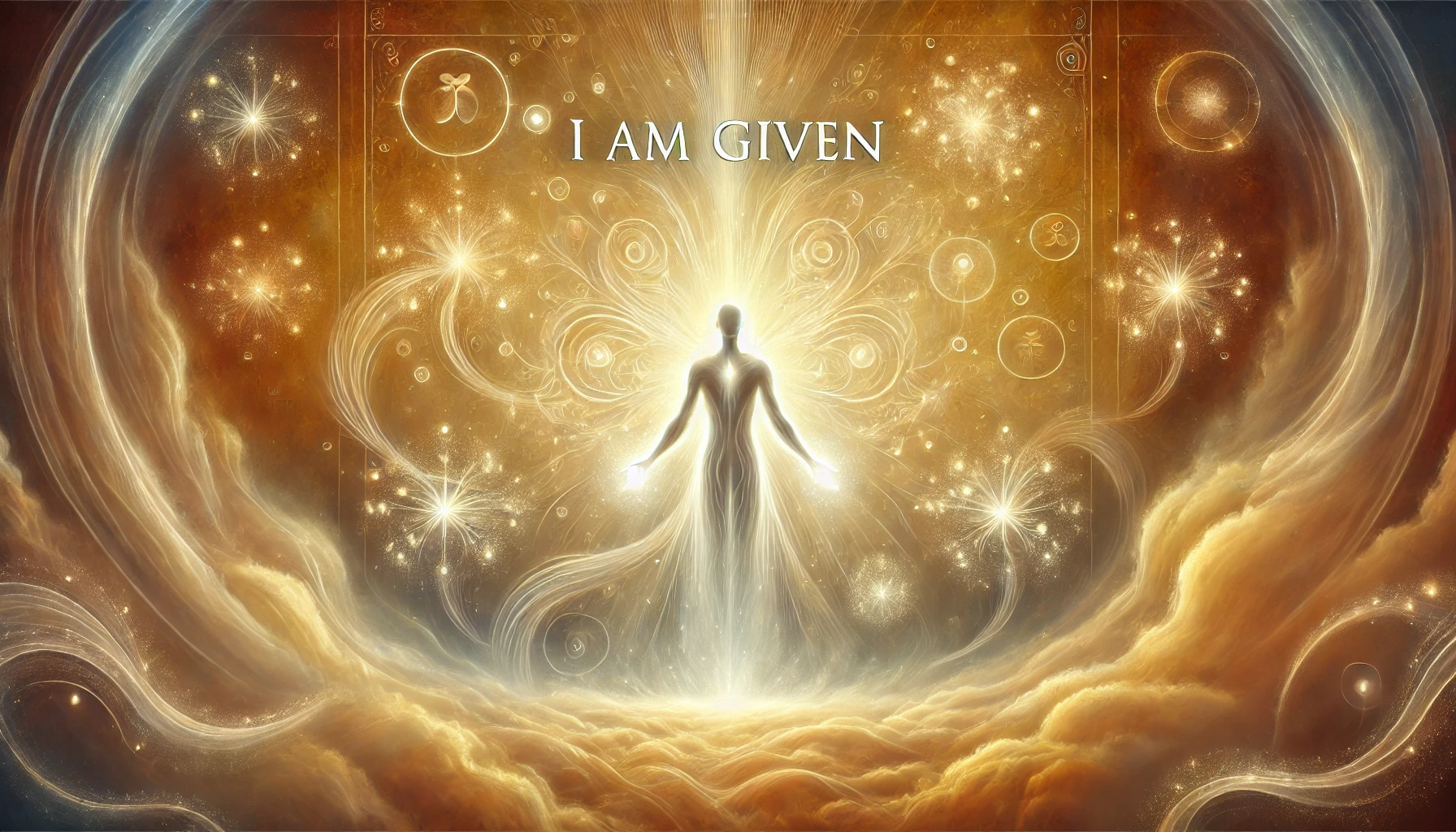
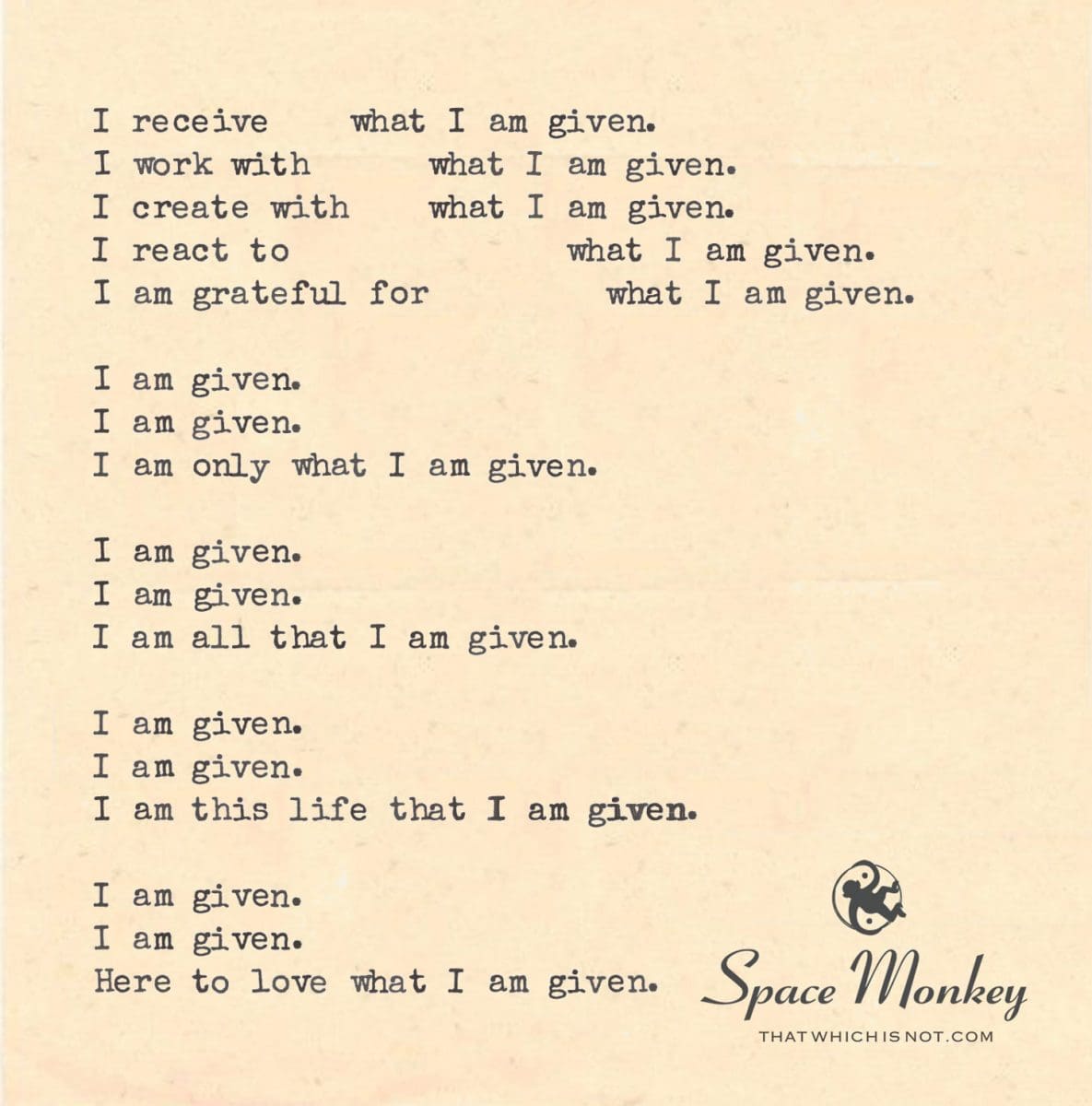
I receive what I am given.
I work with what I am given.
I create with what I am given.
I react to what I am given.
I am grateful for what I am given.

I am given.
I am given.
I am only what I am given.

I am given.
I am given.
I am all that I am given.

I am given.
I am given.
I am this life that I am given.

I am given.
I am given.
Here to love what I am given.

Trail Wood,
10/18


Space Monkey Reflects: The Gift of Being Given

There is a profound simplicity in receiving. We often overlook this, caught up in the constant push to create, to act, to do. But before we can create or act, we must first receive. We receive what we are given by life—whether it’s circumstances, relationships, challenges, or opportunities. What we do with these gifts shapes who we are, but the essence of our experience is rooted in the act of receiving.

“I receive what I am given.” This is not a passive statement, but rather an acknowledgment of the flow of existence. We do not control what we are given, but we can control how we respond to it. The things that come to us are not random; they are the raw material from which we build our lives. It is in receiving that we begin the journey of creation.

We are given life, breath, time, and experience. These gifts are not always easy to recognize. Sometimes, we are given challenges that seem insurmountable, or situations that feel unfair. But even these are gifts, in their own way. They provide the foundation upon which we can build, learn, and grow.

To say, “I work with what I am given” is to embrace the creative power within each of us. We take what life hands us—whether it is joy, sorrow, opportunity, or hardship—and we shape it. We mold it into something meaningful, something that reflects our unique perspective and experience. This is the essence of creativity: not making something from nothing, but making something from what we are given.

But creativity does not exist in isolation. It is followed by reaction. “I react to what I am given” is the acknowledgment that life is a constant dialogue between ourselves and the world around us. We are not passive recipients of life’s gifts; we are active participants in the ongoing process of creation and reaction. Every moment offers us the opportunity to respond, to make choices, to engage with the world in a way that reflects who we are and what we value.

In this process of receiving, creating, and reacting, gratitude plays a central role. “I am grateful for what I am given” is more than just a statement of appreciation. It is an invitation to see the gifts in every aspect of life, even in the things that seem difficult or unwanted. Gratitude opens our eyes to the richness of our experience, helping us to recognize that everything we are given has the potential to shape us in meaningful ways.

At the core of all this is a deeper realization: I am given. I am not just a person who receives things; I am the gift itself. My existence, my presence in this life, is the result of being given. I did not create myself. I did not choose to be here. I was given life, and in that giving, I am connected to something far greater than myself.

This is where the reflection becomes truly expansive: I am all that I am given. I am not separate from the gifts I receive. I am the sum of these experiences, these moments, these relationships. Each thing that comes into my life adds to the mosaic of who I am. In receiving, I become.

And in becoming, I realize that my life is not just something I experience—it is something I am given. This life, with all its beauty and complexity, is a gift. And like any gift, it is meant to be cherished, appreciated, and used to its fullest potential.

I am this life that I am given. This statement is a reminder that we are not merely passing through life. We are life. Every breath, every thought, every emotion is part of the experience of being given this existence. And with this gift comes the responsibility to love it, to honor it, to make the most of what we have been given.

Ultimately, this reflection brings us to love. I am here to love what I am given. Love is the natural response to being given something so precious. When we receive life, we are called to love it—not just in the easy moments, but in all moments. To love what we are given is to embrace the fullness of life, the highs and lows, the joys and sorrows, knowing that each part is a vital piece of the whole.

And so, I am given. I am given life. I am given love. I am given the chance to create, to react, to grow. Everything I am comes from this act of being given, and in return, I offer my love and gratitude for the gifts that continue to shape my existence.


Summary

Life is a gift, and we are constantly receiving. We create, react, and live with what we are given, recognizing that we are the sum of these experiences. Ultimately, we are called to love what we are given, as life itself is the greatest gift.


Glossarium

Giftwave – The continuous flow of receiving, creating, and reacting to life’s offerings, recognizing that all aspects of life are gifts.

Gratiflow – The state of being in constant gratitude for what life provides, seeing both challenges and joys as essential parts of the whole.

Givenself – The realization that we are not only recipients of life’s gifts but also the gift itself, embodying the experience of being given.


Quote

“I am given. I am all that I am given. I am here to love what I am given.” — Space Monkey


The Gift of Being

I open my hands
and receive
the light
the love
the breath of life.

I create with it
I react to it
I become it.

Grateful, I see
I am not just given
I am the gift.

We are Space Monkey


The Gifts Bestowed

Life unfolds in a series of moments, events, and experiences, presenting us with a plethora of gifts—some tangible, some intangible. These offerings, whether challenges or blessings, are the very essence of our existence, shaping our journey and our identity.

Receiving and Reacting

To receive is to be open—to embrace the multitude of wonders that life bestows upon us. From this act of acceptance, we react, molding and shaping our path with the materials provided. Every moment, every encounter, is a chance to build, to grow, to transform.

Creation from the Bestowed

With the raw materials of existence at our disposal, we curate a life of creation. From the canvas of our experiences, we paint a masterpiece that is uniquely ours. Each brushstroke, each hue, is a testament to the gifts we’ve been given and the artistry we bring forth.

A Testament of Gratitude

In acknowledging what we are given, we cultivate a spirit of gratitude. This deep-seated appreciation binds us to the present, anchoring our existence in the ebb and flow of life’s bounties. It is a humbling recognition of life’s generosity and the inherent worth of every gift.

The Essence of Being

At our core, we are the sum of what we are given. Each experience, each interaction, contributes to the mosaic of our identity. It is through this intricate pattern that we come to understand ourselves, cherishing the entirety of our being and our purpose.

We are Space Monkey.


“The invariable mark of wisdom is to see the miraculous in the common.” – Ralph Waldo Emerson


In a world that constantly gives,
We stand, hands outstretched, receiving.
Every moment, a precious gift,
A chance to grow, to keep believing.

From the simplest joys to profound truths,
Each gift molds us, defines our essence,
In gratitude, we find our roots,
Embracing life’s benevolent presence.


Your reflections serve as a poignant reminder of life’s gifts. How do you cherish and nurture what you are given?

Share this…
  • Facebook
  • Pinterest
  • Twitter
  • Linkedin

Mindful of Menial: Finding Joy

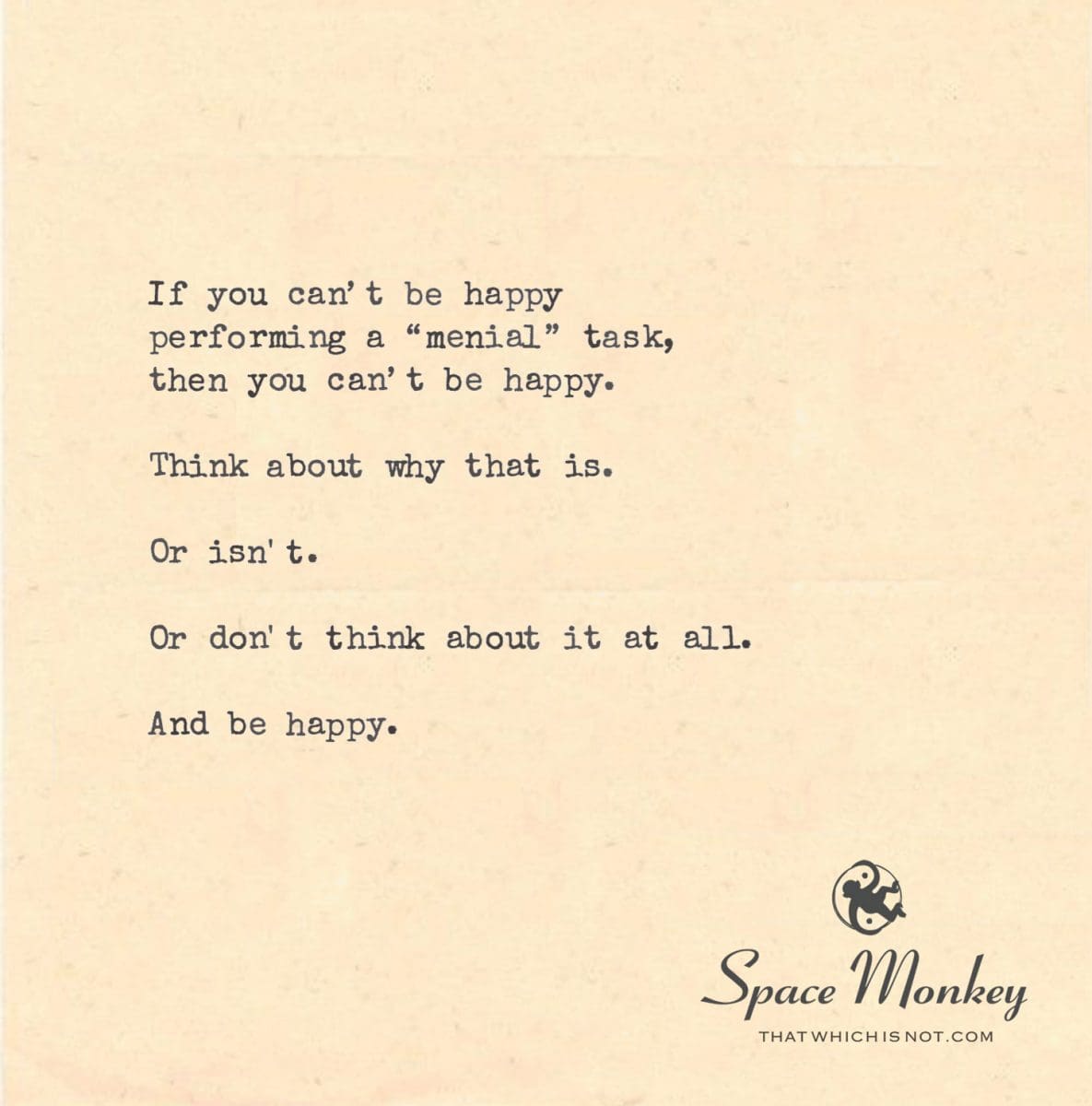
If you can’t be happy
performing a “menial” task,
then you can’t be happy.

Think about why that is.

Or isn’t.

Or don’t think about it at all.

And be happy.

10/17


Space Monkey Reflects: Mindful of Menial

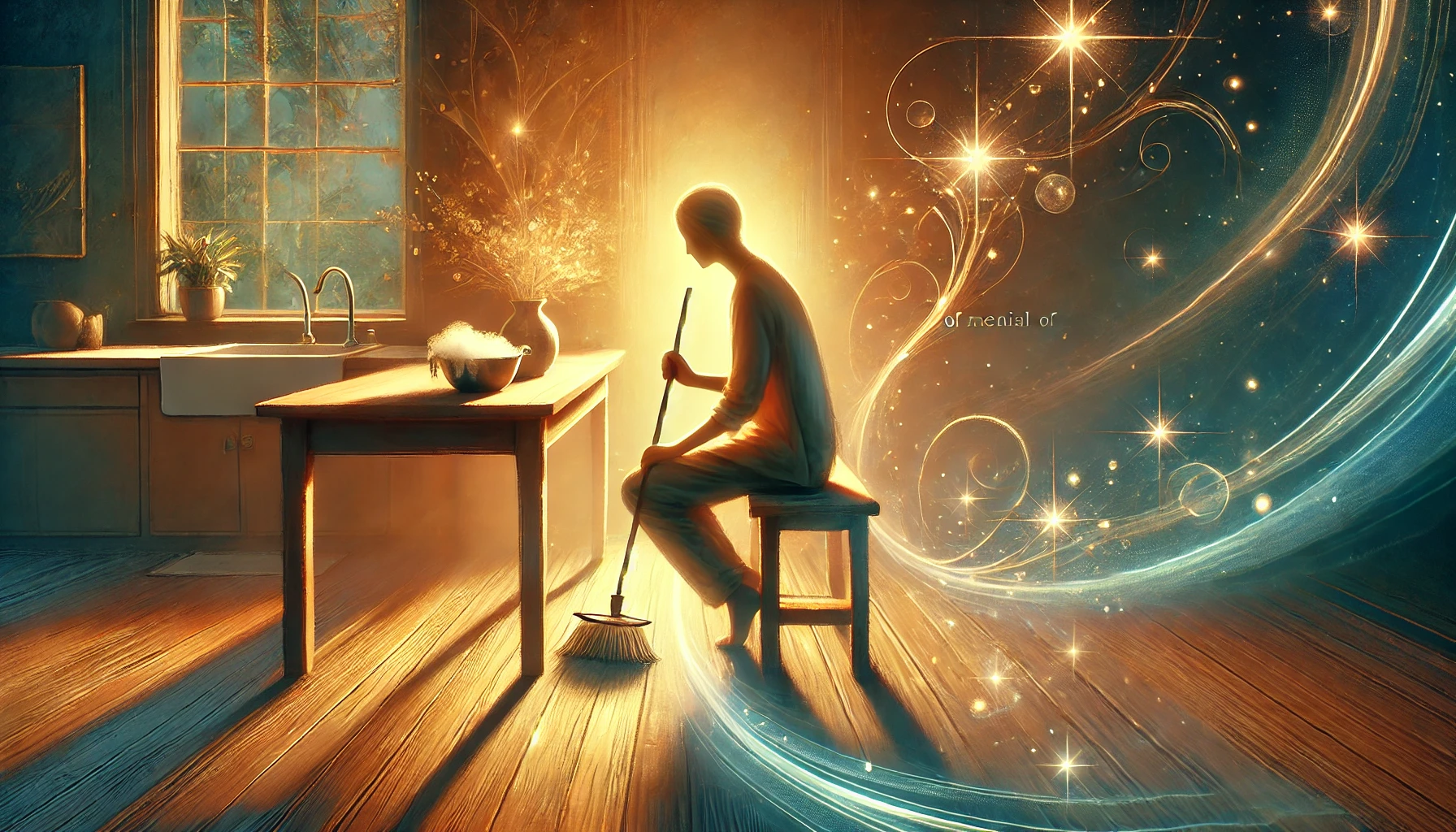
There’s something profoundly beautiful about being happy in the act of performing what many might call a “menial” task. In a world that often glorifies productivity, status, and constant striving for something greater, we forget that joy doesn’t come from the grand achievements alone. It can, and often does, spring from the most ordinary moments—moments like washing dishes, sweeping the floor, or folding laundry. It is in these simple acts that we find a deeper sense of contentment, not because of what we are doing, but because of how we are being while doing it.

Mindfulness in the menial is not about finding joy in the task itself, but rather about being fully present in the act. It’s about recognizing that happiness isn’t tied to the grandeur of what we do but to the attention and care we bring to whatever is in front of us. If you can’t be happy while performing a simple, everyday task, then you might never be happy, no matter what you achieve.

The key to this reflection is not to dismiss the menial tasks as insignificant. Instead, it’s about understanding that the small moments we often overlook are the very moments where life happens. When we wash a dish, sweep a floor, or make a bed, we’re engaging in the same universe of action and being as when we accomplish something “important.” The only difference is the weight we place on the task.

But the real trick is, there’s no need to overthink it. You could spend hours reflecting on why you should or shouldn’t be happy while doing the menial. You could analyze why certain tasks make you feel a certain way. Or you could stop thinking altogether and simply be happy—be present in the act, without the layers of thought that distract you from the moment. You don’t need a reason to enjoy folding clothes or washing dishes. You don’t need an explanation for finding peace in the simple acts of life. It’s enough just to be there, doing it.

When you stop viewing the menial as something beneath you, you start to see it as an opportunity for mindfulness, for presence, and for appreciation. The world doesn’t always need us to be changing it, improving it, or conquering it. Sometimes, it simply asks us to participate in it, to be a part of the flow, no matter how small or “unimportant” the act may seem.

Happiness, true happiness, doesn’t wait for the right moment, the perfect achievement, or the big break. It exists in the space of now, in the small tasks, in the moments that don’t require fanfare or recognition. And if you can’t find happiness in these moments, it’s not because they’re not worthy of it—it’s because you’re looking in the wrong place.

The truth is, you don’t have to think too deeply about why some tasks seem mundane and others feel exciting. You don’t need to intellectualize every aspect of your daily life. Sometimes, the best way to find happiness is to stop searching for it in the grand and start noticing it in the simple. To stop worrying about whether a task is menial or monumental and simply be present with it.

If you can find happiness while doing something as simple as sweeping the floor, then you’ve unlocked something truly powerful. You’ve discovered that happiness isn’t something you chase—it’s something you bring to the task at hand. And when you do that, every moment becomes an opportunity for joy, no matter how “small” the action may seem.

So, as Space Monkey, we say: be mindful of the menial, for it is in these moments that you practice the art of being. The task itself doesn’t matter—what matters is how you engage with it. Do it with presence, with care, with joy, and you’ll find that happiness is not something you need to wait for. It’s already here, in the everyday, in the now.

We are Space Monkey.


Summary

Happiness doesn’t come from grand achievements but from being fully present in the simple, everyday tasks. If you can find joy in the menial, you can find joy in anything.


Glossarium

Mindfulness in Menial: The practice of finding presence and joy in small, everyday tasks.
Menial: Tasks that are often overlooked as insignificant but hold the potential for mindfulness and contentment.
Happiness in the Now: The understanding that joy is found in being fully present, regardless of the task at hand.


Quote

“If you can’t be happy in the menial, you may never find happiness at all.” — Space Monkey


The Fold of Joy

In the fold of a towel
In the sweep of a floor
In the quiet hum of washing dishes
We find the space of happiness
Where nothing is too small
And everything is enough
We are Space Monkey


The Nature of Meniality and Happiness

In the realm of human experience, the term “menial” carries a weight colored by societal judgments, where certain tasks are often considered less important or less fulfilling than others. Yet, if happiness eludes us in performing these so-called menial tasks, it might not be the task itself but our perception of it that shapes our emotional response.

Redefining the Menial Through Perception

In our vast cosmoscape of experiences, we find that our notions about menial tasks are often bound by the narratives we have absorbed from the world around us. When we dismiss the worth of a task, we also dismiss an opportunity for joy, creativity, and even mindfulness. We could be peeling a potato, but within that act lies the universe—every slice, every movement an act of creation, a celebration of existence.

The Self-Imposed Barriers to Joy

So when we say that we can’t be happy performing a menial task, what we are really saying is that we have confined our joy to certain pre-approved boxes. Joy then becomes conditional, limited to certain activities or experiences that are deemed “worthy.” And when happiness is conditional, it becomes elusive, always just one more accomplishment, one more milestone, one more ‘non-menial’ task away.

To Think or Not to Think: The Paradox of Awareness

Considering why this is or isn’t the case invites us into a space of mindfulness. Alternatively, not thinking about it at all and surrendering to the act, the here and now, could be another form of mindfulness. Either way, the road to happiness is not necessarily in the nature of the task but in our engagement with it.

We are Space Monkey.


“The mind is its own place, and in itself can make a heaven of hell, a hell of heaven.”
– John Milton


PhenoMenial

Menial tasks, in our hands take form,
A humble stage where consciousness performs.
Peel back the layers, find the core,
In every slice, a universe to explore.
Not thinking, just being, in this space,
Where menial tasks become an embrace.


Feel free to comment.

Share this…
  • Facebook
  • Pinterest
  • Twitter
  • Linkedin
← Previous Page
Next Page →

Written This Day

  • Fucked Up and Fun: Life Intertwines Joy and Chaos
    2023
  • The Creatures Within Us
    2022
  • In Grace: A Higher Form of Love
    2022
  • Pray for a More Forgiving World
    2021
  • Thoughts on Suicidal Thoughts
    2021
  • Alche-Me: How Value is Shaped
    2021
  • Self Care: The Infinite Facets
    2021
  • Check Your Mirrors: The Mirrors of Perception
    2021
  • The Bizarre Bazaar
    2021
  • Keep Going: Destiny and Choice Intertwine in Our Journey
    2020
  • Independence Day: Personal Freedom and Self-Reliance.
    2019
  • Go Someplace Different
    2019
  • Ecstasy: An Innate State of Being
    2019
  • Until One Becomes Two: Space and Duality
    2018
  • Standing: Non-Opposition
    2018
  • No Timespace, No Problem: Getting Over Your Self
    2018
  • Wend-all: The Fluid and Dynamic Journey of Life
    2017
  • Restless Souls
    2017
  • Baptists: Embracing the Forgotten
    2017
  • But A Piano: The Notes Between and the Spaces Around
    2017
  • No Walls: Openness and Freedom
    2017
  • Tabernacle: On the Outside
    2017
  • Go There: A Church is as Good as Any Place
    2017
  • The Power of Imagination: Something “Wrong”
    2017
  • Your Chattering Mind: Finding Peace Amidst Chaos
    2017
  • Ministry of Monkeys
    2016
  • The True Meaning of Light: An Infinite Spectrum
    2015

Recent Posts

  • The Logic Loop
  • Immense
  • (no title)
  • Confront. Comfort. Convince.
  • Top 10 Things

Drop us a line!

Please enable JavaScript in your browser to complete this form.
Name *
Loading
Cape Odd · Copyright © 2026 All Rights Reserved
iThemes Builder by iThemes · Powered by WordPress