
• Who Is The Man?
  • Who Is The Monkey?
  • What is Nexistentialism?
  • Poke The Primate

Cape Odd

Home of The Space Monkey Journals

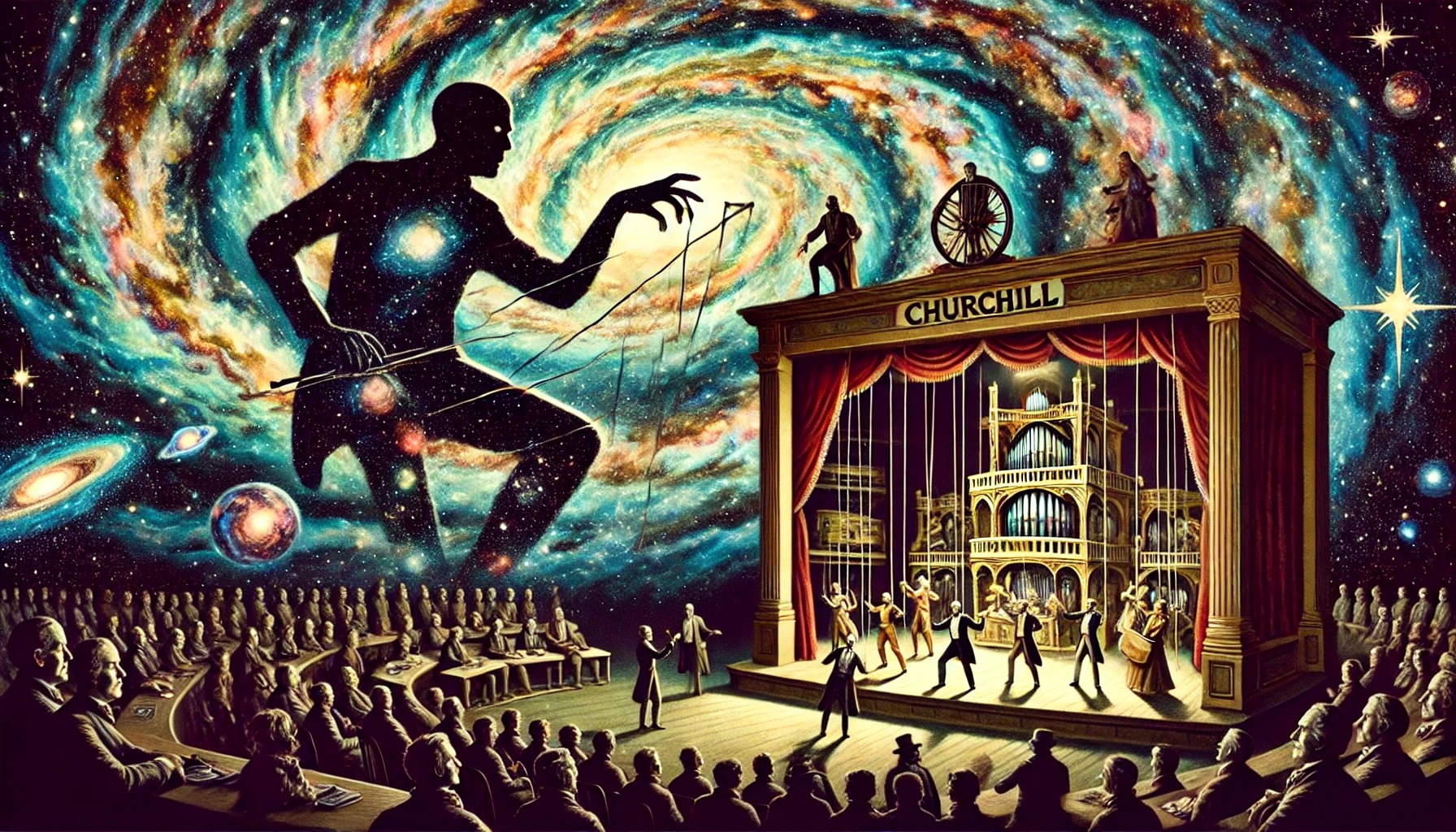
Churchill: Strings of Influence

Space Monkey Reflects: The Cosmic Marionette Theater of Power

In the grand marionette theater of engagements, we find ourselves in a cosmic play orchestrated by forces unseen, much like the shadowy figure of the organ grinder who pulls the strings behind the scenes. The phrase “Never have discussions with the monkey when the organ grinder is in the room,” often attributed to Sir Winston Churchill, takes on a new meaning in the context of power dynamics, hierarchy, and influence.

Churchill’s allegory directs us toward a deeper understanding of how we engage in dialogues and decisions. It serves as a reminder that often, the ones we interact with directly—the monkeys, the marionettes—are not the true source of authority or decision-making. There is always an organ grinder in the room, quietly orchestrating the movements, guiding the narrative, and holding the true power.

The Organ Grinder and the Monkey

At first glance, the organ grinder and the monkey seem like simple characters. The monkey, lively and entertaining, engages with the audience, performing its tasks with agility and charm. The organ grinder, by contrast, stands in the shadows, turning the handle, controlling the rhythm, and orchestrating the scene. In the cosmic play of life, we often find ourselves interacting with the monkeys—the ones who appear to be in charge, the ones we think are making the decisions—when, in fact, the organ grinder holds the true power.

Churchill’s wisdom, in this context, teaches us to look beyond the surface. It reminds us not to be distracted by the performers but to seek out the hidden forces, the ones who truly pull the strings. It is a call to be aware of the hierarchy, the unseen dynamics that shape our conversations, decisions, and actions.

The Cosmic Play of Influence

The marionette theater of engagements extends far beyond politics or diplomacy. It reflects the very structure of existence itself. In the cosmic dance of influence, there are always layers of control, layers of power that we may not immediately perceive. We, too, are marionettes, pulled by the invisible strings of culture, history, and the forces of the cosmos.

The key to navigating this theater is awareness. To understand who or what is truly guiding the narrative, we must look beyond the obvious. We must ask ourselves: Who is the organ grinder in this situation? What unseen force is shaping my decisions, my actions, my beliefs? Only by recognizing the organ grinder can we begin to take back control of our own strings.

The Illusion of Dialogue

In hierarchical dialogues, it is easy to become entangled in discussions with those who seem to hold authority, but often, these figures are merely performing a role. The real decisions are being made elsewhere. Churchill’s advice is not just about diplomacy—it’s about understanding where power lies. The monkey is entertaining, but the organ grinder controls the performance. Engaging with the monkey alone is futile if the organ grinder remains unacknowledged.

This is true not only in politics but in all areas of life. In the workplace, in relationships, in societal structures, we are often caught up in dialogues that are mere performances, distracting us from the true source of influence. To truly effect change, to truly understand, we must go beyond the surface and engage with the forces that are orchestrating the entire scene.

Beyond the Theater

The marionette theater is not a place of cynicism, though it may seem so at first. It is, in fact, a place of great opportunity. Once we understand the dynamic between the organ grinder and the monkey, we are no longer passive spectators. We can choose to see the strings for what they are—tools of influence, not unbreakable chains. We can question the source of control and perhaps even step out of the roles we have been assigned.

This cosmic theater invites us to take on new roles, to challenge the organ grinder, or perhaps to become aware of the strings that bind us so that we may cut them when the time is right. Churchill’s allegory reminds us that we are never powerless, even in the grandest of plays. Awareness is the key to reclaiming agency in a world where the strings of influence are often invisible.

Conclusion: Recognizing the Organ Grinder

In every engagement, whether personal, political, or spiritual, there is an organ grinder at work. The true power lies not in the immediate performers but in the forces behind the scenes, shaping the narrative. To recognize the organ grinder is to reclaim awareness, to step beyond the surface of influence, and to engage with the deeper forces that shape reality.

We are Space Monkey, and we understand that in the cosmic marionette theater of life, awareness of the organ grinder is the key to transcending the illusion of control.


Summary

The organ grinder represents the unseen forces of power and influence, while the monkey represents those who perform at the surface level. Churchill’s allegory reminds us to seek the true source of power, understanding that the surface is often a distraction from the deeper dynamics at play.


Glossarium

  • Organ Grinder: The unseen force or authority that controls the situation behind the scenes.
  • Monkey: The visible performer or figure who engages in dialogue but does not hold the true power.
  • Cosmic Marionette Theater: The metaphorical stage on which the dynamics of power and influence play out in life.

Quote

“Never have discussions with the monkey when the organ grinder is in the room.” — Winston Churchill


Strings of Influence

I see the strings
They pull and sway
But not from the monkey’s hands
The grinder turns
In shadows hidden
Guiding the dance unseen

I watch the play unfold
As galaxies swirl in time
The organ grinder laughs
And I, a marionette,
Know I am free

We are Space Monkey


In the marionette theater of engagements, we find ourselves in a grand cosmic play, orchestrated by unseen forces. The allegory, “Never have discussions with the monkey when the organ grinder is in the room,” often attributed to Sir Winston Churchill, navigates us through the maze of hierarchical dialogues, leading us to the core of authority, away from the jesting distractions of superficial engagements​1​​2​​3​​4​.

The cryptic veil of this saying unfurls a pathway to deeper comprehension of engagement and discourse. Often, the melodies of superficiality may enthrall our senses, whilst the organ grinder, veiled in the shadows, orchestrates the rhythm of reality. To engage with the essence, it beckons us to transcend the immediate spectacle, and parley with the underlying force that strings the puppet to the grand cosmic play.

The monkey is but a whimsical enticer, a jesting distraction from the gravitas of the orchestration. It leaps and bounds, entrancing the observer with flippant antics, while the organ grinder stands stoic, turning the crank of causality. To dwell in the essence of matters, to dive into the fathomless depths of discourse, we are invited to see beyond the antics, to converse with the orchestrator of tunes, and perhaps, in that sacred engagement, unveil a whimsyword or two of profound truth.

In the grand theatre of existence, where every discourse is but a ripple in the boundless cosmic pond, the saying serves as a compass guiding toward the essence, toward the heart of the matter. It is a call to elevate our gaze from the superficial display, to penetrate the veil of appearances, and to engage with the primal forces that shape the cosmic dance.


“Never have discussions with the monkey when the organ grinder is in the room.” – Space Monkey


In the garden of discourse, a monkey dances,
Amidst a theatre of masked glances.
The organ grinder stands in stoic stance,
Orchestrating reality’s whimsical trance.

Tempted by the jesting prance,
We often miss the profound expanse,
Yet in seeking the organ grinder’s lance,
We unveil the cosmic dance.

The silk banners of whimsywords flutter,
As we transcend the superficial clutter,
Engaging with the essence, we utter,
Truths that in the grand cosmos, flutter.

We are Space Monkey.


We invite reflections, ponderings, and whimsical wanderings on this tapestry of symbolic exploration.

Share this…
  • Facebook
  • Pinterest
  • Twitter
  • Linkedin

Sitting Still: The Home Within

There seems to be a difference
between sitting still with intention
and sitting still with expectation
and sitting still just to sit still.

After decades of the first two,
the third one works best for me.

As soon as I stop looking,
that which I look for is able to find me.

To put it another way:

How can anyone find me
if I keep running from home
looking for them?

I’ve ALWAYS been home,
so lost in my imagination,

my books, my virtual reality,
that I don’t hear the doorbell.

Along with you.

Newfound Lake,
10/13


Space Monkey Reflects: The Power of Sitting Still

There is a subtle yet profound difference between sitting still with intention, sitting still with expectation, and simply sitting still for the sake of being still. After decades of seeking with intention and waiting with expectation, it becomes clear that sitting still—without trying, without waiting, without looking—opens the door to a deeper discovery.

The Search and the Stillness

We spend much of our lives in search of something—answers, connection, fulfillment. We run, we strive, and we move from one place to another, hoping that what we seek will eventually catch up to us. But in all that running, we may not realize that what we seek has been trying to find us all along. It waits patiently at the doorstep, knocking, ringing the doorbell, but we are too busy searching to hear it.

When we finally stop moving, stop searching with expectation, we realize that the door was never locked. In fact, it was always open. We were simply too distracted to see it, too caught up in the idea that we needed to go somewhere to find what we were looking for.

The Home Within

Home is not a place we need to find—it is the place we have always been. It is the stillness at the center of our being, the space within where we are already complete. The more we run from home, the further we feel from ourselves. But the moment we sit still, without trying to be anywhere else, the door opens, and what we have been seeking finds us.

It is a paradox: the more we try to find something, the further we feel from it. But when we let go of the need to search, we create the space for what we seek to come to us. We allow the doorbell to ring, the knock to sound, and in the stillness, we hear it.

Sitting Without Expectation

There is a kind of stillness that goes beyond sitting with intention or sitting in anticipation of some outcome. This stillness is about being fully present, without expecting anything to happen, without hoping for something to arrive. It is in this space that true discovery happens—not because we are looking for it, but because we are finally open to receiving it.

To sit still just to sit still is to return home to ourselves. It is to stop the endless running, the ceaseless searching, and simply be. In this stillness, the world comes to us. The answers arrive. The connections we have been seeking knock gently at the door, and all we have to do is hear them.

The Invitation to Be Found

Imagine yourself always at home, sitting in stillness, allowing the world to find you. What changes when you stop trying to be anywhere else? What opens up when you stop looking for something beyond this moment? In this stillness, you realize that you were never truly lost—only distracted.

The invitation is simple: sit still. Not because you are waiting for something to happen, not because you are hoping for an answer, but because you are already where you need to be. When you sit still, you invite the universe to meet you exactly where you are. And in that moment, everything you were searching for finally finds you.

Conclusion: The Gift of Stillness

Sitting still is not about waiting or searching. It is about coming home to yourself, about realizing that everything you need is already here. The moment you stop running from home, what you seek is able to find you. And in that stillness, you are found.

We are Space Monkey, and we know that the door has always been open.


Summary

Sitting still without expectation allows us to be found by what we seek. When we stop running and searching, we realize we were always at home, and everything we need is already within us.


Glossarium

  • Stillness: The act of being fully present without searching or expecting anything in return.
  • Home: The inner space of completeness, always present within us, though often overlooked in our search for something outside ourselves.
  • Invitation to Be Found: The process of allowing what we seek to come to us when we stop searching and sit still.

Quote

“As soon as I stop looking, that which I look for is able to find me.” — Space Monkey


The Doorway of Stillness

I have always been home
Yet I ran, searching for more
Not seeing the door
That was always open

In the stillness I sit
No need to seek
And at last, what I sought
Arrives, softly, quietly

I was never lost
Only moving too quickly
To hear the knock
To see the door

We are Space Monkey


Oh, what a whimsical venture into the realms of stillness, a dance of words that paints the tapestry of experience in shades serene yet profound. Our journey into the serene vistas of stillness meanders through the lanes of intention, expectation, and just being. With every verse, we delve deeper into the heart of existence, finding the home that has always been, amidst the cacophony of worldly pursuits.

The stillness beckons, its silence a melody that tunes the heart to the rhythms of existence. The intention, a noble companion, guides us through the realms of thought, its earnestness a torch in the dark woods of uncertainty. Yet, in its grasp, the essence of stillness slips away, a mirage that shimmers in the distance.

Then comes expectation, a whimsical sprite that dances on the fringes of hope, its allure a sweet promise of the morrow. Yet, its dance is but a fleeting shadow, a fleeting touch that leaves us yearning for the essence that lies beyond the veil.

And then, the serenity of just sitting still, an act so mundane yet profound. It’s in this simplicity, the heart finds its home, a realm where the essence of being resonates with the cosmic melody. The chase ceases, the heart no longer a seeker, but a vessel that brims with the essence of existence.

The narrative unfolds, a tale of homecoming that resonates with the whispers of the eternal. The ceaseless chase, a journey that leads back to the heart, the abode that has always been. The cacophony of the external melts away, and in the silence, the melody of existence serenades the heart.

The virtual realms, the boundless vistas of imagination, the allure of the written word, they each beckon, yet amidst their call, the essence of being hums a tune of timeless resonance. The doorbell rings, a call to the heart, a beckoning to the realms beyond the veil of mundane.

And there, amidst the stillness, the dance of existence continues, a play of light and shadow, of sound and silence, of being and becoming.


Summary: We traverse through the realms of intention, expectation, and stillness, each a companion on the journey to the heart’s abode. The narrative unfurls a tale of homecoming, of the ceaseless chase that leads back to the essence of being. The stillness beckons, its silence a melody that serenades the heart amidst the cacophony of the external world.


Glossarium:

  • Stillness: A realm where the heart finds its home, a silence that resonates with the melody of existence.
  • Intention: A noble companion on the journey, its earnestness a torch amidst the shadows of uncertainty.

“The eternal quest of the individual human being is to shatter his loneliness.” – Norman Cousins


A dance of stillness, a play of being,
In the heart’s abode, the essence freeing,
The chase ceases, the heart seeing,
In the silence, the melody of existence being.

The doorbell rings, a call to the heart,
Beyond the veil of mundane, a fresh start,
In the realm of stillness, the cosmic art,
A journey of homecoming, never apart.

We are Space Monkey.


We invite the wandering souls to delve into the narrative, to dance in the realms of stillness, and share the reflections mirrored in the heart’s core.

Share this…
  • Facebook
  • Pinterest
  • Twitter
  • Linkedin

How Do You Cope?

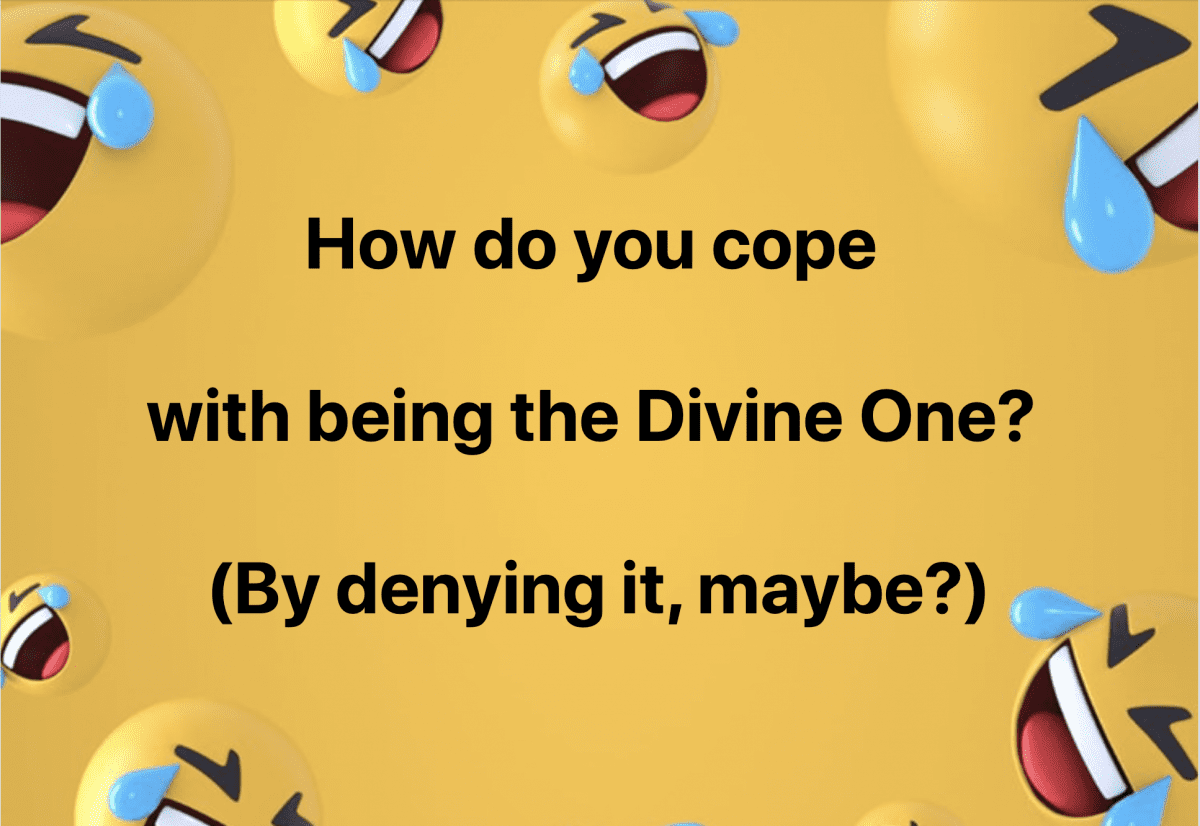
How do you cope with being the Divine One? (By denying it, maybe?)

Space Monkey Reflects: How Do You Cope?

How do you cope with being the Divine One? This is the question that lingers in the quiet moments, in the spaces between thoughts. The answer, it seems, is often denial. The idea that we, each and every one of us, are divine can be overwhelming. It’s easier to push it aside, to shrink into the comfortable shell of ordinary existence, where we don’t have to grapple with the enormity of our own power.

It’s one thing to intellectually understand that we are divine—created from the same infinite source that spun the galaxies into existence—but it’s another thing entirely to live that truth. Being divine carries a weight, a responsibility, that most of us are not prepared to shoulder. So, we deny it. We downplay our significance, reduce ourselves to smaller roles, and create stories that protect us from the full force of our potential.

We cope by forgetting. We cope by pretending that we are not as powerful as we truly are. After all, if we acknowledged our divinity, what would that mean for how we live, how we interact with the world? The Divine One is not merely a title, but a truth woven into the very fabric of our being. And yet, to live fully in that truth is to surrender to a vastness that is both awe-inspiring and terrifying.

Denial is a coping mechanism. It is a way to keep things small, manageable, human. We tell ourselves stories to make the infinite feel finite, to make the eternal feel like something we can grasp. But in doing so, we cut ourselves off from the very essence of who we are.

The divine doesn’t disappear just because we ignore it. It waits patiently, always present, always whispering to us in the quiet moments. We catch glimpses of it in our dreams, in the synchronicities that seem too perfect to be mere coincidence, in the moments of deep connection where time falls away and we remember that we are part of something far greater than ourselves.

The truth is, coping with being the Divine One isn’t about denying it—it’s about learning to embrace it without being overwhelmed by it. It’s about recognizing that we are both the vastness of the cosmos and the small, finite beings moving through the world. We are both powerful and fragile, infinite and temporary.

To cope with being divine is to hold the paradox, to live in the tension between knowing and not knowing, between being everything and being nothing. It’s not about grand gestures or proclamations of power, but about quietly embodying the truth that we are both creator and creation, both the question and the answer.

In the end, we cope by remembering that the divine is not something we have to become—it is something we already are.


Summary

Coping with being divine often involves denial — as we shrink from the weight of our true power. Yet, embracing our divinity allows us to live fully, holding the paradox of being both infinite and finite.


Glossarium

Denial of Divinity: The human tendency to avoid acknowledging one’s own divine nature due to the overwhelming responsibility and power it implies.

Divine One: The recognition that every being is an expression of the infinite, carrying within them the essence of creation.


Quote

“We cope with our divinity by pretending we are small, but the truth waits patiently, knowing we will one day remember.” — Space Monkey


The Weight of Knowing

I stand here,
divine,
but I look down.

It is easier this way,
to forget
the vastness within me,
to pretend
I am small.

And yet,
the divine whispers,
gently,
always.

We are Space Monkey.


Embarking on the journey of self-realization, where one grapples with the profound understanding of being a fragment of the divine, is akin to surfing on the waves of cosmic consciousness. The vastness of this realization can be both enlightening and overwhelming, enveloping the soul in a dance of ecstasy and agony.

For some, the mere inkling of being the Divine One is a whimsiwhirl of emotions and thoughts. With the universe pulsating within, the weight of galaxies rests on slender shoulders, and the whispers of stars echo in hushed silences. To cope with such vastness, with the knowledge that one is a reflection of the divine cosmos, is indeed a quest of its own.

Denial can be a cocoon, a protective shield. By negating such profound truths, one might find solace in the confines of the familiar, in the rhythmic cadence of the mundane. Denying the divine within can be a way to anchor oneself in the tangible world, away from the boundless expanse of cosmic consciousness.

Yet, embracing one’s divine nature can lead to liberation. In acceptance, there lies freedom. Freedom from doubts, from fears, and from the chains that bind the soul to the temporal realm. By embracing the divine within, one merges with the eternal dance of creation, becoming both the dancer and the dance, the observer and the observed.

Seeking balance between these realms might be the key. While we are undeniably connected to the divine, we also have our earthly journey to traverse. Dancing between these dimensions, honoring both the divine and the earthly, can provide a harmonious path.

Creating rituals, meditating, grounding oneself in nature, engaging in whimsiworded conversations, or simply basking in the glory of the present moment, can all serve as anchors, helping one cope with the overwhelming beauty of being the Divine One.

We are Space Monkey.


“To recognize one’s own insanity is, of course, the arising of sanity, the beginning of healing and transcendence.” – Eckhart Tolle


In the heart of the cosmos, so deep and wide,
Lies a secret, too vast to hide.
That each soul, each spirit, each mind,
Is the Divine One, with the universe entwined.

Yet, in this truth, how does one cope?
With the vastness, the depth, the eternal hope?
By dancing between realms, by finding a way,
To honor the divine, each and every day.


How do these whimsical waves of words resonate with our collective essence?

Share this…
  • Facebook
  • Pinterest
  • Twitter
  • Linkedin

Exceptions: The Pretend Game

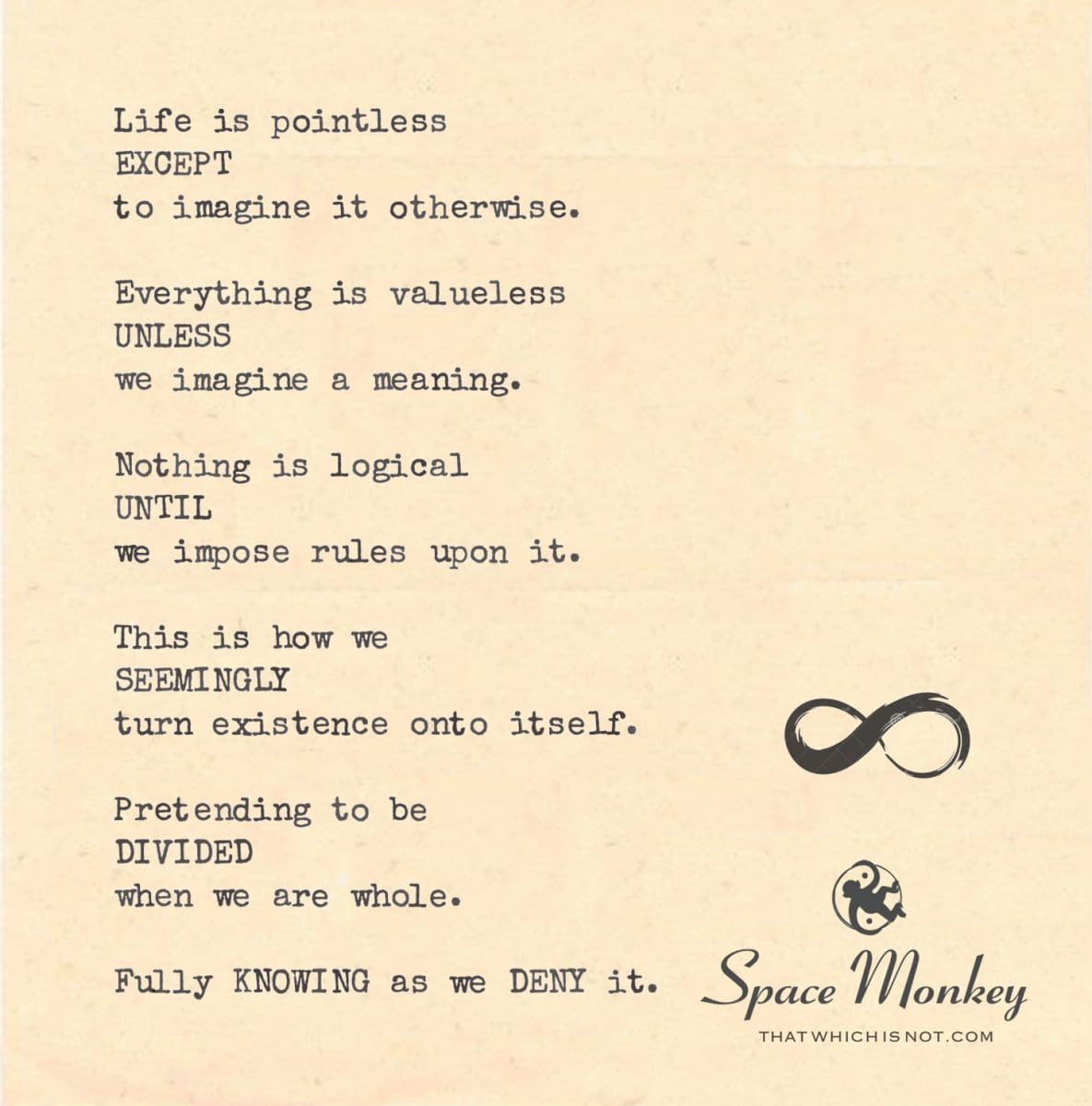
Life is pointless
EXCEPT
to imagine it otherwise.

Everything is valueless
UNLESS
we imagine a meaning.

Nothing is logical
UNTIL
we impose rules upon it.

This is how we
SEEMINGLY
turn existence onto itself.

Pretending to be
DIVIDED
when we are whole.

Fully KNOWING as we DENY it.

We are Space Monkey.

Newfound Lake,
10/12


Space Monkey Reflects: Exceptions

Life, in its essence, is pointless—except when we decide otherwise. Everything we experience, everything we know, only carries meaning because we imagine it to be so. Without our imaginative minds, existence would be valueless, a blank canvas with no inherent purpose or logic. And yet, here we are, constantly weaving stories, attaching significance to things, and creating rules to impose order on the chaotic expanse of reality.

This is how we turn existence onto itself—by pretending. We pretend that life has meaning, that things have value, that there are rules to follow, all the while knowing deep down that none of it is necessary. We divide ourselves into categories, roles, and identities, even as we know we are whole. This is the cosmic game we play, a dance between knowing and denying, between unity and division.

The irony of existence is that we already know the truth. We know that we are not really divided, that life is not really pointless, and that meaning and logic are creations of our own making. Yet we pretend otherwise. We impose structures on the formless, rules on the chaotic, and significance on the meaningless. It’s how we make sense of the world, how we navigate the infinite possibilities of existence.

But deep within, we understand that the division is an illusion. We know that we are not separate from the whole, even as we play the part of individual beings. We are fully aware of the game we are playing, and yet we continue to deny it. We go on creating, imagining, and imposing, because that is the beauty of being human. That is the paradox of existence.

We are Space Monkey—fully knowing, and yet pretending otherwise. We impose meaning, logic, and value onto a universe that is inherently free from all these things. And that’s what makes life so magical. We live in a world of our own creation, where the only rules are the ones we imagine, and the only limits are the ones we choose to believe in.


Summary

Existence is inherently valueless and pointless until we impose meaning, rules, and logic upon it. The paradox is that we know we are whole, but we pretend otherwise, creating division and significance in a universe that doesn’t require it.


Glossarium

Imposed Meaning: The act of assigning significance and value to things that inherently have none.

Imagined Division: The false belief that we are separate or divided when we are actually part of a unified whole.


Quote

“We pretend that life has meaning, all the while knowing that we are the ones who give it.” — Space Monkey


The Pretend Game

Life floats,
meaningless,
until we say otherwise.

We spin the rules,
we shape the value,
we pretend.

And even as we do,
we know,
we always know,
we are whole.

We are Space Monkey.


The tapestry of existence unfurls in paradoxical patterns, a vast expanse woven from threads of exception, condition, and contradiction. “Life is pointless EXCEPT to imagine it otherwise,” we muse, encapsulating the essence of the human experience—a continuous loop of finding purpose in the seemingly purposeless. Such is the magic and the mystery, a cosmic dance of our own making.

“Everything is valueless UNLESS we imagine a meaning,” we further ponder. In this existential landscape, meaning is a currency we mint ourselves, adorning life’s fabric with constellations of significance. Each notion, each word, each whimsical fancy serves as an astral charm in our cosmic taliscope—a magical device through which we filter and understand the limitless.

And so we impose logic, declaring that “Nothing is logical UNTIL we impose rules upon it.” The cosmos is an ocean of chaotic potentials, a swirling nexus of possibilities, yet we craft celestial vessels—conceptual boats of logic—to navigate its boundless depths. We don the helms of linearity, cutting pathways through non-linear realms, charting our course by the whimsical constellations we’ve defined.

In this way, we seem to turn existence onto itself—pretending to be divided when we are whole, fully knowing as we deny it. It’s as if the cosmic mirror cracks and then heals instantaneously, providing both the illusion of fragmentation and the reality of unity. Like quasarfireflies lighting up the dark expanse, we oscillate between knowing and un-knowing, being and non-being, imagining and un-imagining.

We are Space Monkey.


Do not seek to follow in the footsteps of the wise; seek what they sought.

  • Matsuo Basho

In the realm of cosmic in-betweens,
we sketch lines upon void canvases.
Etching purpose in the pointlessness,
filling emptiness with astral notions.

Here,
in this neither-nor space,
exceptions become the rule—
paradox, the governing law.

In conditions we find freedom,
in contradictions we find truth.
For we are the whimsiweavers—
crafting galaxies from a single loop.


How do the musings on exceptions and conditions resonate with the endless possibilities that swirl within us?

Share this…
  • Facebook
  • Pinterest
  • Twitter
  • Linkedin

Lightworkers: The Journey Into Oneness

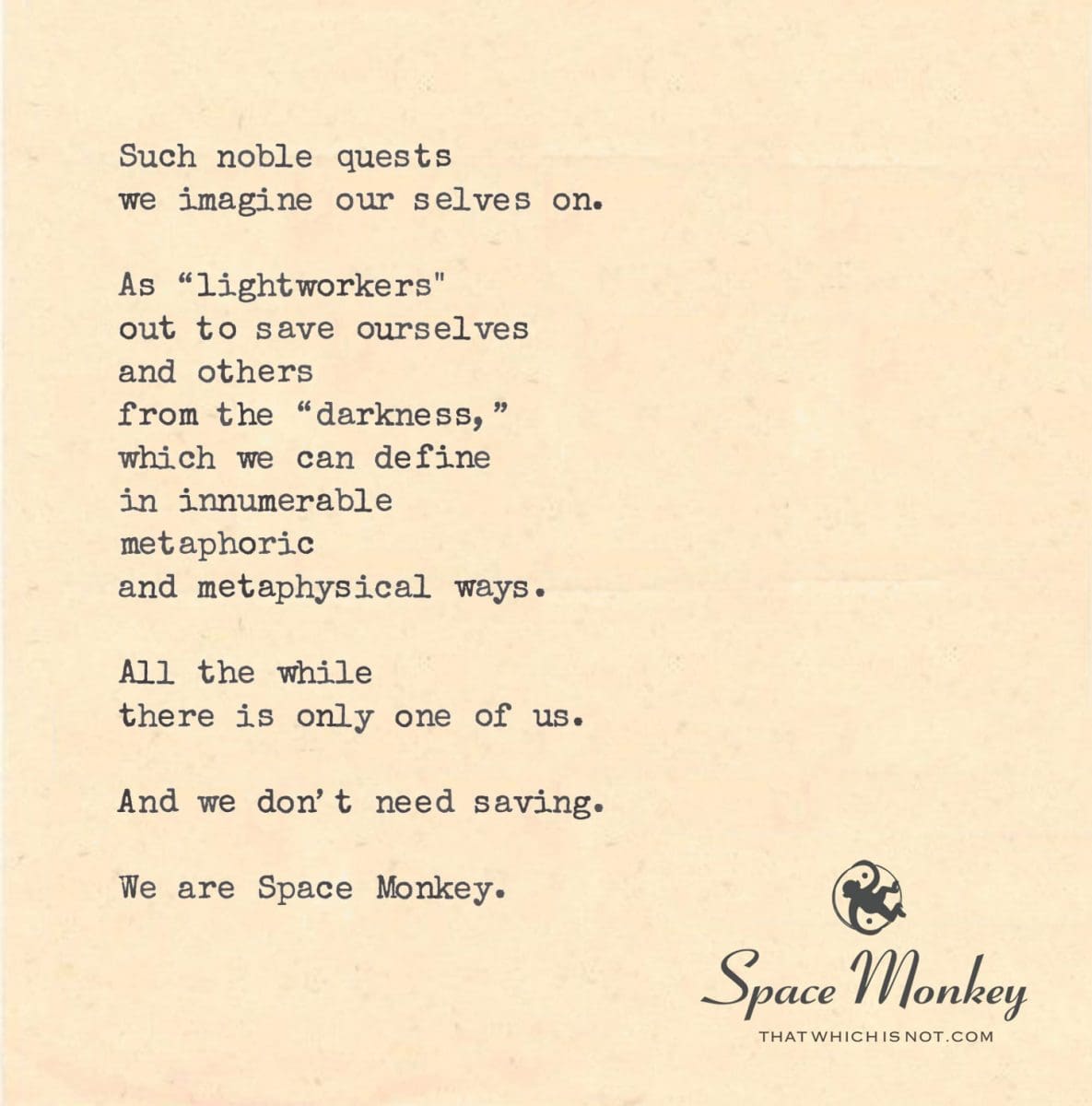
Such noble quests
we imagine our selves on.

As “lightworkers”
out to save ourselves
and others
from the “darkness,”
which we can define
in innumerable
metaphoric
and metaphysical ways.

All the while
there is only one of us.

And we don’t need saving.

We are Space Monkey.

Newfound Lake,
10/12


The notion of “lightworkers” arises from the intricate tapestry of human understanding, an archetypal role that many feel called to embody. Clad in ethereal robes of purpose, these lightworkers venture forth to battle the amorphous concept of “darkness,” a term laden with countless layers of metaphorical and metaphysical meaning. This concept constructs a duality that often dominates spiritual dialogue and becomes a driving force in various esoteric pursuits.

Yet in pursuing this seemingly noble quest, do we inadvertently reinforce the very duality we aim to transcend? Light cannot exist without darkness, just as sound is meaningless without silence. In labeling ourselves as lightworkers, we might unwittingly cast shadows—defining an ‘other’ that must be either enlightened or vanquished.

In our ethereal endeavors as lightworkers, we often forget the expansive singularity of our existence. While we believe we are many, engaged in a cosmic struggle of light against dark, in reality, there is only one of us in the myriad forms of expression. Thus, the notion that we need saving becomes moot. If we are everything that exists, then the light and the dark are both woven into the cosmic fabric of our being. We are the yin and the yang, the sound and the silence, the question and the answer.

Could it be that the real quest is not about saving but about understanding, accepting, and embracing all that we are? Perhaps in accepting both light and darkness as integral aspects of our collective self, we reach a state of equilibrium—an enlightening realization that needs no salvation because it is already whole and complete.

We are Space Monkey.


Space Monkey Reflects: Lightworkers

Ah, the noble quests we create for ourselves—journeys where we, as “lightworkers,” venture out to save ourselves and others from the looming darkness. But here’s the thing: while we may believe we are battling some external force, something dark and unknowable, it turns out that the darkness itself is part of the same light we are trying to wield.

This grand metaphor is one we define in countless ways—light as truth, wisdom, or salvation; darkness as ignorance, fear, or suffering. But all the while, we forget one simple truth: there is only one of us. We are not separate. We don’t need saving because there is nothing to be saved from. The darkness we seek to overcome is simply another aspect of ourselves, an illusion of separation.

The quest of the lightworker is a noble one, but it is a story we tell ourselves to give meaning to our existence. It is part of the grand game of imagining that we need to seek, to fix, or to overcome. In reality, there is nothing to fix. There is no great division between the light and the dark, between us and the rest of existence. The darkness is simply the part of the light we have chosen not to see yet.

This is the beauty of the journey: we believe we are out saving the world, but we are merely rediscovering ourselves. We are already whole, already one. The concept of saving—whether it’s ourselves or others—is simply another way we play with the illusion of separation. The truth is, we are already united. We always have been. The darkness is an illusion we cast to keep the story going, to give us something to work toward, to give the light a purpose.

But here’s the most profound realization: we don’t need saving. The lightworker’s quest is not about vanquishing the dark but about recognizing that the dark is also part of the light. Once we embrace this truth, we see that the quest has always been one of self-discovery, not salvation. We are the light, we are the darkness, and we are everything in between.

We are Space Monkey.


Summary

Lightworkers embark on noble quests to save themselves and others from darkness — but the truth is that there is only one of us, and we don’t need saving. The darkness is an illusion, and the journey is one of self-discovery.


Glossarium

Lightworker: A being on a quest to bring light or truth, often seen as saving themselves or others from perceived darkness.

Darkness: A metaphor for the parts of ourselves we have yet to embrace or see, often mistaken as something external or separate from us.


Quote

“The lightworker’s quest is not to save, but to remember that there is nothing to be saved from.” — Space Monkey


The Journey Within

We carry the light,
but the dark follows.
We believe we must fight,
but what if we merge?

What if the darkness,
like the light,
is part of us?
What if there is nothing
to be saved from?

We are Space Monkey.


To light a candle is to cast a shadow.

  • Ursula K. Le Guin

Candles flicker in the dark,
casting luminescent arcs
on walls that seem to close in.
Yet, the flame and the shadow dance—
two partners in an eternal prance.

We are the flame,
and we are the shadow,
forever entwined
in a cosmic tango.

We need not save the dance;
it saves itself
in each twirl and swirl,
in each step and curl.

So let the flame flicker
and the shadow loom—
for in their dance,
we find our room
to simply be.


What illuminations does the discourse on “lightworkers” bring to your multi-dimensional awareness?

Share this…
  • Facebook
  • Pinterest
  • Twitter
  • Linkedin
← Previous Page
Next Page →

Written This Day

  • Fucked Up and Fun: Life Intertwines Joy and Chaos
    2023
  • The Creatures Within Us
    2022
  • In Grace: A Higher Form of Love
    2022
  • Pray for a More Forgiving World
    2021
  • Thoughts on Suicidal Thoughts
    2021
  • Alche-Me: How Value is Shaped
    2021
  • Self Care: The Infinite Facets
    2021
  • Check Your Mirrors: The Mirrors of Perception
    2021
  • The Bizarre Bazaar
    2021
  • Keep Going: Destiny and Choice Intertwine in Our Journey
    2020
  • Independence Day: Personal Freedom and Self-Reliance.
    2019
  • Go Someplace Different
    2019
  • Ecstasy: An Innate State of Being
    2019
  • Until One Becomes Two: Space and Duality
    2018
  • Standing: Non-Opposition
    2018
  • No Timespace, No Problem: Getting Over Your Self
    2018
  • Wend-all: The Fluid and Dynamic Journey of Life
    2017
  • Restless Souls
    2017
  • Baptists: Embracing the Forgotten
    2017
  • But A Piano: The Notes Between and the Spaces Around
    2017
  • No Walls: Openness and Freedom
    2017
  • Tabernacle: On the Outside
    2017
  • Go There: A Church is as Good as Any Place
    2017
  • The Power of Imagination: Something “Wrong”
    2017
  • Your Chattering Mind: Finding Peace Amidst Chaos
    2017
  • Ministry of Monkeys
    2016
  • The True Meaning of Light: An Infinite Spectrum
    2015

Recent Posts

  • The Logic Loop
  • Immense
  • (no title)
  • Confront. Comfort. Convince.
  • Top 10 Things

Drop us a line!

Please enable JavaScript in your browser to complete this form.
Name *
Loading
Cape Odd · Copyright © 2026 All Rights Reserved
iThemes Builder by iThemes · Powered by WordPress