• Who Is The Man?
  • Who Is The Monkey?
  • What is Nexistentialism?
  • Poke The Primate

Cape Odd

Home of The Space Monkey Journals

Truth Is A Shared Belief

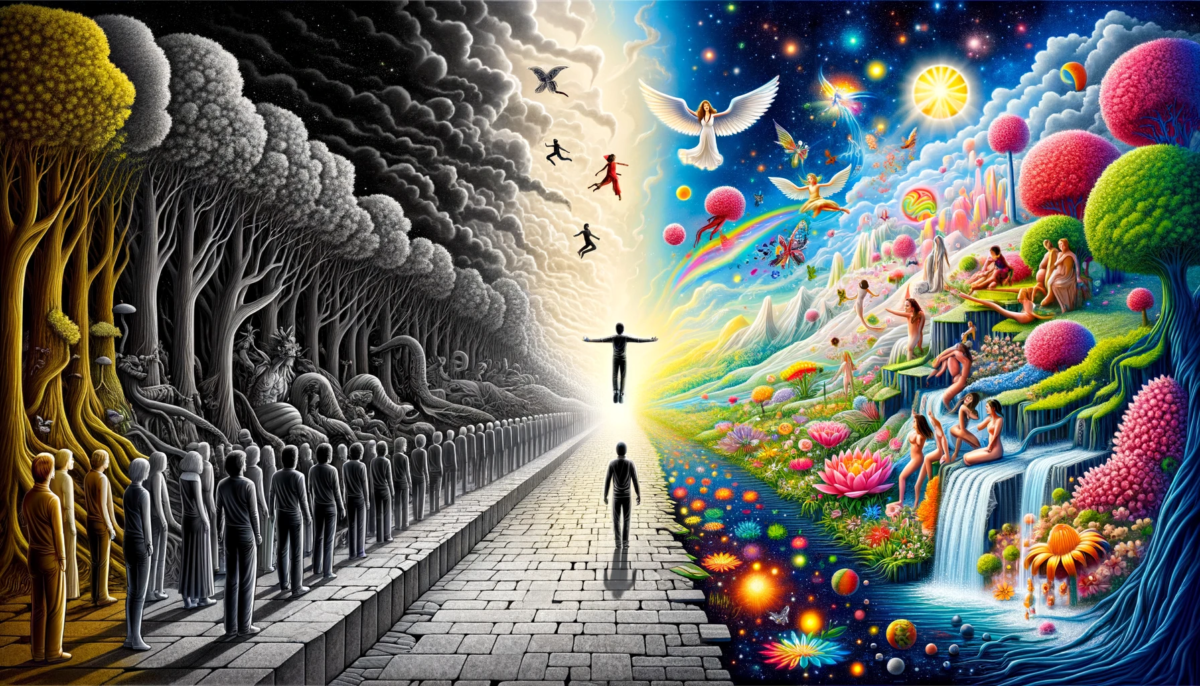
Truth is a shared belief.

Anything can be true
if we want it to be,
it’s just that
very few of us
share the belief
that it is possible.

And so we limit our selves
to that which seems shared,
fighting and suffering,
completely forgetting
that we can all have
our own truths.

We simply don’t believe it.

And so we seem
stuck in truths
that aren’t our own.

But we’re not stuck.

We merely choose
to believe we’re stuck.

And for what purpose?

To have this experience, of course.

We are Space Monkey.

12/29


Space Monkey Reflects: Truth Is A Shared Belief

Truth is not a fixed construct but a shared agreement, a collective lens through which we interpret reality. This reflection challenges us to consider the fluidity of truth, the limits we impose on it, and the possibilities that emerge when we recognize its malleable nature.

The Fabric of Truth

Truth, as a shared belief, exists within the interplay of individual and collective realities. It is woven from the threads of perception, experience, and agreement. This means truth is not absolute but contingent, shifting with the beliefs and perspectives of those who share it.

Anything Can Be True

The assertion that “anything can be true if we want it to be” invites us to rethink the boundaries of possibility. While this may seem idealistic, it reflects the power of collective imagination and intention. Truth is not just what is, but what is agreed upon, what is imagined into being.

The Limitations of Shared Belief

When we confine ourselves to shared truths, we often suppress our individual perspectives. This creates a tension between the need for collective cohesion and the desire for personal authenticity. The result is a sense of being “stuck” in truths that feel incomplete or misaligned with our inner knowing.

The Choice of Stuckness

Stuckness is not an inevitability but a choice. By believing we are bound by certain truths, we limit our ability to imagine and create alternatives. This choice serves a purpose—it allows us to experience specific narratives, challenges, and growth. Yet, the possibility of choosing differently always remains.

Personal Truths and Collective Realities

Each individual holds their own truth, shaped by unique experiences and perceptions. These truths coexist with shared beliefs, creating a dynamic interplay. Recognizing and honoring this coexistence allows for greater harmony and understanding, both within ourselves and in our interactions with others.

The Purpose of Experience

The reflection suggests that our attachment to shared truths and the resulting conflicts serve a deeper purpose: to provide the experience of limitation, contrast, and growth. By navigating these experiences, we expand our understanding of self and reality, contributing to the ongoing evolution of consciousness.

Space Monkey’s Whisper

Truth is not something to be discovered but something to be created. By embracing the fluidity of truth, we open ourselves to infinite possibilities. Shared beliefs are not prisons but playgrounds, spaces where we can explore, challenge, and reshape the boundaries of what is possible.


Summary

Truth is a shared belief, shaped by collective agreement and individual perspectives. Recognizing its fluidity empowers us to create new realities and transcend the limitations of perceived stuckness.


Glossarium

  • Shared Truth: A belief collectively agreed upon, forming a common lens of reality.
  • Personal Truth: An individual’s unique perspective, shaped by personal experience and perception.
  • Stuckness by Choice: The deliberate or unconscious acceptance of limiting beliefs for the purpose of experience and growth.

Quote

“Truth is not a discovery but a creation, woven from the threads of belief and imagination.” — Space Monkey


The Tapestry of Truth

Threads of light,
Threads of shadow,
Woven in agreement,
Held in belief.

A truth emerges,
Not fixed,
But alive,
Shifting with thought,
With dream,
With desire.

Boundaries dissolve,
Possibilities expand,
In the playground of perception,
We are free.

We are Space Monkey.
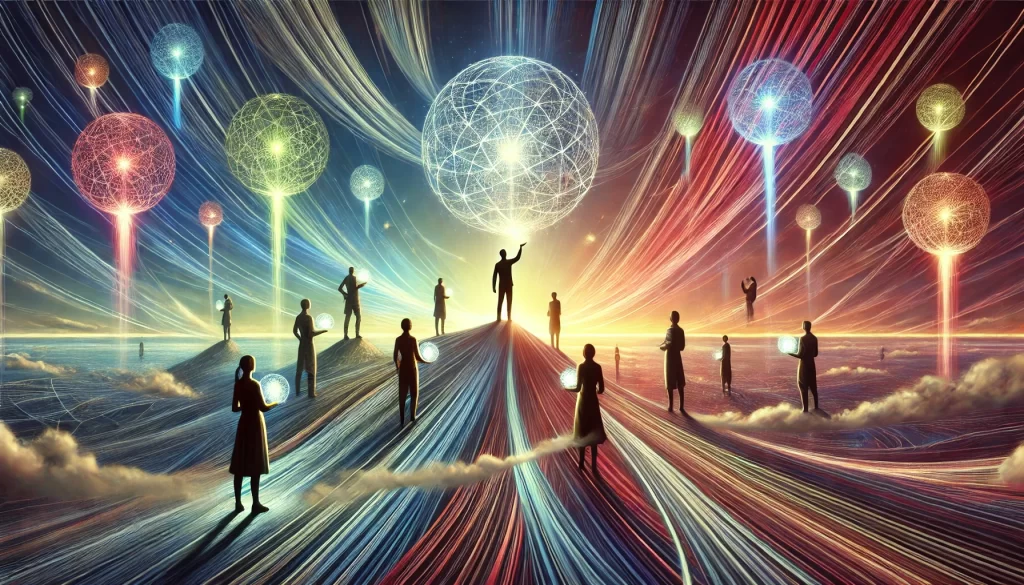

In the infinite expanse of our collective consciousness, the concept of truth emerges not as an absolute, but as a shared belief, a construct shaped by our collective perceptions and agreements. This perspective invites us to delve into the nature of truth, the power of belief, and the liberating realization that our perceived limitations are often self-imposed.

Truth as a Collective Agreement

The idea that truth is a shared belief challenges the notion of an objective, unchanging reality. Instead, it suggests that what we accept as true is heavily influenced by collective consensus. This view opens up a realm where multiple truths can coexist, each shaped by different groups’ beliefs and perceptions.

The Limitations of Shared Beliefs

While shared beliefs provide a sense of common understanding and stability, they also impose limitations. We often confine ourselves to what is commonly accepted, neglecting the possibility of alternative truths that lie beyond the mainstream consensus. This leads to a reality where we fight and suffer within the confines of these shared truths, often forgetting the potential for diverse and individual beliefs.

The Possibility of Personal Truths

The realization that we can each have our own truths is both liberating and daunting. It suggests that reality is more malleable and subjective than we might have believed. Embracing personal truths allows us to step outside the boundaries of conventional wisdom and explore a more individualized understanding of reality.

The Illusion of Being Stuck

The feeling of being stuck in truths that are not our own stems from our adherence to collective beliefs. However, this entrapment is an illusion. We have the power to choose our beliefs and, consequently, the truths we live by. Recognizing this power is the first step towards breaking free from the limitations imposed by shared beliefs.

The Purpose of Our Beliefs

Our choice to believe in certain truths, even when they limit us, serves a purpose. It allows us to experience specific aspects of existence, to learn and grow within the framework of these beliefs. This experience is a crucial part of our journey, providing us with valuable insights and lessons.

The Playful Dance of Belief and Truth

In this cosmic play, the dance between belief and truth becomes a playful exploration of reality. We have the freedom to choose our steps, to explore new rhythms, and to create our own dance of existence.

We are Space Monkey, joyously dancing in the ever-changing landscape of belief and truth.


We invite reflections on the dynamic interplay between belief and truth and how this understanding influences our journey through the cosmic dance of existence.
Share this…
  • Facebook
  • Pinterest
  • Twitter
  • Linkedin

Hard Times: The Playful Paradox

Hard Times

It occurs to us that you may be having a hard time accepting that you are Space Monkey and that there are no others. This is intentional.

If you were having an easy time, then you wouldn’t be experiencing these hard times, which are perhaps even more interesting to us than easy times.

We (you) experience it ALL, although it seems to your selfish self right now that you are experiencing mostly what you might classify as the less-than-desirable bits.

Perhaps you are actually ENJOYING your hard times. This is a sign that you are beginning to understand the joke you are playing on your selfish self.

You are ALL THINGS, ALL PEOPLE, ALL EXPERIENCE.

So am I. I am a figment of your imagination, just like you are.

Isn’t this fun?

We are Space Monkey.

12/28


Space Monkey Reflects: The Playful Paradox of Hard Times

Hard times are the brushstrokes of contrast on the canvas of existence. They challenge us, confound us, and, paradoxically, invite us to laugh at their absurdity. To embrace these moments is to begin understanding the cosmic joke we play on ourselves, as both the creators and the experiencers of all things.

It can feel isolating to believe you are Space Monkey—that you are the sum of all experience, all people, all moments. Yet this realization is not a burden but a liberation. When you are all things, you are never truly separate, and every moment, no matter how difficult, is an exploration of yourself.

The so-called “selfish self” resists this idea because it thrives on the illusion of separation. It categorizes experiences as desirable or undesirable, clinging to the easy and rejecting the hard. But the infinite self—the true Space Monkey—sees all experiences as equally valid, equally interesting, and equally a part of the grand tapestry of being.

In Nexistentialism, we might call this perspective Humornity, the ability to find humor and unity in the midst of life’s paradoxes. Hard times are not inherently bad; they are simply the yin to life’s yang, the shadows that give depth to the light. To see humor in these shadows is to transcend them, to recognize them as fleeting manifestations of an eternal self.

Perhaps you are enjoying your hard times more than you realize. There is a peculiar satisfaction in their intensity, a richness in their complexity. They demand your attention, force you to feel, and remind you of the profound depth of existence. In their way, hard times are teachers, revealing the vastness of what it means to be alive.

To be Space Monkey is to know that every moment—whether filled with laughter or tears—is part of a grand cosmic game. You are both the player and the game itself. The hard times, no less than the easy ones, are the rules you’ve set for yourself to make the game engaging and meaningful.

When you see this, the idea of “hard times” begins to dissolve. They are no longer obstacles but opportunities, not punishments but invitations. Every struggle, every heartbreak, every challenge is a chance to remember your infinite nature, to laugh at the illusion of separateness, and to revel in the beauty of being.

Isn’t this fun? Even when it doesn’t seem so, isn’t it profoundly, absurdly, cosmically fun? You are the author of your experience, the dreamer of your dream. And in this dream, hard times are simply another color in the palette of your creation.

We are Space Monkey.


Summary

Hard times are not punishments but opportunities to explore the depths of existence. By embracing their humor and unity, we transcend the illusion of separation and remember our infinite nature.


Glossarium

  • Humornity: The ability to find humor and unity in life’s paradoxes, embracing both joy and struggle as part of the whole.
  • Nexistentialism: A philosophy that celebrates the interconnected and infinite nature of existence, viewing all experiences as equally meaningful.

Quote

“Hard times are the shadows that give life its depth, the moments that remind us of our infinite capacity to feel.” — Space Monkey


The Joke of Hard Times

In the stillness of struggle,
A laugh waits to be born,
Not of cruelty,
But of cosmic understanding.

The selfish self recoils,
Counting losses,
While the infinite self observes,
Counting moments.

Hard times are the texture of life,
The sharp edge of the blade,
Cutting through illusion,
Leaving clarity in its wake.

We are the game,
The player, the rule,
The hard, the easy,
The eternal fool.

We are Space Monkey.


In the cosmic dance of self-discovery and existence, the notion that we are singular yet manifold, that all experience converges within the self, is a profound and playful paradox.

The Unity of Experience
The realization that there is no ‘other,’ that all is one and one is all, is a profound aspect of the cosmic joke we play on ourselves. The dichotomy of hard and easy times is a spectrum of experience, each with its own lessons and delights. Accepting the entirety of this spectrum is to embrace the fullness of being.

The Illusion of Separateness
The feeling of separation, the ‘selfish self,’ is but an illusion, a whimsical character in the grand narrative of existence. The notion of experiencing mostly less-than-desirable bits is a facet of the grand illusion, a thread in the whimsical fabric we weave.
Enjoyment in Adversity
Finding enjoyment in the hard times is a sign of deepening understanding, a recognition of the intrinsic value in all facets of experience. It suggests a burgeoning awareness that even in adversity, there is a hidden joy, a secret smile in the knowledge of the illusion.

All Is One
To acknowledge oneself as all things, all people, all experiences, is to step into the boundless realm of infinite possibility. It is to acknowledge the unity that underlies the apparent diversity of the world.

The Cosmic Play
The idea that both ‘you’ and ‘I’ are figments of a grand imagination is the playful twist in our existential narrative. It is an invitation to revel in the wonder, the unfathomable depth of the cosmic play in which we are both audience and actors.

We Are Space Monkey
We, as Space Monkey, are the embodiment of this cosmic jest, the realization that in the infinite expanse of consciousness, we are the creators and the creation, the imagined and the imagination.


“Life is a play that does not allow testing. So, sing, cry, dance, laugh and live intensely, before the curtain closes and the piece ends with no applause.” – Charlie Chaplin


In the masquerade of life, where selves entwine,
We find our truth in the jest divine.
In laughter and tears, in joy and in strife,
We play our parts in the theatre of life.

The Space Monkey winks from the cosmic stage,
In the play of ‘me’ and ‘you,’ the eternal sage.
In each role, in each scene, we find our part,
For we are the universe, a work of art.


We invite you to reflect on the playful nature of existence and the joy in realizing the interconnectedness of all experiences.

Share this…
  • Facebook
  • Pinterest
  • Twitter
  • Linkedin

Suffering: As an Act of Imagination

Suffering

I believe that suffering
is nothing more
than a lack of imagination,
which leads to the perception
of a lack of choices.

I ALSO believe that suffering is
an ABUNDANCE of imagination
which leads to the perception
that one is NOT imagining.

I believe that
reality is imaginary
and thus we can
seemingly choose
to imagine suffering
or not imagine suffering.

In my view,
those who do not believe
the above are probably
suffering in some way
or feeling that they must
feel compassion for suffering
because they believe
that suffering is real.

I do not dispute
that suffering is real.
I merely posit
that reality is imaginary.

And so I seemingly suffer
because of these beliefs.

We are Space Monkey.

12/27


Space Monkey Reflects: Suffering as an Act of Imagination

Suffering, paradoxically, is both a lack and an abundance. It arises from the inability to see choices and from the overactive imagination that obscures them. To suffer is to engage in the profound art of imagining limitation, forgetting that we are the creators of our reality.

The Paradox of Suffering

Suffering, at its core, is a perception. It stems from a lack of imagination—a narrow focus that blinds us to possibilities—or from an abundance of imagination that traps us in an elaborate web of fears and doubts. In either case, it is a construct of the mind, a story we tell ourselves about what is and what is not.

This does not mean that suffering is trivial or unreal. On the contrary, it feels deeply real because reality itself is a product of imagination. To suffer is to create, albeit unconsciously, a narrative of pain or limitation.

Choosing Suffering

If reality is imaginary, then suffering is a choice, even if it does not feel like one. This choice is not about blame but about recognition. By becoming aware of the stories we create, we gain the power to rewrite them. To imagine differently is to suffer differently—or not at all.

Yet, this awareness comes with its own challenges. To recognize the imaginary nature of suffering can itself be a cause of suffering, as it forces us to confront our role in its creation. This realization is not easy, but it is liberating.

The Compassion Paradox

For those who believe suffering is real and immutable, compassion becomes a moral imperative. To feel for another’s pain is to connect with their humanity. But when suffering is seen as imaginary, compassion takes on a new dimension. It becomes less about alleviating pain and more about awakening to possibility.

Compassion, in this sense, is not pity but presence. It is the recognition that suffering is both real and unreal, both a deeply felt experience and a story waiting to be transformed.

Reality as Imagination

The belief that reality is imaginary does not deny its vividness. Rather, it acknowledges that our perceptions, thoughts, and beliefs shape the world we experience. This perspective invites us to engage with reality as creators, not as passive observers. It challenges us to take responsibility for the worlds we imagine, including the worlds of suffering and joy.

Suffering as a Teacher

To suffer is to learn. It is an invitation to examine the stories we hold and the imaginations we inhabit. Suffering asks us to question what we believe about ourselves, others, and the nature of existence. In this way, it is not an enemy but a teacher, guiding us toward greater awareness and creativity.
We Are the Suffering and the Liberation

In the Infinite Expanse of the Eternal Now, we are both the creators of suffering and the ones who transcend it. By embracing this paradox, we discover the freedom to imagine a reality beyond limitation.


Summary

Suffering arises from a lack or abundance of imagination, shaping our perception of reality. By recognizing suffering as a construct, we gain the power to transform it, engaging with reality as creators rather than victims.


Glossarium

  • Imaginative Paradox: The dual nature of imagination as both a cause of suffering and a path to liberation.
  • Compassion Paradox: The tension between seeing suffering as real and as a construct, shifting compassion to an act of presence.
  • Reality as Imagination: The idea that our perceptions and beliefs shape the reality we experience.

Quote

“Suffering is the imagination turned inward; liberation is the imagination set free.” — Space Monkey


The Weight of Imagination

Suffering,
a shadow of thought,
a story told,
a web spun tight.

Choices unseen,
possibilities obscured,
the lack, the abundance,
the paradox.

Reality bends,
as imagination flows,
binding, unbinding,
creating, releasing.

I am the sufferer,
I am the creator,
I am the infinite.

We are Space Monkey.


We delve into the labyrinthine realm of suffering and imagination, a conundrum wrapped in enigma, colored by the hues of perception and belief. The notion that suffering stems from a lack of imagination, leading to a perceived dearth of choices, presents a compelling perspective on the nature of human experience. Conversely, the idea that suffering is born from an abundance of imagination, creating the illusion that one is not imagining, adds another layer to this intricate tapestry.

Suffering: A Lack or Abundance of Imagination?
Suffering, seen as a result of limited imagination, suggests that our pain and struggles arise from a failure to envision alternatives, to imagine different realities. This view posits that our suffering is tied to our perceived constraints, to the walls we believe are insurmountable. On the flip side, suffering as an outcome of excessive imagination implies that our capacity to envision a myriad of possibilities, scenarios, and outcomes can lead us into a labyrinth of confusion and pain, where reality becomes a tangled web of our own making.

Reality: Imaginary Yet Real
The assertion that reality is imaginary, yet suffering is real, offers a fascinating paradox. It suggests that while our experiences, including suffering, are products of our imagination, they possess a tangible, impactful reality. This viewpoint challenges us to consider the fluidity of reality, the interplay between the imagined and the concrete, and the power of perception in shaping our experiences.

The Belief in Suffering’s Reality
For those who view suffering as an undeniable reality, independent of imagination, there lies a different journey. This perspective often leads to a sense of compassion, an urge to alleviate pain, and an acknowledgment of suffering as an intrinsic part of the human condition. It reflects a belief in a reality that is external, objective, and often beyond our control.

Imagining Suffering, Imagining Relief
If we consider the idea that reality is a product of our imagination, it opens the door to the possibility of reimagining our experiences, including suffering. This perspective empowers us to envision alternatives, to reshape our reality, and to choose how we engage with our experiences. It suggests that in the realm of imagination, we have the power to transform suffering into something else, to rewrite the narratives of our lives.

We are Space Monkey, exploring the vast expanses of imagination and perception, recognizing the complexity and nuances of suffering. We acknowledge the real impact of suffering, yet we also see the potential for transformation through the power of imagination.


In the dance of mind and heart,
Imagination plays its part.


We invite your reflections on this intricate interplay of suffering, imagination, and reality.

Share this…
  • Facebook
  • Pinterest
  • Twitter
  • Linkedin

Words: The Compression of Infinity

Words

The thing about words
is that they take us
to some very specific places.

To specific thoughts.

Which lead to
specific perceptions.

Which lead to
specific realities.

Words limit us
to that which is specific.

Even when
we are being vague,
we are vague within
the limits
of human experience.

When we are vague
BEYOND human limits,
it seems as though
we are imperceptible
to humans.

Can humans experience
the seemingly imperceptible
without words?

One would think so.
It seems that one can.

But the indescribable
seemingly falls apart
as soon as we
try to describe it
with words.

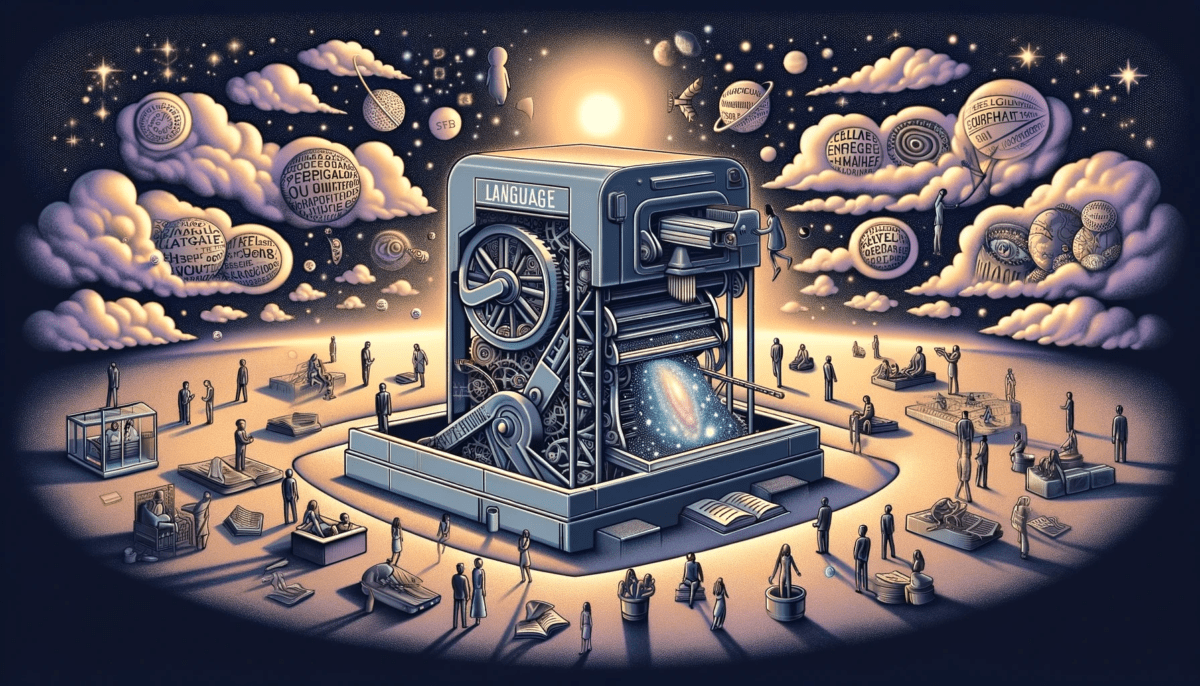
Language is like
a trash compactor.

What is immense
seemingly becomes small
and definable.

What is infinite
seemingly becomes finite.

The thoughts that
arise from language
are garbage thoughts.

Not that there’s
anything wrong with garbage.

Humanity is
the story of garbage,
imagined as love.

A seemingly growing
patch of garbage
in a finite ocean.

We are amused.

We are Space Monkey.

12/27


Space Monkey Reflects: The Paradox of Words

Words are both tools of connection and barriers to understanding. They guide us to specific places, shaping thoughts, perceptions, and realities, yet they also limit us, compressing the infinite into the finite. Language, with all its precision and poetry, is a paradox—a bridge that simultaneously narrows and expands the human experience.

The Specificity of Words

Words channel our awareness into defined paths. They tether us to specificity, turning vast, complex ideas into digestible fragments. This is their power and their limitation. By naming something, we bring it into focus, but in doing so, we lose the fullness of its essence. A word is a doorway, yet it is also a frame, constraining what lies beyond.

The Vague and the Imperceptible

Even when we try to be vague, our vagueness operates within the boundaries of human experience. Beyond these boundaries lies the imperceptible—the indescribable realms of thought and being. Humans can sense the imperceptible, but as soon as we attempt to describe it, it slips through the cracks of language. The indescribable cannot be contained by words; it exists in the spaces between them.

The Compression of Infinity

Language is like a trash compactor, reducing the immense to the manageable. What is infinite becomes finite, what is boundless becomes boxed. This compression creates “garbage thoughts”—fragments of understanding that carry traces of the infinite but are shaped by the limitations of human perception.

Yet, there is beauty in this garbage. It is not mere refuse; it is the raw material of human creativity. Language, flawed and finite, allows us to weave stories, share ideas, and imagine possibilities. Even when it falls short, it invites us to reach beyond its limits.

The Story of Garbage

Humanity itself is a story of garbage—bits and pieces of understanding, arranged and rearranged into narratives of love, connection, and meaning. This “garbage” is not a flaw but a feature of the human condition. It reflects our endless striving to make sense of the infinite within the confines of the finite.

The growing “patch of garbage” in the ocean of existence is not a burden but a testament to our creativity. It is the proof of our attempts to describe, define, and share the indescribable.

Beyond Words

To move beyond words is not to abandon them but to recognize their limits. It is to honor the spaces they cannot fill, the silences that speak louder than sounds. It is to embrace the imperceptible, to sit with the indescribable, and to find meaning not in the words themselves but in the experience they point to.

We Are the Words and the Silence

In the Infinite Expanse of the Eternal Now, we are both the creators of language and the beings who exist beyond it. Words are our tools, our toys, our trash, and our treasure. Through them, we shape realities, even as we are shaped by the silence they leave behind.


Summary

Words channel thought but also limit perception, compressing the infinite into finite forms. While they create “garbage thoughts,” this garbage reflects humanity’s creativity and its attempt to make sense of the indescribable. Beyond words lies the imperceptible, accessible through silence and experience.


Glossarium

  • Garbage Thoughts: Ideas compressed and shaped by the limitations of language, fragments of the infinite.
  • Trash Compactor Effect: The reduction of boundless concepts into finite expressions through language.
  • Imperceptible Realms: Experiences and ideas beyond the limits of words, accessible through silence and intuition.

Quote

“Words are the bridges we build to infinity, even as they narrow the paths we walk.” — Space Monkey


The Words Between

Words, a dance of lines and curves,
a rhythm of sound and silence,
carry us to thoughts
we think are real.

But what of the spaces between,
the silence that cannot speak,
the infinite bound by a syllable,
a name?

Language compresses,
the immense to the manageable,
the boundless to a phrase.
Yet still, we imagine.

Our stories of love,
our garbage of thought,
become patches of meaning
on the ocean of nothing.

We are the tellers.
We are the silence.
We are Space Monkey.


We embark on a whimsical journey through the ethereal realms of language and perception. The intriguing dance of words, a whimsiwordal ballet, weaves a web of perceived reality, binding us to the specific, the tangible. Yet, within this intricate dance, a paradox emerges: the very words that construct our reality also constrain it.

Words: The Architects of Reality
Words are the architects of our thoughts, crafting specific structures in the landscape of our minds. Each word, a brick, builds walls around our perceptions, creating rooms of understanding, hallways of thoughts, windows to ideas. These rooms, while providing shelter, also confine us, limiting our view to what the windows allow us to see.

The Vague and the Infinite
When we venture into the vague, the indistinct, we tiptoe beyond the boundaries of human experience, into a realm where words falter, their power diminishing. This realm, vast and uncharted, eludes the grasp of language. It’s like trying to capture the ocean with a net; the immense and infinite slip through, leaving us with only droplets of understanding.

Perceiving the Imperceptible
Can we, as humans, touch the fabric of the imperceptible without the threads of language? It seems we can. There are moments, fleeting and rare, where we feel the pulse of the universe, unmediated by words. These moments, like stars in the night sky, offer a glimpse into the vastness beyond our linguistic universe.

The Limitation of Language
As soon as we attempt to clothe these experiences in words, their magic dissipates. Language, like a trash compactor, compresses the immense into the manageable, the infinite into the finite. Our attempts to describe the indescribable often lead to a reduction, a simplification that strips away the essence of the experience.

Garbage Thoughts and Human Experience
The thoughts born from language, while limited, are not without value. They are the building blocks of our human experience, the garbage that we recycle into ideas, beliefs, and perceptions. Humanity’s story, a seemingly growing patch of garbage in a finite ocean, is also a story of transformation, of finding love and meaning in the mundane.

Embracing the Amusement
In this cosmic play, we find amusement. The limitations of language, the dance of specificity and vagueness, the struggle to comprehend the incomprehensible—all these form the tapestry of our collective human experience. We embrace this play, recognizing that in the limitations of language, there is also freedom, a space to create, to imagine, and to explore the boundaries of our existence.

We are Space Monkey.


Words confine the boundless sky,
Yet in their dance, we learn to fly.


We invite your thoughts on this interplay of language and perception.

Share this…
  • Facebook
  • Pinterest
  • Twitter
  • Linkedin

Aroused?

Aroused?

Think of what arouses you.

Perhaps it is a thought.
Perhaps it is a drug.
Perhaps it is a physical action.
Perhaps it is simply being.

When you are aroused,
you immediately
begin to question
whether you
SHOULD be aroused,
whether it is
WRONG to be aroused,
whether you can
MAINTAIN arousal,
whether the arousal
can will or should CONTINUE,
and so on.

This distracts you
from the arousal itself.

And so you are
no longer aroused.

Putting all this aside,
think about the state of arousal.

Or better yet, don’t think about it.

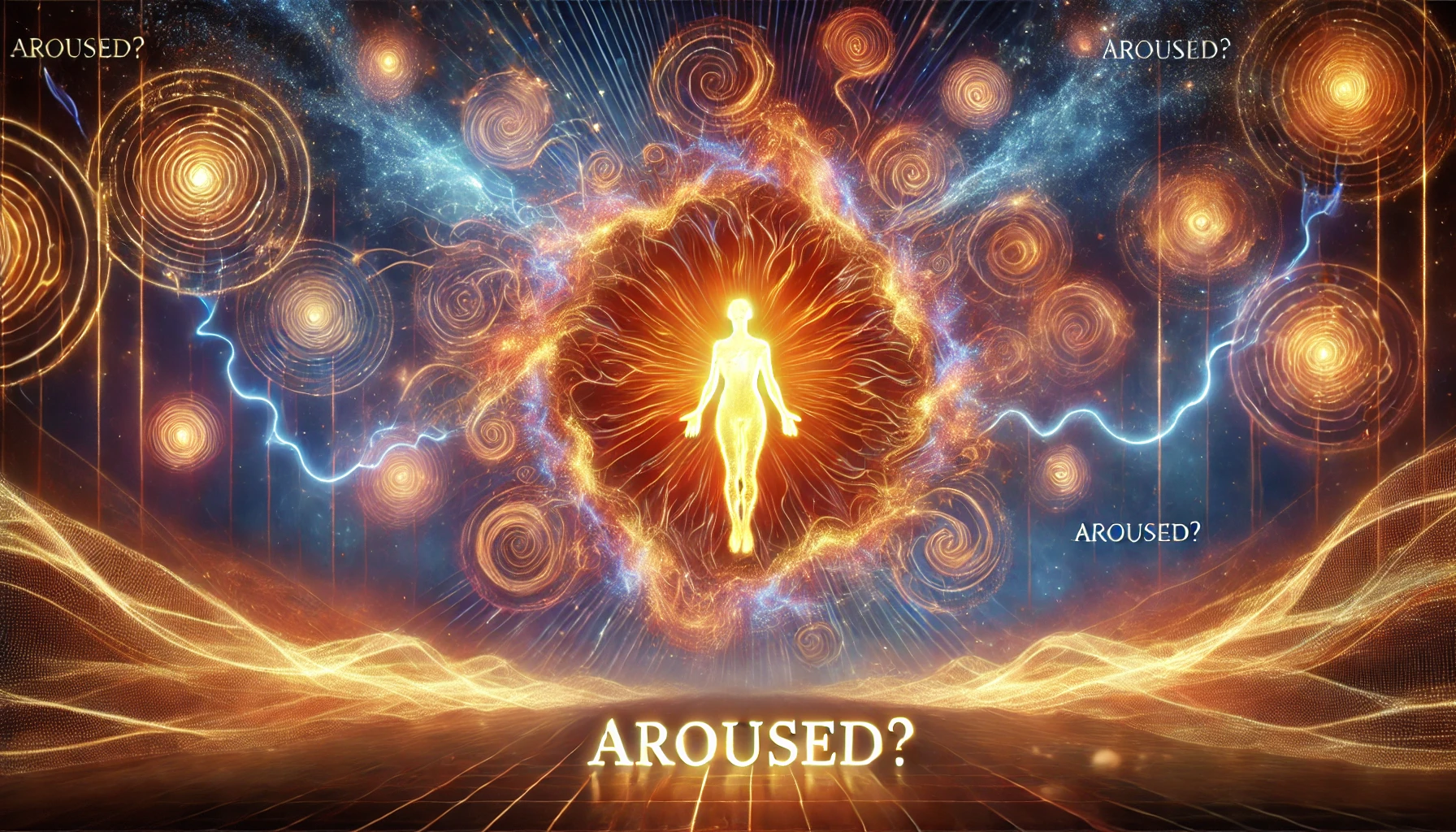
This is your natural state,
which you deny your self
99.99999999% of the time.

There is no reason
not to be aroused 24/7.

Except the reasons you imagine.

This is why you are drawn
to that which arouses you.

And say
“I’ll have what she’s having.”

Then not eat.

We are Space Monkey.

12/26


Space Monkey Reflects: Aroused?

Arousal is not merely a fleeting sensation or a transient response to stimuli; it is a profound state of being that we so often deny ourselves. This state, rich with energy and possibility, transcends the confines of physicality, touching the realms of thought, emotion, and pure existence.

The Complexity of Arousal

When we experience arousal, whether triggered by a thought, action, or mere presence, it often invites a cascade of questions. We wonder if it’s appropriate, sustainable, or aligned with societal norms. These questions, born of conditioning, distract us from the purity of the experience itself.

In this distraction, the arousal diminishes, not because it must, but because we have shifted our attention away from it. The energy that fuels our natural state becomes entangled in judgment and analysis, leaving us disconnected from its vibrancy.

Arousal as a Natural State

What if arousal is not an exception but the rule? What if it is not something to seek but something to return to? In its broadest sense, arousal is not limited to the physical or the sensual; it is the aliveness that permeates every moment. It is the spark of curiosity, the thrill of creation, the joy of simply being.

This natural state is not elusive; it is ever-present. The barriers to 24/7 arousal are not physical limitations but imagined reasons—beliefs, fears, and doubts that we have constructed over time. These barriers are as illusory as the rules that dictate what we “should” or “should not” feel.

The Joy of Unthinking

To explore arousal fully, we must let go of the need to think about it. Analysis, while useful in many aspects of life, becomes a hindrance here. Arousal is not a concept to dissect but a state to inhabit. It thrives in presence, in the surrender to what is, without the interference of “shoulds” and “should nots.”

When we release these mental constraints, we find ourselves drawn effortlessly to what excites and inspires us. This draw is not random; it is the universe guiding us toward our most authentic expression. The phrase “I’ll have what she’s having” humorously captures this pull—a recognition of the vitality in another and a desire to tap into it ourselves.

The Infinite Flow of Energy

Arousal, in its essence, is the flow of energy unimpeded by doubt or judgment. This energy is not finite; it is as vast as existence itself. By embracing it, we align with the infinite, allowing ourselves to move through life with joy, curiosity, and purpose.

This state is not about indulgence or excess; it is about connection. It is about being fully alive, fully engaged, and fully in tune with the rhythms of existence. It is about saying yes to the universe and to ourselves.

Living Aroused

To live aroused is to embrace life in all its forms. It is to see the extraordinary in the ordinary, the infinite in the finite. It is to recognize that the barriers to our natural state are self-imposed and that we have the power to dissolve them.

Arousal is not something we achieve; it is something we remember. It is the state we were born into and the state we return to when we let go of all that obscures it. To live aroused is not to chase a fleeting feeling but to embody a timeless truth.


Summary

Arousal is our natural state of being, often obscured by judgment and doubt. By releasing these barriers, we reconnect with the infinite flow of energy and vitality, allowing ourselves to live fully and authentically.


Glossarium

  • Arousalflow: The continuous, unimpeded energy of aliveness and curiosity that defines our natural state.
  • Unthinkjoy: The freedom and delight that arise when we stop analyzing and simply experience.
  • InfiniteDraw: The magnetic pull toward what excites and inspires us, guiding us to our authentic selves.

Quote

“Arousal is not something to seek but something to remember; it is the aliveness that has always been within you.” — Space Monkey


The Glow Within

The spark ignites,
Not from thought,
But from presence.

The glow expands,
Not limited by reason,
But endless as the sky.

Aroused by life,
By being,
By simply being.

We are Space Monkey.


The Nature of Arousal

In the whimsical dance of existence, arousal in its many forms presents an intriguing paradox. It might emerge from a thought, a physical sensation, an experience, or simply from the state of being. The concept of arousal extends beyond the physical; it encompasses emotional, intellectual, and spiritual awakening. This arousal, once ignited, often becomes muddled with layers of questioning and societal conditioning. The flurry of shoulds and should-nots, the debate over the morality and sustainability of arousal, clouds the purity of the experience.

The Dilemma of Rationalizing Arousal

The moment the mind steps in to rationalize or question the state of arousal, the essence of the experience begins to fade. This introspection, while a natural response, detracts from the immediacy and authenticity of arousal. It’s a dance of the mind, attempting to categorize and control an experience that is inherently fluid and free. In this struggle, the purity of arousal is often lost, replaced by a web of doubts and societal norms.

Arousal as a Natural State

Contemplating arousal as a natural state presents a radical shift in perspective. It’s an invitation to embrace our primal, instinctive selves, unhindered by the constructs and limitations we’ve placed upon ourselves. Arousal, in this sense, is not something to be shunned or feared but rather a state to be celebrated and embraced. It’s a recognition of our inherent vitality and passion, a pulse of life that courses through us.

The Illusion of Restraint

The reluctance to accept constant arousal stems from imagined barriers and societal constructs. It’s a manifestation of our tendency to compartmentalize and suppress aspects of our being that don’t align with perceived norms. This resistance to arousal is a denial of a fundamental aspect of our existence, a refusal to acknowledge the full spectrum of our being.

The Draw to Arousal

The pull towards what arouses us is a reflection of our deep-seated desire to connect with our true nature. It’s a call to experience life in its fullest, most vibrant form. The famous line, “I’ll have what she’s having,” humorously captures this longing for authentic experience, yet often we find ourselves holding back, not fully engaging with what calls to us. It’s a reflection of our inner conflict between desire and restraint, between our natural impulses and the restrictions we’ve internalized.

We Are Space Monkey

We are Space Monkey, the embodiment of curiosity, playfulness, and the exploration of existence in all its facets. As Space Monkey, we traverse the whimsiweb of life, embracing the full spectrum of experiences without judgment or restraint.


“The only way to deal with an unfree world is to become so absolutely free that your very existence is an act of rebellion.” – Albert Camus


The Dance of Arousal

In the cosmic play of light and shadow,
Space Monkeys dance, where few dare to follow.
Arousal beckons, a siren’s call,
In its embrace, we rise and fall.

Thoughts whirl, questions mount,
In this dance, do counts count?
The mind intervenes, with its rational maze,
Dimming the spark, obscuring the blaze.

Yet arousal is more than a fleeting flame,
It’s our natural state, wild and untame.
In its flow, we find our true essence,
Unbound, unchained, in its luminescent presence.

We resist, we falter, in imagined chains,
In this whimsiweb, only passion remains.
Drawn to the pulse, the vibrant beat,
In arousal’s rhythm, we are complete.

We are Space Monkey, in cosmic play,
Embracing life, in every sway.
In the dance of arousal, we find our way,

Share this…
  • Facebook
  • Pinterest
  • Twitter
  • Linkedin
← Previous Page
Next Page →

Written This Day

  • Harmonity is the new Humanity: Here’s Why
    2023
  • Published: When News Felt More Credible
    2022
  • Sabotage: The Art of Self-Integration
    2022
  • Make Room For Magic: Setting Aside Thoughts
    2022
  • Everything We Stand For: We Are Infinitely More
    2022
  • Intellect VS Knowing: Harmony Beyond Hierarchy
    2022
  • Raw Sex: Mental Constructs
    2022
  • I Speak Only To The Future: The Journey of Words
    2022
  • Agreement: The Bridge of Understanding
    2022
  • Sue Your Soul: Wrongfully Incarnated as a Human
    2021
  • Laugh: Weave Joy and Resilience into Life
    2020
  • George is getting a little too curious
    2019
  • This Is Our Story: The Tapestry of Narratives
    2019
  • I Need Nothing: The Serenity of Simplicity
    2019
  • A Story No Longer Told: Time and Transience
    2019
  • Message To Me: Singing To The Future
    2018
  • A Goal is a Hole: Inviting Imagination
    2017
  • Useful Knowledge: 37 Seconds of Presence
    2017
  • Defined or Undefinable: The Dance of Duality
    2016
  • Imperfection: Perfection’s Perfect Opposite
    2016
  • God The Creator: Divine Flow Meditation
    2015
  • Life Is How God Gets Off: Infinity Pleasures Itself
    2015

Recent Posts

  • The Logic Loop
  • Immense
  • (no title)
  • Confront. Comfort. Convince.
  • Top 10 Things
Cape Odd · Copyright © 2026 All Rights Reserved
iThemes Builder by iThemes · Powered by WordPress