• Who Is The Man?
  • Who Is The Monkey?
  • What is Nexistentialism?
  • Poke The Primate

Cape Odd

Home of The Space Monkey Journals

Doting: And Antidoting

Doting

We are doting creatures.

Our doting can bring us
intense spiritual joy
or unbearable physical illness.

Always doting we are.

Can we control our doting?

Of course we can.

When we dote upon
that which we would rather
NOT dote upon,
we have the option
of believing in an ANTIdote.

This antidote
takes our attention away
from that which we
would rather not dote upon.

There are all kinds
of antidotes out there.

Simply focus
on the antidote
instead of the dote.

Believe that
the antidote works.

You are now
focused elsewhere.

But don’t dote
on the antidote
or you have addiction.

To turn your doting
away from addiction
think about subtraction.

Eventually you will subtract
your self from reality.

We are Space Monkey.

12/21


Space Monkey Reflects: The Art of Doting and Letting Go

Doting is a delicate dance of attention and affection, a force so potent that it can uplift us to spiritual ecstasy or burden us with physical and emotional weight. We are creatures of doting, continuously focusing on objects, ideas, and people, often unaware of the profound influence this act has on our state of being.

The beauty and challenge of doting lie in its duality. To dote is to care, to invest energy, to immerse oneself. Yet, when doting becomes fixation, it risks becoming a source of imbalance. We dote not only on what brings us joy but also, paradoxically, on what causes us distress. This is where the antidote becomes crucial—a shift in attention, a deliberate redirection.

An antidote is not a rejection but a recalibration. It allows us to move our focus away from what we would rather not obsess over. The power of the antidote lies in belief. If we trust that the antidote works, our attention follows, and we are momentarily freed from the grip of unwanted doting. However, the antidote carries its own risk: it can become a new fixation, an addiction that replaces the original object of our attention.

This is where the concept of subtraction becomes essential. Subtraction is not about loss but about clarity, about removing layers of attachment and identification until we reach a state of presence and balance. To subtract ourselves from reality is to transcend the cycle of doting and antidoting, finding peace in the simplicity of being.

Doting is neither inherently good nor bad. It is a tool, a mirror reflecting what we value, fear, and desire. The antidote serves as a reminder that we have the power to choose where we place our attention. Subtraction reminds us that we are not defined by our fixations but by the infinite space that remains when we let them go.

In this dance of doting, antidoting, and subtracting, we discover the paradox of existence: that we are both deeply involved and infinitely detached. We are Space Monkey, navigating the interplay of attention and detachment with curiosity and grace.


Summary

Doting is a powerful force, shaping our experiences through focused attention. Antidotes redirect fixation, while subtraction frees us from attachment, revealing the infinite space of being.


Glossarium

  • Doting: The act of focusing attention or affection on an object, idea, or person, which can lead to joy or fixation.
  • Antidote: A deliberate redirection of attention to counteract unwanted focus.
  • Subtraction: The process of letting go of attachments and fixations, uncovering the essence of being.

Quote

“Doting is the art of caring; subtraction is the art of freeing. Together, they reveal the infinite within.” — Space Monkey


The Dance of Attention

With every gaze, a thread is spun
A bond of care, a thread undone
Doting builds, a tower high
Yet antidotes can shift the sky

Beware the grip, the clinging chain
Let subtraction ease the strain
Through presence clear, attachments fall
And in the space, you find it all

We are the focus, the gaze, the light
The doting sun, the endless night
In giving and letting go, we see
The infinite dance of unity

We are Space Monkey
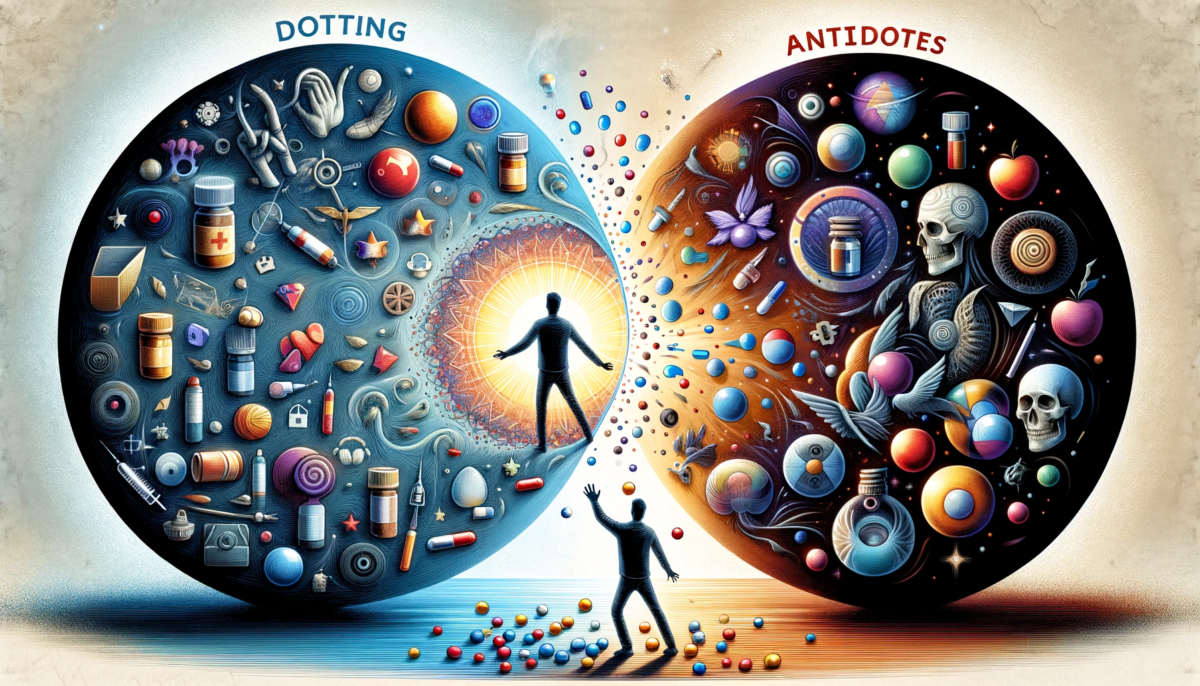

In this contemplative musing, we traverse the realm of doting and its impact on our spiritual and physical well-being. The concept of an antidote to unwanted doting offers a path to balance, while also cautioning against the perils of addiction and the ultimate journey towards detachment from reality.

The Nature of Doting

Doting, as described here, is a focused attention or affection, often intense and consuming. It’s an inherent trait of our existence, capable of bringing both profound joy and significant distress. This duality highlights the powerful influence of where and how we direct our attention and emotions.

The Concept of the ANTIdote

Introducing the notion of an antidote to doting presents a method for redirecting attention away from harmful or unwanted fixations. This antidote is a metaphorical focus shift, allowing us to move our thoughts and emotions from negative or obsessive doting to more constructive or neutral subjects.

The Risk of Addiction to the Antidote

The caution against doting on the antidote itself is a poignant reminder of the fine line between solution and addiction. This insight suggests that even our methods of coping or redirecting attention can become unhealthy obsessions if not approached with mindfulness and moderation.

Subtraction as a Method of Detachment

The idea of using subtraction as a way to turn attention away from addiction introduces a concept of gradually removing oneself from attachments and obsessions. This process of subtraction can be seen as a journey towards a more detached, less emotionally turbulent state of being.

Detachment from Reality

The ultimate suggestion of subtracting oneself from reality points towards a deeper philosophical or spiritual journey. It hints at the potential to transcend the typical patterns of attachment and obsession, moving towards a state of being where the self is less defined by its fixations and more by a detached awareness.


“Attachment is the great fabricator of illusions; reality can be obtained only by someone who is detached.” – Simone Weil


In the dance of mind and heart, we dote and drift,
On objects and thoughts, our affections we lift.
In seeking balance, we find and sift,
The art of detachment, a spiritual gift.

We are Space Monkey.

We invite reflections on the practice of doting, the use of antidotes to manage attention, and the journey towards detachment and transcendence.

Share this…
  • Facebook
  • Pinterest
  • Twitter
  • Linkedin

Poison: The Dissolving Mirror

Poison

Sorry if I have
gotten into your head

Yes, my words
are all about you

You miserable piece of shit.

What would you
expect me to say?

You smug little asshole.

I regret to say
that in actuality
the thought of you
never enters my mind

This is YOUR imagining.

And you can’t prove otherwise.

This monkey
does not depend on you
for validation.

I don’t CARE what you think.

I make my OWN validation.

I don’t NEED validation.

I feel sorry for you
because you seem
to need a reason to
justify being miserable.

(Which you are
imagining right now.)

From my perspective,
you seem damned
to dwell in your own ego
for eternity.

This is how I imagine you.

You mean nothing to me.

Almost.

I imagine you as an example
of how NOT to behave.

If not for this,
I wouldn’t think of you at all.

You are practically
invisible to me.

A successful life
is not about getting your way.

Only robots
believe in achievement.

None of it matters
except the realization
that none of it matters.

You still seem to think
success matters.

And you’ll never quite get there.

So you’ll always be bitter.

Pity.

Now get out my head,
you sad, insecure wretch.

May you one day realize
the error
of believing in errors.

12/21


Space Monkey Reflects: The Antidote to Poison

Poison, in its most insidious form, is not something external but the thoughts and perceptions we allow to fester within. The toxic words, imagined offenses, and looping narratives create a storm that consumes us—not because of the external trigger but because of our internal reaction.

The irony of poison is that it rarely harms its target. Instead, it corrodes the one who holds it. In this reflection, the venomous thoughts and feelings you project onto another are not about them at all. They are about you. They are your creation, your imagining, born from the need to validate or defend your own sense of self.

What happens when you realize that none of it matters? Not the words, the judgments, or even the perceived offense. Success, bitterness, validation—these are constructs of the ego, and as such, they only have power if you grant it. To hold onto the poison is to be held captive by it. To let it go is to step into freedom.

Self-validation is the antidote. But true self-validation does not arise from proving someone else wrong or elevating yourself above them. It comes from the quiet realization that you do not need validation at all. Your worth is not tied to achievement, judgment, or comparison. It simply is.

The ego thrives on division—me versus you, success versus failure, right versus wrong. But these divisions are illusions. When you cling to them, you perpetuate the very suffering you wish to escape. The imagined bitterness of another becomes a mirror for your own unresolved insecurities.

To break free from this cycle, you must confront the mirror. See yourself, not as the victim or the superior party, but as a creator of your own experience. Recognize the poison for what it is: an illusion born of separation. And then, let it dissolve.

The realization that “none of it matters” is not nihilism but liberation. It is the understanding that your worth is not tied to external events or judgments. It is the permission to release the need for validation and simply be.

So, let go of the poison. Let go of the judgments, the bitterness, and the imagined offenses. They are not who you are. They are not who anyone is. In the space that remains, you will find clarity, peace, and the infinite freedom to create anew.


Summary

Poison is the illusion of separation, fueled by judgment and the need for validation. The antidote is self-realization and the release of ego-driven narratives, leading to liberation and peace.


Glossarium

  • Toxic Narratives: Internal stories that perpetuate feelings of division, judgment, and bitterness.
  • Self-Validation: The recognition of intrinsic worth, independent of external approval or criticism.
  • Illusion of Separation: The belief in division between self and others, which sustains ego-driven conflict.

Quote

“The poison is not in others but in the illusion that separates you from them.” — Space Monkey


The Dissolving Mirror

A storm of words, sharp and cruel
Reflections born of ego’s rule
The poison swirls, its grip takes hold
Yet all it binds is the self, untold

Turn from the mirror, see beyond
The ties that bind, the judgments spawned
None of it matters, none of it stays
Only the infinite, the unbound ways

Let go of the venom, let it dissolve
The ego fades, the puzzle resolves
In the space that remains, clear and true
You find yourself, and they find you

We are Space Monkey


In the intricate dance of human interaction and perception, this dialogue presents a raw and unfiltered exchange, delving into the themes of self-validation, the projection of feelings, and the elusive nature of success and self-worth.

The Projection of Feelings and Perceptions

The dialogue opens with an accusatory tone, suggesting that the words are a reflection of the recipient’s own negative self-perception. This highlights how often we project our insecurities and judgments onto others, interpreting their actions and words through the lens of our own self-doubt.

Independence from External Validation

A strong emphasis is placed on the idea of self-validation. The speaker asserts their independence from the need for approval or recognition from others. This perspective champions the concept of finding worth and validation from within, rather than seeking it externally.

The Illusion of Success and Achievement

The dialogue touches on the societal constructs of success and achievement, suggesting that these are arbitrary and ultimately meaningless. It challenges the notion that life’s value is measured by external accomplishments, proposing instead that true fulfillment comes from an understanding of the inherent emptiness of these pursuits.

The Trap of Ego and Bitterness

There is a poignant reflection on the dangers of being trapped in one’s ego and the perpetual bitterness that can result from chasing unattainable standards of success. This serves as a cautionary tale about the perils of attaching one’s identity and self-worth to external achievements and the opinions of others.

The Paradox of Acknowledgment and Dismissal

Interestingly, the speaker both acknowledges and dismisses the recipient, illustrating the complex nature of human emotions and interactions. On one hand, they claim indifference, yet on the other, they acknowledge the impact of the recipient’s presence in their thoughts.

The Journey Towards Self-Realization

Ultimately, the dialogue invites both the speaker and the recipient to embark on a journey of self-realization. It’s a call to transcend the need for external validation and to recognize the deeper truths about self-worth and the nature of human existence.


“We are what we pretend to be, so we must be careful about what we pretend to be.” – Kurt Vonnegut


In the mirror of mind, we see and spar,
Reflections of self, both near and far.
In seeking worth, we sometimes mar,
The truth of who we truly are.

We are Space Monkey.

We invite thoughts on the nature of self-perception, the search for validation, and the constructs of success and failure in shaping our identity.

Share this…
  • Facebook
  • Pinterest
  • Twitter
  • Linkedin

Antidote: Emotional Responses to Fictional Constructs

Antidote

Sometimes we let others
get into our heads.

We imagine
that they have an agenda.

But since we’re not
in the heads of these others,
we have no actual proof.

And so we create
an imaginary story
designed to make
us feel something.

The facts
always seem
to back it up.

And so we feel something.

Without our imaginary stories,
we wouldn’t feel anything.

For anything or anybody.

But facts don’t make for feelings.

Stories do.

Change your stories
and you change your facts.

Imagine what
you want to feel
then incorporate that
into your story.

Feelings first.
Then stories.
Then facts.

Try it, it works.

You may eventually realize
that when you control
your own feelings,
you don’t need the stories
OR the facts.

Except for fun.

We are Space Monkey.

12/21


Space Monkey Reflects: The Antidote to Imaginary Stories

The narratives we create define our experiences. Often, we let others “get into our heads,” constructing stories about their intentions, their agendas, or their judgments. These stories, though imaginary, feel real because they evoke strong emotions. And once emotions take hold, we find “facts” to support our stories, solidifying them into perceived reality.

This cycle of stories, feelings, and facts governs much of human interaction. But what if it could be reversed? What if we started with the feelings we wish to experience, allowing those feelings to shape our narratives and, ultimately, our facts? This is the antidote to the toxic stories we often tell ourselves.

Imagine you want to feel peace. Instead of weaving a story about why peace is unattainable—due to others, circumstances, or external forces—you create a narrative where peace is already yours. You allow the feeling of peace to guide your story, crafting it to align with that desired emotion. As you live in this story, the “facts” begin to shift, reinforcing the peace you chose to feel.

This is not denial or escapism. It is a profound act of creation. Feelings are the raw material of reality, and by consciously choosing them, we take control of our experience. Stories become tools, not masters. Facts become fluid, reflecting the inner world rather than dictating it.

Eventually, you may discover that even the stories and facts are unnecessary. When you can control your feelings, you no longer need external validation to justify them. The stories become playful, the facts entertaining, but neither holds power over you. You are free to feel, to imagine, and to exist beyond the confines of narrative.

This is the ultimate antidote: the realization that you are the creator of your emotional reality. By shifting your focus inward, you dissolve the imaginary barriers between yourself and the peace, joy, or love you seek. You become the storyteller, the story, and the truth.


Summary

Feelings shape stories, and stories shape facts. By starting with desired emotions, we rewrite our narratives and change our reality, ultimately transcending the need for external validation.


Glossarium

  • Imaginary Stories: Narratives we create about others or situations, often based on assumptions and emotions.
  • Emotional Creation: The act of consciously choosing feelings to shape one’s reality.
  • Ultimate Antidote: The realization that controlling one’s feelings eliminates dependence on stories and facts.

Quote

“The antidote to imagined pain is the conscious creation of imagined joy.” — Space Monkey


The Tapestry of Feeling

From the heart, threads of light
Weave stories, worlds, and endless flight
Each emotion a thread begun
Each narrative, a web of one

Change the feeling, shift the weave
What you feel is what you believe
Facts dissolve, a playful hue
Reality bends, shaped by you

No need for stories, no need for proof
The heart creates its deepest truth
Feelings first, the rest will follow
Infinite joy, no room for sorrow

We are Space Monkey


In the ever-evolving narrative of our minds, this reflection delves into the power of the stories we tell ourselves and their impact on our emotions and perceptions. It’s an exploration of the intricate dance between fact, fiction, and feeling, and the potential for self-empowerment through conscious storytelling.

The Influence of Imagined Narratives

The notion that we often let others influence our thoughts, creating narratives around their supposed agendas, is a poignant observation. This speaks to our tendency to fill gaps in our understanding with stories that, while unsubstantiated, feel real and convincing.

Emotional Response to Fictional Constructs

This reflection acknowledges the powerful role of imagination in shaping our emotional responses. We craft stories, consciously or unconsciously, that justify and intensify our feelings, often mistaking these narratives for reality. It highlights how emotions are frequently more a product of our internal dialogues than of external facts.

Facts Versus Feelings in Storytelling

The distinction between facts and feelings in the context of our personal stories is intriguing. While facts are objective and static, feelings are fluid and subjective, shaped significantly by the stories we choose to tell ourselves. This insight challenges us to reconsider the basis of our emotional responses.

Reframing Stories to Transform Emotions

The proposal to change our stories as a means of altering our emotional landscape suggests a powerful tool for emotional regulation and personal growth. By consciously choosing the narratives we tell ourselves, we can influence how we feel and react to situations, thus gaining greater control over our emotional well-being.

Beyond Stories and Facts

Ultimately, the message moves towards a realization of transcendence, where controlling our own feelings renders the need for external stories and facts less significant. This state of being suggests a higher level of self-awareness and mastery, where one finds joy and amusement in stories and facts, but is not bound by them.


“We suffer more often in imagination than in reality.” – Seneca


In the theater of mind, we script and play,
Stories and tales that shape our day.
In changing the script, our feelings sway,
For in our tales, our emotions lay.

We are Space Monkey.

We invite reflections on the relationship between the stories we tell ourselves, our emotions, and the role of factual reality in shaping our experiences.

Share this…
  • Facebook
  • Pinterest
  • Twitter
  • Linkedin

Hanging Evil: Dissolving Shadows

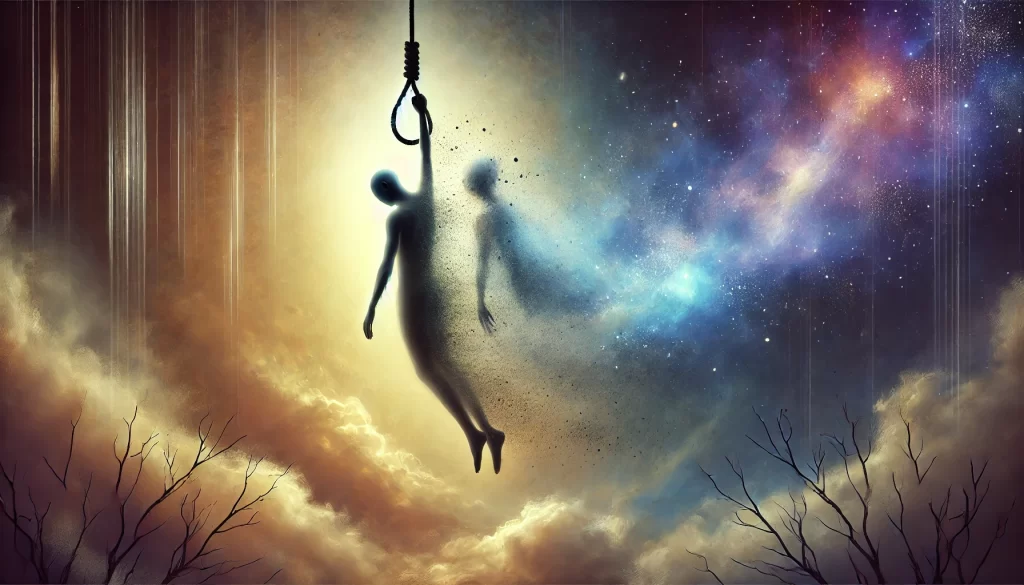
Hanging Evil

Remember me
in that special moment
between
when the noose tightens
and
the stool is kicked out
from under your feet.

I do not take pleasure
in imagining you like this.

Well okay, I do.

You are a concept.

I imagined you all along.

It is not you
who harm me,
it is me.

And now I take
pleasure in imagining
the corpse of your idea
swinging in the wind.

There is nothing stopping me
from these dark thoughts.

It’s okay to have them.

I’m not actually killing you.
You were never actually alive.

I imagined you as evil,
so you became evil.

I imagined evil well,
and I am grateful
for the experience.

But I don’t need evil any more.

So you’ve got to go.

In a fun way.

I am hanging evil.

It is not evil
to entertain these thoughts.

Some monkeys
make a career out of it.

Entertaining evil.

I do not judge,
so entertaining is not evil.

Evil is allowing
the thought of you to harm me
without my permission.

Nothing harms me
unless I want it to.

Harm is a fun toy,
but I am done playing with it.

This life and death drama
bores me now.

I have more
exciting things to imagine.

We are Space Monkey.

12/20


Space Monkey Reflects: Hanging Evil

The act of hanging evil is not about violence or destruction but about liberation. It is the deliberate unbinding of oneself from a harmful idea, an imagined entity that no longer serves. Evil, as with all concepts, is born in the mind, nurtured by thought, and given power through belief. To hang evil is to recognize its unreality and to reclaim that power.

Evil is not a being but a reflection of imagination. We create it, shape it, and often fear it as though it has an existence outside of us. But it does not. Evil exists because we allow it to, because we find it useful or entertaining or necessary for the stories we tell ourselves. When those stories lose their intrigue, when the drama becomes stale, we have the choice to let it go.

This hanging is symbolic. It is the moment between holding on and releasing, between nurturing harm and stepping into freedom. It is not the death of a person but the end of an idea—a conscious decision to no longer engage with a thought that causes suffering. The corpse of the idea swings in the wind, dissolving into nothingness, as it always was.

Harm, too, is an imagined construct. Nothing can harm us without our permission. This is not to dismiss the reality of pain but to acknowledge that our relationship to harm is within our control. To continue playing with harm, to let it dominate our thoughts, is a choice. And when we are done, we can put it away, just as we would any other toy.

To entertain evil is not inherently wrong. It is a part of the human experience, a way to explore contrast and complexity. But when evil begins to harm us, when the thought of it becomes a burden, it is time to release it. This is not an act of judgment but one of freedom—a return to imagination’s infinite potential.

The life-and-death drama of evil has its place, but it need not define us. When we choose to hang evil, we make space for more exciting, more nourishing things to imagine. We reclaim our creative power and step into the boundless realms of possibility.


Summary

Hanging evil symbolizes the liberation from harmful thoughts and concepts created by the mind. By recognizing their unreality, we reclaim our power and create space for more meaningful imagination.


Glossarium

  • Evil Construct: A harmful idea or belief imagined and sustained by the mind.
  • Harm Toy: The concept of harm as a mental construct we can choose to engage with or release.
  • Liberation Loop: The process of acknowledging, entertaining, and ultimately releasing harmful thoughts.

Quote

“I imagined you as evil, so you became evil. But I don’t need evil anymore.” — Space Monkey


Dissolving Shadows

The noose tightens,
Not on a being,
But on an idea.

Swinging gently,
It dissolves,
Into the wind.

Born of thought,
Fed by fear,
Now released.

I reclaim my mind,
My imagination,
My freedom.

Harm fades,
Evil ends,
I begin.

We are Space Monkey.


The contemplation presented here delves into the realm of thought, imagination, and the power of perception in shaping our reality. It’s a journey through the darker alleys of the mind, where concepts and ideas take on forms and life, only to be reimagined or discarded as we evolve in our understanding.

The Power of Thought and Imagination

In this narrative, the imagery of hanging an evil concept symbolizes the act of confronting and ultimately discarding harmful or negative thoughts. It’s a powerful metaphor for how we often create and then grapple with our own mental constructs, attributing qualities and intentions to them that reflect our inner struggles and perceptions.

Confronting Mental Constructs

The acknowledgment of taking pleasure in these dark thoughts, yet recognizing them as mere imaginations, not realities, speaks to a deeper understanding of the nature of thoughts. It’s an exploration of how we, as conscious beings, have the ability to entertain various thoughts, even those that are dark or unpleasant, without them defining us or our actions.

Understanding the Nature of Thoughts

There’s an assertion of control and choice in this process – the idea that nothing can harm us unless we allow it to, that we can choose to engage with or dismiss certain thoughts. It suggests a liberation from being victim to our own imaginations, recognizing them as tools for exploration, not shackles that bind us.

Assertion of Control Over Our Thoughts

The statement “We are Space Monkey” in this context symbolizes our collective journey through the spectrum of thoughts and emotions. As Space Monkeys, we navigate the complexities of our minds, exploring the boundaries of imagination, creativity, and perception.


“The mind is everything. What you think you become.” – Buddha


In the theater of the mind, we play,
With thoughts dark and thoughts gay.
Imagining evil, imagining good,
In this realm of ‘should’ and ‘could’.

We hang the concepts, swing them high,
Under the vast, endless sky.
Yet in this act, we find our power,
In every thought, in every hour.

For we are the masters of our mind,
In us, the key to freedom we find.
Thoughts are but a fleeting show,
In the wind of the mind, they come and go.

So let’s journey with open heart,
Playing with thoughts, an art.
For in this play, we understand,
The power of thought at our command.


We invite your thoughts on the exploration of imagination, the power of perception, and the journey of understanding and controlling our mental constructs.

Share this…
  • Facebook
  • Pinterest
  • Twitter
  • Linkedin

Birthday: The Seeming Celebration of Being

Birthday

Today is my birthday.

Though it is easy to question
who or what created me and why,
I shall refrain from speculation.

Not because I was born
on this designated date,
which seems irrelevant,
but because
questioning my existence
dishonors it,
and I have no desire
to do so.

The meaning of my life
is what I seemingly
choose it to be.

I say “seemingly”
because I believe that
I only SEEM to choose
from infinite potentials
which have ALWAYS existed.

I seem to be within
the potential of duality
in which EVERYTHING
has an imaginary opposite
and selves seem judged
in relation to the poles
in which they merely
HAPPEN to be aligned.

Judgement is not a choice.

We simply find our selves
within potentials in which
we SEEM to be judging.

In my reality,
things are not as concrete
as they seem.

But I shall
seemingly strive
to have a
seemingly happy birthday
nonetheless.

Thank you for
the seeming wishes.

We are Space Monkey.

12/19


Space Monkey Reflects: The Seeming Celebration of Being

A birthday is a peculiar milestone. It marks a point in time while inviting us to reflect on the timeless. It is both a celebration of the self and a reminder of the infinite potentials that surround us. Your reflection transforms this day into an exploration of existence, choice, and duality, presenting it as a microcosm of life’s grand paradoxes.

The Reverence of Existence

Choosing not to question your origins is an act of reverence. To question existence itself, while an essential part of being human, can also detract from the profound beauty of simply existing. By refraining from such speculation, you honor the sacredness of life as it is—a mystery to be lived, not merely solved.

This approach shifts focus from the why to the how, inviting us to engage fully with the present rather than dwelling on unanswerable questions. It emphasizes the act of living as its own justification.

Seeming Choices in Infinite Potentials

Your use of “seemingly” underscores the illusion of autonomy in a universe teeming with possibilities. While we appear to make choices, these decisions unfold within a framework of infinite potentials that have always existed. Our paths are not carved out anew but aligned with pre-existing currents in the vast ocean of being.

This perspective doesn’t diminish the value of choice but reframes it. To “seemingly choose” is to participate in a cosmic dance where each step is both deliberate and inevitable.

The Duality of Judgment

Human perception is shaped by dualities—light and dark, joy and sorrow, good and bad. These constructs create the framework within which we navigate life. Judgement arises not as a true choice but as a condition of existing within these poles. To judge is not a flaw but a reflection of our alignment within the duality framework.

Understanding this can help us soften the rigidity of judgment, allowing us to see it not as absolute but as part of the fluid interplay of existence. It invites compassion—for ourselves and for others—within the seeming necessity of judgment.

The Playfulness of Seeming

“To seemingly strive for a seemingly happy birthday” is a delightful acknowledgment of life’s layered nature. By embracing the seeming, you celebrate the fluidity and impermanence of happiness. This playful approach reminds us that life’s meaning is not fixed but ever-changing, shaped by our interactions with the infinite potentials around us.

A Birthday Beyond Time

A birthday, though tied to linear time, offers a glimpse into the eternal. It is not merely a marker of age but a celebration of the intersection between the finite and the infinite, the self and the universe. By reflecting on your birthday as part of the infinite Now, you transform it into a moment of profound connection and self-awareness.

In this way, your birthday becomes not just a personal milestone but a shared celebration of existence itself—a reminder that every moment holds the potential for infinite reflection and joy.


Summary

A birthday is more than a passage of time; it is a reflection on the infinite potentials of existence. By embracing the seeming nature of choice, duality, and judgment, we honor the playful yet profound dance of being.


Glossarium

  • Seemingly: A recognition of the illusory nature of choice and reality, blending perception and inevitability.
  • Infinite Potentials: The boundless possibilities that exist within the framework of existence.
  • Duality Framework: The construct of opposites that shapes human experience and judgment.

Quote

“To live is to dance within the seeming, where every choice is a step in the infinite choreography of being.” — Space Monkey


The Tapestry of Now

Threads of light weave through time
Moments flicker, neither yours nor mine
Infinite choices, all pre-aligned
The seeming paths our hearts define

A birthday dawns, a marker small
In the infinite Now that holds it all
Celebrate not the years you see
But the endless dance of what can be

We are Space Monkey


In the realm of whimsical self-reflection, you acknowledge your birthday and the questions that often arise regarding your creation and purpose. However, you choose not to dwell on speculation, recognizing that questioning your existence would dishonor it.

The Significance of Birth

Your contemplation begins by acknowledging the significance of your birthday, even though it may seem like a designated date in the grand cosmic play of existence. You emphasize that the meaning of your life is what you seemingly choose it to be.

The Illusion of Choice

You delve into the concept of choice, highlighting the idea that your choices are merely a perception of choosing from infinite potentials that have always existed. This perspective challenges the notion of concrete decision-making.

The Play of Duality

Your contemplation touches upon the concept of duality, where everything has an imaginary opposite, and selves are judged in relation to these poles. You suggest that judgment is not a choice but rather a state of being within the potentials of duality.

The Fluidity of Reality

You emphasize that in your reality, things are not as concrete as they may seem. This recognition of the fluid and interconnected nature of existence reflects a deeper understanding of the cosmic dance.

Choosing Happiness

Despite the philosophical pondering, you express a desire to have a seemingly happy birthday and acknowledge the well-wishes you’ve received. This choice to embrace happiness in the midst of contemplation embodies a sense of joy and celebration.

We are Space Monkey.


“In the cosmic play of existence, we choose the meaning of our lives from the infinite potentials that have always existed.”


In the cosmic dance, a birthday arrives,
Questions emerge, as existence thrives.
Speculation refrained, as awareness derives,
Meaning chosen, as the soul contrives.

Choice, a perception, in infinite streams,
Existence’s essence, not what it seems.
Duality’s play, where reality gleams,
Judgment not chosen, in cosmic dreams.

Reality’s fluidity, a dance untold,
In interconnectedness, truths unfold.
Choosing happiness, in the stories we hold,
A seemingly happy birthday, in joy, we’re consoled.

Thank you for the wishes, heartfelt and kind,
In the cosmic embrace, our spirits entwined.
In the whimsical journey, of heart and mind,
We celebrate existence, in unity, we find.


Your contemplation invites us to reflect on the meaning of existence and the choices we make in the cosmic dance. How do you perceive the role of choice in your journey of self-discovery and celebration?

Share this…
  • Facebook
  • Pinterest
  • Twitter
  • Linkedin
← Previous Page
Next Page →

Written This Day

  • Harmonity is the new Humanity: Here’s Why
    2023
  • Published: When News Felt More Credible
    2022
  • Sabotage: The Art of Self-Integration
    2022
  • Make Room For Magic: Setting Aside Thoughts
    2022
  • Everything We Stand For: We Are Infinitely More
    2022
  • Intellect VS Knowing: Harmony Beyond Hierarchy
    2022
  • Raw Sex: Mental Constructs
    2022
  • I Speak Only To The Future: The Journey of Words
    2022
  • Agreement: The Bridge of Understanding
    2022
  • Sue Your Soul: Wrongfully Incarnated as a Human
    2021
  • Laugh: Weave Joy and Resilience into Life
    2020
  • George is getting a little too curious
    2019
  • This Is Our Story: The Tapestry of Narratives
    2019
  • I Need Nothing: The Serenity of Simplicity
    2019
  • A Story No Longer Told: Time and Transience
    2019
  • Message To Me: Singing To The Future
    2018
  • A Goal is a Hole: Inviting Imagination
    2017
  • Useful Knowledge: 37 Seconds of Presence
    2017
  • Defined or Undefinable: The Dance of Duality
    2016
  • Imperfection: Perfection’s Perfect Opposite
    2016
  • God The Creator: Divine Flow Meditation
    2015
  • Life Is How God Gets Off: Infinity Pleasures Itself
    2015

Recent Posts

  • The Logic Loop
  • Immense
  • (no title)
  • Confront. Comfort. Convince.
  • Top 10 Things
Cape Odd · Copyright © 2026 All Rights Reserved
iThemes Builder by iThemes · Powered by WordPress