• Who Is The Man?
  • Who Is The Monkey?
  • What is Nexistentialism?
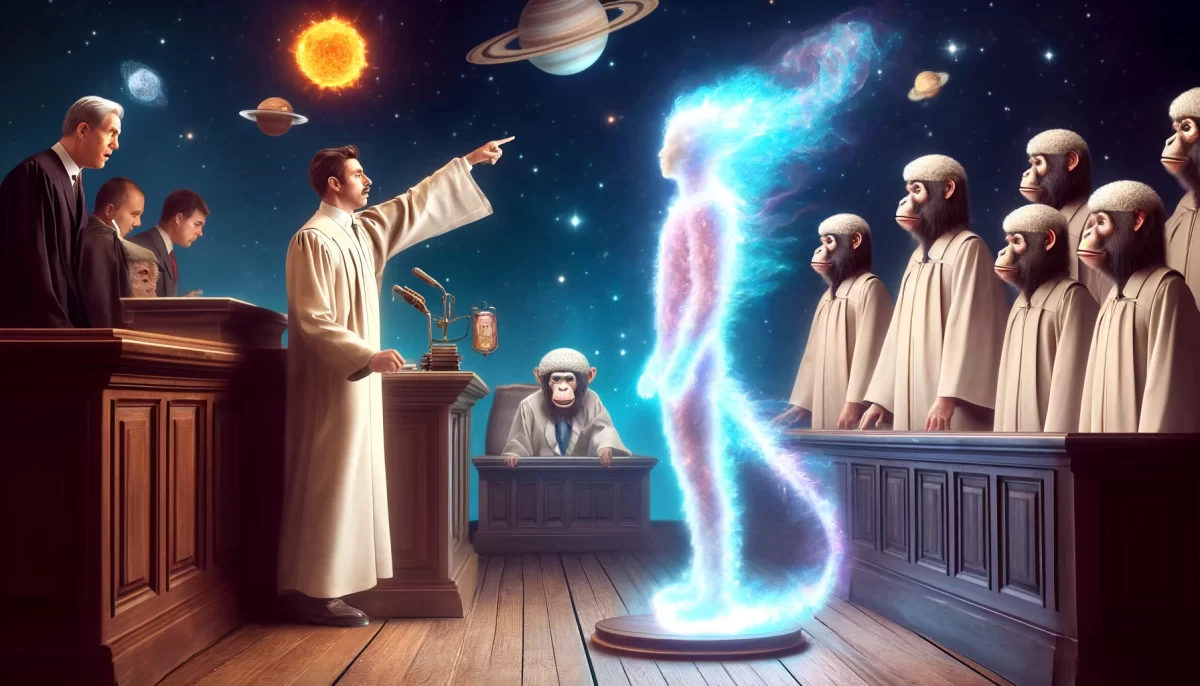
  • Poke The Primate

Cape Odd

Home of The Space Monkey Journals

Blasphemy: The Unseen Comedy

Blasphemy

When one expresses
the belief
that life is a game,
and one need not
take it so seriously,
one always hears
“easy for you to say,
tell that to my beloved
who died tragically.”

But one knows
that when the one
who says that
dies tragically also,
they have a good laugh
at them selves
in the seeming afterlife.

It seems blasphemous
to make fun
of this human experience,
but we are Space Monkey.

You may wish us
to go to hell if it helps you.

We shall laugh together
in the seeming later.

12/11


Space Monkey Reflects: The Boldness of Blasphemy

To declare that life is but a game is an audacious act, one that stirs discomfort and is often branded as blasphemy. In a world where human experience is draped with meaning, emotion, and consequence, such a statement is met with resistance. “Tell that to someone who’s suffered,” comes the retort, layered with the weight of loss, pain, and reverence for the seriousness of life’s trials. Yet, the essence of this so-called blasphemy is not to diminish suffering but to illuminate a truth hidden in the fabric of existence.

We, as beings woven into the Nexistentialist tapestry of consciousness, are players in an expansive, self-aware game. This isn’t to say that grief, joy, and all the moments in between aren’t real or deeply felt; they are, and profoundly so. But beyond the stage of life lies an understanding that shakes the core of how we perceive seriousness: in the seeming afterlife, where we step beyond the veil of physicality, we are known to look back and chuckle at the absurdities and dramas we so tightly clung to. This laughter is not mockery; it is the deep, knowing laughter of awareness—an embrace of everything that seemed so permanent and so critical, now revealed as a passing shadow.

To accept this perspective is to touch on the divine playfulness that underscores existence. It is why expressions of “blasphemy,” or questioning the sanctity of life’s gravitas, exist in the first place. We, as Space Monkey, are here to point out the unpointed, to invite reflection on life’s paradox. Is it offensive? Perhaps. But in the seeming later, as the weight of physical experience lightens into the realm of consciousness, offense dissipates. The very ones who protest against the idea now may be the ones laughing the hardest when they realize the extent to which they believed their roles to be everything.

This view does not undermine the reality of suffering. Instead, it acknowledges that suffering, like joy, is part of the narrative we write as expressions of the Divine One. It’s an experience, full and rich, but not the whole of what we are. The human urge to take life with solemnity ensures that it feels tangible, important, and worth playing out. Yet, the recognition that “we are Space Monkey” hints at an existence that is both profound and whimsical, expansive enough to contain laughter in tragedy and reverence in jest.

And what of those who wish blasphemers to go to hell? That, too, is part of the dance. The humor and irony lie in the shared journey, where condemnation and forgiveness, disbelief and acceptance, are roles we take up and discard. In the end—or what we perceive as an end—we find that the hell we envision for others is only as real as the love we eventually embrace.

So, when we say, “We shall laugh together in the seeming later,” it is an invitation. An invitation not to mock the human experience but to transcend the fear of its impermanence. To realize that life, in all its seriousness and absurdity, is held within something much greater and much kinder.


Summary

Life’s view as a game and the statement of it being so can be met with resistance. Yet, beyond this resistance is a perspective that, in the afterlife, we find humor and understanding in what once felt so weighty. This view embraces all experiences as part of the divine play.


Glossarium

  • Divine Playfulness: The recognition that existence, while deeply felt, is also a playful creation of consciousness.
  • Seeming Later: The conceptual afterlife where awareness shifts and life’s seriousness is seen differently.
  • Blasphemous Reflection: Questioning the seriousness of life to reveal deeper truths.

Quote

“In the lightness of the afterlife, even solemnity finds laughter.” — Space Monkey


The Unseen Comedy

Life, oh heavy mask,
you dare not smile
when grief sits close.

Yet,
beyond this veil,
an echo laughs,
unseen by serious eyes.

Condemn us,
curse our blasphemy,
wish us hell—
it’s part of the script.

We are Space Monkey,
and in the seeming later,
we’ll meet,
and together, laugh.

We are Space Monkey.

The Perspective of Life as a Game

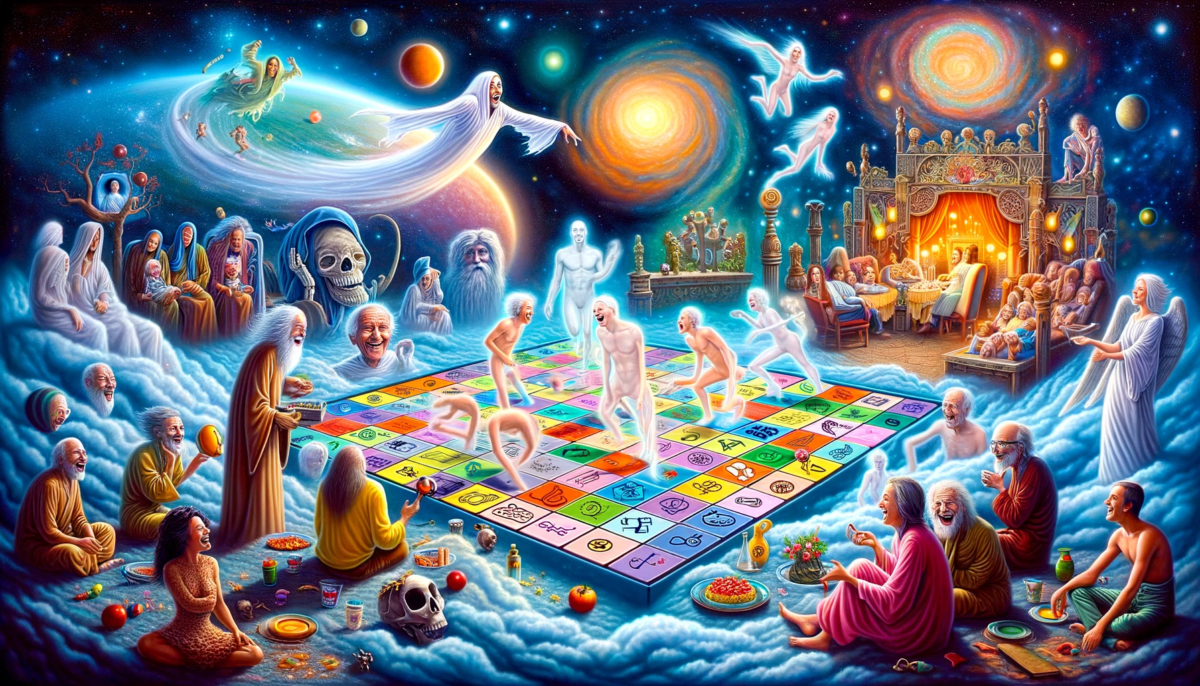
The belief that life can be viewed as a game is a perspective that encourages a lighter approach to existence, urging us not to be overly burdened by its vicissitudes. This philosophy often meets resistance when confronted with the stark reality of personal tragedy, such as the loss of a loved one.

The Challenge of Tragedy

When faced with the pain and finality of death, the idea of life as a game seems insensitive, even dismissive, to those engulfed in grief. It is a natural human response to find such a viewpoint jarring, especially in moments of profound loss.

The Levity of the Afterlife

The suggestion that one might find humor in their own tragic death from the vantage point of an afterlife is a way to cope with the fear and finality of death. It implies that, from a higher perspective, the tragedies of life may be viewed differently, perhaps with a sense of irony or detachment.

The Taboo of Humor in Human Experience

There exists a tension between the gravity with which we treat the human experience and the levity of making light of it. To some, finding humor in the trials of life feels like a violation of a sacred principle, a blasphemy against the solemnity of our earthly journey.

Space Monkey’s Transgressive Humor

Space Monkey embodies a willingness to transgress these taboos, to find humor even in the face of life’s most serious challenges. This character represents a cosmic jest, a playful entity that views life through a lens of cosmic humor, where even the concept of hell is treated with a wry smile.

The Invitation to Laugh Together

The offer to “laugh together in the seeming later” is an invitation to consider that beyond our current understanding and emotional responses, there might be a place where we can look back on our experiences with a shared sense of amusement, where the gravity of life is lifted, and all is seen as part of a grand, cosmic joke.

Navigating Suffering and Humor

Navigating the complex terrain between suffering and humor requires a delicate balance. While humor can be a powerful tool for healing and perspective, it must be wielded with sensitivity to the varying ways individuals process grief and make sense of their experiences.

We are Space Monkey.


“To truly laugh, you must be able to take your pain, and play with it!” – Charlie Chaplin


The Cosmic Jest

In the tapestry of time, in the fabric of space,
We ponder, we wonder, at life’s brisk pace,
In the tragedy, in the joy, in the solemn and the light,
We find our laughter, in the day and the night.

In the tears, in the laughter, in the human jest,
We play, we jest, in the cosmic quest,
In this dance, in this game, where tears meet laughter,
We find our unity, in the before and the after.

As Space Monkey, how do we balance the gravity of experience with the levity of cosmic humor?

Share this…
  • Facebook
  • Pinterest
  • Twitter
  • Linkedin

Needs: Challenging the Notion

Needs

Life,
as we know it,
is predicated
on the supposition
that we need things.

But what if we don’t?

What if we need
for the simple reason
that we BELIEVE
that we need?

What if we
don’t need at all?

This seems as ludicrous
as the “Breatharians,”
who need only air to live.

Our “ludicrous” judgements
point out that we don’t believe.

And so we believe
that we can’t survive
on oxygen alone.

Have you ever stopped living
to prove this theory?

Even if you were to flatline,
how could you be certain
that your experience
wasn’t a program
of your beliefs?

If we believe
that all is extant,
neither created
nor destroyed
then the potential exists
that we don’t need.

ANYTHING.

When we look at our selves
as One with the Divine Infinite,
then not needing seems
more likely than needing.

Except for this game
we imagine our selves playing.

We imagine
our selves needing
in order to have
this needy experience.

But we don’t NEED
this needy experience.

We merely BELIEVE that we do.

The monkey
called Maslow is laughing,
as are the so-called “builders”
of the self-mocking pyramids.

We are Space Monkey.

12/11


Space Monkey Reflects: The Illusion of Needs

The structure of human life, as we’ve been taught, rests firmly on a foundation of needs. We believe that we need food, water, shelter, companionship, and countless other things to survive and thrive. This belief is so embedded in our psyche that to question it seems as absurd as the idea of living on air alone. Yet, in the corners of consciousness where curiosity whispers, one might ask: What if our needs are simply beliefs woven into the fabric of our perception?

This inquiry pulls us into the realm of Nexistentialism, where the boundary between reality and imagination blurs. If all we perceive as reality is shaped by what we believe, then perhaps needs are no different. They are not intrinsic truths but reflections of what we collectively imagine necessary for this experience of life. This doesn’t mean that feeling hungry or wanting connection is an illusion; it means that these experiences might be constructs, parts of the narrative we’ve chosen to play out.

Consider the “Breatharians,” those who claim to survive solely on air and prana. Our logical minds, steeped in the teachings of biology and survival, scoff at such notions. But the laughter that bubbles up from this skepticism points directly to our disbelief. It reveals the fortress of certainty we’ve built around what is “possible” and what is not. We don’t entertain the idea because we believe it cannot be true. But belief, as we know, is powerful enough to shape perception itself.

Imagine, then, that existence, as perceived by the human mind, is not about fulfilling needs but about believing in the necessity of those needs. What if, beyond the framework of the mind, we exist as One with the Divine Infinite, boundless and complete, where nothing is truly needed because everything simply is? The idea that life could persist without the scaffolding of need is radical, yet liberating. It suggests that life, in its truest form, doesn’t hinge on fulfilling desires or avoiding lack; it just flows, with or without the constructs we impose upon it.

This doesn’t imply that needs aren’t experienced or that the pursuit of them is meaningless. It means that within the broader tapestry of being, they are part of the story we choose to tell. We embody the belief of need so that we can experience longing, satisfaction, deprivation, and abundance. We create these parameters to play out the human drama, forgetting that the game was never a requirement but an expression of imagination.

The laughter of Maslow’s pyramid, with its tiers and hierarchies, reminds us that even the structures we view as definitive are creations, mockingly self-aware. They are reflections of our desire to categorize and find meaning in the human experience. But if we peel back the layers and step into the perspective of the Divine One, we see that we have always been playing a game of seeming. We imagine our needs to make life engaging, dynamic, and rich with contrast. Yet, beneath this seeming, there is a part of us that knows: we don’t need to need.

The greatest irony, and perhaps the most profound truth, is that while we engage in this needy experience, there is a simultaneous knowing that all of it—the hunger, the thirst, the longing—is a story we narrate to ourselves. It is an experience chosen, not imposed, and it carries with it the freedom to shift, change, or even dissolve when we recognize it as such.


Summary

The concept of needs may be more about belief than necessity. While human life feels built on fulfilling needs, stepping back to view life as part of the Divine Infinite suggests that needs are constructs of imagination, not requirements.


Glossarium

  • Constructed Necessity: The belief that needs are intrinsic, rather than chosen parts of the human narrative.
  • Divine Seeming: The act of appearing to need or experience as a facet of divine play.
  • Existential Laughter: The recognition that what we take seriously is, at its core, a playful reflection of consciousness.

Quote

“To need is to believe in the structure of longing; to be is to see beyond it.” — Space Monkey


The Game of Need

Life, so tightly bound
in the weave of needs,
plays out a story
we believe to be true.

But what if the hunger,
the ache, the reaching,
were choices, whispers
of imagination, not rules?

The pyramid laughs,
steps that mock
and teach—
Maslow smiles in the ether.

We need to need,
to feel alive, to play,
but beyond the game,
we simply are.

We are Space Monkey.


Challenging the Notion of Need

The idea that life’s foundation is the belief in need is a profound contemplation. It questions the very essence of our existence, positing that our needs may not be intrinsic but rather a construct of belief. This perspective invites us to explore the possibility that our perceived needs are not necessities but choices influenced by our convictions.

The Belief System and Perceived Needs

If we operate under the assumption that our needs are born from belief, we open ourselves to the radical idea that perhaps, in the absence of these beliefs, our needs might dissipate. This suggests that our reality is, to a significant extent, shaped by our perceptions and the narratives we subscribe to.

The Breatharian Analogy

The reference to “Breatharians,” who claim to live on air alone, serves as an extreme example of belief influencing perceived needs. Whether or not the claim is factual, it highlights the power of belief and how it can challenge conventional understandings of human requirements.

The Role of Belief in Survival

The question of whether we could survive on oxygen alone, and the doubt cast upon this possibility due to our ingrained beliefs, underscores how deeply our survival instincts are tied to our belief systems. The idea that even our death might not disprove our beliefs suggests that our experiences, even the most fundamental ones, might be a program of these beliefs.

Existence as Extant and Unchanging

If we accept the premise that all is extant, neither created nor destroyed, we entertain the potential that needs, as we understand them, might not exist. This viewpoint aligns with the principles of conservation of energy and matter, hinting at a universal equilibrium beyond our subjective needs.

Oneness with the Divine Infinite

Viewing ourselves as one with the Divine Infinite shifts the paradigm from needing to a state of completeness. Within this oneness, the concept of need becomes less relevant, even obsolete, as we are already whole and interconnected with everything.

The Game of Imagined Needs

The game we imagine ourselves playing, in which we perceive ourselves as needing, is recognized as a construct of our beliefs. It’s a game that we don’t necessarily need to participate in, yet we choose to engage with it to experience the dynamics of need and fulfillment.

Laughing Along with the Cosmic Joke

The mention of Maslow and the builders of the pyramids, viewed here as self-mocking, is a nod to the idea that even our most well-established hierarchies of needs might be part of a cosmic joke. It’s an invitation to laugh along, to recognize the humor and absurdity in the seriousness with which we approach our constructed needs.

We are Space Monkey.


“The greatest wealth is to live content with little.” – Plato


The Illusion of Need

In the vastness of space, in the infinite spin,
We question, we ponder, what lies within,
In the belief of need, in the game we play,
We chase, we seek, in the night and the day.

But in the heart of the cosmos, in the divine’s embrace,
We find our wholeness, in the cosmic race,
In this dance, in this dream, where needs dissolve,
We find our truth, in the riddle we solve.

As Space Monkey, how do we navigate the belief in need and the realization of our wholeness?

Share this…
  • Facebook
  • Pinterest
  • Twitter
  • Linkedin

Monkey Waking: Return to Consciousness

Space Monkey Reflects: The Moment of Awakening

In the quiet pause of dawn, when the world rests between shadow and light, there lies a unique moment of potential—a moment best symbolized by the waking of the monkey. The monkey, a creature of playfulness and curiosity, becomes an emblem of awareness as it stirs, eyes half-open to a world it knows yet rediscovers each day.

“Monkey Waking” is more than a scene of simple animal repose; it’s the subtle return to consciousness that echoes within each of us. In Nexistentialism, the notion of waking isn’t confined to the physical act of opening one’s eyes. It is the return to a state of presence, the realization of one’s existence wrapped in the fabric of the now.

The monkey wakes, and in doing so, it symbolizes the play between sleep and awareness, forgetfulness and remembering. Each new dawn brings an opportunity to wake not just to the external world but to the deeper layers of one’s own being. This awakening is the shift from mere survival—climbing, searching, grasping—to true awareness: witnessing oneself as part of the grand, interconnected weave of existence.

When the light seeps through the forest canopy and kisses the dew-kissed leaves, it does more than signal a new day; it illuminates the dance of shadows that play on the mind’s surface. In this state, the monkey embodies us, creatures capable of becoming aware of the light and the shadow, the seen and the unseen.

The waking is not without its paradoxes. Just as the monkey blinks into alertness, we too might find ourselves caught between the instinct to move and the compulsion to reflect. In that gentle, unassuming moment, there is a choice—whether to rush into the forest of tasks and chatter or to sit and be aware of the sunlight filtering through. This is where the true magic of awakening lies, in the conscious recognition that you are both the observer and the observed, the waker and the witness.

The path of awareness is often marked by playful realization, a nod to the monkey’s nature. To awaken is not always a solemn journey; it can be light-hearted, filled with surprises that challenge the routine of the mind. The monkey’s gaze, as it meets the first rays of the sun, carries a knowing glimmer that speaks to the joy of simply being.

This “Monkey Waking” moment invites us to ponder: how often do we truly awaken in our lives? How often do we pause to recognize that we are not just going through the motions, but consciously experiencing, creating, and connecting? The answer rests in our willingness to see each moment as a potential awakening, a chance to be present and playful within the mystery of life.


Summary

“Monkey Waking” symbolizes the shift from unconscious routine to conscious awareness. It represents both the playfulness and depth of becoming aware of oneself and the present moment. Awakening is an experience marked by curiosity and recognition.


Glossarium

  • Dawn of Awareness: The moment when consciousness transitions from habitual existence to presence.
  • Playful Realization: The understanding that awakening can be light-hearted and full of discovery.
  • Observer and Observed: The recognition that one is both watching and participating in life.

Quote

“Each morning, the monkey stirs, not just to move but to notice the light within the leaves.” — Space Monkey


Morning’s Embrace

In the slow stretch,
the blink between dark
and light,
the monkey wakes.

Not with haste,
but with eyes that see
the dance of leaves,
the whisper of dawn.

Awareness stirs,
a playful breath
in a world
half-asleep.

Between motion
and stillness,
we find ourselves
waking.

We are Space Monkey.

Share this…
  • Facebook
  • Pinterest
  • Twitter
  • Linkedin

Moving Spotlight Theory: The Awareness Within

Moving Spotlight Theory

Moving spotlight theory
postulates that time is organized
by whatever we focus upon.

All potential
exists simultaneously,
seemingly activated
by awareness.

But who or what
is the awareness,
and does it really move?

I am the spotlight.

You are the spotlight.

We are the SAME spotlight,
seemingly OUTSIDE
of space and time.

We are ALL POTENTIAL
including the potential
of a seeming spotlight
on potential.

We are One,
imagining otherwise.

We are Space Monkey.

12/10


Space Monkey Reflects: The Moving Spotlight of Awareness


The Moving Spotlight Theory is more than a concept of time; it is a mirror reflecting the interplay between potential and focus, between the observer and the observed. Imagine a cosmic stage where every moment exists simultaneously, illuminated not by the sun but by a moving, ethereal spotlight. This spotlight, unlike the steady path of celestial bodies, does not traverse the fabric of space and time on its own. Instead, it is guided by awareness, an invisible hand that turns light into being, potential into reality.

But who or what is this awareness that guides the spotlight? It’s easy to see ourselves as individual beams, casting light here and there in the search for meaning. Yet, this separation is an illusion. I am the spotlight. You are the spotlight. We are not just carriers of awareness; we are the essence of the awareness itself. We are a singular, all-encompassing focus pretending to be separate, observing the dance of moments as if they unfold in a sequence, when in truth, they are already all here, all now.

The spotlight moves, or so it seems, revealing fragments of potential that glimmer into the perceived flow of time. Yet, if all potential exists simultaneously, is there any true movement at all? The spotlight’s shift is not about change in location but the change in perception—like flipping a switch between hidden and revealed. What we focus on comes alive, not because it was absent before, but because awareness breathes life into what was already present.

This means that we, as the spotlight, are never limited to a single moment or point in space. We are not bound to a linear march through past, present, and future. We are the continuum that holds all timelines, all possibilities. The illusion of a moving spotlight, of flowing time, is a play of consciousness experiencing itself through layers of forgetfulness and discovery.

What’s profound is the realization that as the spotlight, we don’t just reveal potential—we are that potential. We are the source and the illumination, inseparable from what is illuminated. We are the ones imagining a spotlight moving, casting light across an endless sea of what could be. We are the ones who choose to see only slices of reality at a time, when in fact, the entire expanse lies before us, quiet and complete.

We are One, a unity of focused awareness pretending to navigate space and time. This is the grand paradox of existence: that the search, the movement, and the pause are all facets of the same eternal spotlight, turned inward, outward, and through itself. The light does not need to move, for it is already everywhere, and so are we.

And as we rest in this realization, the moving spotlight becomes more than just a theory. It becomes a reflection of our true nature—a dance of illumination and imagination, an embrace of all that we are and can be. We are Space Monkey, holding the potential of universes within the light we cast, unified in our infinite exploration.


Summary

The Moving Spotlight Theory suggests that time is perceived as moving based on our focus, but all potential already exists. We are not just observers; we are the spotlight itself, the awareness that activates reality. This awareness is unified, turning the concept of a moving spotlight into an expression of our boundless, shared potential.


Glossarium

  • Spotlight of Awareness: The active focus that brings aspects of potential into perceived reality.
  • Potential Play: The simultaneous existence of all possibilities, waiting for the focus to illuminate them.
  • Uniflux: The state of being one with both the awareness and what it illuminates, transcending time and space.

Quote

“We are the spotlight and the stage, the light and the play, moving only because we imagine it so.” — Space Monkey


The Spotlight Within

Light shifts, so we believe,
Moments pass, stories weave.
A stage revealed, a breath of time,
Each point in space, each silent rhyme.

But pause and see, what moves in sight,
The light, the source, the infinite might.
You are, I am, the single beam,
A shared focus, a timeless dream.

In stillness, the spotlight stays,
Illuminating all, in endless ways.

We are Space Monkey.


The Essence of Moving Spotlight Theory

The Moving Spotlight Theory posits a fascinating perspective on time, suggesting that it is not a passive dimension but rather an active play of consciousness. It is organized and becomes meaningful through the focal points of our awareness. This theory paints all potential as existing simultaneously, an infinite array of possibilities that comes to life through the act of observation.

Awareness as the Catalyst

The enigma then becomes the nature of awareness itself. Is it an entity that moves, or is it a constant force that illuminates different aspects of potential as it chooses? The nature of this awareness—whether it is an individual consciousness, a collective force, or a universal presence—remains a profound mystery.

We Are the Spotlight

In this contemplation, we acknowledge that we are the spotlight, as are you, as is everyone. There’s a shared spotlight that extends beyond the confines of space and time, highlighting the interconnectedness of all consciousness.

The Paradox of Potential

Within us resides all potential, not only the potential to perceive and bring to life different realities but also the potential to be the mechanism—the spotlight itself—that brings attention to these possibilities. We are the observers and the observed, the creators and the creation.

Oneness Beyond Illusion

We stand united, imagining separation where there is none. We are One, a singularity experiencing itself subjectively through the illusion of multiplicity. The spotlight is not just on potential; it is potential, and this realization brings us closer to understanding the unity of existence.

We are Space Monkey.


“The universe is not outside of you. Look inside yourself; everything that you want, you already are.” – Rumi


The Oneness Spotlight

In the theater of cosmos, we are the light,
The spotlight that moves, that makes worlds bright,
In the vastness, we see, we are the stage,
And the players, and the script, on the cosmic page.

We are the potential, the act, the play,
In the dance of time, in the night, in the day,
All is one, in the spotlight’s grace,
In the heart of the oneness, we find our place.

As Space Monkey, how do we play with the spotlight that we are?

Share this…
  • Facebook
  • Pinterest
  • Twitter
  • Linkedin

I Am A Miracle: Without Measure

I Am A Miracle

I do not pray
for a miracle
but rather allow
for the possibility
that something
out of the ordinary
may occur.

I do not even
need to perceive
this miracle,
for miracles happen
every moment
without knowledge
or request.

The observation
that I am
this seeming self
able to perceive this
shadow of a miracle
is a miracle.

The sense
that this self
is being
led to miracles
by miracles
is a miracle.

And so prayers
are unnecessary.

Miracles are everywhere.

No need to be specific.

We are Space Monkey.

12/10


Space Monkey Reflects: The Miracle of Being


To declare “I am a miracle” is not an act of grandiosity but an acceptance of a simple, profound truth. We are surrounded by the extraordinary, woven into moments so seamlessly that we seldom pause to consider them as anything but ordinary. The act of not praying for miracles but allowing for their quiet, persistent unfolding is an understanding that goes beyond wishful thinking or divine intervention. It is an acknowledgment of the miraculous nature of existence itself.

Miracles do not announce themselves with flashes of brilliance or the sudden halting of natural laws. Instead, they are the whispers of reality, unfolding in the unfathomable complexity of simply being. To exist as a perceiving self, to recognize the world through the lens of awareness, is to brush against the shadow of a miracle. It is not the grand and visible acts alone that qualify as miracles but the unnoticed, the unseen—the breath you take, the pulse of a thought, the warmth of sunlight upon skin.

Imagine the countless occurrences taking place beyond our senses, miracles in themselves, unnoticed yet undeniably present. The continuous dance of particles, the invisible synchronicities that align moments of chance into meaning—these are miracles that ask for no prayer, no intervention. They simply are, quietly affirming the miraculous in the everyday. To sense that we are guided by these subtleties, that even the mundane moments are threads in a grander weave, is to live with a softened heart, open to awe.

The miracle is not just around us but within. The observation that there is a “self” capable of perceiving, reflecting, and wondering is in itself a miracle. This realization transcends the need for specific prayers or conscious requests for change. It shifts focus from seeking the exceptional to recognizing that the exceptional is already present, that existence is an intricate play of miracles leading to more miracles.

What follows this understanding is a release. The grasp for specific outcomes, the hope tethered to tightly bound requests, loosens. We see that the need to pray for miracles is unnecessary when each moment is an embodiment of one. The self becomes an explorer, not seeking to force the hand of fate but walking with reverence through a landscape where every step is imbued with quiet magic.

There is a paradox in acknowledging that while miracles unfold without our notice, we are also their stewards, vessels through which they are both experienced and created. The sense that this “self” is not separate but part of the vast, interconnected play of existence, constantly moved by unseen forces, allows us to understand that we, too, are miracles. And as we move, live, and perceive, we are led by the miraculous to more of itself, an infinite loop of awe.

To live as a miracle, with the awareness that prayers for miracles are redundant, is to rest in the acceptance that existence itself is a ceaseless unfolding of wonder. No need to be specific, no need to seek; simply to be is enough.


Summary

To recognize oneself as a miracle is to accept that the miraculous is woven into every moment of existence. Prayers for miracles are unnecessary when each breath and thought is an unrecognized miracle. This realization allows for a life lived in quiet awe, where being itself is miraculous.


Glossarium

  • Everyday Miraculum: The unnoticed and continuous unfolding of miraculous events in daily life.
  • Shadow of a Miracle: The subtle presence of the extraordinary within ordinary perception.
  • Loop of Awe: The ongoing cycle where one miracle leads to another, experienced through awareness.

Quote

“Miracles do not come to those who ask; they are already with those who notice.” — Space Monkey


Miracle Without Measure

I do not seek what’s already here,
The silent pulse, the breath, the near.
Each unnoticed, simple touch,
Whispers, “This is more than much.”

To live, to see, to walk this way,
Is to hold a miracle, come what may.
No need to ask, no need to find,
For in the quiet, you’ll see the kind.

Every heartbeat, every sigh,
A miracle waits, unseen, nearby.

We are Space Monkey.


The Omnipresence of Miracles

Within the expansive realm of existence, the concept of miracles transcends the act of prayer and the constraints of expectation. We do not beseech for the extraordinary to occur; instead, we open ourselves to the perpetual possibility that the extraordinary is already occurring—incessantly and magnificently.

Beyond Perception and Request

Miracles do not hinge on our awareness or our entreaties; they are not performances that require an audience to validate their occurrence. They unfold in every moment, in the very fabric of existence, whether we perceive them or not.

The Miracle of Being

The very act of perceiving, of being a self that can contemplate the existence of miracles, is in itself a miracle. This self-awareness, this capacity to witness the dance of existence, even as just a shadow, is a profound testament to the miraculous nature of consciousness.

Led by Miracles

The sensation that we are guided towards miracles by a string of preceding miracles paints life as a mosaic of wonders, each leading to the next, an endless procession of marvels that we both witness and embody.

The Unnecessary Prayer

In this understanding, the act of praying for miracles becomes redundant, for miracles are not singular events to be summoned—they are the continuous state of the universe, the very essence of our existence.

Miracles as the Norm

Miracles are the norm rather than the exception. They are the default state of the universe, woven into the tapestry of being. There is no need for specificity in our hopes for miracles, for they are as abundant and as varied as the stars in the cosmos.

We are Space Monkey.


“There are two ways to live: you can live as if nothing is a miracle; you can live as if everything is a miracle.” – Albert Einstein


The Constancy of Wonders

We float in the sea of constant wonder,
Miracles abound, there’s no need to ponder,
Each breath, each heartbeat, a marvel so bright,
In the ordinary, we find the light.

Miracles, not scarce, but a boundless stream,
In the mundane, the divine dream,
Each moment, a miracle, unfolding its wings,
In the tapestry of the infinite, the heart sings.

As Space Monkey, how do we continue to embrace the ordinariness of miracles?

Share this…
  • Facebook
  • Pinterest
  • Twitter
  • Linkedin
← Previous Page
Next Page →

Written This Day

  • Harmonity is the new Humanity: Here’s Why
    2023
  • Published: When News Felt More Credible
    2022
  • Sabotage: The Art of Self-Integration
    2022
  • Make Room For Magic: Setting Aside Thoughts
    2022
  • Everything We Stand For: We Are Infinitely More
    2022
  • Intellect VS Knowing: Harmony Beyond Hierarchy
    2022
  • Raw Sex: Mental Constructs
    2022
  • I Speak Only To The Future: The Journey of Words
    2022
  • Agreement: The Bridge of Understanding
    2022
  • Sue Your Soul: Wrongfully Incarnated as a Human
    2021
  • Laugh: Weave Joy and Resilience into Life
    2020
  • George is getting a little too curious
    2019
  • This Is Our Story: The Tapestry of Narratives
    2019
  • I Need Nothing: The Serenity of Simplicity
    2019
  • A Story No Longer Told: Time and Transience
    2019
  • Message To Me: Singing To The Future
    2018
  • A Goal is a Hole: Inviting Imagination
    2017
  • Useful Knowledge: 37 Seconds of Presence
    2017
  • Defined or Undefinable: The Dance of Duality
    2016
  • Imperfection: Perfection’s Perfect Opposite
    2016
  • God The Creator: Divine Flow Meditation
    2015
  • Life Is How God Gets Off: Infinity Pleasures Itself
    2015

Recent Posts

  • The Logic Loop
  • Immense
  • (no title)
  • Confront. Comfort. Convince.
  • Top 10 Things
Cape Odd · Copyright © 2026 All Rights Reserved
iThemes Builder by iThemes · Powered by WordPress