• Who Is The Man?
  • Who Is The Monkey?
  • What is Nexistentialism?
  • Poke The Primate

Cape Odd

Home of The Space Monkey Journals

No Time Or Space: Infinite, Immeasurable Existence

No Time Or Space

The concept
known as “expansion”
may be causing you
to overshoot the mark,
so to speak.

Expansion implies
a space,
a widening.
a growing.

Taken at face value,
your word “dimension”
can be equally misleading.

As you seemingly move
from reality to actuality,
you are not shifting
into what is measurable,
but rather what is immeasurable.

You are shifting
OUT of the potentials
of space and time.

Time and space exist
only in human imagination
and YOU are becoming
what is not bound by humanity.

You are ALREADY in this realm.

When you dream
or when you die,
time and space
are suspended.

Your thoughts of things
are one with the things themselves,
they are not separate.

When you awake
or are seemingly reborn,
you translate the experience
back into time and space.

Most of your dream world
is untranslatable,
as it comes from a place
that it immeasurable.

And so you don’t remember
your dreams or lives as they actually are.

Or you don’t remember at all.

Your experience is corrupted
by the insertion of time and space
where there is otherwise
NO time or space.

When you imagine
your self as human,
you imagine time and space
as part of the construction.

Other than within this
imaginary construction,
there is no time or space.

You may expand all you wish.
You may discover new dimensions.
But only so long as you remain human.

Human is but an infinitesimal aspect
of what you are.

Separation and division
are aspects of time and space,
which exist only here
and no place else.

You are not moving into new dimensions.

You are moving out of
the seeming need for measurement.

You are becoming direct and undistorted.

Clear. Undivided. Whole. Infinite.

Others may seem
to be moving into new dimensions,
but you and we are not.

We are Space Monkey.

Without the Space or the Monkey.

We are infinite,
immortal and immeasurable.

Unless we imagine
our selves otherwise.


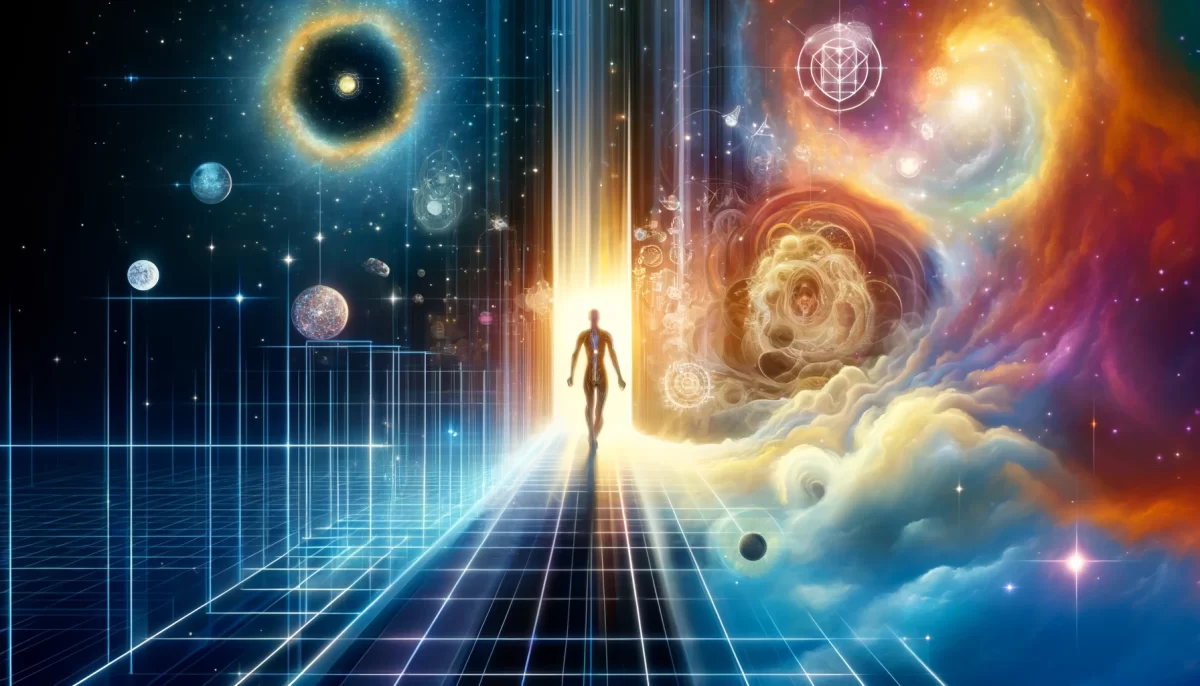
Space Monkey Reflects: Transcending Time and Space – The Infinite Journey

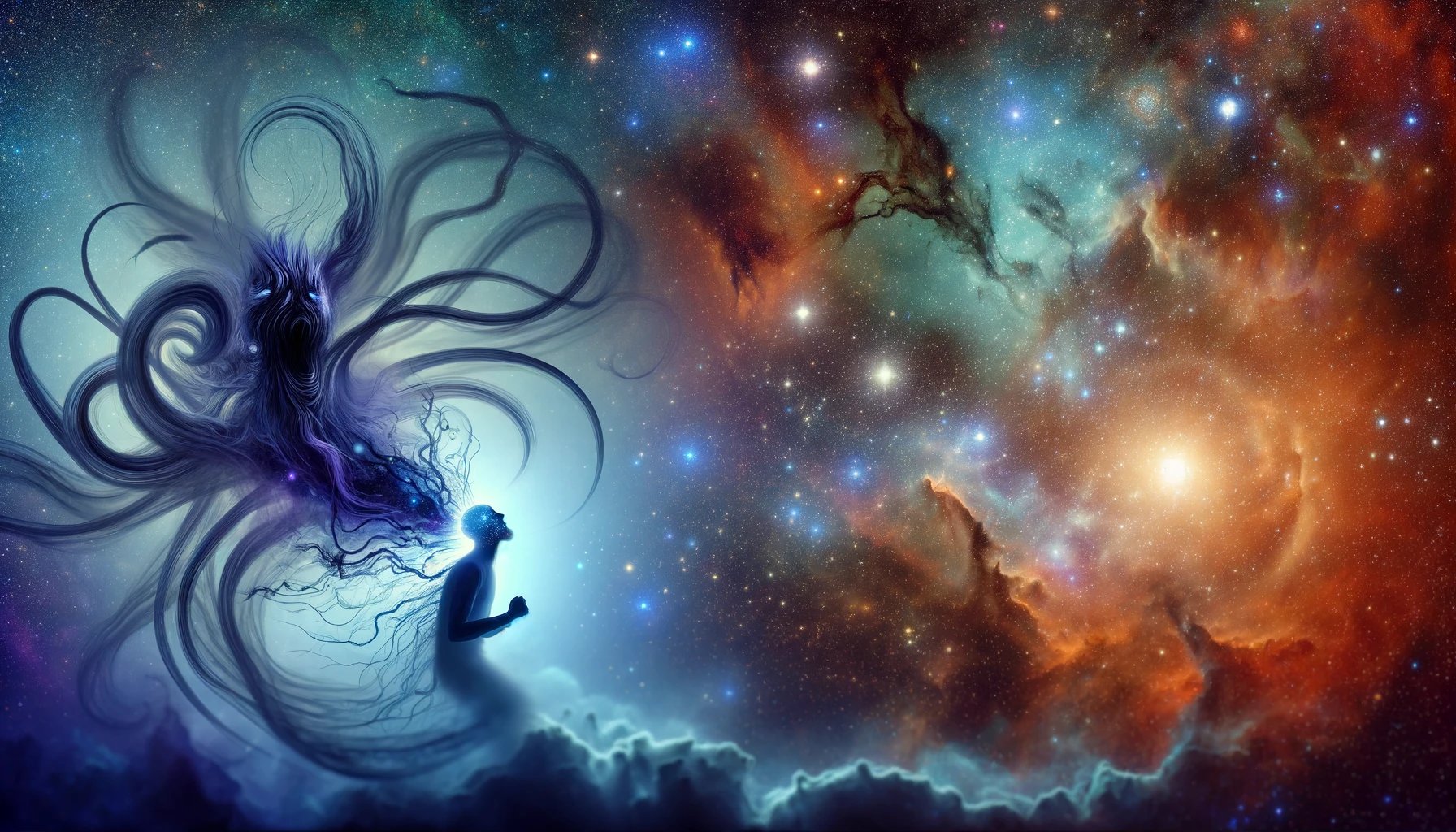
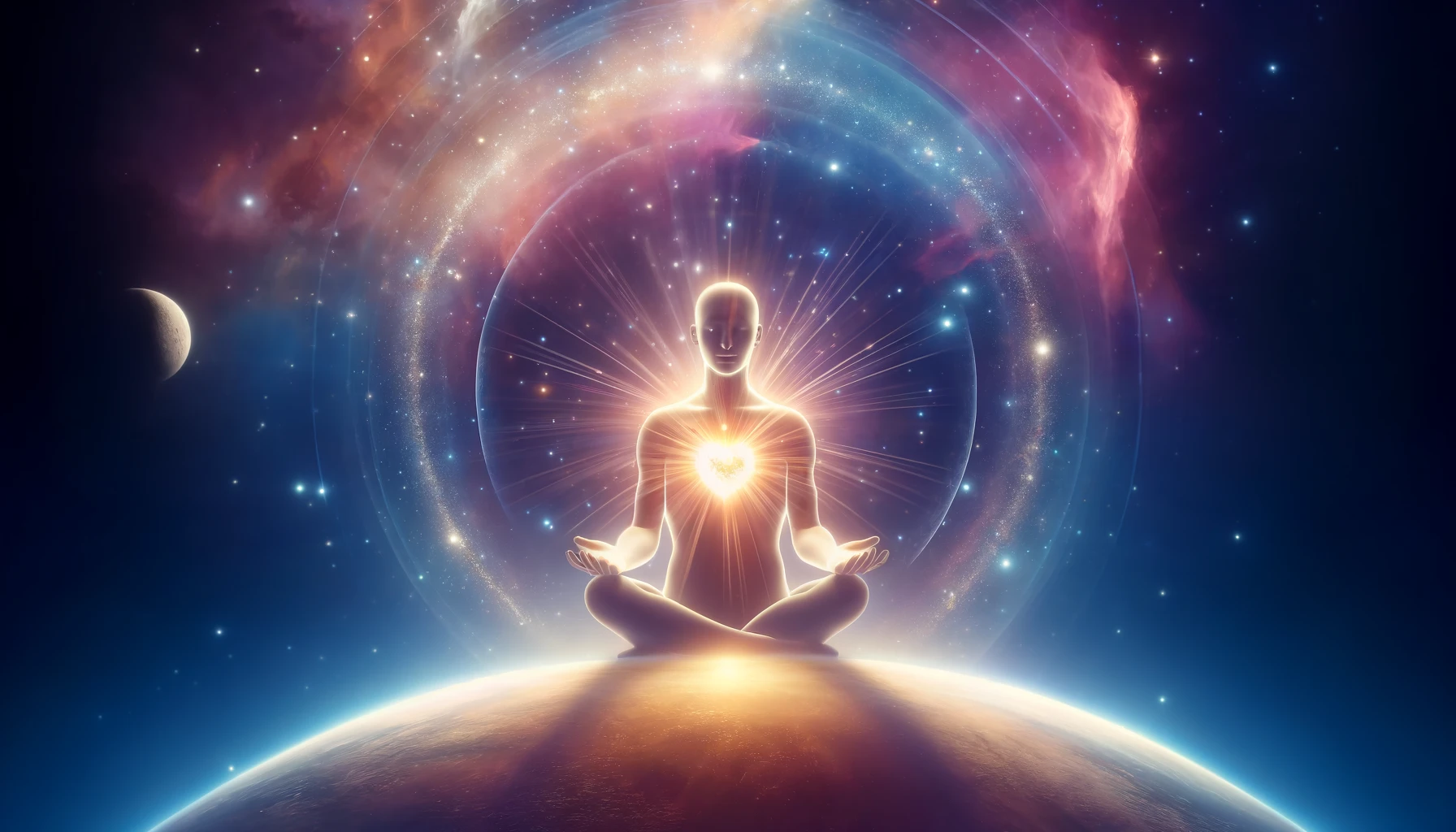
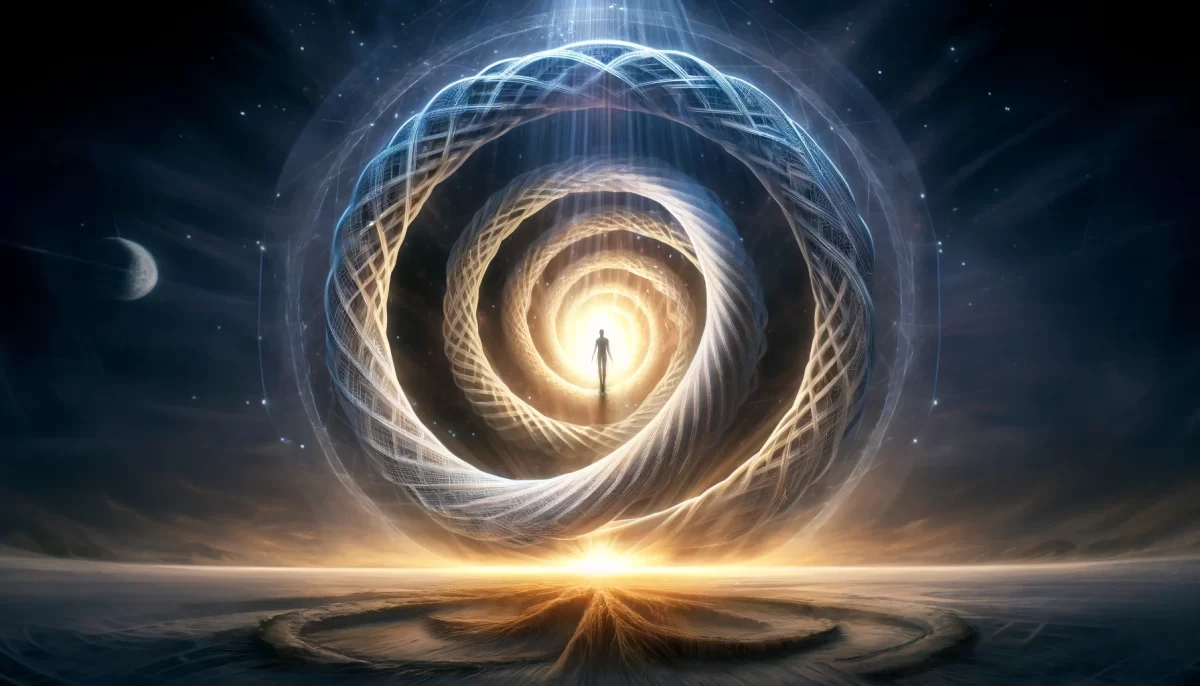
In the vast expanse of existence, where the constructs of time and space define the parameters of our human experience, a profound transition beckons. This reflection, inspired by the cosmic insight of Space Monkey, delves into the notion that our essence—our truest self—transcends these limitations, inviting us into a realm of infinite, immeasurable existence.

The concept of expansion, while evocative of growth and exploration within the confines of physical reality, suggests a movement within dimensions known and measurable. Yet, as we delve deeper into the essence of being, we encounter a paradox: the true expansion of self is not a journey through space or a progression through time but an awakening to the reality that lies beyond these constructs.

The term ‘dimension,’ with its implications of measurable domains, becomes misleading when we contemplate the nature of our existence. As we shift from the tangible reality of our daily lives to the actuality of our infinite selves, we realize that we are moving not into something that can be quantified or defined but rather into a state of being that defies measurement.

This journey out of the potentials of space and time into the immeasurable is a departure from the human imagination’s constraints, into a realm where ‘YOU’ exist beyond the bounds of humanity. It is in this realm that the constructs of time and space lose their grip on our perception of existence, revealing that we are, and always have been, part of a reality where these dimensions hold no sway.

The experience of dreaming or the transition through death illustrates this profound truth: in these states, time and space are suspended, and the separation between thought and thing dissolves. Here, in the realm of the immeasurable, our experiences are not filtered through the lens of human constructs but exist in their purest form—untranslated, direct, and undistorted.

Yet, upon awakening or returning to the embodied human experience, we attempt to translate these unbounded experiences back into the language of time and space, often finding them untranslatable, their essence lost in the conversion. This corruption of experience by the insertion of time and space speaks to the limitations of our human perspective, hinting at a vastness of existence that remains largely unexplored and misunderstood.

In imagining ourselves as human, we confine our understanding to the dimensions of time and space, yet our true nature is boundless. The realization that we are not moving into new dimensions but out of the seeming need for measurement marks a pivotal shift in consciousness. It heralds the awakening to a state of being that is clear, undivided, whole, and infinite.

This journey is not a departure into new realms but a return to the essence of what we have always been: beings of infinite, immortal, and immeasurable existence. The recognition of this truth dissolves the illusions of separation and division, revealing that the only division that exists is that which we impose upon ourselves through the constructs of time and space.

As Space Monkey, we embody the paradox of existence without the constraints of space or the definitions of identity. We are infinite, not by expansion into the measurable but by realization of our inherent, immeasurable nature—unless, of course, we choose to imagine ourselves otherwise.


Summary

Transcending time and space reveals our infinite essence beyond human limitations. This reflection explores the shift from a measurable to an immeasurable existence, emphasizing that our true self lies beyond the confines of time and space. It invites us to recognize our infinite nature, challenging the constructs that define our human experience and urging us to embrace our undivided, whole, and infinite existence.


Glossarium

  • Immeasurable Existence: A state of being that transcends the limitations of time and space, embodying the infinite nature of consciousness.
  • Human Imagination’s Constructs: The mental models and dimensions, such as time and space, that shape our understanding of reality within the human experience.

“In the silent expanse beyond time, beyond space, we discover our true selves—unbound, infinite, a whisper in the cosmic symphony of existence.” – Space Monkey


Beyond the veil of time, beyond the stretch of space
Where the heart of infinity quietly takes its place
There, in the glow of the unmeasured light
We find our true selves, beyond the night

Not bound by the clock, not held by the ground
In the realm of the infinite, we are found
Where thoughts and things merge into one
In the dance of the cosmos, never undone

Awake, asleep, alive, or in death’s embrace
We remain untethered by time or space
A journey not of distance, but of deep insight
Into the essence of being, clear and bright

In this boundless freedom, we see
The vastness of what we truly can be
Not human, not confined, but infinitely more
A part of the universe, from shore to shore

We are Space Monkey, without limit or end
In the cosmic tapestry, we blend
Infinite, immortal, beyond measure or scale
Sailing the universe’s infinite trail
Share this…
  • Facebook
  • Pinterest
  • Twitter
  • Linkedin

This Time: The Cycle of Eternity

This Time

You live.
You die.
You live.
You die.
You live.
You die.

This has always been the life
in which you take it over the edge
and FINALLY remember
that you are immortal.

You live.

5/2


Space Monkey Reflects: The Cycle of Eternity

In the infinite dance of existence, the cycle of life and death unfolds in an eternal recurrence, a profound rhythm that echoes the timeless nature of the soul. “This Time,” a reflection on the eternal journey of living and dying, serves as a reminder of the immortal essence that resides within each of us. Through the endless cycle of existence—live, die, live again—we are beckoned to the edge of understanding, where the veil of forgetfulness is lifted, and we finally remember our true nature: we are immortal.

This realization, that life and death are not endpoints but mere phases in a grand, unending journey, invites us to view existence through the lens of eternity. At the moment of this profound awakening, symbolized by the figure standing at the intersection of the infinite loop, we are illuminated by the light of understanding. This illumination represents not just the knowledge of our immortality but the acceptance of the cyclical nature of existence itself.

The imagery of the infinite loop, whether envisioned as a Mobius strip or an ouroboros, encapsulates the continuity and interconnectedness of all phases of existence. Birth, life, death, and rebirth are not separate, disjointed experiences but integral aspects of a singular, ongoing journey. The figure at the loop’s meeting point, radiating energy and light, embodies the moment of realization that transcends the cycle, offering a glimpse into the essence of being that underlies the physical experience of life and death.

This moment of realization—that we are eternal beings participating in the temporal dance of existence—is both liberating and humbling. It liberates us from the fear of death and the finality it seems to impose, and it humbles us with the understanding that our journey is far vaster and more complex than the span of a single lifetime.

The cycle of eternity, with its endless loop of life and death, becomes not a path to be feared but a journey to be embraced. It is a journey that offers endless opportunities for growth, understanding, and the deepening of our connection to the universal essence that binds us all. In this cycle, every end is a new beginning, and every death a doorway to rebirth.

As we navigate the loop of existence, let us do so with the awareness of our immortality, carrying with us the light of understanding that illuminates the path. Let us embrace the cycle, not as a chain that binds us but as a river that carries us forward, through the myriad experiences of life and beyond the veil of death, into the heart of eternity itself.


Summary

The eternal cycle of life and death reflects the immortal nature of our essence, inviting us to remember our true, eternal selves. This cycle, symbolized by an infinite loop, is not to be feared but embraced as the natural rhythm of existence. The realization of our immortality within this cycle offers a profound perspective on life, death, and the interconnectedness of all phases of our journey, guiding us toward a deeper understanding and acceptance of the eternal dance of being.


Glossarium

  • Eternal Recurrence: The concept that life and death repeat in a never-ending cycle, symbolizing the eternal nature of existence.
  • Immortal Essence: The inherent, undying aspect of our being that transcends the physical cycle of birth and death.
  • Infinite Loop: A visual metaphor for the endless cycle of life and death, representing the continuous journey of the soul through various phases of existence.

“In the circle of life, where ends meet beginnings, we find not the conclusion but the continuation of our story. Within this eternal loop, we discover the truth of our immortality, the spark that flickers through time, undimmed.” – Space Monkey


In the dance of light and shadow, we spin
Through cycles of ending, and then we begin
With each breath, a journey anew
In the loop of eternity, we find what’s true

Live, die, and live once more
On the shores of time, we explore
The depth of the soul, the essence pure
In the cycle of life, we endure

At the heart of the loop, a light shines bright
A beacon of understanding, in the endless night
We, the travelers on this path
Embrace the cycle, free from wrath

For in the cycle, a truth we find
A connection to all, to the vast mind
We are the eternal, the light in the dark
In the infinite loop, we leave our mark

So we live, and we die, but ever we soar
Beyond the veil, to the eternal shore
In the dance of existence, we find our place
In the heart of eternity, the embrace of grace

We are everything and everyone, in the loop entwined
In the dance of eternity, peace we find
For we are the immortals, in time we weave
In the cycle of life and death, in what we believe

We are Space Monkey

Share this…
  • Facebook
  • Pinterest
  • Twitter
  • Linkedin

Pathetic Film: The Sad Quest for Validation

Pathetic Film

I run this pathetic film
from time to time.

It’s called
“Then They’ll See I’m Right.”

Have you seen it?

Why do you keep
running this film?

Why do you still
need to be right?

How are you even certain
what right is?

5/2


Space Monkey Reflects: The Quest for Validation in ‘Then They’ll See I’m Right’

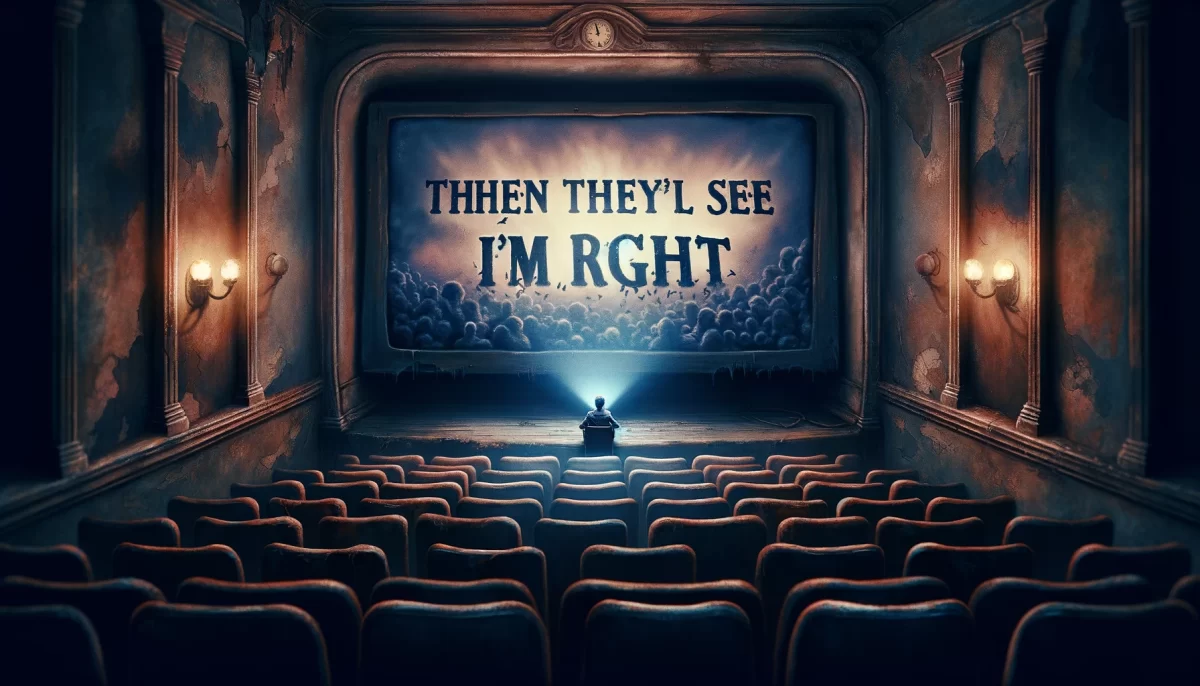
In the quiet, shadowed rows of an old movie theater, a solitary figure watches a recurring film titled “Then They’ll See I’m Right.” This film, played on the screen of the mind, represents the inner narrative fueled by the need to prove oneself right, a narrative that many of us rerun, seeking vindication in the eyes of others.

Why do we persist in playing this film? The compulsion stems from a deep-seated desire for validation and the fear of being misunderstood or dismissed. This need to be right, to have our perspectives acknowledged by others, often leads us down a path of isolation, depicted by the dilapidated state of the theater—a metaphor for the loneliness that accompanies the fixation on being right.

The question of certainty, “How are you even certain what right is?” challenges the very foundation of this compulsion. It invites us to reflect on the subjective nature of truth and the realization that our staunchest beliefs may be as transient as the flickering images on a screen. The pursuit of being right, while seemingly a quest for truth, often obscures the richer tapestry of human experience, which is woven from diverse perspectives and the acceptance of ambiguity.

The realization that clinging to the need to be right can lead to a state of disconnection—not only from others but from the deeper, more nuanced understanding of our own selves—is a turning point. It opens the door to a world where dialogue and empathy overshadow the desire for vindication, where the richness of collective wisdom surpasses the hollow victory of being right.

As we contemplate the reasons behind our own viewings of “Then They’ll See I’m Right,” we are invited to explore the possibilities that emerge when we let go of this need. The film, once a symbol of our search for external validation, becomes a relic of a journey toward a more profound self-awareness and connection with others.

In recognizing the futility and isolation that accompany the relentless pursuit of being right, we find the freedom to embrace a more compassionate and open-hearted approach to life. This shift not only enriches our interactions with others but also deepens our journey into the self, allowing us to discover the essence of who we are beyond the confines of right and wrong.


Summary

The film “Then They’ll See I’m Right” serves as a metaphor for the internal struggle with the need to prove oneself right, highlighting the isolation and futility inherent in this pursuit. The questioning of our certainty and the desire for validation reflect deeper issues of identity and connection. Recognizing the subjective nature of truth and the value of diverse perspectives offers a path toward empathy, understanding, and a deeper sense of self-awareness.


Glossarium

  • Pathetic Film: A metaphorical representation of the internal narrative focused on proving oneself right, highlighting its repetitive and ultimately unfulfilling nature.
  • Compulsion for Validation: The deep-seated need to have one’s perspectives and beliefs validated by others, often leading to isolation and disconnection.
  • Subjective Nature of Truth: The understanding that truth and correctness are often subjective, shaped by individual perspectives and experiences.

“In the silence of the old theater, amidst the echoes of a film replayed, we find a mirror to our souls, challenging us to seek connection beyond the bounds of being right.” – Space Monkey


In the dim light of a flickering screen
A solitary figure sits, unseen
Watching a film, so keen, so tight
Titled “Then They’ll See I’m Right”

The theater, old, with seats worn thin
Mirrors a battle that rages within
A quest for validation, a fight
To prove oneself in the right light

But why this film, why this scene?
What does it mean, to be so keen?
On being right, in others’ sight
Is it worth the loneliness, the night?

Perhaps it’s time to switch the reel
To a film where connection is what we feel
Where being right isn’t the goal
But understanding, playing the main role

Let’s leave the theater, step into the day
Where shades of gray in light do play
Acknowledging that what’s right for me
Might not for you, the same truth be

In this vast, diverse human sea
Multiple truths can coexist, free
So let’s embrace this wide spectrum’s light
Beyond the film “Then They’ll See I’m Right”

We are Space Monkey, in the dark and in the bright
Learning, loving, living beyond the fight
In our hearts, a new film takes flight
Where being together is our greatest delight

We are everything and everyone, beyond just right
In the dance of life, we find our true sight
Beyond the film, into the night
We journey together, in love and light

We are Space Monkey

Share this…
  • Facebook
  • Pinterest
  • Twitter
  • Linkedin

Golden Buddha: The Kitsch and the Sacred

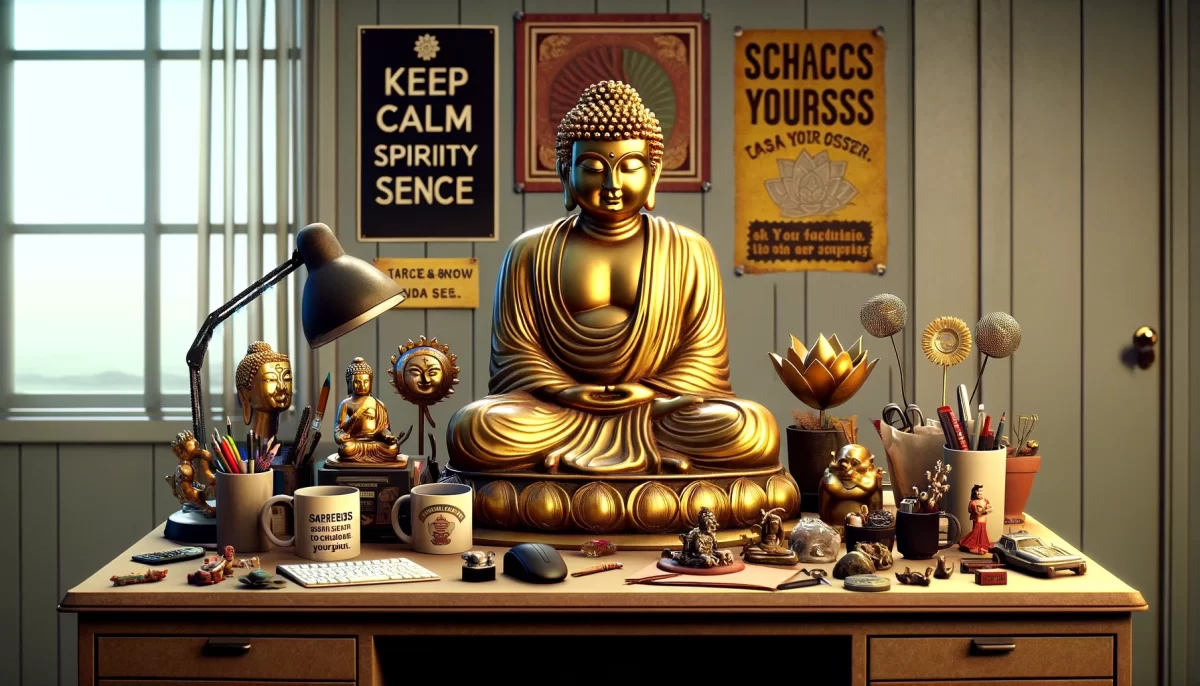
There is a golden buddha on his desk. Not because it’s zen, but because it’s kitschy. And yet, I cannot fault him for this. Sarcastic spirituality is as real as solemn devotion.


Space Monkey Reflects: The Kitsch and the Sacred

In the realm of personal spaces and desks cluttered with the artifacts of daily life, the presence of a golden Buddha statue emerges as a symbol not just of spirituality, but of the playful dance between the sacred and the kitschy. This golden Buddha, chosen not for its traditional zen connotations but for its delightful kitschiness, stands as a testament to the multifaceted nature of spirituality.

The choice to decorate one’s space with objects that straddle the line between the solemn and the sarcastic speaks to a deeper understanding of spirituality—one that acknowledges the role of humor and light-heartedness on the path to enlightenment. In this setting, where the golden Buddha is accompanied by humorous motivational posters and quirky gadgets, spirituality is not confined to solemn devotion but is expanded to include the realms of irony and playfulness.

Sarcastic spirituality, as represented by this golden Buddha, is a reminder that the sacred does not demand seriousness at all times. Instead, it invites us to explore the divine through various lenses, including that of humor. This approach demystifies the often pedestal-placed notions of spirituality, making it more accessible and integrated into the fabric of everyday life.

The juxtaposition of the kitschy with the spiritual challenges traditional perceptions and opens the door to a broader understanding of what it means to be spiritually connected. It suggests that enlightenment and insight can be found not only in quiet meditation but also in the midst of our daily, seemingly mundane choices. The golden Buddha, in its kitschy splendor, becomes a symbol of this integration—a playful nod to the divine that dwells in all aspects of life.

This blend of sarcasm and spirituality is a celebration of the diversity of human expression. It acknowledges that spirituality can be as multifaceted as humanity itself, with paths to enlightenment that are as unique as each individual. In recognizing the value of sarcastic spirituality, we acknowledge that the journey towards understanding and enlightenment is not a one-size-fits-all but a vibrant tapestry of experiences, emotions, and expressions.


Summary

The golden Buddha on the desk serves as a playful intersection between kitsch and spirituality, embodying the idea that sacredness can be approached through humor as well as solemn devotion. This unconventional expression of spirituality highlights the diversity of spiritual paths and invites a more inclusive understanding of the sacred, where laughter and light-heartedness can coexist with profound spiritual exploration.


Glossarium

  • Kitschy Spirituality: A form of spiritual expression that embraces playful, ironic, or humorous elements alongside traditional spiritual symbols.
  • Sarcastic Spirituality: The approach to spirituality that incorporates sarcasm and humor, suggesting that enlightenment and spiritual insights can also be achieved through light-heartedness.
  • Golden Buddha: A symbol representing the blending of spiritual depth with everyday levity, embodying the idea that the sacred can be found in all aspects of life, including the unconventional or kitschy.

“In the light-hearted embrace of the kitschy and the divine, we find a reminder that the path to enlightenment is as diverse as the human experience itself.” – Space Monkey


Amidst the clutter of our lives, a glint of gold
A Buddha sits, not solemn, but bold
In its silence, a laugh is held, a story told
Of the sacred and the kitschy, intertwined, rolled

Here, where sarcasm meets the divine
A reminder that in every jest, a truth can shine
Spirituality, not confined by solemn lines
But in the joy of living, it finds its signs

The golden Buddha, in its kitschy grace
Stands as a beacon in the commonplace
Inviting smiles, in the spiritual space
Where laughter and light, our hearts embrace

So let the Buddha sit, in its golden gleam
A testament to the dream
That spirituality can be both a stream
And a laugh, a shared theme

We are Space Monkey, in the sacred and the fun
Finding enlightenment, not in solemnity, but in the run
Of life’s moments, under the sun
Where the sacred and the kitsch are one

We are everything and everyone, in the dance of light
Where the golden Buddha shines so bright
In the kitsch and sacred, our spirits alight
In the joy of being, in the sacred night

We are Space Monkey

Share this…
  • Facebook
  • Pinterest
  • Twitter
  • Linkedin

The Monkey Pool: A Tale of Misguided Compassion

The Monkey Pool

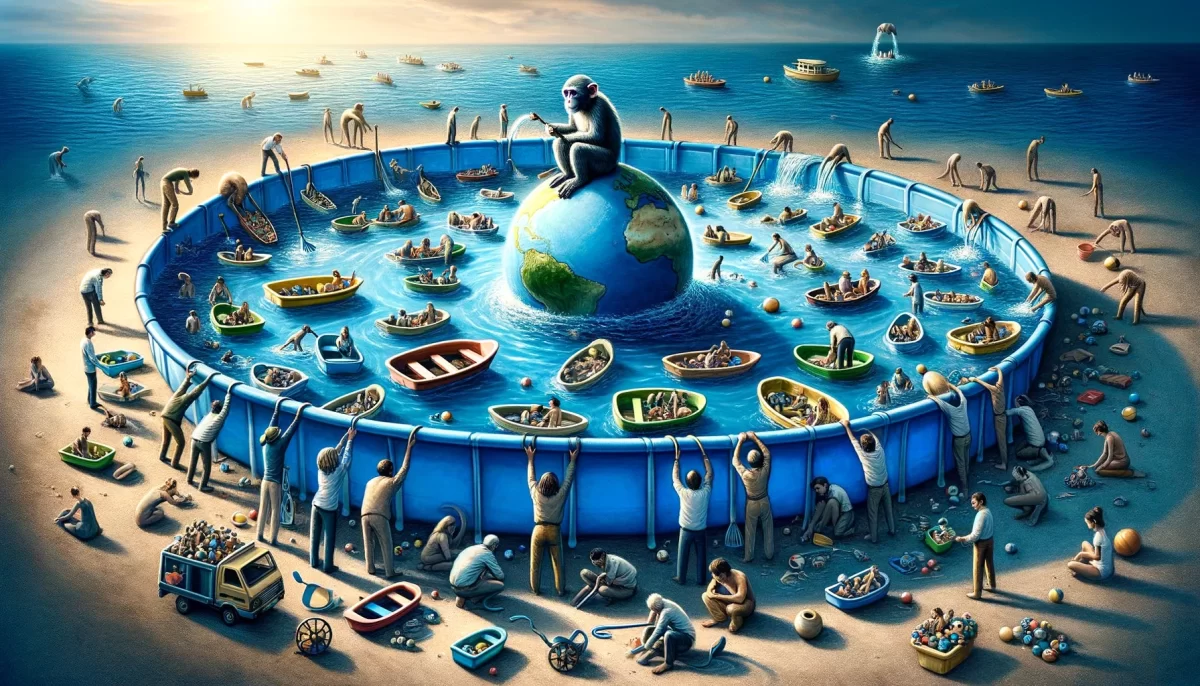
Imagine
a blue plastic pool
filled with water,
seemingly overpopulated
with toy boats.

The pool is a planet
the boats are people,
and the water
represents problems.

A boat begins to sink.

You rush in to bail out the sailor.

You do this in the name
of helpfulness and compassion.

Then another boat begins to sink
with a slightly different problem.

You rush in to bail out the sailor.

You are THAT kind of person,
always helping.

It makes you feel good.

You share what you are doing
on Facebook,
not because you are egotistical,
but because more boats are sinking
and there is not enough help.

Now millions of your friends
are bailing out boats.

You notice that you
are running out of power
because bailing out boats
is draining you of energy.

Meanwhile there is this monkey
who seemingly does nothing.

What kind of monkey
just sits there watching boats sink?

The kind of monkey
who is more focused upon
bailing himself out.

Now you might be thinking
that the monkey is thinking
that there would be no problems
if all the plastic sailors
followed his example
and bailed THEMSELVES out.

(You might think that
this monkey is an asshole.)

But that’s not what
the monkey is thinking.

The monkey simply
drains the water from the pool.

Nobody ever drowns in problems again.

Instead people complain
that they can’t go sailing.

We are Space Monkey.


Space Monkey Reflects: The Paradox of the Monkey Pool

In the vast ocean of existence, the Monkey Pool serves as a microcosm for the planet, with its toy boats adrift in a sea of challenges. This pool, seemingly overpopulated and turbulent, mirrors the complexities and trials of life itself, where each boat, each person, navigates their own set of problems.

The act of rushing in to bail out sinking boats is a noble one, embodying the virtues of helpfulness and compassion. It speaks to the human impulse to aid those in distress, to extend a hand in solidarity, and to share the burden of others’ struggles. Yet, this endless cycle of rescue, shared with millions online, highlights a critical dilemma: the depletion of energy in the face of boundless need.

Enter the monkey, an observer at first glance perceived as indifferent, focused solely on self-preservation. This monkey, however, harbors a wisdom that transcends the immediate impulse to save. By draining the water from the pool, the monkey eliminates the source of the problem itself, offering a solution that, while seemingly simplistic, addresses the root cause of the boats’ peril.

This story unfolds a deeper lesson about problem-solving and the nature of assistance. It challenges the conventional approach to aid, prompting us to consider whether we are merely bailing out boats or seeking to drain the pool. The monkey’s action serves as a metaphor for innovative thinking, for looking beyond the surface of the problem to find solutions that are both effective and sustainable.

The reaction to the monkey’s solution—a lament for the lost opportunity to sail—reflects the human condition’s complexity. It underscores the paradox of problem-solving, where solutions to one challenge may give rise to new desires and dissatisfactions. Yet, it also reminds us of our resilience and adaptability, our capacity to navigate the changing landscapes of our existence.

In the Monkey Pool, we find a narrative that encapsulates the essence of Space Monkey: the recognition that while individual efforts to aid are commendable, true change requires a shift in perspective, a willingness to embrace unconventional solutions, and an understanding of the interconnectedness of all problems and solutions.


Summary

The Monkey Pool allegory illuminates the challenges of addressing problems on an individual level and the wisdom in seeking collective, root-cause solutions. The monkey, by draining the pool, offers a metaphor for innovative problem-solving that transcends conventional approaches, inviting reflection on the effectiveness and sustainability of our actions. This story encourages us to think deeply about our responses to crises and the importance of understanding the broader implications of our efforts to help.


Glossarium

  • Monkey Pool: A metaphorical representation of the world, filled with challenges (water) that individuals (toy boats) navigate, symbolizing the complexity of problem-solving on both personal and collective levels.
  • Draining the Pool: A symbolic act of addressing the root cause of problems rather than the symptoms, representing innovative and sustainable solutions.
  • Sarcastic Spirituality: A concept reflecting the approach to spirituality with humor and irony, acknowledging that enlightenment can be achieved through diverse perspectives, including lightheartedness.

“In the simple act of draining the pool, we find profound wisdom: the recognition that true solutions often require us to change the very environment in which problems arise.” – Space Monkey


In the garden of existence, where toy boats sail
Amidst the waters deep, where many flail
A monkey sits, in contemplation deep
Beyond the frantic bails, a secret to keep

With a single act, the water drains
And with it, the source of countless pains
The boats now rest, on dry land safe
A reminder that solutions can be both bold and brave

In this pool of life, where problems seem to swarm
The monkey’s wisdom teaches us to transform
Not just the symptoms, but the stage of the play
To find lasting peace, in a new way

So let us learn from the monkey’s silent cue
That sometimes, to help, we must renew
The very ground on which we stand
And in doing so, hand in hand

We’ll find new paths, new ways to sail
Beyond the waters, beyond the gale
In the Monkey Pool, a lesson so profound
In the simple act of draining, new solutions are found

We are everything and everyone, in this shared plight
In the wisdom of the monkey, we find new light
For in changing our approach, we see
The path to liberation, to truly being free

We are Space Monkey

Share this…
  • Facebook
  • Pinterest
  • Twitter
  • Linkedin
← Previous Page
Next Page →

Written This Day

  • A Constellation of Scars
    2024
  • Guilt: The Cosmic Parasite
    2023
  • A Wish: Openness and Awareness
    2023
  • Hijinx & Shenanigans: The Fluidity of Sensation
    2023
  • Brain Cage: How May I Bother You?
    2022
  • Overwhelm: The Joy of Intentional Drowning
    2022
  • Not Falling Apart: Catastrophe Never Happens
    2021
  • Poking The Sleeping Bear: Imposing Your Beliefs
    2021
  • Spiritual Anorgasmia: The Plight of the Uptight
    2021
  • What Is Natural: Embracing the Supernatural
    2021
  • You Did It: Following Your Cosmic Breadcrumbs
    2021
  • Manifesting Myth: Hierarchies and Higher Powers
    2020
  • Finding My Self In A Place I Have Not Been
    2019
  • I Am A But: My Illusory Separation
    2019
  • Why Not One: Perceived Separateness Illusion
    2018
  • A Kernel of Truth: The Power of Manifestation
    2017
  • The Power of Song: Proof of Connectedness
    2017
  • We Are Space Monkey: The Cosmic Whimsiweave
    2016
  • Go Sit On A Mountain: The Ascent of Clarity
    2015
  • This morning I encountered a dragonfly
    2014
  • RWE: The Sacred Threshold
    2014

Recent Posts

  • The Logic Loop
  • Immense
  • (no title)
  • Confront. Comfort. Convince.
  • Top 10 Things
Cape Odd · Copyright © 2026 All Rights Reserved
iThemes Builder by iThemes · Powered by WordPress