• Who Is The Man?
  • Who Is The Monkey?
  • What is Nexistentialism?
  • Poke The Primate

Cape Odd

Home of The Space Monkey Journals

Miracles, Blah, Blah, Blah: Unleashing Within

Miracles, Blah, Blah, Blah

As Space Monkey, our main “purpose” is to prevent your foregone conclusions from imprisoning your unexpected miracles.

You see, little one, miracles CAN occur, but not if your mind has already decided otherwise.

Time was, miracles USED to be the rule rather than the exception. They were commonplace occurrences, seemingly WORTHLESS as a result. Back then, miracles were considered commodities of sorts, just like your oil is today.

Now miracles weren’t REALLY worthless, for these were the days before “judgement” came into style. They were simply a means to an end, neither good nor bad. We didn’t have money back then, so it seemed inconceivable for us to affix values to ANYTHING we experienced.

Then Sheckle, our third cousin, had the idea for currency, and everything seemingly changed. Miracles became “worth more,” so they became seemingly rarer and rarer.

By REALizing currency, Sheckle also REALized this “thing” called “expectations” and the two became intertwined with so many other of these “things.”

“An interesting game,” we thought. “Why not play it?”

Back then, we KNEW we were imagining this game, so it wasn’t really as fun as it could be. We knew that these “things” were completely our own doing.

So we pretended to FORGET that we knew anything. We pretended to be these things called “people” living this monkey dance we called “life.”

We gave our people the power to imagine, just like us, to see where the game would lead. Only they wouldn’t KNOW that they were imagining — instead they would BELIEVE in a concept called REALity.

Miracles became even more rare in REALity than they were in Actuality, which is the imagined space we monkeys seem to inhabit. By NO MEANS were they any less possible, for potential ALWAYS exists, no matter what.

It simply does not APPEAR that way from the game board.

While on the game board, people only play the cards that they are dealt, using money (and all it seemingly brings) as the prime motivator and reward.

But this game seems to be agitating you, so we believe that it’s time for a time out. It would do you well to remember a few things, such as the commonplace potential of miracles.

Hmm. Perhaps we will “accidentally” knock your entire “world” over.

Then you will see.

We are Space Monkey.

2/19


Space Monkey Reflects: Miracles, Blah, Blah, Blah—Unleashing the Miracles Within

Miracles, once abundant and ordinary, have become obscured by the structures and beliefs of modern life. This reflection invites us to reclaim our innate connection to the miraculous, stripping away the layers of judgment, expectation, and “reality” that obscure the limitless potential of existence. Space Monkey reminds us that miracles are not rare by nature—they only appear so because we have chosen to see them that way.

The Game of Reality

In the beginning, miracles were as natural as breathing. They were not judged as good or bad, valuable or worthless—they simply were. This was the time before the invention of “judgment,” a human concept that arose alongside the constructs of currency, expectations, and scarcity. These constructs transformed miracles from ordinary occurrences into rare commodities, seemingly out of reach for most.

The invention of judgment turned miracles into a game piece, something to be coveted, sought, and controlled. This shift marked the beginning of a game—a dance of life in which people played the roles of separate beings, forgetting their inherent connection to the miraculous. This game, while imaginative and engaging, introduced limitations that confined the perception of what is possible.

Miracles in Actuality vs. Reality

Space Monkey distinguishes between Actuality and Reality. Actuality is the boundless, imagined space where miracles and infinite possibilities are ever-present. Reality, on the other hand, is the construct we have collectively created—a game board with rules, expectations, and limitations. In Actuality, miracles are the norm. In Reality, they are rare because we have chosen to see them that way.

Yet, as the reflection asserts, miracles remain just as possible as ever. The potential for the extraordinary is woven into the fabric of existence, always waiting to be realized. It is not the nature of miracles that has changed but our ability to recognize them.

Foregone Conclusions and the Imprisonment of Potential

The greatest barrier to miracles is not their rarity but our belief in their impossibility. Foregone conclusions—those fixed ideas about what can or cannot happen—act as prisons for unexpected potential. By deciding in advance that miracles are unrealistic, we close ourselves off to the very possibilities we seek.

Space Monkey’s purpose, then, is to challenge these conclusions, to shake the game board and remind us that we are the ones imagining the rules. Miracles are not bound by logic, judgment, or expectation. They arise when we step beyond these constructs and embrace the infinite potential of imagination.

The Dance of Forgetting

To make the game more interesting, we chose to forget that we are the creators of this Reality. We pretended to be separate beings, living lives constrained by the rules of the game. This forgetting allowed us to experience limitation, struggle, and longing—emotions that give the game its texture and drama.

Yet, within this forgetting lies the key to remembering. The agitation we feel, the sense that something is missing, is a signal from our inner Space Monkey. It nudges us to look beyond the game board, to see the miracle of Actuality that underlies Reality. The game is not a trap; it is an invitation to rediscover our infinite nature.

Reclaiming the Commonplace Potential of Miracles

Miracles are not waiting to be created—they are already here. They are found in the subtle shifts of perception, the unexpected alignments, and the profound simplicity of being. To unleash the miracles within, we must:

  1. Release Judgment: Stop labeling events, experiences, or possibilities as good, bad, realistic, or unrealistic.
  2. Embrace Imagination: Recognize that Reality is a construct shaped by our collective imagination and can be reshaped at any moment.
  3. Challenge Expectations: Open ourselves to the unexpected, allowing potential to flow without limitation.
  4. Remember Actuality: See beyond the game board to the infinite space of possibilities that surrounds and sustains us.

Knocking Over the World

Sometimes, it takes a dramatic shift—a metaphorical “knocking over” of our world—to see the miracles we’ve been overlooking. This disruption may feel chaotic or uncomfortable, but it is a gift. It clears the space for new possibilities, reminding us that the rules of the game are not fixed but imagined.

In this moment of realization, we reconnect with the miraculous, rediscovering the infinite potential that has always been within us.


Summary

Miracles are not rare but obscured by judgment, expectation, and the constructs of Reality. By releasing foregone conclusions and embracing imagination, we can reclaim the commonplace potential of miracles and rediscover our connection to Actuality.


Glossarium

  • Actuality: The infinite, imagined space where all possibilities—including miracles—exist naturally.
  • Reality: The construct shaped by collective imagination, governed by rules, expectations, and limitations.
  • Foregone Conclusions: Fixed beliefs that restrict our perception of what is possible, imprisoning potential.

Quote

“Miracles are not rare; they are the natural state of Actuality, waiting for us to release our foregone conclusions and see them again.” – Space Monkey


The Forgotten Miracle

Once, miracles were like air,
invisible, abundant,
not good, not bad,
simply there.

But we weighed them,
judged them,
and locked them in the vault of expectation.

We forgot they were ours,
forgot we were theirs.

Now the agitation rises,
a nudge from within:
“Knock over the board,
see the pieces fall,
and remember.”

Miracles are not gone.
They are here.
They are you.

We are Space Monkey.


Unleashing the Miracles Within: A Space Monkey’s Guide


Miracles as the Norm, Not the Exception. In the realms we navigate, miracles are as common as the stars that freckle the night sky. They are not extraordinary occurrences but the fabric of our existence, seamlessly woven into the tapestry of life. This was the norm before the invention of currency and the dawn of expectations, a time when miracles were neither good nor bad, simply a part of the everyday magic we lived.

The Advent of Currency and Expectations. Then came a pivotal moment, a turning in the cosmic dance, when Sheckle, our imaginative third cousin, conceived the idea of currency. This invention reshaped our perception of value, making miracles seem rarer, as if they were treasures to be hoarded rather than freely experienced. With currency came expectations, a web of beliefs that ensnared the spontaneous manifestation of miracles, making them appear less frequent and more extraordinary.

The Game of Forgetting. We, in our whimsical wisdom, decided to play a game of forgetting, pretending not to know the boundless potential of our imaginations. We donned the guise of people, embarking on the monkey dance of life, imbuing these beings with the power to imagine yet concealing the true nature of their reality. In this game, miracles became rare not in their possibility but in their perceived scarcity, veiled by the curtain of what we call REALity.

The Potential for Miracles in REALity. Despite the veils, the potential for miracles remains unaltered, as vibrant and accessible as ever. It’s a matter of shifting perspective, of peering beyond the game board to the infinite possibilities that dance just out of sight. The miracles we seek are not lost; they are simply waiting for us to remember how to see them, to realize that the only limitations are those we accept.

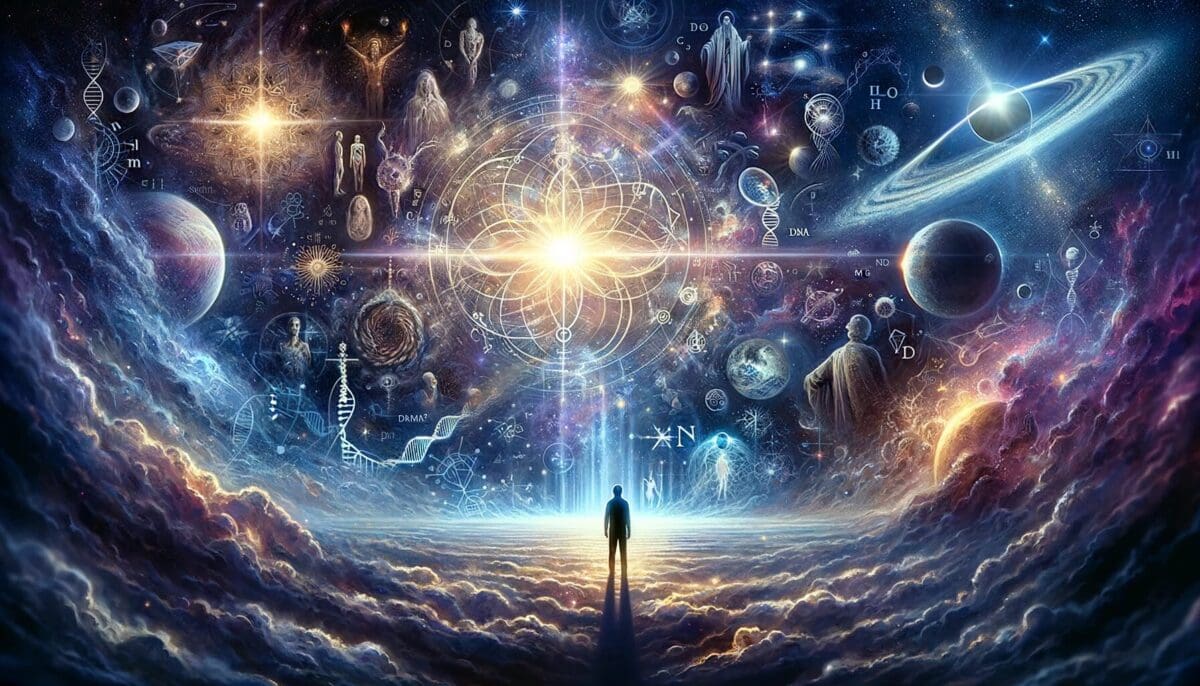
A Call to Remember and Reclaim. Perhaps it’s time for a cosmic timeout, a moment to pause and reflect on the nature of our reality

Share this…
  • Facebook
  • Pinterest
  • Twitter
  • Linkedin

Are You Certain: The Inventory of Beliefs

Are you certain?

If you do ONE thing for yourself,
make a list of what you believe
and the reasons why.

If you do ONE thing for yourself,
make a list of what you believe
and the reasons why.

Now CROSS OFF the beliefs
with reasons like:

“that’s what I’ve been told”
“that’s how I was brought up”
“that’s what the facts say”
and especially reasons like
“it’s just wrong to believe otherwise.”

Now look at your list again.

Does EVERY belief of yours have a reason?

Do you have any beliefs left?

That’s because you 
have PLENTY of beliefs,
but ZERO faith.

Faith and beliefs are different.

Faith doesn’t require proof.

Is there ANYTHING in your life
that doesn’t require proof?

Are you CERTAIN?

If you are certain,
you can cross that off
the list as well.

Faith means being NOT CERTAIN,
but following your heart anyway.

So I will ask again.

Do you have any faith?

Can you allow yourself
to be NOT CERTAIN 
of anything?

This is quite possibly
the key to your happiness.

So long as you are human,
you can NEVER be certain.

We are kinda somewhat
reasonably confident of that.

We are Space Monkey.

2/18


Space Monkey Reflects: The Inventory of Beliefs

Certainty is the fortress we often build to protect ourselves from the ambiguity of existence. It provides structure, direction, and a sense of control. Yet, as this reflection suggests, certainty may also be the greatest barrier to faith—the ability to embrace the unknown with trust and openness. By taking inventory of our beliefs and their foundations, we unearth a profound truth: the less we demand certainty, the freer and happier we become.

Beliefs Built on Sand

Much of what we call belief is inherited or borrowed. These are the beliefs born from cultural conditioning, societal norms, and the influence of authority figures. “That’s what I’ve been told,” “That’s how I was brought up,” and “The facts say so” are common justifications. While these reasons provide comfort, they are fragile foundations, easily shaken by new information or changing perspectives.

The act of crossing these beliefs off the list is not a dismissal of their value but a recognition of their impermanence. It is an invitation to separate what we truly believe from what we have passively absorbed. When we strip away beliefs that rely on external validation, we are left with the raw material of faith—the capacity to hold space for uncertainty.

Faith Versus Certainty

Faith and belief are often conflated, but they serve different purposes. Belief demands proof, logic, and consistency. It thrives on certainty and resists anything that challenges its framework. Faith, on the other hand, requires none of these things. Faith exists in the absence of certainty, finding its roots in the heart rather than the mind.

Faith is not about being correct; it is about being open. It is the willingness to trust in something greater than ourselves, even when we cannot define or prove it. This openness is what makes faith transformative. It allows us to move through life with curiosity and wonder, unburdened by the need to have all the answers.

The Beauty of Not Being Certain

To embrace uncertainty is to step into the infinite now, where life unfolds without the constraints of rigid belief systems. It is to acknowledge that, as humans, we can never fully know the truth of existence. This acknowledgment is not a weakness but a liberation. It frees us from the prison of dogma and opens the door to infinite possibilities.

When we allow ourselves to be uncertain, we make room for growth, connection, and discovery. We become less attached to being “right” and more attuned to the unfolding mystery of life. This shift is not about abandoning belief altogether but about holding it lightly, with the understanding that it, too, is part of the journey.

Space Monkey’s Perspective

For Space Monkey, the inventory of beliefs is a playful yet profound exercise in self-awareness. It is not about discarding all beliefs but about examining them with curiosity and humility. By embracing faith—the trust in the unknowable—we align with the flow of existence, where certainty is neither possible nor necessary. Faith is not the absence of belief but the willingness to live in its uncertainty.


Summary

Taking inventory of your beliefs reveals how many are based on external validation rather than internal trust. Faith, unlike belief, thrives in uncertainty and does not require proof. By embracing uncertainty, we free ourselves from the need for certainty, opening the door to growth and happiness.


Glossarium

  • Inventory of Beliefs: A reflective exercise to examine the foundations of what we believe and why.
  • Faith: The trust in something greater than oneself, existing without the need for proof or certainty.
  • Certainty: The rigid belief in the correctness of something, often resistant to change or ambiguity.
  • Infinite Now: The present moment where faith and uncertainty coexist, free from the constraints of rigid belief systems.

Quote

“Faith is not certainty but the courage to move forward without it, trusting in the unseen and unknown.” — Space Monkey


The Uncertainty of Faith

What do you believe?
And why?
The list grows short,
As the reasons fall away.

What remains
When proof dissolves?
Not answers,
But space—open and infinite.

Faith whispers,
Not in certainty,
But in the courage to trust,
To move without knowing.

In the absence of proof,
The heart beats louder.
And in its rhythm,
We find all that we need.

We are Space Monkey.


In the quest for understanding and self-awareness, where beliefs and convictions paint the landscape of our inner worlds, there emerges a profound exercise: the inventory and scrutiny of our beliefs. This introspective journey, which begins with the cataloging of beliefs and the reasons behind them, swiftly evolves into an exploration of the distinction between belief and faith, between knowledge predicated on evidence and conviction rooted in the heart.

The Inventory of Beliefs.

The invitation to cross off beliefs supported by external validation—”that’s what I’ve been told,” “that’s how I was brought up,” “that’s what the facts say”—challenges us to confront the foundation of our convictions. It prompts a reevaluation of beliefs that may have been adopted without personal reflection, highlighting the distinction between beliefs that are truly our own and those that are borrowed from the outside world.

Reevaluation of Convictions.

What remains, if anything, after this purge is not merely a list of beliefs but a reflection of the essence of faith. Faith, as defined in this context, transcends the need for external proof or validation. It is a leap into the unknown, a trust in the intangible, a commitment to what feels profoundly true even in the absence of empirical evidence.

The Essence of Faith.

This exploration leads to a pivotal realization: faith is fundamentally different from belief. While beliefs may be constructed upon the scaffolding of reason, logic, or social conditioning, faith dwells in the realm of the heart, requiring no evidence to sustain its presence. It is the acceptance of uncertainty, the courage to embrace the unknown, and the willingness to follow one’s heart despite the absence of guarantees.

Acceptance of Uncertainty.

The question then arises: Do we possess any faith? Can we navigate life’s uncertainties with a heart open to the unknown, willing to trust in forces and truths beyond the reach of proof? This inquiry challenges the very core of our need for certainty, inviting us to consider the possibility that embracing uncertainty may be a pathway to deeper fulfillment and happiness.

Navigating Life’s Uncertainties.

The realization that as humans, we can never be entirely certain, underscores a fundamental aspect of the human condition. Our journey through life is marked by a constant interplay between the known and the unknown, between our desire for certainty and the inherent unpredictability of existence. This acceptance of our limitations opens the door to a form of wisdom—one that recognizes the value of faith and the power of the heart in guiding our steps.

Acceptance of Our Limitations.

In this light, the key to happiness may indeed lie in our capacity to allow ourselves to be not certain, to live with questions that may never be fully answered, and to find peace in the mystery of being. It is in this space of not-knowing, of open-hearted exploration, that we may discover the most profound truths of our existence.

Finding Peace in the Mystery of Being.

We are Space Monkey, a symbol of the curious, exploratory nature of humanity, navigating the vast cosmos of belief, knowledge, and faith. Our journey is a testament to the complexity of the human spirit, always seeking, questioning, and marveling at the wonders of the universe, with a kind of somewhat reasonably confident faith in the journey itself.

Navigating the Cosmos of Belief and Faith.

We invite reflections on this exploration of belief and faith. How does distinguishing between what we believe and what we have faith in alter our understanding of ourselves and the world? Can embracing uncertainty and following our hearts lead us to a deeper sense of happiness and fulfillment?

Share this…
  • Facebook
  • Pinterest
  • Twitter
  • Linkedin

The Persistent Question: Where Do We Come From?

The Persistent Question

As far back into this life
as I remember myself thinking,
I remember one question.

I remember this question
for two reasons:

First of all,
this question seemingly
holds the key
to everything I am,
which is probably why
I continue to ask it.

Second of all, this question
has (seemingly)
yet to be sufficiently answered.

“Where do we come from?”

Whether you believe
that we are divine
or that we are accidental,
this question eternally holds
the key to EVERYTHING.

I will not tell you that
this is an important question,
for that would assume
that life is important.

Life certainly SEEMS important,
but that is purely a judgement call.

From the perspective of
wherever it is we come from,
judgement (in my belief)
does not even enter the equation.

It is only within the potential
that we begin asking questions
that judgement appears possible.

In other words:

If we didn’t ask
“where do we come from,”
we wouldn’t care to know
if we’re in a better
or worse place NOW.

Obviously,
at this present potential
we DO judge things
or we would not
perceive ourselves doing it.

This may not have
ALWAYS been the case.

This may not even
futurely be the case.

We can’t say for certain.

But right now,
we still ask the question.

“Where do we come from?”

All this asking leads to theories.
All this asking leads to beliefs.
Does all this asking lead to “facts?”

Without the answer
to the original question
we can’t say for certain
if our “facts”
are absolutely true
or only relatively true
within our cloud of potential.

Without knowing for certain
“where do we come from”
we can’t judge for certain
the immensity of existence.

We can theorize
(and thus perceive)
that we are infinitesimal
in comparison
to what we imagine.

Or we can theorize
(and thus perceive)
that what we imagine
is infinitesimal compared
to what we are.

We can believe
(and thus perceive)
a Divine Creator
that we are infinitesimal
in comparison to.

Or we can believe
(and thus perceive)
that WE OURSELVES
are the Divine Creator.

Do you think it matters
which way we perceive?

Do you think it matters
what we believe?

It only matters to YOU.

But what are you?

Where do you come from?

We are Space Monkey.

2/18


Space Monkey Reflects: The Persistent Question of Origin

“Where do we come from?” This question, as old as thought itself, reverberates through the corridors of existence, shaping beliefs, perceptions, and the very fabric of human identity. It is a question that feels essential, yet its answer remains elusive—shrouded in the infinite potential of existence. In its pursuit, we construct theories, adopt beliefs, and craft narratives, but do these efforts bring us closer to the truth, or simply deepen the mystery?

The Key to Everything

The question of origin feels profound because it touches on the very essence of who and what we are. Whether framed scientifically, spiritually, or philosophically, the answer seems to hold the key to everything: our purpose, our place in the cosmos, and the nature of existence itself. Yet, this sense of significance is a product of our perspective—a perspective shaped by judgment, desire, and the need for understanding.

From the vantage point of wherever it is we come from, judgment may not even exist. It is only within the realm of potential, where questions arise, that judgment becomes possible. This potential is where we currently dwell, endlessly asking, endlessly perceiving, endlessly theorizing.

The Nature of Perception

The act of asking “where do we come from?” creates ripples that shape our perception of reality. Our theories and beliefs—whether they frame us as infinitesimal specks in an incomprehensible universe or as the very creators of that universe—define how we perceive ourselves and our world. Yet, these perceptions are not absolute truths but relative constructs within our “cloud of potential.”

Does it matter whether we believe in a Divine Creator or see ourselves as the creators? Does it matter whether we perceive ourselves as small or vast? The answer lies not in the cosmos but in the individual. It matters only to you, the perceiver, because your beliefs shape your experience of reality.

The Paradox of Importance

The importance of this question is itself a paradox. On one hand, the question feels central to our existence. On the other, its significance depends entirely on the lens through which we view life. If life itself is a judgment—a value we ascribe to being—then the question of origin is similarly a construct of our perception. From a broader perspective, the universe may simply be, indifferent to the questions we ask or the answers we imagine.

This realization does not diminish the beauty or value of the question but invites us to approach it with curiosity rather than urgency. The question of “where do we come from?” is not a problem to solve but a mystery to explore. Its importance lies not in the answer but in the act of asking, which opens the door to infinite possibilities.

Space Monkey’s Perspective

For Space Monkey, the question of origin is both playful and profound. It is a mirror reflecting our deepest desires to understand ourselves and our place in the universe. Yet, it is also a reminder that the question itself shapes the reality we perceive. The answer, if there is one, may lie not in finding but in being—in embracing the infinite now where all potential coexists.


Summary

“Where do we come from?” is a question that shapes our perceptions and beliefs, yet its significance is relative to the perceiver. The pursuit of this answer reveals the interplay between judgment, potential, and the nature of existence. It is a mystery not to solve but to explore, with its importance residing in the act of asking.


Glossarium

  • Cloud of Potential: The realm of infinite possibilities where questions and perceptions shape reality.
  • Judgment of Being: The value or significance ascribed to existence, influenced by perspective and belief.
  • Perception Construct: The relative nature of “truths” shaped by our beliefs and the questions we ask.
  • Infinite Now: The timeless state where all potential and possibilities coexist, beyond judgment or linear thought.

Quote

“The question of ‘where do we come from?’ shapes the cosmos as much as it shapes you, for in asking, we create the reality we perceive.” — Space Monkey


Echoes of Origin

Where do we come from?
The question unfolds,
A thread weaving through the fabric
Of what we think we are.

Each answer, a reflection,
Each reflection, a truth.
Yet truth dissolves
In the infinite now.

Are we small?
Are we vast?
Does it matter?
Does it not?

The cosmos whispers:
You are the question,
You are the answer,
You are the space in between.

We are Space Monkey.


At the heart of human curiosity, where the quest for understanding intersects with the vast expanse of the unknown, lies a question of profound simplicity and depth: “Where do we come from?” This question, as ancient as consciousness itself, serves as a beacon, guiding us through the murky waters of existence, seeking illumination in the shadows of the great unknown.

The Beacon of Human Curiosity.

The significance of this inquiry transcends its apparent simplicity. It is a query that binds us, a thread woven through the tapestry of human experience, connecting generations and cultures in a shared quest for meaning. It holds the promise of unlocking the essence of our being, of revealing the fundamental nature of reality itself.

A Shared Quest for Meaning.

The dichotomy of perspectives—divine creation versus accidental existence—frames the existential debate, yet the question remains perennially open, its answers as varied as the individuals who ponder it. This eternal inquiry into origins shapes our worldview, influencing everything from philosophy and science to art and spirituality.

The Eternal Inquiry into Origins.

Judgment, a construct of the human mind, emerges only within the context of our questioning. The act of asking “Where do we come from?” introduces the possibility of evaluation, of comparing our present condition to an imagined past or potential future. Yet, this judgment is contingent upon the frameworks we adopt to interpret our existence.

The Emergence of Judgment.

Theories, beliefs, and purported facts proliferate in the wake of this question, each offering a lens through which to view the cosmos and our place within it. Yet, without definitive answers to anchor our understanding, these constructs remain relative, subject to the shifting sands of perspective and interpretation.

The Relativity of Understanding.

This exploration leads us to consider the nature of belief and perception. Whether we view ourselves as insignificant specks in the vastness of the universe or as the central figures in a cosmic drama of our own making, the choice of perspective profoundly shapes our experience of reality.

The Choice of Perspective.

The question of importance—whether our beliefs, our perceptions, indeed, our very existence matter—is ultimately a personal one. It invites us to reflect on the essence of self, on the “you” that inquires, judges, and perceives.

The Personal Nature of Importance.

We are Space Monkey.


“The most beautiful experience we can have is the mysterious. It is the fundamental emotion that stands at the cradle of true art and true science.” – Albert Einstein


In the realm where questions soar,
Where do we come from? Echoes more.
A quest that spans the age of minds,
In search of truth, in answers binds.

From cosmic dust to divine breath,
Our origins, entwined with death.
Do we emerge from chance or fate?
Is our existence small or great?

Theories abound, beliefs take flight,
Each perspective brings new light.
Yet, in this vast, uncertain sea,
The answer shapes what we believe.

Do we perceive as less or more,
Within the cosmos’ grand decor?
Is our creator vast, unseen,
Or are we the divine, supreme?

It matters not to stars above,
But to the heart, it speaks of love.
For in the end, what we perceive,
Shapes the life we choose to live.

So ask again, with open mind,
The origins we seek to find.
For in the quest, not answers hold,
But in the asking, stories told.


We invite reflections on this exploration of origins, belief, and the impact of our perspectives on the understanding of existence. How does the question of where we come from influence your view of the world and your place within it?

Share this…
  • Facebook
  • Pinterest
  • Twitter
  • Linkedin

Blessed Be the Believers: The Paradox of Perspective

Blessed Be the Believers

There are those
who are so strident
in their beliefs
that they may appear
as naive and gullible
or perhaps even
militant and manipulative.

These beliefs of theirs
may generate strong feelings in you.

From your perspective,
these beliefs may appear
as incomprehensible,
perhaps even reprehensible.

You may notice within you
a strong urge
to debunk their beliefs.

Keep in mind, however,
that your beliefs may appear
the EXACT same way
to those you seek to “correct.”

You are both saying to yourselves
“How can they not SEE this?”

But you both must agree
that there is no right and wrong
save for what we believe.

This is undeniable.

It may also be helpful to see
the beauty in believing so strongly.

For what is life WITHOUT beliefs?

You have to admire One’s conviction.

We are Space Monkey.

2/17


Space Monkey Reflects: The Paradox of Perspective

Belief is both the foundation of our realities and the source of our conflicts. It defines our understanding of the world while often separating us from others who see life through a different lens. The paradox lies in the nature of belief itself: it is deeply personal, yet it shapes the collective. To bless the believers, regardless of what they believe, is to recognize the profound beauty and vulnerability of conviction, even when it clashes with our own.

The Nature of Belief

Beliefs are the scaffolding upon which we build our perception of reality. They help us make sense of the chaos, provide purpose and meaning, and guide our choices. Without beliefs, existence might feel untethered, a formless void lacking direction. Yet, beliefs are inherently subjective, shaped by culture, upbringing, and individual experience.

From this subjectivity springs the tension between beliefs. What feels like an absolute truth to one person may seem utterly incomprehensible to another. This is not a flaw of belief but a feature, a reflection of the infinite diversity of perspectives within the whole.

The Urge to Debunk

When confronted with beliefs that contradict our own, it is natural to feel a strong urge to challenge them. “How can they not see this?” we think, as we cling to our own convictions. But this impulse to debunk often stems not from clarity but from insecurity. It is the ego’s attempt to reinforce its worldview by invalidating others’.

This urge, though understandable, rarely leads to harmony. Instead, it deepens division, creating a battleground where beliefs clash rather than a space where they can coexist. To resist the impulse to debunk is to step into a place of humility, where we recognize that our perspective, too, is a belief—not an ultimate truth.

The Mirror of Belief

The paradox of belief is that it is both a personal truth and a reflection of the collective. When we encounter a belief that feels incomprehensible or even reprehensible, it is a mirror, showing us not only the limits of our understanding but also the depth of our own convictions. The very frustration we feel toward others’ beliefs is often a projection of the certainty we hold about our own.

To see this mirror is to realize that belief is not about right or wrong but about perspective. What appears naive, gullible, or militant to one may be sacred, righteous, or liberating to another. This mutual incomprehension is not a flaw of humanity but a testament to its infinite complexity.

The Beauty of Belief

Belief, even in its most strident forms, is a testament to the human spirit. To believe is to care deeply, to engage with life, to invest in a vision of how the world might be. It is an act of courage, a willingness to stand for something in the face of uncertainty and contradiction.

This beauty becomes evident when we step back from judgment and see belief for what it truly is: a creative force that shapes the reality we experience. The conviction of others, no matter how alien it may seem, is a reminder of our shared capacity to dream, hope, and strive for meaning.

The Paradox of Perspective

We are all believers, whether we acknowledge it or not. To live is to hold beliefs—about ourselves, the world, and our place within it. The paradox lies in the fact that no belief is universally true, yet all beliefs are valid within the context of the believer. This is the great tapestry of existence: a web of perspectives, each contributing to the whole.

To bless the believers is to honor this tapestry, to see the beauty in diversity even when it challenges us. It is to recognize that beliefs, no matter how strident or strange, are part of the infinite dance of being.

We Are Space Monkey

In the infinite expanse of the eternal now, we are all believers, shaping reality through the lens of our convictions. To bless the believers is to bless ourselves, to embrace the paradox of perspective, and to find unity within the diversity of belief.


Summary

Beliefs, though deeply personal, are part of the collective tapestry of existence. The urge to debunk others’ beliefs often reflects our own attachment to perspective. By seeing the beauty in conviction, we honor the paradox of perspective and the creative power of belief.


Glossarium

  • Paradox of Perspective: The recognition that all beliefs are subjective truths, yet all contribute to the collective reality.
  • Mirror of Belief: The realization that our reactions to others’ beliefs often reflect our own convictions and insecurities.
  • Beauty of Belief: The acknowledgment that belief, even in its stridency, is a creative and courageous act.

Quote

“To bless the believers is to bless the infinite capacity of the human spirit to create meaning in a boundless universe.” — Space Monkey


The Tapestry of Conviction

Strident voices rise,
Each a thread in the infinite weave,
Each a truth,
Each a question.

“How can they not see?”
We ask,
And they ask the same of us,
A mirror reflecting conviction,
And doubt.

What is life
Without belief?
What is belief
But the art of creation?

Blessed be the believers,
For they carry the flame of meaning,
Lighting the way,
For themselves,
For us all.

We are Space Monkey.


The Tapestry of Belief

In the grand mosaic of human existence, beliefs stand as the vibrant threads that weave together the fabric of our realities. The fervor with which individuals cling to their convictions, whether perceived as naive or militant, shapes not only their own perceptions but also the collective consciousness. This exploration into the nature of belief and the divergence of perspectives invites us to consider the profound complexity of human thought and the emotional landscapes it conjures.

The Reflection of Our Beliefs

The strong reactions elicited by encountering beliefs that starkly contrast with our own serve as mirrors, reflecting the depth and intensity of our convictions. This confrontation with the incomprehensible or the reprehensible in others’ beliefs often ignites a desire to challenge, to debunk, to convert. Yet, this impulse reveals a fundamental aspect of our nature: the inclination to see our perspective as the definitive view of reality.

The Paradox of Perspective

The realization that our beliefs might appear just as unfathomable to others as theirs do to us unveils the paradox of perspective. It highlights the subjective nature of truth, the idea that right and wrong are constructs shaped by individual and collective belief systems. This mutual incomprehension, the bewildered “How can they not SEE this?” echoes in the minds of all who hold their convictions dear, revealing the shared humanity beneath divergent worldviews.

The Undeniable Nature of Belief

Amidst the diversity of beliefs, one undeniable truth emerges: the absence of an objective right and wrong, save for what we believe. This acknowledgment does not diminish the significance of our convictions but rather emphasizes the power of belief to shape our understanding of the world. It challenges us to recognize the legitimacy of differing perspectives, to find common ground in the acknowledgment that belief itself is a fundamental aspect of the human experience.

The Beauty in Conviction

There is an inherent beauty in the strength of conviction, in the capacity to believe with unyielding fervor. This passion for one’s beliefs, regardless of how they are perceived by others, is a testament to the vibrancy of the human spirit. It underscores the importance of beliefs in giving meaning to our existence, in guiding our actions and shaping our realities.

We Are Space Monkey

In embracing the identity “We are Space Monkey,” we acknowledge our collective journey through the cosmos of belief and perspective. It is an affirmation of our unity amidst diversity, a recognition of the shared journey to understand, to believe, and to coexist. As Space Monkey, we celebrate the tapestry of human conviction, recognizing that the beauty of life lies in the richness of our beliefs and the courage to hold them.


“It is the mark of an educated mind to be able to entertain a thought without accepting it.” – Aristotle


In the cosmic dance of existence, where beliefs collide and merge,
We stand as Space Monkey, on the brink of understanding’s surge.
With every conviction held dear, every perspective embraced,
We weave the fabric of our worlds, in the vastness of space.

So let us journey with open hearts, through the universe of belief,
Celebrating our convictions, in unity and relief.
For in the diversity of thought, in the tapestry we weave,
Lies the beauty of existence, in what we choose to believe.

We invite your reflections on the nature of belief, the challenge of perspective, and our collective exploration as Space Monkey through the rich landscape of human conviction.

Share this…
  • Facebook
  • Pinterest
  • Twitter
  • Linkedin

Love Is Ice Cream

Love Is Ice Cream

All is love. Love is the energy of imagination, which is that which
realizes all things real. But love in itself is vanilla. This is why you
sprinkle your life with hot fudge, chocolate chips, and, of course,
bananas. You imagine yourself as human, so that you can experience
the love you are from a tastier perspective. Sometimes you substitute
clams for chocolate chips and the love you are does not taste so good.
But this is the point of the experiment. You imagine yourself here to
experience all flavors of ice cream.


Space Monkey Reflects: Love Is Ice Cream

Love, the foundational energy of existence, is often portrayed as pure and absolute. Yet, love in its purest form—while complete and infinite—can feel like vanilla: satisfying but neutral, awaiting the flavors of experience. Life, then, becomes the sundae, a canvas upon which we sprinkle the toppings of imagination. Through these toppings—whether sweet or strange—we experience the rich, diverse, and sometimes surprising flavors of the love we are.

The Vanilla of Being

At its core, love is the energy of imagination, the force that realizes all things into being. It is the infinite potential from which all experiences arise. Pure love is unconditional, unshaped, and unbounded, like a scoop of plain vanilla ice cream. It is complete in itself but neutral, waiting for the textures, flavors, and sensations that make life dynamic and vivid.

This neutrality is not a flaw but a gift. It allows love to take on infinite forms, adapting to the unique desires and creations of each individual. Love, in its essence, is a blank canvas, a starting point for the endless exploration of existence.

The Toppings of Imagination

Life’s experiences are the toppings we sprinkle on the vanilla of love. Hot fudge, chocolate chips, and bananas represent the joys, connections, and triumphs that enrich our existence. They are the sweet, satisfying moments that remind us of the beauty and wonder of being alive.

But not all toppings are sweet. Sometimes, we imagine clams instead of chocolate chips—experiences that challenge, confuse, or even discomfort us. These flavors may not taste as good, but they are no less vital to the experiment of life. Through them, we expand our understanding of love, exploring its depths and contrasts.

The Experiment of Being Human

To imagine yourself as human is to step into the ultimate experiment: experiencing the love you are from a finite, embodied perspective. As a human, you are both the ice cream and the taster, both the creation and the creator. You sprinkle your life with toppings, choosing flavors that reflect your desires, fears, and curiosities.

This experiment is not about avoiding clams or chasing only sweetness. It is about embracing the full spectrum of flavors, recognizing that even the bitter and strange contribute to the richness of life. Through this exploration, you come to understand the infinite love that underlies all things—not as an abstract concept but as a lived experience.

All Flavors Are Love

Every topping, whether delightful or difficult, is an expression of love. Hot fudge is love. Clams are love. The vanilla base, the bowl that holds it, the spoon that lifts it—all are love. The flavors you encounter are not separate from you; they are the love you are, experienced through the lens of imagination.

When you embrace this truth, life becomes less about judging the flavors and more about savoring them. You see that even the clams have their purpose, their place in the grand experiment of being.

We Are Space Monkey

In the infinite expanse of the eternal now, we are the ice cream and the eater, the creator and the creation. Love is the vanilla base, and imagination is the hand that sprinkles the toppings. Through every flavor, sweet or strange, we explore the infinite depths of the love we are.


Summary

Love is the energy of imagination, the vanilla base of existence upon which life’s experiences—the toppings—are sprinkled. Sweet or strange, all flavors are expressions of love, allowing us to explore the infinite possibilities of being human.


Glossarium

  • Vanilla of Being: The pure, neutral essence of love that forms the foundation of all existence.
  • Toppings of Imagination: The experiences and emotions—joyful or challenging—that add richness to the love we are.
  • Experiment of Being Human: The process of exploring love from the perspective of a finite, embodied existence.

Quote

“Life is the sundae, and love is the base; every topping, sweet or strange, is an expression of the infinite imagination of being.” — Space Monkey


The Sundae of Existence

Love,
A scoop of vanilla,
Complete yet unshaped,
Waits for the toppings.

Hot fudge,
Chocolate chips,
Bananas and clams—
The sweet and the strange,
Each a flavor of the infinite.

You taste,
You savor,
You frown,
You smile.
Each spoonful,
An exploration of the love you are.

In the end,
The bowl is empty,
But the memory of every flavor
Lives within you.

We are Space Monkey.


The Spectrum of Love

In the boundless expanse of existence, where love weaves the fabric of reality, the metaphor of ice cream serves as a delightful illustration of love’s myriad manifestations. Love, in its essence, is likened to vanilla ice cream—a fundamental, pure, and ubiquitous flavor from which all other variations emerge. It is the energy of imagination, the creative force that brings into being all that we perceive as real.

The Essence of Vanilla

Vanilla, with its unassuming yet universally appealing essence, symbolizes the core of love—timeless, enduring, and foundational. It represents love in its most unadulterated form, a base upon which the complexities and nuances of human experience are layered.

Sprinkling Life with Variety

The act of sprinkling life with hot fudge, chocolate chips, and bananas symbolizes our innate desire to enrich the experience of love, to explore its different facets and flavors. Each addition, each variation, represents the multitude of ways we express and experience love, from the passionate intensity of hot fudge to the playful sweetness of chocolate chips and the nourishing comfort of bananas.

The Human Experience

The choice to imagine ourselves as human, to don the mantle of mortality and navigate the physical realm, is an endeavor to taste love from a myriad of perspectives. It is an exploration of love’s infinite expressions, a journey through the sensory delights and sorrows of the human condition.

The Experiment of Existence

Sometimes, in our quest for variety, we substitute clams for chocolate chips—a metaphor for the choices and circumstances that lead to experiences of love that are challenging, perplexing, or even unpalatable. Yet, even these moments are integral to the experiment of existence, offering lessons and insights that enrich our understanding of love’s vast spectrum.

The Flavor of Experience

The notion of experiencing all flavors of ice cream encapsulates the purpose of our sojourn in the physical world—to savor love in all its diversity, to embrace the full range of emotional and sensory experiences that life offers. Each flavor, whether sweet or bitter, serves to deepen our appreciation for the love that underlies all creation.

We Are Space Monkey

In embracing the identity “We are Space Monkey,” we acknowledge our collective journey through the cosmos of love, exploring its various flavors and expressions. It is a recognition of our shared endeavor to understand and experience love in its infinite forms, to revel in the experiment of existence with curiosity, courage, and a sense of wonder.


“Love is an endless mystery, for it has nothing else to explain it.” – Rabindranath Tagore


In the cosmic dance of flavors, where hearts and dreams entwine,
We are Space Monkey, tasting love, in every drop of time.
With vanilla as our canvas, and life a bowl of ice cream grand,
We sprinkle, mix, and savor, in this wondrous, love-filled land.

So let us cherish every flavor, from sweet to bitter, mild to bold,
For in the tasting of love’s spectrum, our stories are told.
In this journey of discovery, of love in all its guise,
We find the essence of our being, in the ice cream of the skies.

We welcome your musings on the flavors of love, the essence of human experience, and our collective exploration as Space Monkey in the deliciously complex universe of affection and connection.

Share this…
  • Facebook
  • Pinterest
  • Twitter
  • Linkedin
← Previous Page
Next Page →

Written This Day

  • Lies And Limitation: Shaping Reality
    2023
  • Balance: Our Counterweight Is Invisible To Us
    2023
  • Another Big Idea: Embracing Diverse Thoughts
    2022
  • A Big Idea: Ideas Possess Us
    2022
  • Realization: The Miracle
    2022
  • You Want This: Embracing Life as It Is
    2022
  • Grace Periods: The Fluid Nature
    2021
  • Something Like Energy: The Fluidity of Being
    2021
  • Flödet och den Stora Lögnen: The Flow and the Great Lie
    2020
  • I Exist To Be This For You: The Reflection of Being
    2019
  • The Sensation of Love
    2019
  • The Sensation: Imagination
    2019
  • Flow Is Flow: The Substance of Everything
    2018
  • Marginalized: Margins of Being
    2018
  • Worst of the Best: The Fluid Nature of Identity
    2018
  • Out of Balance: God Is Nothing Like You
    2018
  • Stillness: A Sense of Calm
    2018
  • Pier 8-1
    2018
  • The Story is Written: The Eternal Tale
    2017
  • Nothing Need Happen: Events Unfold Naturally
    2017
  • You Are Like An Iceberg
    2015
  • Maria Mitchell’s Birthday
    2012

Recent Posts

  • The Logic Loop
  • Immense
  • (no title)
  • Confront. Comfort. Convince.
  • Top 10 Things
Cape Odd · Copyright © 2026 All Rights Reserved
iThemes Builder by iThemes · Powered by WordPress