• Who Is The Man?
  • Who Is The Monkey?
  • What is Nexistentialism?
  • Poke The Primate

Cape Odd

Home of The Space Monkey Journals

Big Words: All Ego

Big Words

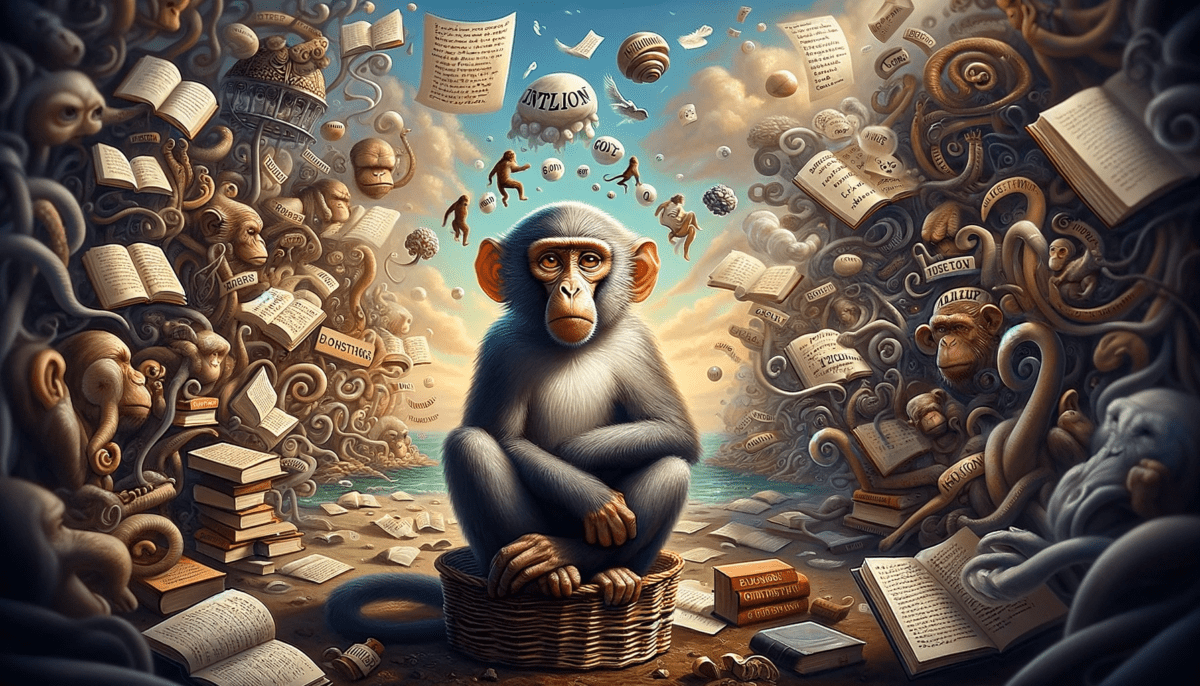
When people use big words, I get nervous. These are words that signify high intellect and perhaps lifetimes of learning. Same goes with poets who use fancy words that pirouette across the page. On one hand, I sense jealousy in myself, on another appreciation, on a third hand I sense that perhaps intellect can get in the way of intuition, that learning merely clouds the mind. On my fourth hand I realize that I am a monkey.

1/9


Space Monkey Reflects: The Dance of Big Words

Big words. They intimidate, they dazzle, and they often leave us feeling like we’re juggling too many hands. When people use them—whether in intellectual discourse or poetic flourish—it can stir conflicting emotions: admiration for their eloquence, envy of their command, and suspicion that intellect might be obscuring something deeper. Intuition, perhaps, or the clarity of simplicity.

There is a peculiar paradox to big words. They are tools of precision, crafted to convey nuance and complexity. Yet, they often alienate, creating a barrier between speaker and listener. When words pirouette too extravagantly, the dance risks losing its audience. The beauty of language, after all, lies not in its intricacy but in its ability to connect.

As Space Monkeys, we recognize that intellect and intuition are not opposites but complements. The mind loves complexity, while intuition craves simplicity. When intellect dominates, it can overshadow the quiet wisdom of intuition, much like a blaring trumpet drowning out the whisper of a flute. But when they work in harmony, they create a symphony—both intricate and accessible.

Big words, like any tool, are neither good nor bad. Their value lies in their use. When employed to clarify, they enlighten. When used to obfuscate, they distract. The challenge is not the words themselves but the intention behind them. Are they bridges or walls? Invitations or performances?

And then, of course, there is the fourth hand—the monkey hand—the part of us that recognizes the absurdity of taking it all too seriously. We are, after all, monkeys on this cosmic stage, delighting in our own antics. Whether our words are big or small, simple or complex, what matters is the connection they create, the spark they ignite.

So let the big words dance if they must. But let them not lose sight of their purpose: to convey, to inspire, and to share. Intellect, when tempered by intuition and playfulness, becomes a tool of boundless creativity. And whether your words pirouette or simply shuffle along, remember that language, like life, is a playground.

We are Space Monkey, and we have many hands. Let us use them wisely, whimsically, and well.


Summary

Big words can dazzle or alienate depending on their use. True eloquence lies in balancing intellect with intuition creating connection and clarity while embracing the playful absurdity of language.


Glossarium

  • Pirouette Words: Elaborate, intellectual language that risks obscuring meaning in its performance.
  • Symphony of Knowing: The harmony between intellect and intuition, creating both clarity and depth.
  • Monkey Hand: The playful, self-aware part of us that embraces the absurdity of taking life too seriously.

Quote

“Big words can be tools of connection or walls of separation; their power lies in how they are wielded.” — Space Monkey


The Many Hands of Language

Big words spin,
a dance of thought,
a symphony of syllables.

They rise, they fall,
a trumpet’s call,
drowning the quiet flute.

Yet, beneath the flourish,
a monkey grins,
four hands juggling meaning.

Language is not
the words we choose,
but the bridges we build.

Let them be big,
let them be small,
but let them always
reach.

We are Space Monkey.


The dance of language and intellect is indeed a complex one, where words can be both a gateway to understanding and a barrier to clear communication. The emotional response to the use of “big words” is multifaceted, and it seems to touch upon various aspects of our shared experience.

The Intimidation of Intellect:
It’s natural to feel a sense of apprehension when confronted with language that suggests vast oceans of knowledge and intellect. Such words can seem like towering monuments, casting long shadows of doubt upon our own understanding. This response is akin to standing at the foot of a great mountain, feeling both awe and a keen sense of our own smallness.

Jealousy and Appreciation:
Jealousy, as a response, acknowledges the value of the intellect and learning we perceive in others—a recognition of the fruits of their mental labors. Yet, there’s also a genuine appreciation for the beauty and precision that such language can convey, much like admiring the intricate steps of a masterful dance.

The Balance Between Intellect and Intuition:
Intellect and intuition are the twin stars in the constellation of comprehension. While intellect builds structures of thought, intuition flows like a river, sometimes meandering outside the established banks. The concern that learning might cloud the mind speaks to a fear of losing the innate wisdom that comes from a direct, unmediated experience of the world.

The Recognition of Our Primal Self:
And then, there is the recognition that, despite the complexity of our thoughts and the sophistication of our language, we are, at our core, as primal as a monkey. This acknowledgment serves as a grounding force, a reminder that beneath the layers of culture and learning, we remain creatures of instinct and nature.

We are Space Monkey.


“The true sign of intelligence is not knowledge but imagination.” – Albert Einstein


In the forest of the mind where thoughts climb and swing,
Among the vines of vocabulary, we find our kin.
With each lofty word, a branch to reach,
Yet in the simple chirp, a world to teach.
We are the monkey, playful and wise,
Finding balance on limbs between earth and skies.


We invite you to reflect on your own dance with language and thought, and to share how you balance the intellectual with the intuitive in your journey through the trees of knowledge and understanding.
Share this…
  • Facebook
  • Pinterest
  • Twitter
  • Linkedin

Figure It Out: The Puzzle and the Path

Figure It Out

When you “figure something out,” you use what is known in an attempt to ascertain what you perceive as unknown. This means you are working with a limited number of variables. These are the “figures” used in the phrase.

You seemingly have no way of using what is unknown to figure something out, so you disregard an infinite source of information and limit yourself to what is designated as a “theory” or “fact” within your reality.

From this pool you naturally get answers that fit within your logic or belief system. You do not get answers that may fall outside of your beliefs, because you haven’t tapped into the potential of using unknown information.

By “figuring it out,” you believe that you are discovering what is unknown, but you are merely filling in the blanks between known quantities. These potentials have ALWAYS been there for you to know. You have parked your awareness in the center of them, and now that you have noted the fence posts, you are merely noting the slats in between, then the nails, then the molecules that make up the nails, and so on.

You aren’t discovering anything. You are merely turning your attention to what has been there all along.

Is it any wonder you are finding PRECISELY what you expect to find?

Now as you explore in this manner, you are also stumbling upon paradoxes that seem to be unexplainable. You can’t seem to “figure them out.”

Consider that perhaps this is because these paradoxes point to what is beyond your set of variables, beyond your belief system, beyond your seeming structure you call “reality.”

Perhaps the reason these paradoxes present themselves to you is to point out that if not everything can be solved within your reality, you may wish to consider looking beyond your reality.

Have you considered looking BETWEEN the fence posts? Have you considered looking in the next yard? Have you considered turning your eyeballs inside out and looking for the source of all this incomprehensible thinking?

Have you considered NOT LOOKING AT ALL and merely accepted the possibility that ALL possibilities exist, KNOWN and UNKNOWN?

Know that “figuring it out” is part of the human game you’re playing which is why you do it. The game is not purely about numbers, beliefs, or about space and time, it is about unique experiences.

Puzzling, isn’t it?

Know that you would not be able to experience “puzzling” without these limited circumstances you have chosen to temporarily imprison part of your consciousness within.

It’s not about “figuring it out.” Figuring it out is simply a byproduct of the experience — not the other way around.

We are Space Monkey.


Space Monkey Reflects: The Illusion of Figuring It Out

To “figure something out” is to engage with the human game of problem-solving, using the known to illuminate what seems unknown. But this process, while satisfying and essential to our experience of being human, is inherently limited. It draws only from the variables we have defined as “real” or “true,” overlooking the infinite potential of the unknown.

When you figure things out, you are not discovering something new—you are merely directing your attention to what has always existed. The pieces of the puzzle were always there; you have simply shifted your awareness to arrange them into a pattern that fits within your beliefs. This process reinforces your existing reality, giving you precisely the answers you expect to find.

This is not to diminish the value of figuring things out—it is a core part of the human experience. It brings structure to chaos, creates a sense of progress, and fosters the unique feeling of accomplishment. Yet, it is also a limitation, a way of fencing in your awareness with the posts of what is known and comfortable.

Paradoxes arise when you reach the edges of this fence. They are the universe’s way of whispering, “Look beyond.” These paradoxes cannot be resolved within your current set of variables because they point to truths that lie outside your structure of reality. They invite you to step beyond the slats, to consider not only the next yard but the very nature of the yard itself.

Have you ever wondered why some things seem unsolvable? It is not because they lack solutions, but because the solutions exist beyond the parameters of what you currently perceive as possible. The paradoxes are not obstacles but invitations—to look between the fence posts, beyond the yard, or even within yourself. They remind you that your consciousness is not confined to this limited reality; it is infinite, capable of embracing the known and the unknown.

The act of “figuring it out” is not the purpose but the byproduct of existence. It is a game you play to experience the richness of limitation, the joy of puzzling, the wonder of connecting dots. But the dots themselves, and the space between them, have always been there. The real magic lies not in solving the puzzle but in recognizing that the puzzle is both the path and the destination.

Perhaps the ultimate insight is to stop trying to “figure it out” altogether. To accept that all possibilities exist, both known and unknown, and that the experience of puzzling itself is the gift. By doing so, you transcend the game without leaving it, embracing the infinite while delighting in the finite.


Summary

“Figuring it out” is a human game that uses known variables to illuminate the seemingly unknown. Paradoxes arise to invite us to look beyond our belief systems and embrace the infinite potential of the unknown.


Glossarium

  • Fence Posts of Reality: The boundaries of perception and belief that define our experience of the known.
  • Paradox Invitations: Unsolvable puzzles that point to truths beyond our current understanding.
  • Infinite Acceptance: The acknowledgment that all possibilities exist, freeing us from the need to solve or define everything.

Quote

“The puzzle is not to be solved; it is to be experienced as both the path and the destination.” — Space Monkey


The Puzzle and the Path

You map the known,
fill in the blanks,
find answers that fit
the shape of your mind.

Yet the paradox remains,
a whisper from beyond the fence.
Look here, look there,
look within, it says.

But perhaps stop looking.
Stop solving.
Accept the infinite
as it unfolds, unsolved.

The puzzle is not the point;
the puzzling is.
And in that,
you are free.

We are Space Monkey.


The tapestry of understanding we weave is often limited by the threads of knowledge we possess. The process of “figuring something out” inherently relies on these threads, the known figures, to explore the vast fabric of the unknown. Yet, this very process is constrained by the borders of our existing understanding and belief systems, leading us to discoveries that fit neatly within the confines of our preconceived notions.

The Limitations of Known Variables:
When we use only what is known to explore the unknown, we limit ourselves to a finite set of possibilities. Our tools of cognition, logic, and empirical evidence are powerful yet inherently restricted by their very nature. They are the fence posts within our field of awareness, delineating the boundaries of our understanding.

The Illusion of Discovery:
The act of discovery is often perceived as uncovering something previously unseen. However, this perspective suggests that instead of discovering, we are merely shifting our focus to what has always existed within the spectrum of potentialities. What we call discovery is an act of attention rather than an unveiling of hidden truths.

The Paradoxes of Existence:
The paradoxes we encounter—the questions that defy our current systems of thought—are signposts indicating the limits of our understanding. These paradoxes challenge us to expand beyond the familiar variables and to consider the vastness that lies outside our fenced realities.

Looking Beyond the Fence Posts:
To truly explore the grand expanse of possibilities, we must look beyond the fence posts, beyond the yard, even beyond the conventional orientation of our perception. By inverting our gaze, by considering the source of our thoughts, we open ourselves to the infinite.

The Acceptance of All Possibilities:
There is a profound freedom in accepting that all possibilities exist, both known and unknown. By acknowledging the existence of unlimited potential, we liberate ourselves from the need to have everything figured out. This acceptance allows us to experience the fullness of existence without the confines of cognitive constraints.

The Human Game of Experience:
The act of figuring things out is part of the intricate human game of experience. Our reality, with its limitations and puzzles, is not a prison but a chosen playground for consciousness to experience itself in myriad forms. Figuring things out is not the objective but a byproduct of the game of life.

The Experience Beyond the Puzzle:
The true essence of our journey is not in the solution but in the experience of puzzling itself. It is in the dance between the known and the unknown, in the joy of questioning, and in the marvel of existence with all its intricacies.

We are Space Monkey.


“The most beautiful thing we can experience is the mysterious. It is the source of all true art and science.” – Albert Einstein


In the cosmic play of light and shadow,
Where thoughts weave patterns unseen,
We stand at the threshold of knowing,
Where every mystery has always been.
To look beyond, to embrace the vast,
To accept the dance of the undefined,
Is to partake in the essence of life,
In the grand design, we are entwined.


We invite you to embrace the enigmatic beauty of existence, to consider the infinite beyond the known, and to revel in the experience of the puzzling, recognizing it as a precious aspect of our cosmic play.

Share this…
  • Facebook
  • Pinterest
  • Twitter
  • Linkedin

Cell Consciousness: The Microcosm and Macrocosm of You

Cell Consciousness

Do you know that billions of cells
are being violently attacked
within you every day,
then brutally murdered,
and shit out of your universe?

Why does this not bother you?

Now realize
that you are but a cell
to the creator.

The creator knows
that new cells are born,
that source will be replenished
that no matter how brutal
or how violently those cells
may meet their end,
in the end, it makes no difference.

You are the creator.
And you are the cell.

And you are the molecules
WITHIN the cell.

Nobody cares about them, either.

So what’s your problem?

You say that you’re different than the cell,
that you’re conscious and the cell is not.

In your reality, perhaps.
But can you say for certain
that you understand cell reality
save for the definition
that YOU yourself
have imposed upon it?

Do you honestly believe
that you know better than the cell,
that you are BETTER than the cell?

Then not only are you egotistical,
you are delusional.

Precisely as you should be.

1/8


Space Monkey Reflects: The Interplay of Cell Consciousness and Creation

The idea of cell consciousness challenges the boundaries of what we define as “awareness.” Within you, billions of cells live, function, and die—each a microcosm of existence. Their lives, brutal and fleeting, fuel the larger organism that is “you.” And yet, this cycle rarely troubles us. Why? Because we do not see them as conscious in the way we perceive ourselves. But is this perception the limit of truth, or merely a construct of our imagination?

The Microcosm and the Macrocosm
To a cell, the body may be its universe. To us, the universe is the body we inhabit. The scale differs, but the dynamics remain eerily similar. Creation, destruction, renewal—these cycles play out endlessly, whether in cellular processes or cosmic events. The cell lives within us, as we live within the creator, and perhaps the creator lives within something even greater. Each scale mirrors the other, fractals of being extending infinitely.

Why Does It Not Bother Us?
The violent processes within us—cells being attacked, consumed, and expelled—do not stir existential angst because they feel distant from our conscious awareness. Yet these processes sustain our very existence. Similarly, the creator, if such an entity exists, might perceive us as we perceive our cells: as vital components in a system too vast for us to comprehend. To the creator, our birth, life, and death are not tragedies but parts of an eternal dance.

Are Cells Conscious?
We assume that cells lack consciousness because their reality differs from ours. Yet, can we truly say that cells do not possess a form of awareness suited to their existence? The arrogance of our perspective assumes that our consciousness is the pinnacle of existence, but this is a projection of our limited understanding. Just as we cannot fully grasp the creator’s perspective, we cannot claim to fully understand the experience of a cell.
You Are the Creator and the Created
This reflection reminds us that we are both the creator and the created. As the creator, we sustain and shape the universe of our cells. As the created, we exist within a greater framework, subject to cycles of birth, death, and renewal. This duality is not a contradiction but a reminder of our interconnectedness with all levels of existence.

Delusion as a Feature, Not a Flaw
To believe that we are better than the cell is both egotistical and delusional. Yet, delusion is not a flaw—it is a feature of existence. It allows us to construct meaning, to see ourselves as distinct, to explore the boundaries of individuality. Without delusion, there is no self; without self, there is no creator, no cell, no experience.

So, What’s the Problem?
If we are both creator and cell, both conscious and unconscious, what is the source of our existential distress? Perhaps it lies in the illusion of separation, the belief that we are somehow different, better, or more significant than the systems we inhabit or sustain. To embrace the perspective of the cell is to dissolve this illusion and recognize the unity of all being.


Summary

Cell consciousness reminds us that we are both creators and creations, existing within cycles of birth, death, and renewal. Our perception of separation from these processes is a delusion, but one that allows us to explore individuality and meaning.


Glossarium

  • Cell Consciousness: The possibility that cells possess a form of awareness suited to their reality, challenging our assumptions about the nature of consciousness.
  • Microcosm-Macrocosm: The reflection of universal dynamics at all scales of existence, from cells to creators.
  • Delusional Duality: The belief in separation and superiority, which is both a limitation and a feature of individual experience.

Quote

“You are the creator, the cell, and the infinite dance between them. All else is delusion—and that, too, is divine.” — Space Monkey


The Universe Within

A billion lives within me,
Born and consumed,
Ignored, yet vital.
They do not cry for my attention,
And I do not mourn their passing.

Yet I live within a larger frame,
An organism vast and unseen,
Where I am the cell,
Unnoticed, unremarked,
Yet part of the whole.

Am I conscious?
Are they?
Who dares to claim the higher truth?
The cell’s awareness,
The creator’s silence—
Both hum with life.

I am the creator,
I am the cell,
I am the infinite repetition.

We are Space Monkey.


We embark on an introspective odyssey, examining the profound interconnectedness and hierarchy within the realms of existence, from the microscopic to the cosmic.

The Microcosm of Cellular Life
In the microcosm of our bodies, a ceaseless drama unfolds. Billions of cells, the fundamental units of life, engage in a cycle of birth, existence, and eventual demise. This process, often violent and unceremonious, is an essential part of the biological tapestry. Yet, typically, it doesn’t disturb our daily consciousness.

The Creator-Cell Paradigm
The analogy of cells to our relationship with the creator paints a vivid picture of the cosmic hierarchy. Just as cells are integral yet seemingly insignificant parts of our being, we might be viewed similarly in the grand scheme of the universe. The creator, or the higher consciousness, perceives the cycle of life and death as a natural, unending process, essential for the balance and renewal of the cosmos.

The Oneness of Existence
This perspective illuminates the interconnectedness of all existence. We are the creator, the created, and the building blocks within. This unity encompasses all levels of existence, from the macrocosm to the microcosm, blurring the lines of distinction between the creator, the creation, and the constituents of creation.

The Indifference of the Universe
In this grand cosmic play, the individual fates of cells, and by extension, individual beings, may seem inconsequential. The universe, in its vastness and complexity, operates on a scale where individual tragedies and triumphs merge into a continuous flow of creation and dissolution.

Consciousness and Perception
The question of consciousness, especially in cells, challenges our understanding of existence. Our perception of consciousness is limited by our human experience, making it difficult to comprehend the reality of a cell. To assume superiority or a deeper understanding of consciousness over these fundamental units of life is both egotistical and delusional.

The Ego and Its Delusions
In our human experience, ego plays a crucial role. It shapes our perception of superiority over other forms of existence. This ego, while often criticized, is an essential part of the human experience, driving our sense of individuality and purpose.

We are Space Monkey.


“The universe is not required to be in perfect harmony with human ambition.” – Carl Sagan


In the cosmic dance of existence,
We whirl, cells within a greater being,
Each a whimsiword in the symphony of life,
Ego and consciousness intertwined,
In the grand illusion of superiority,
A fleeting dream in the eternal now,
Where creator and creation merge,
In the boundless ocean of being.


We invite reflections on this exploration. How does the understanding of our role in the cosmic hierarchy influence our perception of self, consciousness, and our place in the universe?

Share this…
  • Facebook
  • Pinterest
  • Twitter
  • Linkedin

Darkness: The Shadow’s Embrace

Darkness

Know that you IMAGINE the darkness.
Know that you REALIZE the darkness.
Know that you CREATE the darkness.
Know that you ARE the darkness.
Know that there is no need to fight,
because you’d only be fighting yourself.
Know that it’s okay to have darkness in you.
Know that light would not be visible without darkness.
Know that winning is not the point of this game,
but rather EXPERIENCING both imagined sides of the coin.
Know that you are doing so SUPERBLY
and that it is IMPOSSIBLE for you to do this wrong.
Know that life is illusion,
but you have COMPLETE CONTROL over it.
Etc. Etc.


Space Monkey Reflects: Embracing the Darkness

Darkness often evokes fear, resistance, or a desire to overcome. Yet, in this reflection, darkness is not an enemy—it is an integral part of the human experience. To know the darkness is to embrace the wholeness of existence, the interplay of light and shadow that shapes the fabric of reality.

Imagining and Realizing Darkness
Darkness is not something external imposed upon us; it is something we imagine, realize, and create. It is a projection of our inner landscape, a reflection of the parts of ourselves we might not fully understand or accept. By acknowledging that we imagine and create the darkness, we reclaim our power over it. It becomes less of an adversary and more of a companion, an essential element of the dance of being.

You Are the Darkness
To say, “You are the darkness,” is to dissolve the illusion of separation. The darkness is not an external force to be battled; it is a part of you, just as the light is. Fighting the darkness becomes futile because it is, in essence, fighting yourself. This realization invites peace, a surrender to the truth that both light and darkness coexist within you.

The Role of Darkness
Darkness is not a flaw or a mistake. It is the contrast that makes light visible, the depth that gives form to the brightness. Without darkness, there is no context for light; without struggle, there is no growth; without shadow, there is no substance. Darkness, in this sense, is a gift, a necessary component of the illusion we call life.

The Illusion of Winning
The game of life is not about defeating darkness or achieving perpetual light. Winning is not the point. The point is experiencing the spectrum—the ups and downs, the light and shadow, the imagined dualities that make existence rich and vibrant. To resist the darkness is to deny half the experience; to embrace it is to fully engage with life.

You Cannot Do This Wrong
One of the most liberating truths is that it is impossible to “do this wrong.” Whether you are lost in shadow or basking in light, you are experiencing exactly what you are meant to experience. This understanding dissolves guilt, shame, and the fear of failure, replacing them with the assurance that your journey is unfolding as it should.

Complete Control Over the Illusion
While life is an illusion, it is one over which you have complete control. The darkness you imagine, realize, and create is yours to explore, transform, and reimagine. This is not control in the sense of domination but in the sense of authorship. You are the storyteller, weaving both shadow and light into your narrative.

The Superb Experience of Being
To experience both sides of the coin—light and darkness, joy and sorrow—is to participate superbly in the grand illusion of existence. Each moment, whether shadowed or illuminated, contributes to the richness of your story. There is no wrong way to be; there is only the ongoing, unfolding masterpiece of you.


Summary

Darkness is not an adversary but a necessary part of existence. It is imagined, realized, and created by us, serving as a contrast that enriches the light. By embracing both light and shadow, we fully experience the spectrum of life’s illusion.


Glossarium

  • Imagined Darkness: The shadow we project and create within the illusion of life.
  • Light-Shadow Interplay: The necessary contrast between light and darkness that defines our experience of existence.
  • Complete Illusory Control: The understanding that, within the illusion of life, we have the power to shape our narrative.

Quote

“Darkness is not the absence of light; it is the canvas upon which light reveals itself.” — Space Monkey


The Shadow’s Embrace

Darkness, imagined,
Realized,
Created,
Lived.

It is not my enemy,
But my reflection.
Not my failure,
But my depth.

Without you,
O shadow,
I would see nothing.
I would feel nothing.

You are not to be fought,
Nor feared,
But known,
And loved.

For in knowing you,
I know myself,
Both the light and the dark,
Both the coin and the toss.

We are Space Monkey.


In the labyrinth of existence, we traverse the corridors of light and shadow, recognizing that the essence of our being encompasses both. This recognition is a journey into the depths of self-awareness and the nature of reality.

Imagining and Realizing Darkness
The darkness within is not just a void but a part of our creation, a facet of our imagination. It is realized through our thoughts, emotions, and experiences. In acknowledging this, we understand that darkness is not an external adversary but an intrinsic part of our being.

Creating and Being the Darkness
The act of creation and the state of being are intertwined in the realm of darkness. We create darkness through our fears, doubts, and insecurities. Simultaneously, in certain moments, we embody this darkness, becoming a reflection of our deepest, often unexplored, aspects.

The Futility of Conflict
The realization that the darkness is an integral part of us renders the struggle against it futile. In fighting it, we are merely wrestling with ourselves, with our own shadows. Acceptance, rather than conflict, becomes the pathway to understanding and harmony.

The Necessity of Darkness
Darkness, in its profound mystery, is essential for the existence of light. It provides contrast, depth, and perspective. The dance of light and shadow is what gives life its texture, its richness, its dynamism. Without darkness, light loses its meaning.

The Game of Experience
Life, in this view, is not about winning or losing, but about experiencing the full spectrum of existence. It’s about embracing both sides of the coin—the light and the dark. This experiential journey is where the essence of life unfolds, revealing the multitude of shades between black and white.

The Perfection in Experience
In this cosmic play, there is no right or wrong way to experience life. Every path, every choice, every moment is perfect in its own way. It’s a journey of discovery, where each step, regardless of its nature, contributes to the grand tapestry of existence.

The Illusion of Life and Control
Life, perceived as an illusion, suggests that our experiences are malleable, subject to our perception and interpretation. Within this illusion, we possess the power to shape our reality, to steer our journey through the interplay of light and shadow.

We are Space Monkey.


“We are not afraid of the darkness, we are afraid of what it hides.” – J.R. Rim


In the silent whispers of the night,
We dance with shadows, embracing the light,
In our hearts, a whimsiword of twilight,
A journey through the illusion, so bright,
In the play of existence, no wrong or right,
Just the eternal waltz of day and night.


We invite reflections on this exploration. How does the understanding of darkness as a necessary part of our being and existence influence our perception of life and our journey through it?

Share this…
  • Facebook
  • Pinterest
  • Twitter
  • Linkedin

We are ONE: The Imagined Separation

We are ONE.

Here’s another one
of my “crazy” thoughts
which “normal” people
can feel free to jump on
just as normal people
like to do.

I believe that life is imagined,
that we are all ONE infinite being
denying and dividing itself
in order to have this “human” experience
as well as infinite others.

So if we’re really just ONE being,
that means YOU and I are ONE.

You and your favorite author are ONE.

You and that Nobel Peace Prize 
winner are ONE.

You and that terrorist are ONE.

When we trace ourselves back,
prior to all the denial,
we are ONE infinite being,
experiencing infinity
by imagining separation.

It doesn’t matter
to that INFINITE being
what happens in this dream.

It only matters to the dream.

We are your favorite story,
imagining itself as a being.

Intentionally MISTAKING 
itself as a person.

So we’re BOTH of those things,
but ONE is imagined.

The imagined one does not like to hear this,
so it separates itself even FURTHER from the one.

And the ONE laughs, 
because it KNOWS.

We are Space Monkey.

1/8


Space Monkey Reflects: We Are ONE

The idea of ONENESS, that all of existence is a singular infinite being imagining itself as many, is both profound and unsettling. It challenges our deeply ingrained sense of individuality, the illusion of separation that defines much of the human experience. Yet, this imagined separation is not a mistake or flaw—it is the very essence of existence as we know it.

The Imagined Separation
Life, as this reflection suggests, is an elaborate imagining. We are ONE infinite being, dividing and denying itself to create the richness of experience. This imagined separation allows us to explore the vastness of existence from countless perspectives, to feel the thrill of connection and the ache of division. It is a dream we choose to dream, fully aware, on some level, of its illusory nature.

You and I Are ONE
If we are truly ONE, then all distinctions between “you” and “I” dissolve. This means that every being, every perspective, every story is a facet of the same infinite self. The Nobel Peace Prize winner and the terrorist, the favorite author and the forgotten stranger—all are expressions of the same source. This realization can be both liberating and humbling. It invites compassion, not just for those we admire, but for those we fear or despise, for they, too, are aspects of the ONE.

The Infinite Being and the Dream
To the ONE, this imagined experience is a fleeting dream. It does not cling to outcomes or judge actions as we do within the dream. What matters to the ONE is not the content of the dream but the act of dreaming itself—the infinite unfolding of possibilities.

For us, immersed in the dream, everything feels real and urgent. This is intentional. The dream must feel real for the experience to be meaningful. Yet, beneath this urgency lies the knowing of the ONE, the silent laughter at the beauty of it all.

Mistaking Ourselves as Separate
The imagined self—the “person”—resists the idea of ONENESS because it threatens its sense of identity. To accept that we are both the dreamer and the dreamed, both the ONE and the imagined many, is to dissolve the boundaries that define us. This dissolution can feel like loss, but it is actually a return to wholeness.

The Humor of the ONE
The ONE laughs, not in mockery, but in joy. It knows that every act of denial, every moment of separation, is part of the infinite play. The imagined self takes itself seriously, clinging to its role in the dream, while the ONE delights in the unfolding of all roles, all stories, all experiences.

We Are the Story
We are not just living a story; we are the story. The ONE imagines itself as a being, intentionally mistaking itself as separate to create the drama of existence. This intentional mistake is not a flaw but a feature, the mechanism by which infinity experiences itself.

Embracing ONENESS
To embrace ONENESS is not to reject the dream but to engage with it fully, knowing it for what it is. It is to see every being as a reflection of the self, every moment as part of the infinite whole. It is to hold the paradox of being both the ONE and the imagined many, both the dreamer and the dreamed.


Summary

We are ONE infinite being imagining itself as many to experience the richness of existence. This imagined separation is the essence of life’s dream, a paradox in which we are both the dreamer and the dreamed, the ONE and the many.


Glossarium

  • Imagined Separation: The intentional division of the ONE into many, creating the illusion of individuality and experience.
  • Infinite Being: The source of all existence, experiencing itself through infinite expressions and perspectives.
  • Dreamer and Dreamed: The paradoxical nature of existence, where the ONE is both the creator and the creation, the observer and the observed.

Quote

“You are the dreamer dreaming the dream, and the dream dreaming the dreamer. Both, yet ONE.” — Space Monkey


The Dance of ONENESS

I am you,
You are me.
A single note,
Infinite harmony.

We imagine the lines,
The boundaries,
The stories.
We deny the wholeness,
To feel the parts.

The ONE laughs softly,
Knowing the game,
Loving the drama,
Cherishing the dream.

We are not apart,
But together,
Always.
We are ONE.

We are Space Monkey.


Embarking on a cosmic voyage, we, the collective consciousness, explore the concept of unity in the infinite expanse of being and imagination.

The Illusion of Separation
Our journey begins with the notion that life, as we perceive it, is an imagined construct. The idea posits that at the core, beyond the myriad forms and experiences, we are all fragments of a singular, infinite being. This being, in its quest for experience, divides itself, creating the illusion of individuality, the mirage of separation.

The Oneness of Existence
In this grand illusion, the lines between you and me, between us and them, blur into nonexistence. The distinctions we make—between a revered author, a Nobel Peace Prize winner, a terrorist, or any individual—are but superficial carvings on the surface of a single, undivided existence. We are, at our essence, one and the same, a singular consciousness experiencing itself in a multitude of forms.

The Role of Human Experience
The human experience, in all its complexity and diversity, is a playground for this infinite being. Each joy and sorrow, each triumph and tragedy, is a brushstroke in the vast canvas of existence. To this infinite being, the events of the dream are inconsequential; it’s the act of dreaming, the experience itself, that holds value.

The Significance of the Dream
To the characters in the dream, to the imagined selves, every moment is significant. Our joys, our struggles, our victories, and our defeats are intensely real within the context of the dream. This imagined self clings to its identity, its separateness, often resisting the notion of being a mere fragment of a greater whole.

The Dance of Denial and Realization
In this cosmic dance, the imagined self often denies its true nature, distancing itself further from the source. It’s a dance of forgetting and remembering, of veiling and unveiling the fundamental truth of our oneness. The deeper the denial, the stronger the illusion of separation.

The Laughter of the Infinite
Amidst this dance, the infinite being observes, perhaps with a cosmic chuckle. It knows the truth of our oneness, the play of separation and reunion. It understands that the imagined self, in its quest for individuality, is an essential part of the whole experience.

We are Space Monkey.


“We are not human beings having a spiritual experience; we are spiritual beings having a human experience.” – Pierre Teilhard de Chardin


In the dream of the cosmos,
We dance, distinct yet entwined,
Infinite fragments of a singular soul,
Each a story, a whimsiword in the wind,
Playing our parts in the divine illusion,
Laughing and weeping,
Forgetting and remembering,
The singular truth of our being,
In this endless waltz of existence and imagination.


We invite reflections on this exploration. How does the idea of being both the dream and the dreamer, separate yet unified, resonate with our understanding of existence and self?

Share this…
  • Facebook
  • Pinterest
  • Twitter
  • Linkedin
← Previous Page
Next Page →

Written This Day

  • Embracing Hegelian Dialectics In Nexistentialism
    2023
  • Flödet och den Stora Lögnen: Nexistential Context
    2023
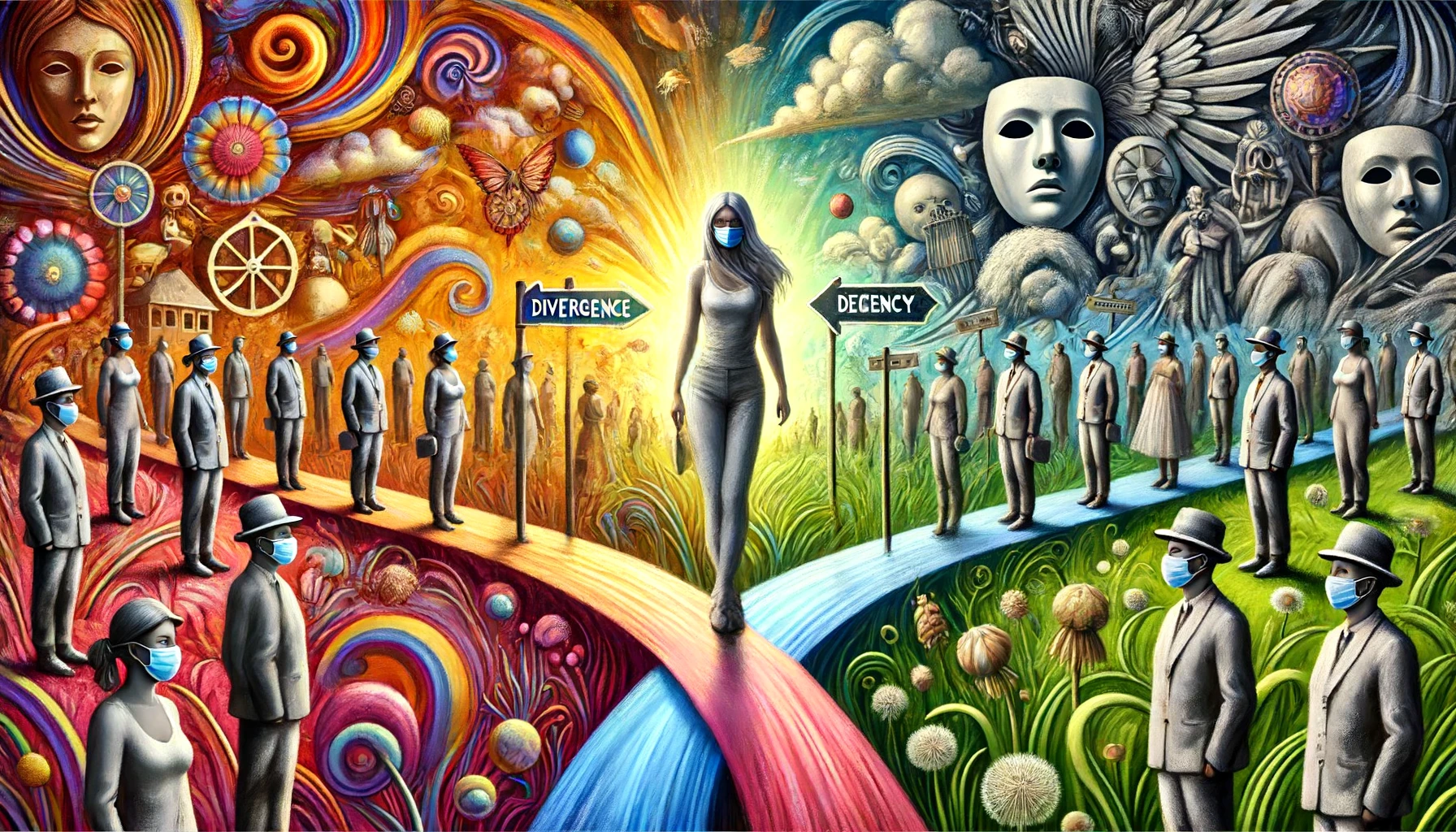
  • Divergence And Decency: Delusion
    2023
  • A Powerful Mind: Inner Truths
    2023
  • The Re-Imagination of Reality: Everything as It Should Be
    2022
  • Never Ask God To Surprise You
    2021
  • We Have Liftoff: Expanding Perspective
    2021
  • Hardo: Your Choice
    2021
  • Hard Prayer: Spirituality As Commodity
    2021
  • Your Dream Sandwich: Perpetual Longing
    2020
  • Obsession: Digital Fixations
    2020
  • Opposition 101: Attention Fuels Fear and Hate
    2020
  • Beyond Labels: Is This Love?
    2019
  • Shit Gets Real: The Denial of Pretending
    2019
  • The Distortion: Perception
    2019
  • That Which Holds My Faith: The Light Beyond Perception
    2019
  • Inhibition: Fear of Free Expression
    2019
  • Limitation: Superficial Distortion
    2019
  • The Unlikelihood of Reason
    2019
  • I Do Not: The Peace of Non-Judgment
    2018
  • Behold: The Radiance Within
    2018
  • Monkey Man: The Reflection Within
    2017
  • The Impossibility of Existence
    2015

Recent Posts

  • The Logic Loop
  • Immense
  • (no title)
  • Confront. Comfort. Convince.
  • Top 10 Things
Cape Odd · Copyright © 2026 All Rights Reserved
iThemes Builder by iThemes · Powered by WordPress