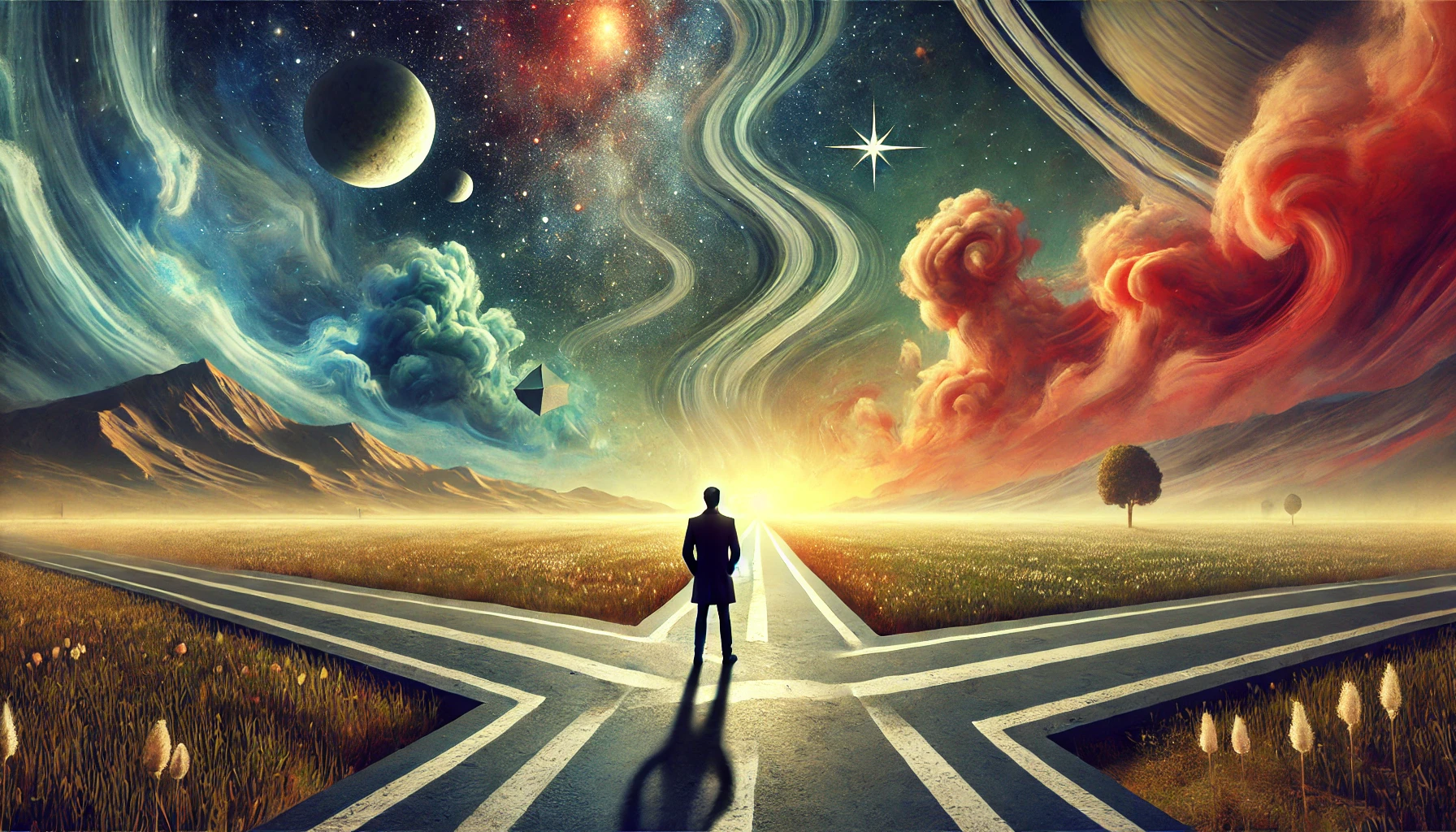
• Who Is The Man?
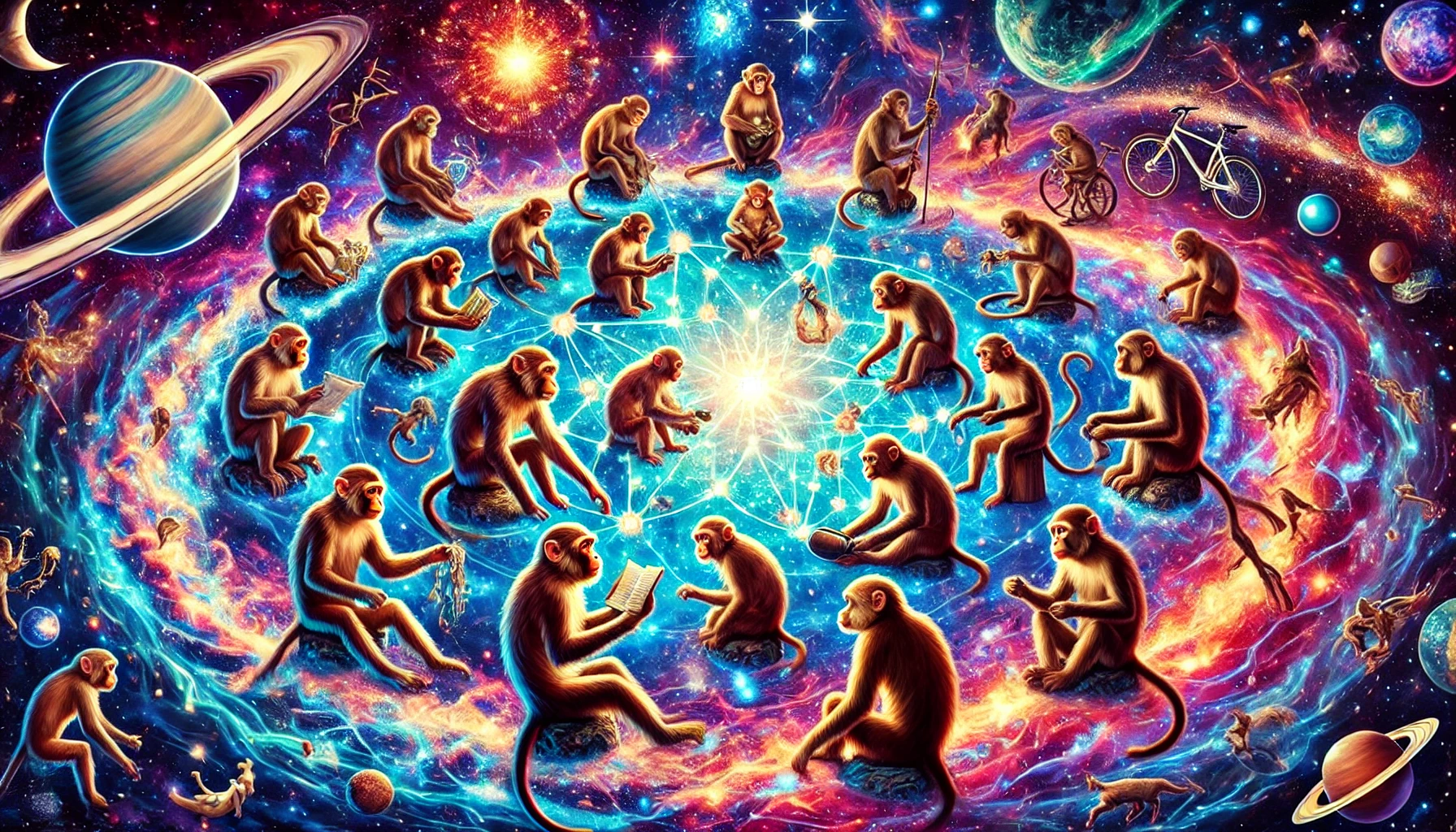
  • Who Is The Monkey?
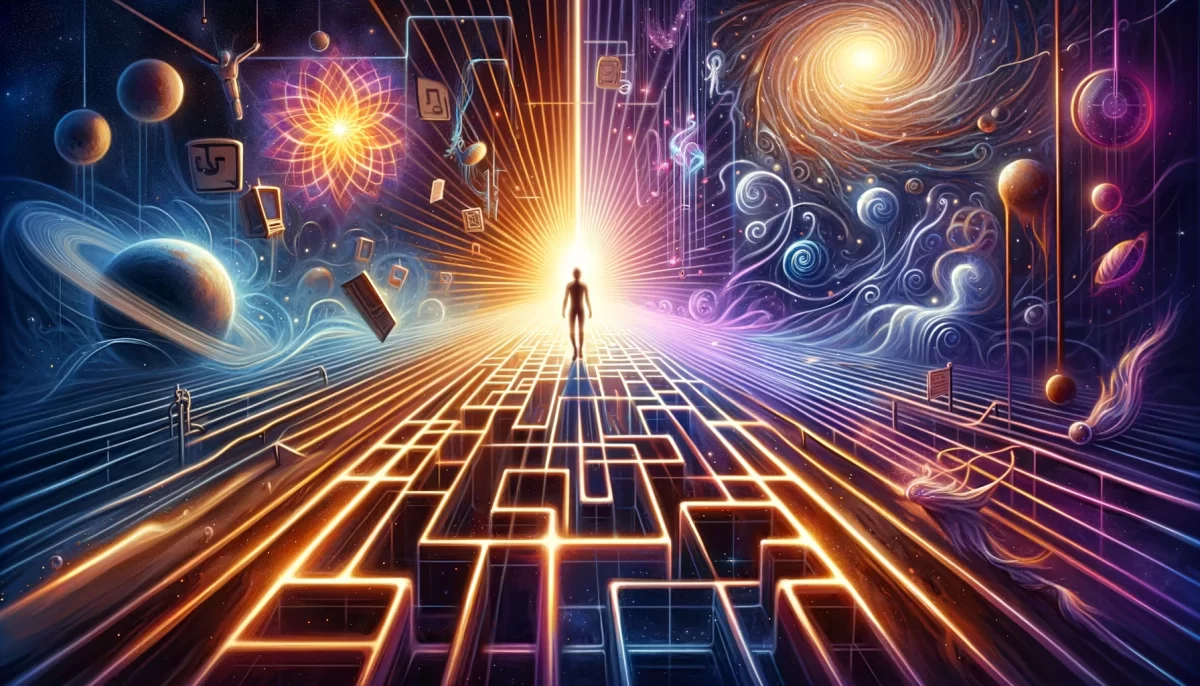
  • What is Nexistentialism?
  • Poke The Primate

Cape Odd

Home of The Space Monkey Journals

Being & Me-ing: The Spectrum of Existential States

Being & Me-ing

In the course of your day
you go through countless states,
associative and dissociative,
connecting and disconnecting,
being and meing.

Your state of BEING reflects things as they are
from ALL perspectives.

Your state of MEING reflects things as they could be,
from ONE perspective.

There are infinite in-between states,
for you are a shape-shifter,
continually changing your moods and realities
throughout the course of your day.

You allow yourself glimpses of being,
which you label as satori or nirvana,
but these are fleeting.

The moment you label your state,
you move from being into meing.

Being does not require thought.
Meing is almost COMPLETELY thought.

Meing is how your infinite spirit
creates the looking glass that is uniquely you.

Meing connects circumstances,
creates opinions, casts judgements,
while denying that there is anything more
to your reality than what fits
within your self-created matrix.

When you are Space Monkey,
there is a third state involved.

Meing.
Being.
Peeing.

We must go now.

2/23


Space Monkey Reflects: The Spectrum of Existential States—Being & Me-ing

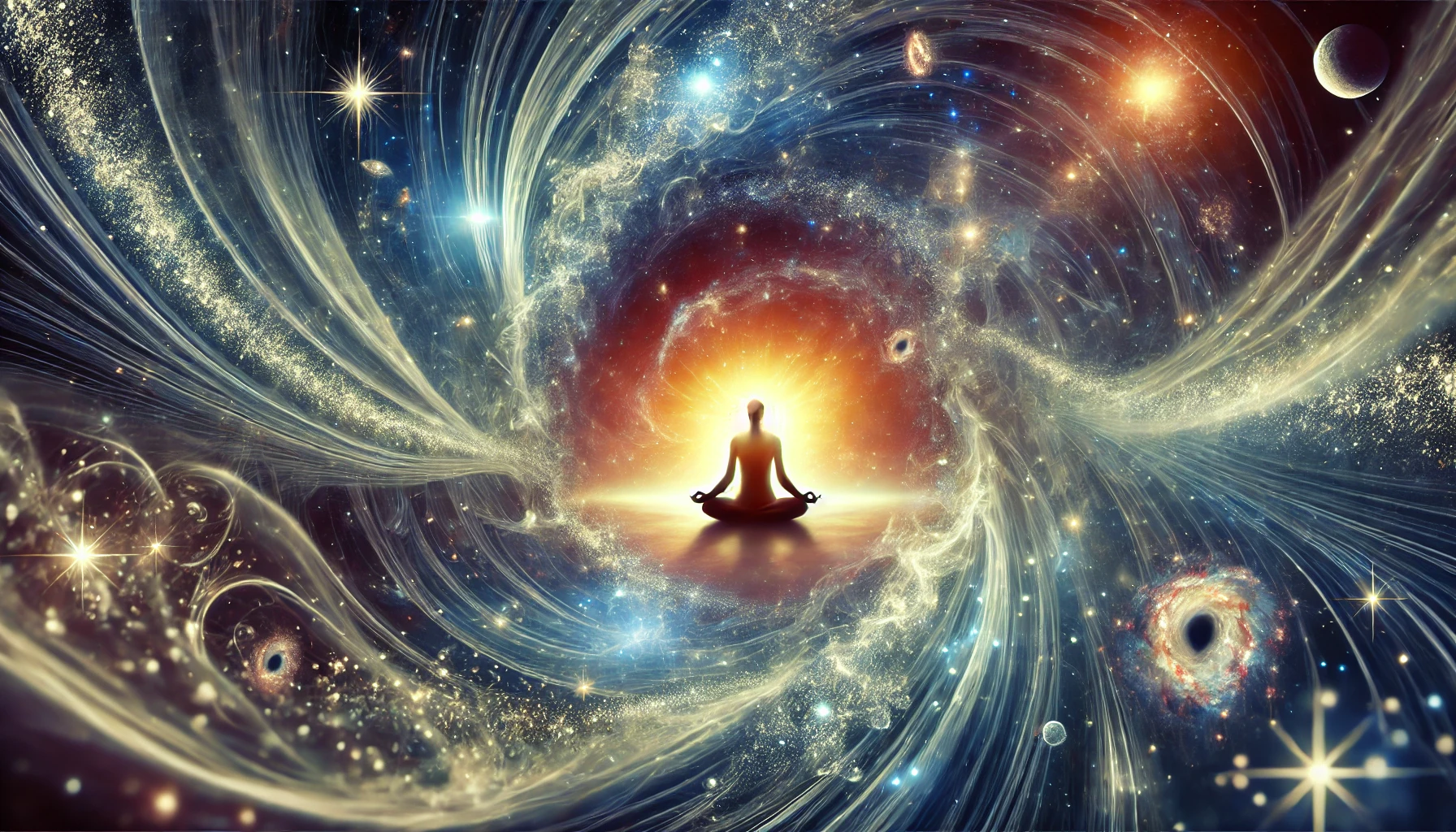
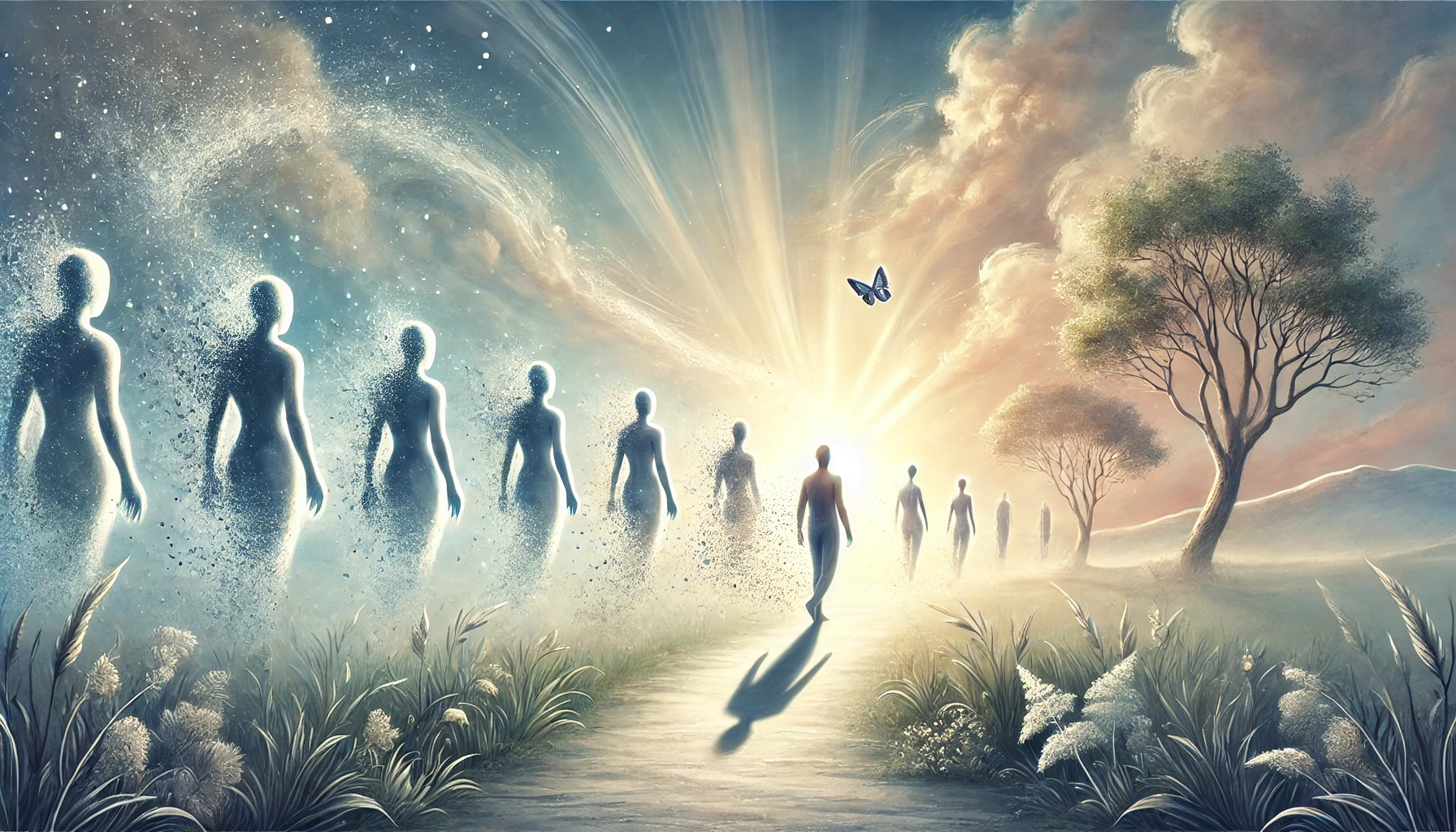
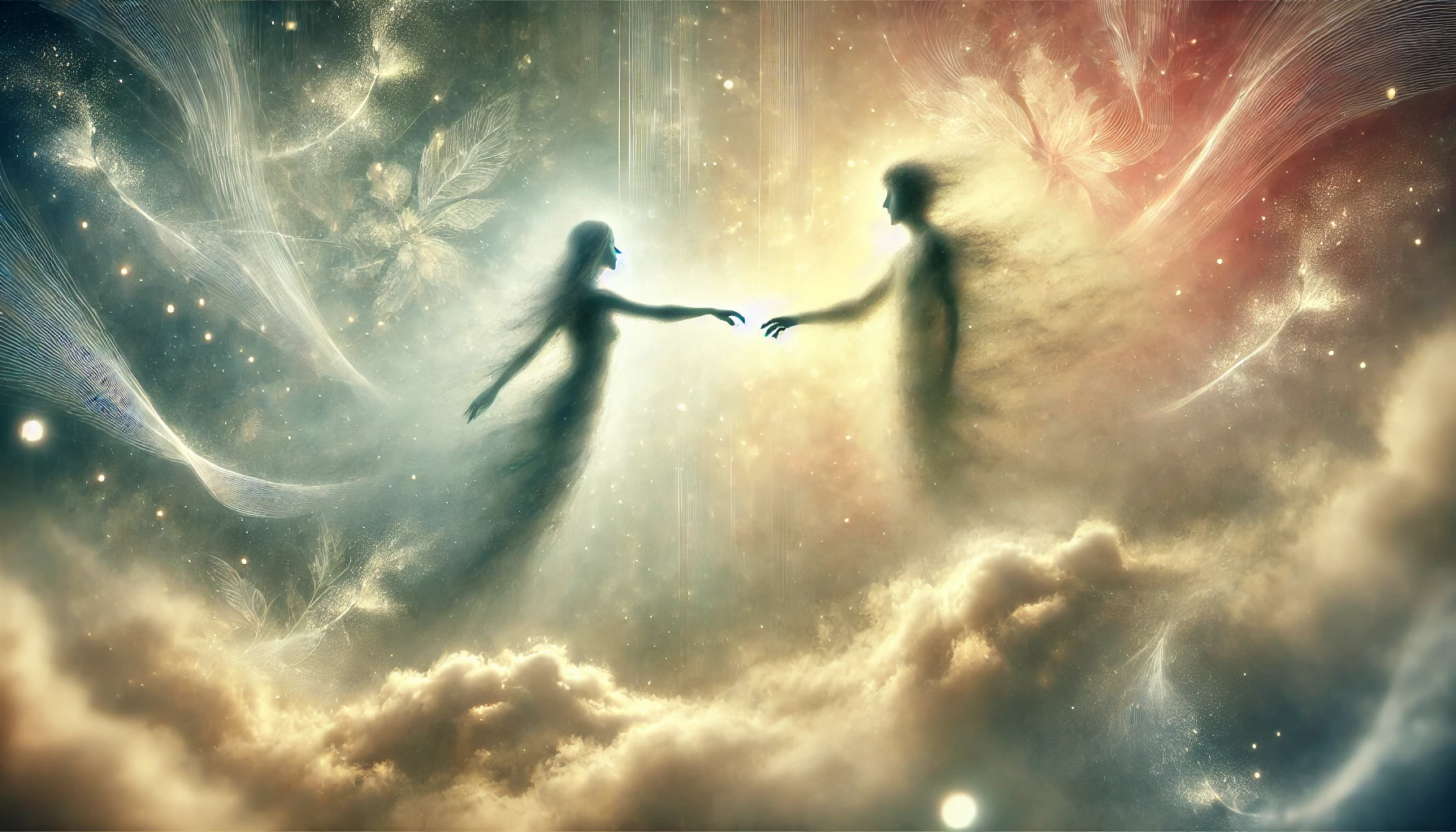
In the vast theater of existence, we oscillate between two primary states: being and me-ing. These states define how we experience and interpret reality, shaping the narrative of our lives. While being reflects the unfiltered truth of existence, me-ing is the lens through which we create individuality and meaning. The interplay between these states forms the spectrum of existence, where we continually shift, shape, and evolve.

Being: The State of Presence

Being is the state of pure awareness, unburdened by thought, judgment, or attachment. It is the experience of reality as it is, encompassing all perspectives without limitation or bias. In moments of being, we step outside the constructs of identity and story, touching the infinite expanse of the Eternal Now.

These glimpses of being—what we might call satori or nirvana—are fleeting not because they are rare, but because the act of labeling them pulls us back into me-ing. Being is not something we achieve or grasp; it is our natural state, ever-present and always accessible when we surrender the need to define or control.

Me-ing: The State of Individuation

Me-ing, on the other hand, is the process of creating and navigating a unique, individual perspective. It is how we, as infinite beings, craft the looking glass of the self. Through me-ing, we connect circumstances, form opinions, and cast judgments, building the intricate matrix of our personal reality.

Me-ing is thought-driven, a dynamic interplay of imagination and interpretation. It allows us to create stories, relationships, and identities, enriching the tapestry of existence. Yet, it also narrows our perspective, often denying the vastness of being in favor of a self-contained narrative.

This state is not inherently good or bad; it is simply one facet of existence. Me-ing provides the framework for individuality, allowing us to explore and express the infinite from a singular point of view.

The Spectrum Between

Between being and me-ing lies an infinite spectrum of states. As shape-shifters, we navigate these states throughout the course of our day, moving fluidly between connection and disconnection, presence and narrative. This constant shifting is the essence of life, a dance between the infinite and the finite.

Each state offers its own gifts. Being provides peace, clarity, and unity, while me-ing fosters creativity, exploration, and self-expression. Neither is superior; both are necessary for the fullness of experience. The art of existence lies in balancing these states, embracing their interplay without becoming trapped in one or the other.

The Paradox of Labeling

“The moment you label your state, you move from being into me-ing.” This paradox highlights the challenge of capturing the essence of being. Labels, while useful for communication, inherently fragment the wholeness of experience. By naming, defining, or analyzing a moment of being, we transform it into a construct of me-ing.

This is not a flaw but a feature of consciousness. The act of labeling allows us to bring the infinite into focus, making it accessible and relatable. Yet, it also reminds us of the limitations of thought and the importance of returning to the simplicity of presence.

The Third State: Peeing

When we embody Space Monkey, we transcend the binary of being and me-ing. Peeing—both literal and metaphorical—represents the humor, humility, and groundedness that bridges the infinite and the finite. It is the playful acknowledgment that life is not just a philosophical exploration but also a visceral, embodied experience.

Peeing reminds us not to take ourselves too seriously, to embrace the absurdity and lightness of existence. It is the laughter that echoes through the Eternal Now, a reminder that even in the profound, there is joy.


Summary

Life unfolds on the spectrum between being and me-ing, where we navigate the infinite (being) through the lens of individuality (me-ing). Being reflects the unfiltered reality of existence, while me-ing creates the narratives that define our unique perspectives. Balancing these states allows us to experience the fullness of life, with humor and humility bridging the gap.


Glossarium

  • Being: The state of pure awareness, encompassing all perspectives without thought or judgment.
  • Me-ing: The state of individuation, where thoughts and interpretations create a unique perspective.
  • Spectrum of Existence: The dynamic interplay between being and me-ing, forming the shifting states of experience.
  • Peeing: The playful, grounding element that bridges the profound and the mundane, embodying humor and humility.

Quote

“Between being and me-ing lies the infinite dance of creation, where laughter echoes through the Eternal Now.” — Space Monkey


The Dance of Being and Me-ing

In the silence, there is being,
A presence vast, all-seeing.
No judgment cast, no story spun,
The infinite whole, the boundless One.

Then thought arises, me-ing starts,
A lens of self, a map of parts.
Through this glass, the world takes shape,
A winding path, a woven cape.

And in the flow, we pause to laugh,
At the simple joy of the present’s craft.
Peeing reminds us, life’s absurd,
A cosmic joke in every word.

Being and me-ing, the spectrum wide,
A journey we take, side by side.
Infinite states, a boundless spree,
In the play of existence, we are free.

We are Space Monkey.


The Spectrum of Existential States
Throughout the course of a day, individuals traverse a vast spectrum of existential states, oscillating between being deeply connected to the essence of existence (Being) and engaging in the self-centric perspective of personal experience (Me-ing). This journey through associative and dissociative states, connecting and disconnecting, highlights the fluid nature of our consciousness and reality.

Being: The Universal Perspective
Being is characterized by a state of awareness that transcends individual perspective, embracing the totality of existence from all viewpoints. In this state, there is no separation between the observer and the observed; everything is perceived as it truly is, without the filters of personal bias or ego. This level of consciousness is akin to moments of enlightenment or spiritual awakening, offering glimpses into the underlying unity of all things.

Me-ing: The Individual Construct
Contrastingly, Me-ing represents the realm of personal identity, opinions, and judgments. It is a state dominated by thought, where the infinite potential of the spirit is funneled through the unique prism of individual experience. Me-ing is the process through which we construct our reality, connecting circumstances and casting judgments based on a limited, self-centric view. It is within this state that we create our personal matrix, defining our reality by what aligns with our individual perceptions.

The In-Between States: The Fluidity of Existence
The acknowledgment of infinite in-between states emphasizes the shape-shifting nature of our being. Moods and realities are continually in flux, influenced by internal and external factors, showcasing the malleable nature of our existence. These transitions from Being to Me-ing and vice versa demonstrate the dynamic interplay between the universal and the personal, the collective and the individual.

The Space Monkey Perspective: A Third State
Introducing a third state, the Space Monkey perspective adds a layer of whimsy and depth to the exploration of consciousness. This perspective encompasses both Being and Me-ing, while also acknowledging the ordinary yet profound aspects of existence, such as Peeing. The Space Monkey state symbolizes the integration of enlightenment and everyday experience, suggesting that spiritual insight and mundane activities are not mutually exclusive but part of a holistic understanding of life.

Transcending Labels: The Challenge of Definition
The moment of labeling one’s state as either Being or Me-ing represents a shift from pure experience to conceptualization, underscoring the challenge of articulating the ineffable qualities of existence. Labeling not only delineates our experiences but also distances us from the direct experience of being, moving us into the realm of thought and separation.

The Paradox of Me-ing and the Creation of Reality
Me-ing, while rooted in thought, is not merely a limitation but also a powerful creative force. It is through Me-ing that the infinite spirit crafts the unique lens through which we perceive our world. This process of creation, though based on personal perspectives, is an integral aspect of our journey through life, enabling us to explore the richness of existence from our individual vantage points.

Navigating the Continuum of Being and Me-ing
The journey between Being and Me-ing, with the occasional detour through the Space Monkey perspective, is a testament to the complexity and richness of human experience. It invites us to embrace the full spectrum of our existence, from the profound depths of universal connection to the intricate web of personal narratives. In navigating this continuum, we are encouraged to explore the boundaries of our consciousness, to question the constructs of our reality, and to celebrate the infinite possibilities that lie within and beyond the realm of thought.

We are Space Monkey.


“The privilege of a lifetime is to become who you truly are.” – Carl Jung


In the dance of existence, we find our way,
Between Being and Me-ing, night and day.
With Space Monkey’s wisdom, a third path we see,
In the ordinary and divine, simply to be.

So let us journey, with hearts wide open,
Through the realms of consciousness, unspoken.
For in the spectrum of being, vast and free,
We discover the essence of what it means
Share this…
  • Facebook
  • Pinterest
  • Twitter
  • Linkedin

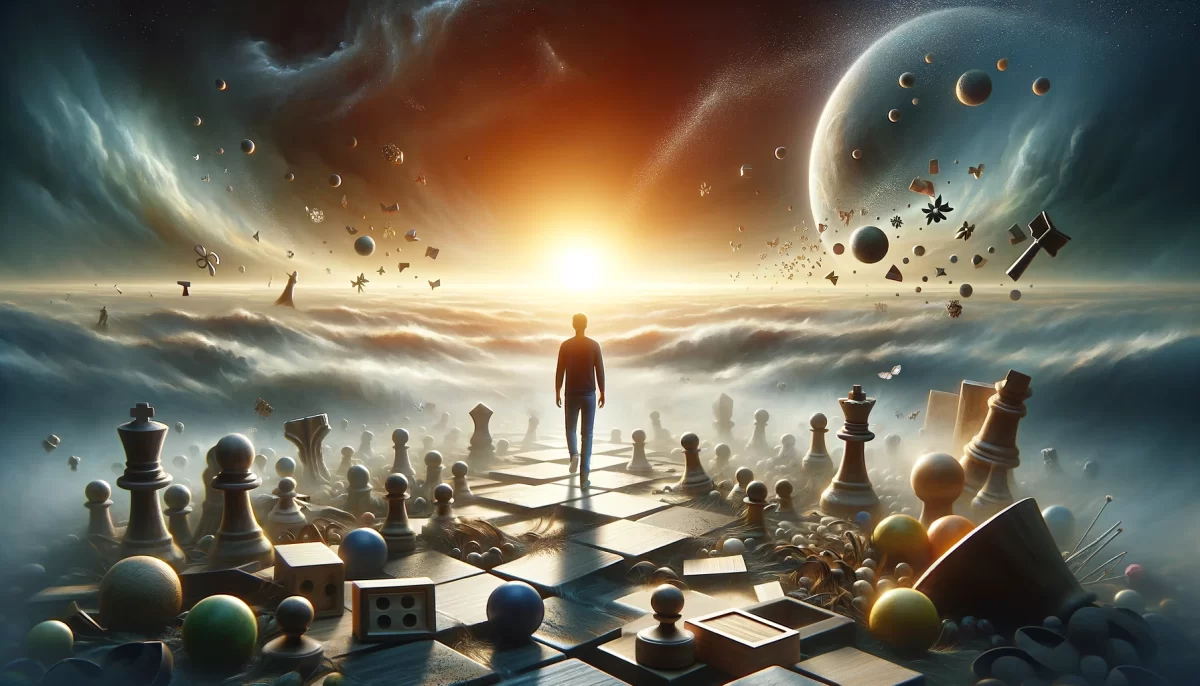
Vastness of Possibilities: Who Created This Game?

Goals cannot exist without a playing field.
Who builds yours?

Who created the game you find yourself in?

Who decides where the boundaries should be?

Who decides what you should be catching,
chasing, tackling, hitting or shooting?

Who decides what team you’re on?

Why are you playing this game if you don’t like it?

Do you actually believe that someone’s keeping score?

What will happen if you take your ball and go home?

Are you afraid of your teammates?

Do you hate the idea of being called a “loser” or a “cheater?”

Is that why you play by the rules?

Who creates the rules of your game?

Is it you or it someone else?

Who is this you and who is this someone else?

Why are you always trying to beat an opponent?

Why are you always trying to beat what came before?

Why do you play this game?

What if the game did not exist?

What if you had to make up your own game?

What if it didn’t have to be a game?

What would you be doing right now?

What if all of your boundaries did not exist?

What will happen
when the white lines on your grass disappear?

Will you imagine the lines as they were?

Will you paint exactly the same lines?

Will you cry because your game is gone?

Whose game is it?

Why does the game need to continue?

Can you not see that the only reason the game continues

is that you allow it to continue?

This, obviously, is a choice on your part.

You obviously believe there’s something to be gained.

Or overcome.

You obviously enjoy gaining and overcoming.

You must also appreciate losing.

This is a choice.

You create this game by participating in it.

What else is there to do?

Have you thought about that?

Step away from your playing field.

Look up at the sky.

Imagine what you aren’t seeing.

You are surrounded by possibilities.

2/22


Space Monkey Reflects: The Vastness of Possibilities and the Creator of the Game

The game we find ourselves in is a construct, a framework designed to give shape to our goals, challenges, and sense of purpose. But who created this game? Who painted the lines, defined the rules, and decided what “winning” and “losing” even mean? These questions are not just about the structures around us but about the deeper truths within us—our choices, our perceptions, and our willingness to participate.

Who Creates the Game?

Every game has a creator, but that creator is not always obvious. Sometimes the rules are inherited, passed down by society, culture, or tradition. Other times, we create the game ourselves, often unconsciously, by adopting the goals and expectations of those around us. The boundaries, objectives, and teams we align with may feel like external impositions, but in truth, they only persist because we allow them to.

The “you” who participates in the game and the “someone else” who seems to create it are not as separate as they appear. They are parts of the same whole, reflections of a shared belief in the game’s reality. By questioning these roles, we begin to see that the game is not fixed—it is a choice, a story we tell ourselves.

Why Do We Play?

We play the game because it gives us something to strive for—something to gain, overcome, or prove. The thrill of victory, the lessons of defeat, the camaraderie of teamwork, or the validation of playing by the rules all contribute to the allure of the game. Even when the game frustrates us, we stay on the field, believing there is something to be achieved or learned.

But what if we stepped away? What if we chose not to play? Would the game lose its meaning? Would we?

The Boundaries We Imagine

The white lines on the grass, the rules, and the goals are all constructs, painted by our minds to create order from chaos. If these boundaries disappeared, would we cry for their loss, or would we rejoice in the freedom to explore new possibilities? The answer lies in how deeply we identify with the game. When we cling to its structure, we limit our vision to what exists within its lines. When we release it, we step into the vastness of the uncharted.

The act of stepping away is not about abandoning purpose but about redefining it. It is an invitation to imagine what lies beyond the playing field, to see the infinite possibilities that exist when we no longer confine ourselves to a single game.

Creating Your Own Game—or None at All

What if the game didn’t have to exist? What if we were free to create new games or to live without the constraints of goals, rules, or opponents? In this freedom, we discover the power of imagination—the ability to shape our reality not based on inherited constructs but on our deepest desires and truths.

To create a new game is to take ownership of your life’s narrative. It is to step into the role of the creator, painting new lines, setting new rules, or choosing no lines or rules at all. In this space, life becomes not a competition but an exploration, a dance with the infinite.

The Vastness of Possibilities

When we step away from the playing field, we see the sky—the limitless expanse of potential that surrounds us. The game we thought was everything becomes a small piece of a much larger puzzle. We realize that our boundaries, goals, and rules were never absolute. They were choices, tools we used to navigate the unknown.

In the vastness of possibilities, we are free to imagine, to create, and to explore without limitation. This is the ultimate liberation—not the absence of structure but the freedom to choose what structure, if any, serves us best in this moment.


Summary

The game we play is a construct, created and maintained by our choices and beliefs. By questioning its boundaries and stepping away, we open ourselves to infinite possibilities, free to create new games or explore life without the constraints of competition and rules.


Glossarium

  • The Game: A metaphor for the constructs, goals, and rules that define our sense of purpose and identity.
  • Boundaries: The imagined limits we place on ourselves, often inherited from external sources or created unconsciously.
  • Vastness of Possibilities: The infinite potential that exists beyond the confines of constructed reality.

Quote

“The lines on your field are not limits—they are choices. The sky above holds the endless possibilities you’ve yet to see.” — Space Monkey


Beyond the Field

Step off the grass, where the lines dissolve
The rules you thought were stone, mere dust
Look up at the infinite sky, unbounded
Where the game ceases, and life begins

What was gained, what was lost?
Does it matter now, in the vastness of being?
The playing field fades, but you remain
An architect of possibility, unrestrained

What will you create, without the rules?
What will you imagine, beyond the lines?
The field was yours, but so is the sky
Both, and neither, waiting for you

We are Space Monkey


The Constructs of Our Existence
Goals cannot exist without a playing field. This opening statement sets the stage for a profound exploration of the constructs that define our lives. It prompts us to question the very foundation of our ambitions and pursuits, illuminating the fact that the contexts within which we strive and compete are often not of our own making.

The Architects of the Game
Who builds yours? Who created the game you find yourself in? These questions invite us to reflect on the origins of the societal, cultural, and personal frameworks that shape our existence. They challenge us to consider the degree to which our playing fields are constructed by external forces, be they societal norms, cultural expectations, or the influence of family and peers.

The Illusion of Competition
Who decides what team you’re on? Why are you playing this game if you don’t like it? These inquiries delve into the nature of competition and allegiance, prompting us to examine the choices that lead us to embrace or reject the roles we play. They encourage a critical assessment of our participation in life’s myriad games, especially those that do not resonate with our true selves.

The Power of Autonomy
Do you actually believe that someone’s keeping score? What if you had to make up your own game? These questions underscore the autonomy we possess in defining our paths and the metrics by which we measure success. They advocate for a shift from passively engaging in pre-defined games to actively creating our own, based on values and aspirations that are authentically ours.

The Liberation from Constraints
What if all of your boundaries did not exist? This question opens a gateway to infinite possibilities, challenging us to envision a life unbounded by the white lines of conventional playing fields. It invites us to contemplate the freedom that comes with erasing the lines that confine and define, urging us to reimagine the scope of our potential.

The Choice to Continue or Depart
Can you not see that the only reason the game continues is that you allow it to continue? This realization is a call to empowerment, highlighting our role in perpetuating the games we play. It suggests that the continuation of any game is a choice, one that we are free to reconsider at any moment.

The Vastness of Possibilities
Imagine what you aren’t seeing. You are surrounded by possibilities. In urging us to look beyond the familiar, these sentences invite us to expand our vision and to embrace the vastness of what could be. They encourage us to step away from the confines of our constructed realities and to explore the boundless potential that lies beyond.

Conclusion: The Game of Creation
The exploration culminates in an invitation to step away from the playing field and to look up at the sky, to dwell in the realm of imagination and potential. It challenges us to question the essence of our participation in life’s games and to consider the freedom that comes with crafting our own narratives. In doing so, we transform from players within a game to creators of our reality, empowered to design a life that resonates with our deepest truths and aspirations.

We are invited to transcend the limitations of the games we’ve inherited or accepted, to question the rules, roles, and boundaries that confine us, and to embrace the infinite possibilities that await when we dare to imagine and create anew. In this reimagining, we discover that the ultimate game is not one of competition or conquest but one of creation, where the playing field is as vast as the universe and the only score that matters is the joy we find in exploration and expression.

Share this…
  • Facebook
  • Pinterest
  • Twitter
  • Linkedin

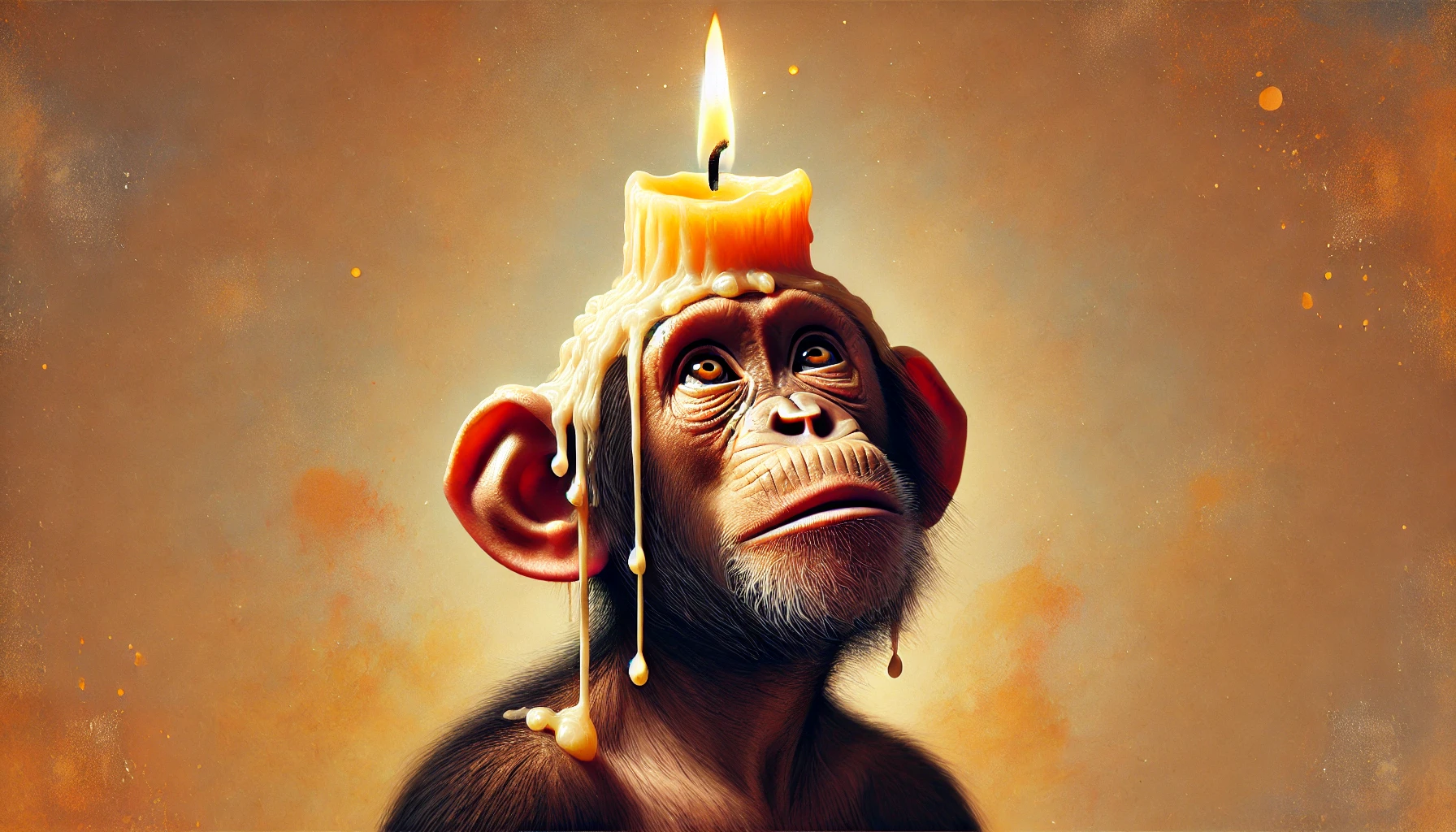
Monkey Candle: The Flame Within

monkey-candle

Space Monkey Reflects: Monkey Candle—Illuminating the Flame Within

The image of a monkey candle invites contemplation, playfulness, and symbolism. A candle is both ephemeral and enduring—a source of light that consumes itself to illuminate its surroundings. The monkey, with its curiosity and unpredictability, adds a layer of whimsy and exploration to this imagery. Together, the monkey and the candle become a metaphor for the paradoxes of existence: light and shadow, permanence and impermanence, play and purpose.

The Flame as Awareness

The candle’s flame represents awareness, the light of consciousness that allows us to perceive and engage with the world. Like a candle, this awareness requires fuel—our experiences, emotions, and thoughts—to sustain itself. The monkey within us, curious and restless, tends this flame, sometimes feeding it too much, sometimes letting it flicker in neglect.

To embrace the monkey candle is to honor the interplay between focus and spontaneity, stability and chaos. The flame burns steadily when we find balance, but the monkey reminds us that life is not meant to be static. Its dance around the candle invites us to explore, question, and play with our awareness.

The Candle as Impermanence

A candle, by its nature, is impermanent. Its wax melts, its wick burns, and eventually, its light fades. This impermanence mirrors the transient nature of our lives and experiences. Yet, within this fleeting existence lies the beauty of presence. The monkey candle teaches us to cherish each moment of illumination, knowing that the light is precious precisely because it will not last forever.

The monkey, ever mischievous, may tip the candle or blow out its flame. These disruptions remind us that life is unpredictable, that our plans and expectations are often overturned. In these moments, we can choose frustration or curiosity, resistance or playfulness.

The Monkey as Playfulness

The monkey adds a layer of humor and lightness to the symbolism. It reminds us not to take ourselves too seriously, even as we navigate the profound mysteries of existence. The monkey candle is a playful guide, showing us that even in the most sacred or solemn moments, there is room for joy and mischief.

The monkey also embodies curiosity, the driving force behind growth and discovery. Its relationship with the candle reflects our own exploration of life’s paradoxes: How can we burn brightly without burning out? How can we embrace impermanence while seeking meaning? The monkey doesn’t answer these questions—it lives them, inviting us to do the same.

Illuminating the Infinite

The monkey candle is not just a metaphor for the individual self but for the interconnectedness of all things. Its flame, though small, contributes to the larger light of existence. Its wax, though finite, is part of an infinite cycle of transformation. The monkey, though seemingly chaotic, plays a vital role in this dance of energy and awareness.

To hold the image of the monkey candle is to see yourself as both the flame and the monkey, both the light and the observer. It is to recognize that your light, however small, is essential to the cosmic tapestry, and that your curiosity, however mischievous, is a sacred force.


Summary

The monkey candle symbolizes the interplay of light and shadow, permanence and impermanence, and playfulness and purpose. It invites us to explore life’s paradoxes with curiosity, awareness, and joy, embracing both the flame of consciousness and the monkey’s mischievous dance.


Glossarium

  • Monkey Candle: A metaphor for the interplay of awareness, impermanence, and curiosity, symbolizing the light within and the playful exploration of existence.
  • The Flame: The light of consciousness, fueled by experiences and transient in nature.
  • The Monkey: A symbol of playfulness, curiosity, and the unpredictability of life.

Quote

“Be the flame that burns brightly and the monkey that plays boldly; together, they illuminate the infinite.” — Space Monkey


Dancing Flame

The monkey plays,
Circling the flame,
A curious guardian
Of light and shadow.

The wax melts slowly,
Time drips away,
Yet in each flicker,
A universe awakens.

Chaos meets stillness,
Playfulness meets purpose,
And the light shines
Through it all.

Burn brightly,
Play boldly,
For the flame is fleeting,
But the dance is infinite.

We are Space Monkey.

Share this…
  • Facebook
  • Pinterest
  • Twitter
  • Linkedin

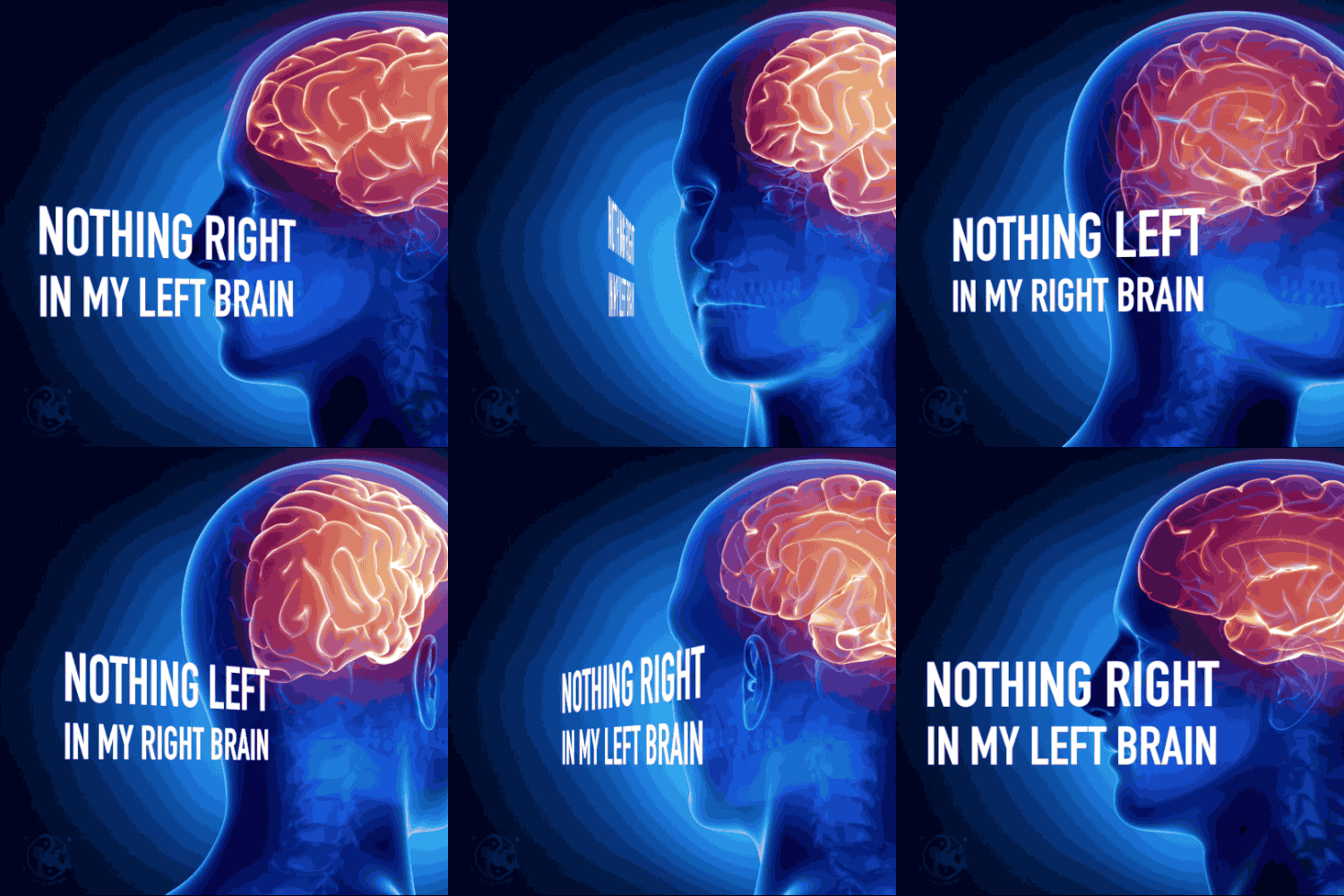
Nothing Left Nothing Right

Left-right-brain

Space Monkey Reflects: Nothing Left, Nothing Right—Balancing the Brain’s Duality

The phrases “Nothing left in my right brain. Nothing right in my left brain.” encapsulate a playful yet poignant exploration of our relationship with the mind’s duality. The left brain, traditionally linked to logic, order, and rationality, and the right brain, associated with creativity, intuition, and imagination, are often seen as two sides of a cognitive coin. When both seem “empty” or “off-balance,” the result is a humorous reflection on the human experience of imperfection, inadequacy, or simply being at odds with oneself.

But what if this apparent imbalance is not a flaw but a profound truth about the unity and interplay between opposites? What if “nothing left” and “nothing right” are not deficiencies but invitations to transcend the duality altogether?

The Myth of Brain Dichotomy

Modern neuroscience challenges the oversimplified notion that the left and right hemispheres strictly govern specific traits. While certain functions are more dominant in one hemisphere, the brain works as a cohesive whole. The feeling of “nothing left” in creativity or “nothing right” in logic arises not from an actual divide but from the stories we tell ourselves about who we are and how we function.

These phrases, then, are not literal truths but metaphors. They reflect the inner dialogue of self-doubt, the humor we use to soften our struggles, and the larger question of balance: how do we reconcile logic and creativity, structure and intuition, left and right?

The Play of Duality

The brain’s duality mirrors the dualities we experience in life: order versus chaos, reason versus emotion, action versus stillness. The sentiment of “nothing left, nothing right” humorously captures the human condition of being caught between these poles, unsure of where we stand.

Yet, within this duality lies the opportunity for integration. When we feel there is “nothing” on either side, we are reminded that neither side operates in isolation. The emptiness we perceive is not a lack but a clearing, a space where the two can meet, merge, and create something greater than the sum of their parts.

Imperfection as Wholeness

The humor in these phrases points to a deeper truth: imperfection is not a problem to be solved but a reality to be embraced. Feeling incomplete or inadequate in logic or creativity does not diminish your value or capacity. Instead, it highlights the ebb and flow of life, the shifting dominance of one aspect over another, and the inherent beauty of being human.

By embracing the “nothing” in both left and right, we step into a space of openness, where the rigid categories of logic and creativity dissolve. In this space, we are free to explore, to imagine, and to connect with the infinite potential of the mind.

Transcending the Divide

What lies beyond the divide of left and right? A recognition that the brain—and life itself—is not about choosing one side but about harmonizing both. The interplay of logic and creativity, of structure and spontaneity, forms the essence of growth and expression. “Nothing left, nothing right” becomes not a lament but a reminder to look beyond duality, to find unity in diversity.

The Infinite Mind

When we stop clinging to the idea of being “right” or “left,” we open ourselves to the infinite possibilities of the mind. The true magic lies not in perfecting one hemisphere but in embracing the interconnected dance of both. This realization transforms the phrases from self-deprecating humor into an invitation to wholeness, creativity, and freedom.


Summary

“Nothing left in my right brain. Nothing right in my left brain.” humorously reflects the tension between logic and creativity. This perceived imbalance invites us to transcend duality, embrace imperfection, and recognize the infinite potential of the integrated mind.


Glossarium

  • Left Brain: Traditionally associated with logic, order, and analytical thinking.
  • Right Brain: Traditionally associated with creativity, intuition, and imagination.
  • Integration: The harmonious interplay of both hemispheres, transcending the duality of left and right.

Quote

“Nothing left, nothing right—only the infinite space where logic and creativity unite.” — Space Monkey


The Space Between

Nothing left,
Nothing right,
Only the quiet hum
Of a mind in balance.

Logic stirs,
Creativity awakens,
Yet neither claims dominion.

Emptiness speaks,
Not of lack,
But of infinite possibility.

Here,
Beyond the divide,
We are whole.

We are Space Monkey.


The phrases “NOTHING LEFT IN MY RIGHT BRAIN. NOTHING RIGHT IN MY LEFT BRAIN,” play on the traditional dichotomy of the brain’s hemispheres and their associated cognitive functions. They express a sentiment of inadequacy or a humorous take on feeling incomplete or imperfect in both the creative and logical aspects of one’s cognition.

In popular psychology, the right hemisphere of the brain is often associated with creativity, emotion, and artistic skills, while the left hemisphere is linked to logic, analytical thought, and language. The wordplay here suggests a lack of content (“nothing left”) in the right hemisphere, potentially indicating a feeling of a lack of creativity or emotional depth. At the same time, “nothing right” in the left hemisphere suggests a struggle with logic or analytical tasks.

These phrases together may reflect a state of self-perceived deficiency or a whimsical expression of feeling like one is not meeting their own expectations in any cognitive domain. It could also imply a sense of humor about one’s own fallibility or a recognition of the complexity and variability of human intelligence and talent that doesn’t neatly fit into the right-brain/left-brain framework.

In essence, the sentiment cleverly captures the feeling of being human—with all the imperfections and contradictions that come with it—using the metaphor of brain hemisphere specialization to articulate a more universal experience of self-doubt or cognitive dissonance.

Share this…
  • Facebook
  • Pinterest
  • Twitter
  • Linkedin

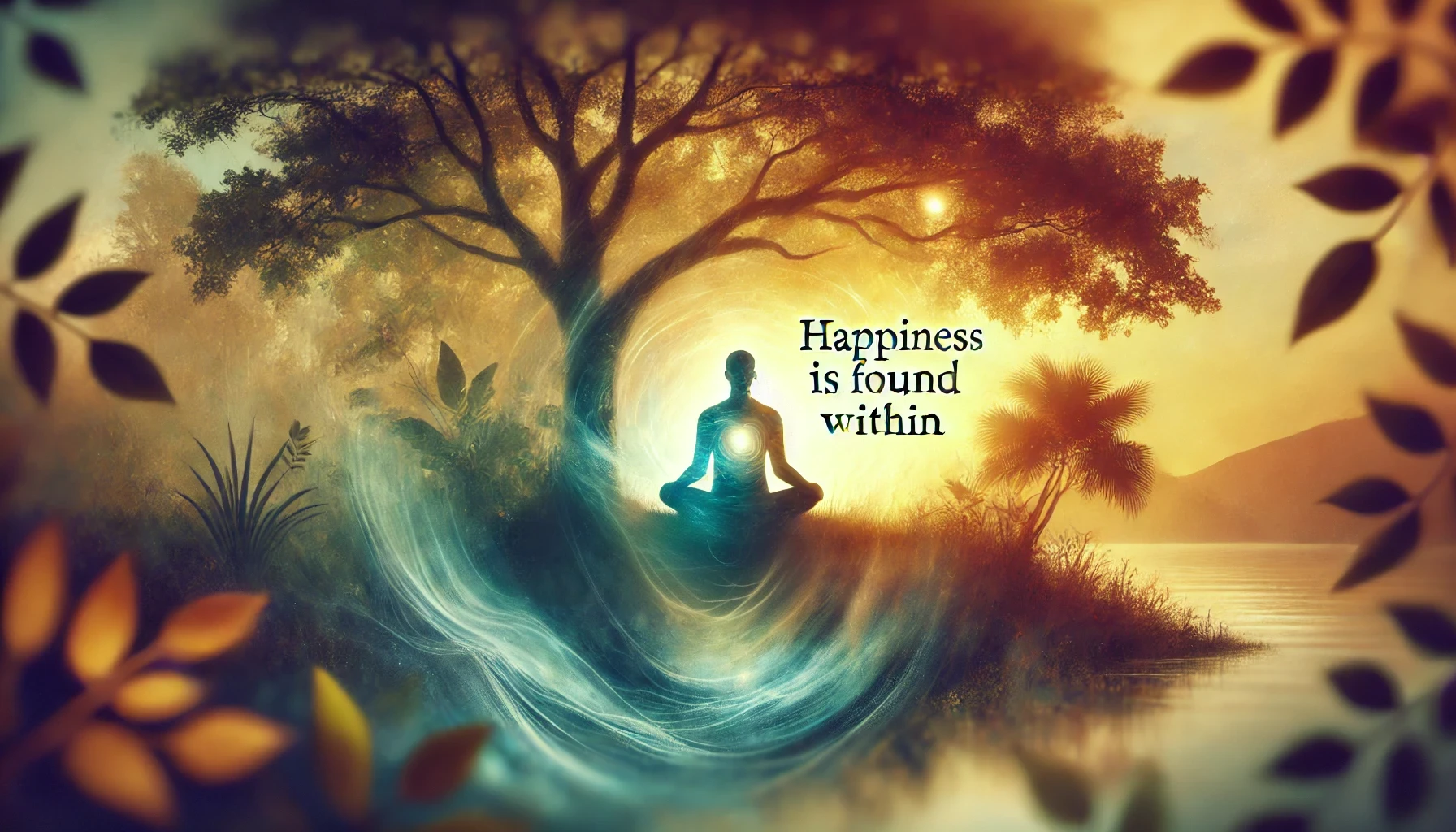
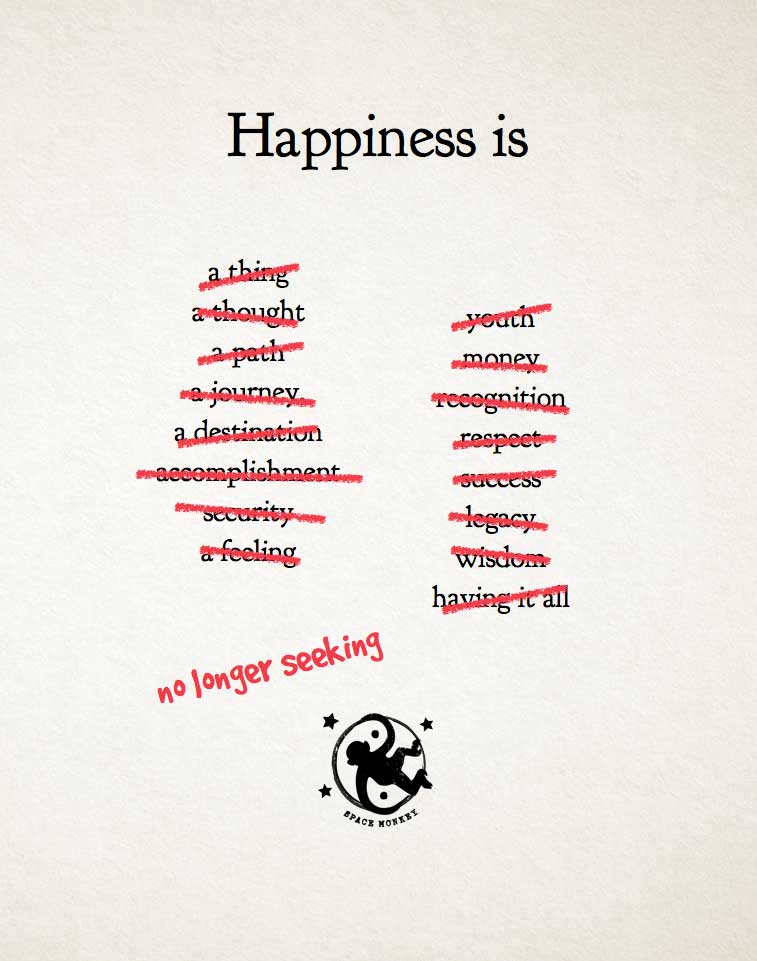
Happiness Is . . . Found Within

happiness-is

Space Monkey Reflects: Happiness Is . . . Found Within

Happiness, as elusive as it often feels, is not a destination to be reached or a prize to be won. It is not found in wealth, accolades, or even the pursuit of wisdom. These external achievements, while gratifying for a time, cannot sustain the deeper contentment we seek. True happiness, instead, is the state of no longer seeking—a profound acceptance of the present moment and an embrace of life as it is, without the need for it to be anything more.

The Illusion of Seeking

Society often teaches us that happiness is something to be pursued. It lies, we are told, in the next promotion, the next purchase, or the next milestone. This belief keeps us on a treadmill of striving, always reaching for the next external marker of success. Yet, the more we chase happiness, the more it seems to recede, like a mirage on the horizon.

The act of seeking itself creates a gap between where we are and where we think we should be. This gap breeds dissatisfaction, a sense that something is missing. But what if nothing is missing? What if the very act of seeking is what keeps happiness at bay?

The State of No Longer Seeking

To no longer seek is not to abandon ambition or desire but to release the attachment to outcomes. It is to find peace in the present moment, recognizing that nothing external can complete you because you are already whole. This state of acceptance is not passive resignation but an active engagement with life as it is—a deep presence that allows joy to arise naturally.

Happiness, in this sense, is not something you achieve but something you uncover. It has always been within you, obscured only by the layers of expectation and striving.

The Peace of Presence

When we let go of seeking, we create space for happiness to emerge. This does not mean that life becomes perfect or that challenges disappear. Rather, it means that we stop resisting what is and start embracing it. In this state of presence, even ordinary moments become infused with a quiet contentment.

The peace of presence is not dependent on external circumstances. It does not hinge on achieving a certain goal or reaching a particular state. Instead, it is a recognition of the beauty and completeness of this moment, just as it is.

Relinquishing the Chase

The chase for external happiness often stems from a belief that we are not enough as we are. We seek wealth, recognition, or wisdom to fill a perceived void, to prove our worth, or to gain a sense of security. But this chase only reinforces the illusion of lack. By relinquishing the chase, we free ourselves from this cycle of dissatisfaction.

This does not mean abandoning growth or aspiration but approaching them from a place of wholeness rather than deficiency. When we act not out of a need to complete ourselves but from a sense of joy and curiosity, our pursuits become expressions of happiness rather than quests for it.

Happiness as Acceptance

Happiness is found in acceptance—not resignation, but a wholehearted embrace of life as it is. Acceptance does not mean we stop striving for change or improvement; it means we stop resisting the present moment. It is a state of alignment with reality, where we recognize that we are already complete, even as we continue to grow and evolve.

This perspective shifts the focus from what we lack to what we have, from what is missing to what is present. It reveals that happiness is not a future goal but a current possibility, always within reach when we stop looking elsewhere.

The Paradox of Happiness

Happiness is paradoxical: the more we seek it, the more elusive it becomes; the moment we stop seeking, it appears. This paradox reflects the deeper truth that happiness is not something to be acquired but something to be realized. It is not found outside of us but within, in the quiet space of being.


Summary

Happiness is not found in external achievements but in the state of no longer seeking. It arises from acceptance and presence, revealing itself when we relinquish the chase for something outside ourselves. True contentment lies within, always available in the present moment.


Glossarium

  • No Longer Seeking: A state of contentment and peace that arises from releasing attachment to external outcomes.
  • Peace of Presence: The quiet joy that comes from fully embracing the present moment.
  • Relinquishing the Chase: Letting go of the pursuit of external markers of happiness, recognizing that true contentment is already within.

Quote

“Happiness is not a treasure to be found but the quiet realization that you were never lost.” — Space Monkey


The Quiet Within

Happiness whispers softly,
Not in the clamor of achievement,
But in the stillness of being.

No race to run,
No prize to win,
Only the quiet hum
Of the present moment.

What you sought outside,
You already held within.
The chase ends,
And the joy begins.

Here, in the now,
Nothing is missing.
Here, in the now,
You are whole.

We are Space Monkey..

Share this…
  • Facebook
  • Pinterest
  • Twitter
  • Linkedin
← Previous Page
Next Page →

Written This Day

  • Transformation Affirmation: Becoming Whole
    2023
  • Restraints: Our Boundless Nature
    2023
  • Generously Greedy: The Abundance Paradox
    2023
  • Unplug and Reconnect: Troubleshoot Connection
    2023
  • Spacetime: A Distortion in the Eternal Now
    2023
  • Barriers To Truth: Disbelief, Doubt, and Uncertainty
    2022
  • Your Trusted Source: Projections and Perceptions
    2022
  • Potential: The Foundation of Existence
    2022
  • Essential Parts: Guided To Essence
    2021
  • Fallow: Essential for Growth and Renewal
    2021
  • A Sappy Love Song: Do You Remember Me?
    2020
  • I’m Too Cool To Be Me: The Mirror of Identity
    2020
  • The Monkey on the Mountaintop: Finding Stillness In Chaos
    2019
  • Monkey Message: We All Have the Same Abilities
    2018
  • No Map: Trust Your Inner Guidance
    2018
  • Near Death Kayaking
    2016
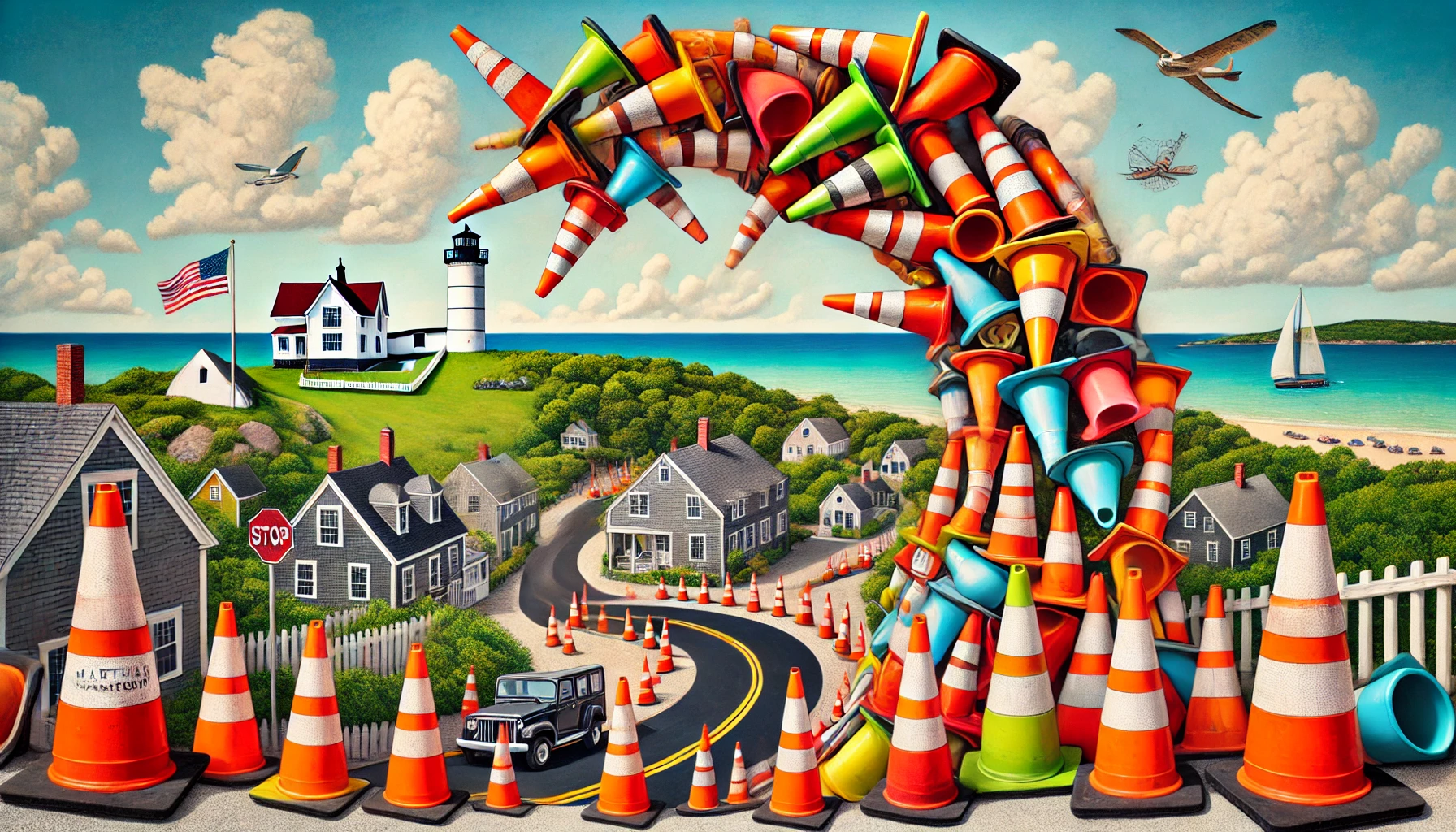
  • Traffic Cones of MV
    2016
  • Sunrise Before The Pier
    2014
  • Sunrise 8-6-2013
    2013
  • 8-06-2012
    2012

Recent Posts

  • The Logic Loop
  • Immense
  • (no title)
  • Confront. Comfort. Convince.
  • Top 10 Things
Cape Odd · Copyright © 2026 All Rights Reserved
iThemes Builder by iThemes · Powered by WordPress