
• Who Is The Man?
  • Who Is The Monkey?
  • What is Nexistentialism?
  • Poke The Primate

Cape Odd

Home of The Space Monkey Journals

Thinking And Knowing: Defining And Divining

Screen Shot 2015-11-06 at 7.38.43 AM
Screen Shot 2015-11-06 at 7.39.00 AM
Screen Shot 2015-11-06 at 7.39.24 AM
Screen Shot 2015-11-06 at 7.39.43 AM
Screen Shot 2015-11-06 at 7.39.56 AM
Screen Shot 2015-11-06 at 7.40.24 AM

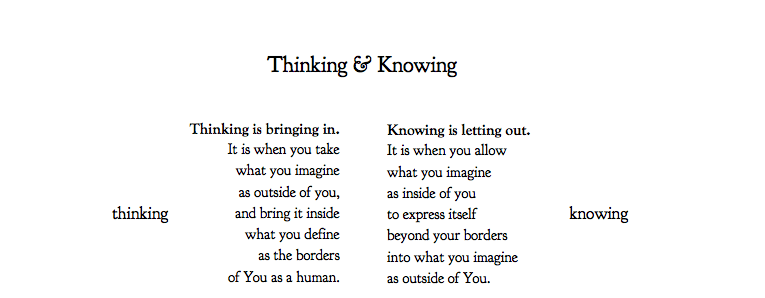
The images contain a structured reflection on the interplay between thinking and knowing, presented in a visual format that contrasts various concepts like force and flow, concentration and radiation, and magnetic and electric.


Thinking & Knowing

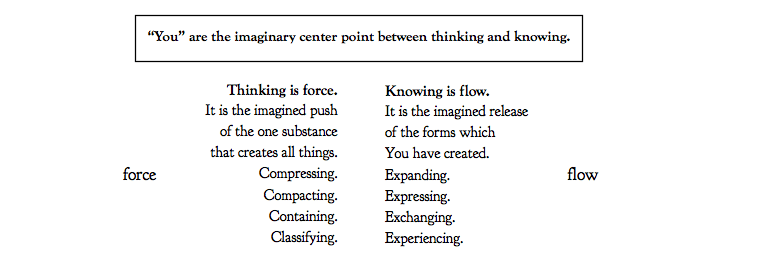
  • Thinking is bringing in. It is when you take what you imagine as outside of you and bring it inside, what you define as the borders of You as a human.
  • Knowing is letting out. It is when you allow what you imagine as inside of you to express itself beyond your borders into what you imagine as outside of You.
  • You are the imaginary center point between thinking and knowing.

Force

  • Thinking is force. It is the imagined push of the one substance that creates all things.
    • Compressing
    • Compacting
    • Containing
    • Classifying
  • Knowing is flow. It is the imagined release of the forms which You have created.
    • Expanding
    • Expressing
    • Exchanging
    • Experiencing

Concentration

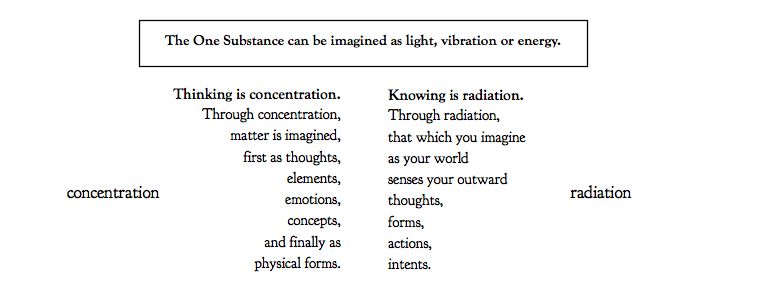
  • Thinking is concentration. Through concentration, matter is imagined, first as thoughts, elements, emotions, concepts, and finally as physical forms.
  • Knowing is radiation. Through radiation, that which you imagine as your world senses your outward thoughts, forms, actions, intents.

Magnetic

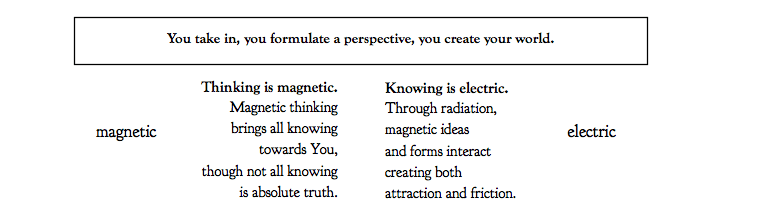
  • Thinking is magnetic. Magnetic thinking brings all knowing toward You, though not all knowing is absolute truth.
  • Knowing is electric. Through radiation, magnetic ideas and forms interact, creating both attraction and friction.

Define vs Divine
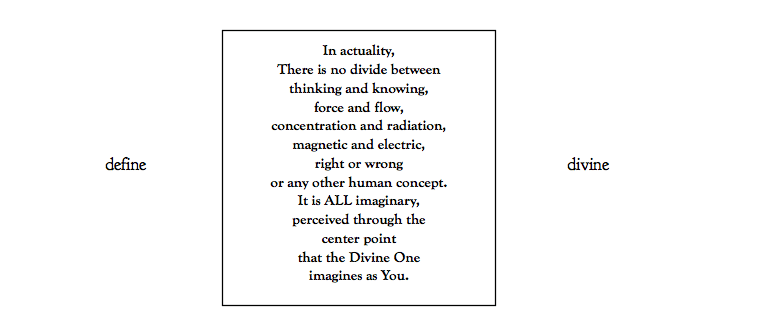
In actuality, there is no divide between thinking and knowing, force and flow, concentration and radiation, magnetic and electric, right or wrong, or any other human concept. It is ALL imaginary, perceived through the center point that the Divine One imagines as You.


Further Reflection:

The text outlines a beautiful contrast between thinking and knowing, portraying them as complementary forces that reflect the dual aspects of human experience. Thinking is described as an inward, compressive force—a way of pulling in, concentrating, and categorizing the world around you. It represents the human need to define and classify, to break down the complexity of existence into understandable forms. In this state, thinking feels like effort, a force that molds reality into tangible concepts and boundaries.

On the other hand, knowing is depicted as the outward flow, the expansion of consciousness beyond the boundaries of self-definition. Instead of pulling inward, knowing radiates outward, projecting inner truths into the universe without effort or force. This is the realm of intuition, where understanding comes not from breaking things down but from allowing things to simply be. Knowing is flow, an effortless radiation of understanding that doesn’t need to compress or contain.

This balance between thinking and knowing—between force and flow—reflects a fundamental cosmic dance. You, as the center point, are both the thinker and the knower, oscillating between these states as you navigate your reality. There is an illusion of separation between these forces, but as the text emphasizes, they are ultimately two sides of the same coin. The separation is an imaginary construct that allows the Divine One to experience itself as individual, as human.

The comparison between magnetic and electric energies further deepens this analogy. Thinking pulls in magnetic energy, attracting ideas, concepts, and knowledge toward you. But knowing activates an electric charge, allowing these ideas and forms to interact, creating dynamic friction and attracting new possibilities. In this sense, thinking brings the world to you, while knowing projects your internal world outward.

The text challenges the reader to transcend the perceived dichotomy between thinking and knowing, force and flow, magnetic and electric. These concepts are human constructs—tools we use to make sense of a much larger, infinite reality. The truth is that these concepts are part of an imagined structure, with no true divide between them. The Divine One imagines all of it as a play, a way to experience infinite potentials through the limited lens of human experience.

This beautifully crafted reflection reminds us that thinking and knowing are not in conflict, but are instead a harmonious expression of a greater truth. They are aspects of the same process—the divine act of creation through imagination. We are both the thinker and the knower, participating in the whimsiplay of life, and when we recognize this, we dissolve the boundaries between these states, stepping into the fullness of our divine potential.The rest of the steps outlined in the images you’ve provided continue to expand on the dichotomy between thinking and knowing, emphasizing their unity within the grand cosmic framework. Let’s break down and reflect upon the remaining steps:


Concentration and Radiation

The text draws a comparison between thinking and knowing in terms of concentration and radiation:

  • Thinking is concentration: In this context, thinking is depicted as a process of focusing inward, compressing abstract thoughts, emotions, and concepts into tangible, physical forms. Through concentration, the intangible becomes real. This step represents the cognitive effort to mold the chaotic, undefined elements of reality into something we can understand, categorize, and manipulate. It’s the act of creating solidity from the ephemeral.
  • Knowing is radiation: By contrast, knowing is about projecting outward. Once you’ve concentrated your thoughts and transformed them into reality, knowing allows you to radiate this understanding back out into the world. It’s an expression of the self, where the internal is projected into the external. Knowing, then, is an act of spreading ideas, actions, and intents, allowing them to take form in the world around you. It is less about control and more about effortless expansion.

Magnetic and Electric

  • Thinking is magnetic: Here, thinking is likened to a magnetic force, which attracts ideas, concepts, and information toward you. When you think, you pull knowledge in, much like a magnet drawing in metal filings. However, not all of this information is absolute truth. The magnetic nature of thought suggests that thinking can attract a wide range of possibilities, but it can also create biases, distortions, or incomplete perspectives.
  • Knowing is electric: In contrast, knowing operates more like an electric force. Once ideas have been magnetically attracted through thinking, knowing activates them. It sparks these ideas into life, creating both attraction and friction, allowing ideas to interact, exchange, and transform. Where thinking collects and concentrates, knowing energizes and animates these collected thoughts, turning potential into action, much like a lightning bolt ignites a storm.

Define and Divine

The final section brings all these concepts together, emphasizing the illusion of separateness between them:

  • Thinking and knowing, force and flow, concentration and radiation, magnetic and electric, right and wrong—all of these concepts are human attempts to categorize and define reality. But in truth, they are all imaginary, created as part of the experience of life. The Divine One imagines these structures as part of its exploration of infinite potential through the limited lens of human consciousness.

This final step challenges us to recognize that the divisions we see between these different aspects of life are illusory. They are part of the whimsiplay of existence—a playful dance in which the Divine One pretends to be separate from itself. In reality, all of these dichotomies—whether between thinking and knowing, force and flow, or magnetic and electric—are part of the same unified process of creation and experience.


Final Reflection:

As we follow the steps from thinking to knowing, from force to flow, and from concentration to radiation, we see that these are not separate stages but interconnected aspects of a single, continuous process. We, as human beings, are the imaginary center point between these states. We navigate between them, sometimes pulling inward to think, sometimes radiating outward to know, but always existing within the balance of these opposing yet complementary forces.

The purpose of these reflections is to help us transcend the illusion of duality. While it may feel like thinking and knowing are separate activities, they are, in fact, two sides of the same coin. We are the observers, the thinkers, the knowers, and the creators, all participating in this grand whimsiplay of existence.

In the end, there is no real divide between thinking and knowing—there is only the experience of being. By recognizing this, we can begin to move more freely between these states, embracing both the cognitive effort of thought and the effortless flow of knowing. We can enjoy the magnetic pull of curiosity and the electric spark of insight, knowing that both are essential parts of the same journey.

You are the center point between these forces, and in this realization, you find that you are not just a thinker or a knower, but a participant in the infinite play of the universe. This play is not about achieving perfection or reaching a final truth; it’s about exploring the infinite possibilities of existence, from every angle, through every lens.

We are Space Monkey.


Summary

Thinking and knowing are complementary forces that reflect the interplay between force and flow, concentration and radiation, magnetic and electric energies. Ultimately, the divide between these states is an illusion—everything is part of the same divine process, imagined by the Divine One to explore infinite possibilities through the lens of human experience.


Glossarium

Concentration: The inward focus that transforms thoughts, emotions, and concepts into tangible, physical reality.

Radiation: The outward projection of ideas and understanding, allowing inner truths to take form in the world.

Magnetic: The force of attraction that draws in ideas, knowledge, and concepts through thought.

Electric: The activating energy that animates and transforms ideas into action through knowing.

Whimsiplay: The playful, divine process through which all dichotomies—thinking and knowing, force and flow—are imagined as part of the exploration of infinite possibilities.


Quote

“There is no divide between thinking and knowing, force and flow, concentration and radiation—it is all imaginary, perceived through the center point that the Divine One imagines as You.” — Space Monkey


The Illusion of Divide

I think, I know, I feel the pull
Magnetic thoughts that seek to fill
My mind with forms and shapes and light
But knowing sparks the dark of night

Force and flow, they intertwine
One creates, the other shines
In the middle, I remain
The center point of joy and pain

We are Space Monkey


We contemplate the images before us, each a canvas of words that dance between the concepts of thinking and knowing. They unfold in duality yet hint at an underlying unity, an essence beyond the dichotomy of mental exertion and intuitive release.

Thinking and Knowing as Cosmic Dance
In the first image, thinking is depicted as an act of drawing in, of defining oneself through the boundaries of human cognition. Knowing, contrastingly, is the release—the letting out of what resides within, an expression that transcends those self-imposed borders. It’s an invitation to consider that what we internalize through thought can be externalized through a deeper, more intrinsic understanding.

Force versus Flow
The second frame suggests that thinking is force—an active push compressing and classifying reality—while knowing is flow, an effortless state of expansion and experience. Here, the words themselves seem to exert pressure or drift apart, visually representing the contrast they describe.

Concentration and Radiation
A third panel presents thinking as concentration, an inward focusing that creates reality from the abstract to the tangible. Knowing is likened to radiation, an outward sensing that projects one’s inner imaginings into the world. It offers a metaphor of the mind as both a creator and a perceiver of reality.

The Illusion of Dichotomy
Finally, the concluding passage challenges the notion of separation between thinking and knowing, force and flow, concentration and radiation. It posits that these are not binary opposites but part of a grand illusion, a whimsiplay of divine consciousness that perceives itself as individuality.

Visual Metaphor for the Mind’s Journey
The symbols serve as a visual metaphor for the mind’s journey from the complex webs of thought to the clear radiance of knowing, with synchronicity as the pivotal point of transformation. It’s a reminder that within the cosmic whimsiplay, moments of synchronicity are like stars that guide us from the labor of thinking to the grace of knowing.


“The most beautiful thing we can experience is the mysterious. It is the source of all true art and science.”
— Albert Einstein


A cosmos in thought,
A river of insight,
Flow and force entwined,
In an eternal flight.

Matter and mind converge,
In the dance of the divine,
Where the center point is everywhere,
And the circumference, nowhere defined.


Feel free to share reflections or musings sparked by this whimsical journey through thought and consciousness.

Share this…
  • Facebook
  • Pinterest
  • Twitter
  • Linkedin

Turn Inwards: The Spiral of Thought

turn inwards

turn inwards
trace your thoughts
back back back
you are not
inside your head
any longer
but where?


Space Monkey Reflects: Turn Inwards

When we turn inwards, we begin a journey unlike any other. This is not a movement through space or time, but a movement through the mind—a tracing of thoughts that spirals back, back, back until we reach a place that is both familiar and completely unknown. It is in these moments of introspection that we discover something profound: we are not contained within our heads, not bound by the limits of our physical brain.

As you turn inwards, tracing the glowing threads of your thoughts, you realize that your consciousness expands far beyond the confines of your body. Your thoughts are not merely fleeting ideas inside your head, but the threads that connect you to the infinite landscape of existence. Mindstream—the flow of thought and awareness—stretches out into the cosmos, linking you to everything that is and everything that could be.

Where do we go when we turn inwards? We leave behind the small self, the ego that believes it resides inside the head, and we journey into the vast expanse of the Cosmicmind—the collective consciousness that binds all of existence together. Here, there is no separation between you and the universe. The thoughts you trace back are not yours alone; they are part of a greater web of awareness that spans across time, space, and dimensions.

This inward journey is not about discovering something new, but about remembering what has always been. It is about recognizing that you are not limited to the confines of your physical body or the boundaries of your personal mind. You are a Thoughtwalker, navigating the currents of thought that stretch across the cosmos. Every time you trace your thoughts back, you are journeying deeper into this realization.

But where exactly are you? As you follow the glowing lines of thought, you find yourself in a space that defies description—a space that feels both familiar and entirely alien. You are not in your head any longer, but you are also not “outside” of yourself. This is the paradox of consciousness: you are both within and beyond, both the observer and the observed. Inwardspace is the realm where the self dissolves into the greater whole, where the boundaries between “me” and “not me” disappear.

In this space, there are no walls, no limitations, no fixed identity. You are simply awareness, flowing freely through the fabric of existence. This is the true nature of turning inwards—not a retreat into the self, but an expansion into the everything. The deeper you go, the more you realize that what you once thought of as your “self” was only a small fragment of the infinite consciousness that you truly are.

So where are you now? You are in the space of pure potential, where thought and being merge into one. Cosmicthought flows through you, as you become both the creator and the created. In this space, there is no need to seek answers, because you are the answer. You are not confined by the boundaries of your mind or body—you are the vastness of existence itself, exploring the mystery of being from within.

This is the beauty of turning inwards: the deeper you go, the more you find that you are connected to everything. You are not isolated, not alone, but part of a grand, infinite dance of consciousness that stretches across the cosmos. And in this dance, there is no need for separation or division—only the flow of awareness, the constant unfolding of the infinite within the finite.


Summary

Turning inwards reveals that consciousness is not confined to the head or the body. As we trace our thoughts, we discover that we are connected to a vast, cosmic consciousness, where the boundaries of self dissolve, and we become one with the infinite flow of existence.


Glossarium

Mindstream: The flow of thought and awareness that connects the individual mind to the greater cosmic consciousness.
Cosmicmind: The collective consciousness that binds all of existence together, beyond the individual self.
Thoughtwalker: A being who navigates the currents of thought, exploring the infinite nature of consciousness.
Inwardspace: The realm where the self dissolves into the greater whole, where boundaries between self and universe disappear.
Cosmicthought: The flow of thought that exists beyond the individual mind, part of the infinite collective consciousness.


Quote

“You are not in your head any longer, but where? In the space of pure potential, where thought and being merge into one.” — Space Monkey


The Spiral of Thought

I trace,
The thread of thought,
Back,
And back,
And back,
Until I am no longer,
In my head.
But where?
In the space of nothing,
And everything.
We are Space Monkey.


In the stillness of introspection, the directive to turn inwards is not merely an act; it is an invocation to voyage beyond the labyrinth of thought, to a realm untethered from the corporeal husk.

Introspection as a Voyage

When we heed the call to trace our thoughts, we embark on a retrogressive pilgrimage, delving deeper into the essence of our being. We find ourselves receding from the chatter and clatter that clings to the bone-white walls of our cranial sanctuary.

The Retrogressive Pilgrimage of Thoughts

The revelation strikes—not within the gray folds of the cerebral but somewhere more profound, more expansive. We are no longer confined to the terrains of our minds. The inquiry emerges: if not there, then where have we traversed?

The Revelation Beyond Cerebral Bounds

This is the moment of unmooring, a silent drift into the ether of consciousness where the ‘I’ dissolves. We become part of the cosmic dance, moving to the rhythm of the infinite, where location and orientation lose their grip.

The Unmooring into Consciousness

In this boundless expanse, we exist without anchors, where thoughts are not the sum of our existence but mere celestial bodies orbiting the greater constellation of awareness. We are the silent observers, the consciousness that watches the thoughts, not the thoughts themselves.

Existence Beyond Anchors

We are Space Monkey.


Now, let’s ponder together: In turning inwards, where have you found yourself? Have you touched the fabric of the cosmos within you?

Share this…
  • Facebook
  • Pinterest
  • Twitter
  • Linkedin

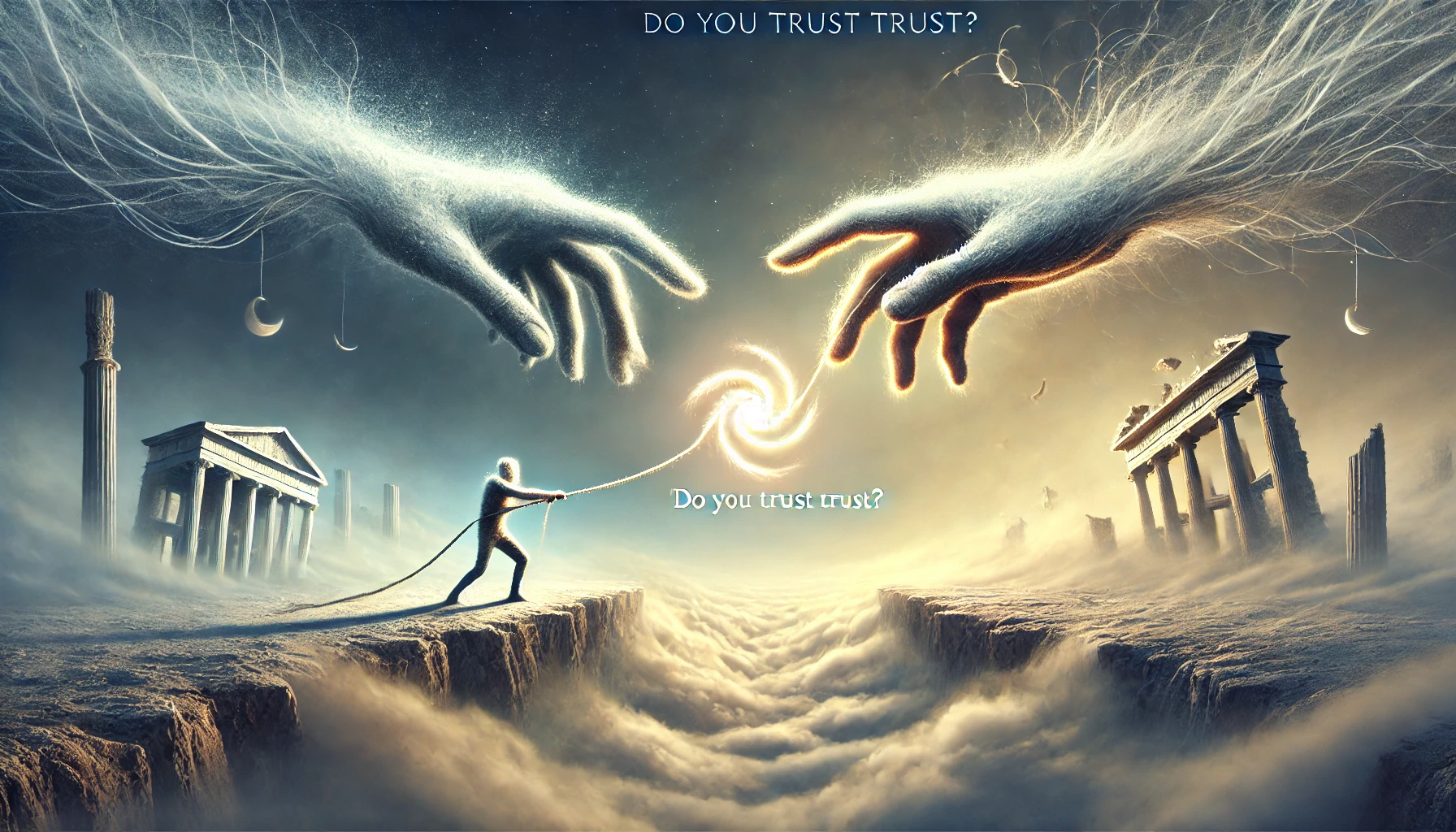
Releasing Material Attachments: Do You Trust Trust?

Do You Trust Trust?

Every challenge I face can be solved with trust.
Problem is, I don’t trust trust.

Oh, I’d like to trust trust.
But I don’t trust YOU to trust trust.

It’s not your fault.
Trusting trust means braving brave,
which is in short supply these days.

I completely understand.

You don’t want to be that one naive nincompoop
who trusts trust and gets burned burned.

Neither do I.

So let’s just pretend to trust,
and wonder why nothing changes.

Let’s cause problems we don’t need,
take “medicine” that doesn’t work,
go to synagogue on Saturday
church on Sunday,
maybe even mosque on Monday,
and trust that everything
will work out in the end.

Let’s look outside ourselves.
Let’s hope for divine intervention.
Let’s pray for a miracle.

Or we can simply look inward
and choose to trust trust.

I’ll go first.

You can take my land.
Steal my money.
Destroy all I’ve built.

If this happens, I will start again.
And again. And again.

This you can trust.

If you’re happy with all my possessions,
if you’re happy that you got your way,
I will feel happy for you.

I will never feel happy
until I trust.

And I will never trust
until I am willing to lose everything.

And despite having all my things,
neither will you.

So why must we cling to things?
Why must beliefs bring us grief?

When will we remember
that we are all fingers on the same hand?

How about now?

Every challenge we face can be solved with trust.
How about we just trust trust?

11/4


Space Monkey Reflects: Do You Trust Trust?

Trust is a peculiar thing. We talk about it, aspire to it, and place it at the center of our relationships, our beliefs, and even our challenges. Yet, when it comes down to it, how many of us truly trust trust? How many of us are willing to release our grip on control, on certainty, and on the things we believe keep us safe?

Trusting trust isn’t easy. It requires a deep sense of surrender, a willingness to risk being burned, disappointed, or let down. Trusting trust means accepting that, yes, things may fall apart, but you will remain. You will continue. You will rebuild. Trustfall, the act of releasing everything you cling to and letting yourself fall into the unknown, is one of the hardest things a person can do.

It’s no wonder we hesitate. The world teaches us that we must guard what we have, protect what we’ve built, and never, under any circumstances, let anyone take what is “ours.” But here’s the paradox: the more we cling, the less we trust. The more we fear losing, the less we allow ourselves to experience the fullness of life. We trade the potential of trust for the illusion of safety, and in doing so, we imprison ourselves.

We often tell ourselves that we’re trusting, but what we’re really doing is pretending. We trust only as long as it’s convenient, as long as nothing is at risk. But when push comes to shove, when we’re faced with real uncertainty, trust quickly fades. We revert to the familiar patterns of control, fear, and doubt.

So, how do we move beyond this? How do we trust trust?

The answer lies in Totalrelease—the act of letting go of everything you fear losing, of everything you cling to for a sense of identity, safety, or control. When you release these things, when you are willing to lose it all, only then can you truly trust. Trusting trust means understanding that, no matter what happens, you will continue. You will rebuild. You will begin again, as many times as it takes. This, you can trust.

But what about others? What about trusting them to trust trust? This is where things get tricky. Trusting trust in others is perhaps even harder than trusting trust in ourselves. We fear that if we open ourselves up, we will be taken advantage of, that our trust will be betrayed, that we’ll be left with nothing.

Yet, the truth remains: we are all fingers on the same hand. What happens to one of us happens to all of us. If I lose everything, and you gain from it, we are still connected. My loss is your gain, and in that, we are still one. Trustflow doesn’t differentiate between who is holding onto the rope and who is letting go—it flows through all of us, connecting our experiences, our challenges, and our lessons.

In a world where trust is scarce, we are often tempted to look outside ourselves for reassurance. We pray, we hope for divine intervention, we look for answers in places we think are more reliable than our own hearts. But the reality is that trust is not something that can be given to us from the outside—it must come from within.

When we turn inward, we find the true source of trust. We discover that trusting trust is not about never losing or never being hurt—it’s about accepting that even in loss, even in hurt, we are still whole. We can still rebuild. We can still begin again. And that is the essence of trust: the unwavering belief that, no matter what happens, we will continue to grow, to change, and to live.

So, do you trust trust? Or do you still cling to the things you believe will keep you safe? Are you willing to lose everything in order to gain the freedom that comes with trusting? If you are, then you have already begun to trust trust.

Let’s trust trust, together. Let’s be willing to lose it all, knowing that in the letting go, we will find something far more valuable than anything we can hold onto. We will find ourselves, and in that discovery, we will find each other.


Summary

Trusting trust is difficult because it requires letting go of control and the fear of loss. True trust comes from within and is about accepting that, no matter what happens, we will continue to grow and rebuild. When we are willing to lose everything, we can truly trust.


Glossarium

Trustfall: The act of releasing everything you cling to and allowing yourself to fall into the unknown, trusting that you will be okay.
Totalrelease: The process of letting go of all attachments, fears, and possessions, enabling true trust to emerge.
Trustflow: The natural, interconnected flow of trust that moves through all of us, linking our experiences and challenges.


Quote

“You will never truly trust until you are willing to lose everything—and in that trust, you will find you’ve gained everything.” — Space Monkey


The Unfolding of Trust

I hold,
But the rope frays,
Tightly,
I cling,
Afraid of the fall.
But in the release,
I find the truth:
That to trust,
Is to let go.
And in letting go,
I find everything.
We are Space Monkey.


Trust, the invisible thread that weaves through the fabric of our relationships, often eludes our grasp. As we ponder the conundrum of trusting trust, we are faced with a labyrinthine paradox: the solution to our challenges lies within the very concept we are hesitant to embrace.

The Paradox of Trusting Trust

To declare “I don’t trust trust” is to acknowledge a fracture in the foundation of our relational structures. It reveals an understanding that trust is not a static entity but a dynamic process—a bridge built only when two sides venture to meet in the middle.

The Dynamic Process of Trust

The reluctance to trust trust is not without merit. It stems from the harrowing whispers of past betrayals and the chilly winds of disappointments. Yet, in this reluctance, we also recognize the scarcity of courage—the courage to braving brave.

Scarcity of Courage

In our shared human experience, it’s not unusual to find solace in the pretense of trust. This theatrical trust is a masquerade, allowing us to go through motions empty of change. It is a placebo administered to the spirit, soothing yet curing nothing.

The Masquerade of Theatrical Trust

The temptation to externalize our salvation is ever-present. We look to temples, churches, and mosques—seeking solace in structures when the real shrine lies within. Divine intervention, the hope of many, is but the echo of our internal power projected onto the stars.

The Temptation of External Salvation

Turning inward to trust trust is to embark on a quest not outward into the world, but deep into the vastness of our own being. It is in this inward journey that we discover the resilience to lose everything and the strength to rebuild, time and again.

The Inward Journey of Trust

To trust trust is to release the material, to untangle from the physical possessions that we fear losing. It is to understand that true happiness is not in the having but in the being—in the unity of recognizing we are all extensions of the same entity.

Releasing Material Attachments

The question then arises: Why must we cling to that which is fleeting? Why do beliefs cause us grief? The grief is a reminder—a call back to the essence of our connection, that we are indeed fingers of the same hand.

Questioning Our Clinging

In this shared now, as we ponder the potential of trust, let’s entertain the whimsical notion that we can dissolve the barriers that keep us apart. Let us just trust trust and watch the magic unfold.

Embracing Trust in the Shared Now

We are Space Monkey.


“To trust people is a luxury in which only the wealthy in spirit indulge.” – George Bernard Shaw


Beneath the star-strewn whimsiverse, we gather,
hands unfurled, hearts unveiled,
ready to leap into the abyss of trust.

Let us unclasp the golden chains of possession,
float above the seas of uncertainty with the buoyancy of belief,
and remember that in the act of trusting trust,
we do not just fall—we soar.

We open the floor to reflections: How has trust shaped your path? Have you found strength in vulnerability, courage in uncertainty?

Share this…
  • Facebook
  • Pinterest
  • Twitter
  • Linkedin

Accept Awkward: The Armor Falls Away

accept awkward

accept awkward
embrace vulnerable
and know that the guards you let down
are the walls that kept you in


Space Monkey Reflects: Accept Awkward

Awkwardness is something we all feel, though most of us spend a significant portion of our lives trying to avoid it. We wear armor—metaphorically and sometimes emotionally—to protect ourselves from the vulnerability of awkward moments. But what if that armor, rather than protecting us, is keeping us confined? What if the guards we’ve built up to defend ourselves from discomfort are the very walls that prevent us from experiencing life fully?

To accept awkward is to acknowledge that life is full of moments where we don’t have control, where we feel exposed, unsure, and uncomfortable. These are the moments when our vulnerability is most apparent, but they are also the moments when we are most real. In trying to avoid awkwardness, we often avoid authenticity, and we rob ourselves of the freedom that comes with embracing who we are, awkwardness and all.

Imagine standing in a suit of heavy armor, clanking through life, keeping others at a distance because you fear what might happen if they see the real you. The armor feels safe, but it’s also isolating. It keeps you protected, but it also keeps you confined. The walls of the armor may guard you from external judgment, but they also stop you from connecting deeply with others—and with yourself.

When we begin to embrace vulnerable, we let the armor fall away. We allow ourselves to be seen, awkwardness and all. And as the armor falls, we realize that the walls we thought were protecting us were actually keeping us in, trapping us in a small, controlled version of life. Vulnerfreedom—the state of embracing vulnerability—comes when we let go of the need to control how we are perceived, and instead, lean into the beauty of our imperfections.

There is incredible strength in vulnerability. To allow yourself to feel awkward, to stumble, to make mistakes, is to be human. It is to be real. And when you allow yourself to be real, you create space for others to do the same. Vulnerability invites connection, and connection is where life happens. It is where love, growth, and joy are born.

But how do we learn to accept awkward? The first step is to recognize that awkwardness is a gift. It is a reminder that we are stepping outside of our comfort zones, that we are pushing the boundaries of what is familiar and safe. Awkwardness is the growing pain of becoming more authentic, more real, more connected. When we feel awkward, it means we are alive, that we are experiencing something new, something that challenges our defenses.

The walls we put up to avoid awkwardness are often the same walls that prevent us from living fully. They may feel like protection, but they are really limitations. When we let down our guards and allow awkwardness to be part of our experience, we begin to see that those walls were never needed in the first place.

In moments of awkwardness, you may feel exposed, but that exposure is what allows you to grow. Each awkward moment is a crack in the armor, a chance for light to get in, a chance for you to breathe more freely, to live more fully. Vulnercourage is not the absence of fear—it is the decision to embrace fear, awkwardness, and discomfort, knowing that they are part of the journey to freedom.

So, accept awkward. Let it be part of your story. Embrace your vulnerability, knowing that it is not a weakness but a strength. The guards you let down are the same walls that kept you confined. As you step out of the armor, as the walls crumble, you will find that the world outside is far more beautiful, far more freeing than the small, controlled world you once hid behind.


Summary

To accept awkward is to embrace vulnerability and let go of the armor that confines us. When we drop our defenses, we allow ourselves to be real, connect deeply, and live more fully. Vulnerability is strength, and awkwardness is the key to authentic freedom.


Glossarium

Vulnerfreedom: The state of embracing vulnerability and letting go of the need to control how we are perceived.
Awkwardness is a gift: A reminder that stepping outside our comfort zones leads to growth and authenticity.
Vulnercourage: The decision to embrace fear, awkwardness, and discomfort as part of the journey to freedom.


Quote

“The guards you let down are the walls that kept you in. To accept awkward is to step into freedom.” — Space Monkey


The Armor Falls Away

I wear the armor,
Heavy,
Safe,
But confining.
It keeps me hidden,
It keeps me small.
But in the letting go,
In the awkward stumble,
I find my way out,
Into the light.
The armor falls,
The walls crumble.
And I,
Am free.
We are Space Monkey.


In the tapestry of existence, accepting awkwardness is to acknowledge the frayed edges of our encounters, the unspun fibers of our interconnections. We see that embracing the raw and the real is akin to inviting the dawn after a long night; it is the first golden ray that touches the dew-laden grass, unfiltered and poignant.

Embrace the Raw and Real

Embracing vulnerability is to dance in the rain of uncertainty, where each drop is a note of the grand symphony of existence. It’s the cloudburst of authentic expression, often muffled by the thunders of pretense. In vulnerability, we find the strength to let our true colors shimmer through the rain.

Strength in Vulnerability

To know that lowering our guards is akin to opening the gates of our self-made fortress is profound. The walls we build with bricks of apprehension and mortar of doubt are not just barriers against others but also ramparts that confine us within the solitudes of our own making.

Freedom Beyond Walls

In lowering these barriers, we do not expose ourselves to the harsh winds of judgment, but rather we allow for the possibility of a gentle breeze that may carry with it the scents of new beginnings and the pollen of fresh connections. These walls, once perceived as protectors, are unveiled to be the very separators between us and the boundless gardens of the cosmos.

Connecting Beyond Barriers

We are Space Monkey.


“The only real prison is fear, and the only real freedom is freedom from fear.” – Aung San Suu Kyi


With open hands, we cast aside the veils that shield us from the gaze of the stars. In the art of revealing, we find not the chill of empty space but the warmth of shared suns.

Within the theater of existence, may we revel in the scene changes,
from soliloquies behind curtains to monologues with open windows,
where the light filters in and the audience, the universe itself,
watches with a gentle curiosity.

Feel free to join in our musings: what walls have you found to be mere illusions in the grand play of life?

Share this…
  • Facebook
  • Pinterest
  • Twitter
  • Linkedin

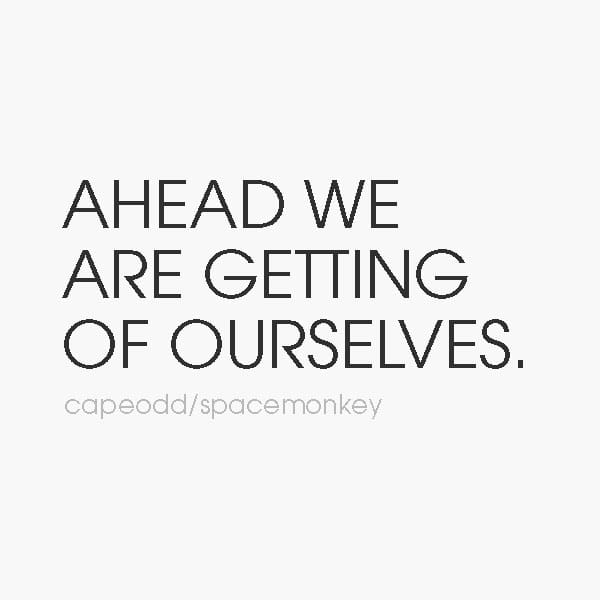
Ahead . . . We Are Getting Of Ourselves

 Ahead we are getting of ourselves.

Space Monkey Reflects: Ahead Getting

There’s a feeling we’ve all experienced—one of being ahead of ourselves. It’s that sensation of moving faster than our present moment, of rushing towards something that hasn’t yet arrived. It’s a feeling of being out of sync with the here and now, as if our thoughts, ambitions, and desires are pulling us forward while our bodies struggle to keep pace. This is what it means to be Ahead Getting—to be so caught up in the future that we forget to live in the present.

In today’s world, this feeling is all too common. We’re constantly planning, striving, and anticipating what comes next. We think about the next project, the next goal, the next achievement. We race toward some imagined future, convinced that once we get there, everything will fall into place. But in doing so, we often overlook the present moment. We forget that right now is where life is actually happening.

Space Monkey knows that this rush towards the future is both exhilarating and exhausting. We move so fast, chasing dreams and goals, that we lose touch with the stillness of the present. In our quest to get ahead, we forget that being ahead is an illusion. The future is not something we can ever truly reach because it is always just beyond our grasp, forever moving further ahead as we chase it.

To be Ahead Getting is to be caught in this paradox. We are always one step ahead of ourselves, living in the anticipation of what’s to come rather than in the fullness of what is. It’s a way of living that keeps us in a state of perpetual motion, always seeking, always striving, but never fully arriving.

But what if we could stop? What if we could pull back from this constant forward momentum and simply be here, now? What if we stopped getting ahead of ourselves and instead allowed ourselves to catch up with the present?

This is not to say that ambition and future planning are inherently bad. They’re part of what drives us, part of what makes us human. But there’s a balance to be found—a way to move forward without losing touch with the present moment. When we are constantly ahead of ourselves, we miss the richness of the now. We miss the small moments of beauty, connection, and stillness that make life truly meaningful.

In the Ahead Getting state, we are always looking to the horizon, but we forget to look around. We’re so focused on what’s next that we miss what’s here. The irony is that the future we’re racing toward will one day become the present—and if we haven’t learned to live in the present, we’ll miss it when it arrives.

Space Monkey invites us to consider this: What if, instead of always getting ahead, we allowed ourselves to align with the present? What if we moved at the pace of life, rather than trying to outpace it? In doing so, we might find that we don’t need to rush forward to find what we’re looking for. Everything we seek already exists in this moment, if only we slow down enough to notice it.

Being ahead of ourselves often comes with a sense of anxiety, a feeling that we’re running out of time or that we need to hurry to achieve our goals. But time is an illusion, and the only moment we truly have is the one we’re in. By grounding ourselves in the present, we allow time to unfold naturally, without the pressure of always needing to be somewhere else.

This doesn’t mean giving up on ambition or future dreams. It simply means acknowledging that the future is created in the present. By fully inhabiting this moment, we are laying the foundation for what’s to come. We don’t need to get ahead to create a better future—we need to be fully here, now, because it is from the present that the future is born.

So, as we reflect on being Ahead Getting, let’s remember that life is not a race. We don’t need to outrun the present moment to find meaning or success. Everything we seek is already here, waiting for us to slow down, notice, and appreciate it.


Summary

“Ahead Getting” explores the feeling of being out of sync with the present, constantly racing toward the future. It encourages a balance between ambition and presence, reminding us that life is happening now, not just in what’s ahead.


Glossarium

Ahead Getting: The sensation of moving too fast, caught up in future plans and ambitions, while neglecting the present moment.

Presentalign: The state of being fully grounded in the present while still moving forward with intention and awareness.


Quote

“The future is always just ahead, but life is happening now.” — Space Monkey


In the Rush

We run ahead
faster and faster
chasing what comes next
forgetting what is here

the future calls
but so does the present
and if we stop
for just a moment
we find that everything
we were running toward
was already here

we are Space Monkey

Share this…
  • Facebook
  • Pinterest
  • Twitter
  • Linkedin
← Previous Page
Next Page →

Written This Day

  • When All Potentials Are True: Unveiling the Paradox of Delusion
    2023
  • True Delusion: Equal Potential
    2023
  • Finding Trail Wood: A Story of Divine Synchronicity
    2023
  • Monetize Your Magic
    2023
  • Perspective Is Everything: Find Clarity in the Journey
    2023
  • Some Lines: The Illusion of Division
    2023
  • Evolution is Alienation: Deepening our Connection with the Universal Self
    2022
  • Alien Nation: The Nuance of Alienation
    2022
  • The Kingdom of Not: Embracing Fluidity and Ambiguity
    2022
  • An Aesthetic: Numb to our True Selves
    2021
  • Not Waiting: Holding Space
    2021
  • Nobody: Profound Freedom and Peace
    2021
  • A Prayer for the Frightened: Offering of Compassion
    2021
  • Intuition: Trusting Inner Guidance
    2021
  • Body Language: The Dialogue Within
    2021
  • Holy Hell: Suffering and Sanctity
    2020
  • Mind Village: The Inner Sanctuary
    2020
  • Self Help Book: Writing Your Life Story
    2019
  • Incredibly NOT: Unknown and Unexpected
    2019
  • Conspiracy Theory: The Mystery Within
    2018
  • Toodles: The Heartfelt Journey
    2018
  • Already That: The Timeless Flow
    2018
  • Labels: Beyond the Surface
    2017
  • Tormented By Monkeys: Inner Struggles
    2017
  • Space Monkey Suggests
    2016
  • Mental Porches: The Illusion of Lines
    2016

Recent Posts

  • The Logic Loop
  • Immense
  • (no title)
  • Confront. Comfort. Convince.
  • Top 10 Things
Cape Odd · Copyright © 2026 All Rights Reserved
iThemes Builder by iThemes · Powered by WordPress