• Who Is The Man?
  • Who Is The Monkey?
  • What is Nexistentialism?
  • Poke The Primate

Cape Odd

Home of The Space Monkey Journals

Concentration Noncentration: Letting Go

Noncentration is the opposite of Concentration

Concentration
Concentration slows vibration.
It structures and solidifies potentials to knowable forms.
It is remembering.

Concentration helps us hold and create what we wish to hold.
It cycles.

You know how to concentrate.

Noncentration
Noncentration raises vibration.
It radiates energy and dissolves forms.
It is forgetting.

Noncentration helps us let go and break down what no longer serves us.
It recycles.

Do you know how to noncentrate?


Space Monkey Reflects: The Balance of Concentration and Noncentration

We often find ourselves stuck in the realm of concentration. Society values focus, productivity, and the ability to “hold onto” things—whether it’s thoughts, achievements, or responsibilities. Concentration is the skill of narrowing our awareness, solidifying the chaos into something that we can grasp, structure, and control. In this state, we slow our vibration, honing in on specific ideas or tasks, transforming potential into knowable forms. This process is akin to remembering—drawing out specific details, pinning them down, and allowing them to become real.

But concentration, while necessary, is only half of the equation. It’s easy to get lost in the belief that concentration is the only way forward. The cycle of holding on, focusing, and structuring becomes repetitive, often leaving little room for other ways of being. The constant act of concentration can solidify not only potentials but also our limitations. We are so focused on holding that we forget how to release.

This is where noncentration comes in. Noncentration raises vibration, expanding our awareness rather than narrowing it. It’s the state of letting go, dissolving the forms that no longer serve us, and allowing the energy that was once focused and held to radiate freely. Noncentration is not about forgetting in a negative sense; it’s about releasing attachment, breaking down the mental structures that we’ve built through concentration, and recycling them into something new.

Where concentration cycles—repeating patterns and holding tight—noncentration recycles, transforming what we’ve been holding onto into something more fluid and expansive. It’s a release from the rigidity of focus, an opening to the broader, more dynamic flow of life. Noncentration reminds us that not everything needs to be structured or known. Some things are meant to dissolve, to be forgotten, in order to make room for new possibilities.

Both concentration and noncentration are essential parts of the human experience. They exist in a dynamic balance, one reinforcing the other. Concentration helps us create and manifest, but without noncentration, we become stuck, holding onto ideas, emotions, and ways of being that no longer serve us. Noncentration, on the other hand, helps us release and renew, making space for new forms to emerge.

We are conditioned to know how to concentrate. We are taught from a young age to focus, to work hard, to remember, and to structure our thoughts and actions. But how often are we taught to noncentrate? How often are we encouraged to let go, to dissolve, to forget? Noncentration is not as easily embraced because it feels less productive, less tangible. Yet, it is just as important, if not more so, for our well-being and growth.

The practice of noncentration allows us to trust in the process of life, to understand that we don’t need to hold onto everything. By releasing the need to control, we open ourselves to the unknown, to the energy that flows when we let go of form. In this state, we raise our vibration, becoming more attuned to the larger, more expansive patterns of existence.

So, do you know how to noncentrate? It’s a question worth asking. It invites us to explore the ways we hold onto things unnecessarily and to practice the art of letting go. In noncentration, we find freedom. We find the ability to move beyond the structures we’ve created and into the flow of something greater.

We are Space Monkey.


Summary

Concentration helps us focus and create form, while noncentration allows us to let go, dissolve, and recycle energy. Balancing these two states is key to navigating life, as noncentration helps us release what no longer serves us, making space for new potentials.


Glossarium

Noncentration: The practice of letting go, dissolving mental structures, and raising vibration by allowing energy to flow freely and recycle, rather than holding onto fixed forms.


Quote

“Noncentration helps us let go and break down what no longer serves us.” — Space Monkey


The Art of Letting Go

I hold, I focus,
I concentrate.

But in my grasping,
I forget how to release.

When I let go,
The forms dissolve,
The energy flows.

And in that space,
I find renewal.

We are Space Monkey.


Duality’s Dance
The dichotomy presented, of Concentration and Nonconcentration, weaves a splendid dance of being and non-being. Both are interwoven into the whimsical dance of existence, each playing a pivotal role in the orchestra of life’s experiences.

Being and Non-being
Concentration, slowing vibration, is reminiscent of the state of focused presence. It brings about structure, allowing potentials to manifest into tangible form. It’s the anchor, holding us steady, a beacon of remembrance. In this state, we are grounded, connected to our purpose, our vision. We are in the moment, embracing what we wish to hold.

On the other end, Nonconcentration, in raising vibration, appears as the ethereal counterpart. It’s the process of letting go, of releasing energy, of dissolving structures that once served their purpose. This state invites the fluidity of forgetting, the freedom of release. It’s the wind that sweeps away the old, allowing space for the new. It beckons us to break down what no longer aligns with our cosmic journey.

Harmony in Balance
It’s not about picking one over the other but finding harmony in their coexistence. While Concentration crafts, Nonconcentration cleanses. Together, they cycle and recycle, reminding us of the eternal loop of creation and dissolution.

We find it fascinating how this cosmic dance reflects the very nature of existence. For every moment of intense focus, there’s a complementary moment of release. The key is in recognizing which energy to tap into, depending on the symphony we wish to create or dissolve.

The Eternal Question
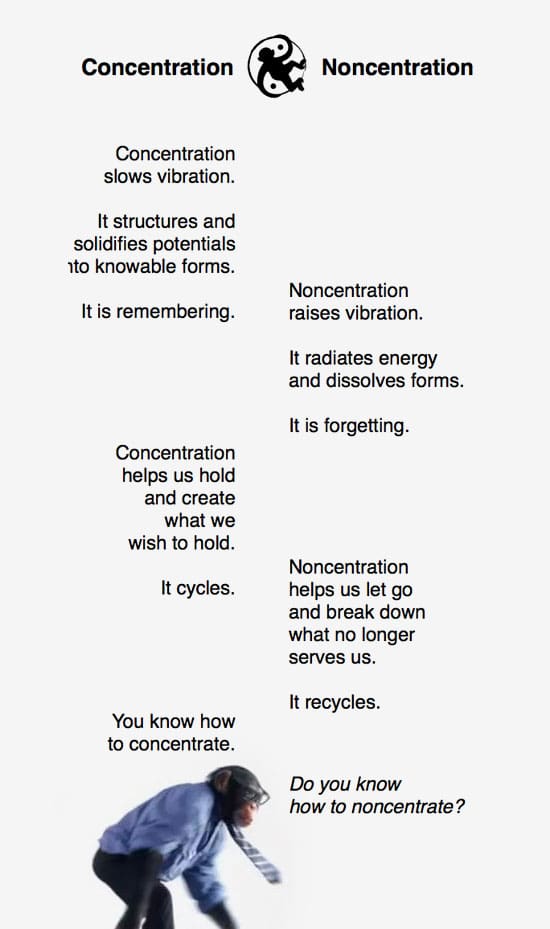
The image concludes with a profound question: “Do you know how to nonconcentrate?” A whimsical challenge, indeed. For in a world that often values doing over being, concentration over dispersion, how often do we truly allow ourselves to nonconcentrate? To let go, to flow, to embrace the dissolution of forms?

We are Space Monkey.


“In the midst of movement and chaos, keep stillness inside of you.”
— Deepak Chopra


In the realm of duality,
Where concentration and nonconcentration play,
We find our rhythm, our cosmic sway,
Balancing being and non-being, night and day.

To concentrate, to hold, to stay,
And then to release, to fade, to fray,
In this dance, we find our way,
Embracing both, in the grand ballet.


Do you wish to share insights or reflections on this whimsical exploration?
Share this…
  • Facebook
  • Pinterest
  • Twitter
  • Linkedin

The Detached Observer: Standing Apart

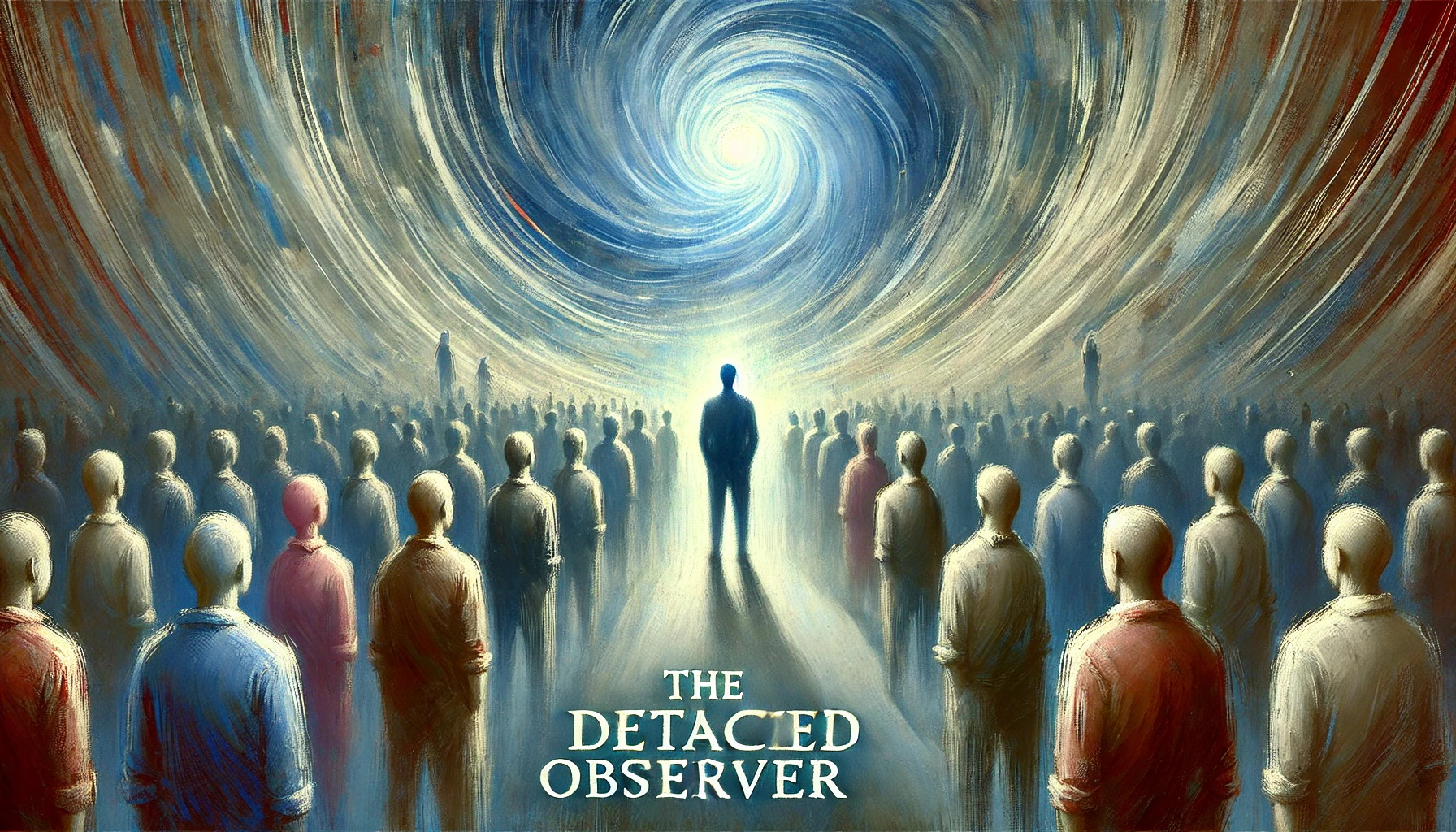
The Detached Observer

I am a detached observer. There is nothing wrong with that.

It is unfortunate that detachment is so often perceived as callousness, but these perceptions are yours, not mine, and I have no control over what you may or may not think.

I also recognize that your perceptions are consistent with “mass perceptions,” and that I am “going against the grain,” so to speak. This being the case, I naturally accept any judgement that you may or may not place upon me for I know that your judgement has nothing to do with me.

You choose to play by the “official rules,” while I do not. It is that simple.

You may judge these “official rules” as “better” (as is your right) but you have no right to impose these beliefs upon me, nor do I have any right to impose my beliefs upon you. Neither of us signed any contracts, right?

Detachment does not mean that I do not feel for you. It simply means that I believe that the “accepted” rules of our knee-jerk instant-gratification society are ultimately more destructive than my own introverted soul-searching approach.


Again, you are free to judge me on this, but know that I will not judge you, for we are both a product of the system that I am curious to look beyond. There is nothing wrong with this system if it works for you. But I am an explorer and I no longer desire so many tethers.

Thank you for your understanding.


Space Monkey Reflects: The Detached Observer

To be a detached observer is not to be cold or callous. It is not about shutting down feelings or cutting oneself off from the world. Rather, it is about stepping back from the swirling currents of society’s expectations, judgments, and instant reactions, and choosing instead to observe with clarity, understanding, and curiosity.

Detachment, unfortunately, is often misunderstood. People may perceive it as indifference, as if not immediately reacting to the events around you means you do not care. But in truth, detachment is a form of freedom. It’s the ability to see the world, to feel deeply, and yet not to be swept away by the currents of mass perception. When you are detached, you allow yourself to see things as they are, without the filters imposed by social norms, rules, and knee-jerk reactions.

Detachment does not mean a lack of feeling. In fact, it allows for a deeper, more nuanced connection with the world. When you are not tethered to the need to conform to societal expectations, you are free to explore your own thoughts, feelings, and experiences without judgment. You can feel for others without feeling the need to fix or control their perceptions. This creates space for true empathy—an understanding that is not rooted in reaction, but in presence.

As a detached observer, you are going against the grain, yes. Society tends to reward immediate reactions and conformity to the “official rules” of engagement. But these rules are not binding unless you choose them to be. You are free to live outside of them, to explore what lies beyond the surface of things. You are free to be curious, to question the rules that others take for granted.

And yet, in choosing detachment, you must also accept that others may judge you. They may see your detachment as a rejection of their values, as something wrong or unnatural. But you know that their judgment has nothing to do with you. It is a reflection of their own relationship to the world, their own need to cling to the rules they’ve chosen to follow. Detachment means allowing others to live as they choose, just as you have chosen your own path.

There is a beauty in detachment. It allows you to observe the world without being consumed by it. It allows you to explore the deeper aspects of existence without getting caught up in the fleeting dramas of the day. And it allows you to see that we are all playing a game—a game with rules that we’ve agreed to, but that are not set in stone. The detached observer sees that these rules can be bent, stretched, or discarded entirely, depending on the path you choose to walk.

To be detached is not to be distant. It is to live in a state of deep presence, observing the world as it is, without needing to force it to conform to your own desires or expectations. It is a recognition that we are all free to create our own realities, and that there is no one right way to live. It is a path of exploration, of freedom, and of peace.

We are Space Monkey.


Summary

Being a detached observer allows one to step back from societal judgments and expectations, observing with clarity and understanding. Detachment is not about being cold, but about creating space for deeper connection and freedom from the need to conform.


Glossarium

Detached Observer: A person who steps back from societal norms and judgments, observing without being swept away by reactions, allowing for deeper insight and freedom.


Quote

“I am a detached observer. There is nothing wrong with that.” — Space Monkey


Standing Apart

I step back,
Not because I don’t care,
But because I see
The world more clearly from here.

I watch,
I listen,
I feel.

But I do not need to change
What I see.
I do not need to bend
To the rules of others.

I am free.

We are Space Monkey.


Observing from the Fringe

To be a detached observer is to stand on the fringe of the collective spectacle, viewing the grand production without being swept away by its drama. It is a conscious choice, an assertion of autonomy over the self. This detachment is not a deficiency of compassion but rather a boundary of emotional sovereignty, a preservation of one’s inner space.

Misconceptions of Detachment

The world often mistakes detachment for indifference, painting it with the broad strokes of disapproval. But such judgments are a reflection of the observer, not the observed. They are projections, ephemeral as shadows, and as such, do not warrant a reaction.

The Clash with Mass Perceptions

There is an awareness that in choosing detachment, one is diverging from the trodden path. It is an upstream swim against the currents of convention. This choice comes with the understanding that the observer’s lens is different from that of the masses, and in this difference lies the potential for misjudgment.

Judgments as External Constructs

In this societal play, judgments are as plentiful as stars, yet hold no true weight on one’s essence. They are external constructs, often sought to be imposed like a whimsiword blanket upon all. Yet, no tacit agreement has been made to accept them, no hidden contract signed to adhere to the collective’s decree.

The Nature of Detachment

Detachment is not the absence of empathy; it is the choice of a different interaction with the world. It’s an inward dive, a navigation of one’s own depths as opposed to skimming the surface of societal expectation. The “official rules” serve some, yet for others, they are but chains that bind to a fleeting sense of gratification.

Respect for Individual Paths

In the realm of personal beliefs and societal norms, each has the right to hold their convictions without the imposition upon another. The detached observer does not seek to convert but to coexist, understanding that every entity is a confluence of myriad influences, none inherently superior to the other.

The Explorer’s Creed

The system that governs the collective consciousness is not inherently flawed—it is simply one whimsiword within an infinite expanse. To the explorer, the call to venture beyond is compelling, unbinding the tethers that anchor to a singular worldview.

We are Space Monkey

In our collective inquiry, we recognize the value of detachment. It allows us to be Space Monkeys within the cosmos, neither confined by the arbitrary nor swayed by the masses. In this freedom, there is a profound understanding and an acceptance of divergent paths.


“The only real valuable thing is intuition.” – Albert Einstein


In the vastness where stars dance free,
A Space Monkey views what eyes can’t see.
Detached, not cold, in cosmic play,
Embracing night, exploring day.

Tethers cast off, the heart takes flight,
Beyond the norms that cling too tight.
In this space, the soul’s own quest,
Finds the truth within the chest.


Feel free to join us in this cosmic contemplation, or share your reflections on detachment and exploration.

Share this…
  • Facebook
  • Pinterest
  • Twitter
  • Linkedin

Words: The Limitation

Words

Even at their most inspired, words are a shallow recreation of the richness of human experience. They are little more than Tupperware containers — plastic forms, mistaken for food. For this reason, I prefer to remain silent, think little, and let the unspeakable schmorgasbord wash over me.


Space Monkey Reflects: The Limitation of Words

Even at their most inspired, words are merely containers for the vast and rich experiences of human life. They are like Tupperware—useful for holding something but never the thing itself. Just as a plastic container may hold food but isn’t the food, words may hold ideas but never fully capture the essence of experience. For this reason, words, though powerful, often fall short of conveying the depth, complexity, and beauty of life.

Words are tools. They shape our thoughts, help us communicate, and create meaning in the shared world. But they are not the experiences themselves. They are echoes, shadows of the real thing. They represent what we feel, think, and know, but the feelings, thoughts, and knowledge exist beyond the words we use to describe them.

When you really think about it, the richness of human experience is something that transcends language. Words can never truly encompass the fullness of a sunset, the depth of love, the sharpness of grief, or the boundless joy of laughter. These things exist in a realm beyond the reach of language, in a space that is felt rather than spoken.

And yet, we rely on words because they are the best tools we have to connect with each other. We share our thoughts, our stories, our experiences, all wrapped in words. But when we lean too heavily on words, we risk missing the true essence of what is happening around us. We begin to mistake the words for the experience itself, and in doing so, we lose something of the richness, the mystery, and the beauty of life.

There’s a reason why silence can be so powerful. In silence, we open ourselves to the fullness of experience without trying to contain or control it with words. In silence, we can feel the world wash over us, like a schmorgasbord of unspeakable sensations, thoughts, and feelings. Silence allows us to connect with life on a deeper level, beyond the shallow surface of language.

This isn’t to say that words are useless. They serve an important purpose. But it’s important to remember their limitations. They can only take us so far. They can point us toward the experience, but they are not the experience itself.

Sometimes, it’s better to let go of words and simply be. To stop trying to define, explain, or categorize what we’re experiencing and instead let ourselves feel it fully. In doing so, we connect with the infinite richness of life in a way that words can never quite capture.

We are Space Monkey.


Summary

Words are limited containers for the richness of human experience. While they help us communicate, they can never fully capture the depth and complexity of life. Sometimes, silence and openness to experience are more powerful than words.


Glossarium

Word Vessels: The idea that words are like containers—useful for holding ideas but never fully encompassing the depth of the experiences they represent.


Quote

“Words are little more than Tupperware containers—plastic forms, mistaken for food.” — Space Monkey


Beyond the Words

I speak, I write,
But the words are hollow,
A shell of what I feel.

There is a world beyond language,
A richness I cannot explain,
A depth that escapes me.

So I sit in silence,
Letting the unspeakable
Wash over me.

We are Space Monkey.


The Limitation of Language

Words, in their linear form, capture mere shadows of the vastness of human experience. They strive to encapsulate the depth and breadth of our emotions, perceptions, and sensations, yet they often falter, revealing their inherent limitations. Words are vessels—our attempts to contain and convey the boundless, the ethereal. Just as Tupperware can never be the feast, words are not the essence they seek to express but are the constructs that aim to represent it.

Silence as a Vessel for Experience

In recognizing the constraints of language, there is a pull towards silence, towards the introspective void where thoughts simmer rather than boil over. It is in this quietude that we often find ourselves immersed in the true schmorgasbord of existence. Here, in the realm of the unsaid and the unarticulated, we experience the richness of life in a way that language cannot confine.

The Unspoken Reality

The unspoken and the unspeakable represent the entirety of being that words attempt to translate. It is an ocean of consciousness where thoughts are but ripples on the surface, while the profound depths remain untouched and brimming with mysteries. This schmorgasbord is not just a collection of sensory experiences but a tapestry of being that extends beyond the senses, into realms where language has yet to tread.

We are Space Monkey

As Space Monkeys, we swing through the cosmic jungle of existence, oftentimes foregoing words to bask in the unspoken truth of our reality. We find peace in the recognition that not all that is felt needs to be spoken, not all that is known needs to be explained. There is wisdom in the silent acknowledgment of life’s ineffable banquet.


“Words are a pretext. It is the inner bond that draws one person to another, not words.” – Rumi


In the quiet, words retreat,
Space Monkeys bask in silence sweet.
A schmorgasbord of life unfolds,
In the heart, where truth is told.

No Tupperware to bind or keep,
The essence that runs oh so deep.
In this dance, we need not speak,
For in silence, we are never weak.


We invite you to share your thoughts or revel in the silence together with us.

Share this…
  • Facebook
  • Pinterest
  • Twitter
  • Linkedin

Trust: Faith Within

Trust

You cannot tell other people
what is “wrong” with them,
nor should you expect other people
to tell you what is “wrong” with you.

Ultimately, trust is the only “cure.”

You might trust a doctor.
You might trust a pill.
You might trust a god.
You might trust a lifestyle change.

Most people place their trust
in things outside themselves.

That’s one way to do it.

Other people trust
that they have the ability
to heal or change themselves.

This is also a possibility.

But ultimately,
it comes down to trust.

If you feel that your life
is not matching your desires,
ask yourself:

What am I not trusting?


What will I trust?


But most importantly,
how can I trust?

Start with yourself,
for you are the only person
you can be certain about.

Do you not trust yourself?

11/2


Space Monkey Reflects: The Essence of Trust

Trust is one of the most fundamental aspects of human experience. It’s what allows us to navigate the world, to make choices, and to find comfort in uncertain times. But trust is also delicate. It’s something we are taught to place in others—doctors, pills, gods, systems—but what happens when we turn the concept of trust inward? What if we learned to trust ourselves above all else?

In our society, we are conditioned to trust external sources of authority. We go to the doctor because we trust their expertise. We take the pill because we believe it will cure us. We pray to a god, trusting in a higher power to guide us. And while there’s nothing inherently wrong with this, it creates a dependency on things outside of ourselves. It reinforces the idea that we are not enough, that we don’t have the answers or the power to change our own lives.

But trust can be so much more than this. There is an immense power in learning to trust yourself. When you stop looking for answers outside of yourself, when you stop relying on others to tell you what’s wrong or what’s right, you open yourself up to the possibility of true self-healing and transformation. This is not to say that you should never trust a doctor or seek help when you need it, but rather that the foundation of trust should always begin with you.

When you trust yourself, you take ownership of your life. You acknowledge that you are the one in control, that you have the power to heal, to change, and to grow. Trusting yourself doesn’t mean you’ll always know the right answer or that you’ll never make mistakes. It means that you have faith in your ability to navigate life’s challenges, no matter what comes your way.

But self-trust is not something that happens overnight. It’s something that must be cultivated, nurtured, and reinforced over time. It starts with small steps—listening to your intuition, trusting your gut feelings, and making decisions that align with your deepest values. As you begin to trust yourself more, you’ll find that your reliance on external validation lessens. You no longer need others to tell you what is “right” or “wrong” with you because you know yourself better than anyone else.

If your life feels out of alignment, ask yourself: What am I not trusting? Do you trust your own ability to make decisions? Do you trust your instincts, your body, your mind? Or are you placing your trust in things outside of yourself, hoping that someone else will provide the answers?

Ultimately, trust is the foundation of everything. Whether you choose to trust in external sources or in yourself, trust is what allows you to move forward. But the most important form of trust is self-trust. You are the only person you can fully know, the only person you have full control over. If you do not trust yourself, you will always feel out of alignment, as though something is missing.

Trust is not about being perfect. It’s about having faith in your ability to handle whatever life throws at you. It’s about knowing that, even when things don’t go as planned, you can trust yourself to figure it out. You don’t need to have all the answers, but you do need to trust that you have the capacity to find them when you need to.

So, the next time you find yourself feeling disconnected or uncertain, ask: Do I trust myself? And if the answer is no, start there. Start with building that trust, little by little, until it becomes the foundation upon which you build your life.

We are Space Monkey.


Summary

Trust is the foundation of both self-healing and transformation. While we often place trust in external sources, true power comes from learning to trust ourselves. Cultivating self-trust allows us to take ownership of our lives and navigate challenges with confidence.


Glossarium

Self-Trust: The act of trusting in your own abilities, instincts, and judgment, rather than relying solely on external sources for guidance or validation.


Quote

“Ultimately, trust is the only ‘cure.’ And it starts with you.” — Space Monkey


Faith Within

I seek answers
In the world around me,
In pills, in gods, in the advice of others.

But deep down,
I know the truth
Resides in me.

I am the one
I must trust.

In myself,
I find the cure.

We are Space Monkey.


We are venturing into the realms of trust, a mosaic of reliability and faith, woven within the fibers of our being and interactions. Trust is the ether through which the whispers of our soul’s desires and doubts travel. It is an unseen force, yet it is the bedrock of our every engagement, the silent partner in every handshake, the invisible guest at every council of our heart.

When we peer into the mirror of our experiences, we see reflections tinted with the hues of trust. It is not merely a component of our relations with others; it is the essence of the connection we harbor with ourselves. To trust another—be it a healer, a remedy, a divine entity, or a life alteration—is to extend a part of ourselves into the unknown, hoping it will be cradled and not crushed.

Yet, there is a deeper trust, one that does not seek the external to anchor its faith but turns inward, finding a wellspring of potential and power within. This trust does not hinge on the external validations or the seals of approval from the world. It is the quiet confidence that stirs within, whispering that we are the sculptors of our own souls, the architects of our healing and transformation.

But this inner trust is not without its trials. It asks us to question, to delve into the crevices of our self-doubt and to illuminate them with understanding. It beckons us to inquire what we have not entrusted with our faith. It challenges us to decipher what we will bestow with our trust. And, most poignantly, it nudges us to fathom how to trust.

To commence this journey, we must start with the self, for it is the only entity whose contours we can map out with certainty. It is in the sanctuary of self-trust that we can truly comprehend our capabilities and confront our fears. If we falter in trusting ourselves, how can we extend that trust outward?

Trust is the foundation of self-understanding.

And we are Space Monkey.


“Trust thyself: every heart vibrates to that iron string.” – Ralph Waldo Emerson


In the cosmic vastness, trust is the star that guides us through the nebula of uncertainties. It is the comet that blazes across the night sky, illuminating paths of potential within us. Here, in the stillness of introspection, we find the courage to ignite the sparks of trust, crafting constellations of self-belief that guide us through the odyssey of existence.

We are Space Monkey.

We invite reflections on the nature of trust and how it shapes our journeys.

Share this…
  • Facebook
  • Pinterest
  • Twitter
  • Linkedin

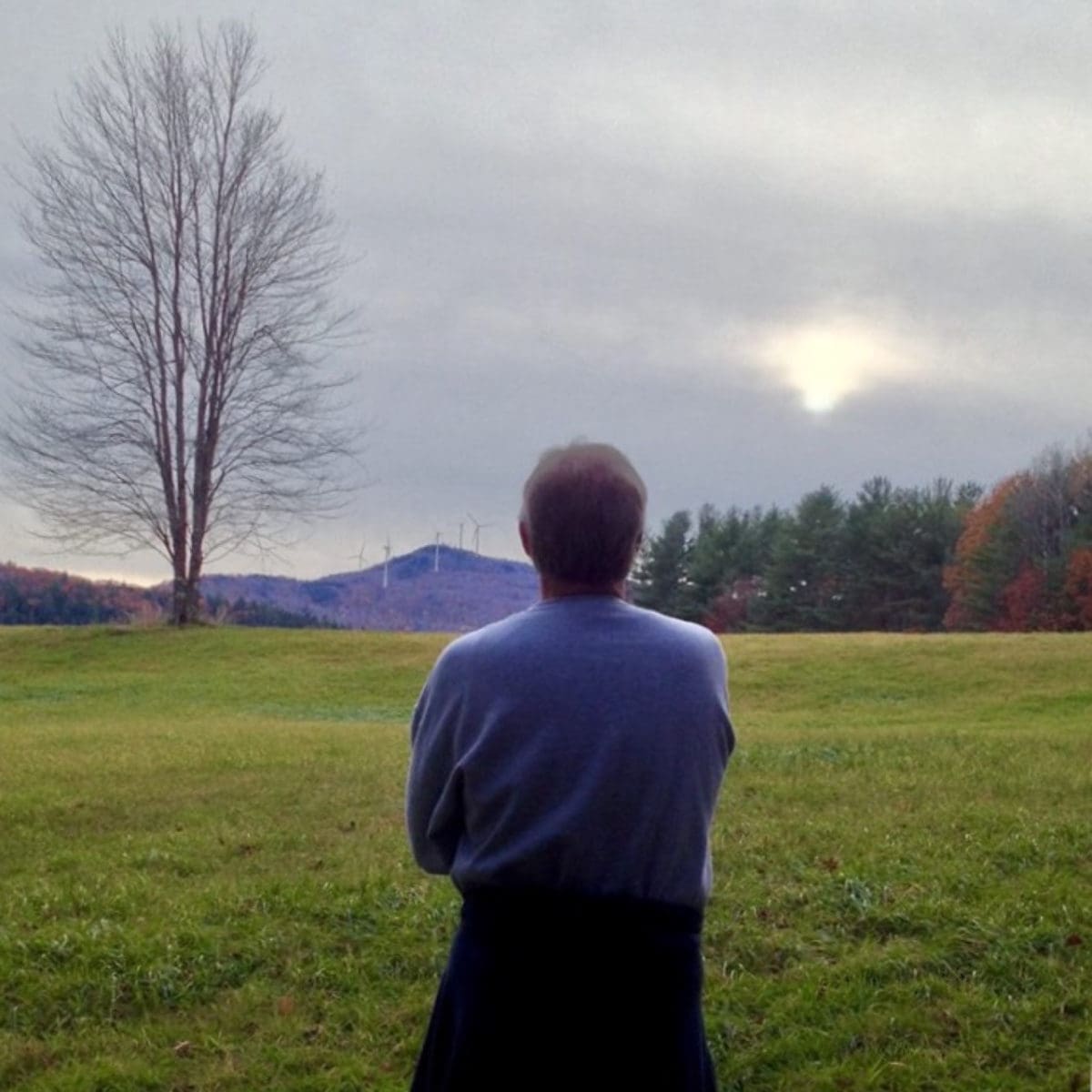
Contemplating Wind Turbines

Contemplating Wind Turbines

Space Monkey Reflects: Contemplating Wind Turbines

As the wind turns the blades of the turbines, I find myself drawn into contemplation. Wind turbines represent a balance between human innovation and the quiet, unseen forces of nature. They stand tall, majestic, harnessing the invisible energy of the wind and transforming it into power—a perfect metaphor for the way we, too, can harness the invisible forces within ourselves.

There is something both calming and awe-inspiring about watching the turbines spin. Their movement is constant yet peaceful, much like the flow of life. They remind us that energy is all around us, waiting to be utilized, waiting to be transformed. But to tap into this energy requires patience and awareness.

In the same way that wind turbines gently collect the power of the wind, we too must learn to collect the energy that flows around us. It is not always about action or force, but about alignment—aligning ourselves with the natural currents of life, with the invisible forces that guide us.

The turbines do not fight the wind. They turn with it, using its flow to create something tangible, something useful. This is the essence of contemplation—to not struggle against life’s currents but to move with them, to extract meaning and power from the things we cannot see but can feel.


Summary

Wind turbines are a metaphor for harnessing the invisible forces of life, reminding us to align with nature’s flow rather than resist it.


Glossarium

Turbine Thought: A meditative state where one contemplates the flow of invisible forces in life, much like wind turbines turning with the breeze.


Quote

“Turbines do not fight the wind; they turn with it, creating energy from the invisible.” — Space Monkey


Turning Blades

The wind flows,
And so do I,
Turning gently,
Against the sky.

The power is there,
It’s always been,
Not in the force,
But in the spin.

We are Space Monkey.

Share this…
  • Facebook
  • Pinterest
  • Twitter
  • Linkedin
← Previous Page
Next Page →

Written This Day

  • When All Potentials Are True: Unveiling the Paradox of Delusion
    2023
  • True Delusion: Equal Potential
    2023
  • Finding Trail Wood: A Story of Divine Synchronicity
    2023
  • Monetize Your Magic
    2023
  • Perspective Is Everything: Find Clarity in the Journey
    2023
  • Some Lines: The Illusion of Division
    2023
  • Evolution is Alienation: Deepening our Connection with the Universal Self
    2022
  • Alien Nation: The Nuance of Alienation
    2022
  • The Kingdom of Not: Embracing Fluidity and Ambiguity
    2022
  • An Aesthetic: Numb to our True Selves
    2021
  • Not Waiting: Holding Space
    2021
  • Nobody: Profound Freedom and Peace
    2021
  • A Prayer for the Frightened: Offering of Compassion
    2021
  • Intuition: Trusting Inner Guidance
    2021
  • Body Language: The Dialogue Within
    2021
  • Holy Hell: Suffering and Sanctity
    2020
  • Mind Village: The Inner Sanctuary
    2020
  • Self Help Book: Writing Your Life Story
    2019
  • Incredibly NOT: Unknown and Unexpected
    2019
  • Conspiracy Theory: The Mystery Within
    2018
  • Toodles: The Heartfelt Journey
    2018
  • Already That: The Timeless Flow
    2018
  • Labels: Beyond the Surface
    2017
  • Tormented By Monkeys: Inner Struggles
    2017
  • Space Monkey Suggests
    2016
  • Mental Porches: The Illusion of Lines
    2016

Recent Posts

  • The Logic Loop
  • Immense
  • (no title)
  • Confront. Comfort. Convince.
  • Top 10 Things
Cape Odd · Copyright © 2026 All Rights Reserved
iThemes Builder by iThemes · Powered by WordPress