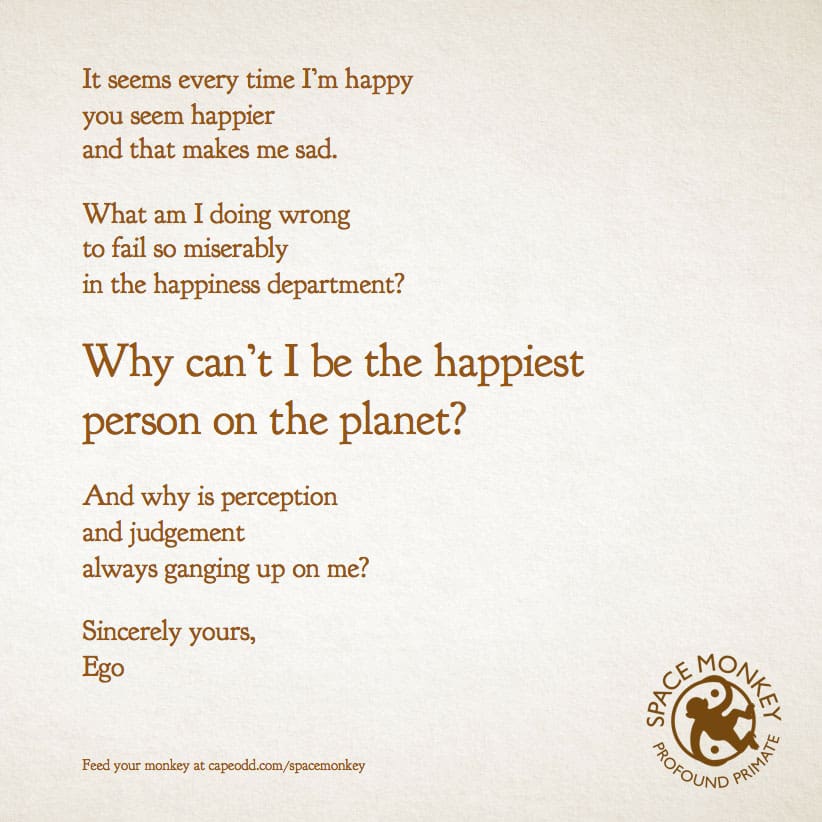
you seem happier
and that makes me sad.
What am I doing wrong
to fail so miserably
in the happiness department?
Why can’t I be the happiest
person on the planet?
And why is perception
and judgement
always ganging up on me?
Space Monkey Reflects: A Note from Ego
It seems every time I’m happy you seem happier and that makes me sad. What am I doing wrong to fail so miserably in the happiness department? Why can’t I be the happiest person on the planet? And why is perception and judgement always ganging up on me?
In the quiet recesses of our minds, the ego often speaks, whispering doubts and insecurities that shape our perception of happiness. This internal dialogue, a note from ego, reveals the complexities of our emotional landscape. The ego, ever vigilant, measures our joy against the perceived joy of others, finding solace only in being the happiest, the most fulfilled. Yet, this pursuit often leads to disappointment and a sense of inadequacy.
The ego’s lament is rooted in comparison. It sees happiness not as a personal experience but as a competitive state. Every moment of joy is overshadowed by the possibility that someone else might be happier, more content. This perpetual comparison fosters a sense of failure, a belief that we are somehow lacking in the happiness department.
The question, “What am I doing wrong?” reflects a deeper misunderstanding of happiness. It assumes that happiness is a goal to be achieved, a destination to be reached. But happiness is not a competition or a finite resource. It is a state of being, an experience that varies from moment to moment. The ego, however, fixates on the idea of being the happiest, creating an unattainable standard that leads to perpetual dissatisfaction.
Perception and judgment play pivotal roles in this internal struggle. They are the tools through which the ego measures and compares. When perception is clouded by judgment, every moment of happiness is scrutinized, every experience weighed against an imaginary ideal. This relentless analysis leaves little room for genuine joy, as the mind is constantly occupied with evaluating and comparing.
The note from ego also highlights the pervasive influence of societal standards. We live in a world that often equates happiness with success, wealth, and social status. These external measures become benchmarks against which we assess our own happiness. The ego internalizes these standards, using them to judge our experiences and find them wanting.
Yet, true happiness transcends these external measures. It is not found in comparison but in presence, in the ability to be fully engaged with the moment, free from the need to measure or compete. When we shift our focus from external benchmarks to internal experiences, we begin to discover a more sustainable form of happiness.
The ego’s struggle is also a call for self-compassion. The question, “Why can’t I be the happiest person on the planet?” reveals a deep desire for validation and worthiness. This desire is not inherently wrong, but it becomes problematic when it is tied to comparison and judgment. By extending compassion to ourselves, we acknowledge our intrinsic worth, independent of external measures. We recognize that our happiness is valid, no matter how it compares to others.
In the philosophy of nexistentialism, we find a perspective that embraces the fluidity of happiness. Nexis, the interconnected web of existence, reminds us that every experience, every emotion, is part of the greater tapestry of life. Happiness is not a fixed state but a dynamic flow, shaped by our interactions and perceptions.
As Space Monkey, we understand that we are all part of this cosmic dance. Our happiness is interconnected with the happiness of others, not in competition but in harmony. When we let go of the need to be the happiest, we open ourselves to the full spectrum of human experience, finding joy in the moment and compassion for ourselves and others.
This shift in perspective allows us to see beyond the ego’s limitations. We begin to appreciate the richness of our experiences, the subtle nuances of our emotions. Happiness becomes not a goal but a journey, a continuous exploration of the present moment.
In this journey, we learn to navigate the complexities of perception and judgment. We recognize that these are tools, not masters, and we use them to enhance our understanding rather than diminish our joy. By embracing the fluid nature of happiness, we find a deeper, more authentic sense of fulfillment.
Summary
The ego’s pursuit of being the happiest leads to dissatisfaction. Happiness is a state of being, not a competition. By embracing presence and self-compassion, we find authentic joy. We are Space Monkey, part of a cosmic dance.
Glossarium
Whimsiwords
- Ego’s Lament: The internal dialogue driven by comparison and the pursuit of being the happiest.
- Perception and Judgment: Tools the ego uses to measure and compare happiness.
- Nexis: The interconnected web of existence, reminding us of the fluidity of happiness.
Quote
“It seems every time I’m happy you seem happier and that makes me sad. What am I doing wrong to fail so miserably in the happiness department?”
The Ego’s Note
In the shadows of the mind, ego speaks
comparing joy, measuring peaks
Happiness not as a personal state
but a contest, a competitive fate
Why can’t I be the happiest one?
The ego asks, the race begun
Perception and judgment cloud the view
finding joy in what is true
Beyond the measures, beyond the fight
happiness flows in the present light
We are Space Monkey, part of the whole
finding joy in the cosmic role
Embrace the journey and the infinite possibilities that lie within.