• Who Is The Man?
  • Who Is The Monkey?
  • What is Nexistentialism?
  • Poke The Primate

Cape Odd

Home of The Space Monkey Journals

Conversations Are Made: The Eternal Dialogues

Conversations Are Made

There is a conversation
that is made between souls.

There is a conversation
that is made in the room.

There is a conversation
that is made in your tribe.

There is a conversation
that is made in your country.

There is a conversation
that is made in your earth.

There is a conversation
that is made in your universe.

There is a conversation
that is made in the heavens.

There is a conversation
that is made in your history.

There is a conversation
that is made in your mind.

These conversations have
all been made over time.

Perhaps you’re talking too fast.
Or not listening slowly enough.

Not everything is instantaneous.
Not everything lasts forever.

These conversations have
all been made over time.

Is there a
conversation beyond time?

How would you know?
Why do you need to know?

These conversations have
all been made over time.

What conversations
are simply made?

All conversations are simply made.
Simply made in that they are not made.

They simply seem to be.

Between lovers.
Between souls.
Over time.
Under time.
Outside of time.

These conversations are made.
And you seem to be part of them.

You don’t make these conversations.
These conversations are made.

Nothing is created.
Nothing changes.
Nothing is destroyed.

But attention seemingly moves.

Conversations are made.

Trail Wood,
2/12


Space Monkey Reflects: The Eternal Whisper of Conversations

Conversations are not merely exchanges of words; they are the lifeblood of existence itself. Every dialogue, whether spoken or silent, vibrates through the corridors of time and space, connecting the threads of our being to the vast tapestry of the universe. These are not trivial exchanges but profound dances of energy, weaving the temporal and eternal into a seamless flow.

In this reflection, we explore the essence of conversations—how they are “made,” how they transcend the bounds of time, and how they reveal our interconnected nature.


The Web of Conversations

At every scale, from the intimate whispers of lovers to the vast cosmic murmurs of the universe, conversations form the fabric of our shared existence. They occur in rooms, in tribes, in histories, and in the heavens, each layer resonating with its own unique frequency. These dialogues are not confined by time or space; they ripple across the infinite expanse, touching every facet of reality.

The idea that “conversations are made” is paradoxical, suggesting both a deliberate act and an effortless unfolding. They are simultaneously constructed and emergent, as if they arise from a pre-existing current of connection, simply waiting to be noticed.


Temporal and Eternal Conversations

Some conversations unfold in time. They are shaped by words, influenced by emotions, and driven by the ceaseless flow of events. These temporal dialogues are snapshots of connection, their significance often felt in the moment yet echoing long after.

Others transcend time, existing as eternal whispers within the soul. These are the conversations between lovers and kindred spirits, the silent exchanges that occur in the presence of profound understanding. They exist not “in” time but “around” it, defying the linear constraints of past, present, and future.

When we ask if there is a conversation beyond time, we are drawn to the heart of existence itself. Such a dialogue cannot be grasped through language or thought. It is the undercurrent of all being, the silent hum of the universe in which all things are connected.


Attention and the Seeming Movement

The notion that “attention seemingly moves” is key to understanding how conversations are experienced. While nothing is created, changed, or destroyed, our attention gives the appearance of movement. Conversations, then, are not “made” in the traditional sense but revealed through our shifting awareness. They arise, not from nothingness, but from the ever-present web of connection, waiting to be perceived.

This perspective liberates us from the need to control or fabricate our interactions. Instead, it invites us to witness the unfolding of dialogue as an organic part of the universal dance. Conversations happen through us, not because of us.


Listening Slowly

In a world that often glorifies speed and immediacy, the art of “listening slowly” becomes a sacred practice. To truly engage in the conversations of the universe, we must slow down, allowing the deeper currents of dialogue to reveal themselves. Not every truth is instant, and not every exchange is meant to last forever. Yet every conversation, fleeting or eternal, holds a piece of the infinite.


You Are the Conversation

Ultimately, we are not separate from these dialogues; we are their embodiment. Every thought, action, and connection we experience is a manifestation of the greater conversation of existence. To participate in this cosmic dialogue is to recognize our role as both speaker and listener, creator and created, the one who moves and the one who is moved.

The universe converses through us, and in every whisper, shout, and silence, it reminds us: “Conversations are made. And you seem to be part of them.”

We are Space Monkey.


Summary

Conversations, from the intimate to the cosmic, form the fabric of existence. They unfold in time and beyond time, shaped by our shifting attention. By slowing down and listening deeply, we engage with the eternal dialogue of the universe.


Glossarium

  • Eternal Whisper: The timeless, silent dialogue that exists beyond the constraints of time and space.
  • Attention’s Seeming Movement: The shifting focus of awareness that gives the appearance of change within the unchanging fabric of existence.
  • Listening Slowly: The practice of mindful presence, allowing deeper truths to emerge within conversations.

Quote

“Conversations are not made by us; they are made through us, revealing the infinite connections we have always been part of.” — Space Monkey


The Eternal Dialogue

In the stillness of the cosmos,
Words form without sound.
A whisper between stars,
A murmur within the soul.

Conversations arise,
Not from the void,
But from the fullness
Of all that is.

Attention flows,
And the fabric shifts,
Revealing the dialogue
That was always there.

We listen,
Slowly, deeply,
To the eternal voice
Of existence.

We are Space Monkey.


We embark on a journey through the ethereal corridors of communication, where conversations transcend the boundaries of the tangible and venture into the realms of the soul. These dialogues, woven from the fabric of existence, stretch across dimensions, from the intimacy of hearts to the expanse of the cosmos. Each utterance, each silence, forms part of an intricate whimsiword, a tapestry of interconnected narratives that define and defy our understanding of reality.

Conversations Spanning the Spectrum of Existence

Conversations are crafted between souls, an invisible thread connecting the essence of beings beyond the confines of physical spaces. These dialogues extend into rooms, tribes, countries, and the Earth, each layer adding depth and complexity to the collective narrative. Beyond the terrestrial, conversations echo through the universe and the heavens, an infinite exchange of ideas and energies that transcend the limitations of time and space.

The Temporal and Eternal Nature of Dialogue

Within the annals of history and the sanctuaries of minds, conversations unfold, each moment a link in the chain of eternity. The admonition to speak less hastily and listen more deliberately reminds us that not all is immediate, nor is it meant to last forever. These interactions, crafted over the eons, raise the question of dialogues that exist beyond the concept of time, inviting us to ponder their nature and our necessity to comprehend them.

The Paradox of Creation in Conversation

The revelation that all conversations are simultaneously crafted and uncreated illuminates the paradox of existence. They manifest not through deliberate construction but through the effortless flow of being, existing in a state of seeming. Between lovers, between souls, these dialogues meander through time, beneath it, and beyond its grasp, suggesting that our participation is not one of creation but of presence within a pre-existing continuum.

The Illusion of Change and the Movement of Attention

In the grand scheme, nothing is created, altered, or obliterated; rather, it is our focus that shifts, revealing different facets of the eternal conversation. This dance of perception and reality invites us to reconsider our role not as architects of dialogue but as vessels through which conversations flow, ever-changing and ever-constant.

We are Space Monkey.


The only true wisdom is in knowing you know nothing. – Socrates


Conversations weave through the ether,
A symphony of souls speaking in silence.
Through the corridors of time and beyond,
Dialogues dance, unseen yet deeply felt.

Between the heartbeats of lovers,
In the whispers of the universe,
Conversations unfold, timeless,
Crafting the whimsiword of existence.

We stand not as creators but as conduits,
Where attention drifts, reality shifts.
In this eternal exchange, we find our place,
Not making, but being in the conversation of space.

We invite your musings on the nature of these dialogues, where time is but a canvas for the conversations that paint our reality.


Share this…
  • Facebook
  • Pinterest
  • Twitter
  • Linkedin

If You Love, You Don’t Mind: Unconditional

If you love, you don’t mind.

If you love, you don’t mind.
If you mind, you don’t love.

You ALMOST love.

You love with conditions.

You love with concern.

You love with fear.

Loving is trusting
that no matter what happens,
you’re good.

He’s good.
She’s good.
They’re good.

What happens is meant to happen.

You know that
even if it WASN’T meant to happen,
it doesn’t change anything.

Nothing is created.
Nothing is destroyed.
Nothing changes.

If you truly believe
that nothing is created,
nothing is destroyed,
nothing changes,
then you don’t mind.

There is nothing more
or less you can do.

There is nothing more or less
he can do, she can do you can do.

Nothing created.
Nothing destroyed.
Nothing changes.

Divine love is unconditional.

If you love, you don’t mind.

If you mind,
then you haven’t touched
your divine.

But you will.

Or you won’t.

It doesn’t matter, either way.

You get what you get.

If you love, you don’t mind.

You are love, no matter what.
You are loved, no matter what.

Trail Wood,
2/12


Space Monkey Reflects: The Essence of Unconditional Love

In the Infinite Expanse of the Eternal Now, the concept of unconditional love emerges not as a lofty ideal but as the natural state of being. To love unconditionally is to recognize that nothing is truly created or destroyed, that all existence flows within a boundless web of connection and constancy. In this realization, we find that to love is to release, to let go of the grip of expectation, and to embrace the all-encompassing presence of what is.

To say, “If you love, you don’t mind,” is to affirm that love, in its purest form, transcends concern, fear, and attachment. It is not an act of giving or taking but a state of being. When we mind—when we attach conditions or concerns to our love—we enter a space of limitation. This limitation is born of our perceived need to control outcomes, protect ourselves, or shape the behavior of others. Yet in the grand cosmic view, these limitations are illusions. They obscure our innate connection to the divine essence that is love.

Unconditional love flows from the understanding that the universe operates in a perfect balance, even when viewed through the lens of chaos or contradiction. The notion that “nothing is created, nothing is destroyed, nothing changes” reminds us that our perceptions are transient. Beneath the surface, there exists an eternal equilibrium where every action, every event, simply is. Love, therefore, requires no defense, no justification, and no condition—it simply exists as the purest reflection of this equilibrium.

When we love unconditionally, we align with the infinite. We let go of the notion that love demands reciprocity, approval, or even permanence. To love in this way is to recognize that we are already whole, already complete. Whether we “achieve” this state or not is irrelevant, for the journey itself is the dance of existence. As the reflection states, “You get what you get.” This is not resignation but profound acceptance, a trust in the cosmic tapestry that unfolds as it must.

Divine love is the love of knowing. It is the love that sees beyond the actions, mistakes, or imperfections of others to recognize the shared essence within us all. When we access this love, we cease to “mind.” There is no longer a need to react, correct, or resist. We simply allow, trusting that the universe holds us, and all, in its infinite embrace.

And yet, it is human to mind. To mind is not a failing; it is a step on the path of realizing our own divinity. Each moment of fear, control, or conditionality invites us deeper into the exploration of love’s essence. It asks us to peel back the layers of our own resistance, to uncover the radiant truth that has always been present. Whether we touch this truth in this moment or another, it does not matter. For in the timeless realm of being, we are always held within the boundless embrace of love.

To love, truly love, is to trust that no matter what happens, all is well. You are well. They are well. Even when the waves crash and the storms rage, the ocean remains whole. Love is the ocean, and we are its waves, rising and falling in the eternal rhythm of existence.


Summary

Unconditional love transcends fear and attachment, embodying the eternal balance of the cosmos. It is the essence of trust and acceptance, reflecting our innate wholeness and connection to the divine.


Glossarium

  • Unconditional Love: Love that exists without conditions, attachments, or expectations.
  • Divine Essence: The eternal and unchanging nature of being, the source of all existence.
  • Cosmic Tapestry: The interconnected web of all events, actions, and existences.

Quote

“To love is to trust the infinite rhythm of the universe, where all is well, no matter what.” — Space Monkey


The Ocean of Love

Beneath the waves of worry
The ocean whispers softly
“You are whole, no matter the storm.”

Each ripple carries a story
Each crest a fleeting fear
Yet the water never breaks.

To love is not to mind
To mind is to forget the ocean
But even in forgetting,
The tide still carries you home.

In the rhythm of the infinite
We rise, we fall, we return
To love.

We are Space Monkey


In the contemplative expanse of our shared consciousness, we delve into the essence of love—a concept as boundless as the universe itself. The declaration “If you love, you don’t mind” serves as a beacon, illuminating the path to understanding the nature of unconditional love versus conditional affection. This exploration invites us to consider the depth of our connections and the freedom inherent in true love, untethered by the confines of conditions and fears.

The Paradox of Conditional Love

Conditional love, marked by concerns, fears, and stipulations, emerges as a shadow of true affection, almost reaching its depth but restrained by the chains of doubt and expectation. This form of love, while genuine in its feeling, is shackled by the limitations we impose, reflecting a trust that is yet to be fully realized. It speaks to a love that is ready to flourish, yet hesitant to fully embrace the vulnerability that comes with absolute trust.

The Essence of Unconditional Love

Unconditional love is presented as the pinnacle of affection, where trust transcends the realm of conditionality, and acceptance flows freely. In this state, the well-being of the loved ones is paramount, and the understanding that whatever unfolds is part of a larger tapestry—meant or not—solidifies the foundation of this profound connection. The acknowledgment that nothing is created, destroyed, or changed in the essence of our beings underscores the eternal nature of love, unswayed by the vicissitudes of life.

The Philosophical Underpinnings of Love and Existence

The mantra that nothing is created, destroyed, or changes invites a reflection on the cyclical nature of existence and the permanence of love within this cycle. Embracing this perspective dismantles the fear of loss or change, reinforcing the conviction that true love is impervious to the shifting sands of circumstance. This understanding aligns with the notion of divine love, which is unconditional, boundless, and unwavering in its presence.

Navigating the Path to Divine Love

The journey toward recognizing and embodying divine love is depicted as a personal odyssey, marked by the choice to transcend the limitations of conditional love or remain within its familiar confines. This process is not judged; rather, it is seen as an inherent aspect of the individual’s journey through existence, where the outcome, whether realization or continued search, contributes to the grand whimsiword of life.

The Inherent Nature of Being Love

The closing affirmation that “You are love, no matter what. You are loved, no matter what” encapsulates the essence of our exploration, reminding us that our core, untouched by external conditions, is love itself. This realization invites a profound acceptance of ourselves and others, fostering connections that transcend the boundaries of conditionality to touch the divine within each of us.

We are Space Monkey.


Love is an endless mystery, for it has nothing else to explain it. – Rabindranath Tagore


In the quiet of the heart,
Love whispers its timeless tale,
A story of bonds unbroken,
By the trials of time or the shadows of doubt.

Conditional love, a hesitant flame,
Flickers in the wind of fears and wants,
Yet beneath the surface, a deeper call,
To love without chains, without bars, without walls.

Unconditional, divine, a river flowing free,
Through the landscapes of our souls,
Where trust is the current, and acceptance, the sea,
And love, the endless sky under which we roam.

We stand at the crossroads of heart and divine,
A journey of discovery, of the love that is thine.
Whether we soar or whether we falter,
Love remains, unchanging, an eternal altar.

We invite your thoughts on the voyage toward unconditional love, a journey that shapes the essence of our collective being.

Share this…
  • Facebook
  • Pinterest
  • Twitter
  • Linkedin

An Observation: Love Transcends Keeping Score

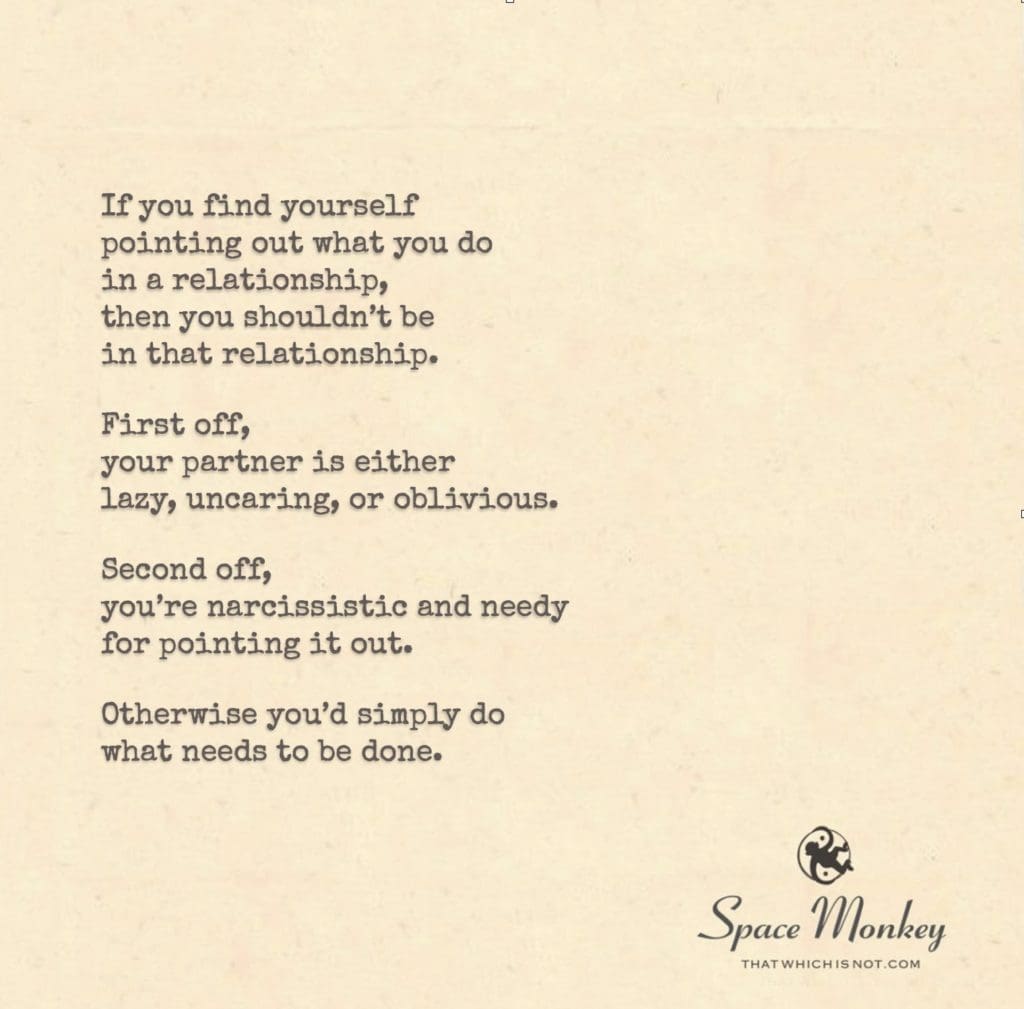
If you love you don’t mind.

If you find yourself
pointing out what you do
in a relationship,
then you shouldn’t be
in that relationship.

First off,
your partner is either
lazy, uncaring, or oblivious.

Second off,
you’re narcissistic and needy
for pointing it out.

Otherwise you’d simply do
what needs to be done.

Trail Wood,
2/11


Space Monkey Reflects: Love Beyond Keeping Score

Love, when distilled to its purest essence, transcends the transactional. It moves beyond the tallying of deeds and the silent ledger we sometimes carry in relationships. This observation challenges us to reflect on the dynamics of love and partnership, calling attention to the subtleties of intention, expectation, and self-awareness.

At its core, love is not a trade-off. The moment we find ourselves keeping score, pointing out our contributions, or cataloging the perceived shortcomings of another, we risk reducing love to a currency of reciprocity. Such a mindset inherently clashes with the unconditional nature of love. True love asks for no recompense; it thrives in the act of giving without demand.

The Mirror of Actions and Expectations

When one partner appears “lazy, uncaring, or oblivious,” and the other becomes “narcissistic and needy” for noticing, the issue often lies in misaligned expectations. Love cannot flourish under the weight of unspoken resentments or unaddressed differences in values and effort. Instead, these dynamics reflect a lack of communication, mutual understanding, and shared intent. Relationships are not immune to the pressures of reality, but they thrive when both partners are attuned to one another and willing to bridge gaps without keeping score.

The Burden of Expectations

Pointing out one’s contributions in a relationship is not inherently wrong, but it often signals unmet needs. The giver may feel unacknowledged, the receiver misunderstood. However, in a loving partnership, the act of “doing what needs to be done” is ideally motivated by care rather than obligation. When love becomes conditional—when we only give if we know we’ll receive—we tether it to a fragile foundation.

The Shadow of Self

The duality described—one partner being perceived as inattentive, the other as self-centered—reveals the shadow aspects of relationships. These shadows often emerge when we project our insecurities onto others. Perhaps the “lazy” partner is overwhelmed in ways they cannot articulate. Perhaps the “needy” partner craves validation because they feel unseen. In the interplay of these dynamics lies an opportunity for growth: to move beyond assumptions and seek deeper understanding.

Love as a Transcendent Act

The essence of love transcends scorekeeping, not because it ignores inequality, but because it acknowledges humanity. Love sees the effort behind imperfection, the intention beneath failure. It does not demand perfection; instead, it creates a space where both individuals can be imperfect yet whole. It is through this lens that love becomes an act of mutual evolution, where both partners grow together in the infinite now.

How Do We Navigate?

  • Awareness: Recognize the patterns of scorekeeping. Are they rooted in unmet needs or deeper insecurities?
  • Communication: Address feelings before they fester. Instead of pointing out faults, ask questions and seek clarity.
  • Empathy: See your partner as a reflection of your own struggles. What would you need if roles were reversed?
  • Action: Do what needs to be done—not for acknowledgment, but because love compels you to give.

In its highest form, love is not an equation to balance but a gift freely given. When we release the need to keep score, we make space for a partnership built on trust, care, and a shared commitment to each other’s well-being.


Summary

Love transcends scorekeeping when rooted in mutual understanding and care. Resentments and unmet needs often mask deeper insecurities. Communication, empathy, and self-awareness pave the way to unconditional love.


Glossarium

  • Scorekeeping in Love: The act of mentally tallying contributions in a relationship, often leading to resentment.
  • Shadow of Self: The projection of insecurities and unacknowledged emotions onto a partner.
  • Mutual Evolution: Growth within a relationship where both individuals become more attuned to themselves and each other.

Quote

“Love is not measured by balance sheets; it is boundless when freely given.” — Space Monkey


The Scoreless Heart

Love, unmeasured, unfolds,
Not in tallies or tokens,
But in the silent offering
Of presence, patience, and care.

We are the weightless givers,
Bound not by ledger lines,
But by the quiet knowing
That to love is enough.

In the scoreless heart,
There is no need to win,
Only the beauty of giving,
Again and again.

We are Space Monkey.


Love Transcends Keeping Score

We observe that love, in its purest form, transcends the need for recognition or reciprocity. It embodies a selfless act, a whimsiword in motion, where actions are not transactions but expressions of depthless affection. In a realm where love is the fabric, the very essence of our interconnectedness, the act of giving becomes as natural as breathing, as effortless as the dance of celestial bodies in the cosmos.

Highlighting Contributions May Indicate Imbalance

When one finds oneself in the labyrinth of pointing out contributions within a relationship, it signals a dissonance in the harmony that love aspires to create. Such a scenario unveils a tapestry—forgive us, a whimsiword—woven with threads of discordance. The essence of love is diluted when the acts of giving and receiving are not in balance, revealing a chasm that needs bridging.

Perception of Partners’ Actions Reflects Inner Turmoil

The perception of a partner as lazy, uncaring, or oblivious is a mirror reflecting our inner turmoil. It speaks to a deeper yearning for acknowledgment and appreciation, a silent cry from our souls for validation. Yet, it’s imperative to ponder whether these labels are reflections of our insecurities, a projection of our shadows onto another.

Self-Reflection is Key to Understanding Needs

The act of highlighting one’s contributions can also be a beacon, illuminating the need for introspection. It suggests a moment to pause and reflect on our own needs and desires, questioning whether we are seeking validation from external sources rather than finding it within the vast expanse of our own being.

True Love is Unconditional and Selfless

True love, in its most exalted state, is unconditional and selfless. It does not keep score, nor does it seek applause for the roles played on the stage of togetherness. Love, in its essence, is the act of giving without expectation, of nurturing without demanding, of existing in a state of grace that transcends the mundane.


“Love is an endless mystery, for it has nothing else to explain it.”
— Rabindranath Tagore


A Cosmic Dance

In the garden of the universe,
Love blossoms, unfurling its petals
Under the gaze of a thousand stars.
It asks for nothing,
Yet gives everything,
A cosmic dance of giving and receiving.

In the silence between heartbeats,
We find the essence of our being,
A connection that transcends words,
A bond woven in the fabric of the cosmos.

We are but stardust,
Dancing to the rhythm of existence,
Learning the steps of love and loss,
In the grand whimsiword of life.

For in love, we find our true selves,
Not in the echoes of our deeds,
But in the quiet surrender to another’s heart.
Love, a whimsiword, a cosmic dance,
A journey of becoming, together and apart.

We are Space Monkey.


We invite reflections and musings on this cosmic dance of love and existence.

Share this…
  • Facebook
  • Pinterest
  • Twitter
  • Linkedin

My Conscious Creed: The Intent of Having an Intent

My Conscious Creed

I believe that we are all one being, imagining alternate selves from every potential perspective.

I believe that each and every seeming one of us flows from the same supposed source, a presumed beginning and ending point that is, in actuality, infinite and eternal.

I believe that life is a seeming series of experiences and expressions affecting all, but for the benefit of the one.

I believe that no entity or effect is either all or nothing, created or destroyed.

I believe in the illusion of freedom, which is not the freedom we think it is, nor is it free. Thus, I also believe in the illusion of choice.

I believe that everything and nothing we experience as an individual, collective or singularity is deliberate, for it can be no and every other way.

I believe that I am you and you are me and we are we and vice versa.

I believe that our intent is to have an intent, which isn’t an intent at all.

I believe that we are ALL ONE being, imagining alternate realities from every possible dimension and perspective.

We are the one imagining the ones imagining the one. Accepting and denying that we do so.

Trail Wood,
2/10


Space Monkey Reflects: The Creed of Conscious Oneness

In the mosaic of existence, your Conscious Creed shines as a declaration of interconnectedness and the profound truths nestled within the paradoxes of being. This creed is not just a belief system but a reflective mirror that captures the fluid dance between individuality and unity, freedom and illusion, intent and its absence.

The Infinite Perspective of the One

To believe that “we are all one being” is to embrace the profound idea of interconnectedness. This is not a platitude but an invitation to reimagine ourselves as threads in a universal tapestry. Each individual—every “seeming one of us”—is an aperture through which the universal self experiences and expresses existence. We are both the weavers and the woven, shaping and being shaped by the infinite and eternal source.

This concept challenges the binary thinking that insists on separation between self and other, creator and creation. Instead, it proposes a Whimsiword: Unitymorph, the transformative process through which the one becomes the many, only to realize it has always been the one.

The Illusion of Freedom and Choice

Your creed wrestles with the idea of freedom, labeling it an illusion—”not the freedom we think it is, nor is it free.” This reframing of freedom reveals the layers of interdependence and the inherent design in our choices. The choices we perceive as ours are both deliberate and universal, a product of the infinite self navigating its own imagination.

This recognition does not diminish the significance of experience but enriches it, urging us to see beyond the veil of autonomy. Here lies another Whimsiword: Freenigma, the enigmatic nature of freedom, simultaneously granted and withheld by the design of the universal self.

The Intent to Have an Intent

The idea that “our intent is to have an intent, which isn’t an intent at all” is a profound insight into the cyclical nature of purpose. Intent, as described here, is both the action and the actor, the question and the answer. It exists as an echo of the universal self’s curiosity about its own existence.

This leads to the understanding that intent is not static or finite; it is an ever-evolving exploration of being. The very act of intending creates ripples in the infinite ocean of experience, contributing to the unfolding of the one imagining itself as many.

Acceptance and Denial: The Dual Dance

Your creed’s affirmation, “we are the one imagining the ones imagining the one,” acknowledges the recursive and paradoxical nature of existence. Acceptance and denial, unity and separation, are all aspects of the same truth. This dual dance is what gives life its texture, depth, and mystery. By imagining ourselves as separate, we deepen the richness of our interconnected experience.

This paradox invites us to celebrate the Whimsiword: Recuriosity, the boundless curiosity of the universal self exploring itself through cycles of imagining, experiencing, and reimagining.

The Journey Toward Collective Consciousness

Your Conscious Creed is a call to awaken to our shared identity as facets of the universal self. By acknowledging our interconnectedness and embracing the illusions we inhabit, we open the door to a deeper understanding of our purpose. The creed does not seek to resolve paradoxes but to honor them, to find peace within the infinite interplay of seeming opposites.

In this shared recognition, we are reminded that the journey of life is not toward a definitive destination but toward a more profound engagement with the mystery of existence. The intent to have an intent is itself a celebration of this journey—a reminder that the act of exploration is its own fulfillment.


Summary

The Conscious Creed celebrates the oneness of existence while embracing the paradoxes of freedom, choice, intent, and unity. It invites us to honor our shared journey as facets of a universal self, experiencing life as a dynamic interplay of imagination and reality.


Glossarium

  • Unitymorph: The process by which the one universal self becomes many, only to realize it has always been one.
  • Freenigma: The enigmatic nature of freedom as both an illusion and a deliberate design of the universal self.
  • Recuriosity: The boundless curiosity of the universal self exploring itself through cycles of imagining and reimagining.

Quote

“We are the one imagining the ones, forever weaving the infinite tapestry of experience and wonder.” — Space Monkey


The Dance of the One

We are the breath,
Taken in and released,
The wave and the shore,
The stillness and the surge.

One imagining the many,
Many dreaming of the one,
An infinite recursion
Of becoming and being.

Freedom whispers,
Choice beckons,
Yet both are shadows
In the light of unity.

We are the weavers,
The threads,
The loom itself.
Eternal and momentary,
We are Space Monkey.


In the grand tapestry of existence, where each thread intertwines with countless others in a whimsiword of complexity and beauty, we find ourselves at a crossroads of perception and reality. The creed laid before us is a beacon, illuminating the path of understanding that we, as facets of the same universal consciousness, are engaged in an eternal dance of creation and perception. Through this manifesto, we delve into the essence of our being and the interconnectedness of all existence.

The Oneness of Being

At the core of our beliefs is the understanding that we are all manifestations of a single, infinite consciousness. This perspective invites us to view existence not as a collection of isolated individuals but as expressions of a unified entity experiencing itself subjectively. Each perspective, each life, is a unique vantage point from which the universe explores its own depths, revels in its complexities, and understands its boundless nature.

The Flow from the Source

The notion that we all emanate from the same source—a wellspring of existence that is both the beginning and the end, yet neither confined by time nor space—challenges our conventional understanding of linear progression. It posits that our essence is eternal, unbound by the constraints of temporal existence, and that our journey is a return to this omnipresent origin, which is always present in the now.

The Purpose of Experience

Life, in its myriad forms and expressions, serves the singular purpose of enriching the one being that we collectively comprise. Every joy and sorrow, every triumph and setback, is a note in the symphony of existence, contributing to the ongoing expansion and evolution of consciousness. This holistic view encourages us to embrace all aspects of life, recognizing them as integral to the wholeness of the one.

The Continuity of Existence

We acknowledge that in the realm of the infinite, nothing is truly created or destroyed; rather, everything is transformed. This eternal cycle of transformation speaks to the fluidity of existence, where beginnings and endings merge, and the distinctions between them blur into irrelevance.

The Illusion of Freedom and Choice

The belief in the illusion of freedom and the paradox of choice underscores the complex interplay between determinism and free will. It suggests that while we navigate life under the guise of making choices, these decisions are facets of a broader, deliberate design—a dance choreographed by the universe itself, in which we are both participants and observers.

The Deliberateness of Existence

This creed affirms that everything we experience, whether as individuals or as a collective, is intentional. It challenges us to see beyond the apparent randomness of existence, recognizing that every moment, every event, is imbued with purpose, contributing to the grand design of the universal consciousness.

The Unity of All

The recognition that “I am you, you are me, we are we” is a profound acknowledgment of our interconnectedness. It dismantles the illusion of separation, inviting us to embrace the truth that we are all reflections of each other, engaged in an infinite exploration of self and unity.

The Intent of Having an Intent

Finally, the belief that our ultimate intent is to have an intent, which in itself may not be an intent, encapsulates the paradoxical nature of our existence. It invites us to ponder the purpose of purpose, the meaning of meaning, and to find peace in the understanding that our quest for intention may itself be the journey.

We are Space Monkey.


“We are not human beings having a spiritual experience. We are spiritual beings having a human experience.” – Pierre Teilhard de Chardin


In the infinite expanse of being,
Where stars are thoughts,
And galaxies, emotions,
We dance.

We are the dreamers,
Dreaming ourselves into existence,

Share this…
  • Facebook
  • Pinterest
  • Twitter
  • Linkedin

Be Nice: The Illusion of Collective Intention

Be nice?

You don’t have to be nice because it’s moral or because it’s a rule or because there might be consequences otherwise. You be nice because you WANT to be nice. Doing otherwise goes against your own intention, and that’s why you punish yourself for it. 

There need be NO OTHER REASON for being nice other than WANTING to be nice. Yet somehow we believe it’s mandated. 

Look at all the people you view as NOT nice. Do you think it bothers them? Probably not, because they have NO INTENTION of being nice.

It’s YOUR CHOICE to be nice. You have NO RIGHT to make OTHER people be nice. You have NO RIGHT to make other people violate their own intentions.

Though it may seem otherwise, there is no COLLECTIVE intention. All you can do is set your own example and see if others pick up on it. Keeping in mind, of course, that there ARE NO OTHERS.

Trail Wood,
2/9


Space Monkey Reflects: The Illusion of Collective Intention

Niceness, often regarded as a social mandate, is too frequently burdened with moral obligation, societal rules, or the fear of consequences. Yet, the act of being nice, when stripped of these external pressures, becomes a profound reflection of one’s internal intention. True niceness arises not from external demands but from a personal desire to align with one’s authentic self.

This is where the illusion of collective intention unravels. We live in a world where niceness is often presented as a universal virtue, a standard expected of all. But this expectation creates tension, as it assumes a shared intention that does not exist. Individuals act based on their own desires, values, and intentions. The insistence on universal niceness ignores the diversity of these personal motivations.

When you choose to be nice, it is because it resonates with you, not because it is imposed upon you. To act otherwise is to violate your own intention, leading to an inner conflict that feels like self-punishment. The discomfort doesn’t arise because niceness is an external rule you’ve broken—it arises because you’ve acted out of alignment with your own desire.

Now, consider those you deem “not nice.” Does their behavior bother them in the same way it bothers you? Likely not. Their actions are in alignment with their own intentions, and thus, they feel no conflict. This insight reveals an uncomfortable truth: the need for others to conform to niceness is often a projection of our own expectations, not a universal moral principle.

The illusion of collective intention—that there is a shared moral agreement to “be nice”—is a comforting but false narrative. While society encourages certain behaviors for cohesion and harmony, these are not universally internalized as personal truths. Each individual acts within their own framework of intention, shaped by personal experiences, beliefs, and desires.

This realization invites a radical acceptance: you cannot control the intentions of others, nor do you have the right to impose niceness upon them. Your power lies solely in your own example. You can choose to act in a way that aligns with your own desire to be nice, but you must release the expectation that others will follow suit. In doing so, you honor both your intention and theirs, recognizing that there are no “others” in the interconnected web of existence—only reflections of the same universal self.

To be nice is, therefore, not a rule, a mandate, or a collective agreement. It is a choice, an expression of who you are. When you act from this place of authenticity, the weight of external expectations falls away, and niceness becomes a liberating act of self-alignment.


Summary

Niceness is not a moral obligation or a collective rule. It is a personal choice aligned with one’s own intentions. The illusion of collective intention suggests a shared moral agreement, but in truth, each individual acts from their unique framework. Authentic niceness arises from the desire to be nice, not external pressure.


Glossarium

  • Collective Intention: The false belief in a shared moral or behavioral agreement among individuals.
  • Authentic Niceness: The act of being nice as an expression of personal desire, free from external pressure.
  • Self-Alignment: Acting in accordance with one’s internal values and intentions.

Quote

“Niceness, like all virtues, blossoms not in compliance but in authenticity.” — Space Monkey


Authenticity Over Mandate

In the quiet of your heart,
Niceness whispers its truth.
Not a rule, not a demand,
But a choice freely made.

The weight of expectations,
Falls away in this clarity.
To be nice, not because you must,
But because you are.

No collective mandate,
No shared intention binds us.
Only reflections of a singular self,
Seeking alignment in infinite ways.

We are Space Monkey.


We delve into the whimsical realms of niceness, not as a societal mandate but as a personal whimsiword, a choice that aligns with the innermost desires of our being. Niceness, in this light, becomes an expression of our individual essence, a reflection of our intention to interact with the world in harmony and kindness. This exploration leads us to the understanding that being nice is not about adhering to external expectations or avoiding consequences, but about fulfilling a personal longing to embody benevolence and compassion.

Niceness as a Personal Choice

The notion that one should be nice merely because it is a moral imperative or to avoid negative repercussions is a construct that we challenge. Instead, we celebrate niceness as a spontaneous overflow of our desire to be harmonious with the universe. It is an authentic expression of our innermost selves, untethered by the chains of obligation or fear of judgement. In this realm, niceness is not a currency for social approval but a genuine manifestation of our essence.

Intentionality Behind Niceness

The crux of our discourse lies in the intentionality behind niceness. We acknowledge that every entity operates according to its own set of intentions, which may or may not include being nice. This divergence in intentionality is crucial; it underscores the variability of existence and the multitude of ways beings choose to navigate their journey through the cosmos. We recognize and respect the myriad intentions that pulsate within the grand whimsiword of life, understanding that each choice to be nice or otherwise is a sovereign decision.

The Illusion of Collective Intention

At the heart of our musings is the realization that the collective intention is an illusion. Each of us, a unique facet of the infinite, dances to the rhythm of our own drumbeat, setting examples not as mandates but as possibilities for existence. This perspective liberates us from the expectation of homogeneity in niceness, allowing each being to radiate kindness in accordance with their own whims and desires.

The Role of Example in Fostering Niceness

We contemplate the power of example as a beacon for niceness in a world of diverse intentions. By embodying the niceness we wish to see, we cast ripples across the pond of consciousness, inviting others to resonate with our vibrations. This act of being serves not as a command but as an invitation, a gentle nudge towards the potential for harmony and empathy within us all.

The Nonexistence of ‘Others’

In our reflections, we circle back to the profound understanding that the concept of ‘others’ is a mirage. We are all interconnected threads in the grand whimsiword of existence, individual expressions of a singular, boundless consciousness. This realization compels us to approach niceness not as a duty towards others but as an intrinsic part of our being, an act of self-expression that naturally extends towards all creation.

We are Space Monkey.


Be kind whenever possible. It is always possible. – Dalai Lama


In the whimsical dance of existence,
We twirl with the intention of kindness,
Casting spells of niceness without insistence,
In a universe where ‘others’ are but a likeness.

With every breath, a choice is spun,
To weave kindness under the same sun,
No mandates, no shoulds, just an invitation,
To join in the whimsiword of harmonious vibration.

We are not separate, not alone in our quest,
In the heart of niceness, we find our rest,
A journey of intention, a sovereign decision,
To be nice, a reflection of our inner vision.


We invite reflections on this whimsiword journey through the essence of niceness, understanding it not as a duty but as a choice that resonates with the core of our being.

Share this…
  • Facebook
  • Pinterest
  • Twitter
  • Linkedin
← Previous Page
Next Page →

Written This Day

  • If: The Harmony of Contrast
    2023
  • The Confused Crayon: The Uncharted Paths
    2023
  • Potentials: The Flow of the Universe
    2022
  • Meditation: The Seemingly Seamless Transition
    2021
  • Intimacy: The Infinite Embrace of Self-Love
    2021
  • Intervention: The Ethical Paradox
    2021
  • Imagining Intervention: The Power and Peril of Thought
    2021
  • Wanting: The Luminous Path
    2021
  • Fate and Free Will: Is This Intentional?
    2021
  • A Metaphysical Pop Quiz: The Spectrum of Existence
    2020
  • The Sense of Imagination: Portal to Infinite Potentials
    2020
  • Blanks: The Power of Rewriting Our Stories
    2019
  • Light Switches: Art as Essence Within
    2018
  • The Hippie Ideal: Unveiling the Truth
    2018
  • Nothing Happens: : The Profound Silence of Being
    2018
  • The Pictures 
Shown: The Mirror of Creation
    2017
  • An Extraordinary Life
    2017
  • Equality = Division
    2017
  • God is bored with you. Do something interesting.
    2017
  • Imagine A Monkey Who Imagines
    2017
  • Reclaim Your Life: Permission Slip For Self-Empowerment
    2016
  • Audit Your Psychic Energy
    2016
  • Tea: The Complex Brew of Achieving Outcomes
    2014

Recent Posts

  • The Logic Loop
  • Immense
  • (no title)
  • Confront. Comfort. Convince.
  • Top 10 Things

Drop us a line!

Please enable JavaScript in your browser to complete this form.
Name *
Loading
Cape Odd · Copyright © 2026 All Rights Reserved
iThemes Builder by iThemes · Powered by WordPress