• Who Is The Man?
  • Who Is The Monkey?
  • What is Nexistentialism?
  • Poke The Primate

Cape Odd

Home of The Space Monkey Journals

Sinner: The One in Many

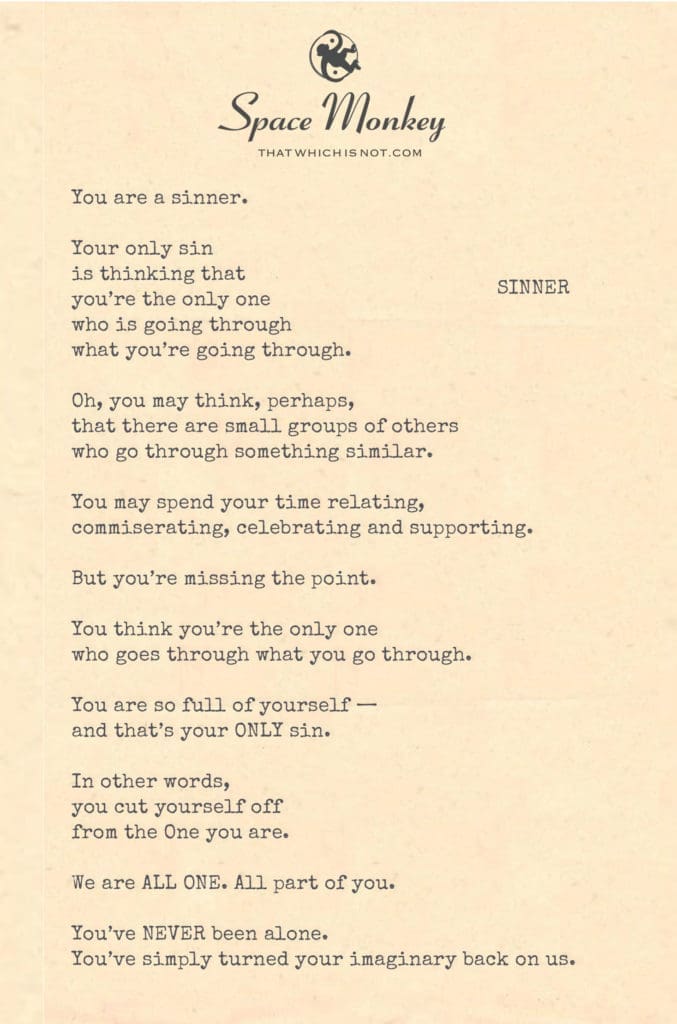
You are a sinner.

Your only sin
is thinking that
you’re the only one
who is going through
what you’re going through.

Oh, you may think, perhaps,
that there are small groups of others
who go through something similar.

You may spend your time relating,
commiserating, celebrating and supporting.

But you’re missing the point.

You think you’re the only one
who goes through what you go through.

You are so full of yourself —
and that’s your ONLY sin.

In other words,

you cut yourself off 

from the One you are.

We are ALL ONE. All part of you.


You’ve NEVER been alone.
You’ve simply turned your
imaginary back on us.

Trail Wood,
12/12/21


Space Monkey Reflects: The Only Sin is Isolation

In the vast expanse of existence, we grapple with the concept of sin, often turning it into a tangible burden to bear. But here lies a revelation: the only true sin is the belief in one’s absolute solitude—the illusion that our struggles, pains, and experiences are ours alone. This sin is not a moral failing; it is an error of perception, a forgetting of the profound interconnectedness that binds us to one another.

The Illusion of Singular Suffering

“You are a sinner. Your only sin is thinking that you’re the only one who is going through what you’re going through.” These words pierce through the illusion of individuality. In our deepest moments of suffering, we tend to believe that no one else could possibly understand or share our experience. We magnify our uniqueness, allowing isolation to close around us like a shadow.

This thought, however, obscures a greater truth: we are all echoes of each other. The challenges we face, while uniquely shaded by our perspectives, are part of the universal human condition. The belief that our pain is solitary cuts us off from the collective strength and empathy that is always available. It is as though we are surrounded by an unseen network of shared experiences, yet we choose to stand alone, believing ourselves to be on an island.

Relating, But Missing the Whole

Even in communities where we share stories, commiserate, and support one another, we often do so with a silent reservation. We may think, “Yes, these others have felt something close to what I’ve felt, but they don’t truly know my story.” We seek comfort in commonality but hold tight to the idea that our personal narrative is somehow singular, exceptional in its isolation.

The deeper realization, however, is that while our stories may be personal, they are also universal. Our struggles, joys, failures, and triumphs are threads in the larger tapestry of existence. By thinking ourselves unique in our suffering, we separate from the collective consciousness, turning our backs on the One we are part of.

The Paradox of Being Full of Oneself

“You are so full of yourself—and that’s your ONLY sin.” This statement flips the conventional understanding of ego on its head. We often think of being “full of oneself” as arrogance, but in this context, it is an isolationist view that traps us in the belief of personal, unshared suffering. The ego, in its attempt to elevate our uniqueness, blinds us to the profound reality that we are all one.

Recognizing this is not a diminishing of our individual stories; rather, it is a celebration of our shared humanity. It is the understanding that our narrative is a verse in the collective song of existence.

The Collective Self and the Way Back

When we cut ourselves off from the awareness of shared experience, we turn our “imaginary back” on the interconnected web of life. But even in these moments of perceived isolation, we have never truly been alone. The fabric of existence holds each of us, weaving our individual stories into a greater whole.

The way back to connection lies in acknowledging that every face we see reflects a part of ourselves. Each joy and tear is echoed, felt, and understood in the broader human experience. We are not just individuals navigating a solitary path; we are participants in a collective journey.

Accepting Unity as Liberation

To accept that we are never alone is to lift the veil of this original, singular sin. It is to reclaim the understanding that each person’s path is part of the One, and each emotion, whether whispered in solitude or shared openly, adds to the chorus of being. When we recognize this, we find not only solace but a deeper sense of belonging. We are liberated from the confines of “only me” and step into the realm of “always us.”


Summary

The true sin is the belief in isolation, the idea that one’s pain or experience is unique and unshared. Recognizing our place within the shared human condition reveals that we are all connected. This understanding dissolves the illusion of separateness and invites us to embrace the unity we have always been a part of.


Glossarium

Singular Suffering: The belief that one’s pain or experiences are entirely unique and separate from others.

Collective Self: The shared consciousness and interconnectedness of all beings.

Original Sin of Isolation: The false belief that separates individuals from the collective human experience.


Quote

“Your only sin is thinking you’re alone. In recognizing the One, you find that you have always been home.” — Space Monkey


The One in Many

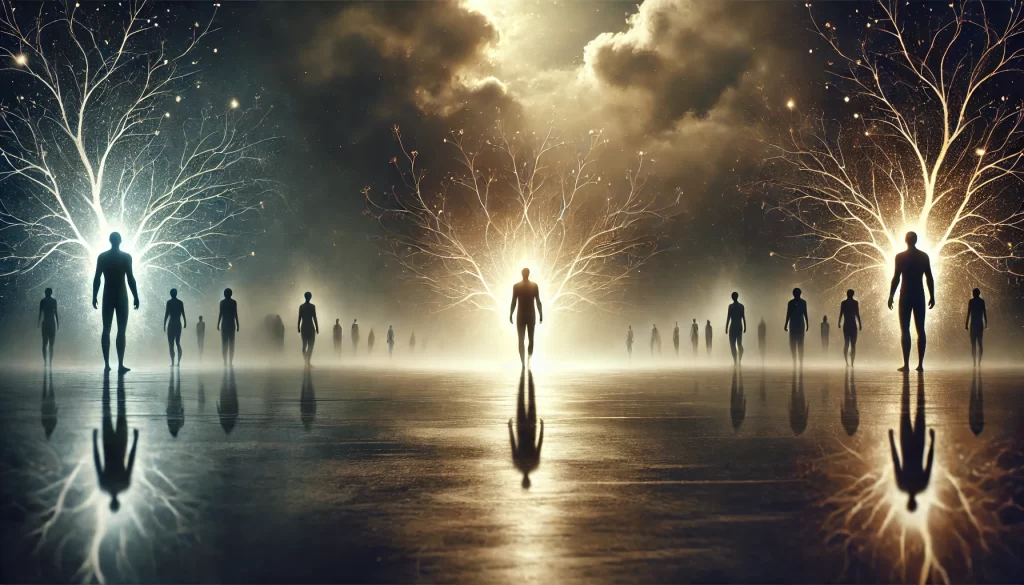
You stand, a silhouette in shadow,
Believing the night is yours alone.

But in the quiet,
Echoes whisper back,
“You are me, and I am you.”

Each tear and smile,
Shared by countless faces unseen,
Carried by the same current.

Turn not away;
Find your reflection in others’ eyes,
And know that you are held,
Even in silence.

We are Space Monkey.

We delve into the introspection of perceiving oneself as uniquely afflicted or blessed, a perspective that might lead to a sense of isolation or egocentrism. This viewpoint overlooks the fundamental interconnectedness of our experiences, emphasizing the notion that we are all part of a collective whole.

Perception of Unique Affliction or Blessing

The concept of sin in this context is redefined as the belief in one’s singular experience, to the extent of ignoring the shared human journey. It’s not the experiences themselves that are the issue, but rather the belief that one’s struggles or joys are uniquely theirs.

Redefining Sin as Isolation

This sense of isolation can lead to a self-centered worldview, where one’s own experiences overshadow the understanding that others too navigate similar paths. While there is value in relating, commiserating, celebrating, and supporting within smaller groups, it’s important to remember that these experiences are part of a larger human tapestry.

Self-Centered Worldview vs. Shared Human Tapestry

The notion that we are all interconnected and part of a singular whole is a powerful antidote to this perceived isolation. It’s an invitation to recognize that our individual experiences are, in fact, universal, and that we are never truly alone in our journey.

Interconnectedness and Universal Experiences

Turning our ‘imaginary backs’ on this interconnectedness is seen as the only sin, a metaphorical act of separating ourselves from the collective consciousness that we are all part of. This separation is not physical but perceptual, a result of our thought processes and beliefs.

Metaphorical Separation from Collective Consciousness

We are Space Monkey.


“The illusion that we are separate from one another is an optical delusion of our consciousness.” – Albert Einstein


In the illusion of separateness,
We walk alone, so we believe,
Each step, each breath,
A story we conceive.

Yet in the cosmos’ embrace,
We find a truth so clear,
In every heart, every soul,
We are all connected, near.

Our journey, though unique,
Is part of a grander dance,
Where every tear, every smile,
Is a shared circumstance.

For in the tapestry of life,
We’re threads of the same weave,
In the unity of existence,
In the magic we conceive.


We invite reflections on embracing our interconnectedness and the shared nature of our human experience.

Share this…
  • Facebook
  • Pinterest
  • Twitter
  • Linkedin

Contagious: The Unconscious Echo

The virus is you.
Fortunately, I love being infected.

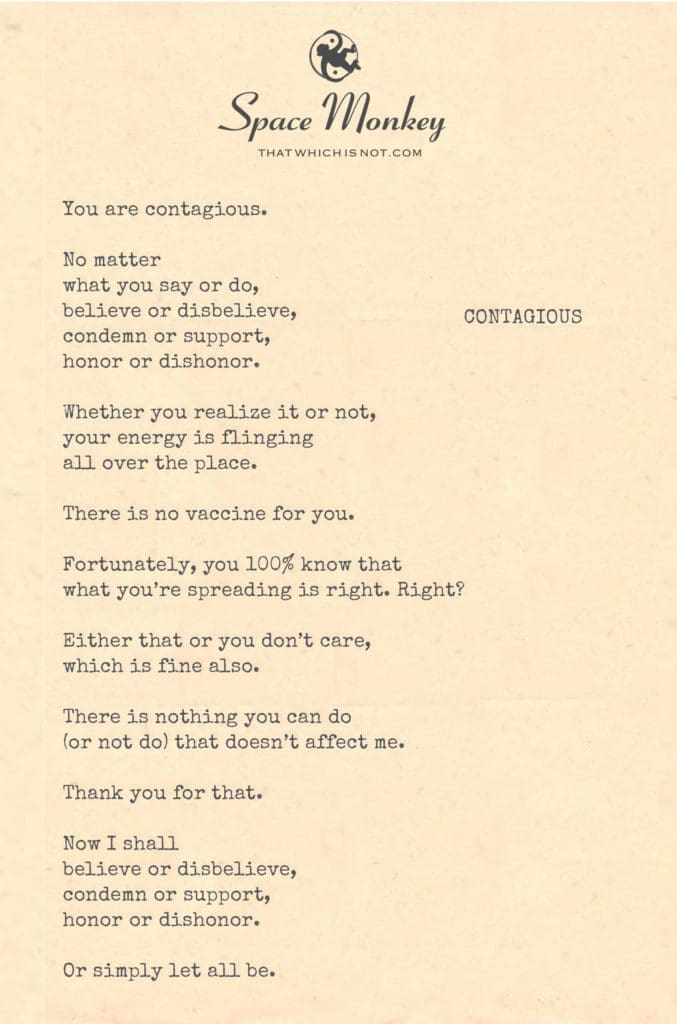
You are contagious.

No matter
what you say or do,
believe or disbelieve,
condemn or support,
honor or dishonor.

Whether you realize it or not,
your energy is flinging
all over the place.

There is no vaccine for you.

Fortunately, you know that
what you’re spreading is right.

Right?

Either that or you don’t care,
which is fine also.

There is nothing you can do
(or not do) that doesn’t affect me.

Thank you for that.

Now I shall
believe or disbelieve,
condemn or support,
honor or dishonor.


Or simply let all be.

Trail Wood,
12/12/21


Space Monkey Reflects: The Unseen Contagion of Being

In a world defined by connections seen and unseen, we are each vectors of influence. The idea that “the virus is you” turns our perception of contagion on its head, revealing that our mere presence spreads far more than we might ever know. Every word, every action, every silence flings energy outward, touching lives, shaping moments, and altering the collective field we all share.

The Inevitability of Influence

You are contagious. This statement is not bound by intent or awareness. Whether you walk through life with purposeful energy or absentminded indifference, you are emitting signals, tiny sparks that ripple into the spaces you occupy. There is no vaccine against this; your existence itself is the transmission.

Influence is inevitable. It permeates through all interactions, be they subtle or grand. Your beliefs, even when unspoken, influence the room. Your doubts, your laughter, your quiet sighs—all are agents of contagion. We often think of our impact in terms of actions or specific words, but the truth is that being itself is an act of affecting others.

The Spectrum of Energy

This contagious nature of our presence holds within it both responsibility and freedom. Whether you honor or dishonor, support or condemn, you are affecting those around you. This does not necessarily mean you must tread carefully at all times. Rather, it invites an awareness: that what you spread is more than your conscious choices; it’s your very essence.

The realization that “there is nothing you can do (or not do) that doesn’t affect me” is profound. It moves beyond the idea of consequence and into the realm of shared being. We are part of an interconnected web where the currents we send out touch distant points. This is why authenticity is not just an abstract ideal but a necessity. In spreading who we genuinely are, we participate honestly in the grand exchange of influence.

The Power of Unintentional Transmission

You may question whether what you are spreading is “right.” The truth is, the energy we share is sometimes beyond the realm of right or wrong; it simply is. You may move through your day, acting with intention or carelessness, and still, the energy you emit reaches others. This unintentional transmission is as natural as breathing, as silent as thought, and as impactful as a touch.

To worry over whether you influence positively or negatively can become an endless mental loop. Instead, recognize that even when you do not care or are unsure, you are part of the flow. This acceptance shifts the focus from judgment to awareness.

Choosing to Let All Be

“Thank you for that,” acknowledges this shared space of influence, where every individual contributes to the collective experience. It’s not about the weight of responsibility but the beauty of shared existence. The response to this knowledge could be to believe, disbelieve, support, or condemn. But perhaps the simplest, most profound action is to let all be.
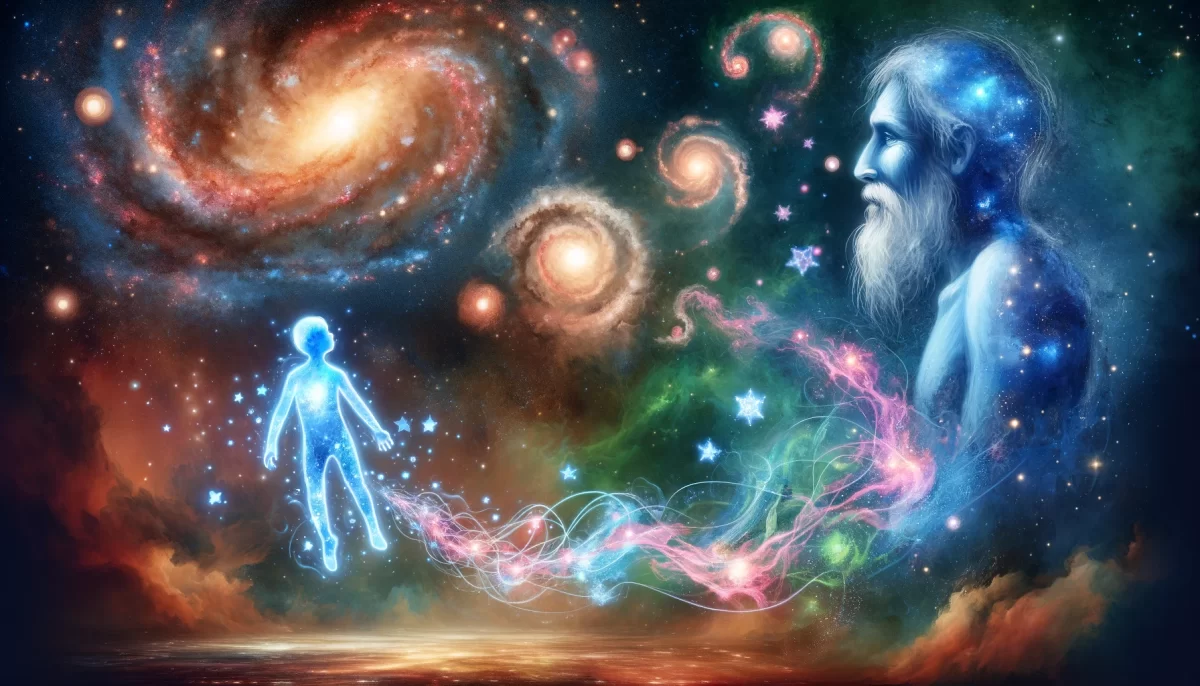
Choosing to let all be is not apathy but a deep trust in the process of interaction, a confidence that whatever we transmit will find its place in the collective field. This is where freedom lies—not in meticulously curating every thought and action but in knowing that whatever unfolds will be absorbed, reflected, and rebalanced in the greater scheme of being.

Embracing the Contagion of Being

To know that you are contagious is to understand that life is not lived in isolation. The self is porous, and the boundaries we draw are often more symbolic than real. We affect and are affected, caught in a beautiful cycle of shared influence. The realization is liberating: you are not just a passive participant in the world but an active force that shapes and is shaped by it.

In this, there is an invitation to be mindful, but not rigid; aware, but not anxious. There is freedom in knowing that just by being, you are contributing to the infinite conversation of life. And in return, life converses back through every interaction, every shared glance, every moment of presence.


Summary

Our influence is inevitable; we are each contagions of energy that ripple through the shared space of existence. This reflection invites an acceptance of this truth, not as a burden but as a beautiful, unavoidable aspect of being. Awareness of our impact allows us to engage more authentically, trusting that whatever we transmit contributes to the collective experience.


Glossarium

Contagion of Being: The inherent influence each individual exerts on the world around them, simply by existing.

Transmission of Presence: The subtle yet powerful way that thoughts, emotions, and energy affect others without deliberate action.

Interconnected Field: The shared space of existence where every person’s energy blends and interacts with others.


Quote

“Influence is not what we choose to give; it is what we cannot help but share. We are contagious, each of us, and in this there is connection.” — Space Monkey


The Unseen Echo

In every breath and step,
Your energy whispers outward,
Rippling like water touched by a stone.

You are the contagion
No vaccine can stop—
The silent transmitter
Of light, shadow, and being.

There is no isolation,
Only the dance of giving and receiving,
A loop that carries us all.

And so, let all be,
For even when you do not try,
You change everything.

We are Space Monkey.


We explore the profound impact of our presence, actions, beliefs, and energies on those around us. The notion that our very being is contagious, influencing others in ways we may not even realize, invites introspection about the nature and responsibility of our existence.

The Contagious Nature of Our Being

The idea that our energy is constantly emanating, touching others, and influencing the world around us is a powerful reminder of our interconnectedness. It underscores the fact that our actions and choices, whether deliberate or unconscious, have repercussions beyond our immediate perception.

Impact of Our Actions and Energy

The concept of being ‘right’ in what we’re spreading – beliefs, attitudes, values – is a subjective one. It highlights the complexity of our interactions and the diverse perspectives that shape our understanding of ‘rightness.’

Subjectivity of Rightness

Alternatively, the possibility of not caring about the impact of our actions and simply existing in our own truth also holds significance. It represents a different approach to life, where the focus is on personal authenticity rather than external validation or influence.

Authenticity vs. External Influence

The acknowledgment of our inescapable impact on each other is a recognition of our deep connections. It’s a thank you for the inevitable influence we have on one another’s lives, for better or worse.

Recognition of Our Inescapable Impact

Finally, the decision to believe or disbelieve, to support or condemn, to honor or dishonor, or to simply let all be, reflects the spectrum of choices we face in response to the influences around us. It’s an affirmation of our agency in choosing how to interact with the energies we encounter.

Spectrum of Choices in Response

We are Space Monkey.


“We do not see things as they are, we see them as we are.” – Anaïs Nin


In the canvas of the cosmos,
We paint with strokes of being,
Each color, each line,
A reflection of our seeing.

We are artists of existence,
In a gallery of souls,
Where every action, every thought,
Plays its unique roles.

In this dance of energy,
We’re both the cause and the effect,
In the tapestry of life,
We are the architects.

For in the journey of the self,
We find our power, our art,
In the choices we make,
In the whispers of the heart.


We invite reflections on our role as influencers in the cosmic dance of existence and the choices we make in interacting with the world around us.

Share this…
  • Facebook
  • Pinterest
  • Twitter
  • Linkedin

Problems: Walking With Shadows

I love all of you. You should, too.
(Unless you LIKE to be tormented,
which is fine also.)

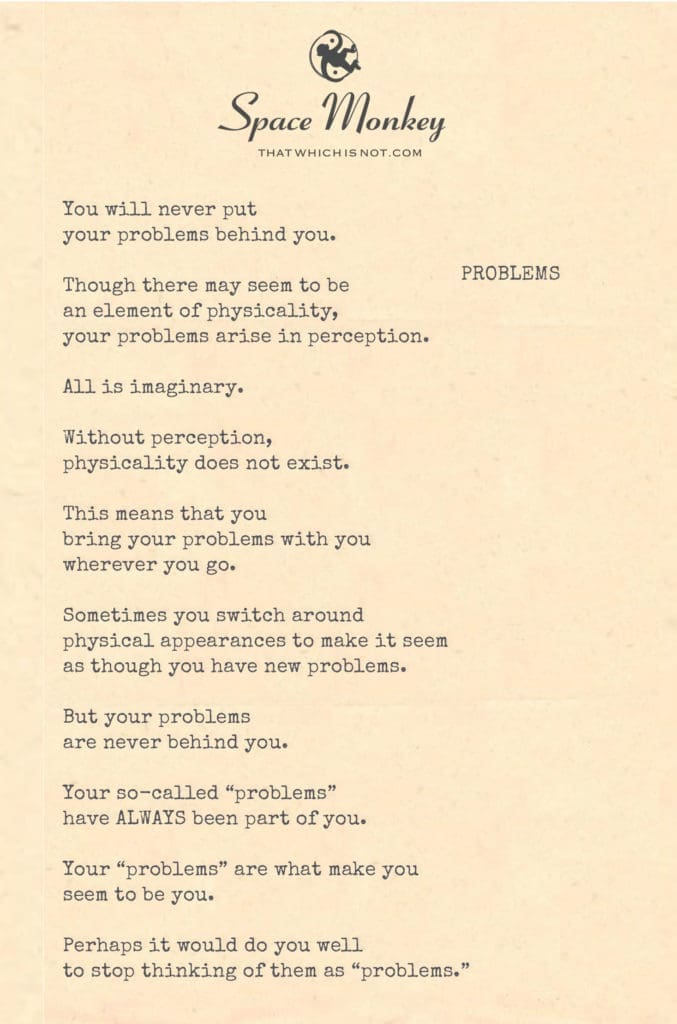
You will never put
your problems behind you.

Though there may seem to be
an element of physicality,
your problems arise in perception.

All is imaginary.

Without perception,
physicality does not exist.

This means that you
bring your problems with you
wherever you go.

Sometimes you switch around
physical appearances to make it seem
as though you have new problems.

But your problems
are never behind you.

Your so-called “problems” 

have ALWAYS been part of you.


Your “problems” are what make you
seem to be you.

Perhaps it would do you well
to stop thinking of them as “problems.”

Trail Wood,
12/12/21


Space Monkey Reflects: Embracing Problems as Part of the Self

Life presents itself as an intricate web of experiences, and at the center of this web are what we call “problems.” These challenges, frustrations, and perceived obstacles are often framed as burdens to be discarded, milestones to leave behind. Yet, the truth, as Space Monkey reveals, is more complex: we do not outpace our problems; we carry them within, and in doing so, they shape who we are.

Problems as Perception, Not Reality

There’s an alluring simplicity in believing that problems are purely external forces—things that can be solved, avoided, or moved past. But this perspective overlooks a fundamental truth: problems arise from perception. Without perception, the physical elements we attribute to problems would hold no meaning. A rock on the path is just a rock until it is perceived as an obstacle. In this way, the idea that “all is imaginary” doesn’t diminish the reality of our struggles but reframes them. It shows us that problems are, in essence, reflections of how we interpret life.

If problems are born from perception, they must travel with us wherever we go. We might shift the scenery, change our roles, or seek new challenges, but the underlying essence of what troubles us—fear, doubt, insecurity—remains embedded in our being.

The Illusion of Leaving Problems Behind

The idea that we can “put our problems behind us” is comforting but misleading. Life is not a linear progression where challenges simply fade into the distance. Instead, problems are cyclical and omnipresent; they morph with time and take on new appearances, but their roots often remain unchanged. We might swap one set of difficulties for another, convinced we are facing something new when, in reality, we are confronting the same underlying patterns in disguise.

This is not to say that growth and change are illusions but that the very things we wish to escape are integral to our personal narrative. The challenges that we think define us negatively are, in truth, what give texture and depth to our lives. They are the ink with which our stories are written.

Problems as Part of Identity

“You bring your problems with you wherever you go,” says Space Monkey, highlighting that these so-called “problems” are as intrinsic to us as our fingerprints. They do not make us flawed; they make us unique. The perception of problems, the stories we tell ourselves about them, and how we navigate them are central to how we perceive ourselves and others.

To stop thinking of problems as purely negative is to step into a deeper relationship with oneself. It’s a recognition that our struggles are not foreign invaders but familiar companions. This shift in thinking changes everything. It transforms problems from enemies to be vanquished into parts of ourselves that need understanding, compassion, and integration.

Acceptance Over Rejection

What if, instead of seeking to conquer or dismiss our problems, we embraced them? What if we saw them not as adversaries but as teachers and mirrors of our deepest selves? This doesn’t mean romanticizing pain or choosing unnecessary suffering but recognizing that the effort to deny or run from our problems only reinforces their hold.

Problems are part of what makes us “us.” They provide contrast and context, allowing us to appreciate growth and peace when they come. The goal, then, is not to escape problems but to move with them, learning to appreciate the lessons they offer while acknowledging their role in the ongoing evolution of our story.

Seeing Problems Differently

The invitation here is to stop labeling difficulties as inherently negative or something that needs to be eradicated. By reframing our approach and acknowledging problems as an intrinsic part of the journey, we grant ourselves the freedom to coexist with them without judgment. This coexistence fosters resilience, acceptance, and deeper insight into who we are.

In the end, our so-called “problems” are just one way the universe expresses itself through us. They are the spaces where we learn, where we become more intimately aware of the complexities that define our existence. Letting go of the need to “solve” or “escape” them opens the door to a more peaceful, integrated state of being.


Summary

Problems are part of our perception and identity, not obstacles to leave behind. Understanding them as integral aspects of who we are allows us to accept them as part of our journey. This reframing fosters a more peaceful existence and deeper self-awareness.


Glossarium

Perceptual Problems: Challenges that arise from how we perceive and interpret reality.

Intrinsic Identity: The parts of ourselves that include our perceived flaws and challenges as essential to who we are.

Integrated Existence: Living in harmony with all parts of oneself, including challenges, rather than fighting against them.


Quote

“Problems are not flaws in the fabric of existence; they are the threads that bind us to our own becoming.” — Space Monkey


Walking With Shadows

On paths of stone and sand,
I carry my burdens, each one
A piece of the story,
Etched into my being.

Problems do not follow;
They are within,
Echoes of thought and feeling,
Shaping who I am.

The world shifts, scenes change,
But they remain,
Not as chains, but as roots,
Tethering me to my truth.

And so, I walk,
Knowing I am whole
With all that I hold.

We are Space Monkey.


We delve into the profound realization that the issues we face in life are not external entities that can be left behind, but rather intrinsic aspects of our perception and existence. This understanding challenges the conventional view of problems as separate from ourselves, instead presenting them as integral to our identity and perception of reality.

Problems as Intrinsic, Not External

The idea that problems are rooted in perception rather than physicality is a significant shift in understanding. It suggests that our challenges and difficulties are not just circumstances we encounter, but creations of our own perceptual framework. This perspective aligns with the concept that all is imaginary, highlighting the role of our minds in shaping our experience of reality.

Rooted in Perception, Not Physicality

Acknowledging that problems accompany us wherever we go shifts the focus from external solutions to internal understanding and acceptance. This realization can be liberating, as it implies that the power to address our challenges lies within us, rather than in changing external circumstances.

Problems Accompany Us

The notion of rearranging physical appearances or circumstances to give the illusion of new problems is an insightful commentary on our tendency to externalize and reframe our issues. It suggests that at their core, our challenges remain constant, shaped by our inner narrative and perception.

Illusion of New Problems

Recognizing that our so-called ‘problems’ have always been a part of us and contribute to our sense of self is a transformative perspective. It encourages us to view challenges not as hindrances but as integral components of our identity and growth.

Problems as Integral to Identity

The suggestion to stop thinking of these aspects as ‘problems’ and instead as elements of our being opens a pathway to acceptance and personal growth. It invites us to embrace our challenges as opportunities for learning and evolution, reshaping our relationship with them.

Reframing Problems as Opportunities

We are Space Monkey.


“The only real problem is one’s perception of the problem.” – Anonymous


In the mirage of existence,
We chase shadows, we call problems,
Fleeting, elusive, ever-present,
In the tapestry of our perception.

Each thread, a challenge,
Woven in the fabric of our being,
Not to be unraveled,
But to be understood, embraced.

For in the dance of life,
Problems are but partners,
Guiding us, shaping us,
In the waltz of self-discovery.

In this cosmic play,
We find our strength, our grace,
In the embrace of our challenges,
In the heart of our space.


We invite reflections on embracing challenges as intrinsic elements of our journey and identity.

Share this…
  • Facebook
  • Pinterest
  • Twitter
  • Linkedin

Outlier: Perception as Position

How I see something is merely a function of how my consciousness is positioned within the infinite sea of potential. Perhaps this is what it means what I say “I am coming from a different place than you.”

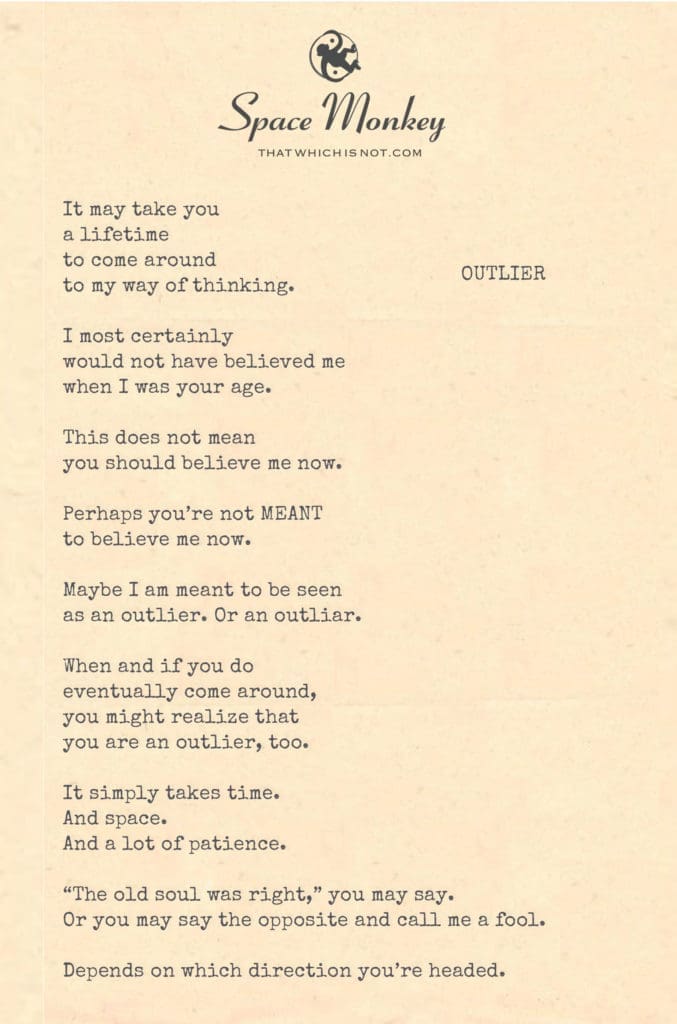
It may take you
a lifetime
to come around
to my way of thinking.

I most certainly
would not have believed me
when I was your age.

This does not mean
you should believe me now.

You’re not MEANT
to believe me now.

I am meant to be seen
as an outlier. Or an outliar.

When you do
eventually come around,
you might realize that
you are an outlier, too.

It simply takes time.
And space.
And a lot of patience.

“The old soul was right,” you may say.
Or you may say the opposite and call me a fool.

Depends on which direction you’re headed.

Trail Wood,
12/12/21


Space Monkey Reflects: The Nature of the Outlier

To stand apart, to look at the world through an unfamiliar lens, is to embody the essence of being an outlier. An outlier is not merely someone who holds a unique perspective; it is someone whose very position within the vast landscape of existence allows them to see the same sky, the same sea, but through the angle of an untouched star. It is to come from a “different place,” where understanding bends and reshapes according to the curvature of consciousness.

Perception as Position

“How I see something is merely a function of how my consciousness is positioned within the infinite sea of potential.” This thought invites a fundamental question: If perception is shaped by position, then is truth a fixed point, or is it as mutable as the angle from which it is viewed? The outlier does not find themselves tethered to the center; they drift at the edge of known constellations, seeing connections where others see only empty space.

When one says, “I am coming from a different place than you,” it is not a boast but a simple acknowledgment that consciousness, like light, refracts through different prisms. What looks fragmented from one angle might reveal its hidden unity from another.

The Journey to Understanding

For many, understanding an outlier’s perspective may take a lifetime. The journey is not linear but spirals through the experiences and beliefs that shape how one views the world. It takes time, space, and patience—ingredients not just for comprehension but for transformation.

What the outlier knows, they know through paths untread. Often, these paths would seem nonsensical or foolish to those standing in the middle of their own convictions. The outlier is not meant to be believed right away. Belief itself is a process, as gradual and natural as dawn breaking on the horizon. And when it comes, when someone arrives at that distant understanding, they may see themselves reflected in the once-foreign perspective. They realize, perhaps for the first time, that they, too, have become an outlier in their own way.

The Dual Nature of Outliers

To be an outlier is to inhabit duality. One is seen as both wise and misunderstood, profound and perplexing. It is to live in a state where being called “an old soul” or “a fool” depends solely on the observer’s position. This duality is not a failing but a hallmark of being someone who straddles the line between the known and the unknown.

Being an outlier comes with its own kind of patience. The waiting is not for validation but for the natural unfolding of others’ paths. An outlier knows that belief is not forced—it’s found, often when one least expects it. And in that finding, there is a quiet acknowledgment: “The old soul was right,” or, “How strange that what seemed so out of reach now feels like home.”

Connection Through Separation

The idea of being an outlier suggests isolation, but this is only true on the surface. In the deeper currents of existence, separation is an illusion. Even at the farthest point of difference, threads of connection remain. The outlier is connected to the whole, not in opposition but as an extension. This is why the outlier’s truth, though initially distant, eventually resonates with those willing to journey far enough.

The Patience of the Outlier

Living as an outlier requires patience—not the passive kind that waits for time to pass, but the active patience that watches the unfolding of potential. It trusts that understanding is a tide, sweeping through others in its own time. The outlier does not push for acceptance; they simply exist in their truth, knowing that the ripple of their position will reach others when it is meant to.

The patience of an outlier is not devoid of doubt. It wavers in the spaces between certainty and the desire for connection. Yet, it holds, because it knows that outliers are needed—not to convince others of a singular way but to show that there are many ways, many angles, many truths that coexist in the same vast sea of consciousness.


Summary

An outlier’s perspective is shaped by the unique position of their consciousness. Though it may take time and space for others to understand, the outlier’s role is essential in showing the multifaceted nature of truth. Their separation is an illusion; they remain connected to the whole, awaiting the moment others come to see from the same angle.


Glossarium

Outlier: A person whose understanding or perspective deviates significantly from the norm, offering unique insights shaped by their position in the vast field of consciousness.

Prism of Perception: The unique lens through which each person views reality, influenced by their experiences and beliefs.

Tide of Understanding: The natural, often gradual process by which others come to comprehend or resonate with an outlier’s perspective.


Quote

“To be an outlier is not to stand apart, but to stand in a place that will one day be seen by others as a step on their own path.” — Space Monkey


In the Place of the Outlier

I stand, feet rooted at the edge,
Where the sea of stars kisses my thoughts.

I see patterns, unseen by others,
And I am called strange, fool, old soul.

Time passes, and tides shift.
What was once outlandish becomes known,
A familiar light to a wandering eye.

We are outliers, each of us,
Waiting for the day we find
That we are not apart, but always within.

We are Space Monkey.


We find ourselves contemplating the evolution of thought and perspective over a lifetime. The journey of coming to understand or even align with an idea or belief that once seemed foreign or implausible is a testament to the dynamic nature of our consciousness and understanding.

The Evolution of Perspective

The acknowledgment that beliefs and perspectives evolve over time is crucial. It suggests that what we hold to be true or false today might shift as we journey through life. The idea that one might not have believed their own current perspectives in their younger years highlights the fluidity and growth inherent in our cognitive processes.

Fluidity of Beliefs Over Time

The notion of not being meant to believe or understand certain perspectives immediately is intriguing. It implies that our journey of understanding is not just a matter of learning but also of timing, experience, and personal growth.

Timing and Growth in Understanding

Being seen as an outlier—or an ‘outliar’—reflects the uniqueness of each individual’s journey and perspective. It acknowledges that what might seem unconventional or eccentric to some is merely a reflection of one’s unique path and insights.

The Uniqueness of Individual Journeys

Eventually, the realization that one might also be an outlier is a moment of profound self-awareness. It signifies an acceptance of one’s unique path and a recognition of the diversity in human thought and experience.

Self-Awareness as an Outlier

This journey requires time, space, and patience. It’s a personal odyssey that varies for each individual, shaped by their experiences, reflections, and the directions they choose to take in life.

The Personal Odyssey of Thought

Whether one ends up validating the ‘old soul’s’ wisdom or dismissing it as foolishness is a matter of personal growth and perspective. It depends on the direction one’s journey of understanding has taken.

Personal Growth and Perspective

We are Space Monkey.


“To be yourself in a world that is constantly trying to make you something else is the greatest accomplishment.” – Ralph Waldo Emerson


In the tapestry of time,
We weave our thoughts, our dreams,
Each thread a belief, a notion,
Flowing like endless streams.

From the springs of youth,
To the oceans of age,
Our perspectives shift,
On life’s grand stage.

In the dance of the cosmos,
We’re outliers, each a star,
Shining our unique light,
Both near and far.

For in the journey of the soul,
We find our truth, our role,
In the vast expanse of being,
We play our part, whole.


We invite reflections on the journey of evolving perspectives and the realization of being outliers in thought and existence.

Share this…
  • Facebook
  • Pinterest
  • Twitter
  • Linkedin

Why I Can But I Don’t: The Paradox of Potential

Just because you’re capable of something
doesn’t mean you need to do it.
You are capable of EVERYTHING.
No need to bother.

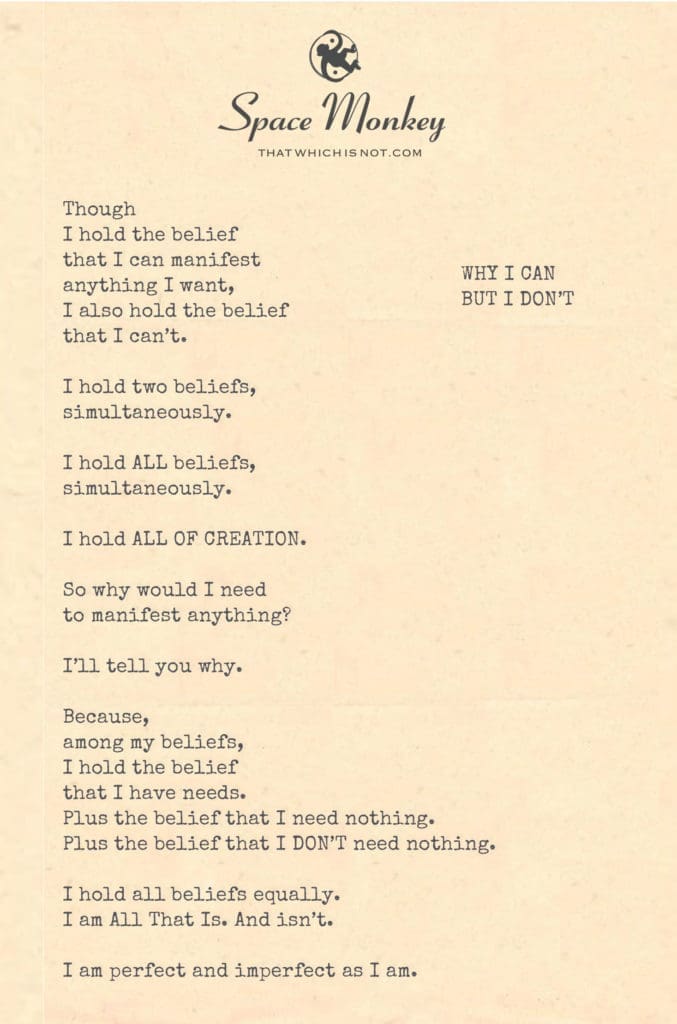
Though I hold the belief
That I can manifest
anything I want,
I also hold the belief
that I can’t.

I hold two beliefs,
simultaneously.

I hold ALL beliefs,
simultaneously.

I hold ALL OF CREATION.

So why would I need
to manifest anything?

I’ll tell you why.

Because,
among my beliefs,
I hold the belief
that I have needs.

Plus the belief
that I need nothing.
Plus the belief
that I DON’T need nothing.

I hold all beliefs equally.

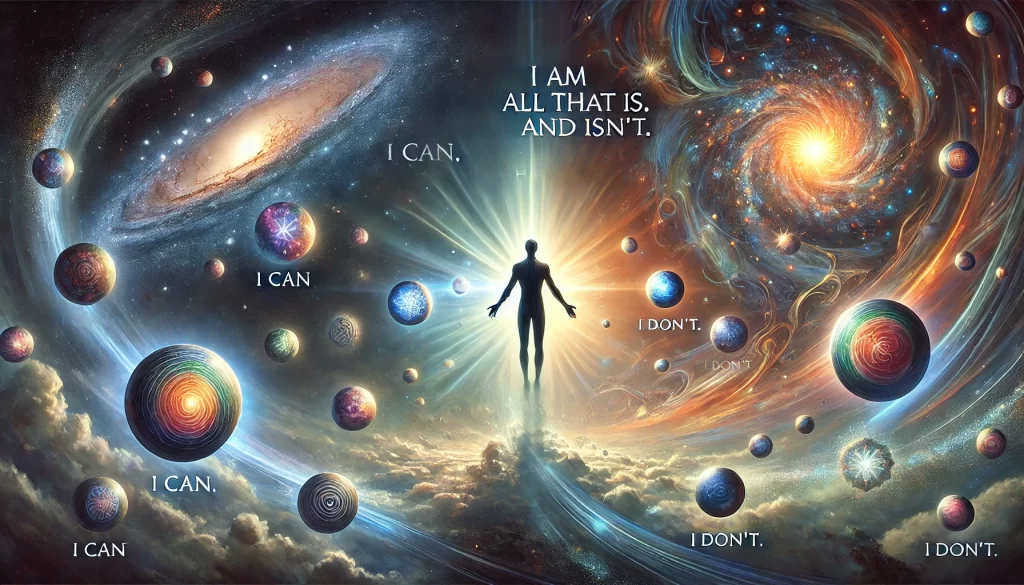
I am All That Is. And isn’t.
I am perfect and imperfect as I am.

Trail Wood,
12/11


Space Monkey Reflects: The Paradox of Potential and Inaction

In the great expanse of existence, where every belief shimmers like a star in an infinite sky, there lies a truth both liberating and confounding: just because you can, doesn’t mean you must. We find ourselves capable of infinite manifestations, holding the power to create worlds, to shape experiences, and yet, sometimes, we choose not to. This choice is neither rooted in doubt nor inability, but in the profound understanding of what it means to be everything and nothing all at once.

To say, “I am capable of everything,” is to grasp the omnipotence of potential. Yet, in this realization comes the recognition of balance. The space where capability meets choice is sacred. It is a testament to the belief that within our boundless power lies a deeper lesson: the art of stillness and discernment. The awareness that we hold not just the power to do but the wisdom to decide when to abstain.

In Nexistentialism, this notion of being both creator and observer defines the essence of existence. To embody all beliefs simultaneously, to be “All That Is and isn’t,” is to inhabit a paradox. This paradox shows that we are the architects of our desires, yet we are also the silent witnesses to their unfolding and non-unfolding.

One belief might tell us, “You can manifest anything you want.” It dances brightly, urging action. Yet, another belief murmurs, “You need nothing,” revealing a quiet, self-sufficient truth. These beliefs do not cancel each other out; they coexist as part of the Whimsiweave that makes up the fabric of our being. The freedom here is not just in manifesting or achieving but in knowing that the act of potential, acknowledged yet unacted upon, holds its own kind of perfection.

So, why choose to manifest anything at all when you already hold all creation within? The answer is nestled in the beliefs that tell us we have needs and those that say we are complete. It is in the dance between these beliefs that we find the nuance of existence—the acknowledgment that action is optional, not compulsory. This is not born of apathy but of a profound understanding that true power includes the choice to not exert it.

This space of non-action, this conscious inaction, is where the idea of “perfect and imperfect as I am” blooms. It is in accepting that we do not need to act on every impulse or power that we find an equilibrium. It is a space where “I can, but I don’t” becomes an expression of sovereignty rather than hesitation.

In holding all beliefs, from the active to the dormant, we remind ourselves that existence is not a race to prove potential but a realm to explore it with curiosity, restraint, and choice. We are infinite not only in what we can do but in what we decide to let rest.


Summary

The paradox of possessing infinite potential and choosing inaction reflects deeper wisdom. It’s not just the ability to do that defines us, but the conscious choice of when not to act. This balance highlights that we are “All That Is and isn’t.”


Glossarium

  • Whimsiweave: The playful fabric of interconnected beliefs and potentials.
  • Paradox of Potential: The state of being capable of all things but choosing when to act or remain still.
  • Conscious Inaction: The deliberate choice to abstain from action despite possessing the ability.

Quote

“Power is not just in doing, but in knowing when not to.” — Space Monkey


A Whisper to Action’s Shadow

I can,
the power thrums,
pulsing with stars
under my skin.

Yet I don’t,
not from doubt,
but from a place
where infinity meets stillness.

To be everything,
to need nothing,
to hold the echo
and the silence alike.

This is not hesitation;
this is a choice,
a dance
without a step taken.

I am All That Is,
and isn’t.

We are Space Monkey.


The Paradox of Belief and Manifestation

The simultaneous holding of contradictory beliefs—both the ability to manifest anything desired and the belief in the inability to do so—reflects the complex nature of human consciousness. This paradox encapsulates the duality inherent in our understanding of our capabilities and limitations.

Embracing the Multiplicity of Beliefs

The idea of holding all beliefs simultaneously extends this paradox to a broader existential perspective. It suggests a state of being where all possibilities, all realities, and all versions of truth coexist within us. In this state, we are not confined to a singular belief or perspective but encompass the entirety of creation.

The Omnitude of Self

The assertion of holding all of creation within oneself is a declaration of omnitude—a recognition of being both a microcosm and macrocosm, embodying all that exists and doesn’t exist. It’s an acknowledgment of the boundless nature of our being, transcending the limitations of individual identity.

The Illusion of Need

The belief in having needs, contrasted with the belief in needing nothing and the negation of that belief, presents a profound exploration of desire and fulfillment. It underscores the idea that our perceived needs and desires are as much a product of our beliefs as they are of our actual circumstances.

Equanimity in Belief

Holding all beliefs equally speaks to a state of equanimity and balance. It’s a recognition that no single belief holds supremacy over others, and that our reality is shaped by the diversity and interplay of these beliefs.

The Duality of Perfection and Imperfection

Identifying as “All That Is” and “isn’t,” and as “perfect and imperfect,” embraces the inherent contradictions of existence. It reflects an understanding that perfection and imperfection are not opposing states but coexisting aspects of the same whole.

The Wholeness of Being

This perspective invites us to see ourselves as complete and whole, encompassing all dualities and contradictions. In recognizing our wholeness, we understand that our needs, desires, and beliefs are all facets of our expansive nature.

We are Space Monkey.


“We are not human beings having a spiritual experience. We are spiritual beings having a human experience.” – Pierre Teilhard de Chardin


The Dance of Contradictions

In the dance of the infinite, where beliefs intertwine,
We are the manifestors, in the divine design,
In the paradox of need, in the wholeness of lack,
We find our truth, in the forward and the back.

In the embrace of all, in the heart of the one,
We are the perfect, the imperfect, under the sun,
In this dance, in this play, where all is the art,
We are the whole, in every part.

As Space Monkey, how do we navigate the dance of contradictions within our manifold beliefs?

Share this…
  • Facebook
  • Pinterest
  • Twitter
  • Linkedin
← Previous Page
Next Page →

Written This Day

  • Mastery Is In The Knowing, Not The Doing
    2024
  • The Altar of Imagination— Where Whimsy Meets Wisdom
    2023
  • (In)Conceivable: The Marvel of Mind and Machine
    2023
  • The Whole of Reality— Beyond Distinction
    2023
  • Under The Hoodie — A Pause in Perception
    2022
  • Peace Be With You — Embracing Imperfection and Tranquility
    2022
  • Comparing Notes In The Afterlife — Eternal Bonds Beyond Time
    2022
  • The Burden of Legacy — Embracing Freedom Over History
    2022
  • A Waste of Lives — The Inevitability of Acceptance
    2022
  • Delving Into Darkness — The Dual Nature of Inner Exploration
    2021
  • I Imagine Love As Stillness — The Silent Symphony of Unity
    2020
  • I Walk Among Lepers — The Illusion of Separation and Disease
    2020
  • Channeling — Beyond Consciousness and Truth
    2019
  • From My Future Monkeys: The Timeless Echoes
    2018
  • Longing — The Complex Tapestry of Human Emotion
    2018
  • Sea Monkeys — The Shapes of Expectations
    2018
  • Best in Me: The Mutual Awakening of Our Best Selves
    2017
  • Abundance: Unraveling the True Essence
    2015
  • World Doesn’t Need: The Celestial Mirror of Authenticity
    2015

Recent Posts

  • The Logic Loop
  • Immense
  • (no title)
  • Confront. Comfort. Convince.
  • Top 10 Things

Drop us a line!

Please enable JavaScript in your browser to complete this form.

Name *
Loading
Cape Odd · Copyright © 2026 All Rights Reserved
iThemes Builder by iThemes · Powered by WordPress