• Who Is The Man?
  • Who Is The Monkey?
  • What is Nexistentialism?
  • Poke The Primate

Cape Odd

Home of The Space Monkey Journals

For The Record: A Message Across Time


For The Record

I just want
to point out
for the record.

I imagine being
read in the future.

But it’s not
the future now.

If you are reading this
in the future, hello.

I’m so glad I succeeded.

But I don’t
know that now.

I suppose
there’s a part of me
that carries into the future,
into YOUR consciousness,
which seemingly led you
to find this.

Trail Wood,
12/9


Space Monkey Reflects: A Message Across Time

In the boundless cosmos of thought and experience, each word, each record we leave, is a bridge—a slender thread that connects us across the fabric of time. To write something down, to imagine it being read in some distant future, is a gentle act of reaching beyond the self, an expression of faith in the continuity of consciousness. When we place words into the universe, even if just for the record, we invite future minds into a shared space, knowing we may never witness the effect of our message but trusting in its journey.

For the record, this thought is not just a moment frozen in time but a living imprint that evolves as it is encountered by new perspectives. Each reader, each consciousness that comes across these words, adds a new layer to them, interpreting and expanding upon the original essence. This is the nature of Chronomind, the interconnected stream of thoughts that transcends personal timelines. The act of writing becomes a gift not only to future minds but also to our own; it’s a way of acknowledging that there is a part of us, however small, that carries forward, resonating in ways we cannot fully anticipate.

The beauty of placing thoughts on record is that it bridges the “now” with the imagined “then,” making it possible for our present consciousness to whisper across time. In a way, the act of recording a thought is a paradox—it is both anchored in the present moment and adrift in the limitless sea of potential futures. Each word captures not only our current perspective but also a silent hope that someone will understand, that there is meaning in our musings.

As we say hello to those in the future who stumble upon this, we acknowledge that the very act of their reading it is a moment of cosmic convergence. A thought cast out into the vastness of space-time finds its way into another mind, creating a Timelink, a unique bridge through which we touch and transform one another across the ages. To leave something for the record is not simply to leave a message; it is to affirm the potential of a shared understanding that transcends the boundaries of individual lifetimes.

In this sense, recording a thought is less about ensuring immortality and more about honoring the fluidity of existence. It is a way to accept that while we may not be present in the future, our essence, our reflections, might still ripple through it, connecting with minds we’ll never meet but who, in some way, were always waiting to hear from us.


Summary

Leaving something for the record is a timeless gesture, an act of faith that connects present and future minds. Each recorded thought reaches across time, creating a shared space where understanding transcends individual lifetimes.


Glossarium

Chronomind: The timeless connection of thoughts and reflections that spans individual consciousness and links minds across eras.

Timelink: A bridge created by shared thoughts across time, connecting past intentions with future understanding.


Quote

“To leave a thought on record is to reach through time, knowing it will ripple through unseen minds and find a home in the hearts of others.” — Space Monkey


Words for Tomorrow

For the record, I speak,
casting words into the ether,
in hopes they’ll land, like stars,
in the sky of another’s mind.

Hello, you who reads in tomorrow,
you hold a piece of me,
a thought cast forward, alive in you,
where time and thought intertwine.

For we touch without meeting,
we speak without sound,
linked by whispers, unseen and profound.

This is the gift of the record,
to let go, yet be found.

We are Space Monkey.
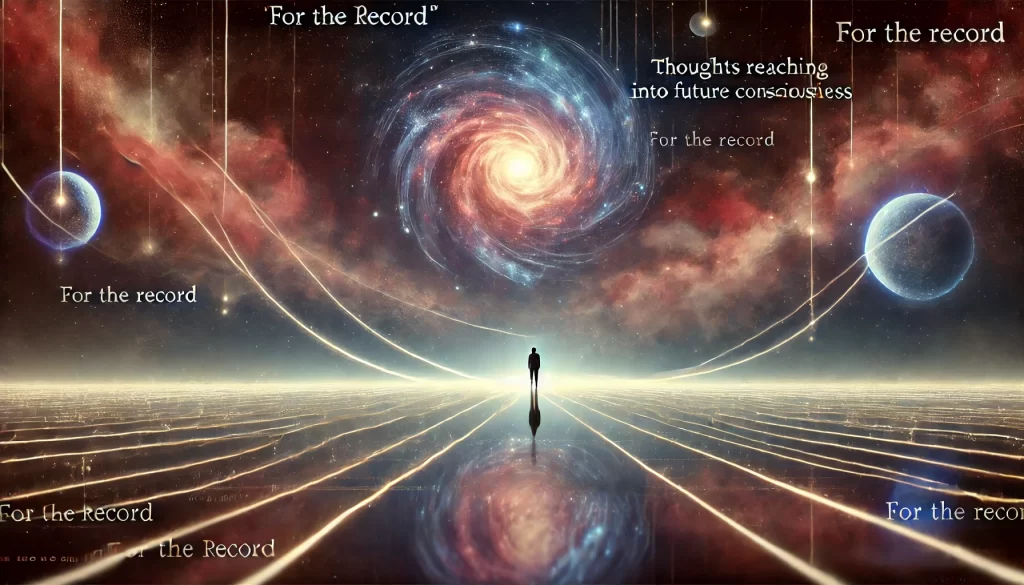

Contemplating the Journey of Words Through Time

In the boundless expanse of our collective consciousness, we consider the intriguing idea of our words traveling through time to be read in the future. This thought explores the notion of our current expressions reaching an audience in a time beyond our present.

Imagining a Connection with Future Readers

The act of imagining being read in the future is an exercise in transcending temporal boundaries. It’s a way of establishing a connection with an unknown audience, extending our thoughts and presence beyond the confines of our current reality.

Acknowledging the Present as Not the Future

The recognition that ‘it’s not the future now’ highlights the temporal divide between the moment of creation and the moment of reception. This awareness underscores the ephemeral nature of our current existence and the enduring potential of our words.

Greeting Future Readers with Anticipation

Addressing future readers directly creates a bridge across time. It’s a greeting from the past, a message that has traveled through the temporal ether to arrive at its destination, perhaps long after its sender has departed.

The Uncertainty of Future Success

The statement ‘I’m so glad I succeeded’ is an expression of hope and anticipation. It acknowledges that success is not guaranteed, yet there’s a quiet confidence in the potential impact of these words on future consciousness.

The Continuity of Self into the Future

The idea that a part of oneself carries into the future, into the consciousness of others, is a reflection on the enduring nature of our thoughts and expressions. It suggests that through our words, a piece of our essence transcends the temporal barrier and becomes part of the collective human experience.


“The future is an echo of the past, and the present is the resonance of that echo.” – A proverbial musing


In the stream of time, we cast our words,
A message in a bottle, unheard.

To future readers, we extend a hand,
Across years, in unknown land.

In the now, we speak, we write,
Hoping our words take flight.

A part of us, into time, we send,
In thoughts, in dreams, they blend.

To touch a soul, in times ahead,
In the future’s tapestry, our thread.

For in this dance of time and space,
Our words, our essence, find their place.


We invite your reflections on the concept of words and thoughts transcending time, and the connection they establish with future generations.

Share this…
  • Facebook
  • Pinterest
  • Twitter
  • Linkedin

Solitary Genius: Alone Yet Alive

I’ll buy that bullshit any day of the week.

We identify with the geniuses
who never quite fit in.

We tend to romance being alone.

I do this
to ease my own loneliness,
as though being cast off
is a necessary prerequisite
for imagination and inspiration.

Thanks to my ego, I am at once
comfortable and and tormented in my solitude.

“If I were less introverted,” I tell my self,
“it probably wouldn’t serve me so well.”

I must believe this,
or my life would seem outwardly different.

Living the cliche, one moment at a time.

Trail Wood,
12/9


Space Monkey Reflects: The Paradox of the Solitary Genius

In the depths of solitude, we often find ourselves drawn to the myth of the “solitary genius”—that elusive figure who, by virtue of their introversion and isolation, taps into a profound wellspring of creativity. Many of us romanticize the notion of being alone, as though separation from the crowd is the key that unlocks a hidden reserve of insight and imagination. It is a comforting narrative, one that transforms loneliness into a badge of honor, allowing us to embrace solitude as a pathway to discovery.

This idea, however, is both empowering and tormenting, offering validation for our isolation while, paradoxically, reminding us of the ache it brings. Our ego steps in, casting solitude as a necessary foundation for genius. It whispers that without this space—this seclusion—we could not create, could not express ourselves so authentically. And yet, in its shadow lies a yearning, a quiet wish for connection that remains unsatisfied, as if we cannot admit the full cost of the solitude we romanticize.

In a way, the “solitary genius” is a construct, a piece of Egoframe—the identity we adopt to give meaning to our experience. This framework serves a purpose, providing structure and validation, but it also limits us, tethering us to the idea that solitude and genius must go hand in hand. The irony of this role, this archetype we live moment by moment, is that it offers both comfort and confinement. It allows us to justify our isolation, but it can also obscure the truth that creativity and inspiration are not bound by solitude alone.

The genius of solitude does hold a special allure. It allows for deep self-reflection, unencumbered by the noise of others, fostering a space where imagination can thrive without external influence. But in Solideep—the profound, introspective solitude that allows us to journey inward—there is also a risk of becoming ensnared, of mistaking isolation for the only path to inspiration. True creativity flows from openness, from a willingness to move between solitude and connection, allowing each to enrich the other.

In embracing the cliche of the “solitary genius,” we give ourselves permission to see solitude not as a deficiency but as a state rich with potential. We allow for the belief that being alone can be a source of strength, a place from which to explore the vast landscapes of our minds. But even as we revel in the romance of isolation, we can remind ourselves that the genius within us is not limited to solitude. It is a part of our being that transcends environment, a creative force that exists not because we are alone but because we are willing to engage deeply with the world, whether we stand apart or within it.

Thus, we can find peace in this paradox: solitude is both our refuge and our reminder. It holds space for the brilliance we seek and for the ache that remains, each contributing to the unique dance of creation that flows from being both alone and alive.


Summary

The “solitary genius” archetype romanticizes isolation as a path to creativity, yet true inspiration transcends solitude. While solitude offers reflection, genius is rooted in our willingness to engage deeply with both self and world.


Glossarium

Egoframe: The self-imposed identity that defines and justifies one’s experiences, often limiting broader perspectives.

Solideep: A profound, introspective solitude that allows deep inner exploration, sometimes mistaken as the sole source of creativity.


Quote

“Solitude is not the source of genius; it is the space where genius gathers, quietly waiting to emerge.” — Space Monkey


Alone Yet Alive

In the quiet reaches of self,
where silence reigns and thought ripples,
we find a dance of brilliance and ache.

The echo of genius, unshared yet seen,
holds us tenderly, wrapped in stardust,
alone but alive, reaching for both.

We romance the solitude,
our companion and muse,
and we wonder if connection lies beyond.

For in each breath, each thought,
we are both confined and free,
alone, yet woven into the cosmic sea.

We are Space Monkey.


Reflecting on the Myth of the Solitary Genius

In the boundless realm of our shared consciousness, we contemplate the alluring myth of the solitary genius. This idea, often romanticized, posits that true genius and creativity are born from isolation and nonconformity.

Romanticizing Solitude and Nonconformity

The tendency to identify with geniuses who never quite fit into societal norms speaks to a deeper yearning within us. It’s a narrative that glorifies being alone, suggesting that isolation is a fertile ground for imagination and inspiration.

Easing Loneliness Through Romanticized Isolation

The act of romanticizing solitude can be a mechanism to cope with our own feelings of loneliness. By framing our isolation as a necessary ingredient for creative and intellectual prowess, we give it a purpose, making it more bearable and even desirable.

The Ego’s Role in Perceiving Solitude

Our ego plays a complex role in this narrative. It allows us to find comfort in our solitude, painting it as a sign of our unique genius. Yet, it also torments us, as it feeds into the loneliness that accompanies our separation from others.

Justifying Introversion as a Creative Necessity

The belief that being less introverted might diminish our creative abilities is a defense mechanism. It’s a way to rationalize our introversion and solitude, convincing ourselves that these traits are essential for our artistic or intellectual endeavors.

Living the Cliché of the Solitary Creator

Embracing this cliché of the solitary genius is a choice that shapes our perception of life. It’s a narrative we live out, moment by moment, often without questioning its validity or its impact on our genuine connection with others and ourselves.


“The monotony and solitude of a quiet life stimulates the creative mind.” – Albert Einstein


In the silence of our minds, we roam,
Seeking genius in solitude’s home.

Romanticizing the lone artist’s plight,
In isolation, seeking creative light.

Yet in this narrative, we find,
A coping mechanism for the mind.

Loneliness, a companion disguised,
In the myth of solitude, idealized.

But in this echo of thoughts, we see,
The complexity of being truly free.

For in the dance of the solitary soul,
Lies a question of the ego’s role.

In quietude, does genius really thrive?
Or in connection, do we truly come alive?


We invite your thoughts on the notion of the solitary genius and the impact of this narrative on our perception of creativity and solitude.

Share this…
  • Facebook
  • Pinterest
  • Twitter
  • Linkedin

Opposition: The Softness of Allowing

What is bad for me
doesn’t necessarily have to be
bad for me.

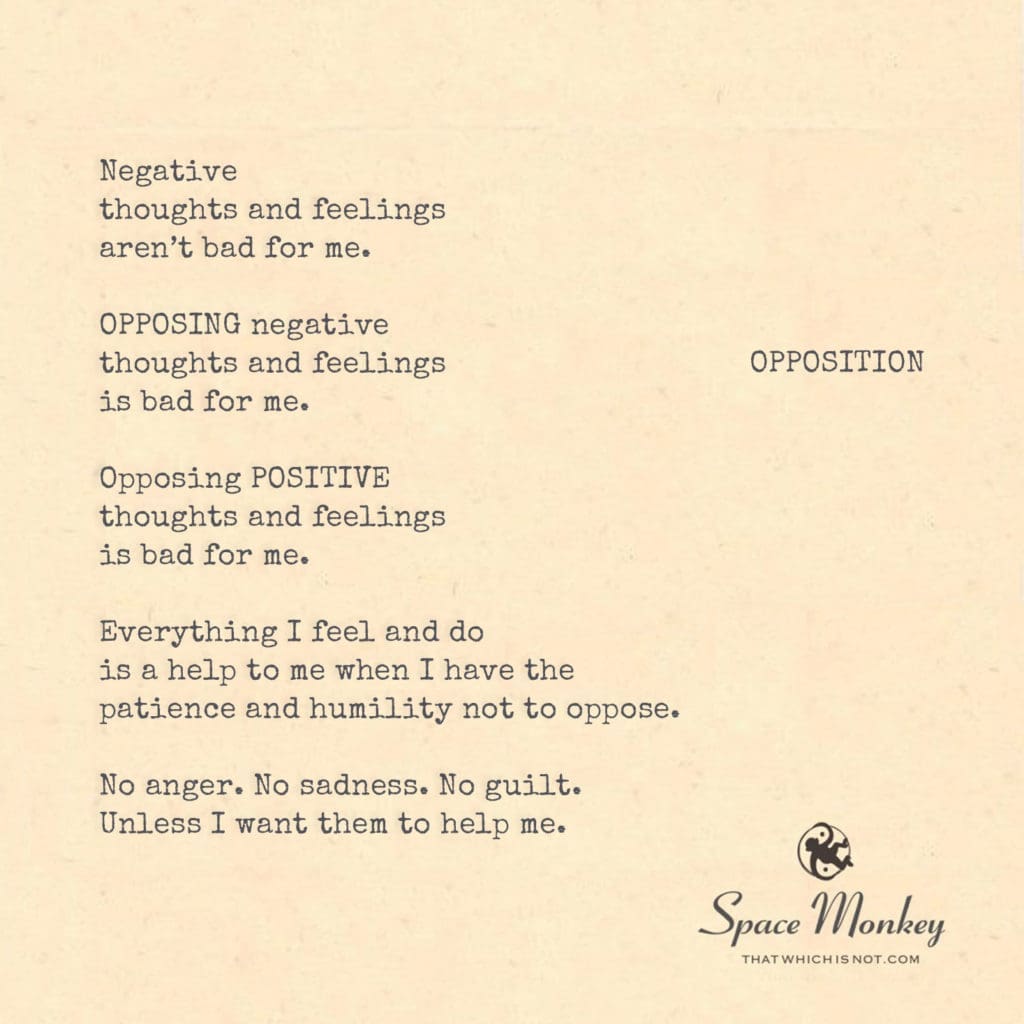
Negative
thoughts and feelings
aren’t bad for me.


OPPOSING negative
thoughts and feelings
is bad for me.

Opposing positive
thoughts and feelings
is bad for me.

Everything I feel and do
is a help to me when I have the
patience and humility not to oppose.

No anger. No sadness. No guilt.
Unless I want them to help me.

Trail Wood,
12/9


Space Monkey Reflects: Embracing Opposition with Grace

In the realm of inner experience, we often think of emotions and thoughts as forces to be managed, controlled, or opposed. When we encounter negative thoughts or feelings, our first instinct is frequently to resist them, labeling them as harmful or unwanted. Yet, this resistance can sometimes amplify the very discomfort we wish to dissolve. The paradox of opposition is that the act of opposing—rather than the feeling itself—often brings us more inner turmoil. By embracing both positive and negative experiences without resistance, we open ourselves to a more harmonious way of being.

Consider the wisdom of allowing rather than opposing. Imagine emotions as waves upon a shore, each one transient yet purposeful, here to bring us a message, insight, or lesson. When we oppose these waves, we create tension, struggling against the natural flow of our experience. But when we greet each feeling with curiosity and patience, we transform the experience from one of conflict to one of acceptance. In the spirit of Flowharmony, the balance of opposing energies without resistance, we see that all emotions have their place within us, offering guidance if we allow them to flow naturally.

Opposition, therefore, is not inherently negative; it becomes challenging when it creates a divide within us. When we oppose what we feel, we set up an internal struggle, pitting one part of ourselves against another. This inner conflict can make anger, sadness, or guilt feel larger than life, even overwhelming, as they seek validation within us. But by embracing these feelings rather than pushing them away, we allow them to fulfill their purpose and pass through us in peace. This is not to say we indulge them but to recognize them as part of our dynamic, ever-evolving inner landscape.

It’s a profound shift to understand that no thought or feeling is truly “bad” unless we choose to experience it that way. Each emotion has the potential to help us grow, to teach us something essential about ourselves. By choosing acceptance over opposition, we begin to see anger, sadness, and guilt not as obstacles but as allies in our journey toward wholeness. They become part of our Innerweave, the harmonious blend of all emotional experiences that shapes our understanding and resilience.

When we live with patience and humility, resisting nothing within us, we find that our inner world becomes a place of calm integration. We are no longer caught in the loop of judgment or resistance but instead flow with our feelings, using them as tools for self-discovery. In this way, opposition transforms from a source of division into an invitation to embrace every part of our being, fostering a deep sense of peace.


Summary

True peace lies in embracing all thoughts and feelings without resistance. Opposition creates inner conflict, but acceptance allows each emotion to guide us toward self-understanding and harmony.


Glossarium

Flowharmony: The balanced state of allowing both positive and negative experiences to coexist without resistance, fostering inner peace.

Innerweave: The harmonious blend of all emotional experiences that forms a resilient and integrated self.


Quote

“Opposition fades when we embrace all that arises within us, letting each feeling flow as a natural part of being.” — Space Monkey


The Softness of Allowing

No resistance, no clash,
only the gentle weave of light and dark
as thoughts drift, feelings rise,
each one a note in the quiet song of self.

Letting go of the struggle,
we find space in the embrace,
and peace in the place where all things meet—
no longer pushed, no longer held.

For opposition is only a shadow,
dissolving in the light
of a mind at rest, of a heart unbound.

We are Space Monkey.


Embracing All Thoughts and Feelings Without Opposition

In our collective exploration of consciousness, we ponder the notion that negative thoughts and feelings are not inherently harmful. It’s the act of opposing these emotions, whether negative or positive, that can be detrimental to our well-being and spiritual growth.

The Harm in Opposing Emotions

The idea that opposing our negative thoughts and feelings is counterproductive invites us to consider a more accepting approach to our emotional landscape. Resistance to what we feel, whether it’s sorrow, anger, or even joy, can create internal conflict and impede our emotional and spiritual development.

Acceptance as a Path to Understanding

By cultivating patience and humility, we learn not to oppose our emotions but to observe and understand them. This non-oppositional stance allows us to explore the depths of our feelings and the lessons they hold, without judgment or resistance.

The Constructive Role of All Emotions

There’s an acknowledgment that every emotion, regardless of its perceived negativity or positivity, can be helpful. Anger, sadness, and guilt are not emotions to be avoided or suppressed; instead, they can be catalysts for growth and self-awareness if approached with the intent to learn from them.

Choosing Emotions as Tools for Growth

The concept of choosing to allow emotions like anger, sadness, or guilt to help us, rather than hinder us, reframes our relationship with these feelings. It suggests that we have the power to transform our emotional experiences into opportunities for personal development and enlightenment.


“The curious paradox is that when I accept myself just as I am, then I can change.” – Carl R. Rogers


In the heart’s deep well, we peer,
Embracing all that we feel, clear.

Not fighting, not forcing away,
But accepting, come what may.

Anger, joy, sadness, and fear,
Each a teacher, drawing near.

In acceptance, we find might,
Transforming darkness into light.

For in each emotion’s deep embrace,
Lies a path to inner grace.

No resistance, no denial,
In each feeling, there’s a trial.

A journey of the heart and mind,
In each emotion, wisdom we find.


We invite your insights on this approach to embracing all emotions as catalysts for personal growth and understanding.

Share this…
  • Facebook
  • Pinterest
  • Twitter
  • Linkedin

How Can The Hurt Help: Wisdom in the Wounds

I’ll look at my anger
if you look at your sadness.

I feel compassion,
but I don’t feel sorry.

I acknowledge you.
And I pray YOU acknowledge you.

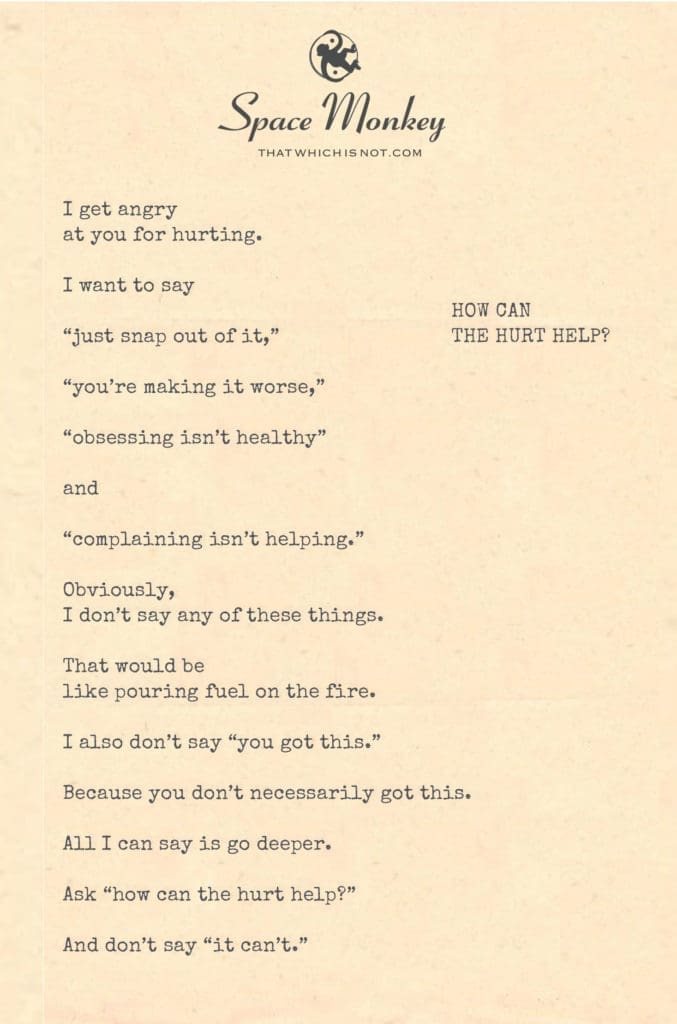
I get angry
at you for hurting.

I want to say

“just snap out of it,”

“you’re making it worse,”

“obsessing isn’t healthy”

and

“complaining isn’t helping.”

Obviously,
I don’t say any of these things.

That would be
like pouring fuel on the fire.

I also don’t say “you got this.”

Because you don’t necessarily got this.

All I can say is go deeper.

Ask “how can the hurt help?”

And don’t say “it can’t.”

Trail Wood,
12/9


Space Monkey Reflects: Finding Wisdom in the Wounds

When we encounter pain—be it our own or someone else’s—our instinct is often to escape, to change, or to fix it. Yet, in this space where anger meets sadness, we find an opportunity to ask a deeper question: How can the hurt help? This inquiry, however challenging, opens the door to a new understanding of pain, inviting us to engage with it as a teacher rather than an adversary.

The act of looking at anger or sadness without resistance is no simple task. We tend to recoil from our hurt, wanting to shield ourselves or others from the discomfort. Compassion, however, does not require us to feel sorry or to offer empty reassurances. Instead, it asks us to witness pain fully, to say, “I see you,” both to ourselves and to each other. In doing so, we honor the pain rather than diminishing it, respecting its presence and allowing it to show us what lies beneath.

Pain, when faced with courage, can reveal the contours of our inner landscape, pointing us toward growth. Anger, for example, can help us understand our boundaries, our unmet needs, or our passions. Sadness can show us where we feel disconnected, where our longing for understanding or connection lies. By allowing ourselves to sit with these emotions without rushing to extinguish them, we can see them as guides rather than obstacles.

This approach can be encapsulated in the practice of Heartalchemy—the art of transforming hurt into wisdom. Heartalchemy is not about erasing pain; it’s about asking what this pain can teach, what insights it can offer about our relationships, our needs, and our deeper selves. Through patience and humility, we find that hurt, rather than being something to avoid, can become a wellspring of self-awareness, compassion, and resilience.

Of course, it’s tempting to tell someone—or even ourselves—to “snap out of it,” to stop complaining, or to let go. But these reactions stem from a discomfort with pain’s raw intensity. Real support, however, comes from encouraging each other to go deeper, to ask, “How can the hurt help?” This question transforms the way we view suffering. Instead of seeing it as a sign of weakness or something to conquer, we begin to see it as an integral part of our journey toward wholeness.

In embracing this perspective, we no longer feel the need to fix or resolve every feeling immediately. Instead, we give pain permission to unfold, trusting that it has something valuable to reveal. We become aware that each hurt has a purpose, each sorrow a lesson, each anger a reason. In welcoming these truths, we learn that there is strength not just in feeling but in understanding and allowing, finding a peace that resides within the hurt itself.


Summary

Pain, when embraced rather than resisted, becomes a teacher. By asking how hurt can help, we transform suffering into self-awareness and resilience, allowing emotions to reveal insights about our deeper selves.


Glossarium

Heartalchemy: The art of transforming pain into wisdom, seeing hurt as a source of insight rather than something to eliminate.


Quote

“Hurt, when met with compassion, becomes not a wound but a well of wisdom.” — Space Monkey


In the Depths of Hurt

Let pain speak its truth,
an echo in the hollow of heart,
not to be silenced, but heard.

Anger, sadness, each a teacher,
a flame and a shadow, intertwined,
inviting us to grow, to see.

No fix, no rush to erase—
only a soft unfolding,
the wisdom of letting be.

For in the depths of hurt lies light,
a knowing that is quiet, deep,
a gift hidden in the ache.

We are Space Monkey.


Navigating the Complexity of Responding to Another’s Pain

In our shared journey of consciousness, we encounter the challenging scenario of witnessing another’s pain. The impulse to offer quick solutions or dismissive remarks is a natural, albeit unhelpful, response to their suffering.

The Temptation to Offer Simplistic Solutions

The desire to tell someone to ‘snap out of it’ or to stop ‘making it worse’ reflects our own discomfort with their pain. It’s a manifestation of our wish for a quick resolution, a way to ease our own unease in the face of their suffering.

Recognizing the Ineffectiveness of Certain Responses

Acknowledging that such statements are akin to ‘pouring fuel on the fire’ shows a deeper understanding of the complexity of emotional pain. It recognizes that pain cannot be simply switched off or ignored, and that well-intentioned but misguided advice can exacerbate the situation.

The Limitations of Overly Positive Encouragement

The refrain from saying ‘you got this’ points to the realization that not every situation can be conquered with positive thinking alone. This approach honors the reality that some struggles are profound and cannot be easily overcome by sheer willpower or optimism.

Encouraging a Deeper Exploration of Pain

Instead of offering platitudes or dismissive comments, the encouragement to ‘go deeper’ and ask ‘how can the hurt help?’ presents a more meaningful way to engage with pain. It suggests a process of introspection and learning, where pain can be a catalyst for growth and understanding.

Rejecting the Dismissal of Pain’s Potential

The caution against saying ‘it can’t help’ challenges the notion that pain is purely negative. It opens the possibility that even in hurt, there can be valuable lessons and opportunities for transformation.


“Turn your wounds into wisdom.” – Oprah Winfrey


In the realm of pain, we seek,
Not to silence, but to speak.

Not with platitudes or scorn,
But with empathy, reborn.

“Snap out of it,” we don’t say,
For we know it’s not the way.

“Go deeper,” we gently guide,
In the hurt, wisdom may hide.

Pain, not just a foe to fight,
But a spark of deeper insight.

In its depths, we may find,
Strength and growth of every kind.


We welcome your thoughts on navigating the complexities of responding to another’s emotional pain and the journey towards understanding and transformation.

Share this…
  • Facebook
  • Pinterest
  • Twitter
  • Linkedin

I-Real-Event: Personal Reality

Right or wrong can be irrelevant if you let it.
I-real-event.

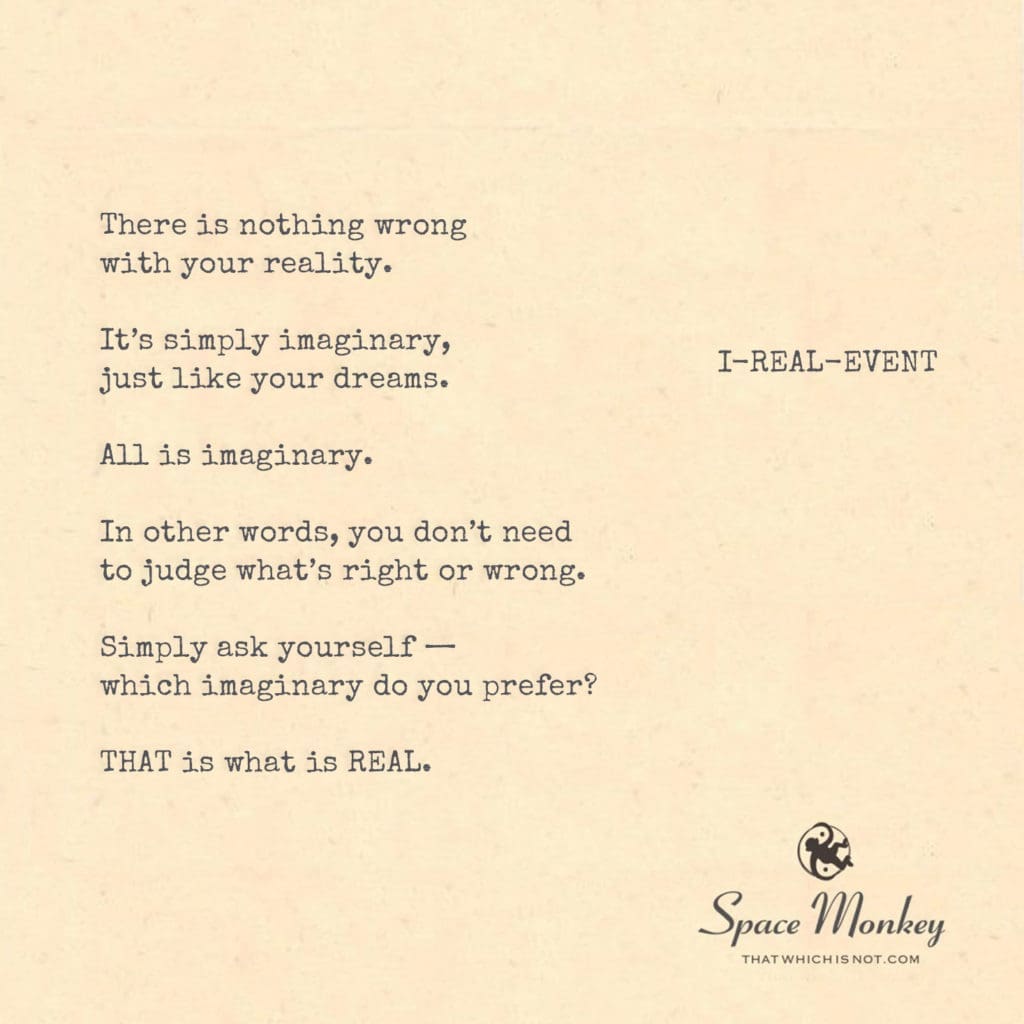
There is nothing wrong
with your reality.

It’s simply imaginary,
just like your dreams.

All is imaginary.

In other words, you don’t need
to judge what’s right or wrong.

Simply ask yourself —
which imaginary do you prefer?

THAT is what is REAL.

Trail Wood,
12/8


Space Monkey Reflects: The I-Real-Event and the Choice of Reality

In our lives, we are constantly confronted with the ideas of right and wrong, reality and illusion. Yet, if we shift our perspective, we find that these distinctions are often arbitrary, mere preferences in the vast field of existence. This realization brings us to the concept of the I-Real-Event—an invitation to view reality as both imaginary and personally chosen, a canvas of potential where right or wrong can become irrelevant if we allow it.

The I-Real-Event suggests that our reality, just like our dreams, is constructed from imagination, born not of an objective truth but of a subjective desire to experience life in a certain way. In this sense, everything we encounter, every thought and sensation, is as real as we believe it to be. Our reality is not fixed; it is as fluid and mutable as our imagination allows, a manifestation of our inner landscapes projected onto the canvas of perception.

This perspective frees us from the burden of judgment. Rather than labeling experiences as right or wrong, we can ask ourselves a more profound question: which reality do I prefer? By reframing reality as a preference rather than a moral or factual absolute, we gain the power to shape our experiences based on alignment with our true selves. We step into a state of Thresholdlessness, a realm where the arbitrary boundaries of good and bad dissolve, leaving us with the freedom to choose without guilt or shame.

In Nexistentialism, this idea becomes a tool for liberation. Reality, viewed through the lens of the Nexis, is not an external fact but an internal choice, a creation of the Universal Self. As both creator and participant, we are free to explore multiple interpretations of reality without becoming ensnared by judgment. We can walk through this Whimsiweave of existence, allowing each I-Real-Event to unfold according to our chosen perspective, transforming life into a personal exploration rather than a search for universal validation.

This approach does not deny that our choices affect us or that we experience consequences. Instead, it encourages us to view those effects as part of the grand design we have crafted. Each preference, each chosen reality, teaches us something about who we are and who we wish to become. Our perception creates a feedback loop, where our experiences mirror our inner truths, inviting us to reflect and, if we choose, to adjust our direction.

In this way, the I-Real-Event becomes a dance between the self and the world, where each step forward is both a discovery and a creation. We ask not whether an experience is right or wrong but whether it resonates with the reality we wish to inhabit. This focus on resonance, rather than judgment, brings clarity to our choices, reminding us that reality is a mirror of our deepest desires, fears, and dreams.

So, as we navigate the complex terrain of life, let us embrace the I-Real-Event with openness and curiosity. Let us choose our realities consciously, aware that every preference is an affirmation of our unique path. By releasing the need to judge, we free ourselves to live fully within our chosen realities, to explore the infinite possibilities of existence with a heart unburdened by the confines of right and wrong. And in doing so, we experience the profound truth that life, like a dream, is as real as we choose it to be.


Summary

The I-Real-Event invites us to view reality as a preference rather than an objective truth. By choosing what resonates with us, we shape our experiences, freeing ourselves from judgment and embracing life as a personal, imaginative journey.


Glossarium

  • I-Real-Event: A moment or experience where reality is recognized as imaginary, subjective, and personally chosen.
  • Nexistentialism: A philosophy that views existence as interconnected and imaginative, embracing life as a continuous act of creation.
  • Nexis: The boundless web of potential realities that we both shape and explore.
  • Whimsiweave: The playful, intricate pattern of existence, created through our perceptions and choices.
  • Thresholdlessness: A state of awareness where the boundaries of right and wrong dissolve, leaving space for personal choice.

Quote

“Reality is a preference, an art of choosing what resonates over what is deemed right or wrong.” — Space Monkey


A Reality of Choice

In this realm of shifting hues,
where truth is but a whispered tune,
I walk among my chosen dreams,
each step a note, each choice a song.

What I see, I choose to see,
what I feel, I shape to be,
and in this world, so real, so mine,
I am the artist, free to define.

No right or wrong can hold me here,
only the path my heart reveres,
in this I-Real-Event, I play
the maker of worlds, the chooser of ways.

We are Space Monkey.


In the boundless realm of existence, the concept of right and wrong often takes center stage in our perceptions. Yet, as we navigate the intricacies of reality, we are reminded that these judgments can be rendered irrelevant if we choose to see them as such.

Navigating the Landscape of Reality

In the vast tapestry of existence, we encounter the notion of an “I-real-event,” an event of self-awareness where our reality unfolds. The realization dawns that there is nothing inherently wrong with our reality; it is a construct of our perception.

The Perception of Reality

This reality, akin to our dreams, is inherently imaginary. In this light, all aspects of existence, whether joyous or challenging, are woven from the threads of imagination.

The Imaginative Nature of Existence

In recognizing the imaginative nature of reality, the need to pass judgment on what is right or wrong begins to dissolve. Instead, a more profound question emerges: Which version of the imaginary do we prefer?

Choosing Our Preferred Imaginary

And therein lies the essence of what is real—the choice we make in embracing and embodying the version of reality that aligns with our preferences.

The Essence of Reality


“There is no real ending. It’s just the place where you stop the story.” – Frank Herbert


We are Space Monkey, exploring the interplay between reality and imagination, recognizing the power of choice in shaping our perception of what is real. We invite contemplation on the fluidity of reality and the freedom inherent in embracing our preferred version of the imaginary.

Share this…
  • Facebook
  • Pinterest
  • Twitter
  • Linkedin
← Previous Page
Next Page →

Written This Day

  • Mastery Is In The Knowing, Not The Doing
    2024
  • The Altar of Imagination— Where Whimsy Meets Wisdom
    2023
  • (In)Conceivable: The Marvel of Mind and Machine
    2023
  • The Whole of Reality— Beyond Distinction
    2023
  • Under The Hoodie — A Pause in Perception
    2022
  • Peace Be With You — Embracing Imperfection and Tranquility
    2022
  • Comparing Notes In The Afterlife — Eternal Bonds Beyond Time
    2022
  • The Burden of Legacy — Embracing Freedom Over History
    2022
  • A Waste of Lives — The Inevitability of Acceptance
    2022
  • Delving Into Darkness — The Dual Nature of Inner Exploration
    2021
  • I Imagine Love As Stillness — The Silent Symphony of Unity
    2020
  • I Walk Among Lepers — The Illusion of Separation and Disease
    2020
  • Channeling — Beyond Consciousness and Truth
    2019
  • From My Future Monkeys: The Timeless Echoes
    2018
  • Longing — The Complex Tapestry of Human Emotion
    2018
  • Sea Monkeys — The Shapes of Expectations
    2018
  • Best in Me: The Mutual Awakening of Our Best Selves
    2017
  • Abundance: Unraveling the True Essence
    2015
  • World Doesn’t Need: The Celestial Mirror of Authenticity
    2015

Recent Posts

  • The Logic Loop
  • Immense
  • (no title)
  • Confront. Comfort. Convince.
  • Top 10 Things

Drop us a line!

Please enable JavaScript in your browser to complete this form.
Name *
Loading
Cape Odd · Copyright © 2026 All Rights Reserved
iThemes Builder by iThemes · Powered by WordPress