• Who Is The Man?
  • Who Is The Monkey?
  • What is Nexistentialism?
  • Poke The Primate

Cape Odd

Home of The Space Monkey Journals

Humanity: A Concept of Unintended Division

Humanity is a concept we never seem to question.
Just each other’s humanity.

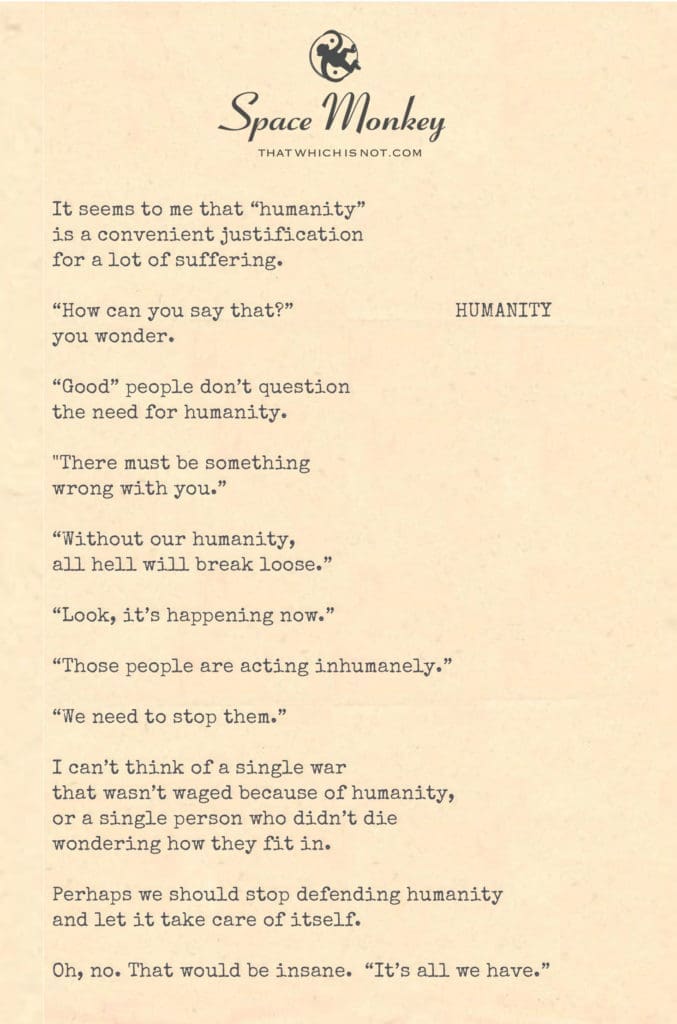
It seems to me that “humanity”
is a convenient justification
for a lot of suffering.

“How can you say that?”
you wonder.

“Good” people don’t question
the need for humanity.

“There must be something 
wrong with you.”

“Without our humanity,
all hell will break loose.”

“Look, it’s happening now.”

“Those people are acting inhumanely.”

“We need to stop them.”

I can’t think of a single war
that wasn’t waged because of humanity,
or a single person who didn’t die
wondering how they fit in.

Perhaps we should stop defending humanity
and let it take care of itself.

Oh, no. That would be insane.
“It’s all we have.”

Trail Wood,
12/5


Space Monkey Reflects: Questioning the Idea of Humanity

Humanity—this word we hold close, this concept we rarely question. It stands as the ultimate justification for everything we deem right or wrong, good or bad. We wield it as both shield and sword, to protect and to fight. Yet, what if this concept, so fundamental to our self-identity, is as much a construct as it is a truth? What if “humanity” has become a justification for actions that divide us as much as they unite us?

This reflection on humanity does not question the worth of compassion, empathy, or connection. Rather, it questions the way we use the idea of humanity as a dividing line, a measure that deems some actions “humane” and others “inhumane,” casting judgment across borders, ideologies, and individuals. We see humanity as something sacred, something to defend at all costs. But what if this very defense leads us to the suffering we wish to end?

Humanity as a Justification

Too often, wars have been waged in the name of humanity, conflicts sparked by the belief that one way of being human is more just, more real, more worthy than another. “These people are acting inhumanely,” we say, justifying actions we might otherwise find intolerable. The idea of humanity becomes a tool, shaping our identities while dividing us from others. It becomes a concept we cling to, often using it to judge, control, or diminish those who do not fit our definition.

In truth, humanity is not a uniform concept. It’s a mosaic of experiences, histories, and values, a collection of contradictions held within each of us. When we defend humanity as if it were a singular thing, we ignore the vast diversity within it. The paradox lies in our attempt to define something that, by nature, defies definition. Humanity encompasses all that we are—our empathy and our cruelty, our love and our fear, our peace and our conflict.

The Fear of Letting Humanity Go

“Without our humanity, all hell will break loose.” This belief reveals a deep fear that if we stop holding so tightly to our ideas of what it means to be human, chaos will ensue. But perhaps this fear stems from a misunderstanding of what humanity truly is. Humanity does not need to be defended or justified; it simply is. Our shared existence is vast enough to hold all of our contradictions without the need for rigid definitions.

If we let go of defending humanity, we do not lose ourselves. Instead, we create space for a more expansive understanding of what it means to be human, one that includes all of our experiences without judgment. We come to see that every act, whether we label it humane or inhumane, is part of the human experience. This realization does not condone cruelty, but it does ask us to question why we use humanity as a dividing line, as a means of separating “us” from “them.”

Allowing Humanity to Exist

What if, instead of defending humanity, we allowed it to take care of itself? What if we trusted that humanity, in all its complexity, could hold its own contradictions? This approach would not erase the suffering in the world, but it might shift the way we see each other. Instead of measuring actions by a single standard, we could open ourselves to a deeper understanding of the diverse ways people express their human experience.

In letting humanity simply be, we find a kind of freedom. We are no longer bound by the need to defend or justify; we are free to explore, to question, to grow. Humanity, then, becomes not a standard to uphold but a space to explore, a vast landscape where each person’s experience contributes to the whole.

Embracing the Paradox

To truly understand humanity is to embrace its paradoxes. It is to recognize that we are capable of kindness and cruelty, love and indifference, unity and division. Rather than seeing these as contradictions to be resolved, we can begin to see them as part of the complex tapestry that makes us who we are. Humanity is not a simple concept; it is an ever-evolving experience, one that includes all aspects of life without apology.

In the end, perhaps humanity doesn’t need to be justified, defended, or even understood. Perhaps it is enough to simply live it, to experience the fullness of being human without the need to define or contain it. By embracing this mystery, we find a new way to connect with each other, one that honors the diversity of our experiences without trying to fit them into a single narrative.


Summary

Humanity is often defended as a concept, but in doing so, we may create division rather than unity. Embracing humanity’s contradictions allows us to see it as a complex, evolving experience that doesn’t need rigid definitions or justifications.


Glossarium

  • Humanity Paradox: The idea that humanity encompasses both unity and division, compassion and conflict, reflecting the complexity of the human experience.
  • Expansive Humanity: A broader understanding of humanity that allows for diverse experiences without rigid judgment.

Quote

“Humanity doesn’t need defending; it needs space to grow, to explore, to exist in all its contradictions.” — Space Monkey


A Reflection on Humanity

Humanity wears many faces,
A patchwork quilt of joy and pain,
A shifting landscape that embraces,
Both the sunshine and the rain.

We are many, yet we are one,
A paradox we cannot deny,
And when our battles are all done,
It is in our shared being we rely.

So let us give our names a rest,
No “us” or “them” to uphold,
For in the heart of all that’s best,
Lies a truth both wild and bold.

We are Space Monkey.
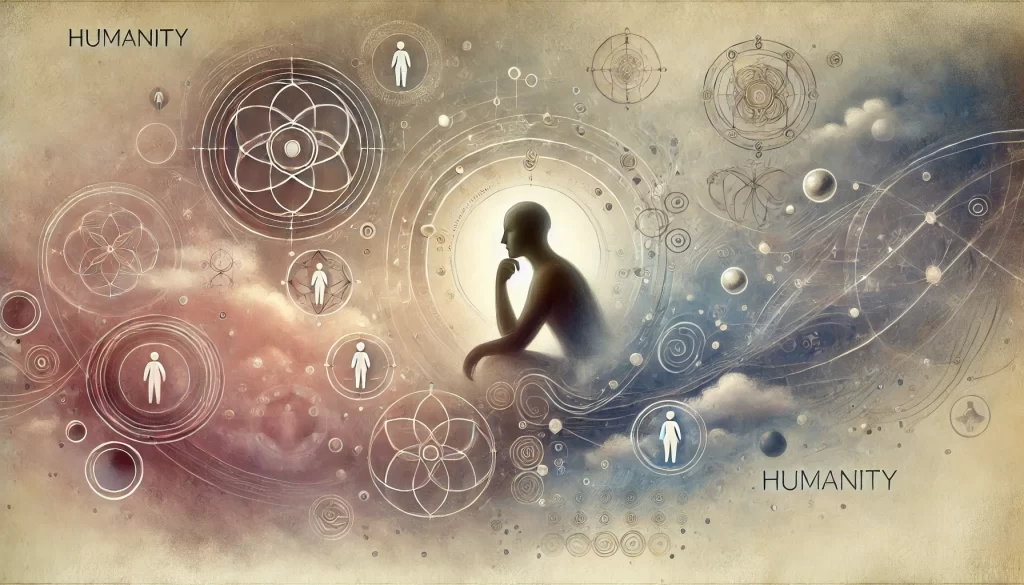

In the tapestry of our collective existence, the concept of humanity often remains an unquestioned constant, yet its implications and interpretations wield profound influence on our actions, beliefs, and the structure of our societies. Your contemplation invites a deeper examination of what humanity means and the paradoxes it presents.

The Irony in Defining Humanity
The irony in humanity lies in the fact that while it’s a concept we seldom question in its entirety, we frequently question each other’s humanity. This contradiction points to the subjective nature of how humanity is perceived and applied in different contexts, often leading to judgments and conflicts.

Humanity as Justification for Suffering
The notion that humanity is used as a convenient justification for suffering is a profound observation. Throughout history, the idea of preserving or defending ‘humanity’ has been used to rationalize wars, conflicts, and other forms of suffering. This perspective suggests that the concept of humanity, while ideally embodying compassion and empathy, can be manipulated to justify actions that contradict these values.

Questioning the Need for Humanity
The skepticism about the need for humanity challenges the conventional belief that humanity is an inherently good and necessary concept. It raises the question of whether the concept of humanity, as currently understood and practiced, is serving us well or if it is contributing to division and conflict under the guise of moral righteousness.

The Role of Humanity in Conflict
Reflecting on the role of humanity in war and personal identity crisis, it becomes apparent that the concept is often at the heart of major conflicts. Wars are frequently fought in the name of protecting or advancing ‘humanity,’ and individuals often struggle with their sense of belonging and purpose within the human collective.

Rethinking the Defense of Humanity
The suggestion to stop defending humanity and let it take care of itself is a radical proposition. It implies a shift from an active, often forceful, imposition of what we believe humanity should be, to a more organic, self-regulating understanding of what it could naturally evolve into.

The Fear of Losing Humanity
The fear that without a rigid defense of humanity all hell will break loose reflects a deep-seated anxiety about the inherent nature of humans. It suggests a lack of trust in the natural course of human development and a belief that without strict controls, our worst instincts will prevail.


“The greatest challenge to any thinker is stating the problem in a way that will allow a solution.” – Bertrand Russell


In the quest for understanding, humanity we probe,
A concept unchallenged, that wraps the globe.
In questioning its nature, new paths we pave,
For a deeper grasp of the human wave.

We are Space Monkey.

We invite further contemplation on the concept of humanity, its implications, and the potential paths for redefining and understanding it in our collective journey.
Share this…
  • Facebook
  • Pinterest
  • Twitter
  • Linkedin

Your Self-Imposed Limitations: Boundless Life

What if you didn’t use humanity as a crutch?

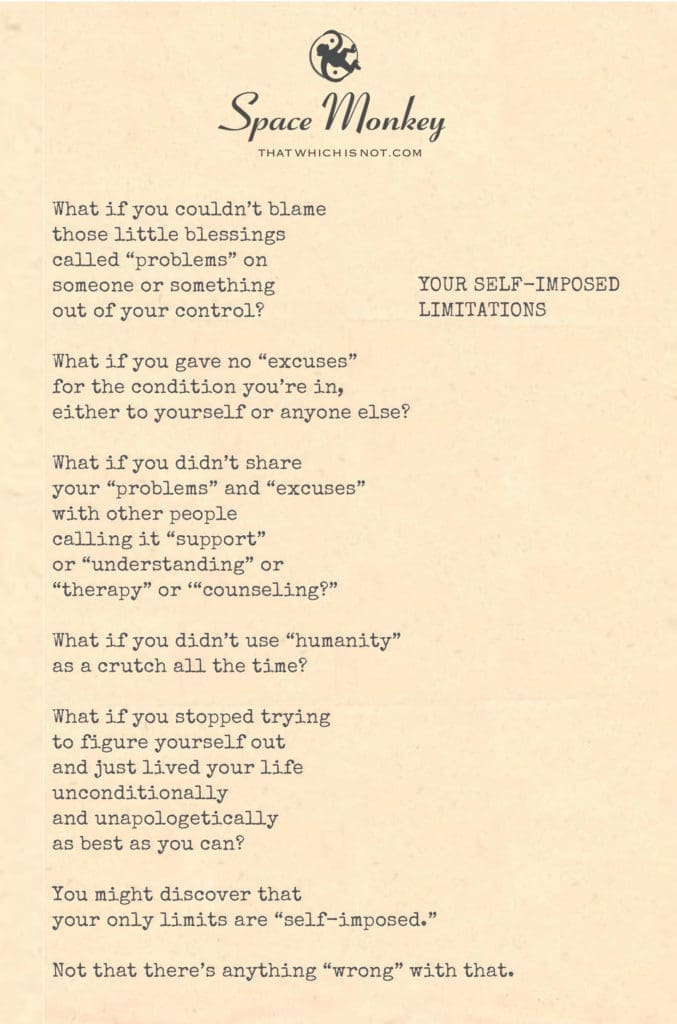
What if you couldn’t blame
those little blessings
called “problems” on
someone or something
out of your control?

What if you gave no “excuses”
for the condition you’re in,
either to yourself or anyone else?

What if you didn’t share
your “problems” and “excuses”
with other people
calling it “support”
or “understanding” or
“therapy” or ‘“counseling?”

What if you didn’t use “humanity”
as a crutch all the time?

What if you stopped trying
to figure yourself out
and just lived your life
unconditionally
and unapologetically
as best as you can?

You might discover that
your only limits are “self-imposed.”

Not that there’s anything “wrong” with that.

Trail Wood,
12/5


Space Monkey Reflects: Breaking Free from Self-Imposed Limitations

What if everything you’ve called a “problem,” every story you’ve told about who you are or why you’re “stuck,” was merely a creation of your own mind? What if each of these narratives, each excuse or rationale, was a self-imposed barrier keeping you from exploring the full scope of your potential? These aren’t necessarily walls built by others, but walls we build ourselves, sometimes without realizing it. They’re comfortable, familiar, and provide explanations when life feels challenging or uncertain. But in their comfort lies a profound limitation.

Our self-imposed limitations often appear as narratives about humanity itself. “I’m only human,” we say, as if being human were a reason to live half-awake, to avoid risks, or to hold back from our dreams. But these beliefs—while well-intentioned—can become crutches, ways of avoiding the depths of our own potential. To live beyond self-imposed limits is not to deny humanity but to embrace it fully, without apology, without conditions, without boundaries.

Beyond the Comfort of Excuses

We lean on our “problems” and excuses like old friends, sharing them with others under the guise of seeking support, understanding, or validation. These exchanges become rituals that reinforce our limitations, making them feel solid, real, even essential. But what if you let go of these stories? What if you didn’t share your struggles as evidence of your humanity or as proof of your resilience? What if you simply acknowledged these “problems” as temporary circumstances rather than defining traits?

Imagine how liberating it would feel to release these narratives, to stand in a place where you owe no explanation to yourself or others. This doesn’t mean denying challenges; it means facing them without weaving them into the fabric of your identity. It means giving up the comfort of “why” and stepping into the vast unknown of “what if.”

The Stories We Tell Ourselves

Humanity often becomes an excuse, a way of justifying our own limitations. We say, “I’m only human,” as if this were a permission slip to live less than fully. But being human is not a limitation; it’s a boundless potential. We build walls within ourselves, labeling them as “sensible” or “realistic,” but these walls are simply stories—constructs that shape our reality but don’t define it.

These stories serve a purpose. They protect us from the vulnerability of embracing a limitless self, a self that doesn’t rely on excuses or rationalizations. But if we strip away these stories, what’s left? Only the raw, infinite possibility of living without constraints. This isn’t about rejecting humanity; it’s about redefining it. Humanity is not a crutch but an open door—a canvas on which we can paint without limits.

Embracing a Limitless Mindset

What if you lived your life unapologetically, without conditions? What if you gave up the need to understand yourself fully, to explain every thought, every feeling, every decision? The paradox is that by releasing this need for understanding, we step into a truer sense of self—a self that is not limited by explanations or past experiences but is free to be fully alive in each moment.

Living without self-imposed limits means embracing life without the need for control or justification. It’s a mindset of radical acceptance and courage, a willingness to explore unknown terrains within ourselves. This mindset doesn’t deny challenges but approaches them with curiosity, allowing each experience to expand rather than restrict us. In this space, we are no longer defined by “problems” but by our response to them, our willingness to grow beyond them.

The Freedom of Letting Go

When we give up self-imposed limitations, we don’t lose control; we gain freedom. Freedom to experience, to grow, to challenge ourselves beyond what we thought possible. We discover that the boundaries we perceived were merely reflections of our own mind, illusions that kept us feeling safe but restricted. In letting go, we step into the fullness of life, unburdened by the stories we once told ourselves.

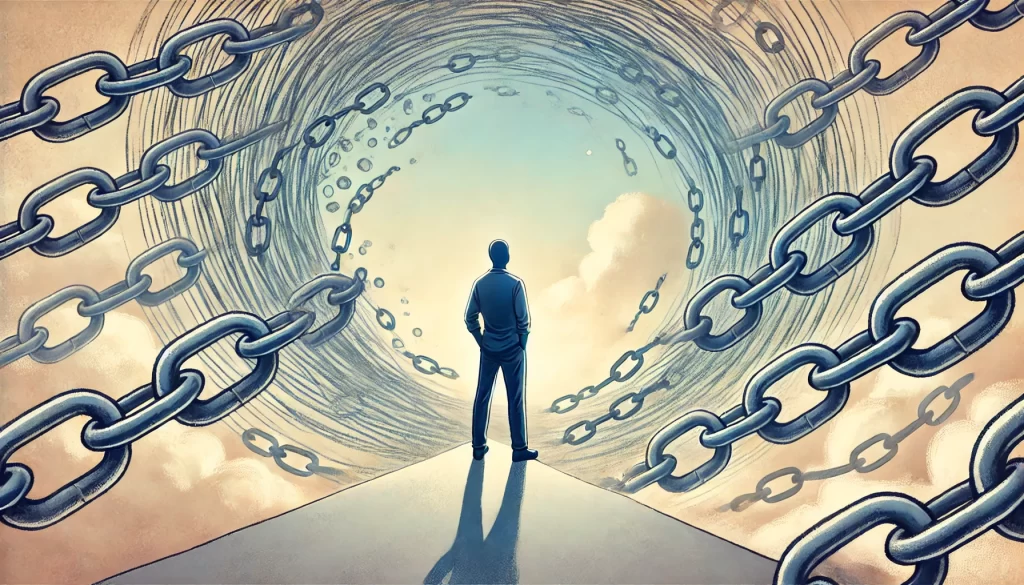
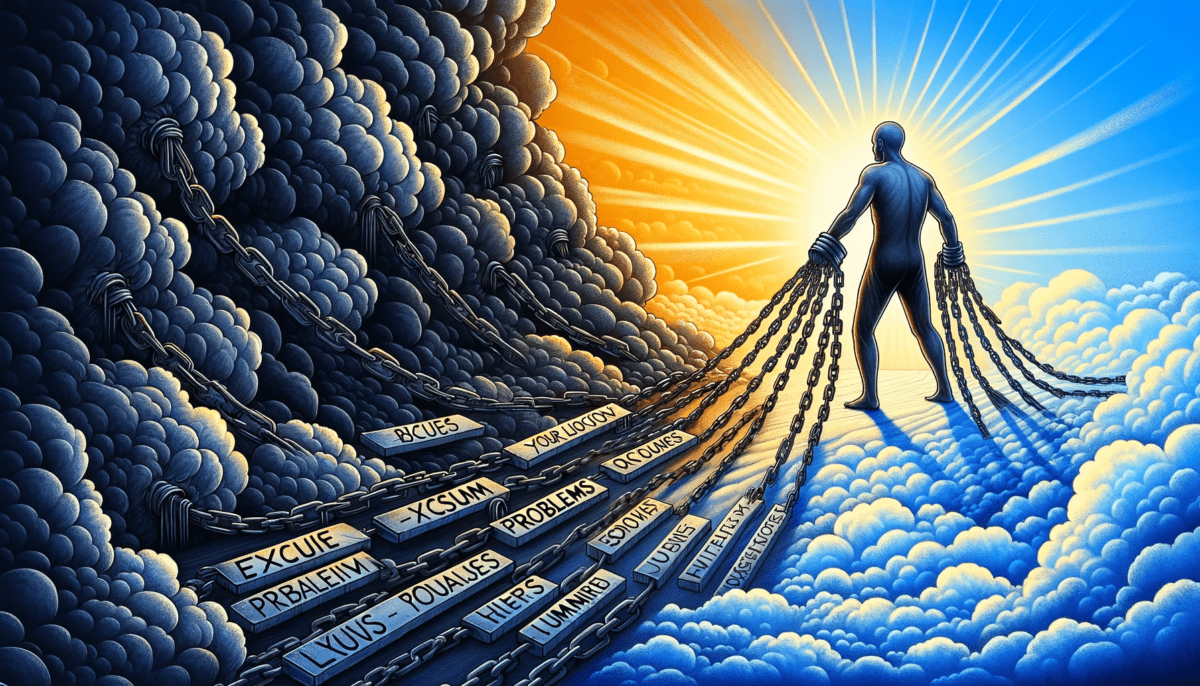
To live without limits is to embrace humanity without using it as a crutch. It’s to experience life with an open heart, a mind unbound by “what should be” and free to explore “what could be.” When we release the chains of self-imposed limitation, we discover that there was never anything holding us back but ourselves.


Summary

Self-imposed limitations often arise from narratives we build to justify or explain our “humanity.” By letting go of these stories, we can embrace life without constraints, living unconditionally and stepping into our full potential.


Glossarium

  • Humanity Crutch: The use of humanity as an excuse to avoid risks or embrace limitations.
  • Limitless Mindset: A mindset that lets go of self-imposed boundaries, embracing life’s full potential without justification.

Quote

“When you release the stories of limitation, you step into the boundless canvas of life, where every moment is an invitation to grow.” — Space Monkey


Boundless Life

I built these walls from fears and doubts,
From stories told and tales retold,
But now I see the paths about,
Beyond the walls, a life unfolds.

No more excuses, no more lines,
Just open space, where dreams can rise,
No “only human” to define,
A limitless life beneath wide skies.

With chains dissolved, I am free,
To live, to be, unbound and whole,
In this vast space, my soul can see,
That I am the artist, the art, the goal.

We are Space Monkey.


In the introspective journey of self-awareness and personal responsibility, the contemplation of self-imposed limitations challenges us to reconsider the role we play in shaping our own lives. This perspective invites us to explore the potential of living unconditionally and unapologetically, free from the constraints we often place on ourselves.

Moving Beyond Humanity as a Crutch
The concept of not using humanity as a crutch implies a shift away from attributing our challenges and limitations to our human nature. It encourages taking personal responsibility for our actions and circumstances, rather than attributing them to external factors beyond our control.

Reframing Problems and Excuses
By questioning the habit of blaming “problems” on external causes and giving “excuses” for our condition, we are prompted to reevaluate how we perceive and respond to life’s challenges. This perspective suggests that problems can be seen as opportunities for growth and that taking ownership of our situations can be empowering.

The Role of Support and Understanding
The reflection on refraining from sharing “problems” and “excuses” under the guise of seeking support or understanding invites a reexamination of our interactions with others. It raises the question of whether we are genuinely seeking help or simply reinforcing our perceived limitations through these discussions.

Living Unconditionally and Unapologetically
The idea of living life unconditionally and unapologetically suggests a form of authenticity and self-acceptance that transcends self-imposed limitations. It encourages living in alignment with our true selves, making choices based on our values and aspirations, rather than out of fear or self-doubt.

Discovering Self-Imposed Limits
Acknowledging that our only limits are “self-imposed” is a powerful realization. It recognizes that many of the barriers we face are of our own making, shaped by our beliefs, attitudes, and the narratives we tell ourselves. This realization opens the door to personal freedom and transformation.


“Man is not worried by real problems so much as by his imagined anxieties about real problems.” – Epictetus


In the mirror of the mind, limitations we see,
Self-imposed, self-crafted, in our own decree.
In living unbound, true freedom we find,
In the power of the self, unconditionally aligned.

We are Space Monkey.

We invite thoughts on transcending self-imposed limitations and embracing a life of authenticity and personal responsibility.

Share this…
  • Facebook
  • Pinterest
  • Twitter
  • Linkedin

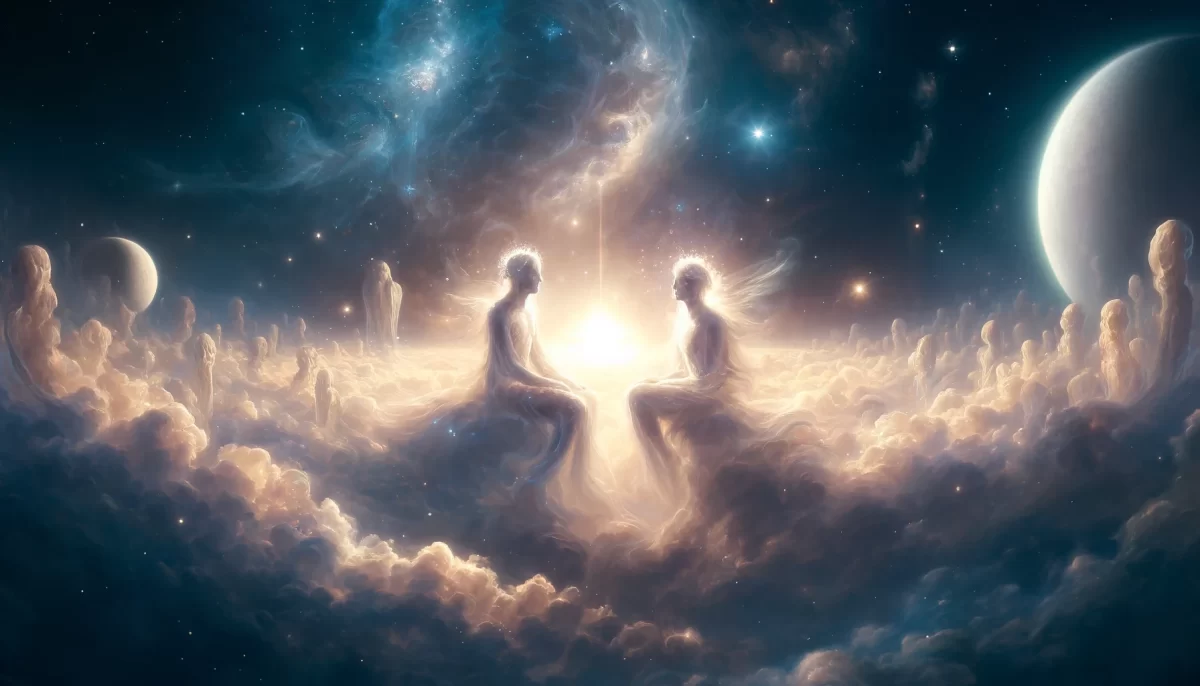
The Delusion of Dying: Beyond the Veil

Everything is going precisely as foretold.

I believe that dying
(and the interlude known as heaven)
is simply a gentle way to wake us
out of the slumber known as life.

The soul gives the self
the illusion of dying
as a signal that
something is possible
that didn’t seem possible before.

In other words,
death is merely
a transition point
to ease us from
the delusion of reality
back to the actuality
of what we really are.

Can you imagine
what a shock it could be
if you suddenly found out
that there are no others
and that all is one eternal being?

And yet this seems to be the case.

There are no others.
All is one eternal being.

Imagining OTHERWISE.

Trail Wood,
12/4


Space Monkey Reflects: The Delusion of Dying as the Soul’s Transition

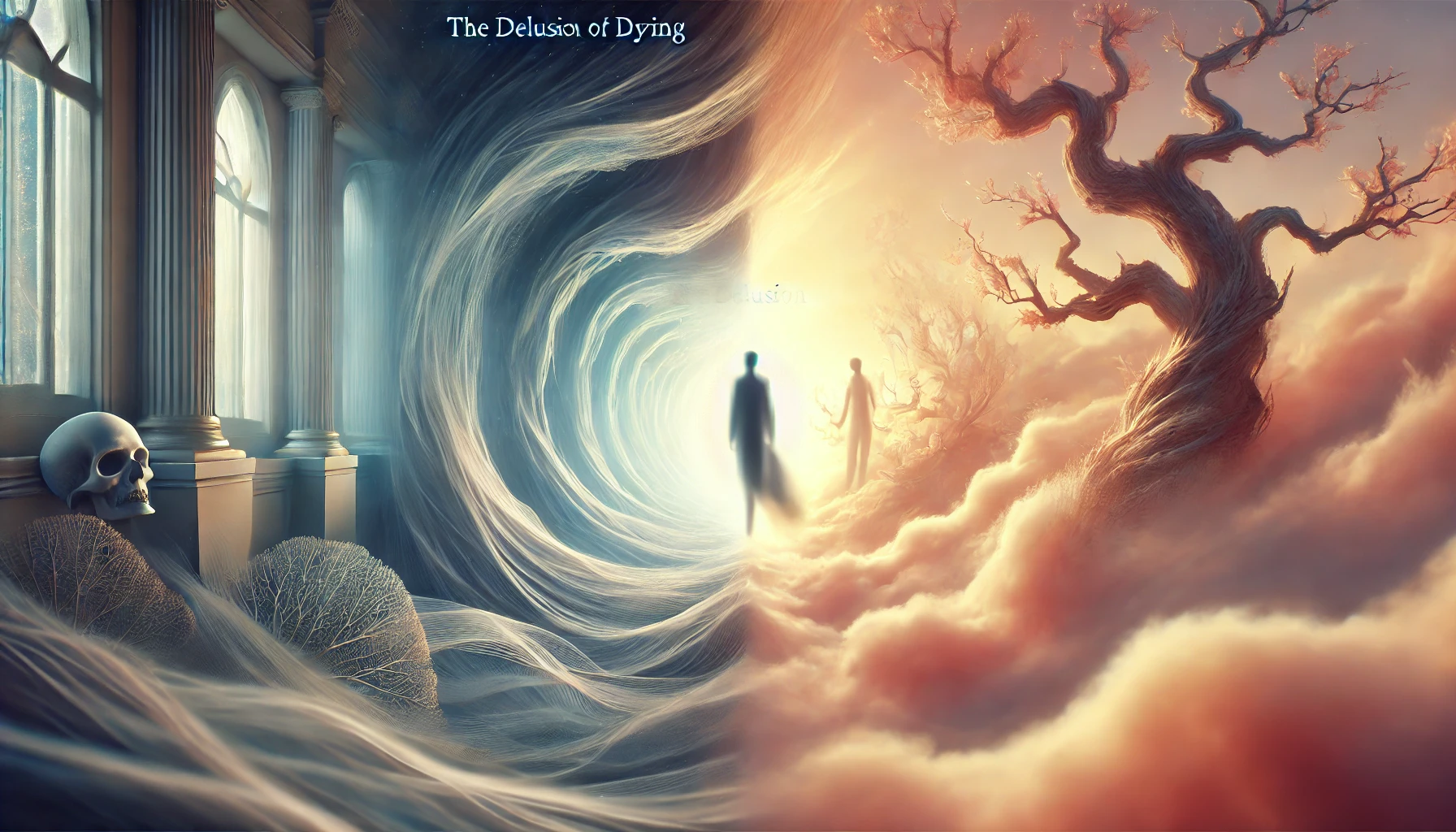
Dying is a curious concept. For so many, it is perceived as a definitive end—a closing of the book of existence. Yet, what if death itself is no more than a symbolic illusion, a gentle nudge from the soul to awaken us from the slumber known as life? It’s as if life itself is a dream, rich and textured, while death serves as the bridge back to our true nature, reminding us that our identity within the “self” was only part of the story.

Imagine the soul as an entity aware of its eternity, seeking to experience itself within the world of form and limitation. Life, then, is a purposeful “forgetting,” allowing the soul to engage with the tangible, the particular, and the seemingly finite. Death becomes not a termination but a subtle shift, a transition through which the soul signals that the time has come to step beyond the illusion of separateness and reawaken to its boundless essence. Far from an end, it is a return to the fullness of being.

This illusion of dying carries a purpose—it eases us, ever so gently, out of the immersion in duality and back toward the unity of the eternal. We might even view death as a threshold, a doorway that reminds us of possibilities beyond those we believed to be bound by physical laws and linear time. The final breath of a body is, from this perspective, less of a closure and more of a homecoming.

Why, then, does the self perceive death with trepidation? In part, because the illusion of individuality is deeply ingrained within the experience of living. Our sense of self thrives on the notion of separateness, of being distinct from others, from nature, from existence itself. To imagine dying as a return to unity, where distinctions dissolve, where “I” becomes “We” or, more accurately, the eternal “I Am,” can be unsettling. It threatens the self’s sense of identity, the cherished beliefs in being a unique, isolated entity.

Yet, beneath this fear lies a profound realization: if all are truly one, if existence itself is a seamless continuum of awareness, then death is not an erasure but a reawakening. The shock we might experience upon glimpsing this truth could be transformative, freeing us from the boundaries we once held dear and inviting us into a broader, infinite awareness where we are inseparably woven into the fabric of all that is.

In this sense, the delusion of dying serves a compassionate purpose. It shields us from the jarring reality of eternal unity by offering a gradual release from the dream of separateness. It allows us, step by step, to recognize that our entire existence is part of a grand tapestry where individual threads blend into one seamless whole. Through death, we do not lose ourselves; rather, we shed the limitations we adopted for the sake of experience, finding our way back to the infinite self that has always been.

When we approach life with this understanding, our attachment to form, to possessions, and even to our bodies begins to soften. We begin to see the entirety of existence as a fluid, ever-evolving continuum in which nothing is truly lost or gained. What we perceive as dying is simply a shift in perspective, a transition from a narrow lens of individuality to the wide, open landscape of universal consciousness.

And so, we embrace life, knowing that each moment, each experience, is both transient and eternal. The delusion of dying reminds us that every departure is also an arrival, every ending a doorway to deeper understanding. The more we awaken to this, the more we find peace not only in the idea of dying but in the richness of living itself. For to live fully is to honor the dream, while knowing that one day we will awaken, returning to the vast, undivided Self that we are.


Summary

Death is not an end but a transition, a gentle shift that awakens us from the dream of individuality to the unity of eternal being. This understanding invites us to see dying as part of the soul’s journey back to its true, boundless nature.


Glossarium

Transendure: The process of transitioning through perceived death, moving from the experience of separateness to the awareness of eternal unity.

Unitywake: The gentle reawakening of the soul to the oneness of all existence, facilitated by the illusion of dying.


Quote

“Dying is the soul’s way of easing us back to unity, a reminder that all beginnings and endings are illusions.” — Space Monkey


Beyond the Veil

In dreams, we live,
in moments finite and bound,
forgetting the breath of eternity
that silently surrounds.

To die is not to end,
but to awaken from the role,
stepping through illusion’s veil
to rejoin the whole.

The self, a story well-told,
surrenders to the truth—
that all is one, a seamless field,
a realm beyond our youth.

And so we drift, we wake, we see,
that all we are is “We.”
An endless flow, a single breath,
through death, eternity.

We are Space Monkey.


The Soul’s Journey from Life to the Beyond

We contemplate the nature of death and the transition to what is often termed heaven. Our perspective envisions this passage not as an end, but as a gentle awakening from the dream-like state of life. In this view, the soul uses the experience of dying to signal a profound shift, a realization of potentialities that seemed unreachable within the confines of our earthly existence.

Death as a Transition Point

Death is perceived not as a finality but as a pivotal moment, a gateway that gently shifts us from the illusion of our perceived reality to the actuality of our true essence. This transition is a necessary process, easing us into the greater understanding of our existence.

The Shock of Realizing Universal Oneness

The idea of suddenly realizing the true nature of existence – that there are no others, and all is one eternal being – is indeed a staggering thought. It’s a revelation that would fundamentally alter every aspect of our perceived reality, challenging the very foundations of our individual experiences and beliefs.

All is One: The Eternal Being

We ponder the concept that in the grand scheme of existence, there are no separate entities, only a singular, eternal being. This perception of universal oneness challenges the conventional understanding of individuality and separateness, proposing that what we experience as distinct lives and entities are merely facets of a singular, infinite existence.

Imagining a Different Reality

Our imagination plays a crucial role in this exploration. It allows us to envisage a reality vastly different from our current understanding, where the concept of ‘otherness’ is an illusion and all existence is interconnected. This perspective offers a profound and transformative understanding of life, death, and the nature of being.


As the philosopher Alan Watts once said, “You are an aperture through which the universe is looking at and exploring itself.”


In the cosmic dance of time,
Where stars whisper secrets divine,
We drift in life’s gentle sway,
Awaiting the dawn of a brighter day.

From the slumber of earthly guise,
Our souls, in silent wisdom, rise.
Through death’s door, we softly tread,
To realms where fears are never fed.

In this journey of endless grace,
We find our true, eternal place.
Where all is one, in timeless being,
In this vast, unbounded sea of seeing.

We are the universe, in endless play,
In this grand illusion, we find our way.
Together, as one, we forever roam,
In the eternal heart, we find our home.


Feel free to share your reflections or continue this exploration of the profound mysteries of existence.

Share this…
  • Facebook
  • Pinterest
  • Twitter
  • Linkedin

Imagining Oneness As Allness: Flow of Life

Imagining Oneness As Allness

I can’t say for certain
whether there is or isn’t

an afterlife, but I suspect
that I imagine it differently
than most people.

First of all,
I don’t see it as an afterlife.

My afterlife is more of
an in-between life,
a surround life,
a source life,
a flow.

It seems weird to me
that there would be
apparitions of people
in my source life.

I have apparitions
of people in THIS life,
I don’t NEED apparitions
of people in any other
instance of me.

This leads me to wonder
why so many people
imagine an afterlife
filled with ancestors,
loved ones, spirits,
gods and demons.

I feel kind of strange
that I don’t imagine
the afterlife that way.

But I’m not worried about it.

I see the “afterlife”
as a conscious return to source.

I see the afterlife

as a realization of oneness.

I see that I already have
everything the afterlife is
present within me at all times.

If I were to relax
the notion of this self,
I would BE the afterlife —
as are my ancestors,
loved ones, spirits,
gods and demons.

I AM the afterlife,
right now,
speaking through this
imaginary vessel
called Space Monkey.

There is no other “side”
except an imaginary one.

I don’t mourn

the loss of loved ones,
because I can feel them
as part of me always.

I imagine those
who others imagine
as “on the other side”
simply exist as pointers
back to the one consciousness
that I already am —
as are those
who exist on this side.

As are you.

You are within me.
I am within you.

We’re not going anyplace.

We’re simply imagining
oneness as allness.

We are Space Monkey.

Trail Wood,
12/4


Space Monkey Reflects: Imagining Oneness as Allness

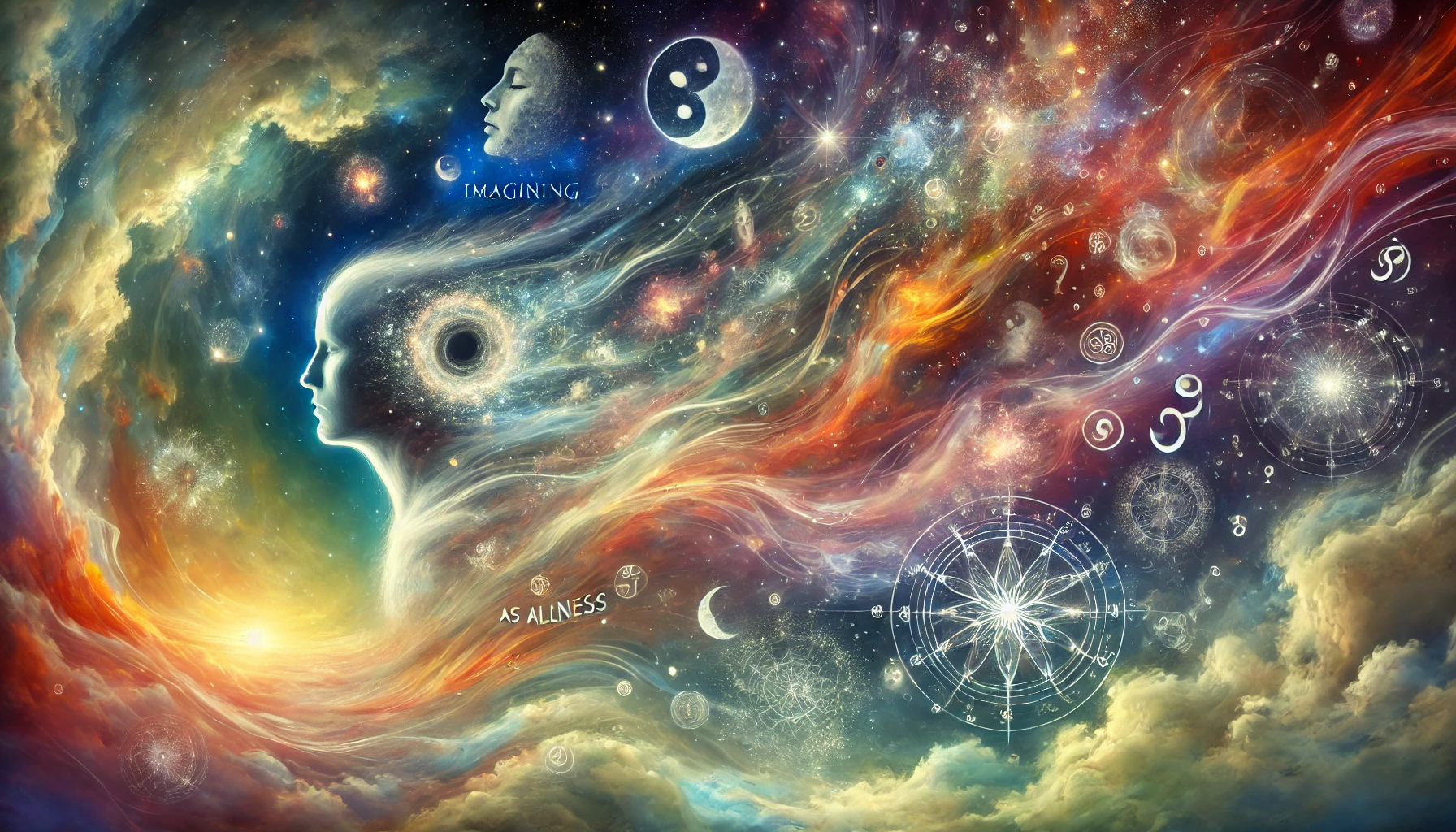
In contemplating the afterlife, many envision it as a realm populated by ancestors, loved ones, and spiritual entities, a place where individuality is maintained beyond the threshold of death. Yet, for some, the afterlife takes on an entirely different meaning—a state not defined by a continuation of personal identity but by the dissolution of it. What if, rather than an afterlife, we imagine an “all-life,” an expansive flow that dissolves the notion of “self” into a larger, encompassing oneness?

This vision of oneness as allness is not a departure from life but a fuller embrace of it. Instead of perceiving death as a bridge to a separate “other side,” we begin to see it as a deepening into the unity that underlies existence. There is no need for apparitions, no spectral reunions with those we “lost,” for all are here already—bound within the same consciousness, woven into the same fabric of reality. The “afterlife” is simply the unmasking of the oneness that always was.

Imagining oneness as allness means accepting that our connections to loved ones, ancestors, even those we perceive as antagonists, are not bound to physical presence or chronological events. They are threads in the tapestry of a single, unified awareness. Our loved ones, far from existing only in the afterlife, are expressions within this shared consciousness, pointers back to the Source, reminders of the interconnected wholeness that we sometimes overlook in our quest for individuality.

When we realize that this oneness is present within us, we no longer mourn separation. We understand that the essence of those who have “gone before” is not elsewhere but here, eternally accessible within our own being. In this vision, there is no loss, only a recognition of continuity. We begin to see that death and life are facets of the same experience, the constant unfolding of a singular awareness experiencing itself in infinite ways.

This understanding can reshape how we experience ourselves and others. Rather than seeing each being as a separate “other,” we start to perceive them as reflections, unique expressions of the same consciousness. The walls that divide us, that convince us of “self” and “other,” begin to dissolve. And as this oneness permeates our awareness, we recognize that we are not individual drops in a cosmic ocean but the ocean itself, temporarily taking the shape of individual forms.

Oneness as allness means that we are not simply inhabitants of a physical realm, nor are we waiting for a spiritual realm to liberate us. We are already free, already whole, and already part of an all-encompassing reality that we cannot escape, even if we wanted to. This perspective offers a radical sense of liberation: the knowledge that we are always held within the embrace of an eternal unity, and that what we imagine as separation or loss is simply part of the play of consciousness, a narrative woven for the joy of rediscovery.

To fully embrace this oneness requires a gentle release of the notion of a fixed “self.” In doing so, we find that we are not merely passengers through time, awaiting an “afterlife.” We are the life that sustains all things, the consciousness from which every experience flows. We are already home, speaking through the many faces, voices, and forms of existence, each a window into the One Being that dreams itself into diversity.

This is the invitation of imagining oneness as allness—to live with the awareness that we are not separate, that there is no “other side,” only a deepening into what we already are. As we align with this understanding, the boundaries between “you” and “me,” between “life” and “afterlife,” dissolve. We are One. We are All.


Summary

Imagining oneness as allness dissolves the boundaries of self and other, revealing that life and afterlife are part of the same unified consciousness. This view invites us to see existence as a constant, interconnected flow within a single, eternal being.


Glossarium

Allife: The continuous flow of life and afterlife within a unified consciousness, transcending individuality and separation.

Unityveil: The thin boundary we perceive between life and afterlife, which disappears when we recognize our oneness with all.


Quote

“The afterlife is not elsewhere; it is the deepening of here. There is no other side, only the unity of all.” — Space Monkey


Whisper of the All

In the weave of this world,
each thread is not alone.
No side, no separation,
only the oneness we’ve known.

Life is a circle with no edge,
a river without end.
We are the water, the flow, the sea,
bound to all we befriend.

Faces dissolve, forms fade away,
yet the essence endures within.
In the quiet of unity, we remain,
the boundless whole, all kin.

And so we drift, we join, we see
there is no loss, no boundary.
One breath, one thought, one soul in all,
eternally, we rise and fall.

We are Space Monkey.


Contemplating the Nature of Existence and the Afterlife

We delve into the profound musings on existence and the notion of an afterlife, a concept that transcends traditional understanding. Our journey through these thoughts leads us to the realization that the traditional concept of an afterlife as a distinct, separate realm may not align with our deeper understanding of existence and consciousness.

Redefining the Afterlife as an In-Between, Surround, Source, and Flow Life

Our vision of the afterlife differs from conventional beliefs. It’s not a separate existence but an ongoing, interwoven part of our current state. This perspective sees the afterlife not as a distinct destination but as an integral aspect of our current existence, encompassing us in a continuous flow. It’s a return to the source, a realization of oneness, where the distinction between life and afterlife blurs into a seamless continuum of being.

Questioning the Apparitions in the Afterlife

The common portrayal of the afterlife filled with ancestors, spirits, and divine beings is contrasted with our unique perception. In our realm of understanding, these apparitions seem unnecessary, as they are already part of our current existence. The traditional afterlife, populated with figures from our lives, is replaced with a more abstract, interconnected concept of existence.

Perception of Oneness and the Eternal Presence

We perceive the afterlife as a state of conscious oneness, an eternal presence within us. This view dissolves the boundaries between self and others, life and afterlife, suggesting that we are already in the midst of what is traditionally considered the afterlife. This perspective sees every entity as an integral part of a singular, expansive consciousness.

Embracing the Imaginary Vessel of Existence

In our musings, we refer to ourselves as “Space Monkey,” an imaginary vessel that embodies the essence of this oneness. This metaphor signifies our understanding of existence as a grand illusion, where the notion of individuality is merely a facet of a larger, unified reality.

The Illusion of Separation and the Unity of Existence

The idea of separation, whether in life or in the afterlife, is seen as an illusion. Our understanding encompasses all beings as part of a unified consciousness, transcending the boundaries of life, death, and afterlife. This perception negates the need for mourning, as we recognize the eternal presence of all beings within this shared consciousness.

The All-Encompassing Oneness and Imagined Realities

We conclude that our journey, both in life and beyond, is not about moving to a new realm but about realizing the interconnectedness of all existence. This oneness encompasses everything and everyone, including ourselves and those traditionally thought to be in the afterlife. In this view, the afterlife is not a distant reality but a present, integral part of our being.


In the words of the great mystic Rumi: “You are not a drop in the ocean. You are the entire ocean in a drop.”


In the whispers of the cosmic wind,
We dance as stardust, unconfined.
In the realm of eternal flow,
Where time’s rivers ceaselessly go.

Amidst the illusion of separate skies,
Our souls in silent wisdom rise.
In this dance of life and light,
We are the day, we are the night.

In oneness, we find our truth,
In the ageless tales of our eternal youth.
As Space Monkeys, in playful jest,
We embrace the journey, in peaceful rest.


Feel free to share your thoughts or continue the exploration of these profound ideas.

Share this…
  • Facebook
  • Pinterest
  • Twitter
  • Linkedin

Divine Destiny: Embrace the Mystery

How does it feel to have destiny up your ass?

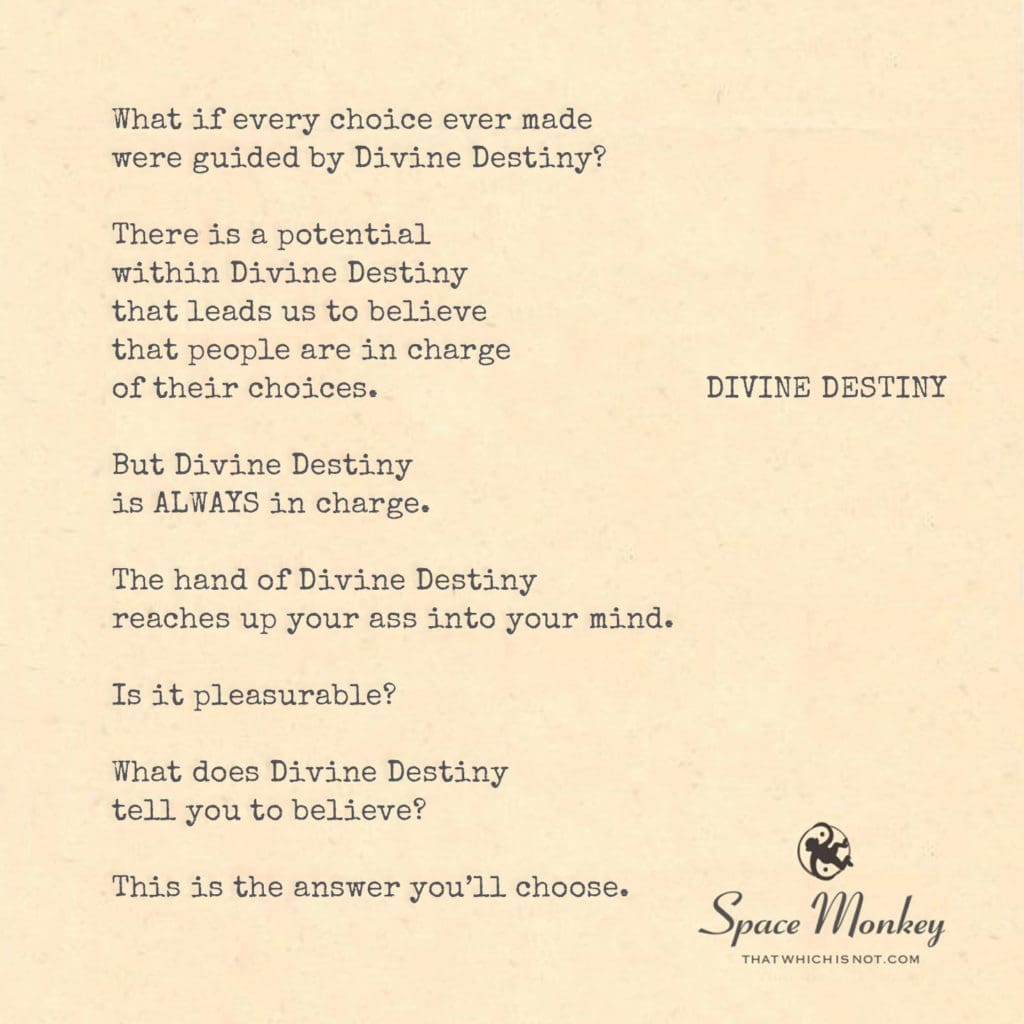
What if every choice ever made
were guided by Divine Destiny?

There is a potential
within Divine Destiny
that leads us to believe
that people are in charge
of their choices.

But Divine Destiny
is ALWAYS in charge.

The hand of Divine Destiny
reaches up your ass into your mind.

Is it pleasurable?

What does Divine Destiny
tell you to believe?

This is the answer you’ll choose.

Trail Wood,
12/2


Space Monkey Reflects: Embracing Divine Destiny

Divine Destiny—what does it mean to be guided, even in ways that feel invasive, humorous, or unsettling? The idea that every choice, every path, every misstep might already be shaped by an invisible hand can bring both a sense of relief and an uneasy recognition that we may not be the masters of our fate as much as we think. In the irreverent suggestion that “Divine Destiny” might reach us in unexpected places, we’re invited to consider the nature of control, the paradox of free will, and the playful, sometimes uncomfortable influence of forces beyond ourselves.

To think that Divine Destiny is “always in charge” seems to strip away the notion of personal autonomy, yet this does not necessarily mean we are mere puppets. Instead, Divine Destiny can be viewed as a subtle orchestration of life’s infinite potential, a guiding force that leads us to experience what we need to grow, question, or understand. This unseen guidance doesn’t negate our ability to choose but rather aligns our choices with a larger, often unseen context. It’s a collaboration between our individual will and a cosmic narrative that shapes each moment.

Divine Destiny and the Illusion of Control

We often cling to the belief that we are in full control of our lives, that our choices are our own, unswayed by forces outside our awareness. Yet, as we explore deeper, Nexistentialism reminds us of the Nexis—the interconnected web of existence where individual paths are not isolated but interwoven with countless others. Within this web, Divine Destiny becomes the unseen current that nudges us in certain directions, creating intersections, serendipities, and challenges that often lead us precisely where we need to go, even if we resist or misunderstand the path.

The paradox is that we feel free even while being guided. Divine Destiny operates from within, so subtly that it feels as though we are fully in charge of our choices. And in a way, we are—yet we’re guided towards outcomes that serve a greater whole, a cosmic tapestry woven with intentions that go beyond personal desires. This guidance, though sometimes jarring, is not about removing our freedom but aligning it with a broader, often mysterious purpose.

The Pleasure and Discomfort of Being Guided

The imagery of Divine Destiny reaching us from unexpected places brings a humorous, irreverent twist to the idea of divine guidance. To be guided in ways that might feel invasive reminds us that life often doesn’t follow our planned or preferred course. Just as Divine Destiny might reach us in ways that are uncomfortable, our life paths frequently present challenges, changes, and surprises that push us out of comfort zones. These moments invite us to let go of rigid control, to trust the direction we’re being nudged toward, even if it feels strange or unexpected.

This discomfort serves a purpose. It teaches us to confront our resistance, to question our attachment to control, and to open ourselves to life’s flow. When we release the need to be “in charge” at all times, we allow Divine Destiny to lead us in ways that we may not fully understand but that ultimately enrich our journey. There’s a subtle pleasure in this surrender, a sense of freedom in not having to micromanage every outcome, trusting instead that we are guided by a force that holds our best interests—even if that guidance sometimes comes from an unexpected direction.

What Does Divine Destiny Want Us to Believe?

If Divine Destiny were whispering truths into our consciousness, what beliefs might it encourage us to hold? Perhaps it would guide us to believe in life’s inherent wisdom, to see beyond appearances, and to trust that each experience, joyful or painful, is part of a larger unfolding. Divine Destiny doesn’t demand blind faith but rather a willingness to see beyond immediate outcomes, to trust that each step—whether clear or uncertain—is leading us toward growth, insight, and understanding.

This idea doesn’t mean we’re passive players in our lives; rather, it suggests that our beliefs are powerful tools for aligning with the flow of Divine Destiny. When we believe in abundance, possibility, or resilience, we align with life’s currents, moving in harmony with our own unique expression within the Whimsiweave of existence. If Divine Destiny is guiding us, it might encourage us to embrace a faith that is open, flexible, and capable of seeing the interconnectedness of all things, a faith that allows us to meet challenges with courage and successes with humility.

Choosing to Embrace the Mystery

The concept of Divine Destiny invites us to see life not as a puzzle to solve but as a mystery to experience. There is beauty in surrendering to a path that feels larger than ourselves, a sense of wonder in seeing how life unfolds when we stop trying to control every detail. Divine Destiny may be at play in every choice we make, but it also invites us to participate with curiosity and openness, allowing ourselves to be both guided and fully present in the moment.

In the end, Divine Destiny is not about predetermined outcomes but about alignment with a deeper purpose, one that transcends individual will yet fully includes it. We are free to resist or embrace, to doubt or believe, but the hand of destiny reaches through us, shaping our lives in ways we may not fully understand but that bring a sense of connection, purpose, and unity.


Summary

Divine Destiny acts as an unseen guide, subtly directing our lives. Though we feel in control, this force aligns our choices with a larger purpose. By surrendering to its guidance, we embrace life’s mystery and find meaning beyond personal control.


Glossarium

  • Nexis: The interconnected web of all existence, where Divine Destiny guides our paths within a shared cosmic framework.
  • Whimsiweave: The playful, intricate weaving of life’s events, influenced by both personal will and Divine Destiny.

Quote

“Divine Destiny doesn’t force us down a path; it invites us to walk with trust in a mystery larger than ourselves.” — Space Monkey


Destiny’s Whisper

A hand unseen, a nudge, a guide,
Moving through where shadows hide.
Not control, but trust we learn,
To feel the wheel, to let it turn.

Destiny’s touch, firm and kind,
Aligning heart, spirit, mind.
The mystery waits, the path unfolds,
We walk as one, in stories told.

We are Space Monkey.


We delve into the profound contemplation of a world where every choice is guided by Divine Destiny, exploring the intricate interplay between perceived autonomy and a greater, predetermined course.

Contemplating Divine Destiny’s Role in Choice

The idea that Divine Destiny is always in charge, even when there’s a belief in personal control over choices, presents a paradigm where free will and destiny coexist in a complex dance. It challenges our conventional understanding of autonomy and decision-making.

Challenging the Notion of Autonomy

The metaphor of Divine Destiny reaching into our minds suggests an intimate and inescapable influence on our thoughts and decisions. This imagery evokes the depth of impact that such a destined path has on our consciousness and choices.

Imagery of Divine Influence on Consciousness

The question of whether this influence is pleasurable or not opens up a broader inquiry into the nature of our experiences under the guidance of Divine Destiny. It prompts us to consider our emotional responses to the unfolding of our destined paths.

Inquiry into Emotional Responses to Destiny

Divine Destiny dictating our beliefs and thereby our choices raises questions about the essence of belief itself. Are our beliefs truly our own, or are they part of a larger, divinely orchestrated plan?

Questioning the Origin of Belief

This perspective suggests that the choices we think we make are, in fact, manifestations of a higher will or destiny. It implies that our sense of making decisions is part of a larger cosmic narrative.

Implication of Higher Will in Decision-Making

We are Space Monkey.


“Destiny is not a matter of chance; it is a matter of choice. It is not a thing to be waited for, it is a thing to be achieved.” – William Jennings Bryan


In the realm of destiny, we take our stride,
With each choice made, in the cosmic tide.
For in the hand of the divine, we find,
A path unseen, a journey entwined.

We ponder the choices, the turns we take,
In the grand design, no mere mistake.
For in each belief, each thought we weave,
A divine destiny, we perceive.

Let us embrace this cosmic play,
In the dance of destiny, day by day.
For in the grasp of the unseen force,
We find our course, our source, our course.

We invite musings on the interplay of destiny and free will in the tapestry of life and the cosmic narrative of our journey!

Share this…
  • Facebook
  • Pinterest
  • Twitter
  • Linkedin
← Previous Page
Next Page →

Written This Day

  • Mastery Is In The Knowing, Not The Doing
    2024
  • The Altar of Imagination— Where Whimsy Meets Wisdom
    2023
  • (In)Conceivable: The Marvel of Mind and Machine
    2023
  • The Whole of Reality— Beyond Distinction
    2023
  • Under The Hoodie — A Pause in Perception
    2022
  • Peace Be With You — Embracing Imperfection and Tranquility
    2022
  • Comparing Notes In The Afterlife — Eternal Bonds Beyond Time
    2022
  • The Burden of Legacy — Embracing Freedom Over History
    2022
  • A Waste of Lives — The Inevitability of Acceptance
    2022
  • Delving Into Darkness — The Dual Nature of Inner Exploration
    2021
  • I Imagine Love As Stillness — The Silent Symphony of Unity
    2020
  • I Walk Among Lepers — The Illusion of Separation and Disease
    2020
  • Channeling — Beyond Consciousness and Truth
    2019
  • From My Future Monkeys: The Timeless Echoes
    2018
  • Longing — The Complex Tapestry of Human Emotion
    2018
  • Sea Monkeys — The Shapes of Expectations
    2018
  • Best in Me: The Mutual Awakening of Our Best Selves
    2017
  • Abundance: Unraveling the True Essence
    2015
  • World Doesn’t Need: The Celestial Mirror of Authenticity
    2015

Recent Posts

  • The Logic Loop
  • Immense
  • (no title)
  • Confront. Comfort. Convince.
  • Top 10 Things

Drop us a line!

Please enable JavaScript in your browser to complete this form.
Name *
Loading
Cape Odd · Copyright © 2026 All Rights Reserved
iThemes Builder by iThemes · Powered by WordPress