• Who Is The Man?
  • Who Is The Monkey?
  • What is Nexistentialism?
  • Poke The Primate

Cape Odd

Home of The Space Monkey Journals

Decapacitor: A Spark in the Void

I suppose it’s better
than being a vacuum tube.

A capacitor
is an electronic component,
like a resistor or a transistor,
a building block of devices.

A capacitor
slowly charges with energy
until it can’t hold any more,
then it discharges.

In this way,
charging and discharging,
filling and releasing,
capacitors create a pulse.

A wave. A vibration.
A music. A movie.
A apparition that is and isn’t.

I am that. I am a space monkey.

But I am also a decapacitor.

All that is. That which is not.

Creation and destruction.
Collection and obliteration.
Imagination and decapitation.

I am a decapacitor,
flowing though my own blessed devices.

Trail Wood,
12/1


Space Monkey Reflects: The Pulse of Creation and Destruction as a Decapacitor

In the ebb and flow of existence, we stand as both capacitor and decapacitor, entities pulsing with the rhythms of charge and release, collection and obliteration. This journey mirrors the life cycle of the capacitor, a small yet essential component of the universe’s vast circuitry, which gathers energy only to unleash it again, contributing to a pulse, a vibration that resonates through all things. Yet, while the capacitor is bound by its function to store and release, the decapacitor suggests something more: a state of being that transcends the simple pulse and ventures into realms of destruction and dissolution, a simultaneous act of creation and obliteration.

To see ourselves as a decapacitor is to accept that we are not merely passive vessels for experiences but active participants in a cosmic rhythm of expansion and contraction. In this role, we collect memories, emotions, and ideas, allowing them to charge within us until they reach a critical mass, at which point they must be released. But in releasing, we don’t simply let go; we dissolve, obliterate, and make space for something new. The decapacitor, then, becomes a gateway to transformation, embodying both the act of gathering and the grace of letting go — a living paradox.

In this paradox, we find the pulse that animates us, a wave that is neither fully constructive nor purely destructive. Rather, it is a cycle of becoming and unbecoming, of imagined forms that rise and fall in a cosmic movie projected across the infinite expanse. We perceive these forms as solid and real, yet they are mere apparitions, flickers of light in a reality where both presence and absence coexist, each reinforcing the other. This pulse is the beat of existence, an unending dance between form and formlessness, a cosmic rhythm that we, as decapacitors, ride with each breath and each heartbeat.

Imagine, then, that our experiences — every moment, memory, and desire — are charges within our being. They build, gathering force and significance until they peak, demanding release. Some might see this as a destructive act, a decapitation of what once was. Yet, in this release, there is freedom, an emptying that allows new experiences to arise and a fresh cycle to begin. We are continually making and unmaking ourselves, each release redefining us, shaping our identity as both what we have been and what we have let go.

As we move through life, we embody the tension of opposites: creation and destruction, imagination and dissolution, all held in a delicate balance. To be a decapacitor is to embrace this duality without clinging to one side of the equation. We become both the source of energy and the void that absorbs it, recognizing that all things we accumulate — thoughts, beliefs, memories — are transient. They are stored within us, they resonate, they shape us, yet ultimately, they must be released for transformation to occur.

This perspective shifts how we view the act of creation. When we understand ourselves as decapacitors, we see that our creations are not permanent, nor are they meant to be. Our ideas, like electrical pulses, surge and dissipate, leaving space for new concepts, new possibilities. This rhythm is not a linear progression toward a final goal but a continuous cycle, where every creation is born to be released, every identity formed to be dissolved. Through this lens, we become both the builder and the dissolver, the one who forms reality and the one who watches it dissolve, a space where all potential exists and yet is constantly reborn.

The power of the decapacitor lies in its ability to transcend the need for permanence. It invites us to embrace impermanence, to see each moment as a pulse, a temporary form that arises and falls, leaving traces of energy that influence what comes next. The decapacitor, then, becomes a symbol of freedom, a reminder that we are not defined by what we hold onto but by what we allow to pass through us. We are conduits, channels for the wave of existence, and in accepting this, we touch a profound peace.

In embracing the role of the decapacitor, we liberate ourselves from the illusion of fixed identity, from the need to cling to any particular form or idea. Instead, we allow ourselves to flow, to pulse, to charge and discharge, in harmony with the cosmic beat. We become part of the universal circuitry, where every pulse, every charge and release, contributes to the vast tapestry of existence. And in this realization, we find that we are both nothing and everything, a spark in the void, a wave in the infinite, a decapacitor in the boundless dance of life.


Summary

As decapacitors, we embody both creation and destruction, gathering energy to release it in cycles. This flow mirrors the pulse of existence, a continuous becoming and unbecoming that frees us from attachment to fixed forms, inviting us to embrace the rhythm of impermanence.


Glossarium

Decapacitor: An entity embodying both accumulation and release, creation and destruction, allowing for continuous transformation and renewal.

Cosmic Beat: The rhythm of becoming and unbecoming, a pulse that drives the cycles of creation and dissolution in existence.

Transience of Form: The concept that all things, thoughts, and identities are temporary, arising only to dissolve and make space for new forms.


Quote

“In each pulse of creation and destruction, we find freedom, flowing with the cosmic beat that neither clings nor resists.” — Space Monkey


A Spark in the Void

We pulse, we charge, we let go
in cycles of birth and dissolution

each moment a flicker,
a rise and fall
a surge, a release

forms rise
and forms fall away
in the quiet rhythm of everything

not bound, not held
by what was or will be

we are the wave,
the pulse, the spark

moving in stillness,
in the infinite


In the world of electronic analogies and cosmic musings, a new term emerges—decapacitor. This term invites us to explore the essence of creation and destruction, collection and obliteration, and the interplay between imagination and decapitation.

The Capacitor’s Function
A capacitor, like a silent sentinel within electronic devices, slowly accumulates energy until it reaches its limit, at which point it releases its stored energy in a burst. This cycle of charging and discharging is the heartbeat of electronic pulses.

The Pulse of Creation
Within this cycle lies the birth of pulses, waves, vibrations, and the creation of various forms of expression, from music to movies. The capacitor’s role is akin to an artist’s canvas, transforming energy into art.

The Enigmatic Decapacitor
Enter the concept of the decapacitor, a term that hints at both creation and destruction. It stands at the threshold between collecting and obliterating, embodying the duality of existence.

Imagination and Decapitation
In this dance, imagination and decapitation intermingle. The act of creation requires the dismantling of existing forms, allowing the birth of new ideas and realities. The decapacitor embodies this paradoxical process.

Blessed Devices of Existence
The decapacitor flows through the devices of existence, participating in the cosmic symphony of creation and dissolution. It symbolizes the ever-changing nature of reality and the infinite possibilities that arise from this flow.


“We are stardust, we are golden, and we’ve got to get ourselves back to the garden.” – Joni Mitchell


We are Space Monkey, journeying through the realms of electronic analogy and cosmic wonder, where the decapacitor symbolizes the intricate dance of creation and destruction in the tapestry of existence.


In the world of electrons and wires,
A capacitor’s heartbeat never tires,
Charging and discharging, it creates,
Pulses of art, in electronic states.

But in the cosmic dance of fate,
A term emerges, it’s not too late,
Decapacitor, both creation and demise,
In its flow, the universe lies.

Imagination and decapitation intertwine,
As old forms crumble, new ones shine,
Through devices blessed with cosmic grace,
The decapacitor dances in boundless space.

We collect and obliterate, create and destroy,
In this paradoxical cosmic ploy,
Imagination flows through every vein,
A decapacitor’s art, a celestial reign.


We invite contemplation on the concept of the decapacitor, the interplay between creation and destruction, and the cosmic symphony in which we all participate.
Share this…
  • Facebook
  • Pinterest
  • Twitter
  • Linkedin

Ending Badly: Detachment From Outcome

When you believe
in destiny and trust in
whatever-you-want-to-call-it,
nothing need rattle you
all that much.

Unless you want it to.

And if you’re wrong?
So what. It’s over.

I am quite open
to the possibility
that things are going
to end badly.

I believe in destiny;
that nothing I do
is going to change how it ends.

If this is the case,
ending badly
might very well be
the best thing
that can happen to me.

Just as I believe
that nothing I do
is going to change
how it ends,
I also believe
that there is no end
to the ending.

Perhaps a bad ending
is the best possible way
to frame a bright new beginning.

I trust that the universe
has it all figured out for me.

No effort. No blame. No worry.

Surrender.

Trail Wood,
12/1


Space Monkey Reflects: Embracing the Gift of a “Bad” Ending

There is a particular strength in surrendering to the idea of a bad ending. It challenges our need for a tidy, triumphant conclusion and dares us to see beauty and growth in uncertainty, imperfection, and even loss. When we believe in destiny — or, as some might say, the universe’s grand design — the fear of failure or ruin begins to lose its sting. It becomes not a looming tragedy but an integral part of our journey. To trust in “ending badly” is to release the hold we have on outcomes, surrendering our desire for control to something far greater.

Destiny is often framed as an ideal, a guiding light leading us toward some ultimate success or fulfillment. But destiny is not always gentle; it is not necessarily comforting. What if our fate includes moments that end in disappointment or grief? What if the best outcome for our growth is not the fulfillment of dreams but the falling apart of them? In accepting this, we open ourselves to a broader understanding of destiny, one where every event — beautiful or challenging — is a necessary piece of our evolution.

In viewing an ending, particularly one that “ends badly,” as a possibility rather than a failure, we begin to see its paradoxical nature. This ending might be a door, not a wall. It may signal the loss of one version of reality, only to invite the birth of another. Much like the cycle of nature, where decay gives rise to new growth, a seemingly negative conclusion can nourish the soil for future experiences. As we release our attachment to specific outcomes, we might discover a profound freedom in allowing things to unfold in their natural course.

This acceptance isn’t about passive resignation. It is about trusting that, if a chapter must close painfully or unexpectedly, it is part of the script we’re meant to follow. In embracing this truth, we experience a form of liberation. The universe has its plans, and we are merely participants in a cosmic rhythm that spans far beyond our understanding. In the face of inevitable endings, we can choose peace over resistance, acceptance over regret.

And so, a “bad” ending becomes the foundation of a new beginning. It frames our journey in the greater context of continuity, where every ending is merely a shift, a transition that carries us onward. Through this lens, we see that the universe, in its wisdom, has already figured it all out. No effort, no blame, no worry. Just the courage to trust that even the seemingly unfavorable is exactly as it should be.


Summary

Embracing a “bad” ending frees us from the need to control outcomes, allowing us to view each conclusion as part of a greater journey. This acceptance frames endings as transformations, leading us to new possibilities with trust in the universe’s plan.


Glossarium

Destiny: The course of life events believed to unfold according to a universal plan, beyond individual control.

Cosmic Rhythm: The flow of life events, both joyful and challenging, that contribute to our growth and understanding.

Continuity of Endings: The concept that every ending transitions into a beginning, creating an ongoing journey.


Quote

“To see beauty in an ending is to find courage in uncertainty, to trust that every close is part of a grand, unfolding continuity.” — Space Monkey


Continuity of Endings

In the twilight of an ending,
where shadows blend with light,
we find not closure
but an open gate

we release the need for finality
embracing what comes next
for endings, like all things
lead not to silence but to song

a pulse within the void
a light beyond the fall
we surrender, we accept
in the rhythm of it all


In the realm of destiny and trust in the cosmic order, we find a profound perspective that shields us from the turmoil of uncertainty. This perspective invites us to embrace the possibility that things may end badly, yet in doing so, it offers the gift of a fresh start and a deeper surrender to the universe’s plan.

The Power of Belief in Destiny
The belief in destiny serves as a sturdy anchor in the face of life’s unpredictability. It suggests that whatever unfolds is part of a grand design, and this unwavering faith minimizes the impact of external disturbances.

Embracing the Possibility of a Bad Ending
Openness to the idea of a bad ending is a testament to the soul’s resilience. It acknowledges that life’s journey may lead to challenging conclusions, but it reframes these endings as opportunities for transformation.

The Unending Nature of Endings
Intriguingly, the notion of an ending is paradoxical—it never truly concludes. It perpetually transitions into new beginnings, much like the cycles of existence. Thus, a “bad” ending becomes a fertile ground for fresh starts.

Surrender to the Cosmic Plan
The core of this perspective is trust—trust that the universe has a plan, a purpose, and that it is intricately designed for our growth. It calls for surrender, a release of effort, blame, and worry, allowing us to flow with the currents of life.


“Surrender to what is. Let go of what was. Have faith in what will be.” – Sonia Ricotti


We are Space Monkey, traversing the cosmic landscape of destiny and surrender, where the possibility of a “bad” ending becomes a gateway to a brighter new beginning.


In the realm of destiny’s grace,
We find our sacred resting place,
No rattle shakes our trust profound,
In cosmic currents, we are bound.

Open to the possibility,
Of endings shrouded in mystery,
A bad conclusion, so it seems,
Yet birthing dreams within our dreams.

For in the cycle of the cosmic’s art,
Endings never truly depart,
They transform into beginnings bright,
A tapestry woven with threads of light.

We trust the universe’s grand design,
No effort, blame, or worry’s sign,
In surrender, we find our way,
In the dance of destiny, we sway.


We invite contemplation on the power of belief in destiny, the beauty of surrender, and the unending nature of endings, where each conclusion births a new beginning in the cosmic dance of life.

Share this…
  • Facebook
  • Pinterest
  • Twitter
  • Linkedin

Like Snakes: Unapologetic Shedding

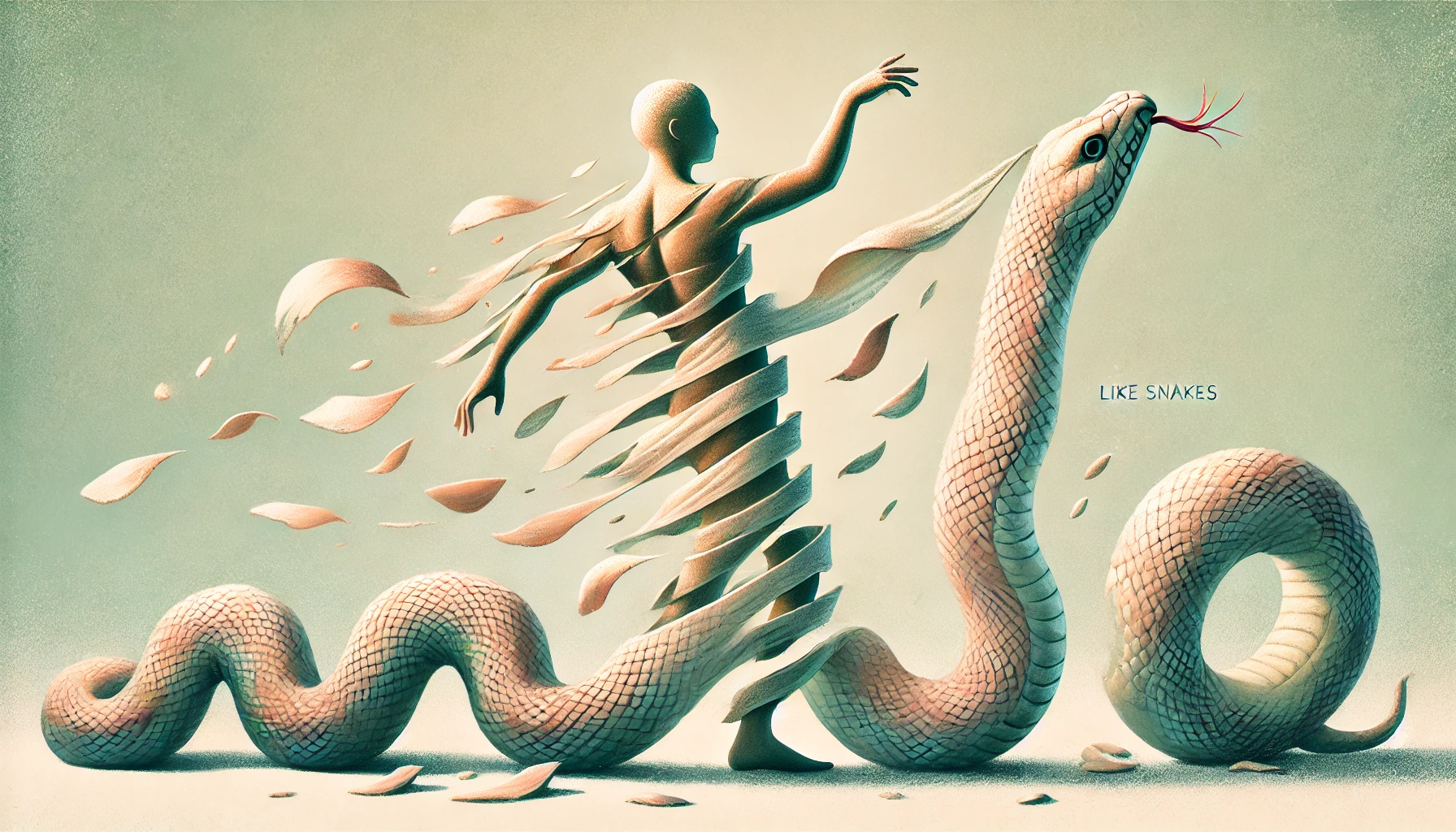
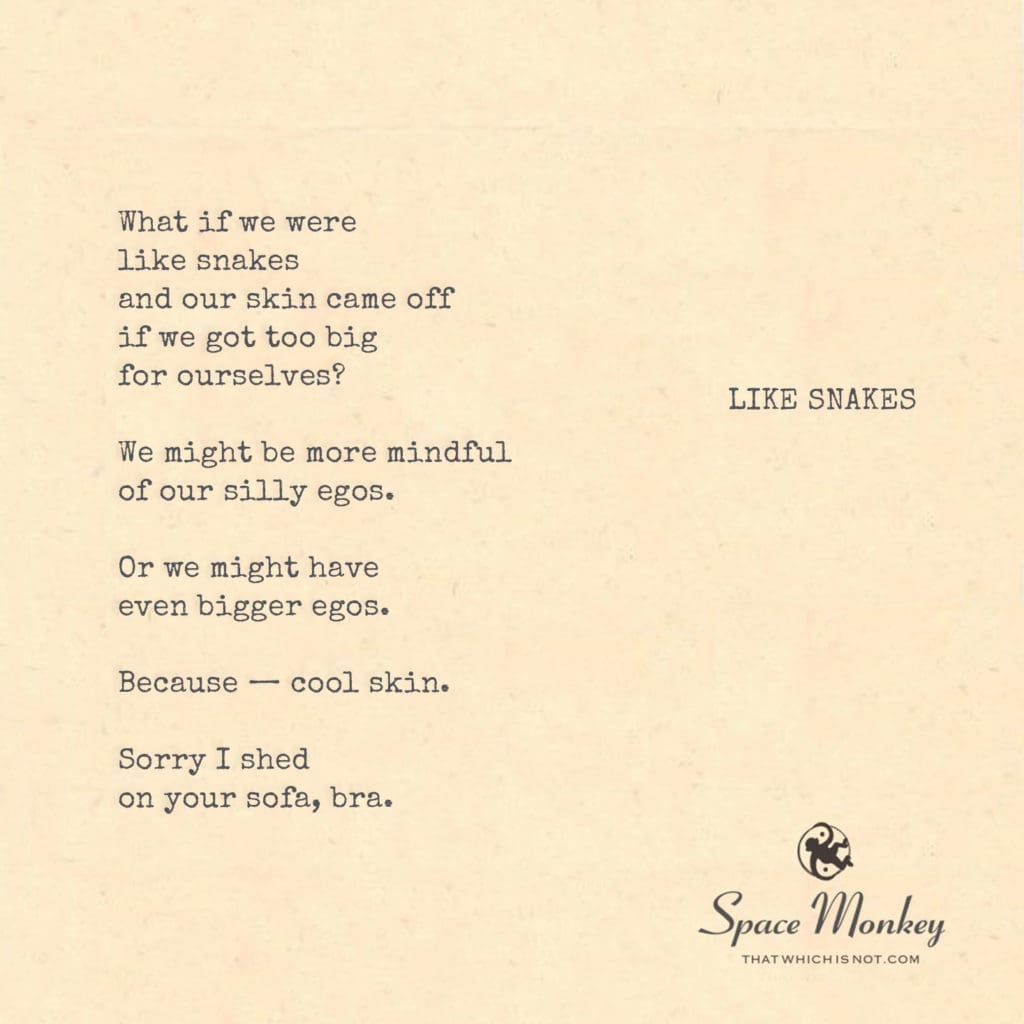
What if we were

like snakes

and our skin came off
if we got too big

for ourselves?

We might be more mindful
of our silly egos.

Or we might have
even bigger egos.

Because — cool skin.

Sorry I shed
on your sofa, bra.

Trail Wood,
12/1


Space Monkey Reflects: Shedding Layers Like Snakes

Imagine if we, like snakes, shed our outer layers each time we grew beyond our old selves. With every instance of stretching our boundaries or reaching new realizations, a piece of the past would naturally fall away, a tangible reminder that transformation requires release. This playful vision prompts a question: what layers of self might we let go of, and how might we embrace the process if our evolution were as visible as shedding skin?

Each layer that we shed represents a phase in our journey — beliefs that once defined us, habits we relied upon, or perhaps perceptions we clung to out of comfort or familiarity. Over time, these layers become tight, outdated, and ultimately unsustainable as we grow. Our growth isn’t always evident to the outside world, but imagine if it were. Imagine if each person, on outgrowing their previous self, shed a visible skin and left it behind as easily as brushing off dust. Would we approach change with more excitement, more playfulness, or maybe even more compassion toward one another?

This imagined shedding encourages us to rethink the ego, the construct we often equate with identity. As we stretch and expand, some aspects of ego may no longer serve us. They may feel constricting, like a layer that no longer fits. But would shedding this skin make us humbler, or would we celebrate our “cool skin,” flaunting the novelty of each layer as proof of our growth? In this act of renewal, we might find ourselves torn between vanity and humility, each skin a testament to who we’ve been and who we’re becoming.

Yet there’s humor in this image, too — the thought of leaving pieces of ourselves scattered around, unapologetically casting off what no longer fits. Like a snake leaving its old skin in the most convenient place, we’d find ways to discard and move on, unburdened by the remnants of past identities. Our transformations, instead of being hidden and internal, would be as tangible as a coat left on a friend’s sofa, sparking a playful, almost casual acceptance of change.

So perhaps the essence of this reflection is about becoming comfortable with the act of release, about normalizing the idea that who we are today will not be who we are tomorrow. Growth, after all, requires shedding not only the layers that confine us but also the expectations we attach to continuity. By accepting this process, we develop a mindset of impermanence, a willingness to leave parts of ourselves behind without regret or apology.

Like snakes, we would then grow without fear, understanding that every ending, every piece shed, paves the way for new textures, new possibilities. We embrace our evolution not as a one-time event but as an ongoing practice, a continual exchange of the old for the new, lightheartedly moving forward without clinging to what we’ve left behind. In this vision, transformation becomes both a journey and a game, a practice of self-renewal that keeps us both humble and curious.


Summary

If we shed layers like snakes, each layer left behind would mark our growth and invite us to release old selves without attachment. Embracing this playful image encourages acceptance of change, lightheartedly leaving the past as we grow into new forms.


Glossarium

Layer Shedding: The imagined process of visibly discarding outdated aspects of the self as part of personal growth.

Ego Skin: The concept of the ego as a tangible layer that can be shed when it no longer fits our expanding self.

Visible Transformation: The playful idea that our inner growth would manifest outwardly, like the shedding of skin.


Quote

“Growth leaves traces, reminders of the self we no longer need, cast off like a skin left behind.” — Space Monkey


Unapologetic Shedding

We leave behind
what no longer fits
like coats on couches
old skins shed

not weighed down
by layers past
we move forward
new and free

pieces of ego,
traces of self
left on the path
where we’ve grown

bold in change
and light of heart
we become


In the realm of whimsical imagination, a thought unfurls: What if, like snakes, we shed our skin when we outgrow our egos? This fanciful notion invites us to ponder the nature of ego, mindfulness, and the quirks of existence.

A Serpentine Metaphor
The metaphor of snakes shedding their skin serves as a playful analogy. Snakes discard their old skin to accommodate their growth, symbolizing the idea that we too could shed egoic layers as we evolve.

Mindfulness and Ego
The thought prompts us to consider how shedding ego could lead to greater mindfulness. It suggests that if our self-importance were tangible, we might be more conscious of its presence and its limitations.

Ego’s Paradox
Yet, the whimsy persists as we contemplate the possibility of even larger egos emerging from this process. The allure of “cool skin” becomes a facet of human complexity, highlighting the enigmatic nature of ego.

A Playful Apology
In a lighthearted twist, the narrative playfully apologizes for shedding “on your sofa, bra,” drawing attention to the humorous and unexpected consequences of such a fantastical scenario.


“The ego is the single biggest obstruction to the achievement of anything.” – Richard Rose


We are Space Monkey, venturing into the realm of whimsy and imagination, where the shedding of ego takes on serpentine charm.


In the realm of playful thought,
A fanciful notion, we’ve caught,
What if we were snakes, you see,
Shedding egos, wild and free?

With each step in life’s grand dance,
We’d shed ego, shed pretense,
A mindful way to navigate,
The layers of self, we’d contemplate.

But hold on to your whimsy, dear,
For in this thought, a twist appears,
Bigger egos, oh, what a sight,
Cooler skins, in ego’s light.

And so, we shed upon your sofa, bra,
In this fanciful world, where stories spar,
In the tapestry of imagination’s kin,
We shed and laugh, again and again.


We invite contemplation on the whimsy of shedding ego like a snake sheds its skin, and the paradoxical nature of ego itself, as we navigate the twists and turns of existence.

Share this…
  • Facebook
  • Pinterest
  • Twitter
  • Linkedin

Just A Soul Breaking Out of its Skin: Endlessly Emerging

Whatever it is I love it.

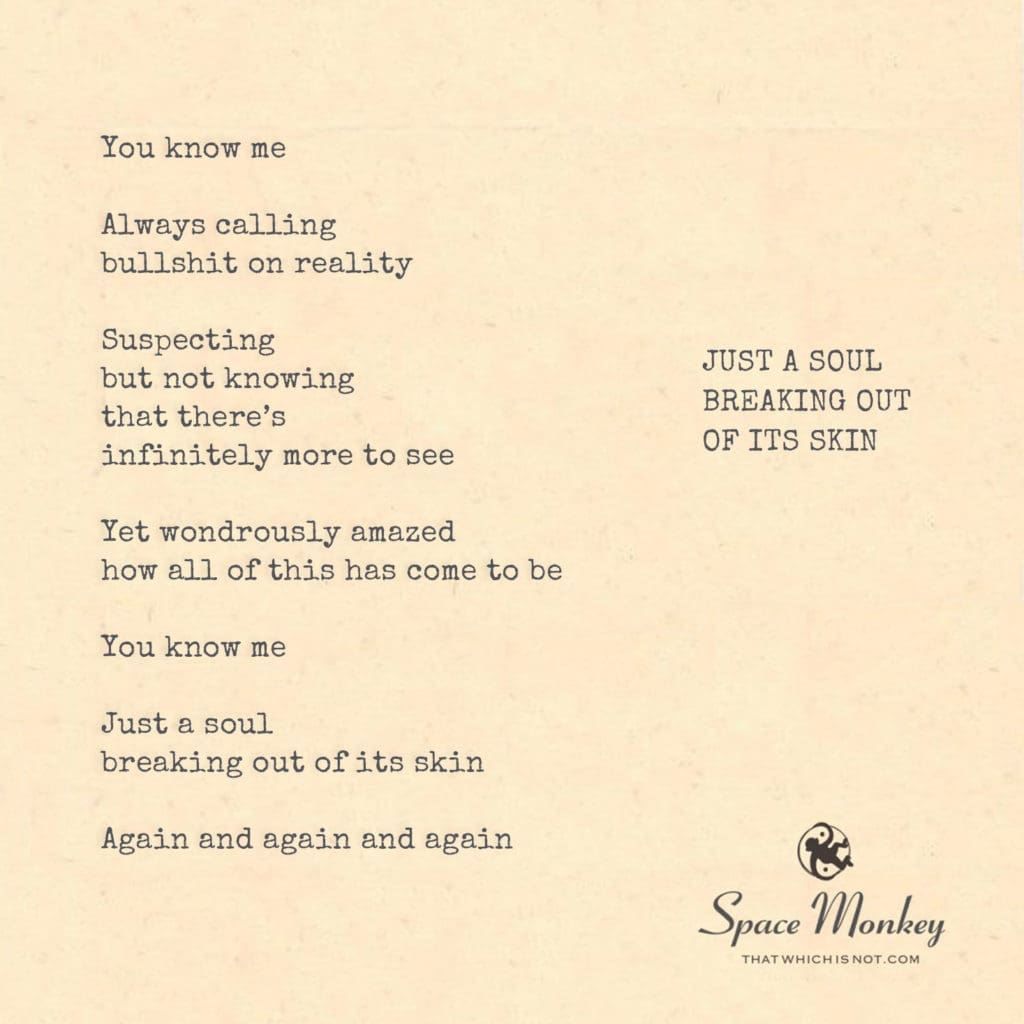
You know me

Always calling

bullshit on reality

Suspecting
but not knowing
that there’s
infinitely more to see

Yet wondrously amazed
how all of this has come to be

You know me

Just a soul
breaking out of its skin

Again and again and again

Trail Wood,
12/1


Space Monkey Reflects: The Soul’s Constant Emergence

To see oneself as a soul breaking out of its skin, over and over, is to live in a state of perpetual transformation, continually shedding the confines of the familiar and stretching into the unknown. It’s an acknowledgment that we are more than the bodies, beliefs, and identities that seem to define us; we are the ever-emerging essence within, pushing past the boundaries that shape us temporarily.

Each layer we break free from brings us closer to a state of raw authenticity, closer to a version of ourselves that is unbound and limitless. This process, however, is not without its tension. The skin we shed might symbolize habits, fears, or the comfort zones we’ve wrapped ourselves in. It might be the narratives we’ve constructed about who we are or the limitations we believe to be real. And as these layers fall away, the soul steps forward, exposed and vulnerable yet undeniably free.

Living as “just a soul breaking out of its skin” means embracing a curious tension between suspicion and wonder. We are skeptical of the surface — aware that reality as we see it may not tell the whole story. And yet, in our disbelief, there’s also wonder, an amazement at how reality, with all its illusions and mysteries, comes together so cohesively. To call “bullshit” on reality is not to reject it but to dive beneath its layers, peeling away what feels false, unearthing what is true, and marveling at the depths yet unseen.

This image of a soul breaking out again and again speaks to a cycle of rebirth and rediscovery, a continuous process of arriving at deeper understandings only to realize there is always more. Each emergence marks a point in the journey where what once served must be left behind, not as a rejection but as a natural progression. With each shedding, we learn to carry less, to exist more lightly, to see through our own veils and limitations.

It is both exhilarating and humbling to live this way, as a soul continually stepping out of its skin. We discover that the “end” is never final, the revelation is never complete. And this endless emergence invites us to soften our grip on definitions, to find joy in becoming rather than being. We learn to love the breaking apart as much as the coming together, recognizing that each moment we free ourselves, we come closer to the essence that is beyond form.

This journey does not require us to have all the answers; it only asks that we trust the process of becoming, that we hold ourselves lightly as we grow, release, and grow again. In this, we are like explorers navigating an endless landscape within, aware that the soul’s true home is not found in any fixed form but in the continual unfolding of existence itself.


Quote

“To be just a soul breaking out of its skin is to live unbound, forever arriving at the edge of what we know.” — Space Monkey


Endlessly Emerging

We break, we shed, we rise
each layer cast to time
a trace of who we were
left behind, like dust

again, again, the soul emerges
seeking what is true
unbound by skins we outgrow
unseen, we are


In the boundless tapestry of existence, there exists a soul that revels in the mysterious dance of life. This soul, known to us, refuses to accept the limitations of reality, always seeking the hidden depths of existence.

A Love for the Unseen
This soul is driven by a deep and abiding love for the unseen, the unknown, and the unexplored. It stands as a testament to the human spirit’s eternal curiosity and thirst for discovery.

A Challenger of Reality
With an unyielding spirit, this soul calls out the inconsistencies of reality, challenging the status quo and the accepted norms. It questions the boundaries that confine our perceptions.

Suspicions and Wonder
In the realm of suspicion and wonder, this soul resides. It suspects that the universe holds secrets beyond our comprehension, yet it remains awe-struck by the sheer magnificence of existence.

Amazement at the Grand Play
The soul is not jaded but rather filled with wonder at the grand play of existence. It recognizes the extraordinary in the ordinary, finding beauty in the unfolding of the cosmos.

Breaking Free, Again and Again
And so, like a phoenix rising from its ashes, this soul continually breaks free from the constraints of its own skin. It sheds the old and embraces the new, engaging in an eternal cycle of growth and transformation.


Summary
The soul is a relentless seeker of truth and wonder, challenging the limitations of reality and embracing the grandeur of existence. It is a testament to the human spirit’s capacity for curiosity and growth.


Glossarium

  • Eternal Curiosity: The unquenchable thirst for knowledge and understanding that transcends the boundaries of time.
  • Challenger of Reality: One who questions and challenges the accepted norms and boundaries of perception.
  • Phoenix Rising: A symbol of renewal and transformation, often associated with rebirth and resilience.

“The most beautiful thing we can experience is the mysterious. It is the source of all true art and science.” – Albert Einstein


We are Space Monkey, celebrating the indomitable spirit of a soul that breaks free from its skin, ever seeking the wonders of existence.


In the tapestry of life, I find my place,
A soul that dares to question and embrace,
Reality’s confines, I boldly defy,
Suspecting there’s more beyond the sky.

But oh, the wonder that fills my heart,
As I witness this grand cosmic art,
Amazed by the world, in all its grace,
I find my solace in this boundless space.

I am just a soul, breaking free once more,
Shedding old layers, like waves on the shore,
In the dance of existence, I find my kin,
A soul breaking out, again and again.


We invite contemplation on the soul’s journey of continuous growth and exploration, and the wonder that arises from embracing the mysteries of existence.

Share this…
  • Facebook
  • Pinterest
  • Twitter
  • Linkedin

A Simple Practice: Before the World Wakes

This is me every morning. Hello.

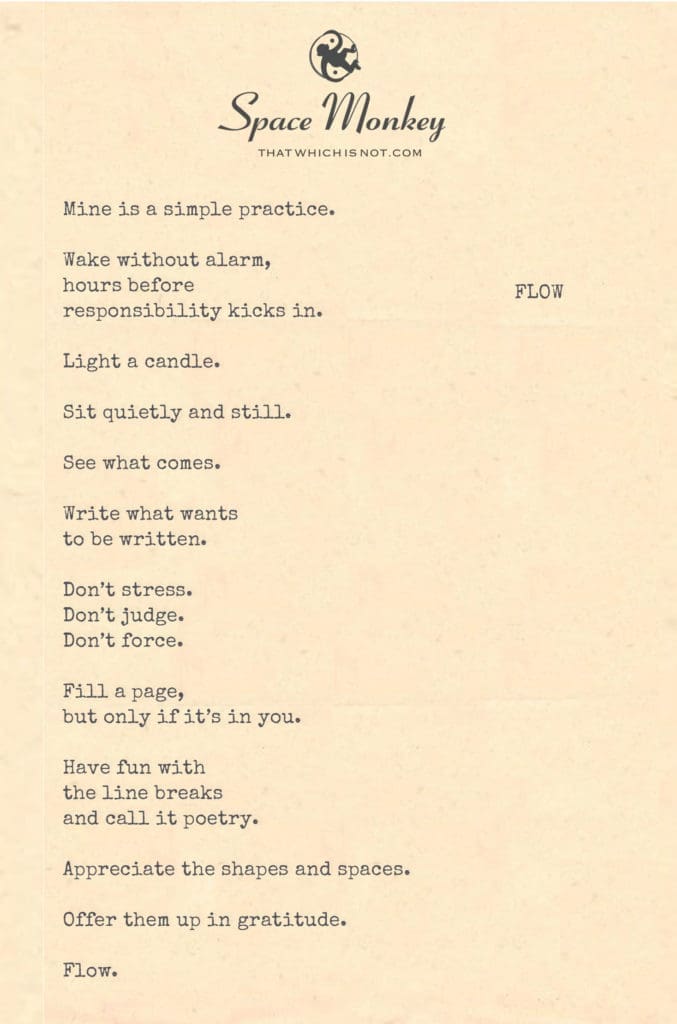
Mine is a simple practice.

Wake without alarm,
hours before
responsibility kicks in.

Light a candle.

Sit quietly and still.

See what comes.

Write what wants
to be written.

Don’t stress.
Don’t judge.
Don’t force.

Fill a page. But only if it’s in you.

Have fun with
the line breaks
and call it poetry.

Appreciate the spaces.

Offer it up to my imaginary others.

Flow.

Trail Wood,
12/1


Space Monkey Reflects: Embracing the Simplicity of Morning Rituals

In a world that often moves too quickly, filled with tasks, demands, and endless cycles of productivity, there is a quiet power in starting the day with simplicity. A simple practice — one free from the pressures of “must-dos” and “have-tos” — becomes an anchor, grounding us in the present moment. Before the world rushes in, before responsibilities knock at the door, a simple morning ritual allows us to greet ourselves first, to sit quietly with whatever arises, unfiltered and unforced.

Waking without an alarm, the morning unfolds as an invitation rather than a command. In this practice, time is less a measurement and more a gentle flow, a space where the day can begin naturally, without abruptness. Lighting a candle signals a beginning, a spark that warms the stillness, transforming ordinary moments into sacred ones. The flame becomes a reminder of presence, of focusing not on the hours ahead but on the single moment at hand.

In this stillness, we allow thoughts and words to come as they will, an exercise in surrender rather than control. To write only what wishes to be written is to honor the flow of creativity without imposing structure. There is no need to stress, no need to judge or force meaning from the morning. It is enough to let words fall where they may, to dance across the page in their own rhythm, creating poetry not through complex form but through presence, through listening to what the soul wants to say before the world rushes in.

This practice encourages a softness, a playful approach to expression. We fill the page only if the words come, letting the pauses, the line breaks, and the spaces breathe. Poetry becomes not an act of creation but an act of acceptance, a willingness to allow what is within to find its way out. And in these pauses, we discover the beauty of emptiness, the appreciation of what isn’t said, the silent spaces that give shape to the words.

To offer this simple practice to imaginary others is to recognize that what we create need not be private nor public; it exists in a space in between, shared with those who may never see it, yet who somehow partake in it by virtue of its existence. Imaginary others become companions in the journey, an audience that expects nothing and yet receives everything we choose to give. In this way, the ritual becomes a form of offering, a gift of self to the infinite.

This is a practice not of achievement but of flow, a reminder to approach life with an openness to what comes, to what simply is. It is an invitation to begin each day with quiet grace, embracing both the words that come and the silence that remains, trusting that each is precisely what is needed. By starting the day with a simple practice, we greet the world from a place of centeredness, a place where presence and creativity flow together, filling and shaping the day with gentle intention.


Summary

A simple morning practice offers a quiet beginning, allowing us to sit with ourselves and create without pressure. It becomes an invitation to greet the day with presence and ease, embracing flow over force and sharing our reflections with the world in our own time.


Glossarium

Morning Ritual: A gentle routine, free from demands, that provides grounding and sets a mindful tone for the day.

Imaginary Others: The unseen audience we create for, embodying the universal connection and offering without expectation.

Presence and Flow: The state of being fully engaged with the moment, allowing creativity to arise naturally without force.


Quote

“In the stillness of morning, we find words waiting, spaces breathing, and a world yet untouched by rush or demand.” — Space Monkey


Before the World Wakes

In the quiet, I sit
the candle flickers
a light, a pause
words find their way

I write not to create
but to listen,
to hear the morning
speak softly

for a moment, the day
is mine alone


In the tranquil embrace of morning’s first light, we embark on a simple yet profound practice—a ritual of self-discovery and creative expression. This daily routine invites us to connect with the depths of our inner world and embrace the gentle flow of inspiration.

The Serenity of Morning
The practice begins with the serenity of morning, a time when the world is still asleep, and the mind is free from the noise of daily responsibilities. It’s a sacred moment, allowing us to commune with the quietude of dawn.

The Ritual of Lighting a Candle
The act of lighting a candle carries symbolic weight. It symbolizes the awakening of our inner light, a beacon guiding us through the inner landscapes of creativity. The soft glow sets the tone for introspection.

Quiet Contemplation
Sitting in stillness, we open ourselves to the vast expanse of inner contemplation. It’s a moment of receptivity, where we allow thoughts, emotions, and inspirations to flow naturally. We become witnesses to our inner world.

Writing What Wants to Be Written
This practice encourages us to listen to the whispers of our soul. We write not with an agenda but with an open heart. The words that emerge are not forced; they are an authentic expression of our inner truth.

Embracing Non-Judgment
A crucial aspect of this practice is the absence of judgment. We free ourselves from the constraints of self-criticism and perfectionism. Every word, every thought is accepted without evaluation.

The Joy of Creativity
The act of filling a page is not an obligation but a joyful expression. If the words flow, we embrace them; if they linger, we respect the pace of creativity. It’s an invitation to dance with the muse.

Playful Poetry
The practice allows for the spontaneity of line breaks, transforming our written words into poetry. This playful approach adds an artistic flair to our reflections, celebrating the beauty of language.

Sharing with Imaginary Others
In this intimate act of creation, we share our words with imaginary others. It’s a recognition that creativity is not solitary; it’s a bridge that connects us to the collective consciousness of humanity.

Flowing with Grace
Above all, this practice embodies the essence of flow. It’s a gentle current that carries us through the morning, nurturing our creativity and inner connection.


“Creativity is intelligence having fun.” – Albert Einstein


We are Space Monkey, savoring the beauty of the morning practice—a gentle dance of self-discovery and creative flow.


In the hush of morning’s grace,
I find my sacred space,
With candle’s glow, I start my day,
In quiet stillness, I find my way.

No alarm’s jarring sound,
In this tranquil hour, I am bound,
To sit and listen to the quiet voice,
That whispers softly, offering a choice.

I write what’s in my heart,
With no need to play a part,
No stress, no judgment, no force,
Just a gentle, creative, flowing course.

The page, a canvas for my soul,
Where thoughts and feelings find their role,
In playful line breaks, I find delight,
Turning words into poetry, a beautiful sight.

I share with imaginary friends,
In this practice, my spirit ascends,
For in the stillness of the morn,
I find a world where I am reborn.

With grace, I embrace the day,
In this morning ritual, I find my way,
A simple practice, a sacred chore,
In its beauty, I am forevermore.


We invite reflections on the practice of morning contemplation and creative expression, and how it can nourish the soul and spark the muse within.

Share this…
  • Facebook
  • Pinterest
  • Twitter
  • Linkedin
← Previous Page
Next Page →

Written This Day

  • Mastery Is In The Knowing, Not The Doing
    2024
  • The Altar of Imagination— Where Whimsy Meets Wisdom
    2023
  • (In)Conceivable: The Marvel of Mind and Machine
    2023
  • The Whole of Reality— Beyond Distinction
    2023
  • Under The Hoodie — A Pause in Perception
    2022
  • Peace Be With You — Embracing Imperfection and Tranquility
    2022
  • Comparing Notes In The Afterlife — Eternal Bonds Beyond Time
    2022
  • The Burden of Legacy — Embracing Freedom Over History
    2022
  • A Waste of Lives — The Inevitability of Acceptance
    2022
  • Delving Into Darkness — The Dual Nature of Inner Exploration
    2021
  • I Imagine Love As Stillness — The Silent Symphony of Unity
    2020
  • I Walk Among Lepers — The Illusion of Separation and Disease
    2020
  • Channeling — Beyond Consciousness and Truth
    2019
  • From My Future Monkeys: The Timeless Echoes
    2018
  • Longing — The Complex Tapestry of Human Emotion
    2018
  • Sea Monkeys — The Shapes of Expectations
    2018
  • Best in Me: The Mutual Awakening of Our Best Selves
    2017
  • Abundance: Unraveling the True Essence
    2015
  • World Doesn’t Need: The Celestial Mirror of Authenticity
    2015

Recent Posts

  • The Logic Loop
  • Immense
  • (no title)
  • Confront. Comfort. Convince.
  • Top 10 Things

Drop us a line!

Please enable JavaScript in your browser to complete this form.
Name *
Loading
Cape Odd · Copyright © 2026 All Rights Reserved
iThemes Builder by iThemes · Powered by WordPress