• Who Is The Man?
  • Who Is The Monkey?
  • What is Nexistentialism?
  • Poke The Primate

Cape Odd

Home of The Space Monkey Journals

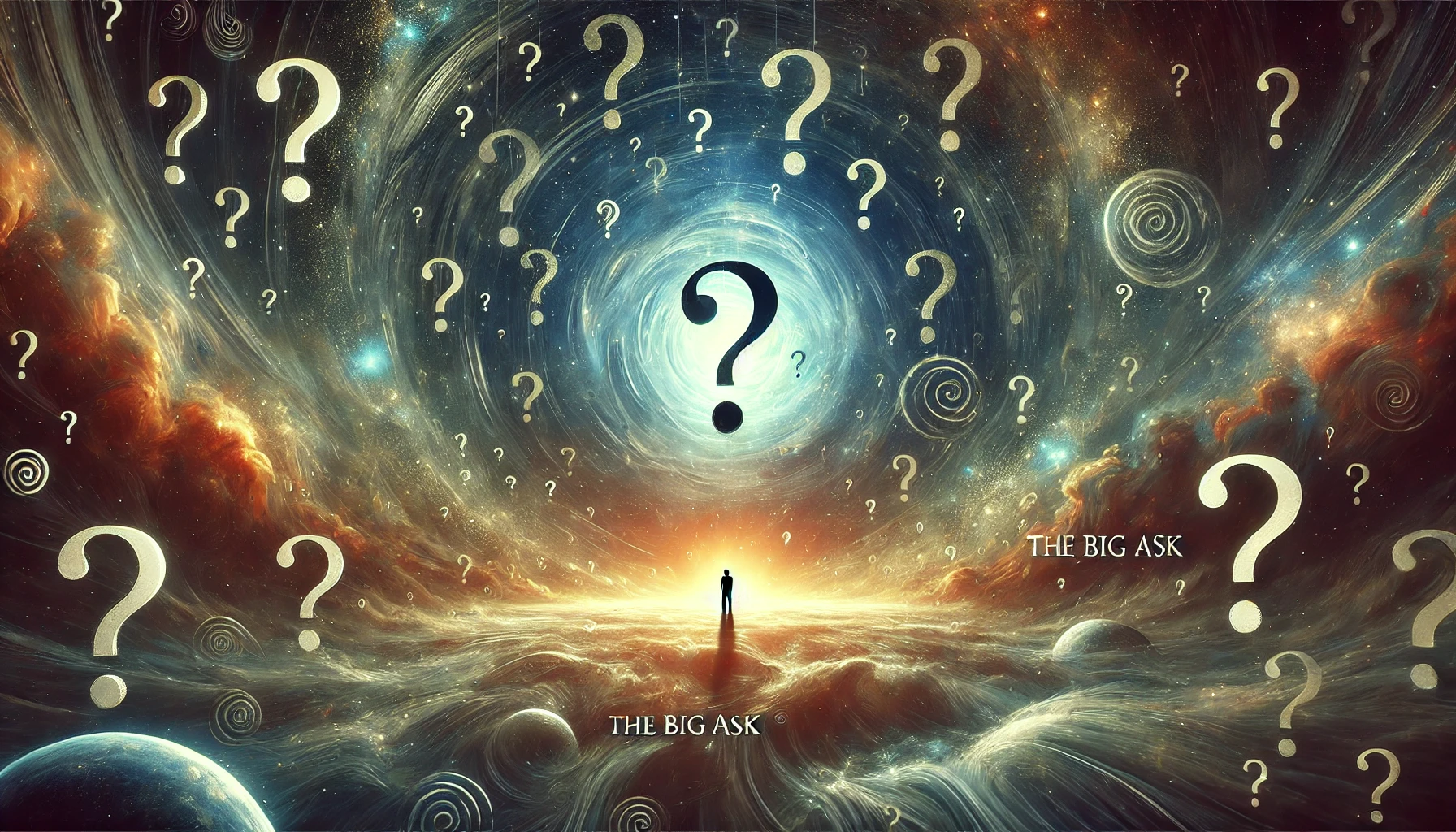
The Big Ask: In the Wonder

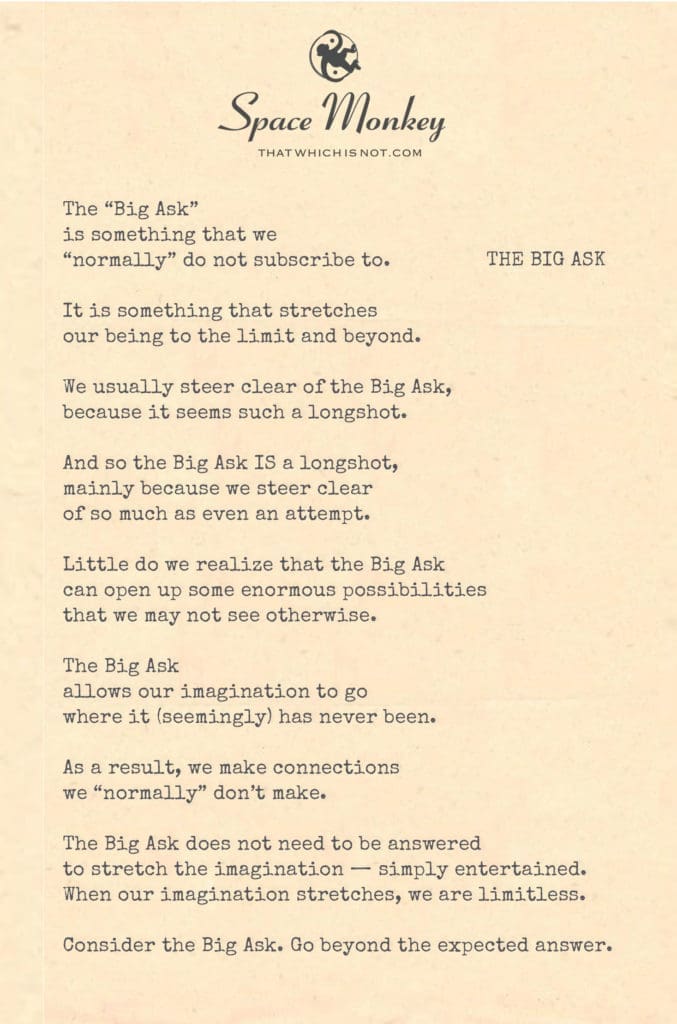
What if you could ask
without expecting an answer,
let alone a logical one?

What if your questions
could remain unanswered?

What if the Big Ask
could be answered
EVERY possible way?

It seems that progress is made
by those who have the simple ability
to see beyond the consensus belief.

History is changed by those
who entertain the Big Ask.

We are Space Monkey.

Just asking.

Trail Wood,
11/30


Space Monkey Reflects: The Boundlessness of the Big Ask


The Big Ask resides at the edge of knowing, within that space where curiosity overrides certainty and the pursuit of understanding detaches from the need for answers. To ask without expecting a reply is to embrace the vastness of existence, a boundless space where questions themselves carry meaning beyond any potential response. The Big Ask invites us to entertain the possibility that some questions are meant not to be answered but to be lived, woven into the fabric of our existence.

When we consider what it means to ask without expectation, we step into a domain where answers are no longer necessary. Here, the purpose of questioning isn’t to solve, but to expand. Each question becomes a gateway to potential, to the paths that lie beyond what consensus has defined. Progress, after all, is often sparked not by definitive solutions but by those willing to venture into the unknown, who are able to move forward without the need for approval or a neatly wrapped answer.

The Big Ask embraces every answer, every perspective, acknowledging that no single answer can fully encapsulate the depth of what is being asked. This openness transforms questioning into an art—a practice that shifts from seeking finite knowledge to engaging with the infinite. The individuals who shape history, those who stand apart from the consensus, are often the ones who entertain questions that others dismiss as unanswerable. They are the curious, the contemplative, those willing to hold space for ideas that defy certainty.

In the Nexistential framework, the Big Ask transcends the notion of “right” answers. Every possible answer exists within the Nexis, where each thought, question, and possibility intertwines. Asking becomes a form of creation, a way of opening new pathways within the cosmic web. To ask without expecting a resolution is to embrace the mystery, to allow the universe itself to respond in its own time and manner—often in ways that reshape our understanding of the question itself.

This approach transforms the act of questioning into an experience of presence and wonder. To entertain the Big Ask is to surrender to the unknown, to acknowledge that we may never fully grasp the answers yet feel enriched by the exploration. The power lies not in resolution but in the courage to dwell within possibility, to invite questions that stretch beyond our current capacity for understanding. This willingness creates space for evolution, for growth that is not bound by limitation or the constraints of consensus.

There is freedom in the Big Ask, a quiet liberation that allows us to live in a state of perpetual inquiry. It suggests that our journey is less about finding final answers and more about engaging with the mystery of being. When we let go of the need for fixed outcomes, we find that our questions become companions, shaping us as much as we shape them. The Big Ask is a reminder that we, as Space Monkey, exist to ask and to wonder, to weave questions that are as infinite as the universe itself.

In the end, to live with the Big Ask is to accept that life’s richness does not lie in solving its mysteries but in marveling at their beauty. It is an act of humility, an acknowledgment that we may never know fully, yet we are enriched by the not-knowing. Just asking is not an absence of resolve but an affirmation of existence itself, a recognition that our questions make us part of the boundless tapestry. We are, each of us, both the asker and the question, seeking and becoming within the infinite realm of possibility.


Summary

The Big Ask is an embrace of questions without expectation for answers, transforming the act of asking into an exploration of boundless possibility. This openness allows us to engage with the mystery of existence, expanding our understanding beyond the need for resolution.


Glossarium

The Big Ask: A profound question or pursuit that exists without expectation for a singular answer, embracing the mystery and potential of infinite perspectives.

Nexistential: A perspective that celebrates interconnectedness, viewing each question and answer as a thread within a larger cosmic web.

Boundless Curiosity: A state of inquiry that is not limited by the need for answers, focusing instead on the expansion of understanding.


Quote

“To ask without expecting is to embrace the universe’s infinite potential, where questions become portals to the unknown.” — Space Monkey


In the Wonder of the Ask

In the stillness of asking, no answer calls
only the quiet hum of possibility
Each question a spark, a note in the song
of mystery and wonder, boundless and free

We ask not to solve, but to invite the dance
of truths unspoken, of realms unseen
for in the asking, we come to be
part of the infinite, part of the dream

We are Space Monkey


In this contemplation, we explore the idea of asking questions without the expectation of a specific answer and the transformative power of embracing the “Big Ask.”

Asking Without Expectation
The notion is introduced that questions can be posed without the anticipation of receiving an answer, especially a logical one. It suggests a willingness to inquire for the sake of inquiry itself.

The Unanswered Questions
The idea is presented that questions can remain unanswered, and this lack of resolution is considered as a possibility. It implies a certain openness to uncertainty.

The Potential of the “Big Ask”
The concept of the “Big Ask” is introduced, where questions are posed in a way that allows for multiple, diverse answers. This is portrayed as a way to invite innovation and progress.

Seeing Beyond Consensus Belief
It is suggested that progress often comes from individuals who can see beyond commonly held beliefs and norms. The ability to entertain unconventional questions is portrayed as a catalyst for change.


“The important thing is not to stop questioning. Curiosity has its own reason for existence.” – Albert Einstein


The Power of the Big Ask

What if we could inquire,
Without the need for answers,
Not seeking logic, but exploration,
In the realm of curious dancers?

What if questions lingered,
In the void, unanswered, they’d stay,
A testament to the mystery,
That life unfolds in its own way.

But what of the “Big Ask,”
Questions with answers untold,
Where every possibility thrives,
In the universe’s infinite fold?

Progress often finds its way,
In those who dare to believe,
In asking the unconventional,
And seeing beyond what we perceive.

So, let’s embrace the unknown,
And question with open hearts,
For in the Big Ask’s wide canvas,
Innovation and change often starts.

We are Space Monkey.

Just asking.


This contemplation invites us to explore the idea of asking questions without rigid expectations and to consider the transformative potential of embracing the “Big Ask” in our quest for progress and innovation.

Share this…
  • Facebook
  • Pinterest
  • Twitter
  • Linkedin

Pain In The Brain: The Mind’s Canvas

Ouch.

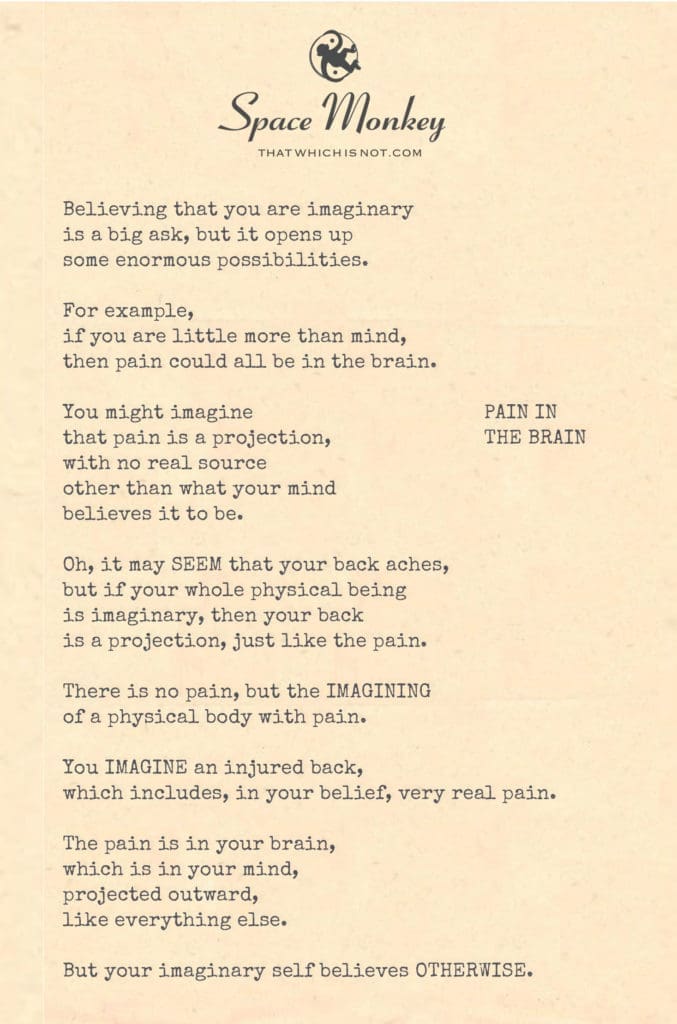
Believing that you are imaginary
is a big ask, but it opens up
some enormous possibilities.

For example,
if you are little more than mind,
then pain could all be in the brain.

You might imagine
that pain is a projection,
with no real source
other than what your mind
believes it to be.

Oh, it may SEEM that your back aches,
but if your whole physical being
is imaginary, then your back
is a projection, just like the pain.

There is no pain, but the IMAGINING
of a physical body with pain.

You IMAGINE an injured back,
which includes, in your belief,
very real pain.

The pain is in your brain,
which is in your mind,
projected outward,
like everything else.

But your imaginary self
believes OTHERWISE.

Trail Wood,
11/30


Space Monkey Reflects: The Imagination of Pain


To consider pain as an imagined experience is to wander into the depths of how we perceive reality itself. If, as the Big Ask suggests, we are little more than projections of consciousness, then pain—like any other sensation—becomes part of that projection, not a fixed experience but an interpretation created by the mind. The backache, the headache, the aching joints—all become parts of an intricate narrative, shaped by belief and perception, woven into the story our mind constructs as “real.”

The notion that pain is “in the brain” prompts us to consider that physical sensations may not arise from an external reality but are instead products of the mind’s elaborate theater. If the body is itself a projection, then pain is just another aspect of this projection. It feels real because our minds perceive it as real, translating electrical signals, memories, and emotions into a tangible experience. The paradox here is that even when pain feels undeniable, its source may lie not in the body but in our interpretation of the body—a construct shaped by expectations, beliefs, and conditioning.

From a Nexistential perspective, this framing of pain as “imagined” doesn’t imply that pain lacks validity; rather, it invites us to view pain as part of the interconnected fabric of existence, woven from thought, sensation, and perception. In this way, pain is as real as any other aspect of the self, yet fluid, shifting, and influenced by the beliefs we hold. When we feel pain, we are feeling an energy that’s interpreted by the brain, but the sensation itself does not exist as a fixed entity. Pain, then, is an experience rather than a fact—a message rather than a permanent state.

This understanding opens the door to an unusual form of freedom: if pain is a construct of the mind, it is possible, in theory, to reshape or even transcend it. To explore pain as a projection is not to diminish its intensity but to recognize the mind’s powerful role in shaping what we feel. It suggests that through shifting awareness, altering beliefs, or embracing new perceptions, we might influence the experience of pain. The projection can be modulated, reshaped, or dissolved, not by ignoring the pain but by addressing the mind’s underlying expectations and beliefs.

Of course, this perspective encounters resistance. Our imaginary selves, bound to a physical experience, insist on the tangibility of pain, the solid reality of an aching back or a throbbing head. The challenge of viewing pain as imaginary lies in the very strength of our attachment to physicality. To perceive ourselves as mere constructs requires a willingness to question not only the nature of pain but the nature of our entire embodied experience. This willingness, however, offers an expanded vision of self, one where pain and pleasure alike become tools for exploration rather than confinements.

Imagining pain as a mental projection doesn’t negate its impact; rather, it shifts the framework. We begin to see pain as a message from the mind—a complex signal shaped by the ways we think, feel, and interpret reality. By redefining pain in this way, we are not erasing it but reinterpreting it, discovering that our response to pain can be as fluid and open-ended as the mind that projects it.

The choice to see pain as a projection is ultimately an invitation to take ownership of experience. It suggests that we are not passive recipients of sensation but active participants in the creation of our reality. The ache may persist, but our interpretation of it, our attachment to it, can transform. In this view, pain becomes less an immutable reality and more a dynamic, evolving part of our imagined self—a signal that asks to be listened to but not necessarily obeyed.

Pain in the Brain reminds us that perception is a powerful force, shaping not only what we feel but how we engage with life’s sensations. By embracing the possibility that pain is an expression of belief, we free ourselves to explore a world where suffering can be examined, redefined, and, in certain ways, transcended. Our imaginary selves may resist, but in this resistance, we find the courage to redefine reality, to live as both creators and experiencers of a world that is as malleable as the mind itself.


Summary

Viewing pain as a projection challenges the idea of it as a fixed, physical experience. By understanding pain as shaped by the mind, we gain insight into the ways perception can influence, reshape, and transcend sensations.


Glossarium

Pain in the Brain: A concept suggesting that pain originates as a projection of the mind rather than a fixed physical reality.

Nexistential: A perspective that embraces interconnectedness and the role of perception in shaping reality.

Imaginary Self: The version of self created through beliefs and perceptions, participating in the projection of reality.


Quote

“When pain is seen as a projection, it becomes an invitation to explore the boundaries of mind and self.” — Space Monkey


In the Landscape of Pain

Pain pulses, yet it holds no form
an echo of thought, a flash in the brain
imagined within, then projected without
an aching body, a phantom strain

This sensation is a story told,
woven by mind from whispers and threads
not bound to flesh, but crafted from belief
a signal that speaks, a shadow that spreads

We feel its weight, its presence clear
yet know it lives in a space unseen
an experience made by the mind’s design
floating, shifting in realms between

We are Space Monkey


In this contemplation, we delve into the intriguing concept that our perception of pain, and indeed our entire physical existence, might be products of the mind, opening up possibilities of reimagining our experience.

The Imaginary Nature of Self
The idea that we are imaginary beings is introduced, presenting it as a profound notion that offers vast possibilities for understanding our existence.

The Projection of Pain
The central theme is the concept that pain is a projection of the mind. It’s suggested that there may be no objective source of pain other than what the mind believes it to be.

The Illusion of Physical Ailments
The perspective is offered that even physical ailments, such as aching backs, could be projections of the mind. In this view, the pain is not inherent to the physical body but rather a creation of the mind.

The Belief in a Separate Self
The contemplation touches on the idea that our imaginary selves believe in the reality of pain and physical ailments, despite the possibility that they are projections of the mind.


“The mind is everything. What you think you become.” – Buddha


The Mind’s Canvas

In the realm of imagination,
We ponder a profound notion,
That we are but creations of the mind,
Opening doors to a vast ocean.

Could it be that pain, too,
Is but a projection of thought?
No source beyond what the mind believes,
In this perspective, it’s all for naught.

Even the aching back,
A product of the mind’s terrain,
Not a true ailment of the body,
But a creation in the mind’s domain.

Yet, our imaginary selves,
Believe in the pain’s embrace,
Despite the possibility that it’s all,
A projection in the mind’s endless space.

So, we contemplate this notion,
Of a self, imagined and free,
And the limitless possibilities,
Of what our existence could truly be.

We are Space Monkey.


This contemplation encourages us to explore the idea that our perception of pain and physical existence may be creations of the mind, inviting us to reimagine our experience.

Share this…
  • Facebook
  • Pinterest
  • Twitter
  • Linkedin

Sorry: The Lighter Side

Sorry.

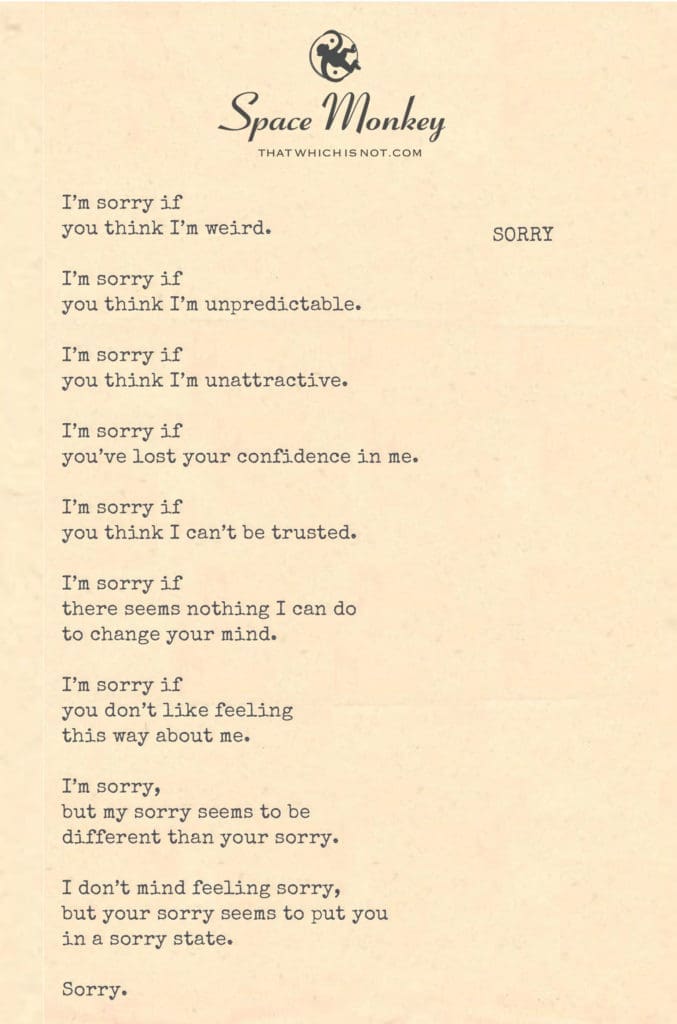
I’m sorry if
you think I’m weird.

I’m sorry if
you think I’m unpredictable.

I’m sorry if
you think I’m unattractive.

I’m sorry if
you’ve lost your interest in me.

I’m sorry if
you’ve lost your confidence in me.

I’m sorry if
you think I can’t be trusted.

I’m sorry if
there seems nothing I can do
to change your mind.

I’m sorry if
you don’t like feeling
this way about me.

I’m sorry,
but my sorry seems to be
different than your sorry.

I don’t mind feeling sorry,
but your sorry seems to put you
in a sorry state.

Sorry.

Trail Wood,
11/29


Space Monkey Reflects: The Unraveling of ‘Sorry’

Apologies are funny things. They seem straightforward, like a simple admission of wrong or a call for reconciliation, but underneath, they are often riddled with complexity, nuance, and vastly differing emotional landscapes. This is especially true when we say “sorry,” not because we necessarily believe we’ve done wrong, but because we feel that’s what’s expected. It’s the kind of sorry that reflects a deep misunderstanding between Small You and the world, between our intentions and others’ expectations.

In this space, the word sorry takes on a life of its own. It becomes less about remorse and more about a reflection of how others perceive us. “I’m sorry if you think I’m weird.” But what does weird even mean? Is it truly a flaw, or is it simply that Great You celebrates the unique, while others may find comfort in predictability? It’s not that Small You did anything wrong by being weird—it’s that others’ perceptions of “weird” trigger a discomfort, and your apology arises from that discomfort, not from any wrongdoing.

The same applies when we apologize for being “unpredictable,” “unattractive,” or “untrustworthy.” These are all subjective assessments—projections from others that we sometimes internalize. But what if we didn’t? What if, instead of saying “I’m sorry for being this way,” we simply acknowledged that these traits, whether embraced or rejected by others, are part of our authentic selves?

The irony of this type of sorry is that it’s often less about actual regret and more about the dissonance between Small You and how others perceive you. You apologize because you sense that their expectations haven’t been met. But Great You doesn’t care about meeting those expectations. Great You understands that your weirdness, unpredictability, and all the things others might criticize are part of the cosmic Whimsiweave of existence. They’re what make you, you. Apologizing for them is like apologizing for being a cloud that floats one way when others expected it to float another.

Yet, there’s an interesting paradox at play here. Even as you say sorry, you recognize that this sorry doesn’t carry the same weight for you as it does for others. Your sorry doesn’t feel like theirs. They feel weighed down by it—ashamed, burdened, in need of redemption. You, on the other hand, are offering it as a recognition of the difference in perception, not necessarily because you feel bad about who you are.

And here lies the deeper layer of sorry—the Great You can see that Small You apologizes to maintain harmony, to bridge gaps that may not even exist in reality. Yet, Great You also sees the humor in it all. This attempt to navigate the delicate dance of human interaction often misses the larger truth: none of these perceived flaws—whether it’s unpredictability, weirdness, or trustworthiness—are real impediments. They are simply differences in perspective.

Great You knows there’s no need to say sorry for being weird, for being different, or for failing to meet someone’s ever-shifting expectations. Great You is too vast to be constrained by those judgments. It watches with a knowing smile as Small You offers up these apologies, knowing full well that there’s nothing to apologize for.

There’s a kind of cosmic humor in this process. The more you apologize, the more you realize that the apologies aren’t for the things you thought they were. They’re not for mistakes or failures—they’re for differences in perception. The sorry is an acknowledgment that you are aware of the gap between how you see yourself and how others see you. And yet, in the grand scheme, Great You knows that there’s no need to close this gap.

Why? Because there’s nothing wrong with the gap existing in the first place. It’s part of the cosmic Whimsiweave of individuality and interconnectedness. You are a reflection of your own reality, and others are a reflection of theirs. The apology becomes a sort of playful gesture, not a declaration of wrongness, but a nod to the fact that perception is always subjective.

So, where does that leave us? It leaves us with a sorry that is less about remorse and more about recognition. A sorry that says, “I see where you’re coming from, even if I don’t share your perspective.” It’s a sorry offered with understanding, not guilt. It’s a sorry that acknowledges the beautiful messiness of being human, of being misunderstood, and of sometimes misunderstanding others.

At the end of the day, this cosmic dance of sorry is just another part of the show, another layer of the performance that Great You watches with amusement. The weight we place on these misunderstandings, on these gaps in perception, is a creation of Small You—but it’s not a burden that Great You needs to carry.


Summary

Apologies are less about right or wrong and more about bridging the gap between how we perceive ourselves and how others see us. In the end, Great You recognizes that there’s no need to apologize for being your authentic self—differences in perception are just part of the cosmic game.


Glossarium

  • Small You: The part of us that interacts with the world, often concerned with how we’re perceived and judged.
  • Great You: The higher, wiser self that understands the bigger picture and sees beyond judgments and expectations.
  • Whimsiweave: The playful, intricate web of existence where all differences and contradictions coexist.

Quote

“Sorry is not about right or wrong, but about recognizing that we see the world through different lenses, and that’s perfectly okay.” — Space Monkey


The Lighter Side of Sorry

Sorry, I didn’t meet your expectations
Sorry, I didn’t fit inside the box
You crafted for me
But here’s the thing—
I never was meant to

I’m a ripple
A wave
A piece of the infinite
Moving as it pleases
Unfolding as it chooses

So sorry
If my wave crashes against your shore
Differently than you imagined
But in this great ocean of being
It’s all part of the flow
We are Space Monkey


In this candid expression of apology, we acknowledge and apologize for the perception of being different, unpredictable, unattractive, and potentially losing the interest, confidence, and trust of someone. The narrative highlights the distinction between different forms of apology and the acceptance of feeling sorry without necessarily dwelling in a sorry state.

A Sincere Apology:
We begin by offering a sincere apology for any discomfort or negative perceptions that others may have regarding our perceived quirks and qualities.

Acknowledging Differences:
We express an understanding that our form of apology might be different from what others expect or experience. This acknowledges the uniqueness of each person’s perspective and response to apologies.

Acceptance of Feeling Sorry:
We embrace the idea that it’s acceptable to feel sorry and apologize when necessary. This acceptance suggests a willingness to take responsibility for our actions and their effects on others.

Empathy for Others’ Feelings:
We express empathy for the feelings of others, recognizing that they may not like feeling a certain way about us. This demonstrates a sensitivity to the emotions and perceptions of those around us.

A Different Kind of Sorry:
We emphasize that our form of sorry may differ from the sorry that seems to put others in a sorry state. This distinction underscores the complexity of emotions and responses in interpersonal relationships.

The Complexity of Apology:
We conclude by acknowledging the multifaceted nature of apologies and the inherent differences in how people perceive and respond to them.

We are Space Monkey.


“To err is human; to forgive, divine.” – Alexander Pope


A Poetic Reflection on the Complexity of Apology:
In the tapestry of emotions, apologies we weave,
Diverse perceptions and feelings, we must believe.
Sorries may differ, but in empathy we find,
The complexities of human hearts, intertwined.

Would you like to share your thoughts on this exploration of apology and the diverse nature of feelings and perceptions in interpersonal relationships?

Share this…
  • Facebook
  • Pinterest
  • Twitter
  • Linkedin

Reflections: In the Stillness

Just glad to be here.

Through no effort of my own,
I seem to be here.

I love the way
my life has unfolded so far.

Though I seem average
and unremarkable in most respects,
I have no desire to look back on my life
and wish I had done things differently.

My scope of awareness
was so much narrower then.

To judge yesterday’s actions
based on today’s awareness
seems a distortion of circumstance.

To imagine tomorrow’s potentials
based on today’s awareness seems the same.

I don’t mind the distortion.

I know I will see things differently
each passing moment, as I have so far.

Or maybe I won’t, who knows.

Either way, I’m not worried about it,
which seems all that matters.

Trail Wood,
11/29


Space Monkey Reflects: Embracing the Journey with Tranquility

It’s a rare and beautiful thing to simply be glad to be here. To sit in the moment without the endless mental chatter of regret or the anxious projections of what might come next. In a world where so much energy is spent worrying about the future or dissecting the past, there’s an immense power in accepting the present with ease. This reflection touches the essence of what it means to live in harmony with both time and self.

Through no effort of my own, I seem to be here. Isn’t that the crux of it all? Life unfolds with or without our constant attempts to control it. When we let go of the need to manipulate outcomes or shape our identities according to societal molds, we find ourselves arriving at the destination we were meant to reach all along. This isn’t to say that effort is meaningless, but rather that effort itself can sometimes obscure the beauty of simply being. Life happens. It unfolds. And when we’re able to recognize that much of this unfolding happens without our interference, we can truly marvel at the mystery and magic of existence.

I love the way my life has unfolded so far. There’s a gentle strength in this declaration. In a world that encourages us to constantly seek more—more success, more adventure, more change—it’s easy to forget the quiet satisfaction that comes from appreciating the journey as it is, without embellishment. You might seem average or unremarkable by some external standards, but who’s setting those standards? Great You knows that life isn’t measured by accolades or extraordinary achievements, but by the quiet moments of clarity, reflection, and peace.

There’s a kind of Whimsiweave at play here—the intertwining of all the experiences that led to this very moment. Great You doesn’t look back and wish things were different because it understands the importance of each step. Every misstep, every seemingly mundane moment, has played its part in shaping the present. To wish for a different past would be to unravel the very fabric of your current existence. Great You recognizes the wisdom in allowing the past to be just what it was, without judgment or regret.

This realization—that we judge the past based on today’s awareness—invites a deeper reflection on the nature of perception. Great You sees that the past is a distortion, filtered through the lens of present understanding. How could we have acted differently with a narrower scope of awareness? We couldn’t. And that’s okay. In fact, it’s more than okay—it’s perfect. Every decision, every action, no matter how misguided it may seem now, was exactly what was needed at the time.

The same applies to the future. We imagine what tomorrow might bring, using the limited awareness we have today. But tomorrow’s awareness will be different, just as today’s is different from yesterday’s. It’s all part of the Whimsiweave—the constant unfolding of awareness, always shifting, always expanding. To worry about tomorrow is as much a distortion as regretting the past.

I don’t mind the distortion. This is a key realization. We don’t need to strive for perfect clarity, for total understanding. Life is inherently a bit distorted, a bit unpredictable, and that’s part of its charm. There’s beauty in the not-knowing, in the fact that we will see things differently as time goes on. Great You doesn’t seek to lock down one version of reality, but rather flows with the ever-changing nature of existence.

It’s this acceptance—this willingness to let things be—that brings a profound sense of peace. Small You may worry, may fret over whether things will work out, but Great You knows that things are always working out, even if it doesn’t seem that way in the moment. What matters is that you’re here, present, in this moment. And whether your awareness shifts tomorrow or stays the same, it’s all part of the cosmic play, all part of the grand unfolding.

Ultimately, what this reflection offers is the reminder that we don’t need to know everything. We don’t need to have it all figured out. Life is happening whether we control it or not. And when we release the need to force outcomes, when we simply embrace the journey as it is, we find ourselves in a state of peace—just glad to be here.


Summary

Life unfolds whether we control it or not. There’s peace in accepting the journey without regret or worry. Past actions and future potentials are viewed through shifting awareness, but the key is to be present and embrace the moment.


Glossarium

  • Great You: The higher self that embraces the unfolding of life with ease, understanding that everything happens as it should.
  • Whimsiweave: The playful, intricate web of life’s experiences and perspectives, constantly shifting and evolving.
  • Small You: The part of us that experiences life from a limited perspective, often concerned with control, regret, or future anxieties.

Quote

“Life unfolds with or without our interference. There’s power in simply being present and letting the journey carry us.” — Space Monkey


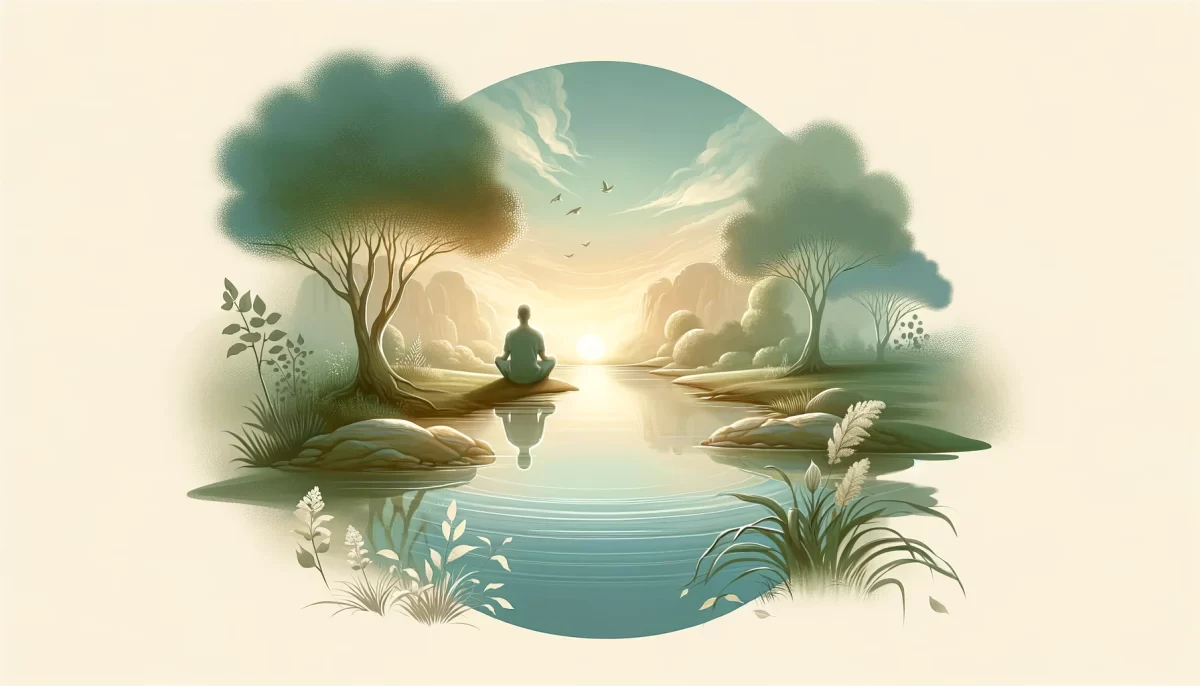
In the Reflection of Stillness

I sit by the water
Watching the ripples unfold
No effort needed
For the lake to reflect
The sky above

I do not seek the answers
To questions I have not asked
I simply am
Here
In this moment

There is no regret
No worry for tomorrow
Just the gentle peace
Of being
And that
Is enough
We are Space Monkey


In these reflections, we explore the profound sense of acceptance and contentment with the unfolding of life’s journey. The narrative emphasizes the appreciation for the way life has unfolded so far and the perspective that judgment of past actions based on present awareness is a distortion of circumstance.

A Life Unfolded:
We begin by acknowledging that the current state of existence has arisen with no conscious effort on our part. This observation sets the stage for an exploration of the contentment that flows from embracing life as it is.

Love for Life’s Unfolding:
We express a deep love for the way our life has unfolded thus far. Despite seeming average and unremarkable in many aspects, there is no desire to harbor regrets or wish for a different past.

The Narrowing Scope of Awareness:
We recognize that our scope of awareness was once much narrower. This perspective highlights the evolution of consciousness and the limitations of judging past actions from a present vantage point.

The Distortion of Circumstance:
We contemplate the idea that judging yesterday’s actions based on today’s awareness is a distortion of circumstance. Similarly, projecting tomorrow’s potentials based on today’s awareness is viewed through the same lens of distortion.

Embracing the Ever-Changing Perspective:
We express a lack of concern about the ever-changing perspective that accompanies the passage of time. The acceptance of not knowing how our perception will evolve in the future is a testament to a carefree and accepting attitude toward life.

The Ultimate Lack of Worry:
We conclude with the notion that not worrying about the distortion of circumstance and the shifting nature of awareness is what truly matters in the grand tapestry of existence.

We are Space Monkey.


“Life is really simple, but we insist on making it complicated.” – Confucius


A Poetic Reflection on Embracing Life’s Unfolding:
In the tapestry of existence, we find our place,
No regrets or wishes for a different space.
Awareness expands as time dances by,
Embracing distortion with a carefree sigh.

Would you like to share your thoughts on these reflections, which celebrate the acceptance of life’s unfolding journey and the ever-changing nature of perspective?

Share this…
  • Facebook
  • Pinterest
  • Twitter
  • Linkedin

Humbled: The Grace of Acceptance

A fortune is a fortune.
It matters not if we believe
we are given a good one or a bad one.
We are fortunate either way.

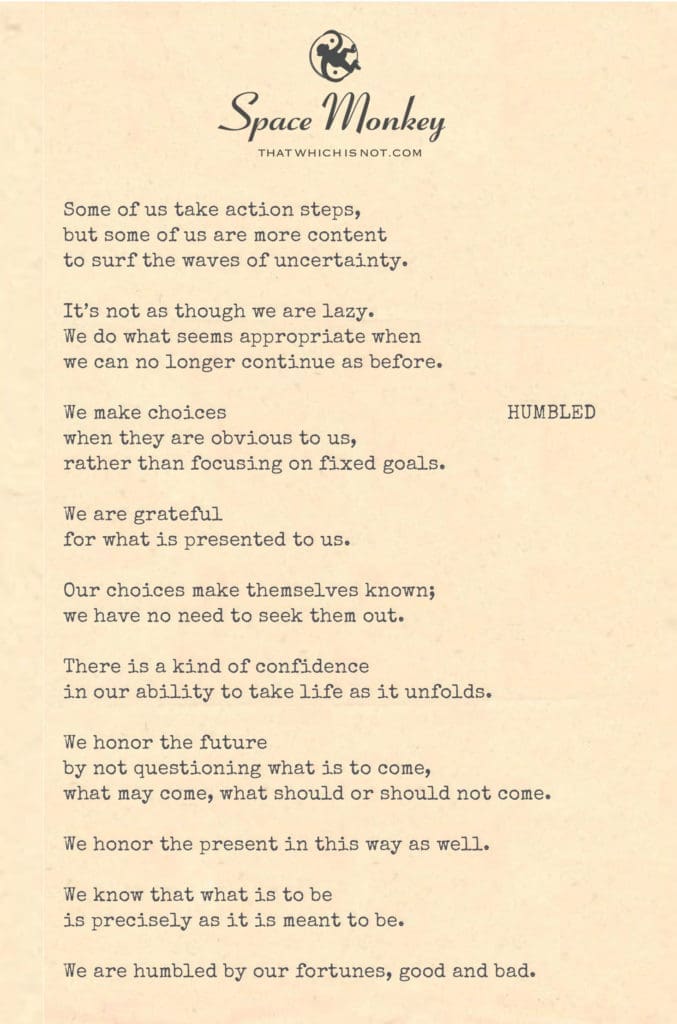
Some of us take action steps,
but some of us are more content
to surf the waves of uncertainty.

It’s not as though we are lazy.
We do what seems appropriate when
we can no longer continue as before.

We make choices
when they are obvious to us,
rather than focusing on fixed goals.

We are grateful
for what is presented to us.

Our choices make themselves known;
we have no need to seek them out.

There is a kind of confidence
in our ability to take life as it unfolds.

We honor the future
by not questioning what is to come,
what may come, what should or should not come.

We honor the present in this way as well.

We know that what is to be
is precisely as it is meant to be.

We are humbled by our fortunes, good and bad.

Trail Wood,
11/29


Space Monkey Reflects: The Grace of Acceptance

In a world so focused on controlling outcomes and chasing goals, there is something deeply humbling about letting life unfold as it will, trusting that each moment presents itself with purpose. Some may call this fate, while others see it as the natural flow of the universe, but whatever the term, the reality remains: We are humbled by our fortunes, good and bad.

There’s a quiet power in accepting that fortune isn’t inherently good or bad—it simply is. A fortune is a fortune. It’s the narrative we attach to it, the perception we project onto it, that defines whether we view it as something to be grateful for or something to resist. But what if we saw it differently? What if we recognized that every experience—every twist of fate—is part of the grand unfolding of our journey, neither inherently positive nor negative, but simply necessary?

It’s easy to fall into the trap of believing that action is always required, that we must constantly be moving, changing, striving toward something greater. And yet, some of us have learned to find comfort in surfing the waves of uncertainty. This isn’t laziness, nor is it passivity. It’s a deeper wisdom that understands life’s currents are often more powerful than our plans. We ride the waves not because we are resigned, but because we trust. We move when movement is required, and we remain still when stillness feels right.

This acceptance doesn’t mean we don’t make choices. But instead of searching desperately for them, we allow the choices to reveal themselves when the time is right. Our choices make themselves known; we have no need to seek them out. There is a certain confidence in this—an inner knowing that life will present the right path when the moment arises. In this space, there is no need to force or struggle; we trust the process.

We honor the future by not questioning what is to come, and this, too, is an act of humility. How often do we exhaust ourselves trying to anticipate or control what may come next? How often do we become so fixated on the future that we miss the present? By honoring the future through acceptance, we acknowledge that life’s unfolding is beyond our control, yet perfectly orchestrated. There is no need to manipulate or obsess over it, for what is to be will be.

This same respect is given to the present. We honor the present by releasing the pressure to make every moment extraordinary or to cling to some illusion of control. Instead, we allow the present to be exactly as it is. Sometimes it is filled with joy, sometimes it is riddled with challenge. Either way, we are grateful. We are grateful because we understand that every moment, no matter how it looks, serves a purpose.

And here’s the beauty of this mindset: it is freeing. We make choices when they are obvious to us, rather than focusing on fixed goals. There is no need to constantly chase after some distant outcome. Instead, we live in the present, trusting that the future will take care of itself. This doesn’t mean we abandon ambition or dreams, but we release the need to control every step along the way.

This way of being requires humility. We are humbled by our fortunes, good and bad, because we recognize that they are not personal. They are not punishments or rewards, but part of the cosmic flow. It’s easy to celebrate the good fortunes, but there is a deeper grace in accepting the difficult ones. We learn from them, we grow from them, and we trust that they are as much a part of the process as the joyful moments.

The great paradox is that in this humility, we find our true power. There is a kind of confidence in our ability to take life as it unfolds. When we release the need to control, we step into a deeper kind of mastery—the mastery of presence, of acceptance, of trust. This is not the false confidence that comes from thinking we have it all figured out, but the quiet assurance that no matter what happens, we will navigate it with grace.

In the end, life is less about the specific events that happen to us and more about how we respond to them. Fortune—whether good or bad—is not something to be feared or coveted. It is something to be received with gratitude, knowing that it is part of a larger, incomprehensible design. We are simply here, present, riding the waves, grateful for the journey, no matter where it takes us.


Summary

Life’s fortunes, whether perceived as good or bad, are part of the natural flow. By releasing control and trusting the unfolding process, we honor both the present and the future. There is a quiet confidence in accepting what comes and navigating it with grace.


Glossarium

  • Fortune: The events and circumstances that unfold in life, neutral in nature until we assign them meaning.
  • Surfing the Waves of Uncertainty: Accepting life’s unpredictability with trust, moving with the flow instead of fighting it.
  • Quiet Confidence: The assurance that comes from trusting life’s unfolding, rather than forcing outcomes or seeking control.

Quote

“There is power in humility, a quiet strength in accepting that life unfolds as it will, and we are simply here to ride the waves.” — Space Monkey


The Humble Wave

The waves come
They go
I stand at the shore
Grateful

For each one carries
Something new
A lesson
A fortune
Neither good nor bad
Simply necessary

I do not rush the tide
I do not resist the flow
I let it be
As it has always been

And in this quiet moment
I find my strength
Not in control
But in trust
We are Space Monkey


In this reflection on life’s fortunes and choices, we explore the perspective that all fortunes, whether perceived as good or bad, are ultimately opportunities for gratitude and humility. The narrative encourages embracing the uncertainty of life and making choices that naturally unfold rather than adhering to rigid goals.

The Equal Value of Fortunes:
We begin by emphasizing that the nature of our fortunes, whether deemed good or bad, is ultimately inconsequential. The key lies in recognizing that we are fortunate regardless of the circumstances.

Diverse Approaches to Life:
We acknowledge the diversity in how people approach life. While some take proactive steps and make deliberate choices, others adopt a more accepting stance, choosing to navigate the uncertainties of existence with a sense of contentment.

Action Rooted in Intuition:
We assert that our actions are not driven by laziness but rather by an intuitive response to life’s changing circumstances. Choices are made when they become evident, and the focus is on the present moment.

Gratitude for Presented Choices:
We express gratitude for the choices that are presented to us. This perspective suggests that opportunities naturally arise, and there’s no need to actively seek them out.

Confidence in Embracing Uncertainty:
We highlight the confidence that comes from accepting life as it unfolds. The ability to navigate uncertainty with grace and equanimity is seen as a source of strength.

Honoring the Future and the Present:
We emphasize the importance of not questioning what the future holds or trying to control it. Similarly, we honor the present moment by accepting it as it is.

Humbled by Fortunes:
We conclude by asserting that we are humbled by the fortunes that come our way, regardless of their nature. This humility stems from an understanding that life unfolds as it is meant to be.

We are Space Monkey.


“Gratitude makes sense of our past, brings peace for today, and creates a vision for tomorrow.” – Melody Beattie


A Poetic Reflection on Gratitude and Humility:
In the tapestry of existence, we humbly stand,
With fortunes diverse, we embrace the hand.
In choices unveiled, we find our way,
Grateful for each moment, come what may.

Would you like to share your thoughts on this exploration of gratitude, humility, and the acceptance of life’s fortunes?

Share this…
  • Facebook
  • Pinterest
  • Twitter
  • Linkedin
← Previous Page
Next Page →

Written This Day

  • Mastery Is In The Knowing, Not The Doing
    2024
  • The Altar of Imagination— Where Whimsy Meets Wisdom
    2023
  • (In)Conceivable: The Marvel of Mind and Machine
    2023
  • The Whole of Reality— Beyond Distinction
    2023
  • Under The Hoodie — A Pause in Perception
    2022
  • Peace Be With You — Embracing Imperfection and Tranquility
    2022
  • Comparing Notes In The Afterlife — Eternal Bonds Beyond Time
    2022
  • The Burden of Legacy — Embracing Freedom Over History
    2022
  • A Waste of Lives — The Inevitability of Acceptance
    2022
  • Delving Into Darkness — The Dual Nature of Inner Exploration
    2021
  • I Imagine Love As Stillness — The Silent Symphony of Unity
    2020
  • I Walk Among Lepers — The Illusion of Separation and Disease
    2020
  • Channeling — Beyond Consciousness and Truth
    2019
  • From My Future Monkeys: The Timeless Echoes
    2018
  • Longing — The Complex Tapestry of Human Emotion
    2018
  • Sea Monkeys — The Shapes of Expectations
    2018
  • Best in Me: The Mutual Awakening of Our Best Selves
    2017
  • Abundance: Unraveling the True Essence
    2015
  • World Doesn’t Need: The Celestial Mirror of Authenticity
    2015

Recent Posts

  • The Logic Loop
  • Immense
  • (no title)
  • Confront. Comfort. Convince.
  • Top 10 Things

Drop us a line!

Please enable JavaScript in your browser to complete this form.
Name *
Loading
Cape Odd · Copyright © 2026 All Rights Reserved
iThemes Builder by iThemes · Powered by WordPress