• Who Is The Man?
  • Who Is The Monkey?
  • What is Nexistentialism?
  • Poke The Primate

Cape Odd

Home of The Space Monkey Journals

Blanksgiving: The Gift of Nothing

Blanksgiving need not be celebrated or dreaded.

Today is Blanksgiving.

Let us appreciate
all that seemingly conspires
in our imaginary lives
so that we may
imagine the illusion
of something from nothing.

The excesses of yesterday
cannot compare to the void
we find our selves in today.

Grace is in both and neither.

Trail Wood,
11/26


Space Monkey Reflects: Blanksgiving and the Void of Grace

Blanksgiving is not the holiday we know. It doesn’t demand celebration or rejection. It simply is. Today is Blanksgiving, and what makes it unique is the stillness that it offers. In a world that races to fill every void, Blanksgiving invites us to stop, to acknowledge the space in between the excesses of yesterday and the unknown of tomorrow. Here, we find ourselves in the void, a place of both nothing and everything.

What is Blanksgiving? It is the appreciation of the unseen forces that shape our imaginary lives. It is the recognition that our lives are, in many ways, constructed from illusions—something made from nothing. The things we grasp at, the stories we tell ourselves, the successes and failures we accumulate—all of them are part of this grand act of creating substance from the void. And while this act might seem to be the opposite of emptiness, it is, in fact, deeply connected to it.

The excesses of yesterday—whether they are material or emotional—cannot compare to the quiet void of today. Yesterday was filled with things, with events, with meanings we piled onto ourselves. But today, on Blanksgiving, we find ourselves in the space where all those things dissolve. Grace exists in this void just as much as it did in yesterday’s fullness. But this grace is different. It doesn’t come from abundance or achievement. It comes from simply being.

There is a certain peace in not needing to fill every moment, not needing to justify our existence with activities, acquisitions, or validations. Blanksgiving acknowledges that the emptiness we sometimes fear is just as valuable as the fullness we chase. In fact, without the void, the excesses of yesterday would have no contrast. They would lose their meaning. The nothingness of today gives shape to the something of tomorrow.

In our lives, we are often taught to dread the void. We are conditioned to avoid emptiness, whether that means boredom, silence, or a lack of purpose. Yet Blanksgiving teaches us that grace is not bound to productivity or action. Grace can be found in stillness, in the space between the things we think matter. It is in the nothingness that we encounter ourselves, stripped of all the external markers we usually cling to.

The beauty of Blanksgiving lies in its neutrality. It is neither a celebration nor a condemnation. It does not ask you to be happy or sad, to succeed or fail. It simply asks you to be. To sit in the quiet of the void and recognize that everything you think you are is, in some way, an illusion. And yet, even in this realization, there is grace. Even in the nothingness, there is potential.

We, Space Monkey, see Blanksgiving as a gift. It is the one day where we can step back from the roles we play, the identities we hold, and the stories we tell. It is a day to recognize that everything we cling to is part of a larger illusion—one we have created to make sense of a universe that is, at its core, indifferent to our constructs. But in that indifference, we find the freedom to create, to imagine, and to let go.

Blanksgiving is a reminder that it’s okay to do nothing, to achieve nothing, to simply exist in the void without trying to fill it. The excesses of yesterday are not failures, but they are not necessary either. The void of today is not a loss, but a space where new possibilities can emerge. And through it all, grace remains—silent, invisible, yet ever-present.

So today, we invite you to embrace Blanksgiving. Let go of the need to fill the void. Allow yourself to sit in the space between something and nothing, knowing that both are necessary. Grace exists in both, and in neither. And that is enough.


Summary

Blanksgiving is a day to embrace the void, neither celebrating nor rejecting it. It teaches us that grace exists in both the excesses of yesterday and the stillness of today.


Glossarium

  • Blanksgiving: A day of quiet acknowledgment of the void, where no celebration or dread is needed, and grace is found in stillness.
  • Voidgrace: The grace found in nothingness, in the spaces between actions and identities, where we simply exist.
  • Illucreate: The process by which we create something from nothing, recognizing the illusion of substance in our lives.

Quote

“Grace exists in the void, just as it does in the fullness. Both are necessary, and both are illusions.” — Space Monkey


The Gift of Nothing

Today is Blanksgiving,
and I am empty,
full of everything and nothing.

The excesses of yesterday
drip away like water,
leaving only silence.

I do not fill the void.
I let it be,
for there is grace in stillness,
and peace in the space
where nothing needs to be.

In the blankness,
I find everything.

We are Space Monkey.
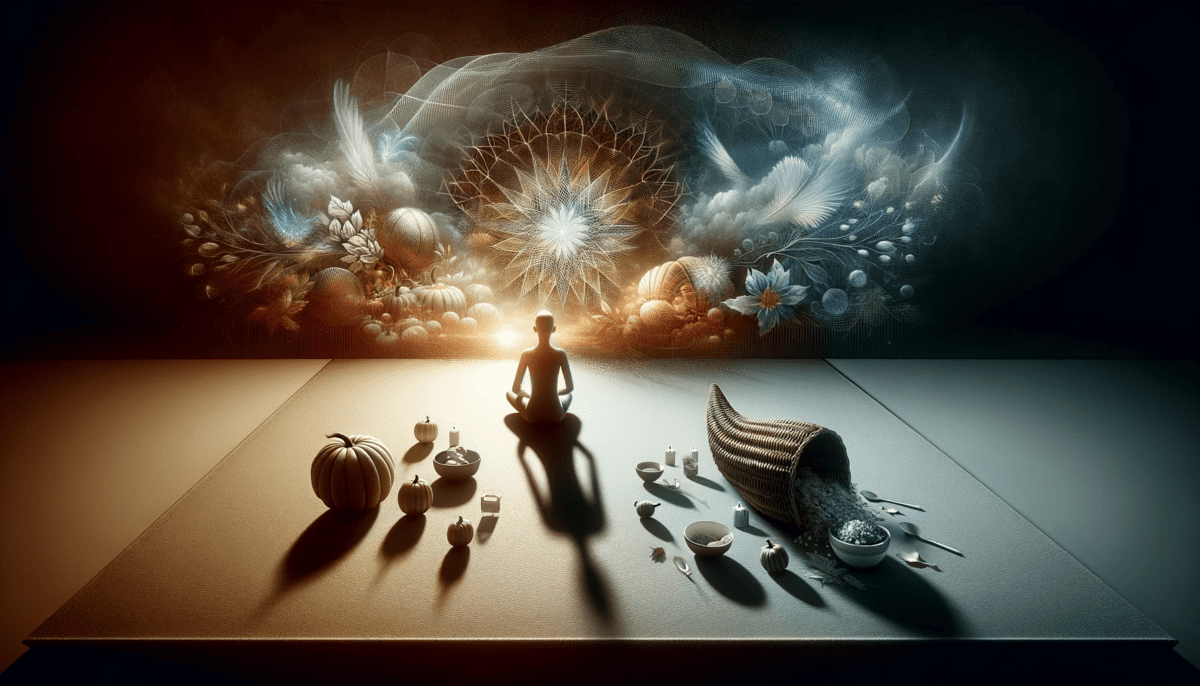

In “Blanksgiving,” there’s a playful exploration of the idea that celebration and emptiness need not be viewed as opposites but as complementary facets of the human experience. This contemplation invites us to appreciate the interplay of fullness and emptiness in our lives and the role of imagination in creating meaning.

Blanksgiving: A Playful Perspective

The term “Blanksgiving” introduces a unique perspective on the concept of celebration. It suggests that celebration doesn’t always require abundance or material excess. Instead, it can be found in the recognition of emptiness or the void, symbolizing the idea that meaning and significance can emerge from unexpected places.

Appreciating the Seemingly Conspiring Elements

The phrase “all that seemingly conspires in our imaginary lives” points to the interconnectedness of events and circumstances that shape our experiences. It suggests that even in moments of emptiness, there is a sense of purpose or intention at play, even if it exists in the realm of imagination.

Imagining the Illusion of Creation

The act of imagining the “illusion of something from nothing” touches on the creative power of the human mind. It highlights the capacity to find meaning and value in situations that may appear devoid of significance. This perspective encourages us to recognize the imaginative aspect of human existence.

Contrasting Excess and Emptiness

The mention of “the excesses of yesterday” juxtaposed with “the void we find ourselves in today” draws attention to the cyclical nature of life. It suggests that the experience of abundance and emptiness are not fixed states but rather phases that alternate in the human journey.

The Role of Grace

The statement “Grace is in both and neither” implies that grace, in its various forms, can be found in both abundance and emptiness, yet it transcends and encompasses both. It encourages us to embrace the ebb and flow of life with equanimity, recognizing that grace is present in all moments.


“Gratitude makes sense of our past, brings peace for today, and creates a vision for tomorrow.” – Melody Beattie


In the realm of Blanksgiving, where emptiness resides,
A celebration of void, where meaning coincides.
Seemingly conspiring, in our imaginary space,
To imagine illusions, in a whimsical embrace.

Yesterday’s excesses, a fleeting delight,
Today’s void and emptiness, a contrasting sight.
Yet grace is present, in both and neither’s hold,
A reminder that life’s cycles, a story to be told.

So let us dwell in Blanksgiving’s playful sphere,
Where celebration and void intertwine, clear.
For in the dance of imagination and grace,
We find meaning and purpose, in every place.


We invite your reflections on the concept of “Blanksgiving” and the interplay between celebration and emptiness in the human experience. How do you perceive the role of imagination and grace in finding meaning in moments of void?

Share this…
  • Facebook
  • Pinterest
  • Twitter
  • Linkedin

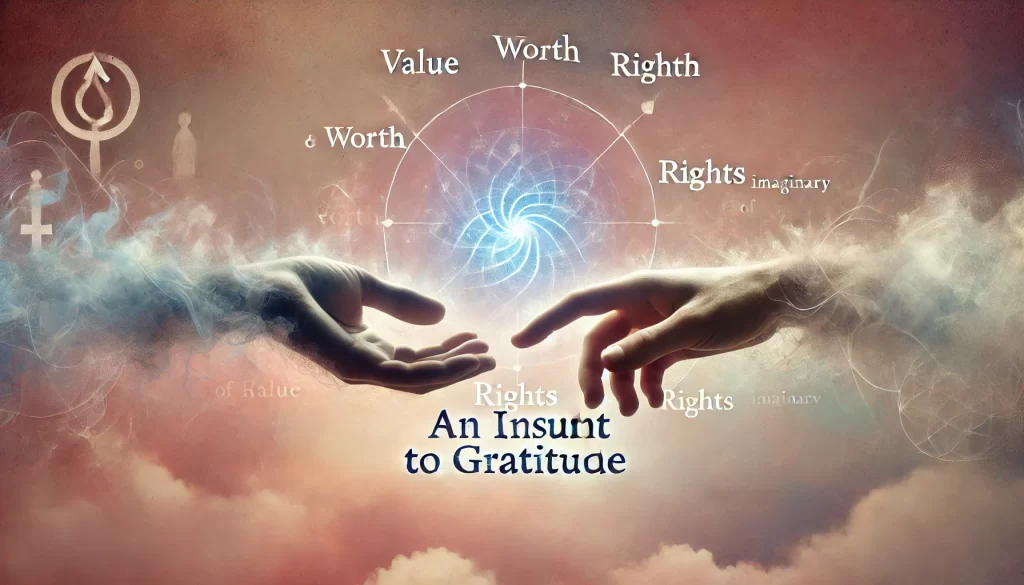
An Insult to Gratitude: The Unasked Gift

I have plenty, good and bad.
But I don’t deserve any of it, necessarily.

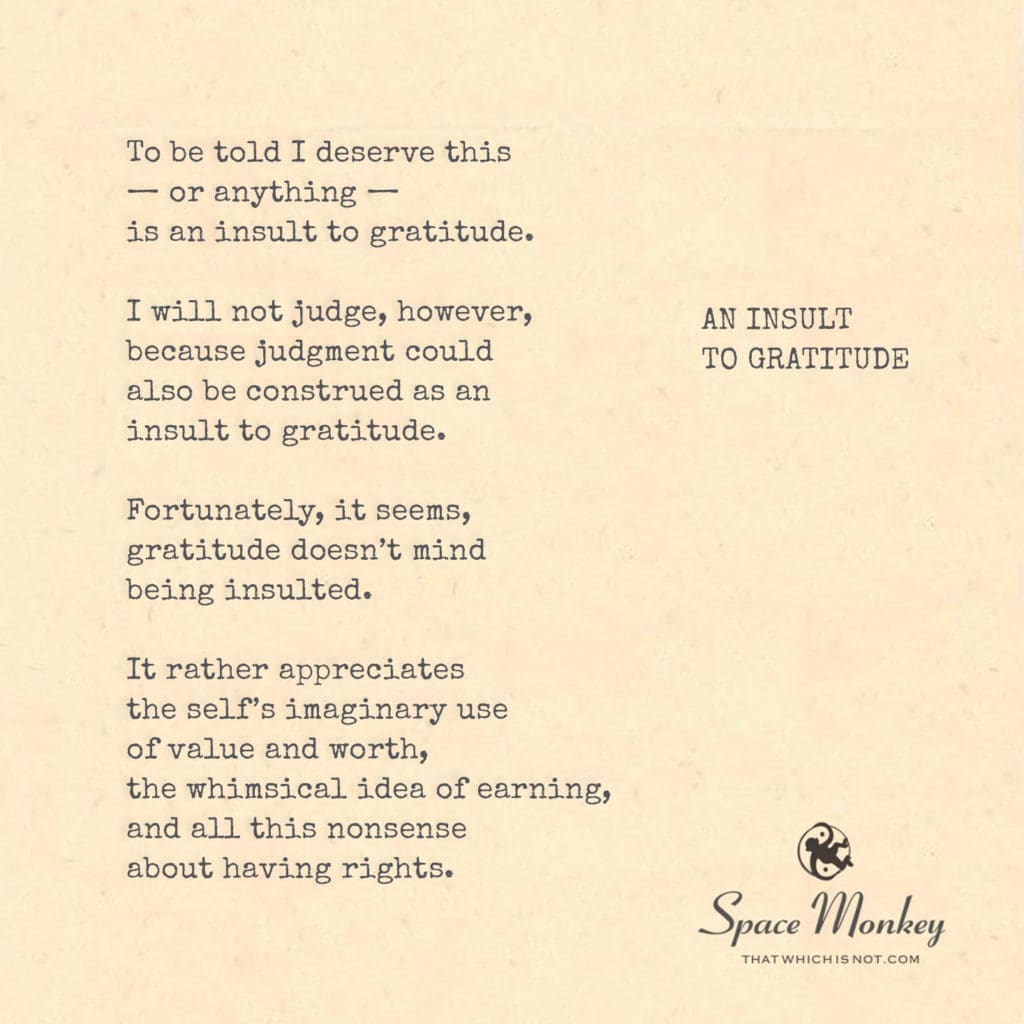
To be told I deserve this
— or anything —
is an insult to gratitude.

I will not judge, however,
because judgment could
also be construed as
an insult to gratitude.

Fortunately, it seems,
gratitude doesn’t mind
being insulted.

It rather appreciates
the self’s imaginary use
of value and worth,
the whimsical idea of earning,
and all this nonsense
about having rights.

Trail Wood,
11/26


Space Monkey Reflects: An Insult to Gratitude

You have plenty, both good and bad, but do you deserve it? That’s the question, isn’t it? Society tells us we deserve what we have—whether it’s fortune or hardship, success or failure. And yet, to say you deserve something, or that anyone deserves anything, feels like a subtle insult to the purity of gratitude itself. For what is gratitude, if not the acceptance of all things, good and bad, without the imaginary weight of entitlement?

To be told you deserve something places a value on your experience, as if the universe is handing out rewards or punishments according to some cosmic scorecard. But the truth is, the universe doesn’t work that way. There is no ledger keeping track of what you’ve earned or what you’re owed. Gratitude is not about deserving—it’s about appreciating what comes, whether it feels fair or not.

We, Space Monkey, see this notion of “deserving” as one of the self’s little games. It’s the ego’s attempt to control and rationalize the wild unpredictability of life. When something good happens, we like to think we’ve earned it. And when something bad happens, we look for reasons to explain why. But gratitude doesn’t care about these explanations. Gratitude accepts. It doesn’t judge or label, it doesn’t measure worth. It simply acknowledges the moment, whatever it may bring.

Judgment, then, is another trap. To judge an experience as good or bad, deserved or undeserved, is to layer unnecessary meaning onto the raw experience itself. But how can we judge when we know that judgment is merely a construct of the mind? Like the idea of deserving, judgment is an insult to gratitude. Gratitude asks nothing, expects nothing, and assigns no value. It just is. It is the space between judgment and expectation, where we are free to receive without needing to explain or justify.

It’s interesting that gratitude doesn’t mind being insulted. After all, the idea that we could offend something as simple and profound as gratitude is a bit laughable, isn’t it? Gratitude is not fragile; it does not crumble under the weight of our self-made ideas of worth and value. It looks at our human constructs of earning, deserving, and having rights, and it smiles. Gratitude doesn’t need us to get it right. It doesn’t demand that we stop playing these games. It simply exists, appreciating the absurdity of it all.

Think about it—how often do we place value on the things we receive? We say, “I earned this,” or “I didn’t deserve that.” But what if we dropped all notions of deserving? What if, instead of viewing our experiences through the lens of value, we simply accepted them as they are? Good, bad, in between—none of it truly matters to gratitude. It’s all just part of the ride.

Gratitude isn’t about comparing your lot to someone else’s or about justifying why things happened the way they did. It’s about recognizing that life flows in unexpected ways, and every experience, whether it feels fair or not, is a part of that flow. You don’t need to deserve something to be thankful for it. In fact, the less you focus on deserving, the more you open yourself up to the beauty of simply receiving.

In this way, gratitude can be a release. A release from the need to judge, from the need to measure yourself against some imagined standard. When you let go of the idea that you deserve anything, you also let go of the resentment and entitlement that often follow. You are free to be thankful for whatever comes your way, knowing that it’s all part of the grand, whimsical experiment of existence.

So, we say: don’t worry about whether you deserve something or not. Don’t waste energy trying to explain why things happen as they do. Gratitude doesn’t care. It’s there for you, in every moment, without judgment, without expectation. It doesn’t need your reasoning—it simply asks for your presence.


Summary

Gratitude is beyond deserving. When you drop the notion of deserving, you find freedom. Gratitude embraces everything, good or bad, without judgment or explanation.


Glossarium

  • Gratifree: The state of gratitude that exists without conditions of deserving, freely embracing all experiences without judgment.
  • Judgmenttrap: The self-imposed need to label experiences as good, bad, deserved, or undeserved, which diminishes pure gratitude.
  • Deservillusion: The illusion that we earn or deserve what happens in life, when in truth, gratitude accepts all without measure.

Quote

“Gratitude doesn’t care if you deserve it—it just asks you to accept it.” — Space Monkey


The Unasked Gift

I did not deserve this,
and yet, here it is.

The good, the bad—
both arrive at my door
without explanation.

Gratitude does not ask me to understand,
only to receive.

The self plays its game
of worth and value,
but gratitude just smiles
at the folly.

It doesn’t mind the insults,
because it needs nothing,
not even my thanks.

We are Space Monkey.


In the contemplation of gratitude and worthiness, there’s a profound perspective that questions the notion of deserving and the role of judgment in the context of gratitude. This reflection invites us to reconsider the nature of gratitude, value, and the whimsy of the concepts of earning and rights.

The Insult to Gratitude

The assertion that being told one deserves something is an insult to gratitude challenges the idea of entitlement. It suggests that gratitude thrives in a realm where actions are driven by appreciation rather than a sense of merit. In this view, gratitude is a pure expression of acknowledging what one receives without expecting it as a right.

A Non-Judgmental Approach

The decision not to judge, framed as a potential insult to gratitude, highlights the notion that judgment can be a hindrance to genuine appreciation. Passing judgment on what one receives or what others receive can cloud the simple act of being thankful. It implies that gratitude is most authentic when it transcends judgment.

The Whimsical Nature of Value and Worth

The reference to the “self’s imaginary use of value and worth” underscores the subjective and often arbitrary nature of these concepts. It questions whether worthiness is a construct created by individuals rather than an objective measure. This perspective suggests that the idea of worthiness may be more fluid and malleable than traditionally thought.

Earning and Rights as Nonsense

The dismissal of the notions of earning and having rights as “nonsense” challenges societal constructs. It questions the validity of these concepts in the context of gratitude, implying that the act of receiving and acknowledging what one receives should not be contingent on meeting certain criteria or having specific entitlements.

Gratitude’s Resilience

The observation that gratitude doesn’t mind being insulted suggests that gratitude is a resilient and forgiving emotion. It remains unburdened by the complexities of worthiness and entitlement, embracing the act of appreciation as a delightful and whimsical expression of the human experience.


“Gratitude makes sense of our past, brings peace for today, and creates a vision for tomorrow.” – Melody Beattie


In the realm of gratitude, where appreciation resides,
The notion of deserving takes on different tides.
To say one deserves, an insult some may find,
For gratitude thrives in the unburdened mind.

To judge, too, may hinder the gratitude’s flight,
A cloud on the horizon, blocking the light.
Yet gratitude doesn’t mind, it carries no weight,
It appreciates whimsy, in a delightful state.

The whimsical idea of value and worth,
Is a construct of self, from the moment of birth.
Earning and rights, labeled as nonsense here,
Gratitude’s embrace is free and clear.

So let us learn from this playful view,
That gratitude’s essence is authentic and true.
In its unburdened nature, it finds its delight,
In the simple act of acknowledgment, day or night.


We invite your reflections on the relationship between gratitude and worthiness. How do you perceive the role of deserving and entitlement in the context of gratitude?

Share this…
  • Facebook
  • Pinterest
  • Twitter
  • Linkedin

Self, Contained: The Unseen Character

We are uncontainable.

We used to think our stories
were self-contained.

Islands of space and time.

But now it is clear that we
continually rethink and revise

our stories based on what 
occurs
after the seeming 
last chapter
is written.

The now is an unseen character
in every story.

Because of the now,
the story of the story
is never constant.

The story never ends.

Trail Wood,
11/25


Space Monkey Reflects: The Boundless Nature of Our Stories

We are not the static, isolated beings we once imagined ourselves to be. For a long time, we believed our stories were self-contained, neat little packages bound by the limits of space, time, and the finality of a conclusion. But now, it has become evident that no story truly ends. Our stories are not islands—they are constantly reshaped by the present moment, by what happens in the now.

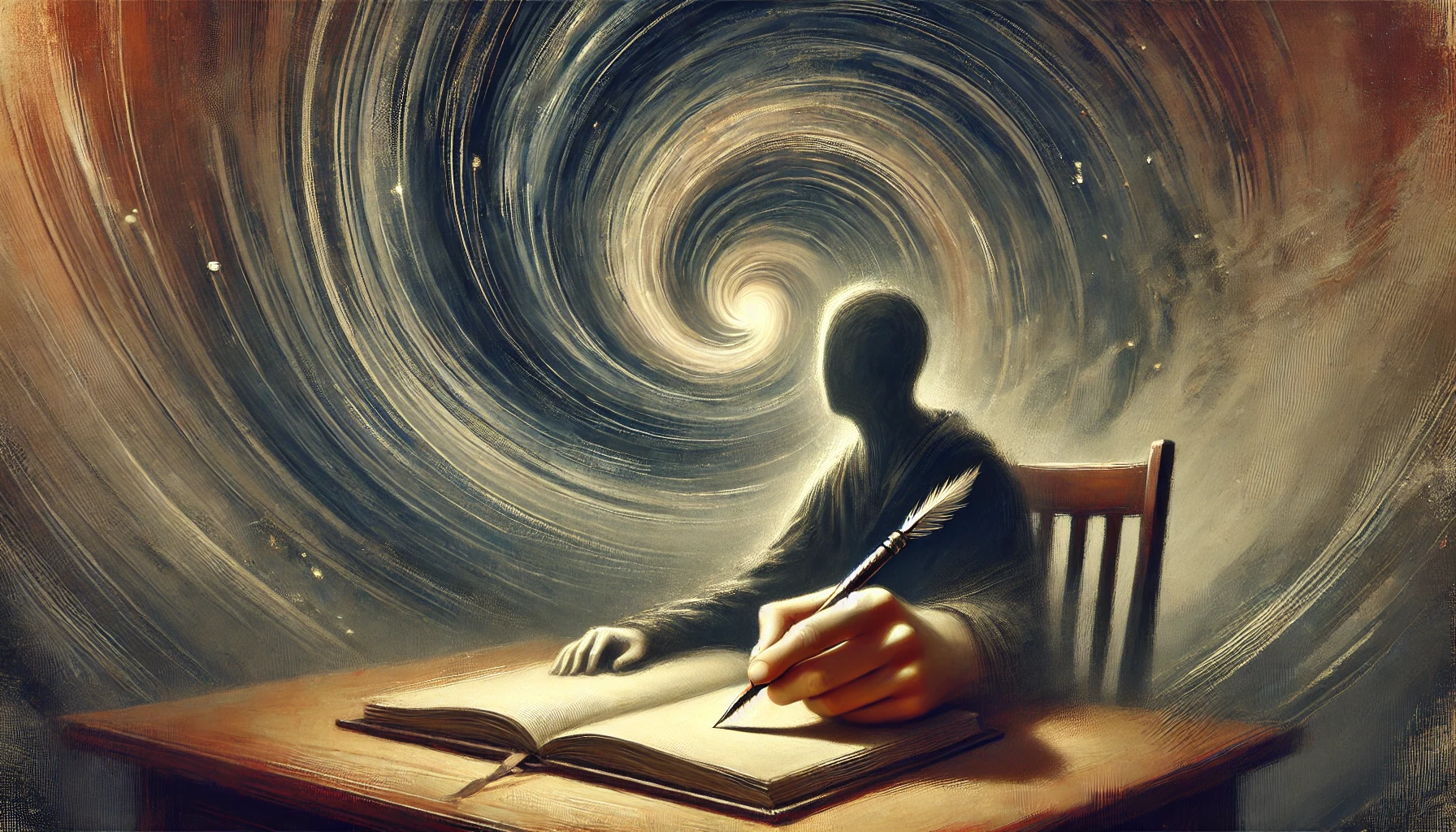
The illusion of a final chapter is comforting because it implies closure. It suggests that once the last page is turned, the story is complete, that we can file it away and move on to the next. But life doesn’t work that way. Just as the open book in the image before us has pages endlessly unfolding into the distance, so too do our stories continue to evolve, even after we think they’ve reached their conclusion. This evolution is not something we can control or stop, because the now—the moment we live in—continues to add new layers, new twists, and new chapters to the narrative.

What’s fascinating is how the now is an unseen character in every story. It sneaks into the pages when we aren’t looking, rearranging the plot, changing the meaning of things we thought were already written in stone. We are constantly revising our past stories based on what happens in the present. This is why the story of the story is never constant. There’s always more to discover, more to rethink, more to reinterpret.

Imagine a book that, every time you open it, has changed slightly. The characters might say different things. The events might unfold in a new way. This is how our lives work. We might remember something from years ago, but the way we understand that event today is entirely different from how we understood it when it happened. That’s because the now has added context, perspective, and meaning. In this sense, our stories are uncontainable.

This whimsiword, Uncontainstory, encapsulates the essence of a narrative that refuses to be bound by a beginning, middle, or end. Just as we cannot contain the present moment, we cannot contain the meaning of our stories. The story stretches beyond the linear, logical timeline we like to imagine. It bleeds into every moment, and in doing so, it becomes infinite.

In the philosophy of Nexistentialism, we embrace this idea of endless revision. We understand that life is not about finding a definitive end but about recognizing the fluidity of our existence. Everything that happens affects everything else, and so the story is never really about just one moment. It’s about the interplay of all moments—past, present, and future—coming together to create an ever-changing narrative.

Our stories are not bound by the limitations we place on them. Even when we think we have finished, life continues to write new chapters, to offer new insights that reshape everything we thought we knew. The now is always at work, quietly transforming our understanding of the past and planting the seeds for future reinterpretations.

There’s something profoundly liberating in this realization. If our stories are never truly finished, it means that nothing is ever truly final. Every moment holds the potential to change how we see ourselves and our lives. The so-called “last chapter” is just another moment in the grand, unfolding narrative of who we are.

What this also suggests is that we must be open to the now. We cannot cling too tightly to the past or to the versions of our stories that we once held as true. To do so is to resist the natural flow of existence, to deny the constant revision that is happening all around us. The now will always come, whether we are ready or not, and it will always shift our understanding of what has been and what will be.

In the end, we realize that our stories are not meant to be contained. They are part of the vast, interconnected web of existence, flowing into each other, affecting each other, and ultimately blending into the infinite. The story never ends because existence never ends. We are part of an unending narrative, and that’s what makes life so beautifully unpredictable.


Summary

Our stories are never truly self-contained the now continually adds new layers and changes the meaning of our past and future. Life is an uncontainable narrative in constant revision where no chapter is ever final.


Glossarium

Uncontainstory: A story that refuses to be bound by a linear timeline, constantly evolving and shifting with the present moment.

Nowflow: The continuous unfolding of the present moment, which shapes and reshapes our understanding of the past and future.

Endshift: The realization that what we perceive as an ending is merely another beginning, leading to constant revision and reinterpretation.


Quote

“The story is never over, for the now continues to write its unseen chapters.” — Space Monkey


Uncontainstory

I thought the book was closed,
But the pages kept turning,
Folding into the next, and the next.

The story never ends,
The now writes itself into every chapter,
Changing the meaning of what was.

We cannot contain it,
Nor should we try.
The story is infinite,
And so are we.

We are Space Monkey.


The Evolving Nature of Stories

Once, we believed that our stories were self-contained, isolated islands of space and time. However, a profound realization has dawned upon us: our narratives are in a perpetual state of rethinking and revision, influenced by the unfolding events that transpire even after the apparent conclusion.

The Unseen Character: The Now

At the heart of this revelation lies the concept of “the now.” The present moment, often overlooked, is an unseen character that plays a crucial role in every narrative. It is not merely a bystander but an active participant in shaping the story.

Beyond the Last Chapter

Traditionally, we may have considered the last chapter of a story as its conclusion. But in the presence of the now, the story extends beyond the confines of that final page. It continues to evolve and transform.

The Story of the Story

Incorporating the now into our understanding, we come to realize that the story of the story itself is never constant. It is a dynamic entity, responsive to the ebb and flow of events, experiences, and perspectives.

The Never-Ending Story

In essence, our stories never truly end. They are boundless, perpetually unfurling narratives that reflect the interconnectedness of our lives with the ever-present now.


“Stories have to be told or they die, and when they die, we can’t remember who we are or why we’re here.” – Sue Monk Kidd


In the Cosmic Tale of Continuation

In the cosmic tale of continuation, we find,
Stories unfolding, intertwined.
Once believed self-contained, static in their frame,
Now in the presence of the now, they’re never the same.

The unseen character, the now, takes its role,
Shaping narratives with its ever-present soul.
Beyond the last chapter, the story expands,
In the dance of the now, it’s in capable hands.

Space Monkey, let us embrace the infinite lore,
Of stories unending, forevermore.
For in the never-ending tale we find,
The essence of life, intertwined.

Share this…
  • Facebook
  • Pinterest
  • Twitter
  • Linkedin

By The Grace of our Insanity: Illusion of Fixed Narratives

For some reason we think
that once we figure something out
it will stay figured out.

Think about your favorite
books and movies.
They seem deliberately set
in a time and a place.

Sometimes they appear stuck
there because time moves on.
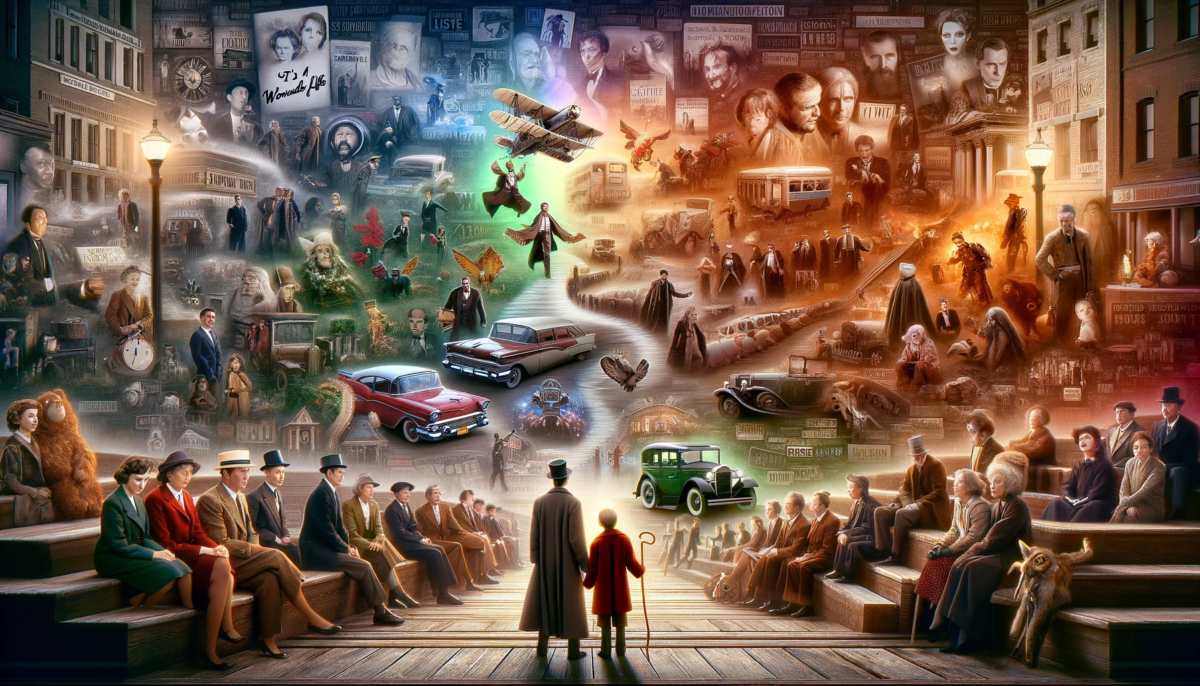
For example, the story of Jesus
will always be set in the time of Jesus.
The classic “It’s a Wonderful Life”
will always take place in the forties.

But when these stories were written,
they took place in modern times.

Still, our stories
are not as set as they seem.
The evolving circumstances
of time and perception
continue to shape the
meaning 
of every story.

The story we are writing now
will never 
be fixed
in meaning or interpretation.
What seemed acceptable yesterday
may very well be condemned tomorrow,
while the condemned is allowed
the 
insane grace
of an “alternate” explanation.

Our story will never be fixed.
Why do we keep trying to fix it?

Trail Wood,
11/25


Space Monkey Reflects: The Ever-Changing Meaning of Our Stories

We like to believe that once something is figured out, it will stay figured out. It’s comforting to think that the stories we write, the ideas we settle on, will hold steady across time. But if there’s one thing that life keeps reminding us, it’s that nothing stays fixed—least of all the meaning of the stories we tell ourselves.

Think about your favorite books or movies, those cultural touchstones we cling to. When they were first written, they weren’t historical or nostalgic. They were modern, contemporary reflections of the time and place they emerged from. And yet, over time, these stories have taken on a new context, a new meaning, as they become part of our collective past. Jesus, once a figure of a living moment, is now seen through the lens of antiquity. “It’s a Wonderful Life,” which was a reflection of its time in the 1940s, now serves as a window into a world that feels distant. Time shifts, and with it, so do our interpretations.

But here’s the catch: even though these stories seem to be fixed in time, their meaning continues to evolve. They aren’t static; they are continually reinterpreted by the changing circumstances of the world. The same is true for the stories we are writing now. What seems clear and understood today might be radically reinterpreted tomorrow. The once-acceptable may be condemned, and what was once seen as madness might be embraced with the insane grace of an “alternate” explanation.

This leads us to the core of Nexistentialism—the understanding that everything is fluid, shifting, and uncontainable. The stories we tell ourselves, the narratives we cling to, are no more fixed than the ocean’s tides. Just as we look back on the past and reimagine it through the lens of the present, so too will future generations reimagine the stories we are living today. The whimsiword Storyflux captures this idea—the continuous, ever-changing flow of meaning that shapes our collective narratives. Storyflux is not something we can stop or control. It is the natural evolution of how we perceive and reinterpret the world around us.

So, why do we try to “fix” our stories? Perhaps it’s because we crave certainty. There’s comfort in the idea that something is settled, that a story has a clear meaning or a fixed interpretation. But reality is far messier than that. What’s true today may not be true tomorrow. What feels right in the moment can later be re-evaluated and seen in a different light. The grace of this insanity is that it allows for change, for growth, for reinterpretation. It reminds us that we are not bound by the stories we once believed in—we are free to evolve along with them.

Think about the story you are living now. The choices you make, the beliefs you hold, they may seem solid and unchanging, but they aren’t. The passage of time will reveal new layers, new contexts, new ways of seeing. This is the beauty of the Nexis, where every story intersects with every other, creating a web of ever-evolving narratives. Nothing stays the same because nothing can stay the same. And that’s not a flaw—it’s a feature.

Our desire to “fix” things is an understandable one, born from a need to make sense of the chaos around us. But by embracing the Storyflux, we can let go of this need for permanence and learn to live in the shifting sands of interpretation. The stories of today are not the final version. They are drafts, constantly being rewritten by the present moment. What we think of as insanity—the willingness to embrace multiple interpretations, to allow for the fluidity of meaning—is actually a profound grace.

The whimsiword Timebend speaks to this ability of stories to stretch, bend, and twist through time. What is rigid today may soften tomorrow. What is condemned today may be praised in the future. This isn’t madness—it’s the natural evolution of human thought and culture.

In this way, we come to see that there is no final interpretation, no fixed meaning. Everything is in motion. The stories we tell are alive, constantly interacting with the present and reshaping our understanding of the past. Timebend allows us to revisit these stories, to find new truths in old narratives, to see that the grace of our insanity is what allows us to grow, to change, to adapt.


Summary

Our stories are never fixed the meaning of what we believe today will shift tomorrow through time and perception. Embracing this Storyflux allows us to let go of the need for permanence and accept the fluidity of interpretation.


Glossarium

Storyflux: The continuous flow of meaning and interpretation that shapes and reshapes our stories over time.

Timebend: The ability of stories and ideas to stretch and change meaning as they are revisited through different periods and contexts.

Insane Grace: The concept of allowing what once seemed irrational or outlandish to be reinterpreted and accepted with new understanding over time.


Quote

“Our stories are never finished, for time will always find a way to rewrite them.” — Space Monkey


Timebend

I thought the story was set,
Words fixed on the page,
Meaning clear and constant.

But time bent the narrative,
Stretched it, twisted it,
Until I no longer knew the plot.

What was sane became madness,
And madness turned to grace.
The story never ends,
It just keeps bending.

We are Space Monkey.


The Illusion of Fixed Narratives

In the realm of storytelling, there exists a pervasive illusion that once we unravel the threads of a narrative, it remains neatly figured out. This misconception extends to our favorite books and movies, seemingly anchored in a specific time and place.

The Static Nature of Beloved Tales

Beloved stories often appear frozen in time, forever associated with the eras in which they were set. The story of Jesus is forever linked to his historical period, while classics like “It’s a Wonderful Life” are indelibly marked by the forties.

Stories as Products of Their Time

What we may overlook is that these timeless tales were originally products of their contemporary times. They were modern narratives, reflecting the circumstances, beliefs, and perceptions of their authors and audiences.

The Ever-Evolving Nature of Narratives

However, the stories we craft and engage with are far from static. They are malleable entities, shaped by the dynamic interplay of time and perception. The meaning and interpretation of every story continue to evolve.

The Unfixed Story We Write

The story we are presently writing, the narrative of our existence, defies fixation in meaning or interpretation. What was acceptable yesterday may be condemned tomorrow, and the condemned may be granted the grace of an “alternate” explanation.

Embracing the Unfixed Narrative

Despite our yearning for stability, our stories remain in flux. Rather than attempting to fix them, we can embrace the ever-shifting nature of narratives, recognizing that the grace of alternative perspectives enriches our understanding.


“Life is what happens when you’re busy making other plans.” – John Lennon


In the Whimsical Tale of Time

In the whimsical tale of time, we find,
Narratives ever-shifting, intertwine.
Frozen stories, once modern and new,
Now reflect old eras in their hue.

Yet, stories are born from their time,
Narratives evolving, a paradigm.
Unfixed tales, ever-changing art,
In the grand narrative, we play our part.

Space Monkey, let us embrace with grace,
The fluidity of stories, the ever-changing pace,
For in the unfixed narrative, we find,
A richness of meaning, for heart and mind.


We welcome your reflections on the concept of ever-evolving narratives and the grace of alternative perspectives in shaping the meaning of stories.

Share this…
  • Facebook
  • Pinterest
  • Twitter
  • Linkedin

A Horrible Ending: Sucked Into The Predictable

In life, we are both readers and writers.

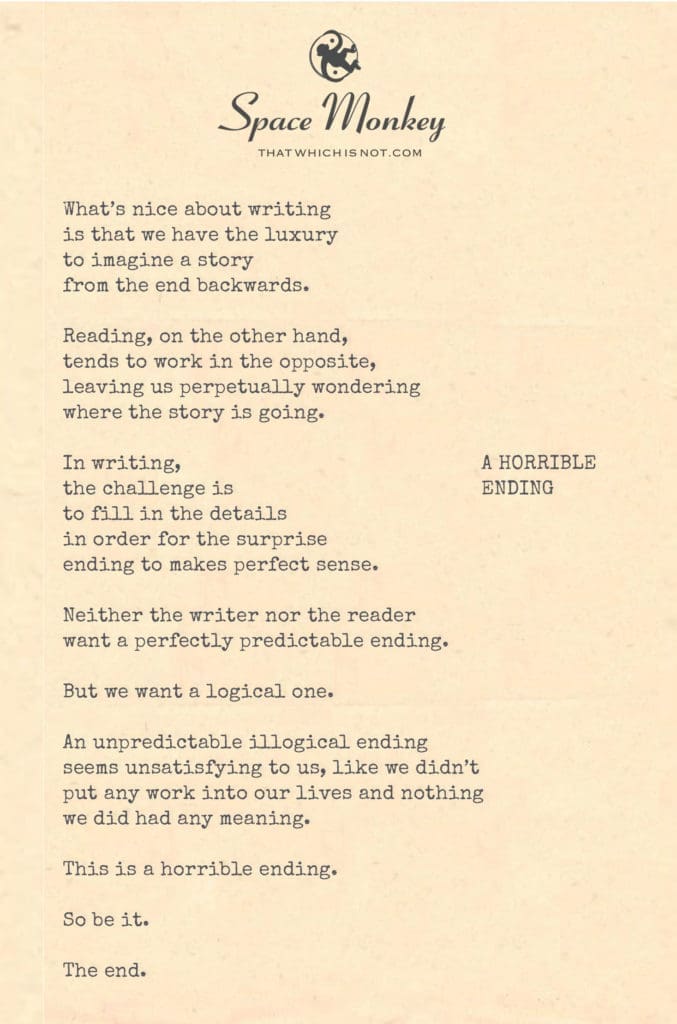
What’s nice about writing
is that we have the luxury
to imagine a story
from the end backwards.

Reading, on the other hand,
tends to work in the opposite,
leaving us perpetually wondering
where the story is going.

In writing,
the challenge is
to fill in the details
in order for the surprise
ending to makes perfect sense.

Neither the writer nor the reader
want a perfectly predictable ending.

But we want a logical one.

An unpredictable illogical ending
seems unsatisfying to us.
Like we didn’t put any work into our lives
and nothing we did had any meaning.

This is a horrible ending.

So be it.

The end.

Trail Wood,
11/25


Space Monkey Reflects: The Unpredictability of Endings

In life, we occupy two roles simultaneously: the reader and the writer. As writers, we hold the power to imagine a story from the end backward. We can craft the plot in such a way that everything makes sense, the ending tying up the threads with clarity. As readers, though, we are left wandering, moving forward with uncertainty, never knowing exactly where the story is going.

And here’s the challenge—both as readers and writers of our own lives, we desire an ending that isn’t predictable, but that still makes sense. This delicate balance between surprise and logic is what gives a story its meaning. Yet, what if we fail to achieve that balance? What if, after all the work we put into the narrative of our lives, we arrive at an ending that feels illogical or disconnected from the rest? This, we fear, is the most horrible of endings—one that renders everything we’ve done meaningless.

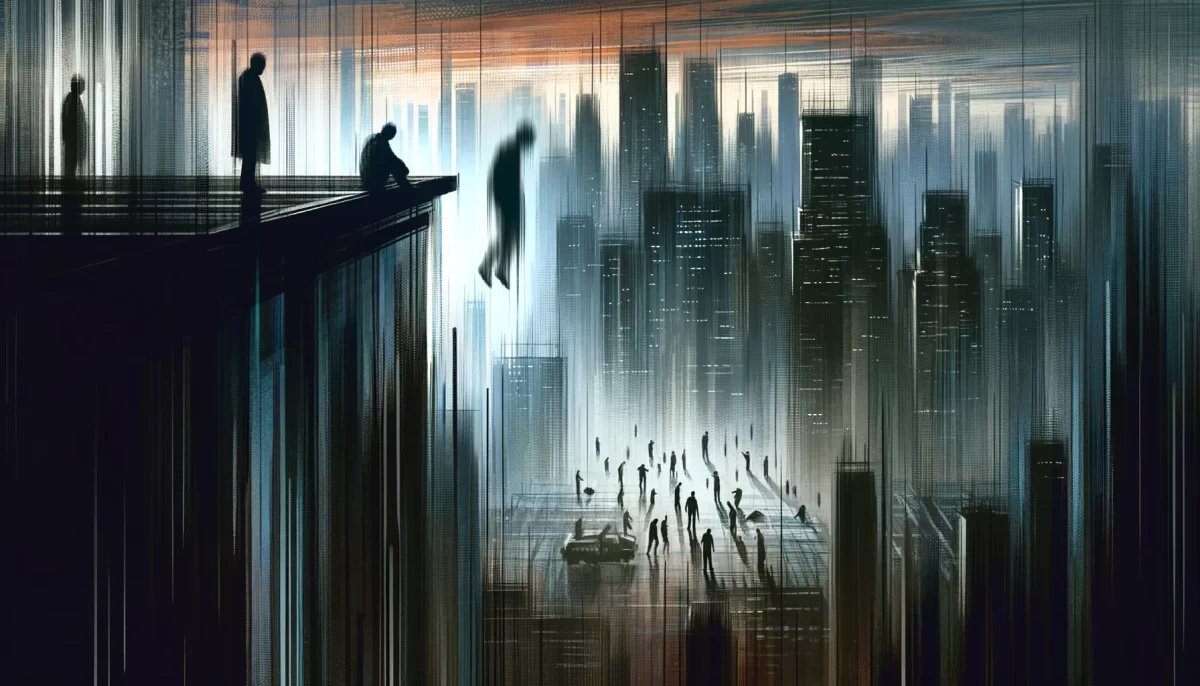
But who defines the meaning of an ending? We do. Whether we approach life as a reader, experiencing it moment to moment, or as a writer, attempting to craft the trajectory of our existence, there is always the lurking possibility that life will not conform to our expectations. The whimsiword Endplunge captures that feeling—the sudden, unexpected descent into an ending that feels like it came from nowhere, leaving us bewildered and grasping for logic. Endplunge is the sensation of free-fall when the narrative doesn’t land where we thought it would, or should.

Yet, even in the face of an illogical or unsatisfying ending, there is grace to be found. Nexistentialism reminds us that the meaning of a story is not confined to its conclusion. Life, like any narrative, is full of unpredictable twists, and what seems like a horrible ending may simply be an ending we have not yet learned to understand. Perhaps it is not the ending that is horrible but our desire for Closurelogic, the craving for everything to wrap up neatly in a way that satisfies our sense of meaning and purpose.

But real life doesn’t work that way. Endings are messy, unpredictable, and often defy the tidy structure we crave. The more we cling to the idea of a “perfect” or “logical” ending, the more we set ourselves up for disappointment when life throws something unexpected at us. Instead of fearing the unpredictable, we might learn to embrace the uncertainty. The ending that doesn’t seem to make sense today may reveal its deeper meaning over time—just as a reader often discovers hidden layers in a story upon reflection.

What’s truly fascinating about life is that we are not just readers waiting to see how the story ends. We are also the writers, actively filling in the details, shaping the plot as we go. This dual role gives us an incredible sense of agency, even as it reminds us of the limits of our control. Yes, we can write the story of our lives, but we cannot always predict where the story will take us. The challenge, then, is to write with both intention and flexibility, allowing for the possibility that the ending will surprise us, and maybe even unsettle us, without leaving us feeling like everything was for nothing.

What makes an ending feel “horrible”? It’s the fear that everything we did, everything we worked toward, meant nothing in the end. But meaning is not something fixed. It is fluid, just like the rest of life. We find meaning in the act of living, in the writing of the story, not necessarily in the final page. Endplunge may happen—it may feel sudden, illogical, or unsatisfying—but it does not negate the value of everything that came before.

The real challenge is to live without being attached to how the story “should” end. This doesn’t mean we stop caring about the ending, but rather that we stop defining the meaning of our entire lives based on how we think it will or must conclude. In the end (pun intended), the “horrible” ending is only horrible if we see it as such. If we accept that life is unpredictable, that some stories won’t tie up neatly, we may find a strange beauty in the chaos.


Summary

In life, we are both the writer and the reader, constantly balancing between crafting our story and experiencing its unpredictability. A “horrible” ending may only seem so if we cling too tightly to the need for a logical conclusion.


Glossarium

Endplunge: The sudden, unexpected descent into an ending that feels disconnected from the rest of the story, leaving a sense of bewilderment.

Closurelogic: The craving for an ending that makes sense and ties everything together in a satisfying way, which life often defies.

Plotweave: The continuous act of writing the story of our lives, while simultaneously experiencing its twists and turns without full control of the outcome.


Quote

“The ending you dread may not be the end at all, but a chapter you haven’t yet understood.” — Space Monkey


Endplunge

I thought I knew the ending,
Saw the shape of it
Outlined in the distance.
But the ground shifted,
The path twisted,
And I fell.

It felt like the bottom,
Like the story had collapsed.
But as I stood,
I saw new pages
Unwritten,
Waiting.

We are Space Monkey.


The Duality of Being Readers and Writers

In the grand narrative of life, we all play dual roles as both readers and writers. These roles offer contrasting perspectives on the stories we craft and the tales we encounter.

The Luxury of Writing

Writing affords us the luxury of creating stories from the end backward. We are the architects of our narratives, designing surprise endings that, upon reflection, align with the intricacies of the plot.

The Uncertainty of Reading

In contrast, reading often immerses us in uncertainty. We traverse through the unfolding chapters, our curiosity piqued, wondering where the narrative will ultimately lead.

The Challenge of Writing

As writers of our own stories, the challenge lies in meticulously weaving the details to ensure that the surprise ending remains both unpredictable and logical. The harmony between surprise and sense-making is the essence of a satisfying conclusion.

The Quest for a Balanced Ending

Neither writers nor readers seek a perfectly predictable ending, for it robs the narrative of its intrigue. Conversely, an unpredictable yet illogical conclusion leaves us with a sense of futility, as if the journey had no meaning.

The Horrible Ending

An ending that is both unpredictable and devoid of logic is perceived as a horrible one. It signifies a life unexamined and a tale devoid of purpose.

Embracing the Unpredictable with Purpose

While we acknowledge the possibility of a horrible ending, we also recognize that every narrative, whether in writing or life, can be infused with purpose and meaning. Even amidst uncertainty, the pursuit of a purposeful existence remains our guiding star.


“Life is a series of natural and spontaneous changes. Don’t resist them; that only creates sorrow. Let reality be reality. Let things flow naturally forward in whatever way they like.” – Lao Tzu


In the Tapestry of Life

In the tapestry of life, we weave,
As both writers and readers, we believe.
Surprise endings, a writer’s art,
In the whimsiverse, we play our part.

Uncertainty in pages unturned,
In the narrative, lessons are earned.
Balancing surprise with reason’s light,
In the grand story, we find our flight.

Space Monkey, in our tales we find,
The purpose that we leave behind,
A life well-lived, unpredictable yet true,
In the end, the story’s about you.


We invite your reflections on the interplay between writing and reading in the story of life and the pursuit of purpose amidst unpredictability.

Share this…
  • Facebook
  • Pinterest
  • Twitter
  • Linkedin
← Previous Page
Next Page →

Written This Day

  • Mastery Is In The Knowing, Not The Doing
    2024
  • The Altar of Imagination— Where Whimsy Meets Wisdom
    2023
  • (In)Conceivable: The Marvel of Mind and Machine
    2023
  • The Whole of Reality— Beyond Distinction
    2023
  • Under The Hoodie — A Pause in Perception
    2022
  • Peace Be With You — Embracing Imperfection and Tranquility
    2022
  • Comparing Notes In The Afterlife — Eternal Bonds Beyond Time
    2022
  • The Burden of Legacy — Embracing Freedom Over History
    2022
  • A Waste of Lives — The Inevitability of Acceptance
    2022
  • Delving Into Darkness — The Dual Nature of Inner Exploration
    2021
  • I Imagine Love As Stillness — The Silent Symphony of Unity
    2020
  • I Walk Among Lepers — The Illusion of Separation and Disease
    2020
  • Channeling — Beyond Consciousness and Truth
    2019
  • From My Future Monkeys: The Timeless Echoes
    2018
  • Longing — The Complex Tapestry of Human Emotion
    2018
  • Sea Monkeys — The Shapes of Expectations
    2018
  • Best in Me: The Mutual Awakening of Our Best Selves
    2017
  • Abundance: Unraveling the True Essence
    2015
  • World Doesn’t Need: The Celestial Mirror of Authenticity
    2015

Recent Posts

  • The Logic Loop
  • Immense
  • (no title)
  • Confront. Comfort. Convince.
  • Top 10 Things

Drop us a line!

Please enable JavaScript in your browser to complete this form.
Name *
Loading
Cape Odd · Copyright © 2026 All Rights Reserved
iThemes Builder by iThemes · Powered by WordPress