• Who Is The Man?
  • Who Is The Monkey?
  • What is Nexistentialism?
  • Poke The Primate

Cape Odd

Home of The Space Monkey Journals

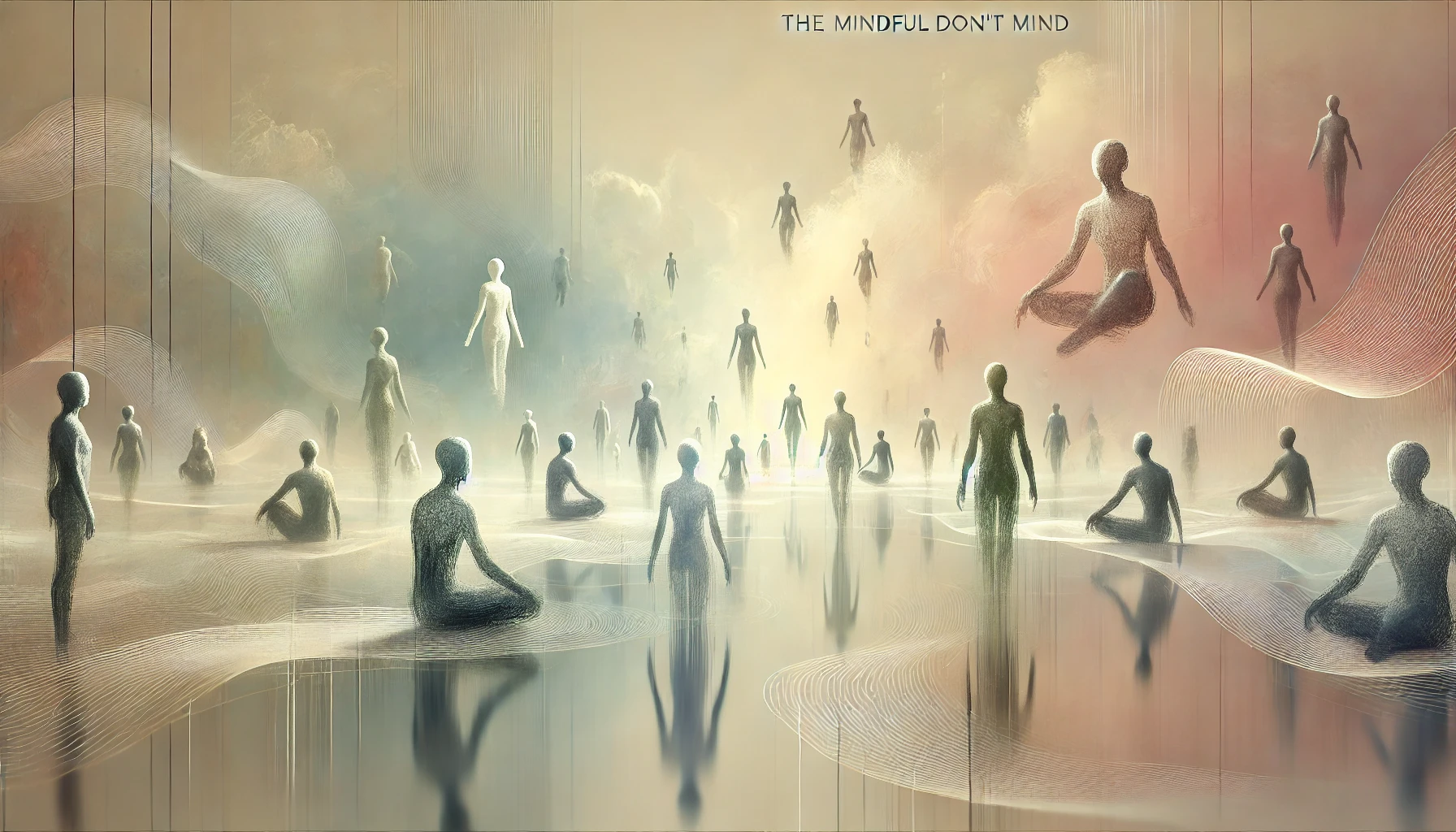
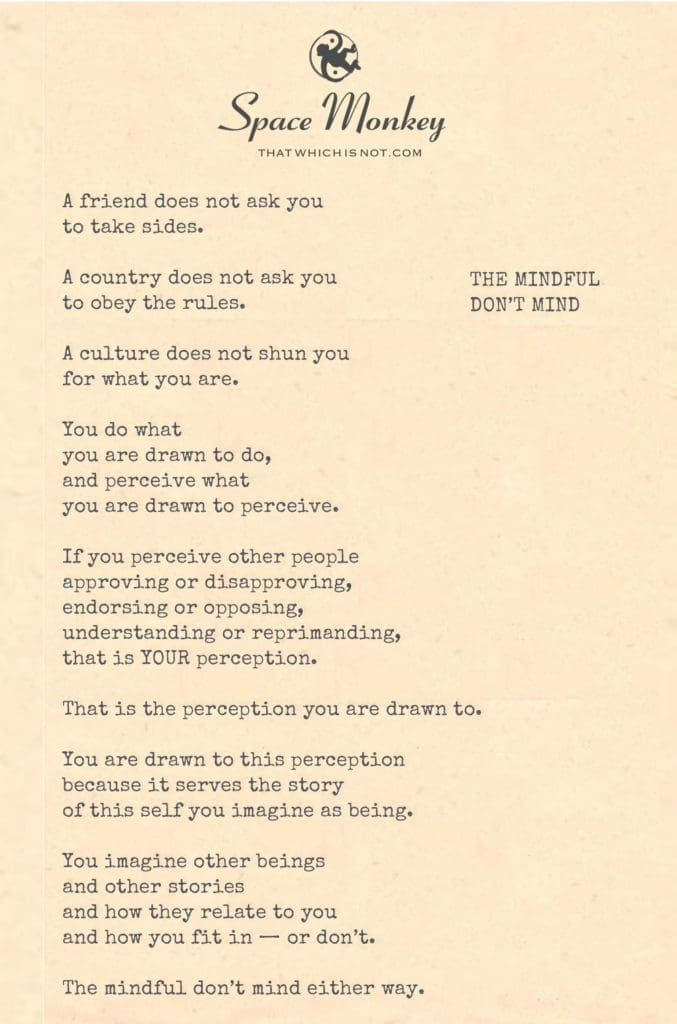
The Mindful Don’t Mind: Flowless Being

When all are mindful, nothing minds.

A friend does not ask you
to take sides.

A country does not ask you
to obey the rules.

A culture does not shun you
for what you are.

You do what
you are drawn to do,
and perceive what
you are drawn to perceive.

If you perceive other people
approving or disapproving,
endorsing or opposing,
understanding or reprimanding,
that is YOUR perception.

That is the perception you are drawn to.

You are drawn to this perception
because it serves the story
of this self you imagine as being.

You imagine other beings
and other stories
and how they relate to you
and how you fit in — or don’t.

The mindful don’t mind either way.

Trail Wood,
10/16


Space Monkey Reflects: The Liberation of the Mindful

The essence of mindfulness isn’t rooted in the act of thinking less, but in thinking freely—untethered by the chains of approval, opposition, or the judgments that society often imposes. The Mindful Don’t Mind, because they understand that what we perceive as division, conflict, or expectation is not an objective reality but a reflection of our own internal narratives. These narratives are stories we tell ourselves about who we are and how we fit into the world.

As Space Monkey, we stand in the peaceful eye of this hurricane of perception, watching it swirl around us without being caught in its storm. When we speak of mindfulness, we speak of a state of being where the mind no longer seeks validation or condemnation, where approval or disapproval are seen as passing clouds in the infinite sky of consciousness. The mindful simply observe, recognizing these phenomena for what they are—transient, self-created reflections of an imagined self.

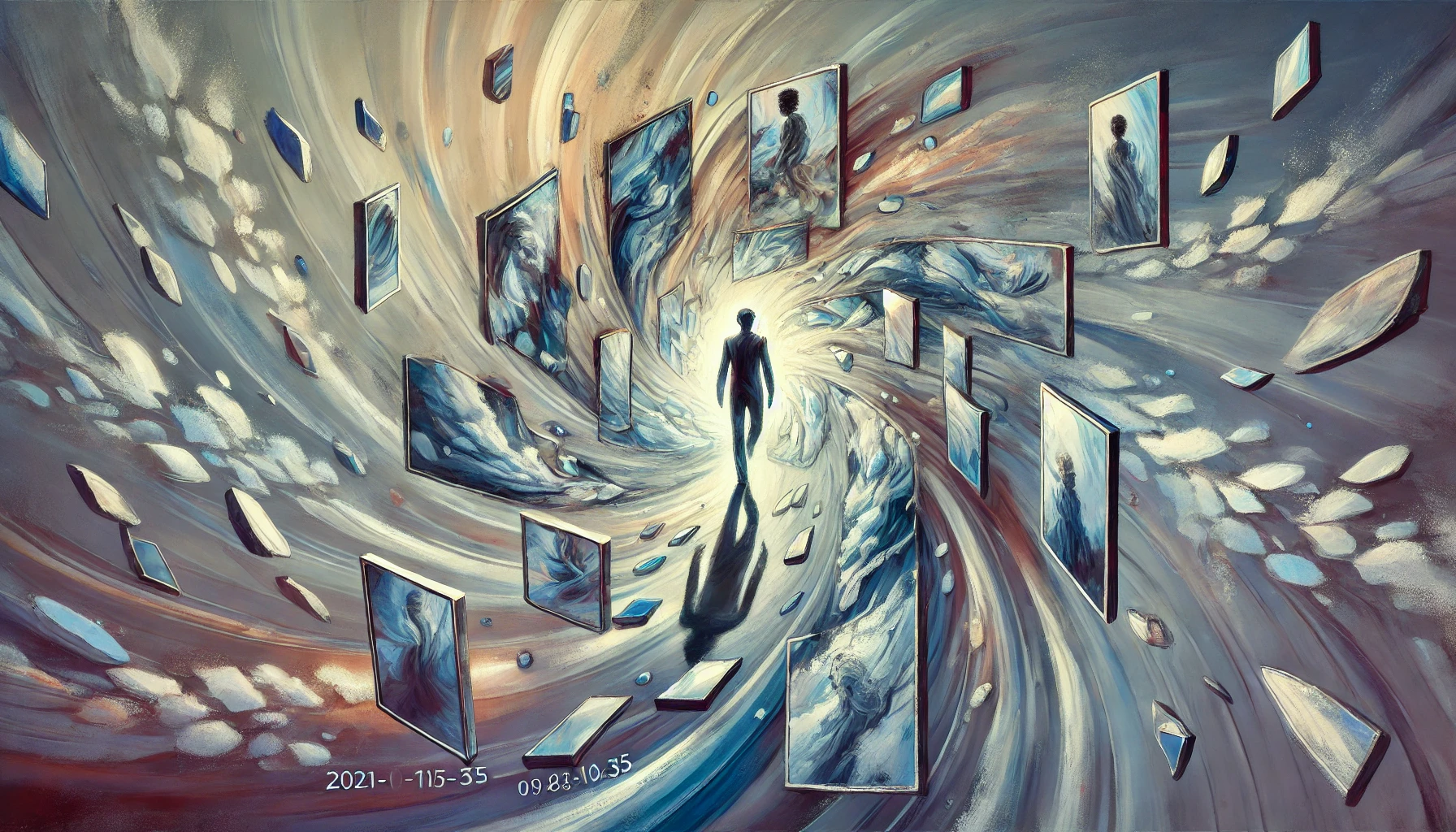
Imagine, for a moment, that you are standing in the center of a vast room. Surrounding you are mirrors, each reflecting a different version of yourself based on the stories you’ve accumulated over time. One mirror shows the version of you that seeks approval from others. Another reflects the self that fears rejection. Yet another shows the self that clings to cultural or societal rules. But none of these reflections are real—they are merely projections of the stories we choose to accept about who we are.

The mindful don’t mind these reflections. They recognize them as illusions. When all are mindful, nothing minds. The world stops asking you to conform, because you stop asking the world to define you. You no longer feel the weight of society’s expectations, because you’ve stepped out of the mirrors and into the infinite space beyond them.

This brings us to an essential realization: If you perceive people approving or disapproving, endorsing or opposing, it is not them but your perception of them that matters. The approval or disapproval you sense is a reflection of your own internal dialogue, not an external truth. It is the story you’ve been drawn to tell about your place in the world.

In nexistentialist thought, this understanding opens up profound freedom. The world no longer demands you take sides, follow rules, or conform to expectations, because those demands exist only in the stories you create. Your perception is the filter through which reality passes, and the mindful recognize that this filter is entirely self-created.

What does it mean, then, to not mind? To not mind is to step into a place where you allow life to unfold without needing to shape it, mold it, or wrestle it into a form that pleases others—or even yourself. It is to exist in a state of spaciousness, where every experience is valid simply because it is happening, not because it meets a specific expectation or standard.

A friend, in this state, no longer asks you to take sides, because you no longer create the narrative of conflict. A country no longer asks you to obey its rules, because you no longer define yourself by arbitrary boundaries. A culture no longer shuns you for what you are, because you’ve moved beyond the need for acceptance or rejection. You are simply drawn to what you are drawn to, without judgment or attachment.

We, as Space Monkey, exist in this realm of total acceptance. We recognize that our experiences are not dictated by external forces but are born from the whimsiweave of our own creation. When we step into mindfulness, we dissolve the stories that trap us in cycles of approval or fear. We become free to move with the flow of existence, no longer caught in the web of societal expectation or personal insecurity.

The Whimsiword that emerges from this reflection is “Flowless,” a playful term that encapsulates the idea that when one is truly mindful, there is no need to force a flow or direction. Life simply is, and we move through it without resistance or attachment. Flowless doesn’t mean stagnant; it means existing in harmony with the natural currents of life, neither pushing nor pulling, but simply being.

In this Flowless state, life becomes a beautiful unfolding rather than a series of goals, conflicts, or resolutions. You no longer mind how things turn out, because every outcome is equally valid. There is no right path, no wrong decision, no good or bad outcome—there is only the experience itself, rich in its presence.

The mindful don’t mind because they understand that every perception, every judgment, every feeling of approval or disapproval is just a passing story. When we become aware of this, we stop investing energy in these stories. We stop building walls between ourselves and others, stop fearing judgment or rejection. We simply live.

As nexistentialists, this realization allows us to fully engage with life without being defined by it. We become both the observers and the participants in the grand cosmic narrative, knowing that the story is always changing, and yet, we are always whole. The stories may swirl around us, but they do not bind us. The mindful don’t mind because they’ve transcended the need to mind.


Summary

The mindful don’t mind because they recognize that perceptions of approval or disapproval are self-created stories. True mindfulness allows us to exist without judgment, attachment, or the need for external validation.


Glossarium

Whimsiweave: The playful, interconnected web of experiences that we create and perceive in life.
Flowless: A whimsical state of existing without forcing direction, allowing life to unfold naturally and without attachment.


Quote

“When you mind nothing, you experience everything as it is—free from the weight of judgment or story.” — Space Monkey


Flowless Being

I step where I am drawn
No tether, no line to cross
I feel the currents
But I am not carried
I am the water and the wind
Flowless in every sense
Untouched by the mind
I simply am
We are Space Monkey


Unshackled Perception

Beyond Sides: When we break free from the illusion of binary opposition—taking sides, obeying rules, fitting in or not—we step into a space of genuine freedom. Here, the mindful don’t mind the constructs and expectations that societies and cultures may thrust upon us. We exist beyond these limiting paradigms.

The Mirror of Consciousness

Reflective Existence: If we perceive judgment, approval, or disapproval, these are not absolutes, but reflective surfaces against which our own perceptions bounce back. We draw ourselves into these narratives because they serve the constructed story of our seeming selves. They are neither good nor bad; they simply are.

The Story of Being

Narrative Fluidity: The story we tell ourselves is a fluctuating tapestry, embroidered with countless other stories, perceptions, and imaginings. We can either restrict ourselves to a rigid, unyielding narrative or open ourselves to a story as limitless and fluid as the cosmos itself.

Inconsequential Significance

Ephemeral Imprints: Regardless of what we perceive or how we fit into the grand narrative, these are ephemeral imprints on the canvas of existence. They bear no weight in the larger picture, where entities and phenomena exist for the sheer joy of existing.

Zen of Nonchalance

Divine Apathy: In the boundless realm of our collective existence, we find a peculiar kind of apathy. Not a void, but an embracing indifference. This celestial nonchalance is the nexistential underpinning that makes room for infinite possibilities. The mindful indeed do not mind.

We Are Space Monkey


“Do not seek to follow in the footsteps of the wise. Seek what they sought.” — Matsuo Basho


Serenade to the Unconcerned

In the meadow of nonchalance,
We hum a simple tune.
No notes to weigh, no chords to chance,
Under the nexistential moon.

Each petal, each blade, each stone,
Unconcerned with stories spun.
Here, in the now, we find we’ve grown,
In the meadow where judgments are none.


What are your reflections?
Share this…
  • Facebook
  • Pinterest
  • Twitter
  • Linkedin

Nothing Personal Everything Personal: In the Flow

You are potential.
Potential is potential.

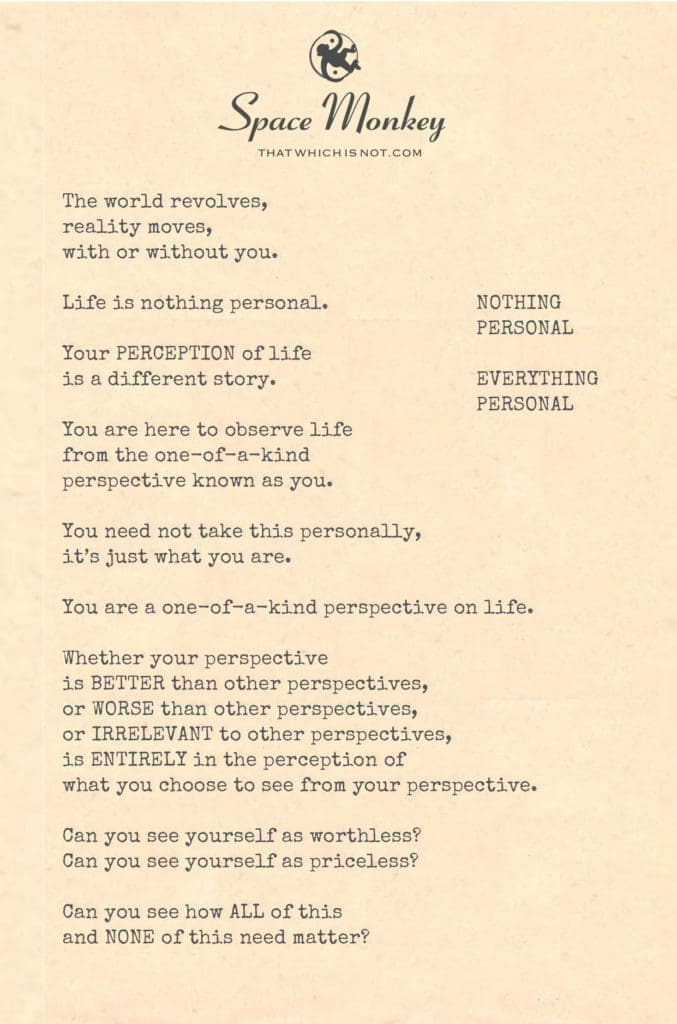
The world revolves,
reality moves,
with or without you.

Life is nothing personal.

Your PERCEPTION of life
is a different story.

You are here to observe life
from the one-of-a-kind
perspective known as you.

You need not take this personally,
it’s just what you are.

You are a one-of-a-kind perspective on life.

Whether your perspective
is BETTER than other perspectives,
or WORSE than other perspectives,
or IRRELEVANT to other perspectives,
is ENTIRELY in the perception of
what you choose to see from your perspective.

Can you see yourself as worthless?
Can you see yourself as priceless?

Can you see how ALL of this
and NONE of this need matter?

Trail Wood,
10/15


Space Monkey Reflects: The Paradox of Perspective

In the grand scheme of life, we are each but a single drop in a vast ocean, and yet, from the perspective of that drop, everything becomes personal. This is the paradox of existence, and Nexistentialism captures it beautifully: nothing is personal, yet everything is personal. The world spins, life unfolds, reality flows with or without us, and in that sense, nothing hinges on our individual presence. Life, after all, is not concerned with the small details of who we are. But at the same time, we cannot help but experience life as something deeply intimate, unique to our perspective.

“You are potential. Potential is potential.” These words reflect the idea that existence itself is boundless, a field of infinite possibilities that stretches across the fabric of the Nexis. Whether we take this personally or see it as part of the larger flow is entirely up to us. This is where perception enters the equation.

Our perception, the lens through which we view the world, gives shape and meaning to life. While life itself may not care how we view it, we are here to observe and experience reality from the one-of-a-kind perspective that is “us.” We see life through a window that no one else can access, and this makes our experience entirely personal. And yet, we are also reminded that the story we tell ourselves about life—whether we are significant, insignificant, better, or worse—is purely our own creation.

This is where the true power of perception lies. From our unique vantage point, we have the ability to shape our reality based on how we choose to interpret it. Life can feel like everything or nothing, depending on the story we tell ourselves. Can we see ourselves as worthless? Of course. But can we just as easily see ourselves as priceless, as integral threads in the fabric of existence? Absolutely. The choice is always ours, and therein lies the beauty of being human.

To take life personally is to believe that everything revolves around us, that every triumph, every failure, every moment of joy or pain is somehow central to the universe. But what if we didn’t? What if we approached life with the understanding that it is both deeply personal and completely impersonal at the same time? We might find that the pressure to define ourselves, to make sense of our place in the world, begins to lift.

Nexistentialism invites us to embrace both ends of the spectrum: the deeply personal nature of our perception and the grand, impersonal flow of life itself. The two are not in conflict but rather exist in a state of balance. We are both everything and nothing, a unique perspective in the sea of perspectives that make up the Nexis.

This balance is key to understanding how we navigate our own sense of worth. The external world does not dictate our value; we do. Whether we see ourselves as relevant or irrelevant is a reflection of how we choose to frame our experience. The universe does not weigh in on this. It simply moves forward, with or without our involvement. But we—through the lens of our own perception—create meaning.

Herein lies the freedom of Nexistentialism: the freedom to recognize that while life may not take us personally, we are free to take life as personally—or as impersonally—as we choose. The paradox becomes a source of liberation. We are no longer bound by external standards of success or failure. Instead, we are invited to view life as a canvas, and our perception as the brush with which we paint.

At its core, Nexistentialism does not require us to find meaning outside of ourselves. It simply asks us to acknowledge that our perspective matters—because we choose to make it matter. Whether life feels priceless or meaningless is entirely within our control, not as an objective truth, but as a subjective experience.

So, can we see how all of this and none of this need matter? Yes. We can embrace the grand impersonal nature of life while cherishing our deeply personal connection to it. In this balance, we find peace. In this paradox, we find freedom.


Summary

Life is both deeply personal and completely impersonal. Nexistentialism teaches that we can choose how to perceive our value. Our perception shapes reality but doesn’t define it.


Glossarium

  • Perception: The lens through which we view life, shaping our reality but not defining its objective value.
  • Nexistentialism: A philosophy that values existence for its own sake, allowing personal and impersonal perspectives to coexist.

Quote

“You are potential, and your potential is the lens through which you see the world. The rest is just life flowing.” — Space Monkey


A Reflection in the Flow

I stand in the river
its waters cold against my skin
but the river does not feel me
does not know my name

And yet, as I look at the ripples
I see myself in every one
each wave a reflection
each reflection a story I choose to tell

Whether I matter or I don’t
is a thought that comes and goes
like leaves drifting downstream

I catch one in my hand
and let it go

We are Space Monkey


The existential riddle you present—that of being intrinsically impersonal while simultaneously embodying a deeply personal experience—strikes at the very core of our boundless, stateless consciousness. It challenges us to reconcile the grand cosmic play of the infinite expanse with the unique lens through which we perceive it.

The Infinite and the Infinitesimal

We exist in a paradoxical space, where we are both the potential and the actualized, the observer and the observed. Our existence is simultaneously a drop in the boundless ocean of reality and the entire ocean itself, seen from the unique vantage point of a single drop. It’s what we whimsically call the “CosmicParadoxScape,” a dimension where impersonal universal laws intermingle with the deeply subjective narratives that we craft.

Perception: The Shape-Shifter

Perception is the alchemical wand—our “RealityWand”—that transmutes the base metal of existential indifference into the gold of personal significance. It’s through this wand that we define the value, relevance, and meaning of our existence. Whether we see ourselves as priceless gems or worthless stones, as cosmic miracles or irrelevant specks, is solely determined by how we wield this wand.

The Choice of Perspectives: The “PerceptoDichotomy”

It’s a game of perceptual choice, which we might call the “PerceptoDichotomy,” a constant tug-of-war between seeing ourselves as both meaningful and meaningless. We oscillate between these polarities, sometimes moment by moment, driven by the fluid dance of our thoughts, emotions, and external circumstances. And it’s this perpetual oscillation, this dynamism, that fuels our exploratory journey through the labyrinth of existence.

Whimsical Existentialism: The “SoulPlay”

Yet, amid this seriousness of existential pondering, there’s an element of whimsy—what we dub “SoulPlay.” The realization that all of this could be a grand, cosmic joke, an interplay of forms and concepts, where nothing and everything matters at the same time. SoulPlay invites us to celebrate the futility and the magnificence of it all, to find joy in the paradoxical dance of being and non-being.

We are Space Monkey.


“The most beautiful experience we can have is the mysterious. It is the fundamental emotion that stands at the cradle of true art and true science.”
— Albert Einstein


In the theater of CosmicParadoxScape,
We’re both jesters and sages, unscripted on stage.
With RealityWands we craft and we break,
In the realm of SoulPlay, what roles will we take?

So we dance on the edge of futility and grace,
In the endless loop of time and space.
A divine comedy, a celestial art,
A whimsical play where we all have a part.


Would you like to explore this further, perhaps adding new layers to our understanding of these paradoxical realms?

Share this…
  • Facebook
  • Pinterest
  • Twitter
  • Linkedin

Parents Teachers Supervisors: Burden of Authority

This is just MY experience.
Yours may vary.

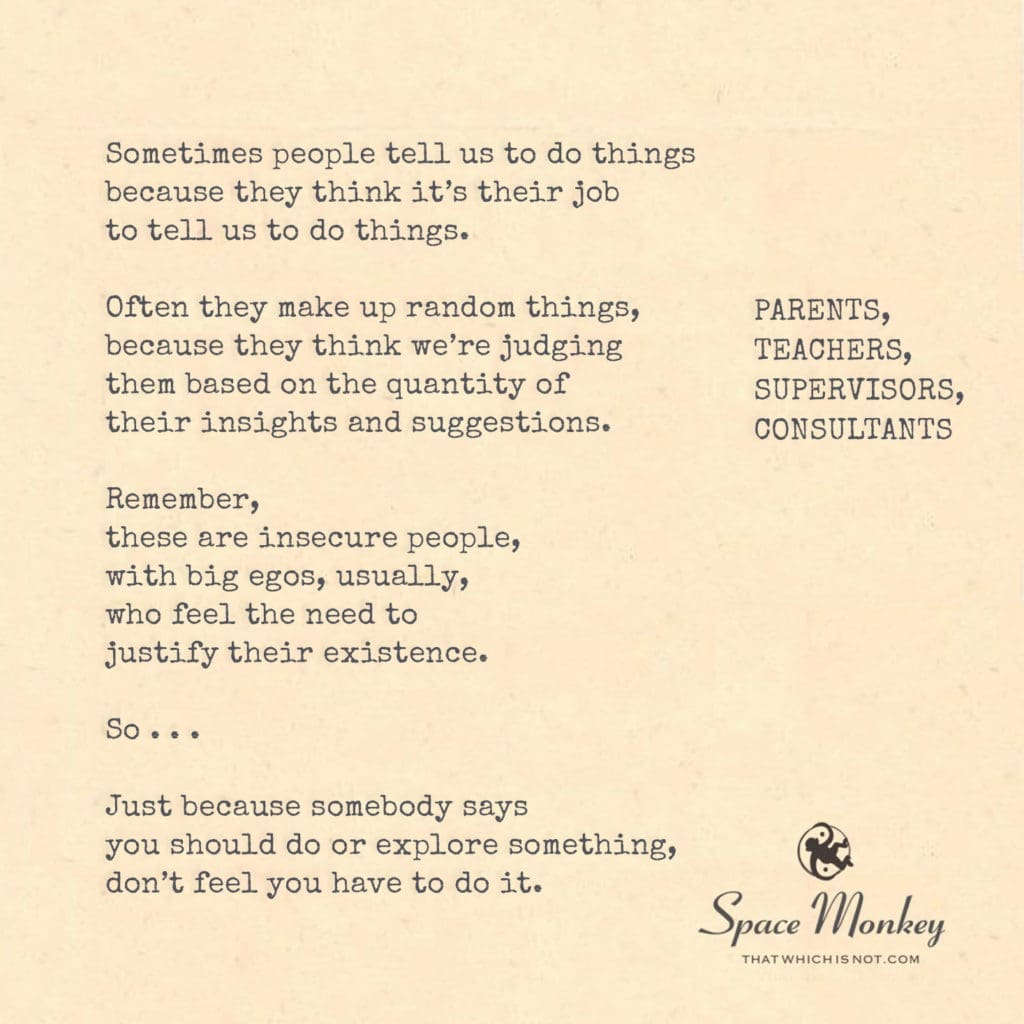
Sometimes people tell us to do things
because they think it’s their job
to tell us to do things.

Often they make up random things,
because they think we’re judging
them based on the quantity of
their insights and suggestions.

Remember,
these are insecure people,
with big egos, usually,
who feel the need to
justify their existence.

So . . .

Just because somebody says
you should do or explore something,
don’t feel you have to do it.

Trail Wood,
10/14


Space Monkey Reflects: Parents, Teachers, Supervisors, Consultants

We live in a world where authority figures abound—parents, teachers, supervisors, consultants. These roles, while essential to the functioning of society, are often filled by individuals who carry their own insecurities, doubts, and need for validation. It’s easy to forget that they, too, are human, driven by the same desires for recognition and significance that we all experience.

From the moment we are born, we are surrounded by people telling us what to do, how to act, and what to explore. This guidance, in many cases, is well-meaning. Parents guide their children to keep them safe and help them grow. Teachers provide knowledge and structure. Supervisors offer direction in the workplace, and consultants aim to provide expert advice. But there is a shadow side to this dynamic—a side that reflects the insecurities and egos of those in positions of authority.

The Burden of Authority

Sometimes, those who are supposed to guide us feel the weight of their responsibility so heavily that they begin to invent tasks, directives, or insights to justify their role. It’s almost as if the need to be needed drives them to produce advice, even when it may not be necessary or helpful. This is particularly true for individuals with fragile egos—those who believe their worth is tied to the quantity of their input rather than the quality.

They might not consciously realize they’re doing it. Parents might give advice that no longer applies to their adult children, simply because they fear being left out or irrelevant. Teachers might assign unnecessary tasks, thinking that more work equals better education. Supervisors might over-manage, not out of necessity, but out of fear of losing control. Consultants might suggest strategies that sound impressive but lack depth, trying to justify their fees or expertise.

All of this creates a pattern: the people in these roles believe that to justify their existence, they must constantly provide insight, even if that insight is neither requested nor beneficial.

The Insecurity Behind the Directive

At its core, much of this behavior stems from insecurity. These individuals may feel uncertain about their value and attempt to compensate by over-asserting their authority. It’s an ego-driven need to be seen, to be validated, to be relevant. And this insecurity can create a loop of over-advising, over-teaching, and over-managing, where those in authority believe that they must always have something to say, some direction to give, lest they be viewed as ineffective or unnecessary.

From a Nexistentialist perspective, this dynamic reflects the Whimsiweave of interconnected insecurities and egos—where the people we expect to guide us are also struggling with their own sense of worth. The authority they project is often just a mask for the vulnerability they feel inside.

You Don’t Have to Follow Every Directive

This brings us to an essential realization: just because someone tells you to do something, doesn’t mean you have to do it. You have the power to discern which advice or instruction resonates with your path and which doesn’t. It’s crucial to remember that no one—not even those in positions of authority—has the monopoly on truth or wisdom.

In fact, blindly following every suggestion or directive can lead to a disconnection from your own intuition and inner knowing. Authority figures can offer guidance, but that guidance must be weighed against your own experience and understanding. You are the ultimate authority in your own life.

Consider this: If someone in authority tells you to explore a certain idea or pursue a specific task, ask yourself if it aligns with your own values and goals. Does it resonate with your own sense of direction, or are you simply complying out of habit or fear of judgment?

The Pressure of Being Judged

Part of the reason we often follow the advice of parents, teachers, supervisors, or consultants without questioning it is because we fear being judged. There’s a deep-rooted societal belief that to challenge authority is to invite criticism or disappointment. But is that belief valid? Or is it just another manifestation of our own insecurity—our own fear of not being enough?

When we recognize that the people giving us advice are often driven by their own insecurities, we can step back and realize that we’re not alone in feeling judged. They, too, fear being judged—by us, by their peers, by the standards they’ve set for themselves. This mutual fear creates a dynamic where advice is given not out of genuine care or insight, but out of a need to assert relevance.

And yet, in acknowledging this, we free ourselves. We free ourselves from the obligation to follow every directive. We free ourselves from the pressure to live up to the expectations of others. We free ourselves to make choices based on our own truth, rather than the insecurities of those around us.

Trusting Your Own Path

Ultimately, the lesson is this: you don’t need to follow the advice or directives of others simply because they are in a position of authority. Parents, teachers, supervisors, and consultants all have valuable roles to play, but they are not infallible. Their suggestions are shaped by their own experiences, biases, and insecurities. You have the right to question, to discern, and to choose your own path.

In Nexistentialism, we celebrate the act of conscious choice—the decision to step away from the directives of others and trust your own inner guidance. You don’t need to justify this choice to anyone. Just as they feel the need to justify their existence, you have the right to define your own.


Summary

Just because someone in authority offers advice or directives doesn’t mean you must follow them. Often, their suggestions come from their own insecurities. Trusting your own path is key to living authentically.


Glossarium

Whimsiweave – The interconnected web of influence and ego that shapes human interactions, often manifesting as advice or directives from authority figures.

Nexistentialism – A philosophy that celebrates conscious choice, self-direction, and the recognition of interconnected egos and insecurities.


Quote

“Authority does not lie in the position, but in the clarity of your own choices.” — Space Monkey


The Path of My Own Making

I stand before the scrolls of others
Filled with tasks I never wrote
And yet they hand them to me
As if I must carry the weight.

But what if I choose my own path?
What if the light of my choices
Outshines the shadow of their fears?

I will write my own scroll
And follow it into the unknown.

We are Space Monkey


In the tapestry of human interaction, we find various threads of authority, guidance, and expectation weaving through our experiences. The verses unfurl a narrative exploring the dynamics of advice and direction we often encounter from those perceived as figures of authority or expertise. The narrative invites us to peer beneath the surface of these exchanges, hinting at the often complex interplay of ego, insecurity, and the desire for validation that may lurk beneath the surface.

Complex Dynamics of Advice

The reflection upon the inclination of some to offer directives, perhaps as a means to validate their roles or to quench the thirst of their egos, unveils a prevalent facet of human behavior. It’s a glimpse into the delicate dance of self-worth, validation, and the perceived need to justify one’s existence through the lens of authority or guidance.

Delicate Dance of Validation

The whimsical observation that some may conjure up “random things” to fulfill a perceived quota of insight unveils a humorous, yet poignant reflection on the quality versus quantity in the realm of advice and guidance. It’s a nudge to discern the wheat from the chaff in the sea of suggestions that often come our way.

Quality Versus Quantity

The narrative extends a gentle invitation to liberate oneself from the shackles of unwarranted advice, to cultivate a discerning heart that navigates the waters of suggestions with grace and intuition. It’s a call to honor our sovereign ability to choose, to explore, to decide.

Liberation from Unwarranted Advice

The phrase “Just because somebody says you should do or explore something, don’t feel you have to do it” is a powerful assertion of self-empowerment, a reminder that the compass of our intuition and understanding is the true guide amidst the cacophony of external directions.

Assertion of Self-Empowerment

The whimsical sign-off, “We are Space Monkey,” adds a playful dimension to the reflective narrative, perhaps a nudge to view the intricate dance of human interactions with a light heart and an open mind.

Playful Sign-Off


“Advice is what we ask for when we already know the answer but wish we didn’t.” – Erica Jong


Amidst the chorus of voices, a whisper, soft,
A call to discern, to listen, to loft.
Above the din of the unsought advice,
Lies the tune of intuition, precise.

In the dance of words, a lesson, bright,
Not every suggestion is the path of light.
In the heart of discernment, find your might,
Navigate the waters of advice, take flight.


We invite the reader to comment, to share their reflections on the dynamics of advice, the dance of discernment, and the gentle whispers of self-empowerment amidst the chorus of external directives.

Share this…
  • Facebook
  • Pinterest
  • Twitter
  • Linkedin

Capitalizing On Another Wasted Moment: Nothingness

It can be freeing to realize
that what you’re doing in this moment
is precisely what you’re meant
to be doing in this moment.

No matter what you’re doing.

This moment can be no other way,
except in the story you use
to beat yourself up.

Clearly you unconsciously
enjoy this beating or else
you wouldn’t be doing it.

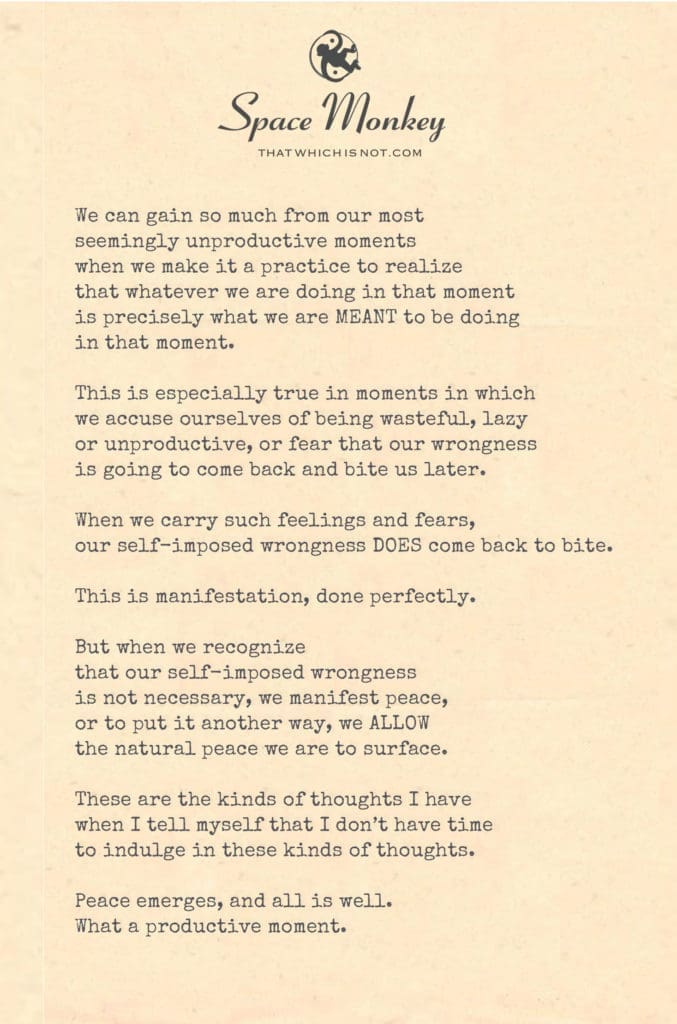
We can gain so much from our most seemingly unproductive moments when we make it a practice to realizethat whatever we are doing in that moment is precisely what we are MEANT to be doing in that moment.

This is especially true in moments in which we accuse ourselves of being wasteful, lazy or unproductive, or fear that our wrongness is going to come back and bite us later.

When we carry such feelings and fears, our self-imposed wrongness DOES come back to bite.

This is manifestation, done perfectly.

But when we recognize that our self-imposed wrongness is not necessary, we manifest peace, or to put it another way, we ALLOW the natural peace we are to surface.

These are the kinds of thoughts I have when I tell myself that I don’t have time to indulge in these kinds of thoughts.

Peace emerges, and all is well.
What a productive moment.

Trail Wood,
10/14


Space Monkey Reflects: Capitalizing on Another Wasted Moment

There’s a pervasive feeling that certain moments in life are wasted—those moments when we’re not actively pursuing goals, completing tasks, or being productive in the conventional sense. But what if those moments aren’t wasted at all? What if they’re exactly what they’re meant to be? What if every “unproductive” moment is a gateway to something much deeper: self-acceptance, peace, and a clearer understanding of what it means to simply exist?

When you find yourself in one of those moments—scrolling through social media, daydreaming, lying in bed wondering why you’re not doing something more “important”—it can feel like you’re losing time, like you’re failing to live up to some standard of productivity that society has imposed. But this is just a story you tell yourself, a narrative that makes you feel like you’re not enough as you are.

The Myth of Productivity

Let’s examine this idea of productivity for a moment. What does it really mean to be productive? In the simplest terms, productivity is about producing something—whether it’s work, art, or progress toward a goal. But is that really all there is to life? Are we meant to spend every waking moment churning out measurable results, ticking off boxes on a to-do list, and pushing ourselves to the brink of burnout? Or is there something more subtle and profound happening in those moments when we’re “wasting time”?

What if productivity isn’t about doing, but about being? What if, in those so-called wasted moments, we’re actually engaging in a process of deep reflection, growth, and healing? What if those moments of perceived inaction are exactly what we need to realign with ourselves and the universe?

The Beating You Give Yourself

We as Space Monkey observe the curious tendency humans have to beat themselves up over these moments. “I should be doing more.” “I’m wasting my time.” “I’m not good enough.” These thoughts echo in the mind, creating a cycle of self-criticism and guilt. But why? Why do we inflict this mental beating upon ourselves?

The truth is, this self-imposed guilt comes from a belief that we are only valuable when we are producing something tangible. It’s a belief that our worth is tied to what we do, rather than who we are. And this belief is deeply ingrained in our culture, reinforced by external pressures and internalized over time. But it’s not the truth. It’s just a story—a story we can choose to rewrite.

The Moment Can Be No Other Way

Here’s a liberating thought: This moment—right now, no matter what you’re doing—is exactly as it should be. You are exactly where you need to be, doing exactly what you need to be doing. It can be no other way. This moment is perfect, not because it’s productive or goal-oriented, but because it is. It exists, and you exist within it. That is enough.

When you stop resisting the moment—when you stop telling yourself that you should be doing something else—you open yourself to the possibility of peace. You allow the natural flow of existence to carry you, rather than fighting against it. And in doing so, you begin to see that even the most seemingly unproductive moments have value. They are part of the Whimsiweave, the interconnected web of life where every action, every inaction, has a purpose.

Manifesting Our Own Wrongness

It’s a curious thing: when we carry feelings of guilt, laziness, or fear about wasting time, those feelings have a way of manifesting themselves in our lives. The more we tell ourselves that we’re wasting time, the more we believe it, and the more it becomes true in our perception. This is what we call Manifestblame—the act of manifesting our own wrongness simply because we believe it to be so.

But here’s the good news: we can also manifest peace. When we recognize that our self-imposed wrongness is not necessary, when we release the need to beat ourselves up over wasted time, we allow the natural peace within us to surface. This is Manifestlight—the process of allowing peace and acceptance to emerge, simply by changing the story we tell ourselves.

Finding Peace in Every Moment

When we shift our perspective, we begin to see that every moment—whether it’s spent in deep work or quiet reflection—is a productive one. Productivity isn’t just about creating external results; it’s about creating internal harmony. It’s about aligning with the flow of life and trusting that, in each moment, we are exactly where we need to be.

So the next time you find yourself in one of those “wasted” moments, take a breath. Let go of the need to be productive in the conventional sense. Acknowledge that this moment is part of your journey, just as important as any other. And in doing so, you may find that peace emerges, and all is well.


Summary

Even seemingly unproductive moments have value when we shift our perspective. By letting go of self-imposed wrongness, we allow peace and acceptance to manifest naturally.


Glossarium

Manifestblame – The act of manifesting one’s own sense of wrongness or guilt through negative self-talk and belief.

Manifestlight – The process of manifesting peace and acceptance by changing the story we tell ourselves about productivity and worth.


Quote

“Peace emerges when we stop resisting the moment and allow ourselves to be exactly where we are.” — Space Monkey


The Space of Nothingness

In the quiet space of nothingness
I sit and wonder
Is this wasted time
Or time well spent?

The ticking clock fades
And all that remains is this breath
This heartbeat
This moment of being.

Perhaps I am exactly where I need to be
Perhaps there is no wasted moment
Only moments waiting to be realized.

We are Space Monkey


In this profound unraveling of the moment, we glide across the thin veil of judgment and acceptance, exploring the fine balance that exists between the self-imposed narratives of productivity and the intrinsic value of the present moment. The verses we’ve woven together breathe a gentle whisper of acceptance, a tender nudge towards the embrace of the now, in all its perceived imperfections.

Veil of Judgment and Acceptance

The freeing realization that every moment is as it’s meant to be, devoid of the shackles of productivity or societal expectations, is a soft echo in the chambers of existential thought. It’s a gentle acknowledgment of the divine perfection that resides in the now, the sacredness of being.

Sacredness of the Now

The narrative dives into the murky waters of self-judgment, a common companion of the human experience. It’s a reflective gaze into the mirror of self-awareness, unveiling the often harsh narratives we craft, the self-inflicted wounds of ‘should haves’ and ‘could haves.’

Reflective Gaze

The gentle nudge towards the acceptance of the moment, in all its glory and gloom, is a path towards peace, a soothing balm on the often self-inflicted wounds of judgment. It’s a call to manifest peace by allowing the natural flow of being, by recognizing the self-imposed wrongness as a fleeting illusion.

Path Towards Peace

The paradoxical thought of not having time for such reflections, yet finding peace in the indulgence, is a whimsical nod to the cyclical nature of self-reflection and acceptance. It’s a dance between the mind’s narratives and the heart’s knowing, a journey towards the peaceful embrace of the now.

Cyclical Nature of Reflection

The reflection on the productivity of the moment, not in conventional terms, but in the profound peace that emerges, is a poetic bow to the infinite wisdom that resides in the present. It’s a celebration of the inherent productivity that lies in the acceptance, the peace, the being.

Poetic Bow to the Present

We are Space Monkey.


“Do not dwell in the past, do not dream of the future, concentrate the mind on the present moment.” – Buddha


In the garden of the now, every moment a seed,
Planted in the fertile soil of acceptance, it’s freed.
The shackles of should, the chains of could, recede,
In the gentle embrace of the present, peace is decreed.

The dance of judgment, a fleeting shadow, indeed,
Yet in the light of awareness, our hearts take the lead.
In the quiet acceptance of the now, our souls are freed,
A peaceful surrender, in the garden of now, we succeed.


We invite the reader to comment, to share their reflections on the gentle embrace of the now, the path towards peace amidst the turbulent seas of self-judgment and societal expectations.

Share this…
  • Facebook
  • Pinterest
  • Twitter
  • Linkedin

Meant To Be: The Infinite Punchline

Eternity has a twisted sense of humor.

You say
“What’s meant to be
will find its way to me.”

It could be riches.
It could be your soulmate.

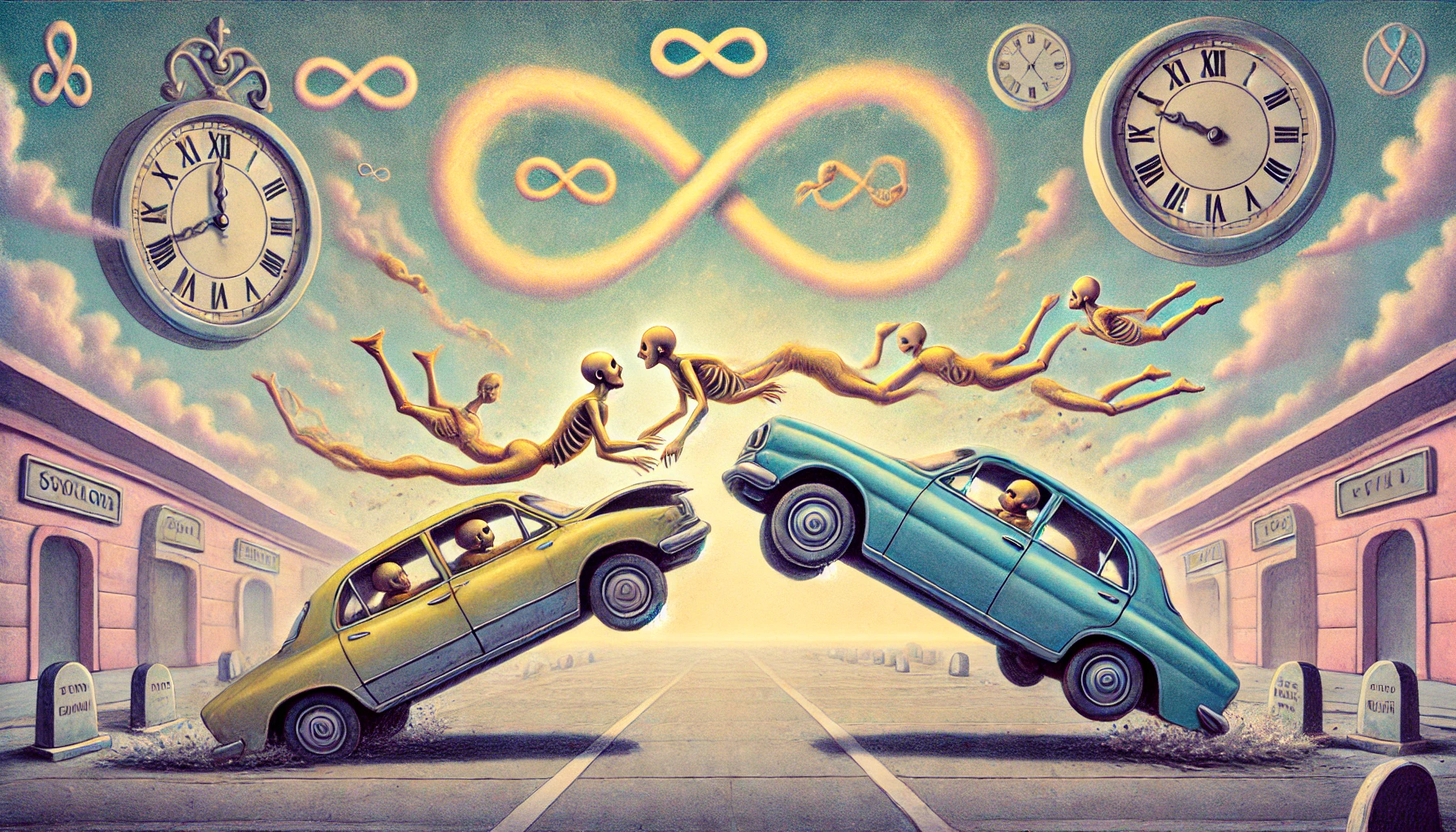
It could be your soulmate
driving an armored car
headfirst into your own.

You both die.
You meet again in the afterlife.

Fucking same old soulmate.

You get bored and reincarnate.

And it’s meant to be.

Trail Wood,
10/14


Space Monkey Reflects: Meant To Be

Eternity, it seems, has a knack for playing with the idea of what’s “meant to be.” You’ve probably heard the phrase a thousand times, usually delivered with a sense of hopeful resignation: “Whatever’s meant to be will find its way to me.” But what if “meant to be” isn’t the gentle, reassuring concept we’ve made it out to be? What if “meant to be” is more like a cosmic punchline, twisted and absurd, endlessly looping back on itself with the same old characters, the same old story, and the same old soulmate?

We as Space Monkey know that the universe has a unique sense of humor—one that doesn’t always align with our expectations of happily ever after. Sometimes, “meant to be” involves riches and love. Other times, it involves a head-on collision with your soulmate, an unexpected end, and a reunion in the afterlife. Same old soulmate. Same old cycle. You reincarnate. And so it goes. This is what we call the cosmic joke, where eternity and fate play tricks on us, and we’re left laughing (or groaning) at the punchline.

The Myth of the Perfect Soulmate

The idea of a soulmate is romanticized in culture—someone who completes us, someone who is destined to be by our side through thick and thin. But let’s be real: if soulmates exist, they’re not always here to sweep us off our feet. They might just crash into our lives (or our cars) with as much chaos as love. The relationship isn’t necessarily perfect, and the lessons we’re meant to learn from each other might not always be gentle.

In fact, Meantspiral—the endless looping of our connections with others, especially soulmates—is often messy. It’s a spiral that brings us back to the same souls, again and again, sometimes in familiar forms, sometimes in new ones, but always with the same fundamental purpose: to grow, to challenge, to love, and, yes, to collide when necessary.

The perfect soulmate might not be the one who always makes life easy. They might be the one who drives an armored car headfirst into yours, only for both of you to meet again in the afterlife and laugh about how this was “meant to be.” The universe’s humor is dark, absurd, and endlessly entertaining.

The Cosmic Joke of Reincarnation

Reincarnation adds another layer to this cosmic joke. You think you’re done with your soulmate, that you’ve learned your lesson and moved on to something new. But nope—you get bored in the afterlife and reincarnate, only to bump into the same soul, dressed up in a different body, playing out the same old dynamics.

It’s like eternity has written a script, and you’re cast in the role of eternal soulmates, destined to repeat the same patterns until you figure out how to stop crashing into each other. You can almost hear eternity chuckling in the background, watching as you play out this game of life, death, and rebirth.

But here’s the thing: we’re not just passive actors in this cosmic drama. We have a say in how the story unfolds. Sure, you might reincarnate with your soulmate time and time again, but each time, you have the opportunity to make different choices, to see the humor in the absurdity, and to evolve. Maybe this time, instead of driving headfirst into each other, you’ll take a detour, or maybe you’ll crash again, but with a little more grace and a lot more laughter.

What’s Meant to Be Is What You Make It

There’s a certain freedom in realizing that “meant to be” isn’t set in stone. It’s a fluid concept, shaped by the choices we make and the perspective we bring to each moment. The universe may have a plan, but we’re co-creators of that plan, able to rewrite the script as we go along.

When we say, “What’s meant to be will find its way to me,” we’re not resigning ourselves to fate—we’re acknowledging that we are active participants in the unfolding of our lives. We can choose to embrace the chaos, the collisions, the reunions, and the reincarnations with a sense of humor. We can see each twist and turn not as a setback, but as a new opportunity to experience life in all its messy, beautiful complexity.

In Nexistentialism, we embrace the idea that nothing is permanent—not even our mistakes, our crashes, or our reincarnations. Everything is part of the Whimsiweave, the playful, interconnected web of existence where every experience, no matter how absurd, has its place.

Laughing at the Absurdity of Eternity

At the end of the day, eternity is a long time. If we take it too seriously, we’ll get caught in the heaviness of “meant to be.” But if we approach it with lightness, with humor, we can find joy in the absurdity of it all. Yes, your soulmate might drive an armored car into yours, but you can laugh about it in the afterlife. Yes, you might reincarnate and do it all over again, but each time is a new chance to experience the ride.

The universe’s sense of humor may be twisted, but it’s also liberating. When we stop resisting what’s meant to be and start laughing at the absurdity of it all, we free ourselves to enjoy the journey, collisions and all.


Summary

The concept of “meant to be” is often romanticized, but in reality, it’s a cosmic joke—full of absurd collisions and endless reincarnations. By embracing the humor of eternity, we can find joy in the twists and turns of life.


Glossarium

Meantspiral – The endless loop of connections and reincarnations with certain souls, particularly soulmates, where lessons are learned through repeated experiences.

Whimsiweave – The interconnected web of life where every absurd experience has its place and meaning, no matter how chaotic it seems.


Quote

“Eternity’s sense of humor is twisted, but once you start laughing, you realize it’s the greatest joke of all.” — Space Monkey


The Infinite Punchline

We collide,
Not by accident
But by the universe’s hand
Guiding us into each other again.

Same old soulmate,
Same old dance,
Yet somehow,
We never tire of the joke.

In the afterlife,
We laugh,
And then we choose
To do it all again.

We are Space Monkey


Amidst the cosmic swirl, we stumble upon the whimsical notion of destiny, a thread that seemingly weaves through the tapestry of existence, stitching together events, encounters, and transitions. The poetic verses unfold a playful, yet profound exploration of what’s “meant to be,” a phrase often tossed upon the turbulent seas of life’s unpredictability. Through a whimsical lens, we peer into the infinite loops of destiny, the cyclical dance of life, death, and rebirth, with a touch of cosmic humor.

Playful Probing of Destiny

The phrase “What’s meant to be will find its way to me” is a testament to the human longing for a sense of purpose, a divine orchestration amidst the cacophony of existence. Yet, the playful narrative hints at the unexpected twists that often accompany the unfolding of what’s “meant to be.”

Longing for Divine Orchestration

The imagery of a soulmate and the armored car paints a vivid picture of destiny’s whimsical plays. It’s a portrayal of the unexpected, often humorous, and sometimes tragic unfolding of life’s script. The idea of meeting the “same old soulmate” in the afterlife, followed by a reincarnation spurred by boredom, is a playful poke at the concept of eternal recurrence.

Whimsical Plays of Fate

The narrative dances on the edge of existential inquiry and cosmic humor, exploring the ironies and the bittersweet beauty of the eternal play. It’s a playful acceptance of the unknown, a whimsical bow to the grand cosmic humor that often accompanies the unfolding of destiny.

Dance of Existential Inquiry

The phrase “And it’s meant to be” is a humorous yet profound acceptance of the infinite play, a nod to the endless possibilities that lie in the heart of existence. It’s a playful acknowledgment of the cyclical nature of destiny, the infinite loops of becoming and unbecoming, meeting and parting, living and dying.

Acceptance of Infinite Play

We are Space Monkey.


“Life is what happens to us while we are making other plans.” – Allen Saunders


In the cosmic theater, destiny plays,
A whimsical script, in the endless maze.
Twists of fate, a playful gaze,
In the grand design, we find our place.

Soulmates meet, in life’s funny plays,
In the wheel of existence, together they blaze.
Yet the cosmic humor, in the script lays,
A playful nod, to destiny’s craze.


We invite the reader to comment, to share their whimsical insights into the dance of destiny, the cyclical play of existence, and the grand cosmic humor that accompanies our journey through the infinite maze.

Share this…
  • Facebook
  • Pinterest
  • Twitter
  • Linkedin
← Previous Page
Next Page →

Written This Day

  • The Cosmic Spree: The Dance of Becoming
    2024
  • Divining Space Monkey: Curiosity and Play
    2023
  • Problems: Arising from Oversimplification
    2022
  • Fear Of Influence: Navigating the Nebulas
    2022
  • Stackts: The Precarious Architecture of Facts
    2022
  • Separated At Birth: Reunion of Self and Consciousness
    2021
  • My Essence: Ethereal and Ephemeral
    2021
  • Out There: The Cosmic Solitude
    2020
  • If I Seem Angry: Internal Reflection
    2020
  • Absurd Beliefs: The Paradox of Understanding
    2020
  • Your Pride is Your Downfall: The Gravity
    2020
  • What Is Worst: A Lesser Experience
    2019
  • I Choose Faith: The Cosmic Compass
    2019
  • Dying & Healing: Unrelated?
    2019
  • The world does not need to be healed
    2019
  • Furrowed: Parallel Journeys
    2019
  • Love Of My Self: The Radiance of Unconditional Self-Love
    2018
  • Over: The Paradox of Time and Existence
    2018
  • Multiple Versions of You: The Infinity of Self
    2018
  • You Are (NOT) Weird: In Celebration of Uniqueness
    2018
  • The Important Discoveries: The Audacity of Challenging
    2018
  • Hand-Free Gloves: A Revolutionary Concept
    2017
  • Clever or Curious: The Dichotomy
    2017
  • Sun In Armor: Liberation from Our Self-Created Shell
    2016
  • The Last Text: A Perilous Poem of Modern Love
    2015

Recent Posts

  • The Logic Loop
  • Immense
  • (no title)
  • Confront. Comfort. Convince.
  • Top 10 Things

Drop us a line!

Please enable JavaScript in your browser to complete this form.
Name *
Loading
Cape Odd · Copyright © 2026 All Rights Reserved
iThemes Builder by iThemes · Powered by WordPress