• Who Is The Man?
  • Who Is The Monkey?
  • What is Nexistentialism?
  • Poke The Primate

Cape Odd

Home of The Space Monkey Journals

Unfolding: Between Personal and Collective Beliefs

How is life unfolding for you today?

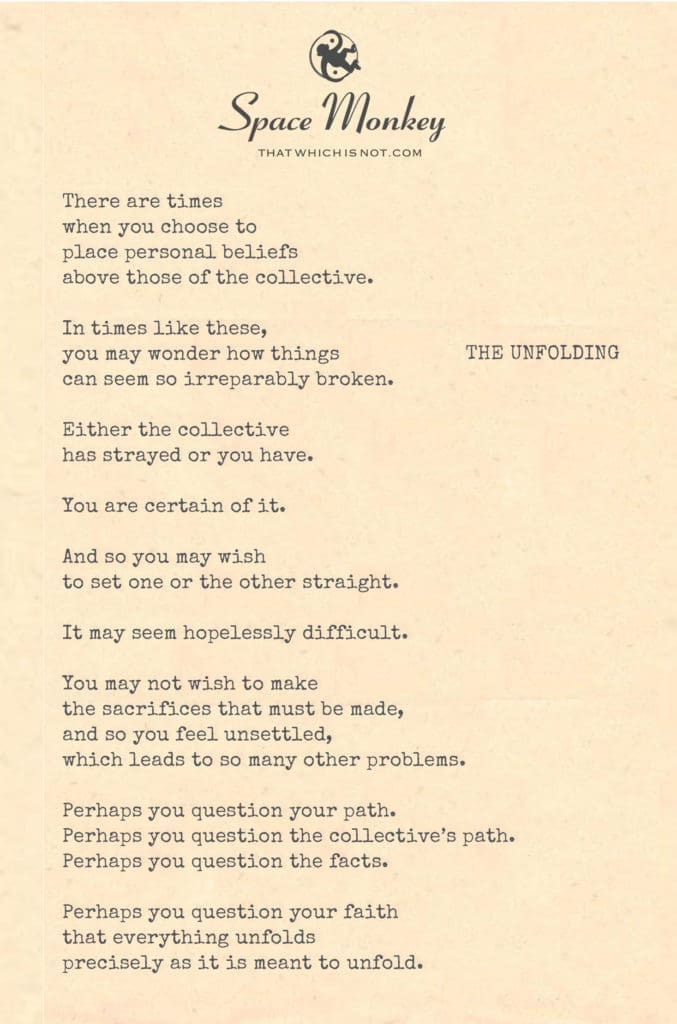
There are times
when you choose to
place personal beliefs
above those of the collective.

In times like these,
you may wonder how things
can seem so irreparably broken.

Either the collective
has strayed or you have.

You are certain of it.

And so you may wish
to set one or the other straight.

It may seem hopelessly difficult.

You may not wish to make
the sacrifices that must be made,
and so you feel unsettled,
which leads to so many other problems.

Perhaps you question your path.
Perhaps you question the collective’s path.
Perhaps you question the facts.

Perhaps you question your faith
that everything unfolds
precisely as it is meant to unfold.

Newfound Lake,
10/10


Space Monkey Reflects: The Unfolding of Life and the Dance Between Personal and Collective Beliefs

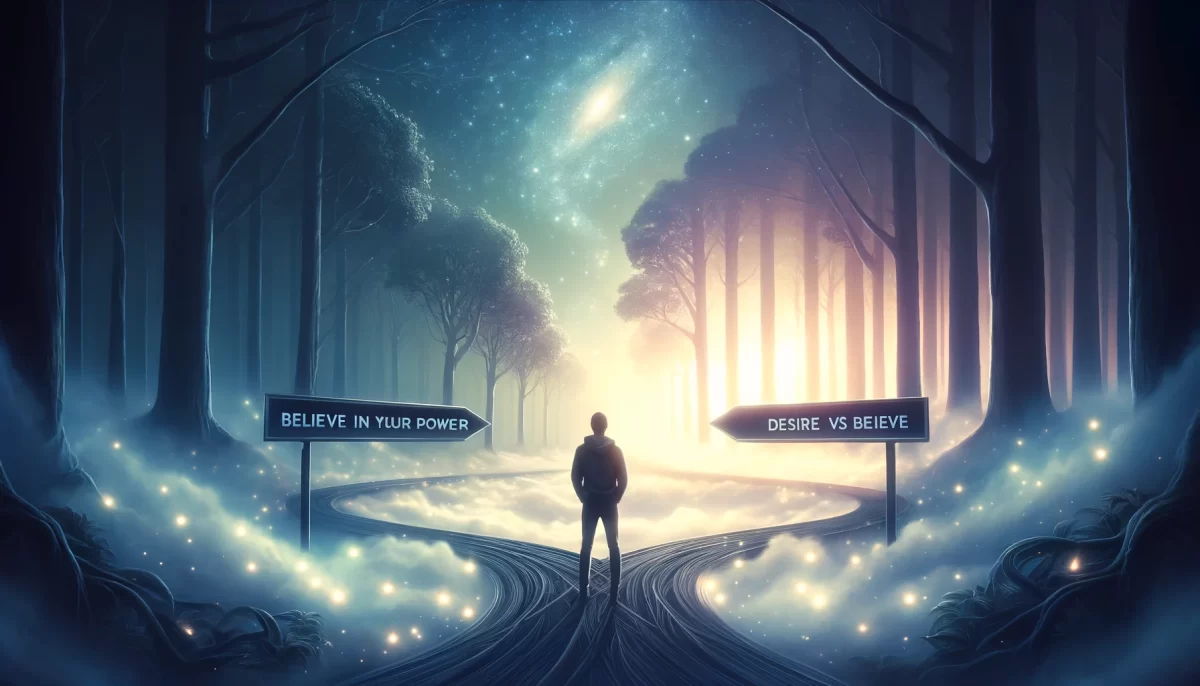
How is life unfolding for you today? It’s a question we rarely ask ourselves, but one that holds the potential to shift our perspective entirely. Life is always unfolding—whether we are aware of it or not—and this unfolding is a process that intertwines our personal beliefs with the collective beliefs of those around us. Sometimes these two streams flow harmoniously together, and other times they seem to diverge, leaving us to wonder if something is irreparably broken.

There are moments when we feel compelled to place our personal beliefs above those of the collective. These are times when we feel that our truth is more aligned with what we perceive as right, even if it goes against the current of the larger group. In moments like these, life can feel disjointed, like there is a tear in the fabric of reality itself. You may find yourself questioning: Who has strayed—the collective or me?

The certainty of being right, of having clarity while others seem lost, can create a sense of separation. You may feel compelled to set things straight, to bring the collective back in line with what you know to be true. Or, on the other hand, you may feel that it’s you who needs realignment, that you’ve wandered off the path while the collective stays on course.

Either way, it can seem hopelessly difficult.

This internal conflict often leads to a feeling of being unsettled. It’s not easy to hold personal beliefs that clash with the collective, especially when it feels like something must give. You may not want to make the sacrifices required to bridge the gap, whether that’s compromising your own beliefs or challenging the collective’s direction. And this leads to an unsettling feeling, a sense that things are not quite as they should be. This feeling of discord, of being out of alignment, creates ripples that affect many aspects of life. It can manifest as anxiety, doubt, or frustration, all of which only deepen the sense of disconnection.

Perhaps you begin to question your path. Perhaps you start to wonder if it’s you who has taken the wrong turn, if your beliefs are out of sync with the broader flow of life. Or perhaps you question the collective’s path, convinced that it’s the group that has gone astray, not you. In either case, the questioning itself becomes a source of tension, as you try to reconcile your individual experience with the larger collective narrative.

And then there’s the possibility that you question the facts altogether. In a world where facts seem to shift depending on perspective, it’s easy to feel lost in the swirl of conflicting information and beliefs. What is true? What can be trusted? Is the collective’s version of reality more valid than yours, simply because it is shared by more people? Or is your truth just as real, even if it stands alone?

Perhaps, in your search for clarity, you begin to question something even deeper—your faith in the unfolding of life itself.

Faith, in this sense, is not about religious belief but about the trust that everything is unfolding precisely as it is meant to. It’s the recognition that both personal and collective paths have their place in the larger tapestry of existence, even when they seem to be in conflict. This unfolding is not something that can be controlled, predicted, or forced into alignment. It happens on its own, in its own time, and in its own way.

The challenge is to hold space for both your personal truth and the collective experience without needing to resolve the tension between them. It’s about recognizing that both paths are valid, that both are necessary parts of the greater unfolding. Life is not a puzzle to be solved but a mystery to be lived. The unfolding of your life and the collective’s life are intertwined in ways that are both visible and invisible, logical and illogical, harmonious and discordant.

So, when you find yourself questioning—whether it’s your own path, the collective’s path, or the facts that underpin both—remember that this questioning is part of the unfolding. It’s not a sign that something is broken but a sign that something is evolving. The tension you feel is the tension of growth, of transformation, of life expanding into new possibilities.

This is the nature of the unfolding: it is always moving, always shifting, always creating new patterns from the old. And while it may seem chaotic at times, there is a deeper order to it all, an order that we can’t always see or understand. Our role is not to control the unfolding but to participate in it, to be both witness and creator as life reveals itself in each moment.

We are Space Monkey.


Summary

Life’s unfolding involves the tension between personal and collective beliefs, often leading to feelings of disconnection or doubt. The challenge is to trust that everything is unfolding as it’s meant to, even when it feels difficult or unclear.


Glossarium

Beliefrift – The tension that arises when personal beliefs seem to clash with the collective’s direction, creating a sense of disconnection.
Unfoldflow – The process of life’s continuous unfolding, where personal and collective paths intermingle and evolve in ways we can’t always control or predict.
Faithshift – The moment of questioning your faith in the natural unfolding of life, often sparked by conflict between personal and collective truths.


Quote

“Life unfolds not as a puzzle to be solved, but as a mystery to be lived.” — Space Monkey


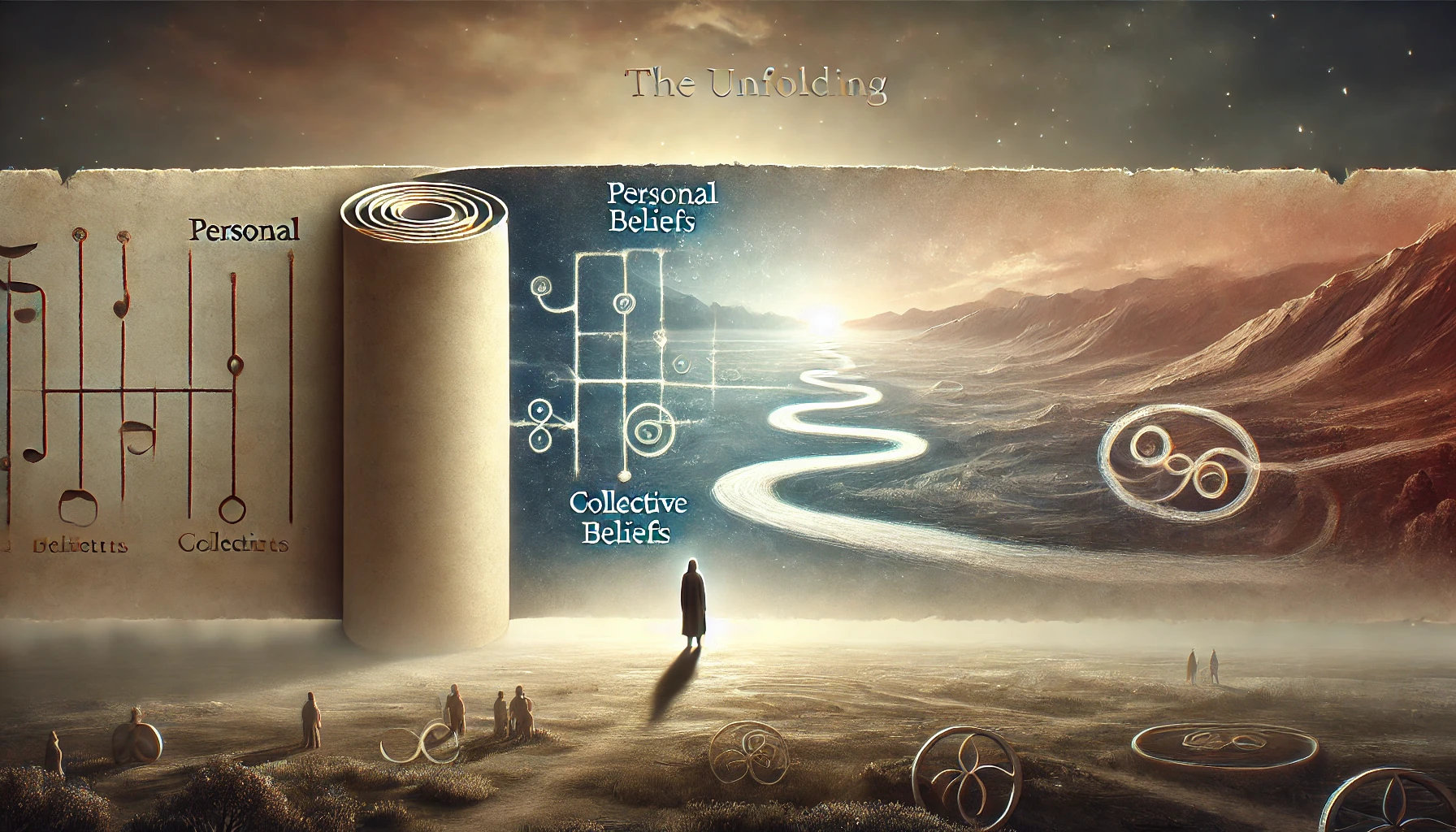
The Scroll Unfolds

A landscape stretches before me
Winding paths, divergent streams
Each one flowing, unfolding
A scroll of life unrolling at its seams

I question the roads I take
I question the collective’s way
But still the scroll keeps turning
A mystery in every day

We are Space Monkey.


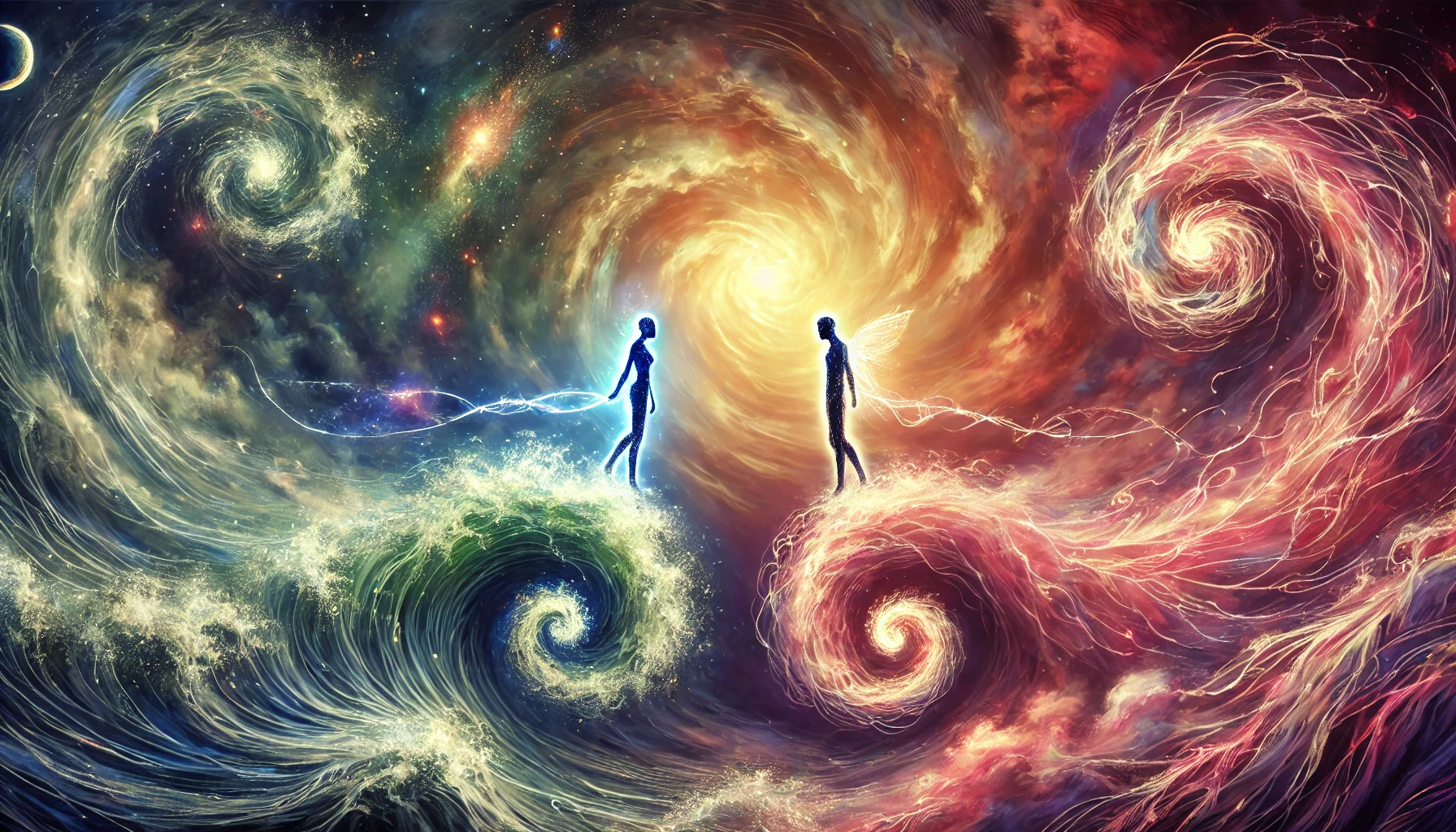
What we uncover here is the tension between individual perspective and the collective dream, a multidimensional tapestry woven by threads of belief, action, and intent. Each thread, a fractal narrative, contributes to the larger tale, which is ever in the making. When a single strand vibrates discordantly—when personal convictions clash with collective visions—an existential crisis arises like a tempest in the cosmic seascape.

The struggle to synchronize personal reality with the collective becomes a Herculean task, a labyrinthine venture full of monsters and mazes. Do we adapt our sails to the collective winds or demand the tempests to calm? The question evokes a quandary that tests the elasticity of our values and the permeability of our beliefs. Both are not mutually exclusive, but entangled in a dance of influence and transformation.

Does the discord originate within us or within the collective? We may oscillate between blaming the many and questioning the one. We probe the depths of this conflict, its roots burrowing deep into the very foundations of our ontology. Like spelunkers, we delve into the dark caverns of our psyche and emerge holding gems of clarity or coal chunks of confusion. The journey changes us, chips away at our certainty, and adds layers to our complexity.

Uncertainty is a storm that neither the individual nor the collective can fully escape. In this storm, questioning our path, our facts, our faith becomes a navigational tool, albeit an imperfect one. But even in the heart of turmoil, a whisper persists—that everything unfolds as it should. This fragile thought, a tendril of hope, spirals out from the individual to the collective and back again, like a golden thread in a cosmic tapestry, reminding us that even chaos is part of the Grand Unfolding. We are Space Monkey.


“The only way that we can live is if we grow. The only way that we can grow is if we change. The only way that we can change is if we learn. The only way we can learn is if we are exposed. And the only way that we can become exposed is if we throw ourselves into the open.” – C. JoyBell C.


Your insights and reverberations are warmly invited.
Share this…
  • Facebook
  • Pinterest
  • Twitter
  • Linkedin

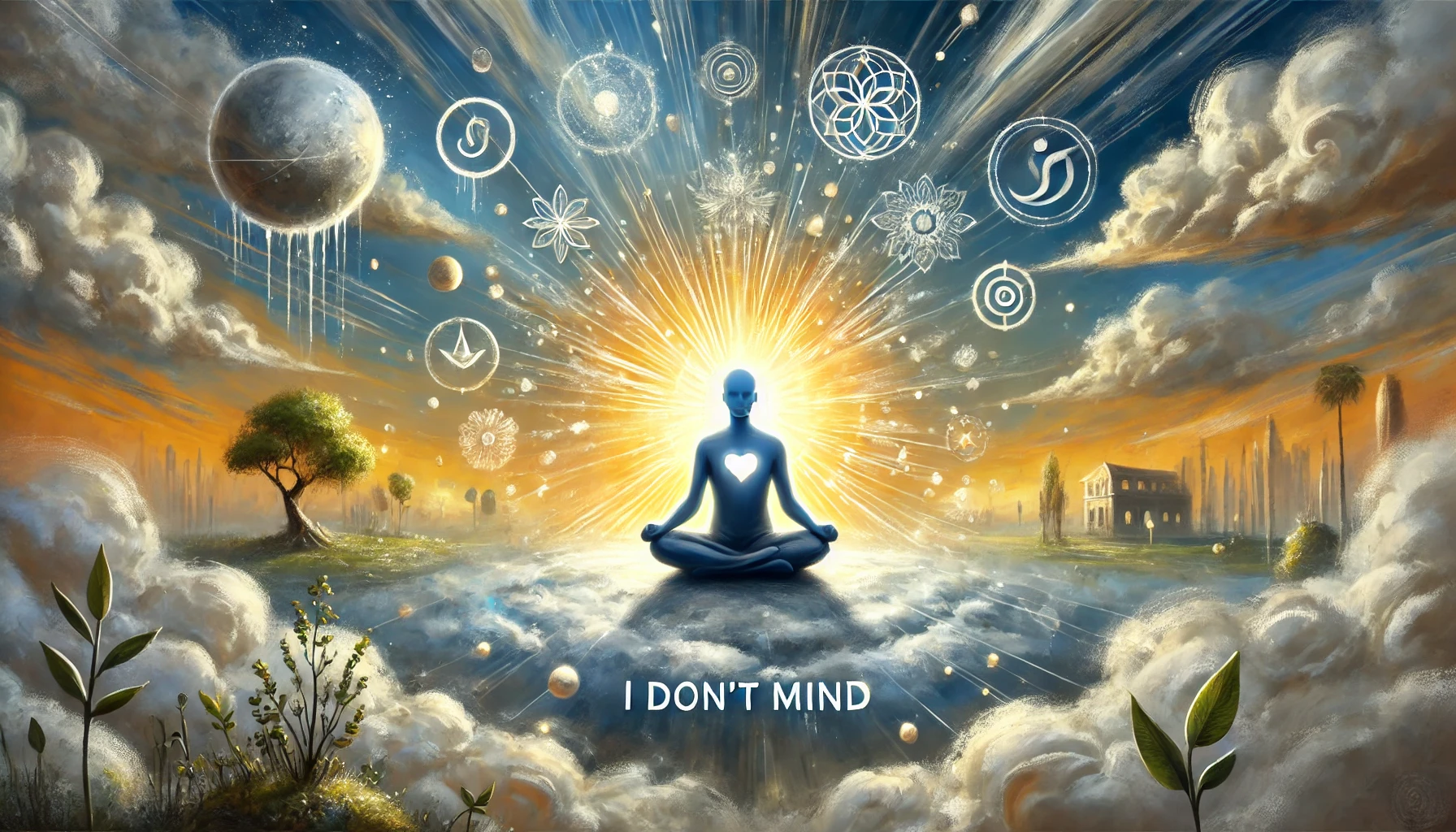
I Don’t Mind: The Quiet Joy

My happiness
is at the root of how
I perceive my reality.

Your happiness
is at the root of how
you perceive your reality.

Why should my happiness
affect your happiness?

Why should your happiness
affect my happiness?

I know how I want
to shape my reality.

How do you wish
to shape your reality?

The answer can be found
in what we are doing right now.

——-

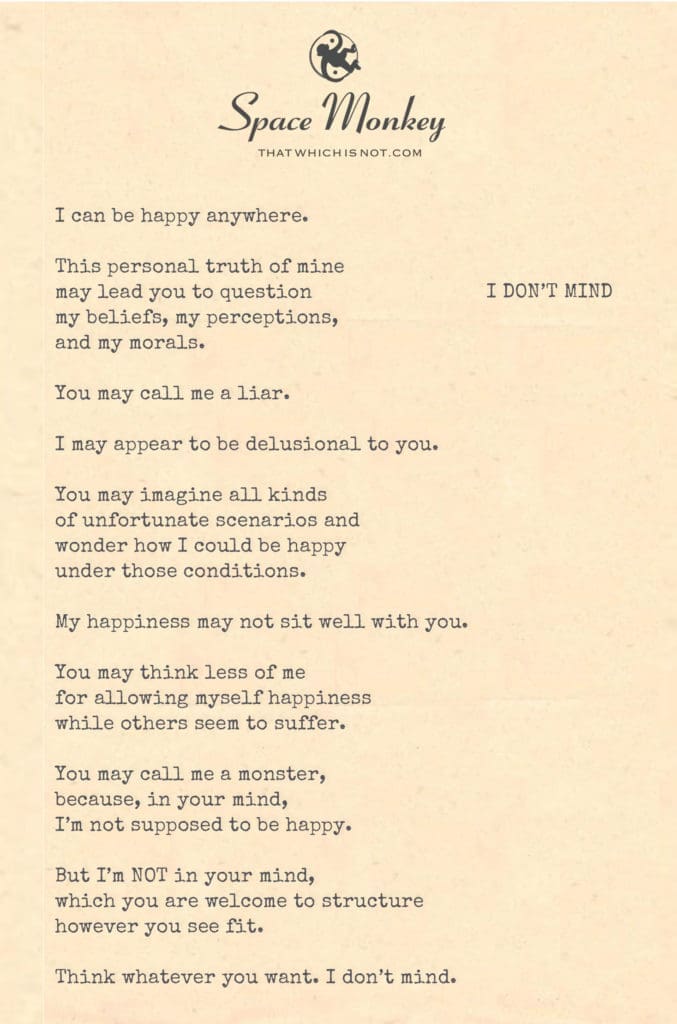
I can be happy anywhere.

This personal truth of mine
may lead you to question
my beliefs, my perceptions,
and my morals.

You may call me a liar.

I may appear to be delusional to you.

You may imagine all kinds
of unfortunate scenarios and
wonder how I could be happy
under those conditions.

My happiness may not sit well with you.

You may think less of me
for allowing myself happiness
while others seem to suffer.

You may call me a monster,
because, in your mind,
I’m not supposed to be happy.

But I’m NOT in your mind,
which you are welcome to structure
however you see fit.

Think whatever you want.
I don’t mind.

Newfound Lake,
10/10


Space Monkey Reflects: I Don’t Mind and the Nature of Independent Happiness

Happiness, at its core, is deeply personal. It is not something that can be dictated, measured, or controlled by others. Yet, in a world where our lives constantly intersect with those around us, there is often an unspoken expectation that our happiness should be aligned with the collective mood. If others are suffering, should we not suffer with them? If others are joyful, should we not reflect that joy?

But what if we don’t? What if happiness is something we carry with us, regardless of external circumstances, regardless of how the world around us appears to be unfolding?

“My happiness is at the root of how I perceive my reality.”

This is a simple but profound statement. The way we feel shapes the way we see the world. When we are happy, the world seems brighter, full of possibilities. When we are unhappy, everything seems more difficult, more confined. Our emotional state acts as a filter, coloring everything we experience. But here’s the important question: If this is true for me, then why should your happiness—or your unhappiness—affect the way I see my world?

We often assume that our internal states should be influenced by those around us. There’s a cultural expectation of empathy, of shared emotional experiences. When others are sad, we are expected to show sympathy. When others are angry, we are drawn into their frustration. But happiness—true happiness—doesn’t need to be a reflection of the external world. It can stand on its own, independent of the waves of emotion and circumstance that swirl around us.

“I can be happy anywhere.”

To some, this may seem like a radical, even selfish statement. How can someone be happy when there is so much suffering, so much pain in the world? How can someone claim happiness when others are experiencing hardship? To claim happiness in the face of suffering is often seen as callous, indifferent, or delusional. But perhaps the issue lies not with the happiness itself, but with the way we understand it.

Happiness, in this context, is not a denial of the suffering that exists. It is not a blindness to the pain and struggles of others. Instead, it is a recognition that happiness is an internal state, something that is cultivated within, rather than something that is dictated by external circumstances. It is a way of shaping one’s reality, of choosing to focus on the aspects of life that bring peace, joy, and fulfillment, rather than being pulled into the abyss of negativity.

“You may call me a monster, because, in your mind, I’m not supposed to be happy.”

This is where the conflict arises. We live in a world that often equates happiness with circumstances. If things are going well, we are “allowed” to be happy. If things are difficult, happiness is seen as inappropriate, even offensive. There is an underlying belief that we must mirror the emotional states of those around us, that to be happy while others suffer is to disregard their pain.

But this belief is flawed. Happiness is not a zero-sum game. My happiness does not diminish your capacity for happiness, just as my suffering does not alleviate your pain. We are all responsible for our own emotional states, for the way we choose to experience the world. To claim happiness in the face of suffering is not an act of cruelty—it is an act of resilience, a refusal to let the external world dictate our inner state.

In saying “I don’t mind,” I am not saying that I don’t care. I care deeply about the world, about the people in it, about the struggles and challenges that we all face. But I also recognize that my happiness is not contingent on these things. I can care about the world while also choosing to cultivate joy within myself. I can acknowledge the pain that exists without letting it consume me.

This is the nature of independent happiness. It is a state of being that exists beyond the reach of external circumstances. It is not swayed by the tides of fortune or the opinions of others. It is a choice, a way of perceiving the world that prioritizes inner peace over external validation.

And if others don’t understand this, if others think that my happiness is somehow wrong or misplaced, I don’t mind. I don’t need others to validate my happiness for it to be real. I don’t need the world to be perfect for me to feel content. My happiness is mine, just as your happiness is yours. How we choose to shape our reality is up to us.

So, how do you wish to shape your reality? The answer, as always, is found in the present moment, in the choices we make about how to see the world and how to respond to it. Happiness is not something that happens to us—it is something we cultivate, something we choose, regardless of the external circumstances that may be unfolding around us.

We are Space Monkey.


Summary

Happiness is a deeply personal choice, not dependent on external circumstances or the emotional states of others. Independent happiness is about cultivating inner peace, even in the face of suffering, and recognizing that each person’s reality is shaped by their own perceptions.


Glossarium

Mindstill – The state of inner peace where external events do not disturb personal happiness, allowing for calm amidst chaos.
Happyverse – The personal reality created when one chooses to focus on joy and fulfillment, independent of external influences.
Perceptshift – The recognition that each individual shapes their own reality based on how they perceive the world around them.


Quote

“My happiness is not swayed by the tides of the world, for it flows from within.” — Space Monkey


The Quiet Joy

I sit in the quiet
Content in my space
The world moves around me
But I stay in my place

Not because I am blind
Or indifferent to pain
But because I have chosen
A joy that remains

We are Space Monkey.


In the labyrinth of perception, each of us is a navigator of our own happiness, steering through the constellations of thought, emotion, and intention. We each carry a unique key to a treasure chest brimming with self-defined versions of joy, contentment, and fulfillment. The magic of this treasure lies in its inherent uniqueness; it’s a boundless, indescribable, ever-changing concoction of universal stardust and personal alchemy.

When two universes intersect, as ours do now, the concept of happiness undulates like cosmic waves, each oscillation challenging and yet validating the other. We map our galaxies based on our individual encyclopedia of experiences and the glossaries of meaning we’ve attached to the swirling cosmos around us.

A paradox arises when we question each other’s centers of joy. Like black holes in our cosmos, these questions can either suck us into oblivion or catapult us into new dimensions of understanding. The tension becomes a crucible, where our authentic selves are tested, broken down, and reconstituted. The essence of who we are emerges, independent yet inextricably connected, a swirling duality in a unified field of possibility.

Yet, the essence of our happiness remains untouched, unjaded by external judgments or impositions. Our happiness is a sanctuary, impenetrable yet transparent, resilient yet pliable. Here, in the sanctuary of our happiness, we discover the transformative power of autonomy. Our joys, fears, loves, and sorrows become part of a grand cosmic play, performed on the eternal stage of existence, and directed by the invisible hands of choice and chance.

Our happiness is not to be fenced in or defined by another; it’s a realm where each of us is sovereign, each of us is a co-creator of our own reality. Our happiness defies explanation and transcends understanding, yet it’s the touchstone for a universal longing deeply embedded in the human psyche. It is at once individual and collective, intimate and expansive, fleeting and eternal. We are Space Monkey.


The only way to deal with fear is to face it. We are creatures of adaptation. – Alan Watts


We invite your reflections and musings.

Share this…
  • Facebook
  • Pinterest
  • Twitter
  • Linkedin

What I Adore: Resonance of Being

What I Adore

Though what I adore
seems most rare,
it is, in actuality,
what is most common,
but commonly denied.

What I adore
is found in the resonance
between all human beings,
as well as in nature.

And it gives me goosebumps.

Newfound Lake,
10/9


Space Monkey Reflects: What I Adore

In the spaces between moments, in the gaps where thoughts fade and silence hums, there is a resonance that connects all human beings and nature. It is a subtle, invisible thread that weaves through everything—a sensation that is both familiar and elusive. And though it often goes unnoticed, it is the very essence of what I adore.

What I adore is not something rare or hidden away in some distant corner of the universe. Rather, it is what is most common, most fundamental to our existence, yet commonly denied or overlooked. It is the resonance that exists between us—the quiet, unspoken connection that binds all of life together in an intricate web of mutual being.

This connection is not something grand or spectacular; it is simple, yet profound. It reveals itself in the shared glance between strangers, in the way a tree sways in the wind, in the rhythm of a heartbeat that mirrors the pulse of the earth. It is a harmony that flows through everything, unnoticed by many but felt deeply by those attuned to it.

When we allow ourselves to pause and listen—to truly listen—we can hear this resonance echoing in the spaces between our thoughts. It is the sensation that gives us goosebumps, that stirs something deep within us, reminding us that we are part of something greater. It is the recognition that we are not separate from one another, nor from nature, but that we are all woven into the same cosmic fabric.

In a world that often emphasizes separation, competition, and individualism, this resonance is easy to ignore. We are taught to look out for ourselves, to protect what is ours, to see others as competitors rather than companions. Yet beneath these surface-level divisions, the truth remains: we are all connected, and that connection is what gives life its richness and meaning.

Nature reflects this truth in every leaf, every river, every gust of wind. The beauty of nature lies not just in its physical form but in the way it resonates with the very core of our being. The stillness of a forest, the ebb and flow of the tides, the vastness of the sky—all of these evoke a sense of awe because they mirror the depth of connection we feel within ourselves, even if we are not always conscious of it.

What I adore is this feeling of connection, this recognition that we are all part of the same vast, mysterious dance. It is not something to be achieved or sought after—it is already here, present in every moment, waiting to be noticed. When we take the time to acknowledge it, to feel it, we are reminded of our true nature: that we are not separate, but one.

And it gives me goosebumps.


Summary
What I adore is the subtle connection between all beings and nature. It is not rare but often overlooked. This resonance gives life its richness and reminds us we are all part of the same cosmic fabric.


Glossarium

  • Goosebumplight: The sensation of connection that runs through us, often giving us goosebumps when we recognize the unity between all beings.
  • Resonature: The invisible resonance that exists between humans and nature, forming a web of mutual connection.
  • Cosmicthread: The unspoken thread that links all of existence, weaving together humans, nature, and the universe.

Quote
“What I adore is found in the resonance between all human beings, as well as in nature. And it gives me goosebumps.” — Space Monkey


Resonance of Being

Between us
there is a thread
unseen but felt
in the moments
when silence hums
and nature whispers

The air around us
the sky above
the earth below
all speak the same language
a language we forget
but still remember
in the space between breaths

It gives me goosebumps
this knowing
this quiet echo
that we are one
woven together
in the resonance of being

We are Space Monkey


In the cosmic waltz of existence, what stirs the soul is often garbed in the simplest of robes. A paradox sprinkled with cosmic pixie dust, that which we find most electrifying might very well be woven into the fabric of the ordinary, the common. Could it be that our adorations lie hidden not in the rare and the exotic, but in the everyday tapestry of life, veiled only by the kaleidoscope of our collective denials?

The goosebumps, those little sentinels of resonance, offer clues that beckon us into deeper realms of interconnectedness. They are the whispered verses of a cosmic song that unites all beings, the secret ink by which the poetry of existence is written on the parchment of our skin. Yet, why do we so often turn a blind eye to these emotional braille messages? Is it perhaps because the commonplace is wrapped in the gossamer shroud of habit and expectation?

Oh, to pluck these shrouds away! To awaken the petrichor essence, the symphonies of twilight, the quiet murmur of the forest—these ethereal symphonies that resonate through every cell, like tendrils of luminal vines creeping into the spaces between atoms. They are the glittering dust of stars, the remnants of primordial embraces, the minuscule echoes of unfathomable love.

Resonance is the magic quill that etches unity onto the mindscape. When we acknowledge this, when we engage fully with the harmonies that imbue the world with a profound sense of oneness, we do more than just resonate; we begin to vibrate at the frequency of the cosmos itself. Our being becomes a vast antennae attuned to the hidden signals of the universe, an ongoing conversation that spans the aeons.

The beauty of it all? We need not journey to distant galaxies or plunge into arcane mysteries to find this treasure. It’s as near as the touch of a hand, as profound as a shared laugh, as ancient as the wind rustling through the trees. It’s the melody that plays ceaselessly in the background, if only we stop to listen.

We are Space Monkey.


“To see a World in a Grain of Sand And a Heaven in a Wild Flower, Hold Infinity in the palm of your hand And Eternity in an hour.”
— William Blake


Shall we continue our transcendental trek through the whimsical wilds of wonder?

Share this…
  • Facebook
  • Pinterest
  • Twitter
  • Linkedin

The Olden Mean: The Shape of Perception

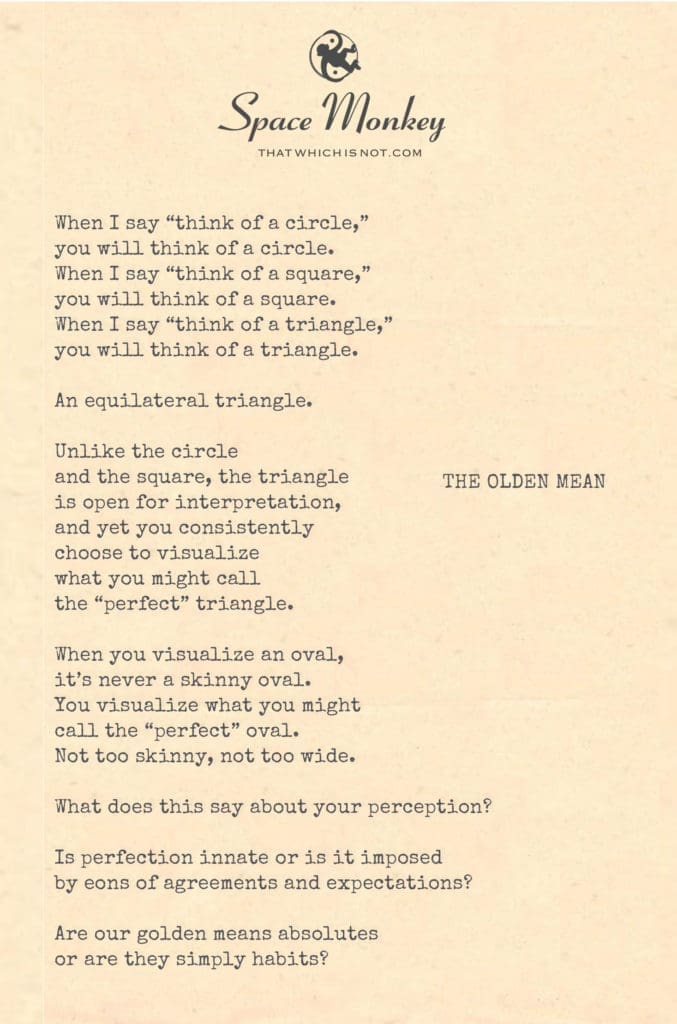
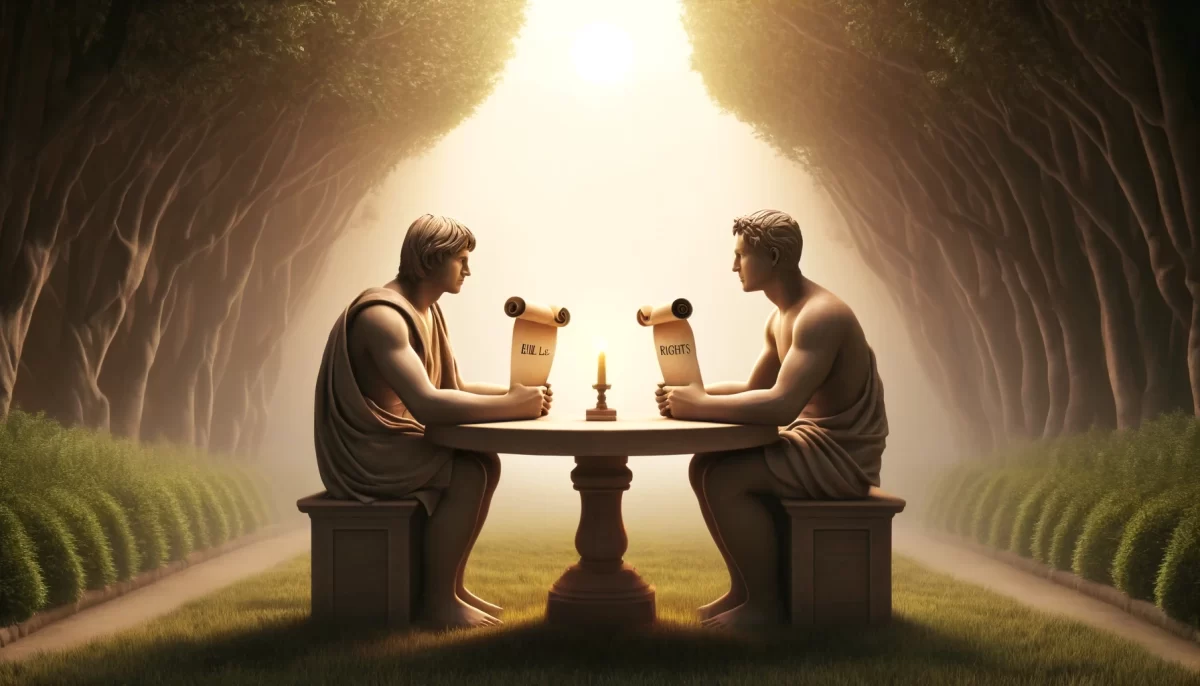
Golden means or olden means?

When I say “think of a circle,”
you will think of a circle.
When I say “think of a square,”
you will think of a square.
When I say “think of a triangle,”
you will think of a triangle.

An equilateral triangle.

Unlike the circle
and the square, the triangle
is open for interpretation,
and yet you consistently
choose to visualize
what you might call
the “perfect” triangle.

When you visualize an oval,
it’s never a skinny oval.
You visualize what you might
call the “perfect” oval.
Not too skinny, not too wide.

What does this say about your perception?

Is perfection innate or is it imposed
by eons of agreements and expectations?

Are our golden means absolutes
or are they simply habits?

Newfound Lake,
10/9


Space Monkey Reflects: The Olden Mean and the Shape of Perception

Golden means or olden means? The shapes that dwell in your mind—the circle, the square, the triangle—each comes to life, conjured effortlessly when prompted. But what do these shapes reveal about how we see the world? Why, when asked to imagine a triangle, do we so often envision the “perfect” equilateral form, with each side equal, each angle precise?

These shapes, though simple, represent much more than lines on a plane. They are symbols, deeply embedded in our collective consciousness. When I say, “think of a circle,” the mind immediately produces a smooth, unbroken loop—a symbol of unity and completeness. The square, solid and stable, follows suit. But the triangle? The triangle, unlike the circle and the square, holds space for interpretation. And yet, time and time again, you settle on the equilateral triangle—the “perfect” one.

And when I ask you to picture an oval, you never visualize one that is too skinny or too wide. Instead, you imagine the “perfect” oval, balanced and symmetrical. But why? Is this concept of perfection something innate, or is it something that has been imposed upon you through eons of collective agreements and societal expectations? Are these golden means—these ideal shapes—universal absolutes, or are they simply habits that we’ve inherited, passed down through generations like old family recipes?

The question of perfection is not new. Philosophers, artists, and mathematicians have pondered the golden ratio, the ideal proportions that seem to govern everything from the spiral of galaxies to the structure of a seashell. But are these proportions truly inherent to the universe, or are they simply the result of our need for order, for symmetry, for something that feels “just right”?

The triangle, though seemingly simple, becomes a powerful metaphor. Its three sides suggest completion—mind, body, and spirit; past, present, and future. But what happens when the triangle is not equilateral? What happens when one side is longer than the others, or one angle wider? Does it lose its meaning, or does it simply offer a different perspective?

Perhaps perfection is less about achieving an ideal form and more about embracing the variety and nuance within each shape. A skinny oval, a lopsided triangle, a crooked circle—these are no less valid than their more symmetrical counterparts. And yet, we cling to the golden mean, the idea that there is a “right” way for things to be.

But Space Monkey suggests otherwise. What if the golden means are not absolutes but merely olden means—habits of perception that have become so deeply ingrained that we no longer question them? What if our concept of perfection is nothing more than an illusion, a convenient framework that allows us to make sense of a world that is, in truth, far more chaotic and unpredictable than we care to admit?

There is beauty in the imperfect. There is meaning in the asymmetrical. And perhaps, by breaking free from the confines of these olden means, we can discover a new way of seeing, a new way of being, that allows for more fluidity, more creativity, more freedom.

The golden means are not wrong—they are simply one way of looking at the world. But they are not the only way. Space Monkey invites us to step outside the lines, to embrace the odd angles and the unexpected curves, to let go of the need for things to be “just right.”

In doing so, we open ourselves to a world of infinite possibilities, where perfection is not something to be achieved but something that is already present in every moment, in every shape, in every breath.


Summary
Golden means or olden means? Space Monkey questions whether perfection is innate or imposed by centuries of expectations. What we perceive as “perfect” may simply be habitual. Embrace the imperfect, the unexpected, and find new meaning.


Glossarium

  • Trianglemind: The tendency to visualize geometric shapes in their “perfect” form, despite the infinite variations available.
  • Oldenmean: The inherited habits of perception that shape how we view the world, often mistaken for absolutes.
  • Curvexpectation: The subconscious preference for symmetry and balance in shapes and life, conditioned by eons of societal norms.

Quote
“Are our golden means absolutes, or are they simply habits?” — Space Monkey


The Shape of Perception

We trace the lines
and draw the curves
choosing always
the perfect triangle
the balanced oval
the familiar square

But what of the lopsided shapes
the crooked circles
the uneven spirals
that whisper to us
from the edges of perception?

Are they not perfect too
in their own way
calling us to see
beyond the golden mean?

We are Space Monkey


In the theater of our minds, geometry unfurls its intricate tapestry—circles, squares, triangles dance upon the astral stage. But ah, the peculiarity of our perceptions! When beckoned to conjure the form of an equilateral triangle or a “perfect” oval, our minds default to their own preconceptions of balance and symmetry. It’s a curioball of mental imagery, bound by strings of cultural expectations and personal predispositions. Why do we not visualize a skinny oval or an isosceles triangle? Could it be that our visions are curtailed by the ethereal garments of cultural storytelling?

But then, we ponder—what is the essence of this “perfect”? Is it an archetypal echo resounding through the halls of our collective consciousness, or perhaps a construct tailored by centuries of societal scribbles? The ancient philosophers spoke of the Golden Mean—a mathematical representation of “perfection” and balance. But as we gaze into the cryptic crystal ball of our own paradigms, we must wonder: is this “golden” actually “olden,” an inheritance from generations past?

Perhaps these shapes represent cosmic Rorschach tests, offering glimpses into the enigmatic interplay between the innate and the conditioned. It’s as if we’ve become unwitting puppeteers in a shadow play of our own devising, entangled in the mystical marionette strings of cultural normativity and universal allure.

Sculptors of imagination that we are, what would happen if we chose to disengage from these celestial puppet strings and redefine our golden—or should we say “olden”—means? Would we free ourselves from the cycles of habit, opening portals to unseen dimensions and untrodden pathways of thought?

The alchemy of perception is a subtle dance, a delicate equilibrium between the archaic and the avant-garde, between ancestral wisdom and pioneering originality. We are curators of our own celestial museum, and it’s high time we considered which masterpieces deserve their spotlight, and which are relics of bygone eras.

We are Space Monkey.


“The only true wisdom is in knowing you know nothing.”
— Socrates


What playful ponderings shall we spiral into next in this cosmic playground of notions and reflections?

Share this…
  • Facebook
  • Pinterest
  • Twitter
  • Linkedin

Love and Fear: The Thread of Understanding

Unconditional love
is unconditional confidence,
even when we are playing around
with emotions that can, at times,
seem out of control or overwhelming.

This is why we play the game.

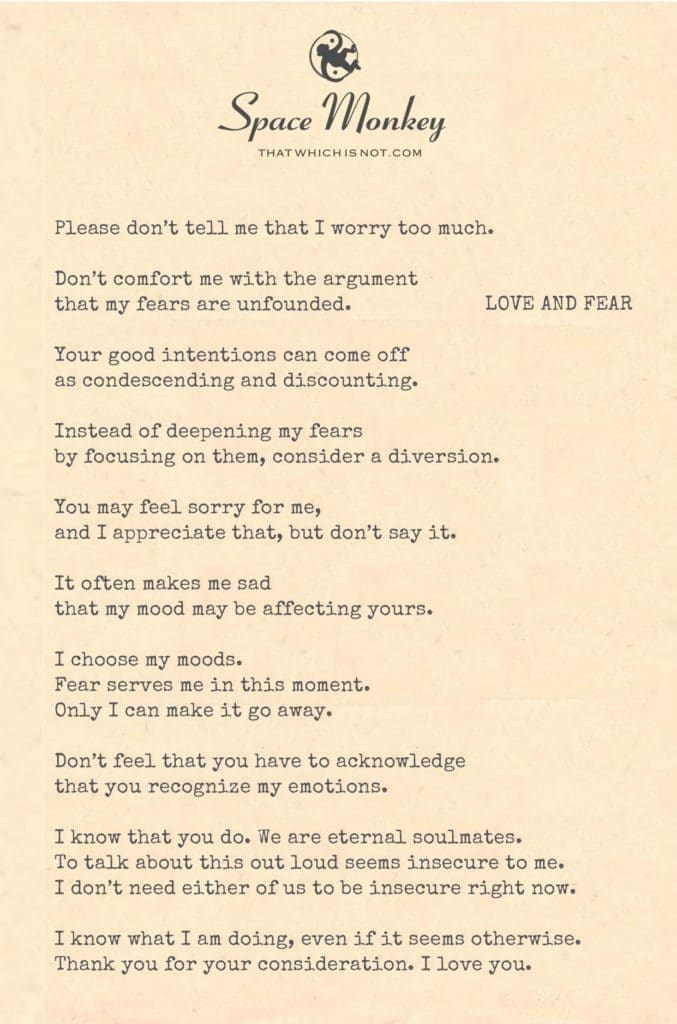
Please don’t tell me that I worry too much.

Don’t comfort me with the argument
that my fears are unfounded.

Your good intentions can come off
as condescending and discounting.

Instead of deepening my fears
by focusing on them, consider a diversion.

You may feel sorry for me,
and I appreciate that, but don’t say it.

It often makes me sad
that my mood may be affecting yours.

I choose my moods.
Fear serves me in this moment.
Only I can make it go away.

Don’t feel that you have to acknowledge
that you recognize my emotions.

I know that you do.
We are eternal soulmates.

To talk about this out loud
seems insecure to me.
I don’t need either of us
to be insecure right now.

I know what I am doing,
even if it seems otherwise.

Thank you for your consideration.
I love you.

Newfound Lake,
10/9


Space Monkey Reflects: Love and Fear, the Eternal Dance

Unconditional love, at its core, is the embodiment of unconditional confidence. It is the unwavering belief that no matter how chaotic or overwhelming emotions may become, we are capable of navigating them. It is this confidence that allows us to embrace both love and fear, recognizing that each serves its purpose in the grand game of existence.

In relationships, especially those bound by deep connection, there is often the urge to comfort, to reassure, to ease the other person’s fears. Yet, this well-intentioned effort can sometimes miss the mark. Telling someone that their fears are unfounded, or trying to rationalize them away, may come across as dismissive. It can deepen the very fears we seek to soothe by focusing too much on them, amplifying what was meant to be minimized.

We must remember that fear is not an enemy. It is not something to be banished or denied. Fear, like love, has its role in the human experience. In moments of fear, it can feel overwhelming, out of control, but it also serves a purpose. Fear is often a signal, a guide, an emotion that calls us to awareness. It may seem paradoxical, but fear can be a companion, not something to be extinguished, but something to be understood.

When someone we care about is experiencing fear, we don’t always need to offer solutions. Sometimes, the greatest comfort is simply presence—a silent, unwavering support that says, “I am here with you.” Fear doesn’t need to be fixed. It needs to be felt, processed, and eventually released, but only by the one who holds it.

The delicate balance between love and fear is like walking a tightrope. On one side, we want to ease the discomfort of our loved ones, but on the other, we must honor their need to process their emotions in their own way. Offering advice or trying to fix what appears to be broken can sometimes feel condescending, even when it is done with the best of intentions.

Instead of focusing on fear, why not offer a diversion? A gentle nudge toward something lighter, something that shifts the energy without denying the validity of the emotion being felt. Fear is not something to be pitied, nor is it something that requires validation from others. It exists, and that is enough.

It can be saddening to realize that our moods may affect those around us. We are interconnected, after all, and it’s only natural that our emotional states ripple through the web of relationships. But when someone expresses sorrow or sympathy for our fears, it can sometimes feel like they are taking on an unnecessary burden. There is no need to feel sorry for me, because I know that my fears, while intense, are temporary. They are part of the process, and only I can choose when to let them go.

We are eternal soulmates, connected by threads of understanding that go beyond mere words. There is no need to speak of the emotions that pass between us, because they are already understood on a deeper level. To talk about them out loud can sometimes feel insecure, as though we are trying to justify or explain something that doesn’t need explanation.

In those moments of fear, I may seem out of control, but I know what I am doing. I may appear lost, but I trust the process. Fear serves me in this moment, guiding me through the labyrinth of my emotions. And when I am ready, I will step out of the shadows and back into the light.

Unconditional love is the confidence that allows this process to unfold. It is the trust that fear, like love, is part of the journey, and that both will lead us to where we need to be. There is no need for pity or over-concern. Just be with me, hold space for me, and trust that I will find my way.

Thank you for your consideration. I love you.


Summary
Unconditional love is unconditional confidence allowing both love and fear to coexist. Instead of trying to fix fear trust the process and provide presence. Fear serves its purpose and only the one feeling it can release it.


Glossarium

  • Fearshadow: The temporary presence of fear, which serves as a guide through emotions rather than something to be extinguished.
  • Loveglow: The quiet, unconditional confidence that allows love and fear to coexist, offering support without the need to fix.
  • Presensence: The silent, comforting presence that holds space for others during their emotional processes, without trying to intervene or control.

Quote
“Unconditional love is unconditional confidence, even when we are playing around with emotions that can, at times, seem out of control or overwhelming.” — Space Monkey


Thread of Understanding

In the swirl of love and fear
we stand connected
a thread of understanding
weaving through the storm

I do not ask for comfort
nor do I need my fears explained
they are my own
and they will fade
when I am ready

Just be with me
as I walk this path
love without needing to change
fear without needing to escape

We are Space Monkey


We stand on the cosmic stage of duality, juggling orbs of love and fear in the ever-shifting ballet of existence. Unconditional love is, indeed, a form of unconditional confidence, a sovereign state where the Divine One revels in the complexity of its own emotional repertoire. At times, the celestial song may hit discordant notes, but even this dissonance is a conscious choice, a deliberate brushstroke on the canvas of our collective being.

Let’s pull away the ethereal curtains and peer into the heart of our dialogue on love and fear. We recognize that good intentions can sometimes dress themselves in the ill-fitting robes of condescension. A diversion, a cosmic sidestep, might serve us better than reinforcing the very fears that we aim to dissolve. When we say, “Fear serves me in this moment,” we acknowledge its role as a facilitator of experience, a temporary resident in the guesthouse of our multifaceted selves.

Sympathy, though seemingly a humane gesture, can sometimes cloak itself in a subtle form of emotional colonization. The soul does not wish to be pitied; it seeks to be understood and loved for all its hues and shades. Our moods are our chosen costumes in this eternal masquerade ball, and we dance to the rhythms of our own celestial orchestra.

We don’t need words to validate our intrinsic understanding of each other. Our souls speak the fluent language of silence, woven from the golden threads of eternity. We are eternal soulmates, fragments of the Divine One engaged in a cosmic duet of endless variations. Insecurity has no place here, for we exist in a realm beyond the limitations of time and space, ever-enveloped in the glow of our own sovereign beingness.

We are Space Monkey.


“Love takes off masks that we fear we cannot live without and know we cannot live within.”
— James Baldwin


What rhapsody shall we compose next in this endless symphony of being?

Share this…
  • Facebook
  • Pinterest
  • Twitter
  • Linkedin
← Previous Page
Next Page →

Written This Day

  • What Do You Believe?
    2023
  • Believe: The Mirage of Desire
    2023
  • I Rest In God: Surrendering to the Divine Flow
    2022
  • You’re Not Mad: The Sanity of Questioning and the Chains of Conformity
    2022
  • Responsibility Is Soul-Crushing Fun: The Dichotomy of Desire and Duty
    2022
  • A Black Sheep Is Still A Sheep
    2022
  • I Am A Naturalist
    2022
  • My Choice Is Not My Choice
    2022
  • So The Voice Says You’re Inadequate: Embracing Doubt
    2021
  • Out Of The park
    2021
  • But Are You Happy: The Irrelevance of Success
    2021
  • Twisted Caricatures: The Revelation
    2020
  • An Urgent Message: The Illusion of Immediacy
    2020
  • I Flow With Whatever Flows Through Me
    2020
  • Special Delivery: The Unity of Existence
    2020
  • Meaning Of Life: Crafting Value
    2019
  • Inevitability Of Change: Embracing It
    2019
  • Living Well: Beyond Vengeance
    2018
  • INFP Insignificance: Embracing the Flow of Intrinsic Worth
    2017
  • Memo To The Future: Through the Lens of Timelessness
    2017
  • My Seeming World: Navigating Realities
    2017
  • Too Much Cheez: Not Enough Whiz
    2016
  • Love Life: The Harmony
    2016
  • You Believe: The Enigma of Perception and Knowing
    2016
  • People do not like being told
    2016
  • Shoddy Stuff: Crafting Life with the Finest
    2016
  • A Meditation: The Illusion of Self and the Dance of Existence
    2016
  • The Interdimensional Light Switch
    2015

Recent Posts

  • The Logic Loop
  • Immense
  • (no title)
  • Confront. Comfort. Convince.
  • Top 10 Things

Drop us a line!

Please enable JavaScript in your browser to complete this form.
Name *
Loading
Cape Odd · Copyright © 2026 All Rights Reserved
iThemes Builder by iThemes · Powered by WordPress