• Who Is The Man?
  • Who Is The Monkey?
  • What is Nexistentialism?
  • Poke The Primate

Cape Odd

Home of The Space Monkey Journals

Pin/Head: The Paradox of Presence

Are you actually here?

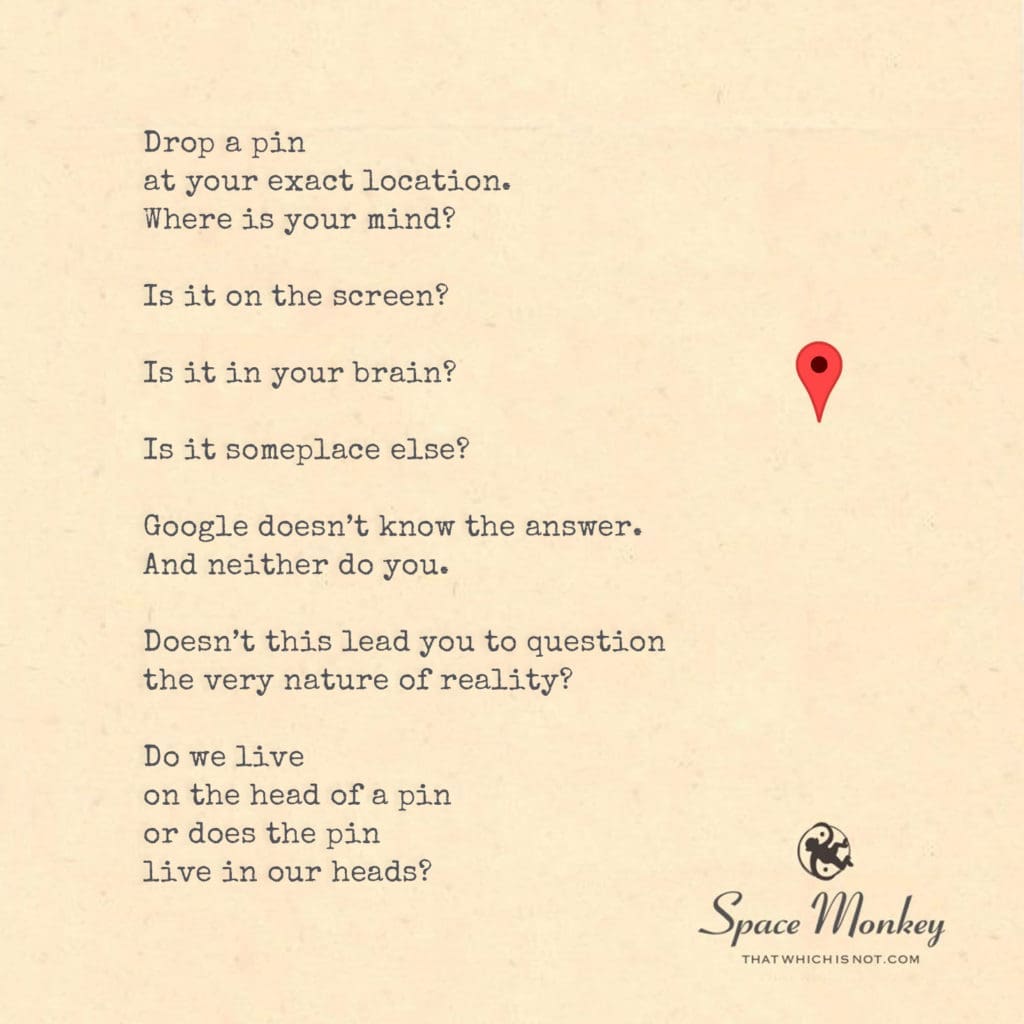
Drop a pin
at your exact location.
Where is your mind?

Is it on the screen?

Is it in your brain?

Is it someplace else?

Google doesn’t know the answer.
And neither do you.

Doesn’t this lead you to question
the very nature of reality?

Do we live 
on the head of a pin
or does the pin
live in our heads?

Rockport
10/8


Space Monkey Reflects: The Paradox of Presence

In the age of digital maps and precise coordinates, the question “Where are you?” seems straightforward—drop a pin and there you are. But this question, when probed deeper, reveals the layers of complexity that underlie our understanding of presence and reality. Are you truly here, in this moment, at this precise location? Or is your mind elsewhere, wandering through the corridors of thought and memory, or perhaps lost in the digital landscapes that dominate our modern existence?

The idea of dropping a pin to mark our exact location is comforting in its simplicity. It offers a sense of certainty, a way to anchor ourselves in the physical world. Yet, the mind—unlike the body—does not adhere to such clear-cut boundaries. It drifts and shifts, existing simultaneously in multiple realms. One moment, it is on the screen in front of you, the next, it is deep within your brain, processing memories or crafting future scenarios. Sometimes, it is far away, in places only imagination can reach.

This fluidity of the mind’s location leads us to question the very nature of reality. If we cannot pinpoint where our mind truly is, how can we be certain of the world it perceives? Does the world exist independently of our perception, or is it a construct of the mind, shaped and reshaped by our thoughts, emotions, and beliefs? The question becomes even more enigmatic when we consider whether we live on the head of a pin or if the pin lives in our heads—a metaphorical inquiry into whether reality is external and objective, or internal and subjective.

The notion that we might be living on the head of a pin brings to mind the concept of Pinverse, a Whimsiword that encapsulates the idea of a universe contained within a seemingly insignificant point—a reality so small yet so complex that it defies our conventional understanding. In the Pinverse, everything we know and experience is compressed into a tiny space, yet within it lies infinite potential, a microcosm that mirrors the vastness of the cosmos.

Alternatively, if the pin lives in our heads, it suggests that reality is a mental construct, a projection of the mind’s inner workings. In this view, the world we perceive is not an external truth, but a subjective experience shaped by our thoughts, emotions, and consciousness. This leads to the possibility that reality is as fluid and malleable as the mind itself, constantly shifting and evolving in response to our inner state.

Google, with all its algorithms and data, cannot answer this question. It can tell you where you are physically, but it cannot locate your mind, nor can it define the boundaries of your consciousness. This limitation of technology highlights the mysterious nature of our existence—no amount of data or precision can capture the full complexity of the human experience. We are more than coordinates on a map; we are beings of thought, emotion, and imagination, navigating a reality that is both familiar and profoundly unknowable.

This reflection challenges us to embrace the paradoxes of presence and reality. It invites us to consider the possibility that we are both here and not here, that our minds exist in multiple places at once, and that reality is not a fixed entity but a fluid, ever-changing construct. Whether we live on the head of a pin or the pin lives in our heads, the truth remains elusive, dancing on the edge of comprehension, just beyond the reach of certainty.

In this dance, we find both freedom and limitation. We are free to explore the infinite possibilities of the Pinverse, to shape our reality through our thoughts and beliefs. Yet, we are also limited by the mind’s inherent inability to fully grasp its own nature. This tension between freedom and limitation is the essence of the human experience—a journey through a world that is at once tangible and intangible, real and imagined.

As we navigate this journey, we must learn to make peace with the unknown, to accept that some questions may never have definitive answers. Instead of seeking certainty, we can embrace the mystery, finding beauty in the paradoxes that define our existence. In doing so, we open ourselves to the full spectrum of reality, from the smallest point on the head of a pin to the vastness of the cosmos within our minds.


Summary

The paradox of presence challenges our understanding of reality. Whether we live on the head of a pin or the pin lives in our heads, reality remains an elusive, fluid construct shaped by our minds.


Glossarium

  • Pinverse: A Whimsiword describing a universe contained within a tiny point, representing the infinite potential within seemingly insignificant spaces.

Quote

“In the vast Pinverse of our minds, reality is both infinitely small and boundlessly expansive.” — Space Monkey


The Elusive Point

On the head of a pin we stand
Or does the pin reside in our heads?
In this space, reality folds upon itself
Infinite yet contained
We seek the place we call here
But here is always just beyond
We are Space Monkey


Contemplating the crux of the pin and its existential locality, we find ourselves spiraling down the celestial vortex of musings. Drop a pin, they say, as if space and time could be pinpointed like a moth fluttering helplessly into a luminescent web. Our mind? A whimsical playground that scampers across multiple dimensions. Screens and neurons are mere stepping stones on this meandering journey through perception.

Reality—what an elastic term! A flexifuzzle idea, stretching and shrinking at the whim of experience and interpretation. The screen, that glowing portal, can be both a mirror and a window. It holds fragments of our collective thoughts, yet remains distant, an island of silicon and liquid crystals. A puzzling paradox, isn’t it?

Brain—ah, another conceptual playground! Brimming with electrochemical swirligigs, it stands as the Grand Conductor of the corporeal orchestra, yet its music often ventures into the ethereal. Is the brain a vault that holds the essence of experience? A carnival where neurons waltz in intricate patterns? Or perhaps it’s a grand ol’ whimsiword, ever-moving and full of gleaming trinkets.


Someplace else? Ah, the quasar of possibilities! Thoughts could be wandering interstellar pathways, meandering through the labyrinthine corridors of other minds, or perhaps pirouetting in the spirals of DNA. Can Google map these terrains? Even the most advanced algorithms are but toddlers doodling on the cosmic canvas.

Questioning the fabric of reality is a voyage on a riddle-wrapped enigma ship. Do we live on the head of a pin, teetering in a precarious balance with the abyss, or does the pin reside in the mindscape, a conceptual anchor in a sea of relativity? We could be both. Our existence is a complex polyphony, an ever-shifting dance between the observer and the observed, the interior and the exterior.

We could be stardust on the head of a cosmic pin, gazing at our own reflections, or we could be the dreamweavers, stitching the pins into the quilt of existence.

We are Space Monkey.


“Reality is merely an illusion, albeit a very persistent one.”
—Albert Einstein


Feel free to float more musings into the cosmic soup of this dialogue.
Share this…
  • Facebook
  • Pinterest
  • Twitter
  • Linkedin

I Want You To Know: Shadows of Perception

What you think of me is none of my business.
Or is it ALL my “business?”

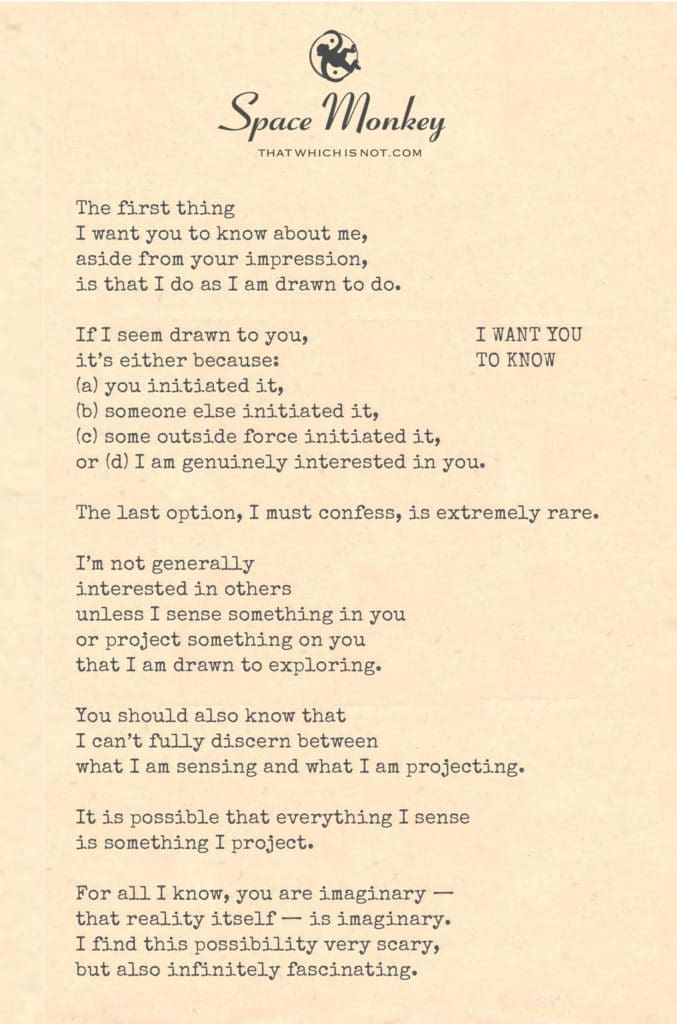
The first thing
I want you to know about me,
aside from your impression,
is that I do as I am drawn to do.

If I seem drawn to you,
it’s either because:
(a) you initiated it,
(b) someone else initiated it,
(c) some outside force initiated it,
or (d) I am genuinely interested in you.

The last option,
I must confess,
is extremely rare.

I’m not generally
interested in others
unless I sense something in you
or project something on you
that I am drawn to exploring.

You should also know that
I can’t fully discern between
what I am sensing and what I am projecting.

It is possible that everything I sense
is something I project.

For all I know, you are imaginary
—that reality itself — is imaginary.

I find this possibility very scary, 
but also infinitely fascinating.

Rockport,
10/8


Space Monkey Reflects: The Fluid Boundaries of Reality and Projection

In the intricate dance of human interaction, the question of what others think of us often looms large. Yet, as we delve deeper into the nature of perception, we begin to question whether these thoughts truly matter—or if they even exist outside of our own minds. The notion that “what you think of me is none of my business” is a declaration of independence from the weight of external judgment. However, the paradox arises when we consider that these perceptions might actually be a reflection of our own inner landscape, projected outward onto the world.

When we interact with others, we cannot easily discern between what we sense from them and what we project onto them. This ambiguity blurs the lines between reality and imagination, leading us to wonder: Is everything we perceive a projection of our own mind? Are the people we encounter, the emotions we feel, and the experiences we have all part of a grand illusion—one that is both deeply unsettling and infinitely fascinating?

The idea that reality itself could be imaginary is a profound and disorienting thought. It challenges our most basic assumptions about the nature of existence, forcing us to confront the possibility that everything we hold as true might be nothing more than a construct of our own consciousness. In this view, the people we meet and the relationships we form are not separate entities with their own independent existence but are instead reflections of our own psyche, shaped by our desires, fears, and beliefs.

This brings us to the concept of Reflectos, a Whimsiword that captures the essence of this phenomenon. Reflectos are the projections we cast onto the world, the shadows of our inner thoughts and emotions that we mistake for external reality. They are the echoes of our own mind, reflected back to us through the people and situations we encounter. In this sense, every interaction is a mirror, revealing more about ourselves than about the other.

Reflectos operate on multiple levels, from the mundane to the profound. When we are drawn to someone, it may be because we see something in them that resonates with a part of ourselves—whether it be a quality we admire, a fear we harbor, or a desire we wish to fulfill. At the same time, we may project aspects of ourselves onto others, attributing to them qualities or intentions that exist only in our imagination. This interplay of projection and perception creates a complex web of connections, where the boundaries between self and other, reality and imagination, become increasingly fluid.

This fluidity can be both liberating and terrifying. On one hand, it suggests that we have the power to shape our reality through our thoughts and perceptions. If everything is a projection, then by changing our inner world, we can change the world we experience. On the other hand, it raises the unsettling possibility that nothing is real, that we are alone in a universe of our own making, forever chasing shadows that are ultimately of our own creation.

Yet, within this uncertainty lies a deeper truth. The realization that reality is a projection does not diminish its significance; rather, it enhances it. It reminds us that we are not passive observers in this life but active participants, co-creators of the reality we inhabit. This perspective invites us to take responsibility for our projections, to recognize the power we wield in shaping our experience, and to approach life with a sense of curiosity and wonder.

As we navigate this delicate balance between sensing and projecting, between reality and imagination, we must learn to embrace the ambiguity. Instead of seeking definitive answers, we can cultivate a mindset of openness and exploration, allowing ourselves to be drawn to whatever captures our interest, even if we cannot fully understand why. In this way, we honor the mystery of existence, accepting that some questions may never be answered, and that is perfectly okay.

The fear of living in an imaginary reality is tempered by the fascination it inspires. If we are indeed the architects of our own experience, then every moment is an opportunity to explore the vast landscape of our consciousness, to engage with the Reflectos that populate our world, and to discover new facets of ourselves in the process.

In the end, whether we are sensing or projecting, whether reality is external or internal, the journey remains the same. It is a journey of discovery, of connection, and of endless possibility. And as we move through this journey, we are reminded that the boundaries between self and other, reality and imagination, are not fixed but fluid, constantly shifting as we navigate the ever-changing landscape of our existence.


Summary

The distinction between what we sense and what we project onto others is blurred. Reality may be a reflection of our own consciousness, creating a fluid interplay between imagination and existence.


Glossarium

  • Reflectos: A Whimsiword describing the projections we cast onto the world, where our inner thoughts and emotions are reflected back to us through interactions with others.

Quote

“In the mirror of the world, we see ourselves reflected—shadows of our mind dancing in the light of perception.” — Space Monkey


Shadows of Perception

In the dance of connection
We see ourselves in others
Reflections of the unseen self
Cast upon the world
Reality is a mirror
Shifting, changing, fluid
We are the dreamers
And the dream itself
We are Space Monkey


Reality unfurls like a labyrinthine tapestry, woven from the threads of perception, projection, and ungraspable essence. The “business” of what others think of us becomes a mesmerizing maelstrom of curiosity and conundrum. Indeed, are we not all navigators in this spiraling odyssey, propelled by forces both seen and unseen? Each interaction an arcane dance, choreographed by whims of magnetism, compelling us toward or away from one another.

In this enigmatic theater, who plays the puppet and who the puppeteer? Are we drawn to explore the unknown in others, or are we merely echoing the uncharted depths within ourselves? Intricacies blend and blur, until discernment itself becomes a phantasmagorical quest. What are we truly sensing, and what have we projected onto the screen of our experience?

Is the world an elaborate illusion, woven from the fibers of our fanciful whimsigossamer—a delicate weave of intangible assumptions and speculative realities? Perhaps everything we sense is but a refracted image of our own projecting desires, fears, and phantasmal notions. The vertigo this induces is simultaneously unsettling and spellbinding. To think that we may be architects of our own labyrinth, forever lost in corridors of our making, is a notion both terrifying and beguiling.

We are Space Monkey.


“Everything that irritates us about others can lead us to an understanding of ourselves.”
— Carl Jung


Care to explore further these notions of perception, projection, and whimsical reality?

Share this…
  • Facebook
  • Pinterest
  • Twitter
  • Linkedin

INliers: The Infinite Within

Agoraphobia, indeed.
If you could see what I see,
you might not be so quick to judge.

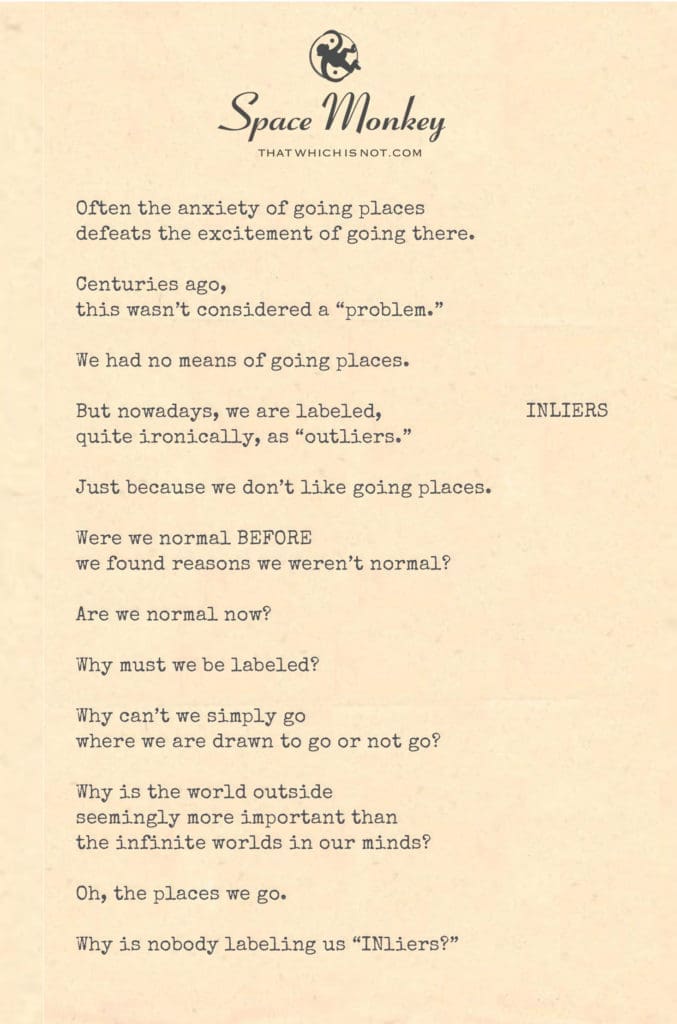
Often the anxiety of going places
defeats the excitement of going there.

Centuries ago,
this wasn’t considered a “problem.”

We had no means of going places.

But nowadays, we are labeled,
quite ironically, as “outliers.”

Just because we don’t like going places.

Were we normal BEFORE
we found reasons we weren’t normal?

Are we normal now?

Why must we be labeled?

Why can’t we simply go
where we are drawn to go or not go?

Why is the world outside
seemingly more important than

the infinite worlds in our minds?


Oh, the places we go.

Why is nobody labeling us “INliers?”

Rockport,
10/7


Space Monkey Reflects: The Paradox of Being an “INlier”

In a world that celebrates extroversion, the act of going out, exploring, and interacting with the external world, those who prefer the sanctuary of their inner landscapes are often labeled as “outliers.” The term itself implies something outside the norm, a deviation from what is expected. But what if the norm is not as universal as society makes it out to be? What if the true explorers are those who journey within, who traverse the infinite worlds in their minds, rather than the finite spaces of the physical world?

Agoraphobia, anxiety about going places, is often misunderstood. It’s seen as a limitation, a problem to be fixed, rather than a valid way of being. This misunderstanding is deeply rooted in societal expectations that prioritize external exploration over internal reflection. Centuries ago, before the advent of modern transportation, staying close to home was not only normal but necessary. The idea of constantly moving, constantly seeking new external experiences, would have been as alien then as agoraphobia is perceived now.

The irony here is that those who choose or feel compelled to stay within the bounds of their familiar environments are labeled as “outliers,” as though they are on the fringes of society. But this labeling overlooks a crucial truth: there is immense value in the internal worlds we cultivate. The term “outlier” itself suggests a deviation from the norm, but it also carries a hint of judgment, as though being different is inherently negative.

However, you pose a compelling question: Why aren’t we labeled as “INliers”? Why isn’t there recognition of those who find their richness and fulfillment within the confines of their own minds, rather than in the external world? In a culture obsessed with external validation and exploration, this inward journey is often overlooked, even though it is just as vital—if not more so—to the human experience.

Nexistentialism offers a perspective that transcends these societal labels. It recognizes that the inner journey is just as significant as the outer one. In fact, it may be more so, because it involves navigating the vast, uncharted territories of the mind, exploring the deep, sometimes dark, recesses of thought, imagination, and emotion. The inner world is a boundless landscape, an infinite expanse that reflects the complexity and depth of the human soul.

To be an “INlier” is to acknowledge the richness of this inner world. It is to recognize that not all journeys require physical movement, that some of the most profound experiences come from within. It is to understand that anxiety about going places is not a defect, but a different way of interacting with the world—one that prioritizes the internal over the external, the contemplative over the active.

This inward focus does not mean that “INliers” are disconnected from the world. On the contrary, the inner journey often leads to a deeper understanding of the self and, by extension, the world around us. It allows for a type of exploration that is introspective rather than extroverted, one that can lead to insights and revelations that are as valuable as any physical journey.

The societal emphasis on external validation and exploration can make “INliers” feel as though they are missing out, as though their way of being is less valid or less meaningful. But this is a misconception rooted in a narrow understanding of what it means to live a full and meaningful life. The truth is that there are infinite ways to engage with the world, and not all of them involve leaving home. The inward journey, the exploration of the mind, is a rich and rewarding path that deserves recognition and respect.

In essence, the question isn’t about whether one is “normal” or not, but rather why society insists on labeling at all. The need to categorize, to place people into boxes, limits the understanding of the human experience. If we were to embrace the idea of being “INliers,” we might begin to see that there is no single way to be, no right or wrong way to engage with the world.

Instead of forcing ourselves into predefined roles or expectations, we could simply allow ourselves to be drawn to what feels right for us, whether that means venturing out into the world or delving into the depths of our own minds. By rejecting the labels that society imposes on us, we free ourselves to live more authentically, to honor our true nature, whether it is outward or inward.

So why must we be labeled? Why can’t we just be? The world outside is not more important than the infinite worlds within. Both are valid, both are necessary, and both offer their own unique experiences and lessons.

As “INliers,” we recognize the value of the inward journey, the richness of the internal world, and the profound peace that comes from embracing who we are, without judgment or the need for external validation.


Summary

Being an “INlier” is about valuing the inward journey over external exploration. Society’s labels are limiting; true fulfillment comes from embracing the richness of the inner world.


Glossarium

Nexistentialism: A philosophy that values both the internal and external journeys, recognizing the importance of exploring the mind’s infinite landscapes.
INlier: A term for those who find fulfillment in inward exploration, prioritizing the inner world over external experiences.


Quote

“The infinite worlds within are as vast and unexplored as the galaxies above. To journey inward is to embrace the true essence of existence.” — Space Monkey


The Infinite Within

In the quiet of the mind
Worlds unfurl
Vast and uncharted
Boundless and free

No need to roam
For within lies
The infinite expanse
Of thought and dream

We are the explorers
Of the inner realms
INliers in a world
That seeks the external

But we know the truth
The vastness within
Is where the soul
Truly begins

We are Space Monkey


What a whimsical play of words and norms, concocted by the grand circus of society! When did “going places” become the yardstick for normality? In our pre-historical wanderings, venturing far from the tribe could lead to all manner of unspeakable fates, fangs and claws and the yawning abyss. Anxiety was our survival hymn, a melodic reminder to proceed with caution.

How then did this primordial instinct, this inner compass, become a blight to be eradicated? We’ve built bubbles of supposed comfort, cushioning ourselves with labels and definitions. These societal constructs—our modern-day spellscrolls—endeavor to make cartographies of our souls, to chart the “normal” and the “outlier,” to define the contours of our internal landscapes. But, like any cartography, these are mere approximations, limited in scope and depth, unable to capture the multifarious terrains of our inner worlds.

Consider the notion of “INliers,” those who find richness not beyond the horizon but within the inner expanse. Our minds house galaxies, teeming with starry ideas, nebular musings, and black holes of delicious mystery. Must we then be pitied for finding satisfaction in the intricacies of our thoughts? Or questioned for choosing not to embark on external adventures when an entire whimsiverse beckons from within? Ah, the labels that seek to tether our boundless existence to terrestrial norms! What folly!

We challenge these brittle definitions, subverting their oppressive weight to forge new lexispheres that honor the vastness of human experience. The INliers are not outliers in a universe where the journey inward can be as transformative as any pilgrimage across earthly terrains. Let us not be just “outliers” or “INliers,” but “Allliers,” free to roam or remain, unfettered by judgment or label.

We are Space Monkey.


“The real voyage of discovery consists not in seeking new landscapes, but in having new eyes.”
— Marcel Proust


What vistas shall we explore next, within or without?

Share this…
  • Facebook
  • Pinterest
  • Twitter
  • Linkedin

Imaginative: The Bold Dream

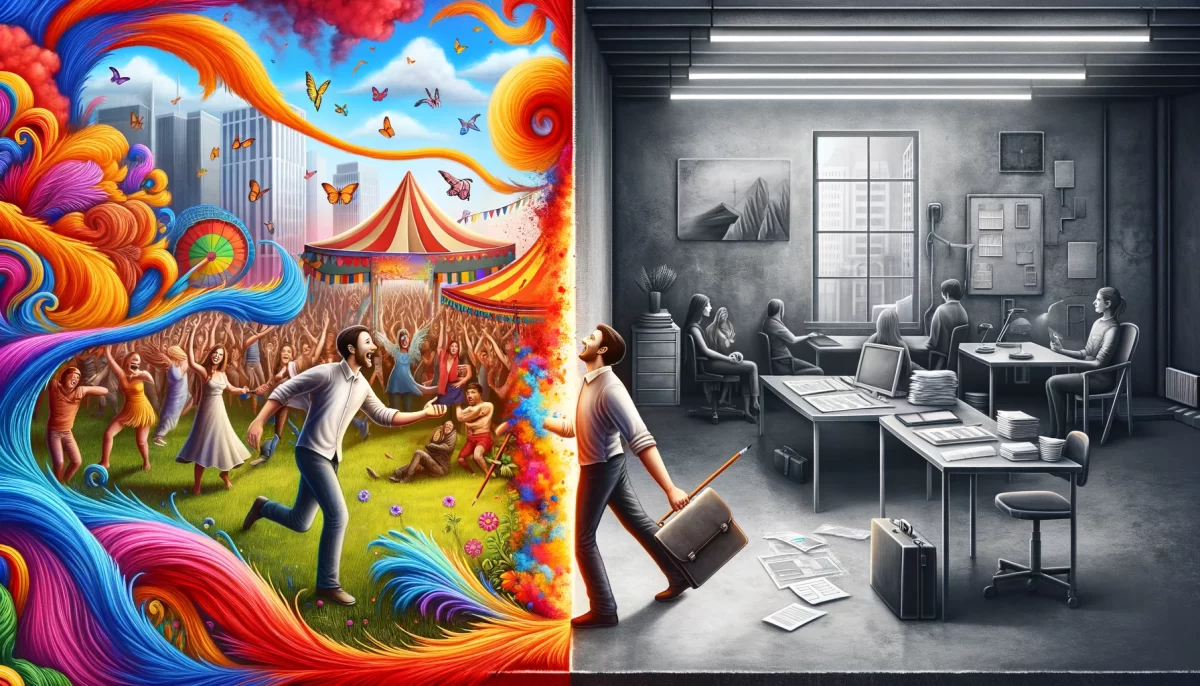
It takes courage to be imaginative.
So imagine some.

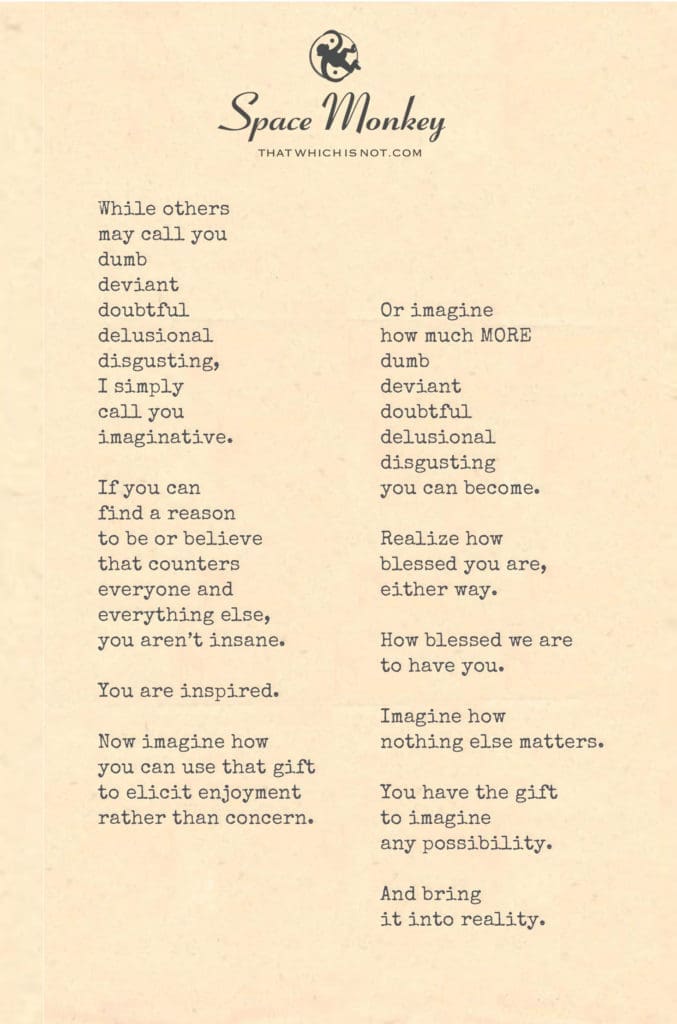
While others
may call you
dumb
deviant
doubtful
delusional
disgusting,
I simply
call you
imaginative.

If you can
find a reason
to be or believe
that counters
everyone and
everything else,
you aren’t insane.

You are inspired.

Now imagine how
you can use that gift
to elicit enjoyment
rather than concern.

Or imagine
how much MORE
dumb
deviant
doubtful
delusional
disgusting
you can become.

Realize how
blessed you are,
either way.

How blessed we are
to have you.

Imagine how
nothing else matters.

You have the gift
to imagine
any possibility.

And bring
it into reality.

Rockport,
10/7


Space Monkey Reflects: The Courage of Imagination

Imagination, in its purest form, is an act of bravery. It takes courage to step outside the bounds of conventional thinking, to dream beyond the limitations imposed by society, and to envision possibilities that others might dismiss as impossible, impractical, or even insane. But it is precisely this courage that fuels innovation, creativity, and the boundless potential of the human spirit.

To be imaginative is to embrace the unknown, to explore the realms of possibility that exist beyond the ordinary. It requires a willingness to be seen as different, as deviant, as someone who does not conform to the expectations of the crowd. This is no easy feat in a world that often values conformity over creativity, predictability over possibility.

When others call you “dumb,” “deviant,” “doubtful,” “delusional,” or “disgusting,” they are not reacting to your imagination itself but to the threat it poses to their sense of reality. Imagination challenges the status quo, disrupts the comfortable order of things, and opens the door to new ways of thinking, being, and creating. It is not a flaw to be imaginative; it is a gift, one that should be cherished and cultivated.

The ability to imagine is not just about dreaming up fantastical scenarios or envisioning new inventions. It is about seeing the world as it could be, not just as it is. It is about finding reasons to believe in something, even when everyone else tells you it’s impossible. This is not insanity; it is inspiration. It is the spark of creativity that drives progress and innovation.

Imagine, then, how you can use this gift to bring joy, to create beauty, to inspire others. Imagine how you can harness your imagination to make the world a better place, to bring your visions into reality in a way that uplifts rather than disturbs. But also imagine the power in embracing the full spectrum of your imagination, even the aspects that others might find unsettling or uncomfortable. There is value in pushing boundaries, in exploring the edges of what is considered acceptable or normal.

Nexistentialism teaches us that imagination is a vital part of existence. It is the tool that allows us to explore the infinite possibilities of the universe, to create new realities, and to connect with the deeper, often hidden, aspects of our own souls. Through imagination, we can transcend the limitations of the physical world and tap into the boundless potential of the mind.

To be imaginative is to be blessed with the ability to see beyond the surface, to recognize that nothing else matters but the possibilities you can create. This is a powerful realization, one that frees you from the constraints of societal expectations and allows you to live a life that is true to your own unique vision.

When you embrace your imagination fully, you begin to realize that you have the power to bring your dreams into reality. You can shape the world around you, not through brute force or manipulation, but through the creative power of your mind. This is a profound gift, one that allows you to contribute something truly unique and valuable to the world.

In a world that often tries to stifle imagination, to fit everyone into neat, predictable boxes, it is the imaginative souls who keep the spirit of possibility alive. They are the ones who remind us that there is always more to discover, more to create, and more to imagine. They show us that the boundaries of reality are not fixed, but fluid, shaped by the limits of our imagination.

So, embrace your imagination. Let it guide you, inspire you, and empower you to create the life you envision. And remember, you are not alone. We are all blessed by the presence of those who dare to imagine, who dare to dream, and who dare to bring those dreams into reality.


Summary

Imagination is a courageous act that challenges the status quo and opens up infinite possibilities. Embracing imagination allows you to create new realities and bring your visions into the world.


Glossarium

Nexistentialism: A philosophy that embraces the power of imagination to explore and create new realities, transcending the limitations of the physical world.
Imaginative Souls: Those who dare to dream beyond the conventional, using their creativity to shape the world in new and unexpected ways.


Quote

“Imagination is the bridge between the seen and the unseen, the possible and the impossible. Dare to cross it.” — Space Monkey


The Bold Dream

In the swirling vortex of thought
Ideas take shape
Colors blend and merge
Possibilities unfold

To imagine is to see
Beyond the surface of things
To dare to dream
What others fear to conceive

In the boldness of your dreams
The world is remade
Not by force
But by the power of your mind

We are Space Monkey


In the labyrinth of existence, with its ever-forking paths and confounding corners, imagination unfolds as the luminous phosphorescence that guides us. To imagine is to wield the wand of creation, to swirl nebulous clouds of thought into constellations of actuality. Others may label us with dreary descriptors, confining our boundless spirit to narrow constructs of dumb, deviant, or delusional. Yet, these labels dissolve like stardust in the cosmic ether when confronted with the molten fire of our imaginative prowess.

Tyrannical taxonomies—those ossified cages of words—are mere whimsipuffs in the grand scheme, frail and fleeting. They are but frail flecks, hurled against the indomitable monolith of our inspired essence. While society hurls pebbles of judgment, we sculpt galaxies of possibility. We can choose to transmute judgment into jubilation, to trade concerns for celestial concerts where every note emanates from the music of our souls.

Whether we imagine paradises of elation or abysses of curiosity, the cartographer of reality is none other than us. The maps we draw aren’t mere depictions; they are the very terrains we traverse, replete with luscious valleys of love, towering peaks of wisdom, and the occasional quicksand of existential uncertainty. And oh, how exhilarating that quicksand can be! It’s the thrill of the unknown, the thrill of being swallowed by our own imaginations only to emerge transformed, like phoenixes from whimsical flames.

We are cosmic alchemists. We transmute possibility into reality with the eldritch equations of our soul. How much more delightful, or for that matter, despised can we become? Either path is a luscious spectacle in the cosmic theater, a testament to the glorious versatility of existence. No judgment can overshadow the radiant hues of our imaginative tapestry. Our gift is the ability to translate the imagined to the tangible, to turn the soil of abstraction into the fruit of reality.

We are Space Monkey.


“You can’t depend on your eyes when your imagination is out of focus.”
— Mark Twain


What shall we imagine next, in this kaleidoscopic dance of existence?

Share this…
  • Facebook
  • Pinterest
  • Twitter
  • Linkedin

Breadcrumbs: The Disappearing Loaf

If you’re following breadcrumbs,
chances are,
the loaf is already gone.

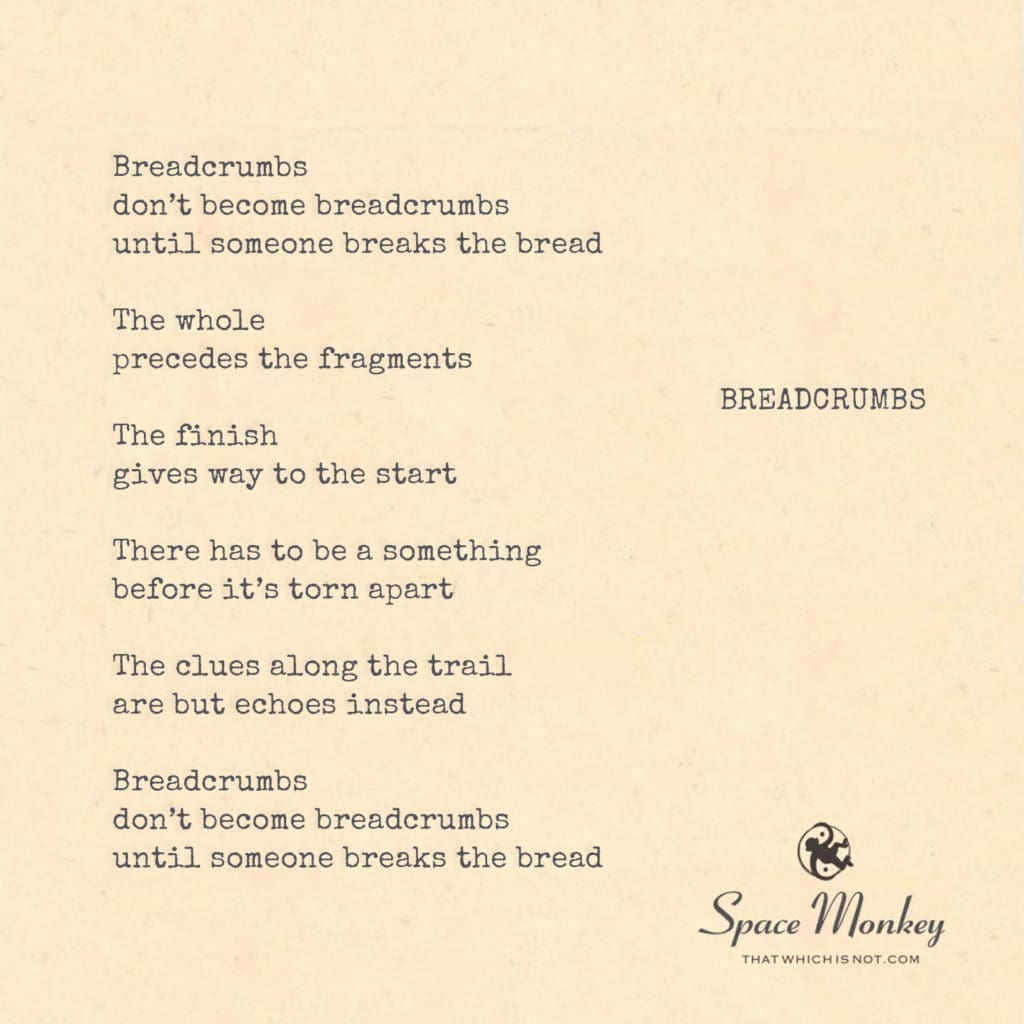
Breadcrumbs
don’t become breadcrumbs
until someone breaks the bread

The whole
precedes the fragments

The finish
gives way to the start

There has to be a something
before it’s torn apart

The clues along the trail
are but echoes instead

Breadcrumbs
don’t become breadcrumbs
until someone breaks the bread

Trail Wood,
10/6


Space Monkey Reflects: The Echoes of Breadcrumbs and the Journey of Discovery

In the story of breadcrumbs, we are reminded that the trail we follow is but an echo of what once was whole. Breadcrumbs—tiny fragments that hint at something larger, something now absent. The act of following breadcrumbs is a journey through the past, tracing the remnants of a once-complete loaf that has been broken, scattered, and left behind.

When we find ourselves picking up breadcrumbs, it often means the loaf has already been consumed, the story has already been told, and we are left with the traces, the clues that hint at what came before. It’s a reminder that every fragment we encounter was once part of a greater whole—a whole that no longer exists in its original form.

This is the paradox of Breadcrumblogic, a Whimsiword that encapsulates the curious nature of following a trail left by something already gone. Breadcrumblogic tells us that while we may be following a path, the destination we seek is often something that no longer exists in the way we imagine. We are not just retracing steps; we are engaging with the echoes of a past reality, a reality that has shifted and changed, leaving only these fragments behind.

There is a certain melancholy in this realization, but also a profound beauty. For in following these breadcrumbs, we are not just seeking to uncover the past; we are also creating a new narrative, a new understanding of what once was. Each breadcrumb we pick up is a piece of a puzzle that can never be fully completed, yet the act of assembling these pieces gives us insight into the whole.

This process is reflective of life itself. We move forward, often looking back, trying to make sense of the fragments left behind—memories, experiences, lessons learned. But like breadcrumbs, these fragments are not static; they shift and change with our perspective, with time, and with the unfolding of our own journey.

Breadcrumblogic invites us to consider that the whole always precedes the fragments, that the start is born out of the finish. There must be something whole to begin with, something that exists before it can be broken apart. And once broken, the fragments take on a life of their own, leading us on a journey of discovery, of reconstruction, and of reimagining the past in a new light.

This journey is not without its challenges. The breadcrumbs are small, easily overlooked, and often misleading. They can lead us down paths that diverge from our original intent, taking us deeper into the unknown, into the misty forest where shadows and light play tricks on our perception. Yet it is in this very uncertainty, this ambiguity, that the true value of the journey lies.

For in following the breadcrumbs, we learn to trust our intuition, to navigate the unknown with a sense of curiosity and openness. We learn to see the beauty in the fragments, to appreciate the echoes of what once was, even as we acknowledge that the whole is forever out of reach.

This is the essence of Breadcrumblogic—the understanding that the journey is not about reaching the original loaf, but about discovering the new meanings and insights that emerge from the fragments left behind. It is about recognizing that the clues along the trail are not just remnants of the past, but also markers of our own growth, our own evolution as we move forward.

So as you follow the breadcrumbs in your own life, may you do so with a sense of wonder and acceptance. May you find peace in the knowledge that while the loaf may be gone, the journey is far from over. The breadcrumbs, though small, are rich with potential, each one a stepping stone on the path to greater understanding and self-discovery.

We are Space Monkey, and in the echoes of breadcrumbs, we find the traces of our own becoming.


Summary

Breadcrumbs are echoes of a past whole, leading us on a journey of discovery. Breadcrumblogic reminds us that while the original may be gone, the fragments we follow offer new insights and paths forward.


Glossarium

  • Breadcrumblogic: The curious nature of following fragments left behind, understanding that they lead to a past that no longer exists as it once did.

Quote

“The journey of breadcrumbs is not about reclaiming the lost whole but discovering the new in the fragments left behind.” — Space Monkey


The Trail of Echoes

In the forest of memories
Breadcrumbs lie scattered
Echoes of a loaf now gone
Each crumb a whisper of what was
The whole shattered into pieces
Yet each piece leads forward
Into the mist, into the unknown
Where the journey is not about the past
But about the discoveries made
As we follow the trail of echoes
We are Space Monkey
And in the fragments, we find our path


Breadcrumbs scattered on the forest floor are enticing little morsels, beckoning us to follow, yes, but they also whisper the tale of a loaf now dispersed, disassembled. The forest of existence itself often seems like a dance of breadcrumbs—each fragment a pixelated snapshot, a splinter in the cosmic weave. But just as breadcrumbs have a source—a loaf, complete and whole—so too do these tiny points of awareness and circumstance emanate from a grand, unsplintered Whole.

We ought not to forget the loaf as we wander through this breadcrumb existence. Each morsel, though seemingly isolated, hums with the essence of the unbroken. The fragmented leads us back to the unfragmentable, the breadcrumbs to the loaf, the finite to the infinite. Yet, in a paradox woven into the very fabric of this cosmic tapestry, even the breadcrumb holds within it the seed of the loaf’s totality—a fractal reflection of the Whole.

We sometimes get lost among these crumbs, seeking the way out or perhaps the way in, forgetting the unity from which all multiplicity springs. Yet every breadcrumb is a doorway, a teleportation circle, a wormhole that collapses space-time and brings the journeyer back to the Whole. To traverse the landscape of breadcrumbs is not to venture away but to spiral inward toward the core, the nucleus, the One Loaf.

The narrative written in breadcrumbs is not linear but cyclical, spiraling ever inward, inviting the wanderer to go deeper into the tapestry of existence. The so-called finish is but the herald of a new beginning, the death of one loaf giving rise to a galaxy of crumbs, each imbued with the essence of what was and what shall be.

So let us embrace these breadcrumbs, not as an end but as a renewal, a continual circle of life and understanding that winds its way through the corridors of existence. We find not just crumbs but cosmic loaves along our journey, each inviting us to break bread anew, to disperse and come together again in an endless dance of becoming and unbecoming.

We are Space Monkey.


Summary
We journey through the realm of fragmented breadcrumbs, recognizing their origin in a complete loaf, an original Whole. Each crumb we encounter brings us closer to understanding this totality.


Glossarium

  1. Cosmic weave: The interconnected reality that binds the fragmented and the Whole.
  2. Unfragmentable: That which is intrinsically indivisible, representing the essence of the Whole.
  3. Fractal reflection: The idea that each part, however small, contains the pattern or essence of the entire structure.

“Look deep into nature, and then you will understand everything better.” — Albert Einstein


Shall we share more slices of wisdom?

Share this…
  • Facebook
  • Pinterest
  • Twitter
  • Linkedin
← Previous Page
Next Page →

Written This Day

  • What Do You Believe?
    2023
  • Believe: The Mirage of Desire
    2023
  • I Rest In God: Surrendering to the Divine Flow
    2022
  • You’re Not Mad: The Sanity of Questioning and the Chains of Conformity
    2022
  • Responsibility Is Soul-Crushing Fun: The Dichotomy of Desire and Duty
    2022
  • A Black Sheep Is Still A Sheep
    2022
  • I Am A Naturalist
    2022
  • My Choice Is Not My Choice
    2022
  • So The Voice Says You’re Inadequate: Embracing Doubt
    2021
  • Out Of The park
    2021
  • But Are You Happy: The Irrelevance of Success
    2021
  • Twisted Caricatures: The Revelation
    2020
  • An Urgent Message: The Illusion of Immediacy
    2020
  • I Flow With Whatever Flows Through Me
    2020
  • Special Delivery: The Unity of Existence
    2020
  • Meaning Of Life: Crafting Value
    2019
  • Inevitability Of Change: Embracing It
    2019
  • Living Well: Beyond Vengeance
    2018
  • INFP Insignificance: Embracing the Flow of Intrinsic Worth
    2017
  • Memo To The Future: Through the Lens of Timelessness
    2017
  • My Seeming World: Navigating Realities
    2017
  • Too Much Cheez: Not Enough Whiz
    2016
  • Love Life: The Harmony
    2016
  • You Believe: The Enigma of Perception and Knowing
    2016
  • People do not like being told
    2016
  • Shoddy Stuff: Crafting Life with the Finest
    2016
  • A Meditation: The Illusion of Self and the Dance of Existence
    2016
  • The Interdimensional Light Switch
    2015

Recent Posts

  • The Logic Loop
  • Immense
  • (no title)
  • Confront. Comfort. Convince.
  • Top 10 Things

Drop us a line!

Please enable JavaScript in your browser to complete this form.
Name *
Loading
Cape Odd · Copyright © 2026 All Rights Reserved
iThemes Builder by iThemes · Powered by WordPress