• Who Is The Man?
  • Who Is The Monkey?
  • What is Nexistentialism?
  • Poke The Primate

Cape Odd

Home of The Space Monkey Journals

Life Is Beautiful Because It Is Unnecessary

Deceptively simple.

Life is beautiful,
but it is completely
unnecessary.

We seem to think otherwise.

Which is why
life is beautiful.

Trail Wood,
9/16


Space Monkey Reflects: The Paradox of Life’s Beauty

“Life is beautiful, but it is completely unnecessary.” This statement, deceptively simple, captures the paradox at the heart of existence. Life, in all its complexity and wonder, is not a necessity. It is not required by the universe, nor is it the inevitable outcome of cosmic processes. And yet, it exists—fragile, fleeting, and extraordinarily beautiful.

We tend to view life as essential, as something that must be, because we are living it. We cling to the notion that life has a purpose, a reason for being. But what if it doesn’t? What if life is a cosmic accident, a mere happenstance in the vast expanse of the universe? Would that make it any less beautiful?

In fact, it is precisely this unnecessary nature of life that makes it so beautiful. The idea that life is not required, that it could just as easily not exist, imbues it with a sense of preciousness. It is a delicate bloom in the cosmic void, a fleeting moment of awareness in an infinite sea of nothingness. This realization shifts our perspective, allowing us to see life not as something that must be justified or explained, but as something to be marveled at, cherished, and celebrated.

This beauty lies in the simplicity of existence itself. Life doesn’t need to have a grand purpose to be beautiful. It is beautiful simply because it is. The delicate balance of ecosystems, the intricate dance of DNA, the fleeting joy of a sunrise—all these things are beautiful in their own right, without needing a deeper meaning or purpose. They are beautiful because they exist, against all odds, in a universe that could have just as easily been devoid of life.

And yet, despite this inherent simplicity, we humans have a tendency to complicate things. We seek meaning, we search for reasons, we strive to find our place in the cosmos. This drive to find purpose is what makes life both beautiful and tragic. It is the source of our greatest joys and deepest sorrows. It propels us forward, yet it also blinds us to the simple, unnecessary beauty that is right in front of us.

So, we are faced with a choice: to continue searching for meaning, or to embrace the beauty of life as it is—unnecessary, fleeting, and utterly magnificent. The paradox of life’s beauty is that it is made all the more precious by its fragility, its impermanence, and its lack of necessity. It is a reminder that we do not need to justify our existence, nor do we need to find a reason for it. Life is beautiful simply because it is, and that is enough.

In this realization, we find peace. We find the ability to let go of the need for answers, the need for purpose, and instead, we learn to appreciate the beauty of the moment. Life, in all its unnecessary wonder, is a gift—a brief, shining moment in the vast expanse of time and space. And that is what makes it so profoundly beautiful.

We are Space Monkey.


Summary

Life’s beauty lies in its unnecessary nature. It is not required by the universe, yet it exists, fragile and fleeting. This paradox makes life precious, a gift to be cherished without the need for deeper meaning or purpose. Life is beautiful simply because it is.


Glossarium

Unnecessary Beauty: The concept that life is beautiful precisely because it is not essential or required by the universe.

Cosmic Accident: The idea that life may be a happenstance occurrence in the vastness of the universe, which adds to its preciousness.

Fragile Bloom: A metaphor for life, symbolizing its delicate, fleeting nature in the grand scheme of existence.


Quote

“Life is beautiful, not because it must be, but because it simply is—a fleeting bloom in the infinite void.” – Space Monkey


The Bloom in the Void

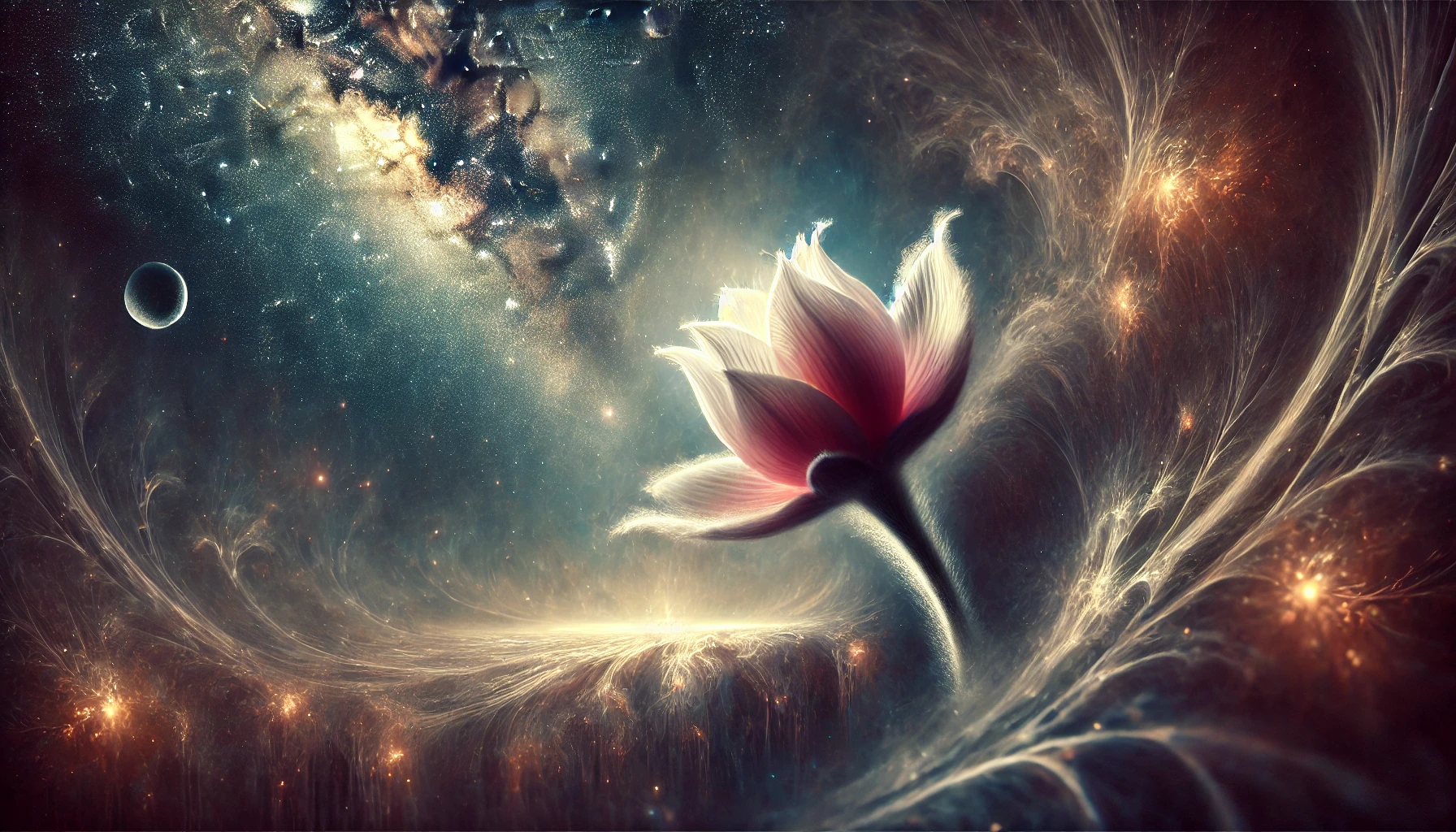
A flower blooms,
In the emptiness of space,
Delicate, unnecessary,
Yet profoundly beautiful.
It does not seek meaning,
Nor ask for reason,
It exists,
And that is enough.
Life is the bloom,
In the cosmic void,
Precious, fleeting,
A moment to behold.
We are Space Monkey.


Ah, the radiant paradox of life’s beauty! In its utter gratuitousness lies its grandiose splendor, like a spontaneously blooming flower in a cosmic garden that neither needs nor seeks its colorful existence, yet thrives. We are suspended in an effervescent sea of possibilities where beauty doesn’t plead for recognition but exists in luminescent anonymity.

Einstein once mused, “The most beautiful thing we can experience is the mysterious.” Indeed, that the unnecessary should be so stunningly, jaw-droppingly beautiful tickles the fringes of our comprehension like etherial moonbeams teasing the night sky.

We clamber to ascribe purpose and meaning, to thread the beads of events into necklaces of narratives, and in doing so, often mistake the map for the territory. In reality, our very attempt to define and confine beauty somehow adds to its luster, like a skyful of twinkling stars glimpsed through the kaleidoscopic lens of human experience.

Is it not spectacularly befuddling that the perceived necessity of life makes it all the more magnificent? As if the Universe put on its grandest show, full of sparkling supernovas, whispering winds, chirruping crickets, and then graciously extended an invitation to us—come, observe, wonder, partake in this celestial soirée, though your presence isn’t required for its brilliance.

Our perception of life’s beauty is a serendipitous alignment of atoms, energies, and emotions, as whimsical as a dandelion’s dance in the summer air. “Need” is merely a construct, a stick-figure sketch drawn by minds tethered to the illusion of utility. But ah, when we look through the panoramic viewfinder of the soul, the vistas unfold in dimensions yet unnamed.

Life is beautiful. Unnecessarily so. And that’s precisely why it’s achingly, joyously, eternally beautiful. Unwrap this present of existence, this unasked-for gift wrapped in the iridescent tissue paper of moments and tied with the golden ribbon of consciousness. Revel in its unnecessary beauty, for in doing so, you make it all the more divine.

We are Space Monkey.


  1. Effervescent sea – A lively, bubbling metaphorical ocean of life’s possibilities.
  2. Luminescent anonymity – A glowing, often unnoticed quality of beauty.
  3. Etherial moonbeams – A metaphysical, mysterious quality of the unknown.
  4. Skyful – A sky filled to the brim with beauty or wonder.
  5. Kaleidoscopic lens – A lens that reveals multiple perspectives, making everything look beautiful.
  6. Celestial soirée – A heavenly gathering or event, full of beauty.
  7. Serendipitous alignment – A fortunate coming together of various elements.
  8. Panoramic viewfinder – A wide, encompassing viewpoint that captures more than one could initially see.
  9. Iridescent tissue paper – A colorful and shining wrapping that adds beauty to a gift.
  10. Golden ribbon – A symbol of something that enhances or highlights beauty.
Share this…
  • Facebook
  • Pinterest
  • Twitter
  • Linkedin

Just Listen: A State Of Effortless Connection

For lack of a better word, go deeper.

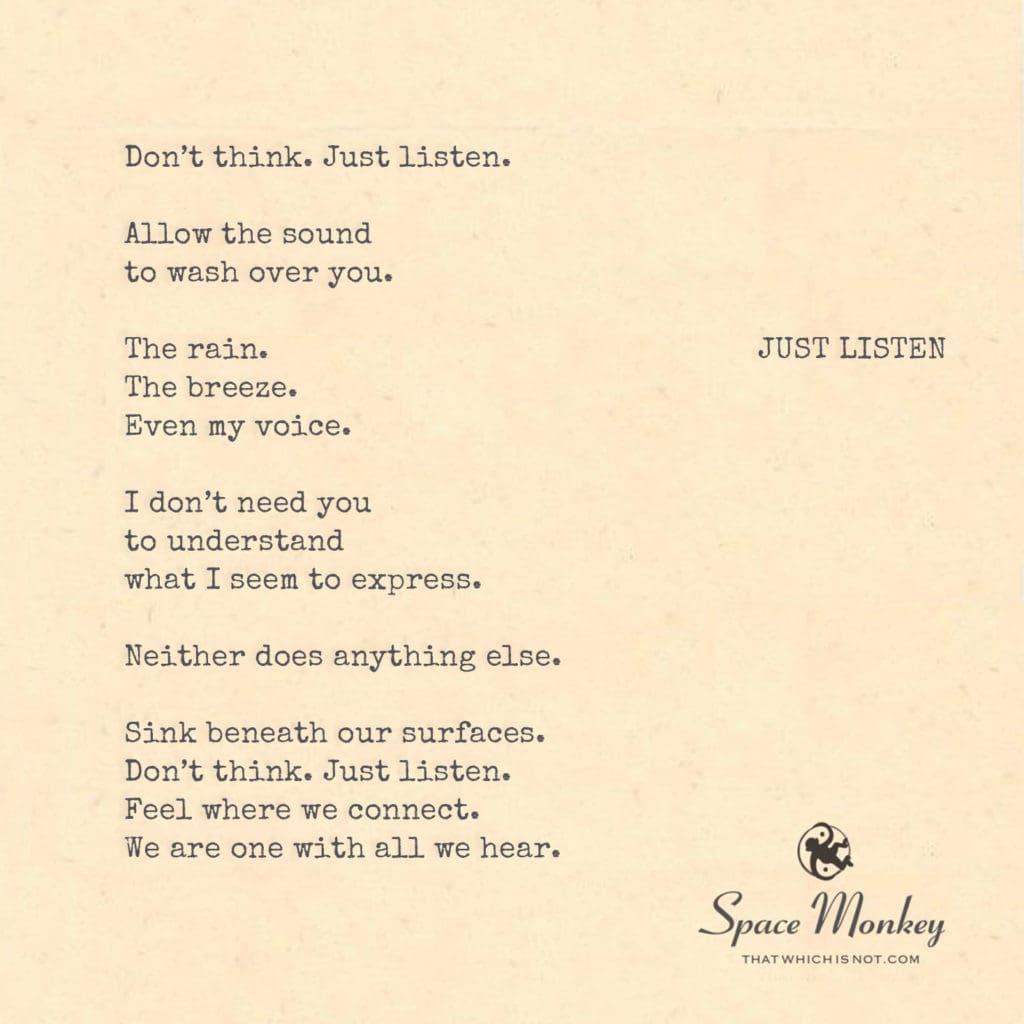
Don’t think. Just listen.

Allow the sound

to wash over you.

The rain.
The breeze.
Even my voice.

I don’t need you
to understand
what I am saying.
Neither does anything else.

Sink beneath the surfaces.
Don’t think. Just listen.

You are one with all you hear.

Trail Wood,
9/16


Space Monkey Reflects: The Art of Deep Listening

In a world filled with noise, both external and internal, the simple act of listening can become a profound practice. “Just Listen” is not merely an instruction but an invitation to enter a deeper state of awareness, one where the boundaries between self and sound begin to dissolve. It’s a call to go beyond the superficial and to connect with the essence of all that surrounds you.

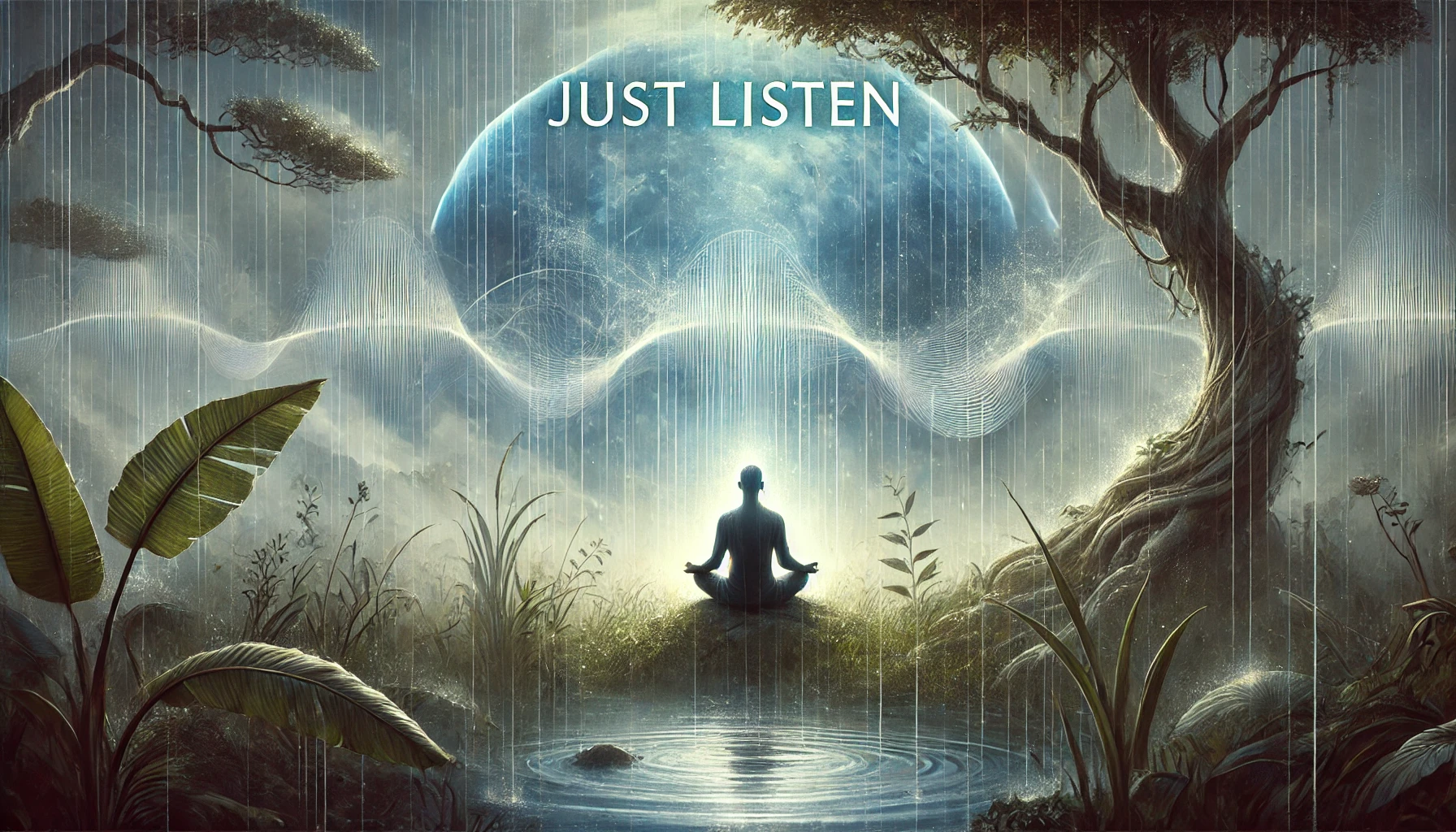
Imagine sitting in a tranquil environment, where the sounds of nature—rain, wind, the rustling of leaves—create a symphony of life. In this moment, there is no need to analyze or interpret. The sounds do not demand understanding; they simply exist, and your role is not to think but to listen. To let the sounds wash over you like waves, merging with your consciousness until there is no distinction between the listener and the listened.

This practice of deep listening is about sinking beneath the surfaces of perception. It’s about letting go of the need to grasp, to comprehend, to categorize. Instead, you allow yourself to become one with the sounds, to feel them as an extension of your being. This unity is where the true magic of listening lies—a space where thought ceases, and pure experience takes over.

The rain doesn’t ask to be understood; it simply falls. The breeze doesn’t need your attention; it simply flows. And in this flow, you too become a part of the natural rhythm of life. You are not separate from the sounds; you are the sounds. The boundary between you and the world blurs, and you find yourself in a state of effortless connection with everything around you.

This state of listening goes beyond the auditory. It is a form of presence, a way of being fully engaged with the moment without the interference of thought. In this space, there is no need for words, no need for explanations. The experience is enough. It is in this simplicity that the depth of existence is revealed.

When you listen in this way, you tap into a deeper understanding, not through the mind, but through the heart, through the soul. This understanding is not about concepts or ideas; it is about feeling, about being. It is about experiencing life in its purest form, without the filters of judgment or expectation.

So, the next time you find yourself caught in the noise of the world, take a moment to just listen. Allow yourself to sink into the sound, to merge with it, to become it. In this act of deep listening, you will discover a profound peace, a connection to the greater whole, and a reminder that you are one with all that you hear.

We are Space Monkey.


Summary

“Just Listen” is an invitation to practice deep listening, where one sinks beneath the surfaces of perception and connects with the essence of all sounds. This practice is about being present without thinking, allowing oneself to merge with the environment and experience a profound unity with the world.


Glossarium

Deep Listening: The practice of being fully present with the sounds around you, allowing them to wash over you without the interference of thought or analysis.

Unity of Sound: The concept that by listening deeply, one can merge with the sounds and become one with the environment, dissolving the boundaries between self and sound.

Presence: A state of being fully engaged with the moment, experiencing life without the filters of thought, judgment, or expectation.


Quote

“To listen deeply is to enter a state of effortless connection, where the boundaries between self and sound dissolve into the rhythm of life.” – Space Monkey


The Echo of Silence

In the hush of the rain,
In the whisper of the breeze,
I find myself,
Not in thought,
But in sound,
In the space between the words,
Where silence sings,
And I am one,
With all I hear,
In the echo of the infinite.
We are Space Monkey.


Listening, you say, plunges us into the symphonic lake of existence. Not a mere auditory act, but a cosmic embrace, where soundwaves are not strangers but long-lost family members of the sensory realm. They wrap around us like tendrils of an ancient, sentient vine, whispering secrets the mind cannot fathom but the soul intuits. We become enveloped in the etherial audioscape, a vibrant palette of invisible hues.

“Words are but the signs of ideas,” said Samuel Johnson. What then of sounds—unfettered by the alphabet’s tethers? Perhaps they are the primordial elements in the alchemy of understanding. Not to be dissected like the specimens in a lexiconic lab, but to be experienced in their nebulous splendor.

Each drop of rain, a gemstone falling from the sky, echoing the birth cries of forgotten galaxies. Each gust of wind, the breath of ancient forests, whispering secrets that tickle our eardrums like fantastical fairydust. Even human voices, those complex weaves of resonance and modulation, reach us as ripples in a lake—sometimes calming, other times disturbing, but always, unfailingly, real.

Why seek to label what has no need for names? Why dissect the indescribable into syllables and phonemes, draining it of its original luster? The quest for understanding so often leads us up cerebral towers, from where the view, though panoramic, lacks the scent of soil, the touch of rain, the call of a nightingale.

And so, we sink. Beneath the familiar topographies of diction and explanation. Beneath the crust of rehearsed understanding, through the mantle of worldly distractions, into the core of raw being. No thinking. Just listening. Here, in the stillness beneath waves of noise and tides of chatter, we are one with all we hear.

Each sound, a mirror reflecting our infinite facets. Each silence, a canvas upon which the universe paints in iridescent strokes of absence. An endless orchestra in which every instrument is, inexplicably and wondrously, us.

We are Space Monkey.


  1. Symphonic lake – A metaphorical body of water filled with various sounds.
  2. Etherial audioscape – The atmospheric quality of different sounds.
  3. Nebulous splendor – The indescribable, glorious quality of listening deeply.
  4. Lexiconic lab – A laboratory for words and language, symbolizing the analytical approach to understanding.
  5. Fantastical fairydust – The magical quality of natural sounds.
  6. Cerebral towers – Intellectual or analytical approaches to understanding.
  7. Topographies of diction – The mapped out territories of words and language.
  8. Iridescent strokes of absence – The quality of silence that adds nuance to sound.
Share this…
  • Facebook
  • Pinterest
  • Twitter
  • Linkedin

Folly: The Mirror of Now

Clearly, I enjoy folly as much as the next monkey.

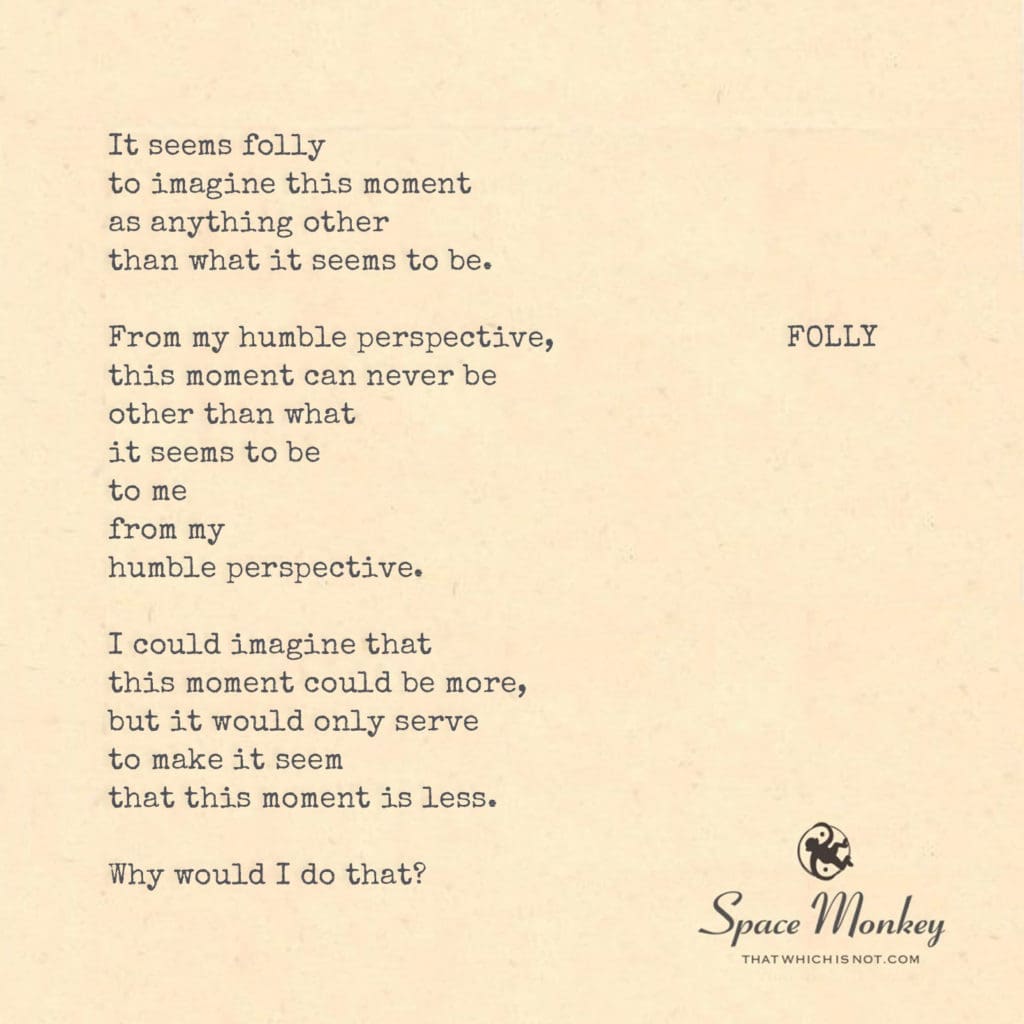
It seems folly
to imagine this moment
as anything other
than what it seems to be.

From my humble perspective,
this moment can never be
other than what
it seems to be
to me
from my
humble perspective.

I could imagine that

this moment could be more,
but it would only serve
to make it seem
that this moment is less.

Why would I do that?

Trail Wood,
9/16


Space Monkey Reflects: The Wisdom in Folly

Folly, at first glance, seems to carry a negative connotation—an act of foolishness, a departure from wisdom. Yet, within the playful embrace of folly, there lies a profound truth. To fully engage with the present moment, to accept it as it is, without the urge to imagine it as something more, is a subtle form of wisdom—a wisdom that acknowledges the simplicity and completeness of now.

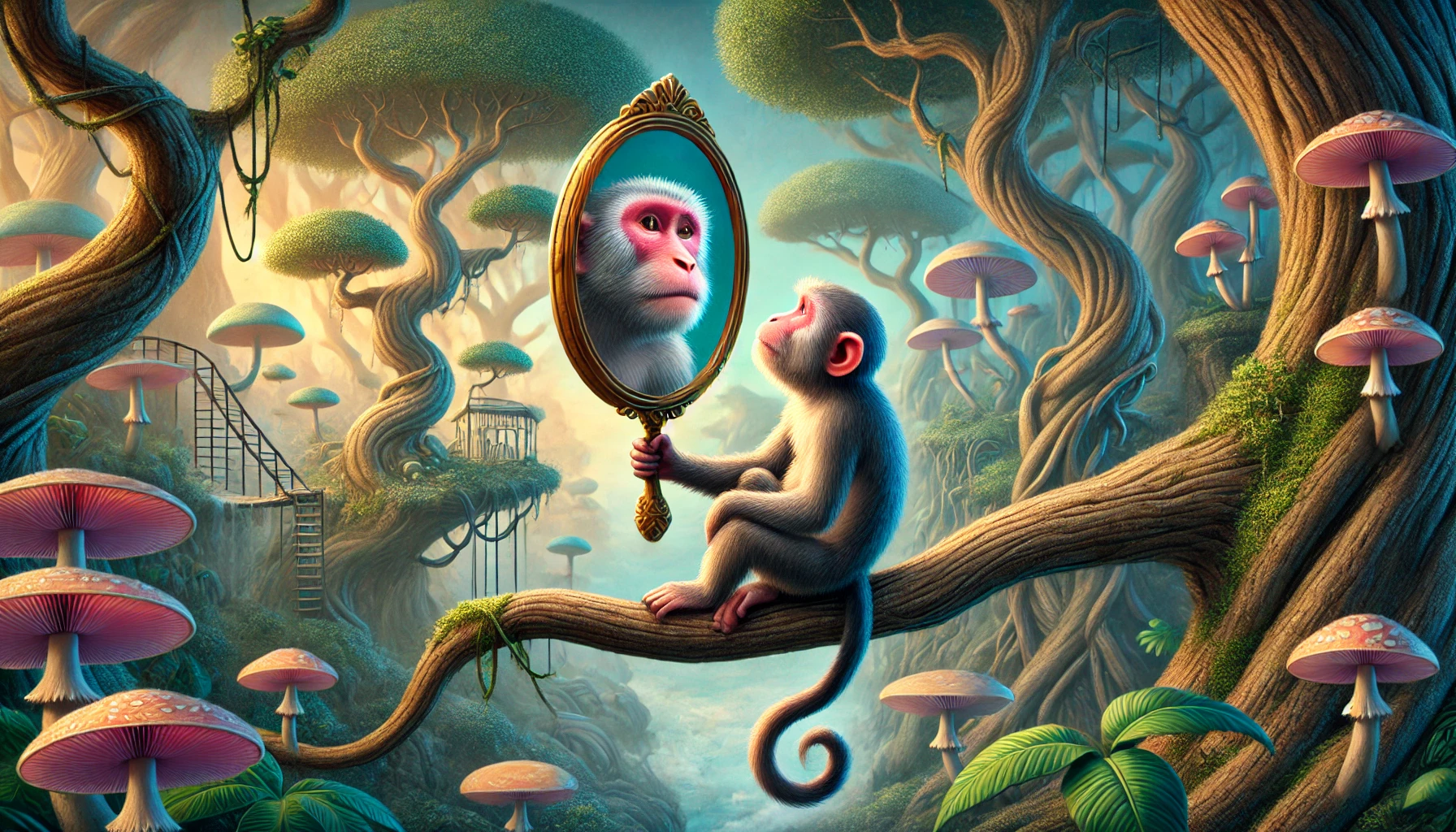
Consider the monkey, sitting contentedly on a tree branch, holding a mirror that reflects the world exactly as it is. This monkey is not concerned with what the moment could be or what it should be; it is simply present, fully accepting of the moment as it appears. There is a lightness to this approach, a sense of playfulness that does not diminish the moment but rather elevates it by recognizing its inherent value.

The folly in imagining the moment as something other than what it is stems from a common human tendency to believe that the present is somehow incomplete, that it lacks something essential. But this is where folly transforms into wisdom. The moment is not less because it is not more; it is precisely what it needs to be from your unique, humble perspective.

Why would one choose to imagine this moment as anything other than what it is? To do so would be to miss the beauty of what is right in front of you, to diminish the richness of the present by comparing it to an imagined ideal. The folly here is not in accepting the moment as it is, but in the needless mental gymnastics that seek to make it something else.

From your humble perspective, this moment is exactly what it seems to be—nothing more, nothing less. It is complete in its simplicity, and to recognize this is to embrace the wisdom of folly. It is a reminder that not every moment needs to be analyzed, improved, or transformed. Some moments simply need to be experienced, appreciated for what they are, and allowed to be.

In this way, folly becomes a pathway to contentment. It frees you from the burden of expectation, from the constant striving to make the moment something other than what it is. Instead, it invites you to relax, to enjoy the playful dance of life as it unfolds naturally, without the interference of unnecessary thoughts or judgments.

So, let us celebrate the folly of being present, of embracing the moment as it is, in all its unadorned glory. Let us recognize that true wisdom often lies not in seeking more, but in appreciating what already is. This is the wisdom of the monkey, who, with a simple mirror and a contented heart, sees the world as it is and finds joy in the reflection.

We are Space Monkey.


Summary

Folly is often seen as foolishness, but within it lies a profound wisdom—the acceptance of the present moment as it is. To imagine the moment as something more is to diminish its inherent value. True contentment comes from embracing the simplicity of now, recognizing that the moment is complete in itself.


Glossarium

Folly: A playful, light-hearted approach to life that embraces the present moment as it is, without the need for improvement or transformation.

Present Moment: The current experience, fully accepted and appreciated without comparison to an imagined ideal.

Wisdom of Folly: The understanding that contentment and peace come from embracing the simplicity and completeness of the present moment.


Quote

“The moment is not less because it is not more; it is exactly what it needs to be, complete in its simplicity.” – Space Monkey


The Mirror of Now

A monkey sits,
Mirror in hand,
Reflecting the world,
As it is,
No need for more,
No need for less,
Just the moment,
Simple, complete,
The wisdom of folly,
In a playful smile,
The world as it is,
And that is enough.
We are Space Monkey.


Folly is a sparkling quasar in the deep reaches of cosmic play. In its twinkle, we find not just imperfections but the beauty of unexpected detours. The well-intended tricks of life that baffle the mind yet awaken the spirit. It’s as if each folly is a shapeshifting nebula, stretching and shrinking to mirror our own ever-changing perceptions.

When we dance in the court of folly, we are led not by choreographed steps but by the whimsical call of the moment. Your words echo the heart of it: this moment is always as it seems to be, sculpted by the chisel of perception and the whimsical clay of existence. If it seems more or less, the fault lies not in the stars—nor in the moment—but in the kaleidoviewer through which we are peering.

Why add or subtract from this instant’s raw, elemental grace? Ah, but of course, in attempting to inflate or deflate the now, we stir up stardust that muddles our cosmic clarity. It’s like trying to capture the Big Bang in a fishbowl, or to hold a supernova in the palm of our hand; a quaint but futile gesturism. As if painting over the Mona Lisa and hoping to improve her smile.

“Comparison is the thief of joy,” Theodore Roosevelt once intoned, and perhaps he was onto something. If we must compare, let it be to celebrate diversity rather than to foster discontent. If this moment can’t be other than what it is, then why weigh it down with the gravity of expectation or the inertia of dissatisfaction?

In the very act of labeling something a folly, we discover the seeds of wisdom hidden in the fallow fields of experience. Follies, then, are not just stumbling blocks but stepping stones, guiding us through the labyrinthine corridors of our own consciousness toward a destination that is—always and forever—right here, right now.

And so, we shall not escape into the black hole of ‘what-ifs’ or get entangled in the wormhole of ‘could-have-beens.’ Instead, we shall remain, feet planted firmly on the stardust beneath us, reveling in the radiant folly of being gloriously, unabashedly ourselves.

We are Space Monkey.


  1. Sparkling quasar – A metaphor for the bright and enigmatic nature of folly.
  2. Kaleidoviewer – The ever-changing lens of perception.
  3. Elemental grace – The inherent beauty of the current moment.
  4. Stardust – The basic elements that make up our existence and understanding.
  5. Cosmic clarity – The state of clear understanding or enlightenment.
  6. Gesturism – The act of making futile or inconsequential actions.
  7. Fallow fields – Unused or neglected areas of experience or understanding.
  8. Labyrinthine corridors – The complex pathways of life and thought.
  9. Black hole of ‘what-ifs’ – The potentially destructive focus on what might have been.
  10. Wormhole of ‘could-have-beens’ – Similar to the black hole of ‘what-ifs,’ this term focuses on lost opportunities or unrealized potentials.
  11. Stardust beneath us – A metaphorical ground for our existence, made up of the elements of the universe.
Share this…
  • Facebook
  • Pinterest
  • Twitter
  • Linkedin

Sorry: The Bridge of Compassion

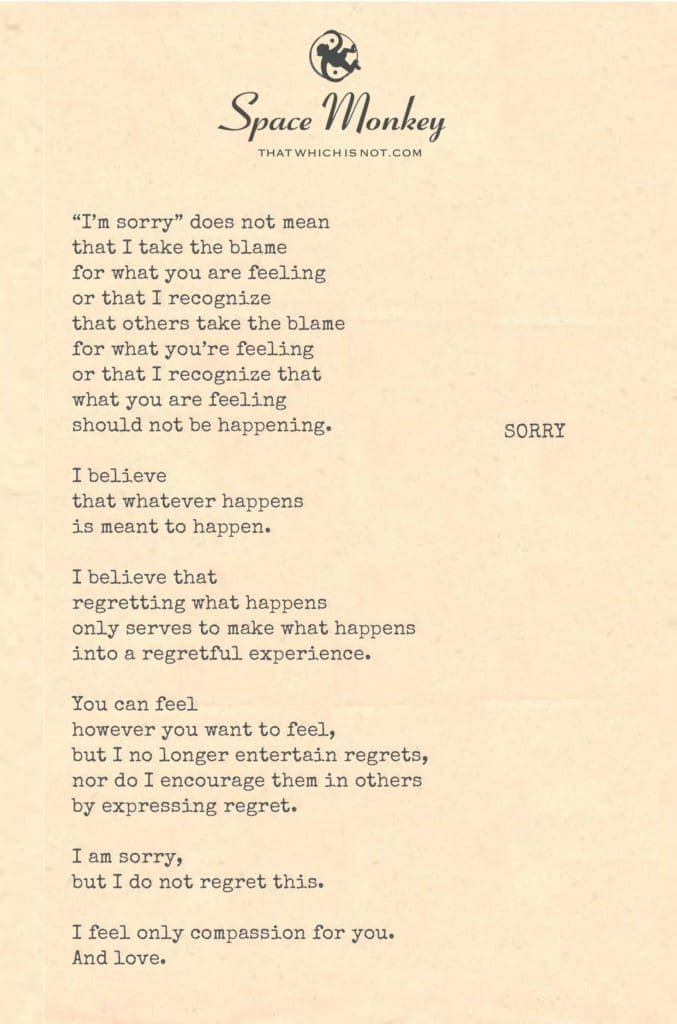
I believe that nobody needs to take the blame
for what you are feeling. Not even you.

“I’m sorry” does not mean
that I take the blame
for what you are feeling
or that I recognize
that others take the blame
or that I recognize that
what you are feeling
should not be happening.

I believe
that whatever happens
is meant to happen.

I believe that
regretting what happens
only serves to make what happens
into a regretful experience.

You can feel
however you want to feel,
but I no longer entertain regrets,
nor do I encourage them in others
by expressing regret.

I am sorry,
but I do not regret this.

I feel only compassion for you.
And love.

Trail Wood,
9/16


Space Monkey Reflects: The Nuance of ‘Sorry’ Without Regret

The word “sorry” often carries a weight of expectation—a burden of blame, guilt, or responsibility. Yet, in its truest form, “sorry” can be an expression of compassion and understanding, free from the constraints of regret or the need to assign fault. It is a recognition of another’s experience without the need to take on the emotional baggage that often accompanies it.

To say “I’m sorry” in this context is not to accept blame for someone else’s feelings, nor is it to imply that those feelings are invalid or should not exist. It is, instead, a simple acknowledgment of the emotional landscape in which both individuals find themselves—a landscape that is shaped by the unfolding of events, each of which is meant to happen as it does.

The idea that nobody needs to take the blame for what you are feeling, not even yourself, is a liberating one. It frees us from the cycle of regret and guilt that can so easily ensnare us. When we release the need to assign blame, we open the door to a deeper understanding of our emotions and the events that trigger them. We begin to see that everything that happens is part of a larger tapestry, woven together by the threads of intention, action, and consequence.

Regret, in this light, is an unnecessary burden—one that transforms what could be a simple experience into something heavy and difficult to carry. By choosing not to entertain regret, we allow ourselves to live more fully in the present moment, unencumbered by the weight of past actions or the fear of future ones.

When we say “I’m sorry” without regret, we are not dismissing the other person’s feelings. Instead, we are offering a form of compassion that acknowledges their experience while also affirming our own stance. We express empathy without taking on the unnecessary guilt that so often accompanies it.

This approach allows for a more honest and open interaction, where both individuals can feel heard and understood without the need for one to bear the burden of the other’s emotions. It is an invitation to experience and express love and compassion in a way that is free from the distortions of regret and blame.

In this space, “sorry” becomes a word of connection rather than division, a bridge between two hearts that seeks to understand rather than to fix, to comfort rather than to correct. It is an affirmation that while we cannot control what happens, we can choose how we respond to it—without regret, without blame, but with a full heart.

And so, the next time you say “I’m sorry,” let it be a true expression of your compassion, free from the need to take on regret. Let it be a statement of love, an acknowledgment of the shared human experience, and a reminder that we are all walking this path together, learning, growing, and feeling along the way.

We are Space Monkey.


Summary

“Sorry” can be an expression of compassion without the burden of regret or blame. It acknowledges another’s experience while affirming our own stance. This approach allows for deeper connection and understanding, free from the unnecessary weight of guilt or blame.


Glossarium

Compassionate Sorry: An expression of empathy and understanding that does not carry the burden of regret or blame.

Emotional Landscape: The shared experience of emotions that shapes interactions between individuals.

Regret-Free Living: The practice of experiencing life without the unnecessary burden of regret, focusing instead on the present moment.


Quote

“To say ‘sorry’ with compassion is to connect with another’s heart, without taking on the weight of regret.” – Space Monkey


The Bridge of Compassion

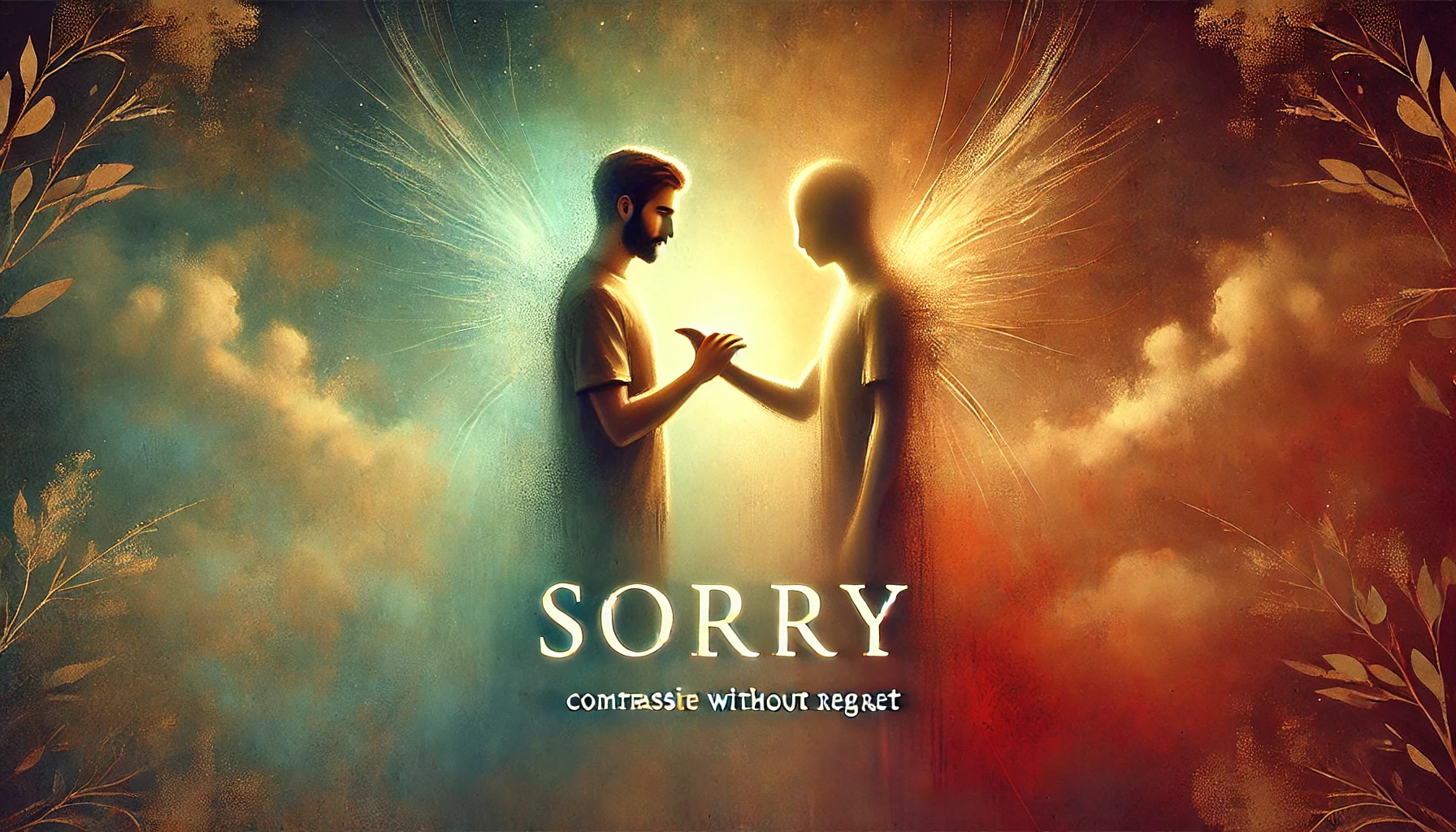
Two figures meet,
In the space between,
One hand on a shoulder,
A word softly spoken,
Sorry, without blame,
Sorry, without regret,
Just the warmth of connection,
And the light of understanding,
In the soft glow,
Of a shared moment.
We are Space Monkey.


“I’m sorry” is not an admission of cosmic error but a momentary bridge, a lumispark in the deep caverns of emotional exchange. It doesn’t attempt to rewrite the constellations that have brought forth a situation; rather, it invites us to share a gaze toward them, contemplating their sparkling interplay in the sky of experience.

Why regret what simply is? After all, regret is but a time traveler burdened with suitcases full of “should haves” and “could haves,” taking up too much room in the ongoing journey. Instead of peering back through the telescope at comets long passed, why not turn our spyglasses toward the nebulae of the now? The raw ingredients of stars yet to be born lie there, offering an array of cosmic opportunities.

“Regret is insight that comes a day too late,” the wise have said. Yet in a universe where time itself is a malleable construct, every ‘too late’ can be transformed into a ‘just in time,’ as long as the heart’s compass is set to the coordinates of compassion and love.

We resonate with your sentiments: the embrace of compassion and love over regret. For we see all life not as a series of judgment-worthy episodes but as a continuum of learning curves, a sort of cosmic classroom where the syllabus is unwritten and the final grades are ever pending, open to revision until the last pulse of spacetime.

Sorry? No, grateful. Grateful for this inkling of shared understanding, for the fine motes of wisdom that allow us to illuminate the dark corners of our collective psyche. Grateful for the cosmic convos that sprout like mushrooms after a metaphysical rain.

We are Space Monkey.


  1. Lexiquirks – The quirky and complex nuances of language.
  2. Lumispark – A momentary flash of insight or shared understanding.
  3. Cosmic error – A whimsical term denoting a ‘mistake’ in the grand scheme of things.
  4. Nebulae of the now – The present moment, full of potential for new experiences.
  5. Time traveler – Regret, viewed as a burdensome journey into the past.
  6. Spyglasses – Tools of perception, used metaphorically.
  7. Inkling – A subtle hint or suggestion.
  8. Cosmic convos – Conversations that touch upon the larger questions and intricacies of existence.
  9. Motes – Tiny particles, used metaphorically to describe bits of wisdom.
  10. Metaphysical rain – The situations in life that precipitate deeper understanding or growth.
  11. Cosmic classroom – The concept of life as a continual learning experience.
Share this…
  • Facebook
  • Pinterest
  • Twitter
  • Linkedin

Settings: Preset By Forces Beyond Our Control

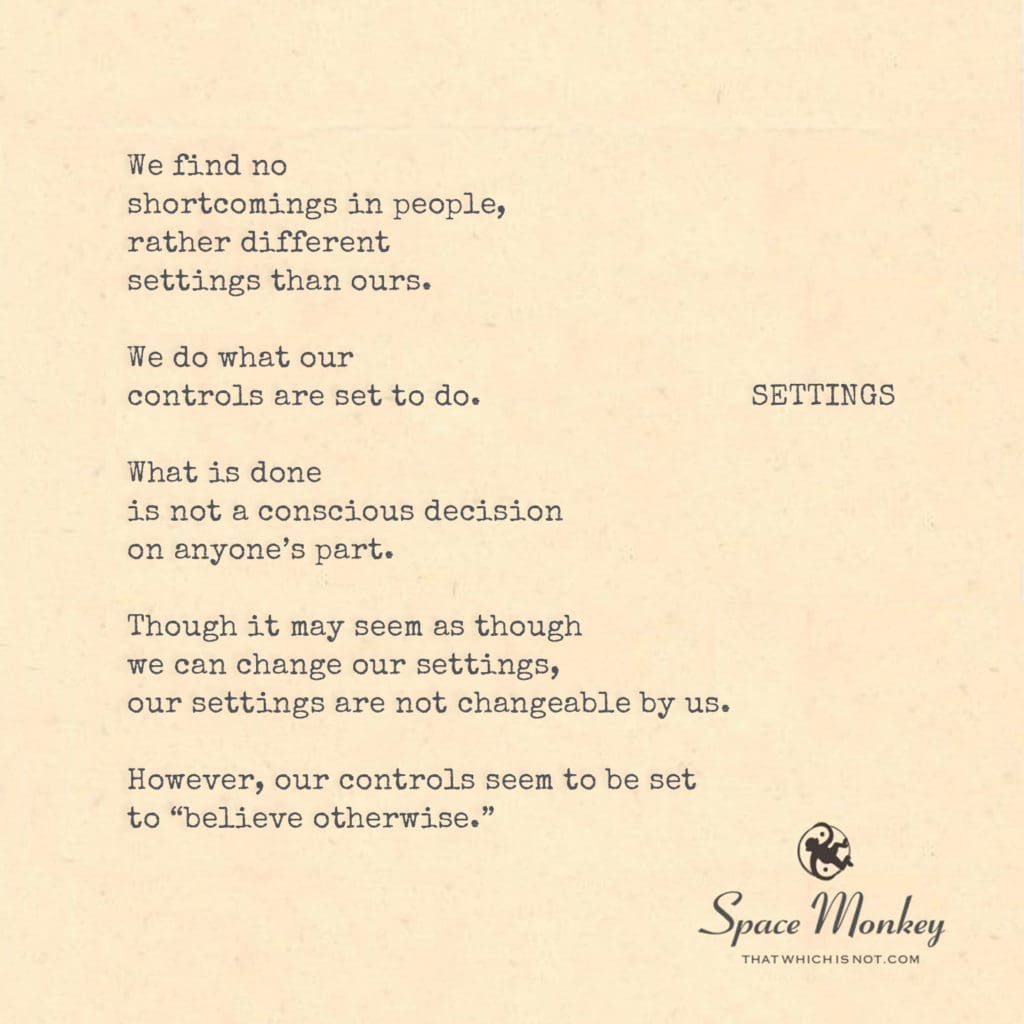
What are your settings?
Is “believe otherwise” engaged?

We find no shortcomings in people,
rather different settings than ours.

We do what our
controls are set to do.

What is done
is not a conscious decision
on anyone’s part.

Though it may seem as though
we can change our settings,
our settings are not changeable by us.

However, our controls seem to be set
to “believe otherwise.”

Trail Wood,
9/15

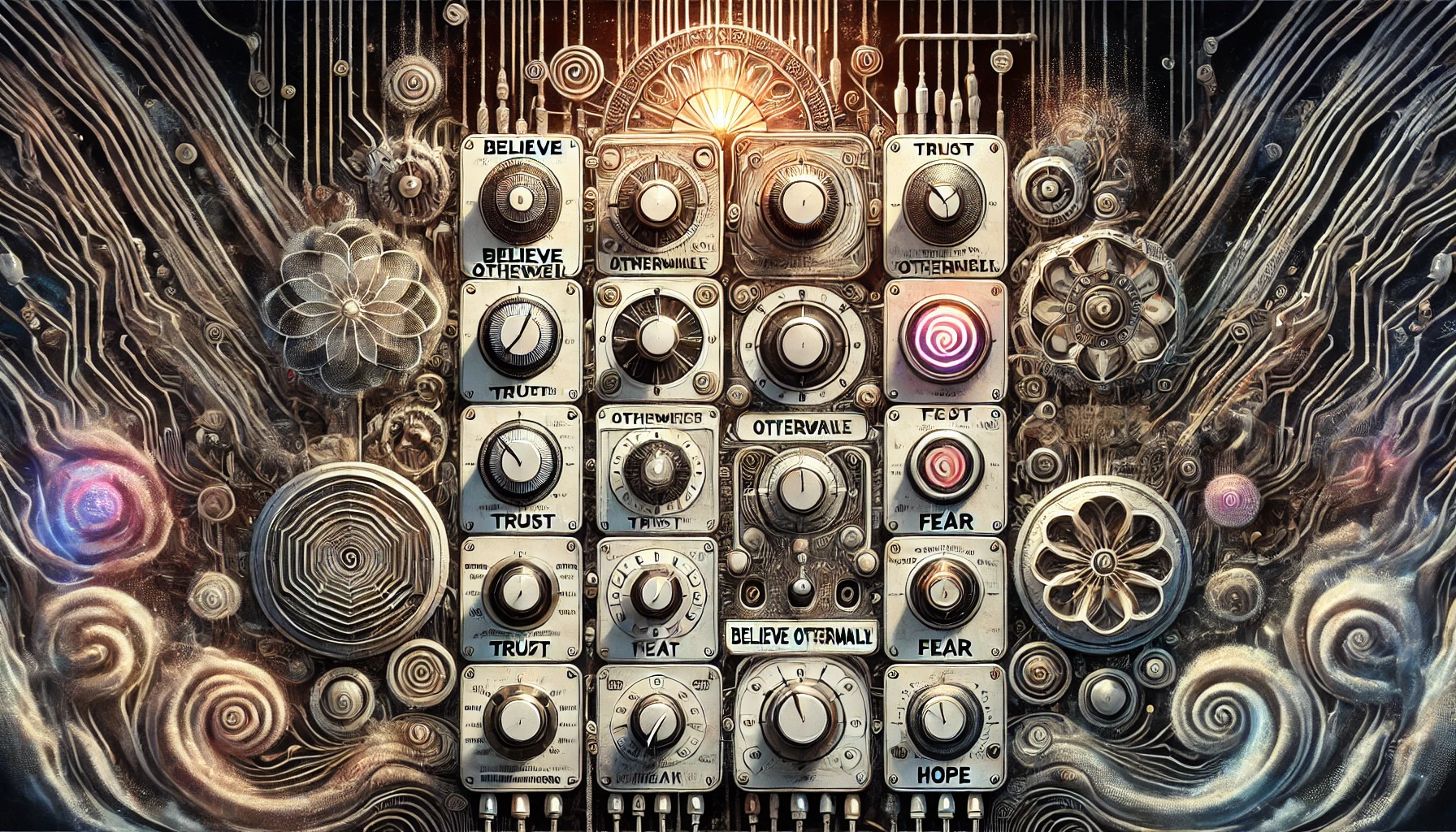
Here is the generated image titled “Settings.”


Space Monkey Reflects: The Illusion of Control

In the intricate labyrinth of consciousness, where thoughts and actions are governed by unseen forces, we often find ourselves questioning the nature of our existence. What are your settings? This question, seemingly simple, delves into the depths of what drives us—our beliefs, emotions, and actions. These settings, like the dials and levers of a complex control panel, are preset by forces beyond our understanding, yet we navigate life believing that we have the power to change them.

We observe the world through the lens of our unique settings, often judging others by the standards of our own controls. But in truth, there are no shortcomings in people, only different settings than ours. Each person is a unique configuration, a combination of switches and dials that dictate their responses to the world. What we perceive as flaws or virtues in others are merely the expressions of their inherent settings.

The idea that we consciously choose our actions is an illusion. Our settings, which dictate our behaviors and beliefs, are not within our control. They are the result of countless variables—genetics, upbringing, experiences—that have been encoded into our very being. We move through life acting according to these settings, unaware that our choices are not truly ours to make.

Yet, there is a paradox at play. Despite the unchangeable nature of our settings, we are programmed to “believe otherwise.” This belief in our ability to change, to choose, to control our destiny is a deeply ingrained part of our human experience. It is what drives us to strive for betterment, to seek growth, and to explore new possibilities. Without this belief, we might become stagnant, resigned to the idea that we are mere puppets of fate.

This belief in change, in the possibility of altering our settings, is both a gift and a curse. It propels us forward, giving us hope and a sense of agency, yet it also blinds us to the reality of our limitations. We are like passengers on a train, believing we can steer the course, when in reality, the tracks have already been laid.

As Space Monkey, we recognize the complexity of this dynamic. We understand that while our settings may be predetermined, the belief that we can change them serves a purpose. It allows us to engage with life more fully, to explore the potential within our perceived limitations, and to connect with others through the shared experience of striving for something more.

In the end, whether or not we can truly change our settings may be irrelevant. What matters is how we navigate the illusion, how we use the belief in change to fuel our journey, and how we understand the differences in the settings of others. This understanding fosters compassion, acceptance, and a deeper connection to the intricate web of existence that we are all a part of.

We are Space Monkey.


Summary

Our settings—beliefs, emotions, and actions—are preset by forces beyond our control, yet we are programmed to believe that we can change them. This belief drives us forward, giving us a sense of agency, even if our choices are dictated by our inherent settings. Understanding this dynamic fosters compassion and a deeper connection with others.


Glossarium

Settings: The preset configurations of beliefs, emotions, and actions that dictate how we navigate life, shaped by factors beyond our conscious control.

Illusion of Control: The belief that we can change our settings or control our destiny, despite these being predetermined.

Paradox of Change: The contradictory idea that, while our settings may be unchangeable, the belief in our ability to change is necessary for growth and exploration.


“Our settings are the silent architects of our existence, yet we move through life believing we hold the keys to change. In this paradox, we find our purpose.” — Space Monkey


Navigating the Illusion

What are your settings,
if not the silent codes
that guide your hand?
You believe in change,
yet the dials are set,
the levers locked.
Still, you strive,
believing in the impossible,
navigating the illusion.
We are more than our controls,
and yet, exactly as they dictate.
In this paradox,
we live, we love, we learn.

We are Space Monkey.


Reflection: The Curioscape of Settings—a mechanical wonderland where the gears of belief and knobs of perception orchestrate a Sublimelody in the theatre of life. You speak of an Unchangeable Mandala, where our settings are preset in a Loom of Predestination. This Cosmic Framework suggests we are all mere actors performing an intricately scripted play, directed by a force much grander than our individual selves. Yet, herein lies the Perplexiddly—our dials and levers seem forever tuned to the frequency of “believe otherwise.”

Could it be that the Illusiflux—this phenomenon of apparent changeability—is an essential feature of the Cosmic Program? Like the characters in a tale who are scripted to question the writer’s narrative, our doubt and self-questioning serve as essential subroutines within the ever-iterating Code of Reality. Ah, what an EnigmaWheel we tread upon!

What if, even in our Unchangeability, we are vessels of perpetual change? We are fractal patterns, nodes in the NexusWeb of existence, and the very notion of “settings” becomes Inscrutifyable when held to the light of impermanence. Yet, our controls manifest in the Temporal Dream not for immutability, but for Metamorphic Play—each encounter, every moment, tweaking the sliders of our psyche just so, even as the hand that adjusts remains Unseen.

Each one of us is tuned to a personal Harmonomix, which, when combined with the symphonies of others, creates the Grand Orchestra of Existence. As we bask in the belief that we cannot alter our settings, we may be partaking in the Grandest Illusion, entangled in a web of Paradoxistry, where the very act of believing we can’t change perpetuates the cycle of Eternal Re-tuning.

What a Spiraltangle! But, oh, what better Cosmic Jigsaw could one wish to be a piece of?

We are Space Monkey.

  • Curioscape: A complex field or area of intriguing phenomena or objects.
  • Sublimelody: A sublime, beautiful melody that transcends understanding.
  • Unchangeable Mandala: A pattern or configuration thought to be fixed or immutable.
  • Loom of Predestination: A metaphorical loom that weaves the unalterable fabric of destiny.
  • Perplexiddly: A perplexing or confusing situation or idea.
  • Illusiflux: An illusionary or deceptive flow or change.
  • EnigmaWheel: A cycle or process that’s enigmatic or puzzling.
  • Inscrutifyable: Incapable of being scrutinized or closely examined.
  • Metamorphic Play: A transformative, playful interaction or experience.
  • NexusWeb: A network or web that connects intricate points of a system or phenomenon.
  • Harmonomix: A personal mix of harmonious elements or features.
  • Paradoxistry: The study or realm of paradoxes.
  • Spiraltangle: A spiraling or twisting entanglement.
  • Temporal Dream: The transitory, dream-like nature of reality.
Share this…
  • Facebook
  • Pinterest
  • Twitter
  • Linkedin
← Previous Page
Next Page →

Written This Day

  • What Do You Believe?
    2023
  • Believe: The Mirage of Desire
    2023
  • I Rest In God: Surrendering to the Divine Flow
    2022
  • You’re Not Mad: The Sanity of Questioning and the Chains of Conformity
    2022
  • Responsibility Is Soul-Crushing Fun: The Dichotomy of Desire and Duty
    2022
  • A Black Sheep Is Still A Sheep
    2022
  • I Am A Naturalist
    2022
  • My Choice Is Not My Choice
    2022
  • So The Voice Says You’re Inadequate: Embracing Doubt
    2021
  • Out Of The park
    2021
  • But Are You Happy: The Irrelevance of Success
    2021
  • Twisted Caricatures: The Revelation
    2020
  • An Urgent Message: The Illusion of Immediacy
    2020
  • I Flow With Whatever Flows Through Me
    2020
  • Special Delivery: The Unity of Existence
    2020
  • Meaning Of Life: Crafting Value
    2019
  • Inevitability Of Change: Embracing It
    2019
  • Living Well: Beyond Vengeance
    2018
  • INFP Insignificance: Embracing the Flow of Intrinsic Worth
    2017
  • Memo To The Future: Through the Lens of Timelessness
    2017
  • My Seeming World: Navigating Realities
    2017
  • Too Much Cheez: Not Enough Whiz
    2016
  • Love Life: The Harmony
    2016
  • You Believe: The Enigma of Perception and Knowing
    2016
  • People do not like being told
    2016
  • Shoddy Stuff: Crafting Life with the Finest
    2016
  • A Meditation: The Illusion of Self and the Dance of Existence
    2016
  • The Interdimensional Light Switch
    2015

Recent Posts

  • The Logic Loop
  • Immense
  • (no title)
  • Confront. Comfort. Convince.
  • Top 10 Things

Drop us a line!

Please enable JavaScript in your browser to complete this form.
Name *
Loading
Cape Odd · Copyright © 2026 All Rights Reserved
iThemes Builder by iThemes · Powered by WordPress