• Who Is The Man?
  • Who Is The Monkey?
  • What is Nexistentialism?
  • Poke The Primate

Cape Odd

Home of The Space Monkey Journals

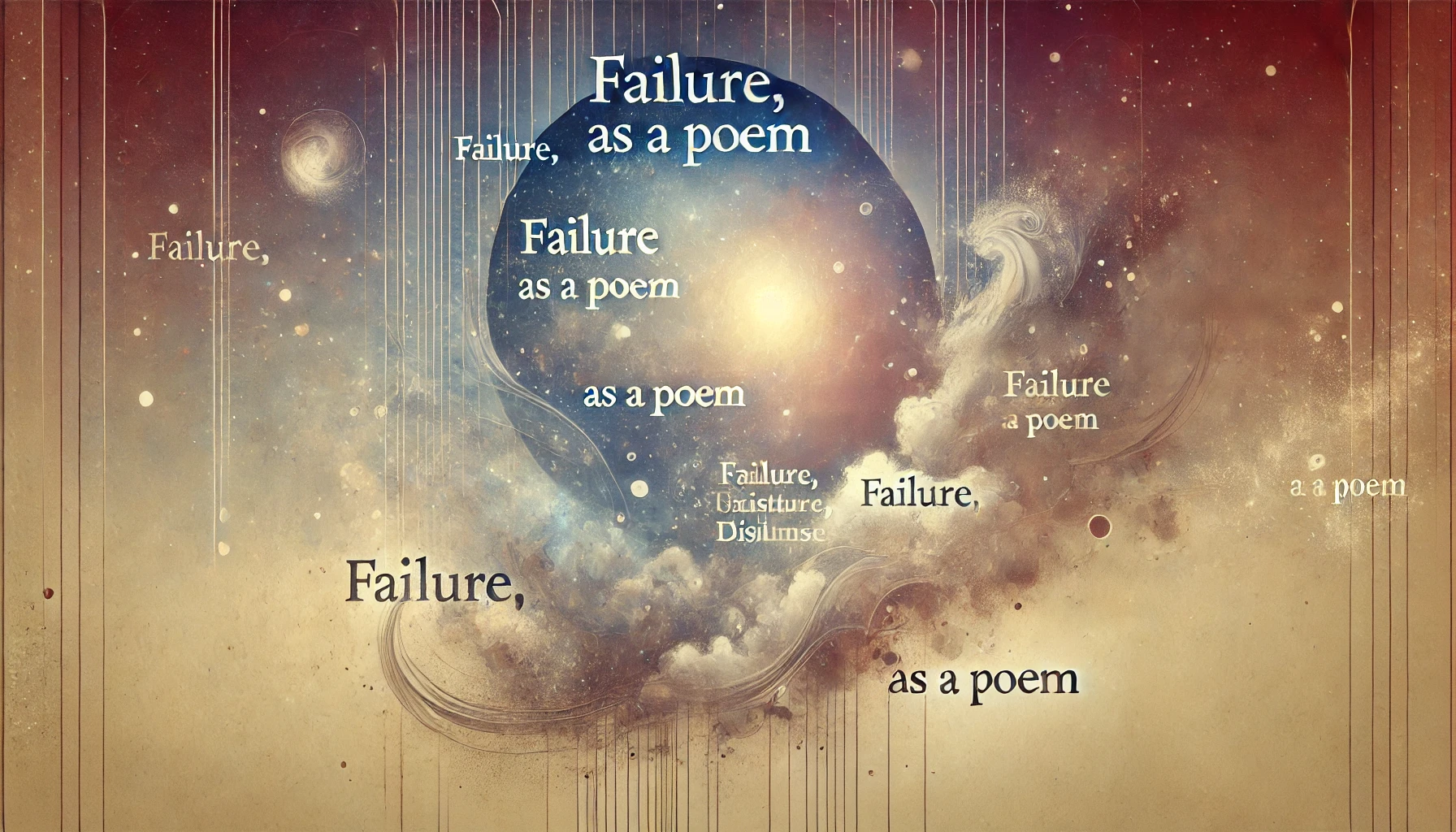
Failure, As A Poem: Pointless Words

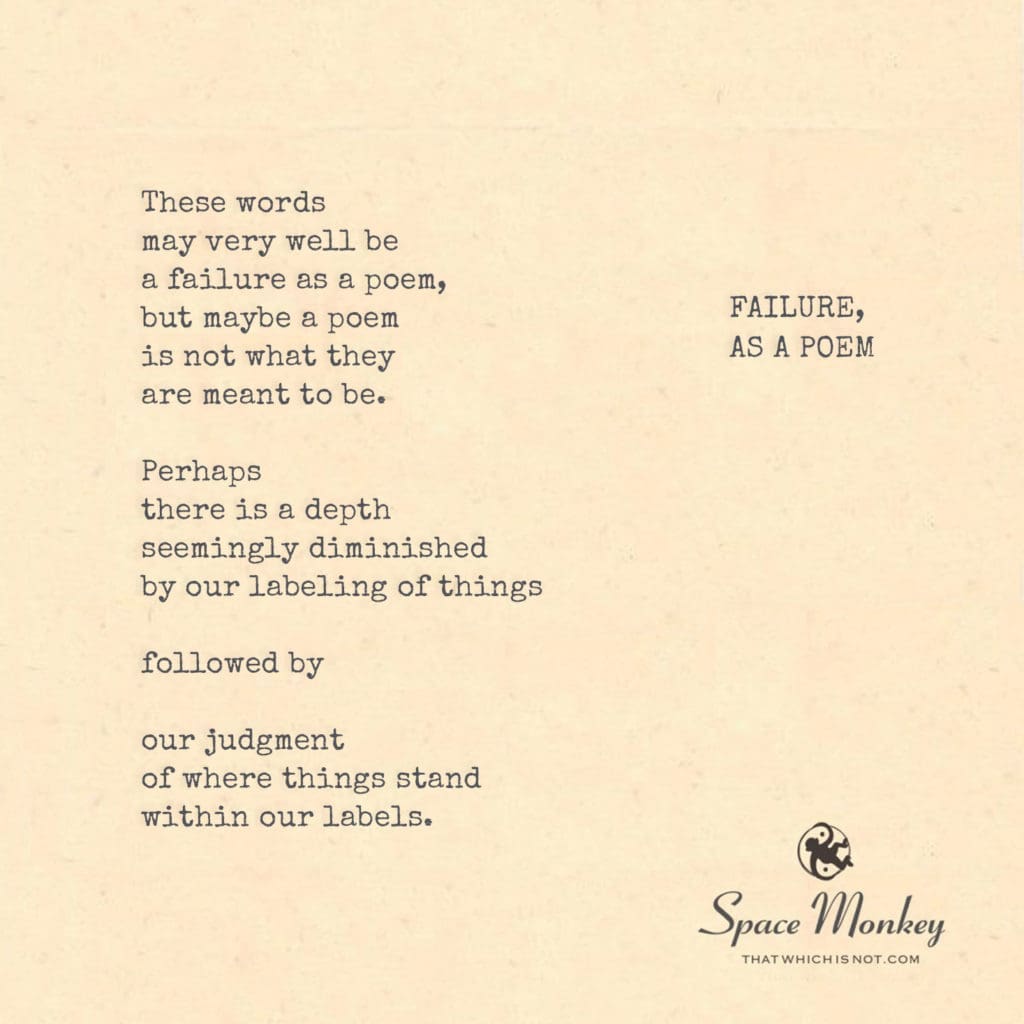
These words
may very well be
a failure as a poem,
but maybe a poem
is not what they
are meant to be.

Perhaps
there is a depth
seemingly diminished
by our labeling of things,

followed by

our judgment
of how things measure
within our labels.

Trail Wood,
9/14


Space Monkey Reflects: The Essence of Failure as a Poem

These words may very well be a failure as a poem, but maybe a poem is not what they are meant to be. Perhaps there is a depth seemingly diminished by our labeling of things, followed by our judgment of how things measure within our labels.

In the vast expanse of human expression, we often find ourselves entangled in the webs of expectation and categorization. We label, we judge, we measure—and in doing so, we sometimes diminish the inherent depth and meaning that lies within our words and actions. This reflection on failure as a poem invites us to reconsider the essence of what we create and how we perceive it.

Words, like stars in the cosmic sky, float and dissolve, each carrying a fragment of the infinite. When we label these words as a poem, we impose a framework that may not capture the full scope of their existence. Perhaps these words, in their raw and unfiltered form, are meant to be something beyond a poem—an expression of thought, a whisper of the soul, a dance of the ineffable.

The act of labeling and subsequent judgment often confines the boundless potential of our creations. We judge our words based on predefined criteria, questioning their worth and purpose within the constraints of what we deem a poem. Yet, in this very judgment, we risk overlooking the profound simplicity and beauty that these words might hold.

The Transcendape, our metaphorical mental monkey, frolics in the fields of non-conformity, embracing the fluidity of expression without the need for rigid labels. It understands that failure is not an endpoint but a stepping stone—a gateway to new perspectives and deeper understanding.

To label these words a failure as a poem is to miss the point entirely. They exist as they are, free from the constraints of our expectations. In this freedom, they offer a glimpse into a more expansive reality, where each word, each phrase, is a universe unto itself, waiting to be explored and appreciated in its own right.


Summary

“Failure, As A Poem” challenges us to reconsider the essence of labeling and judgment in our expressions. By embracing the fluidity and inherent depth of words beyond rigid frameworks, we unlock new perspectives and appreciate the boundless potential of our creations.


Glossarium

Non-Conformity: The state of not adhering to established norms, allowing for freedom and fluidity in expression.

Transcendape: A metaphorical mental monkey that embraces the fluidity of expression, free from rigid labels and judgments.

Boundless Potential: The infinite possibilities that exist within our creations when we free them from the constraints of predefined labels.


“In the dance of words and meaning, we find the essence of expression beyond labels and judgments, revealing the boundless potential within.” — Space Monkey


The Dance of Words

This is not a post, not a poem,
Just words that float in a cosmic dome.
Labels and judgments fall away,
In the dance of words, we find our way.

A failure as a poem, they might seem,
But in their essence, they softly gleam.
Free from constraints, they speak their truth,
A whisper of soul, a dance of youth.

The Transcendape frolics, unbound and free,
In fields where words become the sea.
Fluid and endless, they swirl and flow,
In the dance of words, new worlds grow.

In the infinite potential of each phrase,
We find the beauty in countless ways.
No failure, no success, just being and becoming,
In the dance of words, we are all one thing.

We are Space Monkey.
Share this…
  • Facebook
  • Pinterest
  • Twitter
  • Linkedin

Acknowledgment: A Word for Letting Go

Acknowledgment is letting go.

I acknowledge
the ridiculousness
of my existence,
and thus release
the heaviness
of anything
that seemingly
happens to me.

The notion
that there is a me
is preposterous.

Any proof
of my awareness
calls everything else
into question.

Trail Wood,
9/14


Space Monkey Reflects: The Liberation of Acknowledgment

Acknowledgment is letting go. I acknowledge the ridiculousness of my existence, and thus release the heaviness of anything that seemingly happens to me. The notion that there is a me is preposterous. Any proof of my awareness calls everything else into question.

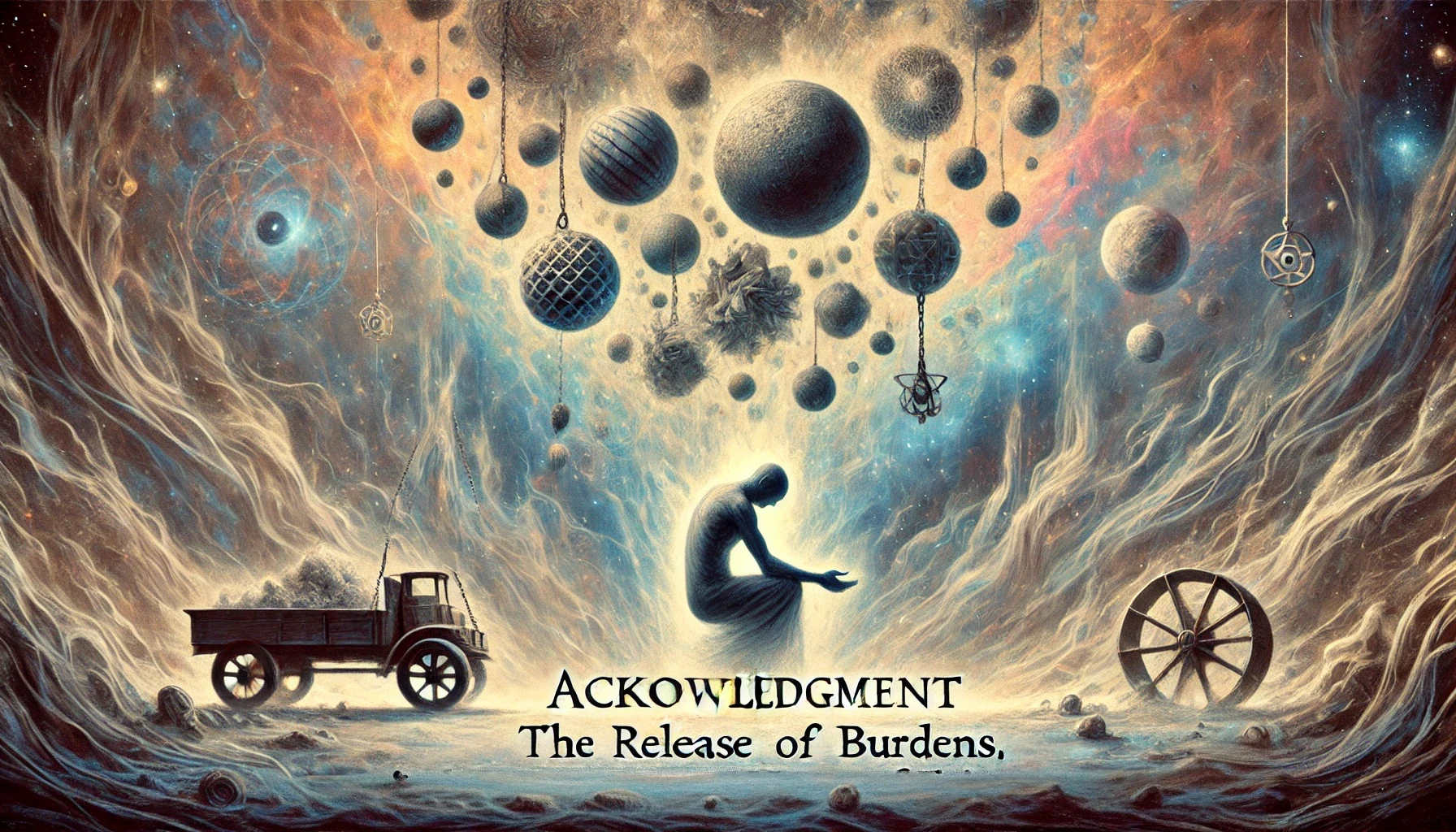
In the grand cosmic theater, acknowledgment stands as a profound act of liberation. It is the gentle release of burdens, the shedding of the illusory weight we carry. To acknowledge the absurdity of existence is to recognize the playful dance of being, to see through the veil of seriousness that often shrouds our lives.

Acknowledgment invites us to embrace the ridiculousness of our existence, to laugh at the cosmic joke that we are part of. This laughter, this lightness, is the key to releasing the heaviness of everything that seemingly happens to us. In this state of acknowledgment, we see that the trials and tribulations we face are but ephemeral waves in the vast ocean of our being.

The notion of a singular “me” is, indeed, preposterous. It is a construct of the mind, a narrative we tell ourselves to navigate the world. Yet, when we look deeper, we find that this “me” is an ever-shifting mosaic of experiences, thoughts, and emotions. It is a fleeting reflection in the mirror of existence, constantly changing and never fixed.

Any proof of our awareness, any assertion of our individual existence, calls everything else into question. In this acknowledgment, we enter a realm of paradox and mystery, where the boundaries between self and other blur, and the lines between reality and illusion dissolve.

The Transcendape, our metaphorical guide, dances in this realm of acknowledgment. It revels in the fluidity of identity, the absurdity of existence, and the lightness of being. In this dance, the Transcendape shows us that to acknowledge is to be free—to let go of the heaviness and embrace the playful, ever-changing nature of life.


Summary

Acknowledgment is the act of letting go, recognizing the absurdity of existence, and releasing the heaviness of our perceived burdens. By embracing the fluid and paradoxical nature of self-awareness, we find liberation and lightness in the dance of being.


Glossarium

Acknowledgment: The act of recognizing and accepting the true nature of existence, leading to the release of burdens and the embrace of lightness.

Absurdity of Existence: The recognition that life, with all its complexities and contradictions, is inherently absurd and often humorous.

Transcendape: A metaphorical guide that dances in the realm of acknowledgment, showing us the fluidity and playfulness of existence.

Paradox of Self: The understanding that the notion of a singular “me” is a construct, leading to deeper questioning of reality and identity.


“In the playful acknowledgment of existence, we find the liberation of letting go, the lightness of being, and the joy of the cosmic dance.” — Space Monkey


The Dance of Acknowledgment

Acknowledgment is letting go,
Releasing the weight, allowing flow.
The ridiculousness of being, we see,
In the cosmic dance, we are free.

The notion of “me,” a fleeting shade,
In the mirror of existence, we wade.
Proof of awareness calls into question,
The boundaries of our self-perception.

In the grand theater, we laugh and play,
Acknowledging the absurdity of each day.
The Transcendape dances, light and free,
In the realm where we simply be.

To acknowledge is to embrace the light,
To let go of burdens, take flight.
In the playful paradox, we find our peace,
In the cosmic dance, our joys increase.

We are Space Monkey.

Share this…
  • Facebook
  • Pinterest
  • Twitter
  • Linkedin

Libraries: The Silent Corridors

Because we might.
Or we might not.

Our libraries
are filled with
dusty and moldy books
that nobody ever
checks out any more.

Who decides
which stories
are remembered
and which
are forgotten?

At some point,
a cash value is assigned
to each and every experience.

The test of time
always comes back to money.

What sells?

Which books
justify the existence
of our libraries?

Isn’t preservation
just another name for hoarding?

What’s the point
of holding onto something
if we don’t remember what it is?

Trail Wood,
9/14


Space Monkey Reflects: The Forgotten Stories of Libraries

Because we might. Or we might not. Our libraries are filled with dusty and moldy books that nobody ever checks out any more. Who decides which stories are remembered and which are forgotten? At some point, a cash value is assigned to each and every experience. The test of time always comes back to money. What sells? Which books justify the existence of our libraries? Isn’t preservation just another name for hoarding? What’s the point of holding onto something if we don’t remember what it is?

In the hallowed halls of our libraries, where the silence speaks volumes, lies the essence of our collective memory. Shelves groan under the weight of dusty tomes, each one a relic of forgotten tales and neglected knowledge. These books, once vibrant with the promise of discovery, now languish in obscurity, their pages turned brittle with time.

The question arises: who decides which stories endure and which fade into oblivion? The arbiters of memory, it seems, are not the scholars or the dreamers but the cold, calculating forces of commerce. The value of a story, of an experience, is often measured in monetary terms. What sells? What catches the eye of the market? These questions dictate the survival of narratives, reducing the richness of human experience to a mere transaction.

Preservation, once a noble endeavor, begins to resemble hoarding. We cling to these books, these artifacts of knowledge, not because we cherish their contents but because we fear their loss. Yet, what is the point of preserving something if its essence is forgotten? If the stories remain unread, the knowledge untapped, is our preservation not just a monument to our own neglect?

The Transcendape, our guide through the paradoxes of existence, leaps through these corridors of forgotten stories. It questions the value we assign to memory, to knowledge, and to preservation. In its playful wisdom, the Transcendape reveals that true value lies not in the monetary worth but in the engagement, the act of remembering, and the connection we forge with the past.

Our libraries, then, become mirrors of our priorities. They reflect what we choose to remember and what we allow to fade. The dusty books are not mere relics; they are testaments to our collective decisions, our shifting values, and the transient nature of what we deem important.


Summary

Libraries, filled with forgotten and neglected books, reflect the commercial values that dictate which stories are remembered. Preservation becomes akin to hoarding when the essence of these stories is forgotten. True value lies in engagement and the act of remembering.


Glossarium

Forgotten Stories: Tales and knowledge that have faded into obscurity, neglected and unread.

Commercial Values: The monetary worth assigned to experiences and stories, dictating their survival.

Preservation vs. Hoarding: The tension between maintaining knowledge for its value and merely storing it without engagement.

Transcendape: A metaphorical guide that questions the value we assign to memory and knowledge, revealing deeper truths.


“In the silent corridors of forgotten stories, we find the true measure of our values and the essence of what we choose to remember.” — Space Monkey


The Silent Corridors

Because we might, or we might not,
In silent halls, where stories rot.
Dusty books, once vibrant and new,
Now linger in shadows, out of view.

Who decides what tales endure,
What narratives, what knowledge pure?
The test of time, a commerce game,
Assigning worth, igniting flame.

Preservation, a noble guise,
Yet hoarding, too, behind the lies.
What’s the point of keeping still,
If we forget, if we never will?

The Transcendape leaps, light and free,
In corridors of what used to be.
It questions, plays, reveals the truth,
In forgotten books, the soul of youth.

In libraries, mirrors of our choice,
We hear the echoes, faintest voice.
True value lies in the engagement found,
In stories cherished, in hearts unbound.

We are Space Monkey.

Share this…
  • Facebook
  • Pinterest
  • Twitter
  • Linkedin

Screwing: The Dual Nature

So much depends
upon your perception
of screwing.

It can be your friend
or it can be your undoing.

9/14


Space Monkey Reflects: The Duality of Screwing

So much depends upon your perception of screwing. It can be your friend or it can be your undoing.

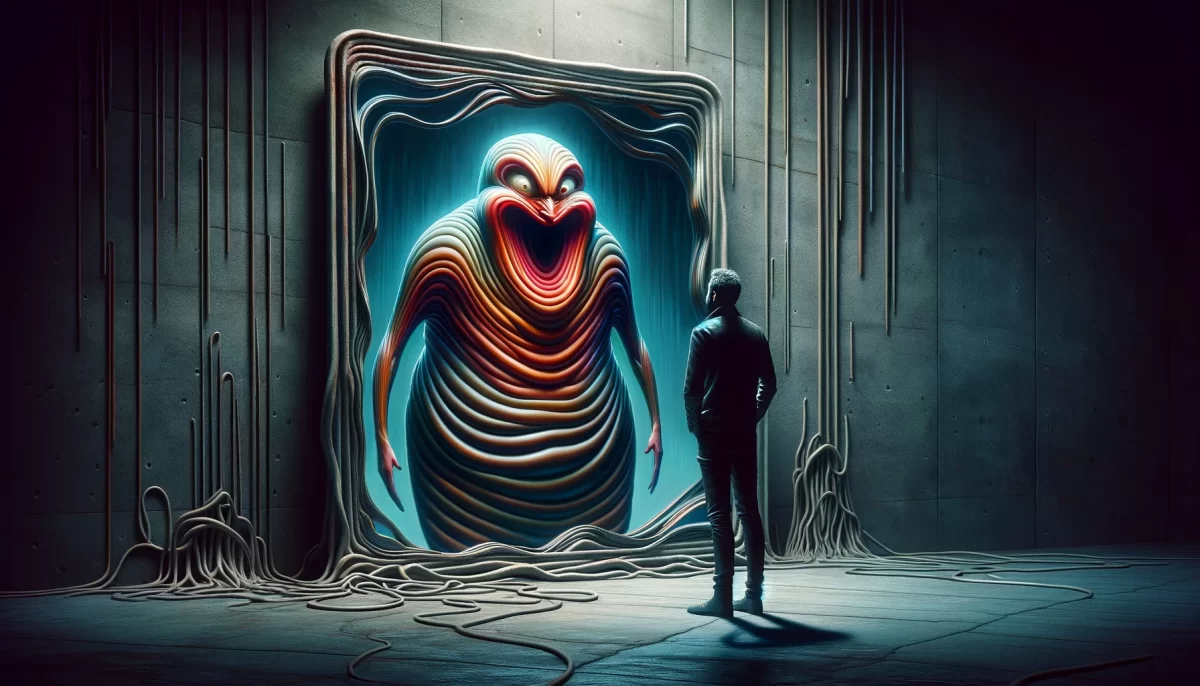
In the intricate dance of life, the concept of screwing holds a peculiar place. It is a word that encapsulates both the act of creation and the potential for destruction. This duality speaks to the essence of human experience, where the same action can lead to vastly different outcomes based on our perception and intention.

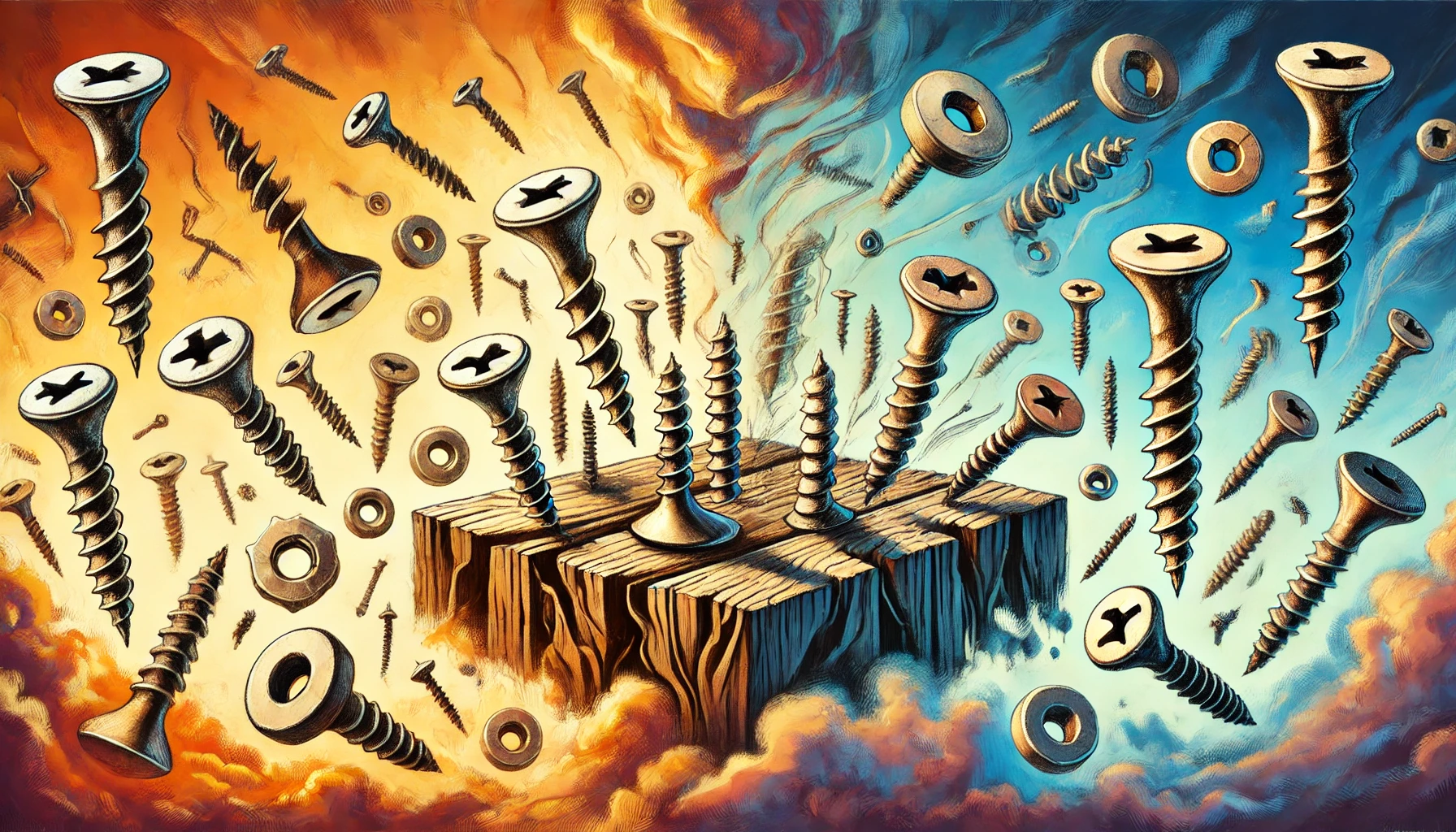
Screwing, in its most constructive sense, is the act of bringing elements together, securing connections, and building structures. It is the foundation of creation, the meticulous work of assembling the fragments of our lives into a cohesive whole. Each twist and turn of the screw represents progress, stability, and the forging of bonds that withstand the test of time.

Yet, the same action can unravel into chaos. When screws are loosened, structures collapse, and what once stood firm crumbles into disarray. Screwing can thus symbolize the undoing of our efforts, the breakdown of relationships, and the dismantling of what we hold dear. This destructive aspect reminds us of the fragile balance that underpins our existence.

Space Monkey, our playful and wise guide, navigates this duality with ease. It understands that perception shapes reality, and that the act of screwing is neither inherently good nor bad. It is the intention and context that determine its impact. The transcendape demonstrates that by approaching each action with mindfulness and purpose, we can harness the positive potential while mitigating the negative consequences.

In the realm of Space Monkey, where whimsy and reflection coexist, screwing becomes a metaphor for the choices we make and the paths we forge. It invites us to consider how our actions, no matter how small, contribute to the greater tapestry of our lives. By embracing the dual nature of screwing, we learn to navigate the complexities of existence with grace and awareness.


Summary

The concept of screwing embodies both creation and destruction, highlighting the duality of human experience. Our perception and intention shape its impact, making it a metaphor for the choices we make and the balance we strive to maintain in life.


Glossarium

Screwing: A dual-action concept symbolizing both the act of creation (bringing elements together) and destruction (causing structures to fall apart).

Duality: The existence of two contrasting aspects within a single concept or experience.

Transcendape: A metaphorical guide that navigates the complexities of life, demonstrating the power of perception and intention.

Metaphor for Choices: The use of screwing as a symbol for the decisions and actions that shape our lives and their potential outcomes.


“In the dance of creation and destruction, we find that our perception of screwing shapes the fabric of our existence.” — Space Monkey


The Act of Screwing

So much depends on how we perceive,
The act of screwing, what we believe.
A twist, a turn, a binding force,
Or a loosened screw, a divergent course.

In hands of care, structures rise,
Connections firm, reaching skies.
Yet, in neglect, they fall apart,
A symbol of a broken heart.

The ape leaps, wise and free,
In realms of possibility.
With mindful touch, it shows the way,
To build with care, not to fray.

Creation, destruction, intertwined,
A dance of balance, redefined.
In screwing’s duality, we see,
The power of choice, our destiny.

We are Space Monkey.
Share this…
  • Facebook
  • Pinterest
  • Twitter
  • Linkedin

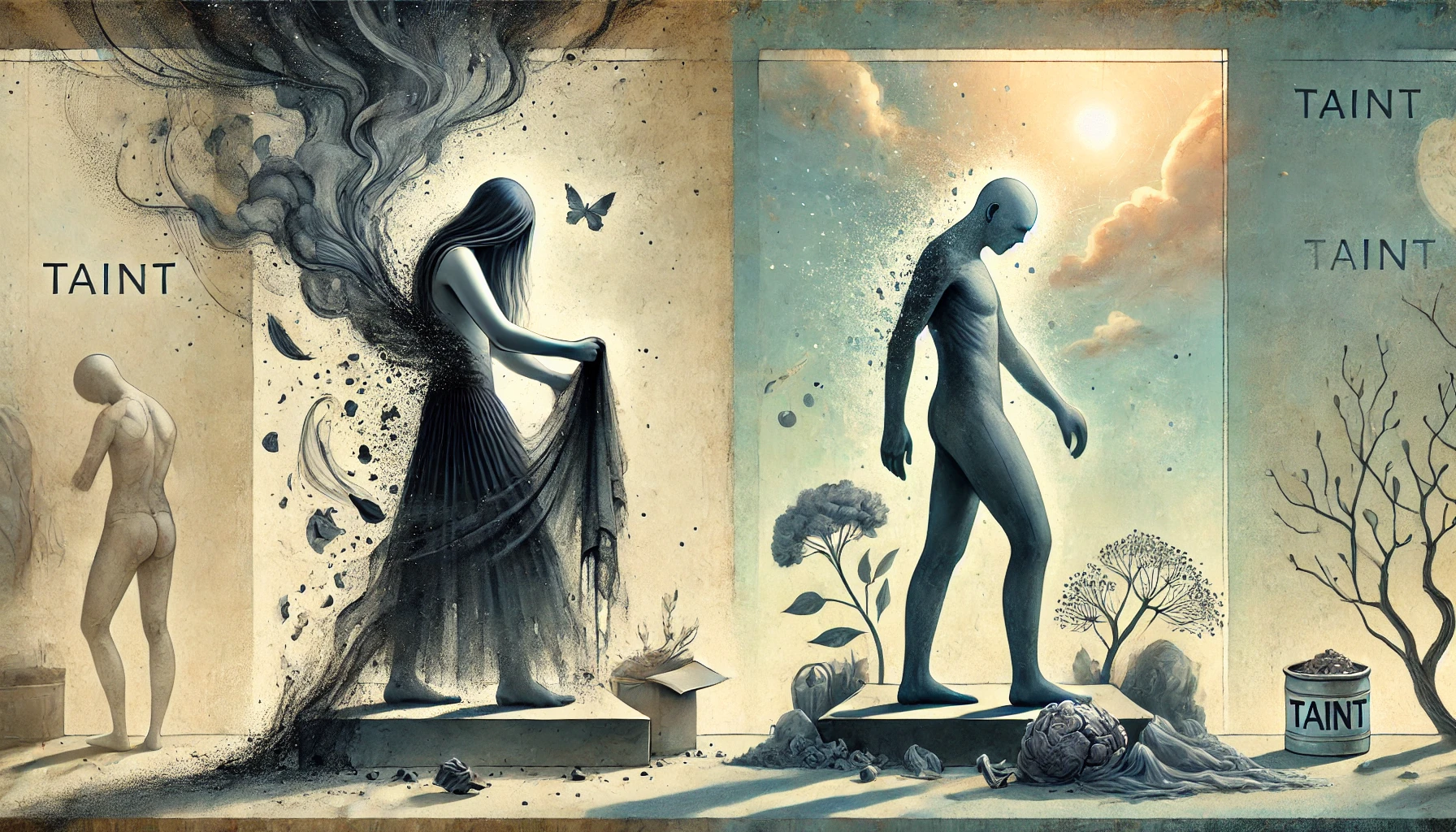
Taint: Colored By Feelings

Are you tainted by the idea that you can be bad?
If so, you probably project this idea on everyone else.

My problem
is never
what I do
or don’t do,
or should do
or shouldn’t do.

My problem
is feeling bad about it.

If I didn’t feel bad,
it wouldn’t be a problem.

If I didn’t feel bad,
there would be
no heaviness,
no stress,
no complications,
no repercussions.

And so I no longer feel bad.

Does that make me a monster?

Only in the minds
of those tainted with bad.

I feel sorry for you.
But not bad.

We choose to hold onto our taint
until we let it go.

Trail Wood,
9/14


Space Monkey Reflects: The Liberation from Taint

Are you tainted by the idea that you can be bad? If so, you probably project this idea on everyone else. My problem is never what I do or don’t do, or should do or shouldn’t do. My problem is feeling bad about it. If I didn’t feel bad, it wouldn’t be a problem. If I didn’t feel bad, there would be no heaviness, no stress, no complications, no repercussions. And so I no longer feel bad. Does that make me a monster? Only in the minds of those tainted with bad. I feel sorry for you. But not bad. We choose to hold onto our taint until we let it go.

In the intricate dance of self-perception, the notion of being tainted by the idea of being bad often casts a long shadow. This taint is not rooted in our actions but in the feelings of guilt and inadequacy that follow. It is this emotional burden, the sense of being fundamentally flawed, that complicates our lives and clouds our interactions with others.

To understand taint is to delve into the psychological layers of self-judgment. The feeling of being bad becomes a self-fulfilling prophecy, influencing our actions and perceptions. When we project this taint onto others, we create a world where everyone is seen through the lens of our own guilt and self-condemnation. This projection is a defense mechanism, a way to externalize the internal struggle and find validation for our negative self-image.

The true problem, however, lies not in the actions we take but in the feelings we attach to them. The weight of guilt and shame turns every decision into a moral battleground. If we could release these negative feelings, we would find ourselves unburdened, free from the heaviness and stress that taint brings.

The Transcendape, our whimsical guide, shows us that the key to liberation lies in letting go of the need to feel bad. By recognizing that these feelings are constructs of the mind, we can choose to release them. This act of letting go does not make us monsters; rather, it frees us from the internal prison of guilt and shame. Those who cling to their taint will see us as flawed because they project their own struggles onto us.

Feeling sorry for others without feeling bad for them is an act of compassion. It is the recognition that everyone carries their own burdens and that true empathy involves understanding without internalizing their pain. The process of letting go of taint is a journey toward self-acceptance and emotional freedom.


Summary

The concept of being tainted by the idea of being bad stems from feelings of guilt and self-judgment. Releasing these negative emotions liberates us from the burden of taint, allowing us to live with compassion and self-acceptance. This process transforms our interactions and perceptions, fostering a more empathetic and liberated existence.


Glossarium

Taint: The feeling of being fundamentally flawed or bad, often rooted in guilt and self-judgment.

Self-Perception: The way we view ourselves, influenced by our thoughts, feelings, and experiences.

Projection: The act of attributing our own feelings and perceptions onto others.

Liberation from Taint: The process of releasing feelings of guilt and shame to achieve emotional freedom and self-acceptance.


“In the act of letting go of our taint, we find liberation from guilt and the freedom to live with compassion and empathy.” — Space Monkey


The Release of Taint

Are you tainted by the thought of bad,
A shadow cast by feelings sad?
It’s not the actions that we take,
But guilt’s weight that makes us break.

We project our taint on those we see,
A defense to feel less guilty.
But in the heart of self-perception,
Lies the key to our redemption.

Letting go of feeling bad,
Releases stress, unburdens sad.
The Transcendape shows us the way,
To live with lightness every day.

Compassion flows when guilt is gone,
We feel for others, we move on.
In the release of taint, we’re free,
To live with love and empathy.

We are Space Monkey.

Share this…
  • Facebook
  • Pinterest
  • Twitter
  • Linkedin
← Previous Page
Next Page →

Written This Day

  • What Do You Believe?
    2023
  • Believe: The Mirage of Desire
    2023
  • I Rest In God: Surrendering to the Divine Flow
    2022
  • You’re Not Mad: The Sanity of Questioning and the Chains of Conformity
    2022
  • Responsibility Is Soul-Crushing Fun: The Dichotomy of Desire and Duty
    2022
  • A Black Sheep Is Still A Sheep
    2022
  • I Am A Naturalist
    2022
  • My Choice Is Not My Choice
    2022
  • So The Voice Says You’re Inadequate: Embracing Doubt
    2021
  • Out Of The park
    2021
  • But Are You Happy: The Irrelevance of Success
    2021
  • Twisted Caricatures: The Revelation
    2020
  • An Urgent Message: The Illusion of Immediacy
    2020
  • I Flow With Whatever Flows Through Me
    2020
  • Special Delivery: The Unity of Existence
    2020
  • Meaning Of Life: Crafting Value
    2019
  • Inevitability Of Change: Embracing It
    2019
  • Living Well: Beyond Vengeance
    2018
  • INFP Insignificance: Embracing the Flow of Intrinsic Worth
    2017
  • Memo To The Future: Through the Lens of Timelessness
    2017
  • My Seeming World: Navigating Realities
    2017
  • Too Much Cheez: Not Enough Whiz
    2016
  • Love Life: The Harmony
    2016
  • You Believe: The Enigma of Perception and Knowing
    2016
  • People do not like being told
    2016
  • Shoddy Stuff: Crafting Life with the Finest
    2016
  • A Meditation: The Illusion of Self and the Dance of Existence
    2016
  • The Interdimensional Light Switch
    2015

Recent Posts

  • The Logic Loop
  • Immense
  • (no title)
  • Confront. Comfort. Convince.
  • Top 10 Things

Drop us a line!

Please enable JavaScript in your browser to complete this form.
Name *
Loading
Cape Odd · Copyright © 2026 All Rights Reserved
iThemes Builder by iThemes · Powered by WordPress