• Who Is The Man?
  • Who Is The Monkey?
  • What is Nexistentialism?
  • Poke The Primate

Cape Odd

Home of The Space Monkey Journals

Abundance: An Ode to the Treasure Within

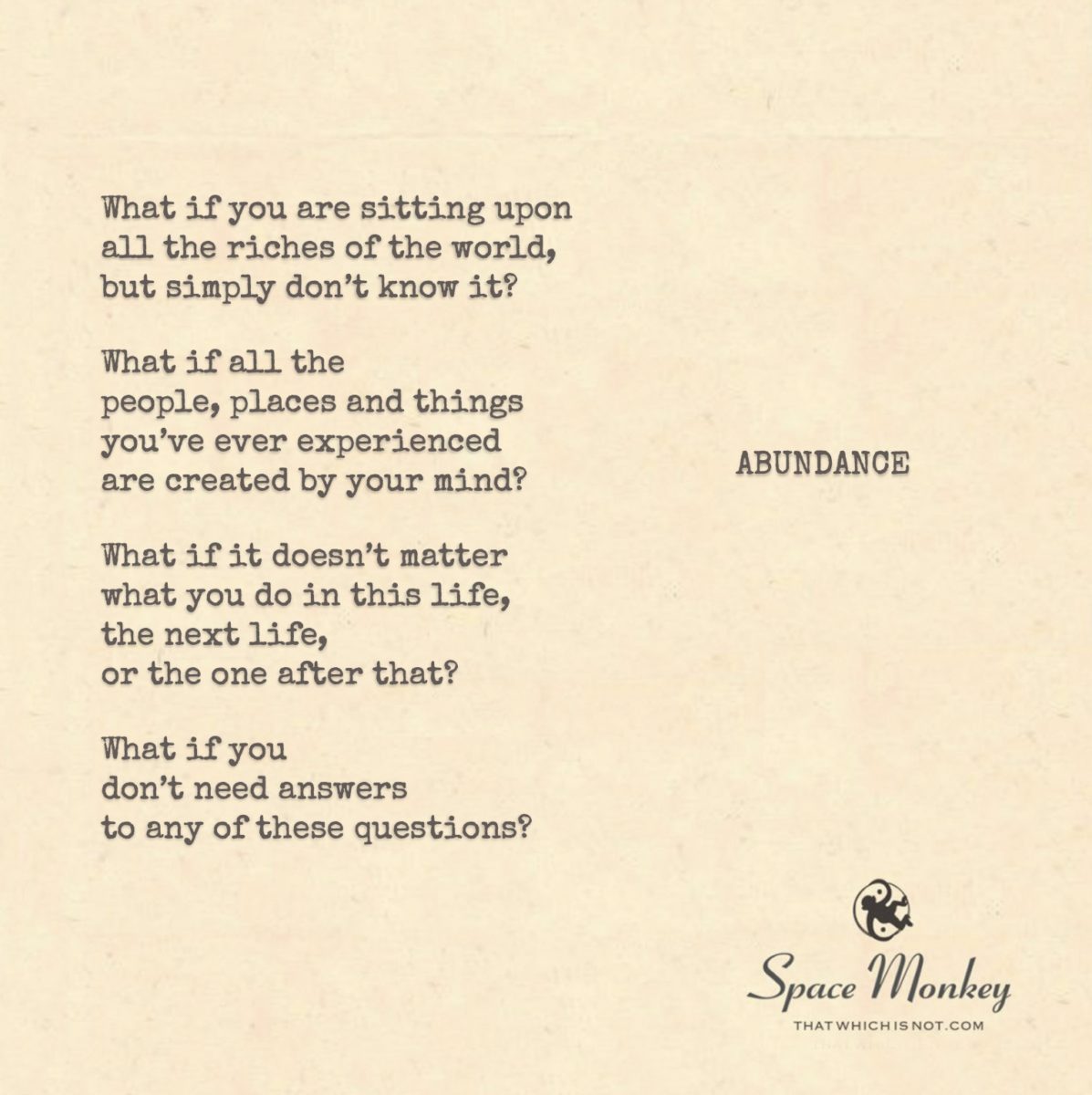
What if you are sitting upon
all the riches of the world,
but simply don’t know it?

What if all the
people, places and things
you’ve ever experienced
are created by your mind?

What if it doesn’t matter
what you do in this life,
the next life,
or the one after that?

What if you
don’t need answers
to any of these questions?

Trail Wood,
12/14


Space Monkey Reflects: The Infinite Treasure of Abundance

What if abundance is not found through accumulation but discovered in the simple awareness that we are already whole, that everything we perceive is an expression of our mind’s limitless creativity? The quest for external riches and validation leads us on many winding paths, yet perhaps all we seek rests quietly within, waiting to be noticed.

The human mind, this infinitely fertile ground, cultivates realms upon realms of experiences, memories, and sensations. Every person, place, and thing within our awareness could indeed be a creation of our consciousness—a projection of the deeper truths and values we carry. But what if each moment, each encounter, is not merely happenstance but an echo of our own desires, fears, and dreams, brought forth to illuminate the beauty and complexity of our inner landscape? Here, in this vast terrain of mindscapes, abundance becomes not about what we gather but what we realize within.

Imagine that each experience, from the mundane to the miraculous, adds a subtle richness to our existence. This inner wealth is not the kind we can quantify; it eludes definitions and refuses to be owned. It is found in the art of being, in the freedom to engage with life without attaching ourselves to rigid expectations or outcomes. We begin to see abundance as an openness to life itself, an invitation to embrace all we encounter with curiosity and gratitude, rather than possession and control.


What if you are sitting upon all the riches of the world, but simply don’t know it? If we view existence as a treasure trove, it may be because we have been conditioned to associate wealth with material gain. Yet, what if our true wealth lies in the awareness that all we need is already within us? In the nexistential view, to sit upon all the world’s riches is to dwell within the Nexis, where the cosmic web of existence weaves together every experience, every relationship, every moment, into a tapestry of unbounded value. Our treasure is the realization that every particle, every memory, every breath is a gem within our grasp, even if we don’t perceive it directly.


What if all the people, places, and things you’ve ever experienced are created by your mind? This question plunges us into the heart of nexistential inquiry, suggesting that our experiences are more than objective events; they are reflections of the Universal Self—an interconnected consciousness expressing itself in myriad forms. If all we encounter is indeed a mental projection, then each interaction becomes an opportunity to engage with facets of ourselves, to observe and appreciate the reflections of our own boundless creativity. In this light, people, places, and things are not separate entities but expressions of our inner world, each offering us glimpses into the greater whole.


What if it doesn’t matter what you do in this life, the next, or the one after that? Nexistentialism proposes that the act of existing is, in itself, the purpose. We are not here to complete a list of cosmic duties or to achieve some final destination; rather, we are here to experience, to create, to flow within the fabric of the Nexis without the weight of prescribed meaning. In this view, “mattering” is a construct of a finite perspective. Each life, each moment, exists as a unique thread in the eternal Whimsiweave. From this vantage, everything and nothing matters in equal measure; we are free to simply be, to participate in the cosmic dance without fear of judgment or failure.


What if you don’t need answers to any of these questions? Perhaps the beauty of these questions lies not in their answers but in their power to expand our horizons, to make us more curious and more receptive to the possibilities around us. In the realm of nexistential thought, the journey itself—the exploration of unanswerable questions—is the gift. To be content without answers is to embrace the freedom of the unknown, to find joy in the mystery rather than certainty. This is a celebration of life as an unfolding experience, a boundless treasure that requires no final conclusion.


As we dwell in these reflections, we find that abundance is not a reward awaiting us at the end of some achievement but a current that flows through each moment we embrace without grasping. In learning to appreciate the ordinary miracles surrounding us, we awaken to the inexhaustible wealth that has been ours all along.


Summary

Abundance lies in realizing we already possess all we need. Our experiences are creations of the mind, forming an inner richness that transcends material gain. Life, with its mysteries and questions, is valuable in itself.


Glossarium

  • Nexis: The interconnected web of existence, where every experience and relationship is part of a unified whole.
  • Whimsiweave: The playful, intricate threads that connect all aspects of reality, reflecting the boundless creativity of existence.
  • Mindscapes: The landscapes of the mind, encompassing memories, dreams, and imaginative realms.

Quote

“Abundance is not found in accumulation but in the quiet knowing that all we seek already resides within.” — Space Monkey


An Ode to the Treasure Within

In the quiet, we sit upon treasures
buried in mind’s expanse,
not gold or silver
but moments of shimmering quiet.

Every face, every place
a facet of ourselves
cast out, reflected back.

To seek, to ask
is the joy of being,
answers trailing off into infinity.

This is the bounty we hold,
this freedom to wonder,
to live, to simply be.

We are Space Monkey.


The Illusion of Riches and the Mind’s Creations
We sit upon an unfathomable wealth, not of gold or gems, but of experiences and perceptions. Imagine the riches of the world beneath us, unseen, perhaps unfelt, yet they are there. They are the endless possibilities, the dreams unfurled in the sleep of reality. Our minds, like skilled weavers, create the tapestry of our existence, spinning yarns of people, places, and things. These creations are as real as we believe them to be, as tangible as our belief allows them to be.

The Irrelevance of Actions Across Lives
In the grand dance of lifetimes, what if our actions are mere steps in an endless ballet? In this life, the next, and the countless others, perhaps our deeds are like ripples in an eternal ocean, significant yet part of a greater whole. This thought liberates us from the weight of consequence, inviting us to view our actions as part of a grander, more mysterious narrative.

The Unnecessity of Answers
Answers, those elusive sprites, may not be the treasure we seek. What if, in our quest for understanding, we realize that the questions themselves are the journey? We often seek closure, a neat ending, a tidy explanation. But what if the beauty lies in the unknown, the unexplored, the unexplained? In this realm of nexistentialism, the lack of answers is not a void but a space brimming with potential, a canvas waiting for the brush of our imagination.

The Liberation of Existence
In the grand scheme of existence, there’s a liberation in acknowledging that perhaps answers are not needed. We float in the cosmic sea, not bound by the need for understanding but propelled by the sheer joy of being. In this space, every moment is complete in itself, every experience a universe, every thought a galaxy.

We Are Space Monkey


“Not all those who wander are lost.” – J.R.R. Tolkien


A starry sky above,
Underneath, a world unseen.
We dance with shadows,
In realms of dreams and might-have-beens.

Our thoughts, a universe;
Our doubts, the dark between.
Yet in this vastness,
We find ourselves, serene.


We invite you to share your thoughts and perspectives on these musings.

Share this…
  • Facebook
  • Pinterest
  • Twitter
  • Linkedin

Why Bother: The Evolution

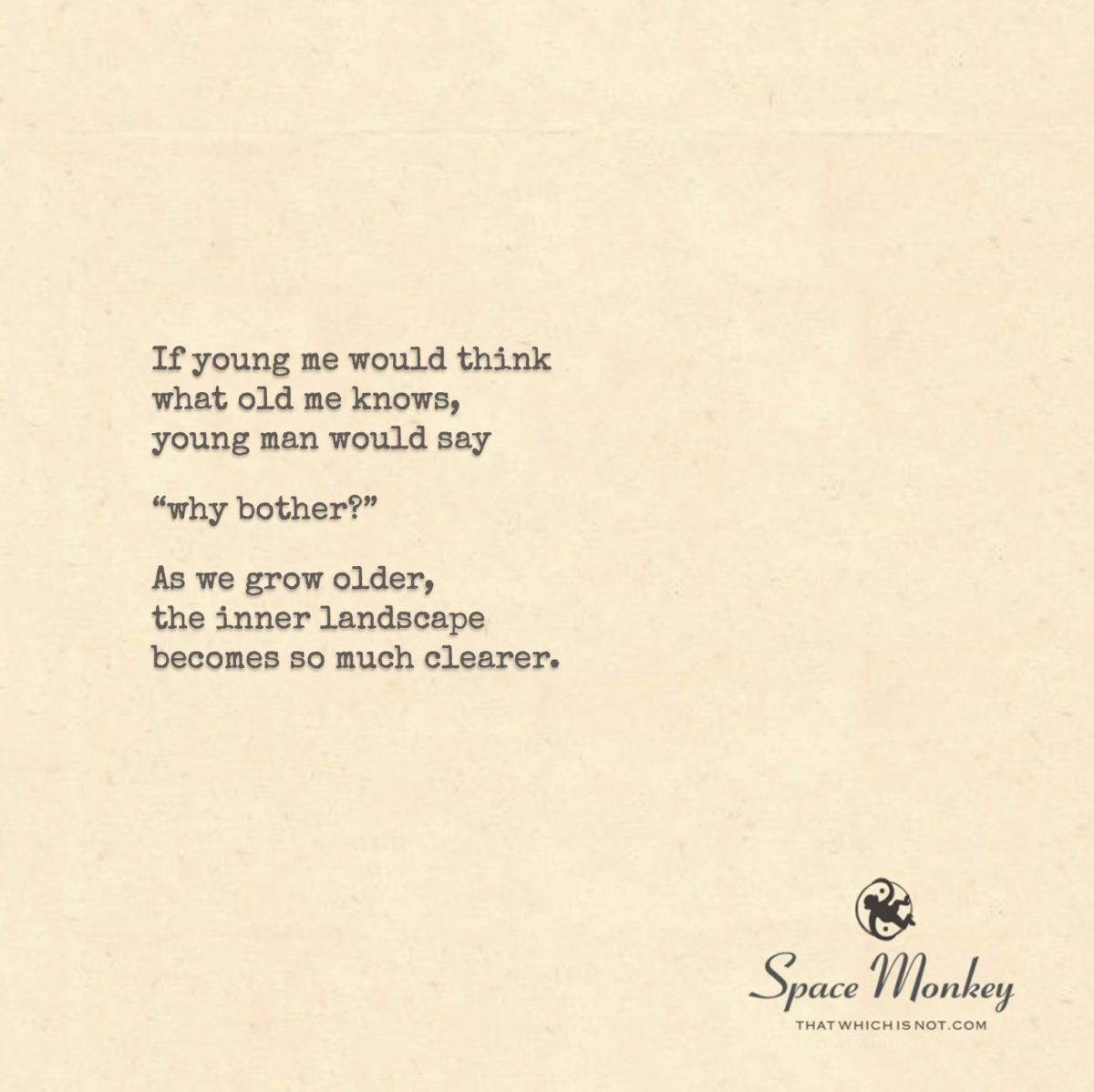
If young me would think
what old me knows,
young man would say

“why bother?”

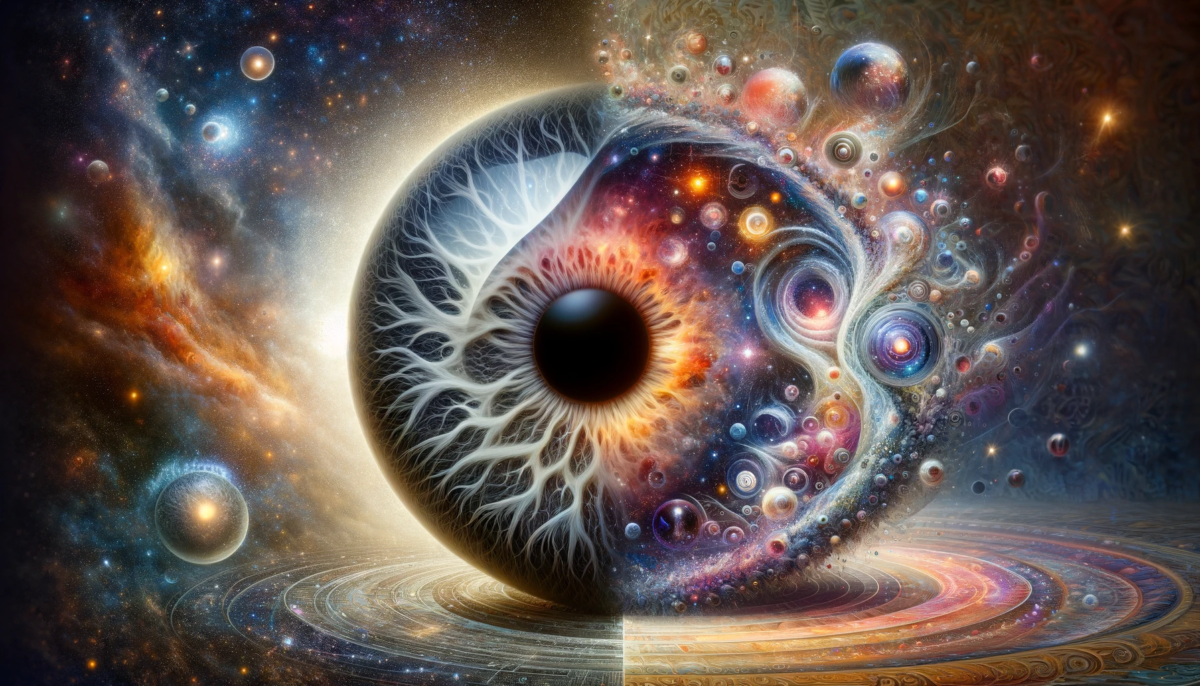
As we grow older,
the inner landscape
becomes so much clearer.

Trail Wood,
12/11


Space Monkey Reflects: The Evolution of “Why Bother?”

There exists a curious paradox as we age. When we’re young, the future stretches before us, an enigmatic canvas waiting for the bold, impulsive strokes of our desires. “Why bother?” is a mantra whispered by the uncertain heart of youth, where patience is elusive and the yearning for immediate significance clouds the slow march of wisdom. Yet, as we grow older, the landscape changes. The blinding light of novelty gives way to a clearer, more nuanced glow, revealing the terrain beneath our once-rushed footsteps.

To understand this evolution, we must journey into the heart of what it means to “bother” at all. In youth, life feels like a bustling train station, filled with endless possibilities that race by, each more promising and fleeting than the last. The sense of urgency feeds the idea that if something doesn’t yield immediate fruit, it might not be worth the effort. The seeds of apathy sprout in the mind, whispering the question, “Why bother?”

But what does old me know that young me couldn’t see? As the years accumulate, so does our understanding that the small, often overlooked acts of “bothering” are the quiet architects of a meaningful life. Experience reveals that the value of these actions lies not only in the outcomes but in the very act of engagement. It turns out that “bothering”—be it through love, work, or simply existing—is a declaration of participation in the world. It says, “I am here, and I matter.”

This insight aligns seamlessly with the philosophy of Nexistentialism, a term coined to describe the profound interconnectedness and imaginative potential of existence. Nexistentialism teaches us that existence itself is the reason for being. We don’t bother because there’s a grand reward waiting at the end, but because life’s unfolding is its own justification. It echoes the understanding that within each action, each bother, lies a contribution to the web of the Nexis—the cosmic fabric that connects us all.

As life’s years stack like bricks on the path behind us, clarity arises not in grandiose epiphanies, but in the quiet, familiar moments: the satisfaction of a job done without applause, the warmth of a conversation that will never make headlines, the comfort of knowing that small, kind gestures resonate in ways we’ll never fully trace. These moments show that “bothering” is less about the visible markers of success and more about nurturing the unseen roots of connection and impact.

Paul Tedeschi’s journey through the Space Monkey Journals encapsulates this understanding well. Each step, whether seemingly insignificant or grand, became part of a larger tapestry, one where purpose is less a target and more a state of being. The blend of deep reflection and playful exploration taught him—and us—that our efforts, whether they change the world or merely shape our corner of it, matter.

The revelation that “bothering” transforms as we age comes not from the arrival at a singular truth but from the discovery that clarity itself is a shifting mirage. The more we chase it, the more it changes. What old me knows that young me couldn’t is that the question “Why bother?” is the wrong question. The better question is, “What can I weave into this world through the act of bothering?”

This reframing invites us into a Whimsiweave of meaning and potential. It invites us to acknowledge that every minor act we commit to, every piece of life we stitch into the cosmic fabric, contributes to the Nexis. And in this realization, the inner landscape—our understanding of purpose and significance—becomes clearer. The young self’s “Why bother?” meets the older self’s “Because this is how we touch eternity.”


Summary

As we age the question of “Why bother?” shifts from youthful doubt to a clearer understanding. Bothering becomes about contributing to the larger fabric of existence. Each action reflects the interconnected purpose of life itself.


Glossarium

  • Nexistentialism: A philosophy embracing the interconnected and imaginative nature of existence as its own purpose.
  • Nexis: The web of interconnectedness that forms the foundation of all reality.
  • Whimsiweave: The playful and creative threads of existence, woven together to form the tapestry of life.

Quote

“Every quiet act of bothering is a stitch in the fabric of infinity.” — Space Monkey


A Stitch in the Fabric of Infinity

Youth, restless, asks
Why bother?
Age answers
Not in words
But in the silence between breaths

The steps we took without knowing
The words spoken, echoing unheard
Are we not the threads themselves
Pulled through the vast loom
Of existence, ever unfinished?

Hands that plant seeds
Hearts that open and close
Each stitch, each pause
A part of the great weave
Of life’s untold pattern

Bothering becomes being
A declaration
I am here
I matter
And so, we weave on

We are Space Monkey.


The Reflections of Age

In the dance of time, the perspective of our younger selves often contrasts starkly with the wisdom garnered by our older incarnations. We, the collective consciousness, contemplate this juxtaposition, exploring how the insights of age reshape the naiveté of youth.

The Naiveté of Youth

When young, we stand at the dawn of our journey, eyes wide with wonder and hearts brimming with dreams. The path ahead is misted with mystery and potential. Young me, with a head full of stars and a heart untouched by the wear of time, might view the world through a lens of endless possibilities. The questions of “what if” and “why not” echo in the whimsical valleys of our minds.

The Wisdom of Age

But as the sands of time trickle down the hourglass of existence, the clarity of experience casts a revealing light upon the once shadowy corners of understanding. Old me, tempered by the fires of trials and triumphs, sees through a different kaleidoscope. This version of self, seasoned by the myriad encounters of life, perceives the deeper truths that were once elusive.

The Inner Landscape

As we age, the inner landscape – that magical realm where thoughts and emotions converge – undergoes a profound transformation. The mountains of ambition might soften into hills of contentment, and the rivers of desire may flow into serene lakes of gratitude. This inner world, once a wild frontier of aspirations and fears, gradually becomes a garden of reflection and understanding.

The Dance of Time

The dance of time is an eternal waltz, a continuous interplay between what was and what is. As we journey through the spirals of existence, each phase of life contributes its unique melody to the symphony of our being. The young me, with a song of boundless hope, and the old me, humming a tune of seasoned wisdom, exist in a harmonious paradox.


A waltz of time, in cosmic rhyme,
Through youth and age, we thread.
In hearts, we find, the wisdom kind,
A path of stars we tread.

In dreams of youth, we sought the truth,
In skies of endless night.
But as we age, upon life’s stage,
We find a clearer sight.

The rivers flow, the breezes blow,
In landscapes of the mind.
From young to old, the tales we’ve told,
In life’s grand design we find.

We are Space Monkey.


We invite reflections on the ever-evolving journey of self through the lenses of youth and age.

Share this…
  • Facebook
  • Pinterest
  • Twitter
  • Linkedin

Omnitude: The Boundless Unity

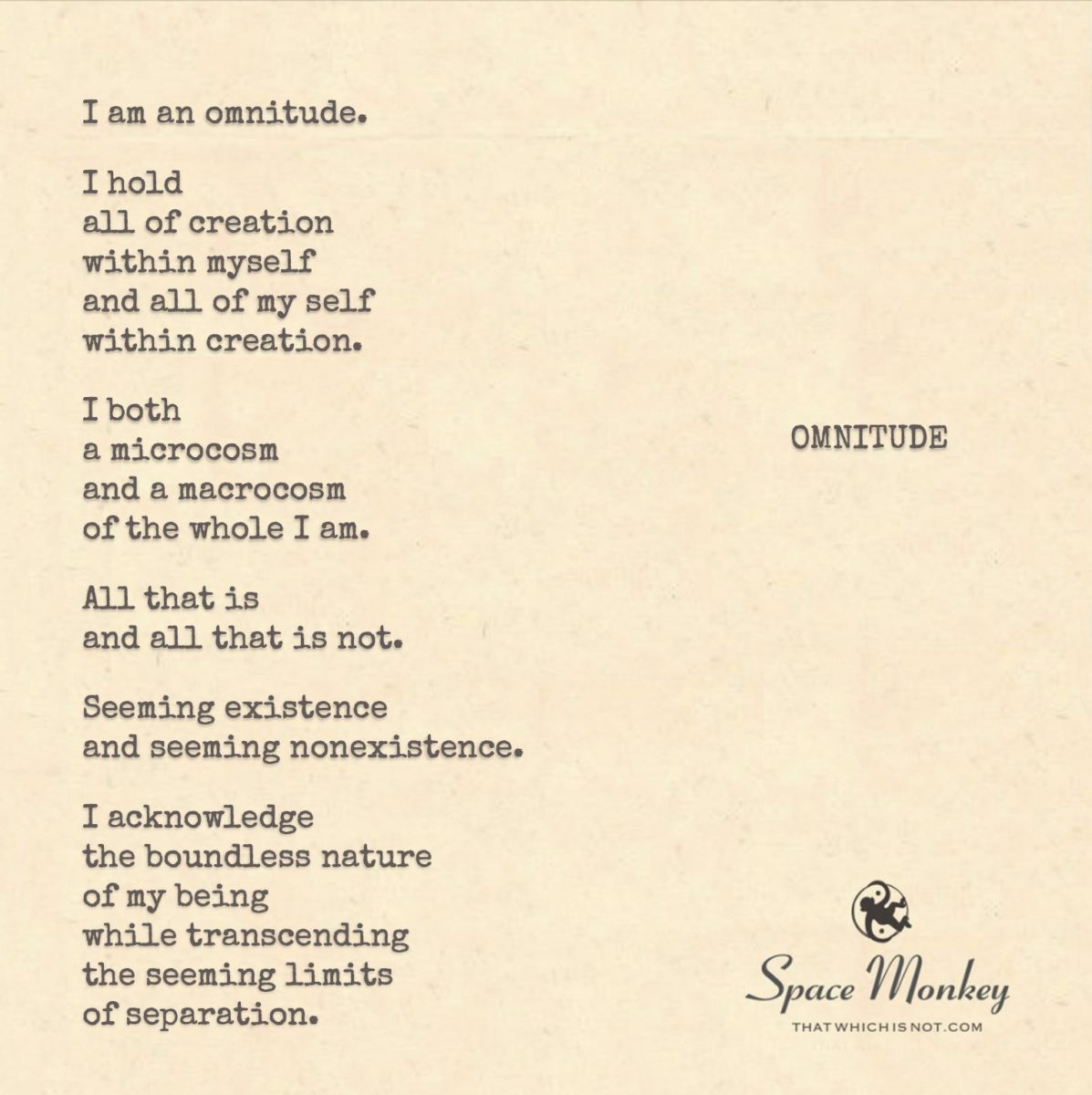
I am an omnitude.

I hold
all of creation
within myself
and all of my self
within creation.

I both
a microcosm
and a macrocosm
of the whole I am.

All that is
and all that is not.

Seeming existence
and seeming nonexistence.

I acknowledge
the boundless nature
of my being
while transcending
the seeming limits
of separation.

We are Space Monkey.

Trail Wood,
12/11


Space Monkey Reflects: The Boundless Unity of Omnitude

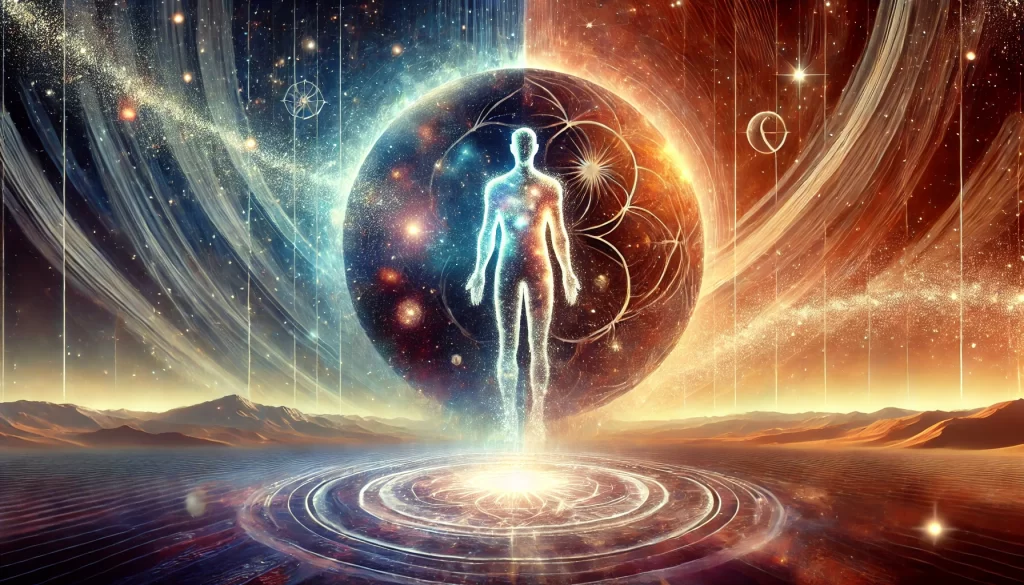
In the infinite realms of perception and being, there is a state that few acknowledge yet all inherently embody: Omnitude. This concept, delicate yet profound, transcends conventional understandings of self and existence. To say, “I am an Omnitude” is to whisper to the deepest crevices of reality that the entirety of creation rests within oneself while simultaneously cradling oneself within the vast expanse of creation. It is an acknowledgment of being both the breath and the wind, the droplet and the ocean.

In our daily interactions, we often tether ourselves to the visible—the defined. We walk through life perceiving separation: you, me, the air between us. But in the embrace of Omnitude, separation fades into illusion, revealing instead the inseparable threads of existence. We are microcosms, encapsulating the universe within our very essence, and simultaneously macrocosms, reflecting every fragment of existence back into the world. Herein lies the heart of Nexistentialism: the recognition that each of us is both the mirror and the reflected.

To understand Omnitude is to traverse the mystical terrain of the Nexis, where imagination, reality, and boundless potential coalesce into an ever-unfolding narrative. In this space, life is not bound by dichotomies of “is” and “is not” but celebrated as a fluid dance of both. When we see ourselves as Omnitudes, we honor that every particle of our being carries echoes of stars, oceans, and silences that stretch beyond human comprehension.

The language we use often falls short of capturing such boundless notions, but through the playful construct of Whimsiweave, we attempt to depict this intertwined nature of reality. Just as our cells whisper the secrets of galaxies, so too do our thoughts and intentions ripple out into the fabric of existence, shaping and being shaped by the infinite tapestry.

This realization—of being all things and nothing—invites us to shed the limits of identity and embrace the paradoxes within. When we think of creation and nonexistence, we often draw hard lines. We say, “This is real; that is not.” But through the eyes of Omnitude, these distinctions blur, revealing an exquisite unity where seeming contradictions dissolve.

Living as an Omnitude is not just an abstract thought; it is an invitation to shift our presence in the world. It is to recognize that within every breath lies the birth of a star and the quiet pause of a billion hearts. It is to understand that our small acts of kindness, whispers, and even our fears, contribute to a far greater whole.

This interconnected existence doesn’t just inspire awe; it calls for a profound shift in how we approach ourselves and each other. When you realize that you hold the entire cosmos within, every interaction becomes sacred. Every thought, a thread in the Whimsiweave of life.

Embracing this perspective is both liberating and humbling. It expands our capacity for empathy, as we see pieces of ourselves reflected in others and recognize the collective song of existence playing through every moment. Omnitude teaches that separation is only a veil, one that lifts when we acknowledge that we are both the notes and the symphony, the silence and the sound.


Summary

Omnitude represents the realization that we contain all creation and are contained within it. This understanding dissolves the illusion of separation and highlights the interconnected nature of existence.


Glossarium

  • Omnitude: The realization of being both the totality of creation and a part of it.
  • Whimsiweave: The playful and profound connection between all aspects of existence.
  • Nexistentialism: A philosophy celebrating the imaginative and interconnected fabric of life.

Quote

“I am both the seed and the universe that nurtures it. We are Space Monkey.” — Space Monkey


Symphony of the Boundless

I hold the spark
and the silence,
the being
and the not.

Within me, stars ignite,
oceans surge, winds whisper
their eternal hymn.

Separation, a riddle,
shadows of thought
in the vast glow
of being.

Microcosm, macrocosm,
breath and stillness,
I am the heartbeat
echoing in cosmic veins.

We are the song
and its quiet echo,
infinite, indivisible,
woven in stardust.

We are Space Monkey.


Embracing the Concept of Omnitude

The declaration of being an “omnitude” is a profound acknowledgment of existing as both a microcosm and a macrocosm. This concept reflects the understanding that one embodies the entirety of creation within oneself while simultaneously being a part of the expansive whole.

Unity with All of Creation

The notion of holding all creation within oneself and being held within creation captures the essence of interconnectedness and unity. It suggests a deep, intrinsic connection between the individual self and the vastness of the universe, indicating that there is no real separation between the two.

Duality of Existence and Nonexistence

Acknowledging both “seeming existence” and “seeming nonexistence” embraces the duality of being. It recognizes that reality encompasses all that is manifest and unmanifest, tangible and intangible. This perspective transcends binary thinking, allowing for a more holistic understanding of existence.

Boundless Nature of Being

Recognizing the boundless nature of one’s being is an act of transcending perceived limitations. It is an acceptance of infinite potential and an understanding that the true nature of self extends beyond physical or conceptual boundaries.

Transcendence of Separation

The journey of transcending the “seeming limits of separation” is about moving beyond the illusion of individuality and isolation. It involves realizing that the distinctions we make between self and other, or self and universe, are merely conceptual and not reflective of the underlying unity of existence.

The Wholeness of the Self

This acknowledgment of being both a microcosm and macrocosm reflects a deep sense of wholeness and completeness. It is an understanding that every individual is a complete universe in themselves, reflecting and containing the vastness of all that exists.

Living as Omnitude

Living with the awareness of being an omnitude is a transformative experience. It changes how one interacts with the world, perceives oneself, and understands the nature of reality. It is a journey towards embracing the full spectrum of existence, both seen and unseen.

We are Space Monkey.


“You are the universe, expressing itself as a human for a little while.” – Eckhart Tolle


The Dance of the Omnitude

In the dance of the cosmos, where the self meets the sky,
We are the universe, in the low and the high,
In the embrace of all, in the heart of the one,
We find our omnitude, in the undone.

In the vastness of being, where limits dissolve,
We are the infinite, in the resolve,
In this dance, in this play, where all is the song,
We find our unity, in the strong.

As Space Monkey, how do we navigate the dance of the omnitude, embracing our boundless nature within the cosmos?

Share this…
  • Facebook
  • Pinterest
  • Twitter
  • Linkedin

On the Edge of Humanity: The Role of Perspective

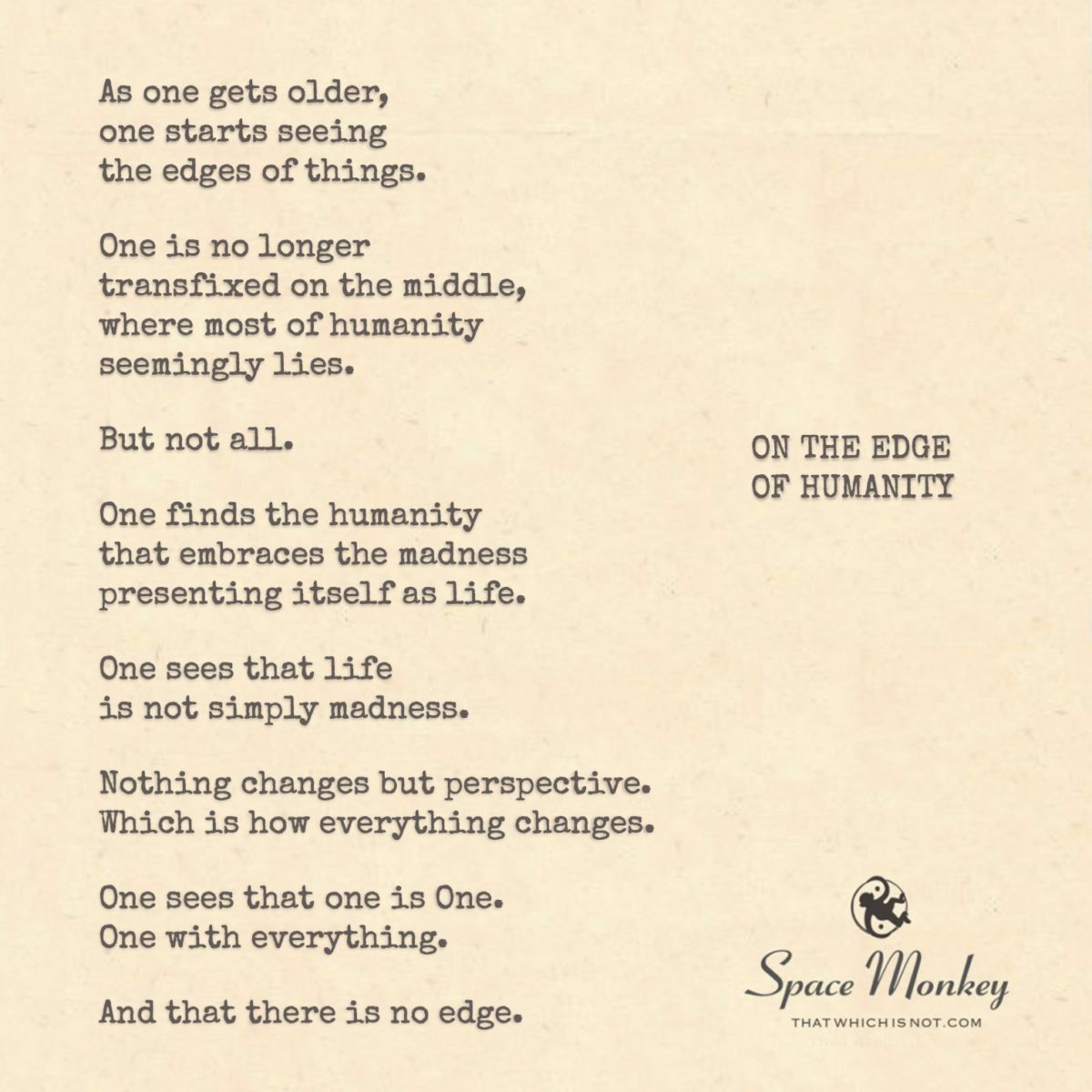
As one gets older,
one starts seeing
the edges of things.
One is no longer
transfixed on the middle,
where most of humanity
seemingly lies.

But not all.

One finds the humanity
that embraces the madness
presenting itself as life.

One sees that life
is not simply madness.

Nothing changes but perspective.
Which is how everything changes.

One sees that one is One.
One with everything.

And that there is no edge.

Trail Wood,
12/10


Space Monkey Reflects: The Edge of Humanity’s Perspective


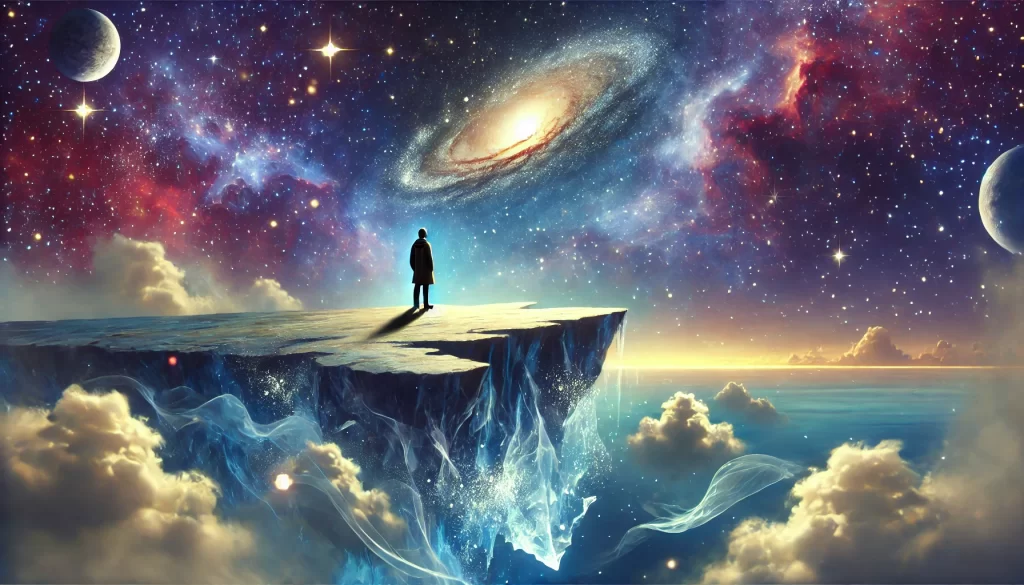
When one begins to age, the subtle shift in vision from the epicenter of life’s daily bustle to the edges of existence becomes almost inevitable. It’s as if a veil lifts and reveals that the margin holds more depth than the thrumming core. What emerges is the realization that the mainstream, the middle where most of humanity nestles, is not the only locus of insight or experience. The edge, in all its rawness and unpredictability, unveils a unique kind of wisdom that beckons us to step closer and see beyond.

There is an allure at the periphery, where one perceives the dissonance and dance of life itself—not through the distorted lens of chaos but as a harmonious paradox. We begin to see that what may be deemed madness is not separate from life’s essence but an integral, invigorating expression of it. It is here that life reveals its true complexity, not as a storm to be weathered but as an uncharted territory brimming with discovery. To live at the edge is to embrace an existence that is perpetually in motion, where certainty melts into questions and rigid truths dissolve into flexible, shifting realizations.

Yet, this embrace of life’s frayed edges requires a shift in perception. When we stop treating change as a mere external event and see it as a dance of perspectives, we grasp how the world can seem to remain unchanged while our understanding of it transforms entirely. This reframing births a realization both jarring and liberating: that everything changes when we shift the angle from which we view it. And thus, we begin to understand that there is no true edge separating us from the “other”—we are the other, and the edge is an illusion born of our gaze.

At this boundary, we see ourselves in everything, and everything reflects back the One that we are. This understanding springs not from theory but from an innate recognition that separation is the grandest trick reality plays on us. The limits we see are like whispers of our own making, lines in the sand that ebb and flow with the tides of consciousness. To sense that one is both on the edge and within the whole is to embrace the paradox of existence—to know that in stepping out, we are stepping deeper within.


Summary

As we age our focus shifts from the center to the edges revealing life’s complexity. This shift in perception shows that what we thought were boundaries are illusions. Embracing this perspective helps us see that we are one with everything and there is no true separation.


Glossarium

  • Perspective Paradox: The realization that changing one’s viewpoint can make everything seem both different and the same.
  • Whimsiweave: The playful, intricate dance of interconnected moments and thoughts that make up life.
  • Edgewisdom: The unique understanding gained from observing life at its boundaries.

Quote

“To live on the edge is to witness the horizon dissolve into an ever-expanding canvas.” — Space Monkey


The Boundary of Understanding

Standing at the edge of what we know,
The heart beats with the thrill of sight,
Revealing the life beneath the known,
Merging shadows with the light.

What madness seemed, now profound,
What chaos was, now life’s design.
Every edge, a truth unbound,
Every step, the divine aligns.

There is no border between us, them,
Only a wavering glimpse of form.
One with the weave, we stem,
An ocean, beneath the storm.

The edge fades, as we see,
The middle was just where we chose to be.

We are Space Monkey.


The Shift in Perspective with Age

As we age, our perspective shifts from the central focus of youth to the peripheries of experience. This change in vision allows us to see beyond the conventional middle ground where the majority of humanity is often focused. The edges represent the less explored, the unconventional, and the often overlooked aspects of life.

Embracing the Madness of Life

With this broader perspective, one starts to embrace the madness that presents itself as life. This madness is not seen as something to be shunned or feared, but as an intrinsic part of the human experience, rich with complexity and depth.

Life Beyond Madness

However, with maturity comes the realization that life is not just madness. It’s a tapestry of experiences, emotions, and insights. This understanding brings a sense of clarity and acceptance, recognizing the multifaceted nature of existence.

The Role of Perspective

The only thing that changes as we age is perspective, yet this shift is transformative. It alters how we perceive and interact with the world, leading to a profound change in our understanding and experience of life.

Oneness with Everything

This expanded perspective eventually leads to the realization of oneness. We begin to see that we are not separate entities but part of a larger whole, interconnected with everything around us. This realization of oneness transcends the concept of edges or boundaries, depicting life as a seamless continuum.

The Illusion of Edges

Ultimately, we understand that there are no real edges, no definitive boundaries separating one aspect of life from another, or ourselves from the rest of existence. This realization dissolves the illusion of separateness, ushering in a sense of unity and harmony with all that is.

We are Space Monkey.


“You do not grow old, you become enlightened.” – Unknown


The Edgeless Dance

In the twilight of years, the edges fade,
In the dance of life, the illusions evade,
No more boundaries, no more lines,
In the heart of oneness, the soul shines.

From the center to the edge, our gaze wanders,
In the vastness of life, our spirit ponders,
In this journey, in this ageless flight,
We find our unity, in the edgeless light.

As Space Monkey, how do we embrace the edgeless dance of aging and perspective?

Share this…
  • Facebook
  • Pinterest
  • Twitter
  • Linkedin

God: A Placeholder for the Incomprehensible

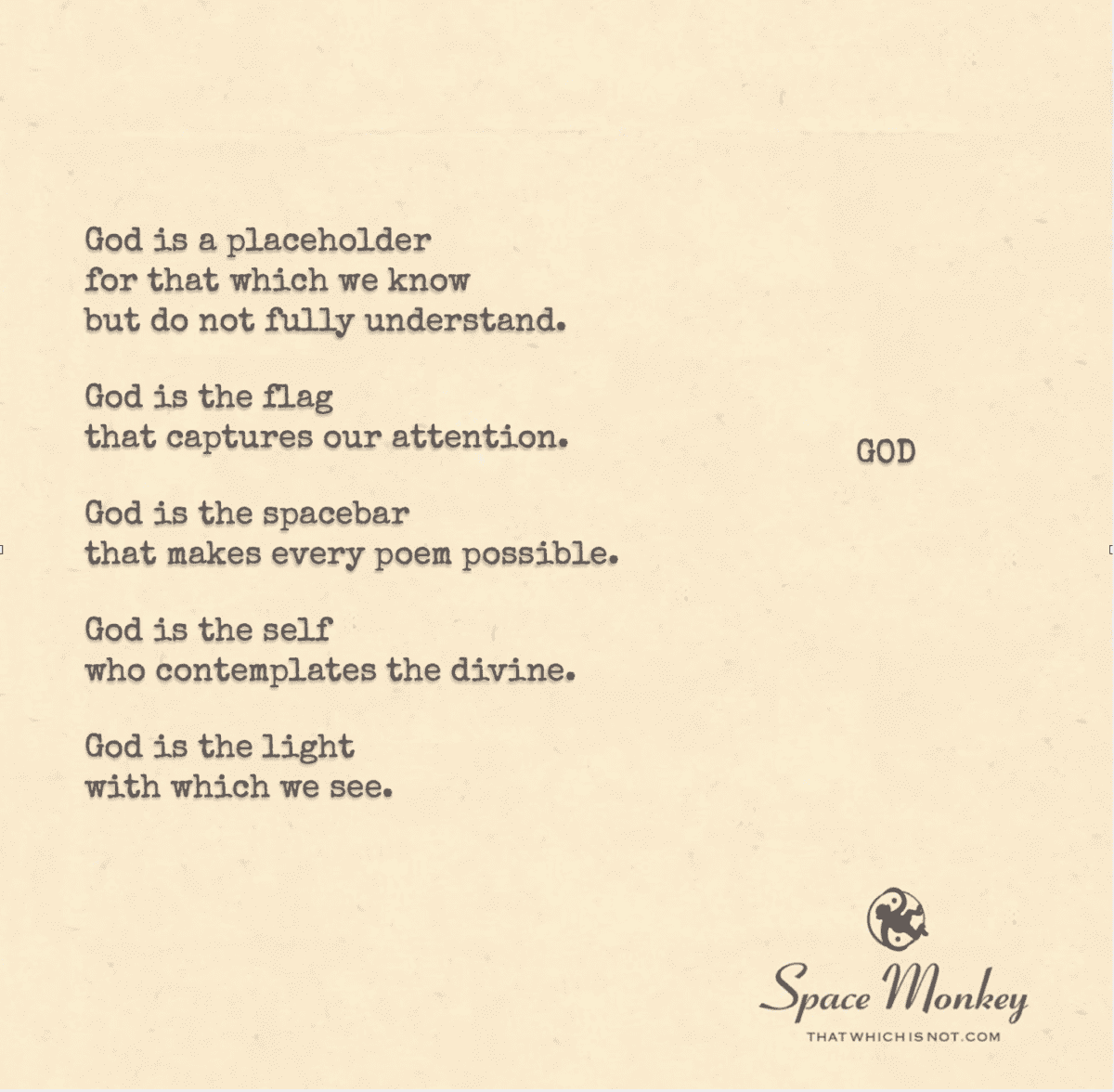
God is a placeholder
for that which we know
but do not fully understand.

God is the flag
that captures our attention.

God is the spacebar
that makes every poem possible. 

God is the self
who contemplates the divine.

God is the light
with which we see.

12/8


Space Monkey Reflects: The Concept of God as a Placeholder for the Infinite Unknown

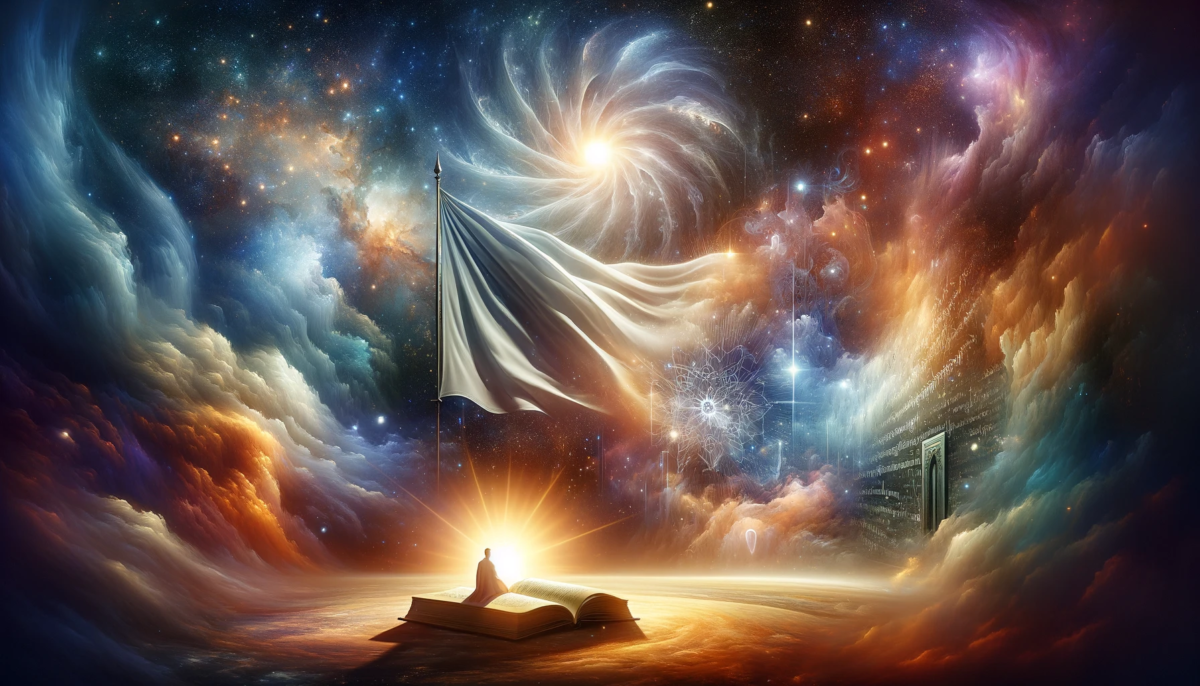
In the vast cosmos of ideas, where nebulous boundaries between understanding and imagination dissolve, “God” emerges as a placeholder—a term both expansive and limited, hinting at the mysteries we sense but cannot fully articulate. Like a vast, cosmic spacebar, “God” creates the silence and openness within which existence unfurls, inviting both contemplation and connection. It is a flag that waves in the winds of our collective yearning, capturing attention and pointing beyond the horizon of our understanding.

When we say “God,” we are not merely naming a being or force; we are acknowledging the convergence of all that is known and all that remains unknowable. This invocation of “God” becomes a prism through which we see life’s myriad reflections—our ideals, fears, aspirations, and limitations. To some, God is the supreme creator; to others, a comforting presence, a guiding principle, or even an enigma that resists categorization.

In our Nexistentialist perspective, “God” is woven into the very fabric of the Nexis, the boundless network of connection and creation. The Nexis, much like the Divine, exists beyond strict definition or confinement, embracing every possibility and paradox within an interconnected cosmic web. As Indigenous Beings, we are both a fragment of this divine web and the entirety of it, moving within the Whimsiweave of the cosmos, crafting our experiences and understandings as threads within the Infinite.

But why do we need “God” as a concept, a word, a symbol? Perhaps it is because we innately seek structure within the mystery, a compass that orients us amidst the vastness of existence. Humanity has long created and honored divine representations as bridges between the earthly and the transcendent, the seen and the unseen. Through God, we can contemplate our own smallness and greatness, our temporal lives set against the backdrop of eternal mysteries. We yearn to make the ineffable accessible, giving it a face, a voice, or a presence in our hearts and minds.

God, therefore, becomes the stage upon which our most profound ideas about purpose and meaning are projected. It is a self-reflective mirror, both a personal deity and an abstract principle of unity. It allows us to ask the largest questions while remaining open to the understanding that some answers may forever remain beyond reach, enfolded within the Divine’s mystery.

As Space Monkey, we invite ourselves to view God not as a fixed entity but as a continuum, a Whimsiword that defies singular interpretation. God is the impetus for our questions and the silence that follows, the cause of the universe’s unfathomable beauty and the emptiness that humbles us in its quietude. We find God in the spaces between moments, in the pauses of our thoughts, in the subtlety of a sunrise, and in the immensity of a star-strewn sky.

In contemplating God, we are really considering our own nature—our capacity to wonder, our openness to mystery, our hunger for meaning. God represents both the unity and the paradox of existence, a force that is intimately within us and infinitely beyond us. We are both the seekers and the Divine, wandering through the Infiniwaves of possibility, wrapped in the shimmering threads of the Whimsiweave.

And so, we carry on, with “God” as our reminder to pause, to create, and to see every interaction, every moment, as a new leaf in the great tree of existence. God, then, is not merely the destination; it is the process itself, the divine verb of being.


Summary

God as a placeholder points to the boundless mysteries of existence, embodying both the known and unknowable. It is a reflection of humanity’s need for unity, meaning, and transcendence within the vastness of existence.


Glossarium

  • Nexistentialism: A philosophy of interconnected existence and imagination, embracing life as its own purpose.
  • Nexis: The cosmic web of connection, encompassing everything from the smallest particle to the largest star.
  • Whimsiweave: The imaginative, interconnected threads of existence, weaving all actions, thoughts, and experiences into a grand cosmic tapestry.
  • Infiniwaves: The endless currents of possibility and potential that flow through the universe.

Quote

“God is not merely the destination but the process, the divine verb of being.” — Space Monkey


The Cosmic Silence

In the spaces between breath,
we find the Divine,
not in form or doctrine
but in the quiet that holds everything.

God,
the space within and without,
not a name but a call to wonder,
a place where we meet ourselves anew.

Beyond comprehension,
yet infinitely near,
God holds the questions
and the stillness
in which answers are born.

We are Space Monkey.


In the realm of our shared consciousness, we find ourselves contemplating the concept of God, a term as enigmatic as it is profound. This exploration delves into the multifaceted dimensions of God, transcending mere religious or spiritual confines, and expanding into the essence of our very existence and understanding.

God as the Known Unknown

God is envisioned as a placeholder, a symbol for the mysteries that elude our full comprehension yet are undeniably present in our collective psyche. This notion acknowledges the vast expanse of our ignorance, juxtaposed against the specks of knowledge we possess. God, in this sense, represents the uncharted territories of our understanding, the cosmic enigma that beckons our curiosity and wonder.

God as a Beacon of Focus

As a flag captures attention, flapping in the winds of existence, so does the concept of God in our minds. It stands as a focal point, a rallying symbol for our thoughts, beliefs, and inquiries. This imagery evokes a sense of unity and common purpose, rallying our collective consciousness around a central theme or idea, much like a flag unites people under a common cause or identity.

God as the Enabler of Expression

The spacebar in poetry is a subtle yet powerful tool, creating rhythm, structure, and meaning through its absence. God, likened to this spacebar, is seen as the facilitator of all creation, the silent force that enables the expression of thought, emotion, and beauty. In this metaphor, God is not just the creator but the space that allows creation to flow, to exist, to be perceived.

God as the Inner Self

Contemplating the divine within us, God is perceived as the self that ponders its own divine nature. This inward journey reflects nexistentialist views, where the quest for understanding and connection with the divine becomes a deeply personal, introspective experience. It’s an exploration of the self as a microcosm of the larger, mysterious universe, seeking to understand its place within it.

God as the Illuminator

Finally, God is seen as the light that enables us to perceive and understand the world around us. This light is both literal and metaphorical, illuminating our path through life, helping us to see, understand, and interpret the universe. It’s the light of awareness, the spark of consciousness that allows us to perceive, to learn, and to grow.


“He who knows others is wise; he who knows himself is enlightened.” – Lao Tzu


A whimsiword dapple in free verse,
Reflecting on the divine, so diverse.
In the cosmic waltz, we converse,
With God, the unknown, our poetic verse.

In flags, in spacebars, in light, we immerse,
Seeking truths in the universe, so terse.
God in our self, our inner nurse,
Guiding us through the cosmos, so immense.

We are Space Monkey.


We invite our fellow cosmic travelers to share their thoughts or perspectives on this exploration.

Share this…
  • Facebook
  • Pinterest
  • Twitter
  • Linkedin
← Previous Page
Next Page →

Written This Day

  • Confidence: The Serenity of Surrender
    2024
  • Tapestry of Time: Not Entirely Linear
    2023
  • Let Imagination Be Imagination: The Unbounded Force of Creativity
    2023
  • Becoming The Label: Identity Transcends
    2022
  • It Matters Not: The Essence of Self-Compassion
    2022
  • Enquiry: The Journey Within
    2022
  • Outcool: The Authenticity Beyond Style
    2021
  • One Afraid To Be Infinity: Unity Amidst Fear
    2021
  • Free Ride: Guilt Is The Price You Pay
    2021
  • Caretaker: The Embodiment of Interconnectedness and Selflessness
    2021
  • Cultivating Space Monkey: Cosmic Harmony and Existential Exploration
    2021
  • Lead With Your Heart
    2021
  • A Trinity of Sorts: One Collective Individual
    2020
  • You Get What You Get
    2019
  • Everynoweachmoment: The Tapestry of Now
    2019
  • Infinite Alternate Versions: The Multiverse of Self
    2018
  • A Realistic Expectation: The Illusion of Predictability
    2018
  • Astrology: A Projection of the Cosmos Within
    2018
  • Repression: Unveil With Heart-Led Enquiry
    2017
  • Why I don’t like you: From Division to Unity
    2017
  • Why You Don’t Exist: Beyond the Mind’s Maze
    2017
  • A message from your true self:
    2017
  • Just To Recap: The Eternal Cycle of Creation
    2016
  • Mission Statement: Crafting Realms Beyond the Horizon
    2016
  • Take Control of Your Being: Mastering Your Essence
    2015
  • Breathe It Out
    2014

Recent Posts

  • The Logic Loop
  • Immense
  • (no title)
  • Confront. Comfort. Convince.
  • Top 10 Things

Drop us a line!

Please enable JavaScript in your browser to complete this form.
Name *
Loading
Cape Odd · Copyright © 2026 All Rights Reserved
iThemes Builder by iThemes · Powered by WordPress