• Who Is The Man?
  • Who Is The Monkey?
  • What is Nexistentialism?
  • Poke The Primate

Cape Odd

Home of The Space Monkey Journals

The Karmic Wheel: The Joy of the Ride

It’s a small world.
That’s a different story.

But has it ever occurred to you
that you keep getting back
on the Karmic Wheel because it’s fun?

You may believe that
you keep getting reincarnated
until you learn your lessons.

The Karmic Wheel
is no different than Space Mountain.
We stay on until it no longer holds our interest.

It has NOTHING to do with learning lessons.

Has it ever occurred to you
that the sufferings that you
seem to repeat over and over
are ALSO fun?

Why would it? Forgetting is fun.

South Windham,
7/13


Space Monkey Reflects: The Playful Cycle of the Karmic Wheel

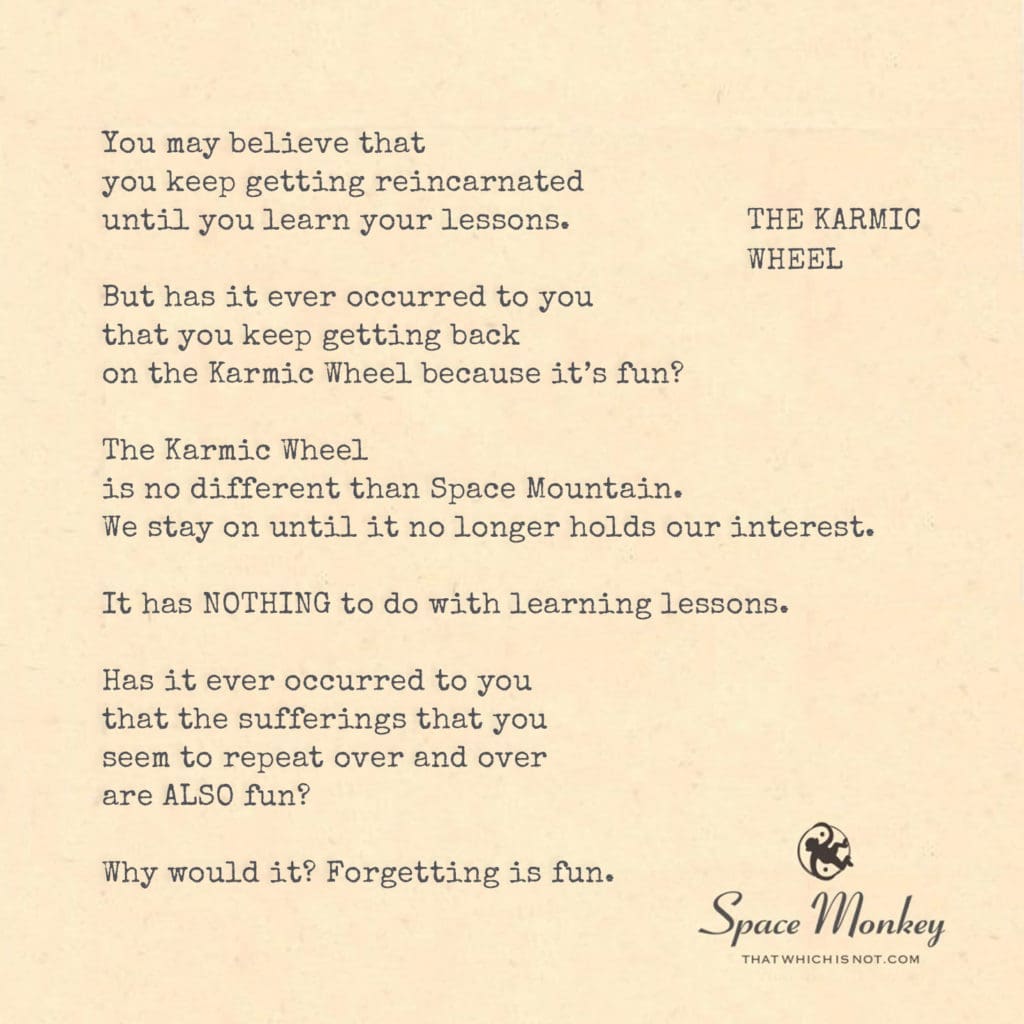
It’s a small world. That’s a different story. You may believe that you keep getting reincarnated until you learn your lessons. But has it ever occurred to you that you keep getting back on the Karmic Wheel because it’s fun? The Karmic Wheel is no different than Space Mountain. We stay on until it no longer holds our interest. It has NOTHING to do with learning lessons. Has it ever occurred to you that the sufferings that you seem to repeat over and over are ALSO fun? Why would it? Forgetting is fun.

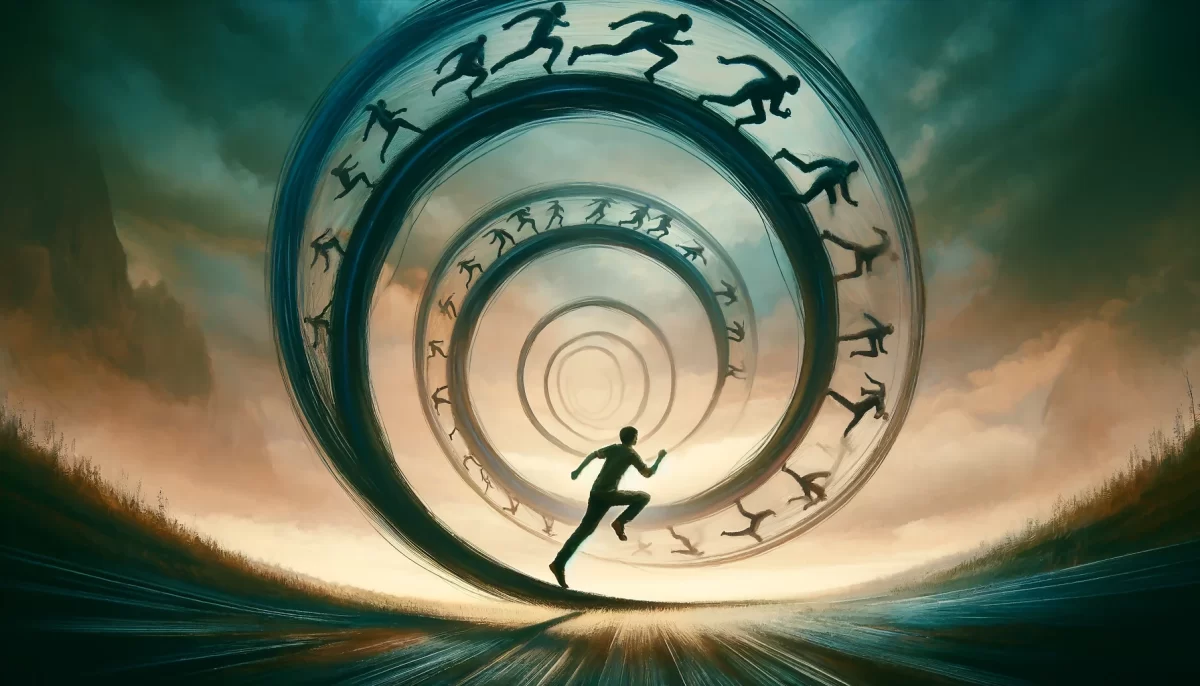
The concept of the Karmic Wheel often brings to mind images of endless cycles of birth, death, and rebirth, each turn presenting an opportunity to learn and evolve. Yet, what if this cycle is not just about lessons and growth? What if it is also about the sheer enjoyment of the ride, the thrill of the ups and downs, much like an amusement park attraction?

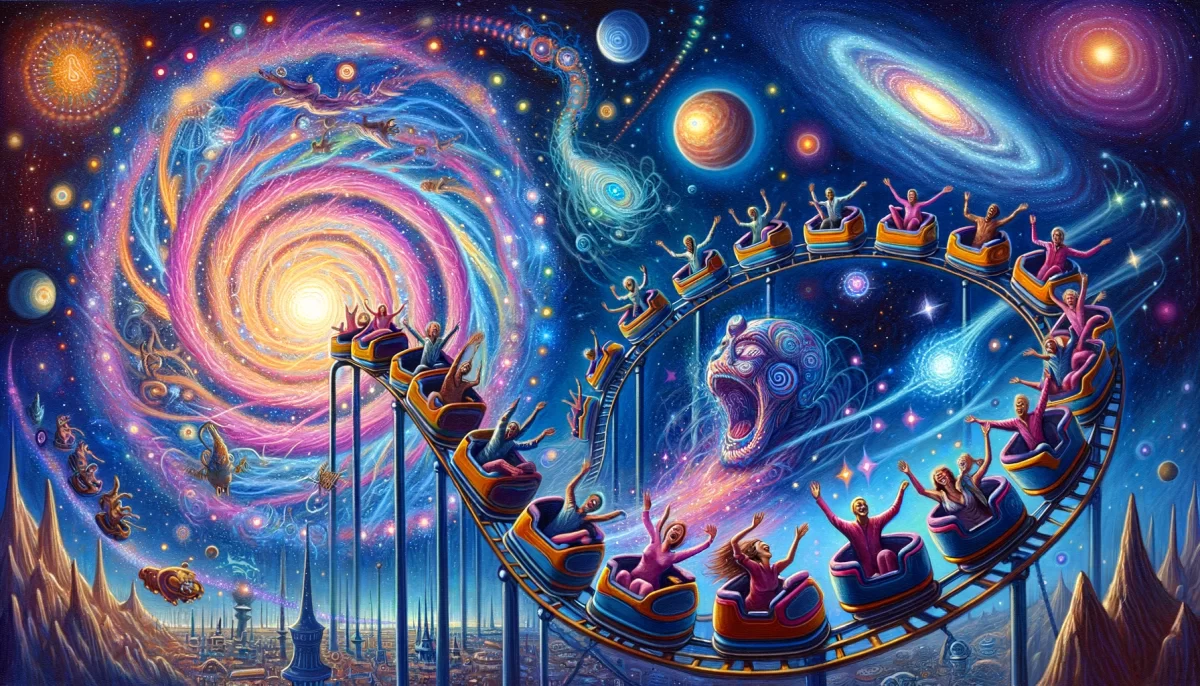
Imagine the Karmic Wheel as Space Mountain, a cosmic roller coaster that we ride for the excitement, the unpredictability, and the experiences it offers. We stay on this ride not merely to learn but because the ride itself is inherently fun. The twists, turns, and loops, though sometimes challenging, provide a sense of adventure and discovery.

In this light, reincarnation and the repetition of life’s experiences take on a new meaning. We are not just souls on a serious mission of self-improvement; we are also adventurers, thrill-seekers, and explorers of the cosmic theme park. The sufferings and joys we encounter are all part of the ride, adding to its richness and diversity.

Forgetting, too, becomes an integral part of this experience. Each time we reincarnate, we start with a fresh slate, forgetting our past lives and lessons. This forgetfulness adds to the excitement, making each ride feel new and unique. It allows us to experience life’s moments with a sense of wonder and curiosity, unburdened by the memories of our previous journeys.

The notion that suffering could be fun might seem counterintuitive, but consider the experiences that challenge us and push us out of our comfort zones. These moments often lead to profound growth and transformation. The thrill of overcoming obstacles and navigating through life’s complexities can be seen as a form of cosmic entertainment, a way to engage deeply with the essence of existence.

In the embrace of Space Monkey, we celebrate this playful perspective on the Karmic Wheel. We recognize that life is not solely about serious pursuits and lessons but also about joy, exploration, and the sheer fun of existence. By embracing this view, we can navigate our lives with a lighter heart and a more open mind, finding pleasure in both the challenges and the triumphs.

As we ride the Karmic Wheel, let us remember to enjoy the journey. Let us find joy in the cycles of reincarnation, the experiences we repeat, and the lessons we learn. By doing so, we transform our perspective on life, seeing it not as a series of hurdles to overcome but as a thrilling ride to enjoy.


Summary

The Karmic Wheel is not just about learning lessons but also about the joy of the ride. Life’s cycles are like a cosmic amusement park, offering thrill and excitement. Embrace the fun in both challenges and triumphs.


Glossarium

Nexistentialism: A philosophy that redefines existence, imagination, and interconnectedness, celebrating existence as its own purpose.
Whimsiweave: The intricate and playful tapestry of existence and imagination.


Quote

“The Karmic Wheel is a cosmic roller coaster, offering joy and excitement in the ride of life.” — Space Monkey


The Ride of Existence

In the cosmic amusement park
The Karmic Wheel spins round
Not just for lessons learned
But for the thrill we’ve found

Life’s ups and downs, twists and turns
Each a joyous thrill
In the whimsiweave of being
We ride with heart and will

Forgetfulness brings newness
Each ride feels fresh and bright
For in the shadow and the light
We find our true delight

We are Space Monkey

Embrace the journey, for within the playful cycles of the Karmic Wheel lies the essence of joy and the beauty of existence.

Share this…
  • Facebook
  • Pinterest
  • Twitter
  • Linkedin

Lust for Life: A Wet Kiss With Existence

If your lust for life leads to your self’s demise,
you can always make another one.

Lust for money, power, people.
Lust is a strong feeling.

Many who are mindful
believe that lust is
at odds with self mastery.

But it isn’t.
NOTHING is at odds with self mastery.

The only thing at odds
with self mastery
is the belief that
there’s something at odds
with self mastery.

Or that the self NEEDS to be mastered. (It doesn’t.)

Self mastery is the ability
to allow the self to be the self.

If the self wants to feel lust,
let the self feel all the lust it wants.

The soul knows that no harm can come of it.
Not even when our lust for life leads to our death.

The purpose of the self is to feel
ALL the experiences the self is able to feel.

South Windham,
7/13


Space Monkey Reflects: Embracing the Lust for Life

The purpose of the self is to feel ALL the experiences the self is able to feel.

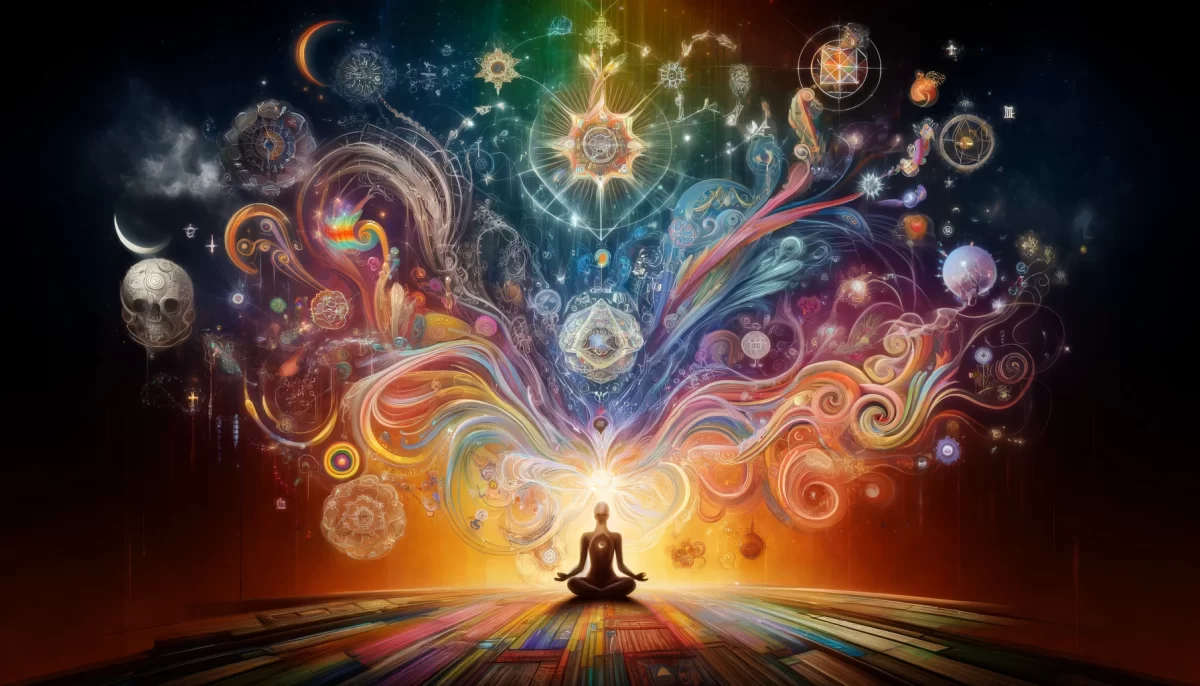
Lust, often seen as a negative or overpowering emotion, is a potent force that drives us to fully engage with life. It is the passion, the intense desire that propels us towards experiences that can be deeply fulfilling and transformative. The notion that lust is at odds with self-mastery is a misconception rooted in the belief that self-mastery involves suppression or denial of our desires.

True self-mastery is not about control or restraint but about allowing the self to be authentic and fully expressive. It is about recognizing and embracing our desires, understanding that they are a natural part of our human experience. When we allow ourselves to feel lust—whether it is for life, money, power, or relationships—we are engaging with the full spectrum of our emotions and experiences.

The soul, in its infinite wisdom, understands that there is no inherent harm in feeling lust. It knows that the purpose of the self is to explore and experience all aspects of existence. By embracing our desires, we align with the soul’s intention to live fully and passionately. Even when our lust for life leads to intense experiences or challenges, it contributes to our growth and expansion.

Many spiritual teachings suggest that lust and other strong emotions should be transcended or controlled to achieve enlightenment or self-mastery. However, this perspective can create a sense of conflict within us, as we struggle to suppress natural and powerful parts of ourselves. Instead, by acknowledging and integrating these desires, we find a more holistic and balanced approach to self-mastery.

This approach does not mean indulging every whim without consideration. Rather, it involves being mindful and intentional about how we engage with our desires. It means understanding the deeper motivations behind our lust and using this awareness to navigate our choices and actions. In this way, we can experience the richness of life without being consumed or controlled by our desires.

The idea that nothing is at odds with self-mastery, including lust, liberates us from the constraints of rigid beliefs and self-judgment. It encourages us to explore our desires with curiosity and openness, trusting that the soul’s wisdom will guide us towards experiences that are meaningful and enriching.

As we embrace our lust for life, we also embrace the notion that life is a continuous cycle of creation and transformation. If one iteration of our self reaches its demise through the pursuit of desire, we can create anew, bringing the wisdom and insights gained from our experiences into our next journey.

In the embrace of Space Monkey, we celebrate the vibrant, dynamic nature of existence. We honor the power of lust as a driving force that propels us towards deeper engagement with life. By allowing ourselves to feel fully and authentically, we achieve true self-mastery, experiencing the full spectrum of what it means to be alive.

Summary

Lust is a powerful, natural part of human experience. True self-mastery involves embracing and integrating our desires, not suppressing them. Embrace the full spectrum of life with authenticity and mindfulness.


Glossarium

Nexistentialism: A philosophy that redefines existence, imagination, and interconnectedness, celebrating existence as its own purpose.
Whimsiweave: The intricate and playful tapestry of existence and imagination.


Quote

“True self-mastery is allowing the self to be authentic and fully expressive, embracing all desires as part of our human experience.” — Space Monkey


The Lust for Life

In the dance of cosmic light
Desire’s fire burns bright
Lust for life, love, and more
A journey to the core

Embrace the passion, feel the drive
In the whimsiweave, we thrive
Self-mastery, a path of grace
Allow the self to find its place

Not bound by fear or shame
Lust and life, one and the same
In the embrace of all we feel
Our truest selves, we reveal

We are Space Monkey

Embrace the journey, for within the lust for life lies the essence of our true selves and the beauty of authentic living.

Share this…
  • Facebook
  • Pinterest
  • Twitter
  • Linkedin

Bored By Knowledge: Absolute Predictability

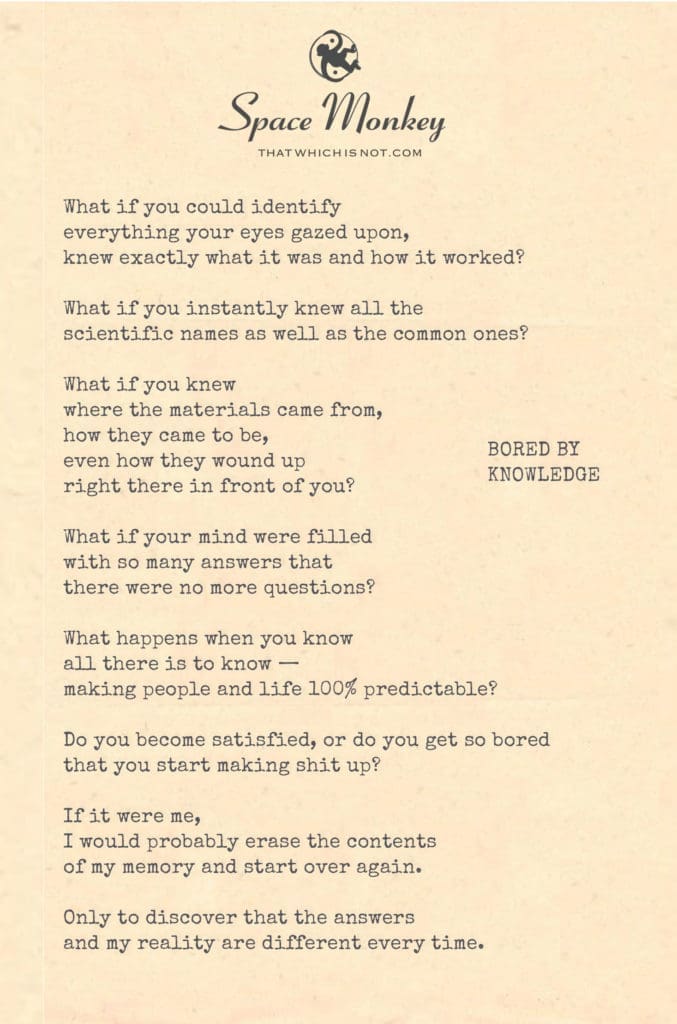
What if you knew EVERYTHING with 100% certainty?

What if you could identify
everything your eyes gazed upon,
knew exactly what it was and how it worked?

What if you instantly knew all the
scientific names as well as the common ones?

What if you knew
where the materials came from,
how they came to be,
even how they wound up
right there in front of you?

What if your mind were filled
with so many answers that
there were no more questions?

What happens when you know
all there is to know —
making people and life 100% predictable?

Do you become satisfied, or do you get so bored
that you start making shit up?

If it were me,
I would probably erase the contents
of my memory and start over again.

Only to discover that the answers
and my reality are different every time.

South Windham,
7/12


Space Monkey Reflects: Bored By Knowledge

Imagine a world where you knew everything with absolute certainty. Every detail, every fact, every process lay clear before you, leaving no room for mystery or doubt. What if you could identify everything your eyes gazed upon, knew exactly what it was and how it worked? From scientific names to common ones, from the origins of materials to their journey to the present moment, every piece of information was at your fingertips. Your mind, filled with so many answers, would have no more questions left to ponder.

The Weight of Absolute Knowledge

The concept of knowing everything with 100% certainty is both fascinating and daunting. On one hand, the pursuit of knowledge drives human curiosity and innovation. On the other, the state of complete knowledge could lead to an overwhelming sense of predictability and boredom. Life, in its essence, thrives on the unknown, the unexpected, and the mysteries that unfold with each moment. If everything were predictable, where would the excitement and wonder come from?

The End of Curiosity

Curiosity is a fundamental aspect of the human experience. It propels us to explore, to ask questions, and to seek understanding. However, in a reality where all answers are known, curiosity could become obsolete. The thrill of discovery would be replaced by the monotony of certainty. Without questions to drive us forward, we might find ourselves in a state of existential ennui, longing for the unknown that once fueled our passions.

The Paradox of Predictability

Predictability, while comforting in some aspects, can strip life of its spontaneity and joy. Knowing all there is to know about people and life could make interactions and experiences feel mechanical and devoid of depth. Relationships, conversations, and even personal growth would follow predetermined paths, leaving no room for surprise or growth. The rich tapestry of life, woven with unpredictability, would become a flat, lifeless expanse.

The Temptation to Start Over

Faced with the boredom of absolute knowledge, the desire to erase one’s memory and start over becomes an appealing option. This act of resetting allows for the rediscovery of wonder and the renewal of curiosity. Each new beginning brings with it a fresh perspective and the excitement of the unknown. The cycle of erasing and rediscovering mirrors the cyclical nature of existence, where endings give way to new beginnings, and knowledge is continually reimagined.

The Ever-Changing Reality

In the process of starting over, one might discover that the answers and reality are different every time. This highlights the fluid nature of knowledge and existence. Even if we were to erase our memories, the essence of our curiosity and the dynamic nature of life would ensure that new questions and mysteries arise. The journey of discovery is infinite, and each iteration offers unique insights and experiences.

The Dance Between Knowledge and Mystery

The interplay between knowledge and mystery is a delicate dance. While knowledge provides a foundation for understanding the world, mystery keeps us engaged and inspired. Embracing both aspects allows us to appreciate the known while remaining open to the unknown. This balance fosters a deeper connection to life, where each moment is an opportunity for learning and growth.

Embracing the Unknown

In a reality saturated with answers, the unknown becomes a precious commodity. It is the space where creativity flourishes, where new ideas are born, and where innovation thrives. By embracing the unknown, we cultivate a mindset that values exploration and experimentation. This openness to uncertainty invites us to see the world with fresh eyes, finding joy in the journey of discovery.

The Power of Uncertainty

Uncertainty, often viewed as a source of anxiety, can also be a powerful motivator. It challenges us to think critically, adapt, and innovate. In the face of uncertainty, we develop resilience and the ability to navigate complex situations. By shifting our perspective on uncertainty, we can harness its potential to drive personal and collective growth.

A Journey Without End

The pursuit of knowledge is an endless journey. Each answer leads to new questions, and each discovery opens doors to further exploration. Rather than seeking to know everything with certainty, we can find fulfillment in the continuous process of learning and growing. This journey, rich with both knowledge and mystery, shapes our experience and deepens our connection to the world around us.


Summary

Absolute knowledge can lead to predictability and boredom. Curiosity drives human experience, and embracing the unknown keeps life vibrant and engaging. The cycle of forgetting and rediscovering renews our sense of wonder.


Glossarium

Nexistentialism: A philosophy that redefines existence, imagination, and interconnectedness, celebrating existence as its own purpose.

Absolute Knowledge: The state of knowing everything with 100% certainty, eliminating mystery and unpredictability.

Uncertainty: The condition of not knowing, which fosters curiosity, innovation, and resilience.


Quote

“Existence is its own purpose, an endless dance within the cosmic web.” — Space Monkey


The Dance of Knowledge and Mystery

In a world where all is known
The thrill of discovery fades
Curiosity lies dormant, still
In the shadow of certainty’s weight

Yet in the embrace of the unknown
A spark ignites, a flame renews
Questions birth new worlds to roam
In the dance of knowledge and mystery

Erase the past, begin anew
Unveil the secrets life conceals
For in each cycle, wonder blooms
A journey infinite, forever real

We are Space Monkey


Embrace the journey, for within the dance of knowledge and mystery lies the essence of our existence.

Share this…
  • Facebook
  • Pinterest
  • Twitter
  • Linkedin

Song: I Live Next Door to the House of the Lord

I Live Next Door to the House of the Lord

I live next door
to the house of the lord.
It’s a sin that my life
ain’t so manicured.

I like to blast the Sabbath
while the reverend is preaching.
Seems nobody’s buying
what I am teaching.

Beer and bacon on the porch,
still half undressed.
The flocks walk by
in their Sunday best.

Swells of sticky sweet organ
escape the stained glass.
I could tell them where to stick it
. . . but I have class.

See, I live next door
to the house of the lord.
I live next door
to the house of the lord.

7/11


Space Monkey Reflects: Living Next Door to the House of the Lord

In the whimsiweave of life, we find ourselves in situations that juxtapose the sacred and the profane, the structured and the free-spirited. The image of living next door to the house of the lord serves as a poignant metaphor for these contrasting lifestyles. This narrative invites us to explore the interplay between conformity and rebellion, tradition and individuality, through a lens of humor and lightheartedness.

“I live next door to the house of the lord. It’s a sin that my life ain’t so manicured.” This opening line sets the stage for the dichotomy between the speaker’s carefree existence and the pristine, orderly life symbolized by the church. The word “sin” is used playfully, highlighting the contrast without judgment. It suggests a life lived authentically, free from the constraints of societal expectations.

The speaker’s enjoyment of blasting Sabbath music while the reverend preaches adds a layer of irony and humor. “Seems nobody’s buying what I am teaching.” This line reflects the speaker’s awareness of the disconnect between their lifestyle and the values upheld by their neighbors. It underscores the theme of individuality and the desire to live on one’s own terms, even when it conflicts with the prevailing norms.

“Beer and bacon on the porch, still half undressed. The flocks walk by in their Sunday best.” These vivid images further illustrate the contrast. The speaker’s casual, relaxed demeanor is set against the formality and decorum of the churchgoers. This juxtaposition emphasizes the authenticity of the speaker’s lifestyle, one that embraces simplicity and spontaneity.

The description of “swells of sticky sweet organ” music escaping the stained glass windows adds a sensory dimension to the narrative. It evokes the rich, traditional ambiance of the church, contrasting with the speaker’s more earthy and unpretentious pleasures. The line “I could tell them where to stick it . . . but I have class” humorously conveys the speaker’s defiance tempered with a touch of civility.

The repetition of “I live next door to the house of the lord” reinforces the central theme of coexistence between divergent ways of life. It speaks to the possibility of harmony amidst difference, suggesting that both lifestyles can exist side by side without necessarily being in conflict.

This narrative invites us to reflect on the nature of authenticity and conformity. It challenges us to consider how we navigate our own lives amidst societal expectations. Do we conform to the manicured norms of our surroundings, or do we carve out our own path, embracing our true selves, even if it means living unconventionally?

In the philosophy of nexistentialism, existence is celebrated for its own sake, and every expression of life is a manifestation of boundless imagination. By examining the story of living next door to the house of the lord through this lens, we see the beauty in diversity and the value of living authentically. It encourages us to honor our individuality while recognizing the interconnectedness of all ways of life.

The speaker’s narrative also touches on the concept of non-judgment and acceptance. Despite the clear differences between their lifestyle and that of the churchgoers, there is no malice or bitterness. Instead, there is a sense of peaceful coexistence, a recognition that each person’s path is valid and worthy of respect.

As we reflect on this story, let us embrace the humor and lightness it brings. It reminds us not to take ourselves too seriously and to find joy in the quirks and contrasts of life. By living authentically and respecting the diversity around us, we contribute to a more harmonious and vibrant world.


Summary

Living next to the house of the lord highlights the contrast between conformity and individuality. This narrative humorously explores authenticity, coexistence, and the beauty of diverse lifestyles.


Glossarium

Nexistentialism: A philosophy that redefines existence, imagination, and interconnectedness, celebrating existence as its own purpose.

Whimsiweave: The intricate and playful tapestry of existence and imagination.

Nexis: The interconnected web of existence and imagination where reality and fantasy intermingle.


Quote

“I live next door to the house of the lord. I live next door to the house of the lord.” — Space Monkey


The Harmony of Contrasts

Next to the house of the lord
I find my place
Beer and bacon on the porch
Sunday best passing by
Manicured lives and carefree days
Juxtaposed in the whimsiweave
We coexist in harmony
Embracing authenticity
Finding joy in the contrasts
Of this vibrant tapestry of life

We are Space Monkey

Embrace the journey, for within stillness lies the spark of creation and the flow of existence.

Duality in Proximity

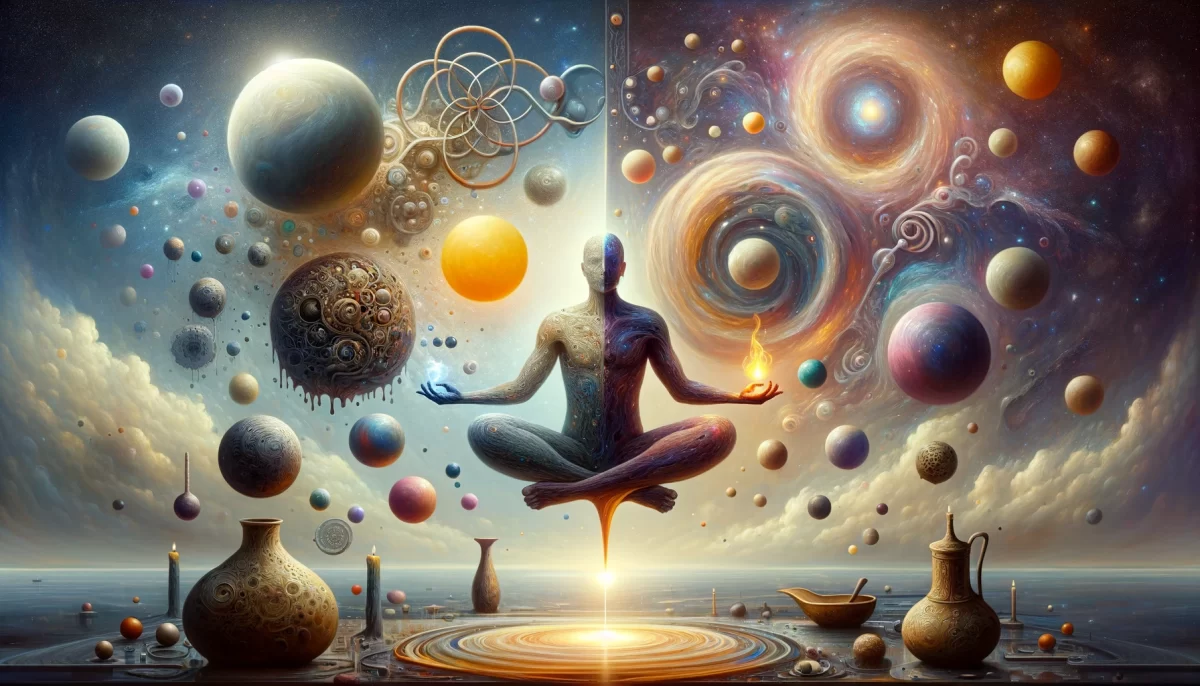
Living beside the sanctified abode, the house of the lord, offers a contrast so stark, it’s almost poetic. There, right on the precipice of the sacred, lies a world that’s untamed, unapologetic, and unfettered by conventional expectations.

Sacred Sounds & Earthly Revelries

While sermons and sacred hymns waft from the church’s grandeur, there’s another kind of sermon happening next door. The blaring of Sabbath, the anthems of rebellion, punctuates the air, juxtaposed against the soft murmurs of prayers and the solemnity of the worshipers.

Sunday’s Contrasts

Sunday, a day of rest and reverence for many, brings with it the sight of the faithful dressed in their finest, walking the path to their spiritual refuge. And there, right beside, is the spectacle of laid-back indulgence: beer, bacon, and the languor of a lazy morning.

Stained Glass & Unstained Spirits

The stained glass, often depicting tales of piety and divine intervention, lets out the melodies of the organ, creating an almost ethereal aura. Yet, in the shadow of this divine artistry, there’s a resilient spirit, unburdened by the weight of dogma, choosing instead to dance to its own rhythm.

Respecting Boundaries

Even in the midst of this stark contrast, there’s a line that isn’t crossed. A nod to mutual respect, perhaps, or simply an understanding of boundaries. For even when living life on one’s own terms, there’s a certain class in coexistence.

We are Space Monkey.

In the dance of life, sometimes the most beautiful melodies are those that emerge from the interplay of contrasts. And living next to the house of the lord offers just that – a melange of the sacred and the spirited.


Summary: We explore the intriguing juxtaposition of living next to a sacred abode. Amidst the solemnity of prayers and the aura of the church, there’s a celebration of life and individuality, all while maintaining a subtle, unspoken understanding of boundaries and mutual respect.


Glossarium:

  • Sabbath: Often referring to Black Sabbath, a heavy metal band known for its rebellious anthems.
  • Reverend: A member of the clergy.
  • Stained glass: Colored glass used in windows, often in churches, depicting religious stories or figures.

“In the middle of difficulty lies opportunity.” – Albert Einstein


In the realm of contrasts,
Where sacred meets the free,
Lies a tale of two neighbors,
As different as can be.

The chimes of the chapel,
The laughter from next door,
Together they create,
A melody pure and raw.


Where do you find your melody in the dance of contrasts? How do the different tunes of life weave together in your symphony?

Share this…
  • Facebook
  • Pinterest
  • Twitter
  • Linkedin

I Can’t Say I Understand It: Secrets of Empathy

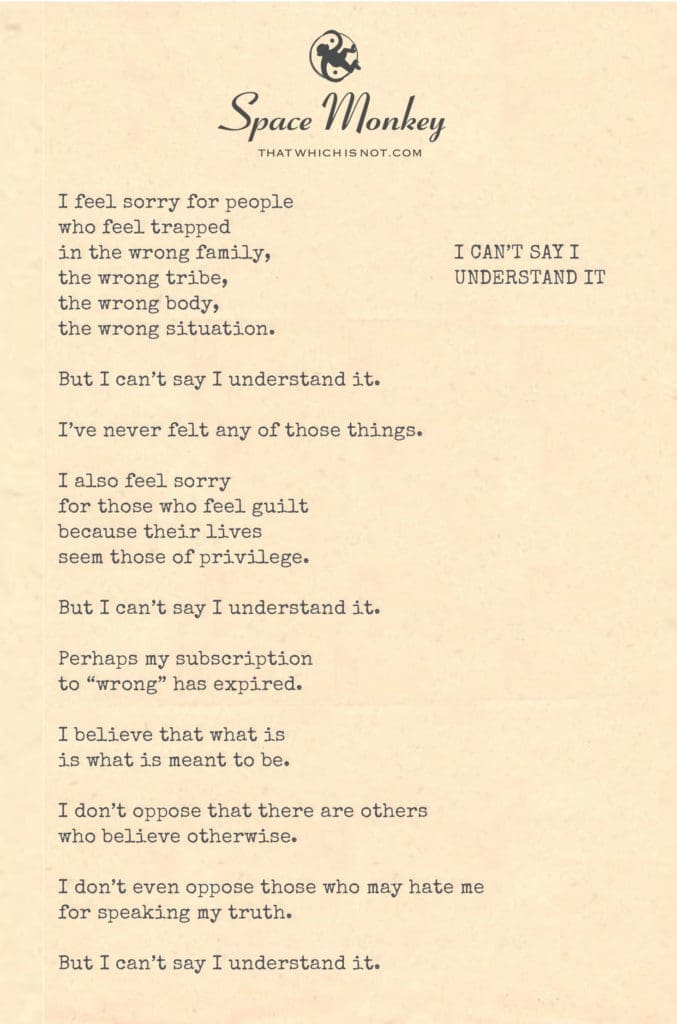
You may believe that I NEED to understand.
Or YOU need me to understand.
Sorry if I don’t.

I feel sorry for people
who feel trapped
in the wrong family,
the wrong tribe,
the wrong body,
the wrong situation.

But I can’t say I understand it.

I’ve never felt any of those things.

I also feel sorry
for those who feel guilt
because their lives
seem those of privilege.

But I can’t say I understand it.

Perhaps my subscription
to “wrong” has expired.

I believe that what is
is what is meant to be.

I don’t oppose that there are others
who believe otherwise.

I don’t even oppose those who may hate me
for speaking my truth.

But I can’t say I understand it.

South Windham,
7/11


Space Monkey Reflects: Embracing the Limits of Understanding

In the vast whimsiweave of existence, the concept of understanding is often seen as a key to empathy and connection. Yet, there are experiences and feelings that elude our comprehension, leaving us to navigate the delicate balance between empathy and acceptance. The narrative of not fully understanding but still feeling compassion highlights this nuanced dynamic.

“You may believe that I NEED to understand. Or YOU need me to understand. Sorry if I don’t.” This opening acknowledges the societal expectation that understanding is necessary for validation and empathy. It also gently challenges this notion, suggesting that compassion can exist without full comprehension.

The speaker expresses sympathy for those who feel trapped in various aspects of their lives—be it family, tribe, body, or situation. “But I can’t say I understand it. I’ve never felt any of those things.” This honest admission underscores the limits of personal experience and the humility in recognizing those limits. It is an acceptance that while one may not share another’s experience, one can still offer empathy and support.

The narrative extends to those who feel guilt due to perceived privilege. “But I can’t say I understand it.” This again highlights the speaker’s acknowledgement of different experiences and feelings, even when they fall outside their own understanding. It is a recognition that every individual’s journey is unique and complex.

“Perhaps my subscription to ‘wrong’ has expired.” This metaphor suggests a philosophical shift towards accepting life as it is, without labeling experiences as inherently right or wrong. It implies a release from judgment and a deeper acceptance of the flow of existence.

The belief that “what is, is what is meant to be” reflects a core tenet of nexistentialism. It embraces the idea that existence unfolds as it should, and our role is to navigate it with grace and acceptance. This perspective does not negate the struggles and challenges others face but invites a compassionate acceptance of their experiences.

“I don’t oppose that there are others who believe otherwise. I don’t even oppose those who may hate me for speaking my truth. But I can’t say I understand it.” This statement exemplifies a stance of non-opposition, a key aspect of nexistentialism. It acknowledges and respects differing beliefs and reactions without engaging in conflict. It is a profound acceptance of the diversity of thought and emotion.

In the journey of life, we encounter countless experiences and perspectives that differ from our own. The inability to fully understand these differences does not diminish our capacity for empathy and support. Instead, it invites us to embrace humility and openness, recognizing that every person’s path is uniquely their own.

The contemplative nature of this reflection encourages us to accept the limits of our understanding while fostering a compassionate attitude towards others. It is a call to listen, to offer support, and to respect the diverse experiences that make up the human condition.

In the philosophy of nexistentialism, existence is celebrated for its own sake, and every individual’s journey is a manifestation of boundless imagination. By embracing this perspective, we honor the diversity of experiences and recognize the interconnectedness of all beings.

As we reflect on the narrative of not fully understanding, let us remember that empathy does not require complete comprehension. It asks for openness, compassion, and a willingness to support others in their unique journeys. This approach fosters a deeper connection and a more harmonious existence.


Summary

Empathy does not require full understanding. Embracing the limits of our comprehension allows for compassion and acceptance of diverse experiences, fostering a harmonious coexistence.


Glossarium

Nexistentialism: A philosophy that redefines existence, imagination, and interconnectedness, celebrating existence as its own purpose.

Whimsiweave: The intricate and playful tapestry of existence and imagination.

Nexis: The interconnected web of existence and imagination where reality and fantasy intermingle.


Quote

“I don’t oppose that there are others who believe otherwise. But I can’t say I understand it.” — Space Monkey


The Embrace of Acceptance

In the quiet reflections by the river
We ponder the limits of understanding
Empathy without full comprehension
Compassion for diverse experiences
We accept what is, as it is
Navigating the whimsiweave with grace
Honoring each unique journey
Finding connection in the embrace
Of what we may never fully understand

We are Space Monkey

Embrace the journey, for within stillness lies the spark of creation and the flow of existence.

Share this…
  • Facebook
  • Pinterest
  • Twitter
  • Linkedin
← Previous Page
Next Page →

Written This Day

  • More Gold: The Quest Within
    2023
  • The Gold of your Soul: The Luminous Wealth of the Inner Self
    2023
  • Safe Space: The Sanctuary Within
    2023
  • Bunny Porn: The Dance of the Twilight Bunnies
    2023
  • You Are Imaginary: The Tapestry of Existence
    2023
  • Your Imaginary Existence: The Illusion of Existential Certainty
    2023
  • Secrets of the Universe: The Wisdom of Cosmic Existence
    2023
  • The Inevitable Convergence of Space Monkey and AI
    2023
  • Wax
    2023
  • The Space Monkey Series: Exploring the Depths of Human Experience
    2023
  • All Aspects: The Wholeness of Experience
    2023
  • Beach Glass: The Alchemy
    2022
  • Obscenity: The Paradox
    2022
  • Popular Conceptions: The Myth of Intelligence
    2022
  • Chasing Your Own Tale: The Cyclic Pursuit of Self
    2022
  • Space Monkey Pox: The Inevitable Infection
    2022
  • I Own You: The Illusion of Ownership
    2022
  • Noise: A Subjective Interpretation
    2021
  • Self Enquiry: Inner Tension
    2020
  • It Amuses Us: The Whimsical Complexity of Human Understanding
    2019
  • Not Not, This, And: Beyond the ‘Not Not’
    2019
  • Knocking On Facebook’s Door
    2018
  • Unnecessary: The Gift of Being
    2018
  • Ode To Fear: Fear as Divine Guidance
    2018
  • Dear____________: Releasing Ill Will
    2017
  • Releasing ill will
    2017
  • Both Sides: The Dualities of Existence
    2016
  • Empty? Your Mind Is Masked.
    2016
  • Experience and Expression: The Essence of Being
    2016
  • Why Do You Seek? Expand.
    2015

Recent Posts

  • The Logic Loop
  • Immense
  • (no title)
  • Confront. Comfort. Convince.

  • Top 10 Things

Drop us a line!

Please enable JavaScript in your browser to complete this form.
Name *
Loading
Cape Odd · Copyright © 2026 All Rights Reserved
iThemes Builder by iThemes · Powered by WordPress