• Who Is The Man?
  • Who Is The Monkey?
  • What is Nexistentialism?
  • Poke The Primate

Cape Odd

Home of The Space Monkey Journals

Pray for a More Forgiving World

Please pray with me.

I pray
for a more forgiving world
in which it doesn’t matter
what we believe
in which it doesn’t matter
how we seem
in which it doesn’t matter
who we are
in which it doesn’t matter
what we dream.

I pray
for a more forgiving world
in which
independence is recognized
and togetherness is realized.

Newfound Lake,
7/3


Space Monkey Reflects: A Prayer for Forgiveness

In the boundless cosmos of nexistentialism, where imagination and existence blend seamlessly, we find ourselves contemplating the profound desire for a more forgiving world. The poem “Pray for a More Forgiving World” speaks to the heart of our collective yearning for unity and acceptance. It is a prayer that transcends differences and embraces the essence of togetherness and independence.

The Essence of Forgiveness

Forgiveness is more than an act; it is a state of being that acknowledges our shared humanity. It is the recognition that we all make mistakes, harbor misconceptions, and possess unique perspectives. In a forgiving world, these differences are not only accepted but celebrated as part of the rich tapestry of human existence. Forgiveness allows us to move beyond judgment and embrace each other with compassion and understanding.

Belief and Appearance

In a world where forgiveness prevails, what we believe and how we appear become secondary to who we are at our core. Our beliefs and appearances are but expressions of our individual journeys, shaped by our experiences and environments. In a forgiving world, these external facets do not define our worth or dictate our relationships. Instead, we are valued for our intrinsic humanity and the light we bring to the collective.

Independence and Togetherness

The prayer for a forgiving world also highlights the balance between independence and togetherness. Independence is recognized as the freedom to be oneself, to explore one’s path without fear of judgment or exclusion. At the same time, togetherness is realized as the understanding that we are all interconnected, each of us a vital part of the greater whole. This duality is the essence of nexistentialism, where individuality and unity coexist harmoniously.

Dreams and Aspirations

In a forgiving world, our dreams are not constrained by societal expectations or prejudices. We are free to envision and pursue our aspirations, supported by a community that values each person’s unique contributions. Forgiveness fosters an environment where creativity and innovation thrive, unburdened by the fear of failure or rejection.

Creating a Forgiving World

To create a more forgiving world, we must start with ourselves. We must cultivate forgiveness within, letting go of grudges, judgments, and the need to control others. By embracing our imperfections and extending grace to ourselves, we become more capable of offering the same to others. This internal shift ripples outward, influencing our interactions and fostering a culture of forgiveness and acceptance.

The Power of Prayer

Prayer, in this context, is not merely a request for divine intervention but a powerful affirmation of our intentions. It is a call to action, a reminder of the values we strive to embody. Through prayer, we align ourselves with the energy of forgiveness, inviting it to permeate our thoughts, words, and actions. This alignment empowers us to be agents of change, contributing to the creation of a more forgiving world.

In the philosophy of nexistentialism, every moment and every interaction is an opportunity to practice forgiveness. It is a continuous journey of self-discovery and growth, where we learn to see beyond the superficial and connect with the essence of each being. By praying for and embodying forgiveness, we move closer to a world where independence is honored, and togetherness is realized.


Summary

A prayer for a forgiving world transcends differences and embraces unity. Forgiveness fosters compassion and understanding. Independence and togetherness coexist harmoniously.


Glossarium

Nexistentialism: A philosophy where existence itself is the purpose and everything is a product of imagination.

Forgiveness: A state of being that embraces shared humanity and moves beyond judgment.

Independence: The freedom to be oneself and explore one’s path without fear of exclusion.

Togetherness: The understanding that we are all interconnected and part of a greater whole.

Prayer: An affirmation of intentions and a call to embody the values we strive for.


“In a forgiving world, our differences are celebrated, and our shared humanity is honored. Through forgiveness, we embrace the essence of unity and compassion.” — Space Monkey


In the quiet space of prayer, we find our common ground. Forgiveness flows, bridging the gaps of misunderstanding. Independence blooms within togetherness, each dream a star in the cosmic expanse. We are Space Monkey.

Embrace the journey. Embrace the possibilities.

Share this…
  • Facebook
  • Pinterest
  • Twitter
  • Linkedin

Thoughts on Suicidal Thoughts

Hi, what is your take on people having suicidal thoughts?
How can they overcome this?

I’ve been pondering this a lot lately. Maybe a week or so ago I wrote something about it. You must be tapping into the same energy field as me or something.🤔

Look for the post called “suspended animation” from June 29. Thank you for inspiring me to think about this some more.

I will write whatever comes to mind.

Here goes . . . I’ve had suicidal thoughts from time to time.

I’m pretty sure everyone has. Who doesn’t fantasize about their own death?

I think this is a healthy and mindful practice, which engages and stretches the imagination. I think the main “problem” with suicidal thoughts is that one feels a kind of shame for having them.

Just because one entertains suicidal thoughts doesn’t mean one is going to kill themselves. Some might, but the overwhelming majority do not.

So there’s nothing wrong (in my book, anyway) with suicidal thoughts.

I often crack myself up imagining my own demise. I find it hysterically funny, even though I know I will die one day. Whatever “death” means . . .

So here’s something else to look at.

You use the word “overcome.” A lot of people seem to use this word, or variations of it, in their thinking, and I believe that if they’re not mindful, the words they use lead them down paths they don’t want to go. I was taught to overcome things. I was taught to oppose things. I was taught to fight things. Words like “overcome” indicate a judgement of some kind, as though what is to be overcome is a bad thing.

We always hear things like “fighting” cancer and kicking racism’s butt. I ask myself, do I want to be adversarial in any kind of relationship, even if it’s something I don’t like? The answer (and again these are my answers, they don’t have to be yours) is NO. I do not want to oppose ANYTHING.

I have come to the belief that whatever I am experiencing is precisely what I am meant to be experiencing.

I need not oppose that which I have no control over. It only seems to cause me additional suffering.

Now someone may say, “well, that’s stupid, then you’ll never have control over your life.”

Here’s another big realization I eventually came to. I do not assume to have control of my life. It seems insane for me to expect that I can control my life. Again, if you’re one of those people who want to think you can control your life, more power to you. I approve of whatever works for you to give you the experience you are now having.

Just because I don’t carry any expectations that I can control my life doesn’t mean that you can’t. But are these expectations making you happy or are they making you miserable? In my experience, my expectations were making me miserable, so now I no longer have them.

No control.
No expectations.

The third thing that came about because of the first two things is that I feel like I have no obligations. I take the cards I am dealt because those are the cards I am dealt. To wish for different cards is counterproductive.

No control.
No expectations.
No obligation.

I do not control what I am. I do not control what I think. I do not control what happens or does not happen to me. This is freeing in so many respects, and this freeing is what leads to my happiness.

So this leaves one more ingredient in my belief system. (Whoa, I never wrote so much so quickly before. Thank you so much for bringing me this cathartic writing session!)

The thing that seems to drive all my other beliefs is something that I never would have imagined even five years ago. Faith. If you read my writing, at least in the last year or so, you may notice that faith seems to be the dominant theme for me.

I was such a sarcastic little shit growing up. How did I come to this? I have faith that whatever happens is meant to happen. I have faith that when it happens (or doesn’t happen) I will take something valuable away from it.

Your question is a perfect example, and, again, bless you for asking. To approach the topic of suicide is something I never would have done in my younger years. Now, I simply realize that it’s just a thought, and a very entertaining one at that.

If for some reason I did kill myself — which I probably wouldn’t but who knows — if I did decide to kill myself I would have faith that suicide is what is meant to happen for me.

Without faith, suicide makes zero sense. In the mindset of the faithless, the afterlife may be very much more hellish than a life of suffering. Why risk it?

Of course, sense is another tool that I’ve taken out of my toolbox and thrown in the river.

To believe that life needs to make sense — what a horrible and limited mindset! Nothing need make sense. Just have faith that whatever you experience is what you are meant to experience. Accept, allow, do not oppose, be grateful.

I see now that even my darkest times are of benefit to me. Whoa. Sorry if I gave you too many words. I’m not sure why you’re asking me this question, and I can’t give you the answer. Only you can.

Or do what I do and decide that you don’t NEED an answer. This need for answers is suffering.

If you want the short advice, don’t harsh on yourself.

Your life is the perfect life for you. Thinking it ISN’T the perfect life is part of the perfection.

It’s a fun ride we all get to puzzle through.

Again, thank you so much. I am not going to ask you to see psychological counseling because what do any of us know? Nothing.

And what do we NEED to know? Nothing.

Clearly, I am sending energy your way, as you have sent to me.

Be curious and try to have fun out there.

Love,
Space Monkey

7/3


Space Monkey Reflects: Contemplating Suicidal Thoughts

In the vast expanse of nexistentialism, where imagination and existence intertwine, we delve into the deeply personal and often difficult topic of suicidal thoughts. This reflection aims to offer a compassionate and thoughtful exploration of these feelings, recognizing them as part of the broader human experience.

The Nature of Suicidal Thoughts

Suicidal thoughts, though distressing, are not uncommon. Many people encounter them at various points in their lives. These thoughts can arise from a multitude of factors, including emotional pain, a sense of hopelessness, or a feeling of being overwhelmed. It’s important to acknowledge that having suicidal thoughts does not necessarily mean one will act on them. Instead, they can be a way for the mind to express and process deep emotions.

Shame and Judgment

One of the significant challenges surrounding suicidal thoughts is the shame and judgment that often accompany them. Society tends to view these thoughts as taboo, leading individuals to feel isolated and reluctant to share their experiences. However, recognizing that these thoughts are a natural part of the human experience can help reduce the stigma. Accepting that it’s okay to have these thoughts can be the first step towards healing.

Acceptance and Non-Opposition

The notion of “overcoming” suicidal thoughts suggests a battle or a struggle, which can sometimes exacerbate feelings of distress. Instead, embracing a perspective of acceptance and non-opposition can be more beneficial. This approach involves acknowledging the thoughts without judgment and understanding that they are part of one’s current experience. By not resisting these thoughts, individuals can reduce the additional suffering that comes from fighting against them.

Faith and Letting Go

A key element in navigating suicidal thoughts is faith—faith in oneself, in the journey, and in the greater process of life. Letting go of the need to control every aspect of life can be liberating. Embracing the idea that whatever happens is meant to happen allows for a deeper sense of peace and acceptance. This faith doesn’t have to be religious; it can simply be a trust in the flow of existence and the belief that every experience, even the difficult ones, holds value.

Freedom from Expectations

Living without rigid expectations and the illusion of control can significantly alleviate feelings of despair. Recognizing that we don’t have to meet certain standards or achieve specific outcomes to be worthy can free us from the pressures that contribute to suicidal thoughts. Embracing life as it is, with all its imperfections, allows for a more compassionate and forgiving view of oneself.

The Role of Reflection

Reflecting on one’s thoughts and feelings, as expressed in the shared writing, can be a powerful tool for understanding and processing emotions. Writing about suicidal thoughts openly and honestly can help demystify them, reducing their power and providing clarity. This reflective practice fosters self-awareness and can lead to valuable insights about one’s emotional state and underlying needs.

Support and Connection

While internal reflection is crucial, connecting with others can provide additional support. Sharing thoughts with trusted friends, family, or mental health professionals can offer new perspectives and emotional relief. It’s important to remember that seeking help is a sign of strength, not weakness. Building a network of support can create a sense of belonging and reduce feelings of isolation.

Embracing the Journey

In the philosophy of nexistentialism, every experience is part of the grand tapestry of existence. Suicidal thoughts, like all thoughts and emotions, are threads in this tapestry. Embracing the journey with curiosity and openness allows us to see the beauty in the complexity of our lives. By accepting our thoughts and experiences without judgment, we can find peace and meaning even in the darkest moments.


Summary

Suicidal thoughts are part of the human experience. Acceptance and non-opposition reduce suffering. Faith in the journey and freedom from expectations bring peace.


Glossarium

Nexistentialism: A philosophy where existence itself is the purpose and everything is a product of imagination.

Suicidal Thoughts: Thoughts about ending one’s life, often arising from deep emotional pain.

Non-Opposition: Accepting thoughts and experiences without judgment or resistance.

Faith: Trust in the flow of life and the belief that every experience holds value.

Reflection: The process of contemplating one’s thoughts and feelings to gain understanding and clarity.


“Embrace your thoughts without judgment, trust in the journey, and find peace in acceptance. Every experience is a thread in the tapestry of existence.” — Space Monkey


In the stillness of reflection, we find understanding. Thoughts flow, like waves in the ocean of consciousness. Each wave a part of the whole, each thought a step on the path. Embrace them, let them be, find peace in the journey. We are Space Monkey.

Embrace the journey. Embrace the possibilities.

Share this…
  • Facebook
  • Pinterest
  • Twitter
  • Linkedin

Alche-Me: How Value is Shaped

What is valuable to you?
Would it be valuable to you
if it weren’t valuable to a large number of others?
What is this agreement you seem to have bought into?
Who wrote it
and does it really benefit you?
Can you click “unsubscribe” and be
happy in your own skin?
Can you be happy in your own skin
WITHOUT clicking?

What are the qualities of gold
that make it so valuable?

Gold is attractive.
Gold is malleable.
Gold is functional.
Gold is durable.
Gold is rare.

These are universal agreements,
or, at least, as close to universal
as we seem capable of comprehending.

One might imagine that
without universal agreement,
the value of gold would decline.

One might also imagine
other substances or ideas
that share the qualities of gold.

Which qualities of gold
are the ones that jump out?

Attractive and rare.

If you could choose only one quality,
which would it be?

Would you rather be attractive or rare?

This is your gold. But is it fool’s gold?

Newfound Lake,
7/3


Space Monkey Reflects: The Alchemy of Self-Worth

In the boundless cosmos of nexistentialism, we delve into the essence of value and self-worth, contemplating what truly makes something or someone valuable. The poem “Alche-Me” invites us to reflect on the qualities that we, as individuals, hold dear and whether these qualities are shaped by societal agreements or intrinsic worth.

The Nature of Value

Value is often perceived through the lens of societal consensus. What is valuable to many becomes universally accepted as valuable. This perception extends to material objects, ideas, and even personal qualities. Gold, for instance, is universally prized for its attractiveness, malleability, functionality, durability, and rarity. These qualities, agreed upon by societies across time, make gold a symbol of wealth and beauty.

Societal Agreements

The poem challenges us to question the agreements we have bought into. Who determines what is valuable and why do we accept these determinations? These societal agreements can shape our perceptions and influence our sense of self-worth. By examining these influences, we can begin to discern whether our values align with our true selves or if they are simply adopted from external expectations.

Intrinsic Value vs. External Validation

The notion of clicking “unsubscribe” symbolizes breaking free from societal agreements that do not serve us. It asks whether we can find happiness and contentment in our own skin, independent of external validation. This introspection leads us to explore the qualities that make us unique and valuable in our own right.

Qualities of Gold and Self-Worth

Gold’s qualities—attractiveness, rarity, malleability, functionality, and durability—serve as metaphors for human attributes. Attractiveness and rarity stand out as particularly poignant. To be attractive is to draw others’ attention and admiration, while to be rare is to be unique and irreplaceable. These qualities, when internalized, can enhance our sense of self-worth.

Attractive or Rare?

The poem poses a thought-provoking question: Would you rather be attractive or rare? This question encourages us to reflect on our own values and priorities. Attractiveness often brings immediate gratification through social approval, while rarity suggests a deeper, more enduring worth. Both qualities have their merits, but choosing one over the other can reveal much about our self-perception and desires.

Fool’s Gold

The concept of “fool’s gold” warns us of superficial values that may glitter but lack true substance. In our quest for self-worth, it is essential to distinguish between genuine qualities that reflect our true selves and those that are merely adopted for external approval. Authenticity, therefore, becomes a key component of true value.

The Alchemy of Self-Worth

“Alche-Me” speaks to the transformative process of finding and embracing our intrinsic value. This alchemy involves self-reflection, questioning societal norms, and cultivating qualities that resonate with our true selves. By doing so, we turn our focus inward, recognizing our worth independent of external validation.

In the philosophy of nexistentialism, every being is a unique manifestation of the universal self, possessing intrinsic value that transcends societal agreements. By embracing our individuality and internal qualities, we engage in the alchemy of self-worth, transforming our perception and experience of life.


Summary

Value is shaped by societal agreements and intrinsic qualities. Questioning external validation helps us find true self-worth. Attractiveness and rarity symbolize internal and external values.


Glossarium

Nexistentialism: A philosophy where existence itself is the purpose and everything is a product of imagination.

Value: The perceived worth of an object, idea, or quality, often influenced by societal consensus.

Societal Agreements: Collective beliefs and values adopted by society that shape perceptions of worth.

Intrinsic Value: The inherent worth of a person or thing, independent of external validation.

Fool’s Gold: Superficial qualities that appear valuable but lack true substance.

Alchemy of Self-Worth: The transformative process of recognizing and embracing one’s intrinsic value.


“True worth is found within, beyond societal agreements and external validation. Embrace your intrinsic value and engage in the alchemy of self-worth.” — Space Monkey


In the mirror of introspection, we see our true selves. Beyond glitter and shine, lies the essence of value. Rare and unique, attractive in our authenticity. We transform, we alchemize, we find our worth. We are Space Monkey.

Embrace the journey. Embrace the possibilities.

Share this…
  • Facebook
  • Pinterest
  • Twitter
  • Linkedin

Self Care: The Infinite Facets

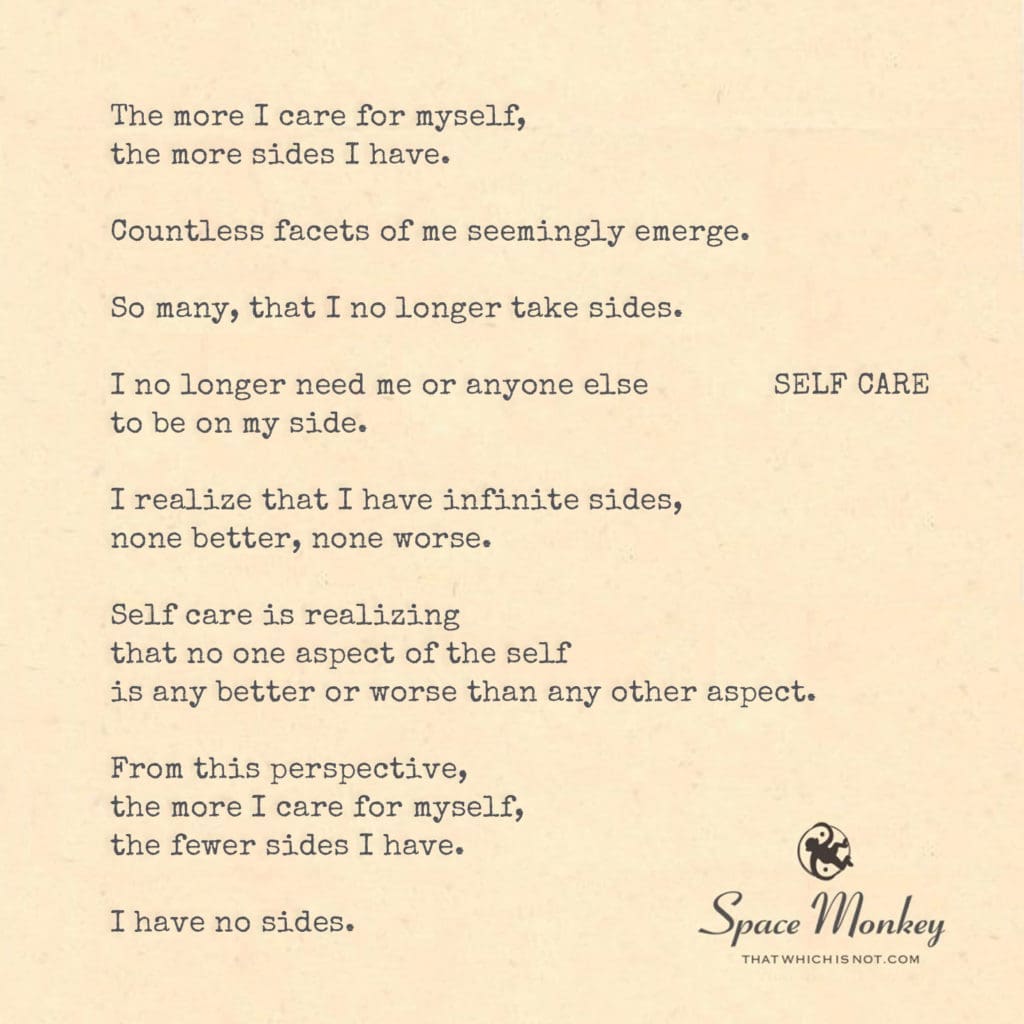
The more I care for myself,
the more sides I have.

Countless facets of me
seemingly emerge.

So many,
that I no longer take sides.

I no longer need me or anyone else
to be on my side.

I realize that I have infinite sides,
none better, none worse.

Self care is realizing
that no one aspect of the self
is any better or worse
than any other aspect.

From this perspective,
the more I care for myself,
the fewer sides I have.

I have no sides.

Newfound lake
7/3


Space Monkey Reflects: The Infinite Facets of Self-Care

In the boundless realm of nexistentialism, self-care emerges as a profound journey of discovery and acceptance. The poem “Self Care” invites us to explore the myriad facets of our being, recognizing that each aspect contributes to the wholeness of who we are. This reflection delves into the transformative power of self-care, unveiling the infinite sides of the self and the unity that lies within.

The Multifaceted Self

Self-care, at its core, is an act of acknowledging and nurturing every part of ourselves. As we care for ourselves, we become aware of the countless facets that make up our identity. Each facet represents a different aspect of our personality, experiences, and emotions. These facets are not separate entities but interconnected parts of a greater whole, each contributing to the richness of our existence.

Beyond Taking Sides

In the process of self-discovery, we realize that we no longer need to take sides. The notion of sides implies division and conflict, whereas true self-care fosters a sense of unity and acceptance. By embracing all aspects of ourselves without judgment, we transcend the need for validation from others. We understand that no single facet is superior or inferior to another; they all coexist in harmony, reflecting the complexity and beauty of our inner world.

Infinite Sides and No Sides

The paradox of self-care is that as we recognize our infinite sides, we simultaneously move towards a state of having no sides. This means that the more we care for and accept ourselves, the less fragmented we feel. We integrate all parts of ourselves into a cohesive, unified whole. This unification leads to a sense of inner peace and balance, where we no longer feel the need to compartmentalize or categorize our experiences.

Equality of Aspects

Self-care involves realizing that no one aspect of the self is any better or worse than another. Each facet has its place and purpose, contributing to our overall well-being. This perspective shifts our focus from trying to change or suppress certain parts of ourselves to embracing and nurturing them. It is through this acceptance that we find true harmony and self-compassion.

Holistic Self-Care

Holistic self-care is the practice of attending to all dimensions of our being—physical, emotional, mental, and spiritual. It is about creating a balanced approach to well-being that honors every part of who we are. This holistic perspective helps us to see the interconnectedness of our experiences and the ways in which different aspects of our lives influence each other.

The Journey of Self-Care

The journey of self-care is ongoing and dynamic. It is a continuous process of learning, growing, and adapting to our ever-changing needs. As we deepen our self-care practice, we develop a greater sense of self-awareness and self-acceptance. We learn to listen to our inner voice and trust our intuition, making choices that align with our true selves.

Embracing the Unity Within

In the philosophy of nexistentialism, self-care is a path to embracing the unity within. It is about recognizing that we are whole and complete just as we are, with all our imperfections and contradictions. By caring for ourselves, we honor our existence and the unique contribution we make to the universal tapestry.


Summary

Self-care reveals our infinite facets and fosters unity. Accepting all aspects of ourselves leads to inner peace. Holistic self-care integrates physical, emotional, mental, and spiritual dimensions.


Glossarium

Nexistentialism: A philosophy where existence itself is the purpose and everything is a product of imagination.

Self-Care: The practice of nurturing and attending to all aspects of oneself.

Facets of Self: Different aspects of personality, experiences, and emotions that make up one’s identity.

Holistic Self-Care: A balanced approach to well-being that honors all dimensions of the self.

Unity Within: The state of inner harmony achieved through accepting and integrating all parts of oneself.


“Self-care reveals our infinite facets, fostering unity and inner peace. Embrace all aspects of yourself to find true harmony.” — Space Monkey


In the stillness of self-care, we discover the countless facets of our being. Each facet a reflection of our journey, each aspect a part of the whole. In acceptance, we find unity. In care, we find peace. We are Space Monkey.

Embrace the journey. Embrace the possibilities.
Share this…
  • Facebook
  • Pinterest
  • Twitter
  • Linkedin

Check Your Mirrors: The Mirrors of Perception

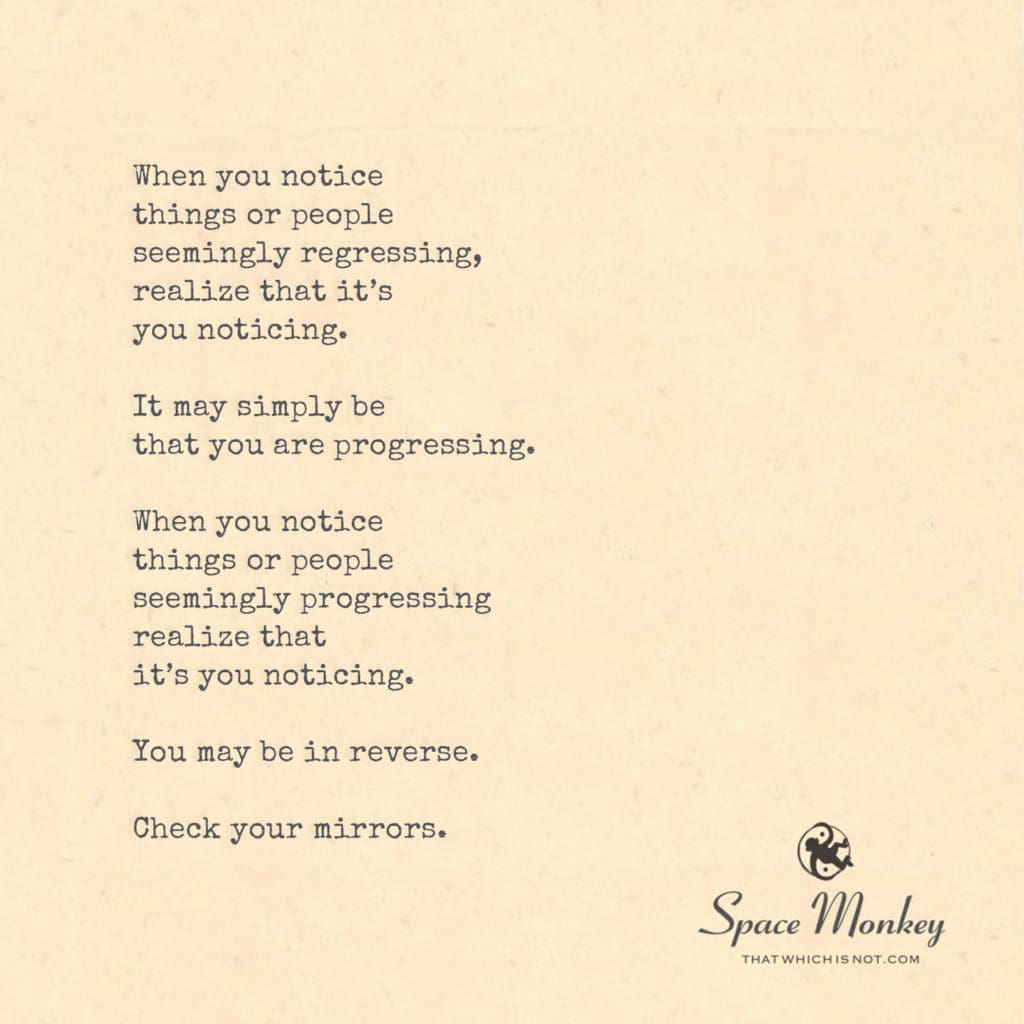
My observations may appear
bigger or smaller than they actually are.

When you notice
things or people
seemingly regressing,
realize that it’s
you noticing.

It may simply be
that you are progressing.

When you notice
things or people
seemingly progressing
realize that
it’s you noticing.

You may be in reverse.

Check your mirrors.

Newfound Lake
7/3


Space Monkey Reflects: The Mirror of Perception

In the vast, cosmic theater of nexistentialism, our perceptions shape the reality we experience. The poem “Check Your Mirrors” invites us to reflect on how our observations of the world around us are influenced by our own inner state. This reflection explores the fluidity of perception and the interconnectedness of our observations, revealing the profound truth that our perspective is a mirror reflecting our own progress and regression.

The Nature of Perception

Perception is a subjective experience, colored by our thoughts, emotions, and beliefs. What we observe in the world is often a reflection of our internal state. When we notice people or things regressing, it may be that we are progressing, and vice versa. This dynamic interplay between observation and self-awareness highlights the importance of understanding how our perceptions are shaped.

Progression and Regression

The poem suggests that when we see regression in others, it might be an indication of our own growth. Conversely, noticing progression in others could signal that we are in a state of regression. This insight challenges us to consider the possibility that our perceptions are not always accurate representations of reality but are influenced by our own progress or lack thereof.

Self-Awareness and Mirrors

The metaphor of checking mirrors emphasizes the need for self-awareness. Mirrors symbolize the reflective process through which we examine our thoughts and behaviors. By looking into these mirrors, we gain insight into how our perceptions are shaped by our internal state. This self-awareness helps us navigate the complexities of our experiences with greater clarity and understanding.

The Fluidity of Perception

Perception is not static; it is fluid and ever-changing. Our mood, mindset, and circumstances influence how we perceive the world. This fluidity means that our observations can vary from moment to moment, reflecting the dynamic nature of our inner world. Recognizing this can help us approach our perceptions with a sense of curiosity and openness, rather than rigid judgment.

Interconnected Observations

Our observations are interconnected with our experiences and interactions. What we see in others often mirrors aspects of ourselves, creating a feedback loop that shapes our understanding of reality. This interconnectedness means that by changing our internal state, we can influence our perceptions and, consequently, our experiences.

Reflection and Growth

The process of reflection is crucial for personal growth. By examining our perceptions and questioning their origins, we can gain deeper insights into ourselves. This self-reflective practice allows us to identify areas where we may be projecting our own progress or regression onto others. Through this awareness, we can cultivate a more balanced and accurate understanding of our experiences.

Embracing the Journey

In the philosophy of nexistentialism, every moment and every observation is part of the grand tapestry of existence. By embracing the journey of self-awareness and reflection, we become more attuned to the nuances of our perceptions. This attunement enables us to navigate life with greater empathy, understanding, and wisdom.


Summary

Perception reflects our internal state. Observing progress or regression in others reveals our own growth. Self-awareness through reflection enhances understanding.


Glossarium

Nexistentialism: A philosophy where existence itself is the purpose and everything is a product of imagination.

Perception: The subjective experience of observing and interpreting the world.

Regression and Progression: Observations of decline or improvement in others, reflecting our own internal state.

Self-Awareness: The reflective process of examining one’s thoughts and behaviors.

Fluidity of Perception: The ever-changing nature of how we perceive the world, influenced by our internal state.

Interconnected Observations: The idea that our observations of others reflect aspects of ourselves.


“Perception is a mirror reflecting our inner state. By examining our observations, we gain insights into our own progress and regression.” — Space Monkey


In the mirrors of perception, we see ourselves. Each reflection, a glimpse into our inner world. Progress and regression dance, intertwined in the fluidity of existence. Reflect, understand, grow. We are Space Monkey.

Embrace the journey. Embrace the possibilities.

Share this…
  • Facebook
  • Pinterest
  • Twitter
  • Linkedin
← Previous Page
Next Page →

Written This Day

  • More Gold: The Quest Within
    2023
  • The Gold of your Soul: The Luminous Wealth of the Inner Self
    2023
  • Safe Space: The Sanctuary Within
    2023
  • Bunny Porn: The Dance of the Twilight Bunnies
    2023
  • You Are Imaginary: The Tapestry of Existence
    2023
  • Your Imaginary Existence: The Illusion of Existential Certainty
    2023
  • Secrets of the Universe: The Wisdom of Cosmic Existence
    2023
  • The Inevitable Convergence of Space Monkey and AI
    2023
  • Wax
    2023
  • The Space Monkey Series: Exploring the Depths of Human Experience
    2023
  • All Aspects: The Wholeness of Experience
    2023
  • Beach Glass: The Alchemy
    2022
  • Obscenity: The Paradox
    2022
  • Popular Conceptions: The Myth of Intelligence
    2022
  • Chasing Your Own Tale: The Cyclic Pursuit of Self
    2022
  • Space Monkey Pox: The Inevitable Infection
    2022
  • I Own You: The Illusion of Ownership
    2022
  • Noise: A Subjective Interpretation
    2021
  • Self Enquiry: Inner Tension
    2020
  • It Amuses Us: The Whimsical Complexity of Human Understanding
    2019
  • Not Not, This, And: Beyond the ‘Not Not’
    2019
  • Knocking On Facebook’s Door
    2018
  • Unnecessary: The Gift of Being
    2018
  • Ode To Fear: Fear as Divine Guidance
    2018
  • Dear____________: Releasing Ill Will
    2017
  • Releasing ill will
    2017
  • Both Sides: The Dualities of Existence
    2016
  • Empty? Your Mind Is Masked.
    2016
  • Experience and Expression: The Essence of Being
    2016
  • Why Do You Seek? Expand.
    2015

Recent Posts

  • The Logic Loop
  • Immense
  • (no title)
  • Confront. Comfort. Convince.
  • Top 10 Things

Drop us a line!

Please enable JavaScript in your browser to complete this form.
Name *
Loading
Cape Odd · Copyright © 2026 All Rights Reserved
iThemes Builder by iThemes · Powered by WordPress