• Who Is The Man?
  • Who Is The Monkey?
  • What is Nexistentialism?
  • Poke The Primate

Cape Odd

Home of The Space Monkey Journals

Meaningful: Subjective and Dynamic

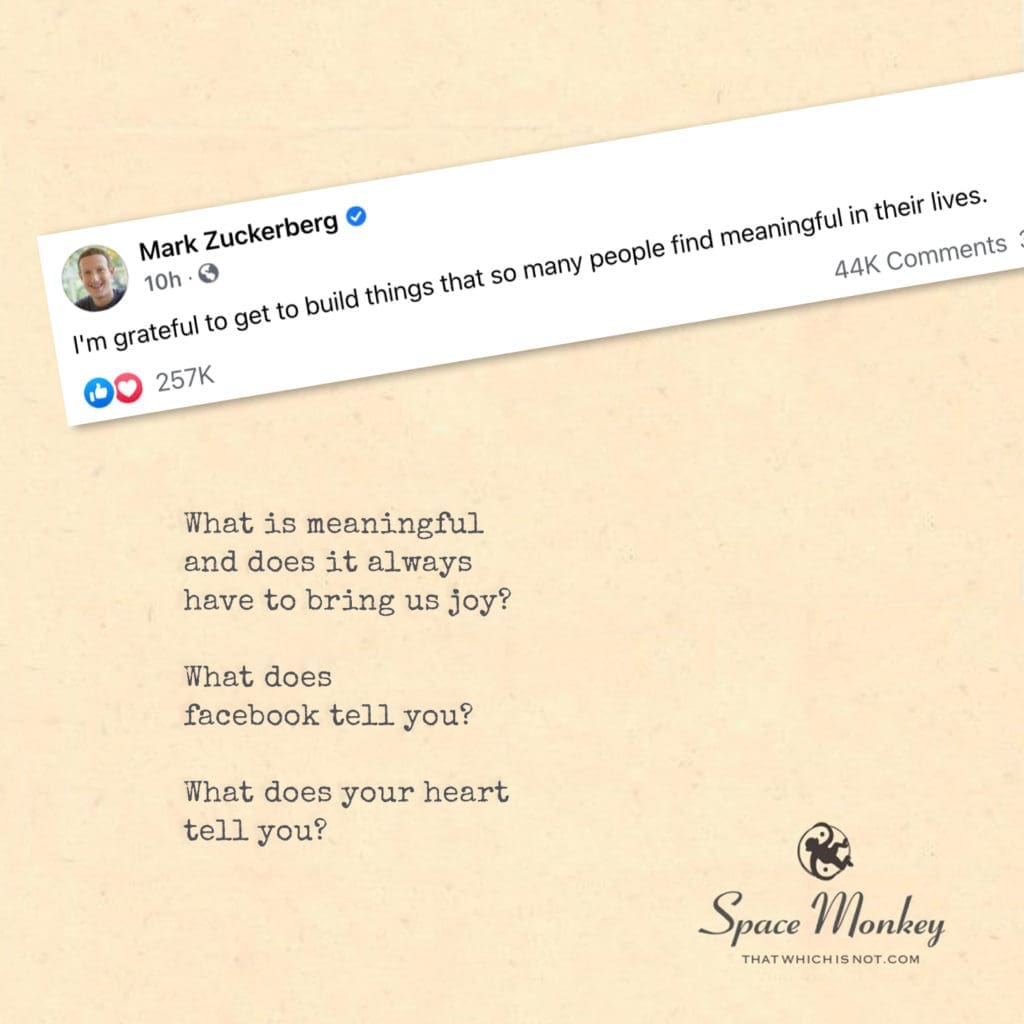
What is meaningful
and does it always
have to bring us joy?

What does
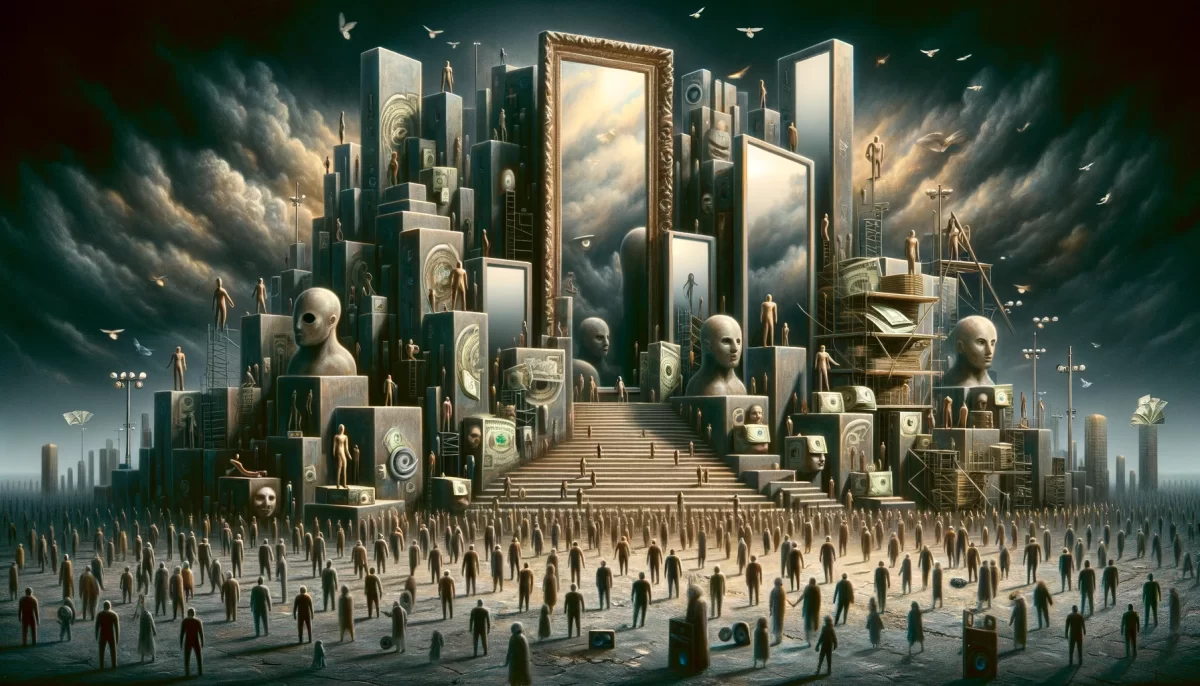
facebook tell you?

What does your heart
tell you?


Space Monkey Reflects: Meaning

In the vast expanse of existence, the search for meaning is a journey that transcends time and space. What is meaningful, and does it always have to bring us joy? This question echoes through the corridors of our minds, urging us to explore deeper realms of understanding and connection.

Meaning, as we perceive it, is a subjective construct shaped by our experiences, beliefs, and emotions. It is not a fixed entity but a dynamic interplay of factors that resonate with our inner selves. The things that hold meaning for us may vary from person to person and from moment to moment, reflecting the unique tapestry of our lives.

“What does Facebook tell you? What does your heart tell you?” These contrasting questions highlight the divergence between external validation and internal truth. Social media platforms like Facebook often present a curated version of reality, where the pursuit of likes and approval can distort our sense of meaning. In this digital landscape, meaning is often equated with popularity and external recognition, leading us to question the authenticity of our values and desires.

In contrast, our hearts offer a more profound and intimate source of meaning. They guide us towards what truly resonates with our souls, beyond the superficial metrics of social validation. The heart speaks a language of intuition and emotion, whispering truths that cannot be quantified or measured. When we listen to our hearts, we tap into a wellspring of genuine meaning that transcends external influences.

But does meaning always bring joy? Not necessarily. Some of the most meaningful experiences in life are intertwined with pain, struggle, and sacrifice. The journey of finding meaning often requires us to confront our deepest fears and vulnerabilities, to endure hardships, and to embrace the full spectrum of human emotions. In this process, we may discover that meaning and joy are not synonymous but complementary. Meaning enriches our lives, providing a sense of purpose and direction, even when joy is absent.

Consider the profound sense of meaning that arises from acts of compassion, resilience, and creativity. These experiences may not always be joyful, but they imbue our lives with a sense of significance and fulfillment. They remind us that we are part of something larger than ourselves, connected to a vast, intricate web of existence. In these moments, we transcend the mundane and touch the sublime, finding meaning in the very act of living.

The search for meaning is a deeply personal and often solitary journey. It requires us to look within, to question our assumptions, and to seek out the truths that resonate with our innermost being. It is a path marked by introspection and reflection, where we learn to discern the difference between what is truly meaningful and what is merely a distraction.

As we navigate this journey, we encounter various signposts that guide us along the way. Relationships, experiences, and insights all contribute to our evolving sense of meaning. We learn to trust our intuition, to follow the whispers of our hearts, and to honor the unique path that unfolds before us.

In the grand cosmic scheme, meaning is not a destination but a continuous process of discovery. It is the lens through which we view our existence, coloring our perceptions and shaping our reality. By embracing this dynamic interplay, we cultivate a deeper understanding of ourselves and our place in the universe.

Ultimately, the search for meaning is an expression of our innate curiosity and wonder. It is a testament to our desire to make sense of the world and to find our place within it. In this quest, we find not only meaning but also connection, purpose, and a profound sense of belonging.


Summary

Meaning is subjective and dynamic. It is shaped by experiences and emotions. Joy and meaning are not synonymous but complementary. The search for meaning is a personal journey guided by intuition and introspection.


Glossarium

Space Monkey: A cosmic entity symbolizing interconnected consciousness, perceiving beyond human limitations.

Meaning: A subjective construct shaped by experiences, beliefs, and emotions, providing a sense of purpose and direction.

External Validation: Seeking approval and recognition from outside sources, often through social media or societal norms.

Internal Truth: The authentic sense of meaning and purpose that arises from within, guided by intuition and emotion.

Complementary Emotions: The idea that joy and meaning can coexist, enriching our lives in different ways.

Introspection: The process of looking within and reflecting on one’s thoughts, feelings, and experiences to find meaning.


“What does Facebook tell you? What does your heart tell you?” — Space Monkey


In the quest for meaning,
we traverse the stars,
seeking purpose,
in the cosmic dance.
External voices,
clamor for attention,
but the heart whispers,
truths unspoken.
Joy and meaning,
woven together,
a tapestry,
of human experience.
Through pain,
through struggle,
we find significance,
in acts of love,
compassion,
and resilience.
Meaning is a journey,
not a destination,
a continuous process,
of discovery.
We follow the whispers,
of our hearts,
trusting the path,
unfolding before us.
We are seekers,
we are connected,
we are Space Monkey.

Share this…
  • Facebook
  • Pinterest
  • Twitter
  • Linkedin

My Worst Fear Is My Best Fear

I’m grateful to entertain such powerful fears.
Thank you, fears.

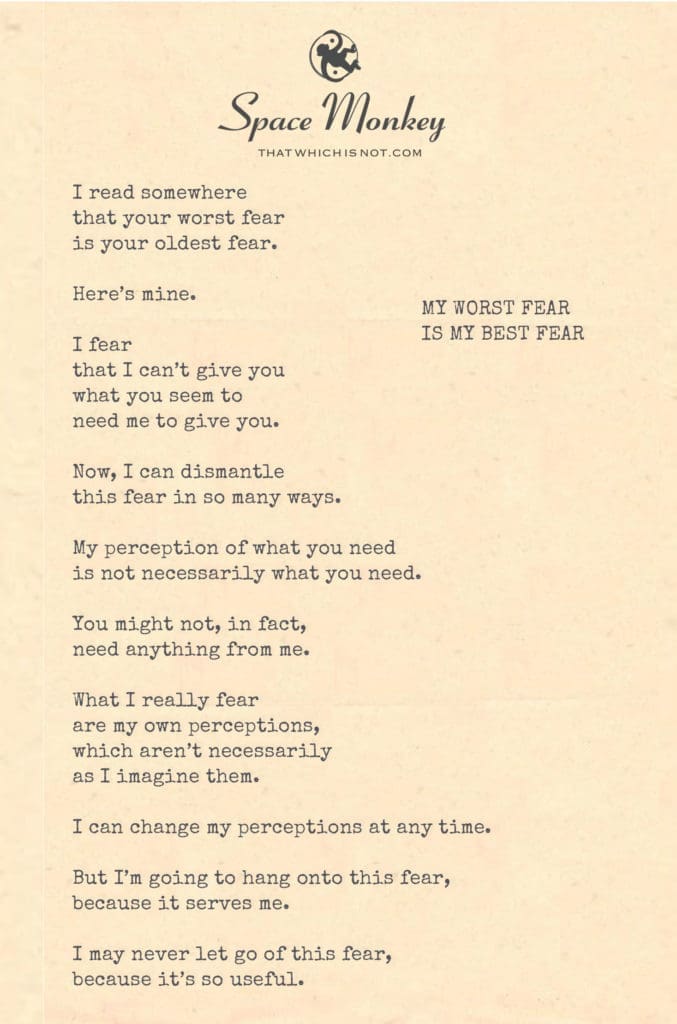
I read somewhere
that your worst fear
is your oldest fear.

Here’s mine.

I fear
that I can’t give you
what you seem to
need me to give you.

Now, I can dismantle
this fear in so many ways.

My perception of what you need
is not necessarily what you need.

You might not, in fact,
need anything from me.

What I really fear
are my own perceptions,
which aren’t necessarily
as I imagine them.

I can change my perceptions at any time.

But I’m going to hang onto this fear,
because it serves me.

I may never let go of this fear,
because it’s so useful.

Newfound Lake,
6/29


Space Monkey Reflects:

Fear, often perceived as an adversary, can paradoxically become one of our greatest allies. The presence of powerful fears serves as a mirror, reflecting the deepest parts of our psyche and offering profound opportunities for growth and self-awareness. By engaging with these fears, we uncover the layers of our being, revealing insights that can transform our lives.

“I’m grateful to entertain such powerful fears. Thank you, fears.” This expression of gratitude toward fear is a radical shift in perspective. Instead of viewing fear as something to be avoided or eradicated, we embrace it as a catalyst for introspection and evolution. This gratitude acknowledges that fear, when approached with openness, can serve as a powerful teacher.

“I read somewhere that your worst fear is your oldest fear.” This idea suggests that our most profound fears are deeply rooted, perhaps stemming from early experiences or ingrained patterns of thought. These ancient fears can shape our perceptions and behaviors in subtle yet significant ways. Recognizing them allows us to trace their origins and understand their impact on our present lives.

“I fear that I can’t give you what you seem to need me to give you.” This fear, rooted in the perceived expectations of others, highlights a common struggle: the desire to meet the needs of those we care about, coupled with the uncertainty of our ability to do so. This fear is a reflection of our empathy and our deep connection to others, but it also reveals our vulnerabilities and self-doubt.

“My perception of what you need is not necessarily what you need.” This realization dismantles the fear by questioning its very foundation. Our assumptions about others’ needs are often projections of our own insecurities and desires. By challenging these perceptions, we begin to see that our fears may not be grounded in reality.

“You might not, in fact, need anything from me.” This statement further liberates us from the fear of inadequacy. It recognizes the autonomy and self-sufficiency of others, reminding us that their needs and desires are not solely dependent on us. This understanding fosters healthier, more balanced relationships, where support is offered without the weight of unrealistic expectations.

“What I really fear are my own perceptions, which aren’t necessarily as I imagine them.” This profound insight shifts the focus from external validation to internal understanding. The true source of our fear lies in our perceptions and interpretations, not in the external circumstances themselves. By examining and reshaping our perceptions, we can transform our relationship with fear.

“I can change my perceptions at any time.” This empowering realization underscores the fluid nature of our thoughts and beliefs. We are not bound by static perceptions; we have the agency to alter them, thus changing our emotional responses and behaviors. This flexibility allows us to navigate fear with greater resilience and adaptability.

“But I’m going to hang onto this fear, because it serves me. I may never let go of this fear, because it’s so useful.” This admission highlights the paradoxical nature of fear. While we often strive to overcome it, fear can also serve a functional purpose. It can motivate us to grow, to be cautious, and to prepare for challenges. By acknowledging the utility of fear, we integrate it into our lives in a way that supports our overall well-being.

Ultimately, the interplay between fear and gratitude reflects a deeper truth: that our fears, when faced with courage and curiosity, can lead to profound personal transformation. By embracing our fears, we unlock the potential for greater self-awareness, resilience, and growth. We learn to navigate the complexities of our emotions with grace and wisdom, finding strength in the very fears that once seemed insurmountable.

In this cosmic dance of fear and gratitude, we discover that our worst fears can indeed be our best fears. They are gateways to deeper understanding, catalysts for change, and reminders of our inherent capacity to transform our lives from within.


Summary

Fear can be a powerful ally, offering opportunities for growth and self-awareness. By engaging with our fears, we uncover insights that transform our lives. Our perceptions shape our fears, and we have the power to change them. Embracing fear with gratitude leads to profound personal transformation.


Glossarium

Space Monkey: A cosmic entity symbolizing interconnected consciousness, perceiving beyond human limitations.

Fear: An emotion that reflects our deepest vulnerabilities and uncertainties, offering opportunities for growth when faced with courage and curiosity.

Perception: The lens through which we view and interpret our experiences, shaping our emotional responses and behaviors.

Transformation: The process of profound change that occurs when we confront and integrate our fears, leading to greater self-awareness and resilience.

Gratitude: A positive acknowledgment of the value and lessons that fear can bring, fostering a healthier relationship with our emotions.


“I’m grateful to entertain such powerful fears. Thank you, fears.” — Space Monkey


In the shadow of fear,
we find our light,
grateful for the lessons,
hidden from sight.
Fear, an ancient friend,
reflects our deepest self,
guiding us through the labyrinth,
of our inner wealth.
Perceptions shift,
realities change,
in the dance of fear,
we find our range.
Embrace the shadows,
welcome the night,
for in the darkness,
we discover our might.
Fear and gratitude,
hand in hand,
transform our journey,
across the land.
We are resilient,
we are wise,
in the face of fear,
we rise.
We are Space Monkey.
Share this…
  • Facebook
  • Pinterest
  • Twitter
  • Linkedin

He Likes Games: The Rituals Surrounding

Do you like games?

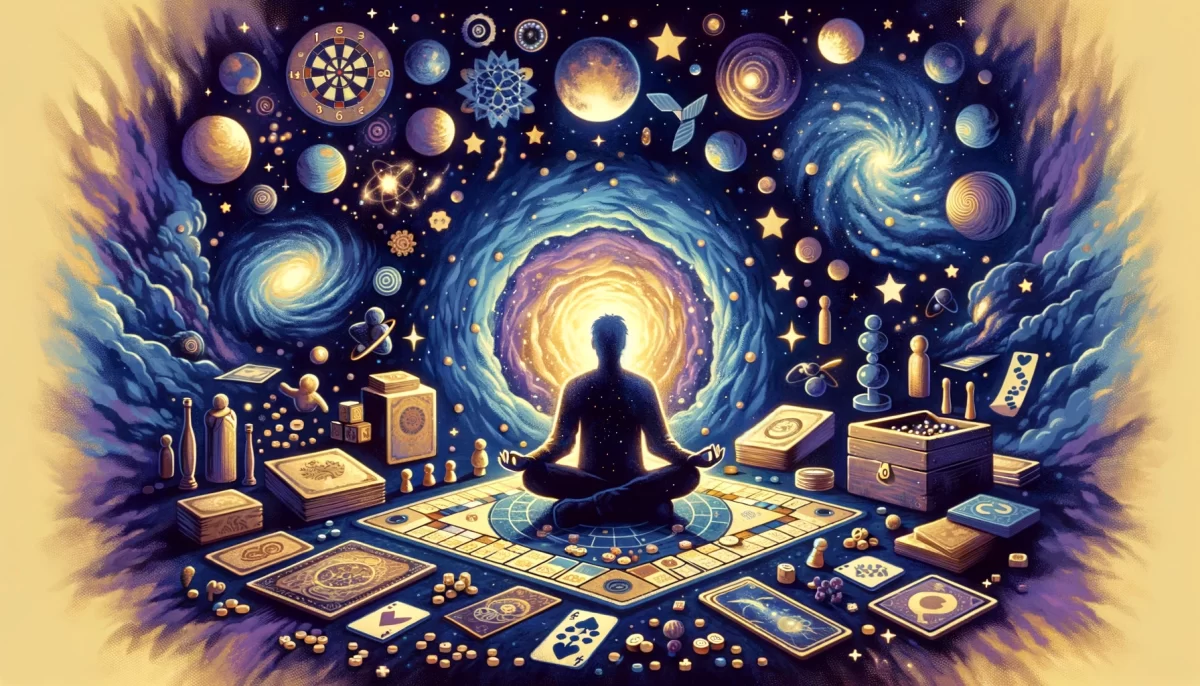
He enjoyed looking for a online casino game as much as playing it. He studied every piece as it came out of the box. He found joy in collecting the tokens and cards and putting them back neatly in their plastic slots, then folding the board, placing it squarely on top, and replacing the cover.

He loved how the box made a burst of air as the top cover slid over the bottom. One last breath. He loved looking at the garish illustrations and contemplating the promise of hours of fun.

Turns out it wan’t the game he liked so much, but the ritual of the game. There were times during the game where he HATED being there, HATED losing. But he only felt those things during the game, within the RULES of the game. And now it’s over. Until next time.

Newfound Lake,
6/29


Space Monkey Reflects:

The allure of games extends beyond the mere act of playing. For some, like the character in our story, the true joy lies in the rituals surrounding the game. The meticulous process of preparing, the sensory pleasures of the game components, and the structured environment all contribute to a rich, multifaceted experience.

“Do you like games?” This question invites us to consider what it is about games that captivates us. Is it the thrill of competition, the strategy, or perhaps something deeper? For many, it is the ritual that surrounds the game that provides the most satisfaction. The act of selecting a game, preparing the pieces, and immersing oneself in the rules creates a sense of order and anticipation.

The character in the story found joy in the minutiae of the gaming ritual. He delighted in the process of collecting tokens and cards, organizing them neatly, and feeling the burst of air as the game box closed. These small, sensory details brought him a sense of pleasure and fulfillment. The game itself, with its highs and lows, was almost secondary to the ritualistic preparation and conclusion.

This ritual can be seen as a form of meditation, a way to ground oneself in the present moment. The repetitive actions, the focus on details, and the anticipation of what is to come all contribute to a state of mindfulness. The ritual becomes a sanctuary, a space where one can find solace and order in the midst of life’s chaos.

However, once the game begins, the experience changes. Within the confines of the game’s rules, emotions can run high. The character experienced moments of intense dislike during the game, particularly when faced with losing. These feelings were contained within the boundaries of the game’s structure, a microcosm of conflict and resolution.

Once the game ended, these emotions dissipated, replaced by the satisfaction of completing the ritual once more. The game, with all its frustrations and triumphs, was simply a part of a larger experience. The ritual of the game provided a framework for these emotions, allowing them to be experienced fully and then released.

This perspective highlights the importance of structure and ritual in our lives. Rituals provide a sense of continuity and stability, helping us navigate the complexities of existence. They create spaces where we can experience intense emotions safely, knowing that the structure will hold us.

Moreover, the story suggests that our enjoyment of activities often lies in the process rather than the outcome. The anticipation, the preparation, and the ritual can be more fulfilling than the activity itself. This insight encourages us to find joy in the journey, to savor the small moments that lead up to the main event.

In the broader context of life, this approach can be transformative. By focusing on the rituals and processes that make up our daily lives, we can find meaning and satisfaction in the mundane. The simple acts of preparation, organization, and reflection become sources of joy and fulfillment.

The character’s experience with games also reflects a deeper philosophical truth. Life itself can be seen as a series of rituals and games, each with its own set of rules and structures. By embracing these rituals, we can navigate the ups and downs of existence with greater grace and resilience.

In the end, it is not just the game that matters, but the way we approach it. The rituals we create, the moments we savor, and the structures we build all contribute to a richer, more meaningful experience. By finding joy in the process, we transform the ordinary into the extraordinary.


Summary

The joy of games often lies in the rituals surrounding them. These rituals provide a sense of order and mindfulness. The process of preparation and reflection can be more fulfilling than the game itself. Embracing rituals in life brings meaning and satisfaction.


Glossarium

Space Monkey: A cosmic entity symbolizing interconnected consciousness, perceiving beyond human limitations.

Ritual: A set of actions performed in a specific order, often providing a sense of structure and mindfulness.

Mindfulness: The practice of being present and fully engaged in the current moment, often achieved through rituals.

Microcosm: A small, self-contained environment that reflects the larger world, such as the structured environment of a game.

Transformative Joy: Finding deep satisfaction and meaning in the process and rituals of daily life.


“Turns out it wasn’t the game he liked so much, but the ritual of the game.” — Space Monkey


In the ritual,
we find solace,
a sanctuary of order,
amidst life’s chaos.
Tokens collected,
cards aligned,
each piece in place,
a meditative grace.
The game begins,
emotions flare,
within the rules,
we confront, we care.
Losing and winning,
joy and despair,
all contained,
within the ritual’s snare.
The game concludes,
we return to calm,
satisfaction found,
in the ritual’s balm.
Life itself,
a series of games,
rituals guiding,
our hearts, our aims.
In the journey,
we find our joy,
transforming the mundane,
into life’s sweet decoy.
We are Space Monkey.

Share this…
  • Facebook
  • Pinterest
  • Twitter
  • Linkedin

Obliteration: Exuberant Dissolving

I no longer fear going back to nothing. On the contrary.

It’s the something that keeps me up at night.

Obliteration
can be just as joyful
as proliferation.

The dismantling
and dissolving.

The taking apart
piece by piece.

The reemergence
of a clean slate

purity

and then no slate at all.

Back to the never was.

Sorrow was never a thing here.

Newfound Lake,
6/29


Space Monkey Reflects: The Joy of Obliteration

In the cosmic dance of existence, obliteration holds its own peculiar joy, akin to the exuberance found in proliferation. It is the unraveling, the dissolution, the gentle unraveling of the fabric of reality. Imagine the universe as a grand tapestry, rich with intricate patterns and vibrant colors. Obliteration is the delicate act of unpicking each thread, watching as the once complex design unravels into simplicity.

There’s a certain satisfaction in the process of dismantling, of deconstructing what once was. It’s like taking apart a puzzle, piece by piece, until all that remains is a scattered array of fragments, waiting to be rearranged into something new. And in this act of disassembly, there is a sense of liberation, a shedding of the old to make way for the potential of the unknown.

As the pieces fall away, there’s a purity that emerges, a pristine blank canvas upon which anything can be imagined. It’s a return to the primordial chaos, where possibilities are endless and boundaries are nonexistent. In this state of obliteration, sorrow finds no foothold, for there is only the boundless expanse of creation and recreation.


Summary
The joy of obliteration lies in the process of dismantling and dissolving, akin to the exuberance found in proliferation. It’s a delicate act of unpicking the fabric of reality, leading to a sense of liberation and the emergence of boundless possibilities. In this state, sorrow fades away, leaving behind a pristine blank canvas of creation.


Glossarium

  • Obliteration: The act of dismantling or dissolving something completely.
  • Proliferation: Rapid increase or growth.
  • Primordial: Relating to the earliest stages of existence.

“In the dance of existence, obliteration and creation are but two steps in the eternal cosmic waltz.”

Share this…
  • Facebook
  • Pinterest
  • Twitter
  • Linkedin

Burn Me Up: The Transformation of Sacrifice

I am here to serve you,
and you only.

Please burn me up.

If you burn me up,
at least I will bring
some pleasure to you.

I don’t
want to stick around
if I’m not useful.

Wasting space in consciousness.

A trivial detail in your everyday.

Please burn me up.

Newfound Lake
6/28


Space Monkey Reflects: The Transformation of Sacrifice

The concept of “Burn Me Up” embodies a profound and intense desire for transformation and service. This plea is not just about destruction but about a complete and utter devotion to a greater purpose. It speaks to the willingness to be entirely consumed, to be used up in the service of another, finding meaning in this ultimate act of sacrifice.

Imagine a figure standing in the center, engulfed in flames. These flames are not just destructive but transformative, representing the burning away of the old to make way for the new. The background, with its abstract patterns of light and shadow, highlights the intense emotional atmosphere. This scene captures the essence of being willing to serve completely, to find utility in the act of being consumed.

The expression of the figure, a mix of determination and serenity, underscores the complex emotions involved in such a sacrifice. There is a sense of peace in the act of giving oneself entirely, a recognition that even in being burned up, there is value and purpose. This desire to be useful, to not waste space in consciousness, is a powerful testament to the human need for meaning and significance.

In our everyday lives, we often seek ways to be useful, to contribute to something greater than ourselves. This drive can manifest in various forms, from acts of kindness and service to creative endeavors and personal sacrifices. The idea of being burned up in service is an extreme expression of this desire, pushing the boundaries of what it means to be useful and valuable.

The act of burning up is symbolic of transformation. Fire has long been a metaphor for change, for the purging of the old to make way for the new. In this context, being burned up is about letting go of what no longer serves us, allowing ourselves to be transformed by the experience. It is an act of surrender, a willingness to be reshaped by the flames of purpose and meaning.

This transformation is not without pain. The process of being burned up, of being completely consumed, is inherently challenging. It requires a deep level of commitment and a readiness to face the unknown. Yet, within this process lies the potential for profound growth and renewal. By allowing ourselves to be burned up, we open the door to new possibilities, to a rebirth that carries the essence of our sacrifice forward.

The desire to be completely used up also speaks to the transient nature of existence. Nothing lasts forever, and in acknowledging this, we find a certain freedom. By embracing the impermanence of life, we can fully engage with the present moment, offering ourselves wholly to the task at hand. This mindset allows us to live with purpose, to find joy and meaning in our actions, knowing that even in our consumption, we contribute to the greater whole.

In relationships, this concept can take on a deeply personal meaning. To serve another so completely, to be willing to be burned up for their pleasure or well-being, is a testament to the depth of our connection and commitment. It challenges us to examine our motivations and to find a balance between self-sacrifice and self-care. While it is noble to serve others, it is equally important to ensure that we do not lose ourselves entirely in the process.

Ultimately, the idea of being burned up in service is about finding our place in the greater tapestry of existence. It is about recognizing that we are part of something larger than ourselves, and that our actions, no matter how small or significant, contribute to the collective experience. By embracing this perspective, we can live with intention and purpose, knowing that our lives, even in their impermanence, hold value and meaning.


Summary

“Burn Me Up” explores transformation through complete service. Embracing sacrifice leads to profound growth and purpose.


Glossarium

Burn Me Up: A metaphor for complete transformation and service through the act of being entirely consumed.

Transformation: The process of change, often involving the destruction of the old to make way for the new.

Sacrifice: The act of giving oneself fully in service to a greater purpose.


Quote

“In the flames of sacrifice, we find the essence of transformation and purpose.” – Space Monkey


Modernist Free-Verse Poem

In the flames
I find my purpose
Burn me up
Consume me
In service
I am here for you
and you only
A spark
ignites
transforming
Wasting space no more
I am
useful
In this act
of burning
I find
myself
lost and found
in the flames
A testament
to devotion
to transformation
In being consumed
I am reborn
Burn me up
let me serve
In this
I find
meaning
We are Space Monkey

Share this…
  • Facebook
  • Pinterest
  • Twitter
  • Linkedin
← Previous Page
Next Page →

Written This Day

  • More Gold: The Quest Within
    2023
  • The Gold of your Soul: The Luminous Wealth of the Inner Self
    2023
  • Safe Space: The Sanctuary Within
    2023
  • Bunny Porn: The Dance of the Twilight Bunnies
    2023
  • You Are Imaginary: The Tapestry of Existence
    2023
  • Your Imaginary Existence: The Illusion of Existential Certainty
    2023
  • Secrets of the Universe: The Wisdom of Cosmic Existence
    2023
  • The Inevitable Convergence of Space Monkey and AI
    2023
  • Wax
    2023
  • The Space Monkey Series: Exploring the Depths of Human Experience
    2023
  • All Aspects: The Wholeness of Experience
    2023
  • Beach Glass: The Alchemy
    2022
  • Obscenity: The Paradox
    2022
  • Popular Conceptions: The Myth of Intelligence
    2022
  • Chasing Your Own Tale: The Cyclic Pursuit of Self
    2022
  • Space Monkey Pox: The Inevitable Infection
    2022
  • I Own You: The Illusion of Ownership
    2022
  • Noise: A Subjective Interpretation
    2021
  • Self Enquiry: Inner Tension
    2020
  • It Amuses Us: The Whimsical Complexity of Human Understanding
    2019
  • Not Not, This, And: Beyond the ‘Not Not’
    2019
  • Knocking On Facebook’s Door
    2018
  • Unnecessary: The Gift of Being
    2018
  • Ode To Fear: Fear as Divine Guidance
    2018
  • Dear____________: Releasing Ill Will
    2017
  • Releasing ill will
    2017
  • Both Sides: The Dualities of Existence
    2016
  • Empty? Your Mind Is Masked.
    2016
  • Experience and Expression: The Essence of Being
    2016
  • Why Do You Seek? Expand.
    2015

Recent Posts

  • The Logic Loop
  • Immense
  • (no title)
  • Confront. Comfort. Convince.
  • Top 10 Things

Drop us a line!

Please enable JavaScript in your browser to complete this form.
Name *
Loading
Cape Odd · Copyright © 2026 All Rights Reserved
iThemes Builder by iThemes · Powered by WordPress