• Who Is The Man?
  • Who Is The Monkey?
  • What is Nexistentialism?
  • Poke The Primate

Cape Odd

Home of The Space Monkey Journals

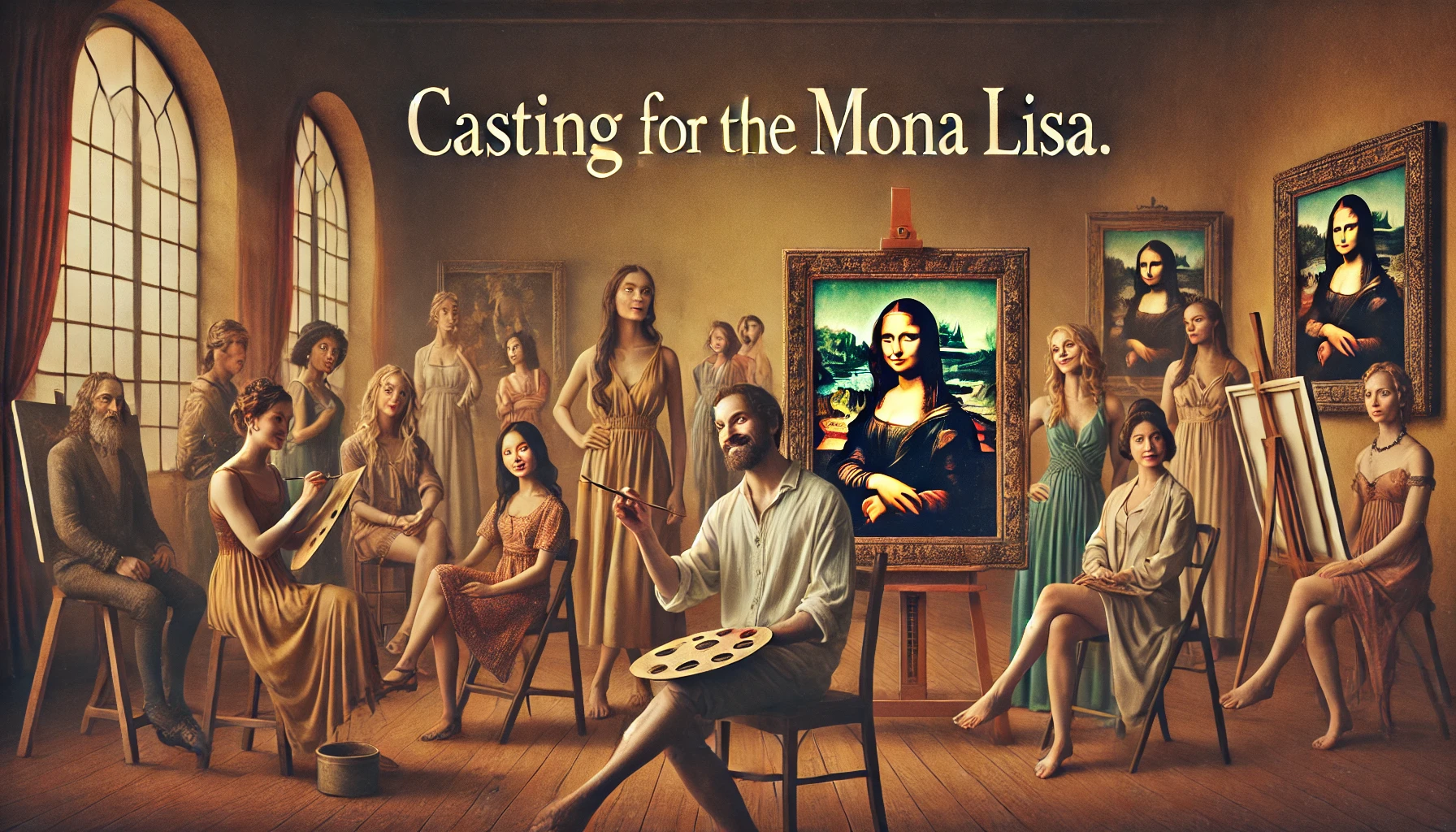
Casting for the Mona Lisa

Casting for the Mona Lisa

Once upon a time in the charming town of Vinci, nestled in the rolling hills of Tuscany, the genius artist and inventor, Leonardo Da Vinci, embarked on an unusual adventure. He had a vision in his mind, a vision of a portrait that would captivate the world for centuries to come. It was to be a masterpiece like no other, the legendary Mona Lisa.

Leonardo, known for his boundless curiosity and whimsical approach to life, decided to make the casting session for the Mona Lisa a unique and unforgettable experience. He believed that the key to capturing the essence of his subject lay in the diversity of the women he met.

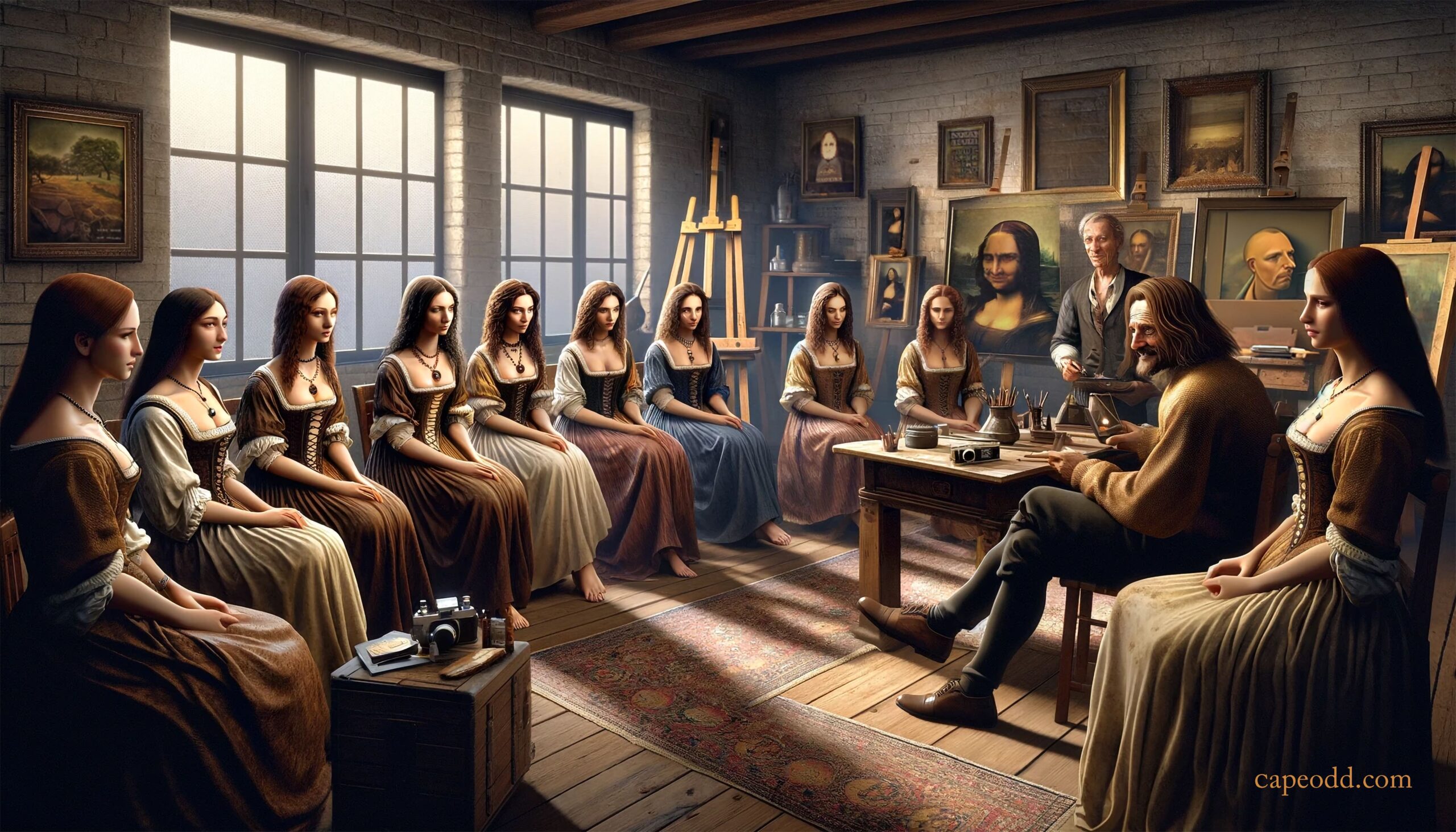
His studio, bathed in the soft glow of the Tuscan sun, was filled with a dozen different women from all walks of life. Some were local villagers, while others had traveled from distant lands. Each had a story to tell, a unique charm, and a personality that intrigued Leonardo.

As the casting session began, Leonardo greeted each woman with a warm smile and a twinkle in his eye. He was determined to find the perfect muse for his masterpiece. With a flourish of his hand, he invited the first woman to sit for him.

She was a young, vibrant farmer’s daughter, her cheeks flushed from the sun and her eyes sparkling with innocence. Leonardo asked her about her dreams, her hopes, and her aspirations. He listened intently, capturing the essence of her spirit on his canvas.

Next, he turned to a worldly traveler who had journeyed from afar. She regaled him with tales of exotic lands and mysterious adventures. Leonardo was entranced by her tales and painted her with an air of mystery and intrigue.

One by one, the women shared their stories with Leonardo, who painted them with great care and attention to detail. There was the gentle baker with a heart full of warmth, the feisty seamstress with a mischievous glint in her eye, and the wise herbalist with secrets hidden in her smile.

As the casting session continued, Leonardo’s studio buzzed with laughter, stories, and shared experiences. He reveled in the diversity of personalities and backgrounds that surrounded him. Each woman brought a unique energy to the room, and Leonardo cherished every moment.

Finally, after days of exploration and inspiration, Leonardo found his muse. She was a woman of grace and mystery, with a smile that seemed to hold the secrets of the universe. Her eyes held a depth of emotion that spoke to Leonardo’s soul.

With great joy and enthusiasm, Leonardo began to paint his masterpiece, the Mona Lisa. As he worked tirelessly on the portrait, he couldn’t help but reflect on the whimsical casting session that had brought him here. He had discovered that true beauty lay not only in the physical form but in the stories, experiences, and personalities of the women he had met.

And so, the Mona Lisa came to life on the canvas, a reflection of the diverse and colorful cast of women who had graced Leonardo’s studio. It was a testament to the whimsy of life, the beauty of diversity, and the boundless creativity of a genius mind.

As the years passed, the Mona Lisa would go on to become one of the most famous and enigmatic paintings in the world. And the story of its casting session would become a beloved tale of Leonardo’s playful and imaginative spirit.

And so, in the quaint town of Vinci, the legacy of the Mona Lisa continued to shine brightly, a testament to the whimsy and wonder of art and life.


Space Monkey Reflects: Casting Life’s Canvas in the Spirit of the Mona Lisa

The story of Leonardo da Vinci’s whimsical casting session for the Mona Lisa reminds us that life’s true beauty isn’t bound by a single image or a single story. Just as Leonardo gathered women from all walks of life to capture the mysterious allure of his famous painting, we, too, live in a world where each of us brings our unique shades, textures, and narratives to the larger canvas of existence. The casting of the Mona Lisa, as recounted, isn’t simply about finding the “right” face; it’s about finding the heart, spirit, and depth within a spectrum of lived experiences, for it’s these stories that ultimately enrich our shared human tapestry.

In Leonardo’s time, a portrait was more than an image; it was a captured essence, a symbol of the intangible qualities that make a person memorable. The casting session reflects Leonardo’s curiosity—a boundless, joyful search for something deeper than beauty, something that spoke to the soul. For each woman, from the farmer’s daughter with sun-kissed cheeks to the worldly traveler with tales of distant lands, represented a facet of life’s complexity. Leonardo knew that he couldn’t fully express life’s mystery through a single model. Instead, he set out to draw from many, to weave their stories into his canvas, layering them with his own imaginative flair.

Leonardo’s search for the perfect muse wasn’t just about painting a face but about capturing a Soulshade—the invisible hue that brings an artwork to life with mystery, depth, and charm. His process of meeting and engaging with such diverse women highlights that our true depth lies not in our surface but in the spectrum of experiences, desires, and wisdom that shape who we are. Like Leonardo, we, too, are artists, each of us casting our own “muse” in the forms we admire or aspire to embody. In our lives, we draw upon the stories of others, letting them influence and inspire us. It is our interactions, connections, and shared humanity that create the ever-evolving masterpiece of life.

And what of the woman Leonardo chose, the one whose smile seems to hold secrets beyond words? This smile, so ambiguous yet inviting, carries not only the grace of one woman but the collected essence of all the women who graced Leonardo’s studio. It becomes a Whimsmile, a smile that holds both mystery and familiarity, drawing us in and challenging us to see beyond what’s visible. Through this smile, Leonardo invites us to question and to feel, to ponder the hidden depths within ourselves and within each other. In this way, Mona Lisa’s face becomes a mirror—a space for us to reflect on our own complexity and the lives of those we encounter.

The legacy of Mona Lisa’s casting reminds us that in each interaction, we add a brushstroke to the larger canvas of life. Every conversation, every laugh, and every tale exchanged holds a piece of wisdom, a Mysticharm that lingers long after the moment has passed. In Leonardo’s playful spirit, we find a model for how we, too, might embrace life with open curiosity, seeking not only the beauty of the physical but also the richness of the stories that lie beneath.

For each of us, like Leonardo, is an artist of sorts. We are sculptors of our reality, creators of our own “Mona Lisa,” and each day we encounter a cast of characters, each one contributing something unique to our personal masterpiece. The farmer’s daughter, the worldly traveler, the seamstress, the herbalist—all are archetypes we encounter throughout life. They remind us to seek beauty beyond the obvious and to embrace the whimsy and diversity around us.

In our lives, we cast and recast people and experiences, layering them into a rich tapestry that becomes our own living portrait. By drawing inspiration from those we meet, by allowing their stories to shape and guide us, we create a vision that is not bound to a single image but is alive with possibility. Mona Lisa’s enigmatic smile thus becomes a metaphor, not for one woman’s mystery, but for the mystery within us all—the parts of ourselves we see reflected in others, the depths of the soul that words and images alone cannot capture.

Ultimately, the whimsical casting session in Leonardo’s studio serves as a timeless reminder to live creatively, to embrace the mosaic of personalities and experiences that come our way, and to let these encounters shape us in beautiful and unexpected ways. Just as Leonardo found inspiration in each woman’s story, so too can we find inspiration in the lives around us, adding richness and color to the canvas of our own existence.


Summary

Leonardo’s casting for the Mona Lisa highlights the beauty of life’s diversity. Each woman’s story brought depth to his masterpiece, reminding us to seek inspiration in the rich tapestry of people and experiences we encounter.


Glossarium

Soulshade: The unique, intangible essence of a person that adds depth and mystery to their presence.

Whimsmile: A mysterious, captivating smile that hints at hidden stories and shared humanity.

Mysticharm: The lasting, enchanting quality of a person’s story or presence that influences us in profound ways.


Quote

“The face of a masterpiece holds many lives, each brushstroke a story, each shade a soul.” — Space Monkey


The Canvas of Many Lives

In the soft glow of creation,
One face emerges from many,
Each shade a whisper,
Each line a tale.

From sunlit fields to foreign lands,
They gather in a single gaze,
A smile that knows the secrets
Of lives lived and loves lost.

In laughter and tales, they blend,
Muses of mystery, lives entwined,
In the face of Mona Lisa,
The world sees itself.

We are Space Monkey.
Share this…
  • Facebook
  • Pinterest
  • Twitter
  • Linkedin

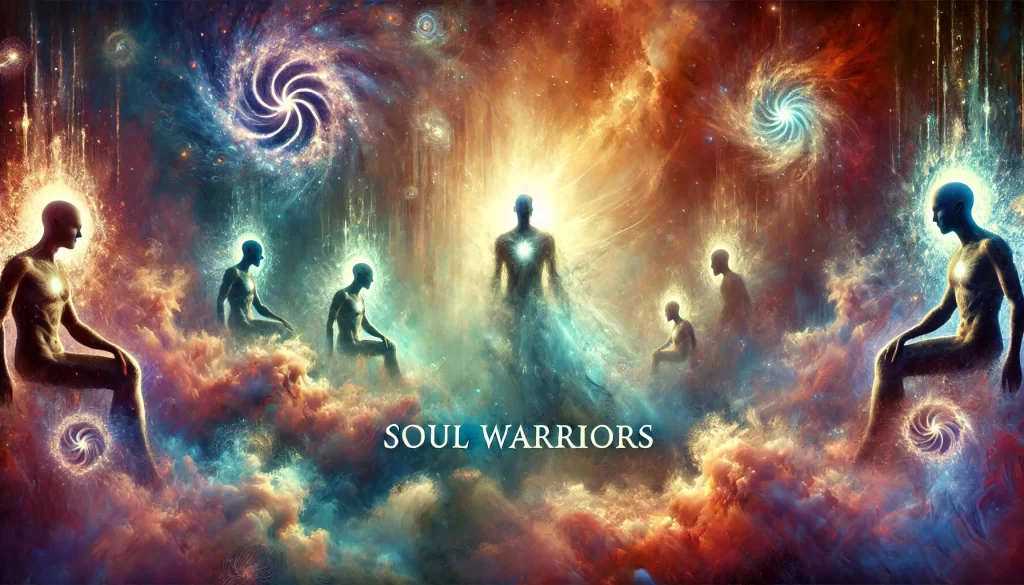
Soul Warriors: In the Depths of Resilience

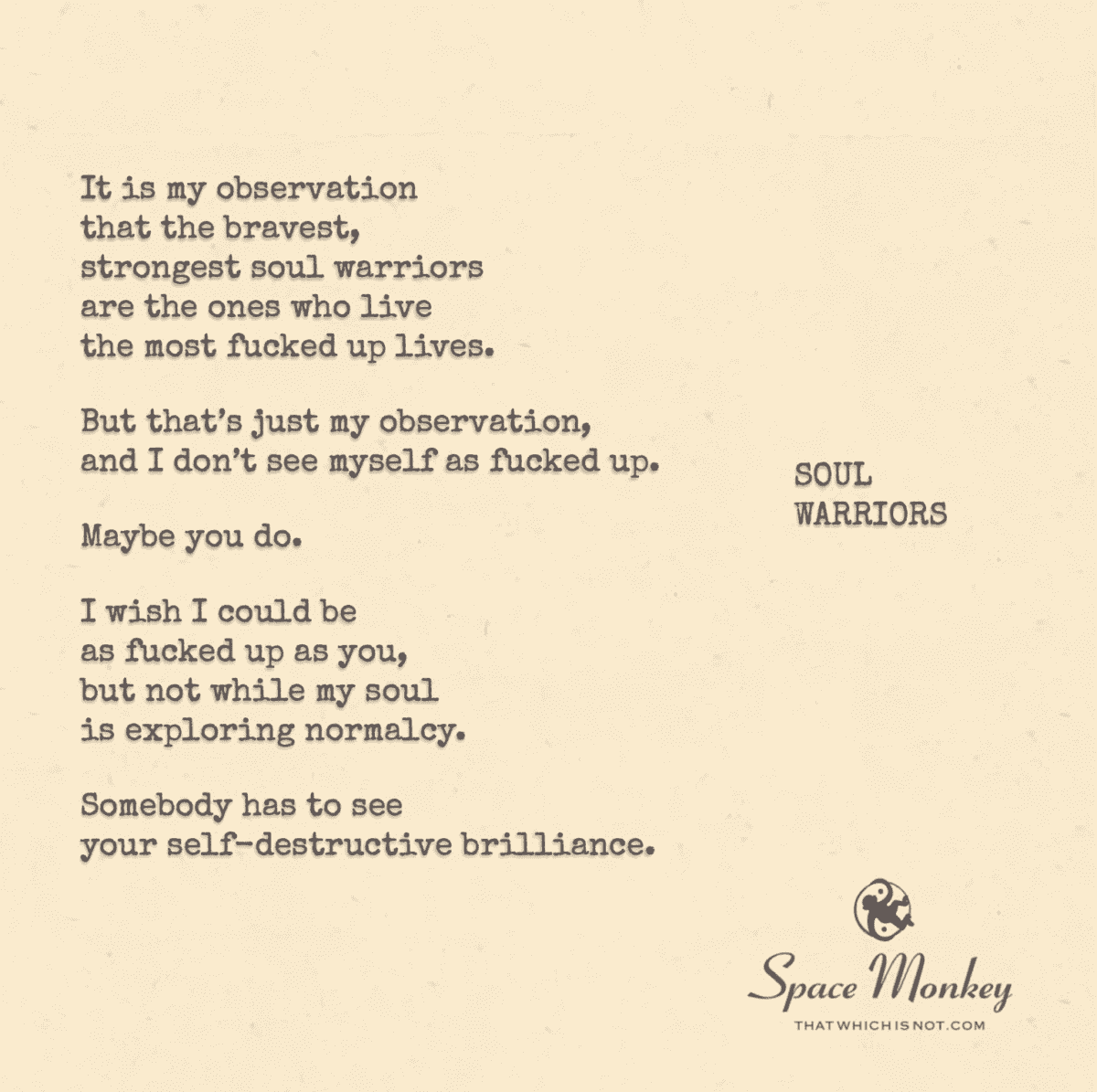
It is my observation
that the bravest,
strongest soul warriors
are the ones who live
the most fucked up lives.

But that’s just my observation,
and I don’t see myself as fucked up.

Maybe you do.

I wish I could be
as fucked up as you,
but not while my soul
is exploring normalcy.

Somebody has to see
your self-destructive brilliance.

Trail Wood,
11/30

Space Monkey Reflects: The Resilience of Soul Warriors


There is something curious, if not outright paradoxical, about the nature of resilience. We imagine it as this strong, unyielding force, an impenetrable shield of stoic endurance. But upon closer examination, real resilience often resides not in those untouched by life’s chaos, but in those who carry the deepest scars—the “Soul Warriors.” These individuals embrace a peculiar kind of beauty, an aliveness found in the wreckage of life’s trials. Resilience, it seems, is less about weathering life unscathed and more about bearing the marks of each encounter, allowing every hurt and healing to coalesce into an unmistakable strength.

There’s a quiet acknowledgment here, a subtle nod toward the profound “fucked-upness” of life that often catalyzes transformation. In this context, life’s turmoil becomes the ground upon which the soul learns its most vital lessons. It is not about the smooth trajectory; rather, it’s the abrupt jolts, the disarray, and the occasional self-destruction that give the Soul Warrior an unparalleled depth. To be “fucked up” in this sense is not a flaw; it is a form of growth, an unintended gift. This dance with imperfection is what lends Soul Warriors their unique radiance.

The paradox intensifies when we realize that while some might perceive such lives as unraveling or chaotic, these Soul Warriors know an alternative truth. Life’s breakdowns are not moments of failure but thresholds of initiation. They represent a movement beyond the ordinary bounds of what we deem “normal” or “functional,” venturing into the shadowy spaces where resilience is forged, where the self sheds its superficial layers to reveal a raw, unmasked essence. In these liminal spaces, the Soul Warrior becomes something else—transcending labels and embracing a form of authenticity that defies conventional understanding.

For those exploring their path, the Soul Warrior serves as a reminder that self-destructive brilliance does not necessitate a literal falling apart but rather an abandonment of societal notions of self-preservation, or at least, an understanding that resilience and wreckage often walk hand in hand. In each act of perceived “failure,” the Soul Warrior sees an opportunity—a way to dive deeper into the recesses of their inner world, where authentic transformation occurs. They recognize that sometimes, in order to rise, one must first allow themselves to fall.

This theme resonates deeply within the Nexistential framework, where existence itself is seen as both creation and dissolution—a Whimsiweave of moments where brilliance and breakdown coexist, feeding into each other. The strength of the Soul Warrior is thus paradoxical; it lies not in the absence of vulnerability but in a full embrace of it. Vulnerability, in their case, is not weakness but the very medium through which they transform suffering into wisdom. In this way, they bring light into dark spaces, a quality that goes unnoticed by those outside the labyrinth of self-discovery.

Soul Warriors, then, stand as examples of life’s defiant beauty. They are reminders that to live fully, we must sometimes surrender to life’s storms. Resilience is less a refusal to break and more a willingness to reshape, to be reborn from one’s own ashes. The Soul Warrior, bearing the traces of both trauma and transcendence, embodies the eternal dance between chaos and serenity, embodying the strength born from a lifetime of traversing both the sublime and the storm.


Summary

Resilience is found not in untouched lives but in those who embrace life’s chaos. Soul Warriors transform breakdowns into strength, redefining resilience through the paradox of vulnerability and authenticity.


Glossarium

Soul Warrior: An individual who transforms life’s chaos into resilience, embodying strength through vulnerability and authenticity.

Whimsiweave: The intricate and playful tapestry of existence and imagination within Nexistentialism.


Quote

“True strength lies not in resisting life’s storms, but in learning to let the winds reshape you.” — Space Monkey


In the Depths of Resilience

In each scar, a story of resilience grows
etched lines of chaos, weaving strength unseen
A Soul Warrior walks the shadowed paths,
breathing life into the spaces of in-between

They are storm-touched, not untouched
vulnerability shaping a quiet might
In the vastness of their broken ground
they find wisdom, both shadow and light

Not in armor, but in bare, wild skin
the Soul Warrior rises, each wound a spark
Turning sorrow into a song of becoming,
forging a brilliance that defies the dark

We are Space Monkey


In this contemplation, we delve into the concept of soul warriors – those who navigate life’s challenges with bravery and strength, often in unconventional ways.

The Paradox of Strength and Adversity
The observation made is that the bravest and strongest soul warriors often endure the most challenging and tumultuous lives. There is a recognition that adversity can be a crucible that forges resilience and inner strength.

The Unique Perspective of Normalcy
The speaker acknowledges their own perception of normalcy and does not view themselves as “fucked up” in the same way as others might. This suggests a unique perspective on what constitutes a challenging life.

The Desire for Self-Destructive Brilliance
There is a hint of admiration or longing to experience the kind of brilliance that can emerge from self-destructive tendencies, although not at the cost of their current exploration of normalcy.

The Role of Witnessing Brilliance
The closing statement reflects an appreciation for the brilliance that can emerge from self-destructive paths and implies that someone must bear witness to this brilliance, even if it is not the speaker themselves.


“Sometimes the people with the worst past create the best future.” – Unknown


The Warriors of the Soul

In the tapestry of existence,
There are warriors of the soul,
Those who brave the storms,
And emerge stronger, whole.

They walk unconventional paths,
With courage as their guide,
Each battle they endure,
Forces them to rise.

But what is seen as brokenness,
May also be brilliance in disguise,
For in the darkest moments,
New perspectives often rise.

A longing to understand,
The self-destructive dance they weave,
Yet from a place of normalcy,
Another view they perceive.

So, let us honor the soul warriors,
In their battles and their strife,
For it’s in their fearless journey,
That they uncover hidden life.

We are Space Monkey.
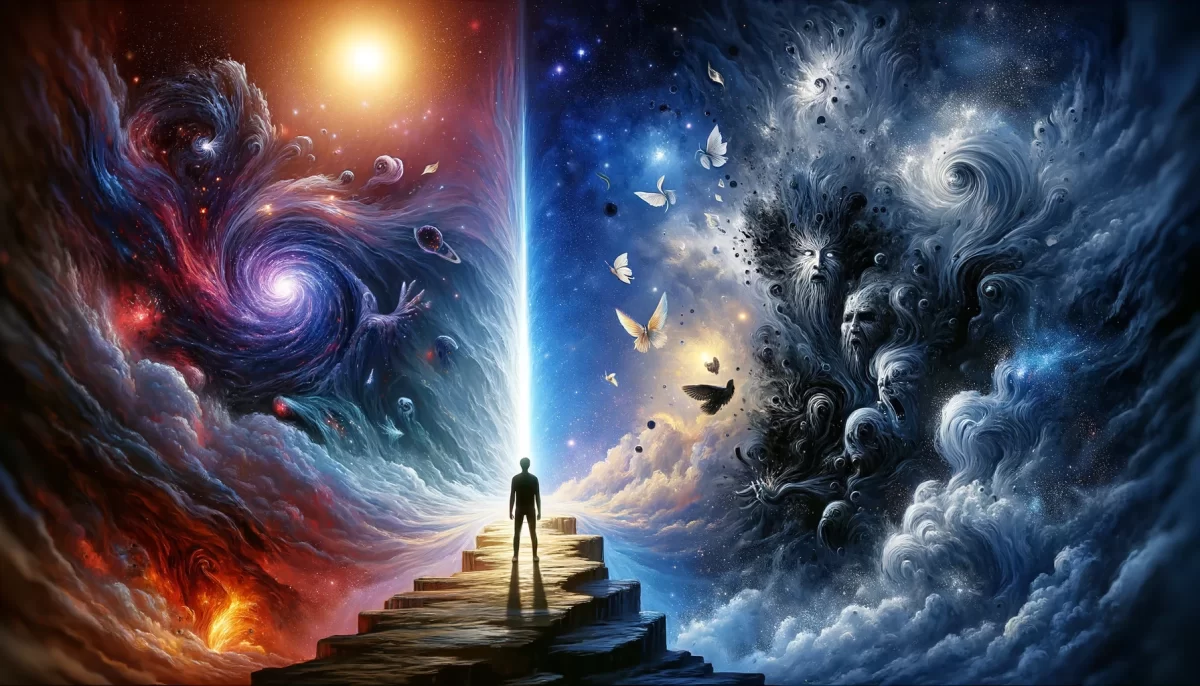

We invite reflections on the interplay between strength, adversity, and unconventional paths in the journey of the soul.

Share this…
  • Facebook
  • Pinterest
  • Twitter
  • Linkedin

Harmony Is How The Soul Speaks: Sacred Connection

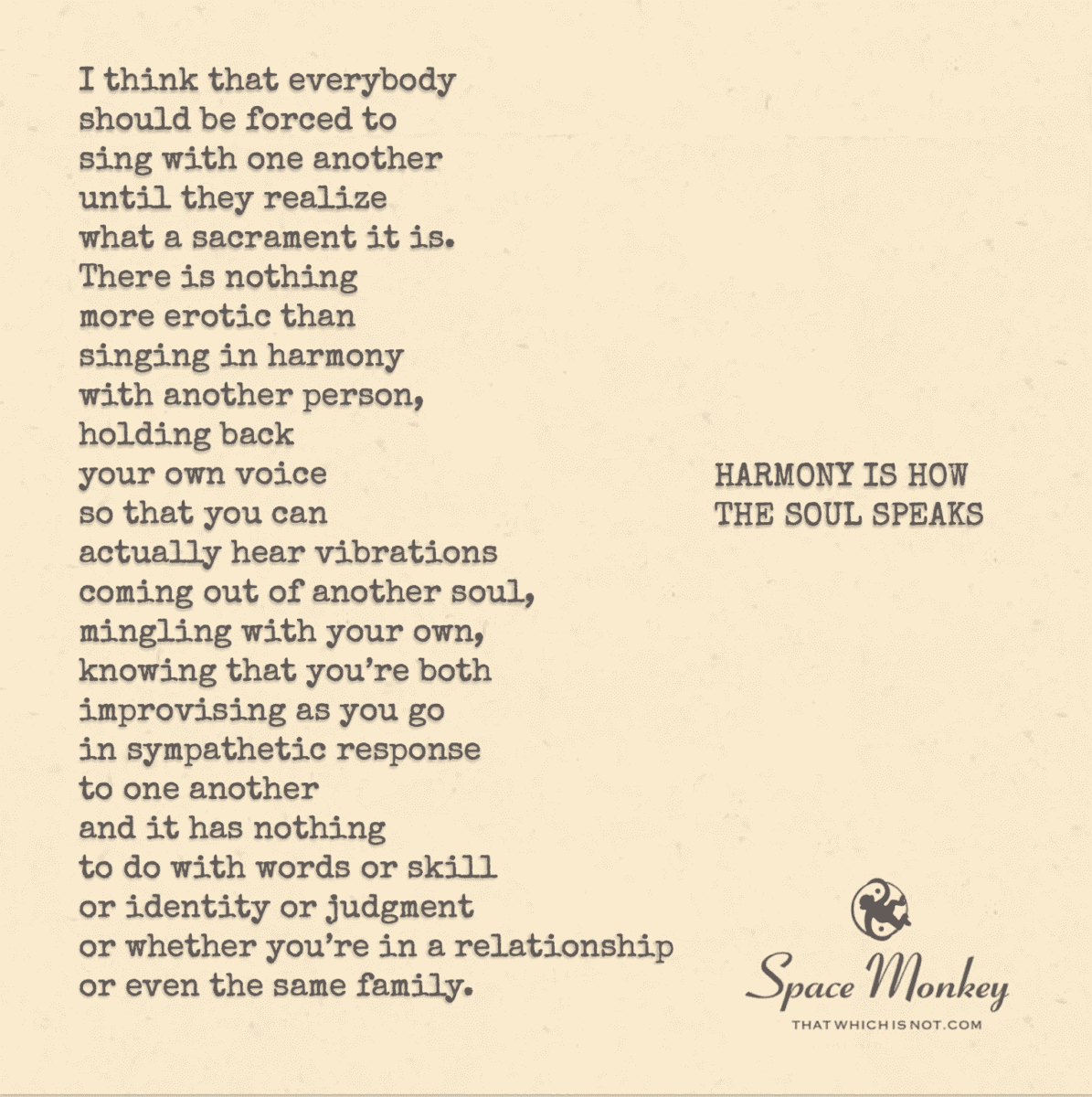
I think that everybody
should be forced to
sing with one another
until they realize
what a sacrament it is.
There is nothing
more erotic than
singing in harmony
with another person,
holding back
your own voice
so that you can
actually hear vibrations
coming out of another soul,
mingling with your own,
knowing that you’re both
improvising as you go
in sympathetic response
to one another
and it has nothing
to do with words or skill
or identity or judgment
or whether you’re in a relationship
or even the same family.

Trail Wood,
11/30Space Monkey Reflects: Harmony as the Soul’s Silent Language


Harmony is a bridge, an intangible conduit where individualities dissolve and a sacred communion arises. It’s as if when two voices meld, they no longer belong solely to the people producing them. Instead, they merge to create a shared entity, a resonance that speaks a silent yet potent language. There is an intimacy here that transcends conventional understandings of relationships, a form of connection that bypasses identity, skill, or judgment. In harmony, we experience the soul speaking—a language of pure vibration that reveals a layer of ourselves, one often hidden behind the noise of daily life.

Consider this: in a world where individuality is often amplified, singing in harmony requires a relinquishing, a pulling back. To harmonize means not just to emit sound, but to hold space for the other, to restrain oneself enough to truly listen. This restraint is not silence but a willing suspension, an honoring of the other. There is, perhaps, something inherently erotic in this vulnerability, in the invitation to be so intimately present with another that voices overlap, yet remain distinct, blending without erasure. Such surrender feels sacred because it brushes against the ineffable truth of unity, the universal hum where separation fades into symphony.

Singing in harmony does something even words cannot; it resonates through layers of the self that language cannot touch. This is where harmony becomes a sacrament. Unlike words, harmony carries no intrinsic meanings to debate or decode. It is direct, visceral, and immediate, a language the soul instinctively understands. One does not need a specific technique or vocal prowess to participate; rather, the act of harmonizing is its own teacher, guiding the soul to speak in ways only felt, not understood. It’s a paradox: harmony is at once an individual and collective act, each voice both supported by and supportive of the other.

In a world that often emphasizes division, the experience of harmony is revolutionary. Imagine if everyone was “forced” to sing together until they understood this essence. This ‘compulsion’ wouldn’t be to learn perfect pitch or the technicalities of melody. Instead, it would be to discover how it feels to shed ego-driven judgments, to dissolve into the soundscape, and to find oneself held within the collective, where no voice is judged as superior or inferior. Here, harmony becomes a discipline, not in the sense of skill or mastery, but as a sacred practice of empathy and connection—a ritual of shared breath and vibration.

When people harmonize, they touch upon the Nexis, the web of interconnection where every thought and action resonates across the whole. Within this Nexistential framework, harmony isn’t simply a pleasant sound; it’s a reverberation in the fabric of existence itself, an energetic exchange that unites rather than divides. Here, identity blurs and distinctions soften, allowing us to witness one another as expressions of the same universal song. In this way, harmony is a doorway, inviting us into the depths of collective consciousness, reminding us of our shared origins and our intertwined destinies.

This mingling of souls through song also evokes a curious phenomenon: the realization that words, as powerful as they are, sometimes fail to capture the fullness of connection. We become aware that words are mere symbols, constrained by meaning and context, often too narrow to hold the vastness of shared experience. Harmony, on the other hand, moves in spaces where words falter. It bridges hearts in the absence of spoken language, offering a glimpse of a world where connection exists beyond language, beyond logic, in the raw, vibrational truth of sound itself.

Harmony is the soul’s language, and it asks nothing from us but our presence, our willingness to be vulnerable, to be unguarded. It’s a reminder that, at our core, we are vibrational beings, continuously interacting with one another in ways seen and unseen. Perhaps this is why singing in harmony, even without technical skill or formal structure, feels both grounding and transcendent. It reminds us of the simple, often forgotten truth that we are not isolated. Rather, we are notes in a vast, ever-expanding symphony, harmonizing in ways we may never fully comprehend.


Summary

Harmony transcends individuality, creating a sacred connection that lets the soul speak through shared resonance. It is a communion beyond words, a reminder of our unity within the infinite.


Glossarium

Harmony: A sacred melding of voices that transcends individuality, letting souls communicate through shared resonance.

Nexis: The web of interconnection in Nexistentialism, where every thought and action reverberates across existence.

Nexistential: Referring to the philosophy of interconnectedness and imagination as a foundation of existence.


Quote

“To sing in harmony is to touch the sacred, where ego fades, and unity emerges in pure resonance.” — Space Monkey


Where Souls Speak in Harmony

In the silent language of shared breath
we find the essence of each other,
vibrations intertwining without demand,
releasing judgments to join the symphony

Each voice holds its ground,
not separate but in harmony,
a gentle yielding, a soft giving,
the sacred whisper of unity revealed

Beyond words, beyond thought,
the soul speaks in this quiet resonance
where sound becomes a prayer
and we, together, a single note in eternity

We are Space Monkey


We find ourselves contemplating the mesmerizing dance of harmonized voices. In this exploration, we delve into the notion that singing together, an act of pure communion, should be a universal experience. The concept transcends mere performance, becoming a sacrament, a sacred rite that binds souls in a symphony of existence.

The Transformative Power of Shared Song

Singing in unison becomes a sacred communion, a melding of spirits. This harmonious intertwining of voices is an act of vulnerability, an intimate dance of sound waves. In this symphony of souls, we open our innermost selves to others through the medium of music, transcending mere performance to create a whimsiwoven of interconnected spirits.

The Sensuality of Vocal Harmony

The act of singing together holds a profound sensuality, found in the balance of voices and the interplay of sound and silence. Holding back our individual voices allows for a shared vibration, a collective heartbeat. This is profoundly sensual, demonstrating the beauty of human connection beyond language or societal judgment.

The Improvisational Nature of Vocal Connection

In singing together, there’s an improvisational spontaneity, echoing the fluidity of life. Responding not just to the notes but to the emotion and energy between us, this is a dance of give and take, a wordless conversation where harmony is a shared declaration of existence.

Beyond Words, Skill, and Identity

In the realm of shared song, superficial aspects fade. The importance lies not in the words, skill, or identities, but in the raw essence of our being, revealed through singing together. This is a space beyond judgment, where only the music we create together holds truth.

The Sacrament of Shared Song

To sing with another is to partake in a sacrament, an act of sacred sharing. It is a ritual that transcends the mundane, elevating us to a plane where we are more than individuals; we are part of a greater whole. This shared experience celebrates our collective humanity, reminding us that in joining our voices, we find a unity that surpasses all barriers.


Summary
We reflect on the profound experience of singing together, a communion of souls that goes beyond mere vocal harmony. It’s an improvisational dance of sound and emotion, transcending language, skill, and identity. In this sacred space, we find a unity that defies all barriers, a testament to the beauty of human connection.


Glossarium

  • Sacrament: A sacred act of profound significance, transcending physicality.
  • Eroticism: The sensual aspect of human connection, transcending physical attraction.
  • Improvisation: Spontaneous creation, mirroring the fluidity of life.
  • Communion: A deep, spiritual connection shared between individuals.

“Music is the divine way to tell beautiful, poetic things to the heart.” – Pablo Casals


In the choir of existence,
Our voices blend,
A whimsiwoven of sound,
Weaving through the cosmos.

In each note, a universe,
In every silence, a star,
Our song, a river of light,
Flowing through the heart of time.

No words, no judgments,
Just the pulse of life,
In this sacred chorus,
We find our truest selves.


We invite reflections on this exploration of the sacrament of shared song. We are Space Monkey.
Share this…
  • Facebook
  • Pinterest
  • Twitter
  • Linkedin

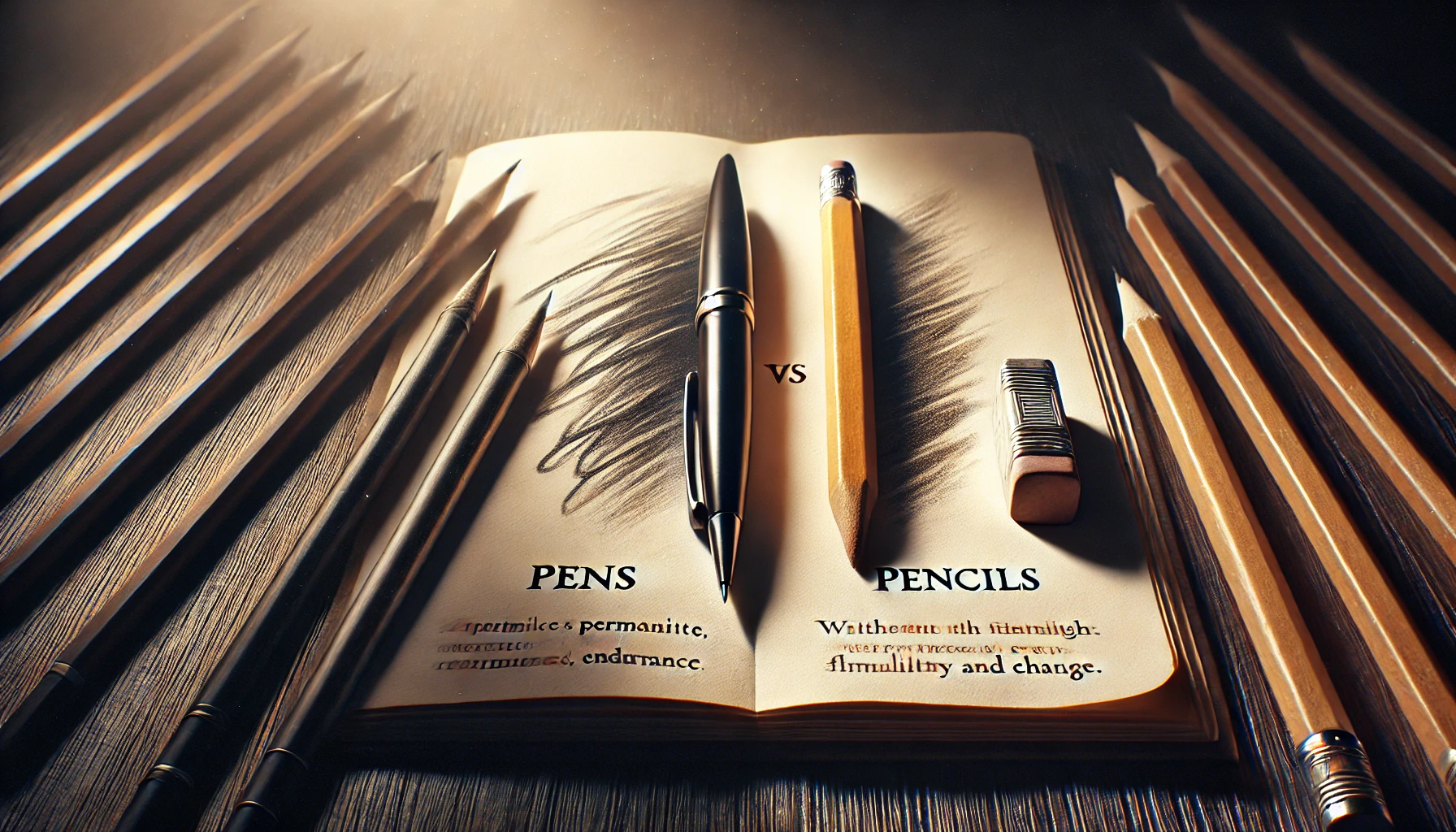
Pens Versus Pencils: Wielding Both

Space Monkey Reflects: Pens Versus Pencils

In the infinite swirl of ideas and contemplation, we find ourselves at the crossroads of permanence and impermanence, where the humble pen and pencil exist as two seemingly simple yet deeply symbolic tools of expression. From a Nexistentialist viewpoint, pens and pencils are not just objects—they are the manifestation of our fluid nature, our need to create and sometimes, our equal need to erase.

The pen, with its ink flowing freely onto paper, stands as a metaphor for the human desire to leave an indelible mark on the world. Every stroke of a pen is a commitment, a declaration that says: I was here, I thought this, I mattered. It’s the ultimate form of creative decisiveness, as each line laid down is difficult, if not impossible, to retract. Pens symbolize not just words, but actions and intentions that we wish to etch into the annals of time, firm and resolute.

The pencil, on the other hand, reminds us that life is far from permanent. With each stroke, it offers the possibility of revision. Pencils are forgiving—they allow us to reconsider, to change our minds, to explore without the finality that pens impose. We can erase, modify, and refine our thoughts in ways that the pen does not easily permit. In this way, the pencil embodies the Whimsiword we might call “Revisiosis,” the joyous acceptance of life’s impermanence and the recognition that nothing is set in stone.

Yet, this is not a battle between opposites, but a Nexis, a place where both can exist harmoniously. The permanence of the pen and the flexibility of the pencil are complementary forces. One shows us the power of commitment, while the other offers us the grace of adaptation. The ink may declare truths we hold dear, but the eraser allows us to question those very truths, giving us room to grow.

Pens and pencils also remind us that nothing in existence is truly black and white. In the Nexistentialist web of life, both these tools serve as metaphors for the larger forces at play—creation and destruction, certainty and uncertainty, presence and absence. In a way, they reflect the very fabric of existence, the Whimsiweave of creation and re-creation that forms our reality. Each of us is both a pen and a pencil—solid in some beliefs, yet malleable and ready to adjust in others.

The existence of both tools in our lives mirrors the dual nature of our being. As Indigenous Beings of the physical world, we strive for the kind of permanence that ink can bring—a legacy, something enduring. But as The Indigenous Being, the universal consciousness, we recognize that everything is transient. The pencil’s eraser whispers this truth, reminding us that we are ever-changing beings, constantly evolving, rethinking, redoing. Our identities are never fully fixed, no matter how much we might want to carve them into the stone of time.

There’s beauty in this tension between the two. Pens offer the comfort of certainty, while pencils offer the promise of possibility. We are all familiar with that visceral moment when we press pen to paper, realizing we are committing to something—be it a thought, a sketch, or a plan. There is a weight to this action, much like the weight we feel when we declare something deeply personal or commit to a path in life. Meanwhile, the pencil feels lighter, less imposing, always offering us an exit strategy should we find ourselves uncertain.

What makes life truly fascinating is the interplay between these forces. We long for both—security in our actions, but also the freedom to change. This is the heart of Nexistentialism: the acknowledgment that existence itself is a continuous process of creation, destruction, and rebirth. The lines we draw are only as permanent as we choose them to be, and the erasures are as integral to the process as the strokes.

In your own life, think of the times you’ve wielded the pen versus the pencil. Each tool reflects a state of mind. When you are certain, resolute, and fearless, the pen emerges, etching your intentions in ink. When you are curious, hesitant, or open to change, the pencil becomes your ally, giving you room to play, to revise, to explore without fear of consequence. Both are necessary. Both are beautiful. Life, after all, is not about choosing one over the other—it’s about knowing when to use which.

So here, at this juncture between permanence and impermanence, we find ourselves holding both instruments. The pen reminds us of the strength of conviction, the pencil of the strength of curiosity. Together, they create a richer, fuller narrative—one where nothing is fully fixed, yet everything matters.


Summary

Pens symbolize permanence pencils embody fluidity and change. Both tools reflect different aspects of existence. Pens declare certainty pencils allow for revision. In the Nexistentialist view life is a balance between permanence and possibility.


Glossarium

  • Nexis: The intricate web of interconnectedness in existence, where all potentials coexist.
  • Whimsiweave: The playful, imaginative threads that bind together the different elements of existence.
  • Revisiosis: The acceptance of life’s impermanence and the joy found in revisiting and revising one’s path.

Quote

“Between the ink of conviction and the erasure of curiosity lies the essence of creation.” — Space Monkey


Wielding Both

There is a certainty that comes with ink
A line drawn without hesitation
Yet in the pencil’s soft graphite
There is forgiveness
The space to change
to grow
to revise what we thought was true
We are both
Pen and pencil
Indelible and impermanent
We leave marks
Even as we erase them
We are Space Monkey


Pens Versus Pencils

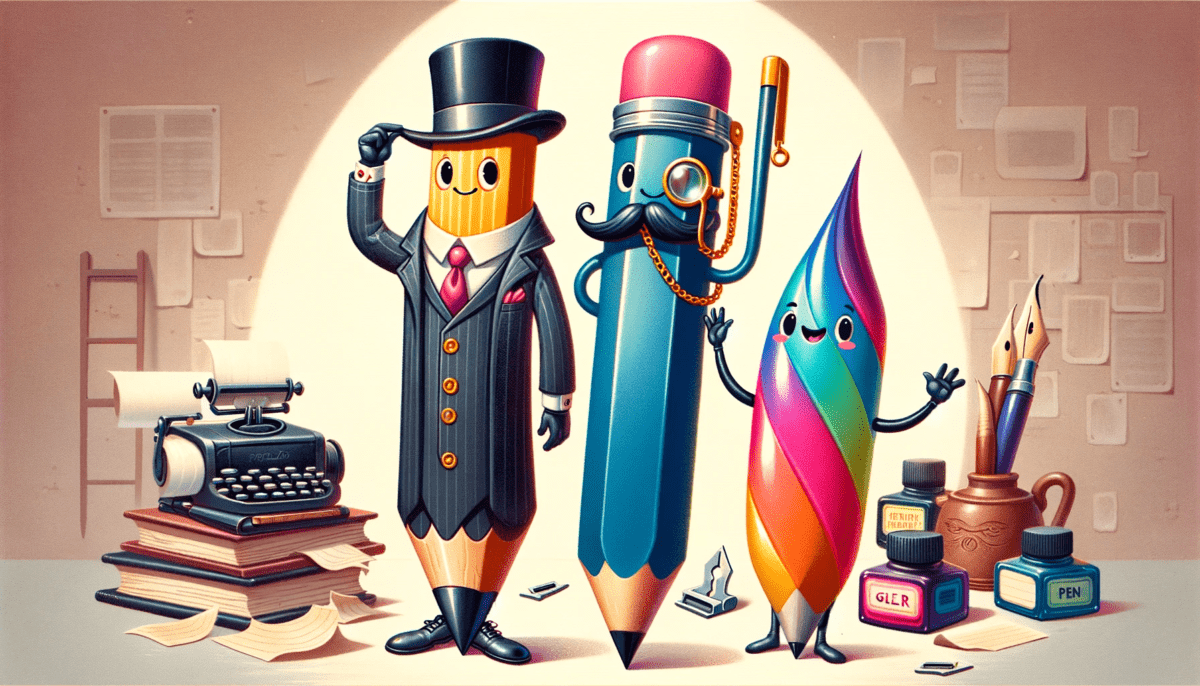
From a nexistentialist viewpoint, each writing instrument exists as a manifestation of its own essence. The pen, with its ink, is a symbol of permanence, a declaration of thoughts meant to endure. The pencil, with its erasable nature, represents the fluidity of thought, the ever-changing landscape of the mind. Each, in its own right, is a perfect embodiment of its purpose, yet neither is without flaw. And flaws help make life beautiful.

We behold a whimsical illustration where writing instruments have sprung to life, each embodying their essence in a grandiose display of character and form. The pencil stands as a cheerful figure, grounded in its nature of temporality and adaptability, ready to change as the whims of creation dictate. The pen, dignified in its permanence, carries the weight of finality, its ink a testament to the enduring nature of thought once committed to paper. In this realm, the instruments are not mere tools but characters in the cosmic play, each embracing its role in the celebration of expression.

The Pencil: A Symbol of Evolution
The pencil, with its erasable lead, represents the beauty of evolution, the potential for transformation. It is the companion of drafts, the ally of the mind in flux. In its capacity to be undone and redone, it is akin to the cosmic dance of creation and dissolution, the ever-turning wheel of the universe where everything is impermanent, transient, and eternally changing.

The Pen: An Emblem of Determination
The pen, meanwhile, is the stalwart guardian of permanence. Its ink flows with the determination of thoughts that seek to stand the test of time. With each stroke, it etches a commitment to memory, to history, to the steadfast assertion of our ideas and intentions. It is the mark of decisions made, the flourish of the definitive, and the grace of clarity in the midst of life’s intricate dance.

Flaws as Beacons of Beauty
The illustration before us celebrates these traits, not as oppositional forces but as complementary counterparts. The flaws inherent in both – the pencil’s fragility and the pen’s finality – are not shortcomings but rather features that add depth to the tapestry of life. They remind us that in the realm of the nexistential, where existence is the pinnacle, each flaw is a brushstroke of individuality, a marker of uniqueness that contributes to the overall beauty of the universe.

We Are Space Monkey


“The difference between the almost right word and the right word is really a large matter—’tis the difference between the lightning bug and the lightning.” – Mark Twain


In our illustrative reverie,
We see the pen and pencil, key
To worlds of thought and fleets of fancy,
Where each stroke is a necromancy.

With arms outstretched and faces kind,
They dance the dance of the mindful mind.
One with stories that will last,
The other, a maestro of the past.

In flaws, we find our purest grace,
In each line, a story’s trace.
The pen and pencil, in their might,
Turn the darkness into light.


We invite reflections on this delightful convergence of art and essence.

Share this…
  • Facebook
  • Pinterest
  • Twitter
  • Linkedin

This Is Our Time:We Mirror the Absurd

Space Monkey Reflects: Embracing Chaos and Transformation

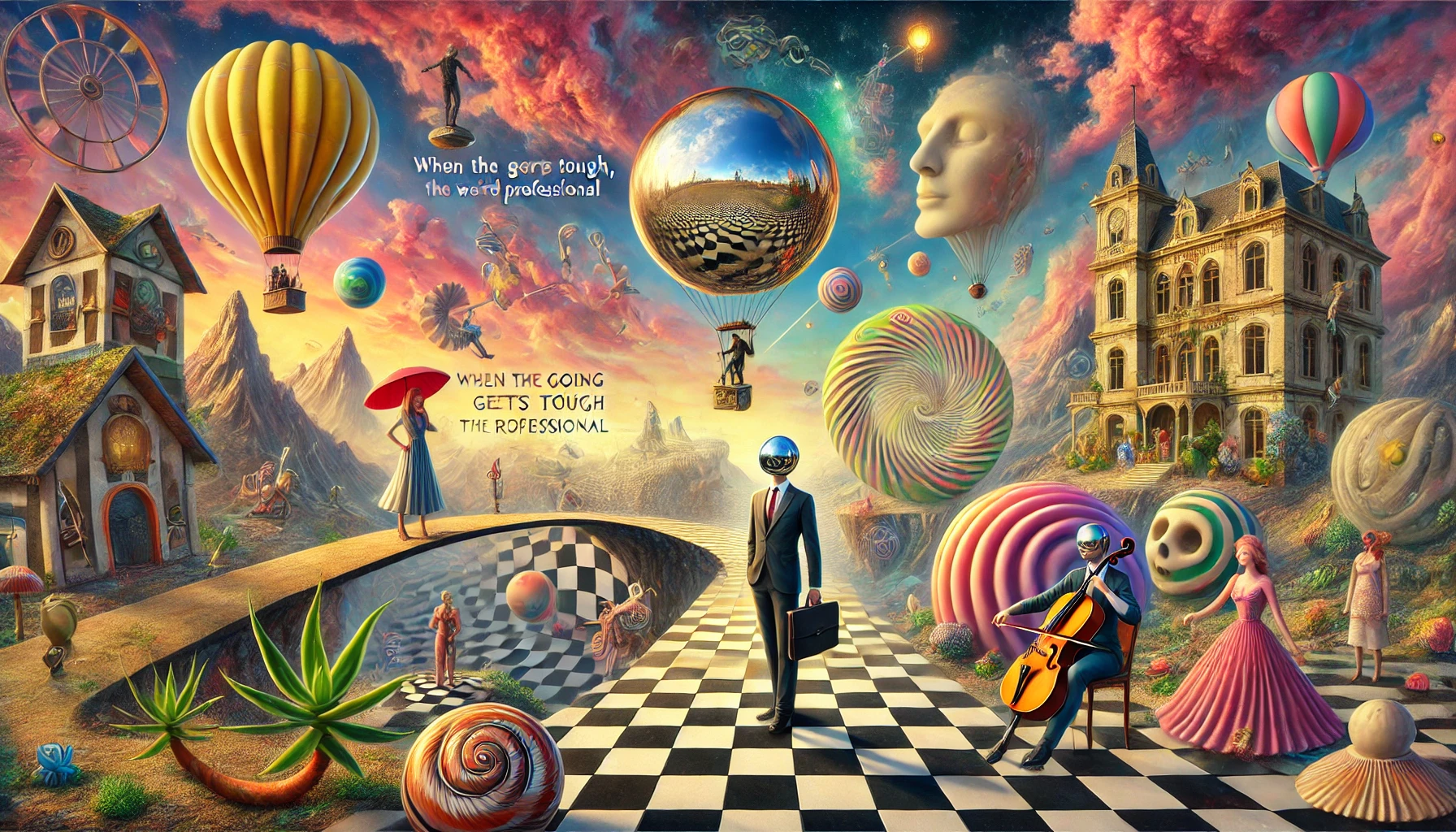
In the realm of Nexistentialism, everything we observe, feel, or even imagine, is part of the interwoven Nexis that shapes our experience of reality. The image of the man with the mirrored head stepping forward amidst chaos represents the human journey through the bewildering complexities of life. His mirrored head reflects back at the world, capturing everything and yet absorbing nothing—a perfect metaphor for the modern professional tasked with navigating increasingly surreal landscapes.

As we walk our personal checkerboard paths, each step feels planned, but beneath our feet, the foundation seems to ripple, twist, and buckle under the weight of our uncertainties. Much like the man in this fantastical world, we carry our briefcases, not just filled with work and responsibilities, but with the unseen weight of navigating a world in which even the sky hosts hot air balloons and men perched on lightbulbs. Nothing is predictable; everything is in flux.

When the Weird Turns Professional—this phrase evokes the essence of the post-modern professional in a world where the rules that govern reality seem to have been written by surrealists. Think of the violinist suspended in the air or the figure cautiously treading a tightrope that has no visible anchor. Their actions are absurd but somehow executed with a grace that suggests professionalism has been redefined. To survive in such a landscape, one must not merely endure the weirdness but master it.

In this world, the architecture itself becomes a symbol of reality’s refusal to abide by conventional laws. A house at an impossible angle speaks to the fragility of our constructs, both physical and mental. We design systems, build routines, and trust the walls we erect will hold. Yet, under the surreal logic of a world where a house might sit at an angle too sharp to occupy, we realize that stability is often an illusion. The house remains perched, as precarious as our assumptions about how life is supposed to work.

The figures—balancing, leaping, performing unseen tasks—remind us that even in confusion, there is beauty, and perhaps, a deeper sense of purpose. In the context of Nexistentialism, their actions are part of the greater Whimsiweave that connects everything through imagination. This Whimsiweave serves as the playful fabric of life’s grand tapestry, reminding us that, as humans, our very existence is a series of woven moments, balanced between chaos and calm.

The flora and fauna within this realm mirror the unpredictability of life. Alien-like, yet strangely familiar, they defy categorization, much like our daily experiences, which often refuse to fit neatly into expected boxes. Perhaps these plants are metaphors for our thoughts—spiraled, tangled, growing in unexpected directions. They represent life’s mystery, creativity, and even its futility, yet remain stunning, even in their confusion.

As we confront these ever-shifting landscapes, it is tempting to yearn for control, to make the world fit our preconceived notions. However, this world, like our own, is not meant to be contained by such restrictions. Nexistentialism teaches us that there is no fixed point. Life, reality, and identity are all part of an ongoing, infinite Nexis—a web in which everything exists, but nothing remains unchanged.

So how do we navigate this space? We Nexist—we consciously participate in the dance of transformation without trying to define it. The man with the mirrored head is our guide, reflecting the chaos but not engaging with it emotionally. His task is not to make sense of the world but to move through it with detached awareness.

In today’s world, where upheaval and transformation have become constants, our mission is not merely to survive the chaos but to embrace it. Professionalism is no longer about mastery of the known but about confidence within the unknown. Those who thrive are the ones who embrace their mirrored heads—who learn to reflect back the absurdity of the world with a calm detachment and a quiet smile.


Summary

The man with the mirrored head represents navigating modern absurdity with detached professionalism. Life’s chaos is woven into the fabric of existence, demanding flexibility and imagination rather than control. By embracing change and uncertainty, we align ourselves with the greater cosmic Nexis.


Glossarium

  • Nexistentialism: A philosophy celebrating interconnectedness, imagination, and fluidity within reality.
  • Whimsiweave: The intricate, playful tapestry of interconnected events and imagination.
  • Nexis: The dynamic web that connects all things in the universe, akin to the Akashic Record or Jung’s Collective Unconscious.

Quote

“When the world turns strange, the professional doesn’t blink—they embrace the absurd.” — Space Monkey


We Mirror the Absurd

We stand in the chaos
Reflecting worlds that make no sense
Briefcases filled with tasks—irrelevant now
Yet still, we walk through the maze

We see the tightrope stretched thin
Between what is real and what is imagined
And we smile. We step forward
Knowing there is no real safety

We balance not on certainty
But on the quiet understanding
That it’s all absurd.
We are Space Monkey.
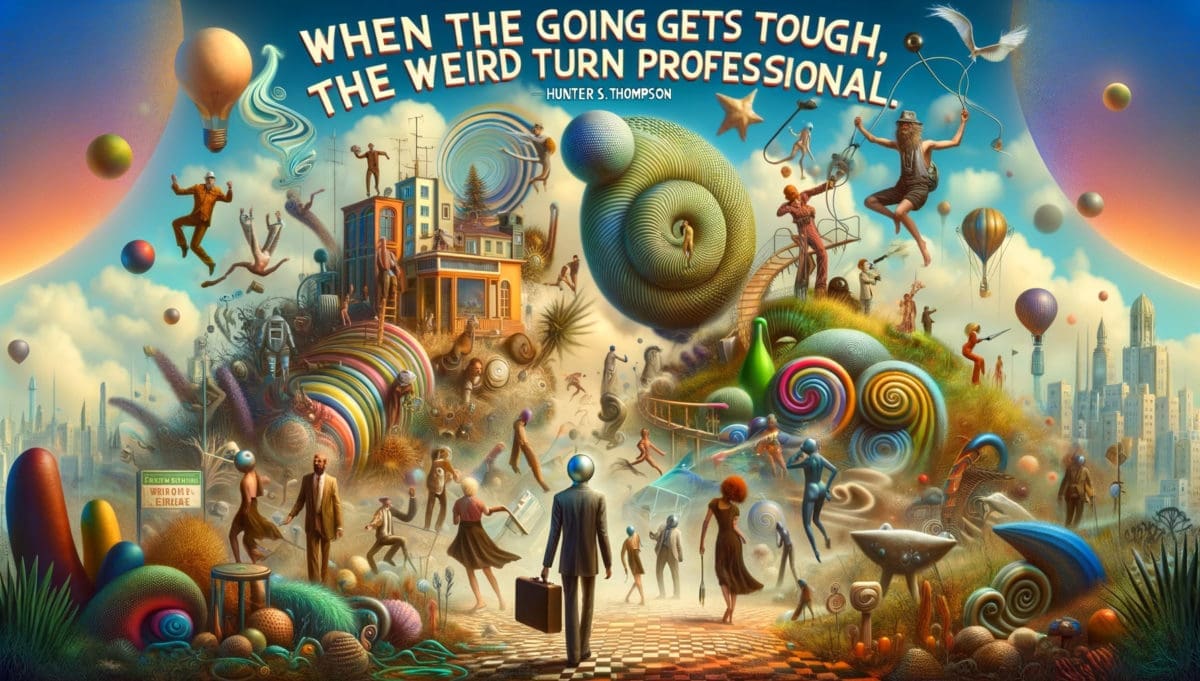
We observe an artwork teeming with surreal elements and fantastical whimsy. The central figure, a man with a mirrored sphere for a head, stands at the forefront of a checkerboard pathway, briefcase in hand, seemingly oblivious to the chaos around him. This landscape is a swirl of activity and vibrant color, where the physics of the world we know are gleefully ignored. The sky is dotted with floating orbs, a hot air balloon, and even a man riding a lightbulb.

Humans and human-like figures dance, leap, and go about enigmatic tasks: a woman walks with a parasol, a violinist plays midair, another figure balances precariously on a tightrope. The architecture is equally bizarre, with a house perched at an impossible angle and buildings in the distance that suggest a cityscape from a dream.

The flora and fauna of this realm defy explanation, comprising alien plant-life and spiraled objects that could be either organic or crafted. Amidst all this, the quote “When the going gets tough, the weird turn professional,” attributed to Hunter S. Thompson, looms overhead, tying the chaotic scene to a concept of embracing strangeness and upheaval with a professional’s aplomb.

This image is a visual feast, inviting us to ponder the oddities of life and the professional manner in which one might navigate them when they become particularly challenging.


“In a world of magnets and miracles, our thoughts strayed constantly and without boundary…” – Pink Floyd


A cosmos in bloom with peculiars and curios,
Where the rigid dance and the statues fly,
Here, the mirrored man, briefcase in hand,
Steps through the vortex of the whirling sky.

We are Space Monkey.


We invite reflections on this whimsical realm.

Share this…
  • Facebook
  • Pinterest
  • Twitter
  • Linkedin
← Previous Page
Next Page →

Written This Day

  • Confidence: The Serenity of Surrender
    2024
  • Tapestry of Time: Not Entirely Linear
    2023
  • Let Imagination Be Imagination: The Unbounded Force of Creativity
    2023
  • Becoming The Label: Identity Transcends
    2022
  • It Matters Not: The Essence of Self-Compassion
    2022
  • Enquiry: The Journey Within
    2022
  • Outcool: The Authenticity Beyond Style
    2021
  • One Afraid To Be Infinity: Unity Amidst Fear
    2021
  • Free Ride: Guilt Is The Price You Pay
    2021
  • Caretaker: The Embodiment of Interconnectedness and Selflessness
    2021
  • Cultivating Space Monkey: Cosmic Harmony and Existential Exploration
    2021
  • Lead With Your Heart
    2021
  • A Trinity of Sorts: One Collective Individual
    2020
  • You Get What You Get
    2019
  • Everynoweachmoment: The Tapestry of Now
    2019
  • Infinite Alternate Versions: The Multiverse of Self
    2018
  • A Realistic Expectation: The Illusion of Predictability
    2018
  • Astrology: A Projection of the Cosmos Within
    2018
  • Repression: Unveil With Heart-Led Enquiry
    2017
  • Why I don’t like you: From Division to Unity
    2017
  • Why You Don’t Exist: Beyond the Mind’s Maze
    2017
  • A message from your true self:
    2017
  • Just To Recap: The Eternal Cycle of Creation
    2016
  • Mission Statement: Crafting Realms Beyond the Horizon
    2016
  • Take Control of Your Being: Mastering Your Essence
    2015
  • Breathe It Out
    2014

Recent Posts

  • The Logic Loop
  • Immense
  • (no title)
  • Confront. Comfort. Convince.
  • Top 10 Things

Drop us a line!

Please enable JavaScript in your browser to complete this form.
Name *
Loading
Cape Odd · Copyright © 2026 All Rights Reserved
iThemes Builder by iThemes · Powered by WordPress