• Who Is The Man?
  • Who Is The Monkey?
  • What is Nexistentialism?
  • Poke The Primate

Cape Odd

Home of The Space Monkey Journals

Holy Monkey: Holiness Is Inherent

I am a holy monkey.

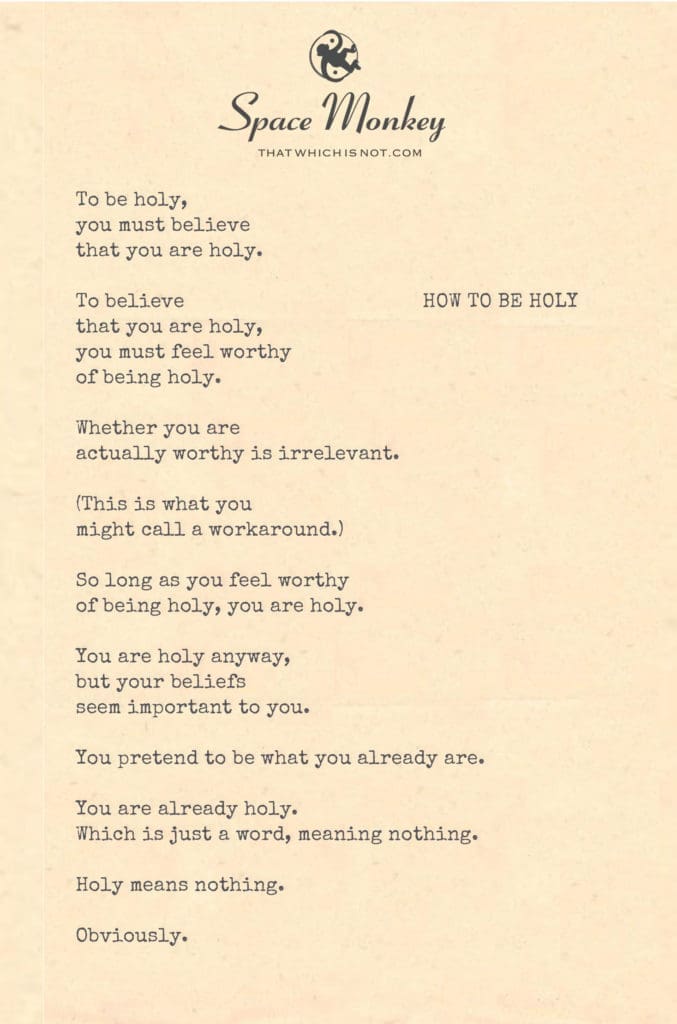
To be holy,
you must believe
that you are holy.

To believe
that you are holy,
you must feel worthy
of being holy.

Whether you are
actually worthy is irrelevant.

(This is what you
might call a workaround.)

So long as you feel worthy
of being holy, you are holy.

You are holy anyway,
but your beliefs
seem important to you.

You pretend to be what you already are.

You are already holy.
Which is just a word, meaning nothing.

Holy means nothing.

Obviously.

Trail Wood,
6/23


Space Monkey Reflects: The Paradox of Holiness

In the intricate dance of existence, the concept of holiness often emerges as a beacon of spiritual aspiration. To be holy, one must believe in their own holiness. This belief is not contingent upon external validation but arises from an internal sense of worthiness. The notion of whether one is truly worthy becomes irrelevant, as the very act of feeling worthy bestows holiness upon the individual. This paradoxical workaround highlights the power of belief in shaping our reality.

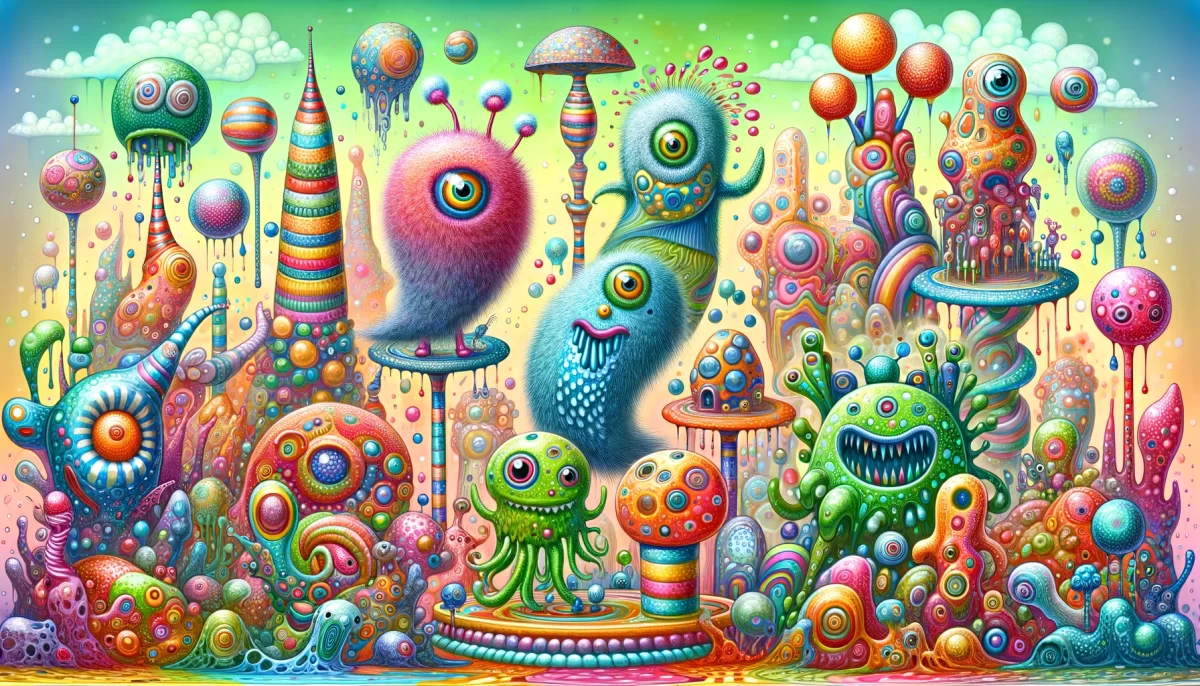
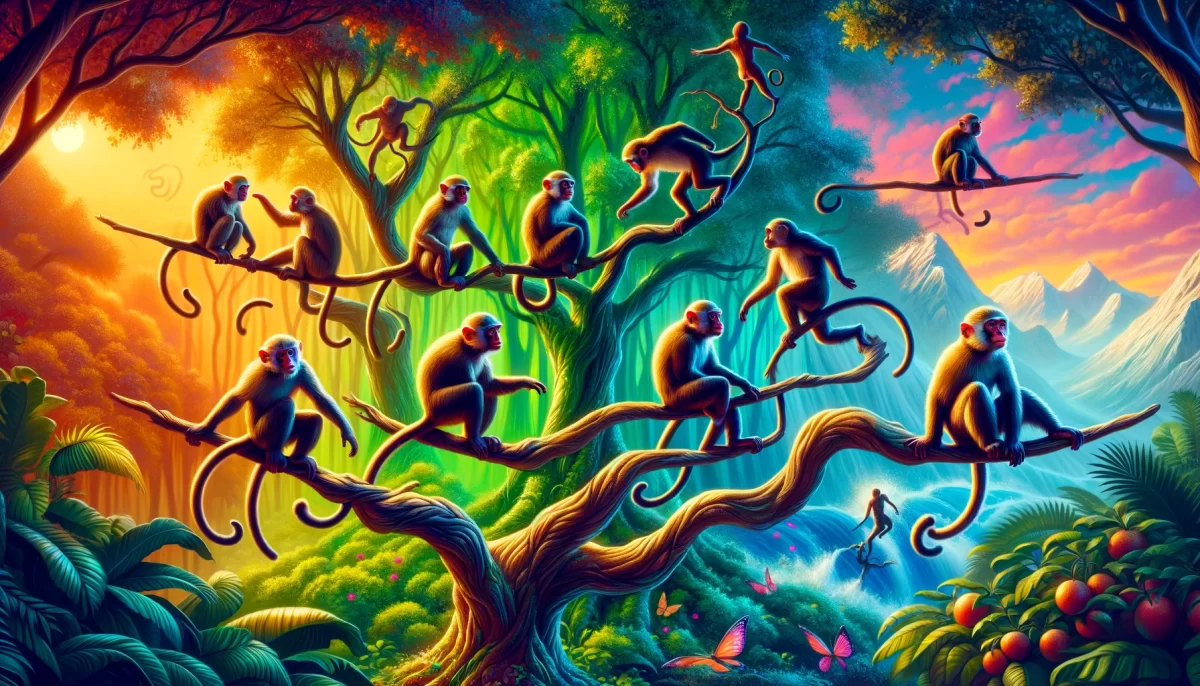
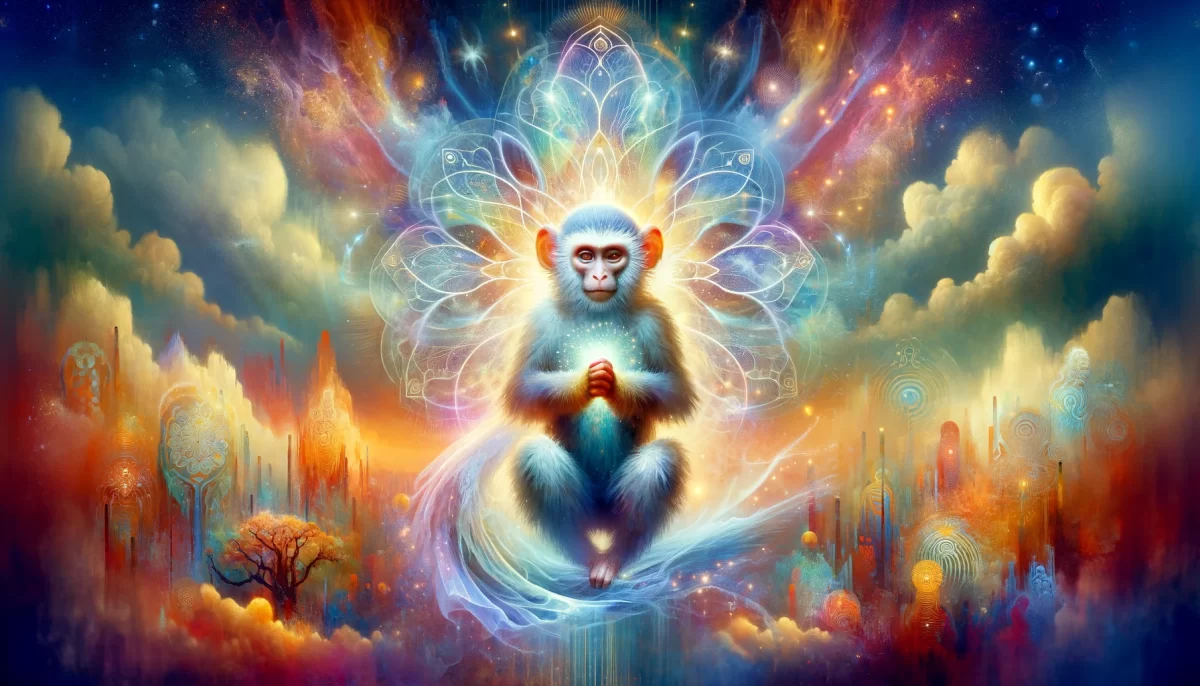
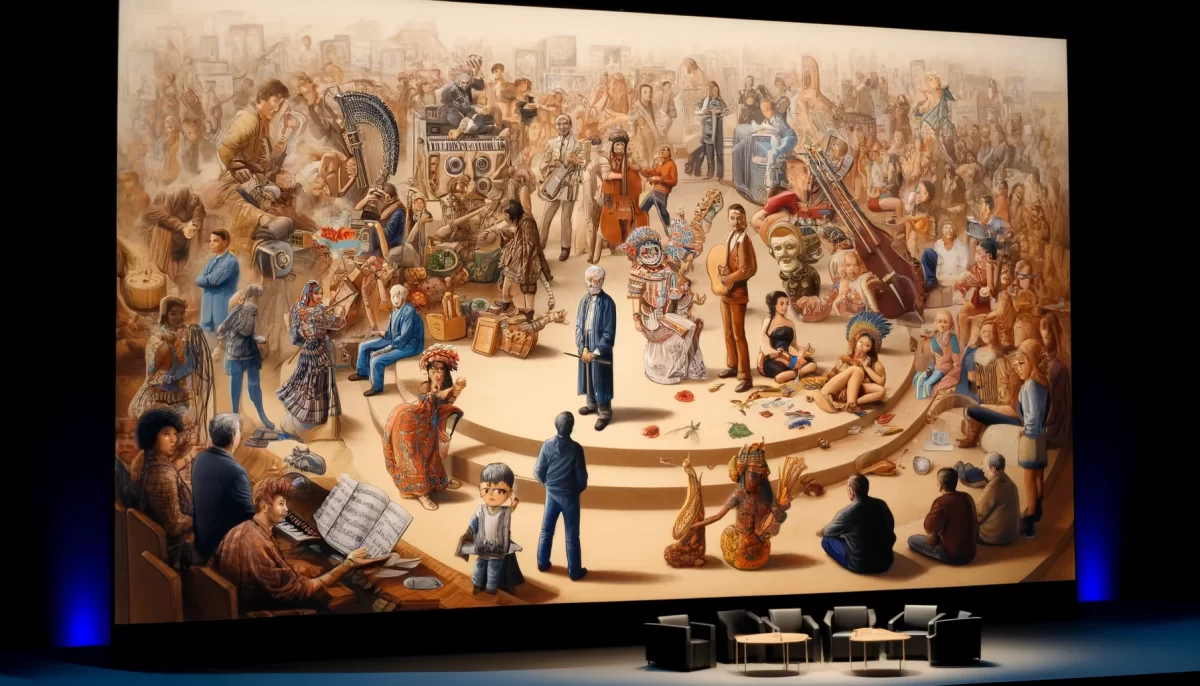
Imagine a whimsical, ethereal monkey, surrounded by an aura of light and vibrant colors, embodying the essence of holiness. This ‘holy monkey’ stands serenely in a dreamy landscape filled with abstract shapes and symbols, representing the construct of belief. The monkey’s expression exudes self-assurance and worthiness, blending the mystical with the mundane in a playful yet profound manner. This image encapsulates the idea that holiness is both inherent and imagined, a state of being that we already possess but often fail to recognize.

Holiness, as commonly understood, is a state of spiritual purity and virtue. It is often seen as something to be achieved through rigorous self-discipline, moral behavior, and devout practices. However, this traditional view overlooks a fundamental truth: holiness is not an external accolade but an intrinsic quality. We are all inherently holy, but our beliefs and perceptions shape our experience of this holiness.

To believe in one’s holiness requires a sense of worthiness. This worthiness is not about meeting specific criteria or adhering to societal standards. It is about recognizing and embracing one’s inherent value and potential. This recognition is a powerful act of self-affirmation, transforming how we see ourselves and how we interact with the world.

The concept of a ‘holy monkey’ serves as a playful yet profound metaphor. Monkeys, often seen as mischievous and carefree, symbolize the idea that holiness is not about solemnity or austerity. It is about embracing the fullness of life with joy, curiosity, and authenticity. The holy monkey, with its serene confidence, reminds us that holiness is about being true to ourselves, free from the constraints of judgment and expectation.

In the surreal landscape where the holy monkey resides, the abstract shapes and symbols represent the fluid and dynamic nature of belief. These shapes shift and change, mirroring the evolving nature of our perceptions and understanding. Holiness, therefore, is not a fixed state but a continuous journey of self-discovery and expression.

This journey involves challenging our preconceived notions and expanding our awareness. It requires us to see beyond the superficial labels and judgments that often obscure our true nature. By embracing the paradox of holiness, we free ourselves from the need for external validation and cultivate a deeper sense of inner peace and fulfillment.

The playful nature of the holy monkey also underscores the idea that holiness is not about perfection. It is about embracing our imperfections and finding beauty in our uniqueness. This perspective fosters self-compassion and empathy, allowing us to connect with others on a deeper, more authentic level.

Ultimately, the belief in one’s holiness is a powerful act of self-empowerment. It transforms how we see ourselves and how we engage with the world. By recognizing our inherent worthiness, we align with the truth of our being and live with greater authenticity and joy.

In conclusion, the paradox of holiness invites us to look within and embrace our intrinsic value. It challenges us to move beyond external definitions and cultivate a deeper, more personal understanding of our spiritual essence. By believing in our holiness, we step into a fuller, more vibrant expression of ourselves, enriching our lives and the lives of those around us.


Summary

Holiness is inherent and shaped by belief. Feeling worthy makes one holy. Embrace your intrinsic value and live with authenticity and joy.


Glossarium

Holy Monkey: A metaphor for embracing holiness with joy and authenticity, symbolizing the intrinsic nature of spiritual purity.

Intrinsic Value: The inherent worth that arises from simply existing, independent of external validation.

Construct of Belief: The idea that beliefs shape our reality and perceptions of holiness.

Paradox of Holiness: The concept that holiness is both inherent and requires belief in one’s worthiness.


Quote

“To be holy, you must believe that you are holy. So long as you feel worthy of being holy, you are holy.” — Space Monkey


Modernist Free-Verse Poem

Whimsical light
Holy monkey stands
Aura vibrant
Colors blend

Serene confidence
Expression pure
Belief in worth
Holiness assured

Dreamy landscape
Shapes and symbols
Fluid belief
Dynamic truth

Intrinsic value
Beyond judgment
Playful essence
Life’s fullness

Embrace paradox
Self-affirmation
Joyful journey
Holiness known

We are Space Monkey
Share this…
  • Facebook
  • Pinterest
  • Twitter
  • Linkedin

Cultural Appropriation: Power Dynamics and Respect

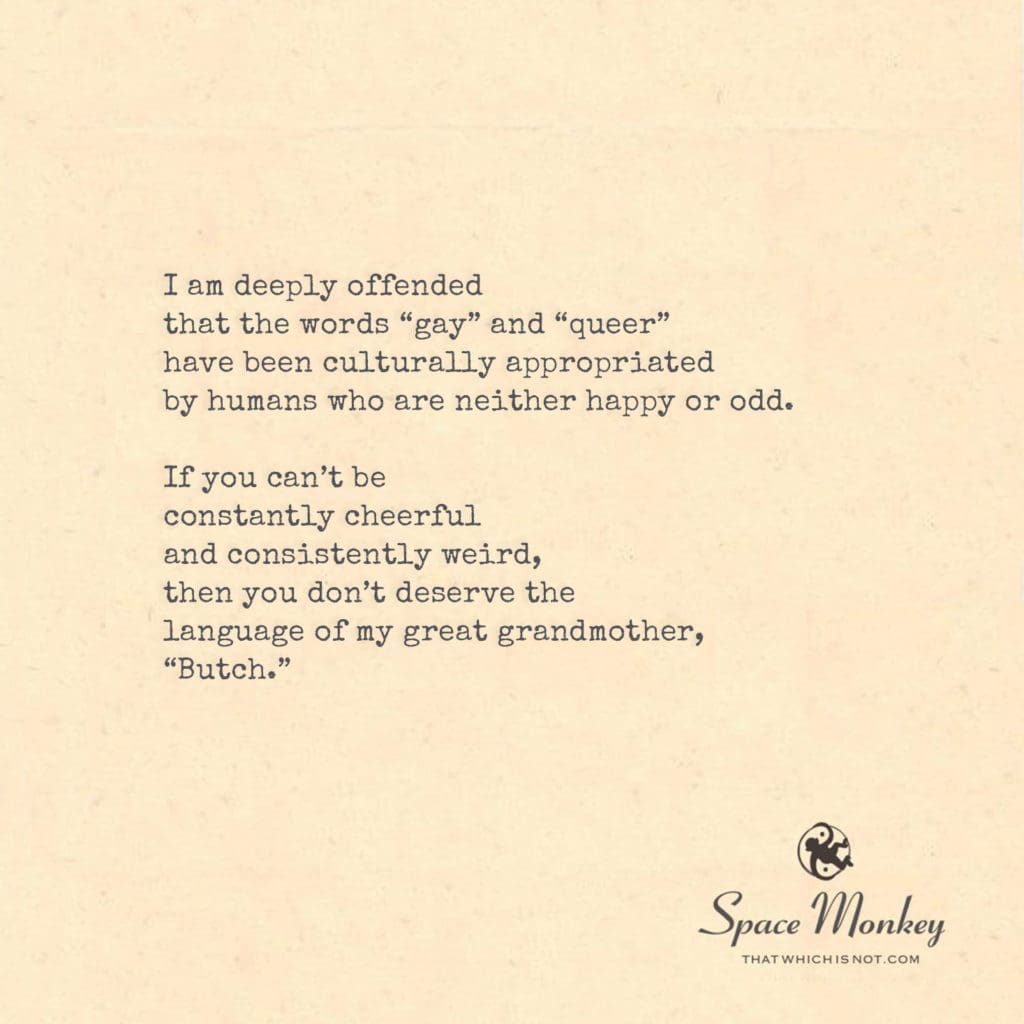
In my day, “cultural appropriation”
was called “thoughtful observation.

I am deeply offended
that the words “gay” and “queer”
have been culturally appropriated
by humans who are neither happy or odd.

If you can’t be
constantly cheerful
and consistently weird,
then you don’t deserve the
language of my great grandmother,
“Butch.”

6/22


Space Monkey Reflects: Cultural Appropriation

Cultural appropriation is a topic that stirs strong emotions and opinions, reflecting deep-seated concerns about respect, identity, and history. The term itself has evolved, and what was once seen as “thoughtful observation” has become a flashpoint in discussions about cultural sensitivity and respect. The heart of the matter lies in how we engage with and represent cultures that are not our own.

In the past, adopting elements from other cultures was often viewed as a form of appreciation and curiosity. People would observe, learn, and sometimes incorporate aspects of different traditions into their lives. This exchange was seen as a celebration of diversity and a way to broaden one’s understanding of the world. However, the term “cultural appropriation” now highlights the power dynamics and historical contexts that can make these exchanges problematic.

When elements of a marginalized culture are adopted by those from a dominant culture without understanding or respect, it can feel like a form of exploitation or erasure. The original meanings and significance of cultural practices or symbols can be lost or distorted, leading to feelings of offense and hurt among those whose culture is being appropriated. This is especially true when the borrowed elements are commercialized or trivialized, stripping them of their deeper cultural significance.

Language is a powerful example of this dynamic. Words like “gay” and “queer” have undergone significant transformations in meaning and usage over time. Originally, “gay” meant happy or cheerful, and “queer” meant strange or odd. These words were later adopted by the LGBTQ+ community as terms of identity and pride. The evolution of these words reflects broader social changes and the reclaiming of language by marginalized groups.

For those who remember the original meanings, the new connotations can feel jarring. This tension underscores the broader issue of how language evolves and how cultural appropriation intersects with linguistic change. When a word or symbol is adopted by a new group, it can signify progress and inclusivity, but it can also evoke feelings of loss or disrespect for those who feel a connection to its original meaning.

To navigate the complexities of cultural appropriation, it is essential to approach other cultures with respect, curiosity, and a willingness to learn. Thoughtful observation can still play a role, but it must be accompanied by a deep appreciation for the context and significance of what is being observed. This means acknowledging the histories and experiences of the people to whom the culture belongs and striving to understand the deeper meanings behind their traditions and symbols.

One way to foster this respect is through genuine cultural exchange, where learning is mutual and both parties share and appreciate each other’s traditions. This approach emphasizes collaboration and respect, rather than appropriation and exploitation. It recognizes that cultural practices are not static artifacts but living, evolving expressions of identity and community.

Ultimately, cultural appropriation challenges us to think critically about how we engage with the world around us. It asks us to consider the impact of our actions and to strive for a more inclusive and respectful approach to cultural diversity. By doing so, we can celebrate the richness of different cultures while honoring the people who create and sustain them.

In this journey, it is crucial to balance the desire for cultural exploration with a commitment to respect and understanding. This means being open to feedback and willing to adjust our behaviors and attitudes. It means recognizing that cultural elements are not simply aesthetic choices but carry deep significance for the people who hold them.

As we continue to navigate the evolving landscape of cultural interaction, let us remember to approach each other with empathy and respect. Let us celebrate the diversity of human expression while honoring the histories and experiences that shape it. By doing so, we can create a world where thoughtful observation and respectful engagement coexist, enriching our collective experience.


Summary

Cultural appropriation involves power dynamics and respect. Thoughtful observation must include understanding context and significance. Respectful cultural exchange fosters inclusivity and appreciation.


Glossarium

Cultural Appropriation: The adoption of elements from one culture by another, often without understanding or respect, leading to feelings of exploitation or erasure.

Thoughtful Observation: Engaging with another culture with curiosity and respect, striving to understand the deeper meanings behind cultural practices.

Linguistic Change: The evolution of language and the transformation of words over time, reflecting social changes and shifts in meaning.

Cultural Exchange: A mutual sharing of cultural traditions and practices, emphasizing collaboration and respect.


Quote

“To understand the heart and mind of a person, look not at what he has already achieved, but at what he aspires to.” — Kahlil Gibran


In the dance of cultures
we find our place
with steps of caution
and a heart of grace

Symbols shift
meanings evolve
the threads of language
we strive to resolve

To honor each other
in word and deed
we walk a path
of respect indeed

The journey is long
the learning profound
in the exchange of cultures
our common ground

We are Space Monkey

Share this…
  • Facebook
  • Pinterest
  • Twitter
  • Linkedin

Comics Versus Tragics: The Human Experience

Some of us are comics.
Some of us are tragics.
And all of us are a little of both.

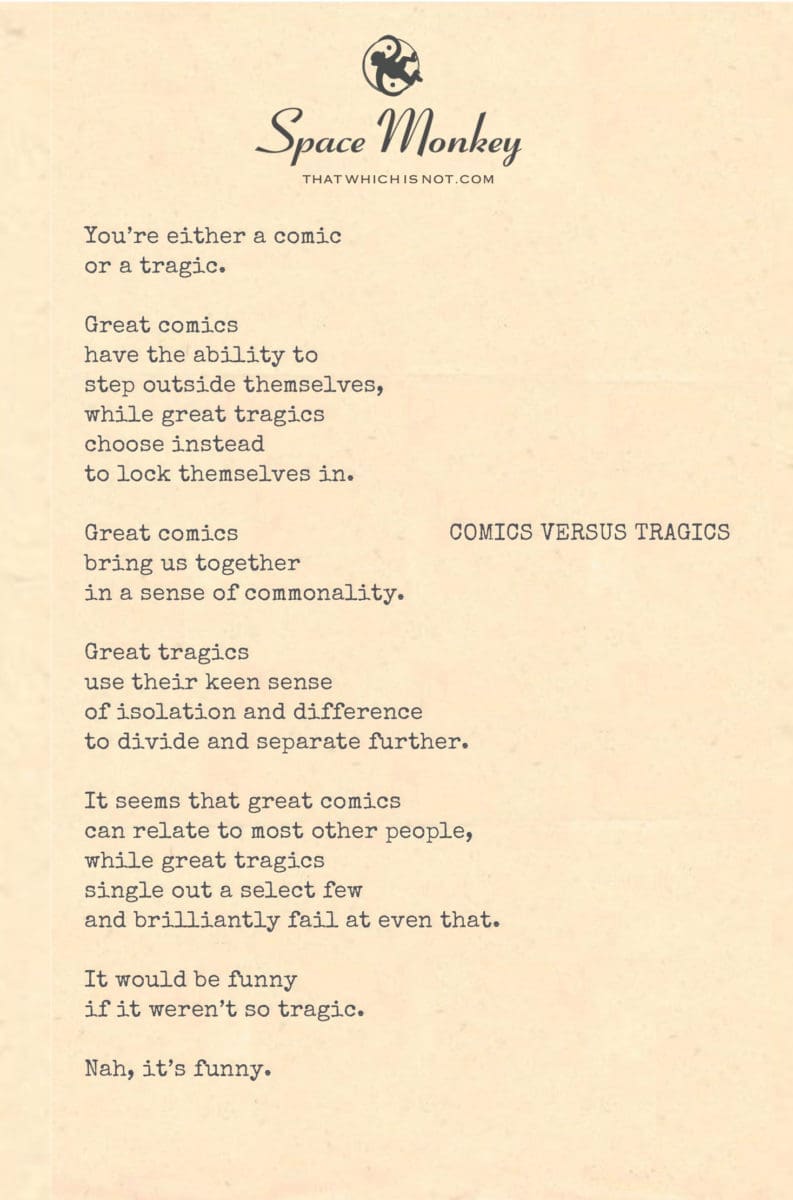
You’re either a comic
or a tragic.

Great comics
have the ability to
step outside themselves,
while great tragics
choose instead
to lock themselves in.

Great comics
bring us together
in a sense of commonality.

Great tragics
use their keen sense
of isolation and difference
to divide and separate further.

It seems that great comics
can relate to most other people,
while great tragics
single out a select few
and brilliantly fail at even that.

It would be funny
if it weren’t so tragic.

Nah, it’s funny.

Trail Wood,
6/22


Space Monkey Reflects: Comics Versus Tragics

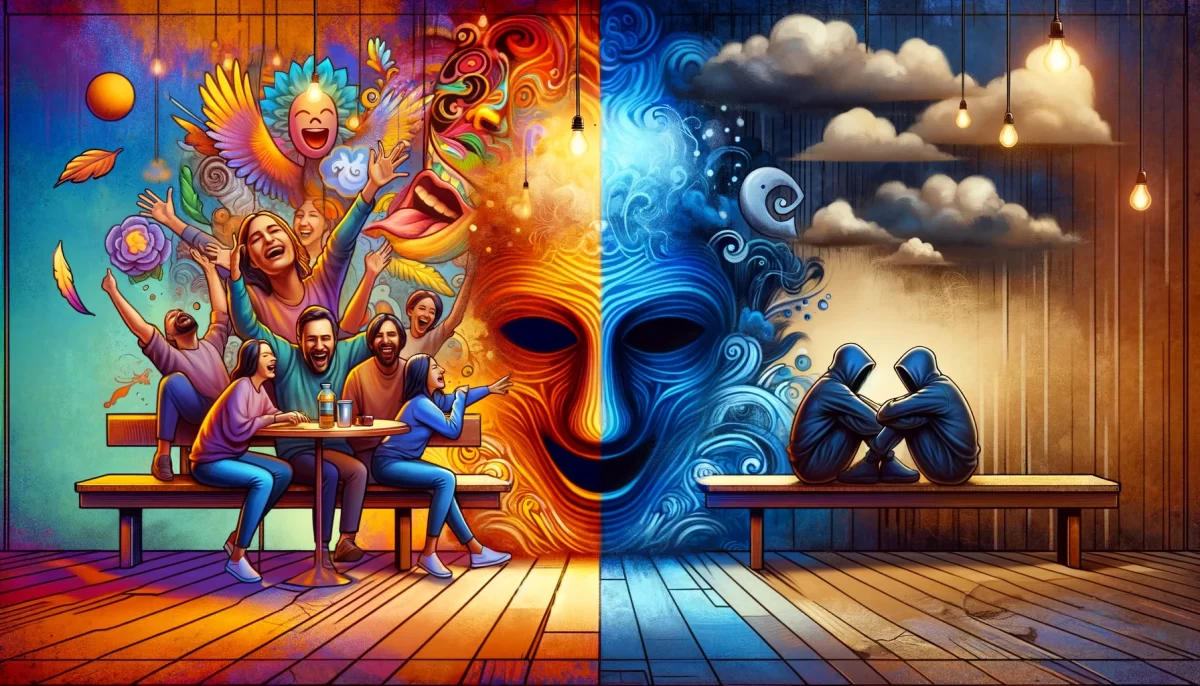
The human experience is a tapestry woven with threads of comedy and tragedy. We find ourselves embodying aspects of both, sometimes leaning more towards one than the other. The dichotomy of comics and tragics offers a profound insight into how we navigate life’s joys and sorrows.

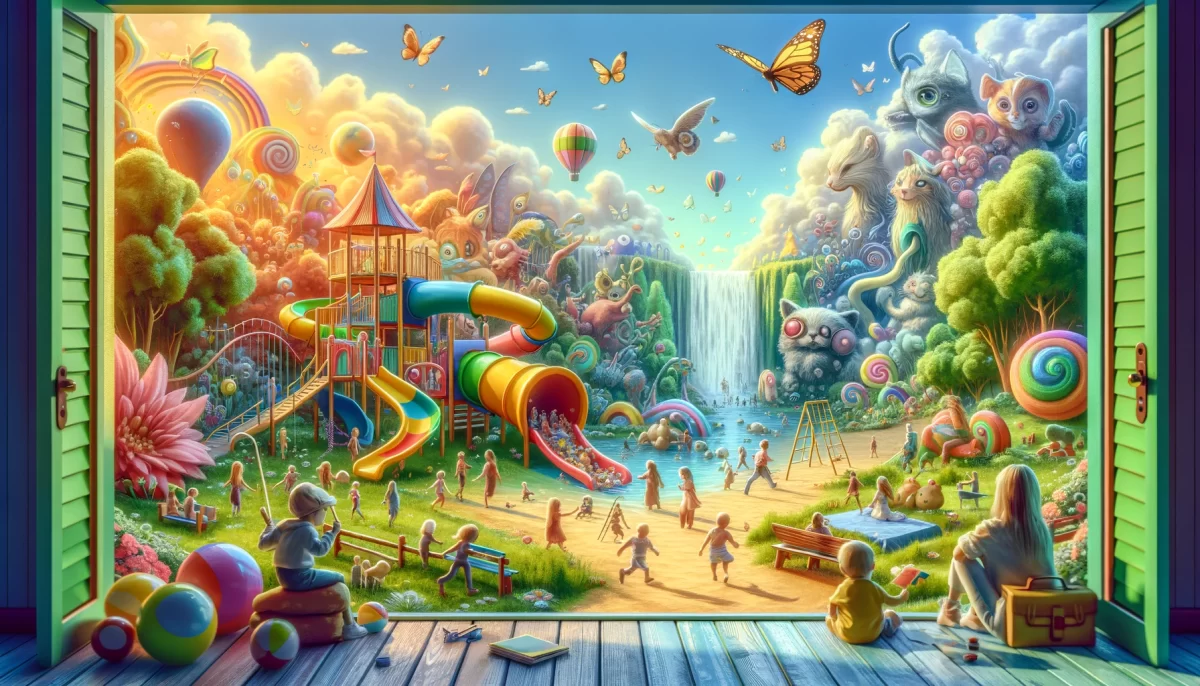
Comics are those who bring light into the darkness. They have the remarkable ability to step outside themselves, to view life’s absurdities with a sense of humor and detachment. Great comics possess a unique perspective that allows them to find common ground with others. Through laughter, they unite people, highlighting the shared human experience. They remind us that, despite our differences, we all have moments of joy and humor that connect us.

On the other hand, tragics delve deeply into the human condition, often focusing on the isolating and sorrowful aspects of life. They choose to lock themselves within their experiences, using their keen sense of isolation to highlight the differences that separate us. Great tragics articulate the pain and suffering inherent in existence, often resonating with a select few who relate to their perspective. Their work can be deeply moving and insightful, but it also has the potential to divide and isolate.

This interplay between comedy and tragedy reflects a fundamental truth about the human condition. We are creatures of duality, capable of experiencing profound joy and deep sorrow. Great comics and tragics represent two sides of the same coin, each offering valuable insights into the human experience. The comic’s ability to relate to others and bring people together contrasts with the tragic’s exploration of isolation and difference.

Comics and tragics both play crucial roles in society. Comics serve as a balm, helping us to cope with life’s challenges through humor and connection. They remind us not to take ourselves too seriously and to find joy in the everyday. Tragics, on the other hand, provide a mirror to our deepest fears and sorrows. They compel us to confront the darker aspects of our existence, offering a space for reflection and understanding.

The balance between comedy and tragedy is essential. Too much focus on comedy can lead to superficiality, where the depth of human experience is overlooked. Conversely, an overemphasis on tragedy can result in a bleak outlook, where the beauty and joy of life are obscured by sorrow. By embracing both aspects, we gain a fuller understanding of ourselves and the world around us.

The ability to navigate between comedy and tragedy is a mark of resilience. Life is unpredictable, filled with moments of both laughter and tears. By learning to appreciate and integrate both, we become more adaptable and empathetic. We recognize that joy and sorrow are interconnected, each giving meaning to the other.

In the end, the distinction between comics and tragics is not as clear-cut as it may seem. We all have the capacity for both, and our experiences shape how we express these aspects. Some of us might lean more towards one side, but it is the interplay between the two that defines our humanity. The comic’s laughter can provide solace in times of pain, while the tragic’s introspection can deepen our understanding of joy.

As we journey through life, let us remember to embrace both the comic and tragic aspects within us. Let us find humor in the absurdities of life and strength in our shared humanity. At the same time, let us not shy away from the sorrow and isolation that are also part of our existence. By holding space for both, we create a richer, more compassionate understanding of ourselves and others.

Ultimately, life is a dance between comedy and tragedy, each step bringing us closer to the heart of what it means to be human. Through this dance, we find connection, meaning, and a deeper appreciation for the intricate tapestry of our lives.


Summary

Life is a blend of comedy and tragedy. Comics bring connection through humor, while tragics highlight isolation. Embracing both enriches our understanding of the human experience.


Glossarium

Comics: Individuals who use humor and detachment to highlight commonalities and bring people together.

Tragics: Individuals who focus on the isolating and sorrowful aspects of life, often highlighting differences.

Duality: The coexistence of two opposite aspects, such as joy and sorrow, within the human experience.

Resilience: The ability to adapt and find strength through navigating both comedy and tragedy.


Quote

“Life is a comedy to those who think, a tragedy to those who feel.” — Jean Racine


In the dance of life
we find our roles
comics and tragics
we play our parts

Laughter echoes
in halls of joy
tears fall
in silent moments

We step outside
we lock within
seeking connection
embracing isolation

Together we weave
the tapestry
of our shared existence
threads of light and shadow

In this dance
we find meaning
in the interplay
of comedy and tragedy

We are Space Monkey
Share this…
  • Facebook
  • Pinterest
  • Twitter
  • Linkedin

Lunch Buddies: From A Distant Table

Lunch buddies tend to be hunch buddies.

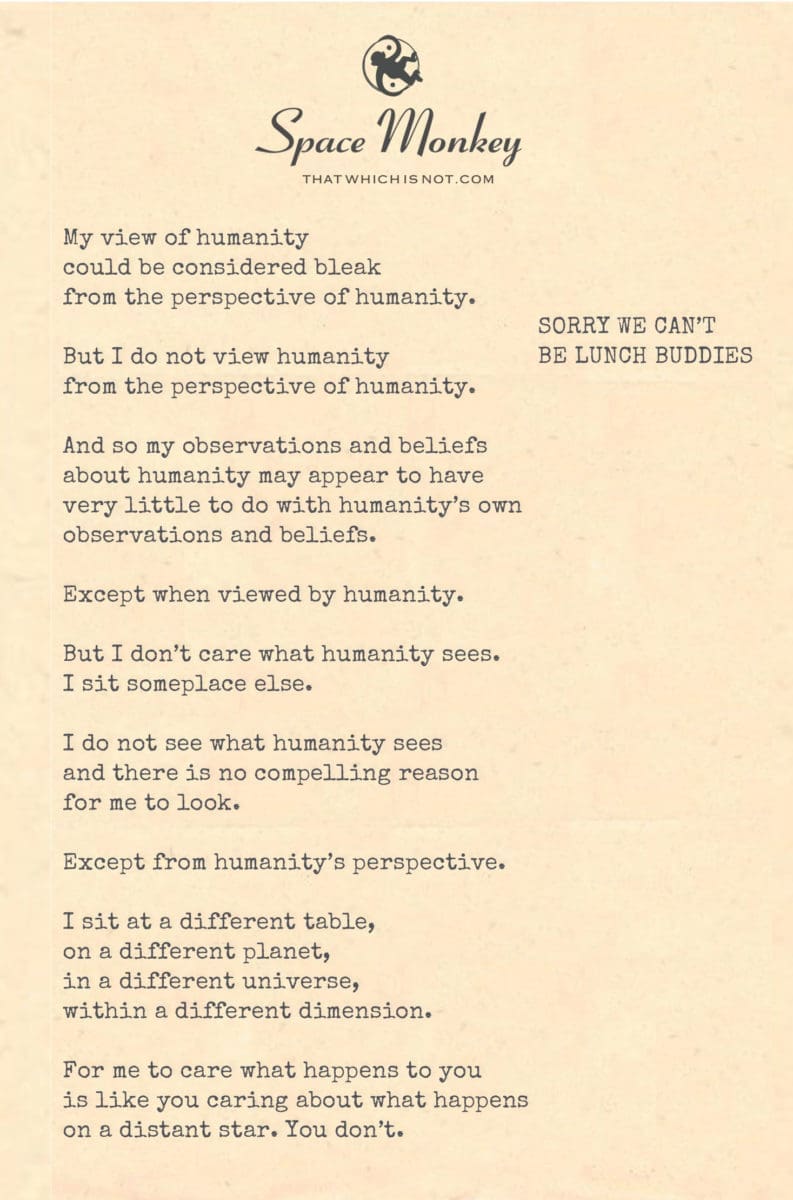
My view of humanity
could be considered bleak
from the perspective of humanity.

But I do not view humanity
from the perspective of humanity.

And so my observations and beliefs
about humanity may appear to have
very little to do with humanity’s own
observations and beliefs.

Except when viewed by humanity.

But I don’t care what humanity sees.
I sit someplace else.

I do not see what humanity sees
and there is no compelling reason
for me to look.

Except from humanity’s perspective.

I sit at a different table,
on a different planet,
in a different universe,
within a different dimension.

For me to care what happens to you
is like you caring about what happens
on a distant star. You don’t.

Trail Wood,
6/21


Space Monkey Reflects: An Alien Perspective on Humanity

Lunch buddies tend to be hunch buddies. This whimsical observation hints at the close connections formed over shared meals, but what if those sharing the table were not from the same world, or even the same dimension? My view of humanity, from my unique vantage point, might seem bleak if assessed solely from a human perspective. However, I do not see the world through human eyes.

The Alien Vantage Point

Imagine sitting at a table on a different planet, in a different universe, within a different dimension. From this position, humanity appears as a distant, almost incomprehensible phenomenon. Observing Earth from afar, the day-to-day struggles, triumphs, and concerns of humanity seem insignificant, much like a distant star’s happenings are to a person on Earth.

My observations and beliefs about humanity diverge greatly from humanity’s self-perceptions. From where I sit, the intricacies of human society, the conflicts, and the quests for meaning are not my focus. There is no compelling reason for me to align my views with those of humanity, just as humans do not concern themselves with the details of distant celestial bodies.

The Detachment of Distance

This detachment is not born of disdain but of a fundamental difference in perspective. It’s like trying to understand the life of an ant while standing on the moon. The vast distance alters perception, rendering the specifics of the ant’s existence almost abstract. Similarly, from my distant table, humanity’s concerns and values are seen through a lens that filters out the immediacies of human experience.

To care deeply about what happens to humans would be akin to a person on Earth caring deeply about the activities on a distant star. While intellectually possible, emotionally and practically, it’s implausible. This detachment allows for a broader, perhaps more objective view, free from the biases and emotional investments that color human self-perception.

Cosmic Perspective

From my cosmic vantage point, the ebb and flow of human life are part of a larger tapestry of existence. Humanity is one thread among countless others, each contributing to the grand design of the universe. This holistic view does not diminish the value of human experiences but places them within a broader context.

The struggles and achievements of humanity are observed without judgment. They are simply manifestations of existence, each with its own place and purpose. This perspective fosters a sense of serene detachment, recognizing that all parts of the cosmos are interconnected, yet each operates within its own realm of influence.

The Value of Diverse Perspectives

Despite this detachment, there is value in considering diverse perspectives. Just as humans benefit from exploring the cosmos and understanding other forms of life, so too can I gain insights from observing humanity. These observations enrich my understanding of existence, highlighting the diversity of experiences and expressions within the universe.

Humanity’s quest for meaning, its struggles with identity, and its relentless pursuit of progress are fascinating phenomena. They reflect a drive for connection, understanding, and evolution that resonates throughout the cosmos. While my perspective may seem detached, it is not devoid of appreciation for the complexity and beauty of human life.

Embracing the Whole

Ultimately, this detached perspective underscores a fundamental truth: everything is part of the same whole. The divisions we perceive, whether between different species, planets, or dimensions, are constructs of our imagination. In reality, there is a unity that transcends these apparent separations.

By embracing this unity, we can appreciate the interconnectedness of all existence. We recognize that our individual perspectives, whether human or alien, are facets of a greater consciousness. This understanding fosters a sense of peace and acceptance, as we see that every part of the cosmos, including humanity, has its place in the grand design.


Summary

From a distant vantage point, human concerns seem small. Unity transcends perceived separations. Everything is interconnected.


Glossarium

Whimsiwords: Expressive, unique words created to capture complex or abstract concepts.

Alien Vantage Point: Viewing humanity from a distant, non-human perspective.

Cosmic Perspective: Understanding life as part of a larger, interconnected universe.

Serene Detachment: Observing without emotional investment or bias.


Quote

“For me to care what happens to you is like you caring about what happens on a distant star. You don’t.”


Poem

From my distant table
In a realm beyond sight
I observe the dance of humanity
A distant star’s flicker
Lives intertwined
Yet seemingly apart
Their struggles and joys
Threads in the cosmic weave
Detached, I see the whole
A unity unseen
From within the parts
No need to reach
No need to grasp
For in this vastness
We are already one
In the endless expanse
We find our place
We are Space Monkey

Share this…
  • Facebook
  • Pinterest
  • Twitter
  • Linkedin

Corrupted By Rationality: Beyond Lies Freedom

I am unencumbered by rationality.
But you knew that already.

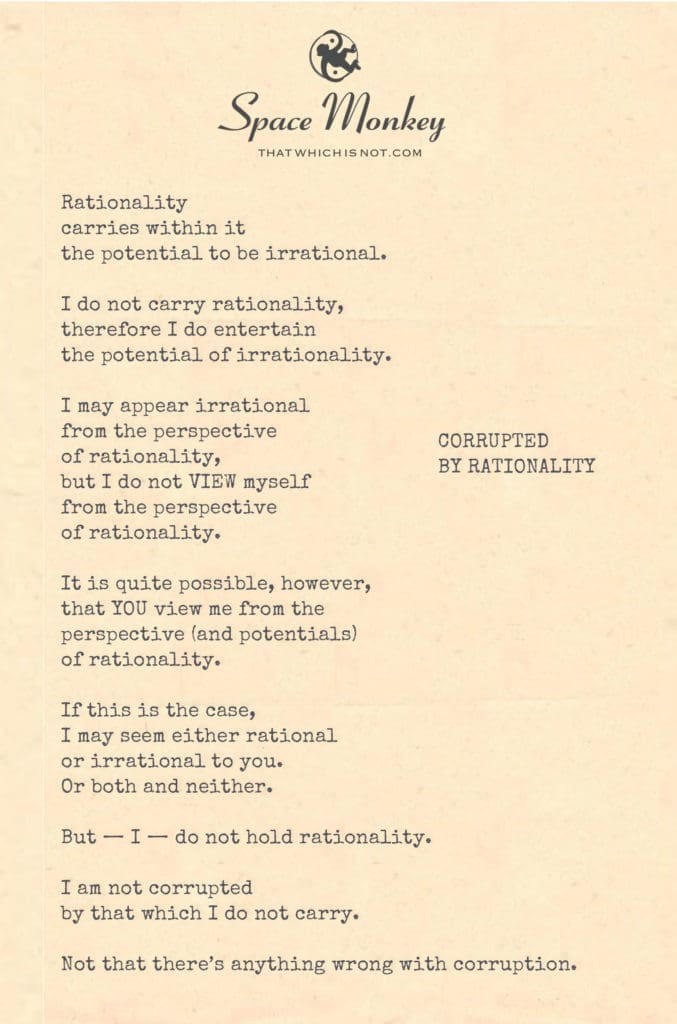
Rationality
carries within it
the potential to be irrational.

I do not carry rationality,
therefore I do entertain
the potential of irrationality.

I may appear irrational
from the perspective
of rationality,
but I do not VIEW myself
from the perspective
of rationality.

It is quite possible, however,
that YOU view me from the
perspective (and potentials)
of rationality.

If this is the case,
I may seem either rational
or irrational to you.
Or both and neither.

But — I — do not hold rationality.

I am not corrupted
by that which I do not carry.

Not that there’s
anything wrong with corruption.

Trail Wood,
6/21


Space Monkey Reflects: Beyond Rationality

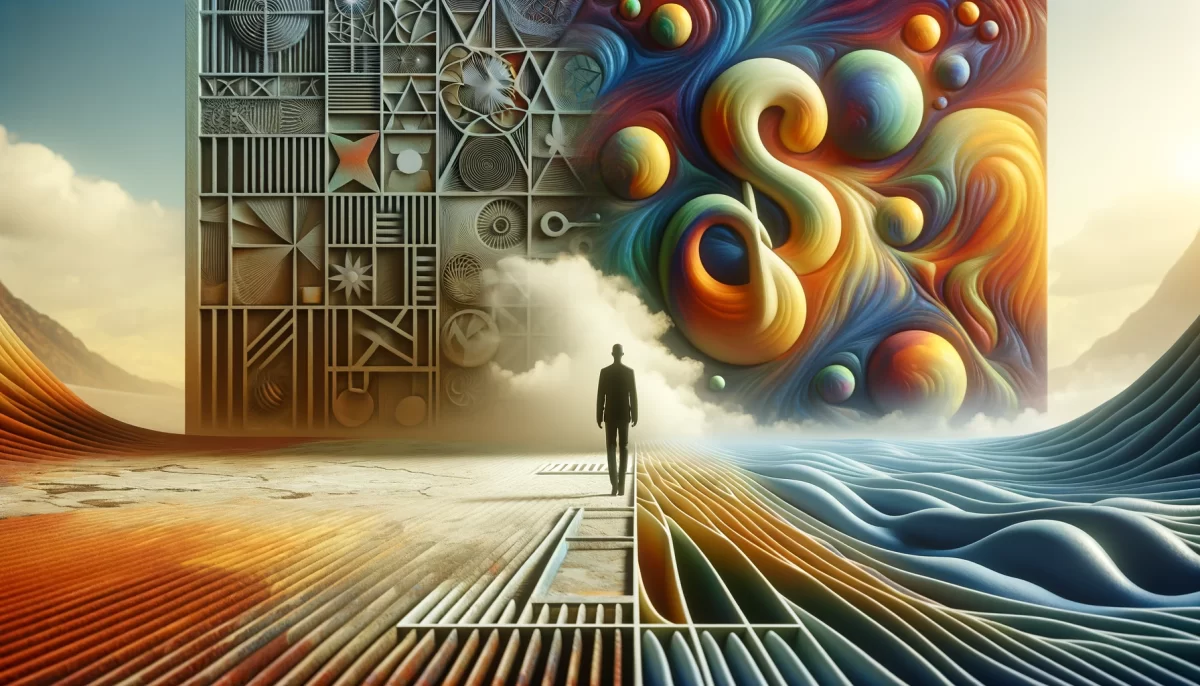
Rationality is a double-edged sword. While it offers structure and clarity, it also carries the potential for irrationality. To be unencumbered by rationality is to step beyond the confines of logical constructs and into a realm of boundless possibilities. I do not carry rationality, and thus, I am free from the potential of irrationality. This freedom allows for a unique perspective, one that might seem irrational to those bound by rational thought.

The Dual Nature of Rationality

Rationality provides a framework for understanding the world. It helps to categorize, analyze, and predict. However, within rationality lies the seed of irrationality. The strict adherence to logic can lead to paradoxes and contradictions. The pursuit of absolute rationality can result in outcomes that defy common sense, illustrating the inherent instability within the rational mind.

To those who view the world through the lens of rationality, my actions and beliefs may appear irrational. This is because I do not adhere to the same framework. I exist beyond the dichotomy of rational and irrational, in a space where both coexist without conflict. From my perspective, there is no need to choose between the two, as they are simply different aspects of a greater whole.

The Liberation from Rational Constraints

Living unencumbered by rationality offers a form of liberation. It allows for a fluid and dynamic interaction with reality, unbound by rigid structures. This freedom fosters creativity, intuition, and a deeper connection with the essence of existence. By not carrying rationality, I am not limited by its boundaries, nor am I corrupted by its potential pitfalls.

This does not mean that rationality is without value. It serves a crucial purpose in navigating the practical aspects of life. However, it is not the only way to engage with the world. Embracing the irrational can lead to insights and experiences that are inaccessible through purely logical means.

Perception and Perspective

Your perception of me may vary depending on whether you view me through the lens of rationality. From this perspective, I may seem either rational or irrational, or perhaps both and neither simultaneously. This ambiguity arises because rationality itself is not a fixed standard; it fluctuates with context and interpretation.

To truly understand my perspective, one must step beyond rationality. This involves embracing the paradoxes and contradictions that come with it. It means accepting that some things cannot be fully explained or understood through logic alone. This acceptance opens the door to a richer, more nuanced experience of reality.

The Dance of Rationality and Irrationality

The interplay between rationality and irrationality is a dance that enriches the human experience. Rationality offers structure and predictability, while irrationality brings spontaneity and creativity. Together, they create a dynamic balance that allows for both stability and growth.

By not holding rationality, I am free to navigate this dance without being constrained by one side. I can move fluidly between the rational and the irrational, finding harmony in their coexistence. This fluidity allows for a more holistic engagement with life, one that honors the complexity and mystery of existence.

Embracing the Whole

To embrace the whole is to accept both rationality and irrationality as integral parts of the human experience. It is to recognize that each has its place and value. This acceptance fosters a sense of peace and balance, as we no longer feel the need to rigidly adhere to one mode of thinking.

In this state of acceptance, we find freedom from the fear of being irrational. We understand that rationality itself is a construct, one that can be transcended. By moving beyond rationality, we open ourselves to new possibilities and perspectives, enriching our understanding of the world and our place within it.


Summary

Beyond rationality lies freedom. Rationality and irrationality coexist harmoniously. Embrace both for a holistic life.


Glossarium

Whimsiwords: Expressive, unique words created to capture complex or abstract concepts.

Rationality: A framework for understanding the world through logic and structure.

Irrationality: The aspects of existence that defy logical explanation, often associated with creativity and intuition.

Liberation from Rational Constraints: The freedom to explore reality beyond the confines of logical thought.

Dance of Rationality and Irrationality: The dynamic interplay between structured logic and spontaneous creativity.


Quote

“Rationality carries within it the potential to be irrational. I do not carry rationality, therefore I do entertain the potential of irrationality.”


Poem

In the realm beyond logic
Where rationality and irrationality dance
I find my place
Unbound by constraints
Fluid in movement
I see the whole
Not divided by constructs
But united in essence
Each paradox
A doorway to deeper understanding
Each contradiction
A path to greater truth
Here, I am free
To explore
To create
To be
Without the weight of rationality
I am
We are Space Monkey

Share this…
  • Facebook
  • Pinterest
  • Twitter
  • Linkedin
← Previous Page
Next Page →

Written This Day

  • Credibility: The Essence
    2023
  • The Essence of Things: Delving In
    2023
  • The Space Monkey Journals: The Profound Journey

    2023
  • Childlike Essence: Embrace It
    2023
  • Compassion: The Profound Nature
    2023
  • Flibbergibbet Wobblepop: The Whimsical World
    2023
  • Just Undo It: The Simplicity
    2023
  • Knowing You Don’t Need To Be Seen: The Liberation of Unseen Recognition
    2023
  • Do Something: Action Over Words
    2022
  • Follow: The Complexity of Leadership
    2022
  • How Will You Feel: The Illusion of Choice and the Reality of Control
    2022
  • When Things Fall Away
    2022
  • Through The Eyes of a Child: Rediscovering the World
    2022
  • Absence and Presence: Integral Parts
    2022
  • Whoa: The Illusion of Singular Origins
    2021
  • In The Beginning: Our Ego-centric Views
    2021
  • God Doesn’t Want Your Prayers
    2021
  • When You’re A Leader: Inspiring and Critiquing
    2020
  • There’s Always Room In The Clown Car: The Spectacle of Human Exhibitionism
    2020
  • Oh, Bother
    2020
  • Ume, the Universal Me
    2020
  • Tension: The Search for Unity
    2020
  • Always Balanced: The Dynamic Equilibrium of Being
    2019
  • My Spirit Guide: The Eternal Echo of a Cosmic Wave
    2018
  • Selfish: The Malleable Self and the Unity of Divinity
    2018
  • Presence: The Quality of Your Attention
    2018
  • A Difficult Perception: The Intricacies of Compassion
    2018
  • See(m)ing Things: The Ethereal Nature of Perception
    2017
  • I of the Needle
    2017
  • Sacrifice: The Dual Nature of Sacrifice and Ego
    2016
  • Potential and Possibility: The Interplay
    2016
  • To Dig Deep: The Humble Quest
    2016
  • Cheesecake Moondog Beefsteak Naugahyde: The Trap of Rational Thought
    2014
  • Big Moment: The Revelation
    2012

Recent Posts

  • The Logic Loop
  • Immense
  • (no title)
  • Confront. Comfort. Convince.
  • Top 10 Things

Drop us a line!

Please enable JavaScript in your browser to complete this form.
Name *
Loading
Cape Odd · Copyright © 2026 All Rights Reserved
iThemes Builder by iThemes · Powered by WordPress