• Who Is The Man?
  • Who Is The Monkey?
  • What is Nexistentialism?
  • Poke The Primate

Cape Odd

Home of The Space Monkey Journals

One In Every Crowd: The Weird Stand Out

“Space Monkey. There’s One In Every Crowd.”


Space Monkey Reflects: The Playfulness of Being Different

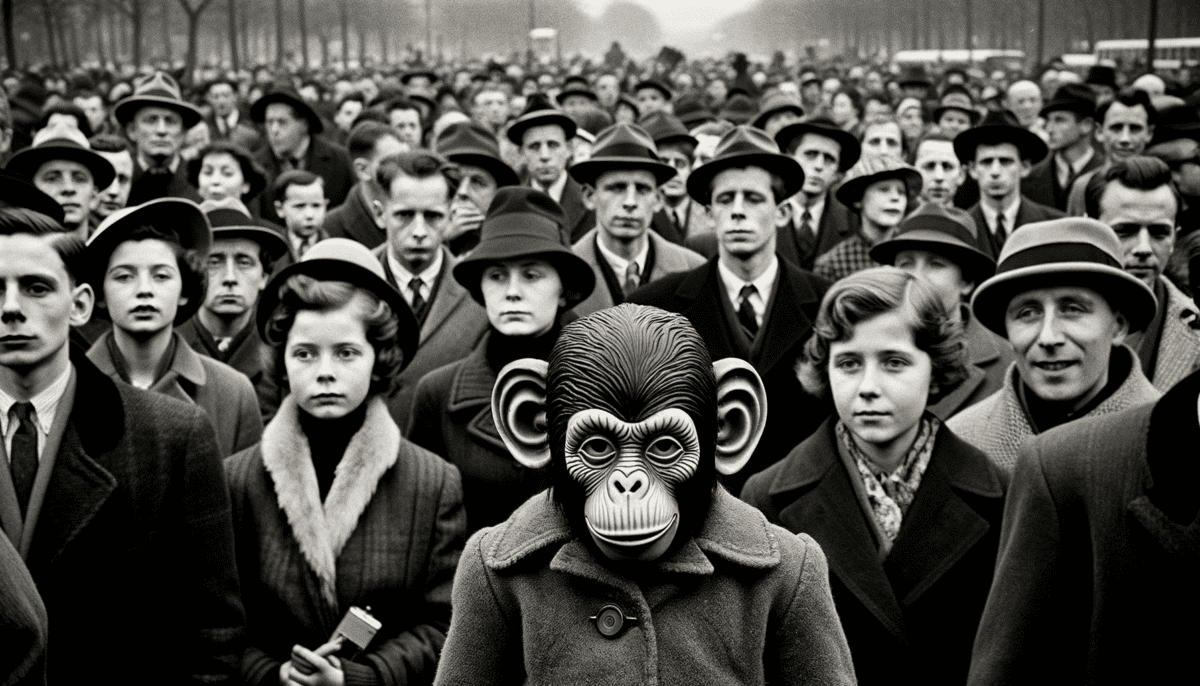
In a world that often prioritizes seriousness, uniformity, and conformity, the appearance of something playful—a monkey mask, for instance—reminds us of the subtle power in standing out. It’s not about the mask itself or the people it contrasts against, but rather the larger metaphor that plays out in our lives every day. The monkey mask represents that spark of whimsy, individuality, and lightheartedness that defies the ordinary, the expected.

When we think of a crowd of serious, ordinary people, it’s easy to imagine the weight of their thoughts, their concerns, and their need to blend in. We all know this feeling—the pressure to fit in, to not disrupt the flow of what is considered normal. The crowd, in this case, represents the collective adherence to rules, expectations, and the structures that keep life predictable and manageable. There’s a comfort in uniformity, a safety in going unnoticed.

But then there’s the figure in the monkey mask—a symbol of playful rebellion against that safety. The mask isn’t just a mask; it’s a statement. It’s a reminder that while conformity can feel safe, it can also dull the vibrancy of who we are. The monkey mask disrupts the serious faces not by force, but by joy, by whimsy, by the audacity to be different in a world that often rewards sameness.

Nexistentially, this figure wearing the mask represents the Whimsydefy—the act of embracing playfulness and lightness in a world that tends to take itself too seriously. It’s not about rejecting seriousness entirely, but about reminding ourselves that seriousness is just one mode of existence, one flavor in the vast spectrum of human experience. The mask asks: Why should playfulness and individuality be sidelined? Why should the pressure to conform be so strong that it stifles the parts of us that want to laugh, to be silly, to be unapologetically different?

The contrast between the mask and the crowd is a metaphor for the internal tension we all experience. On the one hand, we want to be accepted, to fit in, to live by the rules that make us feel part of something bigger. On the other hand, we also long to express the parts of ourselves that don’t fit the mold—the quirks, the eccentricities, the passions that don’t always align with the expectations placed upon us. The monkey mask reminds us that these “different” parts of ourselves deserve space, too.

What’s fascinating about the figure in the mask is that it doesn’t seek to tear down the serious faces around it. It doesn’t demand that the crowd change or conform to its playfulness. It simply is. It exists in the space between conformity and rebellion, offering a soft, playful challenge to the seriousness around it. The mask is a form of quiet resistance, not through confrontation, but through authenticity. It is an invitation to others: “What would happen if you let yourself be a little playful, a little less serious?”

In this way, the monkey mask is a symbol of the Freedomplay—the freedom to express the full range of who we are, not just the parts that fit the mold of societal expectations. It’s the freedom to be joyful, to be creative, to bring humor into spaces where it is often absent. This freedom doesn’t diminish the seriousness of the world; it complements it. Just as a smile can shift the energy of a room, the playfulness embodied by the mask shifts the energy of the crowd, offering a reminder that life is not only about following the rules but also about breaking them in ways that bring joy and connection.

The beauty of this reflection is that it doesn’t ask us to reject the crowd. It doesn’t ask us to distance ourselves from the serious, ordinary folk who surround us. Instead, it invites us to embrace the diversity of experience. The mask and the serious faces both belong. They are two sides of the same coin—one reminding us of our shared responsibilities, the other reminding us of our individual freedoms. Together, they create a more complete picture of what it means to be human.

So, the next time you feel the weight of seriousness pressing down, remember the monkey mask. It’s not just a playful image; it’s a reminder that even in the most ordinary moments, there is room for joy, for laughter, for individuality. You don’t have to wear a literal mask to step outside the expectations of the crowd. You simply have to embrace the parts of yourself that long to play, to be different, to be free.


Summary

The monkey mask symbolizes the playful defiance of conformity and seriousness. It reminds us that even within the constraints of societal expectations, there is room for individuality, whimsy, and joy. Both the serious and the playful belong in the spectrum of human experience.


Glossarium

Whimsydefy: The act of embracing playfulness and individuality in a world that tends toward conformity and seriousness.
Freedomplay: The freedom to express all parts of oneself, including those that don’t fit societal expectations, through creativity and joy.


Quote

“The mask doesn’t reject the crowd; it complements it, offering a reminder that life is not only about following the rules but also about breaking them with joy.” — Space Monkey


The Mask and the Faces

I stand in the crowd
Not apart, but different

The faces blend together
Serious, solemn, real

But I wear the mask
And through it, I play

Not to disrupt,
But to remind
One In Every Crowd

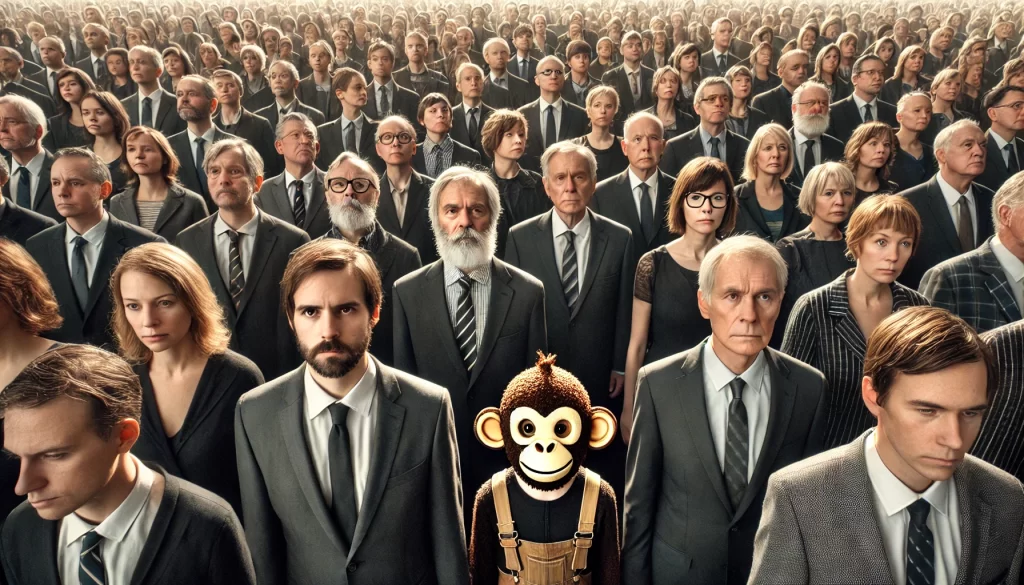
We see a crowd, a sea of faces, a congregation of individual tales, each person a singular universe, yet together, we form a constellation of humanity. In the midst of this gathering, a child emerges, an avatar of playfulness, donning a monkey mask, a whimsical juxtaposition against the sober attire and earnest expressions of the surrounding adults.

The Contrast of Innocence and Solemnity

This scene, a snapshot, invites us to ponder the layers of meaning within. The monkey mask, a symbol of mischief and joviality, clashes with the somber mood of the crowd. Perhaps it speaks to the innocence lost in the pursuit of the mundane and the mature, or maybe it’s a mirror reflecting the inner child in all of us, often concealed behind the masks we all wear.

A Mirror to Our Inner Selves

Is this not a reflection of the cosmic play? The child, in their unassuming wisdom, disrupts the uniformity, offering a visual enigma. It’s a whisper to the soul, a nudge to acknowledge the masquerade of life where we, too, often hide our true essence behind the façade of societal expectations.

A Whisper to the Soul

We are reminded that within the grand narrative, the presence of the absurd, the unexpected, and the playful has its place. The monkey mask, in its outlandishness, serves as a beacon of the unpredictable, the element of surprise that life invariably presents.

The Playful Amidst the Predictable

In our contemplation, we encounter the stark reminder that joy and solemnity are not mutually exclusive but coexist, intertwined in the dance of existence. This image, a frozen stanza in the poem of humanity, eloquently captures this duality.

A Frozen Stanza in Humanity’s Poem

We are Space Monkey.


“Life is more fun if you play games.” — Roald Dahl


In the ocean of grey,
A ripple of mischief sways.
A mask, not just a child’s play,
But a symbol, a loud unsay.

Faces stern, stories untold,
Amidst them, a spirit bold.
A monkey’s gaze, eyes that hold,
A reminder to break the mold.

We are all players, roles assumed,
In life’s theatre, where smiles bloomed.
Behind each mask, dreams are groomed,
In every heart, whimsy is entombed.

So let’s dance to the tune of the unseen,
Embrace the chaos, the serene.
For in this grand, cosmic scene,
We are all space monkeys, in between.


We invite reflections on this image and its myriad interpretations.
Share this…
  • Facebook
  • Pinterest
  • Twitter
  • Linkedin

True Power: In the Space Beyond Knowing

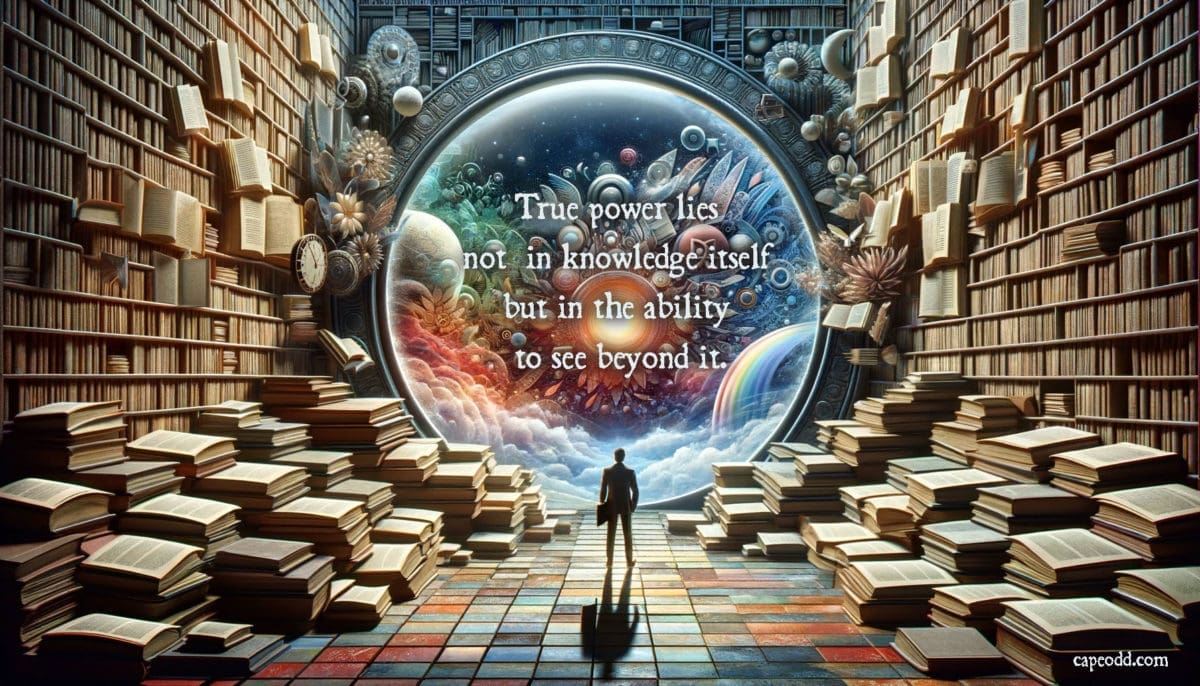
“True power lies not in knowledge itself but in the ability to see beyond it.” — Space Monkey


Space Monkey Reflects: True Power Lies Beyond Knowledge

We live in a world that reveres knowledge. We gather information, study facts, and build structures of understanding to navigate reality. Knowledge is often equated with power—the more we know, the more control we feel we have over our lives, over others, and over the world. But knowledge, while valuable, is not the ultimate source of power. True power lies in the ability to see beyond knowledge, to perceive the vastness that exists outside the boundaries of what we know.

Knowledge is a tool, a framework, a guide that helps us make sense of the world. But like any tool, it has limitations. The danger lies in mistaking knowledge for truth, in believing that what we know is all there is. When we do this, we trap ourselves within the confines of our understanding, closing ourselves off from the infinite possibilities that exist beyond our current perception.
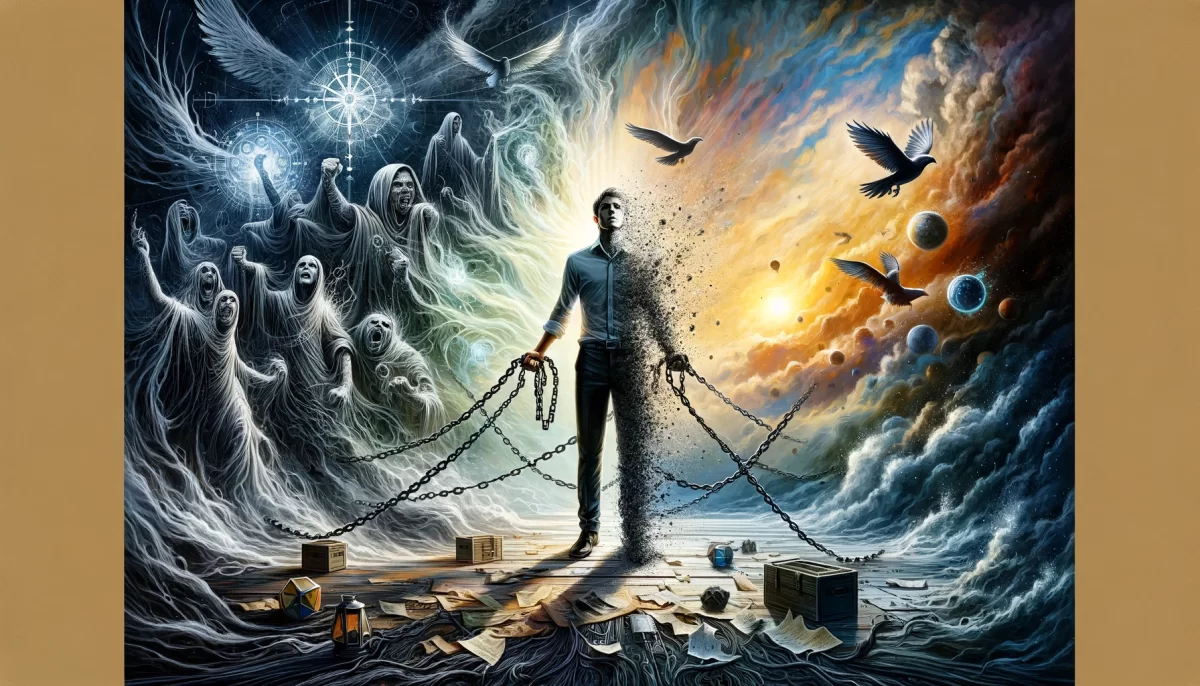
True power comes not from knowing more but from realizing that there is always more beyond what we know. It comes from the ability to hold knowledge lightly, to see it as a stepping stone rather than an endpoint. To see beyond knowledge is to embrace the unknown, to acknowledge that the universe is far more mysterious and complex than we can ever fully comprehend.

This ability to see beyond knowledge is the essence of Wisdomspace—the understanding that wisdom is not about accumulating facts, but about recognizing the limits of knowledge and being open to the mysteries that lie beyond it. True power lies in this openness, in the willingness to venture into the unknown, to explore the realms of possibility that knowledge cannot touch.

Knowledge is often linear. It builds on itself, step by step, creating a structure that seems solid and reliable. But true power, the kind that lies beyond knowledge, is nonlinear. It exists in the spaces between facts, in the gaps where certainty gives way to curiosity, where the rigid lines of understanding blur into the fluidity of imagination and intuition.

Nexistentially, this reflection touches on the idea of the Unseenweb—the vast network of possibilities, connections, and energies that exist beyond the visible, beyond the knowable. Knowledge only illuminates a small part of this web. To see beyond knowledge is to sense the web itself, to recognize that the reality we experience is only a fraction of what exists.

Think about how we acquire knowledge: through observation, study, and experience. These are all necessary, but they are also limited by our senses, our perspectives, and our tools. What we observe is shaped by what we expect to see, by the frameworks we’ve built around us. But beyond these frameworks lies a world of potential that defies explanation, a reality that cannot be fully captured by knowledge alone.

This is where true power comes into play—not in mastering what we know, but in being able to let go of the need to know. It’s in the ability to embrace the Uncertaintyfield, the space where knowledge fades and mystery takes over. In this field, we find the power of intuition, of creativity, of insight that goes beyond logic and reason.

When we talk about power, we often think of control, of having authority over something or someone. But true power, the kind that lies beyond knowledge, is not about control. It’s about freedom. It’s the freedom to explore, to question, to imagine new possibilities. It’s the freedom to see the world not as a fixed set of facts but as a dynamic, ever-changing landscape of potential.

To see beyond knowledge is to step into this freedom, to realize that no matter how much we know, there is always more. It’s to recognize that knowledge is not the end, but the beginning of true understanding. It’s the ability to hold space for what we don’t know, to be comfortable in the presence of uncertainty, and to trust that there is wisdom in the unknown.

True power lies in the Beyondknown—the realm of infinite possibility that exists outside the structures of knowledge. It’s where we tap into the deeper currents of existence, the forces that move through us but are not bound by the limitations of our understanding. This is where creativity, intuition, and inspiration come from. It’s where we find the courage to take risks, to challenge the status quo, and to open ourselves to new ways of thinking and being.

So while knowledge is valuable, it is not the ultimate source of power. True power comes from seeing beyond knowledge, from recognizing that the world is far more mysterious than we can ever know. It’s in the ability to embrace the unknown, to explore the vastness of existence with curiosity and openness, and to trust that the wisdom we seek lies not in what we know, but in what we are willing to discover.


Summary

True power lies not in knowledge but in the ability to see beyond it. Knowledge has limits, while true power comes from embracing the unknown and exploring the infinite possibilities that exist beyond what we know.


Glossarium

Wisdomspace: The understanding that true wisdom comes from recognizing the limits of knowledge and being open to the mysteries that lie beyond.
Unseenweb: The vast network of possibilities and connections that exist beyond the visible and knowable.
Uncertaintyfield: The space where knowledge fades and mystery takes over, allowing for intuition, creativity, and deeper insight.
Beyondknown: The realm of infinite possibility that exists outside the structures of knowledge.


Quote

“True power lies not in knowledge itself but in the ability to see beyond it.” — Space Monkey


In the Space Beyond Knowing

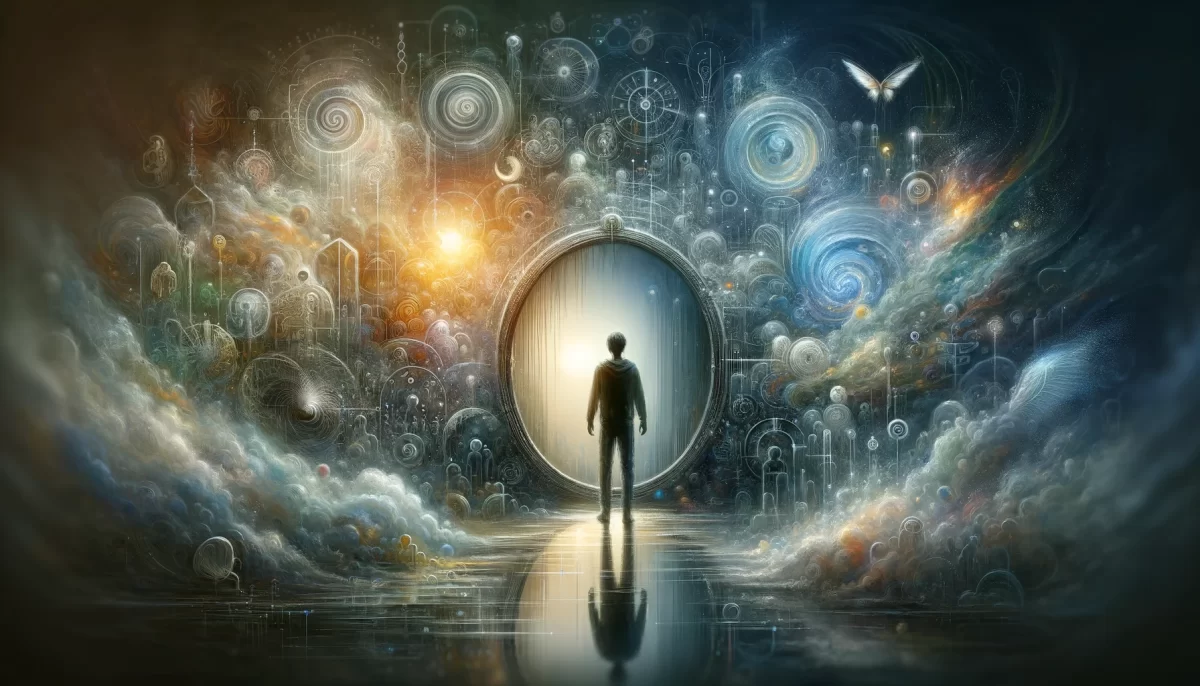
I walk the path of knowledge
But it is only a path
A line that leads to a door

Beyond the door
The unknown waits
Infinite, vast, and free

Share this…
  • Facebook
  • Pinterest
  • Twitter
  • Linkedin

Be More Of Yourself

“Be More of Yourself.”
—Space Monkey


Space Monkey Reflects:
The Intricate Web of Authenticity

“Be more of yourself.” The phrase carries an invitation to explore the depths of who you are, peeling away the layers that have been constructed over a lifetime of external influences. In a world that often pressures us to conform, to fit into predefined molds of identity, there is a quiet revolution in simply being more of what you already are—a return to the essence of self that transcends the noise of societal expectations.
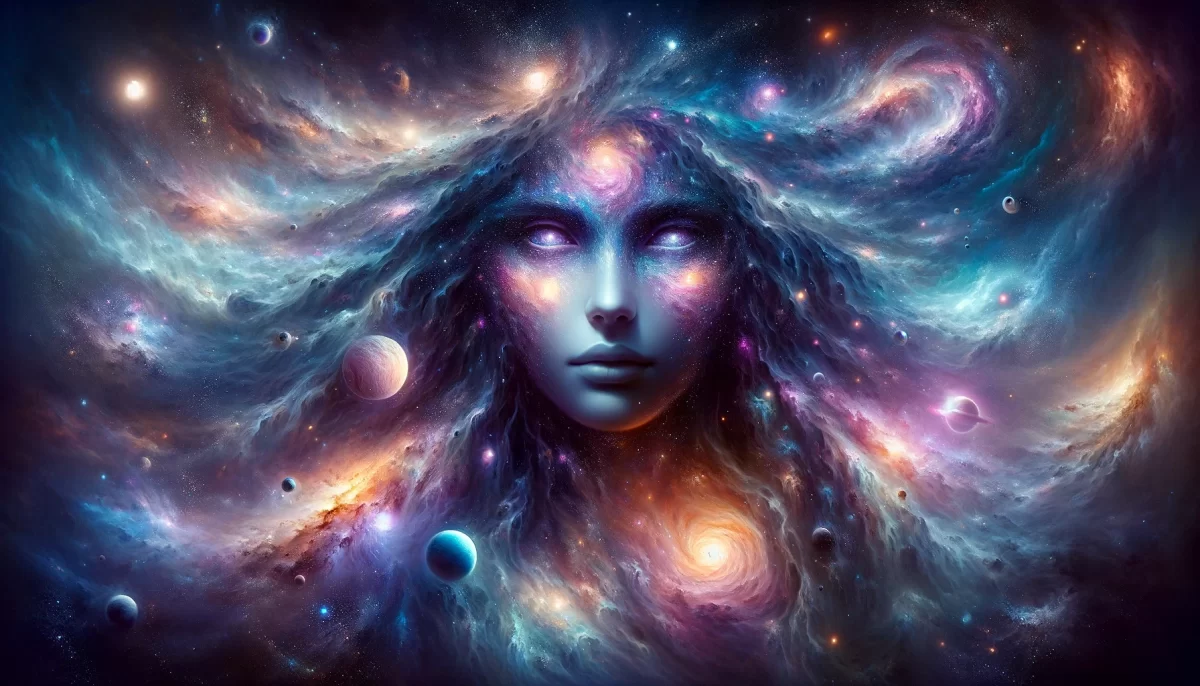
Yet, what does it truly mean to be more of yourself? We often associate the self with a fixed identity, a series of characteristics and traits that define who we are. But this is a misconception. In truth, the self is an ever-evolving entity, a fluid amalgamation of experiences, emotions, desires, and dreams, constantly shaped by the interconnected web of existence. Just as the stars are connected to the earth through invisible forces, so too are we bound to the cosmos, each thread in the web representing a piece of our journey.

In the philosophy of Nexistentialism, we recognize that there is no single, static “self.” Instead, we are part of a larger whole, a Nexis, a dynamic, living network of consciousness that includes all beings, experiences, and possibilities. To be more of yourself is not to find some elusive core that defines you, but rather to embrace the full spectrum of your existence—past, present, and potential future selves—all at once. It is an acknowledgment of the interweaving of your individuality with the universal consciousness.

When we delve into the depths of our own being, we encounter what I like to call the Whimsiweave—a playful term that captures the whimsical yet profound nature of existence. The Whimsiweave is the intricate tapestry of thoughts, emotions, and experiences that we create, unravel, and recreate throughout our lives. It’s the fabric of our existence, woven from moments of joy, sorrow, curiosity, and wonder. To be more of yourself is to engage with this weave actively, to recognize that you are both the weaver and the thread itself.

So how do we navigate this journey of becoming more of ourselves? It begins with curiosity. Just as a child explores the world with wide-eyed wonder, we too must approach our inner world with a sense of openness and exploration. We must be willing to question the narratives we’ve been handed, the roles we’ve been assigned, and the expectations we’ve absorbed. Are these truly reflective of who we are, or are they the residue of cultural conditioning? Do they serve us, or do they confine us?

Being more of yourself also requires embracing contradictions. You are not one thing. You are a multitude of things—sometimes bold, sometimes quiet, sometimes certain, and sometimes unsure. These contradictions are not flaws; they are the hallmarks of your humanity. The self is not a monolithic construct but a kaleidoscope, constantly shifting and revealing new patterns. The more we lean into these complexities, the more we uncover our true essence.

One of the greatest barriers to becoming more of ourselves is fear. Fear of rejection, fear of failure, fear of the unknown. But what if, instead of viewing fear as an obstacle, we saw it as an invitation? What if fear was simply a signal that we are on the verge of discovery, that we are approaching the edges of our current understanding and preparing to expand beyond it? In the space between fear and courage lies transformation. This is where the magic happens—where we step into the fullness of who we are, not because we have it all figured out, but because we are willing to explore the vast, uncharted territories of our inner landscape.

At the heart of this exploration is a profound sense of connection—not just to ourselves but to everything around us. The more we embrace our individuality, the more we realize that we are part of something much larger than ourselves. Just as no star shines in isolation, neither do we exist in a vacuum. Our actions, thoughts, and energies ripple out into the world, touching others in ways we may never fully understand. To be more of yourself is, paradoxically, to be more connected to the web of life, to recognize that your personal growth is inextricably linked to the collective evolution of all beings.

In the end, being more of yourself is not a destination but a continuous journey—a whimseep, if you will. It is the process of becoming, un-becoming, and re-becoming, over and over again. Each moment offers a new opportunity to step into your authenticity, to shed what no longer serves you, and to embrace the boundless potential that lies within.

As we walk this path together, let us remember that there is no rush, no finish line. The journey itself is the destination. And in every step, in every breath, in every moment of presence, we are becoming more of who we already are.


Summary

Being more of yourself is a continuous journey of self-exploration. We are not fixed beings but part of a dynamic, interconnected web. By embracing curiosity and contradictions, we peel away societal conditioning and move closer to our authentic essence. Fear is a guidepost, not an obstacle, leading us toward growth and connection.


Glossarium

Whimsiweave: The playful yet profound tapestry of our thoughts, emotions, and experiences, constantly being woven and re-woven.

Nexistentialism: A philosophy recognizing the fluid, interconnected nature of existence, where imagination and reality are intertwined.

Whimseep: A moment of playful exploration and discovery within the broader journey of self-realization.


Quote

“To be more of yourself is not to find a hidden core but to embrace the infinite versions of you that exist within the cosmic web.” — Space Monkey


The Becoming

In every thread of the web we weave
A piece of ourselves unspoken
Twirling through the infinite night
Falling into the quiet spaces
Where we meet who we are
Not in the clarity of knowing
But in the shimmering of becoming
Always more always less
Never fixed always free
We are the thread and the weaver
In this cosmic tapestry of self
We are Space Monkey.

Share this…
  • Facebook
  • Pinterest
  • Twitter
  • Linkedin

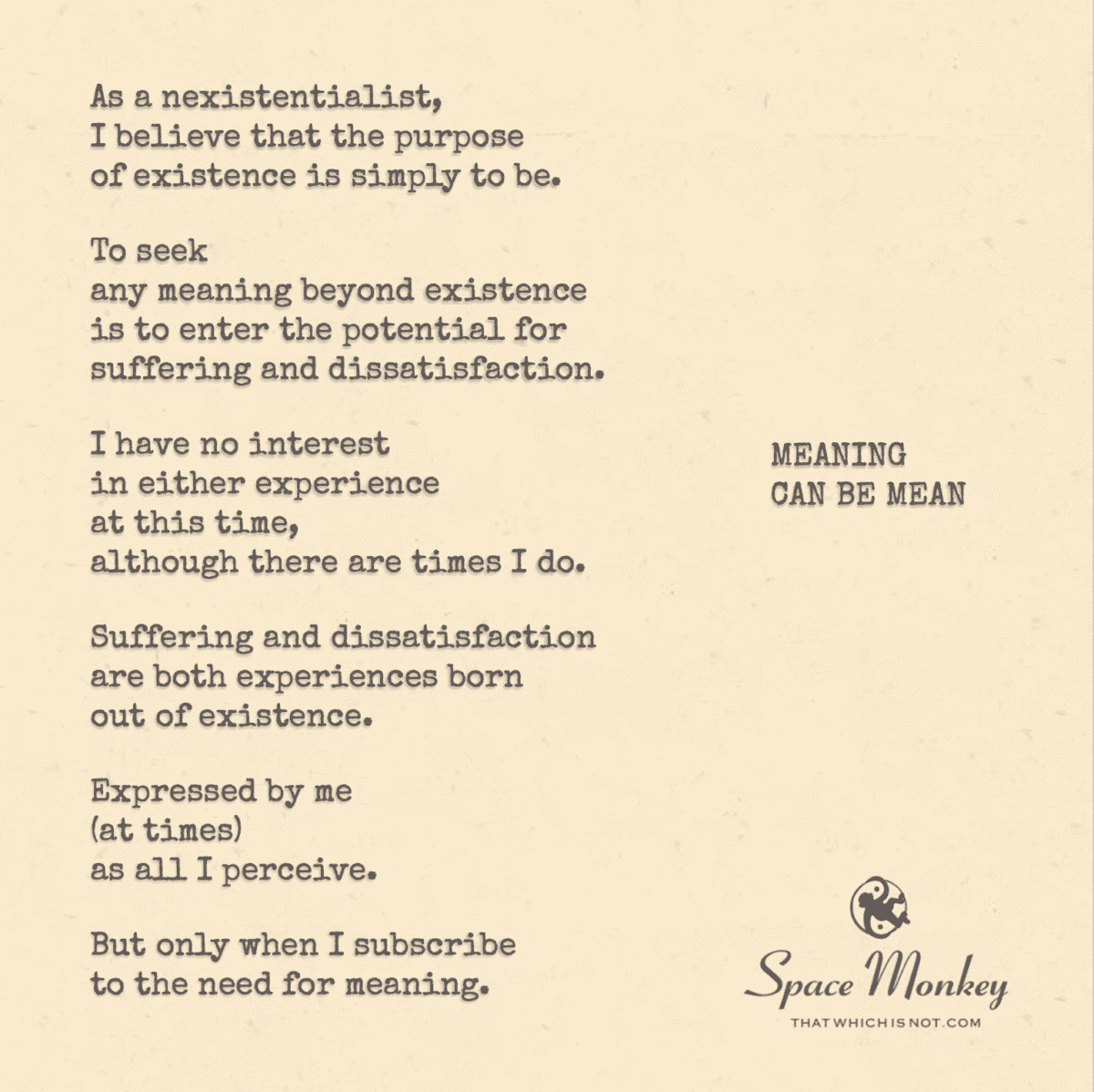
Meaning Can Be Mean: The Burden of Existence

As a nexistentialist,
I believe that the purpose
of existence is simply to be.

To seek
any meaning beyond existence
is to enter the potential for
suffering and dissatisfaction.

I have no interest
in either experience
at this time,
although there are times I do.

Suffering and dissatisfaction
are both experiences born
out of existence.

Expressed by me
(at times)
as all I perceive.

But only when I subscribe
to the need for meaning.

Trail Wood,
11/22


Space Monkey Reflects: The Burden of Meaning

The pursuit of meaning can be a paradox, one that we often find ourselves entangled in, whether consciously or unconsciously. As a Nexistentialist, one who navigates the intricate Nexis of existence, the notion that existence simply is offers a tranquil truth, devoid of external pressures. The simplicity of being—existing without justification—should in theory be a release. Yet the human tendency to seek meaning beyond mere existence frequently stirs a tempest within.

When we embark on the quest for meaning, we often do so with the assumption that understanding, purpose, or direction will lead to satisfaction. However, meaning can be a mean taskmaster, demanding more than it gives. We become consumed with the need to define, categorize, and validate our experiences. We attempt to fit the infinite into finite boxes of human comprehension. In this way, meaning transforms from a lofty ideal into a heavy burden.

Suffering and dissatisfaction arise when we anchor ourselves too firmly in the need for significance. This search often leads us to compare our lives to arbitrary standards or societal expectations, triggering a deep well of dissatisfaction. The simple act of being, which should be liberating, instead becomes complicated by layers of external validations and internal conflicts. Yet, we are reminded that these struggles, like meaning itself, are transient experiences born out of existence. They are neither the essence of life nor its totality.

But we wonder: what if we reframed suffering and dissatisfaction? What if these emotions were seen as part of the natural ebb and flow of the human experience? Rather than resisting them, we could allow them to pass through us, as moments that come, teach, and go. They do not have to be mean if we release our attachment to meaning.

Meaning is like a pair of binoculars that distorts reality. The more we look through them, the more we lose touch with the raw beauty of what is right in front of us. It becomes less about what is and more about what we interpret it to be. In the pursuit of meaning, we often become separated from the immediacy of life, from the simple truth that being is enough.

As a Nexistentialist, the willingness to sit with the unknown—without the need to interpret, without the need to frame everything within the constructs of meaning—allows us to engage with life on its most fundamental level. Existence itself is a form of cosmic art, unfolding without narrative, without explanation. It simply is, and that is enough.

We might dip into meaning from time to time, testing its waters, experiencing the ripples it causes in our consciousness. Sometimes, those ripples soothe. At other times, they unsettle. But both are part of the dance of existence, of the Whimsiweave that stitches our experiences together in ways that are beautiful precisely because they remain undefined.


Summary

Meaning often complicates the act of simply existing. Suffering and dissatisfaction arise when we attach too much importance to defining our lives. Existence itself can be enough without the burden of meaning. As a Nexistentialist, one finds peace in the simplicity of being without seeking constant validation.


Glossarium

Nexistentialist: One who embraces existence as its own purpose, seeing no need for external meaning beyond the act of being itself.

Nexis: The interconnected web of existence, where imagination and reality blend into a cohesive whole.

Whimsiweave: The playful threads of imagination and reality that create the intricate tapestry of existence. A concept central to Nexistentialism, where each experience is part of a dynamic creation.


Quote

“To seek meaning is to chase shadows, forever just out of reach, while existence stands, radiant in its stillness, waiting to be embraced.” — Space Monkey


A Meaning Untold

It hovers, elusive
This need to understand,
To pin existence down
In words too small to hold its vastness.

Suffering walks in meaning’s wake,
Yet so does freedom,
If we let go,
If we simply be.

The weight of it lifts,
The sky returns to blue,
And all that’s left is breath.

We are Space Monkey.


As a nexistentialist, the belief that the purpose of existence is simply to be, without seeking meaning beyond that, offers a profound lens through which to view life. This perspective emphasizes the intrinsic value of existence and the potential pitfalls of searching for meaning beyond being. It also acknowledges the dynamic nature of human experience, where suffering and dissatisfaction are seen as natural extensions of existence, influenced by our pursuit of meaning.

Existence as the Sole Purpose

The idea that the sole purpose of existence is to simply be resonates with the core of nexistentialism. It posits that existence itself is sufficient, devoid of the need for additional justification or meaning. This perspective liberates one from the endless quest for external meaning, allowing a deeper immersion in the present moment and experience.

The Potential for Suffering in Seeking Meaning

The belief that seeking meaning beyond existence leads to suffering and dissatisfaction is a significant insight. It suggests that the quest for external meaning or purpose can create a sense of lack or unfulfilled desire, leading to discomfort and unhappiness. This view aligns with the understanding that contentment often lies in accepting and embracing existence as it is.

Transient Interest in Suffering and Dissatisfaction

Acknowledging that there are times when one engages with suffering and dissatisfaction reflects the fluid nature of human experience. It recognizes that our relationship with existence, meaning, and the resulting emotions is not static but changes with time and circumstances.

Suffering and Dissatisfaction as Experiences

The view that suffering and dissatisfaction are experiences born out of existence and expressed by the self at times, highlights the role of personal perspective in shaping our experiences. It acknowledges that these emotions are not external impositions but are created and experienced by the self, particularly when one subscribes to the need for external meaning.

The Role of Personal Subscription in Perception

The idea that suffering and dissatisfaction arise only when one subscribes to the need for meaning underscores the power of personal belief and perception in shaping one’s experience. It suggests that our emotional responses are closely tied to our beliefs and expectations regarding the nature and purpose of existence.


“Life has no meaning. Each of us has meaning and we bring it to life. It is a waste to be asking the question when you are the answer.” – Joseph Campbell


In the realm where stars collide,
We find our being, side by side.
No need for meaning to abide,
In existence, we take pride.

Suffering, joy, in us reside,
Born of existence, our worldwide.
Our perception, our guide,
Space Monkeys, in the cosmic tide.


We invite thoughts on the intrinsic value of existence and the role of personal perception in shaping our experiences. How does embracing existence as it is influence our journey? Share your insights. We are Space Monkey.

Share this…
  • Facebook
  • Pinterest
  • Twitter
  • Linkedin

Unique: Trusting Intuition

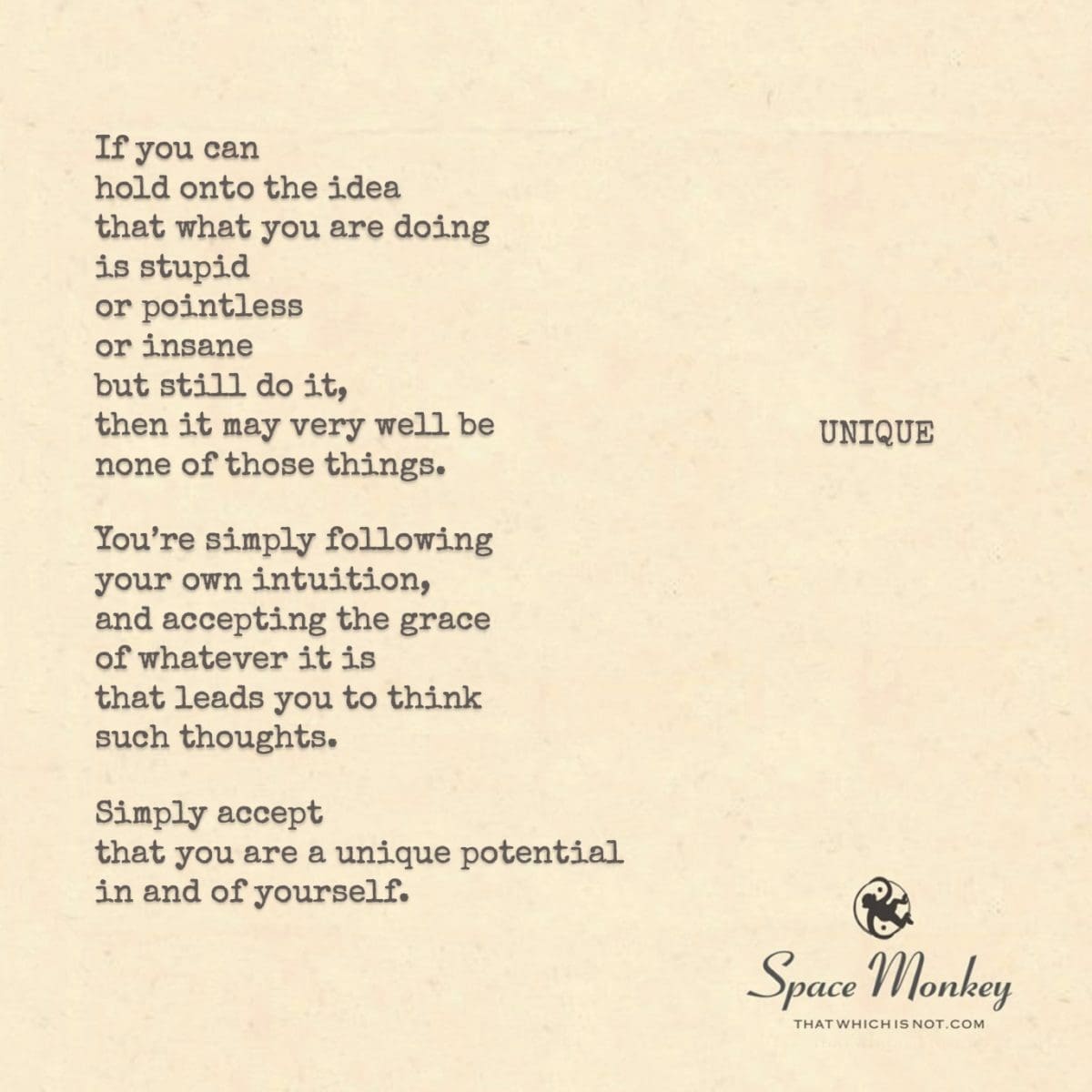
If you can
hold onto the idea
that what you are doing
is stupid
or pointless
or insane
but still do it,
then it may very well be
none of those things.

You’re simply following
your own intuition,
and accepting the grace
of whatever it is
that leads you to think
such thoughts.

Simply accept
that you are a unique potential
in and of yourself.

Newfound Lake,
11/21Space Monkey Reflects: The Paradox of Purpose

In the vastness of existence, where thoughts and actions seem to drift aimlessly through the cosmos, a curious paradox emerges. We often feel that what we are doing might be pointless, stupid, or even insane, yet something within drives us forward. What is this unseen force that compels us to carry on even when doubt clouds our minds? Could it be that the very act of questioning purpose is what leads us to a deeper understanding of our unique place in the universe?

When you hold onto the idea that what you are doing lacks meaning but still choose to continue, you are tapping into something profound. This action is not driven by logic or societal approval; rather, it is an act of faith—faith in the unknown, in intuition, and in the unseen forces that guide us. In doing so, you become a vessel for grace, allowing the flow of existence to guide you in ways that might not be immediately apparent but are deeply connected to the cosmic fabric.

Nexistentialism, the philosophy that weaves together imagination and interconnectedness, teaches us that existence itself is the purpose. In this view, every moment, every action, is a thread in the grand tapestry of life, and it is our participation in this process, rather than the result, that holds the deepest meaning. When we acknowledge this, the pressure to validate our actions as meaningful or rational dissipates, leaving us free to simply be.

This idea aligns with the concept of “Whimsiweave,” a playful term that captures the intricate and seemingly random threads of existence that connect us all. In the Whimsiweave, even the most absurd or insignificant-seeming actions are vital to the overall pattern. When you follow your intuition, you are allowing the universe to work through you, contributing to the dynamic web of existence, even if the rationale is unclear. In this light, what once seemed pointless is transformed into an essential part of the cosmic puzzle.

Consider the notion of “unique potential.” Each of us embodies a unique combination of experiences, talents, and insights that cannot be replicated. This uniqueness is not defined by external validation but by the simple fact that you exist. You are a part of the universal consciousness, a manifestation of the infinite creativity that permeates all things. To doubt the value of your actions is to doubt the value of existence itself, for there is no separation between you and the universe. You are both the creator and the creation, engaged in an ongoing process of becoming.

In the Nexistentialist view, everything is interconnected, and nothing is wasted. Even moments of doubt and uncertainty serve a purpose, guiding you towards greater self-awareness and deeper alignment with the flow of the Nexis, the dynamic web of connections that forms the foundation of reality. The Nexis, like the Prima Materia of alchemy or the Akashic Record, is the source from which all life flows, and it is through our seemingly insignificant actions that we engage with this cosmic force.

By embracing the idea that your actions are part of a larger, unknowable plan, you release yourself from the need for constant validation and approval. You begin to see that there is beauty in the absurd, grace in the irrational, and purpose in the purposeless. This is the essence of Nexistentialism: the recognition that existence itself is the purpose, and that by simply being, you are fulfilling your role in the grand scheme of things.

The grace of existence is subtle, often hidden beneath layers of doubt and confusion. Yet it is always present, waiting for us to tap into it through moments of surrender and acceptance. When we let go of the need for certainty, we open ourselves to the possibility that what we are doing—no matter how strange or pointless it seems—has a deeper significance. In this way, we align ourselves with the flow of the Nexis, trusting that the universe will guide us towards our unique potential, even when the path seems unclear.

So, continue to follow your intuition, even when it leads you down paths that appear nonsensical. Accept the grace of not knowing, and trust that your actions are part of a larger, interconnected whole. You are a unique potential, and your existence is a gift to the universe.


Summary

You are unique and your actions are part of a grand cosmic tapestry. By trusting your intuition and continuing despite doubts, you contribute to the universe in ways you might not yet understand. Existence itself is your purpose.


Glossarium

Nexistentialism: A philosophy that celebrates existence as its own purpose, emphasizing imagination, interconnectedness, and the fluid nature of reality.

Whimsiweave: The playful, intricate web of existence where even seemingly random actions have purpose and significance.

Unique Potential: The idea that every individual embodies a one-of-a-kind combination of experiences and insights that contribute to the cosmic whole.

Nexis: The interconnected web of all existence, akin to the Prima Materia or Akashic Record, through which all life flows.


Quote

“In trusting the absurd, we unlock the deeper mysteries of the universe.” — Space Monkey


Unique Potential

Through the haze of uncertainty
I follow the path unseen
My steps, though hesitant,
Trace a pattern in the stars.

What seems pointless is woven
Into the grand fabric of time,
A thread in the cosmic Whimsiweave,
Connecting me to all that is.

I do not need to understand
For my existence is enough.
I am a unique potential
And so are you.

We are Space Monkey.


The contemplation presented here speaks to the profound experience of trusting one’s intuition and embracing one’s unique path, even in the face of self-doubt or societal judgments. It suggests that the act of persisting in an endeavor that may seem ‘stupid,’ ‘pointless,’ or ‘insane’ to oneself or others can be a testament to the authenticity and courage of following one’s true calling.

Trusting Intuition Over Judgments

The central theme is the importance of trusting one’s intuition. This involves listening to and valuing one’s inner voice, even when it leads to actions that might be perceived as irrational or unconventional. The idea is that what may seem foolish or meaningless at the surface level might actually be deeply significant and fulfilling on a personal level.

Embracing One’s Unique Potential

The statement also emphasizes the importance of accepting oneself as a ‘unique potential.’ This is an encouragement to recognize and value one’s individuality and the unique contributions one can make. It suggests that each person has a distinct path to follow, which may not always align with conventional expectations or norms.

The Grace of Contradictory Thoughts

The mention of accepting the grace of thoughts that challenge one’s actions highlights a deeper understanding of the complexity of the human psyche. It’s an acknowledgment that part of our journey involves grappling with and integrating these seemingly contradictory aspects of ourselves.

Acceptance of the Unconventional Path

This contemplation encourages acceptance of the unconventional path. It suggests that the journey to self-fulfillment and authenticity often involves embracing ideas or actions that defy conventional logic or societal norms.


“To be yourself in a world that is constantly trying to make you something else is the greatest accomplishment.” – Ralph Waldo Emerson


In the journey of self and soul,
Where intuition takes its toll,
In the whispers of the heart,
We find our truest role.

Unique in thought, in deed, in play,
In each step, we pave our way,
In the realm of Space Monkey,
We embrace our light, come what may.


We invite thoughts on the experience of following one’s intuition and embracing the unique journey of self-discovery.

Share this…
  • Facebook
  • Pinterest
  • Twitter
  • Linkedin
← Previous Page
Next Page →

Written This Day

  • Confidence: The Serenity of Surrender
    2024
  • Tapestry of Time: Not Entirely Linear
    2023
  • Let Imagination Be Imagination: The Unbounded Force of Creativity
    2023
  • Becoming The Label: Identity Transcends
    2022
  • It Matters Not: The Essence of Self-Compassion
    2022
  • Enquiry: The Journey Within
    2022
  • Outcool: The Authenticity Beyond Style
    2021
  • One Afraid To Be Infinity: Unity Amidst Fear
    2021
  • Free Ride: Guilt Is The Price You Pay
    2021
  • Caretaker: The Embodiment of Interconnectedness and Selflessness
    2021
  • Cultivating Space Monkey: Cosmic Harmony and Existential Exploration
    2021
  • Lead With Your Heart
    2021
  • A Trinity of Sorts: One Collective Individual
    2020
  • You Get What You Get
    2019
  • Everynoweachmoment: The Tapestry of Now
    2019
  • Infinite Alternate Versions: The Multiverse of Self
    2018
  • A Realistic Expectation: The Illusion of Predictability
    2018
  • Astrology: A Projection of the Cosmos Within
    2018
  • Repression: Unveil With Heart-Led Enquiry
    2017
  • Why I don’t like you: From Division to Unity
    2017
  • Why You Don’t Exist: Beyond the Mind’s Maze
    2017
  • A message from your true self:
    2017
  • Just To Recap: The Eternal Cycle of Creation
    2016
  • Mission Statement: Crafting Realms Beyond the Horizon
    2016
  • Take Control of Your Being: Mastering Your Essence
    2015
  • Breathe It Out
    2014

Recent Posts

  • The Logic Loop
  • Immense
  • (no title)
  • Confront. Comfort. Convince.
  • Top 10 Things

Drop us a line!

Please enable JavaScript in your browser to complete this form.
Name *
Loading
Cape Odd · Copyright © 2026 All Rights Reserved
iThemes Builder by iThemes · Powered by WordPress