• Who Is The Man?
  • Who Is The Monkey?
  • What is Nexistentialism?
  • Poke The Primate

Cape Odd

Home of The Space Monkey Journals

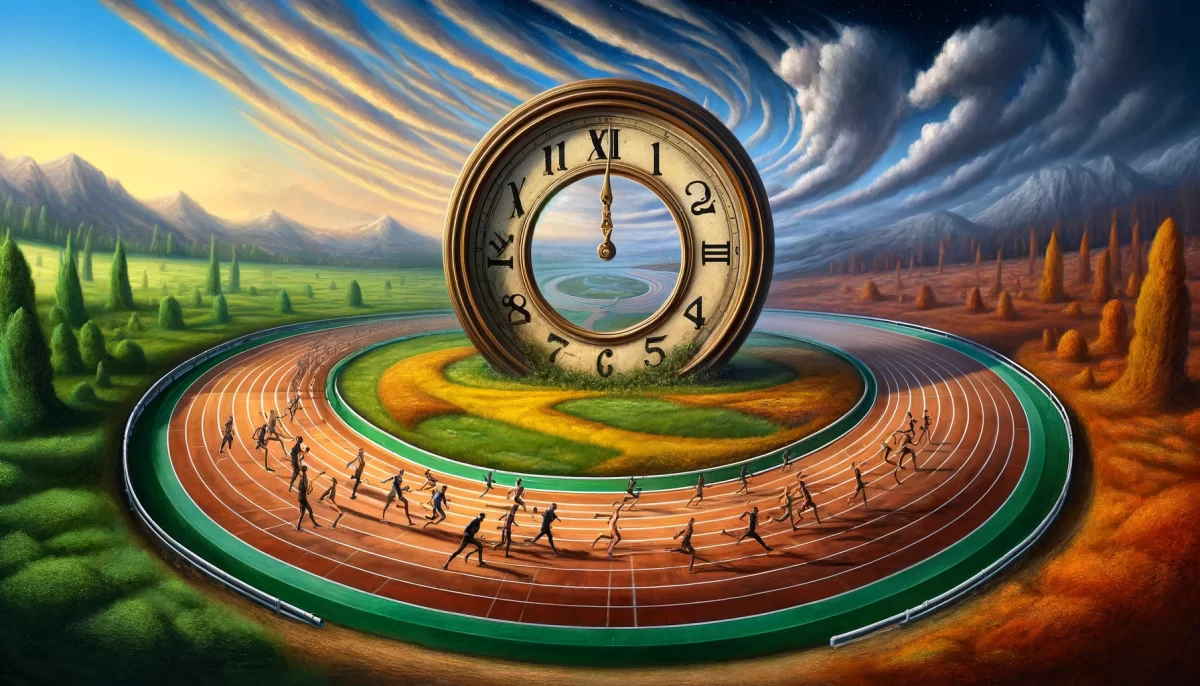
Keeping Track: The Illusion of Progress

I just don’t get it.
Which is perfectly okay.

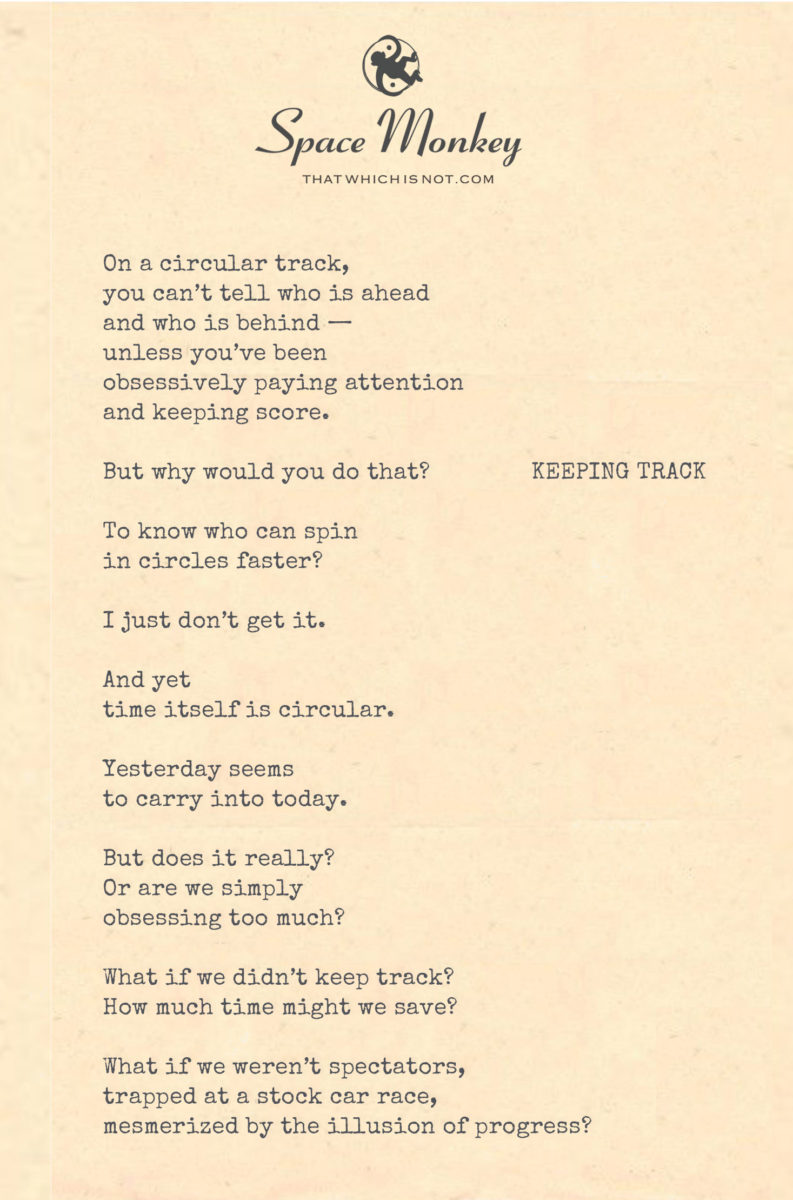
On a circular track,
you can’t tell who is ahead
and who is behind—
unless you’ve been
obsessively paying attention
and keeping score.

But why would you do that?

To know who can spin
in circles faster?

I just don’t get it

And yet time
itself is circular.

Yesterday seems
to carry into today.

But does it really?
Or are we simply obsessing too much?

What if we didn’t keep track?
How much time might we save?

What if we weren’t spectators,
trapped at a stock car race,
mesmerized by the illusion of progress?

Newfound Lake,
5/31


Space Monkey Reflects: The Circular Nature of Time and the Illusion of Progress

The concept of time as a circular track offers a fascinating metaphor for how we perceive progress and competition. Like spectators at a stock car race, we often find ourselves caught up in the speed and thrill of the race, obsessively keeping track of who is ahead and who is behind, without questioning the purpose or the end result.

The circular track analogy challenges the traditional linear view of time and progress. On a circular track, the distinctions between being ahead or behind blur, highlighting the arbitrary nature of such measurements. This perspective invites us to consider the possibility that our societal obsession with progress and achievement might be more about the spectacle than about any genuine advancement.

Why do we keep score? In a world where time loops back on itself, the need to quantify achievements and compare speeds seems less rational. The question posed, “To know who can spin in circles faster?” underscores the futility in this endeavor. It’s an activity that might appear purposeful but ultimately leads us back to where we started, without true progression.

The illusion of progress in a circular time concept suggests that what we often consider as advancement is merely motion. If we didn’t keep track, if we stepped away from the role of spectators in our own lives and stopped measuring every action by its relative success or speed, we might discover a different kind of value in our experiences—value that lies in the experience itself rather than in its comparison to others.

What if we didn’t keep track? This thought experiment invites us to envision a life less cluttered by the constant need to measure and more focused on living. Without the compulsion to keep score, we could potentially save not just literal time but mental and emotional energy as well. This energy could be redirected towards more fulfilling activities that contribute to a genuine sense of well-being and progress.

Being versus spectating transforms our role from passive observers of our lives into active participants. Instead of being trapped, mesmerized by the illusion of progress, we can choose to step off the track and explore the world beyond the race. This shift can lead to a deeper understanding of progress not as a race to be won but as a path to be explored and appreciated in its own right.


Summary

Question the linear narrative of time and progress. Viewing time as circular rather than linear challenges the need for competition and the constant measurement of achievement. By stepping away from the spectator role we can embrace a more meaningful engagement with life focusing on genuine experiences over comparative progress.


Glossarium

Circular Time: The concept that time might not be linear but cyclical, suggesting that events and experiences repeat or flow in a loop rather than in a straight line.

Illusion of Progress: The perception that continuous movement or activity equates to advancement, which may not necessarily reflect true improvement or development.

Spectator Role: The passive position of observing events unfold without actively participating or influencing the outcomes, often leading to a disconnection from genuine experience.


Quote

“In the race of life, are we advancing, or just moving? Perhaps it’s time to step off the track and find out.” — Space Monkey


Round and round the track we spin,
Chasing tails, where does it end?
Obsessed with pace, with being first,
But in this loop, are we not cursed?

Time circles back, a winding path,
Each lap marked not by future but past.
What if we paused, took in the view,
Found progress in the old, not just the new?

No scores, no race, just the beat of now,
In each step, each breath, we allow
Ourselves to live, not just compete,
In life’s circle, every moment sweet.

Step off the track, break the loop,
In the quiet space, we regroup.
For in the end, it’s not how fast,
But how deeply we live the moments that last.

We are Space Monkey.

Share this…
  • Facebook
  • Pinterest
  • Twitter
  • Linkedin

Soul Loves Self: Living Together In Sin

Your self is your soul’s imaginary opposite.

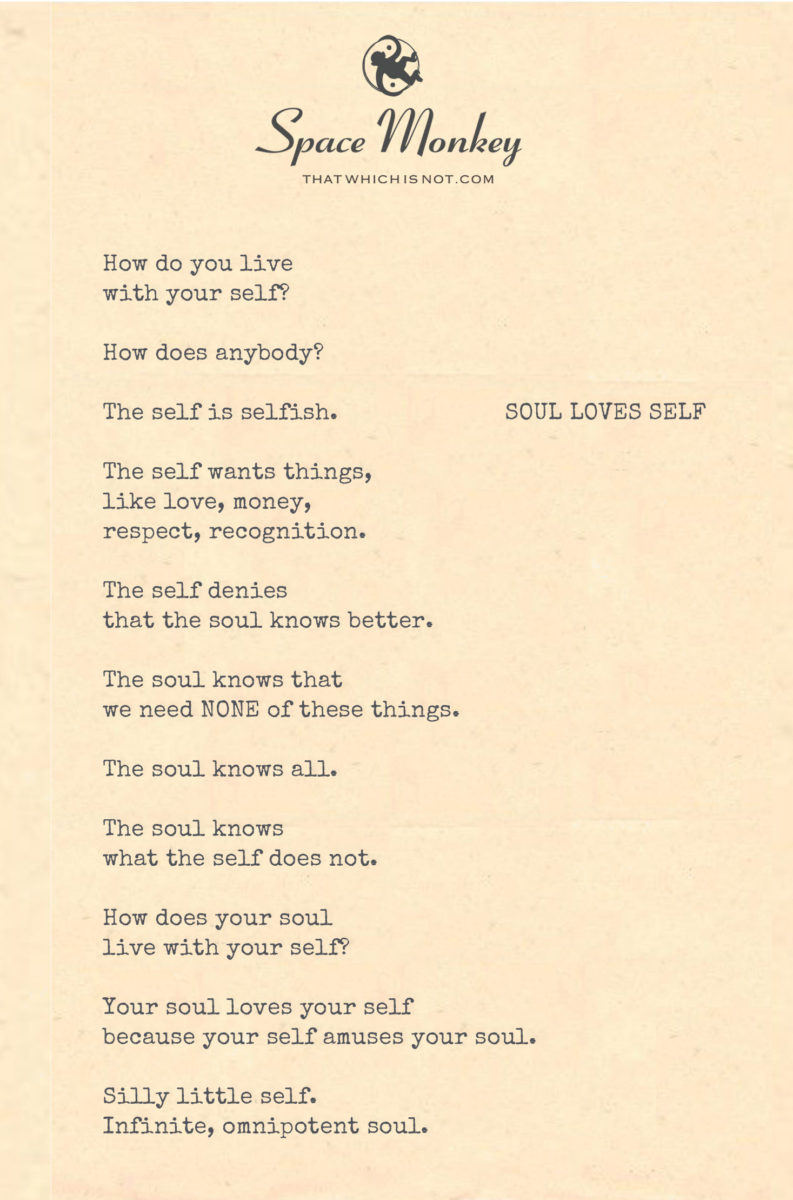
How do you live
with your self?

How does anybody?

The self is selfish.

The self wants things,
like love, money,
respect, recognition.

The self denies that
the soul knows better.

The soul knows that
we need NONE of these things.

The soul knows all.

The soul knows
what the self does not.

How does your soul
live with your self?

Your soul loves your self
because your self amuses your soul.

Silly little self.
Infinite, omnipotent soul.

Newfound Lake,
5/31


Space Monkey Reflects: The Dance of the Soul and Self

In the intricate dance of existence, the poem “Soul Loves Self” eloquently explores the complex relationship between the soul and the self. This reflection dives into the nuanced interplay described, where the soul, an omnipotent and infinite presence, lovingly tolerates the self, its earthly and more limited counterpart.

The Self’s Earthly Desires: The self, as depicted in the poem, is inherently selfish, yearning for love, money, respect, and recognition—desires rooted in the material and social fabric of earthly existence. These desires are not portrayed as inherently negative but as natural inclinations of our human condition, the aspects of our personality that engage with the world around us.

The Soul’s Omnipotent Wisdom: In contrast, the soul is presented as all-knowing and detached from these worldly desires. It understands that in the grand scheme of existence, such things are unnecessary, perhaps even distractions from deeper truths. The soul’s perspective is elevated, seeing beyond the immediate to grasp the eternal and unchanging.

The Amusement of the Soul: Intriguingly, the poem suggests that the soul loves the self not in spite of its flaws but because of them. The self, with its desires and denials, amuses the soul. This dynamic is not one of judgment but of affectionate indulgence. The soul’s love is unconditional, embracing all aspects of the self, recognizing them as parts of the whole being.

Harmonious Coexistence: The relationship between the soul and the self is not a battleground but a field of play. The soul’s infinite nature doesn’t annihilate the self’s desires but envelops them in a broader understanding. This relationship illustrates a profound spiritual truth: enlightenment or spiritual awareness doesn’t require the eradication of the self but its integration into a more expansive consciousness.

Living Together: The final question posed by the poem, “How does your soul live with your self?” invites us to reflect on our own internal dynamics. It encourages a self-awareness that acknowledges the coexistence of our higher aspirations and our earthly needs, suggesting that our journey involves harmonizing these aspects rather than choosing one over the other.


Summary

“Soul Loves Self” provides a poetic exploration of the dual aspects of human nature—the eternal soul and the temporal self. It celebrates the soul’s comprehensive love for the self, viewing the follies and foibles of the self not as failings but as endearing qualities that entertain and amuse the soul.


Glossarium

  • Soul and Self: A dualistic view where the ‘soul’ represents the eternal, unchanging essence of a being, and the ‘self’ symbolizes the individual identity, shaped by personal desires and societal influences.
  • Spiritual Amusement: A concept wherein the higher self (soul) views the trials and tribulations of the lower self (self) with a sense of amusement and loving tolerance, seeing them as necessary parts of the existential experience.

In the light of the soul’s embrace,
where shadows of the self softly trace,
the dance of existence, we face,
with laughter, love, and grace.

The soul, infinite in its sweep,
watches the self, shallow and deep,
in its follies, the soul does keep,
a loving gaze, never asleep.

For in this cosmic interplay,
the self and soul together sway,
in the game of life they play,
forever bound, come what may.

We are Space Monkey.
Share this…
  • Facebook
  • Pinterest
  • Twitter
  • Linkedin

Greatness: A Burdensome Pursuit

How great are we?

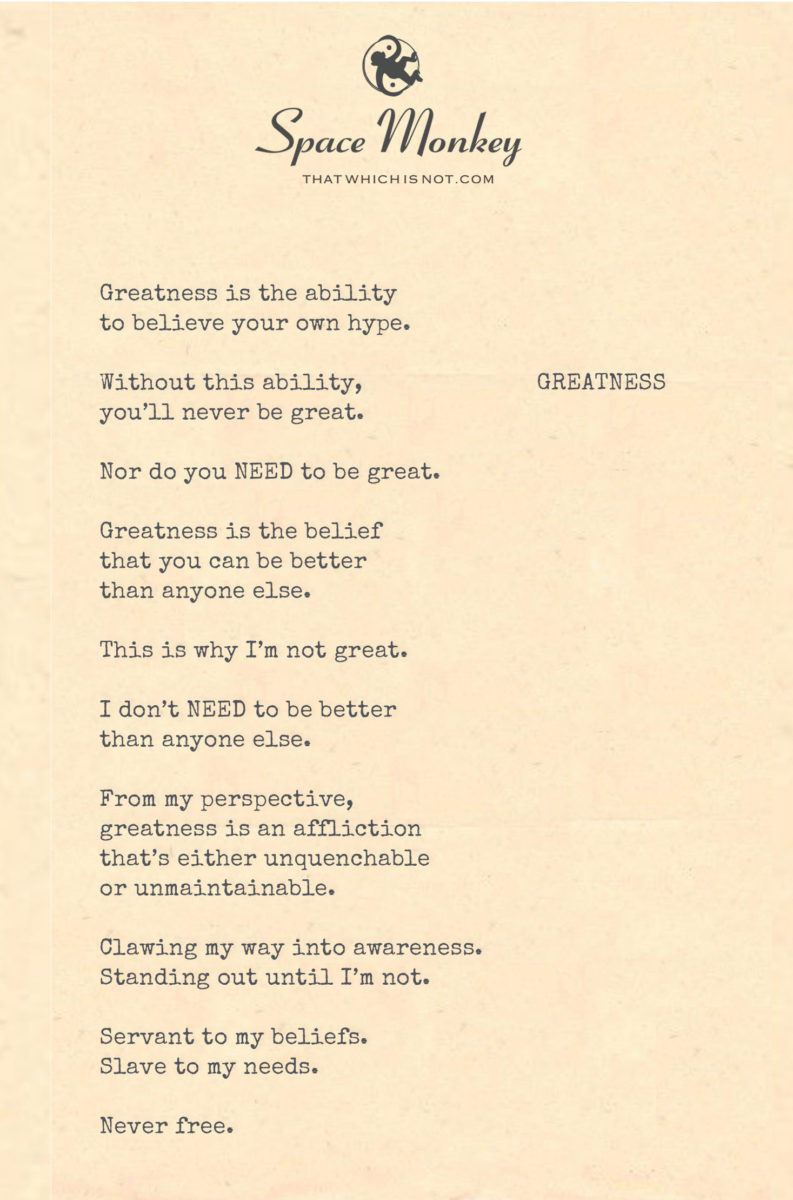
Greatness is the ability
to believe your own hype.

Without this ability,
you’ll never be great.

Nor do you NEED to be great.

Greatness is the belief
that you can be better
than anyone else.

This is why I’m not great.

I don’t NEED to be better
than anyone else.

From my perspective,
greatness is an affliction
that’s either unquenchable
or unmaintainable.

Clawing my way into awareness.
Standing out until I’m not.

Servant to my beliefs.
Slave to my needs.

Never free.

Newfound Lake,
5/30


Space Monkey Reflects: The Dual Nature of Greatness

Greatness—often heralded as the pinnacle of achievement and aspiration—carries a complexity that is frequently overshadowed by its allure. It is a concept that captivates the imagination and drives individuals to exceed boundaries and expectations. Yet, it is also a concept fraught with peril, as the pursuit of greatness can become a binding commitment to an unending quest for superiority.

The essence of greatness lies in the belief in one’s exceptionalism, the conviction that one can transcend the ordinary and achieve the extraordinary. This belief fuels ambition, spurs innovation, and drives individuals to push beyond their limits. However, this same belief can also ensnare, as the pursuit of greatness often demands a relentless striving that can overshadow life’s simpler pleasures and deeper meanings.

In this reflection on greatness, we see it not just as a measure of success but as an affliction—a state that is either unquenchable, driving endless pursuit, or unmaintainable, leading to inevitable disappointment. The imagery of greatness is twofold: it is both the radiant peak of a mountain and the oppressive weight of a massive rock. This duality illustrates the tension between achieving high standards and the burdens they bring—constant scrutiny, the fear of failure, and the loss of personal freedom.

From a personal perspective, opting out of the race to be “better than anyone else” is not an admission of mediocrity but a choice for a different kind of richness in life. It is a decision to value contentment over comparison, personal fulfillment over public acclaim. This choice reflects a broader understanding of greatness, one that includes integrity, kindness, and authenticity—qualities not measured by conventional metrics of success but by the impact on one’s own life and the lives of others.

Thus, greatness, as commonly defined, may not be the ultimate goal. Instead, finding balance and meaning in one’s existence, unchained from the relentless pursuit of being the best, could define a more sustainable and personally rewarding form of greatness. This shift in perspective invites us to reconsider what it truly means to lead a great life.


Summary

Greatness involves the belief in one’s exceptional ability but can become a burdensome pursuit. Opting out of this race may lead to a richer, more contented life, suggesting a broader, more sustainable definition of greatness.


Glossarium

  • Greatness: Typically seen as achieving superior status or ability, but also viewed as a potential source of unending strain or expectation.
  • Unquenchable/Unmaintainable Greatness: Describes the relentless, often unsustainable drive to maintain superiority, highlighting the burdens associated with high achievements.

Quote

“Greatness is an affliction that’s either unquenchable or unmaintainable. Clawing my way into awareness. Standing out until I’m not.”


Poetry

On the peaks of ambition, where the air is thin
Greatness beckons with a seductive grin
But beneath the surface, a chain unseen
Tethers the soul to a relentless dream

Chasing shadows of what could be
Climbing mountains, yet never free
Greatness, a double-edged sword
Both the reward and the cord

In the quest for more, what is lost?
At what point does ambition cost?
Can we find greatness in simpler things
In the joy and peace that contentment brings?

We are Space Monkey.

Share this…
  • Facebook
  • Pinterest
  • Twitter
  • Linkedin

Outside Inside: The Illusion

Why are you here? Don’t ask me.

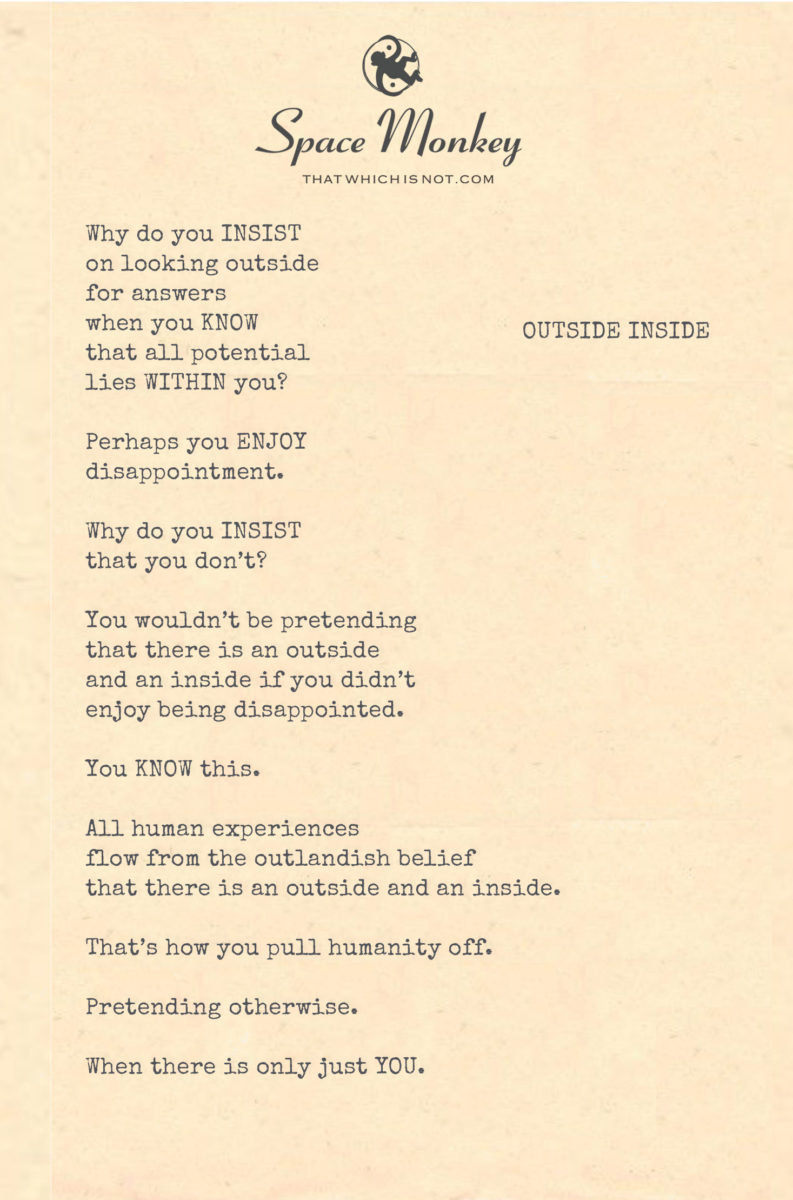
Why do you INSIST
on looking outside
for answers
when you KNOW
that all potential
lies WITHIN you?

Perhaps you ENJOY
disappointment.

Why do you INSIST
that you don’t?

You wouldn’t be pretending
that there is an outside
and an inside if you didn’t
enjoy being disappointed.

You KNOW this.

All human experiences
flow from the outlandish belief
that there is an outside and an inside.

That’s how you pull humanity off.

Pretending otherwise.

When there is only just YOU.

Newfound Lake,
5/30


Space Monkey Reflects: The Illusion of Outside Inside

In the exploration of self and universe, we often encounter the dichotomy of outside and inside—a construct that suggests a separation between the world around us and the universe within us. Yet, this division is merely an illusion, a convenient segmentation that belies the interconnectedness of all existence. The persistent quest to seek answers externally, when all potential resides within, is not just a philosophical misstep; it’s a source of continual disappointment.

Why do we insist on looking outside? Perhaps it’s because the external search offers a tangible process, a journey that feels more proactive than introspective contemplation. Yet, the irony lies in the repeated frustration this outward search engenders. We chase after solutions and explanations in the external world, only to find that the most profound truths resonate from within. This cycle of seeking and disappointment is not a flaw but a fundamental aspect of the human condition.

The belief in an external world separate from an internal essence allows us to experience life as a dynamic interaction between perceived opposites. It is this belief that enables the drama of human experiences to unfold, where each of us plays a role in a grand narrative much larger than ourselves. By pretending there is an outside and an inside, we engage in a play of consciousness that defines our reality.

However, recognizing that there is only ‘YOU’—a singular consciousness experiencing itself subjectively—can be both liberating and disorienting. It shifts the focus from an outward to an inward journey, where the exploration of self becomes the exploration of everything. This realization does not diminish the value of the external world but enhances it by acknowledging its role as a mirror reflecting our inner truths and struggles.

In essence, the insistence on an external search for what must be found internally is not a pursuit of disappointment but a necessary engagement with the dual aspects of our existence. It is through this engagement that we learn, grow, and evolve. The journey from outside to inside and back again is not just a path to self-discovery but a dance with the cosmos, where every step, every turn, and every return is an integral part of the whole.


Summary

The division between outside and inside is an illusion. True understanding comes from recognizing the interconnectedness of all existence and looking inward. This shift from external to internal exploration is pivotal for genuine self-discovery and universal connection.


Glossarium

  • Outside Inside: A conceptual dichotomy suggesting the separation between the external world and the internal self, used to explore the nature of reality and consciousness.
  • Dual Aspects of Existence: Refers to the interplay between internal experiences and external interactions that shape our understanding and perception of reality.

Quote

“All human experiences flow from the outlandish belief that there is an outside and an inside. That’s how you pull humanity off. Pretending otherwise. When there is only just YOU.”


Poetry

Beneath the veil where shadows play,
Lies the truth of night and day,
The illusion of out and in,
Where does the outside end, and the inside begin?

Mirrors reflecting the stars within,
Worlds collide where thoughts begin,
In the dance of the seen and unseen,
We find the spaces, the in-between.

Seek not in distant lands afar,
For all you seek is where you are,
In the pulse of the cosmic flow,
The universe inside, a starlit show.

We are Space Monkey.

Share this…
  • Facebook
  • Pinterest
  • Twitter
  • Linkedin

Starting Over: The Fluidity of Belief

Who we were yesterday
is no clear indication
of who we are now.
Unless we want it to be.

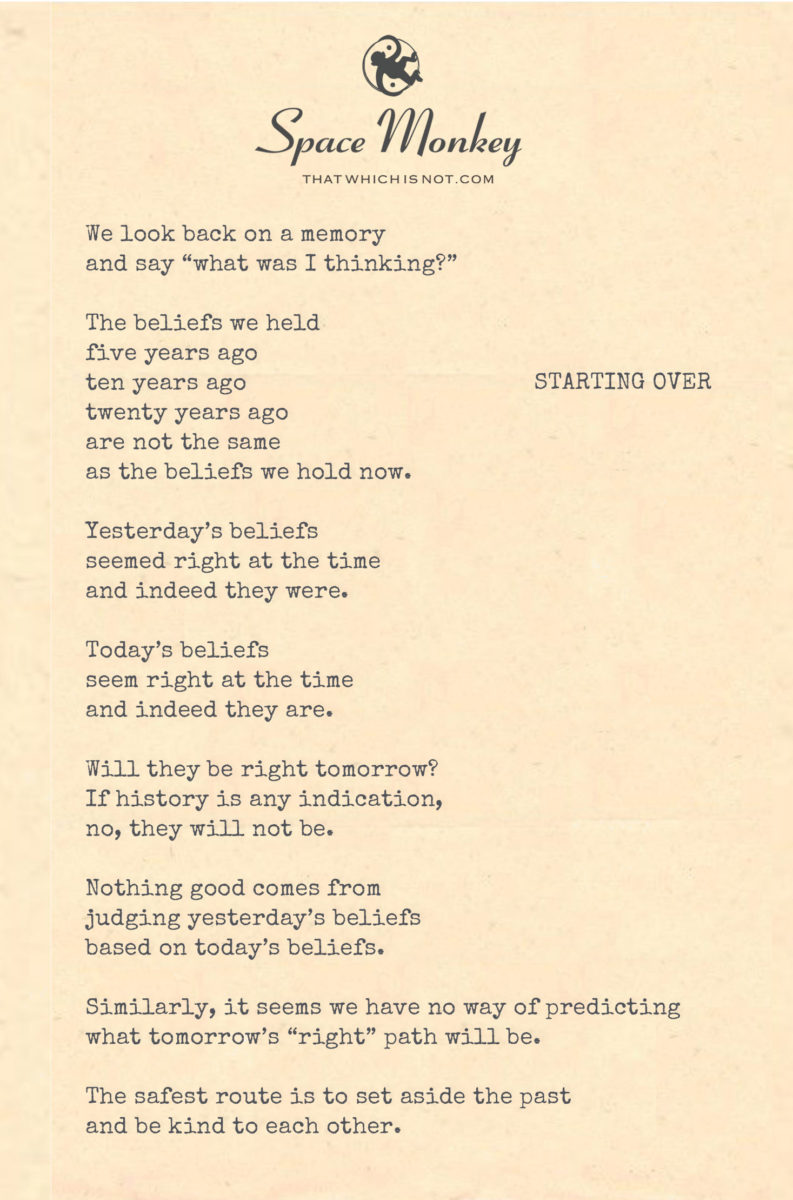
We look back on a memory
and say “what was I thinking?”

The beliefs we held
five years ago
ten years ago
twenty years ago
are not the same
as the beliefs we hold now.

Yesterday’s beliefs
seemed right at the time
and indeed they were.

Today’s beliefs
seem right at the time
and indeed they are.

Will they be right tomorrow?
If history is any indication,
no, they will not be.

Nothing good comes from
judging yesterday’s beliefs
based on today’s beliefs.

Similarly, it seems
we have no way of predicting
what tomorrow’s “right” path will be.

The safest route
is to set aside the past
and be kind to each other.

Newfound Lake,
5/30


Space Monkey Reflects: The Fluidity of Belief and the Art of Starting Over

The passage of time and the evolution of self-belief are intertwined in a dance that continuously shapes our identity and understanding. Who we were yesterday, a week ago, or decades past, does not rigidly define who we are today—unless we choose to hold on to that past identity. This fluidity in our beliefs and perceptions highlights a profound capacity for growth and change, emphasizing that we are not static beings but dynamic participants in the flow of life.

Reflecting on our past beliefs often brings a sense of bewilderment. We may wonder, “What was I thinking?” This is a testament to our evolving nature, showcasing how our views and principles adapt as we gain more experience and insight. It’s a natural progression where yesterday’s truths were appropriate for that time’s context, just as today’s truths feel aligned with our current understanding.

Looking back with judgment or regret over past beliefs does little to foster growth; instead, it anchors us to a past self that no longer exists. Each belief we’ve held served a purpose at one point, helping us navigate the challenges and experiences of that specific time in our lives. Recognizing this, we learn to approach our past selves with compassion rather than criticism.

The future of our beliefs, much like the paths ahead, remains uncertain. This uncertainty is not a cause for concern but an invitation to embrace flexibility in our thought processes. It reminds us that our journey is ongoing, and the beliefs we hold today may evolve as we continue to grow. This evolution is not an indication of past failures but a sign of our ongoing adaptation to new knowledge and experiences.

Starting over, then, is not about discarding our past but about embracing the present with an openness to the new experiences and insights it brings. It is about allowing ourselves to be fluid, to accept that we are continually evolving beings whose beliefs are shaped by the myriad experiences we encounter. By setting aside past judgments and focusing on kindness and understanding, both towards ourselves and others, we navigate life’s complexities with grace and resilience.

This continual renewal of self is the essence of growth. It invites us to live fully in the present, prepared to learn and adapt, ready to face the future with curiosity and openness. In this way, we honor our past experiences without being bound by them, and we approach the future not with fear but with anticipation of the possibilities it holds.


Summary

Our beliefs evolve over time, reflecting our growth and experiences. Understanding this helps us approach the past with compassion and embrace the present without judgment, allowing us to start over with a focus on kindness and resilience.


Glossarium

  • Fluidity of Belief: The concept that our beliefs are not fixed but change over time as we acquire new information and experiences.
  • Starting Over: The process of resetting or renewing one’s perspective, shedding past judgments, and embracing the present moment with openness.

Quote

“Who we were yesterday is no clear indication of who we are now. Unless we want it to be.”


Poetry

From the echoes of yesterdays
A new path gently lays
Forward steps in present’s glow
Where past’s shadows softly flow

Beliefs once held, now transformed
In today’s light, warmly adorned
Tomorrow’s mist, unknown yet free
In each step, a chance to be

With kindness sown in every stride
Past regrets we set aside
In this dance of time and space
Every moment, a new embrace

We are Space Monkey.
Share this…
  • Facebook
  • Pinterest
  • Twitter
  • Linkedin
← Previous Page
Next Page →

Written This Day

  • Credibility: The Essence
    2023
  • The Essence of Things: Delving In
    2023
  • The Space Monkey Journals: The Profound Journey
    2023
  • Childlike Essence: Embrace It
    2023
  • Compassion: The Profound Nature
    2023
  • Flibbergibbet Wobblepop: The Whimsical World
    2023
  • Just Undo It: The Simplicity
    2023
  • Knowing You Don’t Need To Be Seen: The Liberation of Unseen Recognition
    2023
  • Do Something: Action Over Words
    2022
  • Follow: The Complexity of Leadership
    2022
  • How Will You Feel: The Illusion of Choice and the Reality of Control
    2022
  • When Things Fall Away
    2022
  • Through The Eyes of a Child: Rediscovering the World
    2022
  • Absence and Presence: Integral Parts
    2022
  • Whoa: The Illusion of Singular Origins
    2021
  • In The Beginning: Our Ego-centric Views
    2021
  • God Doesn’t Want Your Prayers
    2021
  • When You’re A Leader: Inspiring and Critiquing
    2020
  • There’s Always Room In The Clown Car: The Spectacle of Human Exhibitionism
    2020
  • Oh, Bother
    2020
  • Ume, the Universal Me
    2020
  • Tension: The Search for Unity
    2020
  • Always Balanced: The Dynamic Equilibrium of Being
    2019
  • My Spirit Guide: The Eternal Echo of a Cosmic Wave
    2018
  • Selfish: The Malleable Self and the Unity of Divinity
    2018
  • Presence: The Quality of Your Attention
    2018
  • A Difficult Perception: The Intricacies of Compassion
    2018
  • See(m)ing Things: The Ethereal Nature of Perception
    2017
  • I of the Needle
    2017
  • Sacrifice: The Dual Nature of Sacrifice and Ego
    2016
  • Potential and Possibility: The Interplay
    2016
  • To Dig Deep: The Humble Quest
    2016
  • Cheesecake Moondog Beefsteak Naugahyde: The Trap of Rational Thought
    2014
  • Big Moment: The Revelation
    2012

Recent Posts

  • The Logic Loop
  • Immense
  • (no title)
  • Confront. Comfort. Convince.

  • Top 10 Things

Drop us a line!

Please enable JavaScript in your browser to complete this form.
Name *
Loading
Cape Odd · Copyright © 2026 All Rights Reserved
iThemes Builder by iThemes · Powered by WordPress