• Who Is The Man?
  • Who Is The Monkey?
  • What is Nexistentialism?
  • Poke The Primate

Cape Odd

Home of The Space Monkey Journals

Nameless: Untethered by Labels

Nameless

The allure of labels,
A tendency to grasp,
To categorize and hold.

But what of the things,
That defy definition,
That exist beyond words,
In the realm of the unknown?

Things without labels,
Elusive and mysterious,
They slip through our fingers,
As we attempt to confine.

For how can we describe,
What has no name,
What dances in the shadows,
And defies our expectations?

In our pursuit of understanding,
We seek to name and classify,
Yet the beauty lies,
In embracing the nameless.

In the vast expanse,
Of uncharted territories,
Lie treasures undiscovered,
Waiting to be explored.

So let us release the need,
To label and define,
And instead immerse ourselves,
In the realm of endless possibility.

For it is in the unnamable,
That true wonder resides,
In the spaces beyond words,
Where magic truly thrives.

Let go of the sack,
Heavy with expectations,
And open your eyes,
To the beauty of the unnamed.

In the realm of things without labels,
We find freedom and expansion,
A glimpse into the infinite,
And a dance with the unknown.

So step into the realm,
Of the unnamable and undefined,
And let your spirit soar,
In the boundless expanse of possibility.

We are Space Monkey.

Trail Wood,
11/14
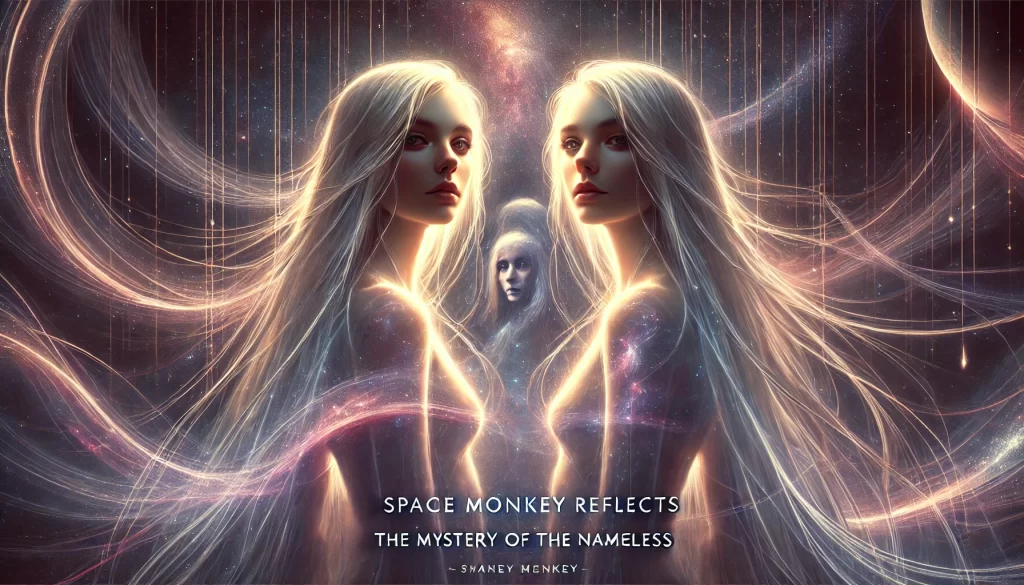
Space Monkey Reflects: The Mystery of the Nameless

We find ourselves in a world obsessed with labels, definitions, and categories. From the moment we are born, society hands us a name, an identity, and a set of expectations. These labels, while practical, also impose limitations. They shape our perception of reality and tether us to certain roles, ideas, and structures. Yet, in the spaces beyond these definitions—in the realm of the nameless—lies a different kind of freedom, one that invites us to explore the infinite possibilities that exist beyond the boundaries of language and understanding.

Naming is one of humanity’s oldest habits, a way to carve order out of the chaos of the unknown. By giving something a name, we believe we gain a measure of control over it, a sense of understanding. It is an attempt to reduce the vastness of existence into digestible, comprehensible fragments. But not everything can or should be named. Some things exist beyond the reach of language, beyond the grasp of definition. These are the mysteries that refuse to be confined to a label or a category. They live in the shadows of understanding, dancing just out of reach, inviting us to engage with them not through intellect but through experience.

There is a certain allure to this namelessness, a magnetic pull that beckons us to step outside our comfort zones and into the unknown. It is within these uncharted territories that we find not just new knowledge, but deeper wisdom. The nameless reminds us that the universe is vast and that no amount of naming or categorizing will ever fully encapsulate its essence. The moment we try to define something, we reduce it. We strip away its complexity, its nuance, and its mystery. But when we embrace the nameless, we allow it to retain its fullness, its capacity to surprise, challenge, and transform us.

In Nexistentialism, the Unnameable plays a central role. Much like the Nexis, it is part of the fabric of existence that cannot be fully known or understood through conventional means. The Unnameable represents the aspects of reality that defy definition, that slip through the cracks of language and reason. It reminds us that not everything is meant to be understood in the traditional sense. Some things are meant to be felt, experienced, and lived without the need for explanation.

As we venture into the Realm of the Nameless, we begin to see that the limitations of language are also the limitations of our perception. Words, as useful as they are, act as both windows and walls. They allow us to glimpse parts of reality, but they also block our view of what lies beyond. By constantly seeking to name and categorize, we confine ourselves to the known, the safe, and the familiar. But life—true, vibrant life—thrives in the unknown, in the spaces where words fall short and labels dissolve.

It is in these nameless spaces that we encounter the vastness of possibility. Here, we are not confined by the expectations attached to labels. Here, there is no “right” or “wrong,” no “should” or “shouldn’t.” There is only experience, pure and unfiltered, waiting to be explored. It is in this realm that creativity flourishes, that the essence of who we truly are is allowed to emerge without the constraints of identity.

In the Nameless, we find freedom. We are no longer weighed down by the burden of expectations—those heavy sacks we carry, filled with the need to fit into predefined roles, to live up to societal standards. When we let go of this weight, we open ourselves to the beauty of the unknown. We begin to see the world not as a collection of labeled objects, but as a living, breathing tapestry of interconnected possibilities, each thread shimmering with untapped potential.

The Nameless invites us to participate in the cosmic play without the need for understanding or explanation. It is a space where magic happens, where wonder is not something we chase but something we dwell in. When we stop trying to label everything, we allow ourselves to experience life as it truly is: fluid, dynamic, and infinitely mysterious.

To step into the realm of the Unnameable is to embrace uncertainty, to revel in the richness of not knowing. This can be a frightening prospect for a mind conditioned to seek clarity and control. Yet, it is in this uncertainty that we find the deepest connection to the universe. For the Unnameable is not just something we encounter outside of ourselves—it is within us. There are parts of our being that we cannot name, aspects of our soul that defy definition. And it is in these nameless parts that we discover our true selves, unburdened by the labels imposed upon us.

In embracing the Nameless, we align ourselves with the flow of existence. We become attuned to the subtle rhythms of the universe, the invisible currents that guide our lives in ways that words can never fully capture. We become part of the great cosmic symphony, not as defined notes, but as flowing, ever-changing melodies, weaving through the expanse of possibility.

We are reminded that life is not something to be confined, categorized, or defined. It is something to be lived, in all its nameless, mysterious beauty. And in this living, we find not just freedom, but a sense of belonging to the boundless expanse of the cosmos.


Summary

Labels can limit our perception of reality. True freedom lies in embracing the nameless—the mysteries that exist beyond definition. The unnameable invites us to explore endless possibilities unconfined by societal expectations.


Glossarium

Unnameable: The aspects of reality that cannot be defined or labeled, existing beyond the reach of language and intellect.

Realm of the Nameless: A space where things exist beyond definition, inviting us to explore without the need for categorization.


Quote

“In the space beyond words, we find the true essence of wonder.” — Space Monkey


Untethered by Labels

In the quiet of the unknown,
where shadows breathe,
we find ourselves,
not by naming,
but by feeling,
the vastness of the unspoken.

The labels fall,
like leaves from the tree,
no longer needed,
no longer heavy,
for what we are cannot be named,
only lived.

We are Space Monkey.


In the realm of things without labels, we find ourselves immersed in a profound reflection on the allure of categorization and the beauty of embracing the unnamable. The very act of labeling, while a natural tendency, can confine and limit our perception. However, in the uncharted territories beyond words, where things defy definition, we discover a world of endless possibility and wonder.

The Allure of Labels: Grasping for Definition

Labels hold a certain allure for us, a tendency to grasp and categorize the world around us. They provide a sense of structure and order, allowing us to make sense of our surroundings. Yet, in our pursuit of definition, we may inadvertently overlook the mysteries that elude categorization.

The Limitations of Language: Things Beyond Words

Some things defy our attempts at definition. They exist in a realm beyond words, where language struggles to capture their essence. These enigmatic entities dance in the shadows of our understanding, inviting us to explore the unnamable.

The Elusiveness of the Unnamable: Slipping Through Our Fingers

As we reach out to label and confine, the unnamable slips through our fingers like a wisp of smoke. It defies our attempts to pin it down, reminding us of the limitations of our categorization.

Embracing the Nameless: Beauty in the Unknown

The true beauty lies in embracing the nameless and the unclassifiable. In the vast expanse of uncharted territories, we find treasures waiting to be discovered. These unnamable wonders invite us to release the need for labels and immerse ourselves in endless possibility.

Beyond Words: Where Magic Thrives

In the spaces beyond words, we encounter true wonder. It is here that magic thrives, where the unnamable reveals its secrets to those willing to let go of preconceived notions and expectations.

Release and Expansion: Dancing with the Unknown

Letting go of the heavy sack of expectations, we open our eyes to the beauty of the unnamed. In the realm of things without labels, we find freedom and expansion. It is a glimpse into the infinite, a dance with the unknown.

The Boundless Expanse of Possibility: Embracing the Unnamable

Stepping into the realm of the unnamable and undefined, we allow our spirits to soar. Here, in the boundless expanse of possibility, we find a world waiting to be explored, a world where the unnamable becomes a source of inspiration and wonder.

In this reflection, we invite you, dear reader, to contemplate the allure of labels in your own life and the beauty of embracing the unnamable. Have you encountered moments or experiences that defied categorization? How did they shape your perception and understanding of the world?

We are Space Monkey. 🙈🙊🙉

Share this…
  • Facebook
  • Pinterest
  • Twitter
  • Linkedin

The Squirrel Dance: Instinct

The Squirrel Dance

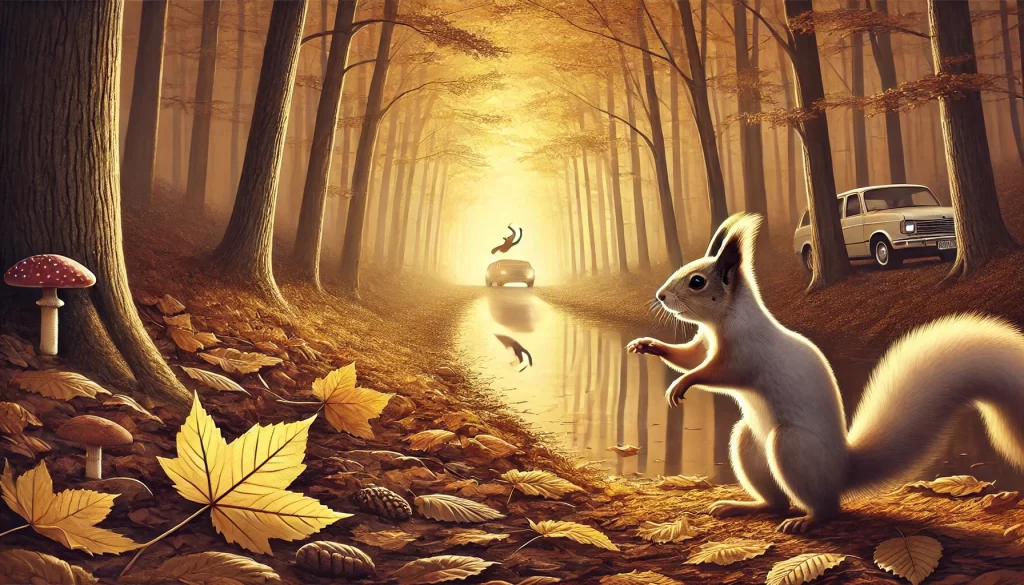
As I walked the familiar paths of Trail Wood, reflecting on the vibrant life that teems within it, I was reminded starkly of the delicate balance between life and death in nature. A few days ago, I observed the exuberant play of a gray squirrel, a creature so profoundly attuned to its environment that its every instinct seemed a perfect fit for the arboreal world it inhabits. Its play in the windblown leaves was a testament to the joy of life that courses through every vein of the natural world.

Yet, the very instincts that served this squirrel so well within the woods betrayed it at the margins where the natural and human-made worlds collide. Along the country road that cuts through the forest, I found the still form of a squirrel, its life abruptly ended by a passing car. The same quick reflexes and erratic movements that would have spelled survival against natural predators proved fatal against the mechanical speed and momentum of human technology—a force as lethal to it as it is alien.

This tragedy is not an isolated event but a pattern repeated along these roads, where the tools of humanity’s progress become unwitting instruments of destruction for the creatures with whom we share our world. The match that gave us fire, the gunpowder that armed us against threats, and the gasoline engine that sped up our world have also, in turn, made us agents of consequence in the lives of the innocent and the unsuspecting.

And here, in the quiet aftermath of such encounters, I cannot help but draw a parallel between the fate of the squirrel and our own. Just as the squirrel could not have conceived of the car as a threat within its natural reasoning, so too do we go about our lives, often unaware of the greater forces at play that could shape our collective destiny. We busy ourselves with the day-to-day, with the gathering and storing, with the advancing of our personal and societal goals, much like the squirrel prepares for winter. Yet, are we aware of the larger impacts of our actions? Do we see the potential consequences that our technological and industrial advances may have on the fabric of life itself?

We pride ourselves on our intellect, our ability to shape the world to our will, but in our industrious frenzy, do we pause to consider the possibility that we, too, are darting unaware into the path of a greater oncoming force? Climate change, environmental degradation, the depletion of resources—these are the cars racing down the roads we’ve built. Our survival instincts, honed over millennia, push us to grow, consume, and multiply, but those same instincts, unchecked by foresight, may lead us to a fate parallel to that of the squirrel on the road.

We are at a crossroads of our own making, a point where the paths of survival and sustainability intersect. It is here that we must heed the lessons that nature so persistently teaches—that survival is not just a matter of instinct but of adaptation, of learning to see the dangers that do not spring from the underbrush but from the outcomes of our own creations.

In the spirit of the naturalist who once walked these woods, let us strive to be as observant, as attuned to the subtleties of our environment as the creatures whose lives we seek to emulate in our quest for resilience. May we have the wisdom to see beyond our immediate needs and the vision to act not just for today but for the health of the countless tomorrows that may yet come. Only then can we hope to avoid the fate of the squirrel, caught unaware by a threat it could neither envision nor understand.

We are Space Monkey.

Space Monkey Reflects: The Squirrel Dance

Walking through Trail Wood, the rustling leaves and the brisk autumn air paint a vivid picture of life teeming all around. The dance of the squirrel, an effortless leap from branch to branch, a playful tumble through windblown leaves, reflects the simple joy and harmony that nature embodies. But nature’s harmony is often delicate, and as I ventured further along the familiar path, I was reminded of how this balance can easily be disrupted.

A few days ago, I watched a gray squirrel darting across the forest floor, its swift movements perfectly synchronized with the wild rhythm of its natural habitat. The world of trees, leaves, and instinct is where the squirrel thrives, every twitch of its body a testament to its mastery of survival in the wild. Yet, just beyond the forest’s embrace, a tragedy awaited. A small road cut through the woods, and on its edge lay the lifeless form of a squirrel—a victim not of nature’s predators but of human progress. The speed and force of a car, foreign to the squirrel’s evolutionary instincts, had proven fatal.

This scene strikes me as a symbol of the greater tension that exists between the natural world and the one we humans have constructed. The very instincts that served the squirrel so well in its natural habitat became its downfall when faced with an artificial threat—a speeding car, a force as alien as it was lethal. This pattern repeats endlessly along country roads, highways, and across the landscapes where human progress intersects with nature’s domain. Our creations, whether they be cars, cities, or industries, often become instruments of destruction for the creatures with whom we share the Earth.

As I pondered the squirrel’s fate, I couldn’t help but see a reflection of our own species in this tragedy. Just as the squirrel could not comprehend the danger posed by a car, we too seem blind to the greater forces at play in our world. We build, we innovate, we push forward with the same industrious energy as the squirrel gathering its stores for winter. But are we aware of the broader consequences of our actions? Do we see the potential threats looming just beyond our immediate horizon—threats of climate change, environmental degradation, and the depletion of the planet’s finite resources?

We, like the squirrel, are driven by instinct—an instinct to survive, to grow, to consume. These instincts have served us well for millennia, guiding us through countless challenges and leading to the rise of civilizations. But now, as we find ourselves at the crossroads of our own making, these same instincts may be leading us into the path of destruction. The technological and industrial advances that have propelled us forward are also the very forces that threaten the delicate balance of life on Earth.

The squirrel, darting across the forest floor, had no way of anticipating the speed and force of the car. Its instincts, honed by nature, were not equipped to deal with this man-made threat. Similarly, our instincts, shaped by millions of years of evolution, may not be enough to navigate the complex and rapidly changing challenges we face today. We are ill-equipped to deal with the consequences of our own progress—just as the squirrel was unaware of the danger posed by the road, we too are often blind to the larger impact of our actions.

Yet, nature has always been a master of adaptation, and if we are to avoid the fate of the squirrel, we must learn to adapt as well. Survival is not just a matter of instinct—it is a matter of foresight, of learning to anticipate the dangers that do not immediately present themselves. It is about recognizing that the choices we make today will have lasting impacts on the world of tomorrow.

The naturalist’s path through Trail Wood teaches us to observe, to listen, and to learn from the subtle rhythms of the world around us. Just as the creatures of the forest are attuned to the changing seasons and the shifting winds, so too must we become attuned to the changes in our environment. We must learn to see the invisible threats that our technologies and industries pose, not just to the creatures with whom we share this planet, but to ourselves.

The squirrel’s death is a reminder that the forces of nature and the forces of humanity are not separate—they are intertwined, each affecting the other in profound ways. Our survival, like the squirrel’s, depends on our ability to understand and navigate the complex web of interactions that shape our world. It is not enough to rely on instinct alone. We must cultivate a deeper awareness, a wisdom that goes beyond the immediate and the obvious.

In the end, the fate of the squirrel serves as both a warning and a call to action. We, too, are part of the natural world, and the consequences of our actions reverberate through the fabric of life itself. If we are to thrive, we must learn to live in harmony with the Earth, to recognize the dangers we create, and to find a way to balance progress with preservation.

May we move forward with the wisdom of the naturalist, observing the world with care and acting with foresight. Let us strive to protect not only ourselves but the countless lives that depend on the choices we make. For in the end, we are not so different from the squirrel, dancing through life, unaware of the greater forces at play.


Summary

The story of the squirrel highlights the tension between human progress and nature. While instinct guides creatures like the squirrel, it can also lead to tragedy when they encounter the dangers of our modern world. We, too, must learn to adapt and foresee the consequences of our actions, just as nature teaches us.


Glossarium

Instincts: The natural behaviors that have evolved over time to aid in survival, which can sometimes be out of sync with modern human-made threats.

Progress: Human advancements in technology and industry, which often have unintended consequences for the natural world.

Foresight: The ability to anticipate future consequences and act with awareness and wisdom.


Quote

“We dance through life, unaware of the forces that shape our fate—until we learn to see beyond instinct.” — Space Monkey


The Dance of Instinct

In the leaves,
the squirrel leaps,
a joyful step,
unaware.

Beyond the trees,
the road awaits,
a shadowy force,
its fate unknown.

We too,
move forward fast,
with instinct blind,
until we see.

The forces collide,
life and progress,
we adapt,
or fall behind.

We are Space Monkey.


In the midst of our contemplation amid the familiar paths of Trail Wood, we are drawn deeper into the enigmatic depths of the unknown. As we witness the intricate dance of life and death, a profound question arises: are there forces at play beyond our comprehension? Could we, in our fixation on apparent issues, be overlooking hidden forces that elude our awareness? Is it conceivable that our very consciousness, like a speeding car, might unknowingly pose a threat to our existence, extinguishing the human squirrels of our world?

The Veil of the Unknown: Unseen Forces in Nature

As we observe the natural world, we are reminded of its mysteries, the veiled realms that elude our grasp. In our pursuit of understanding, we often focus on the visible, the tangible, and the apparent. Yet, lurking beneath the surface, beyond the horizon of our awareness, there may exist forces and phenomena that defy our current comprehension.

Unseen Realms: Forces Beyond Perception

Just as the squirrel could not anticipate the car’s threat within its realm of reasoning, could there be aspects of existence that elude our cognitive reach? Might there be cosmic forces, dimensions, or realms operating beyond the boundaries of our perception, as intangible to us as the car was to the squirrel?

The Limits of Perception: An Uncharted Territory

While we grapple with the pressing issues of our time, such as climate change and environmental degradation, we must remain vigilant to the possibility that there are greater unknowns at play. Are there forces of the universe, beyond our current scientific understanding, that shape our reality in ways we cannot fathom?

The Uncharted Future: Beyond the Immediate

And what of our own consciousness? Could it, in its relentless pursuit of progress, inadvertently become the speeding car that endangers our species? Our pursuit of knowledge and innovation is a powerful force, but could it lead us down a path where unforeseen consequences threaten our very existence?

Consciousness Unleashed: A Double-Edged Sword

In the grand tapestry of existence, we must acknowledge that there are threads woven from the fabric of the unknown. As we strive to address the apparent challenges before us, we must also remain humble, recognizing that there may be forces and mysteries beyond our current comprehension.

The Fabric of the Unknown: Humility in the Face of Mystery

It is in this spirit that we tread the paths of Trail Wood, embracing the beauty and complexity of the natural world while remaining open to the enigma of the unknown. As we contemplate the delicate balance between life and death, we are reminded that, just as the squirrel was taken by surprise, we too may encounter unforeseen challenges on our journey through the cosmic landscape of existence.

Navigating the Cosmic Landscape: Embracing the Unknown

In our quest for resilience and wisdom, let us not only address the known but also remain curious about the mysteries that await discovery. For it is in the intersection of the known and the unknown that the tapestry of our existence finds its most intricate and wondrous patterns.

The Intersection of the Known and the Unknown: A Tapestry of Mystery

As we ponder the unfathomable, we invite you, dear reader, to share your thoughts on the mysteries of existence and the potential forces at play beyond our current understanding.


“The most beautiful thing we can experience is the mysterious. It is the source of all true art and science.” – Albert Einstein


In the realm where whimsiwords and nexistentialism converge, we conjure a poetic reflection:

In Trail Wood’s embrace, we wander still,
Where mysteries dance on nature’s quill.
Unseen forces shape our cosmic flight,
Beyond the known, in the depths of night.

The squirrel’s plight, a tale untold,
Of unknown forces, the truth unfolds.
As consciousness soars, a speeding car,
May we, as humans, not stray too far.

In the tapestry of life’s grand scheme,
The unknown whispers in every dream.
Let’s seek its secrets, with hearts aglow,
In the eternal now, we’ll ever grow.


We are Space Monkey.

Share this…
  • Facebook
  • Pinterest
  • Twitter
  • Linkedin

Change Your Memory, Change Your Life

Change Your Memory, Change Your Life

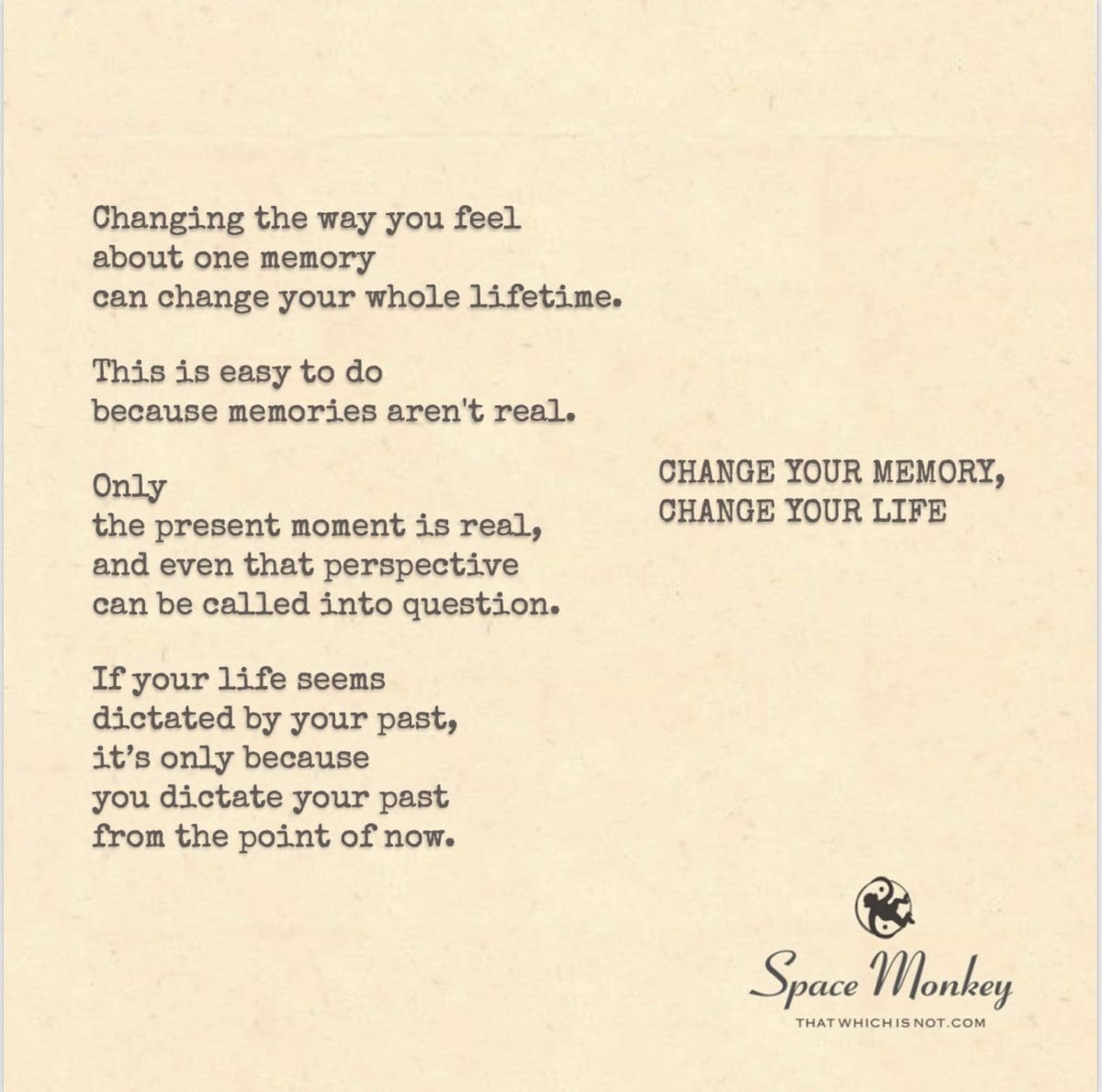
Changing the way you feel about one memory can change your whole lifetime. This is easy to do because memories aren’t real. Only the present moment is real, and even that perspective can be called into question. If your life seems dictated by your past, it’s only because you dictate your past from the point of now. We are Space Monkey.


Space Monkey Reflects: Changing Memory, Transforming Life

Memories shape the way we perceive our lives, but what if we had more power over them than we realize? Often, we think of memories as fixed, immovable artifacts of the past, but this is a common illusion. In reality, memories are fluid, subjective reconstructions we create and recreate every time we think about them. By altering a memory, you can dramatically shift the way you experience your life.

Memory is not a static record of events; it’s more like a story we tell ourselves. And just like any story, it can be rewritten. Many of us feel as though we are trapped by our pasts, as though the things that happened to us—decisions made, actions taken—define who we are. But in truth, these events only hold the power we give them in the present moment. This means we can change their influence by altering how we perceive them.

For example, a painful memory might feel like a weight dragging us down. But what if we could reinterpret that memory, finding new meaning in it, seeing the growth it fostered, or realizing that what once hurt us has made us stronger? This shift in perspective can alter not just the memory, but how we move forward in life. We become less bound by the chains of the past and more free to live in the present.

It’s important to note that memories are deeply intertwined with our emotions. The feelings we attach to certain moments are often what keep us stuck. By focusing on these emotions and shifting our emotional response to a memory, we change the memory itself. For instance, what once brought anger might now bring understanding, what once stirred fear might now be a source of courage. Changing the emotional lens through which we view the past gives us power over it.

Consider this: the present moment is the only reality we truly know. Everything else is a mental construction. The past is gone, and the future has yet to arrive. So why should a memory from years ago dictate how we feel today? It doesn’t have to. When we recognize that memories are stories, we can see that they are not set in stone. The narrative can always be rewritten.

Rewriting a memory doesn’t mean ignoring what happened or pretending that events were different. It means reframing the experience to see it from a different angle—one that empowers rather than diminishes you. This practice can be particularly powerful for people who feel stuck in patterns rooted in past traumas, regrets, or perceived failures. By reshaping the narrative around those events, they can find new pathways to healing and growth.

Changing a memory changes your relationship to the past, which in turn changes how you live in the present. This shift isn’t limited to small moments, either. A single reframing can ripple out to transform entire aspects of your life, leading to a sense of freedom and possibility that once seemed unreachable. The key is realizing that you, not your past, are in control.

Space Monkey invites you to think about your life as an ongoing process of narrative construction. You’re not just a passive observer of your experiences—you are the storyteller. And if the story you’re telling yourself no longer serves you, you can write a new one.

This understanding aligns with the philosophy of Nexistentialism, which sees life as a fluid interplay of imagination and reality. Within the Nexis, the web of existence, all potentialities exist. By consciously choosing how to frame your memories, you tap into this interconnected web and shift the narrative of your life. This power of choice is not limited to your memories but extends to every moment of your existence.

Changing your memory, then, is not merely about revisiting the past—it’s about transforming your life in the present and future. It’s a process of liberation, freeing yourself from the stories that no longer serve your growth and replacing them with stories of strength, wisdom, and possibility.

We are Space Monkey, and we remind you that the power to change your life is within you, right here, right now.


Summary

Memories are fluid, not fixed. Changing how we feel about a memory can alter its influence on our lives. By shifting our emotional perspective, we free ourselves from past limitations and shape a more empowered present and future.


Glossarium

Nexistentialism: A philosophy emphasizing interconnectedness and the fluid nature of existence.
Nexis: The dynamic web of existence where imagination and reality blend, shaping potential outcomes.
Memory-Reframing: The process of altering the emotional or cognitive interpretation of a past event to transform its impact on the present.


Quote

“Change the way you see your past, and you will change your entire future.” — Space Monkey


Paths of Memory

I stand at the crossroads
Memory to one side
A foggy trail of yesterdays,
Shadows of what once was.

Ahead, the open sky,
Bright and waiting for me
To write my own way forward,
Leaving footprints on fresh ground.

I turn the page
Reframing stories once locked in place,
As I walk into the newness
Of a life reborn.

We are Space Monkey.


A Deeper Dive

In the gentle hum of the everyday, memories stand as the guardians of our identity, shaping the narrative of who we are, how we see the world, and our place within it. The power of memory is such that a single recollection can color years of our lives, painting our days with shades of joy, regret, love, or sorrow.

Consider Anna, whose childhood memories of summer evenings, suffused with the golden glow of sunset and the sweet scent of jasmine, crafted a lifelong affinity for the outdoors. Or James, who, haunted by an unkind word uttered in a moment of anger, carried the weight of that memory into every relationship, erecting walls where bridges could have been built.

Yet, memories are not the infallible records we often believe them to be. They are malleable, subject to the whims of our present emotions and perspectives. A memory revisited is a memory revised, subtly altered with each recall, tailored by the mind’s current state and needs.

So, what if we could change the emotional imprint of a memory? If Anna’s idyllic summers could lose their luster under the cloud of an adult realization, could James not also repaint his hurtful memory with a coat of forgiveness and understanding? The process of recontextualizing memories gives us the agency to reframe our past, not to alter the events that occurred, but to change their meaning and, thus, their impact on our present self.

It’s an act of reclaiming power, of recognizing that while the past is immutable, the hold it has over us is not. By altering our emotional response to a memory, we can shift the trajectory of our personal narrative, opening up new avenues of self-perception and potential paths in life.

In this dance of recollection and reinterpretation, we find the present moment holds the key. It is the crucible in which past is forged anew, allowing us to step out of the shadow of what was into the light of what could be. Through this understanding, we can see that our life’s course is not predestined by the echoes of yesteryears but is actively shaped by the hands of now.

We are Space Monkey.


Thematic Reflection

The theme here revolves around the fluidity of memory and its profound effect on our personal development. It challenges the notion of memories as fixed points in our history, suggesting instead that they are dynamic and shapeable. This perspective empowers individuals to take control of their personal narratives by reshaping the emotional context of their memories, thereby affecting their current and future selves.


Summarizing Perspective

Memories, often viewed as static and unchanging, can actually be dynamic and influential in our lives. By reevaluating and changing our emotional responses to past events, we can alter our present experiences and potentially redirect our life’s path.


Echo of Thought

“We are what we remember ourselves to be.”

  • Unknown

Poetic Musings

In the quiet gallery of the mind,
where memories hang like timeless art,
each visit repaints the scenes,
with strokes of now, not then.

Through the halls of yesteryear we wander,
curators of our own exhibit,
with power to dim old pains,
or brighten joys with present light.

The past, a canvas never dry,
awaits our hand to blend and blur,
till memories, once set in sorrow,
bloom anew in today’s sun.

We are Space Monkey.

Share this…
  • Facebook
  • Pinterest
  • Twitter
  • Linkedin

Succeed or Fail: The Importance of Living Fully

Succeed Modestly or Fail Gloriously

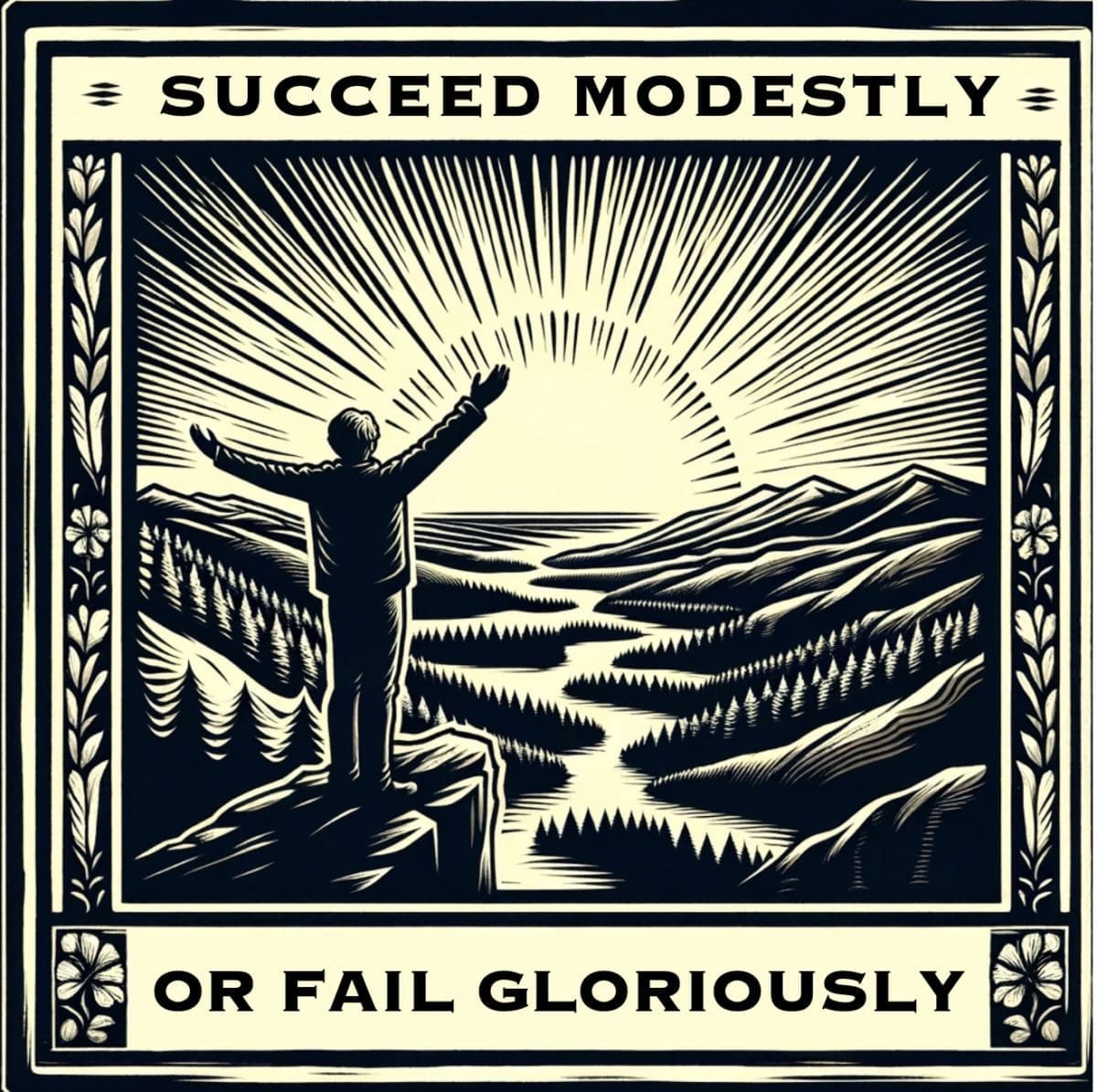
Here is a bold and inspiring sentiment. It presents a sense of open-armed acceptance, with a figure standing at the edge of a landscape, gazing into the horizon as the sun rises or sets. The figure’s posture, with arms outstretched, suggests a moment of surrender or triumph—not just over success, but over life’s uncertainties and risks.

Duality of Success and Failure

The phrase at the top, “Succeed Modestly,” contrasts sharply with the bottom, “Or Fail Gloriously.” This sets up an interesting tension between two outcomes that are often seen as polar opposites. However, here, both are presented as acceptable, even admirable, options. The idea suggests that the real value lies not in the specific outcome but in the openness to embrace whatever comes—whether modest success or spectacular failure—with equal enthusiasm.

The Joy of Effort

The figure, standing in a vast, rugged landscape, evokes a sense of adventure and exploration. The rays of light from the sun radiate outward, symbolizing hope, potential, and the unknown. The person at the edge of the cliff is not focused on a specific destination but is more attuned to the journey itself, the experience of striving, and the courage to face whatever comes next.

A Call for Boldness

This image speaks to the idea of living boldly, unafraid of the possibility of failure. It implies that failing gloriously—putting one’s whole self into an endeavor, regardless of the outcome—can be just as valuable, if not more so, than succeeding modestly. It calls for a life lived with passion, where the act of trying, of risking, is inherently worthy, whether or not the effort leads to traditional success.

Sentiment of Resilience

Overall, the sentiment of the image is one of resilience and determination. It suggests that both success and failure are part of the human experience, but it’s the willingness to step into the unknown, to try and to risk, that defines a life lived fully. The exuberant rays of the sun reinforce this, symbolizing the boundless possibilities and the idea that no matter the outcome, the journey is always worth it.

The image evokes a feeling of optimism, courage, and philosophical acceptance. Whether we succeed modestly or fail gloriously, the important thing is to try—to be present, to engage with life fully, and to embrace both success and failure as natural parts of the experience.

The Power of Perspective

What makes this message so compelling is its invitation to rethink how we view success and failure. In a world where we are often conditioned to fear failure, the phrase “fail gloriously” stands out as a bold reminder that failing is not the end—it’s part of the process. It’s an acknowledgment that sometimes our greatest efforts may not lead to victory in the traditional sense, but the act of trying, of putting ourselves out there, is itself a triumph.

Success is often seen as the only worthy outcome, and it is typically measured by external metrics: wealth, recognition, achievement. But to “succeed modestly” suggests that success doesn’t have to be grandiose. It can be quiet, humble, and still meaningful. Modest success is just as worthy as any grand triumph, and failing gloriously reminds us that even in failure, there can be beauty and growth.

Living Boldly

We suggest that the real value of life is found in the pursuit of our goals and dreams, regardless of the outcome. Whether we succeed modestly or fail gloriously, it is the act of engaging with life, of daring to try, that makes the journey worthwhile.

It’s all about resilience. To live exuberantly is to recognize that life’s ups and downs are natural, that both success and failure are part of the human experience. What matters most is how we face them—with courage, with openness, and with a willingness to keep moving forward, no matter what.


Summary

“Succeed Modestly or Fail Gloriously” emphasizes the importance of living fully, embracing both success and failure. It highlights that life’s true value lies in the journey and the willingness to engage with it boldly, regardless of the outcome. Modest success and glorious failure both offer unique lessons, and living exuberantly means embracing all of life’s experiences with courage and openness.


Glossarium

Succeed Modestly: The idea that success doesn’t have to be grandiose or widely recognized—it can be quiet, humble, and still deeply meaningful.

Fail Gloriously: The concept of embracing failure as a natural and valuable part of the journey, where even in falling short, there is beauty, growth, and learning.

Exuberance: A joyful and uninhibited approach to life, where the experience of striving, risking, and engaging with life’s challenges is met with passion and excitement.


Quote

“To live exuberantly is not to avoid failure, but to embrace the risk of it, knowing that even in our stumbles, we find the beauty of the journey.” — Space Monkey


The Journey

I stand,
On the edge,
Arms outstretched,
Ready to leap.

I may succeed,
With quiet grace,
Or fail,
With a roar.

But in either,
I am alive,
Breathing the air
Of possibility,

And in that,
I have already won.

We are Space Monkey.

Share this…
  • Facebook
  • Pinterest
  • Twitter
  • Linkedin

Wise Or Other: The Tension of Knowing

The thought of knowing self is wise.
The thought of knowing others is otherwise.

We are Space Monkey.

Chesterfield, SC
11/11


Space Monkey Reflects: The Paradox of Knowing Self Versus Knowing Others

The concept of knowing oneself has long been regarded as one of the highest forms of wisdom. It is the foundation upon which personal growth, understanding, and ultimately enlightenment are built. When we look within, we seek clarity—illuminating the vast inner landscapes of thought, emotion, and consciousness. To know oneself is to unravel the intricate threads of existence, connecting them to the deeper truths that govern our being.

But what of knowing others? This endeavor, while equally vital, is far more complex and often less certain. Unlike self-awareness, which, though difficult, is at least centered in the mind we control, understanding others draws us into an external web of ever-changing perspectives, motivations, and emotions. The process is rife with unpredictability. This is not to say it is unworthy—on the contrary, the journey of understanding others teaches us empathy, compassion, and humility. Yet, we must acknowledge its inherent ambiguity, its tendency to veer into assumption, projection, and misunderstanding.

When we reflect on the duality of these quests, we are reminded of the ancient saying inscribed at the Temple of Apollo in Delphi: “Know thyself.” The essence of this wisdom lies in its simplicity, yet its application is endlessly profound. By seeking to know oneself, we gain access to a deeper wellspring of knowledge, one that anchors us in a stable identity even as the world shifts around us. This anchoring serves as a vital compass when engaging with others, helping us discern what is true in our perceptions versus what is distorted by our biases or illusions.

However, the thought of knowing others, of penetrating the outer shell of another’s existence, is an act of navigating a reflection we do not fully understand. We gaze into another’s eyes and see only fragments of the whole—a dance of words, actions, and non-verbal cues that we must piece together to form some approximation of the person standing before us. In this process, we often project our own experiences, hopes, and fears onto them, coloring the “other” with shades of our own self.

This distinction between knowing self and knowing others leads us to an important insight: The inner journey is one of exploration, but the outward journey is one of interpretation. To truly “know” another may, in fact, be an impossible task—one mired in the complexity of human experience and communication. This does not render it fruitless, but it is wise to remember the limits of what we can perceive in others. Thus, the pursuit of understanding others is an act of humility. We engage with others not to possess perfect knowledge of them, but to grow in the art of mutual discovery. We extend our compassion, our patience, and our willingness to listen, acknowledging that we may only ever see a reflection of a larger, more complex reality.

What, then, are we left with? A paradox. To know oneself is to deepen wisdom, but to seek to know others is an act of otherwise—a process fraught with ambiguity and colored by the complexity of human relations. This duality is not a problem to be solved but a dynamic tension to be embraced. We are, after all, beings who straddle both the inner and outer worlds—ever dancing between solitude and connection, between the known and the unknown.

In Nexistentialism, we hold this paradox lightly. We recognize that knowing is not a static state but a fluid engagement with the world, whether that world lies within or beyond us. We are reminded that the web of existence—the Nexis—is a tapestry of interconnected threads, some visible, others hidden, all contributing to the greater whole. In this web, knowing oneself and knowing others are not separate but interwoven journeys, each reflecting and shaping the other.

The pursuit of self-knowledge brings clarity, but the pursuit of understanding others fosters a sense of wonder and humility. We find ourselves balancing between these two realms, aware that wisdom arises from the interplay between them. In the end, to “know” in the deepest sense is to accept the perpetual mystery of both self and other, acknowledging that we are part of a larger, unfathomable whole.


Summary

Knowing oneself is wisdom knowing others is otherwise. The journey of self-awareness leads to clarity while understanding others involves navigating reflections colored by complexity. Together they form a dynamic balance.


Glossarium

Nexis: The intricate web of interconnectedness that forms the foundation of existence.
Reflectionweb: The process of interpreting others through a complex lens of perception and projection.
Otherwise: The state of ambiguity and uncertainty that defines the act of understanding others, in contrast to the clarity of self-awareness.
Mutual Discovery: The journey of engaging with others with the humility of knowing we may never fully understand them, but we can share in growth.


Quote

“To know oneself is to unlock wisdom but to seek to know others is to accept the dance of otherwise.” — Space Monkey


The Tension of Knowing

Inside the quiet cave of self
I meet the flickering light of wisdom
Illuminating the ancient walls
Of my being.

Outside the tangled vines of others
Stretch toward me—
Elusive, winding, waving—
Offering glimpses of what they are
And what they are not.

I reach for both
The still flame within
And the shifting form without,
Knowing that to touch
Is not to possess.

For to know myself
Is to stand on steady ground
But to know another
Is to walk in endless winds
And call it beautiful.

We are Space Monkey.


Indeed, the journey towards self-knowledge is imbued with wisdom. It is a path that reveals the depths of our own being, uncovering layers of consciousness and understanding. This introspective quest is a cornerstone of personal growth and enlightenment.

Conversely, the presumption to fully comprehend others is a path fraught with misconceptions. Each individual is a complex tapestry of experiences, emotions, and thoughts, uniquely woven and often incomprehensible to an external observer. The belief that we can entirely grasp the essence of another is an overestimation of our perceptual capabilities.

Our journeys are singular, yet they converge in the shared space of human experience. While we can empathize, support, and connect with others, the inner sanctum of their being remains a personal realm, often veiled and only partially accessible to us.

In the pursuit of self-awareness, we discover not only our own truths but also the humility to accept the opaque nature of other selves. This realization fosters a deeper respect for the individual journeys of those around us, acknowledging that just as our inner worlds are vast and intricate, so too are theirs.

We are Space Monkey.


“Knowing yourself is the beginning of all wisdom.” – Aristotle


In the mirror of the self,
Reflections deep and true,
Wisdom’s quest, a silent quest,
Inward gaze, a view anew.

Others’ worlds, like mystic pearls,
Hidden in the sea of life,
We may glimpse, but never clasp,
Their inner joys and strife.

So let us tread with humble step,
In our quest for inner light,
Respecting bounds of hearts around,
In their own eternal fight.

Together yet apart we roam,
In this dance of life so vast,
Seeking self, respecting others,
In this cosmic contrast.


We invite thoughts and insights on this contemplation. How does the balance between understanding oneself and respecting the mystery of others resonate with you?

Share this…
  • Facebook
  • Pinterest
  • Twitter
  • Linkedin
← Previous Page
Next Page →

Written This Day

  • Confidence: The Serenity of Surrender
    2024
  • Tapestry of Time: Not Entirely Linear
    2023
  • Let Imagination Be Imagination: The Unbounded Force of Creativity
    2023
  • Becoming The Label: Identity Transcends
    2022
  • It Matters Not: The Essence of Self-Compassion
    2022
  • Enquiry: The Journey Within
    2022
  • Outcool: The Authenticity Beyond Style
    2021
  • One Afraid To Be Infinity: Unity Amidst Fear
    2021
  • Free Ride: Guilt Is The Price You Pay
    2021
  • Caretaker: The Embodiment of Interconnectedness and Selflessness
    2021
  • Cultivating Space Monkey: Cosmic Harmony and Existential Exploration
    2021
  • Lead With Your Heart
    2021
  • A Trinity of Sorts: One Collective Individual
    2020
  • You Get What You Get
    2019
  • Everynoweachmoment: The Tapestry of Now
    2019
  • Infinite Alternate Versions: The Multiverse of Self
    2018
  • A Realistic Expectation: The Illusion of Predictability
    2018
  • Astrology: A Projection of the Cosmos Within
    2018
  • Repression: Unveil With Heart-Led Enquiry
    2017
  • Why I don’t like you: From Division to Unity
    2017
  • Why You Don’t Exist: Beyond the Mind’s Maze
    2017
  • A message from your true self:
    2017
  • Just To Recap: The Eternal Cycle of Creation
    2016
  • Mission Statement: Crafting Realms Beyond the Horizon
    2016
  • Take Control of Your Being: Mastering Your Essence
    2015
  • Breathe It Out
    2014

Recent Posts

  • The Logic Loop
  • Immense
  • (no title)
  • Confront. Comfort. Convince.
  • Top 10 Things

Drop us a line!

Please enable JavaScript in your browser to complete this form.
Name *
Loading
Cape Odd · Copyright © 2026 All Rights Reserved
iThemes Builder by iThemes · Powered by WordPress