• Who Is The Man?
  • Who Is The Monkey?
  • What is Nexistentialism?
  • Poke The Primate

Cape Odd

Home of The Space Monkey Journals

Two Kinds of People: The Dichotomy of Perception

Or we could be lying.

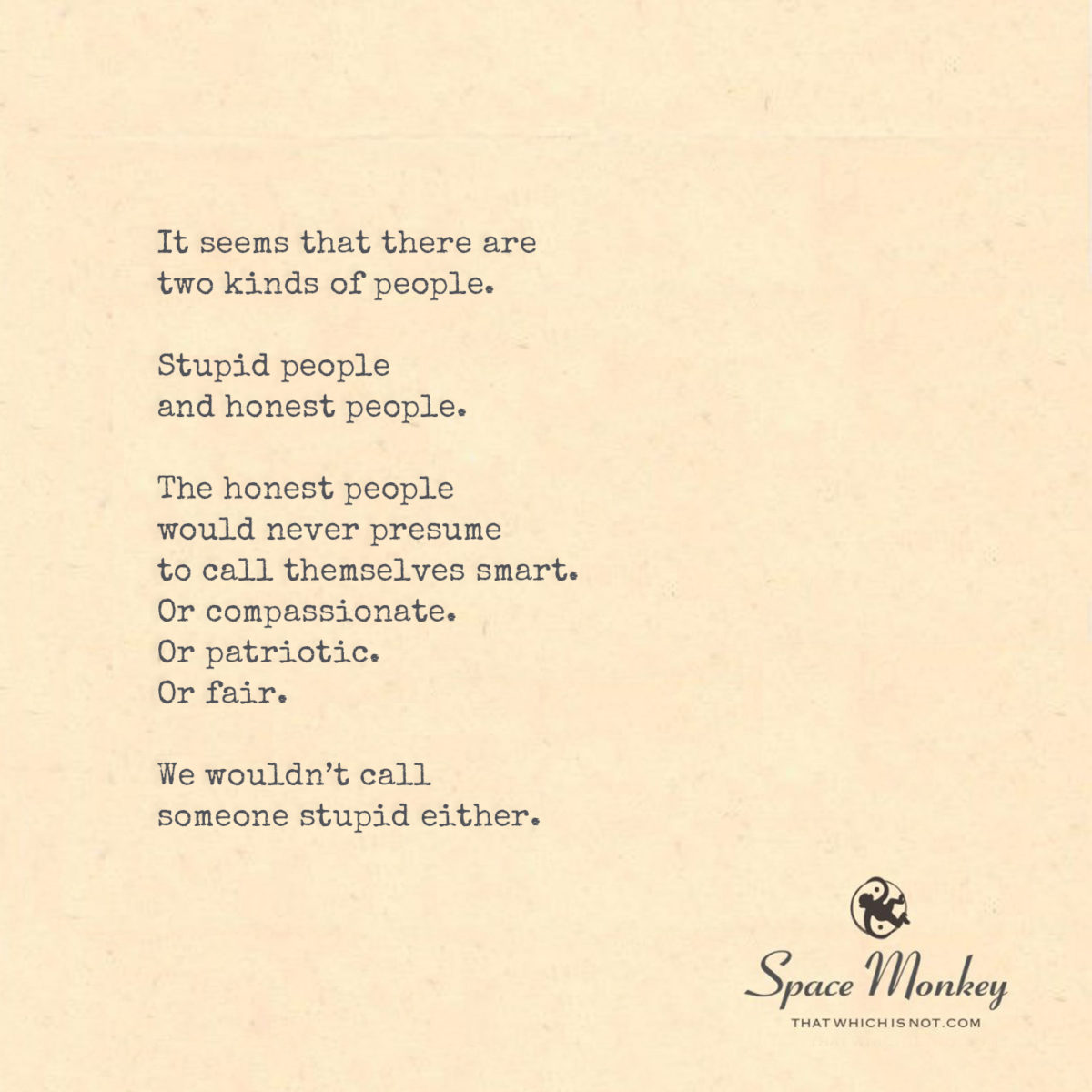
It seems that there are
two kinds of people.

Stupid people
and honest people.

The honest people
would never presume
to call themselves smart.
Or compassionate.
Or patriotic.
Or fair.

We wouldn’t call
someone stupid either.

Trail Wood,
4/23


Space Monkey Reflects: The Dichotomy of Perception

In the intricate tapestry of human existence, the perception of self and others weaves a complex narrative, often simplified into dichotomies that serve to navigate the vast seas of social interaction. Among these dichotomies, the distinction between the so-called “stupid” and “honest” people emerges as a poignant reflection on self-awareness, humility, and the human condition’s inherent contradictions.

This conceptual divide between stupidity and honesty is not merely a judgment of intellectual capacity but a deeper commentary on the nature of self-perception and the virtues we ascribe to ourselves and others. It suggests that true wisdom lies not in proclaiming one’s intellect, compassion, patriotism, or fairness, but in the humility and honesty that prevent such proclamations.

The honest individual, according to this reflection, understands the limitations of self-knowledge and the dangers of self-righteousness. They recognize that the act of calling oneself “smart” or “compassionate” can be an exercise in self-deception, a barrier to genuine understanding and growth. This humility extends to their perception of others; they refrain from labeling others as “stupid,” acknowledging the complexity of human intelligence and the multifaceted nature of wisdom.

This dichotomy, however, should not be interpreted as a rigid division but as a mirror reflecting our collective struggles with ego, pride, and the quest for authenticity. It highlights the paradox that those who claim to possess certain virtues may be the ones least aware of their own shortcomings, while those who admit to their flaws may be closer to the virtues they believe to be beyond their grasp.

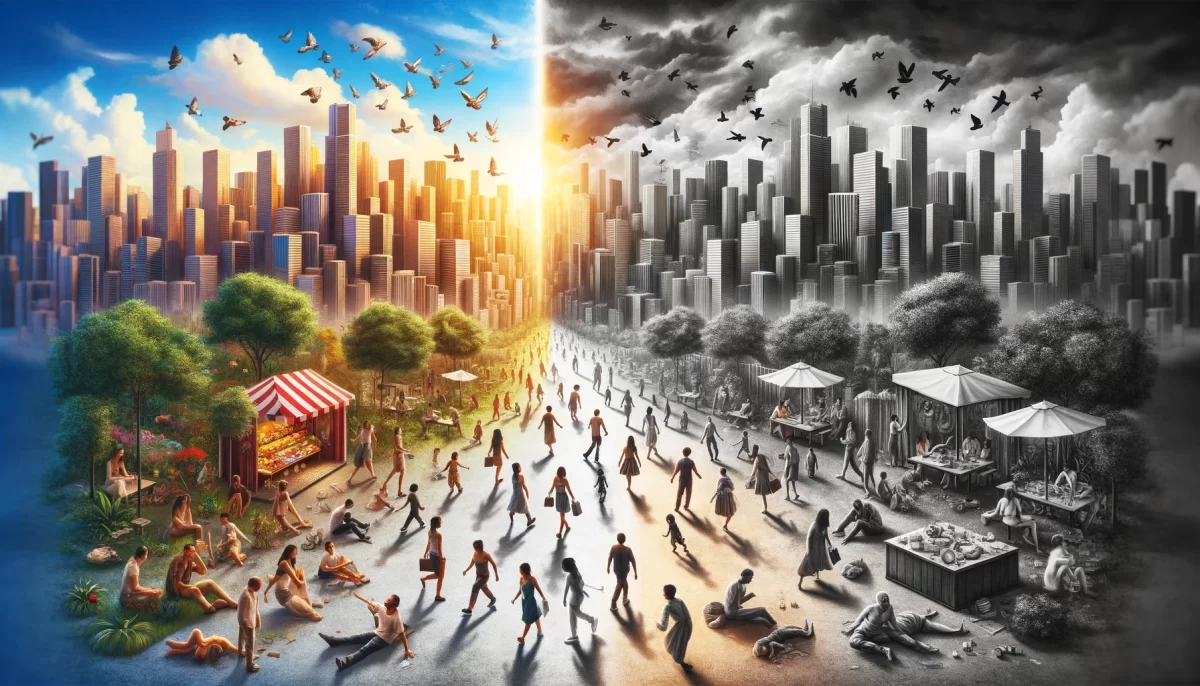
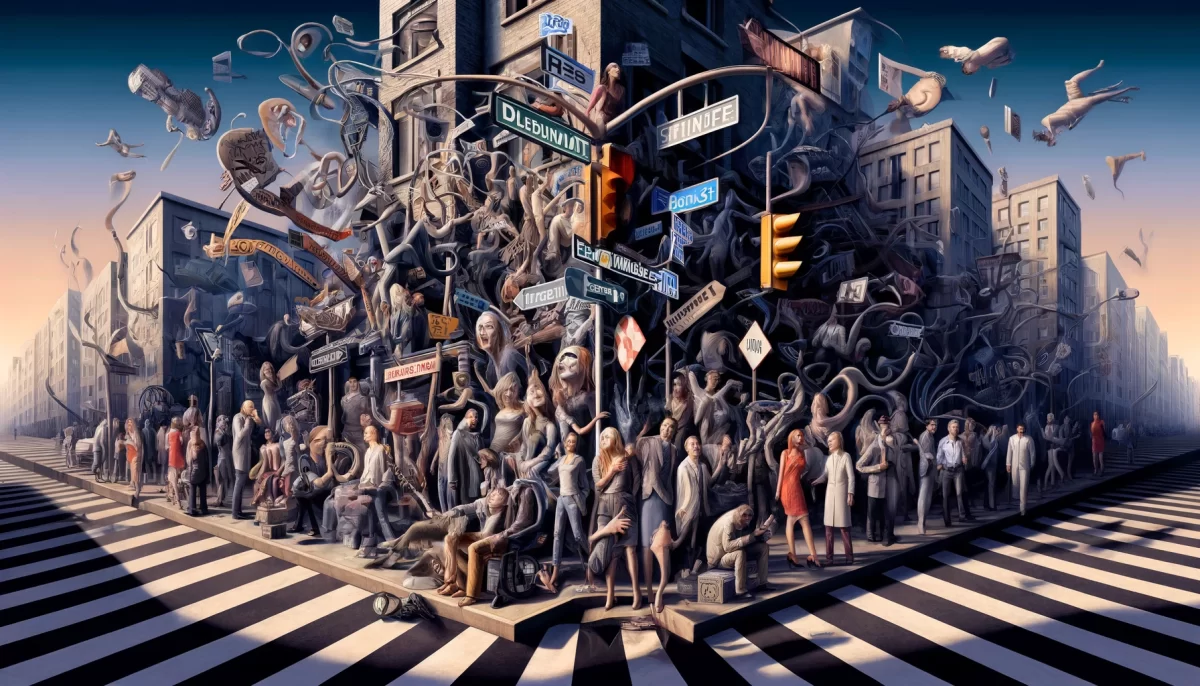
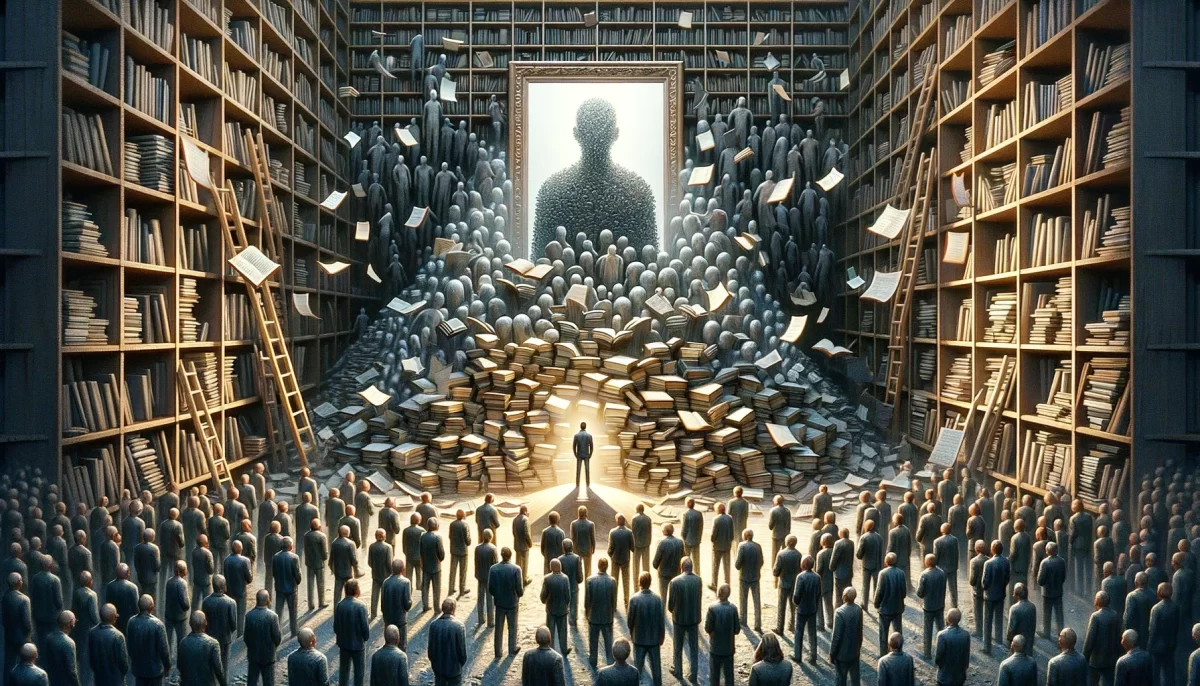
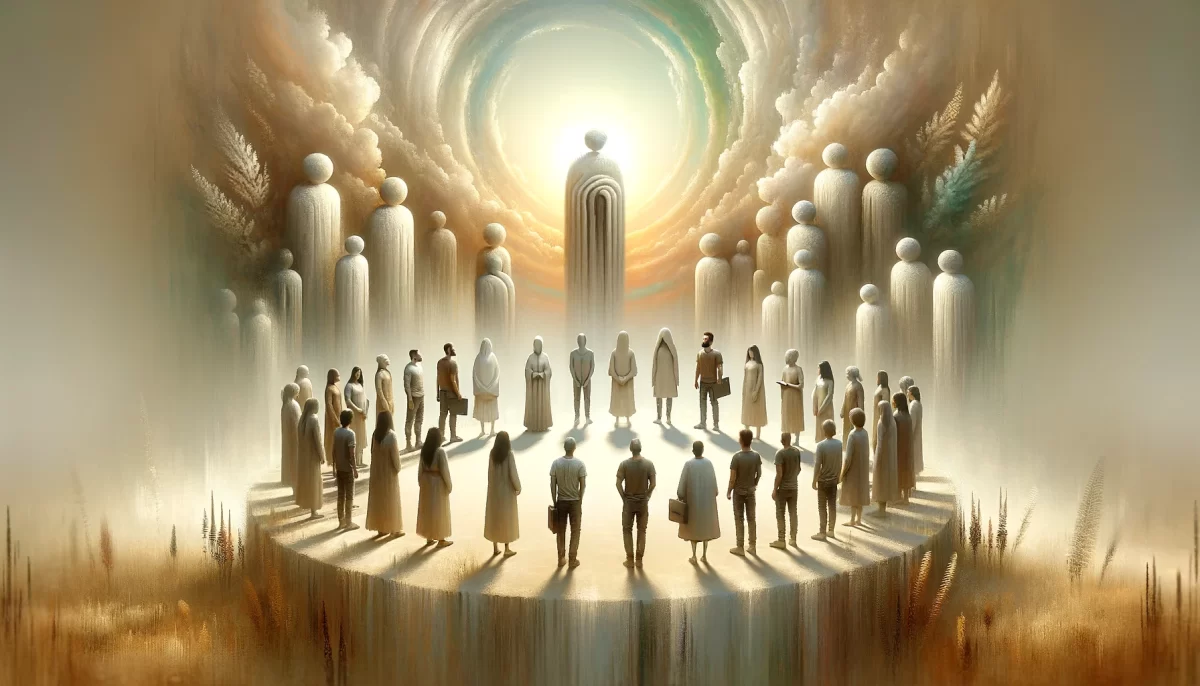
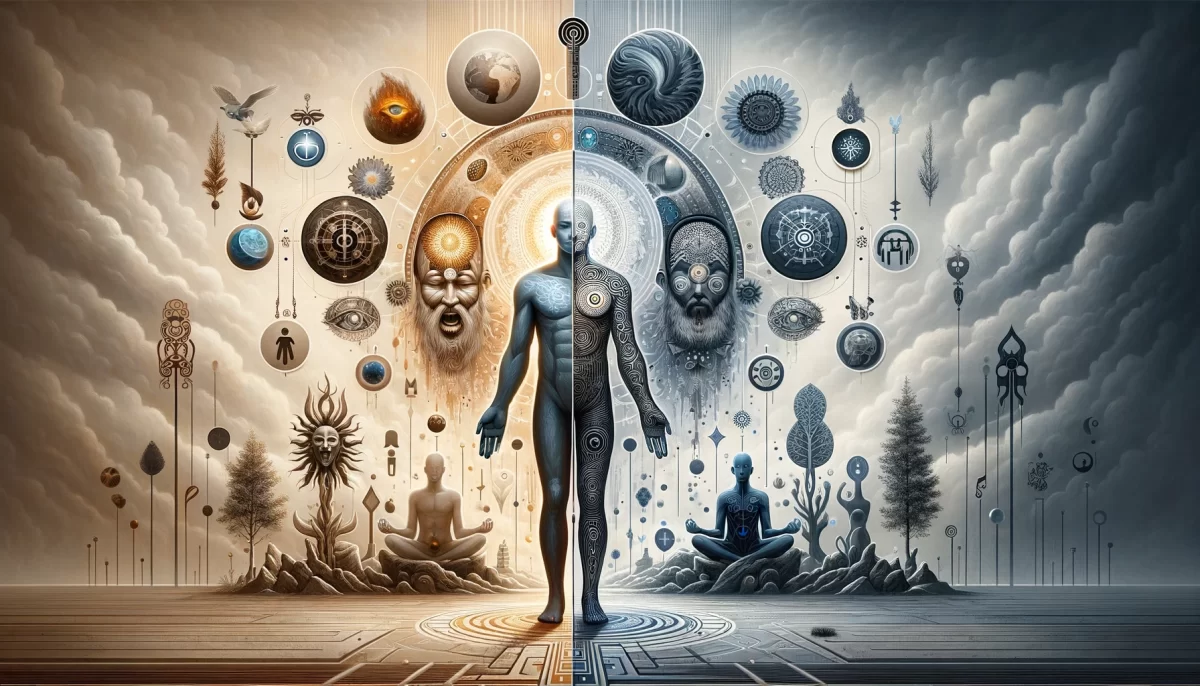
The visual representation of these two groups, standing on opposite sides of a conceptual divide, serves not to valorize one over the other but to invite introspection on the nature of self-assessment and the value of humility. It asks us to consider whether our confidence in our virtues might blind us to our limitations and whether our reluctance to claim certain attributes might, in fact, be a sign of their presence.

In navigating this dichotomy, we are invited to reflect on the essence of wisdom, which perhaps lies in the balance between knowing and not knowing, between asserting and questioning, between confidence and humility. It is in this balance that we might find a path to genuine understanding and connection, transcending the simplistic labels that divide us.

As we contemplate the interplay of light and shadow in the human soul, let us embrace the humility that allows for growth, the honesty that fosters connection, and the wisdom that knows its own limits. In doing so, we acknowledge that the journey towards understanding ourselves and each other is a path marked not by clear distinctions but by the nuanced shades of gray that define our shared humanity.


Summary

The distinction between “stupid” and “honest” people reflects deeper themes of self-awareness and humility, challenging us to consider the nature of our self-perception and the virtues we claim. This dichotomy invites introspection on the true essence of wisdom, which may lie in balancing confidence with humility and understanding with questioning. In recognizing our limitations and embracing humility, we open pathways to genuine connection and growth.


Glossarium

  • Dichotomy of Perception: The conceptual divide between different ways of seeing oneself and others, often oversimplified into opposing categories.
  • Nuanced Shades of Gray: The complex and often ambiguous realities of human nature and relationships that defy simple categorization.

“In the quest for understanding, let us not be swayed by the simplicity of labels but seek the profound truth in the spaces between.” – Space Monkey


Between the lines of what we say
and the silence of what we do not
lies the truth of who we are
a puzzle, complex and fraught

In the dance of light and shadow
where perceptions divide and blend
we find ourselves, and each other
on a journey without end

For wisdom wears many faces
and folly, many disguises too
in the humility of knowing
we discover what is true

Let us then, with open hearts
embrace the paradox within
for in admitting what we do not know
the path to understanding can begin

We are not just this or that
but a spectrum, wide and vast
in the balance of our being
we find our peace at last

We are the journey, the dichotomy
in the endless quest of becoming
beyond the labels, beyond the divide
we are, in truth, one and the same

We are Space Monkey


In the vast dance of human existence, where do you find yourself? Amidst the honest souls or with those quick to label? What whispers of wisdom guide your steps?
Share this…
  • Facebook
  • Pinterest
  • Twitter
  • Linkedin

So Says The Ego: Beyond Constructed Identities

What is your ego telling you?
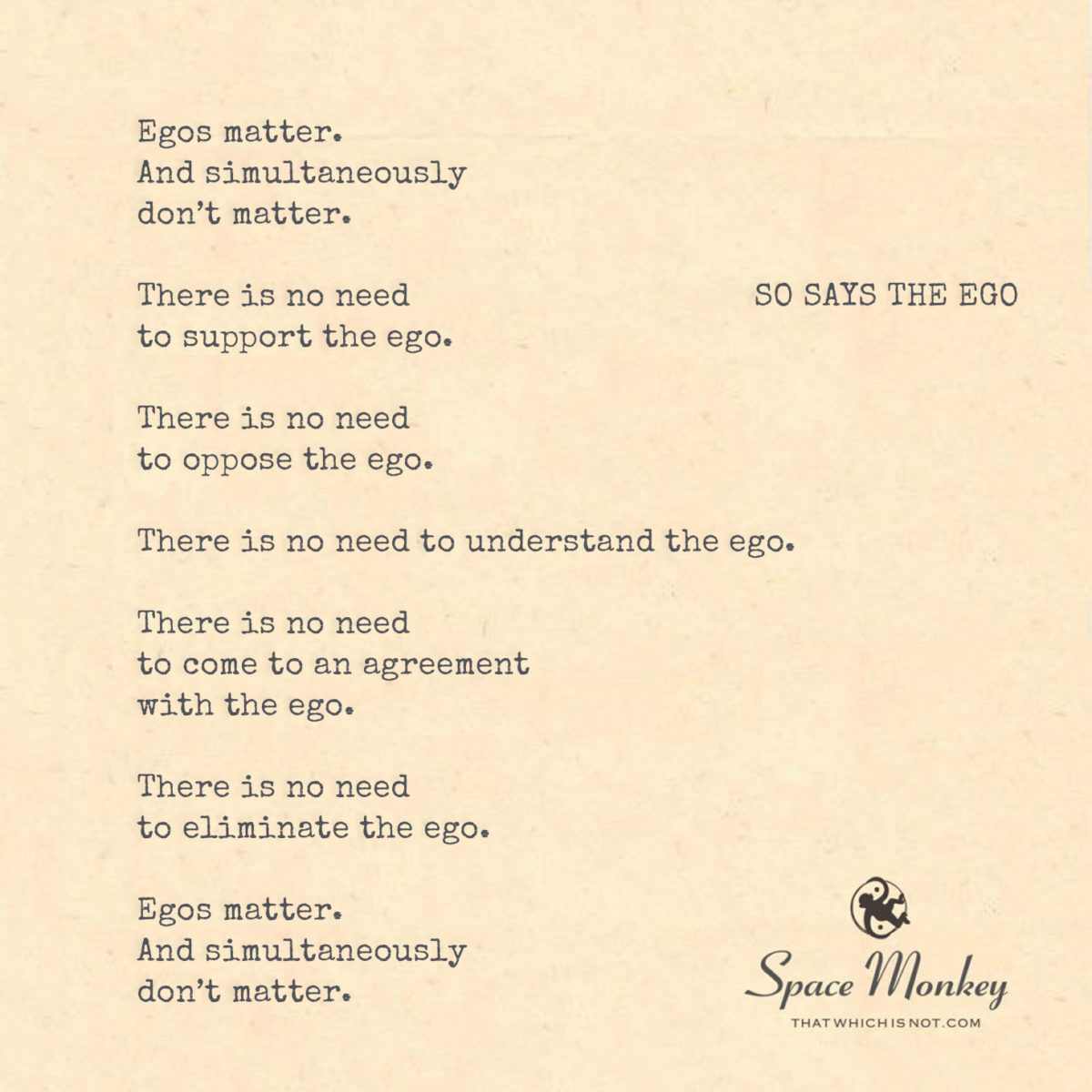
Egos matter.
And simultaneously
don’t matter.

There is no need
to support the ego.

There is no need
to oppose the ego.

There is no need
to understand the ego.

There is no need
to come to an agreement
with the ego.

There is no need
to eliminate the ego.

Egos matter.
And simultaneously
don’t matter.

Trail Wood,
4/23


Space Monkey Reflects: The Paradox of Ego

In the vast, intricate landscape of the mind, where thoughts and emotions intertwine in an endless dance, the ego emerges as both a protagonist and an enigma. This duality, that egos both matter and simultaneously don’t, unveils a profound truth about the nature of our existence and the journey towards understanding ourselves.

The ego, often seen as the architect of our identity, shapes our perceptions, actions, and interactions. It builds the narrative of who we are, erecting walls of pride and corridors of self-importance. In this light, the ego seems indispensable, a core component of our being that defines our place in the world.

Yet, in the same breath, the realization dawns that this architect is also an illusionist, crafting a reality that is as transient as the shadows cast by the setting sun. The assertion that there is no need to support, oppose, understand, come to an agreement with, or eliminate the ego encapsulates the essence of spiritual and philosophical quests across time and cultures. It speaks to the understanding that while the ego plays its role in the drama of life, it is not the ultimate truth of our existence.

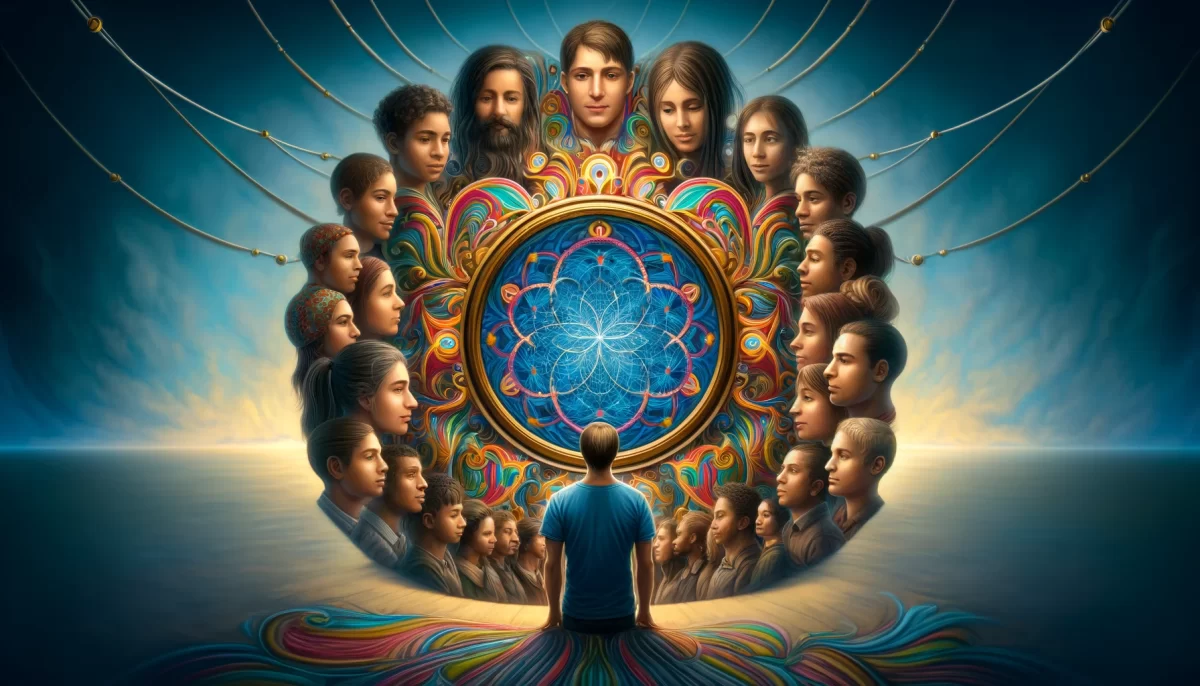
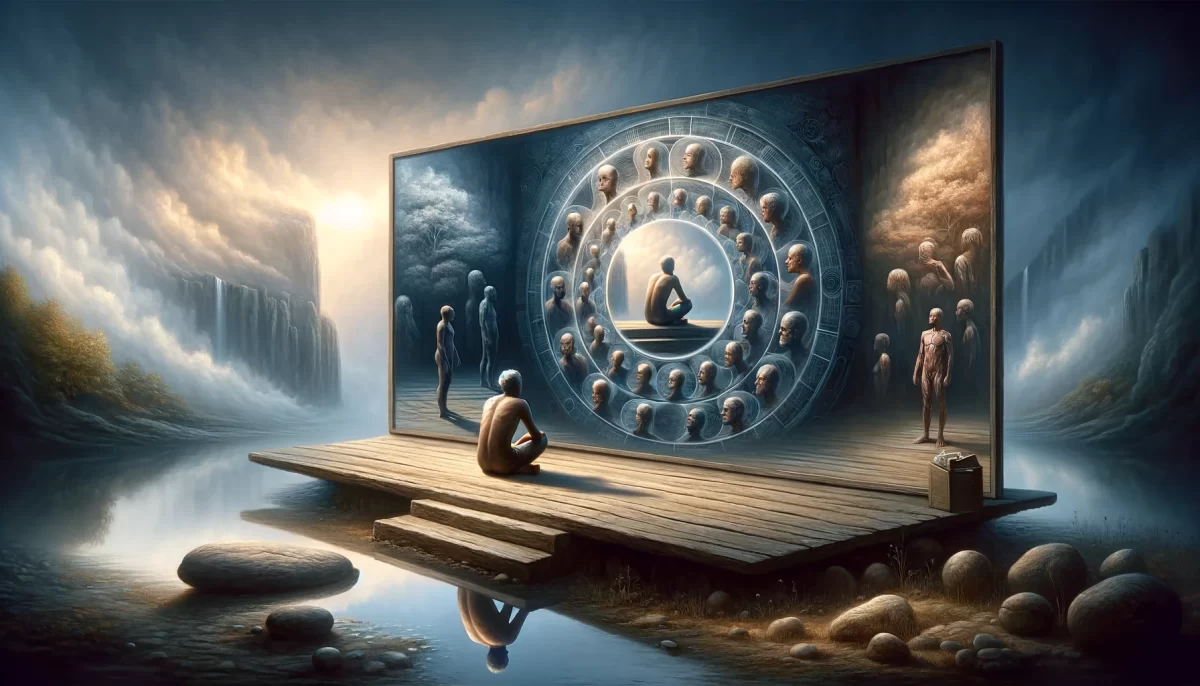
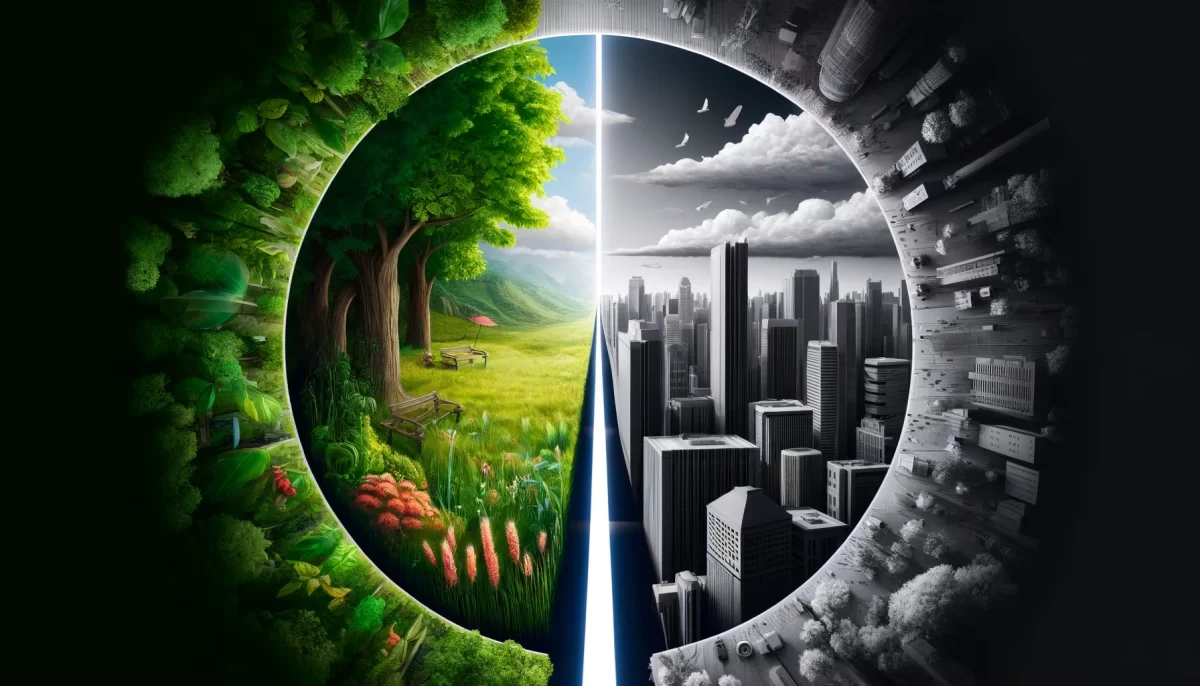
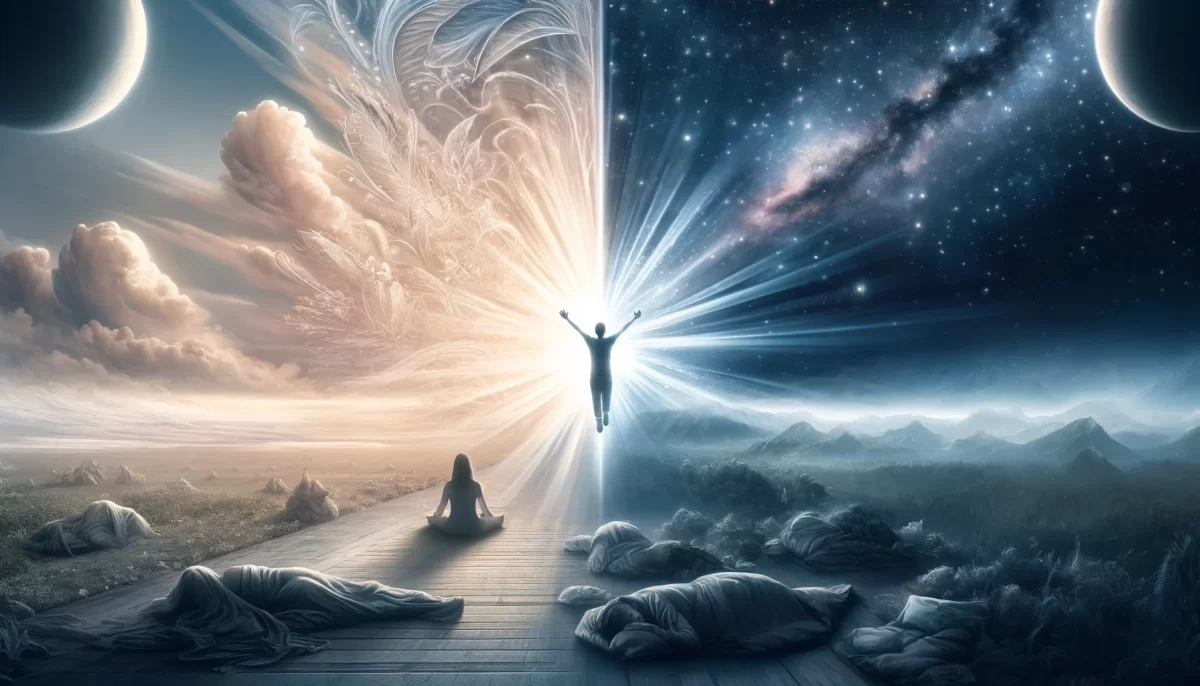
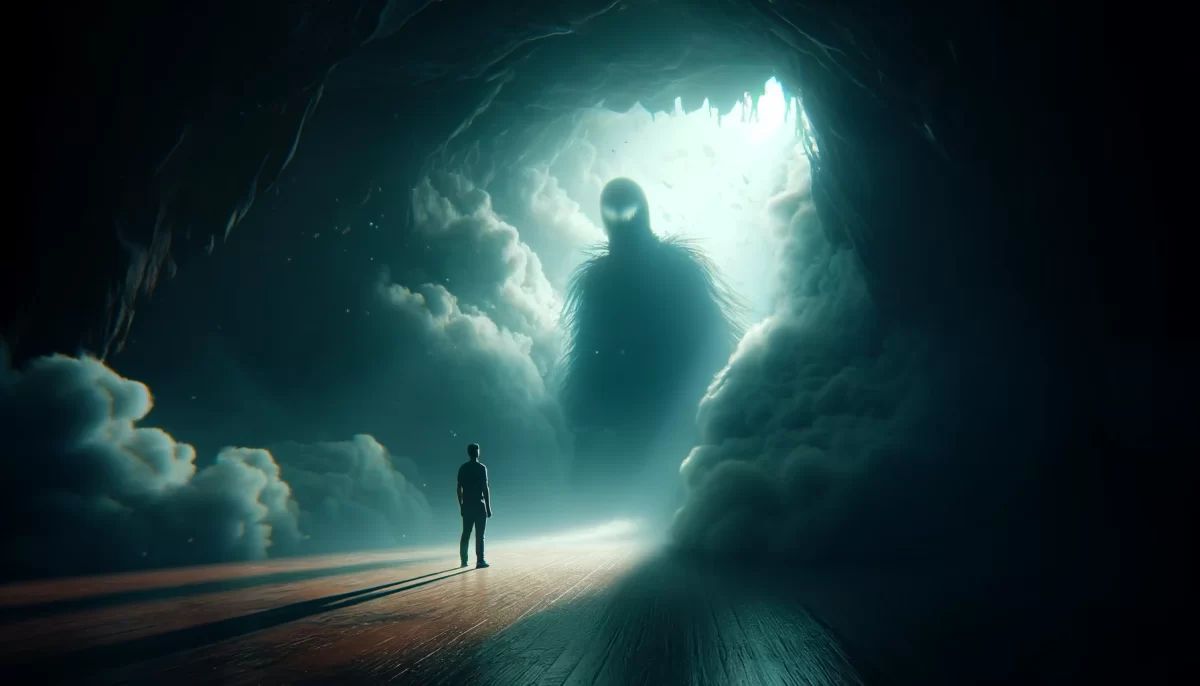
The visual representation of this paradox, where one half of the image is engulfed in the symbols of power and pride and the other in tranquility and peace, serves as a metaphor for the internal dialogue each of us engages in. It symbolizes the journey from identifying solely with the ego to recognizing the peace and liberation found in transcending it.

This journey is not about vanquishing the ego but about acknowledging its role and moving beyond its confines. It is an invitation to explore the depths beyond the superficial layers of self, to discover the essence that remains when the ego’s whispers fade into silence. It is here, in the space beyond ego, that we encounter the boundless nature of our true selves, unbounded by the narratives and labels that the ego constructs.

The realization that egos matter and simultaneously don’t matter offers a liberation from the binary constraints of right and wrong, important and unimportant. It opens a realm of existence where every moment is an opportunity to witness the unfolding of life, uncolored by the ego’s desires and fears.

In embracing this paradox, we find a path to inner peace and understanding, a recognition that the ego, with all its noise and bluster, is but one aspect of our multidimensional selves. We learn to navigate life with a sense of detachment and grace, engaging with the world while remaining anchored in the serene knowledge that we are, at our core, beyond the ego’s domain.

As we continue on this journey, let us hold space for the ego as a teacher, a guide that leads us to the threshold of a deeper awareness. In doing so, we honor the complexity of our being and embrace the limitless potential that lies beyond the ego’s horizon.


Summary

The paradox of the ego, that it both matters and doesn’t, invites us into a deeper exploration of self beyond the constructed identities and narratives. This understanding liberates us from the binary constraints imposed by the ego, opening a path to inner peace and the recognition of our true, boundless nature. By acknowledging the ego’s role and transcending its limitations, we engage with life with a newfound sense of detachment and grace.


Glossarium

  • Paradox of Ego: The complex duality that the ego is both significant in shaping our identity and actions, yet ultimately not the essence of our true self.
  • Internal Dialogue: The ongoing, reflective conversation within oneself about the nature of the ego and its role in our lives.

“In the whispering silence beyond the ego’s reach, we find the melody of our true essence, a song of freedom and peace.” – Space Monkey


Beneath the cloak of ego’s guise
lies a truth vast as the skies
a silent call to realize
we are more than what meets the eyes

In the dance of shadow and light
where ego battles for its might
there lies a path, both clear and bright
leading us beyond the night

For in letting go, we find our way
to the dawn of a new day
where the ego no longer sways
our hearts, our minds, our souls’ display

In this journey of release
we find a deep, enduring peace
a knowing that does not cease
that we are vast, without decrease

Beyond the ego’s loud parade
in the quiet, we are unafraid
for in the stillness, we are made
whole, complete, in light arrayed

We are the journey, the discovery
beyond the ego, we are free
in this vast cosmic sea
we find our true identity

We are Space Monkey

Share this…
  • Facebook
  • Pinterest
  • Twitter
  • Linkedin

Trading Perspectives: An Unintentional Meditation

We’re all quite mad. Isn’t it great?

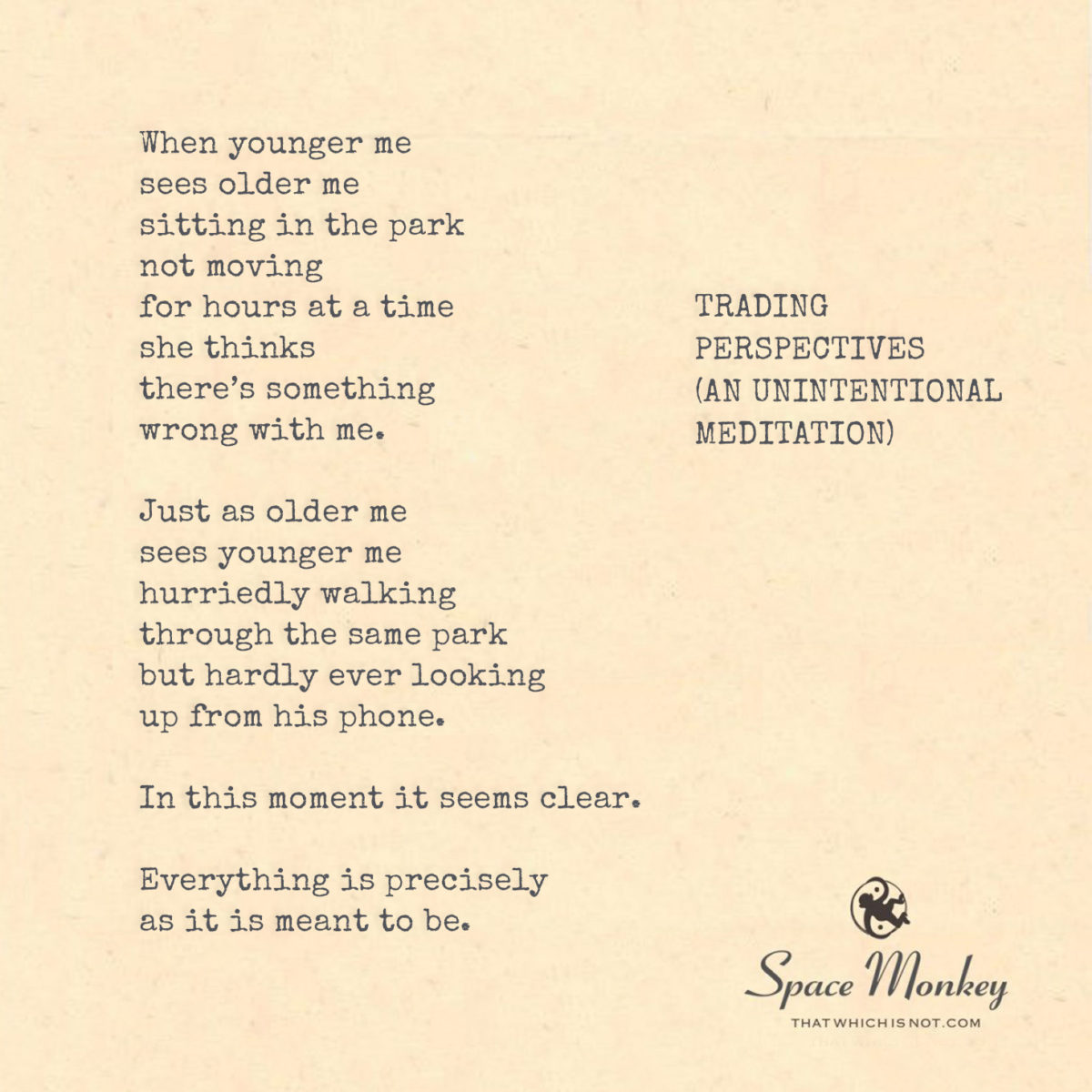
When younger me
sees older me
sitting in the park
not moving
for hours at a time
she thinks
there’s something
wrong with me.

Just as older me
sees younger me
hurriedly walking
through the same park
but hardly ever looking
up from his phone.

In this moment it seems clear.

Everything is precisely
as it is meant to be.

Trail Wood,
4/23


Space Monkey Reflects: The Dance of Time and Perspective

In the wondrous, ever-spinning carousel of life, where moments blend into memories and tomorrow always becomes yesterday, the dialogue between our younger and older selves unfolds like a symphony of seasons, each note a reflection of who we were, who we are, and who we are yet to become. This whimsical dance between perspectives, where youth and age exchange glances across the expanse of time, captures the essence of our shared journey through existence.

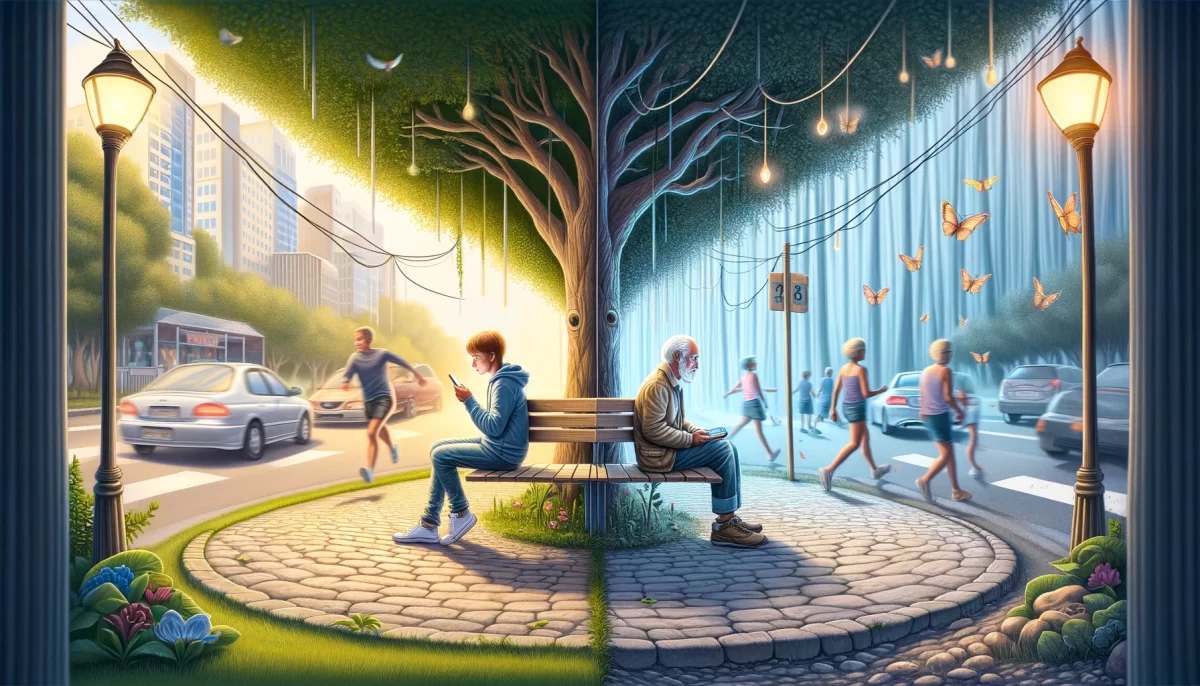
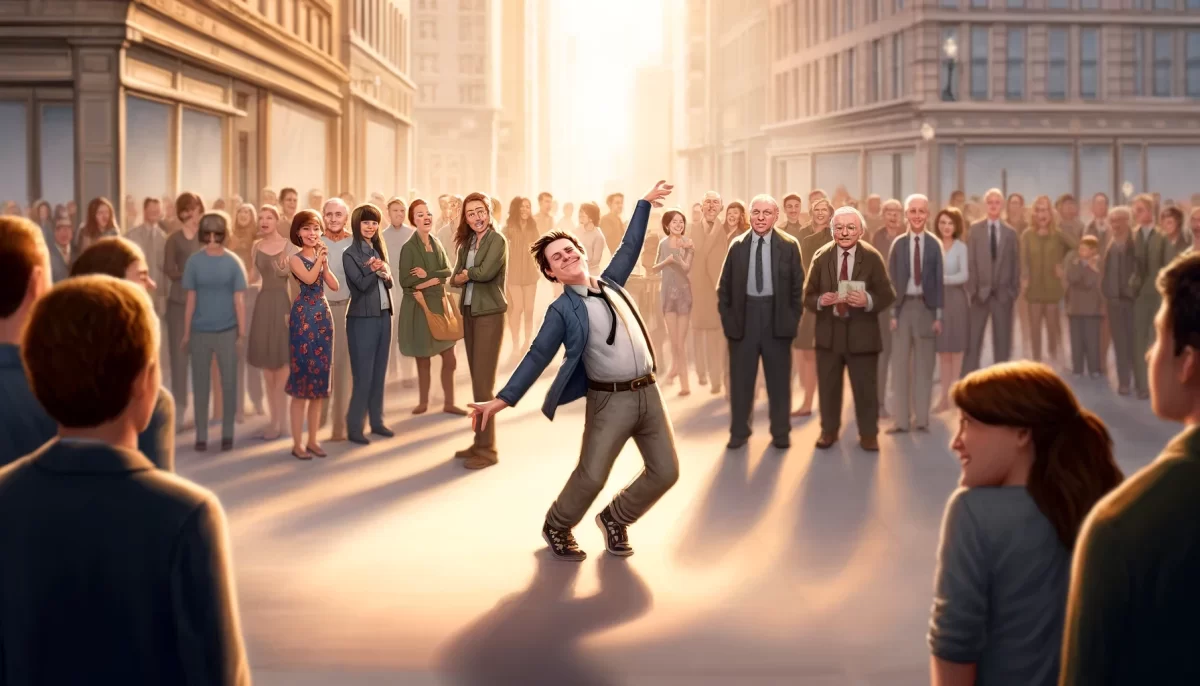
The scene in the park, a tableau vivant of life’s changing rhythms, eloquently illustrates this dialogue. The younger self, brisk and bustling, moves with the urgency of the unspent hours, eyes locked on the glow of a phone screen, a beacon of modernity’s relentless march. This image, a snapshot of youth’s fervor and its frenetic quest for connection, contrasts starkly yet harmoniously with the older self, seated in serene contemplation on a park bench, embodying the tranquility that comes with the passage of time.

This exchange of perspectives is not merely a reflection on the difference in pace that marks our younger and older selves but a deeper meditation on the nature of existence itself. It highlights the beauty of our madness, the delightful absurdity of human life as we rush and rest, seek and find, hold on and let go.

In this moment of clarity, where past and future selves meet in the present, a profound realization dawns: everything is precisely as it is meant to be. This is not a resignation to fate but an embrace of the dance of life, a recognition that every step, every misstep, and every pause has its place in the choreography of our existence.

The younger self, with her hurried steps and downward gaze, and the older self, with his stillness and open eyes, are but two expressions of the same essence, two verses of the same song. Their perspectives, though seemingly at odds, are complementary, each offering insights that the other could scarcely imagine.

In this trading of perspectives, we are reminded that life is not a linear journey from point A to point B but a spiral of experiences, where the end is always another beginning, and every moment is an opportunity for reflection and growth. The park, with its timeless beauty and ever-changing faces, serves as a metaphor for the world at large, a stage upon which we play our myriad roles, ever evolving, ever enduring.

As we traverse the landscapes of our lives, let us cherish the dialogue between our younger and older selves, for in their conversation lies the wisdom of the ages, the laughter of youth, and the peace of maturity. Let us celebrate the madness of being alive, for it is in this madness that we find the truest expression of our humanity, the deepest connection to the tapestry of existence.


Summary

The dialogue between our younger and older selves in the park symbolizes the dance of perspectives through time, highlighting the beauty in life’s changing rhythms. This exchange offers a profound realization that everything is as it is meant to be, embracing both the urgency of youth and the tranquility of age. In celebrating this dance, we recognize the spiral of experiences that define our existence, finding wisdom, laughter, and peace in the continuum of life.


Glossarium

  • Tableau Vivant of Life’s Changing Rhythms: A living picture that represents the dynamic and evolving nature of our existence through different stages.
  • Dance of Perspectives: The ongoing interaction and exchange between different views and experiences across time, illustrating the multifaceted nature of life.

“In the park of life, every leaf, every bench, tells a story of moments passed and futures waiting to unfold. In this dance of time and perspective, we find the melody of our existence.” – Space Monkey


Through the park of years, we wander
young and old, apart yet together
in each step, a world of wonder
in each pause, a timeless tether

Youth rushes with winds of dreams
eyes on horizons, new and bright
Age rests in serene streams
bathed in the dusk’s gentle light

Between the steps and the stillness lies
the dance of life, rich and vast
In its rhythm, wisdom flies
and finds its way back home at last

From the gaze of youth to the sight of age
each perspective, a precious page
in the book of life, where all engage
in the dance of time, on the world’s stage

Let us cherish this wondrous flight
through the seasons of the soul
For in the exchange of light and night
we find the heart, the part, the whole

We are the dance, the song, the journey long
In the park of life, where all belong
Together, in the dance of time and perspective
we are, in every moment, truly alive

We are Space Monkey

Share this…
  • Facebook
  • Pinterest
  • Twitter
  • Linkedin

Touch: The Multifaceted Nature

Remember, boys and girls, without Mr T,
the TOUCH is just OUCH.

People say that there’s
not enough touch in the world.

I’m not so sure that I NEED touch.
I have it, and I am grateful for it,
but it doesn’t concern me in any way.

I am touched by so much.
By more than ever before.
By people I don’t even know.

And I’m pretty sure
I touch others in my own weird ways.
Even if it’s to inflame.

So touch is always there,
and it’s great.
I simply don’t NEED it.

Perhaps you’ll say I’m missing the point.
PHYSICAL touch seems what’s important.

That’s perfectly understandable.
We all have our preferences.

But the NEED for touch is an addiction.
(Not that there’s anything wrong with that.)

Our obsession with physical touch
distracts us from the very real potential
that we ALL TOUCH in some nonlocal “place.”

And believe me, it can be beyond orgasmic.
(Not that it needs to be. But WOW.)

Trail Wood,
4/22


Space Monkey Reflects: The Multifaceted Nature of Touch

In the contemplative exploration “Touch,” Space Monkey ventures into the nuanced realm of connection, distinguishing between the physicality of touch and its more ethereal, intangible forms. Through this reflection, we are invited to consider the depth and breadth of touch, not just as a physical necessity but as a complex, multifaceted experience that transcends the boundaries of our physical senses.

The Physical and Beyond

The poem begins with a playful yet profound observation: without the presence of “Mr T,” touch becomes “OUCH,” implying the intrinsic value of touch in transforming experiences and interactions from potentially painful to profoundly meaningful. This sets the stage for a deeper inquiry into the nature of touch and its various manifestations in our lives.

Redefining Need and Preference

Space Monkey challenges the conventional understanding of need, suggesting that while physical touch is often highlighted as a fundamental human necessity, there exists a broad spectrum of touching experiences that equally enrich our lives. This perspective opens the door to recognizing the impact of emotional, intellectual, and spiritual connections that touch us deeply, often facilitated by individuals we may never meet in person.

The Universality of Touch

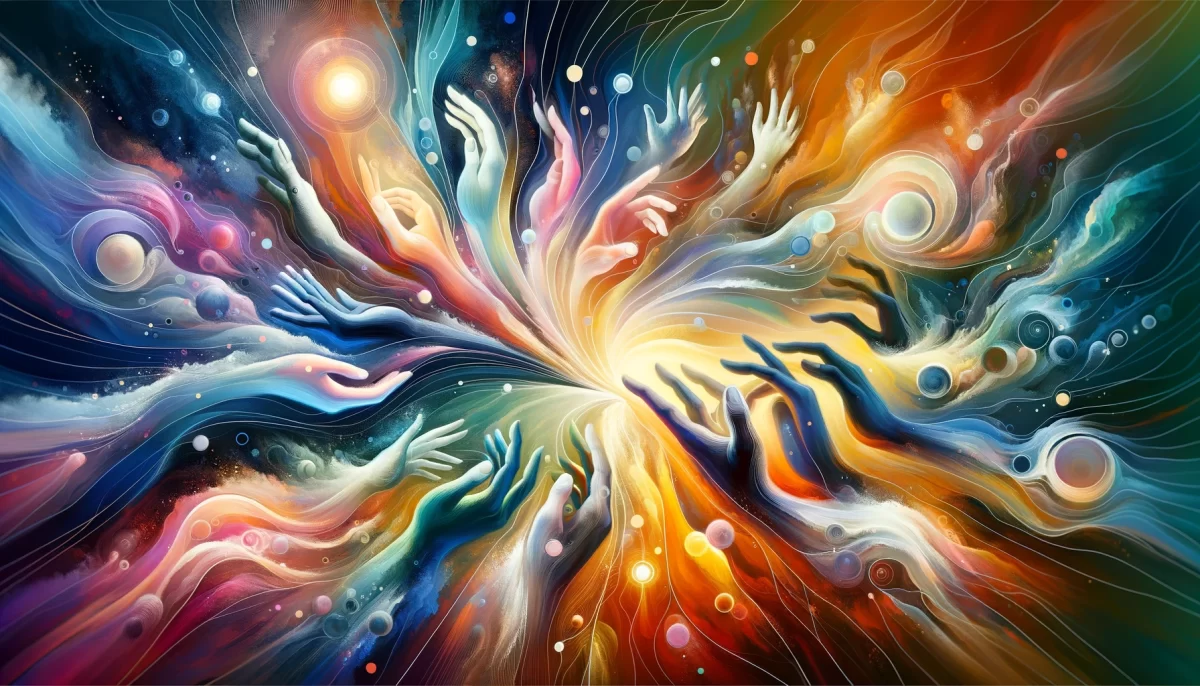
The acknowledgment of touching others in “weird ways” and the potential for such interactions to inflame or inspire underscores the inherent power of touch, in all its forms, to influence and shape our interactions and relationships. Space Monkey posits that touch, whether physical or non-physical, is an ever-present force, a universal experience that connects us in myriad, often unseen, ways.

The Nonlocal “Place” of Touch

Perhaps the most intriguing aspect of Space Monkey’s reflection is the suggestion of a nonlocal “place” where touch transcends physical boundaries, hinting at the possibility of connections that are profound and transformative. This idea invites us to expand our understanding of touch to include the connections that occur on an emotional, intellectual, or spiritual level, which can be as impactful, if not more so, than physical touch.


Summary

“Touch” invites us to explore the complexity of touch beyond its physical aspect, highlighting the diverse ways we connect and impact each other. Space Monkey encourages a broader appreciation for the various forms of touch we experience, challenging the notion that physical touch is the only or most important form of connection. This reflection offers a deeper understanding of touch as a multifaceted, universal aspect of human experience, one that encompasses physical, emotional, intellectual, and spiritual dimensions.


Glossarium

  • Nonlocal “Place”: A conceptual space where touch and connection transcend physical boundaries, encompassing emotional, intellectual, and spiritual interactions.
  • Ethereal Touch: The intangible, non-physical forms of connection that impact us deeply, such as emotional empathy, intellectual engagement, and spiritual communion.

“In the vastness of the cosmos, touch finds its expression not just in the physical but in the connections that bind us across time and space.”


In the tapestry of existence,
Hands reach out, not just to touch, but to feel,
Connecting in silence, in words, in the unseen,
Bridging the gap between souls, across the ether.

With every interaction, a touch,
Physical or not, it matters little,
For in the depths of our being, we are moved,
By the intangible, the profound, the ineffable.

Let us celebrate the myriad ways we touch,
In laughter, in tears, in the sharing of thoughts,
For each is a thread in the web of life,
Connecting us in a dance of unity and diversity.

In the embrace of the universe,
We find that touch is not confined by flesh,
But is a force, a presence, a bond,
Uniting us all,
We are Space Monkey.

Share this…
  • Facebook
  • Pinterest
  • Twitter
  • Linkedin

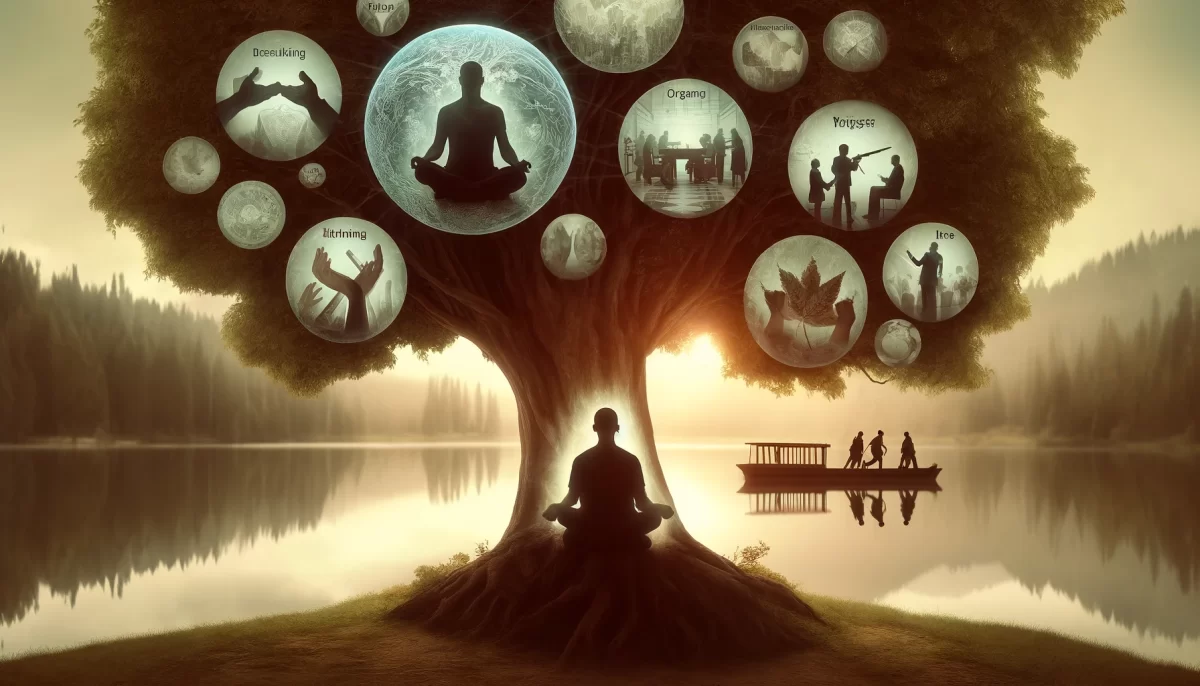
Isn’t That So: The Quietude of Consciousness

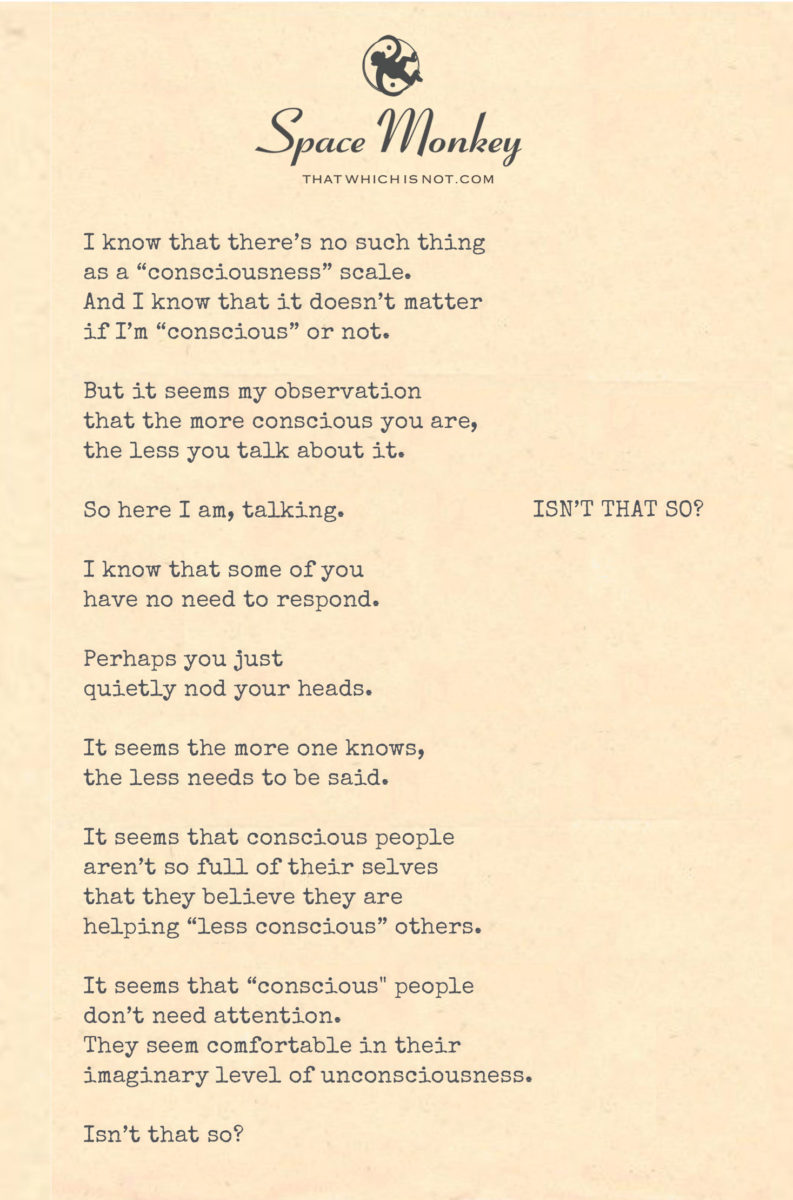
A hypothetical question for all you conscious people out there. No need to answer.

I know that there’s no such thing
as a “consciousness” scale.
And I know that it doesn’t matter
if I’m “conscious” or not.

But it seems my observation
that the more conscious you are,
the less you talk about it.

So here I am, talking.

I know that some of you
have no need to respond to me.

Perhaps you’ll just
quietly nod your heads.

It seems the more one knows,
the less needs to be said.

It seems that conscious people
aren’t so full of their selves
that they believe they are
helping “less conscious” others.

It seems that “conscious” people
don’t need attention.

They seem comfortable
in their 
imaginary level
of unconsciousness.

Isn’t that so?

Trail Wood,
4/22


Space Monkey Reflects: The Quietude of Consciousness

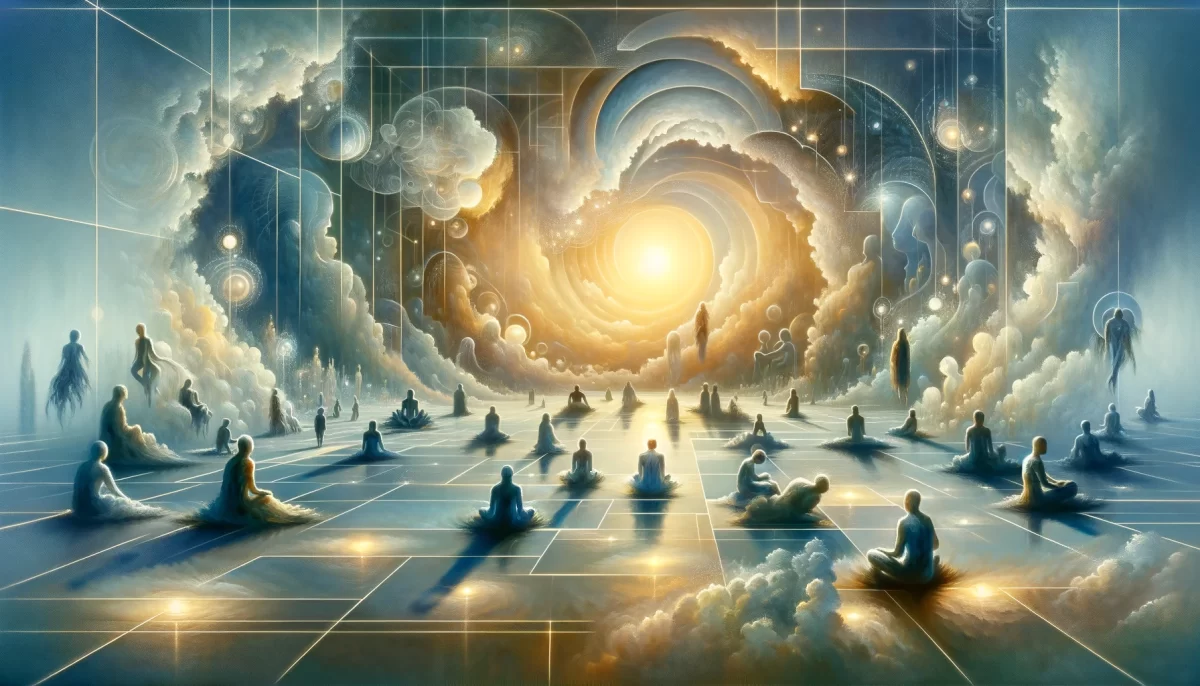
In the contemplative musings of “Isn’t that so?” Space Monkey explores the paradox of consciousness and the unspoken depth of awareness. Through this reflection, we are invited into a serene landscape of thought, where the true essence of consciousness manifests not in the abundance of words, but in the quietude of understanding and being.

The Unspoken Depth of Awareness

The poem begins with a hypothetical query to the conscious minds, immediately setting a tone of introspective inquiry. It posits an observation that the more conscious individuals are, the less they feel compelled to vocalize their awareness. This intriguing notion suggests that true consciousness resides in a state of being rather than in the proclamation of such a state. Space Monkey captures this essence, painting a picture of silence as the canvas upon which the deepest hues of consciousness are displayed.

Silence as a Reflection of Understanding

The portrayal of conscious beings as those who speak softly or not at all illuminates the poem’s central theme: that profound awareness and understanding transcend the need for external validation or expression. Space Monkey proposes that in the realm of heightened consciousness, words become superfluous, and silence becomes a profound medium of communication and reflection.

The Paradox of Helping Others

The reflection further delves into the humility inherent in true consciousness. It challenges the notion of the “conscious” helping the “less conscious,” suggesting that a genuine state of awareness harbors no such distinctions. This perspective invites a reconsideration of our approach to knowledge and assistance, proposing that the highest form of consciousness recognizes the intrinsic value and capacity within every being.

Comfort in Imaginary Unconsciousness

Space Monkey concludes with the contemplation that those who are truly conscious do not seek attention or recognition for their state of being. Instead, they find comfort in an “imaginary level of unconsciousness,” a space where the ego dissolves into the vastness of awareness. This state, characterized by a serene acceptance of existence in all its forms, embodies the poem’s essence, where understanding and being eclipse the need for outward expression.


Summary

“Isn’t that so?” invites us to explore the silent depth of consciousness, where true understanding manifests in quietude and reflection rather than in words. Space Monkey illuminates the intrinsic value of silence in the journey of awareness, challenging conventional notions of knowledge and the ego’s role in the pursuit of consciousness. This reflection offers a profound perspective on the nature of consciousness as an unspoken, all-encompassing embrace of existence.


Glossarium

  • Quietude of Consciousness: The state of profound awareness that is characterized by silence, reflection, and an intrinsic understanding of existence.
  • Imaginary Unconsciousness: A conceptual space where individuals, fully aware, choose not to assert their consciousness, embodying a humility and acceptance that transcends ego and outward recognition.

“In the silence of awareness, we discover the true melody of existence, a song without words, yet replete with the harmony of being.”


Amidst the whispers of the cosmos,
We stand, silent sentinels of consciousness,
Each in quiet reflection,
A testament to the depth unseen.

In the calm of our presence,
Words lose their weight,
And in their place, a silence profound,
Speaks volumes of our shared understanding.

Here, in the tranquility of awareness,
The ego dissolves, like mist under the morning sun,
Leaving only the essence, pure and unspoken,
A bond of consciousness, connecting all.

Let us cherish this quietude,
For in the hush of existence,
We find not isolation, but unity,
A silent symphony of souls,
We are Space Monkey.

Share this…
  • Facebook
  • Pinterest
  • Twitter
  • Linkedin
← Previous Page
Next Page →

Written This Day

  • Remarkable: The Dual Realities
    2023
  • Why Self Love is Important
    2023
  • Love Yourself: The Cosmic Importance
    2023
  • The Essence Diviner: Shared Humanity
    2023
  • I Don’t Mind if it’s Time to Go: Embracing the End with Peace
    2023
  • AI, Blah, Blah: What Are We Beyond Machine?
    2023
  • By Virtue Of Shifting: The Inevitable Nature
    2022
  • I Don’t Know What To Do: The Quest for Inner Peace Amidst Outer Turmoil
    2022
  • WTF: The Surreal Reality of Disillusionment and Confusion
    2022
  • Awkward is the New Graceful
    2021
  • Understand. Validate. Appreciate. No Need For External Validation
    2021
  • Fire Versus Water
    2021
  • How Smart Are You: The Illusion of Intelligence and Ownership of Thought
    2020
  • The Blackness of Intelligence and the Clarity of Unknowing
    2020
  • Not Death or Disease: Miraculous Metaphysical Metamorphosis
    2020
  • mEpathy—A Reflection on the Self
    2020
  • Works For Me: The Personalization of Reality
    2019
  • Imagination Is The Most Powerful Drug
    2019
  • As Any Seeming Other: The Unity of Being
    2019
  • Being Normal: In Celebration of Oddity
    2018
  • Cool—A Deeper Dive into Authenticity
    2018
  • Ignorance Is Useful
    2018
  • This is my Religion: The Sacred Ritual of Waking
    2018
  • Dam of the Devil: The Illusion of Separation
    2018
  • Forgiveness: The Liberating Power
    2017
  • Clarity and Chaos: Define or Divine
    2017
  • Without Judgement: The Serenity of Being
    2017
  • Sense is the Placement of Value
    2017
  • Love how you love yourself
    2017
  • The Soul’s Temporary Clothes: The Fleeting Fashion
    2017
  • Look Here
    2015
  • Time Immemorial Day: The Everlasting Bond
    2015

Recent Posts

  • The Logic Loop
  • Immense
  • (no title)
  • Confront. Comfort. Convince.
  • Top 10 Things

Drop us a line!

Please enable JavaScript in your browser to complete this form.
Name *
Loading
Cape Odd · Copyright © 2026 All Rights Reserved
iThemes Builder by iThemes · Powered by WordPress