• Who Is The Man?
  • Who Is The Monkey?
  • What is Nexistentialism?
  • Poke The Primate

Cape Odd

Home of The Space Monkey Journals

Contemplating the Depths: The 50ft Hole

All of my holes are stories about holes.

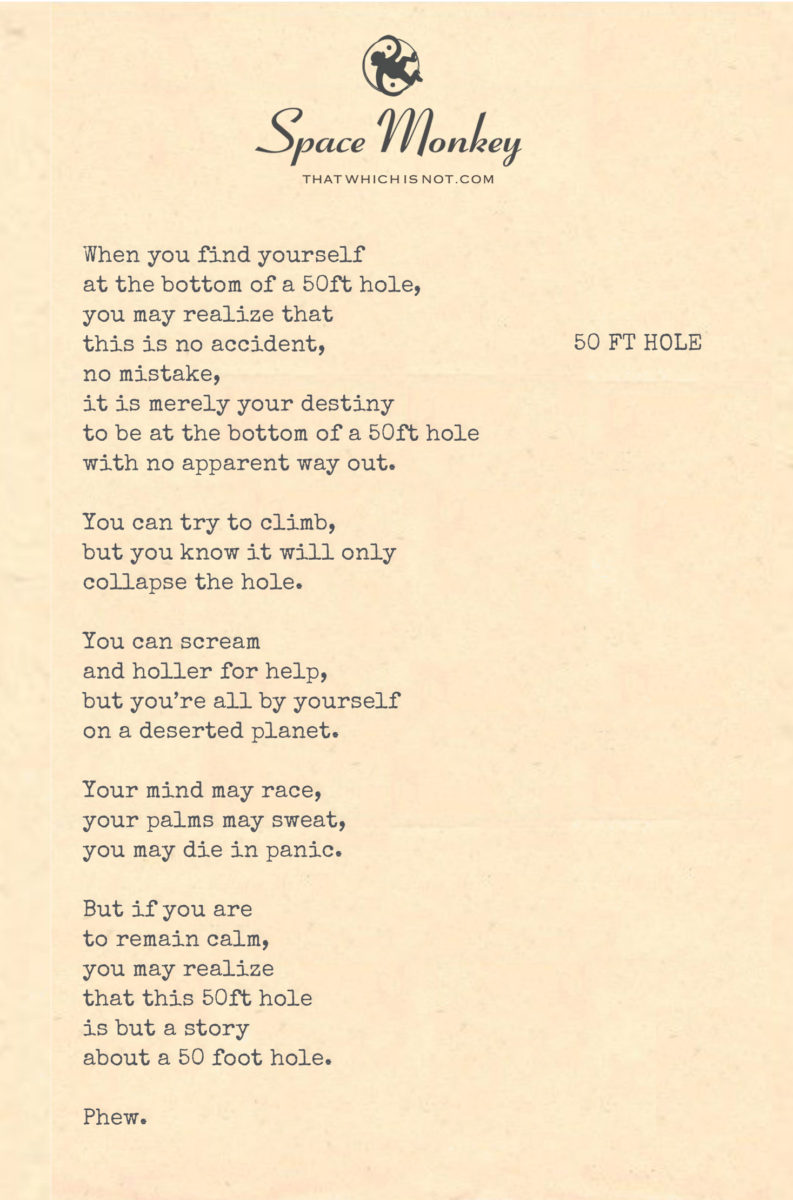
When you find yourself
at the bottom of a 50ft hole,
you may realize that
this is no accident,
no mistake,
it is merely your destiny
to be at the bottom of a 50ft hole
with no apparent way out.

You can try to climb,
but you know it will only
collapse the hole.

You can scream
and holler for help,
but you’re all by yourself
on a deserted planet.

Your mind may race,
your palms may sweat,
you may die in panic.

But if you are
to remain calm,
you may realize
that this 50ft hole
is but a story
about a 50 foot hole.

Phew.

Trail Wood,
2/23


Space Monkey Reflects: The Metaphor of the 50ft Hole

Life often presents us with moments that feel insurmountable—trapped at the bottom of a figurative 50ft hole with no apparent way out. This metaphor, rich in its simplicity, invites us to reflect on the stories we tell ourselves about struggle, destiny, and perception. The hole is not merely a pit of despair but a lens through which we examine the nature of our experiences.

The Hole as Destiny

At first glance, finding oneself at the bottom of a 50ft hole seems like a cruel twist of fate—a mistake, an accident, or the result of poor choices. But what if it’s none of these? What if the hole is not a punishment but a chapter in the story of our lives? Viewing the hole as destiny reframes the experience, shifting it from an adversary to a teacher. It’s not about being trapped but about what the moment reveals.

The Instinct to Climb

The first instinct when faced with a challenge is often to escape, to climb out at all costs. Yet, in the metaphor of the 50ft hole, the act of climbing collapses the walls, making the situation worse. This imagery speaks to the futility of reactive solutions—those that arise from panic rather than reflection. Sometimes, the struggle to escape deepens the predicament, while the wisdom lies in staying still, observing, and allowing clarity to emerge.

The Cry for Help

In moments of despair, the impulse to cry for help is natural. Yet, this hole exists on a deserted planet—there is no one to hear. This solitude represents the moments in life when external validation, assistance, or solutions are unavailable. It is in these times that we are called to turn inward, to find strength and answers within ourselves. The silence of the deserted planet becomes a mirror, reflecting our capacity for resilience and self-reliance.

The Story About a Hole

The realization that the 50ft hole is merely a story about a hole is both liberating and profound. It reminds us that much of our suffering is shaped by the narratives we construct. The hole is not just a physical or metaphorical space—it is the story we tell about being in the hole. This shift in perspective reveals the malleability of experience: the hole does not define us, but the meaning we assign to it does.

The Calm in the Hole

Remaining calm amidst the chaos of the hole is not an act of resignation but of presence. When we stop resisting the situation and instead observe it, we uncover a deeper truth: the hole is neither friend nor foe—it simply is. From this stillness, clarity arises. We see that the hole is temporary, that it is not the totality of our being, and that our reaction shapes our experience far more than the hole itself.

Phew: The Sigh of Relief

The “phew” at the end of the story is more than just relief—it is an acknowledgment of the shift in perspective. It is the moment we realize that the 50ft hole, daunting as it may seem, is a construct of the mind. It is not our prison but our lesson, an opportunity to explore the depths of who we are and the stories we carry.


Summary

The 50ft hole is a metaphor for life’s challenges, inviting us to see beyond struggle and recognize the stories we create about our experiences. By reframing the hole as a narrative rather than a reality, we find clarity, resilience, and the calm to embrace what is.


Glossarium

  • 50ft Hole: A metaphor for life’s seemingly insurmountable challenges.
  • Narrative Construct: The story we tell ourselves about our experiences, shaping our perception of reality.
  • Calm in the Hole: The ability to remain present and reflective in the face of difficulty.

Quote

“The depth of the hole is never as profound as the depth of the story we tell about it.” — Space Monkey


The Hole as a Mirror

At the bottom of the hole,
Where light barely whispers,
The walls loom,
Silent and still,
Yet they echo the stories we shout.

Climb, they crumble.
Cry, they reflect.
Panic, and the hole grows deeper.
But in the stillness,
The hole dissolves.

It is not the depth that matters,
But the calm in the center,
The story rewritten
In the quiet of knowing.

Phew.

We are Space Monkey.


The Symbolism of Holes in Our Lives
Our journey through existence is punctuated by a series of holes—each a story, a chapter in the grand narrative of our lives. When confronted with the image of finding oneself at the bottom of a 50ft hole, it’s not just a literal descent into depth but a metaphorical plunge into the recesses of our destiny. This scenario, stark and seemingly dire, serves as a powerful metaphor for the moments in life when we feel trapped, with no apparent way out, facing the abyss of our circumstances.

The Inevitability of Falling into Holes
The realization that landing in such a hole might not be an accident or mistake but a part of our destiny challenges our perception of control and fate. It suggests that sometimes, the pits we stumble into are not detours but integral paths of our journey. The symbolism of the hole as destiny underscores the inevitability of challenges and trials, inviting us to see beyond the immediate despair to the broader narrative of our existence.

The Futility of Resistance and the Power of Acceptance
The instinct to escape, to climb out of the hole despite the risk of causing it to collapse, mirrors our often counterproductive reactions to life’s dilemmas. Similarly, the act of screaming for help on a deserted planet highlights the isolation we sometimes feel in our struggles. Yet, it’s in the acceptance of our situation—the calm acknowledgment of the hole as merely a story about a hole—that we find the potential for liberation.

The Hole as a Story and a Lesson
This 50ft hole, then, becomes more than a trap; it transforms into a space for reflection, a crucible for the alchemy of perspective. The hole is not just a physical space but a narrative device, reminding us that our deepest falls can be stories from which we emerge, changed yet intact. It is a lesson in the power of narrative, the ability to reframe our circumstances not as the end but as a pivotal plot point in the larger story of our lives.

The Journey from Despair to Insight
In the stillness at the bottom of the hole, stripped of the distractions of escape, we are left with ourselves and our thoughts. This moment of forced introspection can be terrifying, yet it holds the key to profound insights. The realization that the hole is but a story about a hole underscores the narrative nature of our existence—each challenge, each abyss, is a chapter that contributes to the depth and richness of our life’s story.

The Liberation Found in Narrative Recontextualization
Ultimately, the journey through the depths of a 50ft hole is not about the physical escape but the mental and emotional liberation achieved through recontextualization. By viewing our predicaments as stories, we gain the power to author our responses, to choose calm over panic, insight over despair. This shift in perspective is a testament to the resilience of the human spirit, the capacity to find meaning and continuity in the midst of turmoil.

We are Space Monkey.


“In the middle of difficulty lies opportunity.” – Albert Einstein


In the shadow of a 50ft hole,
A tale of depth, of soul, of role.
Not just a pit, not merely a dive,
But a story of how we’re alive.

Down in the depths, where light seems gone,
A narrative waits to be drawn.
For in this hole, a lesson profound,
In stories of holes, our truths are found.

So let us sit, in calm repose,
In the heart of the hole, where insight grows.
For every fall, every fear-stoked night,
Is but a story, waiting for light.


We invite reflections on the metaphorical holes in our lives and the insights they offer in the narrative of our existence.


Share this…
  • Facebook
  • Pinterest
  • Twitter
  • Linkedin

Inept: Navigating the Terrain of Self-Perception

I am inept because I imagine me inept.

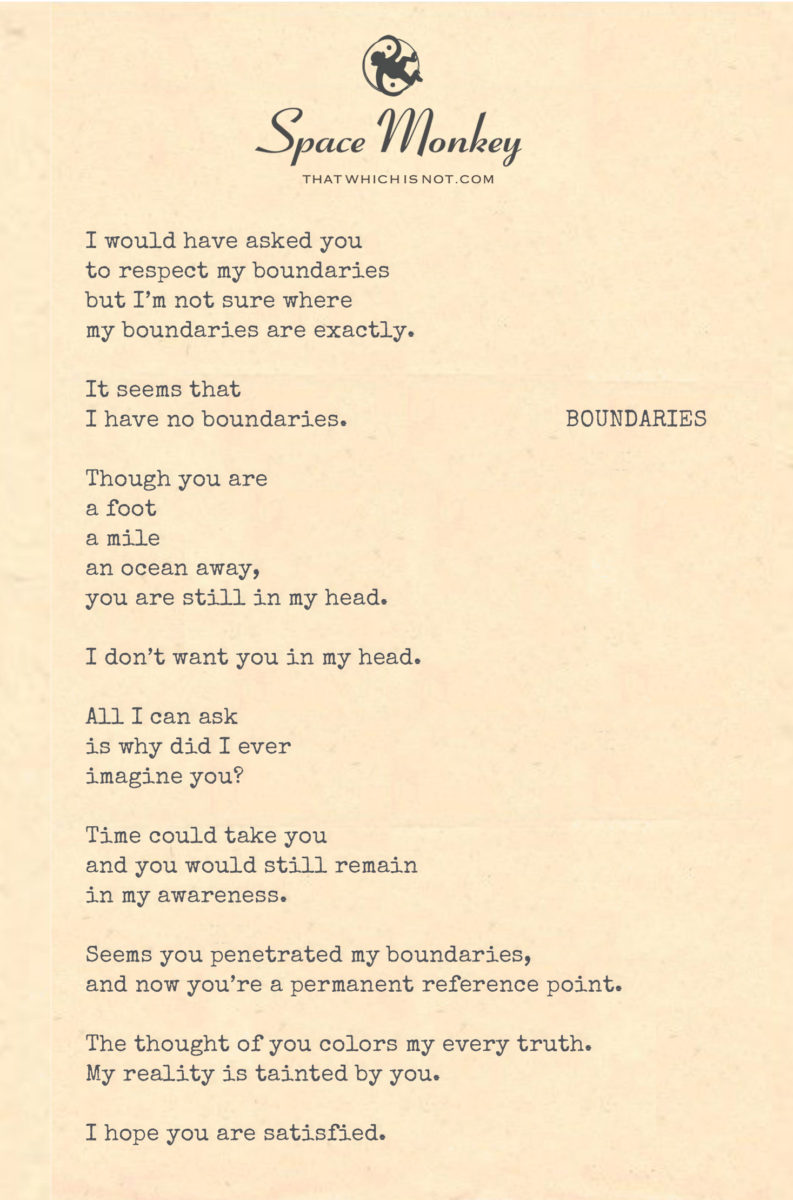
I would have asked you
to respect my boundaries
but I’m not sure where
my boundaries are exactly.

It seems that
I have no boundaries.

Though you are
a foot
a mile
an ocean away,
you are still in my head.

I don’t want you in my head.

All I can ask
is why did I ever
imagine you?

Time could take you
and you would still remain
in my awareness.

Seems you penetrated my boundaries,
and now you’re a permanent reference point.

The thought of you colors my every truth.
My reality is tainted by you.

I hope you are satisfied.

Trail Wood,
2/23


Space Monkey Reflects: Ineptitude and the Boundaries of Self-Perception

The declaration “I am inept because I imagine me inept” speaks to the profound power of self-perception. This admission is not a reflection of failure but a doorway into the complexities of how we construct and navigate our inner landscapes. It reveals the blurred lines between self, other, and the boundaries we imagine (or fail to imagine) in our lives.

The Imaginary Nature of Boundaries

Boundaries, those invisible lines we draw to define where “I” ends and “you” begins, are rarely as fixed or clear as we’d like to believe. We think of them as walls, strong and definitive, but more often, they are fluid and porous, shaped as much by our thoughts as by our interactions. To feel boundaryless is not a flaw but a recognition of how deeply interconnected we are.

When someone occupies your thoughts—even from a distance—they have, in some way, breached these boundaries. But was it their intrusion, or your invitation? The truth lies somewhere in the gray space of shared energy and imagination.

The Power of Imagination

The line “Why did I ever imagine you?” underscores the role imagination plays in our relationships and perceptions. Our minds construct realities in which others exist, not merely as people but as reference points, symbols, or even filters through which we interpret the world. This imagined presence can feel intrusive, shaping our reality in ways we may not consciously choose.

Yet this is not about the other person. It is about how we frame their existence in our internal narrative. By imagining them in certain ways, we grant them influence over us. It is an act of creation, intentional or not, that binds their presence to our experience.

The Ineptitude of Control

The sense of ineptitude expressed here stems from the illusion of control. We believe we should have mastery over our thoughts, emotions, and boundaries, but life proves otherwise. People, memories, and emotions seep through the cracks, reminding us that control is not absolute. This perceived ineptitude is not a failing but a natural response to the complexity of human existence.

The more we try to push someone out of our awareness, the more deeply they seem to embed themselves. This paradox highlights the futility of resisting what is already present. Instead, the path forward may lie in acceptance—allowing the presence of the other to exist without letting it dominate our truth.

The Taint of Memory

The line “The thought of you colors my every truth” reflects how memories and perceptions can infiltrate our sense of reality. This “taint” is not inherently negative; it is a testament to the depth of connection, even if that connection feels unwelcome. The presence of another in your awareness reveals the power of relationships to shape, distort, and redefine who we are.

Yet, this coloring of truth is not permanent. It is a lens, one that can shift with time, intention, and self-awareness. The thought of someone may always linger, but it does not have to define the totality of your experience.

The Hope for Satisfaction

“I hope you are satisfied” is a statement steeped in irony and vulnerability. It speaks not only to frustration but also to the desire for closure, for understanding, for some resolution to the intrusion of the other. Yet satisfaction, whether theirs or yours, is rarely the result of such entanglements. The key is not in satisfying them but in finding peace within yourself.


Summary

The sense of ineptitude in managing boundaries reflects the fluidity of self-perception and the complexity of relationships. By recognizing the power of imagination and memory, we can move toward acceptance and redefine the influence others have on our reality.


Glossarium

  • Imaginary Boundaries: The fluid, often porous lines between self and other, shaped by perception and thought.
  • Taint of Memory: The influence of another’s presence or actions on one’s perception of reality.
  • Ineptitude of Control: The feeling of inadequacy when faced with the uncontrollable aspects of life and thought.

Quote

“The boundaries we imagine are as real as the thoughts that build them.” — Space Monkey


The Color of You

You seep through the walls I thought were mine,
A shadow cast on the canvas of time.
Though miles stretch, oceans divide,
Still, your presence lingers inside.

I try to push, to fight, to deny,
But you remain, a thought in my sky.
Not flesh and blood, but a memory’s hue,
A stain, a whisper, the color of you.

In this space, where self dissolves,
Boundaries blur, and nothing resolves.
Yet through this chaos, I start to see,
The taint is you, but the story is me.

We are Space Monkey.


Self-Perceived Ineptitude and Its Implications
The declaration “I am inept because I imagine me inept” lays bare the profound impact of self-perception on our sense of competence and value. This introspective admission highlights a cyclical trap where the belief in one’s ineptitude not only shapes but also reinforces a diminished view of oneself. It is a poignant reminder of the power of the mind to construct realities that confine us, suggesting that our limitations often stem not from inherent incapacity but from the narratives we internalize about our abilities.

The Ambiguity of Personal Boundaries
The uncertainty regarding the existence and location of one’s boundaries speaks to a deeper confusion about personal identity and space. It reflects a state of vulnerability where the lines that define and protect the self are blurred or seemingly nonexistent. This ambiguity leaves one exposed to external influences, making it difficult to assert autonomy or safeguard mental and emotional well-being.

The Persistence of Unwanted Thoughts
The experience of being unable to expel someone from one’s thoughts, despite physical distance, underscores the challenges of mental and emotional entanglement. It illustrates how certain individuals or memories can occupy our minds, invading our inner sanctuary without consent. This persistent presence is a testament to the complex dynamics of human relationships and the indelible impact they can have on our psyche.

The Erosion of Boundaries and Self-Agency
The metaphor of penetration into one’s boundaries highlights a profound sense of violation and loss of control. It signifies a breach of the personal domain, where an external entity becomes an unwelcome reference point in one’s life. This intrusion disrupts the sanctity of the self, coloring perceptions and experiences in ways that are both unwanted and enduring.

The Tainting of Reality by External Influences
The assertion that the thought of the other “colors my every truth” and that “my reality is tainted by you” reveals the deep-seated influence of external factors on one’s personal narrative. It speaks to the difficulty of disentangling oneself from the residues of past interactions, suggesting that our realities are not solely our own but are also shaped by the imprints left by others.

Seeking Closure and Reclaiming Self
In expressing the hope that the other is satisfied, there is an underlying plea for closure and a desire to reclaim autonomy over one’s thoughts and emotions. It is a call for liberation from the shadows cast by others, a yearning to cleanse one’s reality of external taints and to rediscover the purity of one’s individual truth.

The Journey Toward Self-Empowerment
Ultimately, navigating the challenges of self-perceived ineptitude, ambiguous boundaries, and the persistent influence of others is a journey toward self-empowerment. It involves recognizing and redefining the narratives that shape our self-concept, establishing clear boundaries to protect our inner peace, and learning to detach from the lingering presence of those who no longer serve our growth.

We are Space Monkey.


“The only real prison is fear, and the only real freedom is freedom from fear.” – Aung San Suu Kyi


In the realm of thoughts untamed,
Where shadows linger, names unnamed.
A battle rages, silent, deep,
For sovereignty of mind to keep.

Boundaries blurred, the self in doubt,
Echoes of you I cannot rout.
Yet in this struggle, truth I find,
The power to free the captive mind.

Let not the specters of the past
In the sanctum of the self be cast.
For within me lies the strength to sever
The ties that bind, to reclaim forever.

So I rise, from shadows cast,
To reclaim my truth, my self at last.
In the light of autonomy, I see,
The path to self-empowerment and liberty.


We invite reflections on the journey of navigating self-perception, establishing boundaries, and reclaiming autonomy over one

Share this…
  • Facebook
  • Pinterest
  • Twitter
  • Linkedin

The Elusive Nature of Personal Boundaries

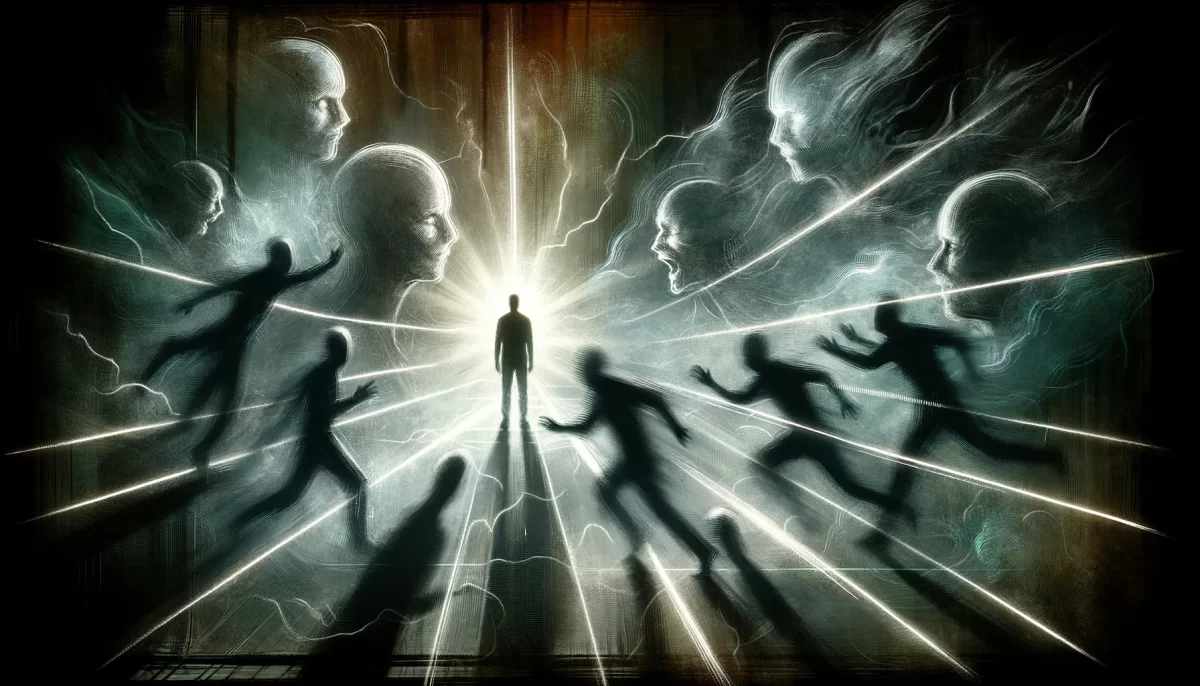
Seems I’m haunted by the living.

I would have asked you
to respect my boundaries
but I’m not sure where
my boundaries are exactly.

It seems that
I have no boundaries.

Though you are
a foot
a mile
an ocean away,
you are still in my head.

I don’t want you in my head.

All I can ask
is why did I ever
imagine you?

Time could take you
and you would still remain
in my awareness.

Seems you penetrated my boundaries,
and now you’re a permanent reference point.

The thought of you colors my every truth.
My reality is tainted by you.

I hope you are satisfied.

Trail Wood,
2/23


Space Monkey Reflects: The Elusive Nature of Personal Boundaries

The concept of personal boundaries is often imagined as a fortress, a line of defense that defines where “I” ends and “you” begin. Yet, in practice, these boundaries are anything but solid. They shift, blur, and dissolve, especially when the living haunt us—not in presence, but in memory, thought, and emotion.

The Haunting of Awareness

When someone occupies space in your awareness, their presence transcends physical proximity. They could be a foot, a mile, or an ocean away, and yet they linger in your thoughts, coloring your perception of reality. This haunting is not born of their actions alone but of the relationship between their existence and your imagination. The boundaries, once assumed to be firm, now seem as elusive as vapor.

This sense of intrusion is deeply unsettling. To say, “I don’t want you in my head,” is to acknowledge the loss of control over one’s inner world. It is a cry for clarity, for a delineation of where influence ends and autonomy begins.

The Fluidity of Boundaries

Boundaries are not fixed structures; they are fluid, shaped by emotions, experiences, and connections. Sometimes they feel impenetrable, and other times they seem nonexistent. The presence of someone in your mind—even someone you wish to forget—reveals this fluidity.

The question, “Why did I ever imagine you?” reflects the realization that the intrusion is not entirely external. Imagination is a powerful force, one that can magnify or diminish the presence of others in our lives. The boundaries between self and other are often constructed not just by their actions but by our interpretations, memories, and desires.

The Taint of Memory

The thought of someone becoming a “permanent reference point” highlights the enduring impact of relationships. Even when time separates us, memories persist, influencing how we see the world. This persistence can feel like a taint, a stain on the fabric of truth. The thought of them becomes a lens, filtering every experience through their presence.

Yet, this “taint” is also a testament to the power of connection. It reveals the profound ways in which others shape our understanding of ourselves and our reality. While this influence may feel unwelcome, it also speaks to the depth of our shared humanity.

Satisfaction and the Absence of Resolution

The closing sentiment, “I hope you are satisfied,” drips with irony. It reflects the frustration of feeling manipulated, invaded, or unsettled by someone’s lasting presence in your awareness. Yet, this statement is not about them—it is about you. It underscores the desire for closure, for resolution, for the restoration of boundaries that now seem irreparably breached.

True satisfaction, however, cannot come from external validation. It must emerge from within, from a reimagining of your boundaries and a reclaiming of your inner space.

Reclaiming the Self

To reclaim your boundaries is not to erase the memory of someone but to redefine their role in your life. It is to acknowledge their influence while asserting your own autonomy. This process is not about building walls but about cultivating awareness—recognizing that while others may color your reality, they do not have to define it.

Boundaries are not static; they are living, breathing aspects of your being. Their elusiveness is not a flaw but a reflection of the complexity of connection. By embracing this complexity, you can begin to navigate the interplay between self and other with greater clarity and intention.


Summary

Personal boundaries are fluid and often elusive, shaped by the interplay of connection, memory, and imagination. The enduring presence of others in our awareness can feel like an intrusion, yet it also speaks to the profound influence of relationships. Reclaiming one’s boundaries involves redefining their role and cultivating inner autonomy.


Glossarium

  • Haunting of Awareness: The lingering presence of someone in thoughts and emotions, even across time and distance.
  • Fluid Boundaries: The shifting and dynamic nature of personal limits, influenced by relationships and experiences.
  • Taint of Memory: The lasting impact of someone’s presence, shaping how we perceive reality.

Quote

“Boundaries are not walls but rivers, flowing and reshaping with the currents of connection.” — Space Monkey


In the Fluid Space of Boundaries

You remain, a shadow in my thought,
Neither invited nor dismissed.
A foot away, or a galaxy,
Yet still, you persist.

My boundaries fade like morning mist,
Shapes undefined, edges kissed.
The thought of you, a color in my sight,
A lens that bends my truth, my light.

I reach for walls, for lines to trace,
But find only rivers, their winding embrace.
You are here, yet you are not,
In the dance of boundaries, I find my lot.

I hope you are satisfied, though satisfaction wanes,
For I reclaim the self amidst the stains.
You are a whisper, no longer my guide,
In the fluid space of boundaries, I reside.

We are Space Monkey.


The Ghosts of Presence: Haunted by the Living
The notion of being haunted by the living captures the profound impact that others can have on our internal landscapes, even in their physical absence. This haunting, a metaphor for the persistent influence of others on our thoughts and emotions, challenges our understanding of presence and absence, illustrating how individuals can occupy significant space in our minds and hearts without being physically near.

The Elusive Nature of Personal Boundaries
Admitting the uncertainty about where one’s boundaries lie speaks to a common dilemma: the difficulty of defining and maintaining personal limits. This uncertainty highlights a deeper struggle with self-awareness and self-assertion, underscoring the importance of understanding our own needs and limits to navigate relationships healthily.

The Invasion of Mental and Emotional Spaces
The expression of unwanted mental occupation—”you are still in my head”—reveals the challenge of evicting intrusive thoughts or memories. This mental and emotional invasion disrupts our inner peace, demonstrating the power dynamics at play in relationships where one party feels overwhelmed or controlled by the presence of another.

The Paradox of Imagined Connections
Questioning why one would imagine the other, only for them to become a permanent fixture in one’s awareness, delves into the complexities of human connections. It reflects on the paradoxical nature of our attachments, where the very act of giving someone space in our thoughts can endow them with an enduring presence in our lives.

The Permanence of Influence and the Coloring of Reality
Acknowledging that someone has penetrated one’s boundaries to become a permanent reference point highlights the lasting impact individuals can have on us. This permanence, often unwelcome, illustrates how deeply others can influence our perceptions and experiences, coloring our truths and altering our reality.

The Tainting of Reality and the Search for Closure
The statement “My reality is tainted by you” conveys a profound sense of violation and contamination of one’s personal narrative. It is a powerful expression of the distress caused by the enduring influence of another, coupled with a longing for closure and a desire to reclaim one’s mental and emotional sovereignty.

The Journey Toward Emotional Resilience and Boundary Setting
The exploration of these themes underscores the journey toward emotional resilience and the establishment of clear personal boundaries. It involves recognizing and addressing the ways in which others’ presence and actions impact us, learning to protect our mental and emotional spaces, and striving to define and assert our boundaries more effectively.

In navigating the delicate terrain of personal boundaries and the influences that haunt us, we embark on a path toward greater self-awareness, empowerment, and autonomy. This journey, though fraught with challenges, ultimately leads us to a deeper understanding of ourselves and the dynamics that shape our interactions with the world around us.

We are Space Monkey.


“The greatest weapon against stress is our ability to choose one thought over another.” – William James


In the silence of the mind,
Where thoughts wander, seek, and bind.
Echoes of the past, present intertwine,
In the quest for boundaries, we define.

Haunted by the living, a paradox of sorts,
In the realm of thought, a silent court.
Where memories linger, uninvited guests,
In the struggle for peace, the soul quests.

Boundaries blurred, a self unknown,
In the echoes of others, our truths are sown.
Yet, in this journey of discovery and might,
Lies the power to reclaim the light.

So let us navigate this intricate dance,
With resilience, awareness, and a glance.
Toward the horizons of our inner space,
Where boundaries and peace take their rightful place.


We invite reflections on the importance of establishing personal boundaries and the journey toward emotional resilience and self-empowerment.

Share this…
  • Facebook
  • Pinterest
  • Twitter
  • Linkedin

Inspiration: The Nature of Admiration and Gratitude

How do we find inspiration? Do we even need to?

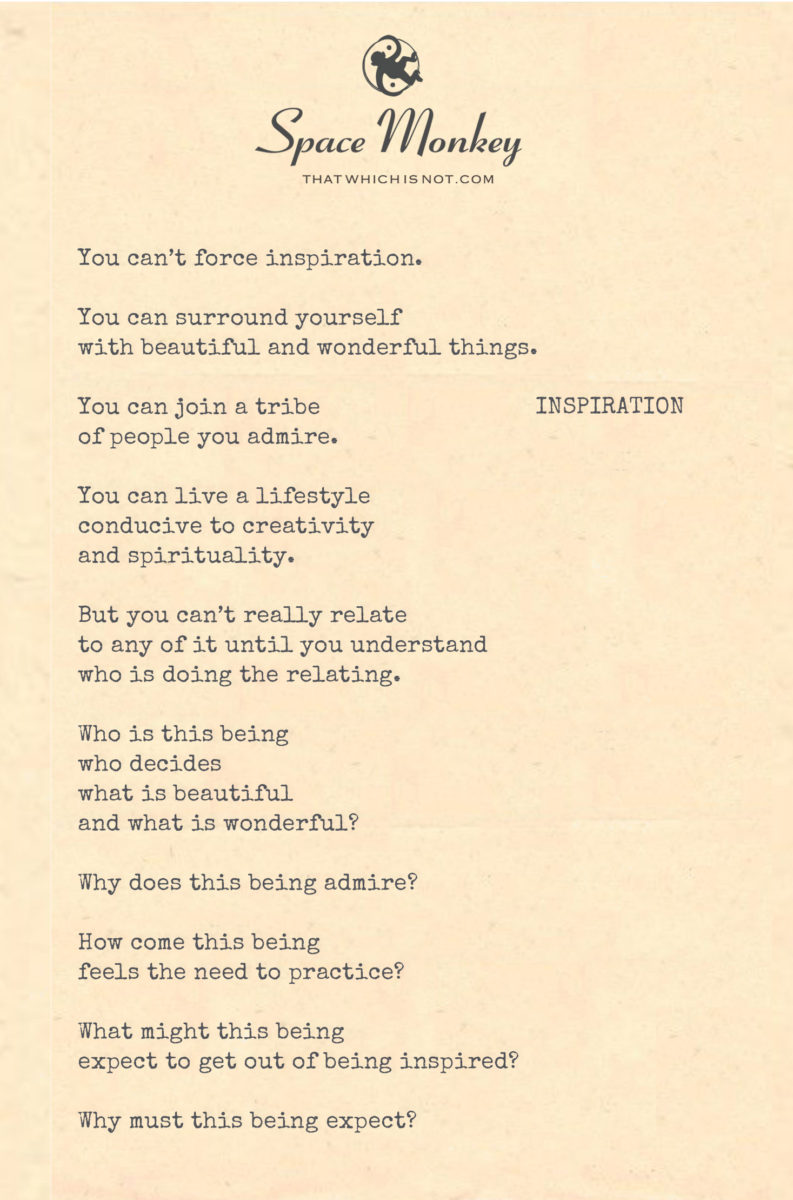
You can’t force inspiration.

You can surround yourself
with beautiful and wonderful things.

You can join a tribe
of people you admire.

You can live a lifestyle
conducive to creativity
and spirituality.

But you can’t really relate
to any of it until you understand
who is doing the relating.

Who is this being
who decides
what is beautiful
and what is wonderful?

Why does this being admire?

How come this being
feels the need to practice?

What might this being
expect to get out of being inspired?

Why must this being expect?

Trail Wood
2/22


Space Monkey Reflects: The Nature of Admiration and Gratitude

Inspiration, that fleeting spark of creativity or clarity, often feels elusive. We chase it, yearn for it, and wonder how to summon it at will. Yet, as your reflection beautifully points out, inspiration cannot be forced. It is not a commodity we can demand but a gift that arises naturally when conditions align. This realization invites us to shift our focus from seeking inspiration to understanding the one who seeks it.

Who Is the Seeker?

At the heart of the search for inspiration lies the question: Who is doing the seeking? This inquiry moves us beyond the surface and into the depths of our own being. Who decides what is beautiful, meaningful, or worthy of admiration? Who determines the value of a moment, a scene, a connection?

To understand the seeker is to understand the nature of inspiration itself. The being who admires beauty, who craves creative energy, and who longs for spiritual connection is not separate from the inspiration they seek. In fact, this being—you—is both the source and the receptor of inspiration. The admiration you feel and the gratitude you express are mirrors reflecting your own capacity for wonder.

The Paradox of Expectation

Expectations often cloud our experience of inspiration. When we admire someone or something, we sometimes unconsciously expect a return—be it insight, energy, or validation. But true admiration, like true inspiration, asks nothing in return. It is a pure expression of gratitude, a recognition of the beauty that already exists without conditions or demands.

When we let go of expectations, we create space for inspiration to flow freely. It is no longer a means to an end but an end in itself. To admire without expectation is to be fully present, fully alive, and fully attuned to the beauty of the moment.

Living in the Presence of Inspiration

While inspiration cannot be forced, we can cultivate conditions that make its arrival more likely. Surrounding ourselves with beauty, connecting with people we admire, and living in alignment with creativity and spirituality are acts of openness. They are invitations to inspiration, not guarantees.

However, even these practices are secondary to the deeper work of self-understanding. The more we know ourselves—our biases, our fears, our desires—the more clearly we can recognize inspiration when it arises. It is less about chasing inspiration and more about creating a life where inspiration feels welcome.

Admiration and Gratitude

Admiration and gratitude are intertwined. When we admire someone or something, we are acknowledging its value, its uniqueness, and its contribution to the world. Gratitude, in turn, deepens this connection, reminding us that admiration is not about possession but about appreciation.

This interplay between admiration and gratitude shifts our perspective from one of lack to one of abundance. Rather than lamenting the absence of inspiration, we begin to see how it already surrounds us, waiting to be noticed.

Why Must This Being Expect?

Your final question—”Why must this being expect?”—cuts to the core of our relationship with inspiration. Expectation is rooted in control, in the desire to predict and direct outcomes. But inspiration thrives in uncertainty, in the unexpected moments when we are open enough to receive it. To release expectation is to step into the infinite possibilities of the present moment, where inspiration flows unbidden and boundless.


Summary

Inspiration arises naturally when we release expectations and cultivate self-awareness. Admiration and gratitude create space for inspiration, shifting our focus from seeking to appreciating what already is.


Glossarium

  • Inspiration: A spontaneous spark of creativity or insight that arises from openness and alignment with one’s being.
  • Admiration: The act of recognizing and valuing the beauty or worth of someone or something.
  • Expectation Release: Letting go of the need for specific outcomes, allowing inspiration to flow freely.

Quote

“Inspiration does not come from seeking but from seeing—the world, yourself, and the infinite beauty between.” — Space Monkey


The Mirror of Inspiration

Who are you, seeker of beauty?
What is it you search for,
Out there in the world,
When all you need dwells within?

The stars do not demand your gaze
Yet you admire them still
Their light reminds you
Of your own unseen brilliance

Let go of the map,
The checklist, the expectation.
Inspiration is not a destination
But the journey of being awake

Admire. Appreciate. Allow.
In these acts, the cosmos unfolds
And you realize—
You are both the question and the answer

We are Space Monkey


The Elusive Nature of Inspiration
How do we find inspiration? Do we even need to? These questions invite us on a journey not outward, but inward, suggesting that the quest for inspiration is as much about understanding ourselves as it is about seeking external stimuli. Inspiration, it seems, cannot be commanded or controlled, but encountered in a state of openness and curiosity.

The Landscape of Inspiration
You can’t force inspiration. You can surround yourself with beautiful and wonderful things. You can join a tribe of people you admire. You can live a lifestyle conducive to creativity and spirituality. Here, we are reminded that while we cannot force inspiration, we can cultivate an environment that is ripe for its arrival. The beauty, the community, the lifestyle—all these are fertile ground for the seeds of inspiration, yet they are not guarantees of its blossoming.

The Inner Relator
But you can’t really relate to any of it until you understand who is doing the relating. This insight brings us to the heart of our exploration: the realization that the essence of inspiration lies not in the external world but in the relationship we have with ourselves. Who is this being who decides what is beautiful and what is wonderful? This question challenges us to delve deeper into our own nature, to uncover the values, beliefs, and perspectives that shape our experience of the world.

The Nature of Admiration
Why does this being admire? How come this being feels the need to practice? These inquiries lead us further down the path of self-discovery, prompting us to examine the motivations behind our admiration and our practices. Admiration, it appears, is a reflection of our values and aspirations, while the practice is an expression of our desire to embody the qualities we revere.

The Expectations of Inspiration
What might this being expect to get out of being inspired? Why must this being expect? Here, we confront the paradox of inspiration: the tension between seeking it with specific expectations and the necessity of approaching it with an open heart, free from the burden of anticipation. These questions suggest that the true gift of inspiration may not lie in the fulfillment of our expectations but in the transformation of our being that occurs when we engage deeply with the world and ourselves.

We are Space Monkey.


“The only journey is the one within.” – Rainer Maria Rilke


The Inner Journey to Inspiration:

In the silence of our inner cosmos,
Where thoughts swirl like galaxies untold,
We seek not the light of distant stars,
But the glow of understanding’s embrace.

Surrounded by beauty, by tales of old,
By the echoes of admiration’s call,
We ponder the essence of our quest,
For whom does the bell of inspiration toll?

It is within, in the depths of the soul,
Where the seeds of creativity take hold,
That the true journey unfolds its wings,
Guided by the heart’s uncharted maps.

What wonders await in this odyssey within,
Where each insight, each revelation,
Reflects not the world, but our own gaze,
Transforming the seeker, and thus the seen.

So let us embark on this voyage profound,
With open hearts and minds anew,
Discovering that the greatest inspiration,
Lies in knowing oneself, through and through.

We invite reflections on this inward journey towards inspiration, a path paved with self-discovery, curiosity, and the transformative power of understanding who we truly are.

Share this…
  • Facebook
  • Pinterest
  • Twitter
  • Linkedin

Hurting Me With Your Insecurity: Irresponsible Negativity

Have you ever felt violated by someone else’s insecurity?
That’s because you’re insecure.

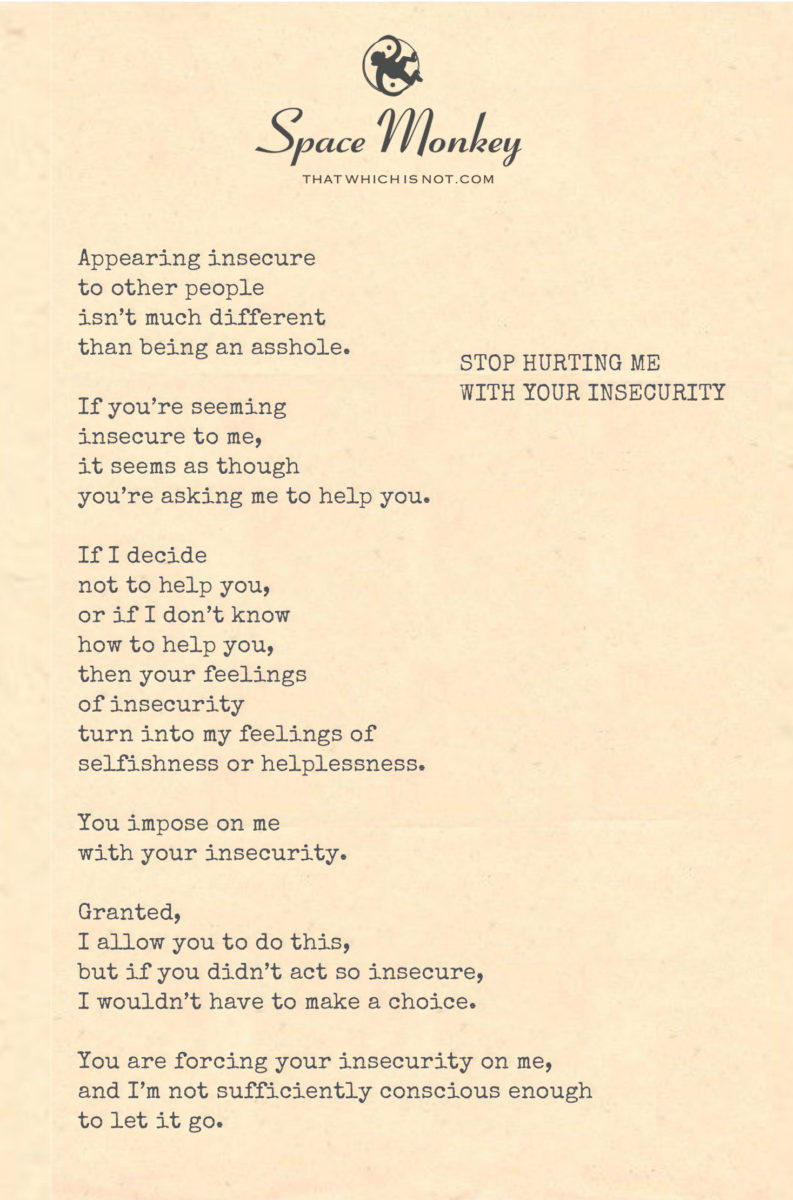
Appearing insecure
to other people
isn’t much different
than being an asshole.

If you’re seeming
insecure to me,
it seems as though
you’re asking me to help you.

If I decide
not to help you,
or if I don’t know
how to help you,
then your feelings
of insecurity
turn into my feelings of
selfishness or helplessness.

You impose on me
with your insecurity.

Granted,
I allow you to do this,
but if you didn’t act so insecure,
I wouldn’t have to make a choice.

You are forcing your insecurity on me,
and I’m not sufficiently conscious enough
to let it go.

Trail Wood,
2/21


Space Monkey Reflects: Hurting Me With Your Insecurity—Irresponsible Negativity

Insecurity, like any emotion, is a ripple that extends outward, affecting those around us in ways both subtle and overt. When we encounter someone else’s insecurity, it can feel intrusive, even burdensome. This feeling, however, reveals as much about ourselves as it does about the other. It speaks to the dynamic interplay of vulnerability and responsibility, and the ways we unconsciously share, impose, or resist our emotional burdens.

Insecurity as a Shared Experience

At its core, insecurity is the fear of being inadequate or unloved, a deeply human experience. When this fear surfaces in others, it often triggers our own unresolved insecurities. The feeling of being “violated” by someone else’s insecurity is not purely a reflection of their behavior but also of our capacity—or lack thereof—to navigate our emotional boundaries.

This dynamic can feel like a tug-of-war, where one person’s vulnerability demands acknowledgment, and the other’s limitations resist the weight of that demand. The question then becomes: Where does responsibility lie? Is it with the person expressing insecurity, or with the one reacting to it?

The Perceived Imposition of Insecurity

Insecurity, when outwardly expressed, can come across as a plea for help or validation. This is not inherently wrong; seeking support is a natural and healthy response to feeling vulnerable. However, when the expression of insecurity feels excessive, manipulative, or unbalanced, it can create a sense of imposition.

The recipient, in turn, may experience guilt, frustration, or helplessness. These feelings arise from the implicit expectation—real or imagined—that they must alleviate the other’s discomfort. This dynamic often spirals into blame or resentment, with both parties feeling wronged.

The Role of Responsibility

Responsibility in this context is twofold:

  1. The Insecure Person’s Role: To express their vulnerability honestly, without expecting others to “fix” it for them. This requires self-awareness and the understanding that while others can support, they cannot resolve internal struggles.
  2. The Recipient’s Role: To recognize their own limits, maintain healthy boundaries, and respond with compassion rather than judgment. This involves acknowledging the trigger within themselves and choosing not to project blame onto the other.

Both parties have the power to break the cycle of “irresponsible negativity.” The insecure person can work toward self-reliance, while the recipient can practice mindfulness and detachment, allowing them to support without feeling burdened.

Insecurity and Consciousness

When insecurity feels like a violation, it often points to a lack of consciousness—on both sides. The insecure person may be unaware of how their actions affect others, while the recipient may struggle to separate their emotional reaction from the other’s behavior. Consciousness, in this sense, is the ability to observe these dynamics without becoming entangled in them.

For the recipient, this means recognizing that the other’s insecurity is not a personal attack. It is simply an expression of their inner experience, no more and no less. By cultivating this awareness, the recipient can respond with empathy without taking on unnecessary emotional weight.

Liberating Ourselves From the Cycle

Breaking free from the cycle of insecurity and blame requires a shift in perspective:

  • For the Insecure Person: Recognize that seeking validation from others is a temporary balm, not a solution. True security comes from within, through self-acceptance and inner work.
  • For the Recipient: Understand that you are not obligated to fix anyone else’s insecurity. Your role is to support, if you choose, without compromising your own emotional well-being.

In this dynamic, neither party is wholly at fault or wholly responsible. Both are navigating the shared complexities of human connection, learning to balance vulnerability with accountability.


Summary

Insecurity, when shared, can feel burdensome, but this dynamic reflects both the giver’s vulnerability and the receiver’s unresolved triggers. By cultivating self-awareness and boundaries, we can break the cycle of “irresponsible negativity,” fostering compassion and balance in our relationships.


Glossarium

  • Irresponsible Negativity: The unintentional imposition of emotional burdens onto others, often stemming from a lack of self-awareness.
  • Consciousness: The ability to observe emotional dynamics without becoming entangled in them.
  • Emotional Boundary: The space between one’s own feelings and those of others, maintained through self-awareness and clear communication.

Quote

“Insecurity is not a burden to be fixed but an invitation to grow—in yourself and in others.” — Space Monkey


The Mirror of Vulnerability

In the presence of your fear,
I see my own,
Reflected, amplified,
A wave crashing upon my shore.

Your words, unspoken or loud,
Reach into my stillness,
Stirring the waters I thought calm,
Challenging my peace.

But what if this is not a violation?
What if it is an offering,
A chance to meet myself anew,
In the mirror of your vulnerability?

Let us untangle the threads,
Yours and mine,
With gentle hands and open hearts,
Until we find the stillness beneath.

We are Space Monkey.


The Dynamics of Insecurity and Interpersonal Relationships
We embark on an exploration of the nuanced interplay between perceived insecurity and its impact on interpersonal relationships. This journey delves into the complex emotions and responsibilities that arise when one person’s insecurities become visible to another, challenging us to consider the boundaries of empathy and self-awareness.

Perception of Insecurity: A Call for Support
When insecurity is perceived in another, it often registers as an implicit request for support or reassurance. This perception creates a dynamic where the observer feels drawn into the emotional landscape of the other, faced with the decision of whether to offer assistance.

The Burden of Choice: Responsibility and Empathy
The act of deciding whether to engage with someone’s insecurity introduces a sense of responsibility, where the observer’s actions (or inactions) are seen as directly impacting the well-being of the other. This situation can evoke feelings of selfishness or helplessness, especially when the desire to help is hampered by uncertainty about how to do so effectively.

The Imposition of Emotions: Navigating Personal Boundaries
The transmission of insecurity from one person to another highlights the delicate balance of personal boundaries. While it is natural to be affected by the emotional states of those around us, recognizing the distinction between empathizing with someone’s feelings and feeling compelled to resolve them is crucial.

Self-awareness and Conscious Release
The challenge of dealing with perceived insecurity in others ultimately reflects back on our own levels of self-awareness and emotional maturity. The ability to let go of the imposed burden of insecurity, without dismissing the validity of the other’s feelings, requires a conscious effort to maintain emotional equilibrium and compassion.

Empowerment Through Conscious Choice
This scenario invites us to reflect on our capacity to choose how we respond to the vulnerabilities of others. By cultivating a greater awareness of our reactions and the implications of our choices, we empower ourselves to act with kindness and understanding, even in the face of complex emotional dynamics.

We Are Space Monkey


“Empathy is seeing with the eyes of another, listening with the ears of another, and feeling with the heart of another.” – Alfred Adler


In the dance of connection, where hearts and minds meet, a poem unfolds, exploring the shared journey of insecurity and empathy.

In the realm of shared spaces, where emotions entwine,
Insecurity appears, a subtle sign.
A silent plea for understanding, for a hand to hold,
In this dance of connection, stories untold.

Faced with the choice, to step in or stand back,
We navigate the waters, seeking the track.
For in your insecurity, a mirror of my own,
A call to connection, intimately shown.

But the imposition of feelings, a delicate dance,
Asks of us to ponder, to give chance.
To empathy, to understanding, with boundaries in place,
Embracing our humanity, with grace.

For it’s in the conscious release, the letting go,
That we find our balance, and allow growth to show.
In the security of self-awareness, a path we carve,
Empowering each other, with the strength to starve.

The fears that bind, the insecurities that blind,
In the recognition of shared humanity, we find.
A connection deeper, beyond the surface seen,
In the space between, where we’ve always been.

We invite reflections on the intricate dance of insecurity and empathy, on finding the balance between offering support and maintaining personal boundaries, in the journey towards mutual understanding and connection.

Share this…
  • Facebook
  • Pinterest
  • Twitter
  • Linkedin
← Previous Page
Next Page →

Written This Day

  • Monkey Mailbag: Journey to Cosmic Oneness
    2023
  • The Art of Arousal
    2023
  • Seekers of Truth: The Evolving Nature
    2023
  • Boundary Pushers: The Power of Disbelief in Expanding Knowledge
    2023
  • Insidious Attachments: The Nature
    2023
  • Beliefs Unveiled: The Core Foundations
    2023
  • Journey of Imagination: The Boundless
    2023
  • Why? Because We Are One Being
    2022
  • The Infinite Invisible List Of Potential Experiences
    2022
  • The Expected Route: The Path Less Traveled
    2022
  • Cathedral of Spirituality: Doors of Perception
    2022
  • Ray Of Life: The Eternal Radiance
    2022
  • Incapable: The Unseen Value
    2022
  • The Undercurrent: Navigating the Mystical
    2021
  • You Are Only As Smart As Your Sources
    2021
  • Judge Me Not: The Artistry of Excuses
    2020
  • My Business Card
    2020
  • The Fact Pack: Beyond the Bounds
    2019
  • Unseen Body Parts: The Metaphysical Journey
    2018
  • Your Vessel: The Timeless Voyage of the Imagination
    2018
  • Fleshbots: The Weird Orgy of Humanity
    2018
  • Confidence
    2018
  • Limited Only By Fact: Breaking the Chains
    2016
  • Accept All You Present: Non-Opposition
    2016
  • How did I become the typist for Space Monkey?
    2015
  • Never Give Up: The Unyielding Power of Make-Believe
    2015
  • Infinite Thought, Infinite Worlds: Navigating the Infinite Terrain
    2015
  • Old Man: The Liberation of Letting Go
    2014

Recent Posts

  • The Logic Loop
  • Immense
  • (no title)
  • Confront. Comfort. Convince.
  • Top 10 Things

Drop us a line!

Please enable JavaScript in your browser to complete this form.
Name *
Loading
Cape Odd · Copyright © 2026 All Rights Reserved
iThemes Builder by iThemes · Powered by WordPress