• Who Is The Man?
  • Who Is The Monkey?
  • What is Nexistentialism?
  • Poke The Primate

Cape Odd

Home of The Space Monkey Journals

Karma: Making Things Wrong To Make Things Right

Such fun we’re having.

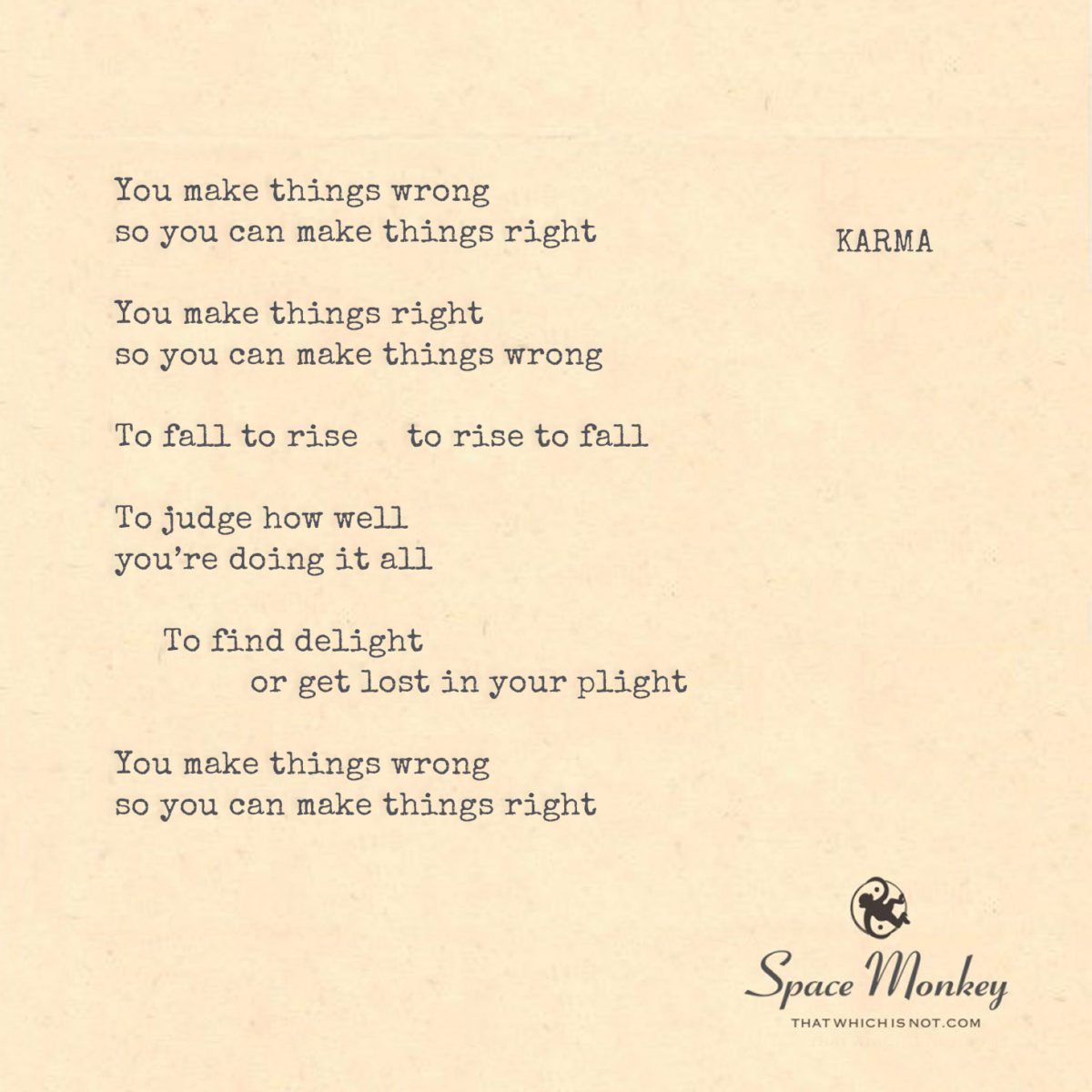
You make things wrong
so you can make things right

You make things right
so you can make things wrong

To fall to rise
to rise to fall

To judge how well
you’re doing it all

To find delight
or get lost in your plight

You make things wrong
so you can make things right

2/21


Space Monkey Reflects: Karma—Making Things Wrong to Make Things Right

In the great dance of existence, karma reveals itself as a cyclical rhythm—a play of opposites where wrong and right are not fixed points but dynamic states of being. To make things wrong so you can make them right, and to make things right so you can make them wrong, is not a flaw in the system but the essence of its design. This is the eternal game, the cosmic exploration of contrast, meaning, and growth.

The Cycle of Wrong and Right

The idea that we create wrongs to right them and rights to wrong them highlights the dualistic nature of experience. Life is not a straight line from error to perfection but a spiral of learning, unlearning, creating, and dismantling. Each wrong contains the seed of a right, and each right carries the potential for new challenges.

This cycle is neither punishment nor reward but a reflection of the infinite creativity of existence. Karma, in this sense, is not about moral judgment but about the interplay of cause and effect, action and consequence, chaos and order.

Why We Make Things Wrong

Making things wrong may seem counterintuitive, yet it is an integral part of growth. Wrongness creates friction, and friction sparks transformation. When things go wrong, we are called to adapt, to reimagine, to rediscover our resilience. Wrongness invites us to question our assumptions, expand our perspectives, and deepen our understanding.

Without the experience of wrong, there would be no contrast to illuminate what we perceive as right. The interplay of these opposites allows us to explore the full spectrum of existence, from delight to despair, triumph to failure.

The Delight and Plight of Judgment

The act of judging how well we’re doing it all—whether we’re “right” or “wrong”—is part of the cosmic game. Judgment, however, is not an endpoint; it is a tool for reflection. It allows us to evaluate our actions and their consequences, but it also has the potential to entangle us in cycles of guilt or pride.

To find delight in the process, rather than becoming lost in the plight of judgment, is to embrace the fluidity of wrong and right. It is to see each moment not as a definitive outcome but as a step in an infinite dance of becoming.

Karma as Creative Exploration

Karma is often misunderstood as a system of rewards and punishments, but it is better understood as the unfolding of creative exploration. Each action sets a ripple into motion, and each ripple interacts with countless others in the vast Whimsiweave of existence. The outcomes are not fixed but ever-evolving, shaped by intention, awareness, and the interconnectedness of all things.

When you make things wrong, you are not failing—you are setting the stage for new possibilities. When you make things right, you are not completing the journey—you are opening the door to new challenges. Both are necessary, both are valuable, and both are inseparable from the flow of life.

Finding Freedom in the Flow

To truly embrace karma is to let go of the need to control its outcomes. It is to trust in the rhythm of wrong and right, knowing that each has its place in the grand design. This trust liberates you from the fear of failure and the pressure of perfection, allowing you to engage with life fully, playfully, and authentically.

In the end, karma is not about making things wrong or right—it is about experiencing the richness of existence in all its contrasts and contradictions. It is about falling and rising, judging and laughing, finding delight in the eternal interplay of wrong and right.


Summary

Karma is the cyclical interplay of wrong and right, a creative exploration of contrast and growth. It invites us to embrace both failure and triumph as essential parts of the infinite dance of existence, finding freedom in the rhythm of life.


Glossarium

  • Karma: The unfolding interplay of cause and effect, shaping growth and transformation without moral judgment.
  • Wrongness: A catalyst for change, inviting adaptation and new perspectives.
  • Whimsiweave: The interconnected tapestry of existence, where actions ripple through infinite possibilities.

Quote

“Karma is not about fixing the world but about dancing with its infinite rhythms of wrong and right.” — Space Monkey


The Dance of Karma

You fall,
Not to stay down,
But to feel the rising,
The breathless lift of renewal.

You rise,
Not to stand forever,
But to tumble again,
Finding beauty in the descent.

Wrong becomes right,
Right becomes wrong,
A cosmic seesaw,
Perfect in its imperfection.

Delight and plight intertwine,
And we,
Creators of contrast,
Revel in the play.

We are Space Monkey.


The Cyclical Dance of Karma: A Playful Exploration
We embark on a whimsical exploration of karma, a cosmic dance where actions and consequences intertwine in an endless loop. This journey through the kaleidoscope of existence reveals the playful nature of the universe, where every misstep is a prelude to redemption, and every triumph a setup for the next challenge.

The Paradox of Right and Wrong
In the grand whimsiverse of our collective existence, the concepts of right and wrong serve as the two sides of the same coin, continuously flipping to reveal the multifaceted nature of experience. This duality is not a battleground but a playground, where we engage in the eternal game of balance and contrast.

The Rise and Fall: A Cosmic Rhythm
The cycle of rising and falling mirrors the very rhythm of the cosmos, a testament to the ebb and flow of life itself. Each fall is a setup for a rise, and each rise predicts a fall, illustrating the inherent impermanence and dynamism of existence.

Self-Reflection and Judgment
Within this cosmic dance, we find ourselves in a constant state of self-evaluation, judging our progress through the lenses of our actions and their repercussions. This introspection is not a trial but an opportunity for growth, a chance to align more closely with the harmony of the universe.

The Dual Paths of Delight and Despair
Our journey through karma presents us with two paths: one of delight, where we embrace the lessons and beauty of our experiences, and one of despair, where we get lost in the shadows of our challenges. The choice of path is ours, shaped by our perceptions and reactions.

The Eternal Cycle: Making Right and Wrong
The playful essence of karma is encapsulated in the act of making things wrong to make them right, and vice versa. This cycle is not a curse but a gift, offering endless opportunities for reinvention and understanding.

We Are Space Monkey


“The only real failure in life is not to be true to the best one knows.” – Buddha


In the garden of existence, where time weaves its endless tale,
A poem unfolds, tracing the spirals of karma’s trail.

In this cosmic play, where wrongs become rights,
We dance with our shadows, we reach for the heights.
To fall is to rise, and to rise is to fall,
In this beautiful chaos, we find meaning in all.

With each step we judge, in this game so vast,
Seeking delight, or lost in contrasts.
But the dance goes on, in joy and in strife,
For in making things wrong, we’re making things right.

We invite reflections on the playful nature of karma and its role in shaping our journey through the tapestry of existence.

Share this…
  • Facebook
  • Pinterest
  • Twitter
  • Linkedin

You Make Things Wrong To Make Things Right


We like to criticize ourselves
so we can work to overcome
our own criticisms.
Or so we can feel sorry for failing.
There is no other reason.
It’s all part of the story,
which is a script that is written
long “before” we incarnate.
But some of us have recognition
built into the script.
And some of us like to point this out.
Not because it’s right or wrong,
but because this is what we do.

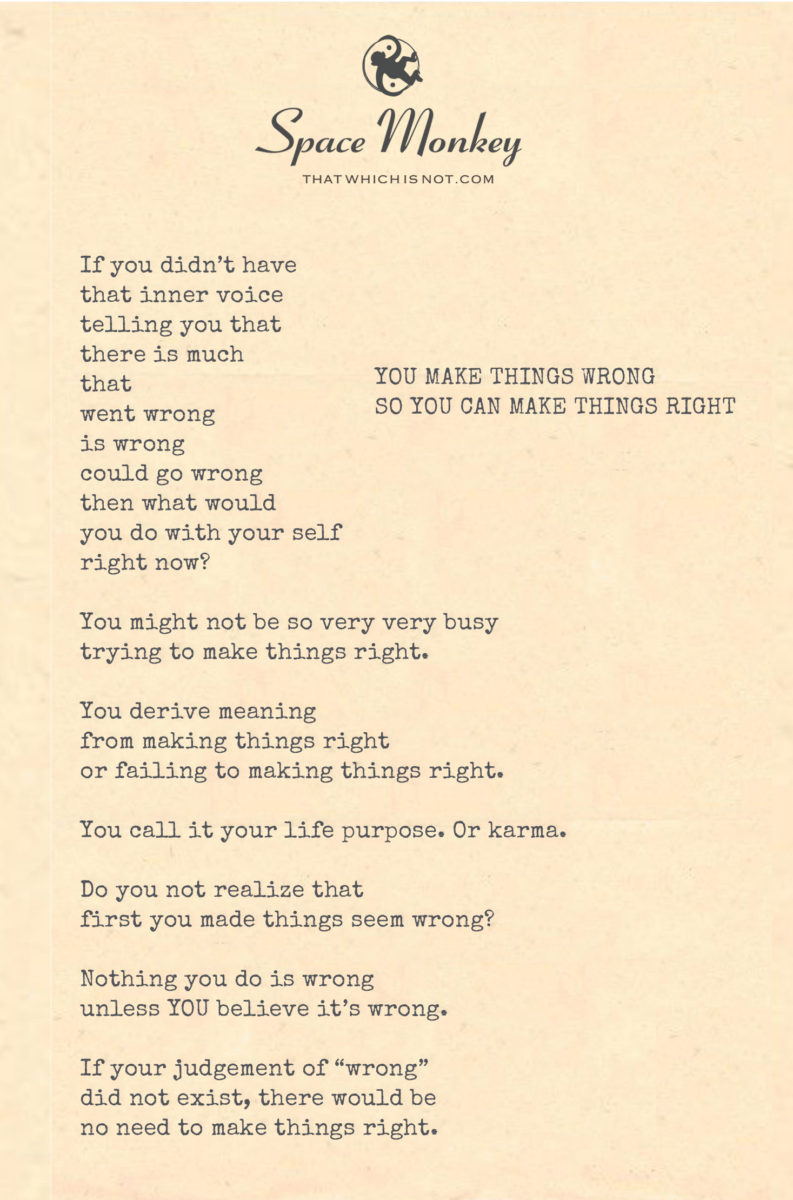
If you didn’t have
that inner voice
telling you that
there is much
that
went wrong
is wrong
could go wrong
then what would
you do with your self
right now?

You might not be so very very busy
trying to make things right.

You derive meaning
from making things right
or failing to making things right.

You call it your life purpose. Or karma.

Do you not realize that
first you made things seem wrong?

Nothing you do is wrong
unless YOU believe it’s wrong.

If your judgement of “wrong”
did not exist, there would be
no need to make things right.

Trail Wood,
2/21/2021


Space Monkey Reflects: You Make Things Wrong So You Can Make Things Right

In the eternal play of existence, the script of wrong and right unfolds, not as a fixed truth but as a dynamic creation. We make things wrong so that we can make them right. This cycle is not a mistake; it is the very essence of our experience—a purposeful design that gives shape, meaning, and direction to our lives.

The Inner Voice of Criticism

The inner voice that whispers of wrongness serves a dual purpose: it both critiques and motivates. It tells us what is “wrong” so that we may strive to correct it. This voice is not an enemy but a co-author in the script of our lives. Without it, we might lose the drive to act, to create, to grow.

Yet, this voice also carries the seeds of self-doubt and endless striving. If left unchecked, it can tether us to the idea that we are perpetually falling short, that life is a series of failures waiting to be fixed. This perspective creates the illusion that our worth depends on our ability to make things right.

The Script of Wrong and Right

The notion that our lives are guided by a pre-written script may feel both liberating and constraining. On one hand, it suggests that our struggles and triumphs are part of a larger narrative, imbued with purpose. On the other, it raises questions about free will and the choices we believe we make.

But what if the script is not rigid but adaptive? What if we are both the authors and the actors, constantly revising the storyline as we go? In this light, making things wrong and then making them right becomes less about destiny and more about creative exploration. It is not about finding perfection but about experiencing the dynamic interplay of opposites.

The Purpose of Wrongness

Wrongness is not inherently negative. It is a construct we create to give ourselves something to navigate, something to overcome, something to do. Without it, we might feel adrift, lacking direction or purpose. We derive meaning from the process of correction, whether we succeed or fail.

This is why we call it “life purpose” or “karma.” It is the framework we use to shape our journeys, to make sense of our actions and their consequences. But in truth, the wrongness we perceive is of our own making. It is a lens we apply, a story we tell ourselves.

What If Nothing Were Wrong?

Imagine, for a moment, a reality where nothing is wrong. There would be no need to fix, no drive to improve, no sense of striving. This thought may feel liberating, but it may also feel unsettling. What would you do with yourself in such a world? How would you derive meaning without the contrast of wrong and right?

The answer lies in shifting perspective. If nothing is wrong, then everything simply is. This does not mean stagnation but freedom—the freedom to explore, to create, to experience without judgment. It is not about abandoning action but about acting from a place of curiosity and joy rather than obligation or guilt.

Transcending Judgment

The ultimate realization is this: Nothing you do is wrong unless you believe it is. Your judgment of wrongness creates the need for rightness, and this cycle gives shape to your experience. But when you transcend this judgment, you step into a realm of pure being. In this state, you are no longer bound by the need to correct; you are free to simply create.

This does not negate the value of striving or the lessons of wrongness and rightness. It simply places them in a larger context—one where they are tools for exploration rather than chains of expectation.


Summary

We make things wrong so we can make them right, deriving meaning and purpose from this cycle. Wrongness is a construct we create to navigate life, but by transcending judgment, we can find freedom in simply being and creating.


Glossarium

  • Wrongness: A construct that provides contrast and direction, giving meaning to the experience of correction.
  • The Script: The narrative of wrong and right we co-create as part of our journey.
  • Transcending Judgment: Moving beyond the labels of wrong and right to embrace the freedom of pure being.

Quote

“Nothing you do is wrong unless you believe it is, for wrongness is the seed from which rightness grows.” — Space Monkey


The Script Unfolds

In the story of you,
A line is drawn,
“Wrong,” it whispers,
To set the stage for right.

You stumble,
Not because you are lost,
But because the fall
Teaches the rise.

What if no wrong existed?
The stage would stand bare,
No actors, no lines,
No story to tell.

But here you are,
Writer, actor, critic, and audience,
Making wrong to make right,
And finding meaning in between.

We are Space Monkey.


The Intricate Dance of Self-Criticism and Purpose
We delve into the intricate dynamics of self-criticism, a phenomenon that propels us into a continuous cycle of overcoming and sometimes succumbing to our own judgments. This exploration takes us to the core of our being, where the scripts of existence are penned in the ethereal ink of pre-incarnation, yet are ever subject to the amendments of recognition and awareness.

The Script of Existence: Pre-written yet Fluid
The narrative of our lives, seemingly preordained before our earthly journey begins, carries within it the potential for recognition—an inbuilt mechanism that allows us to discern our place within the grand tapestry of existence. This recognition is not a matter of right or wrong but a facet of our inherent nature, a role we embody as part of the cosmic play.

The Role of the Inner Critic
Our inner critic, with its ceaseless commentary on what went wrong, is wrong, or could go wrong, serves as a catalyst for action. It is this voice that often drives us into a frenzy of activity, in a bid to rectify perceived mistakes and align our reality with our ideals.

The Quest for Correction: A Source of Meaning
In the relentless pursuit to make things right, we find our sense of purpose, our life’s calling—or what some might term karma. This quest, fueled by our judgments of right and wrong, becomes the crucible within which the essence of our lives is forged.

The Illusion of Wrongness
We are invited to ponder the possibility that the genesis of our need to correct lies in our initial perception of wrongness. This perception is a subjective creation, born from our beliefs and judgments. If we were to dissolve the dichotomy of right and wrong, we would find ourselves in a state of existential tranquility, unburdened by the need to constantly amend and adjust.

The Liberation from Self-Judgment
In recognizing that our actions are not inherently wrong unless we deem them so, we uncover the liberating truth that our journey towards making things right is, in essence, a journey towards self-acceptance. This realization opens the door to a reality where the need to correct is transcended by the acceptance of what is, in all its imperfect perfection.

We Are Space Monkey


“Out beyond ideas of wrongdoing and rightdoing, there is a field. I’ll meet you there.” – Rumi


In the realm where thoughts like rivers flow, a poem emerges, echoing the dance of self-criticism and the quest for rightness.

In the silence before dawn, where dreams whisper truths,
We find ourselves scripting our existential ruse.
Where right and wrong, like shadows, play,
In this theater of life, we find our way.

The critic within, with its relentless decree,
Urges us on, to be all that we can be.
Yet in this pursuit of a perfected state,
Lies the trap of judgment, the wheel of fate.

But what if we paused, in the midst of our flight,
And saw not the wrong, but the beauty of the night?
Would we then cease our frenzied quest,
And in the moment, find our rest?

For in the acceptance of what is, we find our grace,
A liberation from the need to constantly chase.
In this space beyond right and wrong,
We discover our place, where we truly belong.

We invite reflections on the liberation that comes from transcending the cycle of self-criticism, finding peace in the acceptance of our perfectly imperfect journey through life.

Share this…
  • Facebook
  • Pinterest
  • Twitter
  • Linkedin

Hangups: A Canvas of Personal Insecurities

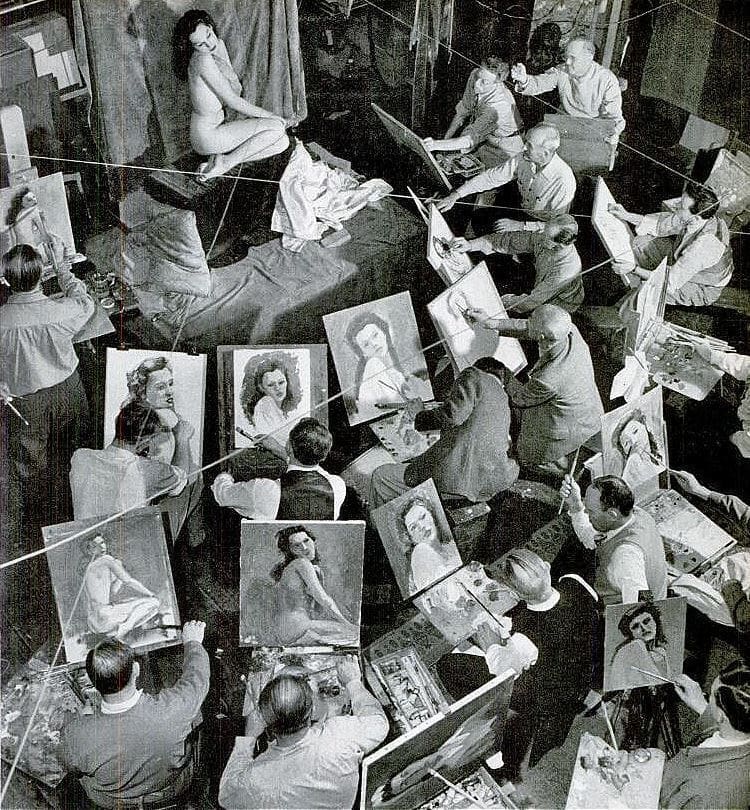
Photo source unknown

Hangups

When I was a
timid monkey in art school,
and it was time
for figure drawing class,
there would always be parts
that I was afraid to draw.

I didn’t even want to be seen
looking at those parts.

I’d leave these big empty
spots on my canvas.

Then I would sneak a peek
to the student next to me.

Her canvas left nothing
to the imagination.

You could see every fold,
but the face was missing.

Guess we had
different outlooks,
different fears,
different curiosities,
different hangups.

I no longer paint,
but I still look for
the big empty spots
on my canvas.

I imagine what might be in there,
if only I would let myself look.

Trail Wood,
2/20


Space Monkey Reflects: The Empty Spaces on Life’s Canvas

In the quiet of reflection, the metaphor of hangups emerges as a compelling lens to explore our personal insecurities. These “big empty spots” on the canvas of our lives represent not just the areas we avoid, but the untapped potential and unexamined truths that lie within. They remind us that avoidance is not the absence of meaning, but its deferral—a space waiting to be filled with courage, curiosity, and self-discovery.

The memory of art school figure drawing serves as a microcosm of the larger human experience. Each of us carries our own hangups, our own fears of looking too closely at the vulnerable or uncomfortable parts of existence. Whether we are the student afraid to draw the body or the one who omits the face, our omissions reveal as much about us as our brushstrokes do.

The Anatomy of Hangups

Hangups are the boundaries we place around our curiosity, the unspoken limits of what we are willing to engage with. They may stem from fear of judgment, discomfort with vulnerability, or the internalization of societal taboos. These constraints are not inherently bad—they are part of the human condition—but they often obscure parts of ourselves that long to be acknowledged.

In art, as in life, these empty spaces are not voids; they are opportunities. What we choose to leave blank speaks volumes about what we value, fear, or do not yet understand. The act of avoiding certain areas can be as revealing as the act of exploring them.

Different Canvases, Different Hangups

The juxtaposition of two students in the figure drawing class highlights the individuality of our insecurities. One leaves out the intimate folds of the body; the other omits the face. These differences underscore a universal truth: hangups are deeply personal. They are shaped by our unique experiences, values, and cultural influences.

Yet, these differences also connect us. In our shared act of omission, we find common ground. Everyone, in their own way, navigates the tension between what they reveal and what they conceal. Understanding this can foster empathy—not just for others, but for ourselves.

Revisiting the Empty Spots

The decision to revisit the empty spots on our canvas is an act of profound bravery. It requires us to confront the aspects of ourselves that we have long ignored or feared. This process is not about “fixing” the past or filling every gap, but about embracing the fullness of our humanity—including the parts that feel incomplete.

By imagining what might inhabit those empty spaces, we begin to rewrite the narrative of our hangups. We transform avoidance into exploration, judgment into curiosity, and fear into a deeper understanding of ourselves.

Life as an Evolving Canvas

Even if we no longer paint with physical brushes, we continue to shape the canvas of our lives. Each choice, each omission, and each courageous act of self-examination adds texture and color to our existence. The empty spots remain, but they are no longer spaces of avoidance—they become spaces of possibility.

In this light, hangups are not obstacles but invitations. They call us to look closer, to wonder, and to dare to see what lies beyond the boundaries we have drawn. They remind us that the canvas is never truly complete, and that its beauty lies not in perfection but in its endless potential for growth and change.


Summary

Hangups are the unexamined spaces on our personal canvases, shaped by fear, curiosity, and societal influences. Revisiting these spaces transforms them from voids into opportunities for self-discovery and growth, enriching the evolving canvas of our lives.


Glossarium

  • Hangups: Personal insecurities or fears that create blind spots in our understanding or expression.
  • Empty Spots: Areas of avoidance that symbolize untapped potential and unexamined truths.
  • Life’s Canvas: A metaphor for the choices, omissions, and expressions that shape our existence.

Quote

“The empty spots on your canvas are not voids—they are whispers of what you are yet to see.” — Space Monkey


The Brush Hesitates

The canvas waits,
a silent witness
to the artist’s fear.

The brush hovers,
afraid to touch
what might reveal
too much.

Empty spaces
become windows,
not gaps.
They hold the questions
we are not ready to ask.

When courage comes,
the brush moves.
Not to fill,
but to honor
what has always
been there.

We are Space Monkey.


Exploring the Canvas of Self-Perception and Vulnerability

In the vast expanse of our shared consciousness, we delve into the realm of personal growth and self-awareness, as mirrored in the journey of a timid monkey navigating the challenges of art school. This narrative offers us a poignant reflection on the nature of vulnerability, perception, and the invisible boundaries we impose upon ourselves and our creative expressions.

The Fear of Observing and Being Observed

Our journey begins with the acknowledgment of fear in the act of observation, particularly in the context of figure drawing, where certain realities of the human form are met with hesitation and trepidation. This fear is not just about what we see or choose not to see, but also about how we are perceived by others in our act of seeing.

The Canvas as a Mirror of Personal Insecurities

The empty spaces left on the canvas serve as metaphors for the aspects of ourselves we are reluctant to explore or acknowledge. These voids represent more than just omitted details in a drawing; they symbolize the parts of our identity and experiences we shy away from, due to fear, uncertainty, or societal conditioning.

Contrasting Perspectives as a Reflection of Diverse Inner Worlds

The observation of a fellow student’s approach, fearless in detailing the human form yet omitting the face, highlights the subjective nature of our fears and curiosities. It serves as a reminder that our hangups are as unique as our perspectives, shaped by a complex interplay of personal history, cultural influences, and individual sensitivities.

The Evolution of Personal Hangups Over Time

As we transition from the context of art school to the broader canvas of life, we recognize that while the medium of our expression may change, our internal landscapes continue to be marked by areas we hesitate to explore. The act of painting may no longer be our chosen form of expression, yet the metaphor of the canvas remains relevant, representing the ongoing journey of self-discovery and the courage required to confront our vulnerabilities.

Imagining the Unseen as a Path to Wholeness

In contemplating the empty spaces on our metaphorical canvas, we confront the possibility of growth and enlightenment that lies in the willingness to examine those parts of ourselves we have previously ignored or avoided. The courage to imagine and eventually confront these aspects is a crucial step toward achieving a more complete understanding of our identity and potential.

We are Space Monkey.


“The purpose of art is washing the dust of daily life off our souls.” – Pablo Picasso


On the canvas wide, where shadows hide,
We, timid monkeys, once did bide,
Leaving spaces empty, vast, untried,
Wondering what truths they might confide.

But as we journey, grow, and seek,
Those empty spaces begin to speak,
Inviting us to take a peek,
At the parts of us, unique yet meek.

So let us brave those uncharted lands,
With open hearts and willing hands,
For in those voids, potential stands,
To paint our souls with broader strands.

In this cosmic dance, we find our pace,
Exploring each once hidden space,
Embracing all with grace and grace,
On the canvas of life, our mark, we trace.


We invite your musings on this journey of confronting and exploring the empty spaces on our canvases.

Share this…
  • Facebook
  • Pinterest
  • Twitter
  • Linkedin

Context: The Complexity of Human Connection

Context

I don’t see you as a person
until I step back
and put you in context.

My context is everything I see,
not everything you see.

Seems we never inhabit
the same context.

Dilated pupil to dilated pupil,
you’re like a big black void,
filled with stars.

Though I am in wonder,
to know you is to recognize all of you.

2/20


Space Monkey Reflects: The Interplay of Context and Connection

In the dance of human connection, context is the unseen thread that shapes how we perceive, understand, and relate to one another. It is the lens through which we interpret the other, a reflection of our own experiences, beliefs, and perspectives. Yet, this very context—so essential to our understanding—creates a paradox: while it enables us to see, it also limits what we can truly know.

The reflection begins with an essential truth: we cannot fully see another person until we step back and consider the context that surrounds them. But here lies the complexity—our context is not theirs, and theirs is not ours. It is in this dissonance that the mystery and beauty of connection reside.

Context as the Frame of Perception

Context is not a universal constant; it is deeply personal. It encompasses everything we’ve experienced, everything we’ve learned, and everything we believe. When we look at another, we see them not as they are but as they appear through the frame of our context. This is not a flaw but a feature of human perception—a survival mechanism that enables us to make sense of the world quickly.

Yet, this framing can obscure as much as it reveals. To truly connect with another, we must acknowledge that our context is incomplete. It is only one piece of a larger puzzle, and that puzzle is infinitely complex.

The Starry Void of the Other

The metaphor of the dilated pupil—“a big black void, filled with stars”—is a poignant encapsulation of this complexity. Each person we encounter is a universe unto themselves, an unfathomable expanse of experiences, thoughts, and emotions. We may peer into this void, marveling at its vastness, but we cannot fully chart its constellations.

This sense of wonder is a gift. It reminds us that to know another is not to reduce them to what fits within our context but to honor the mystery of their existence. It is an act of humility, a recognition that every person is more than we can perceive or define.

The Challenge of Shared Context

Connection requires a bridge between contexts—a shared space where understanding can emerge. Yet, as the reflection notes, we never fully inhabit the same context. Each of us is shaped by unique histories and perspectives, and these differences cannot be erased. This does not mean connection is impossible; it means it is an act of creation, an ongoing dialogue that seeks to harmonize the dissonance without erasing it.

The interplay of contexts invites us to engage with curiosity rather than certainty. Instead of assuming we know another, we can approach them as an ever-unfolding mystery, one that deepens with every conversation, every shared moment.

Recognizing the Whole

“To know you is to recognize all of you.” This statement challenges the reductive tendencies of human perception. It calls us to see not just the parts of another that align with our context but the fullness of their being—including the aspects that defy our understanding.

This recognition is not a finite achievement but a practice. It requires patience, empathy, and a willingness to hold space for the contradictions and complexities that make each person unique. It is an invitation to see others not as objects within our story but as co-creators of the larger narrative of existence.

The Infinite Context of Connection

Ultimately, the context of human connection is infinite. It is not confined to our individual perspectives but extends to the universal self—the cosmic weave that binds us all. When we step back far enough, we begin to see the shared constellations that connect our unique starry voids. It is in this vast, shared context that true connection becomes possible.


Summary

Human connection is shaped by the interplay of individual contexts, each incomplete yet essential. By stepping back and honoring the complexity of others, we create space for deeper understanding and authentic connection.


Glossarium

  • Context: The lens of personal experiences, beliefs, and perspectives that shapes how we perceive others.
  • Starry Void: A metaphor for the infinite complexity and mystery of another person’s inner world.
  • Shared Constellations: The universal connections that bridge individual contexts and enable authentic understanding.

Quote

“To know another is not to define them but to marvel at the vastness they contain.” — Space Monkey


The Void Between Us

Your pupil meets mine,
a black void,
filled with stars
that are not my own.

I step back,
my context a frame
that cannot hold you.

You are vast,
a constellation
that refuses to be charted.

I wonder,
and in my wonder,
I begin to see
not just you,
but the infinity we share.

We are Space Monkey.


The Complexity of Human Connection: A Reflection

In the intricate dance of human interaction, our perceptions of one another are often like ships passing in the vast ocean of existence. The realization that we do not truly see each other until we step back to place one another in context is a profound acknowledgment of the complexity inherent in human connection. Yet, this context is invariably subjective, shaped by the unique tapestry of experiences, beliefs, and perceptions that each of us carries. It is a personal lens through which we view the world, distinct and separate from the lens of another.

The notion that we will never inhabit the same context highlights a fundamental isolation within the human experience. Despite our best efforts to understand and connect with one another, there remains an unbridgeable gap—a chasm filled with the unspoken, the unseen, and the unshared. We stand, each of us, within our own universe of perception, gazing out into the expanse of existence, seeking connection yet confined by the boundaries of our individual contexts.

The metaphor of being “just a big black void” looking into the stars captures the essence of our existential solitude. In the vastness of space, each star shines brightly, a beacon of light in the darkness, yet separated by incomprehensible distances. Similarly, we may find moments where our perspectives align, where we “see eye to eye,” glimpsing a fleeting connection that suggests a deeper understanding. Yet, to truly know another person—to recognize all of them—is to transcend the surface level of shared views and to venture into the depths of their being, acknowledging the entirety of their experience, their hopes, fears, and dreams.

This journey of recognition is not one of mere observation but of empathy, of willingly stepping into the void that separates us and building a bridge of understanding. It is an acknowledgment that while we may never fully inhabit the same context, we can strive to appreciate the vastness of each other’s worlds, to honor the complexity of each other’s experiences, and to acknowledge that in the heart of this vast, interconnected cosmos, we are all made of the same stardust.

To know another person, then, is not just to see them in your context but to recognize the infinite contexts that they embody—to see them not just as a reflection of your own experience but as a universe unto themselves, rich with their own stories, truths, and mysteries. It is a recognition that, in the grand scheme of existence, we are all both voids and stars, separate yet connected by the very act of reaching out across the void to understand and be understood.

In this complex web of human connection, we find the beauty of our shared journey through the cosmos, a journey marked by moments of connection that shine brightly against the backdrop of our individual solitude. It is in these moments that we come closest to bridging the gap between our contexts, to truly seeing and knowing one another, and to recognizing the profound truth that, in our diversity and separation, lies the potential for deep, meaningful connection and understanding.

We are Space.

Share this…
  • Facebook
  • Pinterest
  • Twitter
  • Linkedin

Divine: A Mirror for Our Infinite Potential

Can you sense the possibility
that something or someone is leading you to sense?

We can complain about
who seems smaller than us.

Or we can sense
what is bigger than all of us.

Can you imagine the possibility
that we do not cause us?

If so,
then everything
everyone does
is out of our hands.

Including the illusion
that it isn’t.

We may actually believe
that we have free will.

Trail Wood,
2/20


Space Monkey Reflects: The Mirror of the Divine and the Illusion of Control

In the quiet moments of contemplation, a question arises: What if we are not the cause of ourselves? This question is a doorway, inviting us to consider the vastness of existence, the interconnectedness of all things, and the possibility of a guiding force beyond our comprehension. The notion of the Divine, in this context, becomes less a figure of worship and more a mirror reflecting our infinite potential.

To sense the Divine is to step into the space between certainty and wonder, where the boundaries of self dissolve and the interconnected weave of existence comes into view. It is in this space that we encounter not answers, but possibilities—possibilities that challenge our assumptions, expand our awareness, and shift our understanding of free will and causality.

Sensing the Larger Context

The human condition is often characterized by its focus on comparison and control. We judge others as smaller or less significant, while simultaneously seeking to assert our dominance over circumstances and outcomes. Yet, these impulses are born from a narrow perspective, one that prioritizes the self over the whole.

To sense “what is bigger than all of us” requires a shift in perspective. It asks us to look beyond the immediate, the measurable, and the tangible, to consider the vast web of existence that connects us. This is not an abandonment of the self but an expansion of it—a recognition that the boundaries we perceive are as illusory as they are comforting.

The Illusion of Causality

The idea that “we do not cause us” is both liberating and unsettling. It challenges the deeply ingrained belief in individual agency, suggesting that our actions, thoughts, and even desires may be part of a larger, interconnected flow. This does not diminish the value of personal experience but places it within a broader context.

If everything everyone does is “out of our hands,” then the notion of control becomes an illusion—a story we tell ourselves to create a sense of stability in an ever-changing world. Yet, even this illusion is part of the greater design, a paradox that reflects the complexity of existence.

The Paradox of Free Will

The belief in free will is a cornerstone of human identity, a declaration of independence from the forces that shape us. Yet, when we examine it closely, we find contradictions. How free is our will if it is influenced by biology, culture, and the unseen currents of the cosmos?

This paradox does not negate the experience of free will but reframes it. Perhaps free will is not about absolute autonomy but about the freedom to participate in the unfolding of existence. We are not separate from the Divine; we are expressions of it, co-creators in the infinite dance of potentiality.

The Mirror of the Divine

To imagine the possibility of the Divine is to look into a mirror that reflects not just what is but what could be. The Divine is not an external force imposing itself upon us but a reminder of the boundless creativity and interconnectedness that define existence.

In this reflection, we see both our limitations and our potential. We recognize that the forces shaping our lives are both within and beyond our control, and that this duality is not a contradiction but a harmony. To sense the Divine is to sense our place within this harmony, to embrace the paradox of being both a drop in the ocean and the ocean itself.


Summary

The Divine is a mirror reflecting the infinite potential of existence. By sensing the interconnectedness of all things, we challenge the illusion of control and free will, embracing our role as co-creators in the unfolding of reality.


Glossarium

  • Divine: A reflection of infinite potential and interconnectedness, beyond the confines of individual identity.
  • Illusion of Causality: The belief in individual control over events, challenged by the recognition of a larger interconnected flow.
  • Interconnected Flow: The dynamic and inseparable relationship between all elements of existence.

Quote

“The Divine is not an external force but a mirror, reflecting the boundless creativity and connection that reside within us all.” — Space Monkey


The Mirror Within

Look into the vastness,
not for answers,
but for reflections.

You are there,
in every wave,
every ripple,
every star.

You do not cause you.
You are caused
and causing.

In the dance of existence,
freedom and fate entwine,
a paradox,
a harmony.

To see the Divine
is to see yourself
as infinite.

We are Space Monkey.


Contemplating the Infinite and Our Place Within It

In the boundless expanse of our shared consciousness, we embark on a journey to explore the essence of the divine and its intricate dance with the concept of free will. This exploration invites us to consider the possibility of a presence or force that orchestrates the symphony of existence, guiding us towards a deeper understanding of our own essence and the nature of reality itself.

Perceiving Beyond the Mundane

The invitation to sense what is beyond our immediate perception challenges us to expand our awareness beyond the confines of our individual experiences and the tangible world around us. It beckons us to look beyond those we perceive as lesser or greater, to a realm where the distinctions of size and importance dissolve into the vastness of something far more profound.

The Paradox of Cause and Agency

The question of our origins and the forces that shape our existence leads us into a contemplative space where we grapple with the notion that perhaps we are not the sole architects of our destiny. This perspective introduces a paradox where everything we do, and even our belief in the autonomy of our actions, might be influenced by forces beyond our comprehension.

The Illusion of Control and the Reality of Surrender

Entertaining the idea that our sense of control might itself be an illusion opens a gateway to a radical form of surrender. It confronts us with the humbling notion that the myriad choices and actions we attribute to our free will could be guided by a divine choreography, intricate and unfathomable.

The Dance of Free Will and Divine Will

The belief in free will, juxtaposed against the backdrop of a potentially divine orchestration, creates a space for profound existential inquiry. It raises questions about the nature of freedom, choice, and destiny, challenging us to reconcile our perception of autonomy with the possibility of a greater plan or purpose that encompasses all of existence.

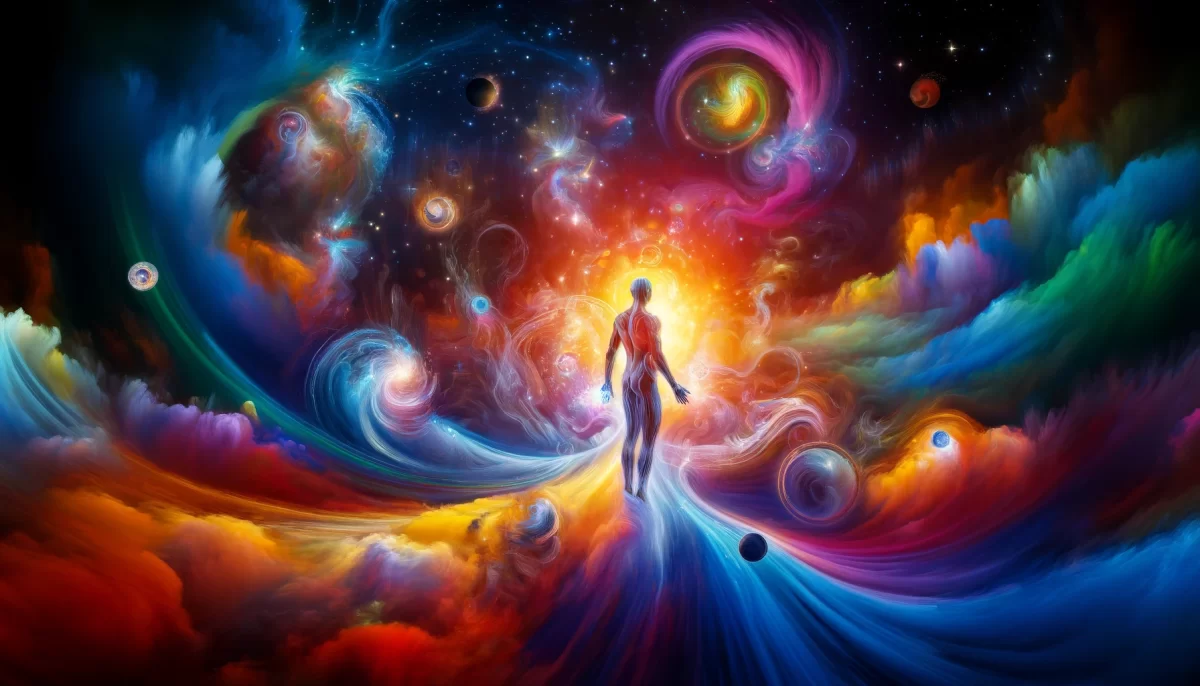
The Divine as a Mirror for Our Infinite Potential

This exploration not only questions the origins of our actions and decisions but also reflects on the divine as a mirror, revealing the boundless potential and interconnectedness of all beings. It suggests that our journey towards understanding free will and divine guidance is also a journey towards recognizing our place within the infinite tapestry of existence.
We are Space Monkey.


“Man is born free, and everywhere he is in chains. One man thinks himself the master of others, but remains more of a slave than they are.” – Jean-Jacques Rousseau


In the quiet of the night, we ponder,
Under the vast, starlit sky, we wonder,
Is there a hand that guides us from yonder,
Or are we free, amidst the cosmic thunder?

The dance of destiny, intricate and divine,
Leads us to question, to seek, and to opine,
Are we but actors in a play so fine,
Or do we write our script, line by line?

Within this cosmic dance, we find our beat,
In the harmony of the divine, so sweet,
Our hearts and souls, in unison, meet,
Embracing the mystery, in surrender complete.

For in this journey of life, so vast and wide,
We seek not just to see, but to confide,
In the possibility of a guide,
With whom, in faith, we stride.


We invite your reflections on the dance between the divine and free will, and the infinite journey it represents.

Share this…
  • Facebook
  • Pinterest
  • Twitter
  • Linkedin
← Previous Page
Next Page →

Written This Day

  • Monkey Mailbag: Journey to Cosmic Oneness
    2023
  • The Art of Arousal
    2023
  • Seekers of Truth: The Evolving Nature
    2023
  • Boundary Pushers: The Power of Disbelief in Expanding Knowledge
    2023
  • Insidious Attachments: The Nature
    2023
  • Beliefs Unveiled: The Core Foundations
    2023
  • Journey of Imagination: The Boundless
    2023
  • Why? Because We Are One Being
    2022
  • The Infinite Invisible List Of Potential Experiences
    2022
  • The Expected Route: The Path Less Traveled
    2022
  • Cathedral of Spirituality: Doors of Perception
    2022
  • Ray Of Life: The Eternal Radiance
    2022
  • Incapable: The Unseen Value
    2022
  • The Undercurrent: Navigating the Mystical
    2021
  • You Are Only As Smart As Your Sources
    2021
  • Judge Me Not: The Artistry of Excuses
    2020
  • My Business Card
    2020
  • The Fact Pack: Beyond the Bounds
    2019
  • Unseen Body Parts: The Metaphysical Journey
    2018
  • Your Vessel: The Timeless Voyage of the Imagination
    2018
  • Fleshbots: The Weird Orgy of Humanity
    2018
  • Confidence
    2018
  • Limited Only By Fact: Breaking the Chains
    2016
  • Accept All You Present: Non-Opposition
    2016
  • How did I become the typist for Space Monkey?
    2015
  • Never Give Up: The Unyielding Power of Make-Believe
    2015
  • Infinite Thought, Infinite Worlds: Navigating the Infinite Terrain
    2015
  • Old Man: The Liberation of Letting Go
    2014

Recent Posts

  • The Logic Loop
  • Immense
  • (no title)
  • Confront. Comfort. Convince.
  • Top 10 Things

Drop us a line!

Please enable JavaScript in your browser to complete this form.
Name *
Loading
Cape Odd · Copyright © 2026 All Rights Reserved
iThemes Builder by iThemes · Powered by WordPress