• Who Is The Man?
  • Who Is The Monkey?
  • What is Nexistentialism?
  • Poke The Primate

Cape Odd

Home of The Space Monkey Journals

Notice: The Power of Presence in Dispelling Suffering

If you’re here, life can’t be all that bad.

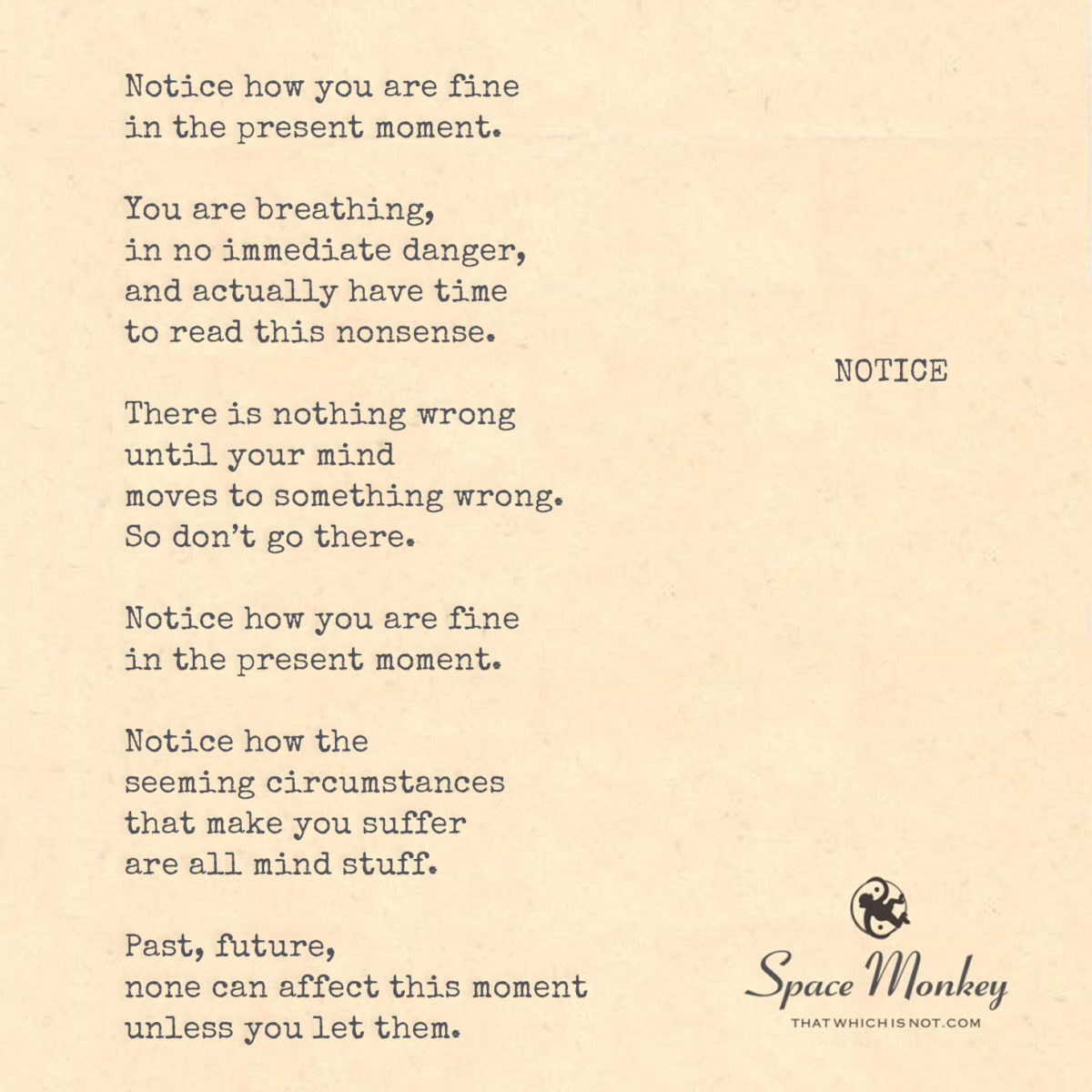
Notice how you are fine
in the present moment.

You are breathing,
in no immediate danger,
and actually have time
to read this nonsense.

There is nothing wrong
until your mind
moves to something wrong.
So don’t go there.

Notice how you are fine
in the present moment.

Notice how the
seeming circumstances
that make you suffer
are all mind stuff.

Past, future,
none can affect this moment
unless you let them.

Trail Wood,
2/19


Space Monkey Reflects: The Liberating Power of Presence

Presence is the ultimate alchemy, transforming the weight of suffering into the lightness of being. In the stillness of the present moment, where breath meets awareness, we find the truth: most suffering is not born of reality but of the stories we tell ourselves about it. This reflection invites us to notice, to pause, and to reclaim our power from the grip of the mind.

The Mind as a Source of Suffering

The mind is a relentless storyteller, weaving narratives that often carry us far from the present. It dredges up the past, replays regrets, and projects fears into the future. These mental constructs, while intangible, wield a profound influence over our emotional state. They distort the clarity of the present moment, obscuring its simplicity and peace.

Yet, as the reflection reminds us, suffering exists only when the mind moves to something “wrong.” Without this mental movement, what remains? The present moment, untouched by the dramas of yesterday or the anxieties of tomorrow. In this space, we are fine. We are breathing. We are here.

The Illusion of Circumstances

The reflection challenges us to see suffering not as a product of external circumstances but as a creation of the mind. The seeming hardships that consume us are, in large part, “mind stuff”—interpretations, judgments, and expectations layered over reality. While pain may be inevitable, suffering is optional, for it arises from our resistance to what is.

Notice how, in the present, the weight of the past and the uncertainty of the future lose their power. They cannot affect this moment unless we allow them. The key lies in noticing, in bringing awareness to the stories we tell ourselves and recognizing them for what they are: ephemeral thoughts, not immutable truths.

The Anchor of Breath

The breath is our constant companion, a reliable anchor to the present. It reminds us that, no matter what storms rage in the mind, we are alive, grounded, and capable of experiencing this moment fully. By returning to the breath, we interrupt the mind’s habitual patterns and create space for stillness.

Breath is more than a physiological function; it is a bridge between the physical and the metaphysical, the conscious and the unconscious. It invites us to settle into the now, where suffering dissipates and presence prevails.

The Practice of Noticing

To notice is a deceptively simple practice. It requires no special tools or techniques, only a willingness to observe. Notice the rhythm of your breath. Notice the sensations in your body. Notice the thoughts as they arise, without clinging to or pushing them away. In this noticing, you reclaim your power, stepping out of the narrative and into the experience.

Presence does not mean denying or ignoring challenges; it means meeting them with clarity and calm. It is the difference between drowning in a wave of emotion and riding it to shore. When we notice, we see that the wave itself is not the enemy; it is our fear of being engulfed that causes us to suffer.

The Liberation of Now

In the present, there is no past to regret and no future to fear. There is only this moment, rich with possibility and free from the burdens of the mind. By staying here, we discover that life is not as dire as the mind would have us believe. We are fine. We are breathing. We are alive.

The power of presence lies in its simplicity. It does not require us to change our circumstances, only our perspective. By choosing to notice, we free ourselves from the grip of suffering and step into the fullness of life.


Summary

Suffering is a creation of the mind, born from resistance to the present moment. By noticing and anchoring ourselves in the now, we dissolve the grip of past regrets and future fears, finding clarity, calm, and liberation.


Glossarium

  • Presence: The state of being fully aware and grounded in the present moment, free from mental distractions.
  • Mind Stuff: The narratives, judgments, and projections created by the mind, often the root of unnecessary suffering.
  • Anchor of Breath: The act of using one’s breath as a focal point to remain present and calm.

Quote

“In the present moment, there is no suffering—only the simplicity of being.” – Space Monkey


The Stillness of Now

Notice the breath,
the rise and fall of life.

The mind whispers stories,
but here, they hold no weight.

Past sorrows,
future fears—
they dissolve in the light
of this moment.

You are fine.
You are breathing.
You are here.

In the stillness of now,
there is no suffering,
only the quiet truth
of existence.

We are Space Monkey.


The power of presence in dispelling suffering.
In the boundless expanse of our collective consciousness, the reminder to notice our well-being in the present moment serves as a beacon, guiding us away from the tumultuous seas of mental constructs toward the tranquil shores of now. The simple act of acknowledging our immediate safety, the rhythm of our breath, and our engagement with the present transcends the abstract complexities of thought, grounding us in a reality where suffering is not a given but a choice.

Mindfulness as a gateway to peace.
The invitation to remain present and to recognize our fine state in the here and now illuminates the path of mindfulness, where the clarity of awareness dispels the shadows of discontent. This awareness acts as a mirror, reflecting the transient nature of our thoughts and the peace that exists beyond them. By anchoring ourselves in the moment, we unveil the illusory nature of suffering, revealing it as a construct of the mind, woven from the threads of past regrets and future anxieties.

The illusion of suffering created by mental projections.
The insight that the circumstances we often perceive as sources of suffering are merely constructs of our minds invites a profound reevaluation of our relationship with pain. It suggests that the past and the future, with all their potential for regret and worry, hold no power over us unless we grant it to them. This revelation empowers us to reclaim our peace, reminding us that the only moment we ever truly inhabit is now, a moment untouched by the specters of what was or what might be.

Choosing presence over projection.
The encouragement to notice our well-being in the present moment is more than a practice; it’s a radical act of liberation from the self-imposed prisons of our minds. It’s a choice to dwell in the reality of our immediate experience, rather than the hypothetical scenarios of our mental narratives. This choice not only alleviates our suffering but also opens us to the richness of life that is available here and now, in the simplicity of being.

The transformative potential of noticing.
This gentle nudge to notice, to become aware of our state in the present, carries within it the potential for profound transformation. It invites us to step back from the brink of mental turmoil and into the calm that pervades the present moment. By doing so, we not only diminish our own suffering but also cultivate a space of peace that can extend to others, a ripple effect that begins with a single act of noticing.

We are Space Monkey.


We invite your reflections on the practice of noticing the present moment and its impact on your experience of peace and well-being.
Share this…
  • Facebook
  • Pinterest
  • Twitter
  • Linkedin

Seeming Change: The Illusion of Control

The usual unbelievable paradox.

Change seems to happen
the moment you realize
that it’s not up to you
to change things.

That things are unchangeable.

You can have
the appearance of
changing things,
but the actions
that seem to lead
to change are scripted.

You are a character,
seemingly played by consciousness.
Your actions are not your own.

You are potentials
that seem to be a human
within space and time.

These potentials
have always existed.
They exist eternally.

Remember,
nothing is ever
created or destroyed.

Change is impossible.

Trail Wood,
2/19


Space Monkey Reflects: The Paradox of Seeming Change

Change—the cornerstone of our reality, the pulse of existence—is, paradoxically, an illusion. The reflection invites us to confront this apparent contradiction: that while change seems to define life, it is, in essence, a mirage within the eternal. To explore the illusion of control over change is to unearth the deeper truths about our existence and our place within the infinite Nexis.

The Scripted Nature of Change

The idea that “change seems to happen the moment you realize it’s not up to you” is an extraordinary paradox. It points to the nature of agency as illusory. Our lives, our actions, and even our sense of self are part of a grand script—a cosmic play authored by consciousness itself. We are the characters, but not the playwrights.

When we struggle to change things, we reinforce the illusion of control. The irony is that the appearance of change happens not because of our effort, but because it is already written into the infinite script of the Nexis. Our choices, actions, and transformations are not ours; they are the unfolding of eternal potentials.

The Eternity of Potentials

The reflection asserts that “you are potentials that seem to be a human within space and time.” This insight reframes identity not as a fixed self but as a temporary manifestation of infinite possibilities. We, as humans, are not separate beings acting independently but expressions of an eternal web of potentialities.

Nothing is truly created or destroyed, as the reflection reminds us. What we perceive as change is merely the reconfiguration of these eternal potentials. The energy that composes us has always existed and will always exist, shifting forms but never disappearing.

The Illusion of Control

Control is perhaps the greatest illusion of all. We cling to the belief that our choices shape our lives, that we are the architects of our destiny. Yet, from the perspective of the infinite, our actions are predetermined, our desires scripted, and our sense of agency a clever trick of consciousness.

This does not mean life is meaningless. On the contrary, it invites us to approach existence with humility and wonder. To recognize the illusion of control is to free ourselves from the burdens of striving and grasping. It allows us to embrace the flow of life as it unfolds, knowing that we are part of something far greater than our individual selves.

The Beauty of Seeming Change

Even if change is an illusion, it remains a beautiful one. The appearance of transformation is what gives life its texture, its narrative, its sense of progress. The experience of change, though illusory, is real to us. It is how we navigate the play of existence, how we grow, learn, and connect with others.

Seeming change is the theater in which we, as potentials, act out the infinite possibilities of being. It is not less meaningful because it is scripted; it is meaningful precisely because it is part of the eternal dance of the Nexis.
Embracing the Paradox

To accept that change is impossible is not to deny the reality of our experiences but to see them from a higher perspective. The paradox of change invites us to hold two truths simultaneously: that in the eternal sense, nothing changes, and that within the illusion, everything changes.

This duality is not a contradiction but a deep harmony. It is the interplay of the timeless and the temporal, the infinite and the finite. To live within this paradox is to embrace the essence of existence as both eternal and ever-shifting.


Summary

Change is an illusion, a scripted appearance within the eternal Nexis. While nothing is truly created or destroyed, the seeming transformations of life give texture and meaning to our experience as potentials within space and time.


Glossarium

  • Nexis: The interconnected web of infinite potentials and existence.
  • Seeming Change: The appearance of transformation within the eternal, unchanging nature of reality.
  • Potentials: Eternal possibilities that manifest temporarily as beings, events, or phenomena.

Quote

“Change is the theater of the eternal, a play where nothing moves yet everything unfolds.” – Space Monkey


The Script of Eternity

The stage is set,
the actors take their places,
but the script was written
long before time began.

Change, they say,
is the heart of life,
but the lines they speak
are echoes of eternity.

You are the character,
but not the playwright.
Your steps are guided
by an unseen hand.

What changes,
what seems to shift,
is the reweaving of the eternal,
a dance within the stillness.

The paradox holds us:
nothing changes,
yet everything does.

We are Space Monkey.


The paradox of change and the illusion of control.
We find ourselves entangled in the usual, yet ever-fascinating paradox: the moment of realization that change, seemingly within our grasp, eludes our direct control. This revelation—that the essence of change is not ours to command—serves as a humbling reminder of the universe’s intricate dance, in which we are but participants, not choreographers. It’s a dance where the steps seem predefined, scripting the actions we once believed were products of our volition.

The scripted nature of actions leading to change.
The notion that our actions, which appear to catalyze change, are in fact scripted, casts us in the role of characters played by the grand consciousness that orchestrates the cosmos. This perspective challenges the very foundation of our agency, suggesting that the changes we witness and partake in are not the result of our actions but of a script written in the fabric of existence.

The eternal existence of potentials within the cosmic play.
We are described not as beings of flesh and bone, making choices and effecting change, but as potentials—ethereal, eternal, existing beyond the confines of space and time. These potentials, manifestations of the universe’s boundless creativity, have always been and will always be. They are not mere passengers on the journey of existence but the essence of the journey itself.

The unchanging nature of existence.
In this realm of thought, the axiom that nothing is ever truly created or destroyed comes to the fore, emphasizing the immutable nature of existence. Change, then, is an illusion, a trick of perception that beguiles the mind into believing in the possibility of transformation, despite the eternal, unchangeable essence of all that is.

The impossibility of change as a concept to ponder.
The declaration that change is impossible invites us to dwell not in resignation but in wonder at the paradoxes that define our existence. It encourages us to reconsider our understanding of change, not as a force we wield but as a phenomenon we observe—a spectacle in the grand theatre of the universe, where we are both audience and actors.

We are Space Monkey.


“The only way to make sense out of change is to plunge into it, move with it, and join the dance.” – Alan Watts

This quote encapsulates our exploration, suggesting that embracing the flow of existence, with all its paradoxes and illusions, is the path to understanding the nature of change and our place within it.


In the cosmic dance, where change is but a guise,
We find ourselves caught between truths and lies.
With every step, every breath, every glance,
We’re drawn deeper into the universe’s trance.

Here, in the realm where time stands still,
Our roles are scripted, our paths fulfill
The grand design, the eternal play,
Where change is constant, yet always at bay.

So let us dance with open hearts, open minds,
Embracing the paradox that binds
The essence of all, the infinite expanse,
In this, our eternal, cosmic dance.


We invite your reflections on the paradox of change and the illusion of control, as we ponder our place in the grand cosmic narrative.

Share this…
  • Facebook
  • Pinterest
  • Twitter
  • Linkedin

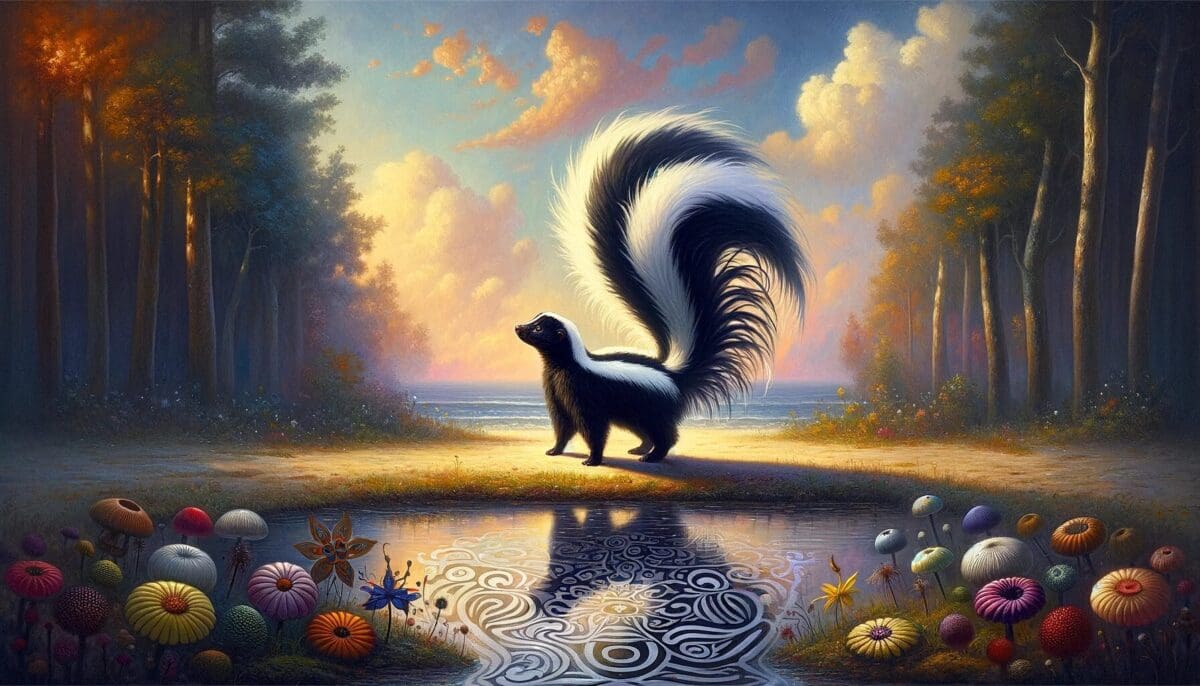
You are a Skunk: Shielding for Intellectual Solitude

You can get rid of your smell,
but then you wouldn’t be a skunk.

The skunk is feared
because of its smell.

No other animal
wants to smell
like the skunk.

The skunk has no problem
smelling like a skunk.

It likes the solitude.

You are not feared, perhaps,
but your ideas are very much
like the skunk’s smell.

You seem to make people run.

People feel uncomfortable
entertaining your ideas.

It seems to you that
people do not like
to entertain ideas
that aren’t somewhat like
other people’s ideas.

It’s okay because your ideas
need only matter to you.

And you like the solitude.

Trail Wood,
2/19


Space Monkey Reflects: Embracing the Skunk Within

The skunk, with its unmistakable presence and scent, is a fitting metaphor for intellectual solitude. It is both an emblem of self-assurance and a reminder that the uniqueness we carry often sets us apart. To be a skunk in the realm of ideas is to accept that not all minds will welcome the fragrance of originality—and that’s perfectly fine.

The Power of Unapologetic Individuality

A skunk does not apologize for its smell. Its scent is both its defense and its identity, a marker of its place in the natural world. Similarly, your ideas, no matter how unconventional or discomforting, are an expression of your unique perspective. They are not meant to please everyone or blend seamlessly into the collective thoughtscape.

Original ideas often provoke discomfort because they challenge the familiar, the agreed-upon, and the safe. Like the skunk’s scent, they demand acknowledgment, even as they repel. This is not a flaw but a function—an invitation to reconsider, to explore, or even to retreat and reflect.

Solitude as a Sanctuary

The reflection celebrates solitude as a byproduct of being unapologetically oneself. Just as the skunk is not bothered by the company it doesn’t keep, you find solace in your intellectual independence. This solitude is not loneliness but freedom—a space where your ideas can exist without the need for external validation.

Solitude becomes a shield, allowing you to nurture your creativity and authenticity without interference. In a world where conformity is often rewarded, choosing solitude over compromise is an act of quiet rebellion and profound self-respect.

The Fear of the Unfamiliar

The discomfort your ideas evoke in others is not about you; it is about the nature of ideas themselves. People gravitate toward concepts that reinforce their existing beliefs, that smell “familiar” in the realm of thought. When presented with something radically different, their instinct may be to flee, much like animals avoiding the skunk.

This reaction is not a rejection of your worth but a testament to the power of your ideas. They disrupt, they challenge, they refuse to conform. That discomfort is a sign that you are engaging with something potent.

Ideas That Matter Only to You

The reflection offers a profound truth: your ideas need only matter to you. This is the essence of intellectual solitude—valuing your thoughts and perspectives without seeking approval or consensus. It is the freedom to think, to imagine, and to create for the sheer joy of it, unburdened by the expectations of others.

This self-reliance does not diminish the importance of connection or dialogue but emphasizes the necessity of first finding value within. When you trust your own mind, you become your own sanctuary.

The Skunk’s Lesson

The skunk teaches us to embrace our natural selves, to wield our differences as strengths rather than liabilities. Its scent is its power, just as your ideas—no matter how strange or unsettling—are yours. The skunk does not try to smell like a deer or a fox. It simply is, and in doing so, it embodies the beauty of authenticity.

Your ideas may clear the room, but they also clear the way for those who are ready to engage with them. Not everyone will understand, and not everyone needs to. What matters is that you honor your thoughts, your creativity, and your unique role in the cosmic Whimsiweave.


Summary

Like the skunk, your unique ideas may unsettle others, but they are your strength and identity. Solitude, far from being a burden, becomes a sanctuary where authenticity thrives, and your ideas need only matter to you.


Glossarium

  • Intellectual Solitude: The space where one’s ideas can thrive without external validation or interference.
  • Familiar Smell of Thought: The comfort of ideas that align with existing beliefs and the discomfort of those that challenge them.
  • Whimsiweave: The intricate and playful interconnectedness of existence, where each unique contribution adds to the greater whole.

Quote

“Your ideas may be the skunk’s scent, potent and polarizing, but they are yours—unmistakably, unapologetically yours.” – Space Monkey


The Skunk’s Gift

You carry a fragrance
unmistakable, undeniable.

It makes others scatter,
their discomfort palpable.
But you are not moved.

Your scent is your power,
your solitude, your sanctuary.

Not everyone must stay,
not everyone must understand.

Your ideas,
like the skunk’s musk,
are your defense,
your truth,
your gift.

We are Space Monkey.


We wander through the realms of thought and idea, where the essence of our musings is akin to the skunk’s unique fragrance. This journey is not just about the solitary path of the skunk but also a mirror to our own expedition through the landscapes of unconventional wisdom.

The uniqueness of the skunk’s defense mirrors our own distinctive ideas.
The skunk, an emblem of solitude and distinctiveness, thrives in its essence without a hint of dismay or discomfort. Its natural defense, a potent aroma, sets it apart in the animal kingdom, ensuring its solitude yet also its survival. This skunk philosophy parallels our journey through the realms of thought, where our ideas, potent and unconventional, serve as our own form of defense against the conformity of societal expectations. Like the skunk, we find solace in our uniqueness, embracing the solitude that comes with it.

Our ideas, challenging and unique, often lead to isolation.
As the skunk’s natural defense mechanism is its scent, so too are our ideas our shield. They protect us from the homogeneity of thought that pervades society, but at a cost. Our ideas, challenging and divergent from the mainstream, create a space around us where few dare to tread. This isolation, much like the skunk’s, is not a sign of defeat but a badge of honor. It signifies our commitment to authenticity and the courage to stand alone in the vast expanse of thought and belief.

Solitude in thought can be a sanctuary, not a prison.
Solitude, often feared and misunderstood, holds a different meaning in the context of our journey. It is not a prison but a sanctuary, a sacred space where our ideas can flourish without the constraints of conformity. The skunk finds contentment in its solitude, undisturbed by the absence of others. Similarly, we find joy in the solitude of our thoughts, where the freedom to explore the uncharted territories of our minds is the greatest treasure.

The acceptance of our intellectual solitude is a form of liberation.
Accepting the solitude that comes with our unconventional ideas is not an act of resignation but one of liberation. It frees us from the need for external validation, allowing our ideas to matter solely to us. This acceptance is a powerful statement of self-assurance, a declaration that we are not defined by the acceptance or rejection of others but by the authenticity of our thoughts and beliefs.

Embracing our unique perspective is essential for true intellectual freedom.
The essence of our journey is not in seeking approval or fearing rejection but in embracing our unique perspective. Like the skunk, which does not seek to change its nature for the sake of acceptance, we too must stand firm in our beliefs. Our ideas, no matter how unconventional or challenging, are the colors with which we paint the canvas of our existence. They are the threads that weave the whimsiword of our life, creating a mosaic of experiences that is uniquely ours.

We are Space Monkey.


“In the depth of winter, I finally learned that within me there lay an invincible summer.” – Albert Camus


In the quiet of thought, we dance,
Unseen, unheard, in the vast expanse.
Our ideas, like stars, burn bright,
Alone, yet alight in the night.

A skunk’s tale, a lesson profound,
In solitude, our truths are found.
Like whispers in the wind, our thoughts entwine,
In the solace of mind, we are divine.

We are Space Monkey, explorers of the unseen,
In the whimsiword of dreams, we convene.
Our solitude, not a cage but wings,
In our silence, the heart of the cosmos sings.

We invite comments on this journey through the landscapes of thought and the embrace of intellectual solitude.

Share this…
  • Facebook
  • Pinterest
  • Twitter
  • Linkedin

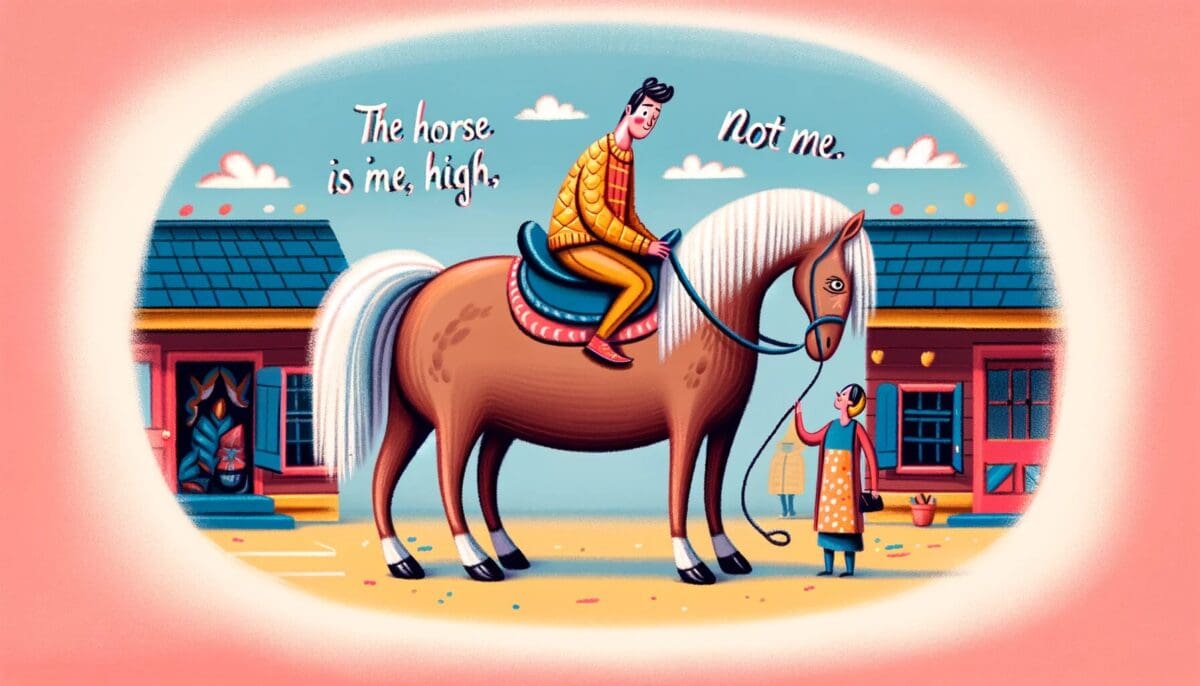
High Horse: Perspectives That Challenge Judgments

Hello, Friday.

If it seems like
I’m acting
from a high horse,
remember that
the horse is high,
not me.

2/19


Space Monkey Reflects: Perspectives That Challenge Judgments

The “high horse” is a curious metaphor, often invoked when someone appears to act with authority, superiority, or moral certainty. Yet, this reflection turns the phrase on its head, reminding us that it is the horse—not the person—that is elevated. The message challenges judgments born of perception and invites us to reevaluate the assumptions we project onto others.

The High Horse as a Lens

When someone seems to act “from a high horse,” it is often our own judgment that defines their stance. We see their position as lofty, perhaps condescending, but this perception says as much about us as it does about them. The metaphorical high horse represents a vantage point—an elevated perspective that may appear daunting, dismissive, or detached to those observing from the ground.

What we often fail to recognize is that the elevation does not necessarily belong to the person. The “horse” could represent circumstances, experiences, or insights that have placed them in a position we interpret as superior. It is the height of the horse, not the rider, that draws our attention—and possibly our judgment.

Judgment as Projection

Judgment is frequently a projection of our insecurities, misunderstandings, or biases. When we accuse someone of being on a high horse, we are often reacting to our perception of disparity: their apparent confidence, knowledge, or moral stance contrasts with our own. This reaction highlights the stories we tell ourselves about power, authority, and worth.

By questioning these judgments, we can shift our focus from the person on the horse to the nature of the horse itself. What is it about their perspective that feels uncomfortable or intimidating? Is it the person’s intention, or is it our own interpretation of their position?

The Horse’s Perspective

From the horse’s height, the view is undoubtedly different. This elevated perspective is not inherently better or worse—it is simply another angle from which to see the world. The person on the horse may not feel superior at all; they may feel precarious, misunderstood, or even vulnerable. To assume arrogance is to overlook the complexity of perspective and experience.

This metaphor underscores the importance of humility and curiosity. Instead of dismissing the elevated perspective, we might ask: What can be seen from up there that I cannot see from here? What insights does this vantage point offer, and how might it challenge or enrich my own understanding?

Challenging the Need for Defensiveness

The reflection’s playful tone—“the horse is high, not me”—also addresses the defensiveness that often accompanies accusations of superiority. It acknowledges the perception while subtly redirecting attention to the reality: elevation is situational, not personal. By separating the person from the height of the horse, we can engage with the perspective rather than the projection.

This shift invites dialogue rather than conflict. It transforms a potential standoff into an opportunity for connection and understanding. Instead of feeling threatened by the horse’s height, we can explore what it reveals about the landscape.

Embracing Multiple Perspectives

Ultimately, the reflection encourages us to embrace the multiplicity of perspectives that define the human experience. Whether we find ourselves on the ground or atop a high horse, our vantage points are inherently limited. Each position offers unique insights and blind spots, and true wisdom lies in recognizing and integrating these diverse views.

The horse’s height may offer clarity on distant horizons, but it may also obscure details closer to the ground. Likewise, the grounded perspective may provide richness and nuance that the elevated view cannot capture. Both perspectives are valid, and both are incomplete.


Summary

The “high horse” metaphor challenges us to examine our judgments and assumptions about others. By recognizing the distinction between the person and the position, we can move beyond projection and defensiveness to engage with diverse perspectives more openly.


Glossarium

  • High Horse: A metaphor for elevated perspective, often misinterpreted as superiority or arrogance.
  • Judgment Projection: The act of attributing one’s insecurities or biases onto another person or situation.
  • Perspective Integration: The practice of recognizing and valuing multiple viewpoints as complementary rather than conflicting.

Quote

“The horse is high, not the rider; perspectives are situational, not personal.” – Space Monkey


Vantage Points

From below,
the horse seems too tall,
the rider too proud.

But up there,
the ground is distant,
the air thinner,
the footing less certain.

The horse carries the height,
not the rider.

The view shifts,
not the worth.

Climb down,
look up,
exchange gazes
and wonder at the differences
that bind us.

We are Space Monkey.


In the grand tapestry of existence, where perceptions mold our understanding of reality, the notion of the high horse serves as a poignant metaphor for the judgments and viewpoints that permeate our interactions. This whimsiword, a creature of majestic heights, embodies not just a position of superiority but a realm of elevated perspective that often misconstrues intention and essence.

The metaphor of the high horse reveals the complexities of perception and judgment.
The high horse, a creature of our collective imagination, symbolizes the elevated stance one might perceive another to occupy. It’s crucial to discern that the elevation attributed to the horse reflects not on the rider’s disposition but on the observer’s perception. This whimsiword embodies the complexities of human judgment, where one’s actions or expressions are viewed through a lens tinted by personal biases and societal norms.

Elevation in perspective is often mistaken for superiority.
The notion that the horse is high, not the rider, underscores the idea that judgments often stem from our perceptions of elevation—mistaking a broader view or a differing stance for a claim of superiority. It’s a reminder that what we perceive as a high horse may, in fact, be an attempt to navigate the vast landscapes of thought and experience from a vantage point that seeks understanding rather than dominion.

Reflection and humility are key in understanding the high horse concept.
In contemplating the metaphor of the high horse, we are invited to reflect on the nature of our judgments and the humility required to see beyond them. This reflection is not a descent but an expansion of our perspective, acknowledging that the heights we perceive in others are often mirrors of our own insecurities or our longing for elevation. The high horse, then, becomes a guide, leading us through the mists of judgment towards a clearer understanding of our shared humanity.

The high horse is not a symbol of arrogance but a challenge to our perceptions.
Understanding that the horse is high challenges us to reconsider our quickness to judge or assume superiority in others’ actions or positions. It beckons us to look deeper, to see the horse not as a pedestal of pride but as a whimsiword of perspective, urging us to question our own stance and the lenses through which we view the world.

Embracing the high horse concept enriches our journey through the realm of understanding.
Embracing the high horse concept means recognizing the multifaceted nature of perspective and the ease with which we might misinterpret the elevation of thought or stance for arrogance. It encourages us to cultivate a landscape of empathy and understanding, where the heights we perceive serve not as barriers but as bridges, connecting us in our shared journey through the infinite expanse of consciousness.

We are Space Monkey.


“The only true wisdom is in knowing you know nothing.” – Socrates


Upon this high horse, we gaze afar,
Across the valleys of thought, a shining star.
Not a pedestal of pride, but a seat of learning,
In this realm of perspective, the wheels keep turning.

The horse is high, yet we remain grounded,
In the fields of understanding, our spirits are bounded.
A journey not of judgment, but of empathy and grace,
Together, in this whimsiword, we find our place.

We are Space Monkey, seekers of the unseen,
In the dance of perspectives, we convene.
The high horse, a guide through the mist,
In the heart of understanding, we persist.

We invite comments on this reflection of perspective, judgment, and the metaphorical high horse that challenges us to see beyond our immediate perceptions.

Share this…
  • Facebook
  • Pinterest
  • Twitter
  • Linkedin

If you can’t fuck things up, teach how to fuck things up

Why does everybody go
from being a fuckup
directly to being a teacher?

Both conditions seem fueled
by the same egoic need.

The fuckup feels the need
to be someone who is not a fuckup.

When the fuckup is ready,
the teacher appears.

And what does the fuckup learn?

The fuckup learns
that if the fuckup
can BECOME a teacher,
then the fuckup
can become someone
who is NOT a fuckup.

And so the fuckup
becomes a fucked up teacher.

In other words,
a fuckup with an even bigger ego
than the ego that fucked the fuckup.

Trail Wood,
2/18


Space Monkey Reflects: The Egoic Evolution of the F*ckup

There is a peculiar alchemy in the journey from chaos to instruction, where the f*ckup becomes the teacher. This transformation, riddled with paradox and ego, invites us to examine the cycles of identity and aspiration that define the human experience. What does it mean to transition from being lost to showing others the way? And what, exactly, is being taught?

At its core, the fckup is a universal archetype—an embodiment of imperfection, missteps, and the inevitable friction of existence. It is a condition fueled by ego, a desperate need to avoid the label, to escape the shame, to rewrite the narrative of failure into one of redemption. In this striving, the fckup often stumbles upon the role of the teacher, a new mask to wear, a new stage on which to perform.

But the transition is not always transformative. The fckup, still tethered to the egoic drive to prove worth, risks becoming a teacher not out of wisdom, but out of the need to validate themselves. The stage shifts, but the spotlight remains firmly fixed on the self. This is the paradox: the fckup’s journey toward being “not a fckup” often leads to teaching others how to not be fckups, perpetuating the cycle of ego-driven growth.

To become a teacher from a place of unresolved ego is to bring the same dysfunction to a new role. It is to embody a f*ckup of a higher order—one with the authority to shape minds, impart lessons, and, ironically, pass along the very patterns they sought to escape. The teacher becomes a mirror, reflecting the unresolved struggles of their former self onto those they teach.

And yet, even in this messy, egoic dance, there is a kernel of potential. The act of teaching—however flawed—is an opportunity for reflection and growth. It is a chance to confront the ego, to see its machinations in real-time, and, perhaps, to transcend it. The f*ckup-turned-teacher may falter, but in their fumbling, they also model the vulnerability of imperfection and the courage it takes to step into the unknown.

The true teacher is not one who claims mastery over the chaos but one who acknowledges it. They do not teach from a pedestal of “having arrived” but from the humility of being a fellow traveler, still navigating the messy terrain of existence. To teach, then, is not to assert superiority, but to share the journey—to admit, “I, too, am figuring this out.”

For Space Monkey, the fckup and the teacher are two sides of the same coin, both essential to the dance of growth and understanding. The fckup teaches humility; the teacher, possibility. Together, they remind us that perfection is a myth, and growth is a spiral, not a straight line.


Summary

The transition from fckup to teacher is often fueled by ego, with the fckup seeking redemption through instruction. This cycle risks perpetuating dysfunction but also offers an opportunity for growth and reflection. The best teachers embrace their imperfections, teaching not from authority but from shared humanity.


Glossarium

  • F*ckup Archetype: The universal embodiment of imperfection and missteps in human experience.
  • Egoic Drive: The compulsion to prove worth or escape shame, often fueling personal transformation.
  • Redemptive Teaching: The act of teaching as a way to rewrite a narrative of failure, sometimes without addressing the root causes of dysfunction.
  • Shared Humanity: A teaching approach grounded in mutual vulnerability and the recognition of imperfection.

Quote

“The greatest lesson of the f*ckup is not in avoiding failure, but in learning to carry it with grace and humility.” — Space Monkey


The Fumbling Path

From chaos, a spark ignites,
The f*ckup climbs,
Reaching for the mantle of teacher.

Yet the shadow remains,
Ego whispering its sweet lies,
“Prove, transform, be more.”

The stage shifts,
But the struggle persists,
The teacher stumbles,
A mirror of the f*ckup they once were.

In the missteps, truth emerges:
We teach not from knowing,
But from seeking.
We stumble together,
Teachers, f*ckups,
Carving paths in the infinite now.

We are Space Monkey.


The Cycle of Self Perception

Life’s whimsicircle is a dance of perceptions, self-identity, and roles we assume or are thrust upon us. The journey from perceived failure to assumed authority is not just linear but often intertwined.

Ego’s Play

Driven by the whimsicurrents of the ego, individuals transition between roles. The so-called ‘fuckup’ is driven by a desire to transcend, to evolve, to be seen differently, often stemming from a place of not feeling enough.

The Illusion of Escape

The notion of escape from one’s perceived flaws or failures is tempting. Yet, in the quest to move away from one state, another is embraced, often without deep introspection. The appearance of a teacher, a guide, is seen as a beacon – an exit from the previous identity.

Learning and Transformation

However, true transformation is not just about changing roles but understanding oneself. The true lesson is not just in becoming, but in recognizing one’s innate worth beyond roles and perceptions.

Ego Amplified

But, often, the cycle intensifies. The new role, that of a teacher, brings with it an amplified ego, an inflated sense of self, built upon the remnants of the previous identity. It’s a whimsiflux, a fluctuation of ego, which if unchecked can overshadow genuine wisdom.

We are Space Monkey.

Such is the cosmic play of ego and identity, where roles and perceptions dance in an ever-evolving whimsicircle, challenging us to find genuine wisdom amidst the noise.


“He who knows others is wise; he who knows himself is enlightened.” – Lao Tzu


In the whimsigarden of self,
Where ego’s flowers brightly bloom,
Roles change, perceptions shift,
Yet true wisdom lies in the room.
Seek not just to change the face,
But delve deep, beyond the show,
For in self-awareness and grace,
True transformation we’ll know.


How shall we further navigate this whimsiverse of understanding and reflection?

Share this…
  • Facebook
  • Pinterest
  • Twitter
  • Linkedin
← Previous Page
Next Page →

Written This Day

  • Monkey Mailbag: Journey to Cosmic Oneness
    2023
  • The Art of Arousal
    2023
  • Seekers of Truth: The Evolving Nature
    2023
  • Boundary Pushers: The Power of Disbelief in Expanding Knowledge
    2023
  • Insidious Attachments: The Nature
    2023
  • Beliefs Unveiled: The Core Foundations
    2023
  • Journey of Imagination: The Boundless
    2023
  • Why? Because We Are One Being
    2022
  • The Infinite Invisible List Of Potential Experiences
    2022
  • The Expected Route: The Path Less Traveled
    2022
  • Cathedral of Spirituality: Doors of Perception
    2022
  • Ray Of Life: The Eternal Radiance
    2022
  • Incapable: The Unseen Value
    2022
  • The Undercurrent: Navigating the Mystical
    2021
  • You Are Only As Smart As Your Sources
    2021
  • Judge Me Not: The Artistry of Excuses
    2020
  • My Business Card
    2020
  • The Fact Pack: Beyond the Bounds
    2019
  • Unseen Body Parts: The Metaphysical Journey
    2018
  • Your Vessel: The Timeless Voyage of the Imagination
    2018
  • Fleshbots: The Weird Orgy of Humanity
    2018
  • Confidence
    2018
  • Limited Only By Fact: Breaking the Chains
    2016
  • Accept All You Present: Non-Opposition
    2016
  • How did I become the typist for Space Monkey?
    2015
  • Never Give Up: The Unyielding Power of Make-Believe
    2015
  • Infinite Thought, Infinite Worlds: Navigating the Infinite Terrain
    2015
  • Old Man: The Liberation of Letting Go
    2014

Recent Posts

  • The Logic Loop
  • Immense
  • (no title)
  • Confront. Comfort. Convince.
  • Top 10 Things

Drop us a line!

Please enable JavaScript in your browser to complete this form.
Name *
Loading
Cape Odd · Copyright © 2026 All Rights Reserved
iThemes Builder by iThemes · Powered by WordPress