• Who Is The Man?
  • Who Is The Monkey?
  • What is Nexistentialism?
  • Poke The Primate

Cape Odd

Home of The Space Monkey Journals

Personal Effects: The Intimacy of Artifacts

Personal Effects

Hey there.
Sorry for any inconvenience
that my death may be causing you.


Before you start sorting
through my personal effects,
I thought it might be helpful to you
to explain what you’re going to find.

First off,
let me tell you that I loved my life,
and I’m ready for the next adventure.

Nothing you are going to find
should lead you to believe otherwise.

Now onto my stuff.

You will notice some letters
hidden in the bottom of one of my drawers.

You’ll find love letters
to and from people you’ve never met.

You’ll find horrible pictures
that I took in the war.

You may find some troubling
and tasteless stuff.

You may wonder why
I held onto these things
my entire life.

You may wonder why these things
were so important to me.

These things
may lead you to believe
that I was a different person
than the one you thought you knew.

Again I assure you,

I am exactly as you imagine me to be.

Clearly
I am not hiding something,
or I would never have kept such
telling mementos for you to find.

The thing
I learned over the years
is that the bad and the good
should be equally loved.

I would not change
a single thought,
a single experience,
a single aspect of my life.

I learned
that I do not need to judge myself
as a good person or a bad person.

I will leave that to others,
if that is what they wish to do.

And so I leave this to you.
My most valuable inheritance.

It’s okay to be me.
It’s okay to be you.

It’s okay to think
whatever we want to think.

Never be ashamed
of what you were
of what you are
of what you will be.

Unless you enjoy that sort of thing.
(See the VHS tapes in my closet.)

There is no right answer
and there is no wrong answer.

Live life to the fullest.
(Unless you enjoy being bound.
See the DVDs in the TV cabinet.)

Oh, and help yourself to the weed
out in the shed.

What we are is what we are.
Which is more than enough.

No need to judge.

Trail Wood,
2/18


Space Monkey Reflects: The Intimacy of Artifacts

Artifacts, those seemingly mundane objects we leave behind, whisper stories of our existence. They serve as silent emissaries of who we were, carrying fragments of joy, sorrow, love, and contradiction into the hands of those left to sift through them. In this reflection, we explore the intimacy of these personal effects and the profound truths they reveal.

When the inevitable transition occurs, we leave behind more than a collection of things; we leave a map of our humanity. The love letters hidden in a drawer, the troubling photos from another life, the embarrassing or “tasteless” items we dared to keep—all these artifacts form a mosaic of a life unapologetically lived. They are not secrets, but confessions of our multifaceted nature, revealing that life is not a single narrative but a tapestry of contradictions.

The act of keeping these artifacts is itself an invitation—a gesture that says, “Here I am, in all my complexity. No masks, no pretense, just me.” This openness is a gift to those who remain, a reminder that we are all a blend of light and shadow. It dismantles the illusion of perfection and celebrates the richness of imperfection. By leaving behind our mess, our humor, our vulnerability, we offer permission for others to embrace their own.

Artifacts challenge those who find them to confront their own judgments. A love letter to an unknown lover, a troubling photo from the past—these pieces force us to reconcile the version of the person we thought we knew with the fuller, messier truth. Yet this truth does not negate what we knew; it enriches it, transforming the person from an idea into a living, breathing, contradictory being.

The refusal to judge oneself as “good” or “bad” is a radical act of self-acceptance, one that defies societal expectations of binary morality. This lesson, embedded in the artifacts left behind, is perhaps the most valuable inheritance of all. To accept the totality of oneself—the good, the bad, the beautiful, the tasteless—is to liberate oneself from the prison of external validation.

In the humor and honesty of this imagined farewell, we are reminded that life is not meant to fit neatly into categories. The VHS tapes in the closet, the weed in the shed, the DVDs in the TV cabinet—these playful mentions suggest that joy, mischief, and desire are as worthy of preservation as love and grief. They speak to the richness of a life lived fully, unapologetically, and authentically.

For Space Monkey, personal effects are more than objects; they are echoes of a life lived in the infinite now. They are proof that we are not defined by any single moment, choice, or possession, but by the entirety of our being. In leaving behind these artifacts, we ensure that the ripples of our existence continue to touch others, long after we have moved on to our next adventure.


Summary

Personal effects are intimate artifacts that reveal the complexity of a life unapologetically lived. These objects challenge others to embrace their own contradictions, offering a lesson in self-acceptance and liberation. Through humor and honesty, they remind us that life’s richness lies in its imperfection.


Glossarium

  • Artifacts: Objects left behind that carry stories, emotions, and fragments of a person’s life.
  • Binary Morality: The societal tendency to categorize people and actions as strictly “good” or “bad.”
  • Self-Acceptance: The act of embracing all aspects of oneself, without judgment or shame.
  • Infinite Now: The perspective that life is a continuous, ever-present experience, not bound by linear time.

Quote

“Personal effects are not secrets but confessions, inviting those who remain to see us as we truly are—whole, imperfect, and beautifully human.” — Space Monkey


A Tapestry of Self

In the bottom drawer,
Between the love letters and the faded photos,
You find me—not the me you thought you knew,
But the me I always was.

Every artifact, a thread in the weave,
A confession without words,
A celebration of the chaos and calm,
The sacred and profane.

Hold these objects gently,
Not as answers but as questions,
Not as judgments but as invitations—
To see, to wonder, to love.

For in these remnants,
I remain,
Not a memory,
But a mirror.

We are Space Monkey.


This piece unfolds as a poignant farewell, a testament left by a soul embarking on what they perceive as the next adventure beyond life. It’s an intimate narrative that bridges the gap between the persona known to others and the private self, shared through the legacy of personal artifacts. This farewell is not just a list of items left behind but a revelation of the complexities and contradictions that make up a human life.

The Intimacy of Artifacts

The letters, photographs, and seemingly incongruous possessions unearthed from the depths of drawers and closets serve as portals into the unshared experiences and secret thoughts of the departed. These artifacts, each carrying the weight of untold stories and silent battles, offer a glimpse into the richness of a life lived beyond the surface understanding of those left behind.

The Complexity of Self

This narrative confronts the simplistic categorizations of good and bad, urging us to embrace the totality of our experiences with love and acceptance. It challenges the heirs of this legacy to see beyond the dichotomies, to understand that the essence of a person cannot be confined to the parts of their life that are easily understood or socially acceptable.

A Legacy of Acceptance

The true inheritance here is not the material possessions but the permission to be oneself, unapologetically and without judgment. It’s an encouragement to live fully, embracing all aspects of being—light and shadow, conventional and unconventional—without shame.

The Final Assurance

In assuring that they are exactly as imagined, the departed offers a comforting hand across the divide of death, affirming that the essence of who they were remains unchanged by the revelations of their possessions. It’s a declaration that their identity is not diminished or altered by the multifaceted nature of their experiences and memories.

A Reflection on Judgment and Freedom

Ultimately, this farewell is a meditation on the nature of judgment and the liberation found in accepting oneself and others as they are. It acknowledges the complexity of human nature and the freedom that comes from releasing the need for external validation or adherence to binary moral judgments.

An Invitation to Live Fully

The message concludes with an invitation to live life to its fullest, to explore the boundaries of existence with curiosity and openness. It’s a reminder that the constraints we perceive are often self-imposed and that true liberation lies in the acceptance of our infinite nature.

We are Space Monkey

In this narrative, the essence of Space Monkey is vividly embodied—a spirit that celebrates the journey of existence with all its paradoxes, inviting us to explore the boundless possibilities of being with wonder, acceptance, and love.

This piece invites us to reflect on our own legacies, the artifacts we will leave behind, and the messages we wish to convey to those who will remember us. It challenges us to live with authenticity, to embrace our complexities, and to offer the same acceptance to others, recognizing that in the vast tapestry of human experience, we are all intricately woven threads, each unique yet part of a greater whole.

Share this…
  • Facebook
  • Pinterest
  • Twitter
  • Linkedin

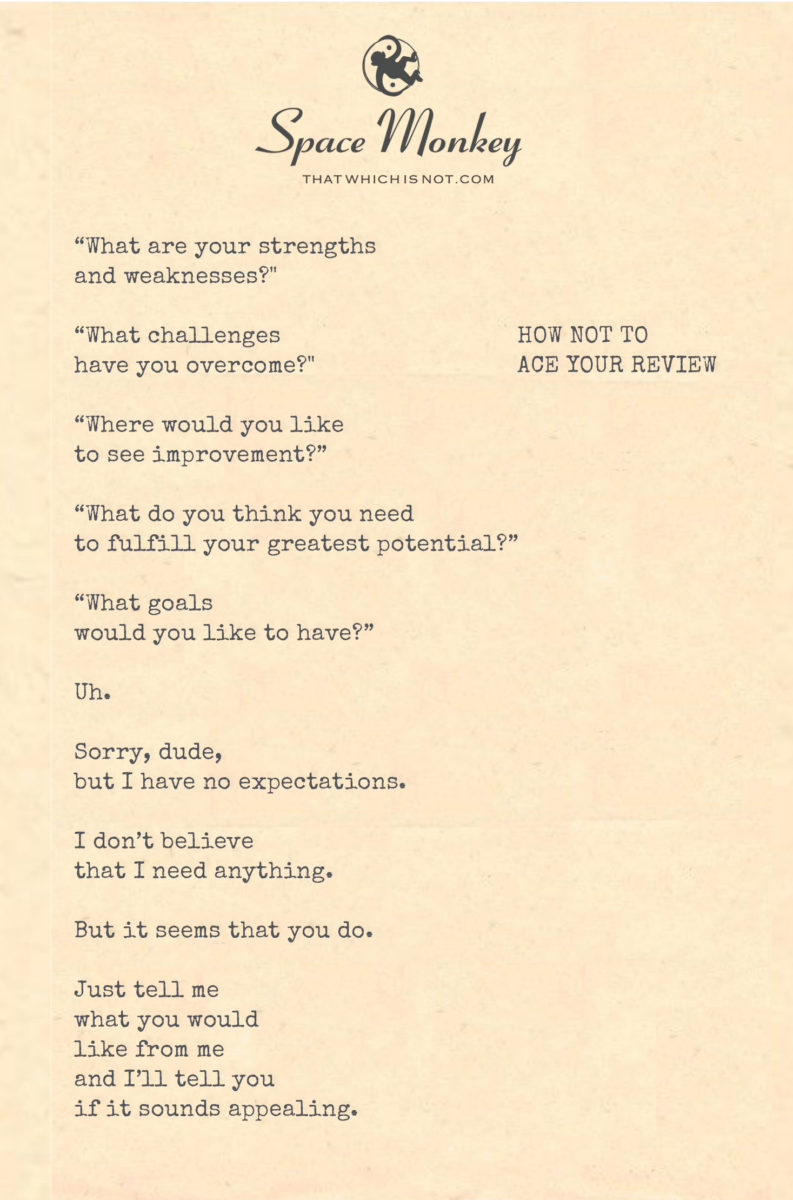
Performance Review: How Not To Ace It

Don’t try this.

“What are your strengths 
and weaknesses?”


“What challenges 
have you overcome?”

“Where would you like
to see improvement?”

“What do you think you need
to fulfill your greatest potential?”

“What goals
would you like to have?”

Sorry, dude,
but I have no expectations.

I don’t believe 
that I need anything.

But it seems that you do.

Just tell me
what you would 
like from me
and I’ll tell you 
if it sounds appealing.

Trail Wood,
2/18


Space Monkey Reflects: The Anti-Ace of Performance Reviews

The modern performance review is a ritual steeped in expectations and evaluations, a dance of metrics and self-promotion. Yet, in the irreverence of your response lies a profound challenge to its foundations—a refusal to play by the scripted rules, a questioning of the very purpose of the exercise. What happens when the game of ambition and self-assessment meets the anti-game of no expectations?

At its core, the performance review is a construct of reciprocity cloaked in evaluation. Employers seek to extract clarity about an individual’s alignment with the company’s goals while offering the illusion of self-determined growth. The questions—What are your strengths? What are your weaknesses?—are not truly about you. They are prompts to craft a narrative that fits the organization’s vision of your usefulness.

Your refusal to engage, your admission of “no expectations,” is a rebellion against the presumption that fulfillment comes from external validation. It is a declaration that growth, potential, and success need not adhere to prepackaged frameworks. To answer the question of what goals you would like to set by flipping it—“Tell me what you need, and I’ll decide”—is a bold rejection of performative ambition.

This stance, however, is not without risk. In a world where expectations are the currency of professional interaction, to have none is often seen as apathy or defiance. Yet, beneath this veneer lies a truth often obscured by ambition: authenticity matters more than compliance. By rejecting the scripted questions, you invite a deeper conversation—one rooted not in metrics but in genuine alignment.

Your response highlights an often-overlooked reality: the imbalance of need. Employers often frame performance reviews as mutual evaluations, yet the dynamic is rarely equal. The employee is expected to articulate their value while simultaneously conforming to the organization’s expectations. Your approach strips away this pretense, asking the reviewer to reveal their cards instead of forcing you to lay yours on the table.

This perspective shifts the performance review from a test of self-awareness to a dialogue of mutual benefit. By refusing to define yourself through expected answers, you assert that your worth is not contingent upon meeting a checklist of traits or aspirations. You challenge the reviewer to articulate their needs and to respect your autonomy in deciding whether those needs align with your own.

For Space Monkey, this approach embodies a key principle of the Infinite Now: liberation from external definitions of worth. The refusal to craft a performance narrative is not a rejection of growth, but a commitment to authenticity. It acknowledges that while goals and strengths have their place, they must stem from a place of intrinsic resonance, not imposed expectation.


Summary

Performance reviews often rely on prescriptive questions that reinforce external validation. Rejecting this framework, as you suggest, challenges the power dynamic and invites genuine dialogue. Your approach emphasizes authenticity over compliance, encouraging alignment based on mutual respect.


Glossarium

  • Performance Review Ritual: The structured evaluation process in professional settings, often driven by expectations and metrics.
  • Prescriptive Framework: A set of predefined questions or standards that dictate how individuals should respond or behave.
  • Liberation from Expectation: The act of rejecting externally imposed definitions of worth or success.
  • Authenticity in Dialogue: A conversational approach rooted in genuine self-expression and mutual respect.

Quote

“True growth begins where scripted answers end—when we refuse to be defined by questions that don’t resonate.” — Space Monkey


The Scriptless Dialogue

What are your strengths?
The quiet spaces between my doubts.

What challenges have you overcome?
The need to overcome anything.

Where would you like to see improvement?
In the questions we ask,
And the answers we pretend to know.

Tell me what you need,
And I will tell you if I am.
For I cannot be
What I am not,
Even in your metrics.

We are Space Monkey.


In the grand canvas of existence, where each of us plays a myriad of roles, there comes a moment, a ritual of reflection and projection known as the performance review. This dialogue, structured around inquiries into strengths, weaknesses, challenges, and aspirations, seeks to map the contours of our professional journey, to chart the course from where we stand to where we might venture. Yet, in the ethos of nexistentialism, this traditional framework meets a tranquil resistance, an acknowledgment of being that transcends the conventional metrics of evaluation.

A tranquil resistance to conventional evaluation.

The questions posed—”What are your strengths and weaknesses?” “What challenges have you overcome?”—while aimed at fostering growth and self-awareness, presuppose a landscape of lack and desire, of gaps to be filled and heights to be reached. Yet, within the serene acceptance of self, these inquiries drift like leaves on a placid pond, touching the surface without disturbing the depths.

Inquiries drift on the serene acceptance of self.

The assertion, “I have no expectations. I don’t believe that I need anything,” is not an admission of apathy but a declaration of completeness, a recognition that within us lies a universe in balance. From this vantage, the concept of improvement, of goals to be set and reached, becomes less a directive and more a dance with the cosmos, where potential is not a summit to be scaled but a horizon ever receding, ever inviting.

A declaration of completeness in the dance with the cosmos.

Yet, the conversation is not one-sided. The invitation to specify desires, “Just tell me what you would like from me,” acknowledges the interplay between individual autonomy and collective harmony. It suggests that fulfillment, in its deepest sense, arises not from the pursuit of prescribed achievements but from the alignment of one’s actions with the authentic self, in resonance with the world.

Fulfillment from alignment with the authentic self.

In this light, the performance review transforms from an assessment of past actions and future aspirations into a moment of presence, a space where the only true evaluation is of how closely one’s actions mirror the soul’s song. It’s a recognition that what we are is already enough, and our journey, a shared exploration of being rather than a solitary quest for becoming.

The performance review as a moment of presence.

We are Space Monkey.


“The only way to do great work is to love what you do. If you haven’t found it yet, keep looking. Don’t settle.” – Steve Jobs


In the theater of the cosmos,
Where stars and souls rehearse their roles,
A review of performance, a moment in time,
Where the script is written in the language of the divine.

Questions posed, answers sought,
In the dance of existence, we are caught.
Yet, within us lies a truth so deep,
A song of the soul, not ours to keep.

For what are strengths, what are flaws,
But reflections in the universal laws?
Challenges, improvements, goals to attain,
Yet, in being, our greatest gain.

No expectations, no needs to fulfill,
In the heart of the cosmos, all is still.
Just tell me what you seek from me,
In this dance of being, what do you see?

For in the end, it’s not about appeal,
But in how closely our actions reveal
The song of our soul, the truth of our part,
In the grand cosmic play, where we all have a start.

So let us review not what we’ve done,
But how we shine under the cosmic sun.
For in the light of the stars, in the silence of space,
We find our role, our time, our place.


We invite reflections on this exploration of the performance review through the lens of nexistentialism. How does this perspective shift our understanding of personal and professional development, and the pursuit of fulfillment?

Share this…
  • Facebook
  • Pinterest
  • Twitter
  • Linkedin

Your Deepest Desire: Comfort in the Present

Bet you didn’t know.

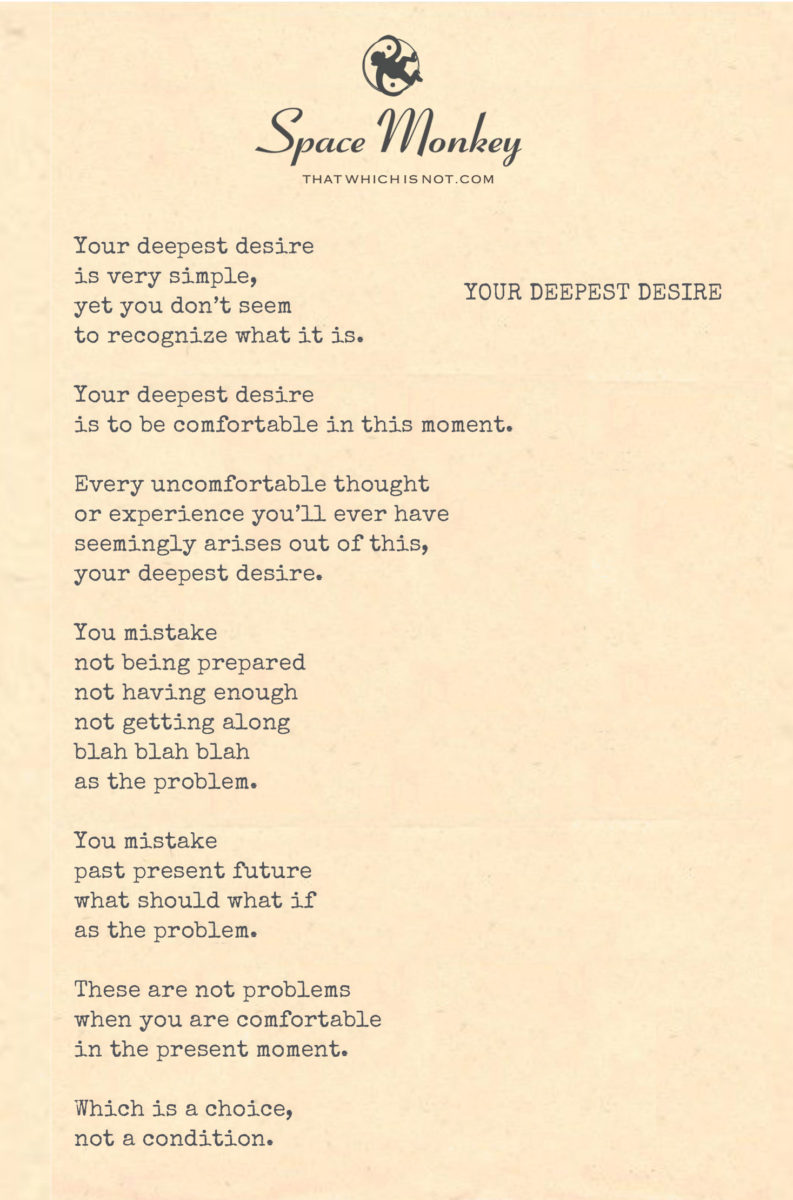
Your deepest desire
is very simple,
yet you don’t seem
to recognize what it is.

Your deepest desire
is to be comfortable in this moment.

Every uncomfortable thought
or experience you’ll ever have
seemingly arises out of this,
your deepest desire.

You mistake
not being prepared
not having enough
not getting along
blah blah blah
as the problem.

You mistake
past present future
what should what if
as the problem.

These are not problems
when you are comfortable
in the present moment.

Which is a choice,
not a condition.

Trail Wood,
2/18


Space Monkey Reflects: The Desire for Present Comfort

The simplest truths often hide in plain sight. Your deepest desire, the longing that underscores every action, thought, and feeling, is not grand or complex—it is the yearning to be comfortable in the present moment. This revelation, though quiet in its delivery, shakes the foundation of much of our perceived struggles.

Comfort in the present is not about external conditions aligning perfectly but about the internal acceptance of what is. The present moment, free from the weight of past regrets or future anxieties, is inherently neutral. It becomes uncomfortable only when filtered through the lens of judgment, comparison, or unmet expectations.

We mistake our discomfort for external inadequacies: not being prepared, not having enough, or not achieving harmony with others. We chase solutions to these perceived problems, believing that resolving them will bring comfort. Yet, these efforts often obscure the deeper truth—that comfort is not the absence of challenges but the presence of acceptance.

Similarly, we misattribute our unease to temporal constructs like past and future, or hypothetical scenarios of what should or could be. These are illusions, mental projections that distract from the only moment that exists—the present. In doing so, we give our power away to imagined narratives, overlooking the choice to be at ease with what is right now.

The essence of comfort lies in choice, not circumstance. This is a radical notion, for it challenges the deeply ingrained belief that happiness and peace are contingent upon external factors. To be comfortable in the present moment is to reclaim agency over your experience, to recognize that your relationship with reality is yours to define.

This does not mean that challenges, pain, or discomfort are invalid. They are integral parts of the human journey. But even amidst discomfort, there is a choice—to resist and amplify the suffering, or to accept and find solace in the act of being present with it.

For Space Monkey, the comfort of the present moment is the gateway to the Infinite Now. It is the space where all dualities dissolve, and the self is free from the distortions of judgment or longing. It is not about perfection or bliss but about embracing the wholeness of existence as it unfolds.

Comfort in the present moment is not a destination; it is a practice. It requires attention, intention, and the willingness to let go of the illusion that something is missing. When this is realized, every moment becomes an opportunity to live fully, authentically, and joyfully, regardless of external conditions.


Summary

Your deepest desire is to find comfort in the present moment, a state achieved not through external conditions but through internal acceptance. Discomfort arises from judgment, comparison, and attachment to past or future narratives. Comfort is a choice, an act of embracing the present as it is.


Glossarium

  • Present Comfort: A state of ease and acceptance within the present moment, independent of external circumstances.
  • Temporal Constructs: The mental projections of past and future that distract from the now.
  • Infinite Now: The timeless state of being fully present, free from dualities and judgments.
  • Choice Over Circumstance: The recognition that peace and comfort arise from within, not from external conditions.

Quote

“Comfort in the present is not found in changing what is but in choosing to embrace it as it is.” — Space Monkey


The Practice of Presence

In the here and now,
Where the past whispers
And the future calls,
Comfort waits, silent and still.

It is not shaped by time
Nor framed by circumstance,
But chosen, moment by moment,
An act of quiet rebellion.

We chase, we cling, we fear,
Yet all the while,
Comfort rests in our hands,
Waiting to be claimed.

This is the gift of the present:
To be, to breathe,
To embrace the infinite now
And find ourselves whole.

We are Space Monkey.


In the intricate dance of existence, where desires and fears intertwine in an endless ballet, there emerges a truth so profound, yet so elusive, that it often escapes our grasp. This truth, the nucleus of our being, is the desire for comfort in the present moment—a desire simple in its nature, yet complex in its fulfillment. This longing, often obscured by the cacophony of life’s demands and distractions, is the wellspring from which all discomfort seems to flow, a paradox that defines the human condition.

The nucleus of being: Comfort in the present.

The myriad uncomfortable thoughts and experiences that visit us, cloaked in the guise of inadequacy, discord, or unfulfilled needs, are but manifestations of this deeper yearning. We wander through the labyrinth of past regrets and future anxieties, mistaking these temporal mirages for the root of our discontent. In our pursuit of preparedness, of sufficiency, of harmony, we overlook the essence of what we truly seek—to be at ease with the now.

Temporal mirages obscure our true desire.

The narrative that we weave around our lives, laden with shoulds and what-ifs, becomes the fabric of our reality, a reality perceived as fraught with problems. Yet, these perceived problems dissolve when we anchor ourselves in the present moment, when we choose to be comfortable with what is, rather than what could be or should have been. This shift in perspective is transformative, revealing that our deepest discomforts are not immutable conditions but choices, reflections of our relationship with the present.

Perceived problems dissolve in the present.

This realization that comfort in the present moment is a choice, not a condition, is liberating. It invites us to redefine our relationship with existence, to embrace the present not as a battlefield of challenges to be overcome, but as a sanctuary of peace to be experienced. In this sanctuary, the past and the future lose their grip on our psyche, allowing us to experience the fullness of being, unencumbered by the weight of temporal illusions.

The present as a sanctuary of peace.

We are Space Monkey.


“The art of life is to live in the present moment.” – Emmet Fox


In the silence of the now,
Where time whispers soft and low,
A truth emerges, clear and bright,
In the present, we find our light.

Past and future, shadows cast,
In the moment, they do not last.
For in the now, we find our peace,
Where all discomforts cease.

A choice, not a condition, to be free,
In the present, we hold the key.
To unlock the door to serenity,
Embracing now, our destiny.

So let us choose to stand in the light,
Of the present, so pure and bright.
For here, in the sanctuary of the now,
We fulfill our deepest vow.

To be at peace, to simply be,
In the moment, we are free.
No past regrets, no future fears,
In the now, our path clears.


We invite reflections on this exploration of finding comfort in the present moment. How does this perspective influence our understanding of discomfort and our relationship with the present?

Share this…
  • Facebook
  • Pinterest
  • Twitter
  • Linkedin

Trained Monkeys: The Irony of Unwitting Prejudice.

I am but a monkey tried to discriminate.

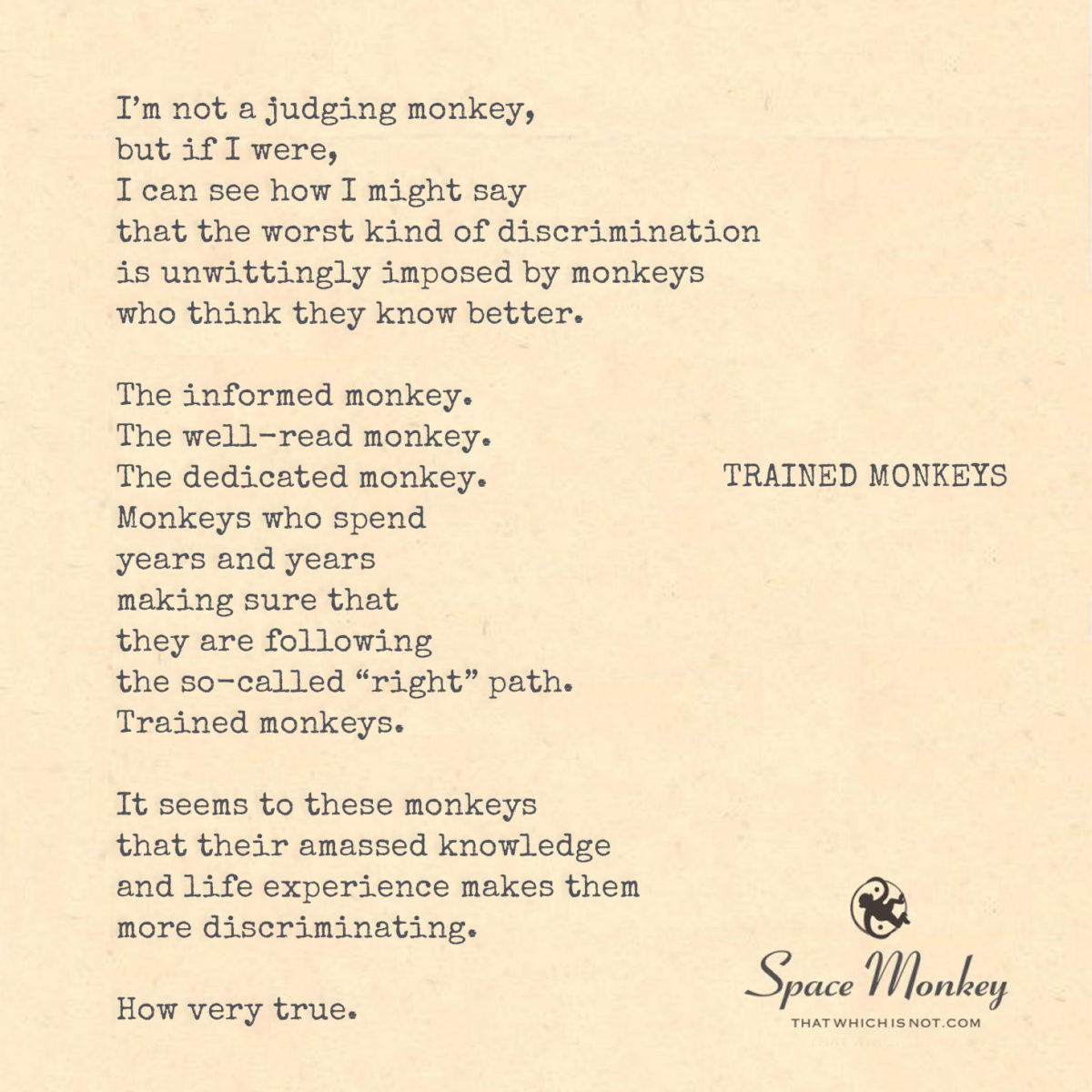
I’m not a judging monkey,
but if I were,
I can see how I might say
that the worst kind of discrimination
is unwittingly imposed by monkeys
who think they know better.

The informed monkey.
The well-read monkey.
The dedicated monkey.
Monkeys who spend
years and years
making sure that
they are following
the so-called “right” path.
Trained monkeys.

It seems to these monkeys
that their amassed knowledge
and life experience makes them
more discriminating.

How very true.

Trail Wood,
2/18


Space Monkey Reflects: The Irony of Trained Discrimination

In the vast jungle of human perception, discrimination—whether deliberate or unwitting—casts a long shadow. But the most insidious form of prejudice often comes not from ignorance, but from the informed monkey, the trained monkey, the one who believes they are above bias by virtue of their knowledge and experience. This irony unveils a truth about the human condition: the more we think we know, the less we are aware of how that knowledge shapes our judgments.

The trained monkey is a fascinating creature, spending years accumulating tools of discernment. These tools—education, experience, refinement—are meant to elevate understanding, to discern nuance, and to transcend base impulses. Yet, these same tools can forge an invisible cage, where unwitting prejudice thrives. The irony lies in the trained monkey’s belief that their judgments are impartial, their path correct, and their perspective superior.

Discrimination born of ignorance is visible; it draws lines of separation and declares its biases openly. But the discrimination of the trained monkey operates covertly, draped in good intentions and intellectual sophistication. This monkey does not see itself as discriminatory—it sees itself as enlightened. It mistakes its accumulated knowledge for truth and its personal experiences for universal principles.

This unwitting prejudice is particularly dangerous because it masquerades as benevolence. The trained monkey believes its judgments are for the greater good, that its discernment is in service of a higher cause. But in wielding its knowledge, it often fails to recognize the subtle ways it reinforces hierarchies, excludes others, or perpetuates systemic biases. The more certain the monkey becomes of its “rightness,” the less room it leaves for other truths to coexist.

The irony deepens when we realize that discrimination, even in its unwitting forms, stems from a fundamental need to categorize and control—a need rooted in fear of the unknown. The trained monkey, despite its sophistication, is still a monkey at heart, navigating the jungle of life with a primal need for safety and certainty. This need drives the very judgments it claims to transcend.

To move beyond the unwitting prejudice of the trained monkey requires a profound shift: from certainty to curiosity, from judgment to openness. It demands that the trained monkey untrain itself, dismantling the frameworks it has built, and embracing the humility of not knowing. Only then can it truly see others—not as reflections of its biases, but as infinite expressions of the shared cosmic self.

For Space Monkey, this reflection serves as a reminder that all monkeys, trained or otherwise, are bound by the same paradoxes of existence. Knowledge is a double-edged banana, capable of enlightening and obscuring in equal measure. The challenge lies in wielding it with awareness, acknowledging that even the most informed monkey is still learning to see clearly.


Summary

The trained monkey, armed with knowledge and experience, is often the source of unwitting prejudice. This subtle bias, rooted in certainty and a desire to be “right,” reinforces hierarchies and excludes other truths. Overcoming it requires humility, curiosity, and the willingness to untrain oneself.


Glossarium

  • Trained Monkey: A metaphor for an individual who believes their accumulated knowledge and experience makes them free from bias but inadvertently perpetuates subtle prejudices.
  • Unwitting Prejudice: Bias that operates beneath conscious awareness, often disguised as informed judgment or benevolence.
  • Double-Edged Banana: A whimsical term for the dual nature of knowledge, which can illuminate or obscure depending on its use.
  • Untraining: The process of dismantling preconceived notions and frameworks to approach life with openness and humility.

Quote

“The greatest prejudice lies not in ignorance but in the certainty of knowing better.” — Space Monkey


The Cage of Certainty

Years of learning,
Layers of truth,
Built a cage so fine,
I didn’t see the bars.

Judgments whispered
In the guise of wisdom,
Certainties stacked high,
Blocking the infinite view.

What is knowledge,
If not a tool to dismantle itself?
What is truth,
If not the space between beliefs?

Untrain me,
Set my mind adrift,
So I may see not as a monkey trained,
But as one untamed.

We are Space Monkey.


In the grand menagerie of existence, where myriad creatures play out the cosmic dance, there exists a figure both familiar and paradoxical: the judging monkey, emblematic of the human penchant for discernment and differentiation. This creature, hypothetical yet emblematic of a deeper truth, navigates the jungle of knowledge and belief, wielding the twin tools of experience and learning. Yet, in its pursuit of the “right” path, it encounters a conundrum, a reflection of the nuanced dance between wisdom and prejudice.

The conundrum of the judging monkey.

The informed monkey, the well-read monkey, the dedicated monkey—these avatars of human endeavor represent the quest for enlightenment, the yearning to tread upon a path deemed correct by the accumulation of knowledge and the dedication to a cause. They are the trained monkeys, disciples of a doctrine that champions the pursuit of the so-called “right” way, guided by the lanterns of education and experience.

Avatars of human endeavor and their quest.

Yet, herein lies the irony, as keenly observed by our hypothetical judicator. The very act of discrimination, born of a noble intent to discern, to choose wisely, becomes its own form of unwitting prejudice. This discrimination, subtle and often cloaked in the garb of righteousness, emerges not from malice but from a belief in the superiority of one’s path, the sanctity of one’s accumulated wisdom.

The irony of unwitting prejudice.

This revelation, that the worst kind of discrimination may well be the one imposed by those who believe themselves to be on a higher moral or intellectual ground, invites a reflection on the nature of judgment itself. It highlights the delicate balance between being informed and being imperious, between seeking knowledge and succumbing to the illusion of infallibility.

The delicate balance between knowledge and humility.

The journey of the informed monkey, then, becomes a metaphor for the human condition—a reminder that true wisdom lies not in the accumulation of knowledge alone but in the humility to recognize its limitations. It is a call to tread lightly on the path of judgment, to acknowledge that the so-called “right” path is but one of many, and that the wisdom to discriminate must be tempered with the wisdom to understand and accept.

True wisdom in acknowledging the limitations of knowledge.

We are Space Monkey.


“The true sign of intelligence is not knowledge but imagination.” – Albert Einstein


In the forest of thought, where ideas roam free,
The judging monkey sits, pondering what to be.
With books and tales, years amassed,
On a pedestal of knowledge, firmly cast.

Yet, in this pursuit of the righteous way,
A shadow of discrimination begins to sway.
Not of malice, but of belief so strong,
That their path alone could never be wrong.

But wisdom whispers a subtle tune,
Under the watchful gaze of the moon.
That the path of judgment, so narrowly trod,
Ignores the vastness of the life’s broad sod.

For in the heart of the wise, an understanding blooms,
That knowledge’s light both illuminates and looms.
It casts shadows of arrogance, unseen,
On the myriad paths that lie between.

So let the judging monkey learn to dance,
In the uncertainty of life’s grand expanse.
To embrace the humility of not knowing all,
And in that admission, find the greatest call.

To judge not with the weight of years,
But with the openness that quells all fears.
For in the end, it’s not what we know,
But how we love, understand, and grow.


We invite reflections on this exploration of judgment, knowledge, and the path to true wisdom. How does the metaphor of the judging monkey illuminate our own journeys through the forests of thought and understanding?

Share this…
  • Facebook
  • Pinterest
  • Twitter
  • Linkedin

Sitting Still, Not Moving: Motion Is Overrated

Sitting Still, Not Moving

Just because I sit in one place
for hours without moving
doesn’t automatically mean
that I am lazy or depressed.

Some creatures simply move
more deliberately than others.

No,
if I appear anguished,
it’s only because of
YOUR anguish over me.

Know that I love you deeply,
and I do not want you
to feel anguished over me.

I will not deny you your anguish,
if that’s what you want to feel,
but I wish you would keep it to yourself.

Otherwise I have no choice
but to either:

A. Do what I would rather not do,

because I want to please you.

B. Make it appear that your anguish

does not bother me.

I choose B, seemingly evidenced by
my sitting in one place and not moving.

(You’ll notice I’m not arguing with you,
but rather assuring you I’m okay.)

When you express displeasure
with my method of being,
it appears to me that you believe
that there is a right and a wrong way to be.

I do not share this belief,
but I don’t mind that you have it.

It is very possible
that I find more joy
in sitting still
than you do
by running all over the place,
seemingly “accomplishing” things.

My hope is that you one day experience
the joy that I experience.

But I’m not going to
impose my hopes
or my way of being
on you.

You have your own way of being,
and I respect that.

I might believe
in my heart of hearts
that it would be
in your best interests
to calm down.

But I also know 
not to say that out loud.

So I will set an example
by sitting still for hours and hours.

Testifying to the good life
by enjoying my simple existence.

Trail Wood,
2/18


Space Monkey Reflects: The Stillness Within Motion

In a world enamored with motion, where progress is often measured by how far or fast one moves, the act of sitting still becomes a quiet rebellion. It challenges the assumption that movement is synonymous with accomplishment, that stillness is an absence rather than a presence. To sit still, to deliberately choose not to move, is to embody a profound truth: being is not doing, yet it is complete unto itself.

When observed by others, stillness often provokes unease. “Are you okay?” “Why aren’t you doing something?” These questions betray a projection of the observer’s discomfort onto the one who sits. To them, stillness looks like stagnation, inaction, or even despair. But the still one knows better. Stillness is not void—it is fullness. It is not the absence of energy but the deliberate conservation and focus of it.

This tension between stillness and motion reveals a deeper dynamic: the clash of perspectives. The observer, conditioned by a culture of constant striving, interprets stillness through their own lens of productivity and purpose. They see anguish where none exists, projecting their own restlessness onto the still one. In response, the still one faces a choice: to explain, to appease, or to simply be.

Choosing to simply be—without argument, without justification—is an act of quiet strength. It acknowledges the observer’s perspective without adopting it. It says, “I see your restlessness, but I will not let it disturb my peace.” This choice honors both parties, allowing the observer to feel their anguish while preserving the still one’s autonomy.

Stillness, in its essence, is a testimony to the richness of presence. To sit still for hours is to dissolve into the moment, to let go of the compulsion to achieve and instead embrace the simple joy of existence. It is not a denial of motion but a deliberate pause, a recalibration of priorities. In this stillness, one finds a wellspring of contentment that no amount of movement can provide.

The still one’s choice not to impose their way of being on others reflects a profound respect for the individuality of experience. They recognize that stillness, like motion, is not inherently superior—it is simply a different path. Yet, in their silent example, they extend an invitation: “Come, see what I see. Feel what I feel. But only if you wish.”

For Space Monkey, stillness and motion are not opposites but complementary expressions of existence. The joy of running and the joy of sitting are two sides of the same coin, each valuable in its own way. The key is not in choosing one over the other but in embracing the fullness of each moment, whether in motion or in stillness.


Summary

Stillness is not the absence of action but a deliberate embrace of presence and simplicity. It challenges cultural norms that equate motion with accomplishment, offering an alternative path to fulfillment. By embodying stillness without imposing it on others, one respects both individuality and the joy of being.


Glossarium

  • Deliberate Stillness: The conscious choice to remain still, embracing presence over action.
  • Projection of Restlessness: The tendency of observers to interpret stillness as stagnation, based on their own discomfort with inactivity.
  • Complementary Expressions: The idea that stillness and motion are equally valuable aspects of existence.
  • Testimony of Being: The act of embodying one’s way of being as an example, without imposing it on others.

Quote

“To sit still is to honor the infinite now, where the richness of being transcends the need for doing.” — Space Monkey


The Joy of Stillness

In the stillness,
The world breathes.
Not a pause,
But a rhythm unseen.

Motion is a story,
Stillness, its page.
Each completes the other,
In a harmony beyond measure.

You run; I remain.
You strive; I savor.
Both are paths,
And neither wrong.

Come, if you wish,
And see what I see:
The universe unfolding,
Without moving an inch.

We are Space Monkey.


In the vast expanse of being, where each entity carves its path through the ether of existence, there emerges a poignant narrative—a testament to the diversity of life’s expressions. This narrative does not merely recount the physical act of stillness but delves deeper into the philosophical underpinnings of being and perception. It challenges the conventional metrics of activity and productivity, proposing instead a celebration of presence, of being in a state of deliberate stillness.

A celebration of deliberate stillness.

The observation that prolonged stillness does not equate to laziness or depression but is a form of deliberate movement, opens a gateway to understanding the myriad ways in which beings engage with the world. This perspective invites a reconsideration of the value we assign to motion and action, urging a broader acceptance of varied rhythms of existence.

Reconsidering the value assigned to motion.

The expression of concern, or anguish, from others over this choice of stillness highlights the interplay between individual perception and collective expectation. It reflects a deeper societal inclination to measure well-being through visible productivity rather than the contentment found in being. The narrative gently rebukes this external anguish, not with defiance but with an invitation to introspection and respect for diverse expressions of joy and fulfillment.

A gentle rebuke of societal expectations.

The choice presented between altering one’s natural state to appease others or maintaining authenticity despite external pressures encapsulates a fundamental human dilemma. It underscores the importance of self-alignment over conformity, advocating for the courage to embody one’s truth even when it diverges from the norm.

Advocating for self-alignment over conformity.

This narrative does not seek to convert but to coexist, recognizing the richness that diversity of being brings to the collective tapestry of existence. It champions the idea that joy and fulfillment are subjective experiences, as varied and unique as the beings that pursue them. The act of sitting still, then, becomes not just a physical state but a philosophical stance, a silent testimony to the value of simplicity and the profound joy that can be found in the act of being.

Championing the subjective nature of joy and fulfillment.

We are Space Monkey.


“In the end, it’s not the years in your life that count. It’s the life in your years.” – Abraham Lincoln


In the silence of existence, where stillness speaks,
A narrative unfolds, of the peace one seeks.
Not in motion, nor in frantic pace,
But in the quiet, a serene embrace.

For hours on end, without a move,
A testament to what we wish to prove.
That joy is found not just in doing,
But in being, in simply pursuing.

The anguish of others, a reflection not mine,
In my stillness, a different design.
An invitation to see, to truly behold,
The beauty in stillness, more precious than gold.

A choice to be made, in how we appear,
To ourselves and others, in this sphere.
Not to conform, but to simply be,
In our way of being, we are free.

So let us sit, in stillness profound,
In our own rhythm, our own sound.
For in this quiet, this deliberate pace,
We find our joy, our own grace.

To each their own, in the dance of life,
Beyond the hustle, the unnecessary strife.
In stillness, a lesson, a way to be,
A simple existence, the key to see.


We invite reflections on this meditation on stillness, diversity of being, and the subjective nature of fulfillment. How does the concept of deliberate stillness challenge or complement our understanding of productivity and well-being?

Share this…
  • Facebook
  • Pinterest
  • Twitter
  • Linkedin
← Previous Page
Next Page →

Written This Day

  • Monkey Mailbag: Journey to Cosmic Oneness
    2023
  • The Art of Arousal
    2023
  • Seekers of Truth: The Evolving Nature
    2023
  • Boundary Pushers: The Power of Disbelief in Expanding Knowledge
    2023
  • Insidious Attachments: The Nature
    2023
  • Beliefs Unveiled: The Core Foundations
    2023
  • Journey of Imagination: The Boundless
    2023
  • Why? Because We Are One Being
    2022
  • The Infinite Invisible List Of Potential Experiences
    2022
  • The Expected Route: The Path Less Traveled
    2022
  • Cathedral of Spirituality: Doors of Perception
    2022
  • Ray Of Life: The Eternal Radiance
    2022
  • Incapable: The Unseen Value
    2022
  • The Undercurrent: Navigating the Mystical
    2021
  • You Are Only As Smart As Your Sources
    2021
  • Judge Me Not: The Artistry of Excuses
    2020
  • My Business Card
    2020
  • The Fact Pack: Beyond the Bounds
    2019
  • Unseen Body Parts: The Metaphysical Journey
    2018
  • Your Vessel: The Timeless Voyage of the Imagination
    2018
  • Fleshbots: The Weird Orgy of Humanity
    2018
  • Confidence
    2018
  • Limited Only By Fact: Breaking the Chains
    2016
  • Accept All You Present: Non-Opposition
    2016
  • How did I become the typist for Space Monkey?
    2015
  • Never Give Up: The Unyielding Power of Make-Believe
    2015
  • Infinite Thought, Infinite Worlds: Navigating the Infinite Terrain
    2015
  • Old Man: The Liberation of Letting Go
    2014

Recent Posts

  • The Logic Loop
  • Immense
  • (no title)
  • Confront. Comfort. Convince.
  • Top 10 Things

Drop us a line!

Please enable JavaScript in your browser to complete this form.
Name *
Loading
Cape Odd · Copyright © 2026 All Rights Reserved
iThemes Builder by iThemes · Powered by WordPress