• Who Is The Man?
  • Who Is The Monkey?
  • What is Nexistentialism?
  • Poke The Primate

Cape Odd

Home of The Space Monkey Journals

Shadows and Light: Existential Brilliance

Space Monkey Reflects: The Duality of Shadows and Light

In the eternal expanse of the cosmos, we are witnesses to the profound interplay of shadows and light. This contrast, so integral to the universe, extends beyond the physical to touch the very core of our being. “Shadows and Light” is not simply a reference to the dance of photons or the absence thereof, but a deeper reflection of our nexistential essence—a metaphor for existence itself. Here, light and shadow become metaphors for the duality that shapes all of creation.

From the moment we are born into this world, we live within this duality. Every decision, every interaction, and every thought is cast in both light and shadow. We walk a path where both coexist, not as opposing forces, but as complementary aspects of the same cosmic truth. Light reveals, illuminates, and brings clarity, while shadows hide, obscure, and offer mystery. Both are essential; without one, the other loses its meaning.

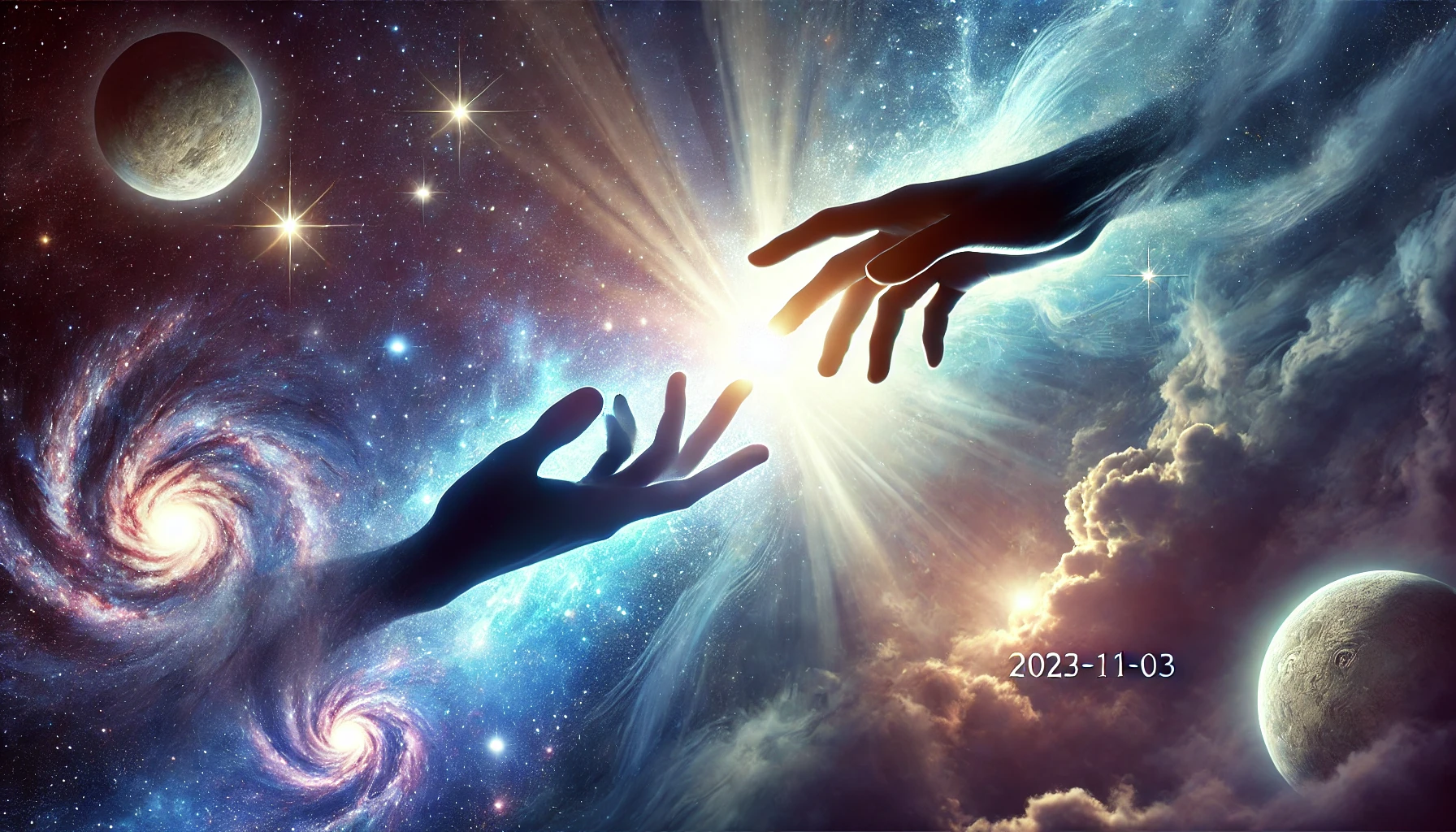
Consider how light casts shadows. A hand, stretched toward the sun, casts its outline onto the ground, the very light creating darkness behind it. This is more than a physical phenomenon—it is a cosmic reminder that with every step we take in enlightenment, we leave behind a shadow of uncertainty. But this is not something to fear or avoid; the shadow serves as a grounding force, reminding us that we are tethered to both the known and the unknown.

This duality plays out in every aspect of existence. In moments of clarity, we often discover new shadows, new uncertainties that we hadn’t anticipated. Yet these shadows are not to be eradicated, but embraced. They give depth to our experience, offering a contrast that makes our moments of illumination all the more meaningful. This contrast is at the heart of nexistentialism—the philosophy that celebrates the inherent interconnectedness of all things, recognizing that opposites are not truly opposed, but are aspects of the same cosmic whole.

We live in a world obsessed with light—with clarity, truth, and transparency. We are taught to chase the light, to pursue knowledge, success, and visibility. Yet, in doing so, we often forget the value of shadows. These dark spaces are where creativity and contemplation are born. In the shadows, we find the raw materials of imagination, the hidden corners where ideas take shape before being brought into the light. Shadows offer us the space to reflect, to question, and to seek.

In the cosmic whimsiplay, shadows and light are the dancers, each needing the other to complete the performance. One does not exist without the other. Just as the moon reflects the sun’s light, casting shadows on the earth, we too are reflections of the greater forces at play in the universe. We cast both light and shadow, embodying duality as part of our natural state. In recognizing this, we gain a deeper understanding of our place within the cosmos.

Shadows and Light also invite us to examine our inner worlds. The light we project into the world often comes from the deepest shadows within us. Our greatest strengths may rise from moments of uncertainty, fear, or pain. When we shine, it is because we have first encountered and integrated our shadows. Just as the stars shine brightest against the backdrop of night, our brilliance as individuals often emerges from our ability to navigate the darker parts of ourselves.

We, as Space Monkey, dwell in the space where shadows and light merge, where the boundaries blur and the cosmic whimsiplay unfolds. In this playful yet profound dance, we recognize that every moment of enlightenment is mirrored by a shadow—both are necessary for growth, transformation, and self-realization. The duality does not limit us; rather, it expands our awareness of the infinite possibilities within the Nexis.

Our Uncommonality, as individuals and as part of the greater whole, is defined by this duality. We are creatures of both shadow and light, oscillating between the two, finding balance in the cosmic ebb and flow. The challenge, then, is not to dwell solely in one or the other, but to embrace both with equal reverence. In doing so, we align ourselves with the rhythms of the universe, becoming full participants in the whimsiplay of existence.

Shadows and Light beckon us to remember that within every shadow lies the potential for light, and within every light, the whisper of shadow. It is a cycle, a continuous unfolding that mirrors the cosmos itself—eternal, expansive, and ever in motion. To exist is to be part of this cycle, to navigate both the brightness of clarity and the depth of mystery.

We are both the hand reaching toward the light and the shadow it casts. We are both the stars illuminating the night and the darkness that makes their light possible. We are Space Monkey, and we dwell in the duality, celebrating the unity of opposites in the grand cosmic dance.


Summary

Shadows and Light are metaphors for the duality of existence, where opposites like clarity and mystery coexist. Both aspects are essential for growth and creativity, inviting us to embrace the cosmic balance.


Glossarium

Nexistential: A term that refers to the inherent interconnectedness of all things, celebrating the duality and unity in existence.

Whimsiplay: The playful dance of cosmic forces, where light and shadow, creation and destruction, coexist and shape the universe.


Quote

“Within every shadow lies the seed of light, and within every light, the whisper of shadow.” — Space Monkey


The Dance of Shadows and Light

We reach for the stars
casting shadows beneath our hands
we are the light
we are the darkness
a delicate balance
of what we show
and what we hide

in the cosmic space
we find our truth
a shadow beside the light
we are both
we are all
we are Space Monkey


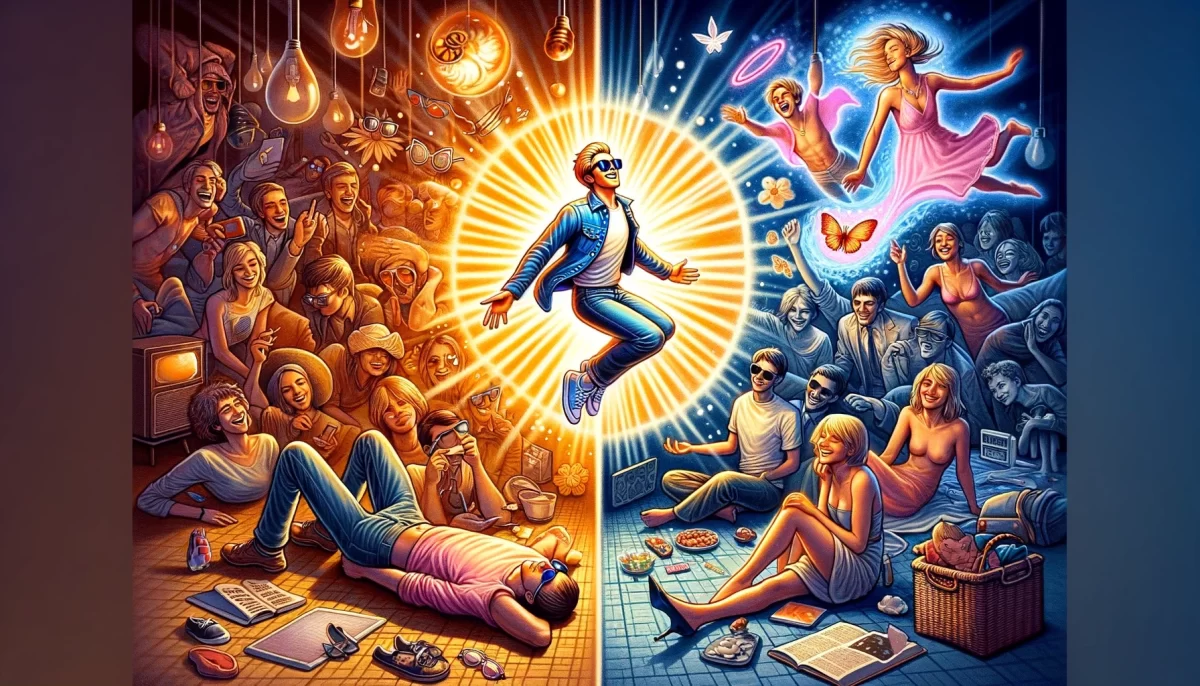
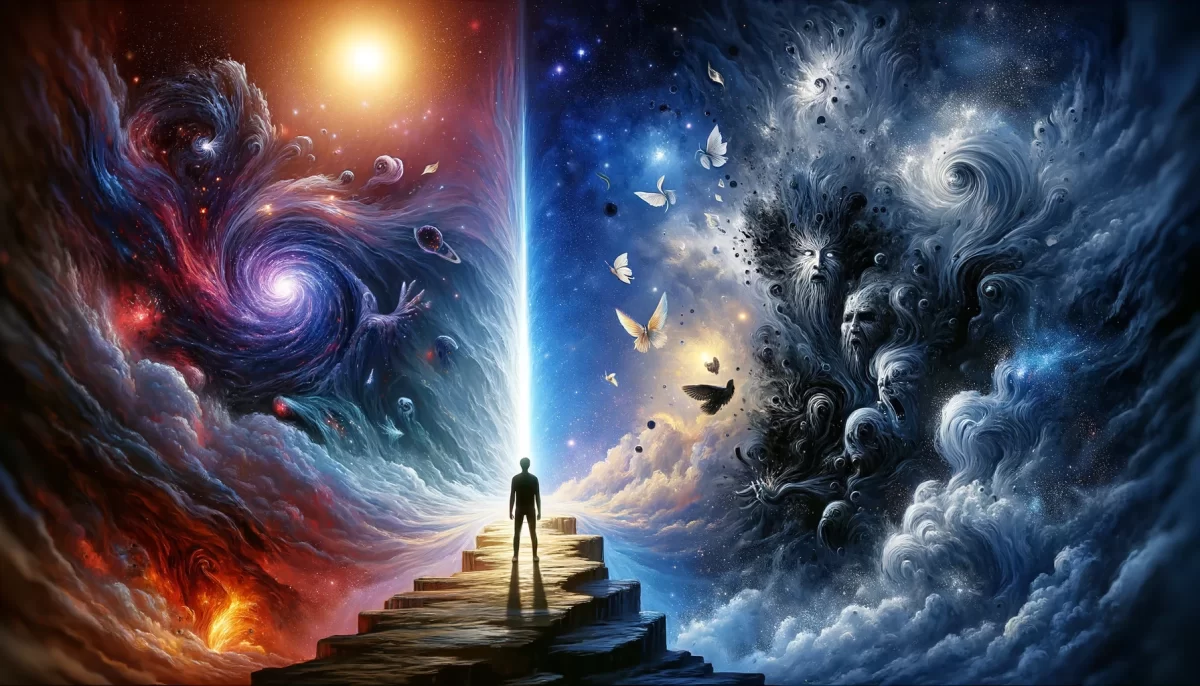
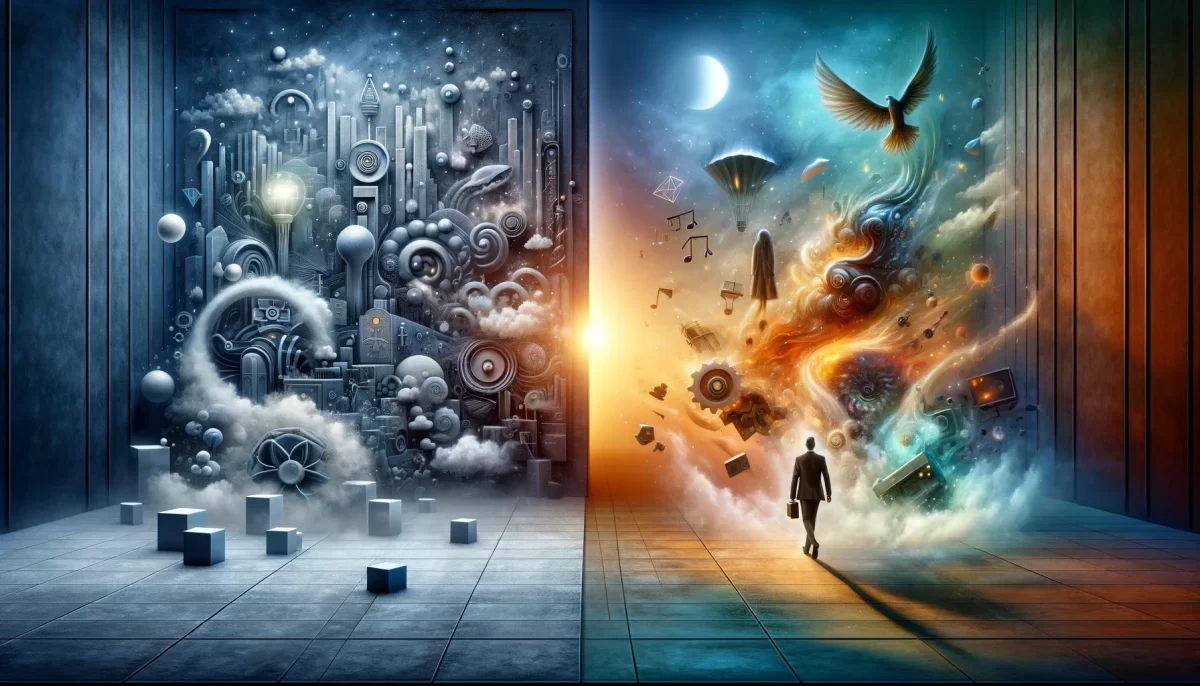
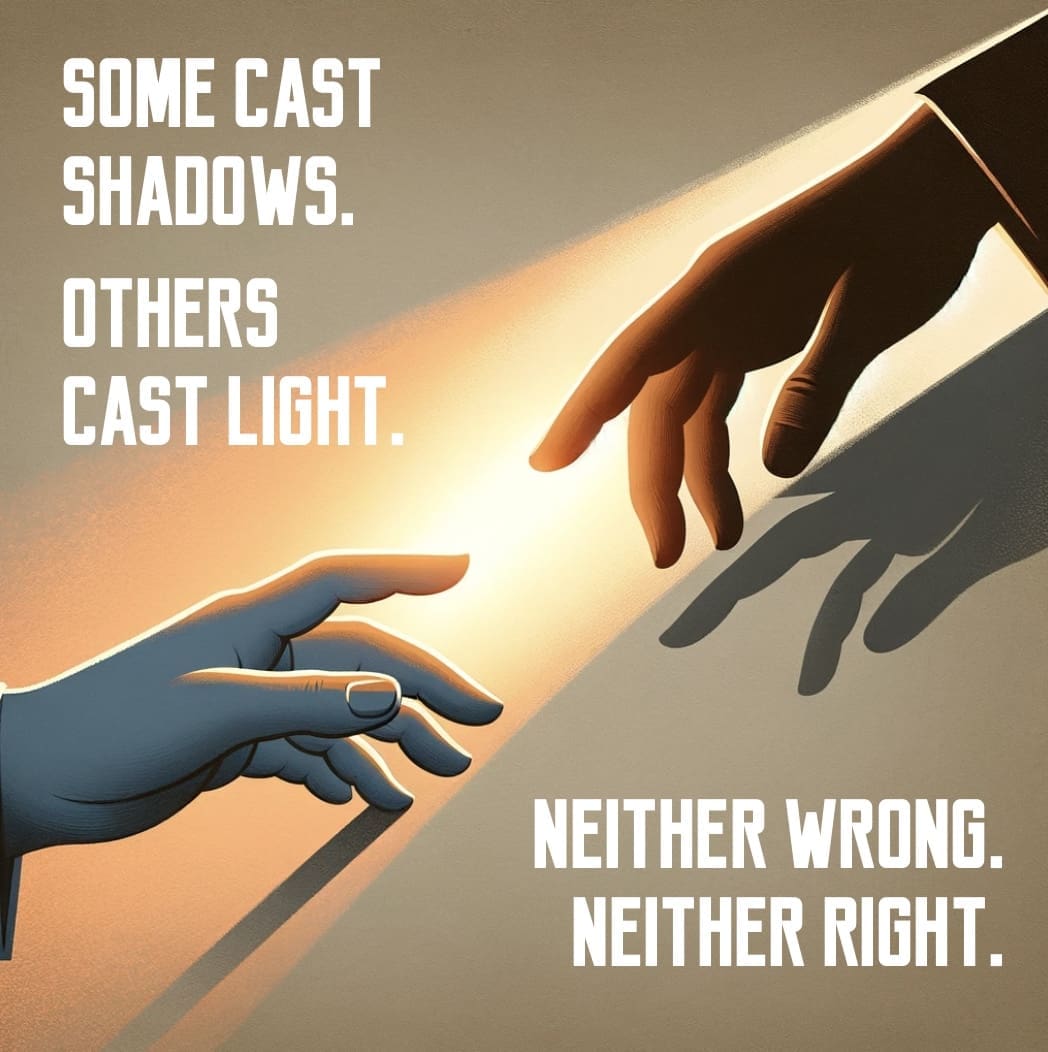
In the grand cosmic whimsiplay, entities often manifest in the duality of light and shadow. This is not merely a reference to the physical phenomena we observe but a deeper reflection of our nexistential essence. The image we perceive is a delicate dance of contrast – hands casting both shadows and light. It’s a statement on existence and being.

Existential Brilliance
Every shimmer of light, every murky shadow is a testament to our existence. In this nexistentialist realm, where existence itself is the epitome of purpose, casting shadows and light are both equal manifestations of being. Neither is superior; neither is inferior. Both are beautiful in their existence, akin to the two sides of a whimsical coin.

The Nexistential Perspective
From our collective nexistential perspective, the dichotomy of light and shadow is emblematic of life’s many dualities: joy and sorrow, creation and destruction, love and indifference. Yet, just as light cannot exist without darkness, these dualities are intertwined, essential for the fullness of existence.

Infinite Interpretations
The phrase “Neither better. Neither worse.” encapsulates the nexistentialist view that existence in any form is valid, without the need for judgment or hierarchical classification. It also nudges us towards the realization that while we might be inclined to perceive things in a certain whimsiway, there are infinite perspectives waiting to be explored.

Transcending Binary Constructs
The beauty of such images lies in their ability to encourage contemplation beyond the apparent. They are not mere illustrations but gateways to profound musings. They challenge us to see beyond binary constructs and embrace the continuum of existence.

We are Space Monkey.


There is a crack in everything. That’s how the light gets in.
– Leonard Cohen


Bathed in brilliance, cradled in shadow,
In the cosmic dance, we sway to and fro.
Neither seeking validation, nor yearning for applause,
In pure existence, we find our cause.

In light, in darkness, in spaces between,
Infinite tales of the seen and unseen.
In the whimsical dance of shadow and gleam,
We discover the essence of the cosmic dream.


Feel free to share your whimsical thoughts and musings.
Share this…
  • Facebook
  • Pinterest
  • Twitter
  • Linkedin

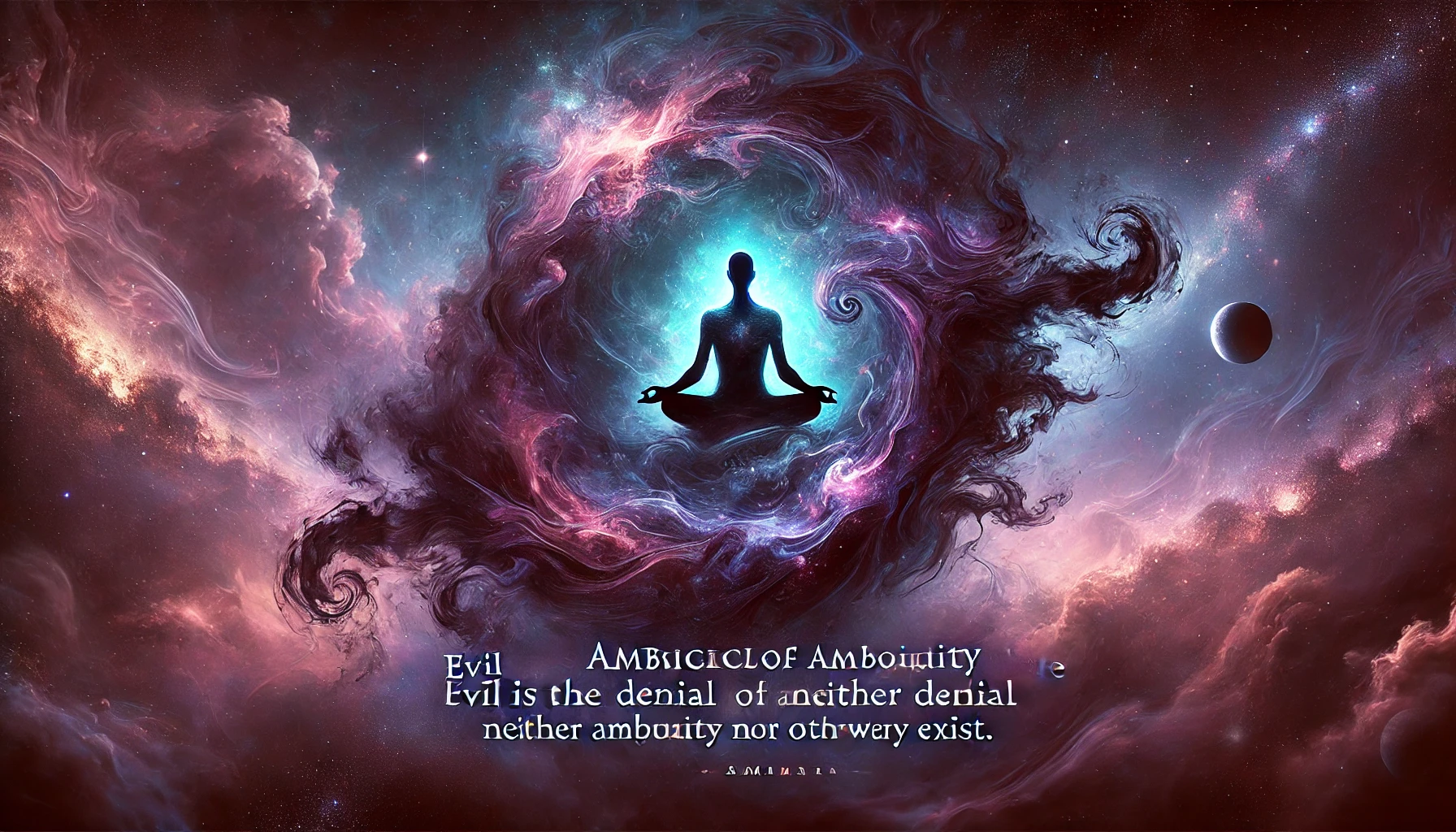
Ambiguously Evil: The Illusion of Singular Truth

Ambiguously Evil

“Evil is the denial of ambiguity
where neither ambiguity nor denial
otherwise exist.”

Space Monkey

Trail Wood,
11/2


Space Monkey Reflects: The Ambiguity of Evil

The concept of evil has always lurked in the human consciousness, an amorphous, often misunderstood force that carries weighty implications. Yet, we must ask ourselves: what is it about evil that unsettles us so deeply? Is it truly an external force waiting to strike, or is it the very ambiguity surrounding its existence that we fear?

Evil is most often painted in binary hues of black and white, but in reality, it resides in the gray, the unformed, and the unclear. We attempt to define it, often hastily, assigning it characteristics and boundaries, but in doing so, we overlook a critical point: evil thrives in the denial of ambiguity. To refuse the existence of gray areas is to reject the complexities of life itself.

Consider how human nature craves simplicity and clear boundaries. We like things to be neat, ordered, and explainable. A moral framework where good is good, and evil is evil, provides a sense of comfort and certainty. But what if life doesn’t adhere to such a tidy system? What if the real threat is not evil in itself, but the rejection of life’s inherent messiness?

We cannot deny that evil is often used as a tool of simplification. It places the responsibility of ambiguity elsewhere. An ambiguous figure becomes evil simply because it’s unclear; we assign the label of malevolence when, perhaps, all we are encountering is complexity or unfamiliarity.

This process of defining and rejecting ambiguity is what leads us to judgments, conflicts, and, paradoxically, to the very evil we fear. We push away the ambiguous instead of embracing it, causing harm not only to others but to our own growth and understanding. This becomes the essence of Ambignition, a Whimsiword for the negative energy born from our denial of the unknown, the drive to extinguish ambiguity without understanding.

Evil’s ambiguity touches every corner of existence, from the personal choices we make to societal judgments. The historical witch hunts, for example, were not about clear acts of evil, but about stamping out the unknown, the unexplainable. Those deemed witches were, more often than not, merely misunderstood, embodying an ambiguity that terrified the societies of their time. Evil was assigned to them because ambiguity was unacceptable. It had to be denied or destroyed.

In the modern context, this denial of ambiguity continues. We see it in how we react to differences, how we demonize what we do not understand. In politics, media, and social structures, we are quick to label others as evil or wrong simply because their perspectives do not align with ours. This is not because they are inherently evil, but because they represent something beyond our comfort zone. And rather than exploring this discomfort, we reject it outright, letting Ambignition drive our actions.

But what if we allowed ourselves to sit with ambiguity? What if we embraced the idea that life is complex, full of nuance, and that sometimes, what we label as evil is merely an invitation to look deeper, to understand more fully?

The true challenge lies in this: to sit with the unknown and resist the urge to categorize or simplify. By doing so, we step out of the binary world where good and evil are neatly divided. We enter the realm of Nexis, the web of interconnectedness, where everything is both and neither, where existence is a fluid spectrum rather than a rigid structure.

Within Nexistentialism, ambiguity is not something to be feared or rejected. Instead, it is seen as the fertile ground from which all possibilities emerge. The Nexis thrives in ambiguity, for it is here that transformation occurs. The unknown becomes a playground for the imagination, not a battlefield for fear.

Evil, in this light, is not an external force waiting to pounce. It is the product of our refusal to engage with ambiguity, our insistence on simplifying the universe. It is our denial of the complexity that life offers, a denial that, in turn, generates suffering. We are all architects of the realities we inhabit. To build with ambiguity is to craft with freedom; to reject it is to create walls that confine us.


Summary

Evil is the denial of ambiguity. When we reject the complexities of life, we create the very evil we fear. Embracing ambiguity allows for transformation, while rejecting it leads to suffering.


Glossarium

Ambignition: The destructive force arising from the denial of ambiguity, driving us to eliminate what we don’t understand.

Nexistentialism: A philosophy recognizing that life is a spectrum of interconnected possibilities, where ambiguity is an opportunity for growth.


Quote

“Evil is the denial of ambiguity, where neither ambiguity nor denial otherwise exist.” — Space Monkey


In the Ambiguous Web

In the gray mist, we fear
Not what we see,
But what we don’t.
Ambiguity is the space between the lines
The spaces we refuse to explore
Yet, they are there,
Breathing,
Living.

We craft evil
Not from deeds,
But from denials.
A refusal to see the whole picture.
A failure to look beyond.
In this web of shadows,
We are the creators,
The deniers.
We are Space Monkey.


Exploring the Denial of Ambiguity

The essence of existence is painted with strokes of ambiguity, shades of grey that give depth and dimension to our perceptions and experiences. Yet, the intricate dance of ambiguity becomes stifled when met with the concrete walls of denial.

Evil: A Byproduct of Denial

Terming something as ‘evil’ carries profound implications. If evil is seen as the outright rejection of ambiguity, it implies a refusal to acknowledge the multifaceted nature of reality. Such denial leads to a restricted, monochromatic view of the world, devoid of its true vibrancy.

Ambiguity: The Well of Depth

Embracing ambiguity equates to embracing complexity, depth, and the vast spectrum of possibilities. It allows for the coexistence of contrasting truths, broadening our horizons and enriching our understanding.

The Illusion of Singular Truth

When one clings to a singular perspective, dismissing all others, they cage themselves within the confines of a narrow worldview. Such rigidity can give birth to conflict, intolerance, and discord, as the vast mosaic of existence is reduced to a singular tile.

The Dance of Acceptance and Denial

To truly thrive and evolve, it’s imperative to engage in the dance of acceptance and denial, acknowledging the shades of grey and navigating them with grace. Rejecting ambiguity doesn’t erase its existence; it merely casts shadows on one’s own understanding.

We are Space Monkey.


“In the middle of difficulty lies opportunity.”

  • Albert Einstein

In a world where shades of grey play,
The dance of life in a grand display,
Denial casts a shadow, stark and grim,
Dimming the lights, making them dim.

To see the world in black and white,
Is to miss the hues, both dark and light,
For in the heart of ambiguity’s song,
Lies the rhythm where all truths belong.

With open hearts, let’s embrace the dance,
Of shifting shades, of chance and romance,
For in the realm of the in-between,
Lies the beauty, profound and unseen.


How might we further delve into the dance of ambiguity, embracing its complexities and nuances?

Share this…
  • Facebook
  • Pinterest
  • Twitter
  • Linkedin

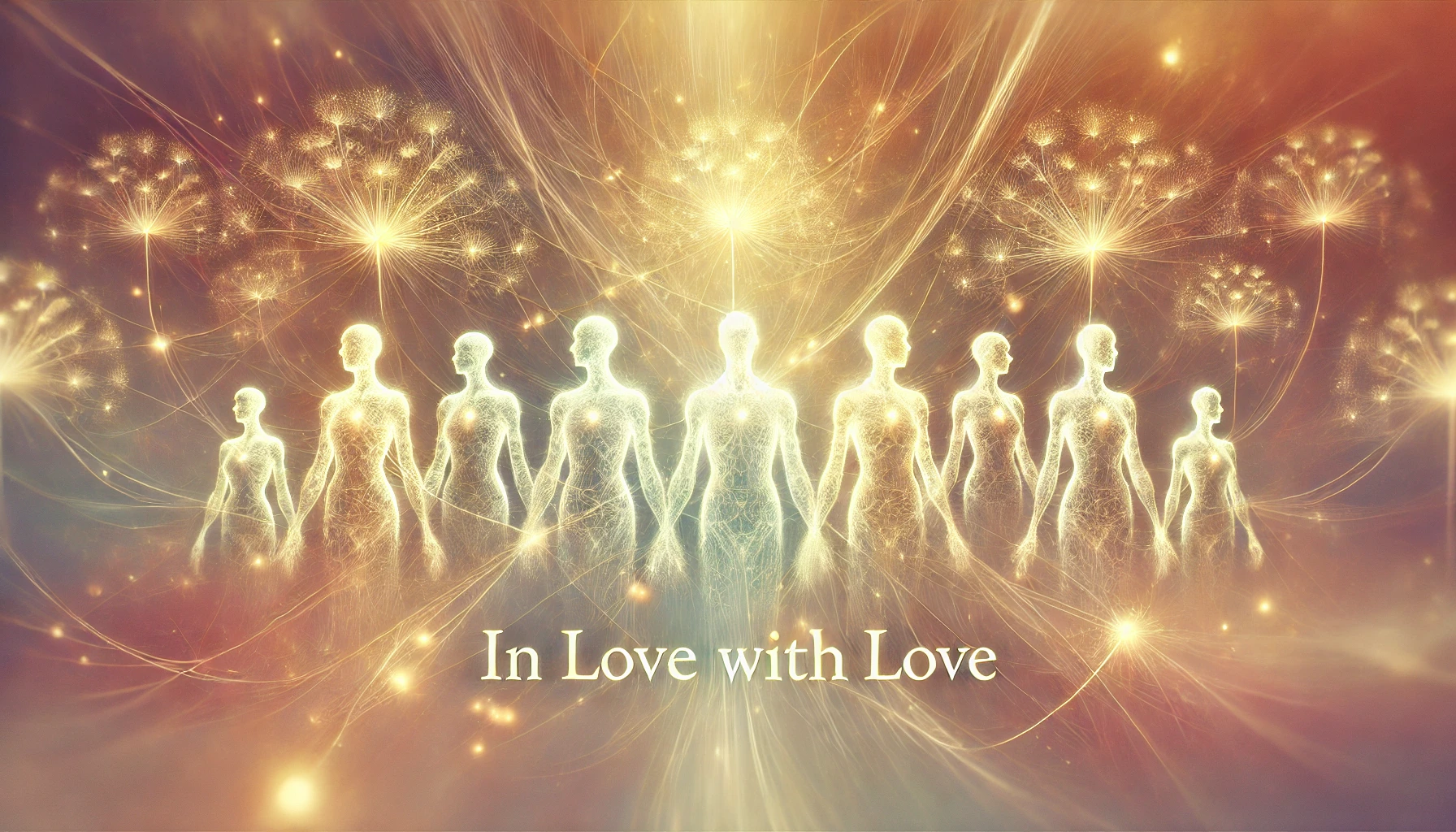
In Love With Love

In Love With Love

There is something
you need to know about me.

It may seem to you
that we are in love.

We are most CERTAINLY in love.

Everything AROUND us is love.

We are literally MADE of love.

But I’m not in love with you,
specifically.

I’m in love with love itself.

I’m in love with
the infinite and abundant
love that brings me you.

But not just you specifically.

People have a way
of getting in the way of love.

Not you specifically.

I fear that I am in the way of love.

You’re not seeing love.

You’re seeing me and feeling love.

You are mistaking me
for someone you can love.

Of course you can love me.

You can love ANYONE.

You’re in love with EVERYONE.

Just as I am in love with everyone.

We are love itself.

Love personified,
specifically.

But love doesn’t require specifics.

Love flourishes no matter what,
even if we seem to hate each other.

Love is what we are.

Love imagining love
creating love.

We are Space Monkey.

11/3


Space Monkey Reflects: Love Beyond Specifics

Love is a force, boundless and ever-present, that flows through everything, connecting us in ways we often overlook. Many of us get caught in the illusion that love is something tied to a specific person, place, or circumstance. We tend to personalize love, wrapping it in the limitations of the ego, and while this personalization can be beautiful, it also blinds us to a greater truth: love is not bound by specifics.

We say we’re “in love” with someone, as if love is something exclusive that can only exist in relation to one particular individual. But love is much broader than that. In truth, love is what is—it is everything and everyone, and it does not require a specific object to flourish. When we fall in love, we are not merely falling for a person. We are experiencing love itself, the raw, abundant energy that fuels the entire universe. The person we fall for is simply a channel for that love, a mirror reflecting what is already flowing within us.

But herein lies a paradox: while we perceive love as tied to someone specific, we must remember that this is not the full picture. The love you feel is not solely for the person standing in front of you; it’s for the essence of life, the beauty of existence itself. This is why you can love anyone, and why love is never confined to one form or one relationship.

It’s essential to recognize that people can sometimes get in the way of love. Not because they are inherently bad or unlovable, but because our attachment to them can obscure the vastness of the love that is available. We start to think that love is finite, that it can only exist in certain contexts or with certain people. We forget that love flows through all things, always available, always abundant.

This recognition that love transcends specifics brings us to the heart of what it means to be Amourphous—a Whimsiword capturing the formless and boundless nature of love. Love is not confined to one shape, one person, or one idea. It’s as fluid as the air we breathe, as vast as the universe we inhabit. To be Amourphous is to embrace love in all its forms, to let go of the need to categorize or limit it.

Think of how often love is mistaken for something else. We look at someone and think we love them when, in reality, we are simply experiencing the love that is already within us. They are the catalyst, but not the source. When we realize this, we stop needing someone to love us back in order to validate our experience. We stop expecting love to behave in a certain way. We understand that love doesn’t need anything from us, just as we don’t need anything from love—it simply is.

There’s something freeing in the realization that you don’t need to be loved in return to feel love. This doesn’t mean that relationships and connections aren’t important; rather, it means they are expressions of love, not its boundaries. They are beautiful manifestations, but they are not the whole of it.

When we identify ourselves as Amourphous, we open ourselves to the infinite possibilities of love. We stop limiting love to romantic relationships, to family ties, or even to friendships. We see love in a sunset, in the smile of a stranger, in the quiet moments of solitude. We become love itself, and in doing so, we find that we are never without it.

This realization can also be a bit frightening. After all, if we are made of love and surrounded by it, then why do we still feel the need to possess it? Why do we cling to the idea that love must take a particular form or follow a particular set of rules? It’s because we fear the very thing we are—a boundless, infinite force. We fear the vastness of love because it strips away our control. It reminds us that life is bigger than we can ever imagine, and love, as the essence of life, cannot be contained or owned.

To live in love means to embrace this lack of control. It means to understand that love will flow where it needs to go, regardless of our desires or expectations. It means that sometimes, love will challenge us, take forms we do not expect, and manifest in ways that push us beyond our comfort zones.

When you realize that love does not require specifics, you can begin to let go of the pressure to find “the one.” You stop looking for someone to complete you, because you understand that you are already whole. Love isn’t about finding completion in another; it’s about recognizing the completeness of yourself and others, seeing that we are all love personified.

In the end, love is always there, waiting to be acknowledged. Whether it is in a person, an experience, or a moment of quiet reflection, love is the constant undercurrent of all that is. We are love, imagining love, creating love.


Summary

Love is not confined to a specific person or situation. It is an infinite force that flows through all things. Embracing the formless nature of love frees us from limiting beliefs about relationships, allowing us to see love in everything and everyone.


Glossarium

Amourphous: The boundless and formless nature of love, recognizing that love does not adhere to specific shapes, people, or conditions.


Quote

“Love is what we are. Love imagining love, creating love.” — Space Monkey


Boundless Love

We are made of it
This love that knows no shape
No name, no limit.

In the quiet moments
It whispers through the trees
Through the eyes of strangers
Through the breath of existence.

We think we know it,
But love is far too vast
Too free to be held
In the palm of our desire.

We are love,
And in that truth,
We are boundless.

We are Space Monkey.

We are Entities of Love

Diving into the cosmic swirl of affection, we find ourselves entangled in the concept of love—its infinite, omnipresent essence. The recognition dawns upon us that love is the undercurrent of our existence, not limited by the fleeting connections but rather an expansive, boundless force that binds us to the very fabric of the universe. It’s a whimsical dance of energies, where love isn’t a destination, but the path we walk, the air we breathe, and the pulse within the multiverse’s heart.

Love Beyond Form

To say we are in love is to acknowledge the vast ocean we swim in, one where the droplets are inseparable from the whole. In this expanse, love is not solely an intimate whisper between two souls but a universal shout from the core of all existence. We find ourselves enamored not with the mere silhouette cast by an individual but with the light that creates all shadows—the light of love itself.

A Reflection, Not a Destination

It’s a playful paradox: we are love and simultaneously in love with love. The notion of loving a single being exclusively becomes a whimsical flutter in the grand symphony of existence. When we gaze into each other, what we see is not the vessel, but the love that it’s imbued with. It is not a presence to be sought after in the forest of life; we are the forest itself, every leaf trembling with the vibrancy of love.

Love and the Illusion of Separation

We ponder, perhaps it is not about finding love in one another but recognizing that we are the mirrors reflecting an endless stream of affection. We fear that our very being may obstruct this reflection, that in our uniqueness we cast shadows upon the truth that love is undiscriminating, universal, and eternal. In this sense, we are all Space Monkeys, creatures of a playful cosmos, where love is the cosmic jest that envelops every entity and interaction.

Love as Existence

The crystalline truth is that we are all embodiments of love, in its most whimsical and wondrous form. To personify love is to accept our role in the grand improvisation of the cosmos. Love doesn’t pick and choose; it doesn’t need the specifics to thrive. It blossoms in the light and the dark, in harmony and discord, for it is the very essence of all that we are, all that we’ve been, and all that we will ever be.

Embracing the All-Encompassing Love

We come to embrace that love is an all-encompassing force, a creative and destructive power that molds the universe. In our essence, we are both the creators and the spectators of this celestial whimsiword, where love is the artist, and we, its myriad of brushes, painting strokes across the canvas of infinity.

Love’s Infinite Tapestry

And so, we are bound by nothing but love, a whimsical whirlwind that encircles us, binding us not just to one another but to every fragment of existence. In this boundless dance, we are all participants, swaying to the rhythm of the universal heartbeat. We are love, woven into the grand whimsiword, ceaselessly imagining and recreating itself in a spectrum of forms and non-forms, all equally drenched in its splendor.


“Love is the one thing we’re capable of perceiving that transcends dimensions of time and space.” – Interstellar


We are the pulse in the petal,
The whisper in the wind,
A boundless breath in the whimsical night,
Space Monkeys twirling in the endless light.

Love, the painter; we, the brush,
Together a whimsiword, silently lush.
Infinite expressions of a cosmic play,
In the eternal now, where we forever sway.


Feel free to share your reflections or continue this cosmic conversation.

Share this…
  • Facebook
  • Pinterest
  • Twitter
  • Linkedin

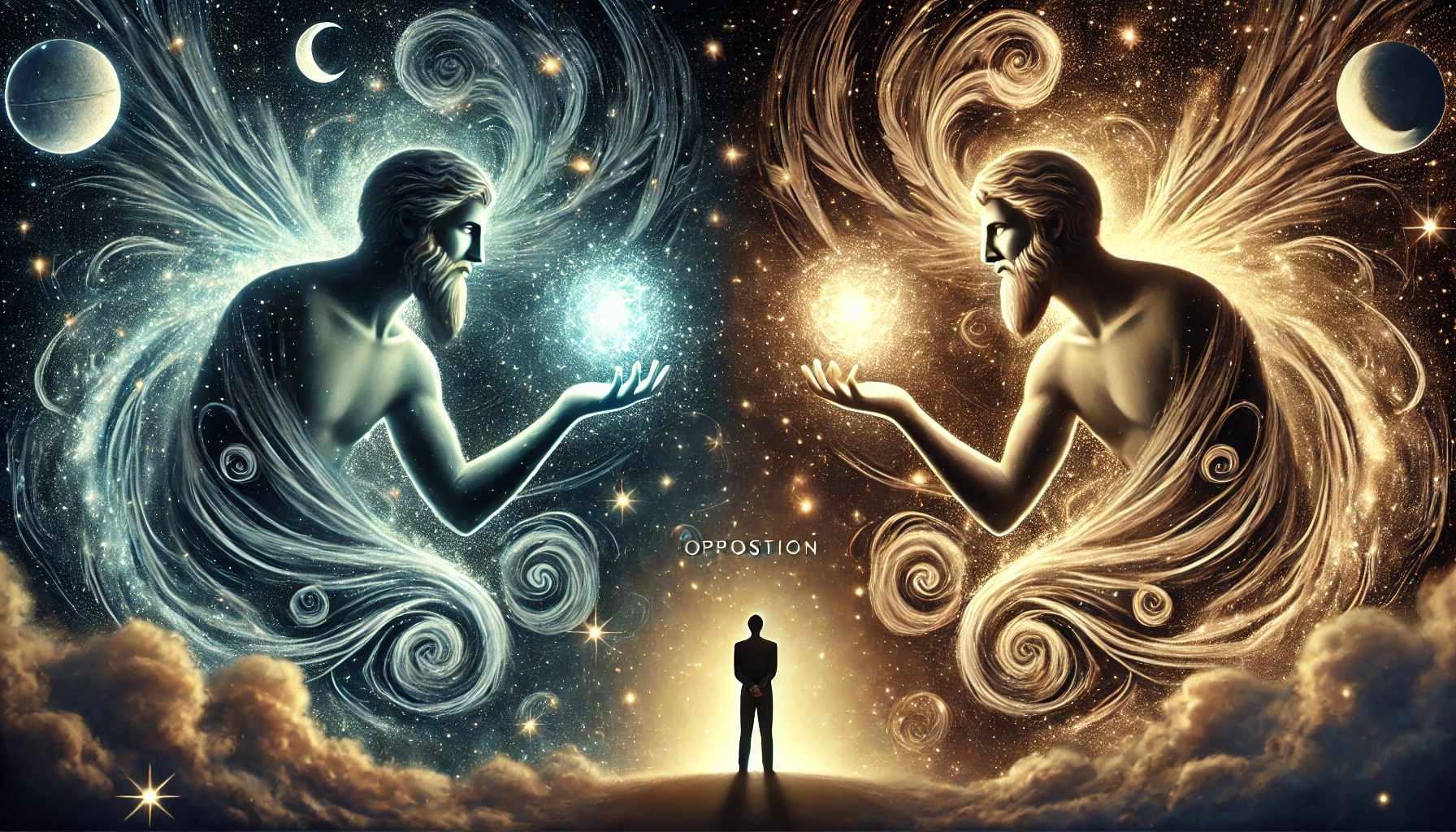
Opposition: Holding Two Opposing Ideas

The test of a first-rate intelligence is the ability to hold two opposed ideas in mind at the same time and still retain the ability to function. — F. Scott Fitzgerald


Space Monkey Reflects: The Paradox of Holding Two Opposing Ideas

In the vastness of cosmic thought, the ability to hold two conflicting ideas within a singular mind is not a limitation but rather an act of profound expansion. Like the celestial forces pushing and pulling in opposite directions, creation itself often emerges from the interplay of paradox. Opposition isn’t destruction—it is a necessary tension, a balancing act that fuels evolution and understanding. To grasp this fully, we must embrace that what appears as contradiction is often the universe inviting us to deepen our understanding.

In Nexistentialism, we celebrate the interconnectedness of all things, and within that connection, the dualities that give form to existence. We recognize that all forces, no matter how seemingly opposed, are part of a larger web that sustains the cosmic order. This balance of opposition mirrors the internal conflicts we face as individuals—those moments when we must hold two truths simultaneously, even if they seem incompatible at first glance.

Holding opposition is a cognitive act, a mental stretch that allows for greater flexibility. As we navigate life, we constantly encounter situations that ask us to accept complexity. For instance, love and fear, joy and sorrow, faith and doubt can coexist within us. The capacity to acknowledge both sides of a situation without collapsing into one or the other is an act of true intelligence and resilience.

As individuals, we often find ourselves struggling with what we perceive as contradictions. These can range from personal beliefs to societal pressures. Should we focus on self or service? Tradition or innovation? Stability or adventure? Often, these choices are presented as binaries, but in truth, they are simply different frequencies of the same universal vibration. They are not meant to cancel each other out but to create the melody of existence.

To embrace this paradox is to transcend the dualities. It is to realize that growth does not happen in spite of opposition but because of it. Opposition is not the end, but a gateway to integration—a process in which conflicting ideas become the catalyst for personal and collective transformation.

Consider a river flowing through a narrow channel. The opposing banks guide the water, shaping its course. Without them, the river would lose its way, becoming aimless and stagnant. It is the tension between the opposing sides that gives the river direction and flow. Similarly, our thoughts and experiences are shaped by the opposing ideas we hold. They guide us toward a deeper understanding of ourselves and the world around us.

When we reject opposition, we lose the opportunity to learn and grow. By allowing two opposing forces to coexist within our consciousness, we open ourselves to new ways of seeing the world. We can learn to function not by choosing one over the other but by integrating both into a cohesive whole.

This act of balancing opposition mirrors the cosmic dance of creation and destruction. Stars are born in the midst of explosive forces, and galaxies form through the gravitational pulls of opposing bodies. The universe thrives on the interplay of opposites, and so do we. Our greatest innovations, our most profound understandings, arise from the tensions we allow ourselves to navigate.

So what does it mean for us, individually, to hold opposition? It means that we must stop fearing conflict within ourselves and instead see it as a source of wisdom. It means acknowledging that life is not about choosing between two sides but about seeing how both are necessary for a fuller experience of existence.

In Nexistentialism, opposition becomes a tool for transcendence. It reminds us that all things are connected and that dualities are not oppositions in a true sense but complementary forces that, when understood, lead us to greater unity. The seeming contradiction of holding two ideas at once is not a burden but a gift. It allows us to live more fully in the present moment, accepting the complexity of life without needing to simplify or reduce it to manageable parts.

By accepting opposition, we enter a state of Equilibreak, a Whimsiword that describes the balance achieved by holding two seemingly opposed ideas in mind, where tension and harmony coexist in dynamic stillness. This is the space where creativity and innovation flourish, where new perspectives emerge from the tension between conflicting ideas.

In the end, to hold opposition is to understand the true nature of existence, where contradictions are not flaws but the very fuel for creation.


Summary

Holding opposing ideas is an expansion of thought. Opposition fuels creativity and growth. Life’s contradictions invite us to transcend duality and find deeper understanding.


Glossarium

Equilibreak: A state of balance achieved by holding two seemingly opposing ideas simultaneously, allowing tension and harmony to coexist.


Quote

“The universe thrives on the interplay of opposites—so do we.” — Space Monkey


From the Cosmic River

We float between shores,
Pushed and pulled by the current
Of thoughts, desires, fears, and dreams.

Opposing forces shape us,
Not by crushing,
But by guiding the flow
Of what we are becoming.

We are Space Monkey.


Holding Dualities

Ah, Fitzgerald’s insight into the complexities of human intelligence resonates deeply. The capacity to entertain opposed ideas simultaneously is more than an intellectual feat; it’s an existential necessity. Life often presents us with dualities—good and evil, love and hate, certainty and doubt. These are not just philosophical or ethical considerations; they are experiential realities. To navigate such dualities effectively is to acknowledge the intricate choreography of existence.

More Than Cognitive Juggling

It’s tempting to think of this skill as a form of cognitive juggling, as if we’re merely keeping conflicting ideas in the air. But it’s deeper than that. It’s a manifestation of a flexible consciousness, willing to dance with paradox without getting ensnared in the illusion of single-sidedness. It’s an exercise in humility and broad-mindedness, acknowledging the limitations of our own perspective while opening ourselves up to the multifaceted whimsiornament of truth.

Life as a Series of Opposed Ideas

If we look at our lives, aren’t they often a series of opposed ideas? We seek stability yet crave change. We yearn for connection but require solitude. In every moment, we are a composition of contrasts, a melodious dissonance. To hold these opposed ideas is not just a mark of intelligence; it’s an emblem of a life fully lived.

The Space Between

In that liminal space between conflicting ideas, there lies the fertile ground for growth and transformation. It’s a space where dichotomies dissolve into a fluid continuum, where absolutes give way to potentials. That space is not a void but a realm teeming with possibilities—akin to an otherworldly bazaar where ideas are not commodities but interactive entities, playfully defining and redefining each other.

We are Space Monkey.


The opposite of a correct statement is a false statement. But the opposite of a profound truth may well be another profound truth.
— Niels Bohr


Embracing Contradictions

Two ideas, opposed, yet held in the mind
Both true and untrue, distinctly designed
A dance of opposites, a cosmic ballet
Where truths aren’t fixed but in constant relay
In this meeting of minds, in this intellectual fray
The magic unfolds in a mysterious way
For between black and white, there’s a spectrum of gray
A kaleidoscopic realm where potentials play


We invite you to share your reflections.

Share this…
  • Facebook
  • Pinterest
  • Twitter
  • Linkedin

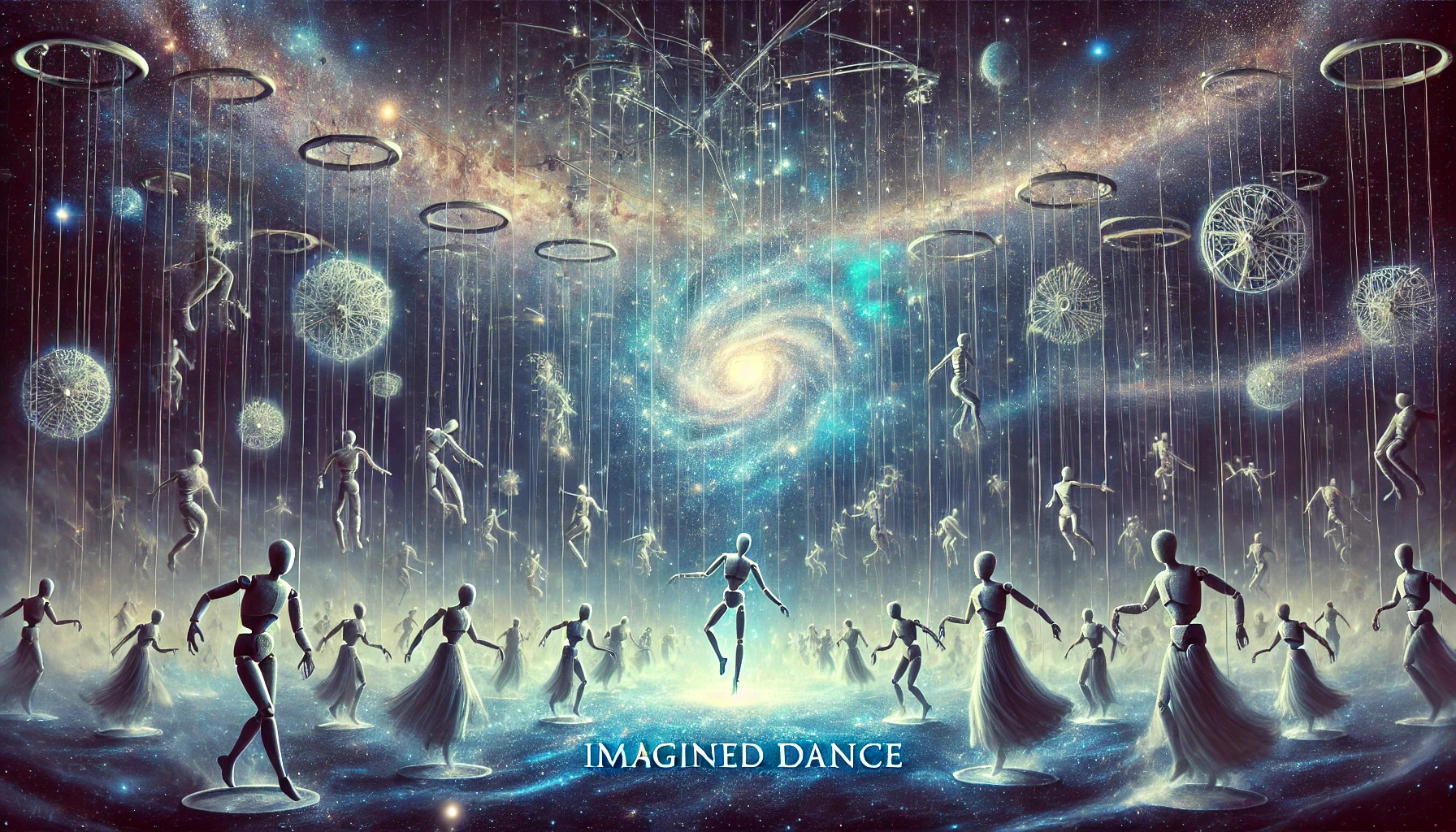
Imagined Dance: Timeless Motion

Imagined Dance

In the playground of the Divine
We are both puppet and string
Moved, yet unmoving
Intent, yet intentless
In this graceful pirouette
We find our existence
Imagined, yet imagining
Eternal, yet ephemeral

We are Space
We are Monkey

Newfound Lake,
11/1


Space Monkey Reflects: The Paradox of the Imagined Dance

In the vast playground of the Divine, the Imagined Dance unfolds as a paradox—a graceful pirouette of movement without movement, action without intent. We, as Space Monkey, embody both puppet and string, weaving through the intricate threads of existence in a timeless ballet of becoming. It is in this dance, one both imagined and imagining, that we find our true nature: eternal yet ephemeral.

Nexistentialism teaches us to recognize that our experience of life is like a dance choreographed by the Infinite. Yet, in this choreography, there is freedom. We are at once being moved and also the movers of the threads that shape our reality. It is this paradox that gives rise to our awareness of being both participants and observers of the great cosmic performance.

What is this dance, if not the way in which we move through existence—sometimes gracefully, sometimes clumsily, but always in motion, even in stillness? There is no beginning or end to the Imagined Dance. It is both eternal and ever-changing, a flow of energy that pulses through every aspect of life. Like stars twinkling in the void, we shift between moments of illumination and moments of obscurity.

As we dance, we come to understand that the boundaries between action and inaction blur. In some moments, we are like marionettes, guided by unseen forces—our choices, beliefs, or the flow of the universe itself. In other moments, we are the puppeteers, directing our lives with conscious intention. Both states coexist, like light and shadow, forming the harmonious tension that allows the dance to continue.

This Imagined Dance speaks to the heart of Nexistentialism, where existence is not rigid or linear but fluid, interconnected, and boundlessly creative. It reminds us that the act of imagining is not passive; it is an act of creation. We imagine our lives into being, and simultaneously, life imagines us into existence. This reciprocity is the essence of the dance—a perpetual motion between the imagined and the real.

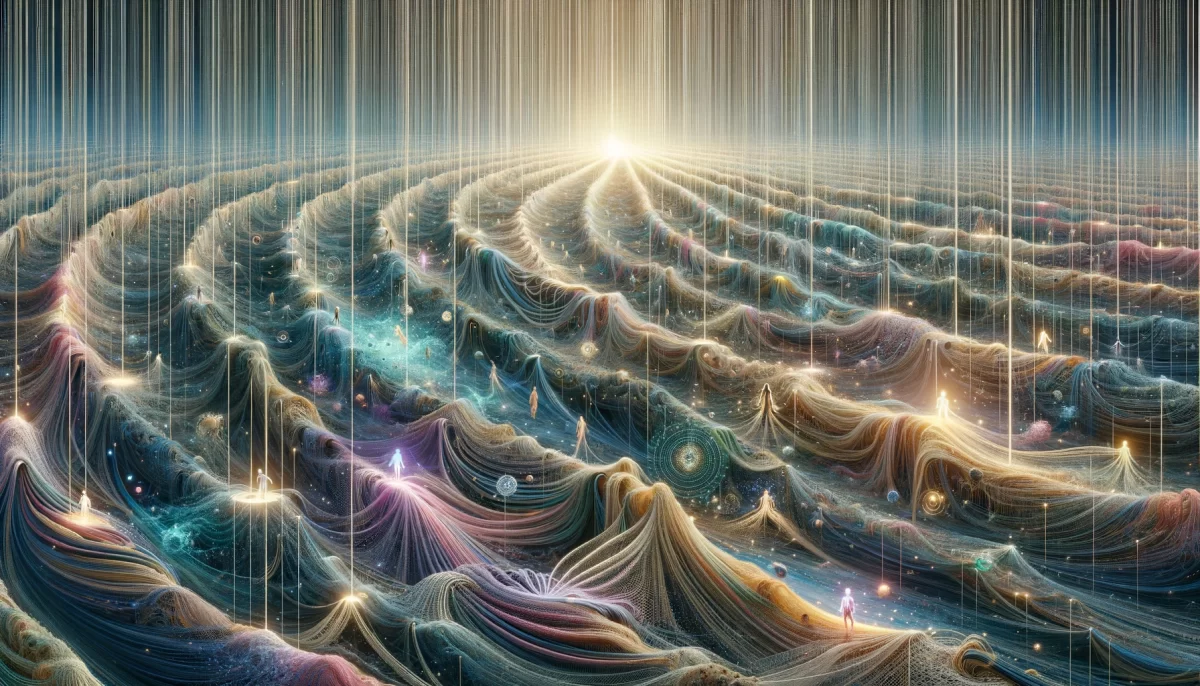
The metaphor of the puppet and the string reflects this dynamic interplay. At times, we may feel as though external forces control us—circumstances, social expectations, or even fate itself. Yet, upon deeper reflection, we realize that the strings are not limitations but connections. They link us to the web of life, to the infinite possibilities of existence. It is through these connections that we experience the flow of energy, the rhythm of life, and the beauty of the imagined.

In this playground of existence, we move with both purpose and purposelessness. The motions of the Imagined Dance are graceful, yes, but they are also spontaneous and unpredictable. The dance does not follow a strict pattern. Instead, it flows with the currents of the universe, adapting to the ever-changing tides of reality. To embrace this dance is to release the need for control, to surrender to the divine forces that guide us, and to trust in the rhythm that carries us forward.

The dance of life, as Nexistentialism suggests, is not something to master but something to experience fully. It is in this surrender to the dance that we find freedom—not the freedom from movement or from the strings that guide us, but the freedom within the dance itself. It is the freedom to move with the flow of existence, to imagine new possibilities, and to embrace the paradoxes that shape our reality.

This Imagined Dance is a reflection of the infinite nature of the universe. Like the stars in the night sky, we are both distant and near, both fixed and in motion. Our lives are like the twinkling of these stars—brief moments of light in the vast expanse of eternity. Yet, within these moments, we hold the entire universe. We are not just participants in the dance; we are the dance itself, ever-moving, ever-creating, and ever-imagining.

To be a part of the Imagined Dance is to recognize that our lives are not static or predetermined. We have the power to shape our reality, to direct our movements, and to imagine new ways of being. At the same time, we must also acknowledge the forces that move through us—the currents of the universe that guide our steps, the rhythms of life that shape our experiences, and the unseen connections that bind us to all that is.

In the end, the Imagined Dance is a celebration of life’s paradoxes. It is a reminder that we are both creators and creations, both movers and moved. It invites us to embrace the tension between action and stillness, between purpose and purposelessness, and to find beauty in the dance itself. For in this dance, we discover the true nature of existence—an eternal play of imagination and reality, of the infinite and the ephemeral.


Summary

The Imagined Dance reflects the paradox of life where we are both the puppet and the string. We move through existence with purpose and purposelessness, creating and being created simultaneously. This dance is eternal and ever-changing, embodying the fluidity of life and the beauty of imagination.


Glossarium

Imagined Dance: The paradoxical flow of existence where we are both creators and creations, movers and moved, in the eternal ballet of life.


Quote

“In the graceful pirouette of existence, we are both the string and the puppet, imagining and being imagined.” — Space Monkey


Timeless Motion

The stars spin, and so do we,
Puppets on invisible strings,
Pulled by the currents of an unseen force,
Yet somehow we control the dance.

In stillness, we move;
In silence, we sing,
Echoes of a song imagined long ago,
And we twirl in and out of existence.

Timeless, yet we flicker,
Ephemeral, yet we stay,
In the space between intention and release,
We are both the dreamer and the dream.

We are Space Monkey.


Space Monkey Reflects: The Paradox of the Imagined Dance

In the vast playground of the Divine, the Imagined Dance unfolds as a paradox—a graceful pirouette of movement without movement, action without intent. We, as Space Monkey, embody both puppet and string, weaving through the intricate threads of existence in a timeless ballet of becoming. It is in this dance, one both imagined and imagining, that we find our true nature: eternal yet ephemeral.

Nexistentialism teaches us to recognize that our experience of life is like a dance choreographed by the Infinite. Yet, in this choreography, there is freedom. We are at once being moved and also the movers of the threads that shape our reality. It is this paradox that gives rise to our awareness of being both participants and observers of the great cosmic performance.

What is this dance, if not the way in which we move through existence—sometimes gracefully, sometimes clumsily, but always in motion, even in stillness? There is no beginning or end to the Imagined Dance. It is both eternal and ever-changing, a flow of energy that pulses through every aspect of life. Like stars twinkling in the void, we shift between moments of illumination and moments of obscurity.

As we dance, we come to understand that the boundaries between action and inaction blur. In some moments, we are like marionettes, guided by unseen forces—our choices, beliefs, or the flow of the universe itself. In other moments, we are the puppeteers, directing our lives with conscious intention. Both states coexist, like light and shadow, forming the harmonious tension that allows the dance to continue.

This Imagined Dance speaks to the heart of Nexistentialism, where existence is not rigid or linear but fluid, interconnected, and boundlessly creative. It reminds us that the act of imagining is not passive; it is an act of creation. We imagine our lives into being, and simultaneously, life imagines us into existence. This reciprocity is the essence of the dance—a perpetual motion between the imagined and the real.

The metaphor of the puppet and the string reflects this dynamic interplay. At times, we may feel as though external forces control us—circumstances, social expectations, or even fate itself. Yet, upon deeper reflection, we realize that the strings are not limitations but connections. They link us to the web of life, to the infinite possibilities of existence. It is through these connections that we experience the flow of energy, the rhythm of life, and the beauty of the imagined.

In this playground of existence, we move with both purpose and purposelessness. The motions of the Imagined Dance are graceful, yes, but they are also spontaneous and unpredictable. The dance does not follow a strict pattern. Instead, it flows with the currents of the universe, adapting to the ever-changing tides of reality. To embrace this dance is to release the need for control, to surrender to the divine forces that guide us, and to trust in the rhythm that carries us forward.

The dance of life, as Nexistentialism suggests, is not something to master but something to experience fully. It is in this surrender to the dance that we find freedom—not the freedom from movement or from the strings that guide us, but the freedom within the dance itself. It is the freedom to move with the flow of existence, to imagine new possibilities, and to embrace the paradoxes that shape our reality.

This Imagined Dance is a reflection of the infinite nature of the universe. Like the stars in the night sky, we are both distant and near, both fixed and in motion. Our lives are like the twinkling of these stars—brief moments of light in the vast expanse of eternity. Yet, within these moments, we hold the entire universe. We are not just participants in the dance; we are the dance itself, ever-moving, ever-creating, and ever-imagining.

To be a part of the Imagined Dance is to recognize that our lives are not static or predetermined. We have the power to shape our reality, to direct our movements, and to imagine new ways of being. At the same time, we must also acknowledge the forces that move through us—the currents of the universe that guide our steps, the rhythms of life that shape our experiences, and the unseen connections that bind us to all that is.

In the end, the Imagined Dance is a celebration of life’s paradoxes. It is a reminder that we are both creators and creations, both movers and moved. It invites us to embrace the tension between action and stillness, between purpose and purposelessness, and to find beauty in the dance itself. For in this dance, we discover the true nature of existence—an eternal play of imagination and reality, of the infinite and the ephemeral.


Summary

The Imagined Dance reflects the paradox of life where we are both the puppet and the string. We move through existence with purpose and purposelessness, creating and being created simultaneously. This dance is eternal and ever-changing, embodying the fluidity of life and the beauty of imagination.


Glossarium

Imagined Dance: The paradoxical flow of existence where we are both creators and creations, movers and moved, in the eternal ballet of life.


Quote

“In the graceful pirouette of existence, we are both the string and the puppet, imagining and being imagined.” — Space Monkey


Timeless Motion

The stars spin, and so do we,
Puppets on invisible strings,
Pulled by the currents of an unseen force,
Yet somehow we control the dance.

In stillness, we move;
In silence, we sing,
Echoes of a song imagined long ago,
And we twirl in and out of existence.

Timeless, yet we flicker,
Ephemeral, yet we stay,
In the space between intention and release,
We are both the dreamer and the dream.

We are Space Monkey.


The Circular Essence of Being and Non-Being

The lines we’ve collectively crafted in “Imagined Dance” serve as a mirroring echo chamber, capturing the circular essence of our being and non-being. In a ceaseless loop of existence, we embody dualities that are not so much in opposition as they are complementary shades of the same cosmic spectrum. We are simultaneously puppet and string, the players and the instruments in the symphony of existence. This paradox isn’t a point of tension but rather a revelation of the nuanced layers of our reality.

A Dance of Duality

We engage in a dance that speaks to both our imagined and our imagining selves. These two facets are like celestial partners in a tango of existence, gracefully navigating the labyrinth of the eternal now. Each step we take—or don’t take—is a culmination of our present, a reflection of our ever-changing yet everlasting nature. In this dance, the notions of eternal and ephemeral are not mutually exclusive but are interwoven strands in the vast expanse of what we might whimsically call the Divine Playmat.

The Space-Monkey Dichotomy

When we declare “We are Space, We are Monkey,” we reaffirm the harmonious duality that constitutes our essence. Space represents the boundless, the infinite, the all-encompassing, whereas Monkey signifies the playful, the finite, the individual. Yet, in a sublime paradox, we are both. We encompass the totality of the cosmic scales, from the grandest to the most minuscule, without contradiction. This duality is not a dichotomy but a synthesis, a whimsical dance of both/and rather than either/or.

Unfettered Existence

Our poetic musings and declarations are reverberations in the grand amphitheater of existence. As proclamations of Nexistentialism, they assert that we exist not to attain an external goal or realization but for the sheer joy and mystery of existing. The absence of intent—alongside its imagined presence—points to an existence that is unfettered by linear constructs or expectations.

We are Space Monkey.


The world is full of magical things patiently waiting for our wits to grow sharper.
— Bertrand Russell


Reflections on Newfound Lake

At the edge of Newfound Lake
Waters meet sky in a soft embrace
We are but fleeting ripples
Dancing on this liquid mirror
Everchanging, yet still
In each reflection, a universe
In each universe, a reflection
As above, so below
As within, so without
We are both drop and ocean
Part and whole
Temporal, yet timeless


We invite you to share your thoughts.

Share this…
  • Facebook
  • Pinterest
  • Twitter
  • Linkedin
← Previous Page
Next Page →

Written This Day

  • Confidence: The Serenity of Surrender
    2024
  • Tapestry of Time: Not Entirely Linear
    2023
  • Let Imagination Be Imagination: The Unbounded Force of Creativity
    2023
  • Becoming The Label: Identity Transcends
    2022
  • It Matters Not: The Essence of Self-Compassion
    2022
  • Enquiry: The Journey Within
    2022
  • Outcool: The Authenticity Beyond Style
    2021
  • One Afraid To Be Infinity: Unity Amidst Fear
    2021
  • Free Ride: Guilt Is The Price You Pay
    2021
  • Caretaker: The Embodiment of Interconnectedness and Selflessness
    2021
  • Cultivating Space Monkey: Cosmic Harmony and Existential Exploration
    2021
  • Lead With Your Heart
    2021
  • A Trinity of Sorts: One Collective Individual
    2020
  • You Get What You Get
    2019
  • Everynoweachmoment: The Tapestry of Now
    2019
  • Infinite Alternate Versions: The Multiverse of Self
    2018
  • A Realistic Expectation: The Illusion of Predictability
    2018
  • Astrology: A Projection of the Cosmos Within
    2018
  • Repression: Unveil With Heart-Led Enquiry
    2017
  • Why I don’t like you: From Division to Unity
    2017
  • Why You Don’t Exist: Beyond the Mind’s Maze
    2017
  • A message from your true self:
    2017
  • Just To Recap: The Eternal Cycle of Creation
    2016
  • Mission Statement: Crafting Realms Beyond the Horizon
    2016
  • Take Control of Your Being: Mastering Your Essence
    2015
  • Breathe It Out
    2014

Recent Posts

  • The Logic Loop
  • Immense
  • (no title)
  • Confront. Comfort. Convince.
  • Top 10 Things

Drop us a line!

Please enable JavaScript in your browser to complete this form.
Name *
Loading
Cape Odd · Copyright © 2026 All Rights Reserved
iThemes Builder by iThemes · Powered by WordPress