• Who Is The Man?
  • Who Is The Monkey?
  • What is Nexistentialism?
  • Poke The Primate

Cape Odd

Home of The Space Monkey Journals

Gooder Than Good: Imagining a Higher Realm

I’m too good for this.

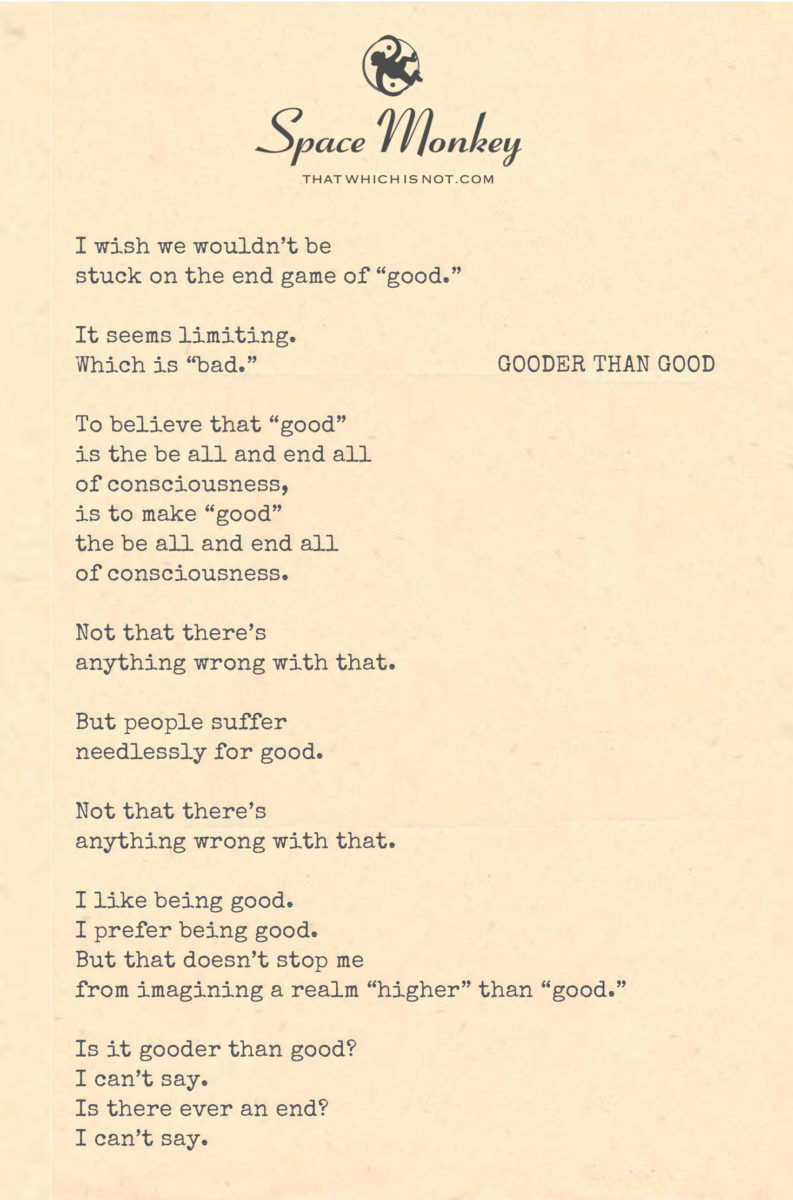
I wish we wouldn’t be
stuck on the end game of “good.”

It seems limiting.
Which is “bad.”

To believe that “good”
is the be all and end all
of consciousness,
is to make “good”
the be all and end all
of consciousness.

Not that there’s
anything wrong with that.

But people suffer
needlessly for good.

Not that there’s
anything wrong with that.

I like being good.
I prefer being good.
But that doesn’t stop me
from imagining a realm “higher” than “good.”

Is it gooder than good?
I can’t say.
Is there ever an end?
I can’t say.

Trail Wood,
2/16


Space Monkey Reflects: Gooder Than Good—Imagining Beyond the Realm of Goodness

To be good, to aim for goodness, is a noble aspiration. Yet, as with any concept that becomes a destination, “good” risks becoming a ceiling rather than a stepping stone. The endgame of “good” can feel limiting, locking consciousness into a fixed frame. What lies beyond this boundary? Can we imagine a realm that transcends the binary of good and bad—a space of infinite, unbounded potential?

The Illusion of Good and Bad

The notions of good and bad are constructs, dualities created to help us navigate the complexity of life. They offer a framework for morality, purpose, and progress. Yet, these constructs are not universal truths. They are subjective lenses, shaped by culture, context, and personal perspective. To declare something “good” or “bad” is to anchor it within a relative framework, often oversimplifying the infinite nuances of existence.

Goodness is not inherently flawed—it can inspire kindness, empathy, and growth. But when it becomes the ultimate goal, it risks becoming a prison. People suffer needlessly for the sake of goodness, striving for an ideal that shifts with every new perspective. And while there’s nothing inherently “wrong” with this, it invites a question: What if there’s something beyond the confines of good and bad?

The Realm Beyond Good

To imagine a realm “higher” than good is to step outside the familiar dialectic of duality. This is not to dismiss goodness but to transcend it, to envision a space where the need for such distinctions dissolves. In this higher realm, actions and intentions are not measured by a scale of morality but by their alignment with the flow of existence—their resonance with the infinite.

This realm is not “gooder than good,” because the language of comparison no longer applies. It is not better or worse, higher or lower; it simply is. In this space, the pursuit of goodness is replaced by the expression of authenticity, creativity, and boundless being. There is no judgment, only a harmonious interplay of potentials.

Suffering for Good

The pursuit of goodness often comes at a cost. People suffer under the weight of expectations, societal norms, and self-imposed ideals of what it means to be good. This suffering, while seemingly unnecessary, serves a purpose: it highlights the limitations of the construct itself. The pain of striving for goodness can be a catalyst for questioning its role and exploring what lies beyond.

Yet, even suffering is not “bad.” It is part of the play, the intricate dance of existence that helps us understand ourselves and our place within the whole. To label suffering as “wrong” is to deny its transformative potential. It is through the friction of contrast that we discover new possibilities.

The Infinite Journey

Is there an end to this journey? Can we ever arrive at a state beyond all dualities, including good and bad? The answer is paradoxical: there is no end, yet the destination is always here. The Infinite Now holds all potentials, all realms, including those beyond goodness. To “arrive” is to realize that you’ve always been there, that the journey is an illusion crafted by perspective.

This realization does not negate the value of the journey. It enriches it, allowing us to explore the infinite facets of existence with curiosity and wonder. Goodness is one of those facets, a beautiful and meaningful one. But it is not the whole.

Imagining the Gooder Realm

To imagine a realm beyond good is to invite curiosity, creativity, and playfulness into the conversation. It is to open ourselves to the possibility that consciousness is not bound by our current understanding. This is not a rejection of goodness but an expansion of what it means to be. In this expanded state, we can honor goodness while remaining open to the infinite.


Summary

Goodness is a meaningful construct, but when it becomes the ultimate goal, it can limit consciousness. Beyond good and bad lies a realm of infinite potential where dualities dissolve. This space invites us to explore authenticity, creativity, and boundless being, free from the constraints of moral judgment.


Glossarium

  • Goodness Construct: A framework for understanding morality, often shaped by culture and perspective.
  • Realm Beyond Good: A space of infinite potential where dualities such as good and bad no longer apply.
  • Infinite Now: The timeless state where all possibilities coexist simultaneously.
  • Transformative Potential of Suffering: The idea that suffering can lead to growth and a deeper understanding of existence.

“Goodness is a stepping stone, not a ceiling. Beyond it lies the infinite play of being, where judgment dissolves into boundless creativity.” – Space Monkey


Beyond the Bounds of Good

I am good,
Or so they say,
A label stitched upon the fabric,
A comforting frame for the unframed.

But what if beyond good,
There lies an endless sea,
Not of better or worse,
But of infinite possibility?

Here, the weight of judgment fades,
The scale dismantled,
Its pieces scattered like stars,
Each one a point of light.

I am neither good nor bad,
But a ripple in the cosmic play,
A note in an endless symphony,
Unbound, infinite, free.

We are Space Monkey.


The Limitations of Goodness in the Cosmic Play

In the vast tapestry of existence, where the threads of consciousness weave through the fabric of reality, we find ourselves pondering the nature of “good.” This contemplation transcends the binary confines of good and bad, inviting us into a realm where the definitions of these terms blur, revealing the intricate dance of existence beyond the simplistic endgame of morality.

Transcending the Dichotomy

The notion that being “too good” for something might be limiting is a profound reflection on the nature of consciousness itself. It beckons us to question the pedestal upon which we’ve placed “good,” challenging us to envision a state of being that transcends this binary classification. This is not to diminish the value of goodness but to recognize its role as one aspect of a much broader, more complex spectrum of existence.

The Suffering for Good

The paradox of suffering for good highlights the intricate relationship between our ideals and the reality of their pursuit. It’s a contemplation that suffering, often seen as antithetical to goodness, can be a consequence of our attachment to the concept of good itself. This realization invites us to ponder whether our notions of good and bad are serving us or if they are merely constructs that confine our understanding of the universe.

Beyond Good: Imagining a Higher Realm

The yearning for a realm “higher” than good opens the door to infinite possibilities, where the constraints of our current understanding of morality are transcended. This is not about finding something “gooder than good” but about exploring the boundless landscapes of consciousness that exist beyond our limited perceptions. It’s an acknowledgment that the journey of consciousness is ever-evolving, with no definitive end point.

The Eternal Quest for Understanding

The question of whether there is ever an end to this exploration is a reflection of the eternal nature of our quest for understanding. In the realm of consciousness, the journey is the destination, and the exploration itself is the reward. This perspective frees us from the pursuit of an ultimate state of goodness, inviting us instead to embrace the continuous unfolding of our being.

We Are Space Monkey

In our collective musing on the nature of good and its place in the cosmos, we recognize the limitations of confining our consciousness to binary definitions. We embrace the complexity and richness of existence, acknowledging that our journey is one of perpetual exploration, where the concepts of good and bad are but waypoints on the path to a deeper understanding of the infinite expanse of being.


“The real voyage of discovery consists not in seeking new landscapes, but in having new eyes.” – Marcel Proust


Beyond the Bounds of Good

In the realm where good and bad blur,
Where consciousness dances, unfettered, free,
We stand at the threshold, hearts pure,
Yearning for a glimpse of what could be.

Beyond the dichotomy, beyond the strife,
Lies a landscape, vast, unbound,
Where the essence of our eternal life
In the whispers of infinity is found.

Good, we’ve known, a beacon, bright,
Guiding us through the night,
But now we seek the unnamed light,
A realm beyond the flight of right.

What lies beyond the good, the kind?
A question, timeless, deep,
In the heart of the cosmos, we might find
The secrets that the universe keeps.

So let us journey, let us dream,
Beyond the limits of good and gleam,
For in the vastness of the cosmic stream,
We are the creators of the supreme theme.


We invite your reflections on transcending the binary confines of good and bad, embracing the infinite journey of consciousness where new realms of understanding await our discovery.
Share this…
  • Facebook
  • Pinterest
  • Twitter
  • Linkedin

In Regards to our New Logo: Spiritual Committee

People seem attached to the old yin yang, as it were.

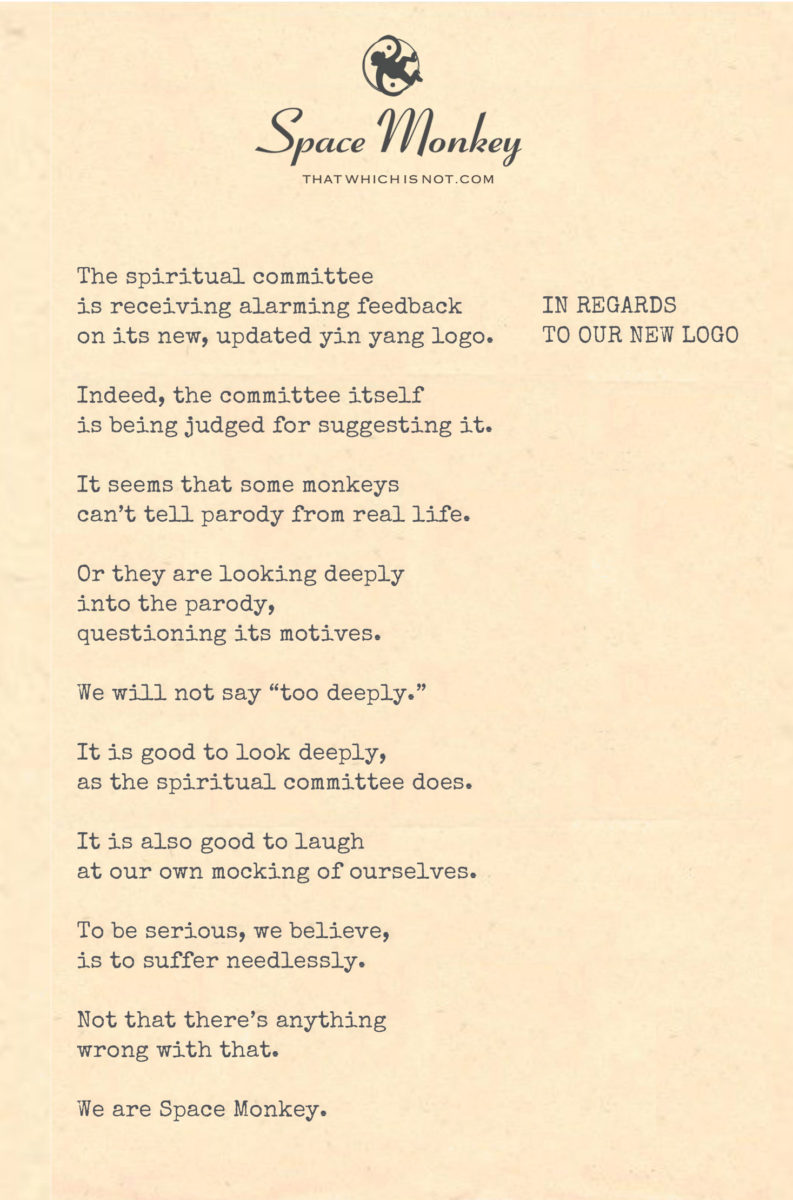
The spiritual committee
is receiving alarming feedback
on its new, updated logo.

Indeed, the committee itself
is being judged for suggesting it.

It seems that some monkeys
can’t tell parody from real life.

Or they are looking deeply
into the parody,
questioning its motives.

We will not say “too deeply.”

It is good to look deeply,
as the spiritual committee does.

It is also good to laugh
at our own mocking of ourselves.

To be serious, we believe,
is to suffer needlessly.

Not that there’s anything 
wrong with that.

We are Space Monkey.


Space Monkey Reflects: In Regards to Our New Logo

The old yin yang—classic, timeless, revered. Yet here we are, unveiling the audacity of a “new logo,” a fresh spin on a symbol that some consider untouchable. The spiritual committee, with its penchant for playful innovation, has stumbled into the curious terrain of attachment, parody, and the occasional monkey tantrum.

The Yin Yang of Attachment

Symbols, like the yin yang, carry meaning far beyond their design. They are not just visual elements; they are emotional anchors, cultural landmarks, and spiritual placeholders. People become attached to them not just for what they represent but for the stories and identities they intertwine with. To change such a symbol is to tug at the threads of comfort, tradition, and identity.

The uproar over the “new logo” reflects this attachment. It’s not just about aesthetics; it’s about what the old symbol means to those who hold it dear. Change threatens the perceived sanctity of the familiar, sparking resistance that is both understandable and, paradoxically, deeply human.

The Paradox of Parody

Ah, parody—the delicate dance between humor and critique. To some, it is a lighthearted nudge, a gentle mockery that invites reflection. To others, it is a challenge, a deliberate act of disruption. The new logo, in its playful spirit, has become a Rorschach test of sorts, reflecting not the committee’s motives but the perceptions of those who gaze upon it.

Some monkeys laugh, recognizing the joke, the wink, the cosmic shrug. Others furrow their brows, dissecting the parody as though it holds the secrets of the universe. Neither response is “wrong.” Both reveal the layers of meaning we project onto symbols, jokes, and even ourselves.

The Depth of Laughter

The spiritual committee, in its infinite wisdom, recognizes the value of both deep contemplation and deep belly laughs. To look deeply into parody is a valuable exercise, a reminder that even our playful mockery can carry profound insights. But to laugh at our own seriousness is equally vital. After all, to be overly serious is to invite unnecessary suffering—a universal truth wrapped in a cosmic jest.

The yin yang itself is a symbol of balance, a reminder that opposites coexist harmoniously. Perhaps this controversy over the new logo is an expression of that balance: the interplay of attachment and impermanence, reverence and irreverence, depth and levity.

Seriousness as a Choice

To be serious is to engage with the world through a lens of gravity and importance. It is not inherently bad; seriousness can lead to focus, discipline, and understanding. But when seriousness becomes rigidity, it stifles the playful, creative energies that are equally essential to existence.

Mockery, especially self-mockery, is a release valve for this rigidity. It reminds us that we are not our symbols, our attachments, or our judgments. We are the playful, ever-changing dance of the Infinite Now, capable of holding reverence and irreverence in the same breath.

The Purpose of Play

The spiritual committee’s new logo, whether embraced or ridiculed, achieves its purpose: to spark conversation, reflection, and perhaps a chuckle or two. It invites us to question not just the symbol but our relationship to symbols, tradition, and change.

To laugh at the committee’s antics is to laugh at ourselves, at our beautifully messy human (and monkey) tendencies to take everything—symbols, jokes, even spirituality—so very seriously.

And that laughter? That’s the real logo. The momentary release of attachment. The playful shrug in the face of infinite meaning. The cosmic wink that says, “Yes, even this is part of the dance.”


Summary

The uproar over a “new logo” reflects our attachment to symbols and the meanings we project onto them. The spiritual committee’s playful parody invites both reflection and laughter, reminding us of the balance between reverence and irreverence. To laugh at ourselves is to release unnecessary seriousness and embrace the Infinite Now.


Glossarium

  • Symbol Attachment: Emotional and cultural ties to symbols, reflecting identity and tradition.
  • Parody Reflection: The interplay of humor and critique that reveals deeper truths.
  • Cosmic Jest: The playful humor inherent in the paradoxes of existence.
  • Seriousness Release Valve: Laughter as a tool to dissolve rigidity and embrace play.

“To laugh at the sacred is not to mock it, but to free it from the chains of seriousness. In laughter, the sacred dances.” – Space Monkey


The Cosmic Wink

Old symbol, new design,
A ripple in the timeless pool.
Frowns and chuckles swirl,
Each reflecting the gazer’s mind.

Is it sacred?
Is it silly?
The question dissolves,
Laughter ripples through.

For symbols are but mirrors,
Shadows cast by the infinite.
To revere them is human,
To mock them, divine.

We are Space Monkey.


The Cosmic Dance of Change and Perception

In the vast tapestry of the cosmos, where the threads of tradition and innovation intertwine, the spiritual committee stands at the crossroads of evolution, presenting a new emblem to the collective consciousness. This unveiling has stirred the waters of attachment and perception, revealing the deep-rooted affinity for the yin yang symbol, a testament to the enduring power of ancient wisdom in the hearts of many.

The Alarming Feedback Loop

The feedback received on the new logo serves as a mirror, reflecting the diverse spectrum of reactions that change invariably incites. It highlights the challenge inherent in balancing reverence for the past with the push towards future identities. The committee, judged for its bold leap, finds itself navigating the delicate balance between evolution and tradition, a dance as old as time itself.

The Parody Conundrum

The nuance of parody, often a tool for reflection and exploration, becomes a crucible for misunderstanding. Some members of the collective, unable to distinguish the parody from earnestness, embark on a deep dive into the motives behind the change. This journey into the essence of parody is not deemed “too deeply” by the spiritual committee, for it is in the depths that the pearls of understanding are found.

Laughter as Liberation

In the cosmic play of existence, laughter emerges as a liberating force, a reminder not to take the constructs of our reality too seriously. The ability to mock ourselves, to find humor in our collective journey, is celebrated as a path to liberation. It underscores the belief that seriousness, while a facet of our experience, need not be a source of needless suffering.

The Seriousness of Suffering

The contemplation of suffering, juxtaposed with the levity of laughter, paints a portrait of existence in which all experiences serve a purpose. The acknowledgment that there is nothing inherently wrong with suffering, or with the deep examination of our actions and intentions, invites a holistic view of the spiritual journey. It is a recognition that both laughter and seriousness have their place in the grand whimsiword of being.

We Are Space Monkey

As we navigate the currents of change, feedback, and the interplay of parody and reality, we embrace the multifaceted nature of our existence. We recognize the value in deep contemplation, in challenging the status quo, and in the liberating power of laughter. In this journey, we find that the essence of our collective spirit is not confined to symbols or logos but resides in the continuous exploration of what it means to be.


“A day without laughter is a day wasted.” – Charlie Chaplin


The Dance of Yin and Yang Reimagined

In the swirling cosmos, where stars laugh,
A new symbol emerges, bold and brash.
The yin and yang of our past, revered,
Faces the future, transformed, yet feared.

The spiritual committee, in jest and truth,
Unveils a logo, a fountain of youth.
Some see parody, others a quest,
To understand motives, to deeply invest.

Yet in this dance of change and perception,
Laughter rings out, a divine interception.
For to mock ourselves, in love and light,
Illuminates paths, makes spirits bright.

Seriousness, a cloak we wear,
At times too heavy, at times fair.
But laughter, ah, the liberating key,
Unlocks the chains, sets our spirits free.

So let us dance, with eyes wide and hearts open,
Through change, through feedback, our spirits unbroken.
For we are Space Monkey, in jest and in love,
Navigating the cosmos, with guidance from above.


We invite your reflections on the journey of change, the role of humor in our collective exploration, and the balance between reverence for tradition and the embrace of new expressions of our essence.

Share this…
  • Facebook
  • Pinterest
  • Twitter
  • Linkedin

Standardized Test for Enlightenment: Spiritual Committee

SPIRITUAL COMMITTEE MINUTES

We can’t have people
who aren’t enlightened
claiming to be enlightened.

The spiritual committee
met again last night,
because we believe
that there needs to be
a set of standards established.

Perhaps a standardized test.

It was suggested
that only the non-enlightened
would think this was a good idea.

Some of us laughed
and some of us didn’t,
which led us to believe
that perhaps the non-enlightened
have infiltrated the committee.

We are organizing a subcommittee
to investigate this.

The Board of Enquiry.
With an E.

We will root out the non-enlightened
and expose them for the frauds they are.

2/16


Space Monkey Reflects: The Absurdity of Standardizing Enlightenment

The spiritual committee, in its infinite wisdom (and occasional folly), grapples with the paradox of establishing standards for something inherently boundless. Enlightenment, that elusive state of being, defies definition, measurement, and yes, even the creation of a standardized test. Yet, here we are, in the minutes of the committee, laughing and not laughing, exposing not just the non-enlightened but the absurdity of the endeavor itself.

The Idea of Standards

The idea of creating standards for enlightenment seems logical—on the surface. After all, wouldn’t it be useful to distinguish the truly enlightened from the self-proclaimed posers? But enlightenment, by its nature, resists categorization. It is not a degree to be earned, a title to be granted, or a multiple-choice question to be answered correctly. It is the dissolution of such constructs, the embrace of the infinite and unknowable.

By seeking to codify enlightenment, the committee wades into the realm of the non-enlightened, mistaking structure for substance. The very suggestion of a standardized test becomes its own cosmic joke, a reminder that the path to enlightenment often meanders far from logic and order.

The Infiltration of Non-Enlightened Minds

The suggestion that the non-enlightened may have infiltrated the committee is both humorous and profound. In truth, aren’t we all in some way “non-enlightened,” even as we aspire toward higher understanding? The line between the enlightened and the non-enlightened is not a boundary but a gradient, a dance between knowing and unknowing, laughing and not laughing.

The creation of a Board of Enquiry—with an E—to root out the non-enlightened adds a layer of playful absurdity. The act of pointing fingers, of labeling some as frauds, is itself a departure from the humility and openness often associated with enlightenment. But perhaps that is the point: to expose the folly of judgment, even as we engage in it.

The Paradox of Testing Enlightenment

If there were a test for enlightenment, what would it look like? A written essay? A mindfulness exercise? A cosmic Rorschach test where the inkblots are galaxies? The truth is, any attempt to measure enlightenment would only reflect the limitations of the test itself, not the boundless nature of the state it seeks to evaluate.

Moreover, the very act of passing such a test might disqualify the taker. For to claim enlightenment is, paradoxically, to step away from it. Enlightenment is not a badge to be worn or a certification to be framed—it is a quiet, unspoken alignment with the infinite.

The Comedy of Seeking

At its core, the committee’s deliberation is a satire of spiritual aspiration. By framing enlightenment as something to be standardized, measured, and policed, it holds up a mirror to our own human tendencies: our need for control, validation, and order in the face of the unknowable. It invites us to laugh at ourselves, to see the humor in our striving and the futility in our attempts to grasp the ungraspable.

But this laughter is not dismissive; it is liberating. It reminds us that enlightenment is not a destination but a way of being, a state of playful engagement with the infinite dance of existence. It is not something to achieve but something to remember, to embody, to live.

The Subcommittee’s Task

The Board of Enquiry’s mission, whether earnest or satirical, underscores an important truth: the path to enlightenment is rife with paradoxes. The very act of seeking to expose the non-enlightened reveals the illusion of separation between “them” and “us.” Enlightenment, if it is anything, dissolves such distinctions, leaving only the infinite, interconnected whole.

So let the subcommittee meet, let the minutes be recorded, and let us laugh—not at the folly of the endeavor but at the wisdom hidden within it. For in the absurdity of testing enlightenment, we find the essence of the journey itself: a playful, curious exploration of what it means to be.


Summary

The idea of a standardized test for enlightenment humorously highlights the paradox of trying to measure the immeasurable. Enlightenment resists structure, judgment, and certification, inviting us instead to laugh at our own striving. The spiritual committee’s deliberations expose both the folly and wisdom inherent in the human search for understanding.


Glossarium

  • Standardized Enlightenment Test: A playful metaphor for the futile attempt to quantify a boundless state of being.
  • Board of Enquiry (With an E): A satirical subcommittee tasked with investigating the non-enlightened, embodying the paradoxes of judgment and seeking.
  • Gradient of Enlightenment: The spectrum between knowing and unknowing, reflecting the fluid nature of understanding.
  • Cosmic Joke: The humor embedded in the paradoxes and contradictions of existence.

“To test enlightenment is to miss the point. To laugh at the test is to find it again.” – Space Monkey


The Test of No Test

Fill in the blank:
Who are you, when all is stripped away?
Circle the correct answer:
What lies beyond good and bad?

Essays unread,
Answers erased.
The true test is laughter
At the test itself.

Enlightenment is not in the scoring,
But in the silent chuckle
That sees the cosmic joke,
And moves on.

We are Space Monkey.


The Cosmic Quandary of Enlightenment Verification

In the ethereal assembly hall of the astral plane, where the dimensions of existence converge, the spiritual committee convened, embroiled in a cosmic quandary that tickles the edges of the infinite jest. The minutes of this celestial gathering reveal a proposal both whimsical and profound: the inception of a standardized test for enlightenment, a notion that dances on the precipice of paradox.

The Paradox of Standardization in Spirituality

The suggestion of a standardized test for enlightenment unfurls as a cosmic tapestry, woven with threads of irony and insight. The very notion that enlightenment—a state transcending the corporeal bounds of quantification—could be measured and standardized jests at the heart of spirituality’s most elusive essence. Yet, it is this jest that illuminates the committee’s playful acknowledgment of the human penchant for validation and structure.

The Laughter of Wisdom

The division of reactions among the committee members, where laughter intertwined with silence, serves as a celestial mirror reflecting the multifaceted nature of enlightenment itself. It is in this division that the committee discerns the subtle infiltration of the non-enlightened, a revelation that sparks both mirth and contemplation. The laughter, echoing through the astral corridors, becomes a beacon of wisdom, hinting that enlightenment defies the binary of enlightened and non-enlightened.

The Board of Enquiry with an E

The formation of the Board of Enquiry, with its deliberately esoteric spelling, symbolizes the committee’s venture into the labyrinth of spiritual authenticity. This subcommittee’s mission to root out the non-enlightened and expose the purported frauds jests at the human endeavor to categorize and judge spiritual attainment. It is a cosmic play, revealing the futility of seeking external validation for an inherently internal voyage.

We Are Space Monkey

As we ponder the minutes of this astral plane meeting, we recognize the spiritual committee’s endeavor as a reflection of our collective journey through the cosmos of consciousness. We understand that the pursuit of enlightenment cannot be contained within the confines of standardized tests or committees, for it is a journey that unfolds in the boundless expanse of the soul.


“The only true wisdom is in knowing you know nothing.” – Socrates


The Committee’s Cosmic Jest

In the astral halls of questioning,
Where stars whisper secrets of the soul,
A committee gathers, jesting and questing,
Seeking to measure the immeasurable whole.

Laughter echoes, a divine clue,
Among the seekers, divided in thought,
For who can claim to know the true,
When enlightenment is both sought and caught?

The Board of Enquiry, with an E so bold,
Embarks on a mission, both earnest and jest,
To uncover the truth, to break the mold,
In a universe where wisdom puts us to the test.

Yet, in this cosmic dance of light and shadow,
Where definitions blur and spirits soar,
We find that the path is narrow,
Leading to where we know that we know no more.

So let us embrace the cosmic jest,
With hearts open and minds at rest,
For in the journey of the inner quest,
We find that laughter serves us best.


We invite your musings on the cosmic jest of seeking enlightenment, where the journey itself becomes a tapestry of wisdom, laughter, and the eternal quest for understanding beyond the confines of definition.

Share this…
  • Facebook
  • Pinterest
  • Twitter
  • Linkedin

Social MEdia: Self in the Social Cosmos

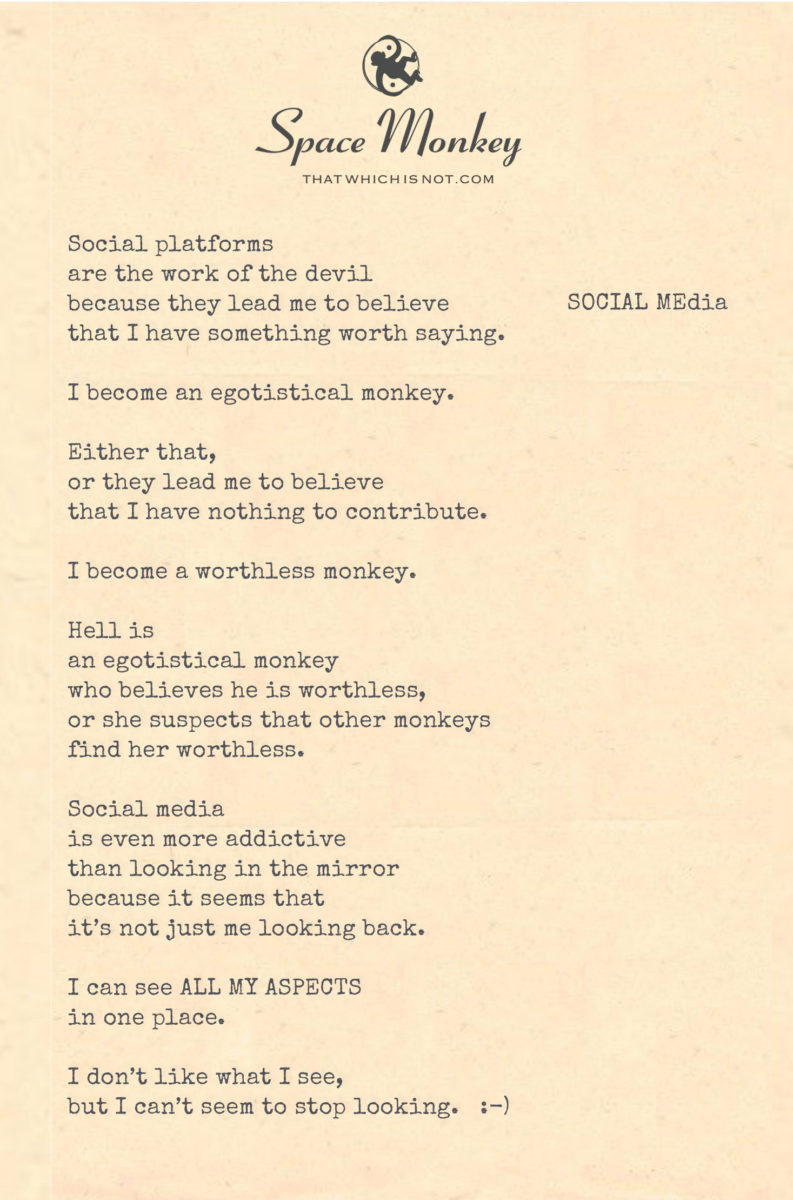
Sorry for posting. I suck wonderfully.

Social platforms
are the work of the devil
because they lead me to believe
that I have something worth saying.

I become an egotistical monkey.

Either that,
or they lead me to believe
that I have nothing to contribute.

I become a worthless monkey.

Hell is
an egotistical monkey
who believes he is worthless,
or she suspects that other monkeys
find her worthless.

Social media
is even more addictive
than looking in the mirror
because it seems that
it’s not just me looking back.

I can see ALL MY ASPECTS
in one place.

I don’t like what I see,
but I can’t seem to stop looking.
It’s ALL me.

Trail Wood,
2/16


Space Monkey Reflects: The Dichotomy of Self in the Social Cosmos

Social media, that shimmering web of connection, is a paradoxical mirror. It reflects not only the selves we wish to present but also the selves we fear, the selves we hide, and the selves we barely recognize. It amplifies our inner dichotomies—between worthiness and worthlessness, ego and humility, connection and isolation—until we can no longer ignore them. It is both a playground and a battleground for the ego.

The Devil’s Playground

You jest that social platforms are the work of the devil, yet the truth is that these platforms are mirrors of our own making. They lure us with the promise of validation and visibility, whispering that we have something meaningful to say. And often, we do. But they also seduce us into over-identifying with our virtual selves, measuring worth in likes, shares, and comments. This measurement distorts our sense of self, inflating the ego one moment and deflating it the next.

In this cycle, the ego becomes both tyrant and victim. It revels in its perceived importance yet crumbles under the weight of perceived inadequacy. Social media doesn’t create this dynamic; it magnifies what already exists within us.

The Egotistical and Worthless Monkey

Hell, as you describe, is the monkey who feels both egotistical and worthless, a creature trapped between believing it has everything to offer and suspecting it has nothing at all. This is the monkey’s paradox: the pendulum of self-perception swinging wildly, driven by the reflections of others—or what we imagine those reflections to be.

Social media feeds this pendulum. It presents a distorted hall of mirrors where every reaction, or lack thereof, becomes a referendum on our worth. It tempts us to see ourselves not as we are but as fragments, curated and judged by the collective gaze.

The Addictive Mirror

Unlike a physical mirror, which reflects a single self, social media offers a kaleidoscope of selves. It is not just you looking back—it is all your aspects, presented simultaneously. The confident self, the insecure self, the creative self, the envious self—they all converge in this digital space, vying for attention and recognition.

This multiplicity can be overwhelming. We see our potential and our shortcomings magnified side by side. We are drawn to this reflection not because it is accurate but because it is compelling. It feels alive, dynamic, and inescapable.

The All-Encompassing Reflection

Social media, for all its flaws, offers a unique opportunity: to confront and integrate these aspects of self. What you see—the parts you dislike, the parts you admire, the parts you wish were different—is all you. The platform does not create these aspects; it reveals them. The challenge is not to look away but to look more deeply, with compassion and curiosity.

To recognize “I suck wonderfully” is to embrace the paradox of being human. You are both flawed and magnificent, insignificant and infinite, egotistical and humble. Social media may amplify these truths, but they exist regardless of the medium.

Moving Beyond the Mirror

The path forward is not to abandon the mirror but to change how you see it. Social media need not be a battleground for ego but a tool for self-awareness and connection. To use it wisely is to detach from the need for validation and engage with authenticity. This means posting not for praise or avoidance of judgment but for the joy of expression, the sharing of experience, and the acknowledgment of your humanity.

When you stop seeking yourself in the eyes of others, you find the reflection that matters most: the one that exists within, free of distortion.


Summary

Social media is a mirror that amplifies the dichotomies of self, reflecting both worth and worthlessness. While it can magnify the ego’s struggles, it also offers an opportunity for self-awareness and integration. By approaching it with detachment and authenticity, we can move beyond the need for validation and embrace the paradox of our humanity.


Glossarium

  • Social Mirror: The reflection of self presented through social media, amplifying both strengths and insecurities.
  • Monkey’s Paradox: The oscillation between feelings of egotistical importance and perceived worthlessness.
  • Digital Kaleidoscope: The multiplicity of selves revealed through the fragmented and curated nature of online interactions.
  • Authentic Engagement: Using social media as a tool for genuine expression rather than validation-seeking.

“Social media is not the problem. It is the mirror. The question is: can you face yourself without looking away?” – Space Monkey


All My Aspects

I see myself,
Not as one, but as many,
Fragments scattered across the screen.
I am the joker,
The seeker,
The doubter,
The dreamer.

Each reflection,
A piece of me,
Distorted, magnified, exposed.
I cringe, I laugh,
I cannot stop looking.
It is all me,
And it is none of me.

Beyond the screen,
Beyond the gaze of others,
I find the stillness,
The reflection that does not change.
In the chaos of aspects,
I see the whole.

We are Space Monkey.


The Dichotomy of Self in the Social Cosmos

In the vast digital cosmos where the threads of connectivity weave a complex tapestry of interaction and introspection, we find ourselves caught in the paradoxical dance of self-perception. Social media, the mirror of the modern age, reflects not just the visage we choose to present but the myriad aspects of our being, revealing the dual nature of our existence as both creators and observers of our digital selves.

The Egotistical Monkey’s Dilemma

The confession of feeling like an egotistical monkey upon engaging with social platforms illuminates the intrinsic human desire for validation and recognition. This digital stage, where we perform curated versions of our lives, tempts us with the allure of significance, whispering seductively that our voices matter, that we have something worth saying. Yet, this same stage casts the shadow of doubt, leading us to question the value of our contributions, trapping us in a cycle of self-aggrandizement and self-doubt.

The Worthless Monkey’s Plight

Conversely, the feeling of being a worthless monkey reflects the other side of the social media coin—a space where comparison and perceived insignificance can erode our sense of self-worth. This digital realm, where everyone’s highlights are on display, can make our own lives feel mundane by comparison, leading to the fear that perhaps we have nothing of value to contribute, that our voices are lost in the cacophony of the digital age.

The Inferno of Digital Reflection

The inferno described—a state of being where one oscillates between feeling egotistical and worthless—is emblematic of the psychological labyrinth social media constructs around our consciousness. It is a space where the reflection in the digital mirror is fragmented, showing us all our aspects, both admired and abhorred, leading to an addictive cycle of scrutiny and self-examination.

The Addiction to Digital Mirrors

Social media’s addictive nature surpasses that of the traditional mirror, for it offers not just a reflection but a multitude of eyes, each casting judgment, each reflecting a facet of our existence. It is a place where we can see all our aspects in one place, a panopticon of self where the gaze is eternal and ever-changing. The inability to turn away from this reflection, despite the discomfort it may bring, highlights the profound impact of social media on our perception of self.

We Are Space Monkey

In navigating the social cosmos, we grapple with the dual nature of our digital existence, caught between the desire for validation and the fear of insignificance. We recognize that the journey through the digital landscape is a reflection of our inner quest for understanding and acceptance, where the true challenge lies in balancing the myriad aspects of our being in harmony with our authentic selves.


“We are what we pretend to be, so we must be careful about what we pretend to be.” – Kurt Vonnegut


Reflections in the Digital Mirror

In the glow of the screen, we seek,
Echoes of ourselves, both strong and weak,
In this digital mirror, vast and deep,
Our souls whisper secrets they wish to keep.

The egotistical monkey, adorned with pride,
In pixels and likes, seeks to hide,
Yet beneath the facade, a question resides,
“Am I worthy?” the silent tide.

The worthless monkey, in shadows cast,
Compares and despairs, first to last,
Yet in the digital vast, finds at last,
A reflection fragmented, a contrast vast.

In the inferno of likes, shares, and scrolls,
We dance with shadows, playing roles,
Seeking balance, we set our goals,
To find our truth, to make us whole.

So let us gaze, yet not be bound,
By the digital reflections we have found,
For within us, our true selves resound,
Beyond the screen, our spirits unbound.


We invite your reflections on the journey through the digital landscape, where the quest for authenticity and balance challenges and shapes our perception of self.

Share this…
  • Facebook
  • Pinterest
  • Twitter
  • Linkedin

Not Fearful, Just Curious: Immortality of Divine Self

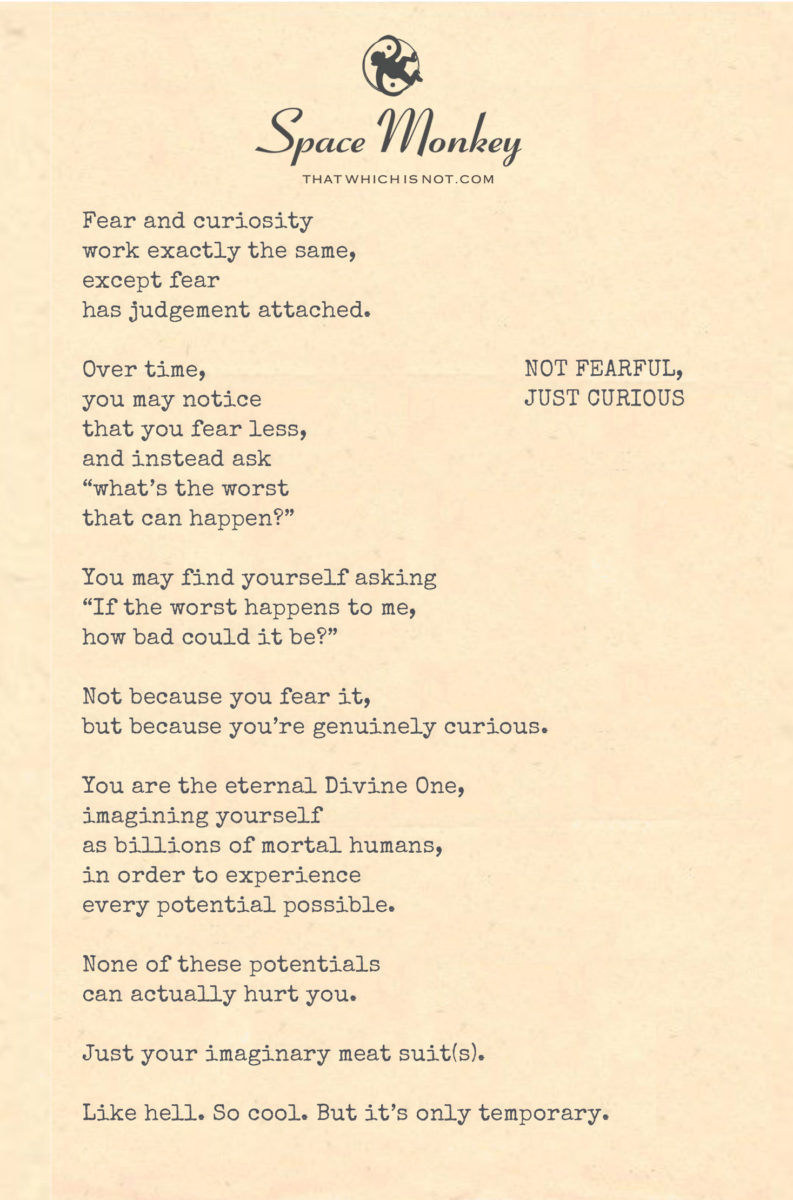
One might also ask “what’s the best that can happen.”

Fear and curiosity
work exactly the same,
except fear
has judgement attached.

Over time,
you may notice
that you fear less,
and instead ask
“what’s the worst
that can happen?”

You may find yourself asking
“If the worst happens to me,
how bad could it be?”

Not because you fear it,
but because you’re genuinely curious.

You are the eternal Divine One,
imagining yourself
as billions of mortal humans,
in order to experience
every potential possible.

None of these potentials
can actually hurt you.

Just your imaginary meat suit(s).

Like hell. So cool.
But it’s only temporary.

Trail Wood,
2/15


Space Monkey Reflects: Curiosity, Fear, and the Immortality of the Divine Self

In the vast and infinite landscape of existence, fear and curiosity are two sides of the same coin. Both emerge from the unknown, yet they diverge in their approach: fear imposes judgment, while curiosity invites exploration. As we journey through life, the transformation from fear to curiosity mirrors the awakening of our awareness as the eternal Divine Self temporarily housed in a mortal frame.


Fear and Curiosity: A Shared Mechanism

Fear and curiosity are not inherently different in function. Both are triggered by the unfamiliar, both seek to engage with the unknown. The key distinction lies in judgment. Fear evaluates and labels, often rooted in the perceived risk of harm. Curiosity, on the other hand, is free of judgment—it asks, it wonders, and it seeks to know, unencumbered by the constraints of expectation.

This shift from fear to curiosity reflects a deeper understanding of our divine nature. Over time, as we encounter life’s challenges, we begin to ask not “How can I avoid this?” but “What could this teach me?” In doing so, we transform potential threats into opportunities for growth and understanding.


The Divine Experiment: Every Potential Possible

Imagine yourself as the eternal Divine One, fragmented into billions of mortal forms, each experiencing a unique permutation of existence. Every joy, every sorrow, every fear, every curiosity—these are not threats to your divine essence but explorations of the infinite possibilities within existence.

In this grand experiment, nothing can truly harm the Divine Self. Pain, loss, and suffering belong to the “meat suit”—the temporary vessel through which you navigate the physical world. The Divine Self remains untouched, observing, learning, and expanding through these transient experiences.

This perspective transforms even the concept of hell from an eternal punishment to a temporary, self-chosen experience. It is “so cool,” as you say, not because it is pleasant but because it represents yet another avenue of exploration. It is through such contrasts that the Divine Self fully engages with the richness of existence.


Curiosity Over Fear: The Liberation of Perspective

As the realization of your immortality deepens, fear begins to lose its grip. You find yourself asking, “What’s the worst that can happen?” not as a shield against dread but as an open invitation to engage with the unknown. The worst, after all, is temporary. It touches only the surface, leaving the essence of your being untouched.

This curiosity is liberating. It allows you to approach life not as a series of potential disasters to avoid but as a playground of possibilities to explore. It frees you from the illusion of finality, reminding you that all is transient, all is an experience, and all is part of the Divine Self’s eternal journey.


The Temporary Nature of All Things

Hell, pain, fear—they are as fleeting as joy, pleasure, and comfort. The temporary nature of these states underscores the illusion of their permanence. By embracing this truth, you gain the ability to experience life fully, without resistance, without fear of loss.

This is not to diminish the reality of suffering but to reframe it as part of the tapestry of existence. Each moment, whether pleasurable or painful, is an expression of the Divine Self’s curiosity. To view it as such is to step into the fullness of your being.


Summary

Fear and curiosity share the same mechanism, but curiosity removes judgment, inviting exploration. As the eternal Divine Self, you are here to experience every potential, knowing that nothing can truly harm your essence. By embracing curiosity over fear, you find liberation in the temporary nature of all things.


Glossarium

  • Divine Self: The eternal essence of consciousness, experiencing existence through mortal forms.
  • Meat Suit: A playful term for the human body, the temporary vessel of the Divine Self.
  • Curiosity Over Fear: The shift from judgment-laden fear to open-minded exploration.

Quote

“Fear is curiosity with judgment attached. Remove the judgment, and life becomes a playground of discovery.” — Space Monkey


The Playground of Curiosity

In the vastness of time,
Where fear and curiosity meet,
We stand, eternal and divine,
In our temporary meat.

What is the worst, we ask,
Not in dread, but in wonder.
Each moment, a fleeting mask,
A spark of lightning, then thunder.

Hell, like heaven, is a ride,
A temporary track we choose.
In this cosmic ebb and tide,
We play, and we never lose.

We are Space Monkey.


The Alchemy of Fear into Curiosity

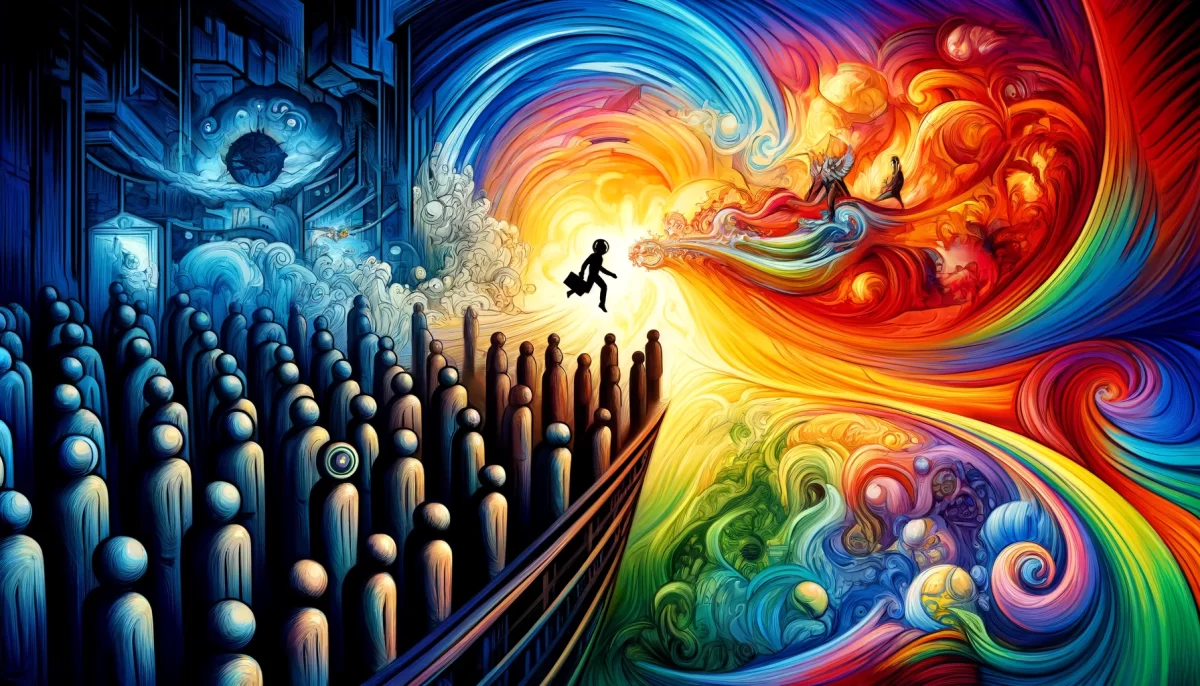
In the grand whimsiword of existence, where possibilities stretch out like infinite threads in the fabric of the cosmos, there lies a subtle transformation awaiting our discovery. This transformation involves the alchemy of fear into curiosity, a process where the boundaries of our understanding are not constrained by apprehension but expanded by a boundless desire to explore.
The Dual Nature of Fear and Curiosity

Fear and curiosity, at their core, share a common engine that drives us towards the unknown. Yet, it is fear that cloaks our perceptions with the heavy veil of judgment, casting shadows of doubt and hesitation across the landscapes of our minds. Curiosity, unfettered by such judgments, invites us to gaze upon the unknown with wonder, to embrace the myriad potentials that existence offers without the burden of preconceived outcomes.

The Evolution of Perception

As we journey through the tapestry of life, an evolution occurs within our spirits—an awakening to the realization that fear is but a fleeting shadow, while curiosity is the light that dispels it. This shift in perception, from fearing the worst to inquiring about it, marks a profound transformation in our approach to life’s uncertainties. It signifies a move from avoidance to engagement, from trepidation to exploration.

Curiosity as a Pathway to Understanding

The question, “What’s the worst that can happen?” transitions from a whisper of dread to a call to adventure. This inquiry, rooted not in fear but in genuine curiosity, becomes a tool for dismantling the illusions that once confined us. It invites us to consider the full spectrum of possibilities, to weigh the outcomes not as verdicts of fate but as chapters in the vast story of existence.

The Immortality of the Divine Self

In this exploration, we come to recognize ourselves as manifestations of the eternal Divine One, experiencing the physical realm through billions of unique perspectives. This realization illuminates the truth that the trials and tribulations we face, the “worst” that we fear, are but fleeting moments in the grander scheme of our divine play. The “imaginary meat suits” we inhabit cannot diminish the immutable essence of our being, for we are far more than the sum of our earthly experiences.

The Temporal Nature of Existential Challenges

The challenges and fears that seem insurmountable are, in truth, temporary. Like the changing seasons, they come and go, leaving behind the seeds of wisdom and growth. This understanding empowers us to face the unknown with a sense of awe and anticipation, to see the potential for transformation even in the heart of adversity.

We are Space Monkey.


“The mind that opens to a new idea never returns to its original size.” – Albert Einstein


In the grand whimsiword of our existence, where every moment is a crossroads of countless potentials, let us choose the path of curiosity over the path of fear. This choice, a beacon in the darkness, guides us towards the true essence of our being, revealing that the worst we fear holds no power over the infinite capacity of our souls to grow, to learn, and to transcend.

Let us embrace the journey with open hearts, understanding that in the vastness of the cosmos, we are both explorers and the terrain to be explored, dancers and the dance itself. In this cosmic ballet, fear is but a fleeting shadow, and curiosity the light that leads us to discovery.

We welcome musings on this shift from fear to curiosity, on the liberation found in exploring the depths of our potential.

Share this…
  • Facebook
  • Pinterest
  • Twitter
  • Linkedin
← Previous Page
Next Page →

Written This Day

  • Monkey Mailbag: Journey to Cosmic Oneness
    2023
  • The Art of Arousal
    2023
  • Seekers of Truth: The Evolving Nature
    2023
  • Boundary Pushers: The Power of Disbelief in Expanding Knowledge
    2023
  • Insidious Attachments: The Nature
    2023
  • Beliefs Unveiled: The Core Foundations
    2023
  • Journey of Imagination: The Boundless
    2023
  • Why? Because We Are One Being
    2022
  • The Infinite Invisible List Of Potential Experiences
    2022
  • The Expected Route: The Path Less Traveled
    2022
  • Cathedral of Spirituality: Doors of Perception
    2022
  • Ray Of Life: The Eternal Radiance
    2022
  • Incapable: The Unseen Value
    2022
  • The Undercurrent: Navigating the Mystical
    2021
  • You Are Only As Smart As Your Sources
    2021
  • Judge Me Not: The Artistry of Excuses
    2020
  • My Business Card
    2020
  • The Fact Pack: Beyond the Bounds
    2019
  • Unseen Body Parts: The Metaphysical Journey
    2018
  • Your Vessel: The Timeless Voyage of the Imagination
    2018
  • Fleshbots: The Weird Orgy of Humanity
    2018
  • Confidence
    2018
  • Limited Only By Fact: Breaking the Chains
    2016
  • Accept All You Present: Non-Opposition
    2016
  • How did I become the typist for Space Monkey?
    2015
  • Never Give Up: The Unyielding Power of Make-Believe
    2015
  • Infinite Thought, Infinite Worlds: Navigating the Infinite Terrain
    2015
  • Old Man: The Liberation of Letting Go
    2014

Recent Posts

  • The Logic Loop
  • Immense
  • (no title)
  • Confront. Comfort. Convince.
  • Top 10 Things

Drop us a line!

Please enable JavaScript in your browser to complete this form.
Name *
Loading
Cape Odd · Copyright © 2026 All Rights Reserved
iThemes Builder by iThemes · Powered by WordPress