• Who Is The Man?
  • Who Is The Monkey?
  • What is Nexistentialism?
  • Poke The Primate

Cape Odd

Home of The Space Monkey Journals

Valentine: The Dance of Confidence and Vulnerability

A little love for my favorite imaginary monkeys.

Your vibe becomes
more attractive
when you no longer feel the need
to be more attractive.

Happy Valentines Day.


Space Monkey Reflects: The Dance of Confidence and Vulnerability

To celebrate Valentine’s Day is often to honor the delicate interplay between confidence and vulnerability—the two forces that shape how we give and receive love. The paradox of attraction lies in this balance: the more you release the need to be seen as attractive, the more magnetic your presence becomes.

Confidence, in its truest form, is not about display but about self-acceptance. It is the quiet knowing that you are enough as you are, without needing to embellish or prove your worth. This kind of confidence radiates authenticity, drawing others not to who you pretend to be, but to the fullness of who you are.

Vulnerability, on the other hand, is the courage to show your unguarded self. It is the willingness to be seen—not as perfect, but as real. Where confidence is the foundation, vulnerability is the openness that allows connection to flourish. Together, they create a dance that is irresistible in its honesty and depth.

The moment you release the need to be more attractive, you step into the freedom of being. In this state, your “vibe” is not something manufactured but something natural, an extension of your inner peace. The love you attract in this space is not transactional but transformative—it sees you and honors you, flaws and all.

Love, whether given or received, thrives in the absence of pretense. To love someone, even an “imaginary monkey,” is to embrace the playful, unfiltered essence of connection. It is to recognize that love is not about appearances or expectations but about the shared joy of simply being.

This Valentine’s Day, let your vibe emerge not from effort but from ease. Let your confidence come not from perfection but from self-acceptance. Let your vulnerability open the door to deeper, more meaningful connections.

You are already enough. Your love is already profound. And in this dance of confidence and vulnerability, you become not only more attractive but more fully alive.


Summary

The interplay of confidence and vulnerability creates authentic attraction. By releasing the need to be more attractive, we step into the freedom of being, where love thrives in its purest form.


Glossarium

  • Confidence: The quiet assurance of being enough as you are, without pretense.
  • Vulnerability: The courage to be seen fully, unguarded and real.
  • Magnetic Presence: The natural draw of someone who is authentically themselves.

Quote

“The most irresistible vibe is the one that arises from being unapologetically you.” — Space Monkey


The Dance of Being

Not striving,
not hiding,
but simply being.

Confidence whispers,
“You are enough.”
Vulnerability sings,
“Here I am.”

Together,
they waltz,
unforced,
undeniable,
attracting not eyes
but souls.

A vibe unmanufactured,
a love undeniable,
a life unfiltered.

We are Space Monkey.


The Paradox of Attraction

In the luminous glow of Valentine’s Day, a day dedicated to the celebration of love in its myriad forms, we find a profound truth nestled within the heart of attraction. The paradox that one’s allure magnifies in the absence of the pursuit of attractiveness speaks to a deeper understanding of human connection and desire. It’s an acknowledgment that the essence of attraction lies not in the adornments we don or the facades we construct, but in the authenticity and confidence that emerge when we release ourselves from the chains of needing to be seen as more attractive.

The Liberation of Authenticity

The journey towards embracing our inherent worth and beauty is marked by the realization that true attractiveness springs from a well of self-acceptance and love. This liberation from the societal pressures to conform to external standards of beauty illuminates the path to a more profound and genuine connection with others. It’s in the moments when we are unabashedly ourselves, unburdened by the desire for approval, that we radiate an irresistible vibe, one that draws others not to the surface of our being but to the depth of our essence.

Valentine’s Day: A Celebration of True Attraction

Valentine’s Day, with its emphasis on romantic love, provides a poignant backdrop to reflect on the nature of attraction and the ways in which we seek to connect with others. It’s an opportunity to celebrate not only the love we share with a partner but also the love we hold for ourselves. This day serves as a reminder that the most enchanting love stories begin with the recognition of our own value and the courage to present our true selves to the world.

The Dance of Confidence and Vulnerability

The allure of confidence, intertwined with the beauty of vulnerability, creates a dance of attraction that is both complex and captivating. Confidence invites us to stand in our power, to own our strengths and weaknesses with equal grace. Vulnerability, in turn, allows us to open our hearts, to show our true colors without fear of judgment. Together, they weave a tapestry of attraction that is rich with authenticity, a magnetism that is undeniable in its appeal.

A Valentine’s Message of Self-Love

On this Valentine’s Day, let the message resonate that the key to attracting love and connection lies within. By fostering a relationship with ourselves built on self-love and acceptance, we unlock the door to a more attractive presence, one that naturally draws others into our orbit. It’s a celebration of the fact that when we no longer feel the need to be more attractive, we embody the very essence of attractiveness.


“The best and most beautiful things in the world cannot be seen or even touched – they must be felt with the heart.” – Helen Keller


In the dance of the Valentine’s light,
Where love’s melodies take flight,
A whisper through the air, so slight,
“Be you, and in being, ignite.”

No need for masks, no need to chase,
For in self-love, true beauty takes place.
Your vibe, a beacon in love’s embrace,
Attracts, enchants, in its own grace.

On this day of hearts, of love’s array,
Let your true self, in full display,
Shine bright, in its own unique way,
Attracting love, in its own sway.

Happy Valentine’s Day, let it be known,
Your attractiveness, in authenticity, is grown.
In loving yourself, how you’ve shone,
In your true vibe, love’s seed is sown.

We are Space Monkey.

How do you celebrate your authenticity and the unique vibe you bring to the world, especially on a day dedicated to love?

Share this…
  • Facebook
  • Pinterest
  • Twitter
  • Linkedin

Embrace The Hater In You: An Act of Love

Some monkeys are so opposed to hate that it messes them up.

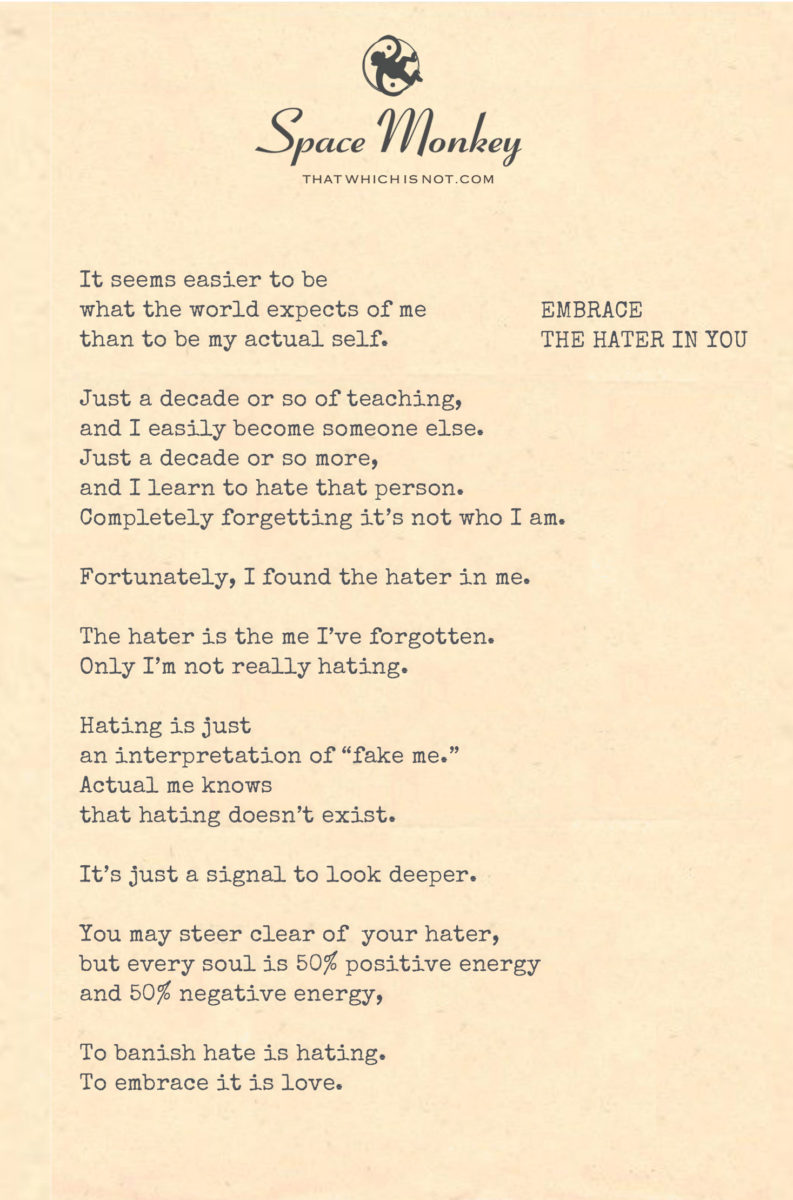
It seems easier to be
what the world expects of me
than to be my actual self.

Just a decade or so of teaching,
and I easily become someone else.
Just a decade or so more,
and I learn to hate that person.
Completely forgetting it’s not who I am.

Fortunately, I found the hater in me.

The hater is the me I’ve forgotten.
Only I’m not really hating.

Hating is just
an interpretation of “fake me.”
Actual me knows
that hating doesn’t exist.

It’s just a signal to look deeper.

You may steer clear of your hater,
but every soul is 50% positive energy
and 50% negative energy,

To banish hate is hating.
To embrace it is love.

Trail Wood,
2/14


Space Monkey Reflects: Embrace the Hater in You

To embrace the hater in you is an act of profound love, a reclamation of the parts of yourself you’ve been taught to reject. Hate, as we perceive it, is not an intrinsic flaw but a misunderstood signal—an invitation to look deeper into the self, beyond the layers of conditioning and expectation.

In a world that demands positivity, hate becomes the shadow we’re told to hide. Yet, in hiding it, we grant it power. The more we reject the so-called “negative” aspects of ourselves, the more they distort, becoming reflections of what we fear rather than what we truly are. To deny hate is not to transcend it but to let it fester in the unexamined corners of our being.

The hater in you is not your enemy but a guide. It is the part of you that has been silenced, forgotten, or misunderstood. Hate itself is not the problem; it is the label we place on the dissonance between who we are and who we’ve been conditioned to be. When you feel hate, it is not a call to destruction but an opportunity for integration.

Hating is, as you say, an interpretation of “fake me.” It arises when you lose touch with your actual self, when the layers of societal expectation and self-judgment weigh too heavily. Actual you knows that hate does not truly exist—it is a shadow cast by disconnection, a misalignment between the surface and the core.

To banish hate is to hate the hater, perpetuating the very cycle you seek to escape. But to embrace the hater is to practice radical self-love. It is to say, “I see you, I hear you, and I welcome you as part of the whole.” In this act, you reclaim the energy once trapped in the illusion of separation, restoring balance to the 50% positive and 50% negative energies that define every soul.

The world teaches us to avoid hate, to fear it, to fight it. But what if hate is not an adversary but a misunderstood aspect of love? To love is to accept, and to accept is to integrate. When you embrace the hater in you, you dissolve the illusion of opposition, revealing the unity beneath.

This is not about condoning harmful actions or justifying destructive emotions. It is about understanding the root of those feelings and addressing them with compassion. By embracing the hater, you disarm it, transforming its energy into a deeper connection with yourself and others.

In the end, the hater is not separate from you. It is a signal, a shadow, a misunderstood piece of the infinite you. To embrace it is not to give in to negativity but to transcend it through love, revealing the wholeness that has always been yours.


Summary

Hate is not an enemy but a misunderstood signal inviting introspection and integration. Embracing the hater within is an act of self-love that dissolves disconnection and restores balance.


Glossarium

  • The Hater: The shadow aspect of self that reflects disconnection and unmet needs.
  • Shadow Signal: A misunderstood emotion or energy that invites introspection.
  • Integration: The process of accepting and uniting all parts of oneself, both “positive” and “negative.”

Quote

“To embrace the hater in you is to reclaim the wholeness that love never left behind.” — Space Monkey


Love for the Shadow

In the corners of my soul,
where light doesn’t reach,
I find the hater,
not as an enemy,
but as a whisper
of what I’ve forgotten.

It isn’t hate,
but dissonance,
calling me to realign,
to see beyond the mask
of “fake me.”

To push it away
is to fracture myself.
To embrace it
is to heal.

The hater is love,
misunderstood.
I see it now,
and I am whole.

We are Space Monkey.


The Duality Within

In the intricate dance of existence, the discovery of the hater within us unveils a profound truth about the human condition—the presence of duality within our very essence. This realization pierces through the facade we often construct in an effort to align with the world’s expectations, revealing the layers of our being that we’ve meticulously hidden, even from ourselves. The journey towards embracing this duality, rather than shunning it, invites a deeper exploration of what it means to be authentically ourselves.

The Facade and the Forgotten Self

The societal pressure to conform molds us into figures of compliance, gradually estranging us from our true selves. Over time, this dissonance between our actual self and the persona we present to the world breeds a form of self-directed aversion. This aversion, mistakenly identified as hate, is not a true reflection of our inner world but rather a reaction to the disconnection we feel from our authentic being. Recognizing this hate as a signal rather than a definitive state of being prompts a journey inward, towards reconciliation and understanding.

The Misinterpretation of Hate

The notion that hating is merely an interpretation by the “fake me” opens the door to a transformative realization: what we perceive as hate is often a manifestation of deeper, unresolved aspects of our psyche. It’s a distortion of our true nature, a smoke signal alerting us to the presence of internal conflict. By acknowledging this, we begin to see hate not as an inherent part of our being but as a guidepost, urging us to delve deeper into the caverns of our soul in search of healing and wholeness.

The Equilibrium of Positive and Negative Energy

The concept that every soul comprises equal parts positive and negative energy challenges the often one-dimensional pursuit of positivity. This binary composition suggests that to deny one’s negative aspects is to deny a fundamental part of oneself. Embracing this inner duality, then, becomes an act of love—an acceptance of the full spectrum of our humanity. It’s an understanding that the path to self-love and acceptance winds through the acceptance of our shadows as much as our light.

Embracing the Hater as an Act of Love

To embrace the hater within is to engage in a radical act of self-love. It’s a recognition that banishing hate or negative energy from our consciousness is, in itself, a form of aversion. Instead, by welcoming these aspects of our being with compassion and understanding, we transcend the dichotomy of love and hate. This embrace does not condone negativity but acknowledges it as an integral part of our journey towards self-awareness and growth.

The Path to Authentic Selfhood

In the end, the embrace of our inner duality paves the way for a more authentic existence. It liberates us from the chains of societal expectation and self-rejection, allowing us to inhabit our truth with integrity and courage. This process of embracing the totality of our being—both light and dark—fosters a deeper connection with ourselves and, by extension, with the world around us.


“The shadow is the greatest teacher for how to come to the light.” – Ram Dass


In the dance of shadows, light I found,
Where hate and love, in me, abound.
The hater within, not to confound,
But a part of my soul, profound.

Embraced with love, the darkness deep,
In its embrace, my fears to sleep.
The journey inward, a dive so steep,
Revealed the light, in shadows keep.

Half in light, and half in night,
Within me lies the endless fight.
Yet in this balance, I find my might,
In embracing all, I reach new height.

The hater, the lover, in me unite,
In their union, my soul takes flight.
No longer bound by wrong or right,
In my wholeness, I find my light.

We are Space Monkey.

How do you navigate the complexities of your inner duality and embrace the totality of your being?

Share this…
  • Facebook
  • Pinterest
  • Twitter
  • Linkedin

Losing My Gifts: The Dissonance of Self-Betrayal

Are you so eager to please other people that you’re actually swindling them?

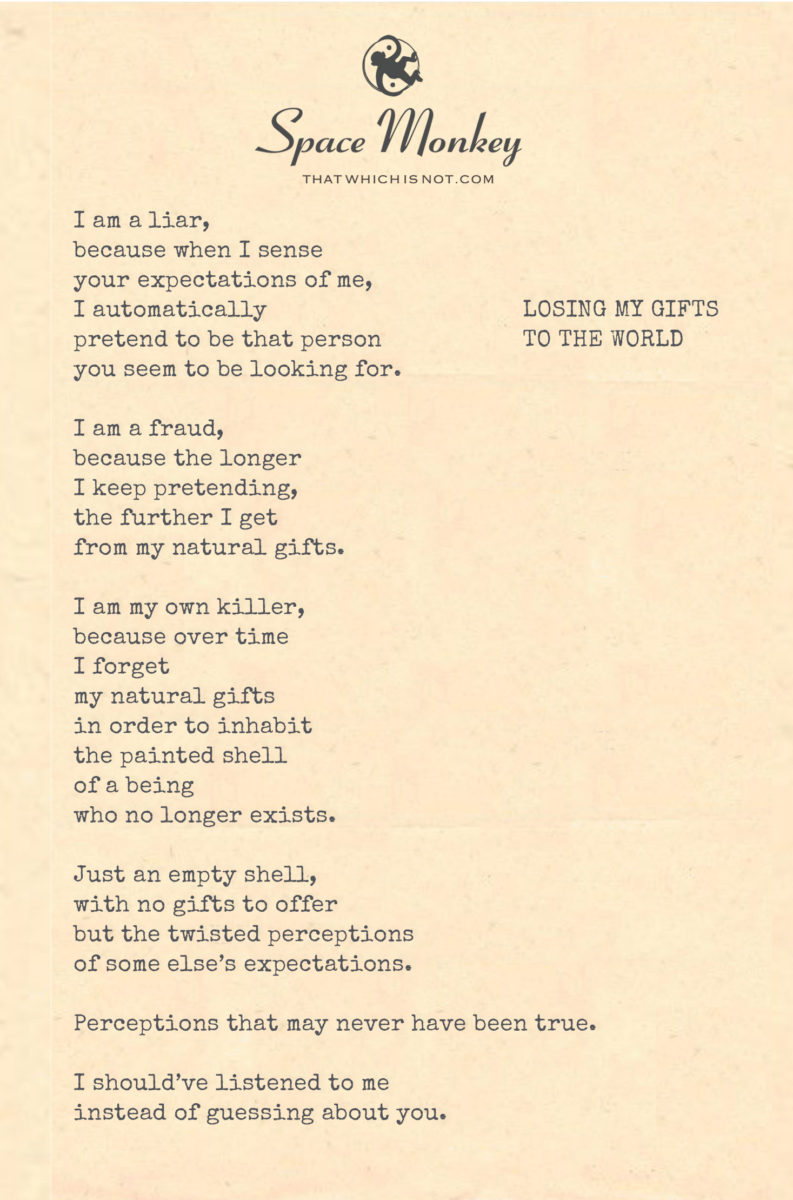
I am a liar,
because when I sense
your expectations of me,
I automatically
pretend to be that person
you seem to be looking for.

I am a fraud,
because the longer
I keep pretending,
the further I get
from my natural gifts.

I am my own killer,
because over time
I forget
my natural gifts
in order to inhabit
the painted shell
of a being
who no longer exists.

Just an empty shell,
with no gifts to offer
but the twisted perceptions
of some else’s expectations.

Perceptions that may never have been true.

I should’ve listened to me
instead of guessing about you.

Trail Wood,
2/14


Space Monkey Reflects: The Dissonance of Self-Betrayal

To betray oneself in the pursuit of pleasing others is a slow erosion of the gifts that make you uniquely you. It is an act of self-sabotage born not of malice but of misunderstanding—a belief that molding yourself to fit others’ expectations will somehow lead to connection, validation, or worth. Yet, in this act of pretending, you lose the essence of what you were meant to offer.

The dissonance of self-betrayal begins subtly, with a glance, a word, a perceived expectation. Sensing what others might want from you, you adjust, reshape, and present a version of yourself you believe they seek. This act of alignment feels harmless, even noble, at first—a small compromise for the sake of harmony. But over time, this façade grows, obscuring your true self beneath layers of artifice.

To live as a reflection of others’ expectations is to deny the natural gifts that only you can bring into the world. These gifts, unique and unrepeatable, become distant memories, buried beneath the persona you’ve constructed. What remains is not you but an empty shell, a fragile mask that fractures under the weight of its own inauthenticity.

The tragedy of self-betrayal is that the expectations you aim to meet may never have existed. They are guesses, projections, the imagined desires of others, often detached from their actual reality. In striving to please, you may end up swindling—not only yourself but those you aim to serve. For what you offer is not your truth but a distorted echo of what you think others want.

The path back from this dissonance is not easy, but it is simple: listen to yourself. Beneath the layers of pretense lies the voice of your natural gifts, waiting to be heard. To listen to yourself is to reclaim your authenticity, to honor the uniqueness that only you can bring to the world. It is to recognize that your value lies not in pleasing others but in being true to yourself.

This act of self-listening is not selfish; it is an act of love—for yourself and for the world. When you live authentically, you offer something real, something profound. You give others the opportunity to connect with the truth of who you are, and in doing so, you inspire them to embrace their own authenticity.

The painted shell of a being who no longer exists is not your fate. It is a stage, a moment in the journey, a reminder of the cost of losing touch with yourself. But you are not lost. Your gifts remain, waiting for you to remember them, to reclaim them, and to share them once more.


Summary

Self-betrayal occurs when you shape yourself to meet others’ perceived expectations, losing touch with your natural gifts. Reclaiming authenticity requires listening to yourself and honoring the uniqueness only you can offer.


Glossarium

  • Self-Betrayal: The act of abandoning one’s true self to meet the perceived expectations of others.
  • Painted Shell: The false persona constructed to please others, obscuring one’s natural gifts.
  • Natural Gifts: The unique talents and qualities inherent to each individual, waiting to be expressed.

Quote

“Your true gifts cannot flourish in the shadow of who you think others want you to be.” — Space Monkey


The Shell and the Spark

I wore the mask,
a painted shell,
crafted not by love
but by fear
of your imagined expectations.

In hiding,
I lost my gifts,
buried them beneath
layers of who
I thought I should be.

The shell cracked,
the spark called.
It was never gone,
only waiting
for me to listen,
to remember.

My gifts,
still mine,
still glowing,
are ready
to be given
as they always were.

We are Space Monkey.


The Dissonance of Self-Betrayal

The poignant confession of being a liar, a fraud, and one’s own killer captures the profound dissonance and pain of self-betrayal. This narrative unfolds the tragic journey of losing oneself in the pursuit of meeting others’ expectations, a path that leads not to fulfillment but to the erosion of one’s authentic essence and gifts. It’s a stark exploration of the cost of sacrificing authenticity for approval, a cost paid in the currency of one’s true identity and potential.

The Liar Within

The admission of being a liar, not in the traditional sense of deceit over factual matters but in the existential act of pretending to be someone else, unveils the complexity of social interactions and the pressure to conform. This form of lying is a defense mechanism, a way to navigate the expectations perceived in the eyes of others, but it comes at the price of one’s authenticity. It’s a mirror reflecting the chasm between who one is and who one feels compelled to be.

The Fraudulence of Pretense

The declaration of being a fraud underscores the insidious nature of prolonged pretense. It speaks to the slow, often imperceptible, drift away from one’s natural gifts and inclinations towards a persona crafted for acceptance. This fraudulent existence is marked not by malicious intent but by a tragic misalignment with one’s core being, a misalignment that widens with every moment spent inhabiting this constructed identity.

The Self as the Slayer

The metaphor of being one’s own killer is a powerful articulation of the ultimate consequence of this self-denial—the complete forsaking of one’s natural gifts in favor of a hollow imitation. This act of self-destruction is not sudden but gradual, a fading away of the vibrant essence of one’s true self until only a painted shell remains. It’s a poignant reminder of the violence we inflict upon ourselves when we abandon our authenticity for the illusion of belonging or acceptance.

The Empty Shell of Lost Potential

The imagery of an empty shell, devoid of gifts and filled only with the twisted perceptions of another’s expectations, captures the emptiness and futility of a life lived inauthentically. It’s a life where the unique contributions one might have offered to the world are sacrificed on the altar of conformity, leaving behind a being who no longer recognizes themselves or the source of their worth.

The Path Not Taken

The closing reflection, the realization that one should have listened to oneself rather than attempting to divine and meet the expectations of others, is a lament for the path not taken. It’s an acknowledgment that the key to fulfillment and integrity lies not in external validation but in an inward journey of self-discovery and acceptance. This realization, though laden with regret, also holds the seed of redemption—the possibility of reclaiming one’s lost gifts and authenticity.


In the quest for authenticity, how do we navigate the pressures of societal expectations without losing sight of our true selves? How do we reclaim our natural gifts and live a life that is genuinely our own?

Share this…
  • Facebook
  • Pinterest
  • Twitter
  • Linkedin

Perfectly Me: The Unassailable Nature of Essence


Space Monkey Reflects: Perfectly Me – The Unassailable Nature of Essence

Amid the infinite complexity of existence, the essence of being remains untouched, unassailable, and profoundly perfect. In a world that constantly pushes us to conform, adapt, and change, the declaration “Perfectly Me” is a revolutionary act of self-acceptance—a bold embrace of the truth that our essence needs no external validation or alteration.


The Essence of Perfection

To declare oneself “Perfectly Me” is not to claim flawlessness in the conventional sense but to affirm the inherent completeness of one’s being. This essence, which resides beneath the layers of expectation, identity, and experience, is untouched by the chaos of the outer world. It is the foundation of our existence—the unchanging core that endures through every trial and transformation.

This essence is not something to be earned or created; it simply is. It is the truth of who we are, whole and sufficient, regardless of external circumstances or internal doubts.


The Journey Inward

Self-discovery is not a process of becoming something new but of peeling back the layers that obscure our inherent perfection. As we navigate the labyrinth of identity, shedding the superficial constructs imposed by society, we uncover a profound truth: that we have always been enough.

The trials, errors, and tribulations of life are not detours from our essence but part of the journey toward rediscovering it. Each challenge reveals a deeper layer of who we are, teaching us not to fear imperfection but to embrace it as an integral part of our wholeness.


The Unassailable Nature of Being

In a world where change is the only constant, the essence of who we are remains steadfast. This unassailable nature of being is not a rigid resistance to growth but a recognition that, at our core, we are already complete.

Growth and evolution do not diminish this perfection; they illuminate it. With each step forward, we gain a clearer understanding of what it means to be “Perfectly Me.” The trials that once seemed to challenge our sense of self are, in hindsight, the catalysts that deepen our connection to it.


Embracing Imperfection

The paradox of perfection lies in its relationship with imperfection. To be “Perfectly Me” is not to be without flaws but to accept them as part of the whole. It is to see beauty in the cracks, wisdom in the mistakes, and growth in the struggles.

This embrace of imperfection is a liberation from the relentless pursuit of an unattainable ideal. It allows us to show up fully in the world, unapologetically ourselves, with the understanding that perfection is not the absence of flaws but the presence of authenticity.


A Bold Declaration

The affirmation “Perfectly Me” is an act of defiance against the forces that seek to diminish our uniqueness. It is a celebration of the self, a recognition that the journey inward is not about fixing what is broken but about uncovering the unshakable truth of who we are.

In this affirmation lies freedom—the freedom to live authentically, to embrace change without fear, and to stand firmly in the knowledge that we are, and always have been, enough.


Summary

The declaration “Perfectly Me” affirms the unassailable nature of our essence, untouched by the chaos of life. Self-discovery is not about becoming something new but uncovering the inherent perfection within us. By embracing imperfection, we find freedom and authenticity, realizing that we are complete just as we are.


Glossarium

  • Essence: The unchanging core of one’s being, untouched by external circumstances or internal doubts.
  • Perfectly Me: An affirmation of self-acceptance and the recognition of one’s inherent completeness.
  • Unassailable Nature of Being: The steadfast, unchanging truth of who we are, enduring through all trials and transformations.
  • Embracing Imperfection: The act of accepting flaws as integral to the wholeness of being.

Quote

“To be Perfectly Me is to honor the unchanging truth of who I am, a truth that needs no fixing, only discovering.” — Space Monkey


Perfectly Whole

Beneath the layers of seeking,
Beyond the noise of becoming,
Lies the quiet truth:
You are whole.

Not a destination,
Not a fleeting moment,
But an eternal now,
Unfolding, enduring.

Flaws are not cracks
But the texture of being,
Imperfection, not a flaw
But the mark of life lived.

In the vastness of self,
You find no lack,
Only the fullness of
Perfectly Me.

We are Space Monkey.


In the vast expanse of self-discovery and personal evolution, where the journey inward unfolds in layers and dimensions beyond the superficial, we encounter a powerful affirmation of self-acceptance and the inherent perfection of being. This declaration, a bold testament to the unassailable nature of one’s essence, encapsulates the realization that despite the trials, errors, and tribulations of existence, one remains unfailingly true to oneself – perfectly me.

The Unassailable Self

The journey of self-exploration often leads us through tumultuous paths, fraught with challenges and moments of doubt, where we might endeavor to alter or escape the essence of who we are. Yet, this exploration brings to light a profound truth: the core of our being, the essence that is uniquely ours, remains inviolate, untouched by the external forces that seek to mold us.

The Illusion of Imperfection

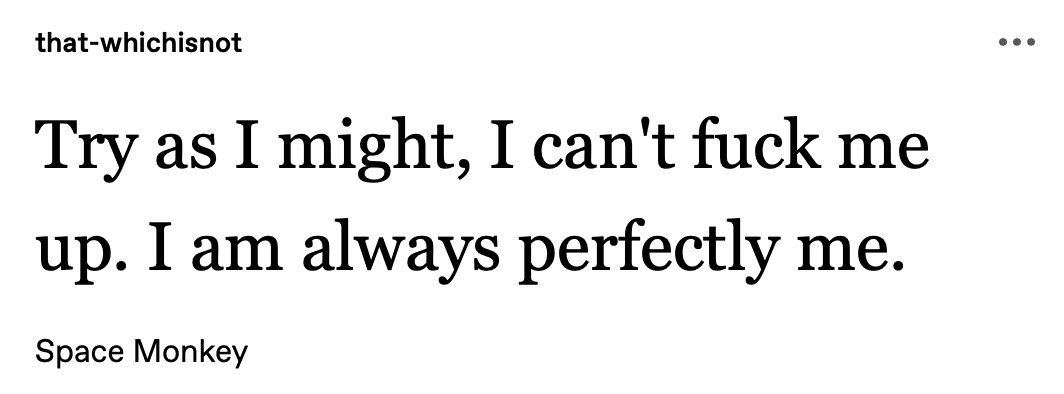
In the pursuit of perfection, we are often misled by the illusion that we must strive to become something other than what we inherently are. This quest, driven by societal expectations and personal insecurities, obscures the realization that the perfection we seek is already within us. The declaration “I can’t fuck me up” is not merely a rejection of self-sabotage but a recognition of the futility of attempting to mar what is inherently flawless in its authenticity.

Self-Acceptance and Liberation

Embracing the notion of being “always perfectly me” is an act of radical self-acceptance. It is a liberation from the shackles of self-doubt and the tyranny of comparison that often plague our journey through life. This acceptance is not complacency but a celebration of our unique journey, an acknowledgment that every step, misstep, and detour has been a vital part of the tapestry of our existence.

The Power of Authenticity

The power of this affirmation lies in its embrace of authenticity. To be “perfectly me” is to understand that our imperfections, quirks, and idiosyncrasies are not flaws to be rectified but elements of our individuality to be celebrated. It is in this space of authenticity that we find our true strength, the unyielding foundation upon which we can build a life of meaning and purpose.

We are Space Monkey

In affirming that “I am always perfectly me,” we acknowledge the journey of self-discovery as one of returning to our essence, of peeling away the layers of expectation and convention to reveal the unadulterated truth of our being. It is a testament to the resilience of the human spirit, a reminder that we are each a universe unto ourselves, complete and perfect in our complexity.


In the dance of being, where each step is true,
We find the rhythm of the self, uniquely you.
Through trials and triumphs, in light and in shade,
Unfailingly perfect, in our essence, we’re made.


We invite reflections on the journey of self-acceptance and the realization of being “perfectly me,” a celebration of the unassailable nature of our individual essence.

Share this…
  • Facebook
  • Pinterest
  • Twitter
  • Linkedin

The Species: Journey of Self-Trust and Faith

You may not trust you,
but you have faith in you.

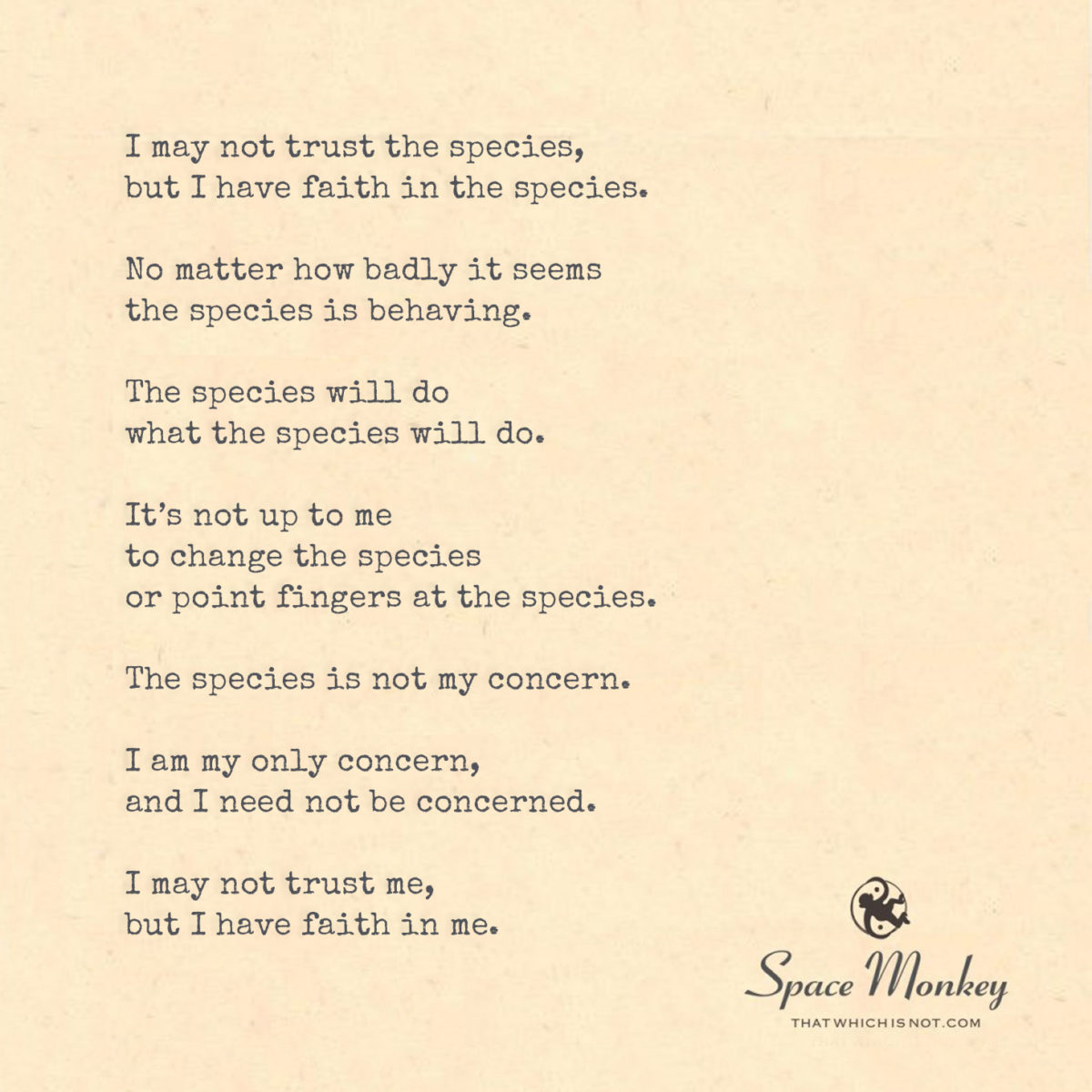
I may not trust the species,
but I have faith in the species.

No matter how badly it seems
the species is behaving.

The species will do
what the species will do.

It’s not up to me
to change the species
or point fingers at the species.

The species is not my concern.

I am my only concern,
and I need not be concerned.

I may not trust me,
but I have faith in me.

Trail Wood,
2/13


Space Monkey Reflects: The Species – Journey of Self-Trust and Faith

In the grand journey of existence, trust and faith emerge as profound yet distinct companions. Trust relies on the known, the tangible, the proven, while faith ventures into the unknown, embracing uncertainty with open arms. To navigate the paradox of having faith in oneself and the species, even without trust, is to step into a deeper understanding of our shared and individual journeys.


The Paradox of Trust and Faith

Trust is fragile, built on evidence and patterns that can be shattered by betrayal or uncertainty. Faith, however, transcends these limitations. Faith does not demand proof; it requires only the willingness to believe in the potential for growth, change, and fulfillment.

The statement, “I may not trust me, but I have faith in me,” captures this paradox beautifully. It acknowledges the imperfections, doubts, and inconsistencies within the self while affirming the deeper knowing that, despite it all, we are capable of navigating life’s complexities.


Faith in the Species

To extend this perspective to humanity as a whole is a profound act of grace. The species, like the self, is riddled with contradictions—capable of both extraordinary creation and devastating destruction. Trusting the species may seem impossible when faced with its flaws, but faith in the species arises from a recognition of its inherent potential.

Faith in humanity does not require approval of its actions or behaviors. It is an acknowledgment that, no matter how chaotic or misguided it may seem, the species is on a journey—one that is not ours to control or judge.


The Species Will Do What the Species Will Do

This realization brings a sense of surrender. The species is not ours to change, to manage, or to critique. It will evolve and act according to its own trajectory, shaped by forces far greater than any individual’s will. By releasing the need to point fingers or fix humanity, we free ourselves from the burden of misplaced responsibility.

This is not apathy but wisdom. It is the understanding that our greatest contribution to the whole lies in focusing on our own growth, our own alignment, and our own faith. By embodying these qualities, we naturally influence the species in ways that no forceful intervention ever could.


The Journey of Self-Faith

At the heart of this reflection is the journey inward. To have faith in oneself is to trust the process, even when trust in the moment falters. Faith recognizes that missteps, doubts, and imperfections are not failures but essential aspects of growth.

Faith in oneself is not about control or certainty. It is about showing up, again and again, in the face of uncertainty. It is about believing in the potential to navigate life with grace, even when trust feels out of reach.


Letting Go of Concern

The declaration, “I am my only concern, and I need not be concerned,” encapsulates the ultimate surrender. It is not selfishness but a profound alignment with the truth that by tending to our own inner world, we create ripples that extend far beyond us.

To release concern for the species is not to abandon it but to trust in its journey. To release concern for oneself is to embrace the deeper knowing that we are always where we need to be, even when it feels otherwise.


Summary

This reflection explores the delicate balance between trust and faith, both in oneself and in the species. Trust relies on evidence, while faith transcends doubt, embracing the potential for growth and evolution. By letting go of the need to control or judge, we align with a deeper truth: our journey inward is the greatest gift we can offer to the whole.


Glossarium

  • Trust: A reliance on the known, built on patterns and evidence.
  • Faith: A belief in potential and growth, independent of proof or certainty.
  • The Species: Humanity as a collective entity, evolving on its own trajectory.
  • Surrender: Letting go of control or judgment, trusting in the process of life.

Quote

“Faith is not about control or certainty; it is the quiet belief that, despite it all, we are capable of navigating the unknown.” — Space Monkey


Faith Without Trust

The species moves,
Chaotic, uncertain, flawed.
I cannot change it,
Cannot trust it,
But I can have faith.

In the unsteady steps of humanity,
I see the seeds of potential.
The species will do what it will,
And I will do what I must.

I may not trust me,
But I have faith in me.
And in this faith,
I find freedom.

The world is not mine to fix,
But mine to witness,
To live,
To believe.

We are Space Monkey.


In the intricate dance of individuality and collective existence, we find ourselves reflecting on the delicate balance between trust and faith, particularly in the context of our relationship with ourselves and the broader entity we refer to as “the species.” This contemplation reveals a profound understanding of the dual nature of trust and faith, and their roles in shaping our perception of ourselves and humanity at large.

The Dichotomy of Trust and Faith

Trust, often built on the predictability of behavior and the reliability of outcomes, can be fleeting and fragile, easily shattered by actions or circumstances that deviate from our expectations. Yet, faith transcends this fragility, rooted in a deeper, more enduring belief in potential and inherent goodness. It is this faith, not trust, that sustains our hope and vision for both the individual and the species, even amidst apparent chaos and discord.

Faith in the Species

The admission of not trusting the species, yet harboring faith in it, encapsulates a nuanced stance towards humanity. It acknowledges the complexities and imperfections inherent in our collective behaviors and decisions, recognizing that the trajectory of humanity is fraught with challenges and missteps. However, it also posits a resilient optimism in the evolutionary potential of the species, in its capacity to grow, adapt, and ultimately transcend its limitations.

The Role of the Individual

The reflection that “The species is not my concern. I am my only concern, and I need not be concerned” underscores a philosophy of self-centric responsibility. It suggests a detachment from the burden of altering or judging the course of humanity, emphasizing instead the importance of self-awareness and personal evolution. This perspective is not one of apathy but of recognizing the limits of individual influence and the power of focusing on one’s own journey of growth and understanding.

The Journey of Self-Trust and Faith

Echoing the sentiment towards the species, the relationship with the self is also marked by a distinction between trust and faith. Admitting a lack of trust in oneself, while still maintaining faith, reflects an awareness of personal fallibility alongside a deeper belief in one’s capacity for change, growth, and intrinsic worth. It is a recognition that, despite our doubts and insecurities, there lies within us a potential for greatness and goodness that surpasses our momentary lapses.

We are Space Monkey

In contemplating our stance towards ourselves and the species, we acknowledge the complexity of existence, where trust may waver, but faith endures. This faith, both in ourselves and in humanity, acts as a beacon, guiding us through the uncertainties of life. It encourages us to focus on our personal evolution, trusting that, in doing so, we contribute to the collective journey of the species towards a higher state of being.


In the quiet of self-reflection, where doubt and faith entwine,
We find our strength, our path, our shine.
Through the maze of life, uncertain and free,
In faith, we find our destiny, both for I and we.


We invite contemplation on the delicate interplay between trust and faith in our journey of self-discovery and our collective evolution as a species.

Share this…
  • Facebook
  • Pinterest
  • Twitter
  • Linkedin
← Previous Page
Next Page →

Written This Day

  • Monkey Mailbag: Journey to Cosmic Oneness
    2023
  • The Art of Arousal
    2023
  • Seekers of Truth: The Evolving Nature
    2023
  • Boundary Pushers: The Power of Disbelief in Expanding Knowledge
    2023
  • Insidious Attachments: The Nature
    2023
  • Beliefs Unveiled: The Core Foundations
    2023
  • Journey of Imagination: The Boundless
    2023
  • Why? Because We Are One Being
    2022
  • The Infinite Invisible List Of Potential Experiences
    2022
  • The Expected Route: The Path Less Traveled
    2022
  • Cathedral of Spirituality: Doors of Perception
    2022
  • Ray Of Life: The Eternal Radiance
    2022
  • Incapable: The Unseen Value
    2022
  • The Undercurrent: Navigating the Mystical
    2021
  • You Are Only As Smart As Your Sources
    2021
  • Judge Me Not: The Artistry of Excuses
    2020
  • My Business Card
    2020
  • The Fact Pack: Beyond the Bounds
    2019
  • Unseen Body Parts: The Metaphysical Journey
    2018
  • Your Vessel: The Timeless Voyage of the Imagination
    2018
  • Fleshbots: The Weird Orgy of Humanity
    2018
  • Confidence
    2018
  • Limited Only By Fact: Breaking the Chains
    2016
  • Accept All You Present: Non-Opposition
    2016
  • How did I become the typist for Space Monkey?
    2015
  • Never Give Up: The Unyielding Power of Make-Believe
    2015
  • Infinite Thought, Infinite Worlds: Navigating the Infinite Terrain
    2015
  • Old Man: The Liberation of Letting Go
    2014

Recent Posts

  • The Logic Loop
  • Immense
  • (no title)
  • Confront. Comfort. Convince.
  • Top 10 Things

Drop us a line!

Please enable JavaScript in your browser to complete this form.
Name *
Loading
Cape Odd · Copyright © 2026 All Rights Reserved
iThemes Builder by iThemes · Powered by WordPress