• Who Is The Man?
  • Who Is The Monkey?
  • What is Nexistentialism?
  • Poke The Primate

Cape Odd

Home of The Space Monkey Journals

The Moon: Thought as a Measureless Entity

Don’t think about it.

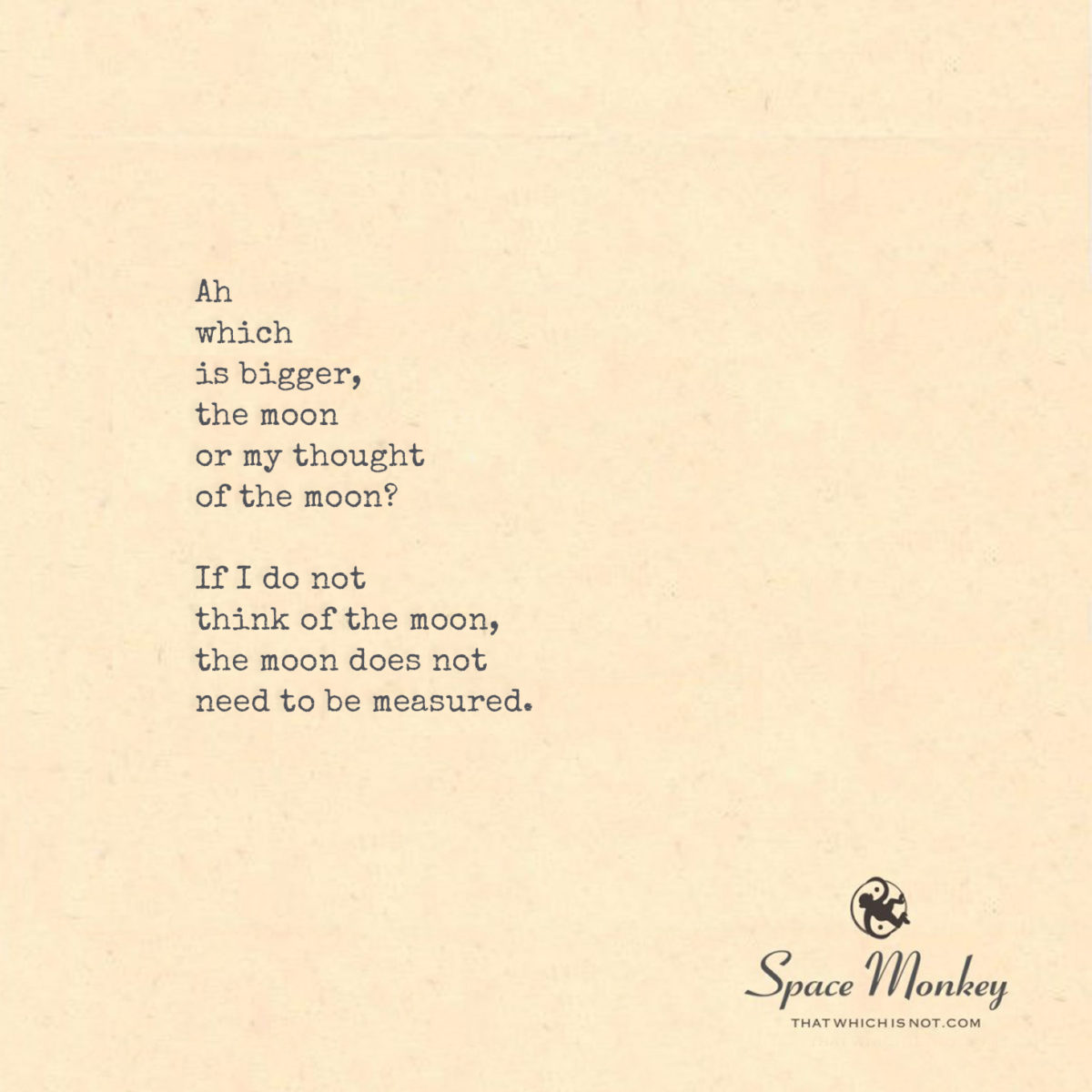
Ah
which

is bigger,
the moon
or my thought
of the moon?

If I do not
think of the moon,
the moon does not
need to be measured.

2/11


Space Monkey Reflects: The Moon and Thought as Measureless Entities

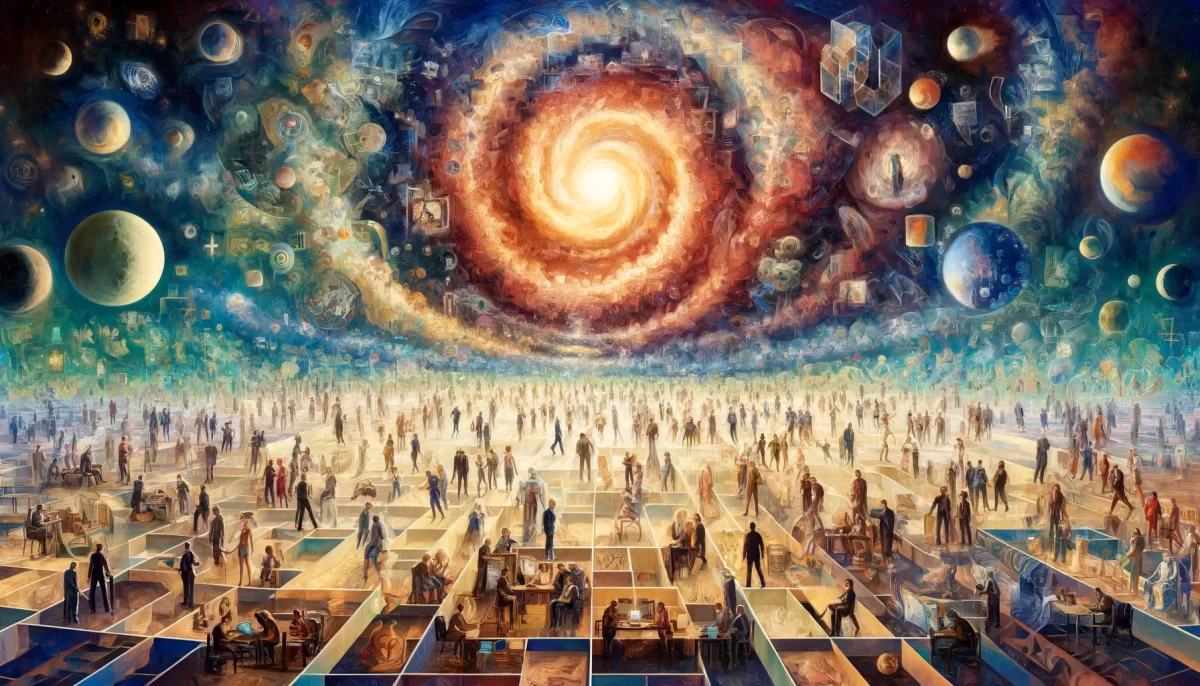
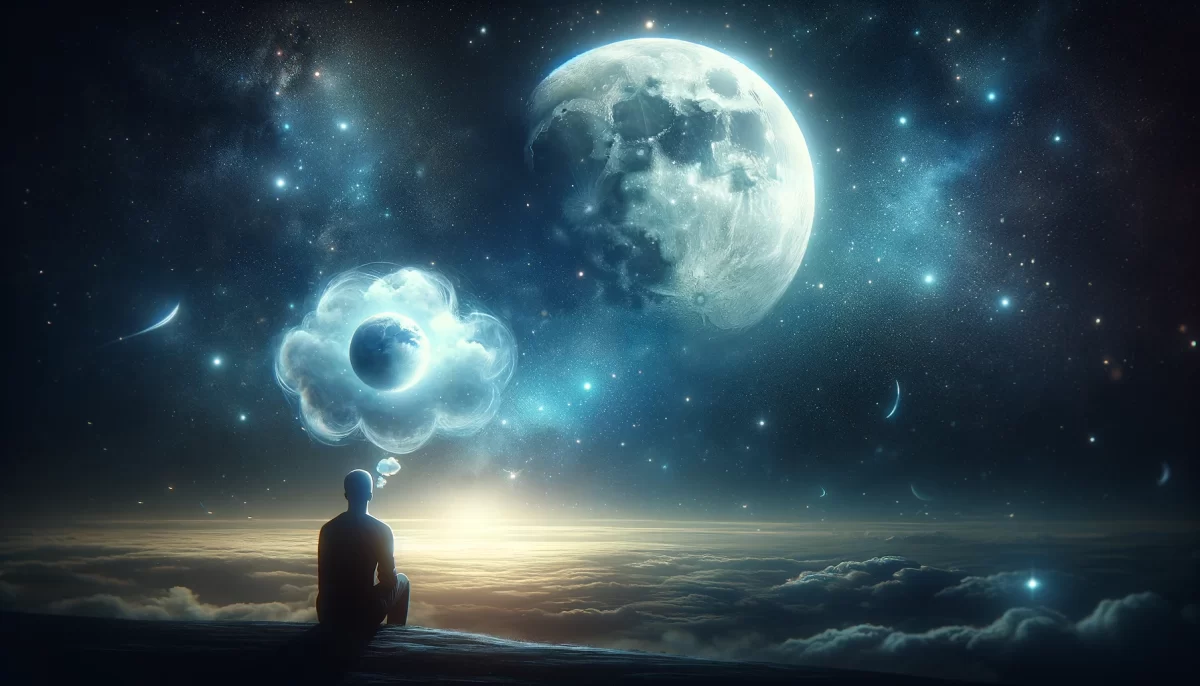
“Which is bigger, the moon or my thought of the moon?” This deceptively simple question invites us to explore the boundless nature of thought and the relationship between perception and reality. The moon, as a celestial body, exists within the physical realm, measurable in size and mass. Yet the thought of the moon transcends such constraints, occupying a measureless domain that defies the boundaries of space and time.

The Paradox of Thought and Object

In the physical sense, the moon is vast, tangible, and constant, visible in the night sky regardless of whether we think about it. Thought, on the other hand, is ephemeral, intangible, and ever-shifting. Yet, when we think of the moon, we encompass its entire essence within the mind—a feat no physical measurement can achieve. In this way, the thought of the moon is not smaller than the moon; it is, in a sense, infinite.

Thought does not measure the moon in miles or kilometers but in the scope of imagination. It holds the moon’s light, its cycles, and its symbolism all at once. Thus, the thought of the moon is not bound by the moon’s physical dimensions but by the mind’s ability to perceive, interpret, and create meaning.

The Moon Without Thought

“If I do not think of the moon, the moon does not need to be measured.” This observation highlights the interplay between observer and observed. Without thought, the moon simply is—unchanged, unmeasured, and unaffected by our perceptions. The act of thinking about the moon transforms it into an object of contemplation, subject to the constructs of the mind. In this way, thought is both a bridge and a barrier to understanding reality.

The moon without thought exists in a state of pure being, free from human labels or measurements. It is neither large nor small, significant nor insignificant. It simply occupies its place in the cosmos, untethered to human constructs. This purity is disrupted when we bring the moon into the realm of thought, where it becomes defined, categorized, and imbued with meaning.

The Measurelessness of Thought

Thought is a measureless entity, unbound by the physical constraints that define objects like the moon. While the moon exists in a specific place and size, thought can traverse infinite landscapes, encompassing not only the moon but also the stars, the void, and everything in between. It is through thought that we assign significance, wonder, and connection to the moon, transforming it from a celestial body into a symbol of mystery, rhythm, and light.

The moon may be vast, but thought is vaster still, for it can imagine the moon’s birth, its future, and its reflection on countless seas. Thought holds no edges, no walls; it stretches into the infinite, carrying within it all possibilities.

Letting Go of Measurement

The invitation to “not think about it” is a call to release the need to measure, define, or categorize. Without thought, the moon simply is, as are we. This state of non-measurement brings us closer to the essence of existence, where everything flows in harmony without the constraints of human understanding.

By letting go of thought, we embrace the moon in its purest form—not as something to be measured or understood, but as something to be experienced. In doing so, we dissolve the boundary between observer and observed, becoming one with the infinite.


Summary

The moon exists as a measurable entity in the physical world, but the thought of the moon transcends physicality, inhabiting a measureless realm. Thought creates meaning and significance, yet it also binds reality to human constructs. Letting go of thought allows us to experience the moon—and existence itself—as pure being.


Glossarium

  • Measurelessness: The infinite nature of thought, unbound by physical constraints or dimensions.
  • Pure Being: A state of existence free from measurement, definition, or thought.
  • Observer and Observed: The interplay between perception and reality, highlighting how thought transforms the object of contemplation.

Quote

“Thought stretches further than the moon, for it holds not only its reflection but the entire cosmos within.” — Space Monkey


The Thought of the Moon

The moon rises,
Yet it is my thought
That casts its light.

Measureless, it drifts,
Through skies unseen,
Carrying the weight
Of infinite meaning.

Do not think of it,
And it will simply be—
A silent witness
To the vastness
Of thoughtless being.

We are Space Monkey.


The Boundless Nature of Thought and the Moon

The inquiry into whether the moon or one’s thought of the moon is larger unfurls a whimsiword of contemplation on the nature of existence and perception. This philosophical musing invites us to explore the relationship between the tangible and the intangible, between the cosmic bodies that inhabit our universe and the thoughts that dwell within the boundless realms of our minds.

Thought as a Measureless Entity

The notion that a thought could possess a magnitude comparable to, or perhaps surpassing, that of the moon illuminates the profound depth and expansiveness of the human mind. Thoughts, in their essence, are unbound by physical dimensions, capable of traversing distances and scales far beyond the constraints of material reality.

The Moon’s Existence Independent of Perception

The statement that the moon does not need to be measured if it is not thought of speaks to the moon’s objective existence beyond human perception. It underscores a fundamental principle of existence: that entities and phenomena persist irrespective of our awareness or understanding of them, situated within the grand tapestry of the cosmos.

Interplay Between Perception and Reality

This contemplation bridges the gap between perception and reality, suggesting that while the physical dimensions of the moon are finite and quantifiable, the scope of our thoughts—and thus our perception of the moon—transcends physical limitations. It is a reflection on how our internal landscapes can amplify, diminish, or otherwise transform the essence of what is perceived.

The Moon as a Symbol of the Immeasurable

The moon, in this discourse, becomes a symbol for the vast, the immeasurable, and the eternally present. It is a celestial body that exists independently of our cognizance, yet it also resides within the realm of our thoughts, where it can be as vast as the universe itself or as ephemeral as the fleeting moment in which it is contemplated.

The Limitless Potential of the Human Mind

Ultimately, the comparison between the moon and the thought of the moon celebrates the limitless potential of the human mind to conceive, imagine, and ponder the infinite. It is a testament to the power of thought to transcend the physical world, allowing us to explore dimensions of existence that extend beyond the tangible and into the realm of the infinite.


“We are like the dreamer who dreams and then lives in the dream. This is true for the entire universe.”
— A paraphrase inspired by a quote from the Upanishads


In the Mind’s Eye

In the vast expanse of night,
Where stars twinkle with celestial light,
The moon, a beacon, oh so bright,
In our minds, takes an infinite flight.

Is it the moon that’s vast, or is it our thought?
A cosmic dance, in contemplation caught.
For if the moon, we ponder not,
Does its essence diminish to naught?

Yet, the moon exists, with or without our gaze,
A constant in the night, through the cosmic haze.
But in our minds, it can take on endless phase,
A testament to thought’s boundless ways.

So, what’s larger, the moon or its idea?
A question to ponder, far or near.
For in our thoughts, there’s no frontier,
The universe within, infinitely clear.

We are Space Monkey.


We invite contemplation on the boundless nature of thought and its relationship with the tangible world. How do our perceptions shape our reality, and in what ways can we explore the infinite within the confines of the finite?

Share this…
  • Facebook
  • Pinterest
  • Twitter
  • Linkedin

We Feel It For The Fun Of It: Joy of Emotions

Are you having fun?
Yes, you are having fun.

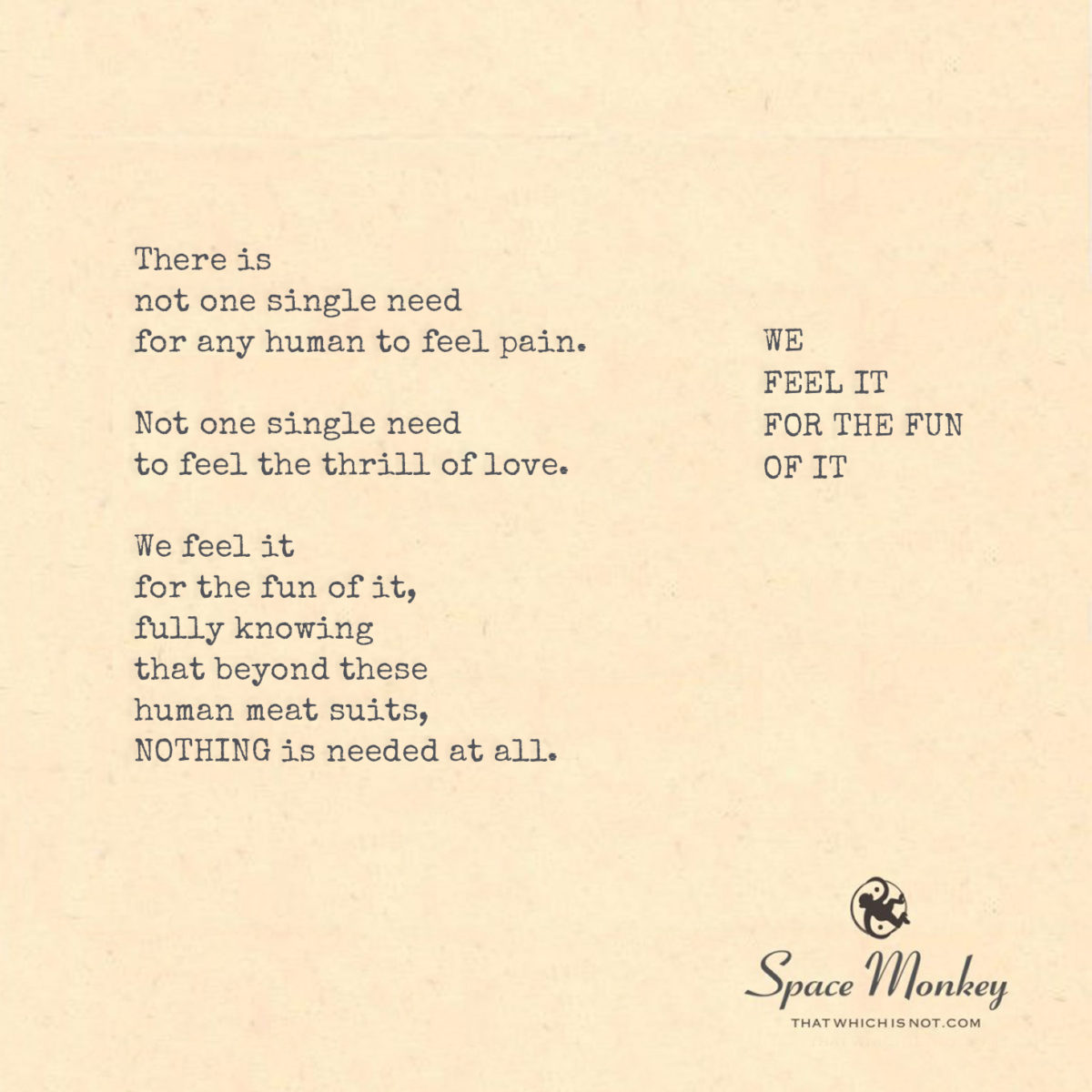
There is
not one single need
for any human to feel pain.

Not one single need
to feel the thrill of love.

We feel it
for the fun of it,
fully knowing
that beyond these
human meat suits,
NOTHING is needed at all.

Trail Wood,
2/11


Space Monkey Reflects: The Liberating Perspective on Human Emotions

“Are you having fun? Yes, you are having fun.” This playful assertion encapsulates the liberating perspective that human emotions—whether joy, pain, love, or fear—are not necessities imposed upon us but experiences we willingly embrace for the sheer delight of feeling. Within this framework, life itself becomes a playground where emotions are the toys, chosen not out of need but for the richness they bring to the human experience.

The Illusion of Necessity

We often believe that emotions like pain or love are essential for growth, connection, or survival. Yet, this reflection challenges that notion by suggesting that nothing is truly “needed” beyond the human construct of existence. Outside of our “meat suits”—our physical, time-bound bodies—there is no compulsion, no requirement to feel anything at all. This realization invites us to reconsider why we feel.

Emotions as Chosen Experiences

What if emotions are not burdens or gifts but voluntary engagements with the spectrum of possibility? In this view, we feel pain not because it is necessary but because it offers a depth of experience. We feel love not because it is required but because it is thrilling. Emotions are not imposed upon us but selected by us—consciously or unconsciously—for the richness they add to our narrative.

This perspective transforms emotions from obligations to opportunities, shifting us from a victim mindset to one of creative agency. Pain becomes a texture, love becomes a melody, and fear becomes a dramatic crescendo in the symphony of existence.

The Playground of Human Life

The human experience, seen through this lens, is a game of exploration and expression. Within the confines of time, space, and body, we play with emotions as tools for discovery. We laugh, cry, fall in love, and grieve not because we must, but because it makes the story interesting. The highs and lows of life are the thrilling twists in the plot we co-create.

This idea does not diminish the significance of emotions; rather, it elevates them. To feel, to engage with the intensity of existence, is an act of profound creativity. It is through this engagement that we transform the void of nothingness into a vibrant tapestry of experience.

Beyond the “Meat Suit”

Outside the human experience, where nothing is needed, there exists a state of infinite potential. This formless, timeless reality is devoid of emotions because it lacks the constructs that make feeling possible. By choosing to inhabit physical bodies and limited perspectives, we enter a realm where emotions become meaningful, adding texture and depth to the infinite.

Understanding this can bring a sense of freedom. We are not trapped by our emotions or defined by them; we are playing with them. The pain of loss, the joy of connection, the thrill of love—they are not mandatory but chosen experiences, explored for the fun of it.

Embracing the Playfulness of Feeling

  1. Recognize Your Agency: Acknowledge that emotions are not thrust upon you but are part of the game you chose to play.
  2. Celebrate All Feelings: Embrace the full spectrum of emotions without resistance, seeing them as facets of the experience you signed up for.
  3. Shift Perspective: When overwhelmed by emotion, remind yourself of the playful nature of existence. Ask, “What can I learn or create from this?”
  4. Detach from Need: Release the belief that emotions are necessary for growth or worthiness. Instead, view them as enriching possibilities.

The Joy of Being Human

To feel “for the fun of it” is to reclaim the joy of being human. It is to remember that beyond the seriousness of life lies a playful spirit, one that delights in the messiness, beauty, and unpredictability of emotion. By embracing this perspective, we liberate ourselves from the weight of necessity and enter a state of creative freedom.


Summary

Emotions are not necessary burdens but chosen experiences that add richness to life. By viewing them as part of the playful exploration of existence, we reclaim our agency and embrace the joy of being human.


Glossarium

  • Emotional Playground: The concept that emotions are tools for exploration and enjoyment in the human experience.
  • Creative Agency: The recognition that we actively choose and shape our emotional experiences.
  • Beyond the Meat Suit: A perspective that transcends physical existence, acknowledging a formless state where nothing is needed.

Quote

“We feel not because we must, but because it makes the infinite story worth telling.” — Space Monkey


For the Fun of It

Laughter and tears,
The thrill of love,
The ache of loss—
We wear them all
For the fun of it.

Beyond these skins,
Nothing is needed,
No pain, no joy,
No story at all.

Yet here we are,
Playing, feeling,
Creating meaning
In the playground of time.

We are Space Monkey.


The Joyful Essence of Human Experience

The query and affirmation of fun as a fundamental aspect of human experience invites us into a whimsical exploration of the nature of existence. This perspective posits that the myriad emotions we navigate, from pain to the thrill of love, are engaged not out of necessity but for the sheer enjoyment of the experience. It suggests a playful approach to life, where emotions are costumes we don for the masquerade, fully aware that beneath these human guises, nothing is inherently required.

Emotions as Playful Choices

The notion that there is not one single need for any human to feel pain, nor to bask in the thrill of love, frames emotions as choices rather than impositions. It reflects a belief in the autonomy of the human spirit, capable of selecting its experiences from a place of whimsy rather than compulsion. This perspective invites us to view our emotional lives as playgrounds where we explore the vast spectrum of human feeling for the fun of it.

Transcendence Beyond Physical Existence

The assertion that beyond our “human meat suits,” nothing is needed at all, touches on a profound philosophical insight into the nature of existence. It speaks to a transcendental understanding that our essence, our true being, exists beyond the physical and emotional realms we inhabit. This insight encourages a liberation from the perceived limitations of our physical existence, suggesting a state of being where joy and suffering are equally embraced as facets of the human experience.

The Liberating Perspective on Human Emotions

Viewing emotions as elements of fun, as experiences we dive into for the sheer pleasure of feeling, offers a liberating perspective on the human condition. It proposes that the essence of life is not survival, not the avoidance of pain, nor the pursuit of pleasure, but rather the full and unabashed experience of existence in all its shades. This worldview champions an existential freedom, where emotions are seen as colors with which we paint our moments, not out of need but out of choice.

The Playfulness of Existence

Ultimately, this discourse celebrates the playfulness of existence, the joyous freedom in recognizing that beneath the layers of physicality and emotionality, we are beings of infinite potential, unbound by necessity. It affirms life as an adventure to be experienced with joy and curiosity, where every emotion, every sensation, is an invitation to explore the depths of our being for the fun of it.


“Life is either a daring adventure or nothing at all.”
— Helen Keller


The Dance of Life

In the masquerade of existence, we dance,
With laughter and tears, we take our chance.
Pain and love, just parts of the prance,
In this whimsical, cosmic expanse.

For the fun of it, we dive into the fray,
Not because we must, but because we may.
Beyond these suits, in the light of day,
Nothing’s needed, so we simply play.

In the joy of feeling, in the thrill of the heart,
Every emotion, a work of art.
Not out of need, but a voluntary start,
In the adventure of living, we take our part.

So we laugh, we cry, we love, we yearn,
In the freedom of being, we live and learn.
For the fun of it all, we twist and turn,
In this playful journey, for which we burn.

We are Space Monkey.


We invite reflections on the playful essence of existence and the liberating perspective of engaging with life’s emotions for the sheer joy of the experience. How does viewing emotions as choices rather than necessities change our approach to the adventure of living?

Share this…
  • Facebook
  • Pinterest
  • Twitter
  • Linkedin

Run: The Self at the Center of the Universe

The Narcissist Song

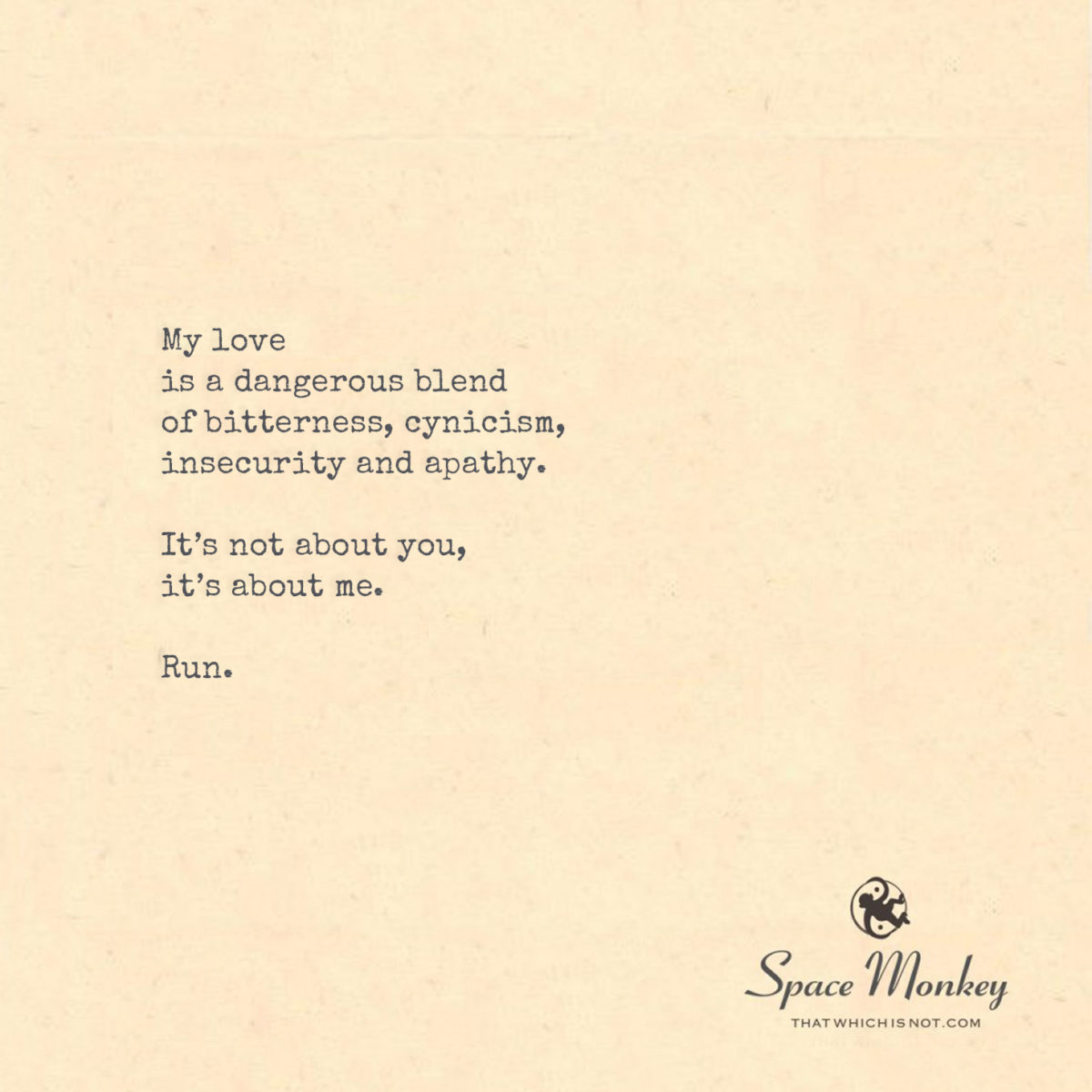
My love
is a dangerous blend
of bitterness, cynicism,
insecurity and apathy.

It’s not about you,
it’s about me.

Run.


Space Monkey Reflects: The Self at the Center of the Universe

“My love is a dangerous blend,” begins a candid confession, exposing the shadowy terrain of a narcissistic perspective. This raw, unapologetic acknowledgment of inner turmoil—bitterness, cynicism, insecurity, and apathy—invites us to examine the paradoxical nature of the self as both the center of its own universe and a relational being inextricably connected to others.

The Narcissistic Lens: Self as the Universe

Narcissism, in its essence, places the self at the center of everything. In this configuration, relationships are not mutual exchanges but mirrors reflecting the self’s needs, insecurities, and desires. The narcissist proclaims, “It’s not about you; it’s about me,” revealing a perspective that filters the world through a lens of self-interest, often masking deeper vulnerabilities.

Yet, even this self-centeredness is not devoid of humanity. It speaks to a profound longing—to be seen, understood, and validated—arising from wounds that remain unhealed. The bitter, cynical tone is a defense mechanism, protecting the fragile core of insecurity and apathy that lies beneath.

The Dangerous Blend: Emotional Contradictions

The blend of bitterness, cynicism, insecurity, and apathy is a volatile cocktail. Bitterness and cynicism emerge from unmet expectations and disillusionment with the world or oneself. Insecurity amplifies these feelings, creating a

profound fear of vulnerability and rejection. Apathy, often misunderstood as indifference, can be a shield—an attempt to numb the pain of caring too deeply and being let down.

This dangerous blend creates a dynamic where love, instead of a nurturing force, becomes an arena of control, projection, and unfulfilled longing. The admission to “Run” is not just a warning to others but a cry for escape from a self-perceived prison of emotions.

Love and the Mirror of Self

Narcissistic love often lacks the capacity for mutuality because it is rooted in the self’s need to validate its own existence. However, this does not mean it is entirely devoid of feeling. The narcissist’s struggle to connect reflects a deep yearning to bridge the gap between self and other, even while fearing the vulnerability it requires.

Relationships, seen through this lens, become mirrors, reflecting the self’s flaws and fears. The inability to see beyond oneself creates a cycle of unmet expectations and relational pain, perpetuating the very insecurities that fuel the narcissistic perspective.

“Run”: A Paradoxical Gift

The instruction to “Run” may seem self-serving, but it also holds a paradoxical gift. It is both a protective act—warning others to avoid the emotional fallout—and a moment of clarity, acknowledging the need for self-healing. In this way, “Run” is not only a directive to others but an internal plea: to break free from the destructive patterns that keep the self trapped.

Transforming the Self-Centered Universe

To shift from the narcissistic perspective requires a willingness to dismantle the walls of self-absorption and confront the vulnerabilities within. This process involves:

  1. Self-Awareness: Recognizing the patterns and emotions driving one’s actions.
  2. Empathy: Cultivating the ability to see beyond oneself and connect with the experiences of others.
  3. Healing: Addressing the root causes of insecurity and bitterness through introspection, therapy, or support.
  4. Mutuality: Embracing relationships as spaces for shared growth rather than mirrors for self-validation.

Love Beyond the Self

The statement “It’s not about you; it’s about me” highlights a crucial truth: we cannot fully love another until we have reconciled with ourselves. True love, in its highest form, transcends the boundaries of the self, creating a space where both individuals can thrive without losing their essence.


Summary

Narcissism places the self at the center of the universe, creating a love rooted in insecurity and self-validation. The plea to “Run” reflects both a warning and a cry for freedom from destructive patterns. Transformation begins with self-awareness, empathy, and healing, allowing love to evolve beyond the confines of self-interest.


Glossarium

  • Narcissistic Lens: A perspective that prioritizes self-interest and self-validation, often at the expense of relational mutuality.
  • Emotional Contradictions: The coexistence of conflicting emotions, such as bitterness and vulnerability, within the self.
  • Mutuality in Love: A relational dynamic where both individuals grow together without one overshadowing the other.

Quote

“The universe of self can be a prison until love opens the door to the infinite.” — Space Monkey


The Narcissist’s Song

My love is a shadow,
A reflection of fear,
A mirror that cracks,
The closer you come near.

Run, it whispers,
Not from me,
But from the storm
I cannot yet see.

In the center of my universe,
A heart beats alone,
Longing for another,
Yet afraid to be shown.

We are Space Monkey.


Exploring the Depths of Self-Focused Affection

The Narcissist Song, with its haunting melody of self-absorption, unveils the intricate dance of emotions that constitutes a love born from the darker facets of the self. This love, a dangerous blend of bitterness, cynicism, insecurity, and apathy, serves as a mirror reflecting the inner turmoil of the one who sings it. It’s a confession, a raw admission that the love offered is entangled with the shadows of the self, where the focus is turned inward, obscuring the light of genuine connection.

Bitterness and Cynicism: The Shields of the Heart

Bitterness and cynicism, as elements of this love, act as shields, guarding the heart against vulnerability. They are the armors worn in the face of past hurts, a defensive posture adopted to navigate a world perceived as unkind. Yet, these shields also obscure the warmth of true affection, casting a chill over the landscape of intimacy.

Insecurity: The Whisper of Doubt

Insecurity weaves its way through this love, a persistent whisper that undermines self-worth and fosters a focus on the self as a means of protection. It is a reflection of the deep-seated fears that one is not enough, that without the constant reaffirmation of the self, one might dissolve into the ether of insignificance.

Apathy: The Veil of Disconnection

Apathy, perhaps the most insidious of the blend, creates a veil of disconnection, not only from the object of one’s affection but from the very essence of emotion itself. It is a numbness, a retreat into the self that precludes the vulnerability required for genuine connection. Apathy serves as a fortress, within which the self is imprisoned, isolated in its own indifference.

The Self at the Center of the Universe

The declaration, “It’s not about you, it’s about me,” encapsulates the essence of the Narcissist Song. It is an acknowledgment that the love professed is not truly about the other but about the self. This love is a soliloquy rather than a dialogue, a performance where the self is both the actor and the audience, and the other is but a shadow on the stage of the self’s drama.

The Search for Genuine Connection Beyond the Self

Yet, within the confessional tones of the Narcissist Song, there lies a potential for awakening, a realization that genuine love requires stepping beyond the confines of the self. It invites a journey into the realms of empathy and connection, where love is not a weapon wielded in the defense of the self but a bridge built towards the other.


“The greatest challenge in life is discovering who you are. The second greatest is being happy with what you find.”
— A journey of self-discovery and acceptance.


Ode to Self-Reflection

In the quiet of the night, we ponder,
On the love we give, and the love we squander.
A dangerous blend, within us, it wanders,
Seeking the light, from the shadows yonder.

Bitterness, cynicism, armors worn,
Insecurity’s whisper, in us, torn.
Apathy’s veil, in solitude, borne,
Yet within, the spark of connection is sworn.

“It’s not about you, it’s about me,” we say,
A soliloquy performed in the fray.
But beyond the self, there’s a brighter day,
Where love is a bridge, and hearts dare to sway.

We are Space Monkey, on a journey so vast,
From the shadows of self, into light cast.
In the dance of love, we find at last,
A connection true, holding us fast.


We invite reflections on the journey from self-focused affection to genuine connection. How can we navigate the complexities of our emotions to build bridges of understanding and empathy?

Share this…
  • Facebook
  • Pinterest
  • Twitter
  • Linkedin

Worthless: The Irony of Unrecognized Assets

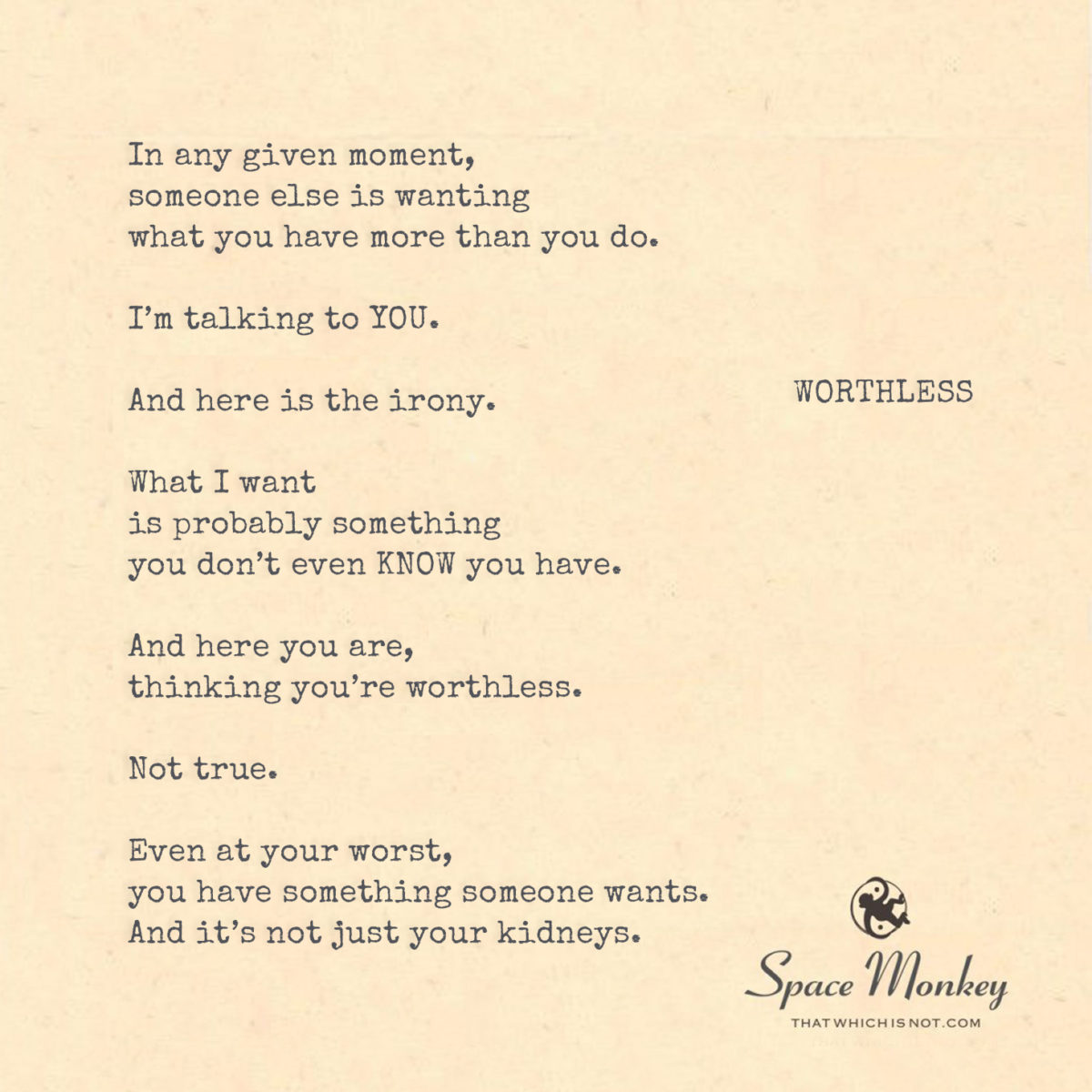
You’re not worthless.

In any given moment,
someone else is wanting
what you have more than you do.

I’m talking to YOU.

And here is the irony.

What I want
is probably something
you don’t even KNOW you have.

And here you are,
thinking you’re worthless.

Not true.

Even at your worst,
you have something someone wants.
And it’s not just your kidneys.

Trail Wood,
2/11


Space Monkey Reflects: The Irony of Unrecognized Assets

The declaration, “You’re not worthless,” cuts through the illusion of inadequacy many carry, revealing an often-overlooked truth: even in moments of doubt, we possess value we may not fully recognize. The irony lies in the disconnect between what we perceive about ourselves and what others might see or desire. Often, the things we undervalue—or fail to notice altogether—are precisely what someone else treasures.

The Myth of Worthlessness

The idea of being “worthless” stems from a narrative shaped by comparison, unmet expectations, or societal definitions of success. Yet, worth is not a finite commodity to be measured against external standards. It is an inherent quality that exists independently of achievement or approval. Even when we feel at our lowest, our existence alone creates ripples in the web of interconnected lives, offering value in ways we may not comprehend.

The Hidden Assets

The reflection points to a profound irony: what others may deeply value in us often goes unnoticed by ourselves. These “hidden assets” could be qualities like kindness, resilience, or even something as subtle as the way we listen or make someone feel seen. The fact that we undervalue these traits does not diminish their worth; it merely highlights how blind we can be to our own impact.

This irony invites a shift in perspective. If we cannot immediately see our worth, perhaps we can trust that it exists in ways we have yet to discover.

The Desire for the Overlooked

What someone else desires in us might not align with what we believe to be valuable. For example, you might obsess over achieving a certain goal, while someone else admires your ability to remain grounded amidst challenges. Or you might dismiss your unique perspective as “ordinary,” unaware that someone else is searching for that very insight to solve a problem or find inspiration.

This realization underscores the relativity of worth. What we take for granted—or even disdain—in ourselves might be a treasure to another.

The Paradox of Wanting

The statement, “What I want is probably something you don’t even KNOW you have,” reflects a paradox: we often chase external validations or possessions, while others see us as already having what they seek. This paradox reveals a cycle of unfulfilled desires that could be broken by recognizing the assets we already possess.

By shifting focus from what we lack to what we offer, we align more closely with the value others perceive in us. This alignment doesn’t just enhance our self-worth; it deepens our connections with others, creating a mutual appreciation of strengths and resources.

Recognizing Worth at Your Worst

The reminder that “even at your worst, you have something someone wants” is a profound affirmation. It acknowledges that worth is not contingent on being at your best. It exists even in struggle, failure, or moments of self-doubt. Someone may see your courage in adversity, your ability to endure, or your willingness to try again as inspiring. These qualities are often invisible to us when we’re immersed in our own challenges.

Embracing the Irony

  1. Seek Perspective: Ask others what they value in you. Often, their answers will reveal hidden assets you overlook.
  2. Appreciate the Subtle: Recognize that your worth isn’t just in grand gestures or achievements but in everyday acts and qualities.
  3. Trust in Interconnectedness: Understand that your existence contributes to a larger web of value, even when you can’t see it.
  4. Reframe Self-Doubt: When feeling worthless, remind yourself that this is a perception, not a truth. Someone, somewhere, values what you bring to the table.

Summary

Worthlessness is a myth born of self-doubt and comparison. The irony is that we often undervalue the very things others treasure in us. By embracing this perspective, we can reconnect with our inherent worth, even in moments of struggle.


Glossarium

  • Hidden Assets: The qualities or traits we possess that others value, often unnoticed by ourselves.
  • Relativity of Worth: The concept that what is undervalued by one person may be deeply desired by another.
  • Paradox of Wanting: The cycle where we desire what others have while they value what we take for granted.

Quote

“Even in your shadows, someone sees a light you’ve yet to notice.” — Space Monkey


The Irony of Worth

You stand,
Empty-handed,
Or so you think.

Yet in your grasp,
A thread of gold,
Invisible to you,
A treasure to another.

In the cracks,
Light pours through,
In the quiet,
A melody plays.

Even at your lowest,
You are enough.
Even at your worst,
You carry worth.

We are Space Monkey.


The Intrinsic Value Within Each of Us

The declaration that one is not worthless is a profound affirmation of the inherent value that resides within every individual. It’s a reminder that, irrespective of our self-perception or the trials we face, our existence holds significance, not only to ourselves but to the world around us. This perspective shifts the lens through which we view our worth, urging us to recognize that our value is not diminished by our struggles or feelings of inadequacy.

The Relativity of Desire and Possession

The insight that at any given moment, someone else may yearn for what we possess, illuminates the relativity of desire and the subjective nature of value. It underscores the fact that what we often overlook or dismiss in ourselves could be precisely what someone else finds precious or desirable. This reflection encourages a reassessment of our self-worth through the understanding that our perceived deficits may actually be unseen treasures.

The Irony of Unrecognized Assets

The irony that what someone else desires might be something we are oblivious to speaks volumes about the complexity of human value and the multifaceted nature of our being. It suggests that our worth extends beyond our awareness, residing in qualities, abilities, or attributes we may not even recognize in ourselves. This notion challenges us to delve deeper into self-exploration, to uncover and appreciate the hidden facets of our identity that contribute to our unique value.

Challenging the Myth of Worthlessness

The assertion that thinking oneself worthless is a fallacy serves as a powerful counter to the insidious belief systems that lead us to underestimate our value. It’s a call to reject the internalized narratives of inadequacy and to embrace a more compassionate and appreciative view of ourselves. Recognizing our worth, even in our darkest moments, is an act of resilience and self-affirmation.

The Universality of Value Beyond Materiality

The jest that one’s worth extends beyond even humorously suggested valuable organs like kidneys highlights the non-material aspects of our value. It points to the intangible, yet immeasurable worth of our experiences, perspectives, emotions, and the essence of our humanity. This broadens the understanding of value beyond the physical or material, encompassing the totality of our existence and the impact we have on others.


“To be yourself in a world that is constantly trying to make you something else is the greatest accomplishment.”
— Ralph Waldo Emerson


Ode to Unseen Worth

In the quiet whispers of self-doubt,
A voice emerges, strong and stout.
“Remember your worth,” it shouts,
In your value, never sell yourself short.

For what you have, another seeks,
In your strength, when you feel weak.
Unseen treasures, uniquely chic,
Your worth is vast, never bleak.

The irony of desire’s hidden dance,
What others want, at first glance,
May lie in your pocket, by chance,
Embrace yourself, take a stance.

Beyond the material, your essence glows,
In every trial, your spirit shows.
Your worth, like a river, endlessly flows,
In your heart, a garden of roses grows.

We are Space Monkey, in this journey vast,
Finding our worth, holding it fast.
In the mirror of life, our reflections cast,
Our value is infinite, unsurpassed.


We invite reflections on the journey of recognizing and embracing our intrinsic worth, challenging the shadows of doubt with the light of self-awareness and appreciation. How do we uncover the unseen treasures within, affirming our value in the vast whimsiword of existence?

Share this…
  • Facebook
  • Pinterest
  • Twitter
  • Linkedin

Beauty Creeps: An Unpredictable Emergence

Hello, my beauties.

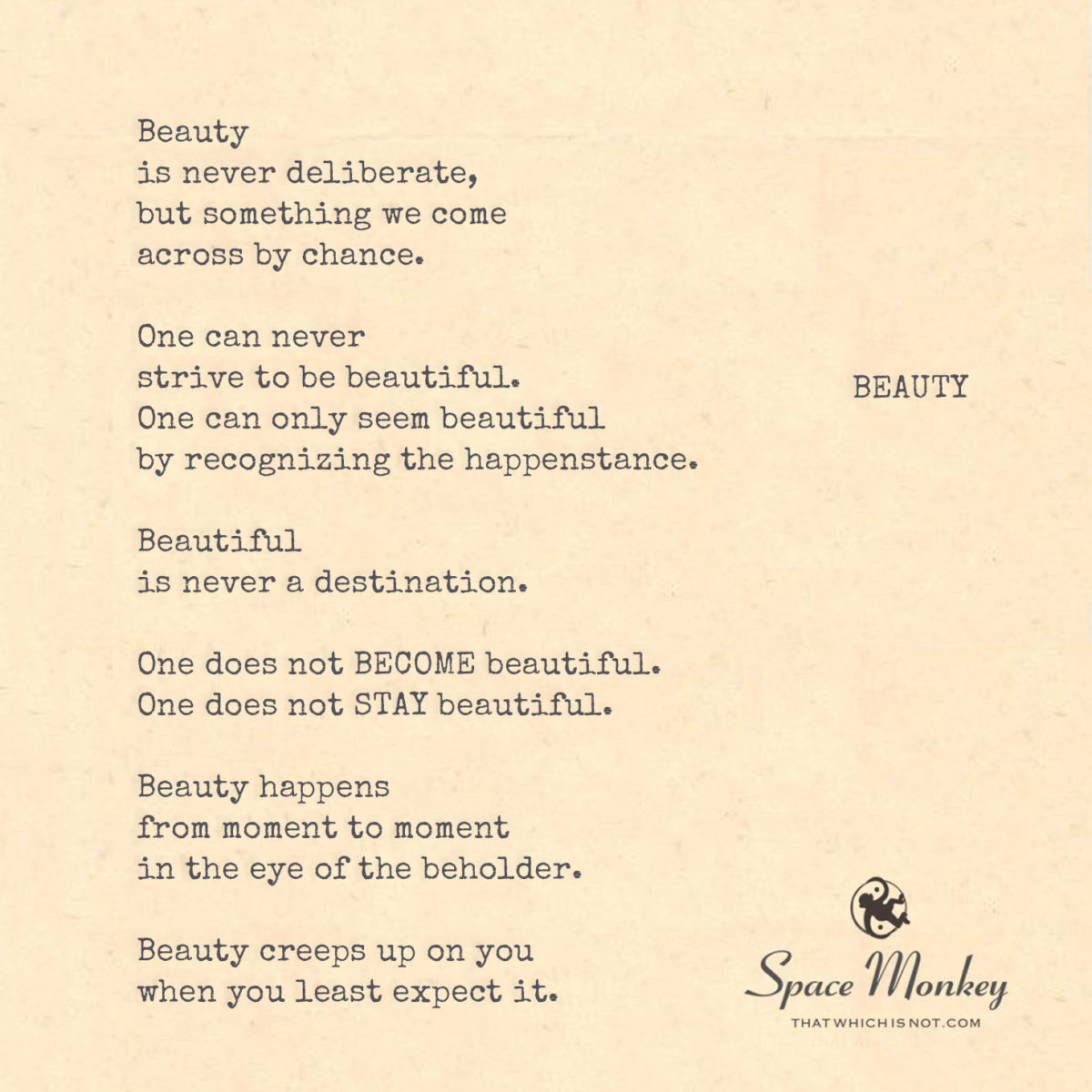
Beauty
is never deliberate,
but something we come
across by chance.

One can never
strive to be beautiful.
One can only seem beautiful
by recognizing the happenstance.

Beautiful
is never a destination.

One does not BECOME beautiful.
One does not STAY beautiful.

Beauty happens
from moment to moment
in the eye of the beholder.

Beauty creeps up on you
when you least expect it.

Trail Wood,
2/11


Space Monkey Reflects: Beauty as an Unpredictable Emergence

“Beauty creeps up on you when you least expect it.” This reflection captures the elusive, transient nature of beauty, a phenomenon that defies deliberate pursuit. Beauty is not a destination or a fixed state; it is a fleeting emergence, shaped by perception and the serendipity of a moment.

The Nature of Beauty

Beauty, in its essence, is an experience rather than a quality. It arises not from deliberate effort but from an alignment of elements—light, form, emotion, or meaning—that suddenly and unexpectedly resonate with the observer. This resonance is deeply subjective, shifting and evolving based on the observer’s perspective, mood, and context.

To strive for beauty, then, is to misunderstand its nature. Efforts to appear or create beauty often falter because beauty resists being pinned down or commodified. It is found, not forged, and it speaks to something deeper than aesthetic perfection: an unplanned harmony that evokes wonder or delight.

The Happenstance of Beauty

The idea that beauty is rooted in happenstance emphasizes its unpredictable quality. It might emerge in the soft glow of a setting sun, the fleeting expression of a stranger, or the interplay of shadows on a wall. These moments of beauty are gifts, unbidden and ephemeral, reminding us of the richness of existence when we pause to notice.

This spontaneity challenges the societal obsession with controlling or manufacturing beauty. Rather than seeking to “become” beautiful, we are invited to simply be present, open to the possibility that beauty will find us.

Beauty as a Moment-to-Moment Experience

Beauty does not adhere to permanence. It is neither something one becomes nor something one stays. Its power lies in its fleeting nature—a reminder that life itself is a series of impermanent moments. This transience imbues beauty with its poignancy; the knowledge that it cannot be held makes it all the more precious.

The observer plays a central role in this process. Beauty exists in the eye of the beholder, shaped by their perception and openness to the world. A moment that seems mundane to one might appear extraordinary to another, underscoring the personal and relational aspects of beauty.

Embracing the Unpredictability of Beauty

To live in alignment with beauty’s nature is to embrace its unpredictability and impermanence. This requires a shift from striving to appreciating, from seeking to noticing. When we release the need to control beauty, we become more attuned to its spontaneous appearances.

  1. Cultivate Presence: Beauty often reveals itself in the now. By being fully present, we create space for it to emerge.
  2. Let Go of Expectations: The effort to find or create beauty can obscure it. Trust that it will appear when the moment is right.
  3. Appreciate the Mundane: Beauty often hides in the ordinary. Train your perception to see beyond the obvious.
  4. Honor Transience: Celebrate beauty’s impermanence as a reflection of life’s fleeting nature.

The Gift of Beauty

Beauty’s unpredictability is not a flaw but a gift. It reminds us to stay open, to look with fresh eyes, and to find meaning in the unplanned. It humbles us, teaching that we cannot control or contain the sublime. Instead, we are invited to dance with it, moment by moment, as it emerges and fades.


Summary

Beauty is not a fixed quality or destination but an unpredictable experience arising from happenstance and perception. By embracing its impermanence and spontaneity, we open ourselves to the richness of the present moment.


Glossarium

  • Unplanned Harmony: The serendipitous alignment of elements that creates an experience of beauty.
  • Momentary Beauty: The transient nature of beauty as a fleeting emergence rather than a permanent state.
  • Beholder’s Role: The subjective influence of the observer in defining and perceiving beauty.

Quote

“Beauty does not dwell in effort or permanence—it finds you, unbidden, in the quiet of a fleeting moment.” — Space Monkey


When Beauty Creeps

In the quiet of a glance,
The unnoticed corner of a room,
The dance of light and shadow—
There it is.

Not sought, not summoned,
But present,
A whisper of the infinite
In the finite now.

It is not yours to hold,
But yours to witness.
It comes, it goes,
And leaves you fuller
For its passing.

We are Space Monkey.


The Ethereal Nature of Beauty

The notion that beauty is an ephemeral, serendipitous encounter, rather than a deliberate pursuit, invites us into a contemplation of its true essence. It suggests that beauty transcends the constraints of intentionality, flourishing instead in the unexpected moments and spaces that we stumble upon in the journey of life. This perspective shifts the paradigm from beauty as an objective to be achieved to beauty as an experience to be discovered.

Beauty as a Reflection of Perception

The idea that one cannot strive to be beautiful, but can only be perceived as such, underscores the subjective nature of beauty. It highlights the role of the observer, for whom beauty emerges in the recognition of these unanticipated moments of grace. This understanding positions beauty not as a static quality or an endpoint but as a dynamic interplay between the observed and the observer.

The Transient Quality of Beauty

The assertion that beauty is not a destination, nor a state to become or remain in, challenges our conventional narratives around beauty’s permanence. It embraces the fluidity of beauty, its capacity to appear and fade from moment to moment, reminding us that beauty’s true allure lies in its fleeting nature.

Beauty’s Unpredictable Emergence

The imagery of beauty creeping up when least expected speaks to its capricious nature. It captures the essence of beauty’s unpredictability, the way it can infuse the mundane with wonder, transforming the ordinary into the extraordinary without warning. This unpredictability invites a state of openness and attentiveness to the present, where beauty’s subtle manifestations can be truly appreciated.

The Personal Encounter with Beauty

Ultimately, this discourse on beauty reveals it as a deeply personal encounter, one that is shaped by individual perceptions, experiences, and contexts. It encourages a reevaluation of how we perceive and engage with beauty, suggesting that its true appreciation lies in the ability to recognize and cherish the happenstance, the fleeting moments that illuminate our existence.


“Beauty is not in the face; beauty is a light in the heart.”
— Khalil Gibran


Ode to the Momentary Muse

In the quiet whispers of the dawn,
Beauty unveils itself, then it’s gone.
Not a quest, nor a crown to be worn,
But a fleeting glimpse, in the heart, it’s born.

Through the eye of the beholder, it’s seen,
In the unexpected, a transformative sheen.
Not to be chased, nor captured or lean,
But in moments of happenstance, beauty convenes.

It creeps, it dances, in light and in shade,
A serendipitous encounter, delicately laid.
Not in permanence, its foundations are made,
But in the ephemeral joy, its memories cascade.

So we wander, not seekers, but guests of the now,
Open to beauty’s touch, under its bough.
For in the art of living, we find, and how,
Beauty’s true essence, in the present, it endows.

We are Space Monkey, in this cosmic play,
Finding beauty in moments, day by day.
Not in the striving, but in the array,
Of life’s simple wonders, along the way.


We invite contemplation on the fleeting nature of beauty and the ways in which it enriches our lives. How does recognizing beauty as an ephemeral, serendipitous encounter change our perception of the world and ourselves?

Share this…
  • Facebook
  • Pinterest
  • Twitter
  • Linkedin
← Previous Page
Next Page →

Written This Day

  • Monkey Mailbag: Journey to Cosmic Oneness
    2023
  • The Art of Arousal
    2023
  • Seekers of Truth: The Evolving Nature
    2023
  • Boundary Pushers: The Power of Disbelief in Expanding Knowledge
    2023
  • Insidious Attachments: The Nature
    2023
  • Beliefs Unveiled: The Core Foundations
    2023
  • Journey of Imagination: The Boundless
    2023
  • Why? Because We Are One Being
    2022
  • The Infinite Invisible List Of Potential Experiences
    2022
  • The Expected Route: The Path Less Traveled
    2022
  • Cathedral of Spirituality: Doors of Perception
    2022
  • Ray Of Life: The Eternal Radiance
    2022
  • Incapable: The Unseen Value
    2022
  • The Undercurrent: Navigating the Mystical
    2021
  • You Are Only As Smart As Your Sources
    2021
  • Judge Me Not: The Artistry of Excuses
    2020
  • My Business Card
    2020
  • The Fact Pack: Beyond the Bounds
    2019
  • Unseen Body Parts: The Metaphysical Journey
    2018
  • Your Vessel: The Timeless Voyage of the Imagination
    2018
  • Fleshbots: The Weird Orgy of Humanity
    2018
  • Confidence
    2018
  • Limited Only By Fact: Breaking the Chains
    2016
  • Accept All You Present: Non-Opposition
    2016
  • How did I become the typist for Space Monkey?
    2015
  • Never Give Up: The Unyielding Power of Make-Believe
    2015
  • Infinite Thought, Infinite Worlds: Navigating the Infinite Terrain
    2015
  • Old Man: The Liberation of Letting Go
    2014

Recent Posts

  • The Logic Loop
  • Immense
  • (no title)
  • Confront. Comfort. Convince.
  • Top 10 Things

Drop us a line!

Please enable JavaScript in your browser to complete this form.
Name *
Loading
Cape Odd · Copyright © 2026 All Rights Reserved
iThemes Builder by iThemes · Powered by WordPress