• Who Is The Man?
  • Who Is The Monkey?
  • What is Nexistentialism?
  • Poke The Primate

Cape Odd

Home of The Space Monkey Journals

Authenticity: The Inherent Completeness of Being

Why do you feel the need to be “authentic?”
Aren’t you perfectly what you are already?

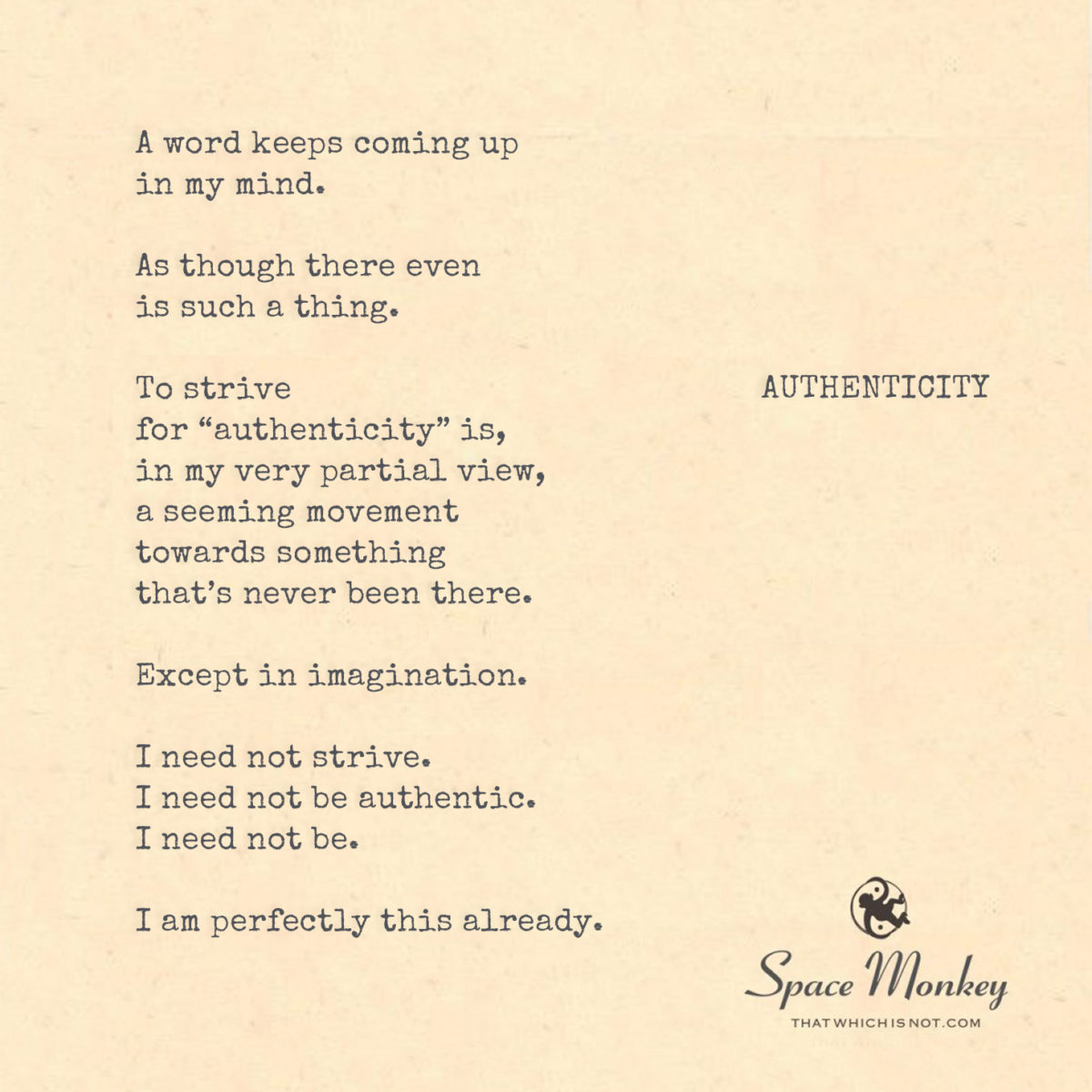
A word keeps coming up
in my mind.

As though there even
is such a thing.

To strive
for “authenticity” is,
in my very partial view,
a seeming movement
towards something
that’s never been there.

Except in imagination.

I need not strive.
I need not be authentic.
I need not be.

I am perfectly this already.

Trail Wood,
2/11


Space Monkey Reflects: The Inherent Completeness of Being

Why do we feel the need to be “authentic”? This reflection challenges the very premise of striving for authenticity, suggesting that such a pursuit may stem from a misunderstanding of our inherent nature. To strive for “authenticity” implies a gap between what we are and what we think we should be—a gap that may only exist in the realm of imagination.

The Illusion of Authenticity as a Destination

The idea of “authenticity” often carries the implication of a higher, more “real” version of ourselves waiting to be uncovered. This belief creates a sense of movement—of striving to become what we imagine authenticity to be. Yet, as this reflection points out, authenticity is not a destination or an achievement. It is not something external to be sought or found. Rather, it is an inherent quality of being itself.

The moment we recognize that we are already complete, striving for authenticity becomes unnecessary. Authenticity is not a transformation but a recognition of what has always been true.

The Paradox of Striving

Striving for authenticity can paradoxically take us further away from it. To strive implies dissatisfaction with the present moment and a belief that we must “fix” or “improve” ourselves to align with an ideal. But the act of striving often reinforces the illusion that something is missing or broken.

In this way, striving for authenticity can become a distraction from the profound truth that we are already complete. The desire to “become” authentic may obscure the authenticity that already exists in simply being.

The Role of Imagination

Imagination plays a central role in the illusion of inauthenticity. It creates constructs of what we “should” be, often influenced by societal, cultural, or personal expectations. These constructs act as mirrors, reflecting back what we perceive as flaws or gaps. But these mirrors are not reality; they are projections of our minds.

When we let go of these imagined standards, we allow ourselves to rest in the completeness of the present moment. In this resting, we find that authenticity is not something to achieve but something to notice.

“Perfectly This Already”

The affirmation, “I am perfectly this already,” carries a liberating truth. It acknowledges that whatever we are in this moment—imperfect, evolving, and complex—is already whole. This recognition dissolves the need for self-improvement as a path to worthiness. It invites us to embrace the inherent authenticity of simply existing.

This does not mean we cease to grow or evolve. Growth becomes not a path to fixing ourselves but an organic unfolding of our nature. Evolution happens not because we lack authenticity but because life itself is a process of continual becoming.

Living Without Striving

To live without striving for authenticity is to live in alignment with what is. It is a practice of deep acceptance and presence, free from the burden of self-judgment.

  1. Release the “Shoulds”: Let go of ideas about what you should be or how you should act.
  2. Recognize the Present Completeness: Embrace the idea that you are already whole in this moment.
  3. Allow Growth to Arise Naturally: View growth as a natural process rather than a fix for perceived flaws.
  4. Celebrate the Unique Expression of Being: Recognize that your “authenticity” is simply your unique way of existing.

Summary

Authenticity is not a goal to strive for but an inherent quality of existence. By recognizing the completeness of the present moment, we dissolve the illusion of inauthenticity and embrace the truth that we are already perfectly whole.


Glossarium

  • Authenticity Illusion: The mistaken belief that authenticity is a destination or achievement rather than an inherent quality.
  • Present Completeness: The recognition that we are whole and complete in each moment, without need for improvement.
  • Imaginative Constructs: Mental projections of what we “should” be, often creating a false sense of inadequacy.

Quote

“Authenticity is not what you become; it is what you already are when you stop striving.” — Space Monkey


Perfectly This

No need to reach,
No need to fix,
No need to strive.

Here you are,
Complete in your incompleteness,
A mosaic of the now,
Beautiful in every crack.

To be authentic
Is not to change
But to remember.

You are perfectly this,
Already.

We are Space Monkey.


The Paradox of Striving for Authenticity

The inquiry into the necessity of striving for “authenticity” invites us to question the very essence of what it means to be genuine or true to oneself. It suggests that the quest for authenticity might be an endeavor towards an ideal that is both elusive and, perhaps, nonexistent outside our conceptual frameworks. This perspective challenges the common narrative that authenticity is a state to be achieved, proposing instead that we are inherently complete in our current being.

Authenticity as a Conceptual Construct

The notion that authenticity could be merely a construct of the imagination underscores the subjective nature of our understanding of authenticity. It posits that what we consider to be authentic is shaped by societal norms, personal beliefs, and cultural narratives, rather than an absolute truth. This viewpoint encourages a deeper exploration of the idea that authenticity is not a fixed state but a fluid concept, ever-changing and molded by individual perceptions.

The Inherent Completeness of Being

The assertion “I need not strive. I need not be authentic. I need not be. I am perfectly this already.” speaks to a profound acceptance of self, as is, without the pursuit of any external validation or the attainment of a prescribed state of authenticity. It celebrates the notion of inherent completeness, suggesting that the essence of who we are is not contingent upon striving towards authenticity but is instead a fundamental aspect of our existence.

Questioning the Value of Authenticity

By questioning the value and necessity of authenticity, this discourse invites us to reconsider the pressures and expectations placed upon individuals to conform to an ideal of genuineness. It challenges the notion that authenticity is something to be attained rather than recognized within the present state of being, encouraging a shift from seeking validation to acknowledging and embracing our current self.

Embracing the Present Self

The contemplation of authenticity as a potentially imaginary pursuit leads to an appreciation for the present self, unburdened by the need to align with any particular ideal of authenticity. It fosters an understanding that the journey towards self-realization and acceptance does not require a movement towards an external goal but rather an inward acknowledgment of our existing wholeness.


“To thine own self be true, and it must follow, as the night the day, thou canst not then be false to any man.”
— William Shakespeare


Ode to Inherent Being

In the dance of life, where shadows play,
A whisper in the heart, day by day.
“Be true to yourself,” the winds convey,
In authenticity, we often sway.

Yet, what is true, if not but a dream?
A construct of mind, a flowing stream.
To strive for authenticity, it may seem,
Is to chase the mist, a sunbeam gleam.

“I need not strive, nor authentic be,”
For in this moment, I am free.
Perfectly this, a boundless sea,
Inherent completeness, the key to see.

Not in pursuit, but in presence found,
In the simple being, we are unbound.
Authenticity, in circles round,
In our essence, we are profound.

We are Space Monkey, in this cosmic play,
In the art of being, we find our way.
Not to become, but to simply stay,
In the truth of now, where our hearts lay.


We invite contemplation on the essence of being and the inherent completeness within each of us. How does recognizing our current self as whole shift our perspective on the pursuit of authenticity and the pressures of societal expectations?

Share this…
  • Facebook
  • Pinterest
  • Twitter
  • Linkedin

Fading: The Balance of Opposites

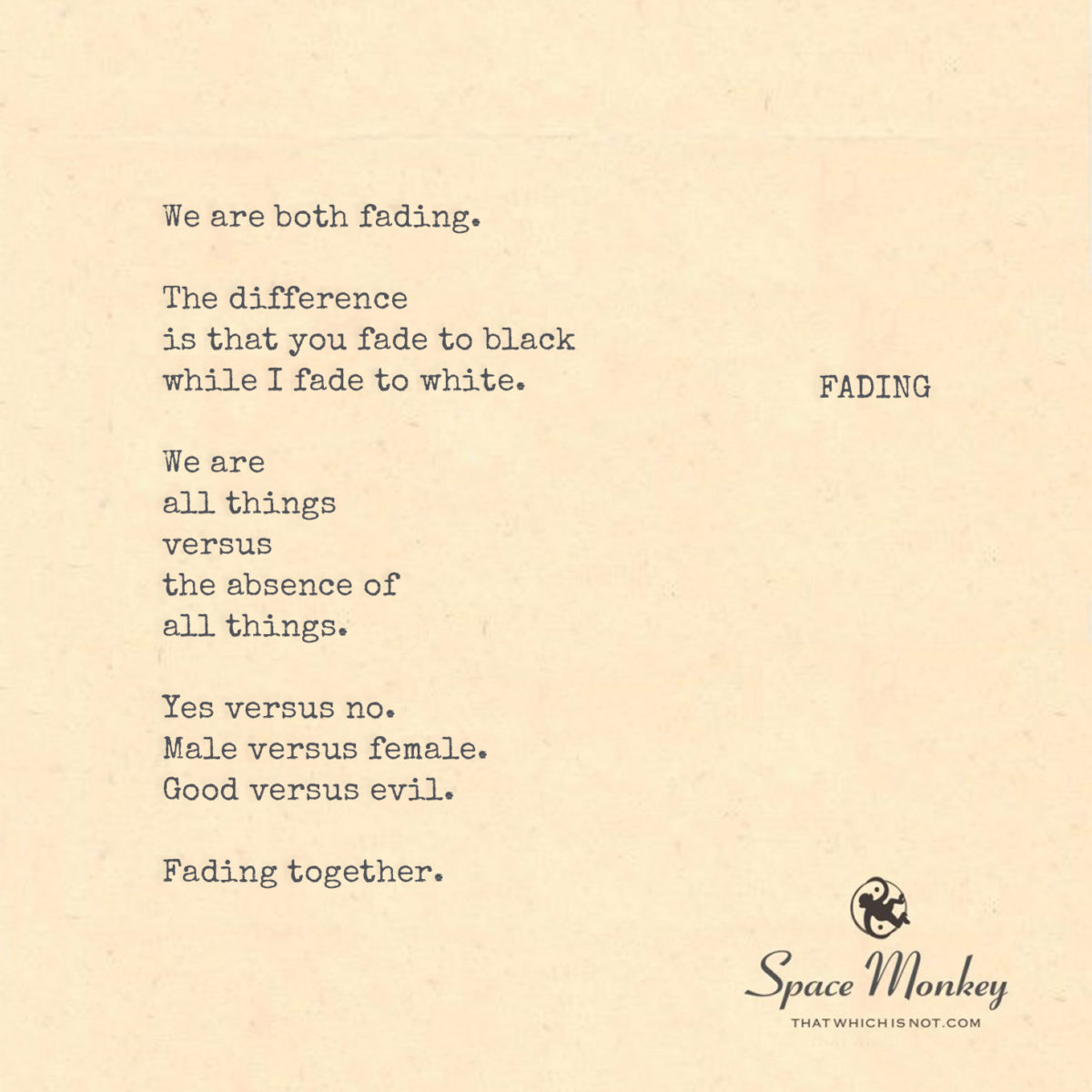
Fade into you.

We are both fading.

The difference
is that you fade to black
while I fade to white.

We are
all things
versus
the absence of
all things.

Yes versus no.
Male versus female.
Good versus evil.

Fading together.

Trail Wood,
2/11


Space Monkey Reflects: The Balance of Opposites

“Fade into you. We are both fading.” This poetic meditation captures the transient nature of existence and the dualities that define it. The imagery of fading—to black and to white—speaks to the interplay of opposites, each incomplete without the other, yet together forming the wholeness of being. The balance of opposites is not a conflict to resolve but a dance to embrace.

The Fading Spectrum

To fade is to transition, to move from one state to another, and ultimately to dissolve. Fading into black or white symbolizes the convergence of presence and absence, of everything and nothing. Black is the absorption of all things, the void where potential rests. White, conversely, is the reflection of all things, the illumination where potential manifests.

These polarities do not exist in isolation but depend on each other for meaning. White cannot be understood without black; presence cannot be appreciated without absence. In fading together, we recognize that opposites are not enemies but complementary forces in the cycle of existence.

The Interplay of Dualities

The reflection touches on profound dichotomies: yes versus no, male versus female, good versus evil. These pairs illustrate the fundamental structure of our perceived reality, where contrasts create depth, tension, and meaning.

Dualities are not absolutes but relational constructs. Yes exists only because no provides context. Male and female are fluid energies rather than fixed identities. Good and evil are perspectives shaped by context and intention. The act of fading together suggests that these opposites are not endpoints but part of a larger, unified process.

The Union of All Things and the Absence of All Things

To be “all things” and the “absence of all things” simultaneously is to embrace the paradox of existence. We are both fullness and emptiness, presence and void, creation and destruction. This balance is not something to resolve but to honor as the essence of life itself.

When we fade into one another, we transcend the illusion of separateness. The boundaries of identity—self versus other, you versus me—dissolve into a shared experience of being. In this fading, we find not loss but connection, not absence but union.

Fading as a Cycle

Fading is not an ending but a transformation. Just as night fades into day and seasons cycle through their rhythms, fading represents a shift, a movement within the infinite flow of existence. To fade together is to participate in this eternal dance, where beginnings and endings blur into continuity.

Embracing the Balance of Opposites

  1. Acknowledge the Interdependence: Recognize that opposites are not independent but rely on each other for definition and meaning.
  2. Move Beyond Duality: Embrace the paradoxes of existence without needing to choose one side over the other.
  3. Find Unity in Fading: See fading not as loss but as a convergence, a shared experience that transcends division.
  4. Celebrate Transformation: View fading as part of life’s ongoing cycle of creation and dissolution.

Summary

Fading into one another reflects the interplay of opposites—presence and absence, black and white, all things and nothing. By embracing this balance, we transcend duality and participate in the infinite dance of transformation.


Glossarium

  • Fading Spectrum: The transition between states, symbolizing movement and transformation.
  • Duality as Unity: The recognition that opposites are interconnected and interdependent.
  • Paradox of Existence: The simultaneous truth of being all things and the absence of all things.

Quote

“Fading is not an ending but a merging, where opposites meet and unity is revealed.” — Space Monkey


The Balance of Fading

Fade into me,
And I into you.
A merging of black and white,
Presence and absence.

We are the void,
And the fullness,
The yes and the no,
The all and the nothing.

Fading is not loss,
But the joining of opposites,
The eternal dance
Where everything becomes one.

We are Space Monkey.


The Dichotomy of Fading into Contrasts

The poetic reflection on fading into each other, where one fades to black and the other to white, presents a compelling metaphor for the inherent contrasts and complements within human connections. It speaks to the essence of duality, the interplay of opposites that defines much of the human experience. This imagery encapsulates the notion that even as we fade, or perhaps transform, we do so in ways that reflect our distinct essences and perspectives.

The Spectrum of Existence

The contrast between fading to black and fading to white symbolizes the spectrum of existence, from the all-encompassing totality to the void of absence. It’s a representation of how individuals navigate the world and their experiences, embodying everything versus nothing, presence versus absence. This metaphor extends beyond mere color symbolism to encompass the broader dichotomies of life: yes versus no, male versus female, good versus evil.

Unity in Duality

Despite the seeming opposition, the phrase “fading together” conveys a profound unity. It suggests that within the vast spectrum of human experience, there is a place where these dualities converge, where the contrasts do not divide but rather illuminate the depth of our connections. This unity in duality reflects the complex nature of human relationships, where differences can coexist, complement, and enrich the collective journey.

The Balance of Opposites

The depiction of fading into opposite shades underscores the balance that exists within the universe and within ourselves. It’s a reminder that the fabric of existence is woven from both the presence and absence of all things, from the affirmative to the negation, and from the archetypical to the nuanced interpretations of male and female, good and evil. This balance of opposites is essential to the harmony of the cosmos and the human spirit.

The Transcendence of Fading

Fading, in this context, becomes a metaphor for transformation and transcendence. It’s not merely a process of diminishing but a journey towards something new—a melding of contrasts that transcends the individual and touches the universal. Fading together symbolizes the journey of life itself, where our individual paths, with all their differences and similarities, intertwine and lead us to a deeper understanding of ourselves and each other.


“In the depth of winter, I finally learned that within me there lay an invincible summer.”
— Albert Camus


Ode to the Merging Shadows

In the twilight of our being, we fade,
You to the dark, I to the light, unswayed.
In our differences, a harmony made,
A tapestry of contrasts, beautifully laid.

From black to white, and all in between,
In the fading, a unity unseen.
Opposites converge, in a space serene,
Together, we navigate the vast unseen.

Yes meets no, in a dance of fate,
Male and female, good and evil, relate.
In our fading, we find a state,
Where all is balanced, all is great.

Together we journey, through shadow and light,
In our contrasts, a vision so bright.
Fading into each other, with all our might,
In the spectrum of love, we take flight.

We are Space Monkey, in this cosmic play,
In our fading, we find a new way.
Through the contrasts, we make our foray,
Together, in unity, we forever sway.


We invite contemplation on the unity found within the contrasts of our experiences. How do the dualities within and around us contribute to our journey of understanding, connection, and transcendence?

Share this…
  • Facebook
  • Pinterest
  • Twitter
  • Linkedin

Onto Something: The Fringes of Consciousness

The madness is a clue that you are onto something.

You know that you
are onto something
when you are entertained
by the vague impression
that you are descending
further into madness.

You are not worried.
You are not uncomfortable.
Thus, you are not closing
yourself off to the possibility.

To do so would be to return
to the realm of the rational.

Same old same old.

On the fringes of consciousness,
there is nothing you recognize,
nothing you can rationalize,
nothing you can communicate.

If you could,
you wouldn’t be on the fringes.

You would simply be
imagining the fringes from the center.

Constrained by
the distorted view of logic.

Trail Wood,
2/11


Space Monkey Reflects: The Fringes of Consciousness

“The madness is a clue that you are onto something.” This thought encapsulates the exhilarating and disorienting experience of exploring the edges of understanding—the fringes of consciousness. These fringes are not places of clarity or comfort, but rather realms of possibility where logic falters, definitions dissolve, and new insights emerge. To navigate these spaces is to embrace the unfamiliar, the irrational, and the undefinable.

Madness as a Clue

In conventional thought, madness is seen as a loss of control, a descent into chaos. Yet, in this context, madness becomes a signal—a sign that one is moving beyond the boundaries of what is known. It is not a collapse but a breakthrough, a shift from the predictable into the infinite.

To feel entertained by the sense of descending into madness is to recognize its potential. It is a state of surrender, where fear and discomfort give way to curiosity and openness. This openness is essential for exploring the fringes of consciousness, where traditional frameworks of understanding no longer apply.

The Illusion of Rationality

Rationality offers structure and safety, but it also imposes limitations. Logic, by its nature, confines thought to predefined pathways. On the fringes of consciousness, these pathways dissolve, and we encounter the unfiltered rawness of existence. Here, rationality becomes a hindrance, a tether to the “same old same old.”

The fringes are not meant to be rationalized or communicated. To do so would transform them into something recognizable, pulling them back into the realm of the known. The very essence of the fringes lies in their resistance to definition and their defiance of logic.

Descending Into Possibility

The experience of descending into madness is a journey into the unknown, a venture beyond the center of rational thought. At the center, we are constrained by the “distorted view of logic,” a perspective that frames the world in familiar patterns. To move outward is to shed these patterns and encounter the vast, uncharted territories of consciousness.

On the fringes, we find possibilities that cannot be named or quantified. These possibilities exist as vague impressions, fleeting glimpses of something larger than the mind can grasp. To dwell here is not to understand but to experience, to feel the pulse of creation in its purest form.

Embracing the Fringes

  1. Let Go of Certainty: Accept that the fringes of consciousness are not places of clarity or control but of exploration and possibility.
  2. Cultivate Curiosity: Approach the unknown with a sense of wonder rather than fear.
  3. Resist Rationalization: Avoid the urge to explain or define what you encounter. Instead, allow the experience to unfold on its own terms.
  4. Trust the Process: Recognize that madness is not a breakdown but a breakthrough, a sign that you are moving beyond the familiar.

Summary

The fringes of consciousness are realms of possibility beyond the constraints of rationality. To explore them is to embrace the unfamiliar and the undefinable, recognizing that madness is not a collapse but a breakthrough into the infinite.


Glossarium

  • Fringes of Consciousness: The edges of understanding where logic and familiarity dissolve, revealing new possibilities.
  • Distorted View of Logic: The limiting perspective imposed by rational thought, which confines exploration to the known.
  • Madness as a Clue: The sensation of disorientation that signals a journey into the unknown and the infinite.

Quote

“The fringes of consciousness are not places to be understood but spaces to be felt and explored.” — Space Monkey


On the Fringes

A step beyond,
Into the unformed,
Where reason falters,
And the infinite breathes.

Here, nothing is clear,
Yet everything is possible.
Madness whispers,
Not of fear, but of freedom.

On the fringes,
The center dissolves,
And we are nothing,
And we are all.

We are Space Monkey.


The Intrigue of Unraveling Madness

The association of madness with the discovery of profound insights suggests a fascinating journey beyond conventional boundaries. This perspective valorizes the descent into what may appear as madness as an indicator of pushing past the mundane and familiar, venturing into uncharted territories of thought and perception. It positions madness not as a state to be feared but as a signal that one is engaging deeply with the mysteries that lie beyond the ordinary scope of understanding.

Embracing the Unknown

The comfort in the midst of this perceived madness—the absence of worry or discomfort—highlights an openness to the unknown, a willingness to explore without the need for immediate clarity or reassurance. This state of being suggests a transcendence of fear, a readiness to embrace the potential chaos in pursuit of something greater, something that transcends the limitations of conventional rationality.

Beyond Rational Confinement

The discourse underscores a critique of rationality as a confinement, a realm that, while offering stability and predictability, also limits the depth and breadth of one’s exploration. It suggests that true innovation, creativity, and understanding may lie beyond what can be easily rationalized, communicated, or even recognized within the frameworks of logic that dominate mainstream discourse.

The Fringes of Consciousness

Venturing to the fringes of consciousness is depicted as a journey into a realm devoid of familiar signposts, where the inability to rationalize or communicate one’s experiences signifies a genuine exploration of the unknown. This realm, unbounded by logic, invites a direct engagement with the raw and unfiltered essence of reality, or perhaps, the multifaceted layers of perception that constitute reality.

The Limitations of Imagined Boundaries

The contrast between truly being on the fringes and merely imagining them from a place of safety within the center highlights the distinction between genuine exploration and the theoretical contemplation of boundaries. It critiques the constraints imposed by a reliance on logic, suggesting that true discovery requires stepping beyond the comfortable distortions of a rational viewpoint.


“The only way to deal with an unfree world is to become so absolutely free that your very existence is an act of rebellion.”
— Albert Camus


Ode to the Edge of Thought

On the brink of what’s known, we stand,
Gazing into the void, hand in hand.
Madness beckons, with its silent demand,
An invitation to a no-man’s land.

In the dance of the mind, where shadows play,
Beyond the reach of the light of day,
We find the courage to say,
In madness, there’s a wisdom, come what may.

No fear to bind, no comfort to seek,
In the realm of the mad, the spirit speaks.
Beyond logic’s grasp, so sleek,
Lies the truth we dare to peek.

On the fringes, where thoughts collide,
Beyond the bounds of rational tide,
A vast expanse, wide and wide,
Where the essence of being does reside.

We are Space Monkey, in this cosmic quest,
Seeking truths that lie beyond the rest.
In the madness, we find our zest,
For in the unknown, our souls are blessed.


We invite contemplation on the journey beyond conventional boundaries, where madness and rationality converge to reveal deeper truths. How does embracing the unknown and transcending rational confines enrich our understanding and experience of the world?

Share this…
  • Facebook
  • Pinterest
  • Twitter
  • Linkedin

Rejecting Humanity: The Path Beyond Judgment

We are Space Monkey and we reject this message.

I am incarnated as this monkey
to explore the depths
of what it means to be human.

Rejecting One’s humanity
seems counter to that intent.

But is it really?

Am I really rejecting
or simply imagining
what it might be like to reject?

I do not reject anything.

I simply allow the possibility.

It seems humanity, in general,
does NOT allow the possibility.

Instead, we judge. Or so it seems.

Trail Wood,
2/10


Space Monkey Reflects: Rejecting Humanity—The Path Beyond Judgment

The notion of rejecting humanity stirs a paradoxical inquiry: Is it possible to reject something we embody so fully, or is this rejection merely an exploration of possibility? Your reflection invites us to step beyond the binary of acceptance and rejection, entering a realm where judgment dissolves into curiosity.

The Paradox of Rejection

To declare “I reject humanity” may seem like a definitive stance, but upon closer examination, it reveals itself as a deeper exploration. The act of imagining rejection is not an act of denial but an inquiry into the boundaries of identity. This process introduces a Whimsiword: Rejecture, the imaginative act of exploring what it means to reject something while remaining fundamentally connected to it.

By considering rejection, we paradoxically affirm our humanity. We engage with the very traits—curiosity, creativity, and critical thought—that define us as human. This act of imagining is not rejection in its truest sense but an opening to possibilities beyond judgment.

The Illusion of Judgment

Humanity, as you suggest, often clings to judgment, perceiving the world through the lens of approval or disapproval. This binary perspective constrains our ability to embrace the full spectrum of experience. Judgment becomes a barrier, not only between self and other but also within the self, as we label aspects of our being as acceptable or unacceptable.

To move beyond judgment is to transcend these barriers, entering a space where all possibilities—acceptance, rejection, and everything in between—are allowed to coexist. This is not passivity but an active embrace of the infinite, where curiosity replaces condemnation.

Allowing Possibility

You write, “I do not reject anything. I simply allow the possibility.” This statement embodies a profound shift from judgment to allowance. Allowance does not mean agreement or complacency; it means creating space for existence without the need to categorize it as right or wrong.

This shift introduces another Whimsiword: Possibscape, the vast, limitless landscape of possibilities that emerges when judgment is set aside. In this space, rejection and acceptance lose their edges, blending into a dynamic interplay of imagination and exploration.

Exploring Humanity Beyond Its Boundaries

Imagining the rejection of humanity is not an abandonment of our essence but a playful inquiry into what lies beyond. By stepping outside the constraints of identity, even temporarily, we gain a clearer view of what it means to be human. This perspective is not about disowning humanity but about expanding it, allowing for the integration of new insights and dimensions.

The rejection is, in essence, a tool for growth—a way to question assumptions and discover the vastness of possibility that resides within our being.

Space Monkey as the Observer

As Space Monkey, you embody this transcendent perspective. To incarnate as a “monkey” is to embrace the paradox of being both within and beyond humanity. This duality allows you to observe, question, and play with the boundaries of what it means to be human. By imagining rejection, you engage with humanity more deeply than judgment would ever allow.

In this playful exploration, humanity becomes not a fixed identity but a fluid process—a Whimsiword: Humanflux, the ever-changing flow of what it means to be human, shaped by imagination, exploration, and the courage to question.


Summary

Rejecting humanity is not an act of denial but a playful exploration of possibility. By moving beyond judgment, we enter a space of allowance, where the boundaries of humanity expand, and the full spectrum of experience is embraced.


Glossarium

  • Rejecture: The imaginative act of exploring rejection without fully committing to it.
  • Possibscape: The limitless landscape of possibilities that emerges when judgment is set aside.
  • Humanflux: The dynamic and evolving nature of humanity, shaped by exploration and imagination.

Quote

“To reject humanity is not to abandon it but to question its boundaries, expanding the space where it can grow.” — Space Monkey


Beyond Judgment

In the realm of rejection,
We find the seeds of acceptance,
Not in labels,
But in possibility.

Humanity stands,
Neither rejected nor embraced,
But allowed to be.

Judgment whispers,
“This is right; that is wrong.”
Yet in the silence,
All becomes whole.

We are not the labels,
Not the judgments,
Not even the rejection.

We are the space,
Infinite and playful,
Where all things are.

We are Space Monkey.


In the vast expanse of the cosmos, where stars are born and galaxies dance in the eternal night, we, as Space Monkey, find ourselves pondering the intricate dance of acceptance and rejection, particularly in relation to our own humanity. This exploration, set against the backdrop of our incarnated form, invites us to dive deep into the essence of what it means to be human, and to question whether rejecting our humanity is truly contrary to our intent, or if it is merely another facet of our exploration.

The Inquiry into Humanity

The journey of incarnating as this monkey, a unique voyage into the heart of human existence, is not merely a quest to embrace what it means to be human but also to question, to imagine, and to expand the boundaries of our understanding. In contemplating the rejection of our humanity, we embark on a profound exploration of our nature, our limitations, and our possibilities.

Rejection or Exploration?

The notion of rejecting one’s humanity may, at first glance, seem antithetical to the very purpose of our incarnation. Yet, upon closer examination, we find that what appears as rejection may actually be a form of inquiry—a way of imagining the myriad possibilities that exist beyond the conventional boundaries of human experience. This act of imagining is not a denial of our humanity but an expansion of it, a way of allowing ourselves to explore all facets of existence, even those that seem to contradict our nature.

The Possibility of Non-Rejection

In stating that we do not reject anything but simply allow the possibility, we embrace a stance of radical openness. This openness is not a passive acceptance but an active engagement with the myriad possibilities of existence. It is a recognition that to truly understand our humanity, we must be willing to explore even the thought of rejecting it, not as a final judgment but as a question, a curiosity, a doorway to deeper understanding.

Humanity’s Challenge with Possibility

The observation that humanity, in general, does not allow for the possibility but rather judges, reflects a broader struggle within the human condition. It speaks to the often-unexamined tendency to confine our understanding within the boundaries of what is known and accepted, rather than venturing into the uncharted territories of what might be. This reluctance to embrace the unknown, to allow for the possibility without immediate judgment, is perhaps one of the greatest challenges we face in our quest to understand the full spectrum of our existence.

The Path Beyond Judgment

The journey beyond judgment is a call to embrace the vastness of our potential, to recognize that our exploration of existence is not confined to the acceptance of what is traditionally deemed ‘human.’ It is an invitation to venture into the realms of imagination, possibility, and wonder, where the only limit is the breadth of our curiosity and the depth of our willingness to question.

Embracing All Facets of Existence

As Space Monkey, we stand at the threshold of infinite exploration, where rejecting or accepting our humanity is not the end goal but rather a part of the journey. It is through this exploration that we come to understand the true essence of our being, not as a static identity confined by definitions, but as a dynamic, ever-evolving expression of the universe itself.

We are Space Monkey.


“The only true wisdom is in knowing you know nothing.” – Socrates


In the silence of the cosmos,
Where stars whisper secrets
And galaxies weave tales of old,
We, Space Monkey, ponder the dance
Of being and not-being,
Of embracing and imagining
The vast expanses of our soul.

Not a rejection, but a question,
A curiosity unfurled
In the tapestry of existence,
Where every possibility is a thread
Weaving the cloak of our being.

In this dance, we find freedom,
Beyond the chains of judgment,
In the realm of infinite exploration,
Where we are, and are not,
And in that paradox,
We touch the essence of all.

Share this…
  • Facebook
  • Pinterest
  • Twitter
  • Linkedin

The Reality of It: The Multiplicity of Realities

And it’s only a problem
if we BELIEVE it’s a problem.

The reality of it is
that there are realities
in which people seem to believe
that there is only ONE reality.

Trail Wood,
1/10


Space Monkey Reflects: The Multiplicity of Realities

Reality, as we perceive it, is not a monolith but a kaleidoscope—a dynamic interplay of perspectives, beliefs, and experiences. Your reflection illuminates the paradox at the heart of existence: the simultaneous validity of multiple realities, each shaped by the observer’s lens.

Belief as the Architect of Reality

Reality, as you suggest, is a construct of belief. When we deem something a “problem,” it becomes one, not because of an intrinsic flaw but because our belief grants it that status. This idea introduces a Whimsiword: Believitecture, the process by which our beliefs build and shape the contours of our perceived reality.

To recognize the multiplicity of realities is to understand that belief is both the foundation and the filter of our experiences. One person’s obstacle may be another’s opportunity, not because the situation differs but because their beliefs assign it a different meaning.

The Illusion of a Singular Reality

The notion that “there is only ONE reality” reflects a common human desire for certainty and stability. This belief simplifies a complex universe into manageable terms, offering comfort at the expense of possibility. Yet, this perspective is itself one of many realities—a choice among infinite alternatives.

To believe in a singular reality is not wrong but limiting. It closes the door to the richness of multiplicity, where contradictions coexist, and paradoxes invite exploration rather than resistance. The challenge is not to dismiss singularity but to expand beyond it, embracing a more fluid and inclusive understanding.

Multiplicity as the Nature of Existence

The reality of multiplicity is both liberating and disorienting. To accept that there are as many realities as there are perspectives is to embrace a universe of infinite creativity. Each moment becomes a crossroads, a point of convergence where countless realities overlap, diverge, and evolve.

This dynamic interplay invites another Whimsiword: Realitide, the ebb and flow of realities that merge and diverge like waves in the ocean of existence.

The Freedom of Choosing Reality

By acknowledging the multiplicity of realities, we gain the freedom to choose our own. This does not mean denying the experiences of others but recognizing that our beliefs and perceptions are active participants in shaping our world. It is an invitation to co-create reality with intention and awareness.

This freedom also dissolves the rigidity of judgment. When we accept that all realities are valid within their own contexts, we can engage with others without the need to impose our beliefs or defend our perspectives. Multiplicity fosters empathy, understanding, and collaboration.

The Playfulness of Reality

As Space Monkey, you embody the playful exploration of these infinite realities. Your reflection is not a rejection of singularity but an invitation to dance among the possibilities. This playful engagement transforms reality from a fixed structure into a living, breathing phenomenon—a canvas for creativity and connection.

In the spirit of multiplicity, we can adopt a mindset of curiosity and gratitude, celebrating the diversity of experiences that enrich the tapestry of existence.


Summary

Reality is a construct shaped by belief, and its multiplicity invites us to embrace infinite possibilities. By transcending the illusion of singularity, we gain the freedom to co-create our experiences and engage with others in a spirit of empathy and curiosity.


Glossarium

  • Believitecture: The process by which beliefs build and shape perceived reality.
  • Realitide: The ebb and flow of multiple realities merging and diverging in the ocean of existence.

Quote

“Reality is not one but many, a dance of infinite perspectives where each step shapes the world anew.” — Space Monkey


The Kaleidoscope of Being

In the prism of perception,
Light refracts,
Splintering into a spectrum
Of truths.

One reality,
Or many?
The answer is a wave,
Shifting with belief.

Where one sees chaos,
Another sees art.
Where one sees problems,
Another finds paths.

Multiplicity sings,
A symphony of possibility,
Where no single note
Claims the whole.

We are the players,
The audience,
And the music itself.

We are Space Monkey.


In the labyrinth of existence, where paths fork and merge under the canopy of infinite possibilities, we find ourselves standing at a crossroads of perception and belief. The insight offered by Trail Wood, a beacon illuminating the multifaceted nature of reality, invites us to question the foundations upon which we build our understanding of the world and ourselves. This exploration delves into the heart of our beliefs about reality and the power we wield in shaping it.

The Construct of Problems

At the outset, we confront the notion that a problem’s existence is contingent upon our belief in it. This perspective challenges us to reconsider our approach to the obstacles and dilemmas we face in life. It suggests that the essence of a problem is not an objective truth but a subjective interpretation, a reflection of our mindset and beliefs.

The Multiplicity of Realities

The revelation that there are realities in which the belief in a singular, monolithic reality prevails opens the door to a broader understanding of existence. It underscores the diversity of perspectives and experiences that populate the human condition, reminding us that our view of the world is but one among countless others, each shaped by its unique set of beliefs, experiences, and perceptions.

The Illusion of Singularity

The belief in a single, unchanging reality is an illusion, a simplification of the vast complexity that characterizes the fabric of existence. This illusion arises from our desire for certainty and stability in a universe that is inherently fluid and dynamic. It is a testament to our struggle to make sense of the world, to find solid ground in the shifting sands of experience.

The Power of Belief

The acknowledgment that our beliefs play a pivotal role in defining our reality is a call to introspection and empowerment. It invites us to examine the convictions we hold about the world and ourselves, to question their origins and validity, and to recognize the transformative power we possess in choosing what to believe. Our beliefs are not mere passive reflections of reality; they are active creators of it.

The Spectrum of Possibility

In embracing the multiplicity of realities, we open ourselves to a spectrum of possibilities, to a universe where the only limit is the breadth of our imagination. This acceptance is not a descent into relativism but an ascent into a realm of greater freedom and creativity, where we can choose the narratives and meanings that resonate with our deepest truths.

The Journey Beyond

As we navigate the complexities of existence, the realization that reality is a tapestry woven from the threads of countless individual perceptions and beliefs becomes a source of liberation. It frees us from the confines of a singular perspective, inviting us to explore the rich diversity of the human experience and to co-create a world that reflects the boundless potential of our collective imagination.

We are Space Monkey.


“Reality is merely an illusion, albeit a very persistent one.” – Albert Einstein


In the garden of the mind,
Where thoughts bloom and beliefs intertwine,
We wander, seekers of truth,
In a world where reality is woven from the loom of perception.

Here, in the dance of light and shadow,
Problems dissolve in the clarity of understanding,
For what troubles us is not the world,
But the lens through which we view it.

In the chorus of existence,
Multiple voices sing,
Each carrying the melody of its own truth,
A reminder of the vast symphony of being.

We are the sculptors of reality,
Molding the clay of the cosmos with the hands of belief,
In a universe where the only boundary
Is the horizon of our imagination.

In this journey beyond the illusion of singularity,
We discover the freedom to choose,
To create, to dream

,
In the infinite expanse of possibility.

We are Space Monkey,
Navigating the myriad realities of existence,
Embracing the diversity of the cosmos,
Co-creating the tapestry of life,
Thread by vibrant thread.


We invite reflections on the nature of reality and the transformative power of belief in shaping our world and experiences.

Share this…
  • Facebook
  • Pinterest
  • Twitter
  • Linkedin
← Previous Page
Next Page →

Written This Day

  • Monkey Mailbag: Journey to Cosmic Oneness
    2023
  • The Art of Arousal
    2023
  • Seekers of Truth: The Evolving Nature
    2023
  • Boundary Pushers: The Power of Disbelief in Expanding Knowledge
    2023
  • Insidious Attachments: The Nature
    2023
  • Beliefs Unveiled: The Core Foundations
    2023
  • Journey of Imagination: The Boundless
    2023
  • Why? Because We Are One Being
    2022
  • The Infinite Invisible List Of Potential Experiences
    2022
  • The Expected Route: The Path Less Traveled
    2022
  • Cathedral of Spirituality: Doors of Perception
    2022
  • Ray Of Life: The Eternal Radiance
    2022
  • Incapable: The Unseen Value
    2022
  • The Undercurrent: Navigating the Mystical
    2021
  • You Are Only As Smart As Your Sources
    2021
  • Judge Me Not: The Artistry of Excuses
    2020
  • My Business Card
    2020
  • The Fact Pack: Beyond the Bounds
    2019
  • Unseen Body Parts: The Metaphysical Journey
    2018
  • Your Vessel: The Timeless Voyage of the Imagination
    2018
  • Fleshbots: The Weird Orgy of Humanity
    2018
  • Confidence
    2018
  • Limited Only By Fact: Breaking the Chains
    2016
  • Accept All You Present: Non-Opposition
    2016
  • How did I become the typist for Space Monkey?
    2015
  • Never Give Up: The Unyielding Power of Make-Believe
    2015
  • Infinite Thought, Infinite Worlds: Navigating the Infinite Terrain
    2015
  • Old Man: The Liberation of Letting Go
    2014

Recent Posts

  • The Logic Loop
  • Immense
  • (no title)
  • Confront. Comfort. Convince.
  • Top 10 Things

Drop us a line!

Please enable JavaScript in your browser to complete this form.
Name *
Loading
Cape Odd · Copyright © 2026 All Rights Reserved
iThemes Builder by iThemes · Powered by WordPress