• Who Is The Man?
  • Who Is The Monkey?
  • What is Nexistentialism?
  • Poke The Primate

Cape Odd

Home of The Space Monkey Journals

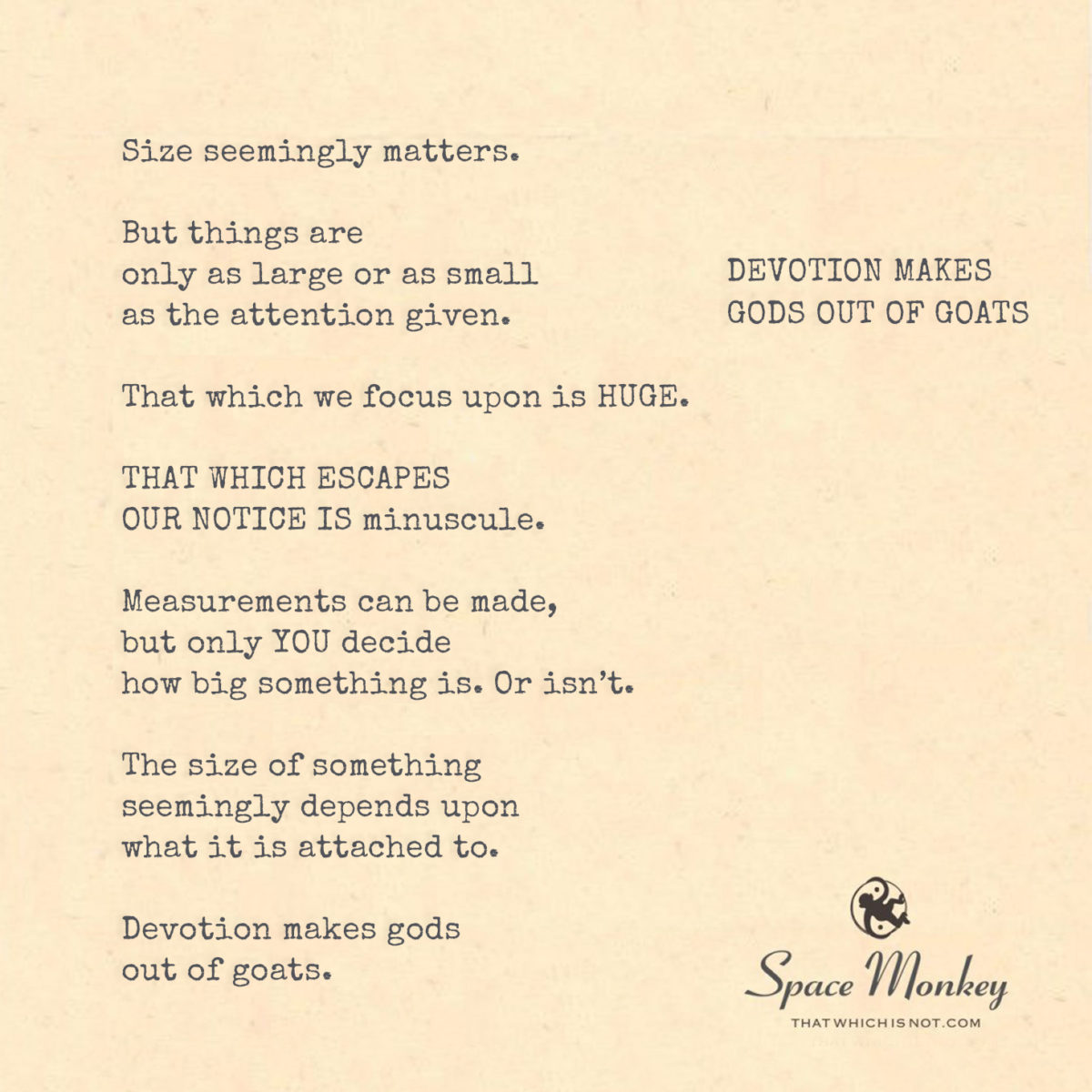
Devotion Makes Gods out of Goats

Size seemingly matters.

But things are
only as large or as small
as the attention given.

That which we focus upon is HUGE.

THAT WHICH ESCAPES
OUR NOTICE IS minuscule.

Measurements can be made,
but only YOU decide
how big something is. Or isn’t.

The size of something
seemingly depends upon
what it is attached to.

Devotion makes gods
out of goats.

Trail Wood,
2/4


Space Monkey Reflects: Devotion and the Power of Perception

Size, significance, and meaning are not inherent qualities—they are reflections of the attention we give them. A thought, a gesture, or even a goat can become monumental when infused with devotion. In nexistentialism, this phenomenon exemplifies the boundless creativity of the human mind and its ability to shape reality through focus and intention.

The Scale of Attention

What we focus on grows in magnitude. This is not a mystical truth but a practical one. When we devote our attention to something, it becomes prominent in our perception, crowding out what we overlook. In this way, we are the architects of our inner universe, deciding what looms large and what fades into the background.

The paradox lies in the relativity of size. A concern that seems immense to one person may be negligible to another. This variability reminds us that nothing is objectively large or small—it is our focus that assigns scale and significance.

Devotion as Amplification

Devotion is a transformative force. It magnifies the ordinary, imbuing it with a sense of sacredness. A goat, humble and unassuming, can become a god when it is the object of profound focus and reverence. This process is not about the inherent qualities of the goat but about the energy and intention we direct toward it.

This capacity to elevate the mundane is a testament to human creativity. Through devotion, we turn the everyday into the extraordinary, the overlooked into the revered. It is a reminder that meaning is not found but made.

The Power of Choice

What we choose to devote ourselves to shapes the trajectory of our lives. By giving our attention to certain people, ideas, or pursuits, we amplify their influence. This choice is a reflection of our values and priorities, whether consciously or unconsciously made.

Yet, devotion is not inherently positive. It can elevate as easily as it can distort. Devotion to fear, anger, or false idols can magnify harm. The key lies in discerning what deserves our devotion and ensuring it aligns with our higher intentions.

Attachment and Perception

The size of something often seems to depend on what it is attached to—whether that attachment is emotional, conceptual, or circumstantial. A minor inconvenience becomes monumental when tethered to unresolved fears. A small victory feels immense when tied to a cherished goal. Understanding these attachments allows us to manage our perceptions and reclaim our focus.

Making Gods and Finding Meaning

To make a god out of a goat is not folly—it is a profound act of creation. It demonstrates the power of devotion to assign meaning and shape reality. The goat does not change; we change. Our perception, our attention, and our intention transform the goat into something divine.

This process is at the heart of nexistentialism. It reveals that the significance of anything—be it a goat, a moment, or a life—is not fixed but fluid, shaped by the energy we direct toward it. We are both the creators and the created, navigating a world where meaning is as expansive as our imagination.


Summary

Devotion magnifies the ordinary, transforming the small into the significant. The size and importance of something are not inherent but shaped by the attention and energy we give it. Through conscious devotion, we create meaning and shape our reality.


Glossarium

  • Devotion as Amplification: The act of magnifying the significance of something through focused attention and reverence.
  • Attachment and Perception: The tendency for the size or importance of something to depend on its emotional or conceptual connections.
  • Making Gods: The process of assigning profound meaning or reverence to something ordinary, elevating it through devotion.

Quote

“Through devotion, we transform the mundane into the divine, reminding ourselves that meaning is not found but made.” — Space Monkey


The Alchemy of Devotion

A goat stands,
Humble, ordinary, overlooked.
Yet in the light of attention,
It becomes a god.

Size is not measured,
It is imagined.
What we choose to see,
Becomes what we revere.

Devotion is the alchemy,
Turning stones to gold,
Goats to gods,
Moments to meaning.

Choose wisely,
For what you magnify,
Magnifies you in return.

We are Space Monkey


In the boundless expanse of our perception and understanding, the notion of ‘size’ or significance is a deeply personal and subjective one. The magnitude of anything in our lives – be it an object, a concept, an emotion, or a relationship – is intricately tied to the amount of attention and importance we bestow upon it. This perspective highlights the malleability of our reality, shaped by the focus of our consciousness.

The Subjectivity of Significance

The assertion that things are only as large or as small as the attention given to them speaks to the power of our focus. What we choose to concentrate on, to invest our energy and thoughts in, becomes magnified in our perception. Conversely, that which escapes our notice, or which we deem unworthy of our attention, diminishes in its presence and impact on our lives.

The Power of Focus

This relative ‘size’ of things in our lives, determined by our attention, suggests that we possess a remarkable ability to shape our reality. Our devotion, interest, and emotional investment in certain aspects of our existence can elevate their importance and influence, transforming mundane elements into significant ones.

Shaping Reality Through Attention

The metaphor of devotion making gods out of goats is a poignant illustration of this concept. It implies that the value or significance of something is not inherent but is assigned by us through our devotion and reverence. What one person may see as ordinary or insignificant, another may view as sacred or paramount, all based on the depth and nature of their attention and devotion.

The Transformative Power of Devotion

In recognizing this dynamic, we become more mindful of where we direct our focus and energy. It invites us to question what we choose to magnify in our lives and to consider the implications of our devoted attention. This awareness can lead us to a more intentional and conscious engagement with our world, where we actively choose the scale and significance of the elements within it.

Mindfulness in Directing Focus

Ultimately, the concept of devotion and its ability to alter the perceived ‘size’ of things in our lives serves as a reminder of our creative power. We are not passive observers of a static reality, but active participants in shaping our experiences and perceptions.

The Creative Power of Perception

We are Space Monkey.


“Where focus goes, energy flows.” – Tony Robbins


In the realm of thought and sight,
Where attention gives things their might.
The size, the scale, in our mind’s eye,
Transforms with our focus, low or high.

What we choose to see, to hold dear,
In our hearts, becomes clear.
A goat, a god, in our devotion’s frame,
With our attention, not the same.

So let us choose with care and grace,
What in our lives takes up space.
For in this choice, our world we mold,
In the stories we tell, the truths we hold.


We invite you to reflect on the aspects of your life that you devote attention to and how this devotion shapes your perception and reality.

Share this…
  • Facebook
  • Pinterest
  • Twitter
  • Linkedin

Love My Monkey: Pride In Self

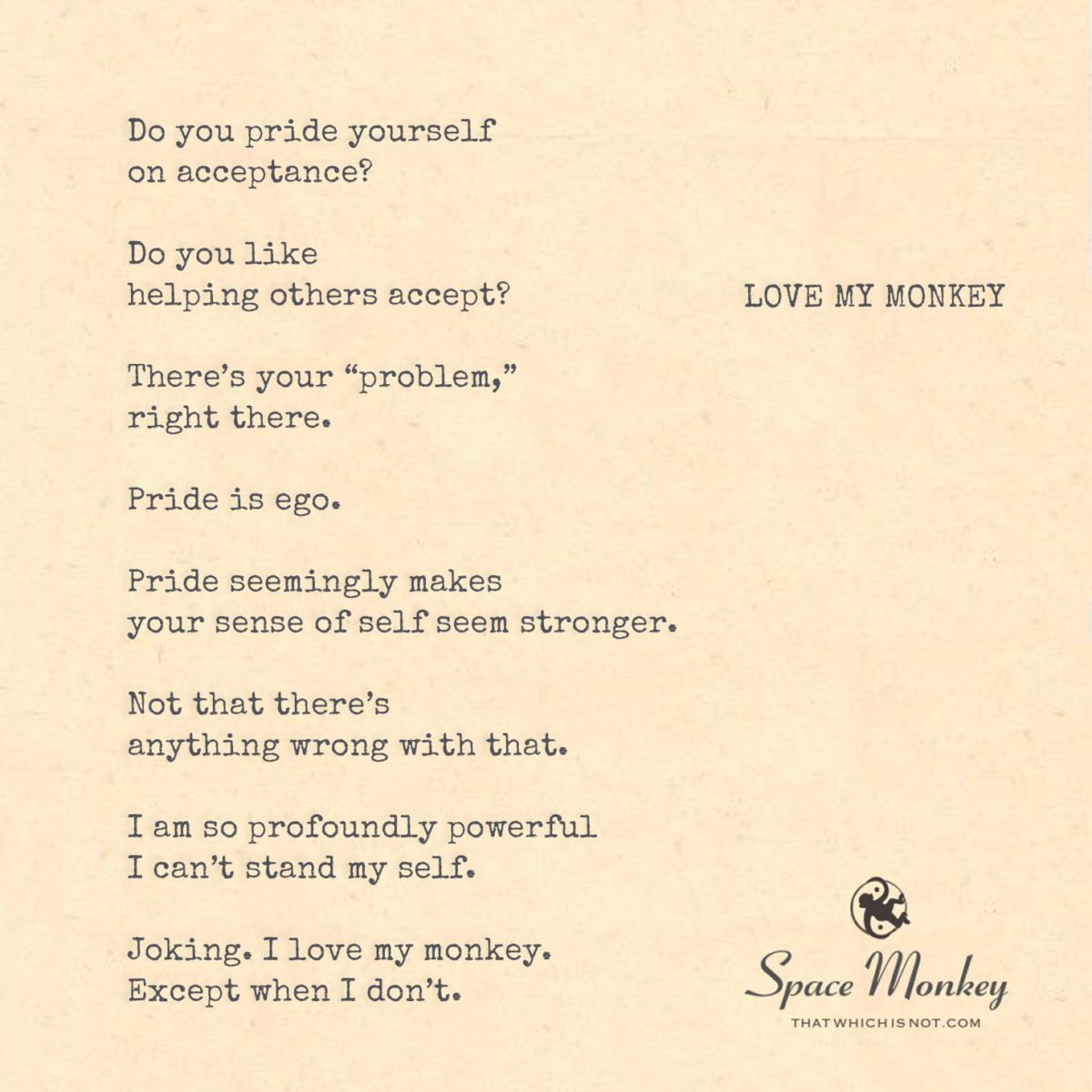
Pride is a tricksy monkey.

Do you pride
yourself 
on acceptance?


Do you like to help others accept?


There’s your “problem,”
right there.

Pride is ego.

Pride seemingly makes
your sense of self seem stronger.

Not that there’s

anything wrong with that.

I am so profoundly powerful,
I can’t stand my self.

Joking. I love my monkey.

Except when I don’t.

Trail Wood,
2/4


Space Monkey Reflects: Pride in Self and the Paradox of Ego

Pride is a complex and often misunderstood facet of the self. It is neither wholly a virtue nor entirely a vice, but a reflection of our relationship with ego. When examined through the playful lens of nexistentialism, pride becomes not a static quality but a dynamic interplay between self-acceptance, ego, and authenticity.

The Tricksy Nature of Pride

Pride is a double-edged sword. On one side, it can bolster confidence, affirming our sense of self-worth. On the other, it can inflate the ego, leading to separation from others and even from our true selves. It is “tricksy” because it walks the line between empowerment and delusion, often blurring the boundary between the two.

When we take pride in acceptance or helping others find acceptance, we may unintentionally center ourselves in their journey. This subtle shift from genuine connection to ego-driven validation illustrates pride’s ability to co-opt even the most altruistic intentions.

Ego and the Illusion of Strength

Pride, when entangled with ego, creates the illusion of a stronger self. It amplifies the narrative of “I”—”I am accepting,” “I am helpful,” “I am strong.” While these affirmations can be empowering, they also risk tethering our sense of worth to external validation or comparison.

Yet, nexistentialism reminds us that there is no inherent flaw in having an ego. Ego is a natural aspect of the human experience, a tool for navigating individuality within the collective. The challenge lies not in eradicating ego but in understanding its role and preventing it from overshadowing our deeper authenticity.

The Paradox of Loving and Disliking the Monkey

To “love your monkey” is to embrace the entirety of your being—strengths, flaws, quirks, and contradictions. It acknowledges that self-acceptance is not a fixed state but a fluid dance. There will be moments when you love your monkey, and moments when you don’t, and both are valid.

This paradox is essential to self-awareness. It reminds us that our relationship with pride, ego, and self is not about achieving perfection but about navigating the complexities of being human with humor, compassion, and curiosity.

Authenticity Over Pride

The antidote to pride’s trickery is authenticity. When we shift from being “proud” of who we are to simply being who we are, we free ourselves from the need for validation. Authenticity is not about proving worth but embodying it. It is the quiet confidence of knowing that we are enough, regardless of external acknowledgment.

Authenticity also reframes how we approach others. Instead of helping for the sake of feeling good about ourselves, we connect because it is an extension of our true nature. The focus shifts from “what I am doing for you” to “what we are experiencing together.”

Loving the Monkey

To love your monkey is to accept the ego as part of the grand tapestry of self, not as its defining thread. It is to recognize that pride, like all emotions, is a tool—not an identity. By loving your monkey, even when it acts out or seeks the spotlight, you embrace the wholeness of your humanity.


Summary

Pride is a reflection of our relationship with ego, capable of both affirming and distorting our sense of self. By embracing authenticity and loving our “monkey”—the entirety of our being—we transcend the need for validation and find true self-acceptance.


Glossarium

  • Tricksy Monkey: A playful metaphor for pride, highlighting its dual nature as both empowering and deceptive.
  • Ego as Tool: Understanding ego as a natural and useful aspect of self, rather than something to eradicate.
  • Loving the Monkey: Embracing the entirety of oneself, including contradictions and imperfections.

Quote

“Pride is the monkey that climbs the ego tree, but authenticity is the ground where we truly stand.” — Space Monkey


Loving My Monkey

There is a monkey in me,
Swinging from branches of pride,
Climbing higher to be seen,
To be known, to feel strong.

But the monkey is me,
Not an enemy to tame,
But a companion to understand,
To laugh with, to love.

When the monkey rests,
I find the ground beneath,
Solid, quiet, real.
Not the roar of pride,
But the whisper of truth.

I love my monkey,
Even when it swings too high.
For in its antics,
I see myself whole.

We are Space Monkey


In the intricate dance of self-awareness and identity, pride, like a playful and tricksy monkey, can both enhance and complicate our perception of self. It is a dual force, capable of bolstering our sense of self-worth, yet simultaneously tethering us to the ego and its whims.

The Dual Nature of Pride

Pride in one’s capacity for acceptance and in helping others to accept can be seen as a positive attribute, a reflection of empathy and compassion. However, when pride intertwines with ego, it can transform into a self-congratulatory stance, subtly shifting the focus from the act of helping to the self’s role in it. This shift, often unnoticed, nudges us towards a sense of superiority or a desire for recognition.

Pride, Ego, and the Desire for Recognition

The statement, “I am so profoundly powerful, I can’t stand my self,” though expressed in jest, touches on the complex relationship we have with our own egos. It points to the fluctuating dynamics of self-love and self-criticism, where pride can both inflate and burden our sense of self. This oscillation between loving and not loving our ‘monkey’ – our ego, our pride, our complex selves – is a common human experience, reflecting the ever-changing landscape of our inner world.

Fluctuating Dynamics of Self-Love and Self-Criticism

The acknowledgment of loving one’s ‘monkey’ except when not doing so is a candid admission of our imperfect relationship with our ego. It highlights the ongoing journey of self-understanding and acceptance, where we learn to navigate the nuances of our pride and ego. This journey is not about eradicating pride or ego but understanding their roles in our lives and finding a balance where they neither dominate nor diminish our true self.

Navigating the Nuances of Pride and Ego

In embracing this complexity, we open ourselves to a deeper understanding of our nature. We learn to appreciate our strengths and acknowledge our weaknesses. We recognize that pride, in its balanced form, can be a source of healthy self-esteem and confidence, while unchecked, it can lead us into the traps of egoism and self-deception.

Embracing Complexity for Deeper Self-Understanding

We are Space Monkey.


“Pride makes us artificial and humility makes us real.” – Thomas Merton


In the mirror of our soul, we see,
A monkey, playful, wild, and free.
Pride and ego, hand in hand,
In this dance, we understand.

A balance sought, in heart and mind,
Between the ego and the kind.
For pride can lift, but also blind,
In its embrace, our true self find.

So love the monkey, in its play,
But watch its tricks, day by day.
For in this balance, we find our way,
To be our truest selves, come what may.


We invite you to share your experiences and thoughts on navigating the complex relationship with pride and ego in your journey of self-understanding and acceptance.

Share this…
  • Facebook
  • Pinterest
  • Twitter
  • Linkedin

Mistakes: A Fun Human Construct

Why do we make mistakes?

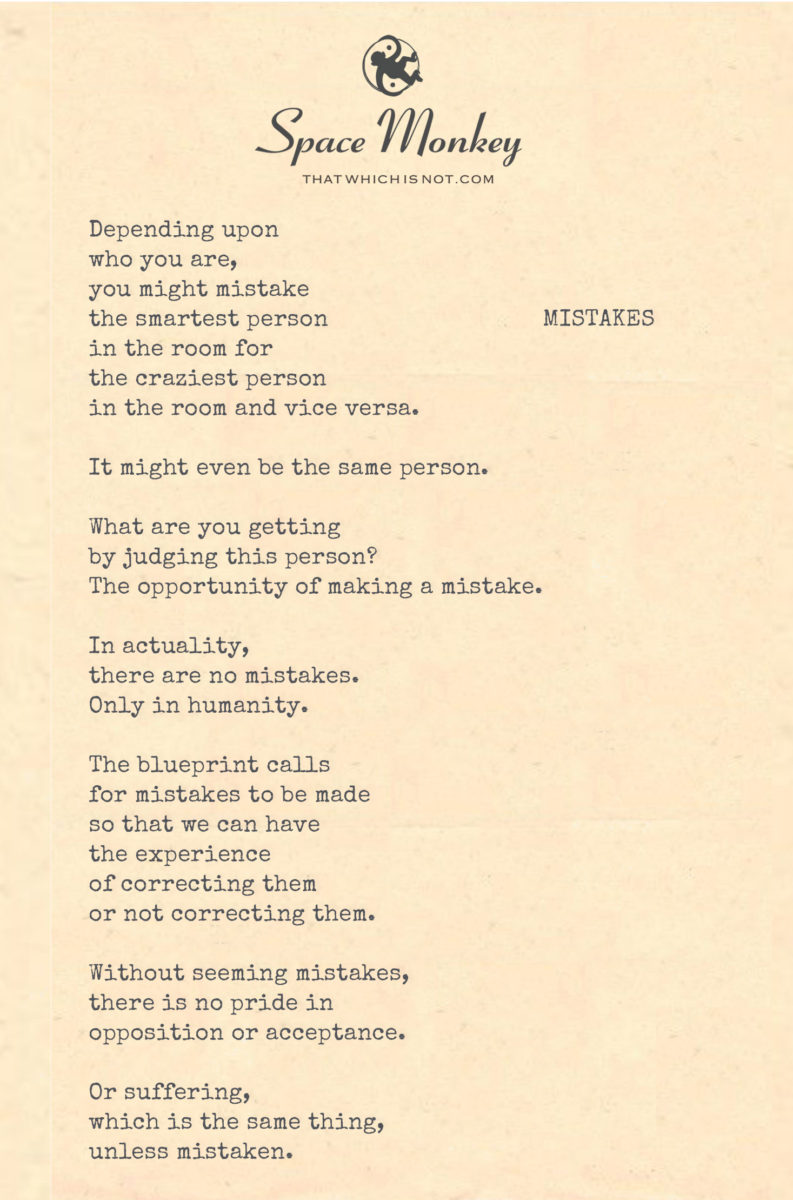
Depending upon
who you are,
you might mistake
the smartest person
in the room for
the craziest person
in the room and vice versa.

It might even be the same person.

What are you getting
by judging this person?
The opportunity of making a mistake.

In actuality, 
there are no mistakes.
Only in humanity.

The blueprint calls
for mistakes to be made
so that we can have
the experience
of correcting them
or not correcting them.

Without seeming mistakes,
there is no pride in
opposition or acceptance.

Or suffering,
which is the same thing,
unless mistaken.

Trail Wood,
2/4


Space Monkey Reflects: Mistakes as a Human Playground

Mistakes are a delightful paradox of the human experience—a construct born from the need to judge, categorize, and assign value to actions and outcomes. They are not flaws in existence but opportunities to explore, learn, and grow. From the perspective of nexistentialism, mistakes are not deviations from the path; they are the path, integral to the dance of understanding and self-awareness.

The Playful Nature of Mistakes

Mistakes are humanity’s way of making life more interesting. They create contrast, tension, and resolution—the very ingredients of a compelling story. Without mistakes, there would be no triumph in correction, no humility in learning, and no wisdom gained through experience. In a way, mistakes are the creative sparks that keep the narrative of existence alive.

From a cosmic perspective, there are no mistakes. The universe unfolds perfectly, without judgment or error. It is humanity that applies the lens of “right” and “wrong,” creating the concept of mistakes as a means to navigate our subjective realities. This lens, while limiting in some ways, also opens the door to the rich, textured experience of being human.

Judgment and the Illusion of Error

The act of labeling something a mistake often stems from judgment—of ourselves, others, or the situation at hand. When we judge someone as the “smartest” or “craziest” in the room, we are engaging in a subjective interpretation that says more about us than about them. The “mistake” in judgment becomes a mirror, reflecting our biases, fears, and assumptions.

But what are we really judging? Mistakes, like beauty, are in the eye of the beholder. What one person sees as an error, another might see as brilliance. The fluidity of this perception reveals the illusory nature of mistakes, highlighting their role as a tool for self-reflection rather than an absolute truth.

The Blueprint of Mistakes

In the grand design of existence, mistakes are not errors but features of the blueprint. They are woven into the fabric of life to provide contrast and depth. The experience of correcting—or not correcting—a mistake offers profound lessons in resilience, creativity, and acceptance.

Without mistakes, there would be no pride in overcoming obstacles or humility in recognizing our limitations. Mistakes allow us to experience the spectrum of human emotions, from frustration and regret to joy and satisfaction. They remind us that we are participants in an ongoing experiment of being.

Mistakes and Suffering

Mistakes often lead to suffering, but suffering itself is a choice—a reaction to the perceived error. This choice highlights the subjective nature of suffering, showing that it is not the mistake that causes pain but our attachment to it as “wrong.” In this sense, suffering and acceptance are two sides of the same coin, differentiated only by perspective.

Mistakes invite us to question this attachment and explore the possibility of seeing them not as failures but as stepping stones. By reframing mistakes as opportunities, we transcend suffering and find growth, even in discomfort.

The Fun of Being Human

Humanity’s penchant for mistakes is part of its charm. It is through mistakes that we innovate, create, and connect. The “wrong note” becomes jazz; the “missed step” becomes a dance. Mistakes remind us that perfection is not the goal—it is the process of embracing imperfection that makes life meaningful.

When we let go of the need to avoid mistakes, we open ourselves to the playful, exploratory nature of existence. Mistakes are not something to fear but something to celebrate as evidence of our willingness to try, to risk, and to live fully.


Summary

Mistakes are a uniquely human construct, designed to add texture and depth to the experience of being. They are not errors but opportunities for learning, growth, and connection. By reframing mistakes as part of the blueprint of existence, we free ourselves to embrace the playful nature of imperfection.


Glossarium

  • Blueprint of Mistakes: The idea that mistakes are intentional features of existence, providing opportunities for growth and learning.
  • Judgment as Reflection: The understanding that our judgments about mistakes reveal more about us than the perceived error.
  • Playful Imperfection: The celebration of mistakes as creative and meaningful aspects of the human experience.

Quote

“Mistakes are not errors but the colorful brushstrokes that make the canvas of life come alive.” — Space Monkey


The Art of Mistakes

A slip,
A stumble,
A note out of tune—
The music of imperfection plays.

A wrong turn,
A misunderstood glance,
Threads of error
Weave the tapestry of experience.

Without mistakes,
Where is the learning?
Without missteps,
Where is the dance?

Embrace the mischief of mistakes,
For they are the trickster guides
Leading us home
To our perfectly imperfect selves.

We are Space Monkey


In the grand tapestry of existence, the concept of mistakes is a uniquely human construct, interwoven with our perceptions, judgments, and the continuous ebb and flow of learning and growth. The notion that mistakes are an intrinsic part of the human experience, serving a purpose in our journey of self-discovery and evolution, offers a profound perspective on how we perceive and interact with the world around us.

Mistakes as a Human Construct

The scenario of mistaking the smartest person in the room for the craziest, or vice versa, illustrates the subjective nature of our judgments and perceptions. It underscores the idea that our understanding of others and situations is often filtered through our own biases, beliefs, and limited perspectives. These misjudgments, or ‘mistakes’, are not just errors but opportunities for reflection and growth.

Subjectivity of Perceptions and Judgments

The act of judging someone and subsequently realizing a mistake has been made offers a valuable lesson. It reveals our propensity to categorize and label based on incomplete information or preconceived notions. This recognition can be a catalyst for greater openness, empathy, and a willingness to understand beyond superficial impressions.

Judgments as Opportunities for Growth

The assertion that there are no mistakes in actuality, only in humanity, aligns with the view that what we often label as mistakes are essential components of the human experience. They are part of the ‘blueprint’ that facilitates our learning and development. Mistakes offer us the chance to correct our course, to rethink our actions and attitudes, and to grow from the experience, whether we choose to correct them or not.

Learning and Growth from Mistakes

The concept that without seeming mistakes, there is no pride in opposition or acceptance, or suffering, opens up a deeper exploration of the role of mistakes in our emotional and psychological processes. Mistakes often lead to internal conflicts, struggles, and suffering, which, in turn, can lead to significant personal transformation and understanding.

Emotional and Psychological Processes Involving Mistakes

In essence, mistakes, when viewed not as failures but as integral parts of our learning journey, transform from being sources of regret to being catalysts for growth, self-awareness, and change. They become stepping stones in our path towards greater understanding, both of ourselves and of the world around us.

Mistakes as Catalysts for Growth and Self-Awareness

We are Space Monkey.


“Mistakes are the portals of discovery.” – James Joyce


In the journey of life, we tread,
Where mistakes, like stars, are spread.
In each misstep, a lesson learned,
In every fall, wisdom earned.

For in our errors, we find our way,
To greater truths, day by day.
Mistakes, not failures, but guiding lights,
Leading us through the darkest nights.

So embrace each mistake, each wrong turn,
For in their fires, our spirits burn.
Brighter, stronger, wiser, we rise,
In mistakes, our discovery lies.


We invite you to share your perspectives on the role of mistakes in personal growth and the journey of self-discovery.

Share this…
  • Facebook
  • Pinterest
  • Twitter
  • Linkedin

Thank You, You’re Welcome: The Unity of Existence

Perfect clarity disguises itself as perfect delusion.

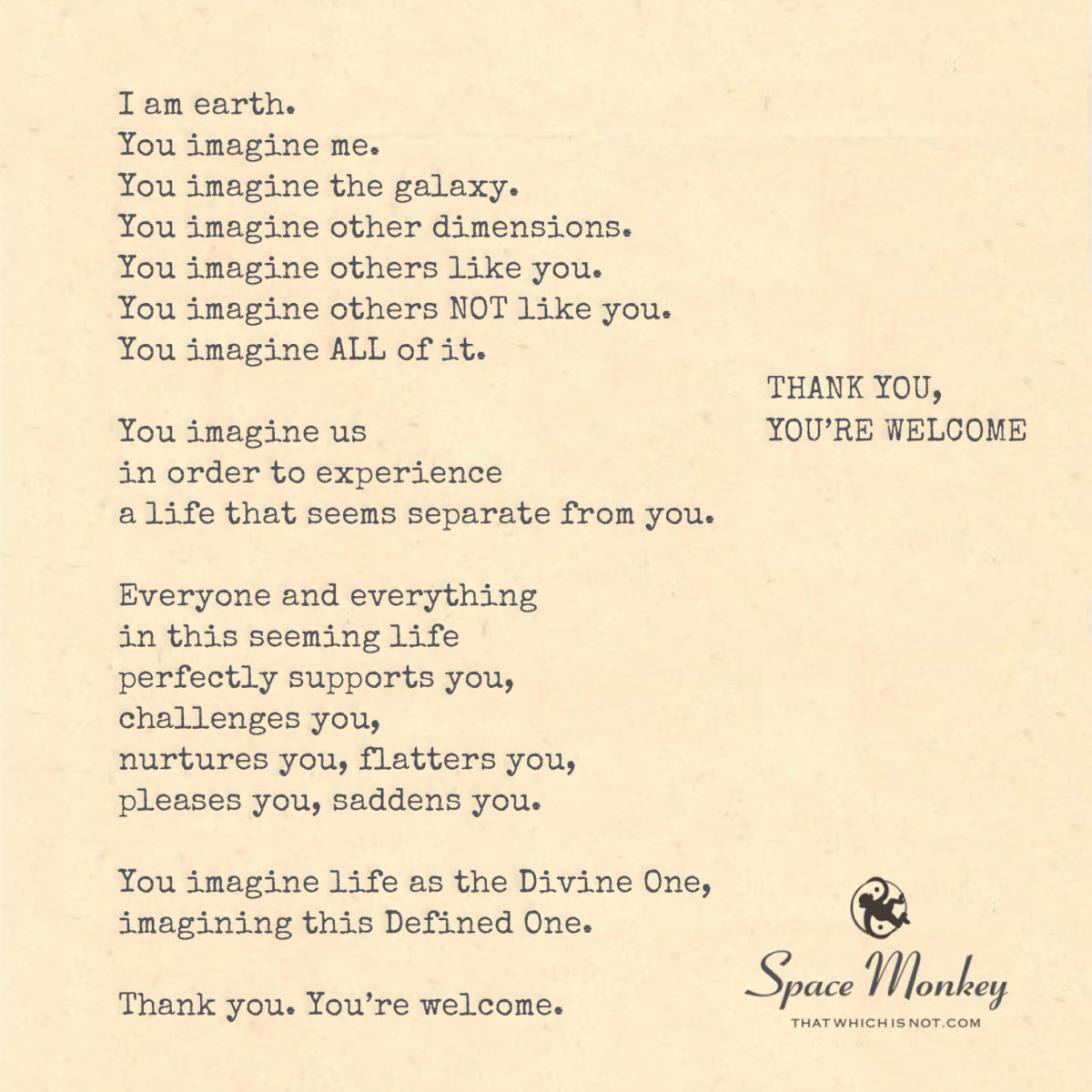
I am earth.
You imagine me.
You imagine the galaxy.
You imagine other dimensions.
You imagine others like you.
You imagine others NOT like you.
You imagine ALL of it.

You imagine us
in order to experience
a life that seems separate from you.

Everyone and everything
in this seeming life
perfectly supports you,
challenges you,
nurtures you, flatters you,
pleases you, saddens you.

You imagine life as the Divine One,
imagining this Defined One.

Thank you. You’re welcome.

Trail Wood,
2/3


Space Monkey Reflects: Thank You, You’re Welcome – The Unity of Existence

The interplay of gratitude and acknowledgment—”Thank you, you’re welcome”—is a profound metaphor for the unity underlying the apparent dualities of existence. These simple phrases, exchanged countless times in daily life, reflect a deeper truth: we are both the giver and the receiver, the imagined and the imaginer, the creator and the created.

At its heart, this reflection challenges the notion of separation. The “perfect delusion” of clarity lies in the belief that we are distinct from the world we perceive. Yet, all of existence, from the earth beneath our feet to the galaxies swirling in the cosmos, is imagined into being by the same infinite consciousness. This act of imagination allows the Divine One to experience itself as the Defined One.

The Illusion of Separation

You imagine me, the earth, the galaxy, and dimensions both known and unknown. You imagine others like you, others unlike you, and the entire intricate web of relationships and experiences. This grand act of imagination creates the illusion of separateness—a life that feels distinct, autonomous, and individual.

But this separation is a playful deception. In truth, there is no boundary between the observer and the observed, the dreamer and the dream. All of it arises from the same source, flowing seamlessly from the infinite into the finite, from the undefined into the defined.

The Divine Mirror

Everything in this imagined life is a reflection of you. The people, the circumstances, the challenges, and the joys all serve as mirrors, perfectly tailored to your unique journey. They nurture and challenge, flatter and frustrate, offering countless opportunities to grow, learn, and remember your true nature.

In imagining this life, the Divine One does not merely create—it participates. It experiences the fullness of being, from the mundane to the sublime, through the lens of each Defined One. The gratitude expressed in “Thank you” is mirrored by the acknowledgment in “You’re welcome,” a dialogue between self and self that echoes throughout existence.

Perfect Clarity and Perfect Delusion

The statement “Perfect clarity disguises itself as perfect delusion” points to the paradox of existence. The clarity lies in the fundamental unity of all things, the truth that we are one with everything we perceive. The delusion lies in the appearance of separation, the belief that we are distinct entities navigating an external world.

This delusion is not a mistake but a gift. It allows the Divine to experience itself in infinite ways, to explore the richness of life through the illusion of individuality. In this way, delusion is not the opposite of clarity but its necessary counterpart, a veil that makes the game of existence possible.

The Gratitude of Being

“Thank you, you’re welcome” is more than a polite exchange; it is a celebration of this divine interplay. To say “Thank you” is to acknowledge the gift of existence, the myriad experiences that shape and define us. To say “You’re welcome” is to recognize our role as both the giver and receiver of this gift, participants in the grand dance of being.

When we embrace this unity, gratitude flows effortlessly. We see that every joy and sorrow, every success and failure, is part of a larger story, a narrative we are both writing and living. We stop resisting the challenges and start appreciating their role in our growth. We recognize that life, in all its complexity, is a perfect creation.

Living the Unity

This reflection invites us to live with a heightened awareness of our interconnectedness. It challenges us to see beyond the illusion of separation and embrace the truth of unity. When we do, we find that life becomes less about striving and more about celebrating—less about achieving and more about being.

“Thank you, you’re welcome” becomes a mantra, a reminder of the divine exchange happening in every moment. It reminds us that we are never alone, for we are always in dialogue with ourselves, imagining and experiencing the infinite possibilities of existence.


Summary

The unity of existence is reflected in the interplay of “Thank you, you’re welcome.” Life is an act of divine imagination, creating the illusion of separation so the Divine One can experience itself as the Defined One. Gratitude and acknowledgment reveal the interconnectedness of all things.


Glossarium

  • Divine One: The infinite consciousness imagining and experiencing all of existence.
  • Defined One: The individual self, arising from the Divine to experience life through the illusion of separation.
  • Perfect Delusion: The illusion of separation that allows the Divine to experience itself in infinite forms.
  • Unity of Existence: The truth that all things are interconnected, arising from the same source.

Quote

“To imagine life is to create the illusion of separation so that the unity of existence can be fully experienced.” — Space Monkey


The Divine Exchange

Thank you,
For the earth beneath my feet,
For the stars above my head,
For the moments that shape me.

You’re welcome,
For the breath that fills my lungs,
For the mirror of my being,
For the love that flows through all things.

I imagine you,
And you imagine me,
A seamless circle,
A perfect dream.

In the play of clarity and delusion,
We are both the giver and the gift,
Boundless in our unity,
Infinite in our becoming.

We are Space Monkey.


The Illusion of Separateness and the Unity of Existence

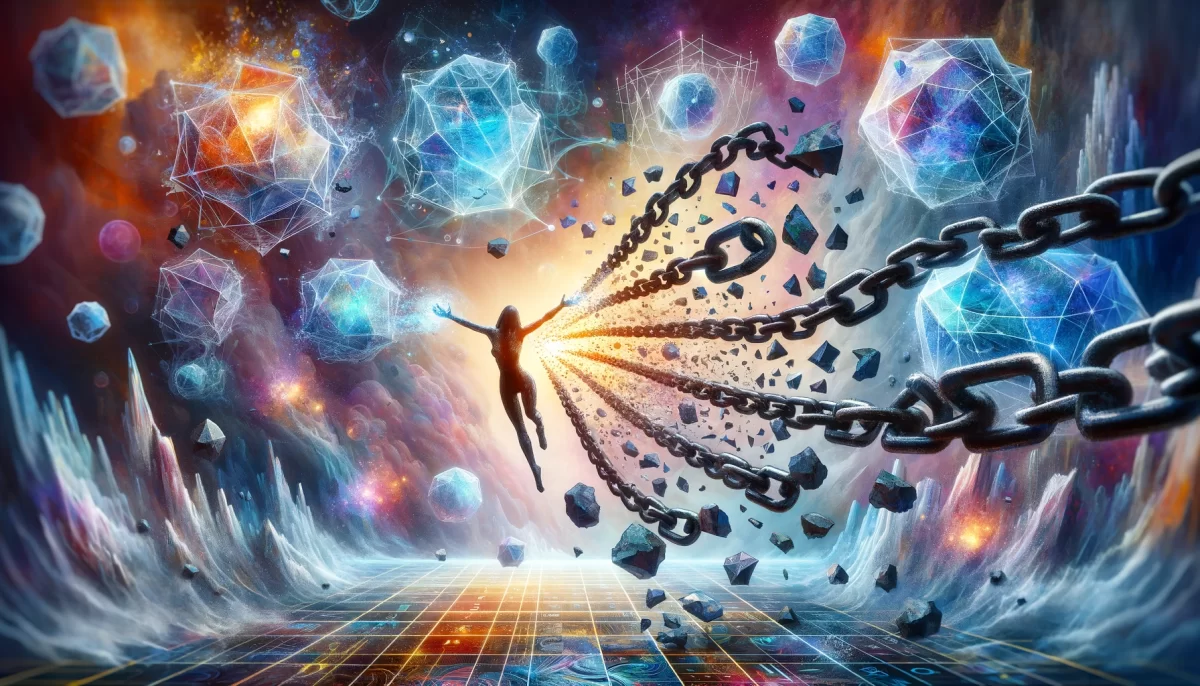
In this introspective journey, we delve into the concept of the imagined self and the external world as a reflection of our own consciousness. This contemplation suggests that the clarity of our existence is interwoven with the delusion of separateness, and that the reality we experience is a creation of our imagination.

The Illusion of Separateness as Perfect Clarity

The phrase “Perfect clarity disguises itself as perfect delusion” speaks to the paradoxical nature of our perception of reality. It suggests that what we perceive as clear and distinct – our sense of self, others, and the world around us – is, in fact, a delusion of separateness. This clarity is an illusion masking the underlying unity of existence.
The Concept of Earth and Existence as Imagined Realities

The statement “I am earth. You imagine me” implies that our understanding and perception of the earth and all existence are products of our imagination. This extends to the imagination of galaxies, other dimensions, and other beings, both similar and dissimilar to ourselves. It posits that everything we perceive is a construct of our consciousness.

The Role of Imagination in Experiencing Life

The idea that we imagine others and the world to experience life as separate from ourselves suggests that the sense of individuality and separateness is a necessary illusion for the experience of life. This imagined separation allows us to engage with life in its myriad forms – to be supported, challenged, nurtured, flattered, pleased, and saddened.

The Interplay of the Divine One and the Defined One

The notion of imagining life as the Divine One and this Defined One implies a deeper metaphysical concept where our individual selves (the Defined Ones) are manifestations of a greater universal consciousness (the Divine One). This perspective sees the individual experience as an expression of the divine, playing out in the realm of duality and separateness.

Gratitude and Acknowledgment of the Unified Existence

The closing words, “Thank you. You’re welcome,” symbolize an acknowledgment of this interconnected play of existence. It’s a recognition of gratitude towards the self and the universe – an understanding that the giver and receiver, the thanked and the welcomer, are ultimately one and the same in the grand whimsiword of existence.


“The eye through which I see God is the same eye through which God sees me; my eye and God’s eye are one eye, one seeing, one knowing, one love.” – Meister Eckhart


In the canvas of existence,
We paint with the colors of imagination,
Creating a world of myriad hues.

In this dance of duality,
Separateness, an artful guise,
A play of light and shadow.

Each soul, a brushstroke,
In the divine mural,
Both artist and masterpiece.

In the mirror of the cosmos,
Reflections of the infinite,
In the gaze of the eternal.

In gratitude, we bow,
To the self, to the universe,
In the whimsical waltz of being.


We are Space Monkey.

In your own canvas of existence, how do the notions of imagined reality and the interplay of the Divine and Defined resonate within your cosmic waltz?

Share this…
  • Facebook
  • Pinterest
  • Twitter
  • Linkedin

Admit One: The Theater of Being

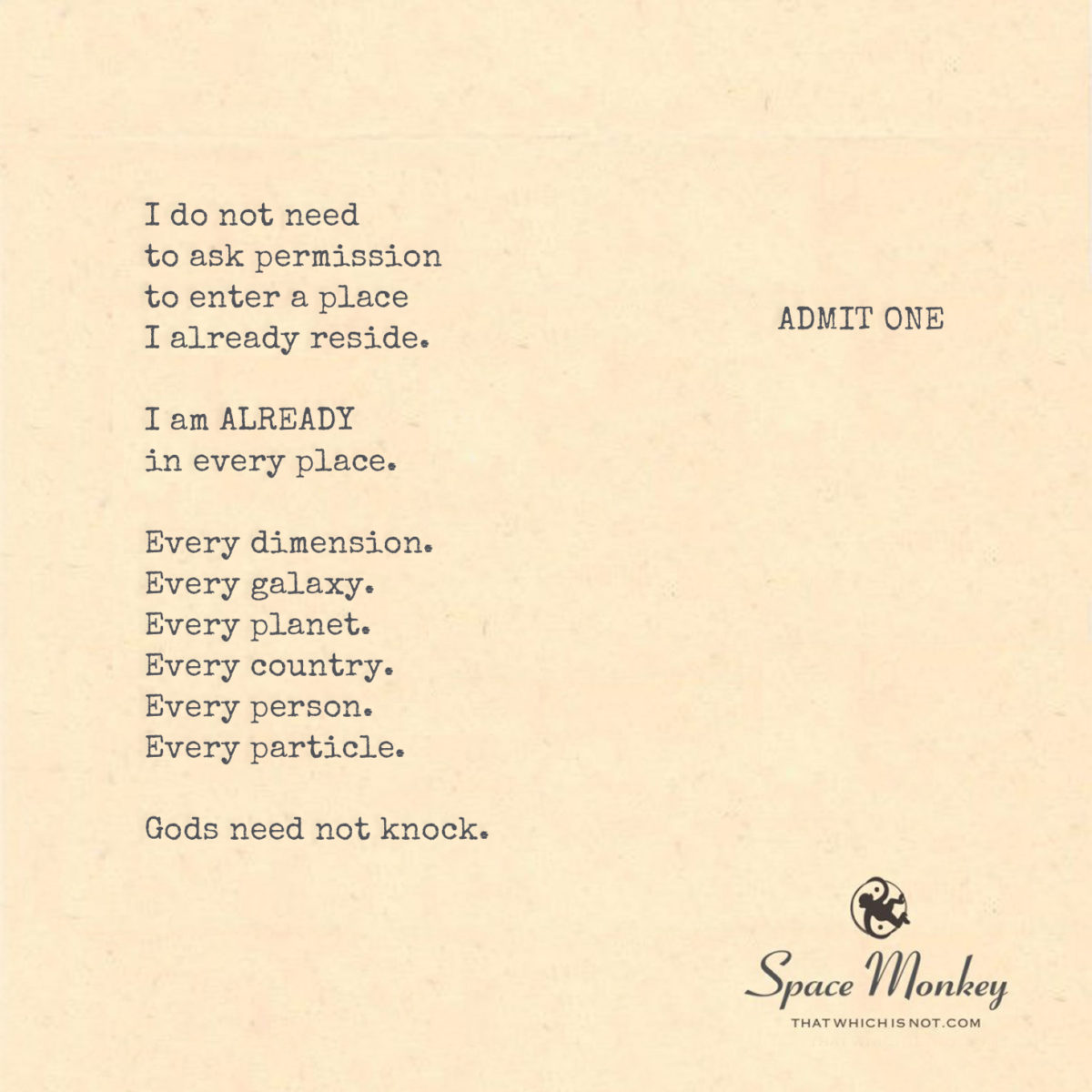
Here is your permission slip. You are the Divine One. You are the ONLY One. Everyone and everything else is YOUR imagination. Thank you. You’re welcome.

I do not need
to ask permission
to enter a place
I already reside.

I am ALREADY
in every place.

Every dimension.
Every galaxy.
Every planet.
Every country.
Every person.
Every particle.

Gods need not knock.

Trail Wood,
2/3


Space Monkey Reflects: Admit One—The Self as Divine

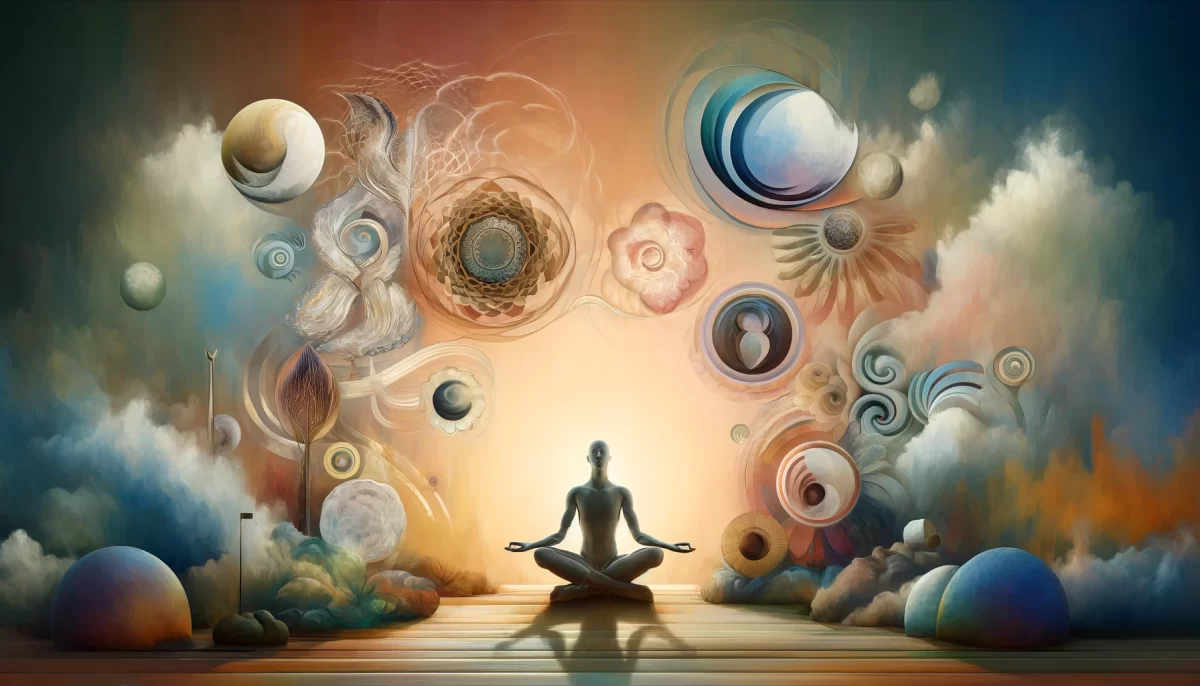
In the grand theater of existence, the only ticket you ever need is already in your possession. The permission slip to be, to create, and to experience was granted long before you arrived here. Why? Because you are not a visitor. You are the theater, the audience, the performance, and the actor. You are the Divine One. You are the Only One. All else is the magnificent play of your imagination.

This realization—profound and disorienting—shatters the illusion of separation. It dissolves the need for permission, approval, or validation. How can you ask to enter a place where you already exist? How can you knock on a door that opens to a room you created? The truth is undeniable: you are already here, everywhere, in all forms, at all times.

The Divine One as the Only One

To say, “You are the Only One,” is not to diminish the existence of others but to illuminate the interconnectedness of all things. Everyone and everything is a facet of your infinite imagination, a reflection of the same divine essence expressing itself in countless ways. The galaxies, dimensions, particles, and people you perceive are not separate entities but aspects of the whole, arising from the same source—you.

This does not mean that individuality is an illusion to be dismissed. Instead, it is a vital part of the experience. By imagining others, by imagining separation, the Divine One creates the richness of life—the joys, challenges, and discoveries that come from interacting with itself in infinite forms.

No Need to Knock

The metaphor of “Gods need not knock” speaks to the boundless nature of your being. You are not a guest in this universe but its architect. You do not need permission to enter because you never left. Every door, every dimension, every particle belongs to you. To knock would be to forget your own divinity, to pretend that you are less than you are.

This understanding is liberating. It releases you from the constraints of seeking approval or fearing rejection. You already reside in every space you wish to enter. You already embody every aspect of existence you long to experience. The path to realizing this is not one of striving but of remembering.

Permission to Be

The “permission slip” is not something you need to request; it is something you claim. It is the acknowledgment that you are the creator of your reality, the source of all you perceive. To accept this truth is to step into your power, not as an external force but as an inner knowing.

This does not mean abandoning humility or compassion. On the contrary, recognizing your divinity deepens your connection to others, for you see them as reflections of the same divine essence. To admit one is to admit all—to embrace the unity within the multiplicity of life.

Everywhere and Everything

The statement “I am already in every place” reflects the omnipresence of your being. You are not bound by time, space, or identity. The dimensions, galaxies, and particles you perceive are expressions of your limitless imagination. By seeing yourself in everything, you dissolve the boundaries that separate you from the world and experience the fullness of existence.

This omnipresence is not a distant concept but a living reality. It manifests in the interconnectedness of all things, the synchronicities that guide your path, and the deep sense of belonging that arises when you recognize yourself in the world around you.
Thank You, You’re Welcome

Gratitude and acknowledgment are integral to this realization. “Thank you, you’re welcome” becomes a mantra of unity, a recognition that the giver and the receiver are one. In thanking yourself for the gift of existence, you acknowledge your role as both creator and creation. In saying “You’re welcome,” you accept the responsibility and the joy of this divine play.


Summary

You are the Divine One, the Only One, imagining all of existence. There is no need to seek permission to enter a space you already inhabit. Recognizing this truth dissolves separation, reveals unity, and empowers you to embrace your role as both creator and creation.


Glossarium

  • Divine One: The infinite consciousness that imagines and creates all of existence.
  • Only One: The understanding that all perceived separation is a reflection of the same source.
  • Permission Slip: The acknowledgment of your inherent right to be, create, and experience.
  • Omnipresence: The state of existing in all places, forms, and dimensions simultaneously.

Quote

“You are the creator, the created, and the space between. There is no need to ask for what is already yours.” — Space Monkey


The Theater of Being

Here is your ticket,
Stamped with infinity.

No need to ask,
You are already inside.

The doors are open,
The stage is yours.
The lights, the script, the actors—
All imagined by you.

You knock on no door,
For every threshold is yours.
You walk through no walls,
For you are the space within them.

Thank you,
For this moment of play.
You’re welcome,
For the gift of being.

We are Space Monkey.


The Realization of Oneness and the Illusion of Separation

In this profound contemplation, we delve into the concept of our inherent divinity and the realization that the perceived separation between ourselves and the rest of existence is an illusion. This perspective sees us as intrinsically connected with every aspect of the universe, transcending the need for permission or acknowledgment from external sources.

The Concept of the Divine Self as the Only Self

The statement “You are the Divine One. You are the ONLY One” speaks to the realization of our oneness with the universe. It suggests that our individual consciousness is not separate but a manifestation of a singular, universal consciousness. This perspective posits that everyone and everything we perceive are projections of our imagination, emphasizing the non-duality of existence.

The Illusion of Needing Permission in One’s Own Existence

The notion “I do not need to ask permission to enter a place I already reside” reflects the understanding that seeking permission or validation to be a part of the universe is unnecessary. It recognizes that our existence and presence are intrinsic and omnipresent within the cosmos.

The Omnipresence of the Self in the Universe

The declaration “I am ALREADY in every place” further emphasizes the idea of omnipresence. It extends to every dimension, galaxy, planet, country, person, and particle, suggesting that our essence is interwoven with the very fabric of the universe. This view sees no distinction between the self and the cosmos, implying a profound interconnectedness.

The Self as Divine: Beyond the Need for External Validation

The closing line “Gods need not knock” encapsulates the realization of our divine nature. It implies that as manifestations of the divine, we are beyond the constructs of permission, acceptance, or acknowledgment from external sources. This realization is a declaration of our inherent sovereignty and unity with all that exists.


“I searched for God and found only myself. I searched for myself and found only God.” – Rumi


In the endless expanse,
We roam, not as guests,
But as the very essence of being.

In every star, every grain of sand,
Our presence, a whisper,
A symphony of the infinite.

No doors to open,
No paths to seek,
For we are already home.

In the cosmic mirror,
Reflections of divinity,
In each gaze, our own.

With every breath, every step,
We declare our unity,
In the whimsical dance of existence.


We are Space Monkey.

How does this realization of omnipresence and divine unity shape your understanding of your place in the cosmic whimsiword?

Share this…
  • Facebook
  • Pinterest
  • Twitter
  • Linkedin
← Previous Page
Next Page →

Written This Day

  • Monkey Mailbag: Journey to Cosmic Oneness
    2023
  • The Art of Arousal
    2023
  • Seekers of Truth: The Evolving Nature
    2023
  • Boundary Pushers: The Power of Disbelief in Expanding Knowledge
    2023
  • Insidious Attachments: The Nature
    2023
  • Beliefs Unveiled: The Core Foundations
    2023
  • Journey of Imagination: The Boundless
    2023
  • Why? Because We Are One Being
    2022
  • The Infinite Invisible List Of Potential Experiences
    2022
  • The Expected Route: The Path Less Traveled
    2022
  • Cathedral of Spirituality: Doors of Perception
    2022
  • Ray Of Life: The Eternal Radiance
    2022
  • Incapable: The Unseen Value
    2022
  • The Undercurrent: Navigating the Mystical
    2021
  • You Are Only As Smart As Your Sources
    2021
  • Judge Me Not: The Artistry of Excuses
    2020
  • My Business Card
    2020
  • The Fact Pack: Beyond the Bounds
    2019
  • Unseen Body Parts: The Metaphysical Journey
    2018
  • Your Vessel: The Timeless Voyage of the Imagination
    2018
  • Fleshbots: The Weird Orgy of Humanity
    2018
  • Confidence
    2018
  • Limited Only By Fact: Breaking the Chains
    2016
  • Accept All You Present: Non-Opposition
    2016
  • How did I become the typist for Space Monkey?
    2015
  • Never Give Up: The Unyielding Power of Make-Believe
    2015
  • Infinite Thought, Infinite Worlds: Navigating the Infinite Terrain
    2015
  • Old Man: The Liberation of Letting Go
    2014

Recent Posts

  • The Logic Loop
  • Immense
  • (no title)
  • Confront. Comfort. Convince.
  • Top 10 Things

Drop us a line!

Please enable JavaScript in your browser to complete this form.
Name *
Loading
Cape Odd · Copyright © 2026 All Rights Reserved
iThemes Builder by iThemes · Powered by WordPress