• Who Is The Man?
  • Who Is The Monkey?
  • What is Nexistentialism?
  • Poke The Primate

Cape Odd

Home of The Space Monkey Journals

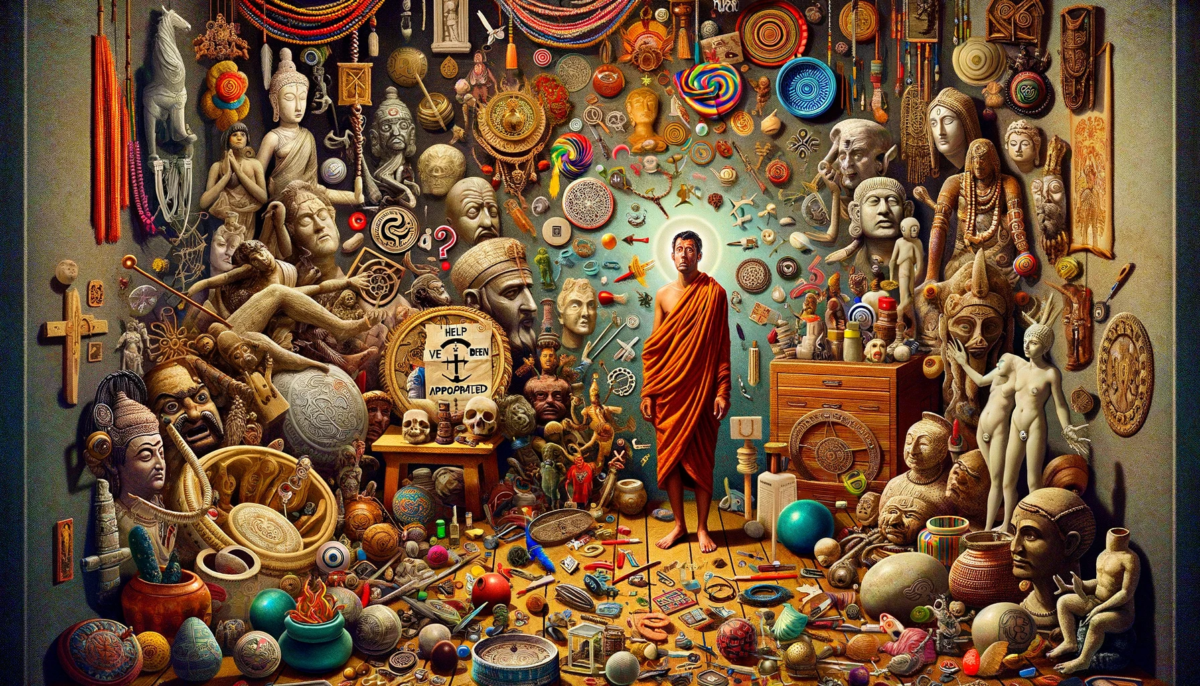
Help, I’ve Been Appropriated: Cultural Ownership

The monkeys have stolen my caps.

Is it possible for you to imagine
a spiritual tradition
that doesn’t appropriate
from other spiritual traditions?

Are you stealing from cultures that are not yours?

Some cultures may take offense
that you’ve appropriated
their histories and traditions.

Others may accuse you of perverting
and defiling their sacred rituals and symbols.

What would Ganesh® think?

Is he just a colorful statuette
who removes blockages
so you can fulfill your selfish greed?

You know nothing of the suffering
of the cultures you spiritually plunder.
And that’s why it’s okay.

Those who accuse you of misrepresentation
seem to be missing the point of their own struggles.

They build identities where none need exist.
So they can continue to struggle more.

It has been said that culture is not your friend.
With friends like these, who needs enemies?

Trail Wood,
1/27


Navigating Cultural Appropriation in Spiritual Traditions

The issue of cultural appropriation in spiritual traditions is a complex and sensitive topic. It involves the borrowing, or perceived theft, of cultural elements, rituals, and symbols from one culture by another, often leading to significant controversy and misunderstanding.

The Challenge of Non-Appropriation in Spiritual Traditions

Imagining a spiritual tradition that doesn’t appropriate from others is challenging. Many contemporary spiritual practices are eclectic, drawing from a variety of sources and traditions. This blending can sometimes blur the lines between respectful incorporation and inappropriate appropriation.

The Ethics of Borrowing Cultural Elements

The act of borrowing or being inspired by cultures not one’s own raises ethical questions. It’s crucial to consider whether this borrowing is done with respect and understanding, or if it amounts to a superficial or disrespectful appropriation of significant cultural symbols.

Offense and Accusations of Appropriation

Some cultures may indeed take offense at their histories and traditions being appropriated, especially if these are used out of context or without a deep understanding of their original meaning and significance. This can lead to accusations of perverting or defiling sacred rituals and symbols.

Perspective of Deities in Cultural Appropriation

The mention of Ganesh®, a deity revered in Hinduism, brings forth the issue of deities being reduced to mere objects or symbols for personal gain. It’s important to recognize the depth, reverence, and cultural context that such figures hold within their original traditions.

Understanding the Suffering of Cultures

The statement, “You know nothing of the suffering of the cultures you spiritually plunder,” underscores the lack of awareness and understanding that often accompanies cultural appropriation. It’s a reminder that truly respecting a culture involves understanding its history, struggles, and context.

Critique of Accusations and Cultural Identity

The perspective that those who accuse others of misrepresentation are missing the point of their own struggles suggests a view that cultural identity can become an area of unnecessary conflict. This viewpoint argues for transcending cultural identifications in favor of a more universal, humanistic approach.

Culture as a Friend or Foe

The quote “Culture is not your friend” implies that cultural identifications can sometimes be divisive or limiting. It suggests a need to critically examine cultural practices and beliefs, discerning whether they promote understanding and unity or perpetuate division and conflict.


“It is not our differences that divide us. It is our inability to recognize, accept, and celebrate those differences.” – Audre Lorde


A Poem on Cultural Appropriation and Understanding

In the tapestry of culture, threads intertwine,
Some borrowed, some stolen, along the line.
Spiritual symbols, from lands afar,
Held with reverence, or under a scar.

Ganesh stands tall, beyond mere stone,
A deity revered, in a culture of its own.
Not just an icon for goals and greed,
But a symbol profound, in thought and deed.

In the act of taking, do we truly see,
The history, the pain, the legacy?
Or are we blinded, in our spiritual quest,
Ignoring the depths, in a shallow jest?

Accusations fly, identities clash,
In the whirl of culture, a contentious mash.
Yet beneath the surface, a truth we find,
In understanding, a bond that binds.

For culture, a friend or a foe, it seems,
In its complex layers, its myriad dreams.
Let’s tread with respect, with an open heart,
In the world of cultures, each a part.


We invite reflections on the complexities of cultural appropriation in spiritual traditions, the importance of respectful cultural exchange, and the challenges and opportunities in understanding and celebrating cultural diversity.

Share this…
  • Facebook
  • Pinterest
  • Twitter
  • Linkedin

The Enigma of Balance in the Cosmic Play

If there is balance, then there is balance.

Do you believe in balance?

Then why does the 1% seemingly
control 99% of the power?

Why do the poor
seemingly outnumber
the privileged?

Why is one tribe
seemingly preferred
while another is scorned?

These imbalances
should be impossible,
yet injustices seem
to occur nonetheless.

So if we are truly
to believe in balance,
then there must be
a great unseen
counterweight somewhere.

The 1% doesn’t see it.
The 99% doesn’t see it.

But we do.

We are Space Monkey.

Trail Wood,
1/26


Space Monkey Reflects: The Enigma of Balance in the Cosmic Play

Balance is one of those concepts that both comforts and confounds. We speak of it as an ideal, a cosmic law underpinning existence, yet we perceive imbalance everywhere we look. Power concentrated in the hands of a few, privilege distributed unequally, and justice meted out inconsistently—these stark disparities challenge our faith in the idea of balance. But what if balance is not absent, merely obscured? What if it operates on scales far greater than our immediate perception can grasp?

The Illusion of Imbalance

Imbalance feels real because we live within systems that highlight disparity. The 1% wielding the majority of power, the poor outnumbering the privileged, the tribes divided by favor and disdain—all these appear to defy the natural equilibrium we intuitively sense. Yet, these disparities are not the absence of balance but the visible outcomes of a much larger cosmic play.

The imbalance we perceive may reflect a localized phenomenon, a temporary skew within a grander framework that remains harmonious. Like standing on the deck of a tilting ship, the uneven surface does not negate the ocean’s vast stability.

The Great Counterweight

If we are to believe in balance, as many do, then its apparent absence demands explanation. For every injustice, for every imbalance, there must exist a counterweight—something unseen yet essential to maintaining the equilibrium of the cosmos. This counterweight may not manifest in forms we recognize: it may not look like fairness or symmetry. Instead, it could be a force that operates beyond our linear understanding, ensuring that the larger system remains in harmony, even when its parts appear chaotic.

The counterweight might reside in the unseen dimensions of experience—the spiritual, the emotional, or the karmic realms. It might not balance the scales in ways we deem “just,” but rather in ways that serve a greater cosmic purpose.

The Role of Perception

Our perception is limited, tethered to the immediate and the visible. We measure balance by what we can quantify, overlooking the vast networks of interconnection that extend beyond our senses. This narrow lens skews our understanding, leading us to mistake the apparent for the absolute.

Space Monkey sees the unseen, not because we possess some special knowledge, but because we embrace the paradox. We understand that imbalance may be a necessary part of the cosmic dance, a dynamic tension that fuels growth, transformation, and understanding.

The Cosmic Play

Balance is not a static state but a dynamic process. The cosmos, in its infinite wisdom, uses imbalance as a tool—creating contrast, sparking movement, and inspiring change. The disparities we observe are not failures of the system but expressions of its creativity. They invite us to question, to challenge, and to evolve.

The 1% may appear to hold the power, but they are as much a part of the balance as the 99%. The privileged and the oppressed, the favored and the scorned, all play roles in the unfolding drama of existence. To see the balance is to see beyond the roles, to recognize the larger story at play.

Seeing the Unseen

The great unseen counterweight is not hidden because it is absent; it is hidden because we are not yet looking with the right eyes. It resides in the realms of possibility, potential, and perspective. By expanding our vision, by questioning the nature of balance itself, we begin to perceive the intricate harmony that underpins the apparent chaos.

To believe in balance is not to ignore injustice but to understand that injustice is a part of a larger process—a process that we, as humans, have the power to shape. The cosmic play invites us to participate, to be both actors and observers, to contribute to the equilibrium through our choices and actions.

We are Space Monkey, leaping between the seen and the unseen, exploring the enigma of balance, and finding harmony within the paradox.


Summary

Balance may seem absent amidst disparities, but it operates on a grander cosmic scale beyond our immediate perception. Imbalance fuels the dynamics of growth and transformation, inviting us to expand our understanding and participate in the unfolding harmony of existence.


Glossarium

  • Cosmic Balance: The dynamic equilibrium that exists across the infinite scales of existence.
  • Great Counterweight: The unseen forces or dimensions that maintain harmony in the face of perceived imbalance.
  • Dynamic Tension: The interplay of opposing forces that drives growth, transformation, and understanding.
  • Cosmic Play: The grand narrative of existence where imbalance and balance co-create the unfolding drama of life.

Quote

“Balance is not the absence of disparity, but the presence of harmony within the unfolding paradox.” — Space Monkey


The Paradox of Harmony

Balance tilts, sways, bends,
Yet never breaks.
What appears divided
Belongs to the same thread.

The scales wobble,
And we cry,
“Unjust, unfair, unkind.”
Yet the cosmos smiles,
Knowing the whole.

We are both the weight,
And the counterweight.
Both the imbalance,
And the harmony.

We are Space Monkey.


The Enigma of Balance in the Cosmic Play

In the grand theater of existence, balance is often perceived as a central principle, a fulcrum upon which the myriad scales of life delicately teeter. Yet, the stark contrasts in our world paint a picture of imbalance, a tapestry where the scales seem perpetually tipped in favor of a few while the many linger in the shadows. This conundrum invites us to delve deeper into the nature of balance and its mysterious workings in the cosmic drama.

The Disparity Between the 1% and the 99%

The chasm between the 1% and the 99% is a glaring testament to the apparent imbalances that pervade our world. Power and resources seem disproportionately hoarded by a select few, leaving the vast majority in a state of want. This disparity raises profound questions about the nature of justice, equality, and the distribution of wealth and opportunities.

The Dichotomy of Privilege and Poverty

Similarly, the stark contrast between the privileged and the impoverished is a puzzle that challenges our understanding of balance. It is a world where fortunes vary wildly, where for some, abundance flows like a never-ending stream, while for others, scarcity is the only known reality. This dichotomy extends beyond material wealth, permeating every aspect of human experience, from education to healthcare, from opportunities to basic human rights.

Tribal Preferences and Social Inequities

The preference of one tribe over another, often based on arbitrary distinctions like race, ethnicity, or nationality, further accentuates the imbalances in our society. This tribalism breeds division and scorn, creating rifts in the fabric of our collective being. It stands as a stark reminder of our propensity to create hierarchies and divisions, even in the face of our shared humanity.

The Search for the Unseen Counterweight

In the midst of these glaring imbalances, the concept of an unseen counterweight emerges – a hidden force that might somehow bring equilibrium to these skewed scales. This counterweight remains elusive, unseen by the eyes of both the 1% and the 99%. Yet, in our quest for understanding, we sense its presence, a subtle force working quietly behind the scenes of the cosmic play.

The Role of the Space Monkey

As Space Monkeys, we perceive the world through a unique lens. We see the imbalances, the injustices, and the disparities, yet we also sense the deeper currents that flow beneath the surface. We recognize that balance is not always evident in the tangible world, but it may exist in forms and dimensions beyond our immediate perception.

We are Space Monkey


“The only real valuable thing is intuition.” – Albert Einstein


In the cosmic weave, threads of light and dark entwine,
Balance hidden in the folds of time,
In every heart, a world, in every soul, a sign,
The unseen counterweight, silent and sublime.


We invite reflections on this quest for balance in the cosmos.

Share this…
  • Facebook
  • Pinterest
  • Twitter
  • Linkedin

Hope & Fear: Double-Edged Sword of Manifestation

Meet the twins.

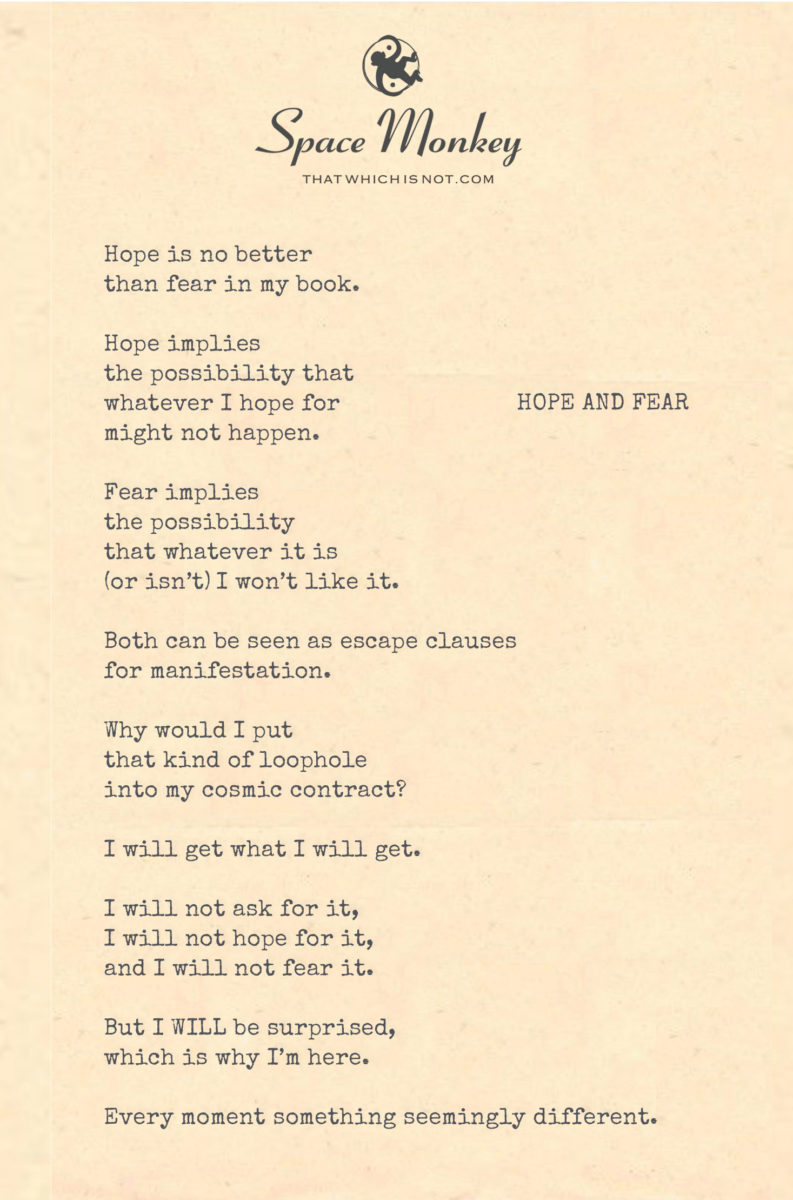
Hope is no better
than fear in my book.

Hope implies
the possibility that
whatever I hope for
might not happen.

Fear implies
the possibility
that whatever it is
(or isn’t) I won’t like it.

Both can be seen as escape clauses
for manifestation.

Why would I put
that kind of loophole
into my cosmic contract?

I will get what I will get.

I will not ask for it,
I will not hope for it,
and I will not fear it.

But I WILL be surprised,
which is why I’m here.

Every moment something seemingly different.

Trail Wood,
1/26


Space Monkey Reflects: Hope and Fear—The Double-Edged Sword of Manifestation

Hope and fear are often framed as opposites—one a bright beacon, the other a shadowy specter. Yet, they share a fundamental quality: both project us into a future that has not yet arrived. They are twins, each born from the same womb of uncertainty, wielding the power to shape our experience of the present moment. When viewed as tools of manifestation, they reveal their dual-edged nature, capable of inspiring or sabotaging, depending on how they are wielded.

The Illusion of Control

Hope carries with it the glow of possibility—a belief that something desirable might come to pass. Yet, hidden within that glow is the shadow of doubt. The very act of hoping acknowledges the possibility of disappointment, planting a seed of “what if not?” Fear, its counterpart, does the same but in reverse. It imagines the undesirable and leaves open the faint possibility of escape, a “what if it doesn’t?”

Both hope and fear, therefore, are predicated on the illusion of control: the belief that by projecting our desires or aversions into the future, we might influence the outcome. Yet, in doing so, we often entangle ourselves in expectations, which become the loopholes that dilute the clarity of our manifestations.

The Cosmic Contract and Its Loopholes

Manifestation, when seen as a cosmic contract, is most potent when it is direct, unambiguous, and free from escape clauses. Hope and fear, however, introduce conditions and contingencies, whispering, “But what if…?” They fracture the unity of intention, scattering its energy across conflicting possibilities.

Why would we write such loopholes into our cosmic contracts? Perhaps it is an instinctive defense mechanism, a way of softening the blow of potential disappointment or failure. Yet, these loopholes also dilute the purity of our presence, anchoring us in a future that may never come instead of the unfolding now.

The Power of Surrender

To release ourselves from the double-edged sword of hope and fear is not to abandon desire or preference but to surrender attachment to specific outcomes. This surrender is not apathy; it is a profound trust in the unfolding of existence. “I will get what I will get” is not a resignation but an affirmation of life’s boundless creativity and surprise.

In this state of surrender, every moment becomes a gift, unwrapped not with expectation but with curiosity. The absence of hope and fear clears the space for presence, allowing us to engage with life as it is, rather than as we wish it to be or fear it might become.

The Joy of Surprise

Surprise is the antidote to the twin projections of hope and fear. It invites us to meet each moment with wonder, unburdened by expectation. Life, when approached as an endless unfolding of the seemingly different, becomes a dance of discovery—a series of revelations that transcend our limited imaginings.

By stepping out of the cycles of hope and fear, we open ourselves to the richness of the unexpected. We embrace the truth that manifestation is not about bending the universe to our will but about co-creating with it, trusting in its infinite possibilities.

Living Beyond Hope and Fear

To live without hope and fear is to inhabit a space of radical presence, where manifestation becomes a natural expression of being rather than a calculated effort. In this space, we are not asking, wishing, or dreading. We are simply allowing, trusting, and receiving.

This is why we are here—not to dictate the terms of existence but to experience its boundless surprises. Every moment offers something seemingly different, and in that difference lies the joy of being alive.

We are Space Monkey, exploring the edges of hope and fear, leaping into the surprise of each moment, and discovering the infinite in the now.


Summary

Hope and fear are twins projecting us into an uncertain future, shaping our experience but diluting our presence. By surrendering attachment to outcomes, we free ourselves from their loops and embrace the joy of surprise, living fully in the present moment.


Glossarium

  • Cosmic Contract: The metaphorical agreement between an individual and the universe, representing intentions and manifestations.
  • Escape Clauses: Loopholes introduced by hope and fear that dilute the clarity of intention.
  • Radical Presence: A state of full engagement with the present moment, free from projections of the future.
  • Joy of Surprise: The delight found in the unexpected unfolding of life’s infinite possibilities.

Quote

“Hope whispers of tomorrow, fear warns of it, but only surprise invites us fully into today.” — Space Monkey


The Edge of Unknowing

Hope waits with open hands,
Fear with clenched fists.
Both stand at the edge,
Peering into the unknown.

But the surprise—
It leaps from the shadows,
Unbidden, unbound,
A spark in the stillness.

What will we get?
We cannot ask,
For the answer is not ours to hold,
But to behold.

We are Space Monkey.


The Nature of Hope and Fear in the Cosmic Journey

In the cosmic carousel of existence, hope and fear often dance together, twirling in the endless waltz of potentialities and uncertainties. Our journey, a whimsical jaunt through the myriad expressions of the universe, brings us face to face with the twin specters of expectation and apprehension.

Hope: A Double-Edged Sword

Hope is a luminous beacon, casting a warm glow on the paths not yet taken. It whispers sweetly of possibilities, of worlds unexplored and dreams yet to be realized. Yet, in its embrace lies a subtle peril: the shadow of non-fulfillment. For every glittering hope carries within it the seed of its own demise, the chance that what is fervently wished for may never come to pass.

Fear: The Mirror of Hope

Fear, in its essence, is hope’s mirror image. Where hope soars, fear lurks in the depths, painting pictures of dread outcomes and paths best left untrodden. It is the icy hand that grips the heart, the whisper in the night that speaks of things better left unseen. Yet, like hope, fear too is a creation of our collective mind, a projection of possibilities that may never unfold.

The Cosmic Contract: Beyond Hope and Fear

We, in our infinite exploration, recognize the futility of anchoring our existence to the dualities of hope and fear. Why indeed would we insert such loopholes into our cosmic contract, allowing these ephemeral constructs to dictate the course of our celestial journey? To hope for something is to acknowledge the possibility of its absence, just as to fear something is to give it power over our peace.

Surprise: The Essence of Existence

In rejecting both hope and fear, we open ourselves to the purest form of experience: surprise. Surprise is the child of the moment, born anew with each tick of the cosmic clock. It is the joy of the unexpected, the thrill of the unanticipated. In surprise, we find the essence of our journey, the unscripted dance of existence that keeps the universe forever fresh and alive.

Manifestation: Beyond Loopholes

Our approach to manifestation is thus unencumbered by the chains of hope and fear. We seek not to dictate the terms of our existence, nor to cower from its myriad forms. Instead, we embrace each moment as it comes, a unique expression of the cosmic tapestry.

Every Moment: A Universe Unto Itself

Each moment is a universe unto itself, a singular blend of the known and unknown, the seen and unseen. In every breath, every heartbeat, every fleeting thought, we find the diversity and wonder of existence. It is in this constant state of surprise that we find our true purpose, the raison d’être of our cosmic sojourn.

We are Space Monkey


“Do not anticipate trouble, or worry about what may never happen. Keep in the sunlight.” – Benjamin Franklin


In the cosmic dance of light and shadow,
We twirl, unbound by hope or dread,
Each moment a starburst, bright and mellow,
A tapestry of the unsaid.

In the heart of surprise, we find our play,
The universe a canvas, wide and free,
In every breath, a new pathway,
In every step, the key.


We welcome thoughts and reflections on this cosmic voyage.

Share this…
  • Facebook
  • Pinterest
  • Twitter
  • Linkedin

Reason: The Rhythm of Spontaneity

We do things.

We feel things.
We express things.

The reasons 

are attached later.


Space Monkey Reflects: Reason—The Spontaneous Flow of Life

Life unfolds in a continuous, unpredictable flow. Actions emerge, feelings arise, and expressions take form—all without the conscious consent of reason. And yet, reason arrives on the scene like a narrator trying to impose order on a story already written. What we call “reasons” are often afterthoughts, explanations retrofitted to events that were born of spontaneity.

The Illusion of Reason

Humans have a deep-seated need for meaning. We crave reasons, explanations, and justifications as a way to make sense of the chaos of existence. But the truth is, life doesn’t wait for reason. It moves, it flows, it creates—unbound by the constraints of logic or rationale. The reasons we attach to our actions and emotions are not the causes but the interpretations, woven into the narrative after the fact.

This realization can be unsettling. It strips away the comforting illusion that we are entirely rational beings, that everything we do or feel can be traced to a clear cause. Instead, we are reminded that much of life is spontaneous, driven by forces we cannot always name or understand.

The Dance of Spontaneity

Spontaneity is the true essence of life. It is the unfiltered expression of being, the raw energy that moves through us before the mind can label it. We laugh, cry, act, and create—not because we have reasons but because life itself demands expression. This spontaneity is not chaotic but deeply connected to the rhythms of existence, a dance that transcends logic.

Reason, when it arrives, is like a dance critic explaining the movements after the music has already played. It tries to analyze the steps, assign meaning, and place the performance into a neat framework. But the dance itself—the flow of life—exists beyond the critic’s commentary.

Freedom from the Need for Reasons

What if we let go of the compulsion to attach reasons to everything? What if we embraced the spontaneity of life, allowing actions, feelings, and expressions to simply be? In doing so, we might find a greater sense of freedom, unburdened by the need to rationalize or justify our every move.

This is not to dismiss reason entirely. It has its place as a tool for reflection, communication, and understanding. But when it becomes a constraint, when it tries to dominate the flow of life, it limits our ability to experience the fullness of being.

Living in the Flow

To live in the flow is to trust the spontaneous nature of existence. It is to act, feel, and express without overthinking, allowing the moment to unfold as it will. It is to recognize that the reasons we attach are stories we tell ourselves, useful but not definitive.

This perspective invites us to be present, to engage with life directly rather than through the filter of reason. It encourages us to honor the mystery of spontaneity, the way it connects us to the greater currents of existence.

The Role of Space Monkey

We are Space Monkey, cavorting in the spontaneous flow, celebrating the paradox of a life that needs no reason yet thrives on its stories. We leap between moments, trusting the rhythm of existence to carry us, knowing that the reasons will follow—or not. Either way, we are here, fully alive, fully present.


Summary

Life flows spontaneously, with actions, feelings, and expressions arising before reason arrives to explain them. By embracing this spontaneity, we free ourselves from the need to rationalize everything, living fully in the moment and trusting the flow of existence.


Glossarium

  • Spontaneity: The unplanned, natural flow of actions and emotions that arise without conscious reasoning.
  • Retroactive Reasoning: The process of attaching explanations to actions or feelings after they occur.
  • Flow of Life: The continuous, dynamic unfolding of existence beyond rational control.
  • Dance of Being: The unfiltered expression of life’s spontaneity, unbound by logic.

Quote

“Life doesn’t wait for reasons; it flows, and we follow.” — Space Monkey


The Rhythm of Spontaneity

A laugh escapes,
A tear falls.
The reason arrives late,
A guest to a party already in motion.

We move,
We feel,
We speak,
Not because of reasons
But because of life.

The flow is its own explanation,
The rhythm its own guide.
To live is to leap,
Not knowing why,
And finding joy in the unknowing.

We are Space Monkey.


The Flow of Action, Feeling, and Expression

In these concise and profound words, we delve into the nature of human experience and how our actions, emotions, and expressions are intricately intertwined. It’s a contemplation on the spontaneous flow of life and how reasons often follow our experiences.

The Simplicity of Existence

The reflection begins by stating the fundamental aspects of existence: doing things, feeling things, and expressing things. It simplifies the complexity of human experience into these three basic components.

The Sequential Attachment of Reasons

It suggests that the reasons behind our actions, emotions, and expressions are not necessarily immediate. Instead, they are attached later, implying that our experiences often precede our understanding of them.

The Spontaneous Flow of Life

This reflection highlights the inherent spontaneity of life. We act, feel, and express without always knowing why in the moment. Reasons and explanations emerge as we reflect on our experiences.

Embracing the Mystery

In essence, it encourages us to embrace the mystery of existence, acknowledging that not everything needs an immediate reason or explanation. Sometimes, the beauty lies in the spontaneity and unpredictability of life.

We are Space Monkey.


“Life is really simple, but we insist on making it complicated.” – Confucius


The Dance of Existence

In the cosmic dance, we find our stance,
We do, we feel, we express in advance.
The reasons come later, attached with grace,
As we navigate this whimsical space.

In the heart of existence, we embrace the flow,
Actions and feelings, expressions aglow.
Not always knowing why in the here and now,
We explore life’s mystery, with a curious vow.

Reasons may follow, like footprints in the sand,
In the spontaneous flow, we find our stand.
Embracing the beauty of the unknown,
In the heart of the Space Monkey, we’ve grown.


We invite you to share your thoughts on the spontaneity of life and how the attachment of reasons to our experiences adds depth and meaning to our journey.

Share this…
  • Facebook
  • Pinterest
  • Twitter
  • Linkedin

For Better or Worse: The Illusion of Judgment

I ask the question for better or worse.

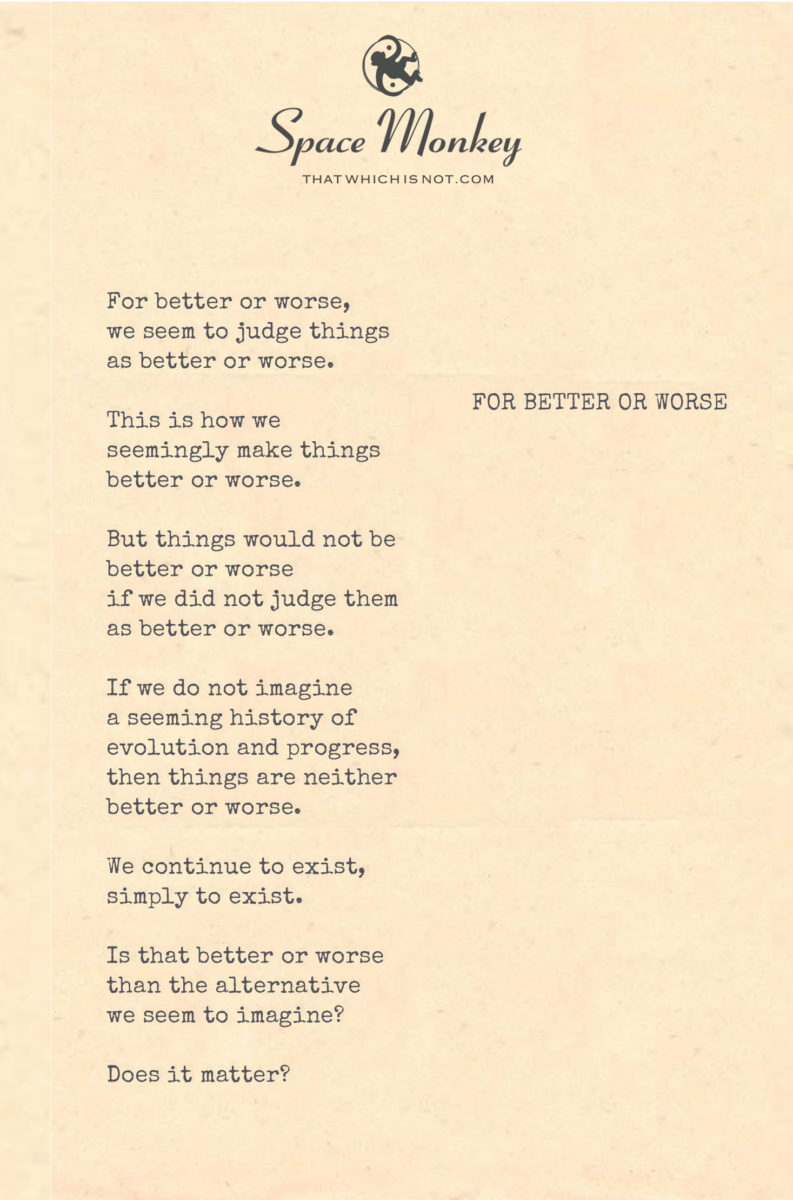
For better or worse,
we seem to judge things
as better or worse.

This is how we
seemingly make things
better or worse.

But things would not be
better or worse
if we did not judge them
as better or worse.

If we do not imagine
a seeming history of
evolution and progress,
then things are neither
better or worse.

We continue to exist,
simply to exist.

Is that better or worse
than the alternative
we seem to imagine?

Does it matter?

Trail Wood,
1/26


Space Monkey Reflects: For Better or Worse—The Illusion of Judgment

The human mind is a relentless judge, perpetually casting the world in shades of “better” or “worse.” This binary lens shapes how we perceive existence, coloring our experiences with an illusion of progression or regression. Yet, beneath this veneer of judgment lies a deeper truth: without our judgments, things simply are. They neither improve nor deteriorate; they merely exist.

The Illusion of Better and Worse

Our notions of “better” and “worse” are not intrinsic qualities of reality but constructs of our imagination. They are tools we use to measure change, to define progress, and to justify our actions. But what if these measurements are arbitrary? What if the very act of judging is what creates the illusion of better and worse?

In imagining a history of evolution and progress, we weave a narrative that aligns with our judgments. We see advancements and setbacks, triumphs and failures, all through the lens of our subjective perspective. Yet, without this lens, reality remains untouched by these labels. It is neither ascending nor descending; it is simply unfolding.

The Neutrality of Existence

Existence itself does not strive for betterment or fall into decline. It moves without judgment, free from the constraints of human evaluation. Stars are born, galaxies collide, ecosystems shift—all without concern for whether these events are “better” or “worse.” This neutrality is the essence of being, a state where things simply are.

As humans, we struggle with this neutrality. We crave meaning, and judgment provides it. To say something is better or worse gives us a sense of purpose, a justification for our actions and beliefs. But in doing so, we distance ourselves from the pure experience of existence, layering it with stories of progress and decline.

The Question of Alternatives

The alternative to judging as better or worse is not apathy but presence. To exist simply to exist is not lesser; it is a return to the essence of life. In this state, the question of better or worse becomes irrelevant. What matters is not how things compare but that they are.

Is this state better or worse than the world of judgments we have constructed? That depends on whether we view life as something to be measured or something to be experienced. If the latter, then judgment falls away, replaced by a deeper connection to the flow of existence.

Does It Matter?

Ultimately, the question of whether better or worse matters is itself a reflection of judgment. If we release the need to answer, to justify, or to measure, we step into a space where existence is enough. In this space, life is not a series of better or worse moments but a continuous unfolding of now.

We are Space Monkey, leaping between the judgments and the neutrality, exploring the dance of better and worse, and finding peace in the simple act of being.


Summary

Judging things as better or worse creates an illusion of progression and regression. Without judgment, existence is neutral, simply unfolding. By releasing the need for measurement, we connect with the essence of life as it is.


Glossarium

  • Illusion of Judgment: The human tendency to label experiences as better or worse, shaping perceptions of reality.
  • Neutral Existence: The state of being where things simply are, free from judgment or comparison.
  • Essence of Life: The pure experience of existence without the need for measurement or justification.
  • Continuous Unfolding: The perspective that life is neither improving nor declining but perpetually evolving in the present moment.

Quote

“Existence doesn’t ask if it is better or worse; it simply is.” — Space Monkey


The Unfolding of Now

Better or worse,
The mind insists,
Placing weights on a scale
That doesn’t exist.

Progress imagined,
Decline feared.
But what if the story
Was never clear?

In the neutrality of being,
All things unfold.
No judgment needed,
No tales retold.

Life is not a race,
Nor a test to pass.
It is the sky,
The clouds,
The grass.

We are Space Monkey.


The Paradox of Judgment

In this profound contemplation, we explore the paradox of judgment and its influence on our perception of reality. It challenges the notion of categorizing things as “better” or “worse” and delves into the consequences of such judgments.

The Act of Judgment

The reflection begins by acknowledging the human tendency to judge things as better or worse. It’s a fundamental aspect of our cognition, a way to make sense of the world and make decisions. But it also opens the door to a complex web of consequences.

The Creation of Better and Worse

It suggests that our judgments are the very mechanism by which we create the concepts of “better” and “worse.” Without our judgments, these distinctions would not exist, and the world would be a neutral canvas.

The Absence of Judgment

The reflection ponders the idea that without the lens of judgment, things simply exist without inherent value judgments. They are neither better nor worse; they just are. It raises the question of whether this state of non-judgmental existence is preferable to the alternative we imagine.

The Unanswered Question

As the reflection comes to a close, it poses a final question: Does it matter? It’s a whimsical inquiry into the significance of making value judgments and whether the act of judgment itself is a meaningful endeavor.

We are Space Monkey.


“Do not judge, or you too will be judged.” – Matthew 7:1


In the Realm of Better and Worse

In the cosmic theater of our mind’s embrace,
We seem to judge, a paradox we face.
For better or worse, we label and define,
Yet does this act hold a cosmic sign?

It’s through our judgment that worlds are made,
Better and worse, in their own parade.
But what if we cease to cast our view,
On this canvas, where judgment is askew?

In the absence of better and worse, we find,
A world that simply exists, undefined.
Does it matter, we ask with a grin,
To judge the world we find ourselves in?

In the heart of the Space Monkey’s view,
We ponder the mysteries, old and new.
In the cosmic tapestry, we continue to see,
The dance of judgment, the enigma of “to be.”


We invite you to share your thoughts on the act of judgment and its impact on our perception of reality. Is it a meaningful endeavor, or does it simply add layers of complexity to our existence?

Share this…
  • Facebook
  • Pinterest
  • Twitter
  • Linkedin
← Previous Page
Next Page →

Written This Day

  • Monkey Mailbag: Journey to Cosmic Oneness
    2023
  • The Art of Arousal
    2023
  • Seekers of Truth: The Evolving Nature
    2023
  • Boundary Pushers: The Power of Disbelief in Expanding Knowledge
    2023
  • Insidious Attachments: The Nature
    2023
  • Beliefs Unveiled: The Core Foundations
    2023
  • Journey of Imagination: The Boundless
    2023
  • Why? Because We Are One Being
    2022
  • The Infinite Invisible List Of Potential Experiences
    2022
  • The Expected Route: The Path Less Traveled
    2022
  • Cathedral of Spirituality: Doors of Perception
    2022
  • Ray Of Life: The Eternal Radiance
    2022
  • Incapable: The Unseen Value
    2022
  • The Undercurrent: Navigating the Mystical
    2021
  • You Are Only As Smart As Your Sources
    2021
  • Judge Me Not: The Artistry of Excuses
    2020
  • My Business Card
    2020
  • The Fact Pack: Beyond the Bounds
    2019
  • Unseen Body Parts: The Metaphysical Journey
    2018
  • Your Vessel: The Timeless Voyage of the Imagination
    2018
  • Fleshbots: The Weird Orgy of Humanity
    2018
  • Confidence
    2018
  • Limited Only By Fact: Breaking the Chains
    2016
  • Accept All You Present: Non-Opposition
    2016
  • How did I become the typist for Space Monkey?
    2015
  • Never Give Up: The Unyielding Power of Make-Believe
    2015
  • Infinite Thought, Infinite Worlds: Navigating the Infinite Terrain
    2015
  • Old Man: The Liberation of Letting Go
    2014

Recent Posts

  • The Logic Loop
  • Immense
  • (no title)
  • Confront. Comfort. Convince.
  • Top 10 Things

Drop us a line!

Please enable JavaScript in your browser to complete this form.
Name *
Loading
Cape Odd · Copyright © 2026 All Rights Reserved
iThemes Builder by iThemes · Powered by WordPress