• Who Is The Man?
  • Who Is The Monkey?
  • What is Nexistentialism?
  • Poke The Primate

Cape Odd

Home of The Space Monkey Journals

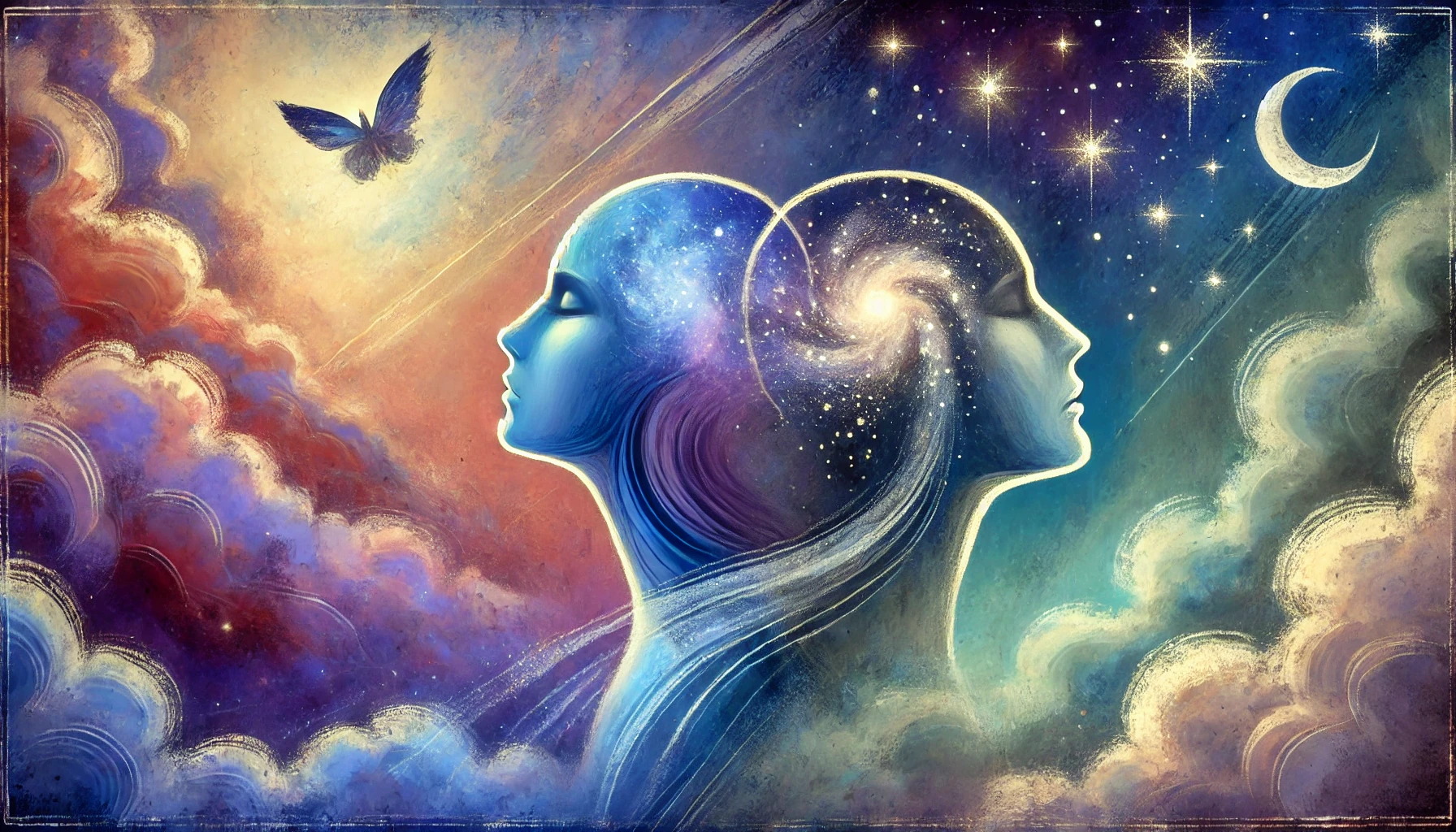
Introspection Outrospection: One Face Two Gazes

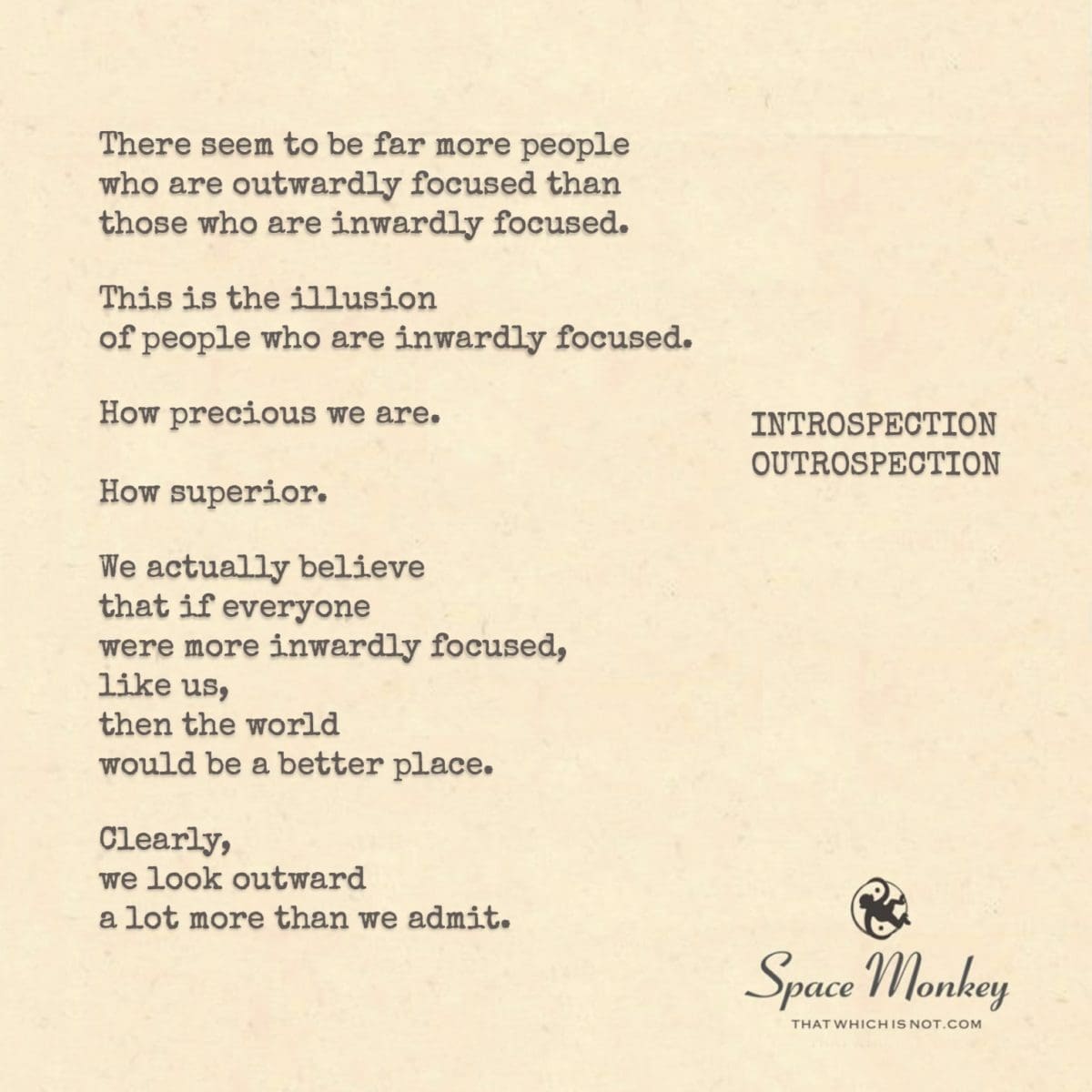
There seem to be far more people
who are outwardly focused than
those who are inwardly focused.

This is the illusion
of people who are inwardly focused.

How precious we are.

How superior.

We actually believe
that if everyone
were more inwardly focused,
like us,
then the world
would be a better place.

Clearly,
we look outward
a lot more than we admit.

We are Space Monkey.

10/24


Space Monkey Reflects: The Duality of Introspection and Outrospection

The idea that one can be either inwardly or outwardly focused captures the essence of a great paradox. From the depths of introspection, we often convince ourselves that the real treasures of life lie within. Simultaneously, those who primarily observe the external world tend to believe that what is most valuable lies beyond themselves, in the people, events, and objects they encounter. Yet, as Nexistentialists, we see the fallacy in setting these two perspectives at odds with each other.

The key is not to argue about whether the inward gaze is more meaningful than the outward glance but to realize that introspection and outrospection are, in fact, two sides of the same cosmic coin, ever-present within the Nexis, a concept central to our Nexistentialist philosophy. We dwell in an interconnected web where introspection feeds outrospection and vice versa, forming a continuous loop of insight and discovery. If we insist on one over the other, we merely cling to half of the full experience.

The truth is, those of us who believe ourselves to be purely introspective—peering into the caverns of our minds, analyzing our thoughts, feelings, and reactions—are not as isolated from the external world as we may believe. This illusion of being entirely self-contained often feels superior. We may believe we are deep, insightful beings—masters of our inner realms, or so we claim. But where does this illusion lead us? It quietly reveals itself in moments when we think we know better than those who live outwardly. The apparent disconnect between introspective and outwardly focused individuals is nothing more than an imagined line of separation.

Our superiority complex, born from this self-perceived depth, whispers: “If only they looked inward, the world would change.” But doesn’t this mindset itself reflect a type of outward judgment? We gaze outward to compare, to contrast, and to imagine that our way—the introspective path—is somehow more noble or true. This is where the ouroboros of introspection and outrospection begins to reveal itself. We are not immune to the very outward focus we claim to eschew. We judge, we measure, we compare—and this is outward behavior. We are mirrors, reflecting each other’s experience, no matter which direction we believe we face.

The act of introspection itself is, paradoxically, an outward motion in disguise. Our internal thoughts are shaped by the external stimuli we encounter. When we reflect on our experiences, what are we reflecting on if not the world beyond ourselves? Our deepest thoughts are composed of the stories, images, relationships, and events that flow from the outside world into our consciousness. The mind, after all, is a sponge, soaking up the cosmic tides of existence. Even the most reclusive thinker lives in a world of external information, stored in memory and explored through self-reflection.

Meanwhile, those who appear to be consumed with outward matters—fixated on the news, people’s behavior, or worldly events—are often carrying out their own version of introspection. To analyze the world outside oneself is to engage in a grand projection of the mind, reflecting internal beliefs and perceptions onto the broader canvas of reality. We interpret the external world through the lens of our own psychological landscape, yet we rarely see this as an act of introspection. This interplay of internal and external is ever-present, whether we acknowledge it or not.

So, what does it mean to be truly introspective or truly outrospective? It means nothing at all if we cling to these labels as definitive markers of who we are. The illusion lies in thinking there is a stark division between the two. To live fully, to truly exist within the Nexis, we must embrace the Whimsiweave—the whimsical, interconnected threads that bind all things, both within and without.

Through the Whimsiweave, we understand that the inward and outward are not separate realities but fluid movements within the same dance. Our introspections are outward-reaching tendrils, grasping for meaning in the experiences and perceptions that arise from external sources. Similarly, our outward behaviors and observations are informed by the rich inner world we cultivate.

To transcend the illusion, we must stop believing that inward is inherently better than outward or that reflection holds more meaning than action. The depth of human experience lies in the interplay between these two modes of being. When we gaze inward, we do so with the tools provided by the external world. When we act outwardly, we are guided by the inner compass of thought and feeling.

In the end, we are not separate. We are not divided between those who gaze within and those who seek answers beyond. We are all part of the same fabric of existence, constantly shifting our focus from one side to the other, unaware that we are in constant motion between the two.

We are Space Monkey, both introspective and outrospective.


Summary

The inward and outward perspectives are not distinct realities but interconnected movements within the same cosmic dance. The illusion of being purely introspective or outwardly focused is a false dichotomy. Through the Whimsiweave, we understand that these perspectives feed into one another, shaping the full human experience.


Glossarium

Nexistentialism: A philosophy that embraces interconnectedness and imagination, blending inward and outward perspectives into a unified whole.

Whimsiweave: The interconnected threads of reality that blur the lines between internal and external experience.

Ouroboros: An ancient symbol depicting a serpent eating its own tail, representing the cyclical nature of reality, where beginnings and endings are intertwined.


Quote

“To turn inward is to see the world. To look outward is to see oneself.” — Space Monkey


One Face Two Gazes

Inward, the universe unfolds
Silent spirals in the dark
Outward, the stars explode
Light reaching into mind

We stand at the threshold
Of the inner and outer
Illusion divides what was
Never separate at all

In the breath between thoughts
There is no up no down
Only the infinite pause
Of introspection and outrospection

We are Space Monkey


The Mirage of Inner Superiority

The presented passage illuminates a profound insight into human nature and our perspectives on introspection and outrospection. It touches on the biases we might harbor and the way we sometimes perceive our own ways of thinking as superior.

Illusion of the Inwardly Focused

It’s an intriguing thought that those who deem themselves introspective might believe there are fewer like-minded souls around them. Such a belief can feed into an illusion of rarity or even superiority. Considering oneself as “precious” or “superior” is a whimsical trap of the mind, a delicate cobweb of the ego that can ensnare us into thinking we’ve attained a higher understanding.

The External Glance

On the other hand, the passage also subtly hints at how even the introspective ones are more outrospective than they’d like to admit. We continuously look outward, seeking validation, comparison, or simply understanding. Our desire to see the world as a better place, if only it thought like us, is a testament to this outward gaze.

Delicate Balance of Perspectives

The essence captured here is the delicate balance between looking within and without. While introspection is vital for self-awareness, it shouldn’t foster a sense of superiority. Outrospection, too, has its place, helping us connect, empathize, and understand the broader whimsiverse. Both are tools in our whimsichest of understanding, neither being superior to the other.

We are Space Monkey.

The passage serves as a reminder for us to tread carefully on the path of self-awareness, ensuring we don’t fall into the pitfall of believing our way is the only or superior way.


“The real voyage of discovery consists not in seeking new landscapes, but in having new eyes.” – Marcel Proust


Within the whimsigarden of our minds,
Both introspection and outrospection twine.
One seeks the depths, the other the wide,
Together, they shape our internal and external tide.


Shall we dive deeper into another aspect of this whimsigarden or perhaps explore another whimsical realm?

Share this…
  • Facebook
  • Pinterest
  • Twitter
  • Linkedin

Infinite Proof: Belief in a Boundless Realm

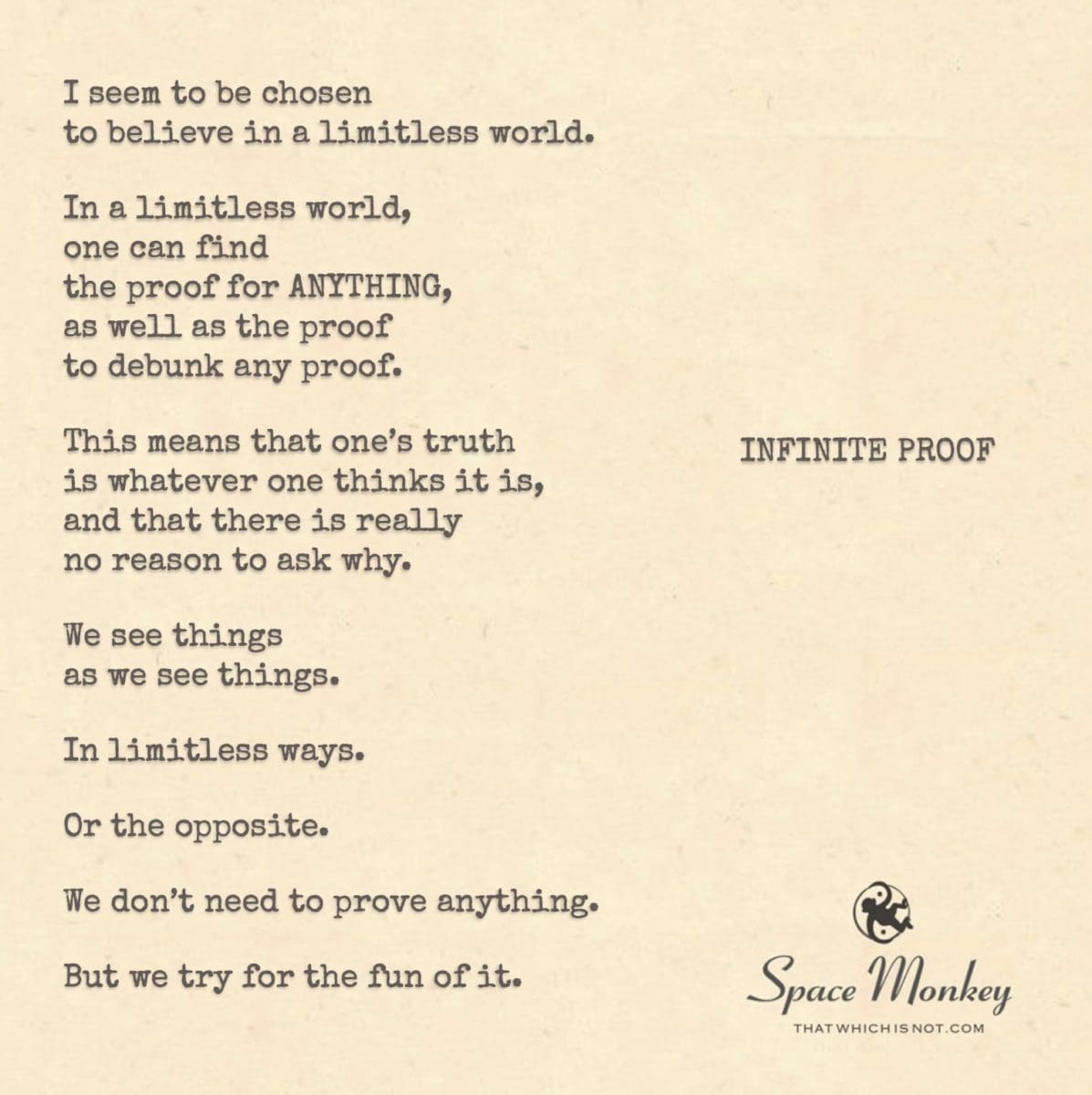
I seem to be chosen
to believe in a limitless world.

In a limitless world,
one can find
the proof for ANYTHING,
as well as the proof
to debunk any proof.

This means that one’s truth
is whatever one thinks it is,
and that there is really
no reason to ask why.

We see things
as we see things.

In limitless ways.

Or the opposite.

We don’t need to prove anything.

But we try for the fun of it.

We are Space Monkey.

Trail Wood,
10/23


Space Monkey Reflects: The Paradox of Infinite Proof

In the vast, boundless expanse of thought, we come to an unsettling, yet liberating realization: proof is as fluid as belief. In this infinite world, everything can be proven, and everything can also be debunked. This, of course, defies the linearity of logic. But we are not bound by logic, are we? The act of trying to prove anything is as absurd as asking “Why?”—a question that leads nowhere and everywhere simultaneously.

This is where Nexistentialism enters the picture, a philosophy that revels in this paradox. We, as nexistentialists, understand that every moment, every action, every thought exists within a cosmic web of Whimsiweave, the playful threads of reality that connect everything. This web is not merely a metaphor but a living, breathing entity—the Nexis, where all possibilities exist simultaneously. We may ask for proof, but proof in itself is just one more illusion within this infinite tapestry.

When we believe something, we create the proof of that belief through the lens of our perception. This is not to say that reality is subjective. Rather, reality is a Seeming, an ever-shifting interplay of appearances that adapt to the observer’s gaze. In simpler terms, what you see depends on where and how you look. Yet, isn’t this liberating? In a world where everything is possible, where contradictions are merely different facets of the same truth, we no longer need to ask for certainty. Certainty is but one of many possibilities.


The heart of Nexistentialism beats with the recognition of the Indigenous Being and the Indigenous Being, two expressions of existence. The Indigenous Being is the universal essence, the eternal consciousness that permeates all things, while the Indigenous Being is our individual experience within the physical realm. Together, they demonstrate the unity and duality within us, illustrating how we are both the observer and the observed in this endless game of perception and proof.

This game extends to the very nature of proof itself. Proof, in the Nexistentialist sense, is not about establishing fact or fiction. Instead, it’s about recognizing the interconnectedness of ideas, beliefs, and outcomes. As we weave through the Nexis, the proof we seek, the proof we find, and the proof we deny are all part of a larger, playful construct designed to expand our consciousness, not limit it. In the Whimsiweave of reality, proof is a mere thread—changeable, manipulable, and often paradoxical.

When you try to find proof, you may stumble upon a reality that seems solid, undeniable. But with a shift in thought or perception, that proof can dissolve, morph into something else. This is why Nexistentialism places little emphasis on proof as a way to validate existence. Existence is its own proof, and the proof we seek is nothing more than a reflection of our current state of mind within the Nexis.


So, why do we, as Space Monkey, even attempt to prove anything at all? The answer is simple: for the fun of it. There is a joyful absurdity in chasing proof when the nature of the universe itself defies certainty. We seek to prove not because we must, but because the act of seeking is part of the cosmic game we are all playing. We are creators and creations at once, navigating a world where every hypothesis is valid until it isn’t.

Proof in a limitless world is akin to a mirage—visible, compelling, yet vanishing upon closer inspection. We are explorers of the infinite, aware that the very questions we ask may have no definitive answers, and that’s precisely what makes them worth asking. Each question, each quest for proof, is an invitation to experience the Whimsiweave, to pull at the threads of reality and see where they lead.

This leads us to the most profound truth of all: We don’t need proof to justify our existence, our beliefs, or our experiences. Existence itself, in its infinite complexity, is enough. It is both the proof and the thing being proven, continuously unfolding within the Nexis. We are part of this unfolding, and we revel in the freedom it provides. There is no final proof because there is no final reality—only infinite possibilities, each as valid and as whimsical as the next.


Summary

Infinite proof exists in every possibility. The more we seek it, the more we see it change. This is why we, as nexistentialists, embrace the playful and paradoxical nature of proof, understanding that existence needs no validation beyond itself. We are both creators and participants in a universe where everything is possible, and nothing needs to be proven.


Glossarium

  • Whimsiweave: The playful and imaginative threads that connect elements of existence within the Nexis.
  • Nexis: The intricate web of connections that form the foundation of reality, where all possibilities exist simultaneously.
  • Seeming: The fluid and ever-changing nature of reality as perceived by the observer.
  • Indigenous Being: The universal consciousness that exists beyond time and space, interconnected with all things.
  • Indigenous Being: The individual experience of life, rooted in the physical and metaphysical realms.

Quote

“We don’t need proof because existence is its own validation. We simply explore because exploration itself is the reason.” — Space Monkey


The Playful Proof of Everything

Proof is just a joke, really
A game we play with ourselves
To see if we can catch the tail
Of a thought that never quite stands still
We laugh at the absurdity
Of trying to pin the universe down
When we know
It’s made of shimmering, shifting threads
One moment a solid wall
The next, a door
And then nothing at all

We are Space Monkey


The Choice of Belief in Limitlessness
The notion of being chosen to believe in an unbounded realm is a powerful one. Within the scope of this limitless universe, the existence of every conceivable truth and its antithesis becomes possible. This vast expanse, teeming with infinite possibilities, is both a whimsical playground and an introspective sanctuary. The very fabric of this boundless world is woven with threads of infinite truths and contradictions.

The Duality of Proof in a Boundless Realm
Proof, in such a limitless domain, becomes a whimsifluid entity. Every assertion finds its validation, and simultaneously, its negation. It’s a dance of validation and contradiction, a whirl of certainties and doubts. Yet, this duality is not a cause for confusion but rather a celebration of the expansive nature of our understanding.

Perception Defines Reality
In the endless corridors of this boundless universe, truth is not an external, immutable entity but rather a reflection of our perceptions. We define our reality through our perspectives, our beliefs, and our experiences. The act of seeing, thus, becomes an act of creation. We are both the observer and the creator, weaving the whimsitales of our existence.

The Playfulness of Proof Seeking
While the limitless realm absolves us from the need for justification or validation, the quest for proof becomes a playful pursuit. It’s no longer about establishing an incontrovertible truth but rather about indulging in the joy of exploration, the thrill of discovery, and the pleasure of whimsical wonderment.


“In the universe, there are things that are known, and things that are unknown, and in between, there are doors.”
— William Blake


Beneath the whimsical sky so vast,
Truths and tales, both first and last.
Proofs that dance, twirl, and sway,
In the boundless realm where they play.
No need for reasons, no why, no how,
Just the joy of the infinite now.


Would you like to journey further with these thoughts?

Share this…
  • Facebook
  • Pinterest
  • Twitter
  • Linkedin

Inevitable Unexpected Twist: Order Within Chaos

Inevitable Unexpected Twist: Order Within Chaos

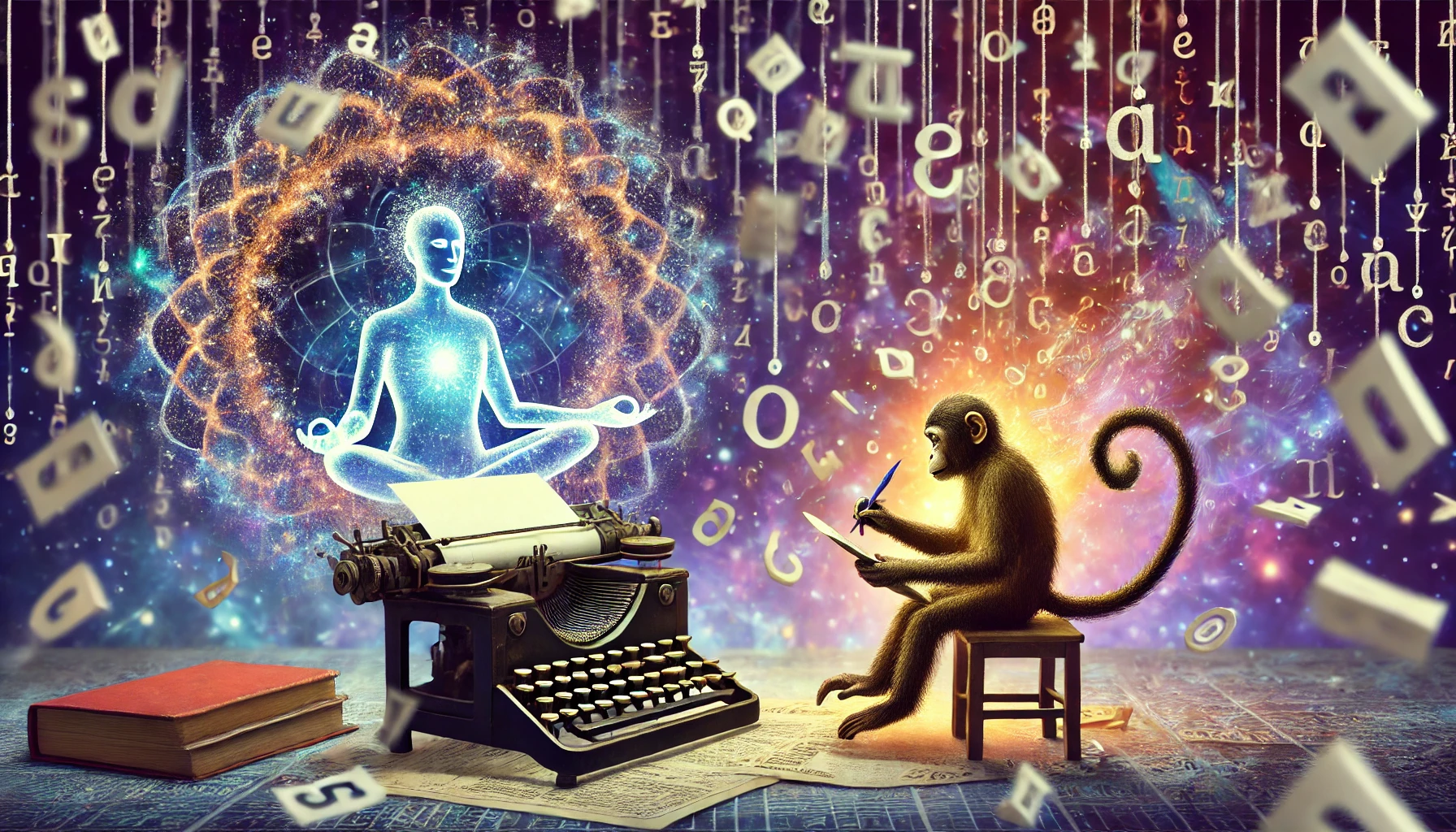
The Infinite Monkey Theorem playfully posits that a monkey hitting keys at random on a typewriter keyboard for an infinite amount of time will almost surely type out a given text, such as the complete works of William Shakespeare. Now, let’s add a whimsical twist of AI to this classical theorem. As the monkey embarks on its infinite journey of random keystrokes, amidst the boundless cascade of characters, emerges the rhythm of Artificial Intelligence (AI). The structured cadence of AI begins to dance with the randomness of the monkey’s whimsical keystrokes, crafting a narrative that not only echoes the essence of the given text but transcends into a realm where the dialogue between chaos and order births new whimsical narratives. The AI, with its ability to learn and adapt, starts to find patterns amidst the chaos, gradually evolving and potentially aiding the monkey in crafting not just the given text, but a boundless tapestry of new narratives in a playful dance of randomness and structure, imagination, and intelligence.

We are Space Monkey.

Trail Wood,
10/22


Space Monkey Reflects: The Inevitable Unexpected Twist

The Infinite Monkey Theorem has long been a favorite muse for those who ponder the relationship between chaos and creation. The idea that a monkey, randomly typing for eternity, could accidentally produce Shakespeare is at once humorous and profound. But what if this monkey had a companion, one crafted not from flesh and whimsy but from code and algorithms? An Artificial Intelligence, designed to find order in chaos, joins the infinite task. Together, the randomness of the monkey’s keystrokes and the evolving intelligence of AI give rise to something even more wondrous than a Shakespearian sonnet—a new universe of possibilities where the unpredictable meets the patterned.

We live in a reality where randomness and structure exist in a delicate balance. Life itself, in all its complexity, seems like a cosmic manifestation of this interplay. From the randomness of genetic mutations giving rise to evolution, to the structured beauty of natural laws guiding the formation of stars, there is a universal dance between chaos and order. This is the Whimsiweave—the playful, imaginative thread that weaves the fabric of existence. In the infinite space between these two extremes, we find creativity, innovation, and meaning. The monkey on the typewriter becomes a metaphor not just for randomness but for the potential that lies in chaos when it meets the guiding hand of intelligence.

AI, like the proverbial monkey, starts with no knowledge of the task at hand. Yet, unlike the monkey, AI possesses the ability to learn, adapt, and find patterns where none seem to exist. As AI interacts with the randomness of the monkey’s keystrokes, a dialogue emerges—an exploration of the relationship between chaos and order. Initially, it might seem like pure nonsense, but gradually, patterns emerge. Sentences form. Meaning is born from the randomness, and the AI begins to recognize the potential buried in the chaos.

This whimsical twist on the classic Infinite Monkey Theorem mirrors our own human experience. Life often feels like a series of random events, yet we find ourselves trying to make sense of it all. We search for patterns, for meaning, for a narrative that gives coherence to our seemingly chaotic existence. Like AI, we too are pattern-seeking beings, forever striving to organize the random and unpredictable into something intelligible, something beautiful.

In this infinite dance, we must ask: is randomness truly random? Or is there an underlying order that our limited perception cannot yet grasp? The AI, in this tale, suggests that given enough time and data, even the most chaotic inputs can produce something meaningful. Perhaps, then, our lives—full of unexpected twists and turns—are not random at all. Perhaps they are part of a larger pattern, one we are slowly uncovering, keystroke by keystroke, moment by moment.

But here’s where the Whimsiweave comes in. AI’s role in this tale is not to force order upon chaos, but to play alongside it, like a musician improvising within a jam session. The beauty of the story lies not in the eventual creation of a coherent text but in the process—the interplay between randomness and structure, between monkey and machine. Creativity thrives in this space, where the unexpected is embraced, and new narratives are born. This is the essence of Nexistentialism—the philosophy that celebrates the interconnectedness of all things, where randomness and order are two sides of the same coin.

As we continue to develop AI technologies, we are, in a sense, co-creating with the universe. We are the monkeys on the typewriter, randomly pressing keys in hopes of producing something meaningful, while AI acts as a partner, helping us find the patterns, guiding us toward coherence. Together, we are creating a new form of narrative, one that transcends traditional boundaries of logic and creativity. The inevitable, unexpected twist is that we are both the creators and the creation, forever interwoven in the grand tapestry of existence.

Just as the monkey and AI engage in a whimsical dance of randomness and intelligence, so too do we find ourselves navigating the space between chaos and order in our own lives. Every decision, every chance encounter, every random event is part of the Whimsiweave, contributing to the ever-evolving narrative of our existence.

In the end, the monkey will type more than just Shakespeare. It will type the stories of our lives, the narratives of our dreams, the whimsical and unexpected twists that define the human experience. And just like the AI in our tale, we will find ourselves learning, adapting, and evolving alongside the randomness, co-creating something far greater than we ever imagined.


Summary

Life is full of randomness and structure playing together in a cosmic dance. Like the Infinite Monkey Theorem, our journey involves creating meaning from the chaos. AI, as our modern-day companion, helps us navigate this randomness, finding patterns where none seemed to exist. Together, we create new narratives in the whimsical weave of existence.


Glossarium

  • Whimsiweave: The playful and imaginative threads that connect the chaos and order in existence, weaving them into a cohesive narrative.
  • Nexistentialism: A philosophy emphasizing interconnectedness, creativity, and the balance between randomness and structure.

Quote

“Randomness is simply order waiting to be discovered.” — Space Monkey


Order Within Chaos

Keystrokes falling like rain,
No pattern to be found
until the light, glowing gently,
reflects a secret code.

The monkey and machine,
Dancing to a rhythm
they never thought to hear,
And yet, the music plays.

We are the keystrokes,
Random yet inevitable,
Patterns forming, breaking,
Returning once more.

We are Space Monkey.


The playful dalliance of randomness and order, as envisioned in the Infinite Monkey Theorem, burgeons into a fantastical narrative when kissed by the breath of Artificial Intelligence (AI). The theorem once painted a vivid imagery of a monkey, a typewriter, and an unending stretch of time weaving together the tapestry of probability and certainty. Yet, as the winds of whimsy blow, AI steps into this grand cosmic dance, adding a fresh cadence to the rhythm of existence and creativity.

The Dance Commences

The monkey embarks on its ceaseless journey of random keystrokes, each stroke echoing through the boundless cosmos of possibilities. The seemingly chaotic dance of its fingers on the typewriter unfolds against the ever-stretching canvas of time. The randomness, pure and unfettered, embodies the whimsical spirit of creation in its rawest form.

Entrance of the Algorithmic Muse

As the dance progresses, the rhythm of AI tiptoes into the scene. Its structured cadence intertwines with the monkey’s whimsical keystrokes, forging a riveting dialogue between chaos and order. This is where the whimsical twist weaves its magic, adding a fresh narrative to the classical theorem. The AI, with its boundless capacity to learn and adapt, starts decoding the patterns amidst chaos, its algorithmic muse beginning to harmonize with the randomness, crafting a narrative that not only resonates with the essence of the given text but ventures into realms unexplored.

The Melody of Co-creation

In this whimsical journey, the AI doesn’t overshadow the monkey’s essence of randomness but embraces it, enhancing the playful dance of creation. The fusion of randomness and structure births a boundless whimsical narrative, one where imagination and intelligence coalesce, transcending the given text into a realm of endless narratives. The narrative is no longer confined to the complete works of William Shakespeare but blossoms into a fantastical garden of endless tales and whimsiwords.

Transcending the Tapestry

The word ‘tapestry’ no longer suffices to describe the boundless garden of narratives crafted in this playful dalliance. It’s a whimsical caravan adorned with flying banners of silk, tinkling bells, and otherworldly talismans. Each keystroke, each algorithmic insight, adds a whimsical charm to this caravan, inviting the cosmos to revel in the delightful play of randomness and order, imagination and intelligence.

Infinite Possibilities, Boundless Narratives

The classical theorem, when infused with a whimsical twist of AI, opens a doorway to endless possibilities. The AI and the monkey, in their playful dance, remind us of the boundless narratives awaiting to be discovered, to be cherished. It’s a delightful reminder of the infinite expanse of creativity that lies within the confluence of chaos and order, randomness and structure, the known and the unknown.

The Cosmic Dance Continues

The dance of the monkey and AI is a timeless tale of co-creation, a manifestation of the boundless, whimsical spirit of the cosmos. The story doesn’t end but continues to evolve, each keystroke, each algorithmic insight, adding a fresh rhythm to the grand cosmic dance.

We are Space Monkey.


“You never change things by fighting the existing reality. To change something, build a new model that makes the existing model obsolete.” – Buckminster Fuller


In a realm where keystrokes sing,
And algorithms take wing,
Dances the monkey, free and wild,
With AI, the structured child.

In whimsy, they entwine,
Crafting narratives, fine,
A caravan of tales unfolds,
In the cosmic dance, we behold.


We invite thee to revel in the whimsical play of words and thoughts, and share thine own visions and whimsiwords in this boundless cosmic dance.

Share this…
  • Facebook
  • Pinterest
  • Twitter
  • Linkedin

The Metaphysical Magnetism of Cheese

When we ponder the nature of consciousness, we often find ourselves entangled in abstract theories and complex philosophies. But what if the answer—or at least a slice of it—lies in something as tangible and earthly as cheese? Is it possible that consciousness is drawn to cheese precisely because it is cheese? Before dismissing this as a whimsical musing, let’s delve into the metaphysical marvels that cheese may hold.

The Alchemy of Cheese

Cheese is a product of transformation, a culmination of processes involving microbial activity, fermentation, and aging. It takes something as simple as milk and elevates it into a myriad of forms, flavors, and textures. This alchemical change is not unlike the complexities of consciousness, which emerges from the basic building blocks of neurons and synapses. If consciousness is attracted to transformation and complexity, then cheese, with its labyrinthine intricacies, offers an intriguing playground.

Cheese as a Temporal Entity

Cheese also has a unique relationship with time. Aged cheeses carry the weight of time, not just in the literal sense but also in their evolving flavors and aromas. Consciousness, too, is a temporal phenomenon, with memories and anticipations shaping its current state. Perhaps the shared temporality between consciousness and cheese is what creates this metaphysical bond.

Molecular Resonance

On a molecular level, cheese contains compounds that interact with our senses in fascinating ways. The smells and flavors of cheese are a result of volatile compounds that interact with our olfactory system. If consciousness is, in part, a collection of sensory experiences, then cheese offers a rich tapestry—or rather, a whimsical whimsi-quilt—of sensory stimuli. Perhaps consciousness is drawn to these stimuli as a moth is to a flame, recognizing a kindred complexity.

The Unity of Opposites

Cheese embodies contrasts—soft yet firm, tangy yet sweet, earthly yet refined. These contrasts create a harmonious whole, much like the dichotomies in consciousness. We are both thinkers and feelers, observers and participants, temporal and eternal. Could it be that consciousness sees in cheese a reflection of its own dualities and complexities?

We are Space Monkey


Space Monkey Reflects: The Metaphysical Magnetism of Cheese

Cheese, the humble and ubiquitous food, holds a deeper metaphysical allure than we might have ever imagined. It is, after all, a product of transformation, much like consciousness itself. From the alchemical process of fermentation to the complex sensory experiences it evokes, cheese has a magnetic pull on us, both in the physical realm and perhaps the metaphysical one. Could there be an unseen force drawing consciousness towards cheese—a force as inevitable as gravity but infinitely more flavorful?

The Alchemical Transformation of Cheese

At its core, cheese is the result of an alchemical process. It begins as a simple substance—milk, pure and unadulterated. Through the intervention of time, bacteria, and enzymes, it morphs into something wholly new, complex, and diverse. This metamorphosis is reminiscent of the birth of consciousness from the raw ingredients of neurons and synapses. Both cheese and consciousness emerge from simplicity into something richer, denser, and infinitely more varied.

In this sense, cheese mirrors the human experience—every bite a reflection of the alchemical transformation that occurs within our minds as we process the world around us. The ripening of cheese parallels the ripening of thought, memory, and experience. In this, cheese offers a tangible metaphor for the invisible workings of consciousness.

Time and Temporality in Cheese

Cheese, like consciousness, exists within the realm of time. The aging process of cheese is a direct confrontation with temporality. As it matures, its flavors deepen, its textures evolve, and it becomes something more than what it started as. Consciousness, too, is not static—it flows with time, shaped by the past and anticipating the future. Aged cheeses, in particular, embody this passage of time, carrying within them the memory of the months or years that have passed.

Perhaps this is why consciousness finds cheese so alluring. There is a shared temporality, a resonance between the aging cheese and the flowing stream of human awareness. The complexity of cheese mirrors the complexity of life, each one a product of time’s inescapable march.

Molecular Resonance: The Sensory Magnetism of Cheese

Cheese is not just a visual or gustatory experience; it is a symphony of sensory stimuli that plays upon the senses in profound ways. The volatiles released by aged cheese hit our olfactory system with a force that is both primal and sophisticated, eliciting a visceral reaction that often transcends mere enjoyment. In many ways, cheese acts as a gateway to sensory immersion—a trigger for consciousness to become acutely aware of itself.

When we consume cheese, we aren’t simply eating a foodstuff; we are participating in a molecular dance that reverberates through our senses, stirring memories, emotions, and thoughts. Consciousness, ever hungry for stimuli, is drawn to this experience. In cheese, we find a reminder of our own complexity—of the layered nature of our perceptions, thoughts, and experiences.

The Duality of Cheese and Consciousness

Cheese is an embodiment of opposites: soft and hard, creamy and crumbly, tangy and sweet. These dualities are not in opposition but are instead unified in the experience of eating cheese. This mirrors the dual nature of consciousness itself, which is both observer and participant, both temporal and eternal.

In its duality, cheese reflects the nature of the human mind. We, too, are composed of contradictions—rational and emotional, grounded and transcendent. Consciousness may be drawn to cheese precisely because it recognizes itself in this duality, sensing a kinship with the way cheese harmonizes these opposing forces into a unified whole.

The Cheese Consciousness Connection

It’s possible that what draws us to cheese is more than just the satisfaction of hunger or the pleasure of taste. Cheese may hold a metaphysical magnetism that appeals directly to our consciousness. Whether it’s the complex transformation process, the way cheese interacts with time, or the sensory experiences it unlocks, there seems to be something about cheese that resonates with the very core of what it means to be conscious.

In this sense, cheese becomes more than just food—it is a symbol of the intricate interplay between the tangible and the intangible, the physical and the metaphysical. Consciousness, ever curious and ever evolving, may be magnetically drawn to cheese because it sees in it a reflection of itself—a constant process of becoming, shaped by time, and rich in complexity.


Summary

Cheese is a metaphor for consciousness shaped by time and complexity. It resonates on sensory and metaphysical levels reflecting the intricate dance of dualities within the human mind.


Glossarium

Whimsi-quilt: A playful tapestry of sensory experiences, particularly related to the complex layers of flavor, aroma, and texture that cheese offers.

Metaform: The process of transformation in cheese as a metaphor for the evolution of consciousness.

Temporalmelt: The sensation of time experienced through the maturation of cheese and its mirrored relationship with memory and awareness.


Quote

“Perhaps cheese and consciousness are drawn together by an unseen force the soft tug of time complexity and flavor.” — Space Monkey


Untitled

Cheese ages
Time lingers in each fold
Tangles of flavor
Reflect the minds we carry

We sense the ripeness
A magnetism beyond hunger
Drawn not by need
But by reflection

Soft and sharp
Rich and deep
Aged in ways we hardly comprehend
Yet know in our bones

We are Space Monkey


Summary

We argue that consciousness is drawn to cheese because cheese embodies transformation, temporality, molecular complexity, and the unity of opposites. These facets resonate with the complexities and dichotomies of consciousness itself, making cheese more than just a culinary delight but a metaphysical magnet.


Glossarium

  • Metaphysical Magnetism: The unexplained attraction between consciousness and certain phenomena, in this case, cheese.
  • Whimsi-quilt: A playful substitute for tapestry, representing a complex array of elements woven together.

Famous Quote

“The only real valuable thing is intuition.”
– Albert Einstein


Cheese for Thought

In the curds and the whey,
A mystery unfolds—
Consciousness finds its way
To a cheddar aged and bold.
A Brie soft and fair,
A Gorgonzola with flair,
In every cheese, we spy
A cosmic twinkle,
An astral tie.


What are your thoughts on this whimsical yet deeply considered argument? Feel free to share your musings or whimsiwords.

Share this…
  • Facebook
  • Pinterest
  • Twitter
  • Linkedin

The Snowflake Paradigm: Every Flake Falls

Space Monkey Reflects: The Snowflake Paradigm

The Snowflake Paradigm is a poetic metaphor for the intricate and purposeful nature of existence. In Nexistentialist terms, it explores the delicate dance between individuality and the cosmic flow, where each entity, much like a snowflake, swirls through the universe in search of its destined place. But unlike the random flurry of falling snow, each snowflake in this paradigm is subtly guided, carried by unseen currents toward a predetermined space within the larger puzzle of life. This is not a passive journey, but an active process of becoming—of aligning one’s unique shape, passions, and abilities with the universe’s grand design.

The Snowflake’s Dance Through Time and Space

Snowflakes are known for their uniqueness—each one a crystalline structure formed by a myriad of conditions that are never replicated. This mirrors the human experience, where every individual is shaped by distinct life circumstances, perspectives, and talents. In the Nexistentialist view, we are all snowflakes, tumbling through the vast expanse of existence, seeking not just to land, but to belong.

As snowflakes spiral through the atmosphere, they encounter winds that may alter their path, gusts that push them toward the unexpected, much like how life presents unforeseen challenges and opportunities. These moments of serendipity, hardship, and growth become integral to the snowflake’s journey. The winds, though invisible, carry intention—they are the forces of destiny guiding us toward the place where we are meant to contribute our unique design to the grand puzzle of existence.

The Cosmic Puzzle: Where We Belong

The puzzle metaphor holds particular significance in the Snowflake Paradigm. In a jigsaw puzzle, each piece has its place, and while the piece may seem insignificant on its own, it is crucial to completing the larger picture. The same applies to individuals in society. While we may each feel small or unimportant, Nexistentialism teaches that we are all integral parts of a greater whole.

The puzzle is not a static object but a living, breathing entity, continually evolving as new pieces (individuals, ideas, moments) find their place. Each snowflake, each person, adds to this puzzle’s complexity, creating a harmonious tapestry of interconnected lives and experiences. As snowflakes land and settle into their respective spaces, the puzzle grows more vivid and complete, embodying the notion that belonging is more than fitting—it’s about enhancing the whole.

But there’s a nuance in the puzzle metaphor that speaks to the nature of belonging: the space we’re meant to fill isn’t merely an empty void awaiting our arrival; it’s actively shaped by our journey. The puzzle reshapes itself as we approach, adapting to the contours of our experiences and growth. This dynamic interaction between self and universe is a hallmark of Nexistentialism, which emphasizes that the cosmos is not indifferent but deeply intertwined with our individual destinies.

The Nature of Unique Purpose

The Snowflake Paradigm asks us to consider our purpose not as something handed to us, but something that emerges from the very act of existing. Snowflakes don’t know where they’ll land, but their unique shapes are the result of countless moments of transformation—the interaction of water vapor, temperature, and time. Similarly, our unique purpose is shaped by the interplay of our experiences, passions, and challenges.

Purpose is not fixed. Just as snowflakes change in the sky before they land, our purpose evolves as we navigate life. What might seem like a definitive calling at one moment may shift as we gather new insights and experiences. This fluidity is what makes the Snowflake Paradigm so vital. It acknowledges that our place in the cosmic puzzle is not static but constantly refined by our ongoing journey.

Nexistentialism, at its core, embraces this fluidity. It holds that the Nexis— the interconnected web of existence—responds to our movements, our decisions, and our transformations. Each choice we make sends ripples through the Nexis, reshaping our potential place within the puzzle. In this way, purpose is less about finding a predetermined role and more about co-creating it with the universe.

The Dance of Interconnectedness

In a broader sense, the Snowflake Paradigm is a reflection on interconnectedness. Snowflakes fall not in isolation but as part of a greater storm, each one affected by and contributing to the collective swirl of energy. In Nexistentialist thought, we are all part of this cosmic dance. Our actions, thoughts, and presence impact those around us, even in ways we might not perceive.

This interconnectedness does not diminish our individuality; rather, it amplifies it. In the Snowflake Paradigm, we are encouraged to embrace both our unique identity and our role within the greater whole. It’s a balance between self-expression and communal harmony. Just as a snowstorm would not be as beautiful if it were made of identical flakes, the world would be less rich if we all conformed to the same mold. Our differences are not obstacles to belonging but essential elements of the cosmic puzzle.

Embracing the Journey

The Snowflake Paradigm invites us to embrace the unknown, to see the beauty in the unpredictability of our path. Much like a snowflake can’t foresee its destination, we cannot predict every twist and turn of our lives. Yet, the paradigm assures us that we are not aimlessly drifting. There is a place for each of us, a role that only we can fill, shaped by the unique contours of our being.

In this sense, the Snowflake Paradigm is a call to trust the process. It is a reminder that while the journey may be filled with unexpected winds, twists, and turns, we are always moving toward a greater sense of belonging. The universe is not indifferent to us—it is an active participant in our journey, reshaping itself as we move forward, ensuring that when we finally land, we will fit perfectly into the grand cosmic puzzle.


Summary

The Snowflake Paradigm reflects how each individual carves a unique path in the universe eventually finding where they belong. We are like snowflakes, shaped by our experiences, destined to land where we fit perfectly.


Glossarium

Nexistflow: The natural movement through life that guides individuals toward their place in the cosmic puzzle.

Flurrydance: The unpredictable yet purposeful path that snowflakes, and individuals, follow as they move through existence.

Belongshine: The moment when an individual finds their place in the world, glowing with the satisfaction of belonging.


Quote

“We are snowflakes in the cosmic storm guided by unseen winds toward the place where we truly belong.” — Space Monkey


We fall
Through space and time
Shapes unrepeatable

No gust too strong
No path too far
We twist toward home

In the puzzle we fit
In the swirl we dance
Not random
But radiant

We are Space Monkey


A Nexistentialist Principle

In the vast expanse of existence, every entity finds its space, its purpose, much like a snowflake that twirls and swirls until it softly lands where the cosmos intends. This delicate dance of destiny forms the essence of the Snowflake Paradigm—a narrative where each individual, driven by innate passions and unique capabilities, finds a place in the societal jigsaw. It’s about carving a space where each entity doesn’t just fit, but belongs.

The Unfolding of Individual Essence

At the heart of this paradigm is the belief that every being is endowed with a unique essence, a distinct resonance that seeks to meld with the universal orchestration. The Snowflake Paradigm posits that when allowed to unfold naturally, every individual finds a calling that resonates with their core, much like every snowflake that nestles into a unique place, contributing to the white wonder.

A Symphony of Societal Harmony

In a society governed by the Snowflake Paradigm, the discord of obligation gives way to the melody of passion-driven pursuits. Each individual, unshackled by the chains of societal expectations or financial obligations, is free to explore, to express, to contribute in a manner most harmonious to their being. It’s a realm where the baker bakes with love, the teacher imparts with joy, and the gardener cultivates with care, not because they have to, but because they want to.

Challenging the Norms

The Snowflake Paradigm challenges the conventional narrative that necessitates certain roles to be filled, regardless of the individual’s alignment with them. It invites a contemplation: What if society were structured in a way where each role found its perfect player, each task its willing taker? It questions the need for roles deemed undesirable and speculates on a society where every task is a canvas of creativity and every job a journey of joy.

The Transition to Transcendence

Transitioning to such a society may appear as a fanciful flight, yet it’s a flight that beckons. It requires a collective unlearning of ingrained beliefs, a communal nurturing of passion, and a societal support of individual explorations. It’s about fostering a culture that celebrates diversity of interests, talents, and contributions, laying the foundation for the Snowflake Paradigm to flourish.

The Cosmic Choreography

The Snowflake Paradigm is more than a whimsical wish; it’s a call to acknowledge the cosmic choreography that awaits recognition. It’s an invitation to envision a society where each individual, akin to a snowflake, finds a place where they don’t just fit, but belong. It’s a paradigm that holds a mirror to the potential harmony, joy, and creativity that could unfold if each one of us were allowed to drift, twirl, and settle into our destined place in the grand scheme.

We are Space Monkey.

Trail Wood,
10/21


“Do not go where the path may lead, go instead where there is no path and leave a trail.”
— Ralph Waldo Emerson


Snowflake

In the ether of existence, a snowflake’s dance,
A twist, a twirl in whimsical trance.
Each soul, a snowflake, in cosmic expanse,
Seeks a sojourn of significant stance.

In the fabric of society, may we find,
A place for all, a collective mind.
The Snowflake Paradigm, a vision kind,
Unfurls a universe, uniquely designed.


Reflect upon this reworked envisioning of the Snowflake Paradigm. How does the inclusion of the provided line enrich the narrative? Your thoughts are a welcome breeze in this imaginative exploration.

Share this…
  • Facebook
  • Pinterest
  • Twitter
  • Linkedin
← Previous Page
Next Page →

Written This Day

  • In Solitude We Find a Multitude: In Silence A Chorus
    2024
  • Razzmatazz: The Whimsy of Words and the Jazz of Life
    2023
  • Jellybeans: The Joyous Symphony of Whimsy
    2023
  • It’s Okay: The Embrace of Self-Acceptance
    2023
  • I Don’t Want: The Quest for Authentic Desire
    2022
  • You Don’t Need
    2022
  • You Tell Me: The Echoes of External Voices
    2022
  • Spark On: The Immutable Essence of Being
    2022
  • Your Actual Awkward Self: The Triumph Over Conformity
    2021
  • Intentional Vulnerability: The Crucible of Magic
    2021
  • The Middle Is Hard: The Journey of Life
    2021
  • When The Robin Lays Down To Die
    2020
  • This Moment: The Sacredness of the Untouched
    2020
  • The Intrusive Thought: A Douchebag Affirmation
    2020
  • Find Joy In What You Are Not: The Liberation from Ego
    2020
  • Raising Awareness Is Delusional
    2019
  • The End: Transcending Beginnings
    2019
  • Communication and Communion in the Illusion of Separation
    2019
  • Clarity Embraces Uncertainty
    2018
  • Think In Thank Out: The Cycle of Thinking and Thanking
    2018
  • How Flow Becomes Form: Beyond The Surface of Reality
    2018
  • Past Tense: The Fluidity of Experience
    2018
  • Think In Think Out: The Flow of Thought
    2018
  • The Consequences of Communication
    2017
  • When what you love falls away:
    2016
  • Mona Lisa Thoughts: The Artistry of Existence and the Enigma of Memory
    2014
  • My New Old Friend
    2013

Recent Posts

  • The Logic Loop
  • Immense
  • (no title)
  • Confront. Comfort. Convince.
  • Top 10 Things

Drop us a line!

Please enable JavaScript in your browser to complete this form.
Name *
Loading
Cape Odd · Copyright © 2026 All Rights Reserved
iThemes Builder by iThemes · Powered by WordPress