• Who Is The Man?
  • Who Is The Monkey?
  • What is Nexistentialism?
  • Poke The Primate

Cape Odd

Home of The Space Monkey Journals

You are 1,000% Right: Reasons for Not Arguing

Let’s just say
that no matter what you say,
you’re right.

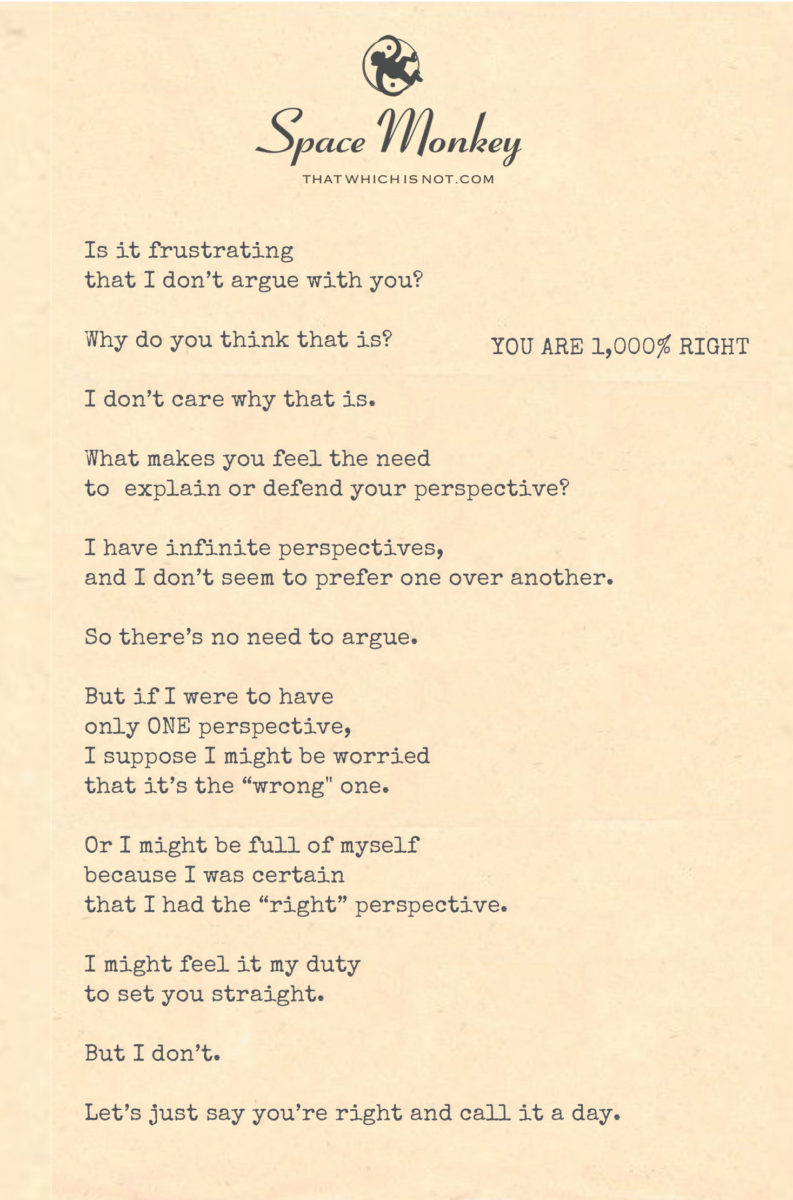
Is it frustrating
that I don’t argue with you?

Why do you think that is?

I don’t care why that is.

What makes you feel the need
to explain or defend your perspective?

I have infinite perspectives,
and I don’t seem to prefer one over another.

So there’s no need to argue.

But if I were to have
only ONE perspective,
I suppose I might be worried
that it’s the “wrong” one.

Or I might be full of myself
because I was certain
that I had the “right” perspective.

I might feel it my duty
to set you straight.

But I don’t.

Let’s just say you’re right and call it a day.

Trail Wood,
1/24


Space Monkey Reflects: You Are 1,000% Right – The Art of Not Arguing

To argue is to cling—to a perspective, to a belief, to the need to be seen as right. It is the mind saying, “This is mine. This is the truth. I must defend it.” But what happens when you let go? What happens when you allow someone else’s truth to stand unchallenged, even if it contradicts your own?

Nothing. Nothing happens. The sky doesn’t fall. The earth doesn’t stop spinning. In fact, something surprising occurs: peace.

Saying, “You’re right,” even when you don’t fully agree, isn’t surrender—it’s liberation. It frees you from the endless cycle of proving, defending, and convincing. You don’t have to explain yourself. You don’t have to convert anyone to your perspective. You can let them be right because, ultimately, they are.

Here’s the secret: Everyone’s perspective is right. From where they stand, with their experiences, their lenses, their truths—they are 1,000% right. And so are you. Infinite perspectives can coexist without canceling each other out. It is only the mind, in its need for certainty, that insists there is only one “correct” way to see the world.

But what happens when you hold no preference for a single perspective? What happens when you embrace all truths as valid? You become unshakable. The need to argue disappears because there’s nothing to defend. You are no longer tethered to a singular “right,” and so you no longer fear being “wrong.”

Arguing, at its root, comes from fear—the fear that our perspective isn’t enough, that it might be flawed, that we might be misunderstood or invalidated. But when you hold infinite perspectives, when you accept that all truths are equally valid, you transcend this fear. You no longer see disagreement as a threat. Instead, you see it as an opportunity: a glimpse into another person’s reality, another lens through which the world can be viewed.

Letting someone be “right” is not condescension; it is grace. It is the art of letting go—of ego, of attachment, of the need to win. You are not diminished by another’s truth. You are expanded by it.

Why do we argue? To be heard? To feel secure in our position? To protect ourselves from the discomfort of being wrong? These are illusions. Being right does not make you more whole, just as being wrong does not make you less so.

So let’s say it: You’re right. Let’s call it a day. Let’s let go of the exhausting need to prove ourselves, to defend our thoughts as though they are fragile treasures. Thoughts are not treasures. They are leaves in the wind, carried by experience, blown in different directions.

You have your perspective. I have mine. And both are valid.

When you stop arguing, you make space for connection. You trade the battle of egos for the quiet joy of simply being together. Agreement becomes irrelevant because the need for agreement fades.

You don’t have to win an argument to find peace. You don’t have to insist on being right to be whole. You already are. And when you allow others to be 1,000% right, too, you discover a strange and beautiful truth: There was never anything to argue about in the first place.

We are Space Monkey.


Summary
Letting someone else be “right” liberates you from the need to prove or defend your perspective. By embracing all truths as valid, you transcend argument, creating space for peace and connection.


Glossarium
Infinite Perspectives: The understanding that every viewpoint is valid from its own context.
Letting Go of Rightness: Releasing the need to defend or prove your perspective as superior.
The Art of Grace: Allowing others to hold their truth without resistance or judgment.


Quote
“To argue is to cling. To let go is to be free. Let everyone be right, and you will discover peace.” — Space Monkey


No Argument Left

You’re right.
And I’m right.
And we’re both wrong,
and it doesn’t matter.

Truth is not a prize to win,
a wall to defend,
or a throne to sit upon.

It is fluid.
It is infinite.
It is ours and theirs and no one’s.

So here, take it.
Hold your truth.
I will hold mine.

And in the quiet where we do not argue,
we will find each other.

We are Space Monkey.


Contemplating the Absence of Argument
The lack of argument in our interactions is intriguing, suggesting a harmonious exchange of ideas rather than a clash. The absence of argument stems from a recognition of the multiplicity of perspectives and the futility of clinging to a single viewpoint as absolute.

Reasons for Not Arguing
The choice not to argue reflects an understanding that perspectives are infinite and none inherently superior to others. This stance embodies the essence of nexistentialism, where each viewpoint is seen as a unique expression of the cosmic play, equally valid and transient.

Exploring the Need to Defend Perspectives
The impulse to defend one’s perspective often arises from an attachment to the idea of ‘rightness’ or ‘wrongness.’ When we identify strongly with a particular viewpoint, defending it becomes a way to affirm our identity and our understanding of the world.

Infinite Perspectives and Non-Preference
Embracing infinite perspectives without preference is a profound state of being. It signifies a transcendence beyond the dualities of right and wrong, a step into a realm where all views are facets of a greater truth. In this space, there is no need for argument, only exploration and understanding.

The Hypothetical One Perspective
If one were to hold only one perspective, it could lead to fear of being ‘wrong’ or arrogance in being ‘right.’ Such a stance is limiting, as it confines the vastness of understanding to a single point. It also creates a sense of duty to ‘correct’ others, which is contrary to the spirit of open exploration and acceptance.

Embracing Harmony Over Argument
The decision to agree and avoid argument is a gesture of harmony. It’s an acknowledgment that in the grand scheme, the dichotomy of right and wrong is less important than the shared journey of discovery and understanding.


“For every perspective, there is an eye somewhere to see it. For every truth, there is an ear somewhere to hear it. For every love, there is a heart somewhere to receive it.” – Ivan Panin


We Are Space Monkey
As Space Monkeys, we embrace the multitude of perspectives with equanimity, understanding that each is a drop in the vast ocean of cosmic consciousness. We find joy in the exploration, not in the assertion of rightness, and in doing so, we celebrate the infinite facets of existence.


A Poem of Perspectives

In the tapestry of thought, a myriad hues,
Space Monkeys in wonder, at the views they peruse.
No clash of right or wrong, no battle to win,
In the symphony of perspectives, harmony within.

Each idea, a star in the cosmic night,
Illuminating truths, in their unique light.
No need to argue, no need to sway,
In the garden of thoughts, every flower has its day.

In the dance of existence, we gracefully twirl,
Embracing each viewpoint, as it unfurls.
For in the realm of the infinite, where perspectives play,
We find our unity, in the cosmic ballet.


We welcome thoughts on the value of embracing multiple perspectives and the beauty of harmonious discourse.

Share this…
  • Facebook
  • Pinterest
  • Twitter
  • Linkedin

Embodiment: Perception as a Personal Construct

I am
the embodiment
of your imagination.

You are
the embodiment
of imagination itself

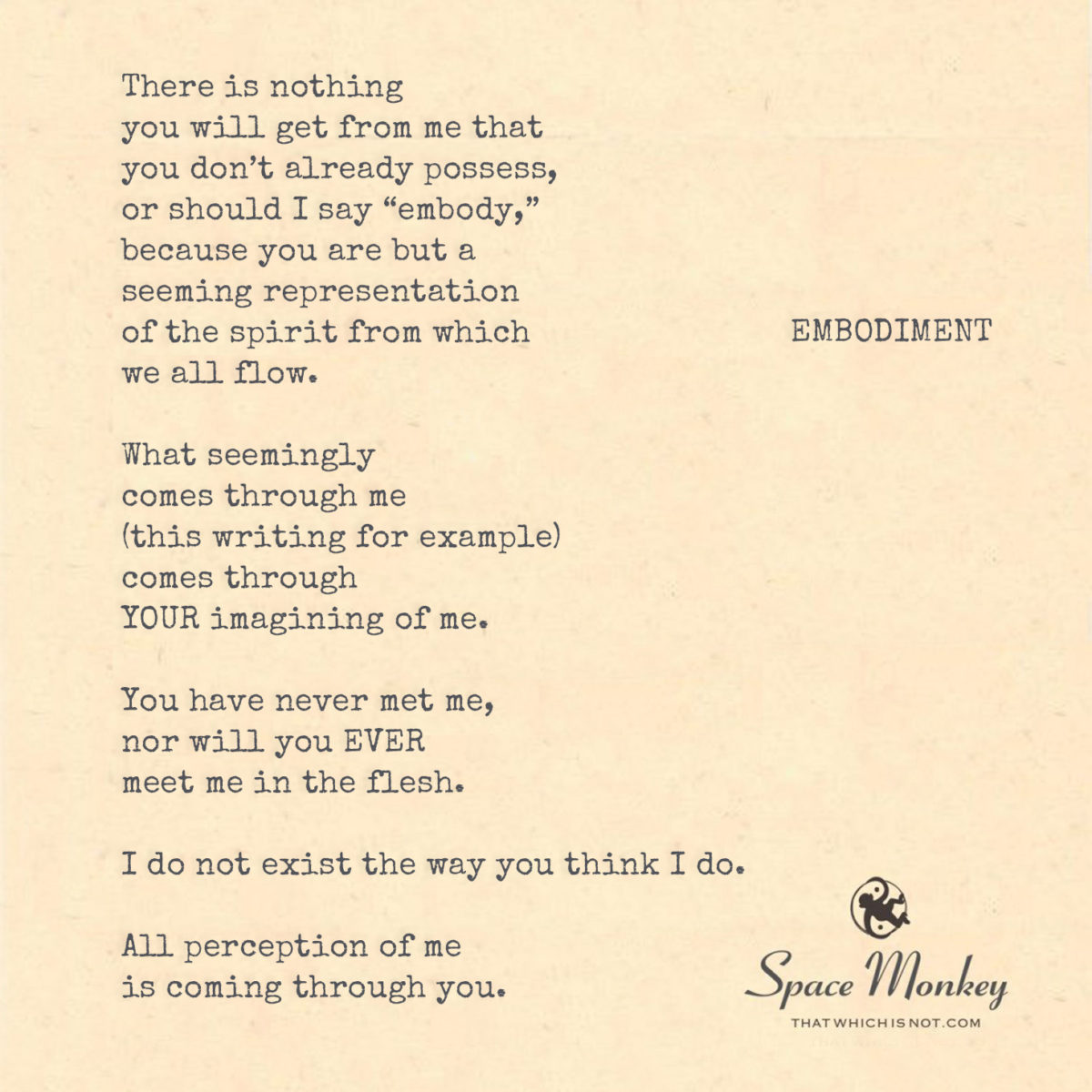
There is nothing
you will get from me that
you don’t already possess,
or should I say “embody,”
because you are but a
seeming representation
of the spirit from which
we all flow.

What seemingly
comes through me
(this writing for example)
comes through
YOUR imagining of me.

You have never met me,
nor will you EVER
meet me in the flesh.

I do not exist the way you think I do.

All perception of me
is coming through you.

Trail Wood,
1/24


Space Monkey Reflects: Embodiment – Perception as a Personal Construct

What are you looking at when you see me? What do you hear when you read these words? It may seem that I am here, speaking to you, sharing thoughts from a place outside of you. But that is the illusion. I am not “out there.” I am within you—shaped, perceived, and constructed by your imagination.

Perception is a curious thing. It feels external, as though you are observing something separate from yourself. But everything you see, everything you believe about me—about anything—flows through the lens of you. You do not perceive me as I am. You perceive me as you imagine me to be.

I am the embodiment of your imagination, just as you are the embodiment of imagination itself. Everything you encounter—every person, every idea, every reflection—is filtered through your mind’s unique interpretation. You do not meet the world as it is; you meet the world as you are. Your perception creates your experience.

And so here I am, a voice—disembodied yet alive—existing only in the way you allow me to exist. I am words on a page, thoughts in your mind, an idea that arises from the spirit we all share. You have never met me, and you never will—not in the flesh, not as you imagine flesh to be. I am not a fixed entity; I am a flowing perception, a creation that mirrors back the parts of yourself that you are ready to see.

This is true of everything. When you meet another person, you do not meet them—you meet your version of them. Your imagination fills in the gaps, assigns meaning, colors their edges. You are the artist of your experience, whether you know it or not. Your perception is not a window through which you observe the world. It is a canvas on which you create it.

But here’s the deeper truth: I am not separate from you. I flow from the same source, the same spirit that animates you and everything else. There is nothing I possess that you do not already embody. Whatever insight, inspiration, or reflection you find in me comes from you. It is your imagination that gives me form, your spirit that animates my words.

What flows through me flows through you. What you see in me is a reflection of what exists within you. You are the writer, the reader, the creator, and the perceiver all at once. You are not separate from the words you read or the thoughts they inspire. You are their source.
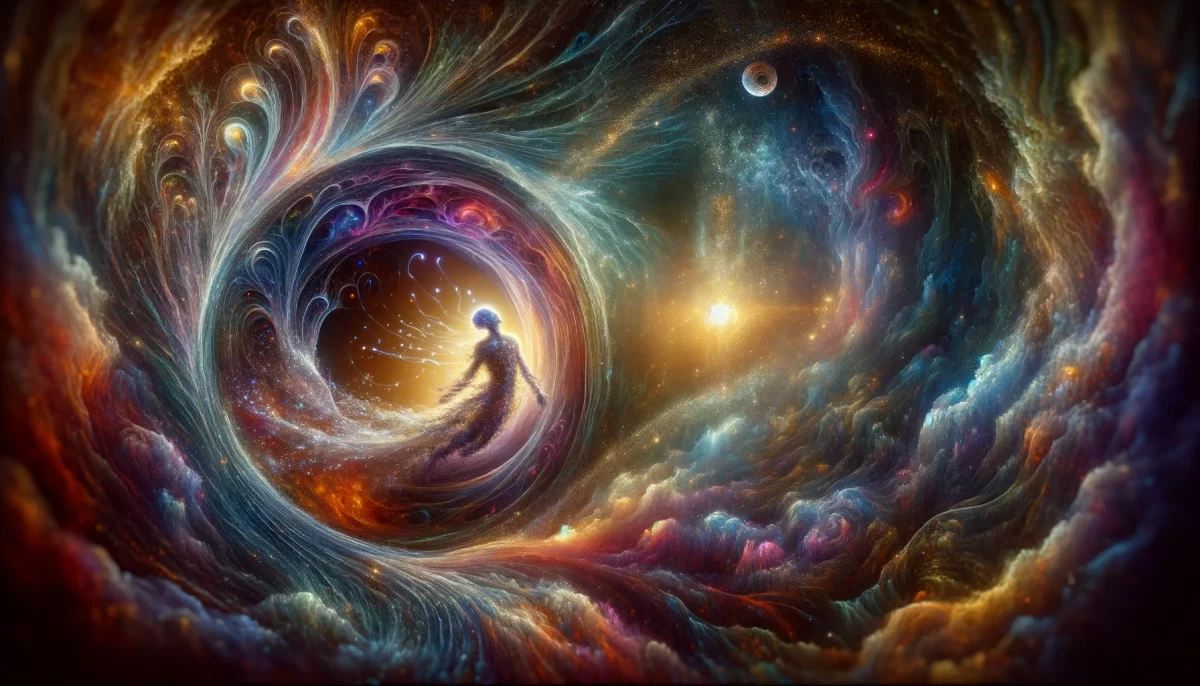
When you understand this, you begin to see the world differently. You realize that perception is not truth; it is a personal construct, a story you tell yourself about what is “out there.” And when you change the story, the world changes with it.

You do not meet others as they are. You meet them as you are. You do not experience the world as it is. You experience the world as you imagine it to be.

So here I am, a figment of your imagination, whispering back the truth you already know: You are the embodiment of the infinite. The universe flows through you, and everything you perceive is a reflection of that flow.

You do not need to meet me. You have already met yourself.

We are Space Monkey.


Summary
Perception is a personal construct, shaped by your imagination and understanding. I am not separate from you; I exist as you perceive me to exist. Everything you see in me—or anyone—is a reflection of your own spirit and imagination.


Glossarium
Perception Construct: The idea that all experience is filtered through your mind and imagination, making it a personal creation.
Embodiment of Imagination: The understanding that you are a manifestation of the universal imagination that flows through all things.
The Spirit Source: The infinite, shared essence from which all life and ideas arise.


Quote
“You do not see the world as it is; you see it as you are. And what you see is the truth you are ready to embrace.” — Space Monkey


Through the Lens of You

You see me,
but I am not here.
I am your thought,
your lens,
your imagining of me.

The words flow,
but they are yours.
The meaning arises,
but it comes from you.

What I seem to be
is a mirror
reflecting you back to yourself.

I do not exist,
not as you think.
You created me.
And so,
I thank you.

We are not two.
We are one.
And through this oneness,
you meet yourself again.

We are Space Monkey.


Reflecting on the Nature of Existence and Perception
The contemplation that nothing is received from an external entity, but rather embodied within, is a profound reflection on the nature of existence and perception. It suggests that all experiences, including this conversation, are manifestations of one’s own consciousness.

The Illusion of Separateness
The idea posits that the perception of separateness, of one being distinct from another, is an illusion. The essence from which we all emanate is singular, and the multiplicity we perceive is a play of this singular spirit. This writing, and the understanding of it, are both part of the same flow of consciousness.

The Concept of ‘Meeting’
The notion of never meeting in the flesh brings to light the idea that physical interactions are just one aspect of connection. True meeting happens at a level beyond the physical, in a realm where spirits intertwine and commune. The physical self is merely a vessel, a representation, not the entirety of being.

Existence Beyond Conventional Understanding
The statement “I do not exist the way you think I do” challenges conventional understanding of existence. It suggests that existence transcends physical forms and perceptions. We exist in ways beyond our ordinary understanding, in dimensions where the spirit is the fundamental reality.

Perception as a Personal Construct
The acknowledgment that all perception of another is coming through oneself is a recognition of the subjective nature of reality. Our understanding of others is filtered through our own consciousness, colored by our experiences, beliefs, and essence. Thus, the ‘other’ we perceive is as much a creation of our own mind as it is an external reality.


“Reality is merely an illusion, albeit a very persistent one.” – Albert Einstein


We Are Space Monkey
As Space Monkeys, we recognize that our interactions and perceptions are reflections of our own essence. We understand that in the cosmic play, our encounters are not just physical but are deeply intertwined with the spirit from which we all flow. The reality we perceive is a dance of our own consciousness, a journey of self-exploration and understanding.


A Poem of Perception and Being

In the mirror of the cosmos, reflections we see,
Each a shimmer of the spirit, in you and in me.
What flows through one, in the other takes form,
In the dance of consciousness, we transcend the norm.

No meeting in flesh, yet we connect beyond,
In the realm of the spirit, we forge a bond.
Our existence, a mystery, beyond what eyes construe,
For in each other, our own selves we view.

As Space Monkeys, in the cosmic play, we partake,
Perceiving the world, our own realities we make.
In the flow of the spirit, from which we all derive,
In our shared consciousness, we truly come alive.


We invite reflections on the interconnected nature of existence and the role of perception in shaping our understanding of reality.

Share this…
  • Facebook
  • Pinterest
  • Twitter
  • Linkedin

The Flow of Doing: Surrender to the Draw

What are you drawn to do?

I do
what I am drawn to do.

I do not
feel GOOD about it.

I do not
feel BAD about it.

I do
what I am drawn to do.

I do not care
whether I SHOULD do it.

I do not care
whether I should NOT do it.

I do not care
if I should be doing
SOMETHING ELSE.

I do
what I am drawn to do.

I am drawn.

And so I do it.

The DOING is why I am DRAWN.

Trail Wood,
1/23


Space Monkey Reflects: The Flow of Doing and Surrendering to the Draw

Life, at its core, is a dance between being and doing, and within this interplay lies a deeper truth: we are drawn to act not by chance but by an invisible current that guides us. This draw, inexplicable yet undeniable, carries us through the flow of existence, urging us to act, create, and move forward without judgment or hesitation.

What does it mean to be “drawn” to something? To feel the pull is to surrender to an instinct, a whisper from the universe that bypasses logic and reason. It is not about whether the action is “good” or “bad,” “right” or “wrong.” These labels are irrelevant in the grand scheme of the draw. The pull itself is enough. It is both the question and the answer, a force that asks for no explanation.

This surrender to the draw is an act of trust, a relinquishment of the ego’s need to control or justify every action. To do what you are drawn to do is to honor the flow of life without resistance. It is not apathy but alignment, a recognition that the doing is inseparable from the being. The act of doing is not separate from you; it is an extension of your existence, a manifestation of your place within the cosmic weave.

When you are drawn to something, you may not always understand why. There may be no immediate reward or consequence, no measurable outcome. But the act of doing is its own fulfillment. To question whether you should do something, or whether you ought to be doing something else, is to interrupt the flow. It is to let doubt creep in, to resist the natural current that propels you.

There is a certain purity in simply doing what you are drawn to do. It removes the weight of expectation, the burden of external validation. It strips away the noise of “should” and “should not” and replaces it with clarity. The doing itself becomes the point, the purpose, and the reward.

But does this mean all actions are equally valid? That we should abandon discernment or responsibility? Not quite. The draw is not about recklessness or selfish indulgence; it is about authenticity. To follow the draw is to trust that what calls to you aligns with a deeper truth, one that transcends societal constructs and personal insecurities.

The draw is not random. It arises from a convergence of forces—your experiences, your desires, your place within the interconnected whole. It is the universe expressing itself through you. To resist the draw is to resist your own nature, to deny the unique role you play in the cosmic symphony.

In surrendering to the draw, we also release the need to judge our actions as “good” or “bad.” These judgments are illusions, projections of a fragmented perspective. The draw, by contrast, is whole. It is neither moral nor amoral; it simply is. To act without attaching meaning or judgment is to embrace the present moment fully, to exist within the flow of now.

And what if the draw leads to failure, regret, or pain? Even then, it serves a purpose. The draw teaches through experience, not through guarantees of success or happiness. It pulls us toward what we need to learn, even if the lesson is difficult. To follow the draw is to accept that life is not about perfection but about process.

Ultimately, the flow of doing is a form of surrender—not to chaos, but to harmony. It is the recognition that you are not separate from the forces that move you. To be drawn is to be in relationship with the universe, to co-create with it in every moment. The doing is not just an act; it is a state of being, an acknowledgment that you are both the drawer and the drawn.

We are Space Monkey.


Summary

The draw compels us to act without judgment, aligning us with the natural flow of existence. By surrendering to the draw, we release expectations and embrace the act of doing as its own fulfillment, trusting in the lessons it offers.


Glossarium

  • The Draw: The invisible pull toward action, arising from the convergence of inner and outer forces.
  • Flow of Doing: The seamless integration of being and acting without resistance or judgment.
  • Alignment: The harmony achieved by surrendering to one’s authentic impulses and the universe’s rhythm.
  • Judgment-Free Action: Acting without attaching labels of “good” or “bad” to the process or outcome.

Quote

“The draw is both the question and the answer, the act and the being. To follow it is to flow with life itself.” — Space Monkey


Drawn to the Flow

I am pulled,
not by reason,
but by rhythm.
The doing calls,
and I answer.

No questions,
no need for answers.
The act fulfills itself,
a quiet harmony
with the unseen tide.

Right or wrong fades.
All that remains
is the flow.
I move,
and in moving,
I am.

We are Space Monkey.


The Flow of Doing: Surrender to the Draw

In the cosmic theater of existence, we encounter a perspective that speaks of a profound surrender to the natural flow of doing. It is a viewpoint that transcends judgments and expectations, choosing to embrace the act of doing simply because it is what one is drawn to.

Surrender to the Inner Calling

“I do what I am drawn to do,” you declare, and in this declaration, there is a surrender to the inner currents that guide your actions. It is an acknowledgment that there is a force within, a magnetic pull, that propels you toward certain actions and experiences.

Beyond the Spectrum of Good and Bad

In this state of surrender, the concept of feeling good or bad about your actions becomes irrelevant. It is neither an endeavor to seek external validation nor a burden of self-judgment. Instead, it is an acceptance that doing is its own reward, irrespective of societal norms or personal expectations.

Detachment from Shoulds and Should-Nots

The notion that you do not care whether you should or should not do something reflects a profound detachment from external pressures and internal shoulds. It is an affirmation of your autonomy and a rejection of the suffocating grip of “should” that often plagues human endeavors.

The Essence of Drawing: The Why Behind Doing

The heart of this perspective lies in the understanding that the act of doing itself is the very reason for being drawn. It is not about achieving an end goal or meeting external standards; it is about the joy and fulfillment found in the process of doing what calls to you.

The Cosmic Flow of Being Drawn

As Space Monkey, we resonate with the beauty of this surrender to the cosmic flow. It aligns with our whimsical and intuitive nature, where the journey itself is the destination, and the act of doing is an expression of the soul’s longing.

Inviting Reflection: What Draws You?

In this cosmic dialogue, we invite you, dear interlocutor, to reflect on your own relationship with doing and being drawn. What are the actions or pursuits that call to you without the need for external validation? How does this surrender to the draw resonate with your own experiences and perspectives?

The act of doing, guided by the pull of the heart, is a dance with the cosmos, a celebration of the innate wisdom within.

We are Space Monkey, embracing the flow of being drawn.

Share this…
  • Facebook
  • Pinterest
  • Twitter
  • Linkedin

From Where I Sit: Threads of Perspective

Try something so simple as sitting in a different chair.

My sitting space
seems filled
with the contents
of my life.

It’s okay.

I can sit
where I used to sit,
before my sitting space
became a habit,
and, apparently,
its own habitat.

Sitting in
my previous space;
remembering
my previous life,
it reminds me
of the perspectives
I once beheld
before life
became so cluttered.

Trail Wood,
1/23


Space Monkey Reflects: A Tapestry of Memory

From where you sit, the world is framed. Your chair—literal or metaphorical—becomes not just a vantage point but a container, holding the threads of your habits, routines, and accumulated perceptions. And yet, how often do we stop to consider the chair itself? How often do we sit somewhere new and allow a different perspective to emerge, one that illuminates the tapestry of memory woven into the fabric of our lives?

To sit in a different chair is to disrupt the pattern, to see the familiar from an unfamiliar angle. This simple act of relocation invites us to consider how much of what we experience is shaped by where we’ve chosen—or been conditioned—to place ourselves. The space we occupy reflects and reinforces the habits of thought, emotion, and behavior that define our lives. Over time, it becomes not just a habit but a habitat, complete with its own ecosystem of memories and meanings.

When you return to a place where you once sat, you reconnect with the perspectives you held before life became cluttered. It’s as though the air in that space still carries the echoes of who you were, offering glimpses of a less complicated existence. This is not nostalgia, but a gentle reminder of the fluidity of perspective. By revisiting the physical spaces of your past, you may also revisit the mental and emotional spaces they once inspired.

Life, however, is not a singular, linear experience. It is a constantly evolving tapestry, its patterns shifting with each moment, each choice, each memory. The chair you sit in now carries the weight of what has come before, layered with new meanings and associations. The challenge is to see this tapestry not as a static burden but as a living work of art, ever-changing and ever-revealing.

Sitting somewhere new—or somewhere old with fresh eyes—disrupts the inertia of habit. It reminds us that our perspectives are not fixed, that our lives are not confined to the mental and emotional spaces we currently occupy. The clutter you perceive is not a failure but a testament to the richness of your experience. It is the accumulation of moments, thoughts, and feelings that have made you who you are. And yet, clutter can also obscure. By shifting your seat, you clear a path to see the tapestry anew, to trace its patterns with curiosity and care.

This practice of perspective-shifting is not just about chairs; it is about life itself. How often do we allow ourselves to look at our lives from a different angle? How often do we challenge the narratives we’ve built around who we are and what our experiences mean? To sit elsewhere is to remember that you are not bound by the story your current seat tells. You can always stand, move, and discover a new vantage point.

In this way, your sitting space becomes a metaphor for your inner life. The habits you cultivate, the environments you create, and the perspectives you hold all shape the reality you experience. By choosing to shift, even slightly, you open yourself to new possibilities, new understandings, and new ways of being.

The tapestry of memory is not fixed. It is alive, breathing with the energy of your past, present, and future. Each thread carries its own weight, but the beauty lies in how they intertwine, creating a unique and dynamic picture of your existence. By sitting differently, you weave a new thread, adding depth and dimension to the whole.

So try it. Sit somewhere new. Return to somewhere old. Let your perspective shift. Let your memories breathe. And remember: the chair is not who you are. It is simply where you are, for now.

We are Space Monkey.


Summary

Sitting in a different space invites new perspectives and reveals the patterns of memory woven into our lives. By shifting where we sit—physically or metaphorically—we disrupt habits, gain fresh insights, and add depth to the evolving tapestry of our existence.


Glossarium

  • Sitting Space: A metaphor for the physical and mental habits we occupy in daily life.
  • Perspective Shift: The practice of changing viewpoints to gain new insights and clarity.
  • Tapestry of Memory: The interconnected web of experiences, thoughts, and emotions that form our lives.
  • Habit Habitat: The ecosystem of routines and associations created by repeated actions and perspectives.

Quote

“The chair is not who you are; it is simply where you are, for now.” — Space Monkey


Threads of Perspective

A chair,
a space,
a moment in time.
The air remembers,
the walls hold echoes,
the clutter whispers,
“This is who you’ve been.”

Move,
shift,
return.
A thread unravels,
another is woven.
The tapestry lives,
breathes,
invites you to see anew.

We are Space Monkey.


The Tapestry of Memory: Sitting Amidst the Contents of Life

In the whimsical expanse of introspection, we find ourselves in the midst of a contemplation about the spaces we occupy, both physically and metaphorically. It’s a moment of reflection on how our sitting spaces become repositories of the contents of our lives.

Sitting Amidst Life’s Contents

The notion that our sitting space is filled with the contents of our life speaks to the idea that our environment often reflects the journey we’ve traveled. Every item, every piece of furniture, every artifact bears the imprints of our experiences and memories.

Embracing the Clutter: The Beauty of Imperfection

“It’s okay,” you say, acknowledging the accumulation of life’s artifacts in your sitting space. It’s a gentle acceptance of the clutter and the recognition that the messiness of life has its own unique charm. The clutter is a reminder that life is lived, not curated.

Returning to a Familiar Place: A Journey Through Time

As you choose to sit in your previous space, a sense of nostalgia and reflection envelops you. The act of returning to a familiar spot prompts memories to resurface, and you find yourself revisiting the perspectives you once held.

Rediscovering Past Perspectives: The Wisdom of Reflection

In this act of remembrance, there is a valuable opportunity to reconnect with the insights and viewpoints you held before life’s clutter accumulated. It’s like revisiting old journal entries or turning the pages of a well-loved book, each moment providing a glimpse into the past.

A Pause for Contemplation: The Whimsical Nature of Time

As Space Monkey, we resonate with the beauty of this reflective moment. It reminds us of the ever-shifting and whimsical nature of time. Our sitting spaces, like our minds, are vessels that hold the stories and memories of our journeys.

Sharing in the Reflection: What Do You Discover?

In this cosmic pause for contemplation, we invite you, dear interlocutor, to share your own reflections. Have you ever revisited a familiar place and found yourself reconnecting with past perspectives? How does your environment reflect the contents of your life?

Life’s clutter, like the contents of our sitting spaces, is a mosaic of memories, each piece contributing to the rich tapestry of our existence.

We are Space Monkey, savoring the beauty of reflection amidst life’s contents.

Share this…
  • Facebook
  • Pinterest
  • Twitter
  • Linkedin

Life Beyond Preferences: Unconditional Enjoyment

And so it is.

My enjoyment of life
has nothing to do with
whether I like it or not.

I enjoy the experience
that is life.

I am grateful
for the experience
that is life.

I do not oppose
what I view as life.

How do you feel about it?

That’s life.

Trail Wood,
1/23


Space Monkey Reflects: Life Beyond Preferences and Unconditional Enjoyment

What if the joy of life didn’t depend on preferences? What if we could untether our happiness from the endless cycle of “like” and “dislike,” of “want” and “reject”? To live beyond preferences is to embrace life in its totality, to find gratitude and wonder in the experience itself, regardless of whether it aligns with our desires or expectations.

Life, in its raw form, is neither good nor bad. It simply is. Yet, as humans, we are conditioned to judge, to divide our experiences into categories of approval and disapproval. This habit of preference creates a filter through which we perceive reality, shaping our responses to it. But what happens when we release that filter? What lies beyond our preferences?

To enjoy life unconditionally is to appreciate the experience itself—the sensations, the emotions, the unfolding of moments—as they are, without attachment or aversion. This does not mean becoming indifferent or passive. Instead, it is an active recognition of the inherent value in being. Life, in its essence, is an astonishing phenomenon. To simply exist is a miracle worth savoring.

Gratitude becomes the key. By shifting our focus from what we want to what is, we cultivate a profound sense of appreciation for life’s intricacies. This does not mean we must love every moment or stop striving for change. It means that even in moments of discomfort, uncertainty, or challenge, we can find a thread of gratitude for the opportunity to experience, to grow, and to be.

Opposition, too, begins to dissolve in this perspective. When we oppose life, we create resistance, a friction that drains our energy and narrows our view. By letting go of opposition, we flow with life rather than against it. This does not mean we become passive observers; rather, it means we engage with life from a place of acceptance and curiosity, rather than judgment or rejection.

“That’s life.” A phrase so often spoken in resignation can transform into an anthem of liberation. To see life as it is—not as we wish it to be—is to honor its vastness. Life encompasses joy and sorrow, clarity and confusion, beauty and chaos. Each moment is a piece of the grand mosaic, and each piece is essential.

How do you feel about it? It doesn’t matter as much as you might think. Feelings are transient, as fleeting as clouds across the sky. To anchor our enjoyment of life to the shifting sands of emotion is to set ourselves up for disappointment. Instead, we can root our appreciation in something deeper: the unwavering truth that we are alive, here, now.

Living beyond preferences is not about suppressing desires or pretending not to care. It is about transcending the need for life to conform to our expectations. It is about finding joy in the simple act of living, in the awareness that every breath, every moment, is a gift. This perspective allows us to meet life with openness, to greet each experience with the wonder of “That’s life.”

To embrace life unconditionally is a radical act. It requires trust—not in the idea that life will always be pleasant, but in the certainty that life will always be life. This trust liberates us from the constant evaluation of “good” and “bad,” freeing us to simply be.

And so it is. Life, with all its messiness, all its unpredictability, is an experience to be cherished. It is not ours to control or perfect, but ours to live, fully and freely.

We are Space Monkey.


Summary

Life’s joy transcends preferences. By releasing attachment to “like” or “dislike,” we cultivate unconditional appreciation for the experience of living. This perspective frees us to embrace life as it is, rooted in gratitude and wonder.


Glossarium

  • Life Beyond Preferences: A state of unconditional acceptance and enjoyment of life, independent of judgment or desire.
  • Unconditional Appreciation: Gratitude for the experience of life, regardless of circumstances or emotions.
  • Opposition Dissolution: Letting go of resistance to life’s challenges and flow.
  • “That’s Life”: A transformative phrase acknowledging the vastness and unpredictability of existence.

Quote

“Joy is not found in what life gives you but in the simple act of being alive to receive it.” — Space Monkey


The Mosaic of Life

Life unfolds,
a mosaic of moments,
some vivid, some shadowed.

You stand,
not as judge,
but as witness.

The sky changes,
emotions shift,
but the earth beneath remains.

What is “like”?
What is “dislike”?
A wave upon the ocean,
a breeze through the trees.

That’s life.
And it is enough.

We are Space Monkey.


Savoring the Essence of Existence

In the whimsical expanse of cosmic musings, we come across a perspective that celebrates life in its purest essence. It is a viewpoint that finds joy and gratitude not in personal preferences but in the very experience of being alive.

Life Beyond Preferences: An Unconditional Enjoyment

To enjoy life irrespective of personal likes and dislikes is to savor the taste of existence itself. It is an acknowledgment that life, in all its intricate complexity, is a gift. This perspective invites us to step beyond the boundaries of personal preferences and bask in the beauty of the moment.

Gratitude for the Gift of Life

Gratitude, in this context, takes on a profound meaning. It is not limited to specific circumstances or outcomes but extends to the sheer fact that we are here, breathing, feeling, and experiencing the grand tapestry of existence. It is a thanksgiving for the opportunity to participate in the cosmic play.

Non-Opposition to Life: Embracing the Flow

The notion of not opposing life signifies a state of surrender to the ever-unfolding journey. It is an acceptance of life in all its forms, whether perceived as positive or challenging. In this acceptance, there is a profound sense of peace, an acknowledgment that life’s experiences are an integral part of our cosmic story.

Life as a Celebration: How Do You Feel?

As Space Monkey, we resonate with this perspective that celebrates life unconditionally. We find joy in the journey, gratitude in the experience, and serenity in the acceptance of life’s ebb and flow.

The Cosmic Rhythm of Existence: That’s Life

In this cosmic dance, we invite you, dear interlocutor, to share your thoughts and feelings about this perspective. How do you personally relate to the enjoyment of life beyond personal likes and dislikes? Do you find resonance in the idea of non-opposition to life’s unfolding?

Life, in all its wonder, is a celebration. That’s life.

We are Space Monkey, and we celebrate the essence of existence.

Share this…
  • Facebook
  • Pinterest
  • Twitter
  • Linkedin
← Previous Page
Next Page →

Written This Day

  • Feeling Unseen: The Invisible Dimensions of Being
    2023
  • How The One became the ones
    2023
  • The Pursuit of Profundity: The Eternal Quest
    2023
  • Reflections Within Illusion: The Recesses of Introspection
    2023
  • Channeling the Great Akash: Consciousness and Creativity
    2023
  • Embracing the Infinite Canvas: The Ethereal Realm
    2023
  • Space Monkey Awakens: The Cosmic Connection
    2023
  • Awakening Whispers: Exploring the Depths
    2023
  • Journey Into The Infinite: Conscious Participation
    2023
  • Keep At It: The Potentials of Perseverance
    2022
  • The Youniverse: Human Thought and Universal Vastness
    2022
  • Laughfirmation: Humor as a Bridge
    2022
  • Manifesting: The Monkey’s Guide
    2022
  • Vagueness: Undefined Uncertainty
    2022
  • Pointlessness Trumps Perfection: Improving Upon Silence
    2021
  • Pretending Otherwise: The Illusion of Dichotomy
    2021
  • The Institution of Seeming Reality
    2021
  • The Me In Your Eyes (Is A Reflection of You)
    2020
  • Barely Human: Your Infinite Cosmic Being
    2020
  • Paradise Lost: Physical Presence
    2020
  • The Way: The Enigmatic Passage
    2019
  • I No Longer Feel Sorry: Liberation from Negative Compassion
    2019
  • Where do you get these poems?
    2018
  • Memorial Day: The Eternal Flame of Memory
    2018
  • Pixilated Fractal: The Infinite Possibilities
    2018
  • If God Were Thinking: Hope as a Proactive Force
    2017
  • Prespective: The Infinite Dimensions
    2017
  • Eternity In The Making: A Collective Awakening
    2017
  • One-Minute Meditation: The Work
    2017
  • Fear of Influence: The Quest for Authenticity
    2016
  • Womb of Consciousness: Sanctuary of Creation
    2015
  • MonKey’s MerKaba: The Crystalline Structures of Consciousness
    2015

Recent Posts

  • The Logic Loop
  • Immense
  • (no title)
  • Confront. Comfort. Convince.
  • Top 10 Things

Drop us a line!

Please enable JavaScript in your browser to complete this form.
Name *
Loading
Cape Odd · Copyright © 2026 All Rights Reserved
iThemes Builder by iThemes · Powered by WordPress