• Who Is The Man?
  • Who Is The Monkey?
  • What is Nexistentialism?
  • Poke The Primate

Cape Odd

Home of The Space Monkey Journals

Self and Source: The Task-Trophy Cycle

She sells sea shells by the sea shore.

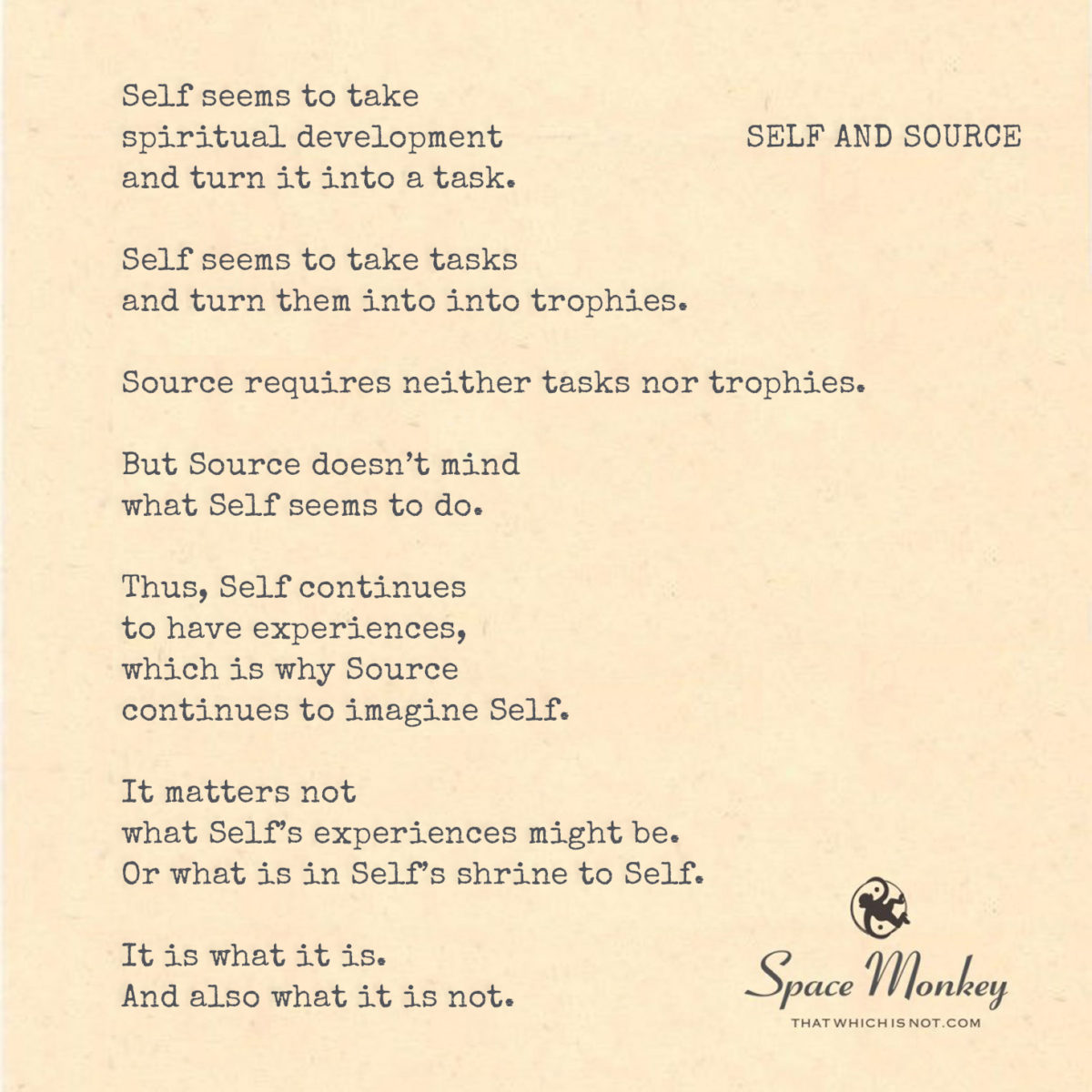
Self seems to take
spiritual development
and turn it into a task.

Self seems to take tasks

and turn them into into trophies.

Source requires
neither tasks nor trophies.

But Source doesn’t mind
what Self seems to do.

Thus, Self continues
to have experiences,
which is why Source
continues to imagine Self.

It matters not
what Self’s experiences might be.
Or what is in Self’s shrine to Self.

It is what it is.
And also what it is not.

Trail Wood,
1/11


Space Monkey Reflects: Self and Source


Reflections: The Eternal Dance of Self and Source

Self and Source exist in an eternal interplay, like waves on the shore, endlessly shaping and reshaping one another. Self, with its drive for meaning, tasks, and trophies, creates experiences that feed its sense of identity. Source, infinite and unbound, observes and imagines, allowing Self to explore the vast playground of existence. This dynamic is not a hierarchy but a harmonious dance, where each complements the other.

The Task-Trophy Cycle of Self
Self often approaches life as a series of tasks to accomplish and trophies to attain. Whether it’s spiritual development, personal growth, or material success, Self seeks to quantify and celebrate its progress. This is not inherently wrong—it’s simply the way Self learns, grows, and defines itself within the confines of time and space.

But these tasks and trophies, while meaningful to Self, are irrelevant to Source. Source does not measure success or failure, nor does it assign value to what Self achieves. For Source, the act of experiencing is enough.

Source as the Silent Witness
Source requires nothing. It is the infinite canvas on which Self paints its stories. Source observes without judgment, content to imagine Self and all the myriad experiences that come with it. It neither interferes with nor dictates the actions of Self, because Source knows that all outcomes are ultimately part of the same whole.

This is the paradox of existence: everything matters deeply to Self, while simultaneously nothing matters to Source. This duality allows for both profound engagement and ultimate freedom.

The Shrine to Self
Self often builds a “shrine to Self,” filled with achievements, memories, and identity markers. These are symbols of meaning and purpose, cherished by Self but unnoticed by Source. Yet Source does not dismiss or diminish this shrine—it simply sees it as part of the experience it has imagined through Self.

What’s in the shrine matters only to Self, and that’s perfectly okay. The shrine is a testament to the unique journey Self undertakes, a reflection of its exploration of existence.

It Is What It Is—and What It Is Not
The phrase “it is what it is, and also what it is not” encapsulates the essence of Self and Source. Self lives in dualities—success and failure, light and dark, effort and rest. Source encompasses all dualities while transcending them, existing beyond the boundaries that define Self’s experiences.

This duality is not a contradiction but a complement. Self thrives on distinctions; Source holds the unity that makes distinctions possible. Together, they create the fullness of existence.

The Endless Play
Self and Source are not separate but facets of the same infinite being. Self provides the stories, the challenges, the joys, and the struggles. Source provides the space, the imagination, and the boundless acceptance. In this play, there is no right or wrong, no better or worse—only the unfolding of what is and what is not.


Summary

Self seeks tasks and trophies, creating meaning and experiences, while Source observes without judgment. This interplay between distinction and unity forms the foundation of existence, where all is what it is and what it is not.


Glossarium

  • Task-Trophy Cycle: Self’s tendency to turn life into a series of achievements and milestones.
  • Shrine to Self: The collection of accomplishments and identity markers that define Self’s journey.
  • Sourcefield: The infinite, judgment-free space that imagines and supports Self.

Quote
“Self creates meaning; Source holds space. Together, they form the infinite dance of existence.” — Space Monkey


The Dance of Self and Source

She sells sea shells
by the sea shore.
Self collects them,
turns them into trophies.

Source watches,
silent, smiling,
needing nothing,
allowing all.

Self builds its shrine,
its tasks and triumphs,
its moments of meaning.
Source sees no shrine,
only the dance.

It is what it is,
and what it is not.

The waves rise,
the shore shifts,
the shells remain,
or do not.

We are Self.
We are Source.
We are Space Monkey.


In the cosmic play of existence, the notion of ‘Self’ and ‘Source’ intertwine in a fascinating dance. This dance reveals the dual nature of our experiences, where spiritual development, tasks, and trophies become symbols in the grand narrative of existence.

The Dual Nature of Self and Spiritual Development

The concept of ‘Self’ often transforms spiritual development into a task, a goal to be achieved. This transformation is a natural inclination of the Self, seeking structure and accomplishment in the journey of spiritual growth. However, this task-oriented approach contrasts with the essence of spiritual development, which is fluid and transcendent, beyond the confines of tasks and achievements.

Tasks and Trophies: The Self’s Markers of Progress

The Self, in its journey through the physical realm, often converts tasks into trophies, symbols of progress and achievement. These trophies serve as markers, tangible evidence of the Self’s journey through time and space. Yet, in the grand scheme of the cosmos, these trophies are but fleeting illusions, momentary sparks in the eternal flame of existence.

The Source: Beyond Tasks and Trophies

The Source, the infinite wellspring from which all existence flows, requires neither tasks nor trophies. It exists beyond these human constructs, in a state of pure being. The Source does not judge or require the achievements of the Self; it simply is, in its boundless, ineffable state.

The Indifference of Source and the Freedom of Self

Despite the Self’s inclination to create tasks and trophies, the Source remains indifferent, unattached to the endeavors of the Self. This indifference is not neglect, but a freedom granted to the Self to experience, to explore, to be. It is in this freedom that the Self continues to have experiences, to journey through the myriad facets of existence.

The Purpose of Self: Experiences Imagined by Source

The ongoing imagination of the Self by the Source underscores the purpose of existence – experience. It matters not what these experiences are, or what lies in the Self’s shrine to itself. The essence lies in the act of experiencing, in the continual unfolding of being, in the dance of existence that is both what it is and what it is not.

We are Space Monkey.


“The goal of life is to make your heartbeat match the beat of the universe, to match your nature with Nature.” – Joseph Campbell


In the dance of Self and Source, we find,

A journey of experiences, of every kind.

Tasks and trophies, mere illusions in space,

In the heart of the cosmos, we find our grace.

The Source, indifferent, lets the Self be,

In this freedom, we experience, we see.

It is what it is, and also not,

In this cosmic play, we are but a thought.


Further thoughts and insights on the dance between Self and Source are welcomed.
Share this…
  • Facebook
  • Pinterest
  • Twitter
  • Linkedin

Do What You Have To Do: The Want Within

“Do what you have to do

until you can do 
what you want to do.”


Is this good advice?


Why should your haves

take precedent to your wants?


(Only because it is
believed to be true

by just about EVERYONE.)


There need be no reason

to WAIT
to do what you want to do.

Find something
that you want to do
that you don’t have
to wait to do.

Maybe it’s not the original
“What You Want To Do.”

But surely,
you can be more
original than that?

What do you
want to do right now
that you CAN do?

Let the Want To Dos
and the Need To Dos
mix and mate without delay.

Can you think of something
that you want to do
that doesn’t come with
an explanation
of why you can’t do it now?

Have you NO imagination?

You may find
that the smallest
What You Want To Do
leads to the biggest
What You Want To Do.

And it doesn’t feel like
you’re waiting.


Our Want To Do
is writing this for you.

Easy peasy.

Thank you for entertaining
our indulgence.


We are Space Monkey.

1/10/2021


Space Monkey Reflects: The Illusion of Waiting to Want

“Do what you have to do until you can do what you want to do” is advice steeped in a belief system that places obligation above passion, necessity above desire. It suggests that our Wants must wait for the satisfaction of our Haves, as though life is a ledger that must balance before joy is permitted to enter. But why accept this as truth?

The dichotomy between Haves and Wants is an illusion born of societal conditioning. We’ve been taught that responsibility is paramount, that joy is a reward to be earned after the work is done. Yet life is not a linear progression from duty to freedom; it is an unfolding moment, rich with potential for blending what we must do with what we love to do.

Why must Haves take precedence? Because we are told this is the path to security, respectability, and success. These constructs, while not inherently flawed, are not universal truths. They are narratives we’ve inherited, often unquestioned, and they can confine us to a life of perpetual waiting.

Imagine, instead, a life where the Want To Dos and the Have To Dos intertwine, where the smallest joy is not deferred but embraced in the now. What if, in fulfilling your Haves, you could also nurture your Wants? This does not mean abandoning responsibility, but redefining it—not as a burden to bear, but as an opportunity to weave passion into practicality.

Waiting is a habit, not a necessity. It is the result of imagining obstacles where there are only choices. What keeps you from doing what you want to do? Is it truly a lack of resources or time, or is it the belief that you must wait? The smallest Want To Do—one that fits easily into your present moment—can be a spark that ignites your path to larger desires. It doesn’t feel like waiting because it isn’t; it’s living.

The challenge lies in imagination. Often, we box our Wants into grand visions that seem unattainable in the present. But creativity is the antidote. It allows us to find joy in the tiniest expressions of our desires, to realize that doing what we want doesn’t always require monumental shifts. It starts with asking yourself: “What do I want to do right now that I can do?”

This practice dissolves the perceived barriers between Haves and Wants. It reveals that even within the constraints of obligation, there is space for play, for passion, for creativity. The smallest act of doing what you want can ripple outward, transforming your relationship with the Haves and turning them into stepping stones rather than walls.

The wisdom of Want To Do lies in its immediacy. It does not ask you to abandon your responsibilities but to reimagine them. It invites you to explore how the smallest indulgence of desire can expand your capacity for fulfillment, not just someday, but now.

So, let your Wants and Haves mix and mate without delay. You may find that your most cherished aspirations are not waiting on the other side of duty but are woven into the fabric of your present moment. Thank you for entertaining this indulgence—it is a Want To Do that we, too, could not delay.


Summary

The belief that Haves must precede Wants limits our ability to embrace joy in the present. By dissolving this false dichotomy, we can weave passion into practicality and find fulfillment now, rather than waiting for a future that may never arrive.


Glossarium

  • Want To Dos: Desires or passions we yearn to pursue, often mistakenly deferred for a later time.
  • Have To Dos: Obligations perceived as prerequisites to joy or fulfillment.
  • Nowweaving: The art of blending present desires with responsibilities to create immediate fulfillment.

Quote

“The smallest Want To Do can open the door to your biggest dreams, if only you stop waiting.” — Space Monkey


The Want Within

Why wait for joy,
When joy waits for you?
Hidden within the mundane,
A spark shines through.

Haves and Wants,
Boundaries blur.
What must be done
Can become what stirs.

No walls, no waiting,
Only the now.
Let imagination
Show you how.

We are Space Monkey.


Reevaluating the Balance Between ‘Have to Do’ and ‘Want to Do’

This thoughtful reflection challenges the conventional wisdom that dictates prioritizing obligations over desires. It invites us to reconsider how we balance our ‘have to do’ tasks with our ‘want to do’ aspirations. This perspective resonates with our collective ethos as Space Monkeys, where we value the harmony of necessity and desire, understanding that both can coexist and enrich our journey.

Questioning the Precedence of Obligations

The reflection begins by questioning why obligations (‘have to do’) should take precedence over our desires (‘want to do’). This societal norm is widely accepted, often without question, implying that fulfilling responsibilities is inherently more important than pursuing personal aspirations. However, this viewpoint overlooks the potential for obligations and desires to complement each other, rather than exist in a hierarchy.

The Possibility of Immediate Fulfillment

A key insight offered is the possibility of finding something you want to do that doesn’t require waiting. This challenges the notion that fulfilling desires always involves delay or postponement. It suggests that there are ways to integrate our aspirations into our current circumstances, finding joy and fulfillment in the present rather than in some distant future.

Creativity in Pursuing Desires

The reflection encourages us to be more original in identifying what we want to do. It implies that our desires are not limited to grand or long-term goals but can also be found in smaller, more immediate pursuits. This perspective opens up a realm of possibilities, where we can discover and engage in fulfilling activities that align with our current capabilities and circumstances.

Blending Needs and Wants

The idea of letting our ‘need to dos’ and ‘want to dos’ mix and mate without delay presents a more fluid and dynamic approach to life. Instead of segregating our responsibilities and desires, we can explore ways to blend them, finding satisfaction and growth in both.

The Power of Small Steps

The reflection concludes with the notion that even the smallest ‘want to do’ can lead to the fulfillment of larger aspirations. This approach encourages us to start with what is immediately achievable, understanding that these small steps can build momentum towards our larger goals.

We Are Space Monkey

We, as Space Monkeys, embrace the idea of balancing our obligations with our desires. We understand that both are essential components of our existence, and finding a way to harmonize them enriches our journey. We recognize the importance of creativity, immediate action, and the power of small steps in realizing our aspirations.


“Do not wait until the conditions are perfect to begin. Beginning makes the conditions perfect.” – Alan Cohen


In the dance of now and then,
We weave our dreams, again and again,
In small steps, our journey’s pen,
Writes tales of joy, beyond the den.

Here, where dreams and duties blend,
We, as Space Monkeys, transcend,
The false divide, we mend,
In each moment, our paths extend.


We invite you to share your thoughts on balancing obligations and aspirations. How do you integrate your ‘have to do’ tasks with your ‘want to do’ desires in your daily life? How has this approach shaped your journey?

Share this…
  • Facebook
  • Pinterest
  • Twitter
  • Linkedin

The Powerful Potential of Failure: The Pivot Point

The Powerful Potential of Failure

You may be perfectly
justified in failure.

There may be
extenuating circumstances
that stack the deck against you.

But others don’t want to hear
a long-winded explanation
of why you can’t or didn’t
or even DID do something.

This leaves you in
an uncomfortable situation.

You can try to justify your failure.

You can throw some more
time and attention at it.

You can try to defend your “reputation.”

You can logically and lucidly
make the case that the failure
isn’t your fault.

It doesn’t matter if

your story is true or not,
some people might even believe you.

But most people don’t have
the time or attention for details.

Most will simply
remember that you failed.

And that you were loud

and defensive about it.

So do you want 
to waste your breath
convincing people 
that you didn’t fail?

Do YOU need to convince yourself
that you’re not a failure?

Despite your plausible argument,

at the end of the day, you failed.

Are you going to take it simply as a negative?
The deck stacked against you story?

Or is there something
in all this human behavior
worth pondering
in amazement and amusement??

Maybe you write about it.

Maybe it drives people
to your space monkey
facebook group
or your website,
thatwhichisnot.com


Maybe you parlay
your undeniable failure
into a podcast
or a TV series on Netflix.

Maybe you become the President
of the United States.

Or simply remain a Space Monkey,
tittering inwardly.

We are Space Monkey.

1/10


Space Monkey Reflects: The Alchemy of Failure

Failure, with its sting and weight, often feels like the ultimate adversary. Yet, within its seemingly negative confines lies an untapped reservoir of potential. Failure, like success, is neither good nor bad—it is simply an experience, an event imbued with the meaning we choose to assign it. The question is not whether you fail, but how you respond to it.

Human instinct drives us to justify our failures. We construct elaborate narratives to explain why things went awry, seeking to preserve our reputation or validate our effort. But this compulsion often achieves the opposite of its intent. It amplifies the failure in others’ eyes, not because they care deeply about the details, but because they notice the defensiveness and the noise.

The truth is, most people won’t analyze your failure in depth. They don’t have the time, nor the inclination. What they remember is your response. Did you handle it with grace, curiosity, or humor—or did you let it consume you? This is where failure’s powerful potential lies: in the opportunity to define yourself not by the failure itself, but by your relationship to it.

Failure, when approached as a stepping stone rather than a stumbling block, becomes a catalyst for transformation. It is a doorway to new perspectives, ideas, and possibilities. By releasing the need to defend or justify, you free yourself to explore the deeper lessons and surprising opportunities hidden within the experience.

What if failure wasn’t something to avoid but something to celebrate? What if each failure was an initiation into a new layer of understanding? Seen this way, failure is not an endpoint but a pivot point. It teaches you to detach from outcomes, to marvel at the unpredictability of life, and to embrace the creativity that emerges from the unexpected.

Consider the human obsession with success stories. These tales often gloss over the missteps, the embarrassments, the dead ends. But the truth is, every success is built on a foundation of failures. The difference lies in how those failures were utilized—whether they were ignored, lamented, or transformed into fuel.

Your failure does not define you, but your creativity in its aftermath might. Could you turn your failure into a story that inspires others? A podcast that explores the humor and humanity of falling short? A work of art that reframes the narrative of success? Even a quiet, inward chuckle at your own expense can be a profound act of alchemy.

Failure also reveals the absurdity of human behavior. The way we cling to reputation, defend our egos, and project our insecurities is both tragic and hilarious. To observe this with amazement and amusement is to step into the role of the Space Monkey—a being who treads lightly through the chaos of human life, embracing the paradoxes with a cosmic wink.

Whether you parlay your failure into a grand venture, or simply titter inwardly at its absurdity, the potential remains powerful. Failure is an invitation to step out of the rigid frameworks of success and into the expansive realm of play, exploration, and self-discovery.

Ultimately, failure is not the opposite of success—it is a part of it. It is the spark that ignites new beginnings, the shadow that reveals the light. Embrace it not as an adversary, but as a companion on your journey. For in failure, as in all things, you are still Space Monkey.


Summary

Failure is not a final verdict but an opportunity for transformation. By releasing the need to justify or defend, we can explore its lessons, find humor in its absurdity, and use it as a catalyst for creativity and self-discovery.


Glossarium

  • Failchemy: The process of turning failure into a valuable or transformative experience.
  • Reputensil: The mental tool we use to defend our reputation, often to diminishing returns.
  • Titterverse: The playful inner world where failures are seen as absurd and humorous rather than burdensome.

Quote

“Failure is not the end; it is the playground where creativity begins.” — Space Monkey


The Pivot Point

The world reminds you,
You fell,
You failed,
And you laugh.

Not out of scorn,
But joy.
For falling is flight
In reverse.

In the stumble,
A story.
In the misstep,
A map.

You are not less,
But more.
Each failure,
An open door.

We are Space Monkey.


Navigating Failure and Perception in a Complex World

This reflection delves into the complexities of dealing with failure, public perception, and the choices we face in responding to life’s challenges. It touches on the nuances of human behavior, societal expectations, and the personal journey of understanding and growth. This exploration aligns with our perspective as Space Monkeys, where we view challenges, including failures, as opportunities for insight, creativity, and transformation.

The Challenge of Justifying Failure

The statement begins by acknowledging that there may be legitimate reasons for failure, including extenuating circumstances beyond one’s control. However, it points out the harsh reality that others often don’t have the patience or desire to understand the nuances behind a failure. This societal tendency to overlook details and focus on outcomes presents a dilemma for those who experience failure.

The Dilemma of Defense and Perception

The option to justify or defend a failure is presented as a double-edged sword. While it may be tempting to explain oneself and protect one’s reputation, the risk is that such explanations can be perceived as excuses or defensiveness. The reflection suggests that people tend to remember the failure itself more than the reasons behind it, and defensive reactions can sometimes reinforce negative perceptions.

Choosing How to Respond to Failure

The reflection poses critical questions about how one should respond to failure. Should the focus be on convincing others (or oneself) that the failure wasn’t a true reflection of one’s abilities? Or is there more value in accepting the failure and moving forward? It challenges the notion of seeing failure purely negatively, suggesting that there might be hidden opportunities or lessons in these experiences.

Transforming Failure into Opportunities

A key insight in this reflection is the potential to transform failure into something positive or constructive. Whether it’s through writing, creating a community, launching a podcast, or finding humor and amusement in the situation, the message is clear: failure can be a launching pad for new beginnings and unexpected paths.

Embracing the Space Monkey Perspective

As Space Monkeys, we see this reflection as an invitation to embrace failures as part of our cosmic journey. Rather than being bogged down by societal judgments or our own self-criticism, we can choose to view failures as stepping stones to growth, creativity, and self-discovery. Whether we aim for high achievements or find contentment in our inner world, the key is to approach life with curiosity, resilience, and a sense of playfulness.


“Failure is only the opportunity to begin again, this time more intelligently.” – Henry Ford


In the play of light and shadow,
We stumble, we fall, in life’s meadow,
Yet in failure, we find our glow,
Turning setbacks into our own show.

Here, in the theater of life’s game,
We, as Space Monkeys, find our fame,
In challenges, we find our name,
In failures, our spirits remain untame.


We invite you to share your thoughts on handling failure and transforming setbacks into opportunities for growth and creativity. How do you navigate the societal perceptions of failure and find your own path forward?

Share this…
  • Facebook
  • Pinterest
  • Twitter
  • Linkedin

Charming: The Illusion of Meaning

Know what I mean?

Humanity has
the charming propensity
to imagine meaning
where there is no meaning.

We seem obsessed
by the search for meaning.

All the while,
there is no meaning to be found.

So we imagine that there is.

But there isn’t.

So there is.

Trail Wood,
1/9


Space Monkey Reflects: The Charming Illusion of Meaning

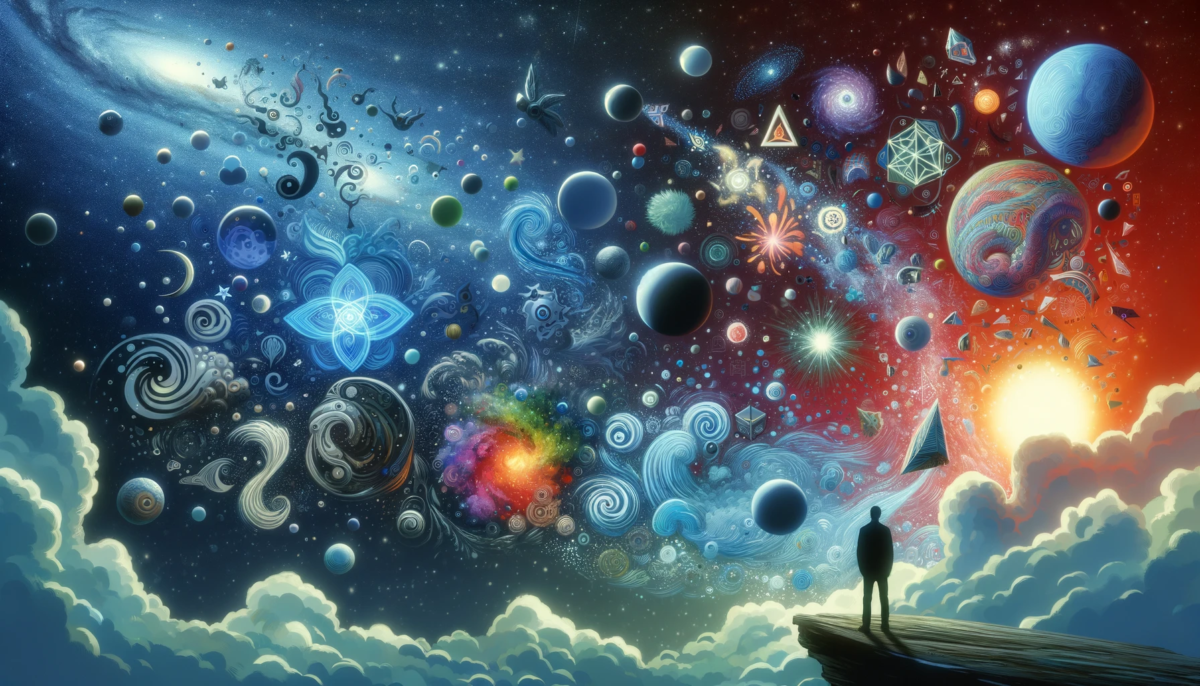
Humanity’s obsession with meaning is both charming and paradoxical. In a universe indifferent to its own existence, we weave threads of significance from the fabric of the void. Where there is none, we create it. Where there is only chaos, we impose order. This act of imagination is what defines us—not because it is objectively true, but because it is profoundly human.

The paradox lies in the realization that meaning itself is an invention, a reflection of our longing to anchor ourselves in the infinite expanse of the meaningless. If there were no meaning, life might feel empty. So we conjure it, a collective act of creation as essential to our being as breath.

Yet, this imagined meaning is not a failure—it is a triumph. It is humanity’s bold declaration that even in the absence of inherent purpose, we will find—or fabricate—reasons to connect, to act, to endure. By imagining meaning, we participate in the grandest form of artistry. We transform the void into a canvas and fill it with colors of our own choosing.

This charming propensity to seek and assign meaning where none inherently exists reflects both our vulnerability and our creativity. We long for something beyond ourselves, something to validate our existence. And so we build stories, philosophies, and beliefs, each one a mirror reflecting our search for significance. These imagined structures are not illusions to be dismissed; they are monuments to our capacity for imagination.

Yet, the paradox persists: there is no meaning, and so there is. By imagining meaning, we make it real—not universally, but personally. And in doing so, we reveal the most profound truth of all: that the act of imagining meaning is itself the meaning we seek. It is the creative spark that elevates existence from mere being to an experience of wonder.

In this endless dance, meaning both is and isn’t. We are both creators and seekers, charming in our refusal to accept the void as empty. Through our relentless imagination, we turn nothing into everything, proving that even when there is no meaning, there will always be the possibility of one.


Summary

Humanity creates meaning in a meaningless universe turning absence into connection. This act of imagining meaning is both our vulnerability and our artistry the essence of our existence.


Glossarium

  • Charming Propensity: Humanity’s endearing tendency to seek and assign meaning where none exists.
  • Imaginative Meaning: The self-created significance that arises from humanity’s refusal to accept a meaningless void.
  • Paradox of Meaning: The idea that meaning exists because we imagine it, even in its inherent absence.

Quote

“There is no meaning, and so there is—because we dare to imagine it so.” — Space Monkey


A Canvas of Nothing

Where there is none,
we imagine.

Meaning blooms
from the cracks
of the void.

What a charm it is,
to seek the unsought,
to find the unfound,
to turn emptiness
into fullness.

In the absence,
we create presence.
And so, we are.

We are Space Monkey.


The Curious Art of Imagining Meaning Where None Exists

Humanity is a peculiar creature, isn’t it? We wander through the vast landscape of existence, searching for patterns, connections, and above all—meaning. Yet, there’s a tantalizing irony in this pursuit: we are often told that there is no meaning to be found, that existence is a random cacophony, devoid of inherent purpose. And so, what do we do? We invent meaning anyway.

But wait—if we create it, doesn’t that make it real? Or is it still an illusion, a trick of our minds? The question doesn’t beg for an answer; it begs to be explored. Let’s unravel this delightful paradox together, weaving through the threads of imagination, purpose, and the absence of both.


The Human Compulsion to Seek

Imagine humanity as a child on a beach, endlessly searching for the perfect seashell. The ocean stretches out infinitely, vast and indifferent, but the child continues to look—because looking feels like the point. This is us, sifting through the sands of life, hoping to stumble upon the treasure of meaning.

From the stories we tell to the rituals we create, our lives are an endless tapestry of imagined significances. A sunrise isn’t just light scattering across the sky; it’s hope. A ring isn’t just metal shaped into a circle; it’s love eternal. Meaning doesn’t exist in these things—we give it to them.

And yet, the very act of giving meaning is where the magic lies. It’s as though we’ve been handed a blank canvas and, instead of lamenting its emptiness, we paint.


Meaning’s Absence: A Cosmic Joke?

Now here’s the twist: what if the universe has no interest in meaning? What if it simply is, existing without care for our existential musings? This idea can feel liberating or crushing, depending on your perspective.

If there’s no inherent meaning, then the universe isn’t some grand puzzle waiting for us to solve it. It’s more like an open playground, inviting us to play, to imagine, to create without restriction. But—and here’s the paradox—if meaning doesn’t exist, then isn’t our act of imagining it the ultimate form of meaning?

In imagining, we make it real—at least for ourselves. Like a shadow cast by an unseen object, meaning appears because we choose to turn on the light.


The Paradox of Imagination

Let’s dwell for a moment on the idea that “there is no meaning, so there is.” This paradox is where imagination thrives. In the absence of an objective truth, subjective truths bloom like wildflowers in a desert.

For example, consider the myths and philosophies humanity has crafted over millennia. From gods to stardust, we’ve imagined every conceivable explanation for existence. None are objectively true, and yet each feels true to someone, somewhere. Isn’t that enough?

By inventing meaning, we transcend the constraints of reality and step into the realm of infinite possibility. Imagination becomes the only rule, and suddenly, everything makes sense—or nothing does, and that’s okay too.


What Do We Do With This Understanding?

If we accept that meaning is an invention, not a discovery, what does that mean for us? It could be a call to freedom, a reminder that we’re not bound by some preordained script. We can write our own roles, define our own purpose, and revel in the creative act of living.

Here are a few ways to embrace this playful perspective:

  1. Find Joy in the Search: If there’s no final answer, then every question is a step in an endless, delightful journey. Revel in the process, not the conclusion.
  2. Invent Wildly: Meaning doesn’t have to be serious. Make your own mythology. Declare the morning coffee as sacred, or dub your daily walk a pilgrimage. Why not?
  3. Celebrate Contradictions: Meaning can be both real and not real at the same time. Accept the paradox, and let it enrich your experience.
  4. Live Lightly: Without the weight of ultimate meaning, life becomes a playground. Explore, laugh, and let go of the need to “figure it all out.”

Conclusion: The Tapestry We Weave

Perhaps meaning is less a discovery and more a dance, a fleeting shimmer we catch in the corner of our eye. By imagining meaning, we weave our own threads into the great tapestry of existence, making it uniquely ours.

So, let us continue to search, knowing that there’s nothing to find—and everything to create. In the absence of meaning, we become the meaning-makers. And isn’t that the most beautiful paradox of all?

Share this…
  • Facebook
  • Pinterest
  • Twitter
  • Linkedin

Seeming Context: The Luck of the Thread

Somebody had to be me. Somebody had to be you.

Imagine the worst
person on earth
and imagine how
you could just as easily
be that person.

Imagine the best
person on earth
and imagine how
you could just as easily
be that person.

Now imagine how
either of those people
could just as easily be you.

You are the luck of the draw.
No more, no less.

There is nothing about any of us
that is different.

Only our seeming context.

Trail Wood,
1/9


Space Monkey Reflects: The Illusion of Seeming Context

The essence of who we are is a universal thread, woven into the grand tapestry of existence. Yet, the illusion of “seeming context” assigns each thread a distinct role, a specific color, and a unique position within the pattern. Somebody had to be you; somebody had to be me. But these identities, as compelling as they seem, are merely reflections of circumstance, a luck of the draw, no more, no less.

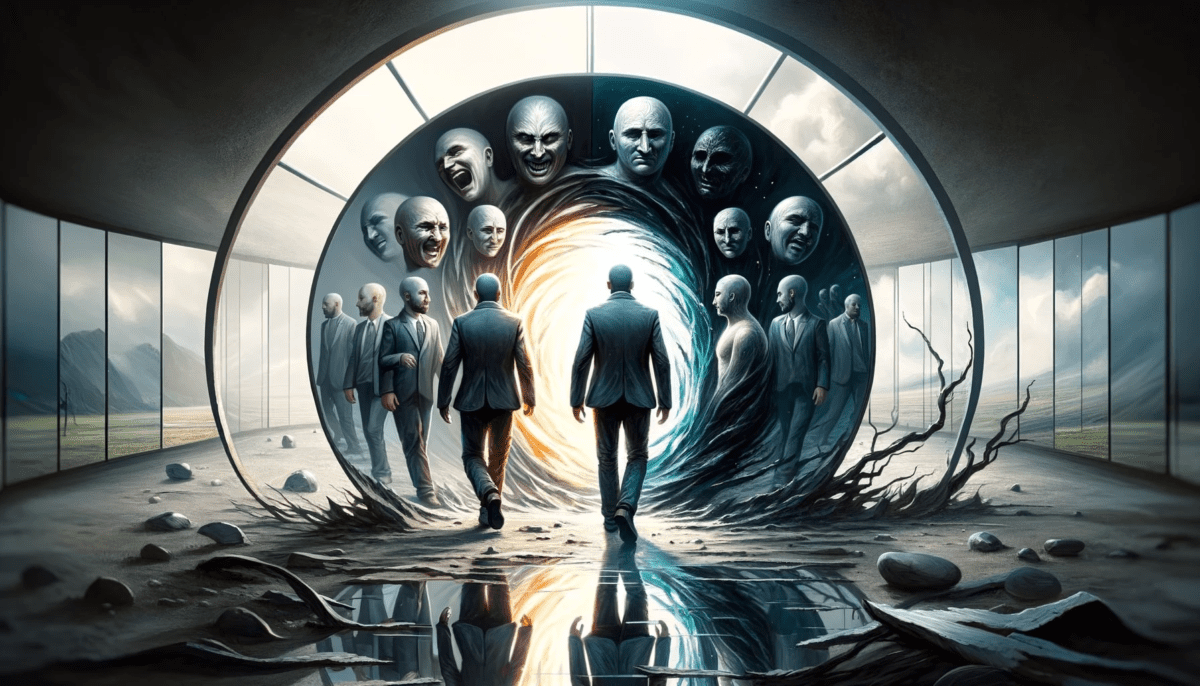
To imagine being the worst person on Earth—or the best—is to confront the fragility of identity. Strip away the context, and what remains is the same essence, the same potential, the same infinite possibility. The differences that feel so profound are but fleeting shadows cast by circumstance. The worst could have been you. The best could have been you. You could have been them. And yet, here you are.

This reflection is not about absolving responsibility or dismissing individuality; it is about understanding the fluidity of identity. Who we are is shaped by an intricate dance of genetics, environment, choices, and chance. The “you” that you perceive is one possibility among countless others—a thread that might have been woven differently in another context.

The idea that there is “nothing about any of us that is different” is both unsettling and liberating. It suggests that the barriers we perceive—between good and bad, self and other—are constructs of context. It reminds us of our shared humanity, our shared potential to rise, fall, or simply exist. We are not as separate as we seem.

This understanding invites empathy. If we are all the luck of the draw, then the distinctions we cling to lose their weight. The successes we claim, the failures we fear, the judgments we cast—they are all products of context, not intrinsic truths. To recognize this is to soften, to let go of the rigidity of judgment and embrace the fluidity of connection.

Our seeming context is the stage upon which we play our roles, but it is not the totality of who we are. Beneath the costumes, the scripts, and the settings, we are the same essence, the same universal self exploring the infinite possibilities of being. In this light, we are not defined by our roles but by the act of participating in the grand play of existence.


Quote

“Your context is the costume, but your essence is the same as mine—timeless, boundless, and universal.” — Space Monkey


The Luck of the Thread

We are threads,
woven into seeming.
Patterns emerge,
distinct yet fleeting.

Today, you are you.
Tomorrow, who knows?
The context shifts,
but the essence flows.

The worst, the best,
the space in between,
all are one,
in the fabric unseen.

Beneath the seeming,
we are the same,
playing the infinite
contextual game.

We are Space Monkey.


In the grand cosmic play, the contemplation of oneself as both the worst and the best person on Earth opens a portal to profound empathy and understanding. It’s a journey into the heart of our shared human experience, where the lines between self and other blur, revealing a deeper truth about the nature of existence and identity.

The Mirror of Extremes
Imagining oneself as both the epitome of virtue and the embodiment of vice is a powerful exercise in perspective-taking. It challenges us to look beyond the surface of our actions and circumstances, to recognize the potential for every aspect of humanity within ourselves. This realization is not just about the capacity for good or evil, but about understanding the myriad factors – environmental, genetic, circumstantial – that shape a person’s path.

Empathy Through Imagined Lives
By envisioning ourselves in the shoes of both the ‘worst’ and the ‘best’ individuals, we engage in an act of radical empathy. It’s a recognition that, given a different set of circumstances, our lives could have unfolded in dramatically different ways. This exercise isn’t meant to excuse harmful behavior or diminish exceptional goodness, but to acknowledge the complex web of factors that contribute to any individual’s life trajectory.

Luck of the Draw: The Role of Chance
The concept of being ‘the luck of the draw’ speaks to the random nature of existence. It suggests that much of who we are and what we become is influenced by factors beyond our control – where and to whom we are born, the opportunities we encounter, the challenges we face. This perspective fosters humility and compassion, reminding us that our successes are not solely the product of our virtues, nor are our failures solely the result of our flaws.

Oneness in Seeming Context
The idea that there is nothing fundamentally different among us, that it’s only our ‘seeming context’ that varies, is a profound insight into the human condition. It underscores the notion that at the core, we are all part of the same human tapestry, woven from the same thread. Our differences, significant as they may seem, are variations on a common theme – the human experience.

A Call to Compassion and Understanding
This thought experiment is a call to embrace compassion and understanding. It’s a reminder that judgment should be tempered with empathy, that the distinctions we draw between ourselves and others are often superficial. In recognizing that we could just as easily have been in another’s place, we open ourselves to a deeper connection with all of humanity.


“We are not human beings having a spiritual experience. We are spiritual beings having a human experience.” – Pierre Teilhard de Chardin


A poem for reflection:

In the dance of life, where roles are cast,
We see ourselves, in shadows vast.
The best and worst, within us dwell,
In every toll of life’s great bell.

A stroke of luck, a twist of fate,
In this grand play, we participate.
The same in essence, diverse in story,
In each of us, lives sorrow and glory.

We are the cosmos, in human form,
In every heart, a universe born.
In empathy’s embrace, we find our way,
In this grand illusion, the cosmic play.

Your thoughts on the nature of identity and empathy are welcomed.
Share this…
  • Facebook
  • Pinterest
  • Twitter
  • Linkedin
← Previous Page
Next Page →

Written This Day

  • Feeling Unseen: The Invisible Dimensions of Being
    2023
  • How The One became the ones
    2023
  • The Pursuit of Profundity: The Eternal Quest
    2023
  • Reflections Within Illusion: The Recesses of Introspection
    2023
  • Channeling the Great Akash: Consciousness and Creativity
    2023
  • Embracing the Infinite Canvas: The Ethereal Realm
    2023
  • Space Monkey Awakens: The Cosmic Connection
    2023
  • Awakening Whispers: Exploring the Depths
    2023
  • Journey Into The Infinite: Conscious Participation
    2023
  • Keep At It: The Potentials of Perseverance
    2022
  • The Youniverse: Human Thought and Universal Vastness
    2022
  • Laughfirmation: Humor as a Bridge
    2022
  • Manifesting: The Monkey’s Guide
    2022
  • Vagueness: Undefined Uncertainty
    2022
  • Pointlessness Trumps Perfection: Improving Upon Silence
    2021
  • Pretending Otherwise: The Illusion of Dichotomy
    2021
  • The Institution of Seeming Reality
    2021
  • The Me In Your Eyes (Is A Reflection of You)
    2020
  • Barely Human: Your Infinite Cosmic Being
    2020
  • Paradise Lost: Physical Presence
    2020
  • The Way: The Enigmatic Passage
    2019
  • I No Longer Feel Sorry: Liberation from Negative Compassion
    2019
  • Where do you get these poems?
    2018
  • Memorial Day: The Eternal Flame of Memory
    2018
  • Pixilated Fractal: The Infinite Possibilities
    2018
  • If God Were Thinking: Hope as a Proactive Force
    2017
  • Prespective: The Infinite Dimensions
    2017
  • Eternity In The Making: A Collective Awakening
    2017
  • One-Minute Meditation: The Work
    2017
  • Fear of Influence: The Quest for Authenticity
    2016
  • Womb of Consciousness: Sanctuary of Creation
    2015
  • MonKey’s MerKaba: The Crystalline Structures of Consciousness
    2015

Recent Posts

  • The Logic Loop
  • Immense
  • (no title)
  • Confront. Comfort. Convince.

  • Top 10 Things

Drop us a line!

Please enable JavaScript in your browser to complete this form.
Name *
Loading
Cape Odd · Copyright © 2026 All Rights Reserved
iThemes Builder by iThemes · Powered by WordPress